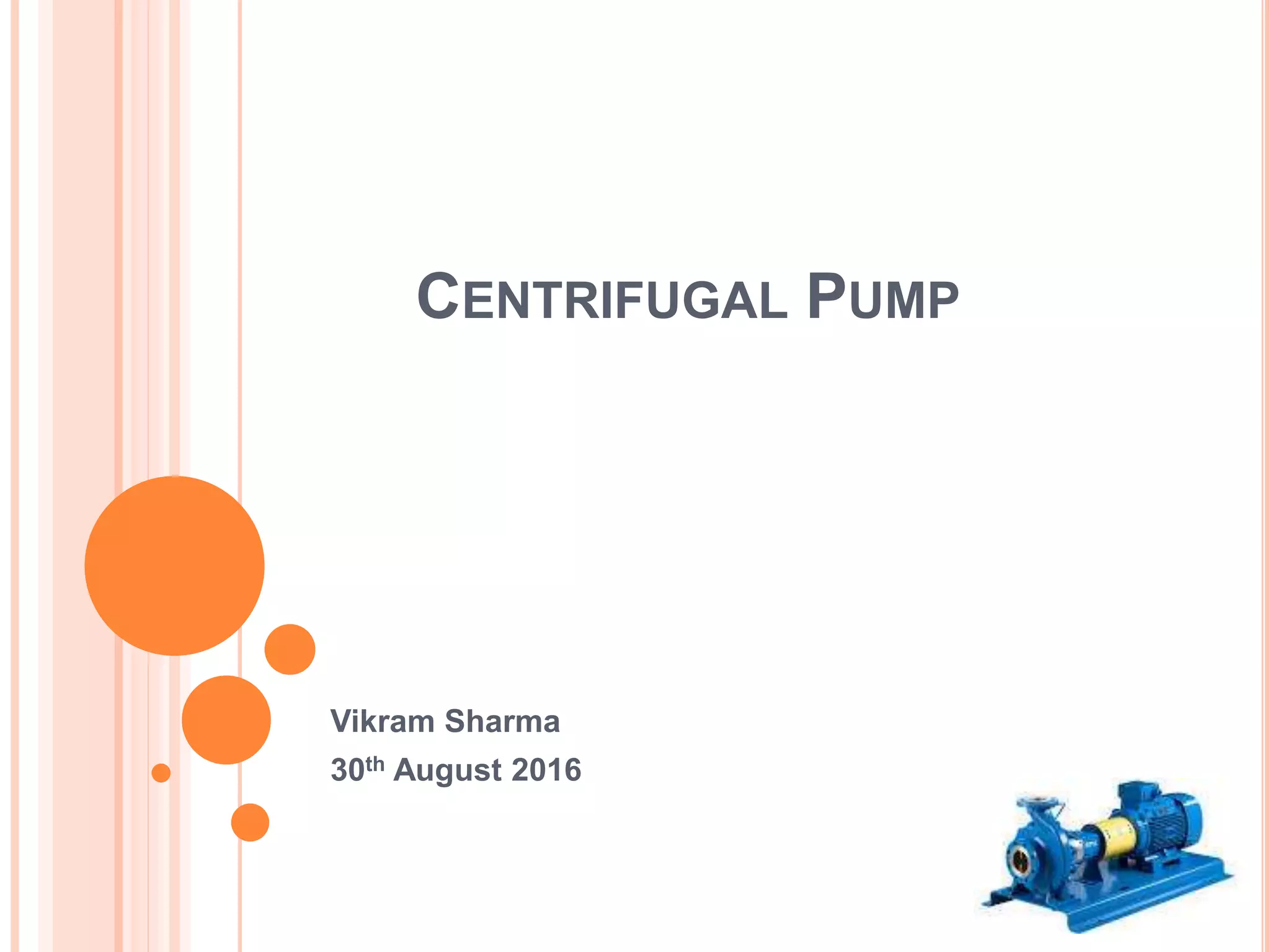
CENTRIFUGAL PUMP
Vikram Sharma
30th August 2016
TABLE OF CONTENTS
 Operating Principles
 Energy Conversion
 Components in Centrifugal Pump
 The concept of NPSH
 Pump Rating Calculation
 Affinity Laws
OPERATING PRINCIPLES
 Liquid enters the suction nozzle & later into the eye
of the impeller due to the rotation of the pump
impeller.
 Low pressure region “pulls” the liquid towards the
eye of the impeller.
 The rotation of the impeller radially pushes the
liquid → centrifugal acceleration.
 The centrifugal force & curved nature of the blade
pushes the liquid in the tangential and radial
direction.
ENERGY CONVERSION
 Convert velocity or kinetic energy into pressure
energy.
 The conversion of energy occur due to two main
parts of the pump → impeller and volute or diffuser.
 Impeller: Driver energy → kinetic energy
 Volute/Diffuser: Kinetic energy → Pressure energy.
 Resistance to flow → Kinetic energy of a liquid
coming out of an impeller is obstructed.
 Initial resistance created by pump casing, “catches”
the liquid & slows it down.
ENERGY CONVERSION (CONT’D)
 Additional resistance created when the liquid is
decelerated (discharge nozzle), Velocity energy →
Pressure energy
COMPONENTS IN CENTRIFUGAL PUMP
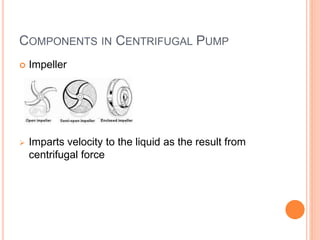
 Impeller
 Imparts velocity to the liquid as the result from
centrifugal force
COMPONENTS IN CENTRIFUGAL PUMP
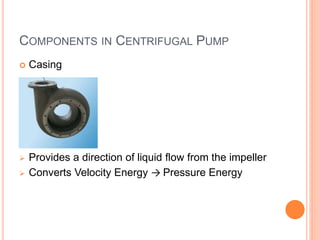
 Casing
 Provides a direction of liquid flow from the impeller
 Converts Velocity Energy → Pressure Energy
COMPONENTS IN CENTRIFUGAL PUMP
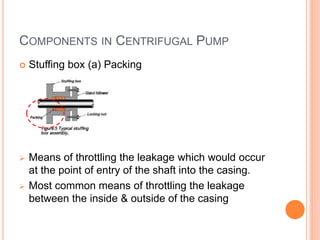
 Stuffing box (a) Packing
 Means of throttling the leakage which would occur
at the point of entry of the shaft into the casing.
 Most common means of throttling the leakage
between the inside & outside of the casing
COMPONENTS IN CENTRIFUGAL PUMP
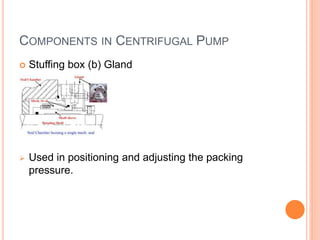
 Stuffing box (b) Gland
 Used in positioning and adjusting the packing
pressure.
COMPONENTS IN CENTRIFUGAL PUMP
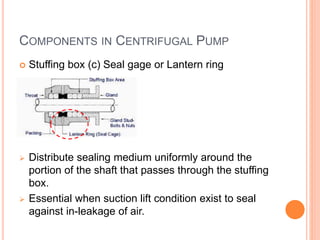
 Stuffing box (c) Seal gage or Lantern ring
 Distribute sealing medium uniformly around the
portion of the shaft that passes through the stuffing
box.
 Essential when suction lift condition exist to seal
against in-leakage of air.
COMPONENTS IN CENTRIFUGAL PUMP
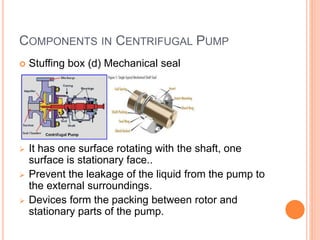
 Stuffing box (d) Mechanical seal
 It has one surface rotating with the shaft, one
surface is stationary face..
 Prevent the leakage of the liquid from the pump to
the external surroundings.
 Devices form the packing between rotor and
stationary parts of the pump.
COMPONENTS IN CENTRIFUGAL PUMP
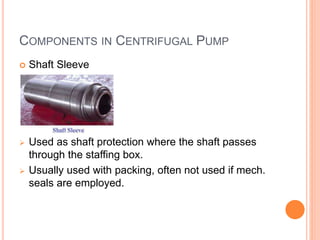
 Shaft Sleeve
 Used as shaft protection where the shaft passes
through the staffing box.
 Usually used with packing, often not used if mech.
seals are employed.
COMPONENTS IN CENTRIFUGAL PUMP
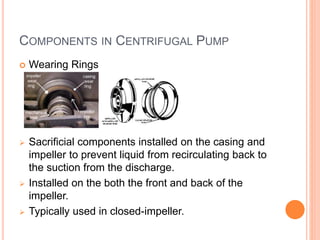
 Wearing Rings
 Sacrificial components installed on the casing and
impeller to prevent liquid from recirculating back to
the suction from the discharge.
 Installed on the both the front and back of the
impeller.
 Typically used in closed-impeller.
COMPONENTS IN CENTRIFUGAL PUMP
 Wearing Plates
 Performs the same function as wearing rings.
 Typically used in open or semi-open impellers.
COMPONENTS IN CENTRIFUGAL PUMP
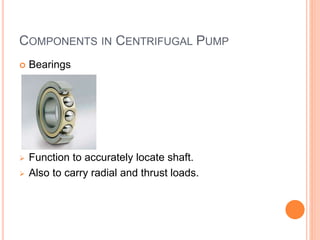
 Bearings
 Function to accurately locate shaft.
 Also to carry radial and thrust loads.
COMPONENTS IN CENTRIFUGAL PUMP
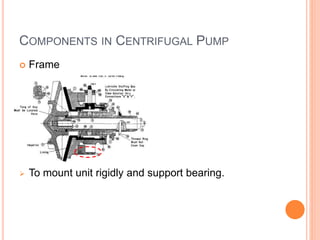
 Frame
 To mount unit rigidly and support bearing.
COMPONENTS IN CENTRIFUGAL PUMP
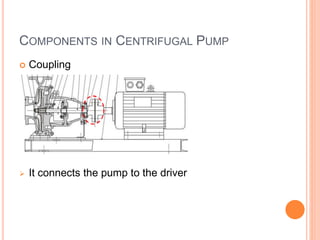
 Coupling
 It connects the pump to the driver
THE CONCEPT OF NPSH
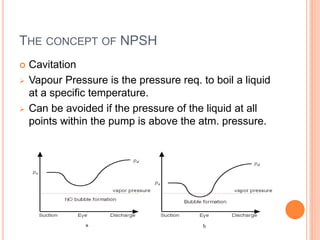
 Cavitation
 Vapour Pressure is the pressure req. to boil a liquid
at a specific temperature.
 Can be avoided if the pressure of the liquid at all
points within the pump is above the atm. pressure.
THE CONCEPT OF NPSH
 Two NPSH parameters, i) available and ii) required.
 NPSHA: Difference between the pressure at the
suction of the pump & the saturation pressure of the
liquid being pumped.
 NPSHR: Min. net positive suction head req. to
avoid cavitation.
 NPSHA ≥ NPSHR
 General requirement: NPSHA is at least 2.0m of
liquid greater than the pump manufacturer requires
under the worst pump operating conditions.
PUMP RATING CALCULATION
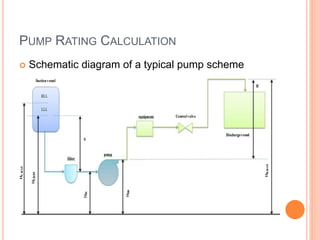
 Schematic diagram of a typical pump scheme
PUMP RATING CALCULATION
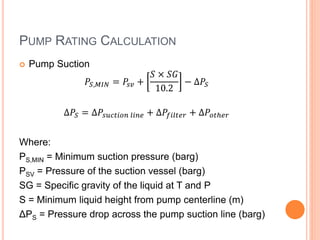
 Pump Suction
𝑃𝑆,𝑀𝐼𝑁 = 𝑃𝑠𝑣 +
𝑆 × 𝑆𝐺
10.2
− ∆𝑃𝑆
∆𝑃𝑆 = ∆𝑃𝑠𝑢𝑐𝑡𝑖𝑜𝑛 𝑙𝑖𝑛𝑒 + ∆𝑃𝑓𝑖𝑙𝑡𝑒𝑟 + ∆𝑃𝑜𝑡ℎ𝑒𝑟
Where:
PS,MIN = Minimum suction pressure (barg)
PSV = Pressure of the suction vessel (barg)
SG = Specific gravity of the liquid at T and P
S = Minimum liquid height from pump centerline (m)
ΔPS = Pressure drop across the pump suction line (barg)
PUMP RATING CALCULATION
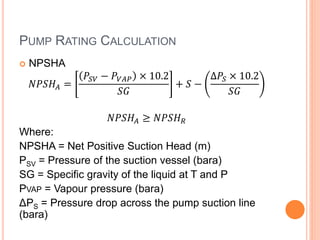
 NPSHA
𝑁𝑃𝑆𝐻𝐴 =
𝑃𝑆𝑉 − 𝑃𝑉𝐴𝑃 × 10.2
𝑆𝐺
+ 𝑆 −
∆𝑃𝑆 × 10.2
𝑆𝐺
𝑁𝑃𝑆𝐻𝐴 ≥ 𝑁𝑃𝑆𝐻 𝑅
Where:
NPSHA = Net Positive Suction Head (m)
PSV = Pressure of the suction vessel (bara)
SG = Specific gravity of the liquid at T and P
PVAP = Vapour pressure (bara)
ΔPS = Pressure drop across the pump suction line
(bara)
PUMP RATING CALCULATION
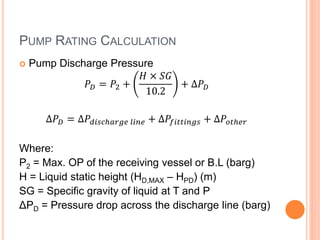
 Pump Discharge Pressure
𝑃 𝐷 = 𝑃2 +
𝐻 × 𝑆𝐺
10.2
+ ∆𝑃 𝐷
∆𝑃 𝐷 = ∆𝑃𝑑𝑖𝑠𝑐ℎ𝑎𝑟𝑔𝑒 𝑙𝑖𝑛𝑒 + ∆𝑃𝑓𝑖𝑡𝑡𝑖𝑛𝑔𝑠 + ∆𝑃𝑜𝑡ℎ𝑒𝑟
Where:
P2 = Max. OP of the receiving vessel or B.L (barg)
H = Liquid static height (HD,MAX – HPD) (m)
SG = Specific gravity of liquid at T and P
ΔPD = Pressure drop across the discharge line (barg)
PUMP RATING CALCULATION
 Differential Height (DH)
𝐷𝐻 =
𝑃 𝐷 − 𝑃𝑆,𝑀𝐼𝑁 × 10.2
𝑆𝐺
Where:
PD = Pump discharge pressure in barg
PS,MIN = Minimum pump suction pressure in barg
PUMP RATING CALCULATION
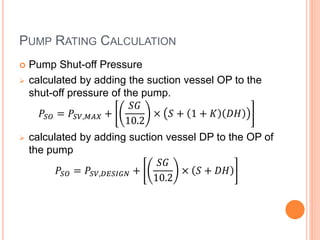
 Pump Shut-off Pressure
 calculated by adding the suction vessel OP to the
shut-off pressure of the pump.
𝑃𝑆𝑂 = 𝑃𝑆𝑉,𝑀𝐴𝑋 +
𝑆𝐺
10.2
× 𝑆 + 1 + 𝐾 𝐷𝐻
 calculated by adding suction vessel DP to the OP of
the pump
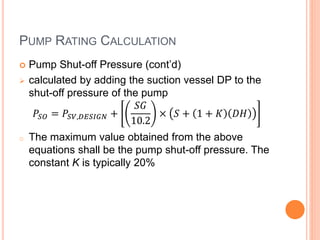
𝑃𝑆𝑂 = 𝑃𝑆𝑉,𝐷𝐸𝑆𝐼𝐺𝑁 +
𝑆𝐺
10.2
× 𝑆 + 𝐷𝐻
PUMP RATING CALCULATION
 Pump Shut-off Pressure (cont’d)
 calculated by adding the suction vessel DP to the
shut-off pressure of the pump
𝑃𝑆𝑂 = 𝑃𝑆𝑉,𝐷𝐸𝑆𝐼𝐺𝑁 +
𝑆𝐺
10.2
× 𝑆 + 1 + 𝐾 𝐷𝐻
o The maximum value obtained from the above
equations shall be the pump shut-off pressure. The
constant K is typically 20%
PUMP RATING CALCULATION
 Power Estimation
 Hydraulic Power / Absorbed Power
Defined as the energy applied on the liquid being
pumped to increase its velocity and pressure
𝑃ℎ𝑦,𝑘𝑊 =
𝑄 × 𝑃 𝐷 × 100 − 𝑃𝑆,𝑀𝐼𝑁 × 100
3600
Where:
Phy,kW = Hydraulic power (kW)
Q = Volumetric flowrate (m3/h)
PD = Pump discharge pressure (barg)
PS,MIN = Min. pump suction pressure (barg)
PUMP RATING CALCULATION
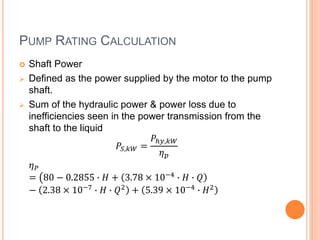
 Shaft Power
 Defined as the power supplied by the motor to the pump
shaft.
 Sum of the hydraulic power & power loss due to
inefficiencies seen in the power transmission from the
shaft to the liquid
𝑃𝑆,𝑘𝑊 =
𝑃ℎ𝑦,𝑘𝑊
𝜂 𝑝
𝜂 𝑃
= 80 − 0.2855 ∙ 𝐻 + 3.78 × 10⁻⁴ ∙ 𝐻 ∙ 𝑄
− 2.38 × 10⁻⁷
∙ 𝐻 ∙ 𝑄2
+ 5.39 × 10⁻⁴
∙ 𝐻2
PUMP RATING CALCULATION
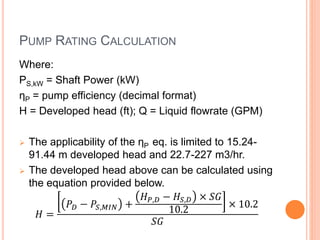
Where:
PS,kW = Shaft Power (kW)
ηP = pump efficiency (decimal format)
H = Developed head (ft); Q = Liquid flowrate (GPM)
 The applicability of the ηP eq. is limited to 15.24-
91.44 m developed head and 22.7-227 m3/hr.
 The developed head above can be calculated using
the equation provided below.
𝐻 =
𝑃 𝐷 − 𝑃𝑆,𝑀𝐼𝑁 +
𝐻 𝑃,𝐷 − 𝐻𝑆,𝐷 × 𝑆𝐺
10.2
× 10.2
𝑆𝐺
PUMP RATING CALCULATION
 The developed head calculated is converted to feet.
PUMP RATING CALCULATION
 Motor Power
 Power consumed by the pump motor that rotates
the pump shaft.
 Combination of the shaft power & inefficiencies in
converting electric energy into kinetic energy
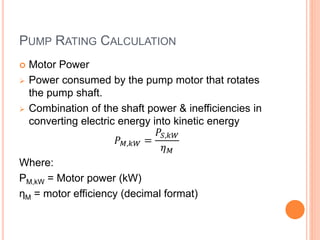
𝑃 𝑀,𝑘𝑊 =
𝑃𝑆,𝑘𝑊
𝜂 𝑀
Where:
PM,kW = Motor power (kW)
ηM = motor efficiency (decimal format)
PUMP RATING CALCULATION
 Temp. rise due to pumping
 Temp. rise due to pump inefficiency
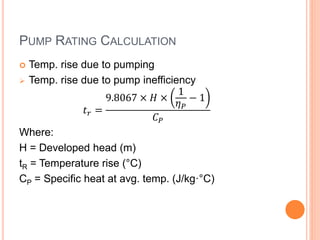
𝑡 𝑟 =
9.8067 × 𝐻 ×
1
𝜂 𝑃
− 1
𝐶 𝑃
Where:
H = Developed head (m)
tR = Temperature rise (°C)
CP = Specific heat at avg. temp. (J/kg·°C)
AFFINITY LAWS
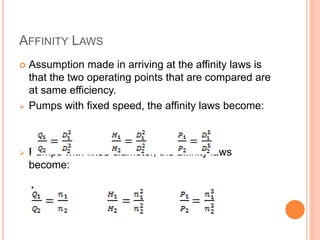
 Assumption made in arriving at the affinity laws is
that the two operating points that are compared are
at same efficiency.
 Pumps with fixed speed, the affinity laws become:
 Pumps with fixed diameter, the affinity laws
become:

Basics of Centrifugal Pump

  • 1.
  • 2.
    TABLE OF CONTENTS Operating Principles  Energy Conversion  Components in Centrifugal Pump  The concept of NPSH  Pump Rating Calculation  Affinity Laws
  • 3.
    OPERATING PRINCIPLES  Liquidenters the suction nozzle & later into the eye of the impeller due to the rotation of the pump impeller.  Low pressure region “pulls” the liquid towards the eye of the impeller.  The rotation of the impeller radially pushes the liquid → centrifugal acceleration.  The centrifugal force & curved nature of the blade pushes the liquid in the tangential and radial direction.
  • 4.
    ENERGY CONVERSION  Convertvelocity or kinetic energy into pressure energy.  The conversion of energy occur due to two main parts of the pump → impeller and volute or diffuser.  Impeller: Driver energy → kinetic energy  Volute/Diffuser: Kinetic energy → Pressure energy.  Resistance to flow → Kinetic energy of a liquid coming out of an impeller is obstructed.  Initial resistance created by pump casing, “catches” the liquid & slows it down.
  • 5.
    ENERGY CONVERSION (CONT’D) Additional resistance created when the liquid is decelerated (discharge nozzle), Velocity energy → Pressure energy
  • 6.
    COMPONENTS IN CENTRIFUGALPUMP  Impeller  Imparts velocity to the liquid as the result from centrifugal force
  • 7.
    COMPONENTS IN CENTRIFUGALPUMP  Casing  Provides a direction of liquid flow from the impeller  Converts Velocity Energy → Pressure Energy
  • 8.
    COMPONENTS IN CENTRIFUGALPUMP  Stuffing box (a) Packing  Means of throttling the leakage which would occur at the point of entry of the shaft into the casing.  Most common means of throttling the leakage between the inside & outside of the casing
  • 9.
    COMPONENTS IN CENTRIFUGALPUMP  Stuffing box (b) Gland  Used in positioning and adjusting the packing pressure.
  • 10.
    COMPONENTS IN CENTRIFUGALPUMP  Stuffing box (c) Seal gage or Lantern ring  Distribute sealing medium uniformly around the portion of the shaft that passes through the stuffing box.  Essential when suction lift condition exist to seal against in-leakage of air.
  • 11.
    COMPONENTS IN CENTRIFUGALPUMP  Stuffing box (d) Mechanical seal  It has one surface rotating with the shaft, one surface is stationary face..  Prevent the leakage of the liquid from the pump to the external surroundings.  Devices form the packing between rotor and stationary parts of the pump.
  • 12.
    COMPONENTS IN CENTRIFUGALPUMP  Shaft Sleeve  Used as shaft protection where the shaft passes through the staffing box.  Usually used with packing, often not used if mech. seals are employed.
  • 13.
    COMPONENTS IN CENTRIFUGALPUMP  Wearing Rings  Sacrificial components installed on the casing and impeller to prevent liquid from recirculating back to the suction from the discharge.  Installed on the both the front and back of the impeller.  Typically used in closed-impeller.
  • 14.
    COMPONENTS IN CENTRIFUGALPUMP  Wearing Plates  Performs the same function as wearing rings.  Typically used in open or semi-open impellers.
  • 15.
    COMPONENTS IN CENTRIFUGALPUMP  Bearings  Function to accurately locate shaft.  Also to carry radial and thrust loads.
  • 16.
    COMPONENTS IN CENTRIFUGALPUMP  Frame  To mount unit rigidly and support bearing.
  • 17.
    COMPONENTS IN CENTRIFUGALPUMP  Coupling  It connects the pump to the driver
  • 18.
    THE CONCEPT OFNPSH  Cavitation  Vapour Pressure is the pressure req. to boil a liquid at a specific temperature.  Can be avoided if the pressure of the liquid at all points within the pump is above the atm. pressure.
  • 19.
    THE CONCEPT OFNPSH  Two NPSH parameters, i) available and ii) required.  NPSHA: Difference between the pressure at the suction of the pump & the saturation pressure of the liquid being pumped.  NPSHR: Min. net positive suction head req. to avoid cavitation.  NPSHA ≥ NPSHR  General requirement: NPSHA is at least 2.0m of liquid greater than the pump manufacturer requires under the worst pump operating conditions.
  • 20.
    PUMP RATING CALCULATION Schematic diagram of a typical pump scheme
  • 21.
    PUMP RATING CALCULATION Pump Suction 𝑃𝑆,𝑀𝐼𝑁 = 𝑃𝑠𝑣 + 𝑆 × 𝑆𝐺 10.2 − ∆𝑃𝑆 ∆𝑃𝑆 = ∆𝑃𝑠𝑢𝑐𝑡𝑖𝑜𝑛 𝑙𝑖𝑛𝑒 + ∆𝑃𝑓𝑖𝑙𝑡𝑒𝑟 + ∆𝑃𝑜𝑡ℎ𝑒𝑟 Where: PS,MIN = Minimum suction pressure (barg) PSV = Pressure of the suction vessel (barg) SG = Specific gravity of the liquid at T and P S = Minimum liquid height from pump centerline (m) ΔPS = Pressure drop across the pump suction line (barg)
  • 22.
    PUMP RATING CALCULATION NPSHA 𝑁𝑃𝑆𝐻𝐴 = 𝑃𝑆𝑉 − 𝑃𝑉𝐴𝑃 × 10.2 𝑆𝐺 + 𝑆 − ∆𝑃𝑆 × 10.2 𝑆𝐺 𝑁𝑃𝑆𝐻𝐴 ≥ 𝑁𝑃𝑆𝐻 𝑅 Where: NPSHA = Net Positive Suction Head (m) PSV = Pressure of the suction vessel (bara) SG = Specific gravity of the liquid at T and P PVAP = Vapour pressure (bara) ΔPS = Pressure drop across the pump suction line (bara)
  • 23.
    PUMP RATING CALCULATION Pump Discharge Pressure 𝑃 𝐷 = 𝑃2 + 𝐻 × 𝑆𝐺 10.2 + ∆𝑃 𝐷 ∆𝑃 𝐷 = ∆𝑃𝑑𝑖𝑠𝑐ℎ𝑎𝑟𝑔𝑒 𝑙𝑖𝑛𝑒 + ∆𝑃𝑓𝑖𝑡𝑡𝑖𝑛𝑔𝑠 + ∆𝑃𝑜𝑡ℎ𝑒𝑟 Where: P2 = Max. OP of the receiving vessel or B.L (barg) H = Liquid static height (HD,MAX – HPD) (m) SG = Specific gravity of liquid at T and P ΔPD = Pressure drop across the discharge line (barg)
  • 24.
    PUMP RATING CALCULATION Differential Height (DH) 𝐷𝐻 = 𝑃 𝐷 − 𝑃𝑆,𝑀𝐼𝑁 × 10.2 𝑆𝐺 Where: PD = Pump discharge pressure in barg PS,MIN = Minimum pump suction pressure in barg
  • 25.
    PUMP RATING CALCULATION Pump Shut-off Pressure  calculated by adding the suction vessel OP to the shut-off pressure of the pump. 𝑃𝑆𝑂 = 𝑃𝑆𝑉,𝑀𝐴𝑋 + 𝑆𝐺 10.2 × 𝑆 + 1 + 𝐾 𝐷𝐻  calculated by adding suction vessel DP to the OP of the pump 𝑃𝑆𝑂 = 𝑃𝑆𝑉,𝐷𝐸𝑆𝐼𝐺𝑁 + 𝑆𝐺 10.2 × 𝑆 + 𝐷𝐻
  • 26.
    PUMP RATING CALCULATION Pump Shut-off Pressure (cont’d)  calculated by adding the suction vessel DP to the shut-off pressure of the pump 𝑃𝑆𝑂 = 𝑃𝑆𝑉,𝐷𝐸𝑆𝐼𝐺𝑁 + 𝑆𝐺 10.2 × 𝑆 + 1 + 𝐾 𝐷𝐻 o The maximum value obtained from the above equations shall be the pump shut-off pressure. The constant K is typically 20%
  • 27.
    PUMP RATING CALCULATION Power Estimation  Hydraulic Power / Absorbed Power Defined as the energy applied on the liquid being pumped to increase its velocity and pressure 𝑃ℎ𝑦,𝑘𝑊 = 𝑄 × 𝑃 𝐷 × 100 − 𝑃𝑆,𝑀𝐼𝑁 × 100 3600 Where: Phy,kW = Hydraulic power (kW) Q = Volumetric flowrate (m3/h) PD = Pump discharge pressure (barg) PS,MIN = Min. pump suction pressure (barg)
  • 28.
    PUMP RATING CALCULATION Shaft Power  Defined as the power supplied by the motor to the pump shaft.  Sum of the hydraulic power & power loss due to inefficiencies seen in the power transmission from the shaft to the liquid 𝑃𝑆,𝑘𝑊 = 𝑃ℎ𝑦,𝑘𝑊 𝜂 𝑝 𝜂 𝑃 = 80 − 0.2855 ∙ 𝐻 + 3.78 × 10⁻⁴ ∙ 𝐻 ∙ 𝑄 − 2.38 × 10⁻⁷ ∙ 𝐻 ∙ 𝑄2 + 5.39 × 10⁻⁴ ∙ 𝐻2
  • 29.
    PUMP RATING CALCULATION Where: PS,kW= Shaft Power (kW) ηP = pump efficiency (decimal format) H = Developed head (ft); Q = Liquid flowrate (GPM)  The applicability of the ηP eq. is limited to 15.24- 91.44 m developed head and 22.7-227 m3/hr.  The developed head above can be calculated using the equation provided below. 𝐻 = 𝑃 𝐷 − 𝑃𝑆,𝑀𝐼𝑁 + 𝐻 𝑃,𝐷 − 𝐻𝑆,𝐷 × 𝑆𝐺 10.2 × 10.2 𝑆𝐺
  • 30.
    PUMP RATING CALCULATION The developed head calculated is converted to feet.
  • 31.
    PUMP RATING CALCULATION Motor Power  Power consumed by the pump motor that rotates the pump shaft.  Combination of the shaft power & inefficiencies in converting electric energy into kinetic energy 𝑃 𝑀,𝑘𝑊 = 𝑃𝑆,𝑘𝑊 𝜂 𝑀 Where: PM,kW = Motor power (kW) ηM = motor efficiency (decimal format)
  • 32.
    PUMP RATING CALCULATION Temp. rise due to pumping  Temp. rise due to pump inefficiency 𝑡 𝑟 = 9.8067 × 𝐻 × 1 𝜂 𝑃 − 1 𝐶 𝑃 Where: H = Developed head (m) tR = Temperature rise (°C) CP = Specific heat at avg. temp. (J/kg·°C)
  • 33.
    AFFINITY LAWS  Assumptionmade in arriving at the affinity laws is that the two operating points that are compared are at same efficiency.  Pumps with fixed speed, the affinity laws become:  Pumps with fixed diameter, the affinity laws become:

Editor's Notes

  • #12 http://www.brighthubengineering.com/machine-design/66250-mechanical-seals-for-the-centrifugal-pumps/