Author: Vikram Sharma
Date: 20th February 2017
 What is a S&T HEX?
 Fluid flow in HEX – counter vs. co-current
 Fluid allocation in S&T Heat Exchanger
 Thermal design principles
◦ Overall duty determination
◦ Initial heat transfer area (Ao)
◦ Tube pitch, tube size, tube length & shell diam.
◦ Calc. tube-side heat transfer coeff. (hi)
◦ Calc. shell-side heat transfer coeff. (hs)
◦ Calc. overall heat transfer coeff. (Uo)
◦ Calc. tube-side pressure drop (ΔPT)
◦ Calc. shell-side pressure drop (ΔPS)
 Summary
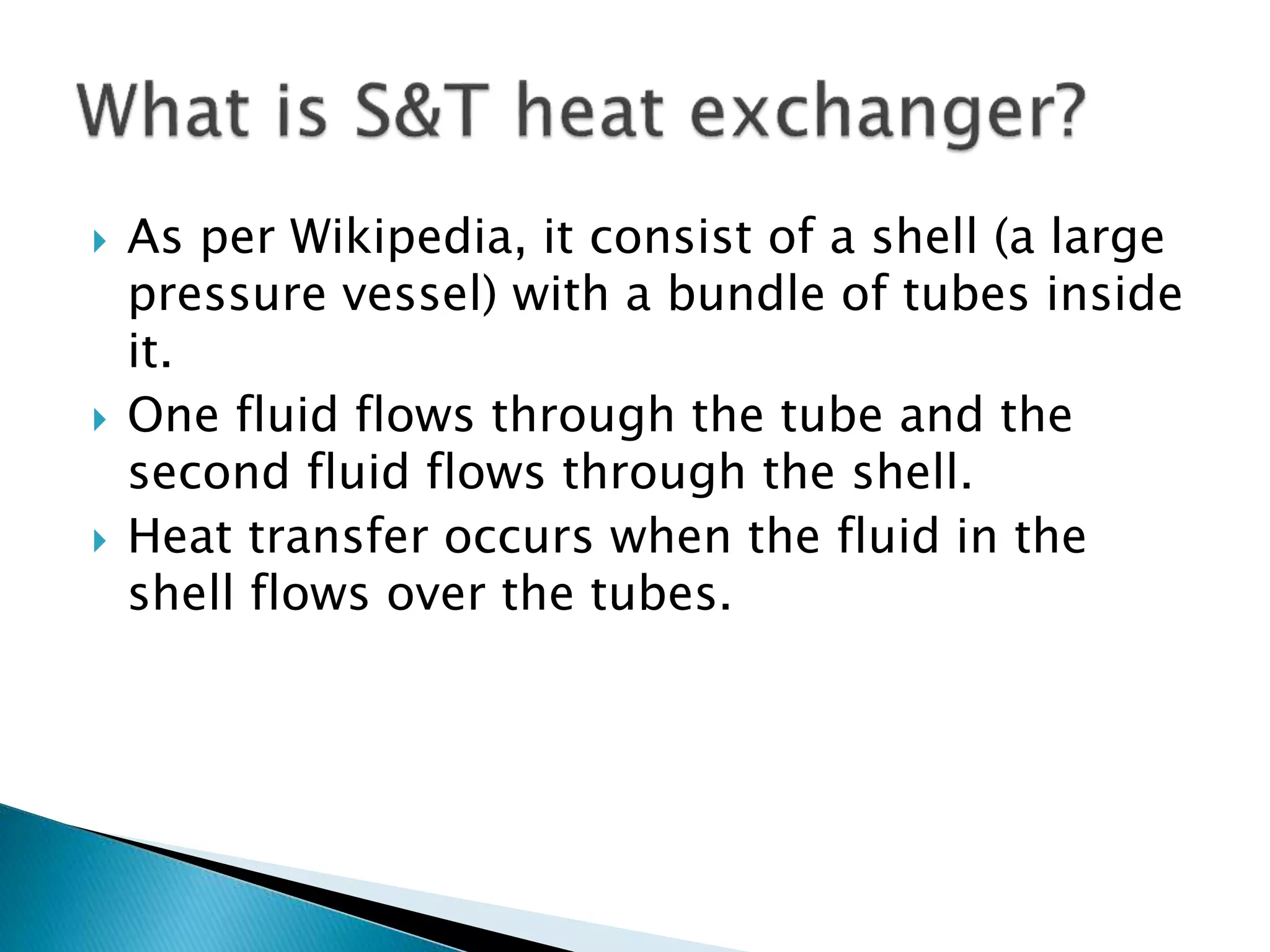
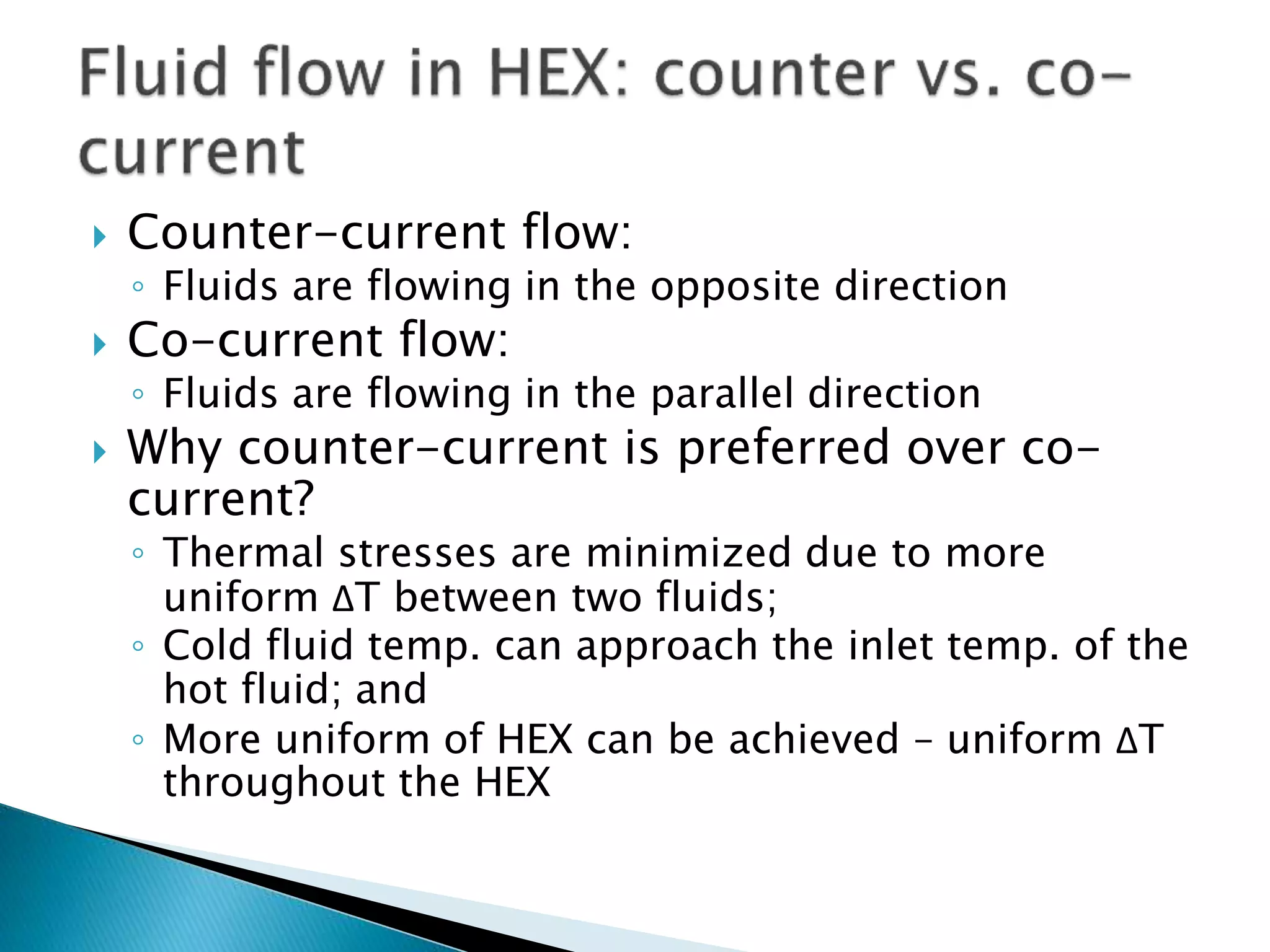
 As per Wikipedia, it consist of a shell (a large
pressure vessel) with a bundle of tubes inside
it.
 One fluid flows through the tube and the
second fluid flows through the shell.
 Heat transfer occurs when the fluid in the
shell flows over the tubes.
 Counter-current flow:
◦ Fluids are flowing in the opposite direction
 Co-current flow:
◦ Fluids are flowing in the parallel direction
 Why counter-current is preferred over co-
current?
◦ Thermal stresses are minimized due to more
uniform ΔT between two fluids;
◦ Cold fluid temp. can approach the inlet temp. of the
hot fluid; and
◦ More uniform of HEX can be achieved – uniform ΔT
throughout the HEX
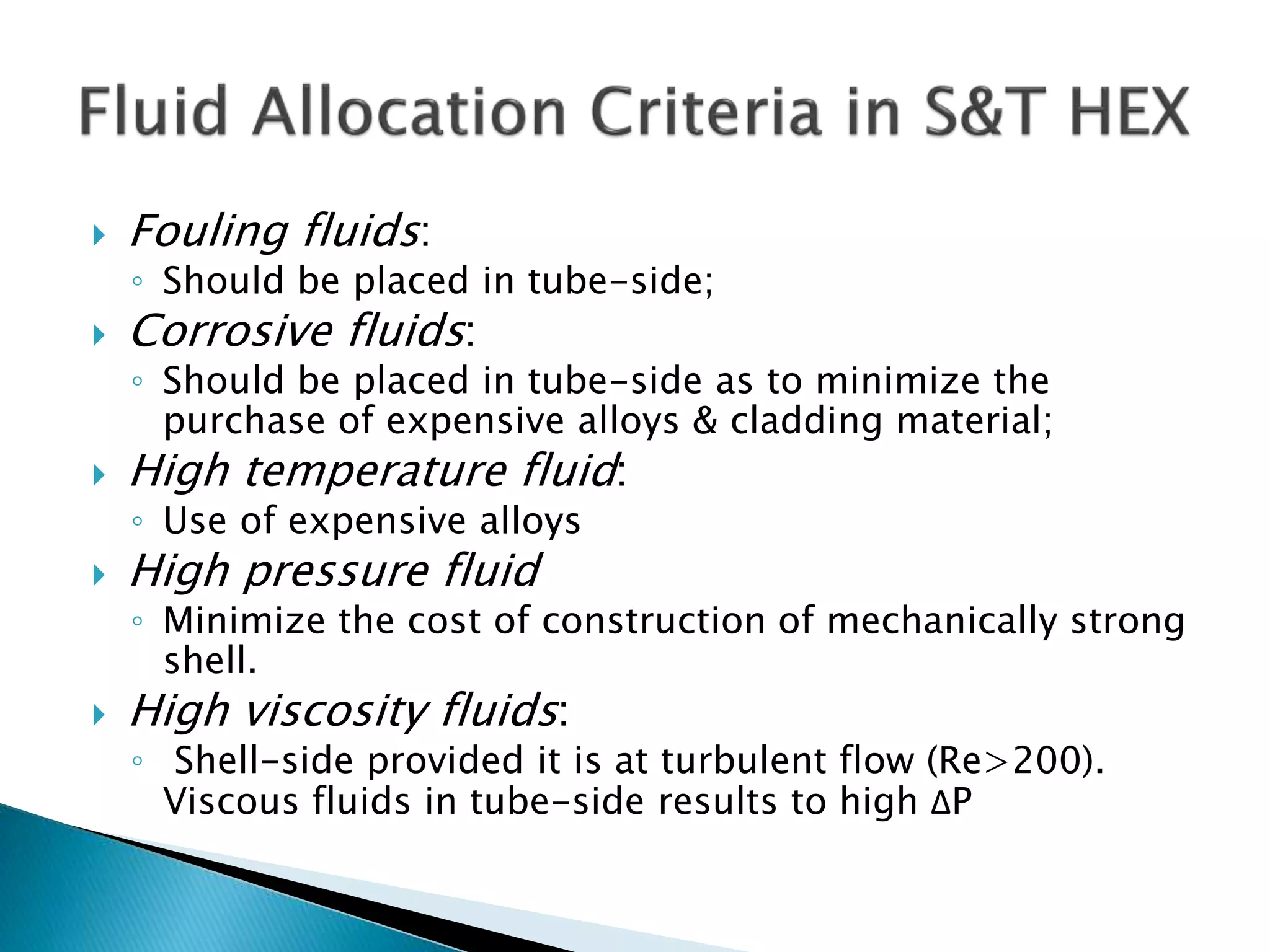
 Fouling fluids:
◦ Should be placed in tube-side;
 Corrosive fluids:
◦ Should be placed in tube-side as to minimize the
purchase of expensive alloys & cladding material;
 High temperature fluid:
◦ Use of expensive alloys
 High pressure fluid
◦ Minimize the cost of construction of mechanically strong
shell.
 High viscosity fluids:
◦ Shell-side provided it is at turbulent flow (Re>200).
Viscous fluids in tube-side results to high ΔP
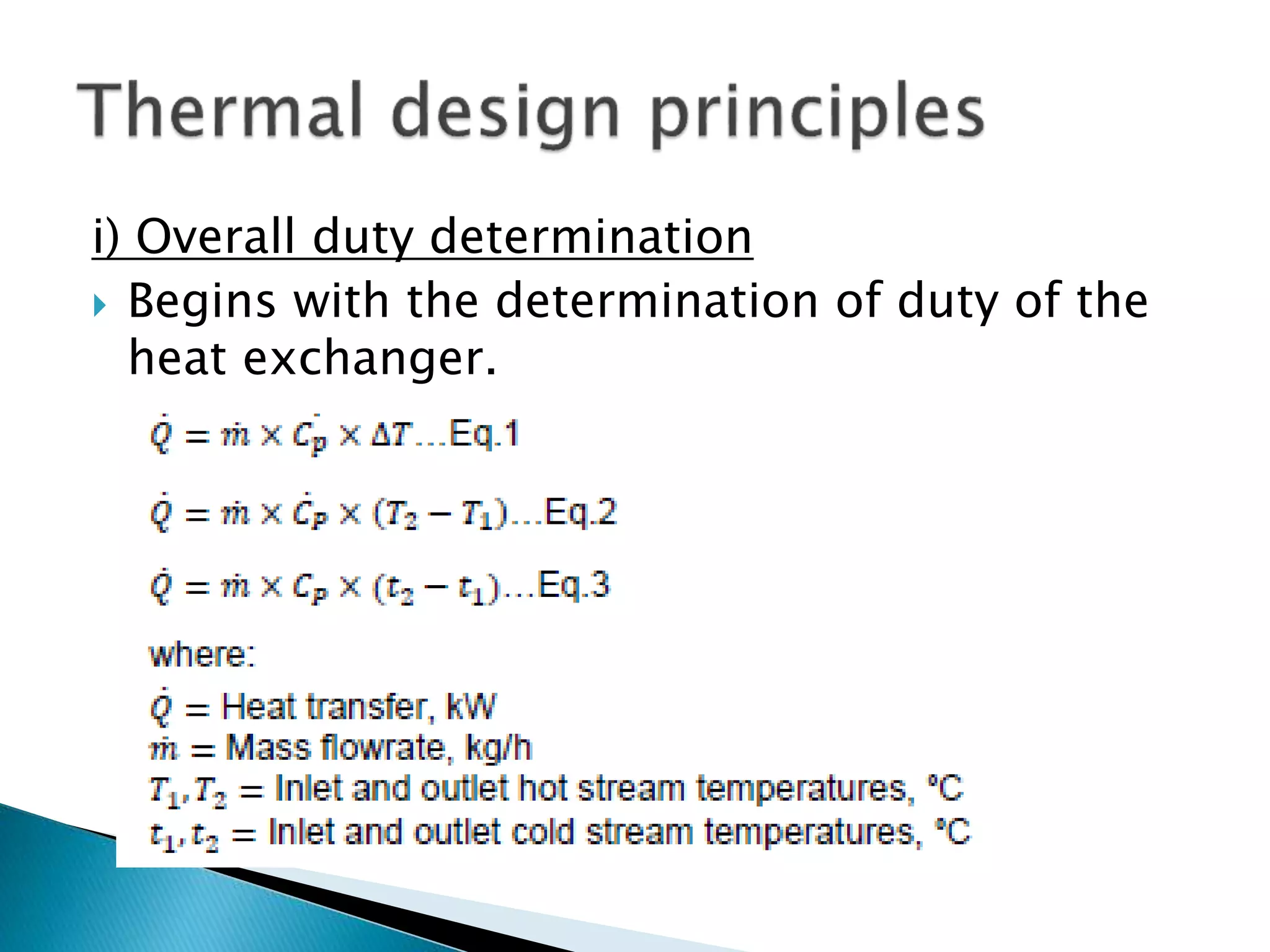
i) Overall duty determination
 Begins with the determination of duty of the
heat exchanger.
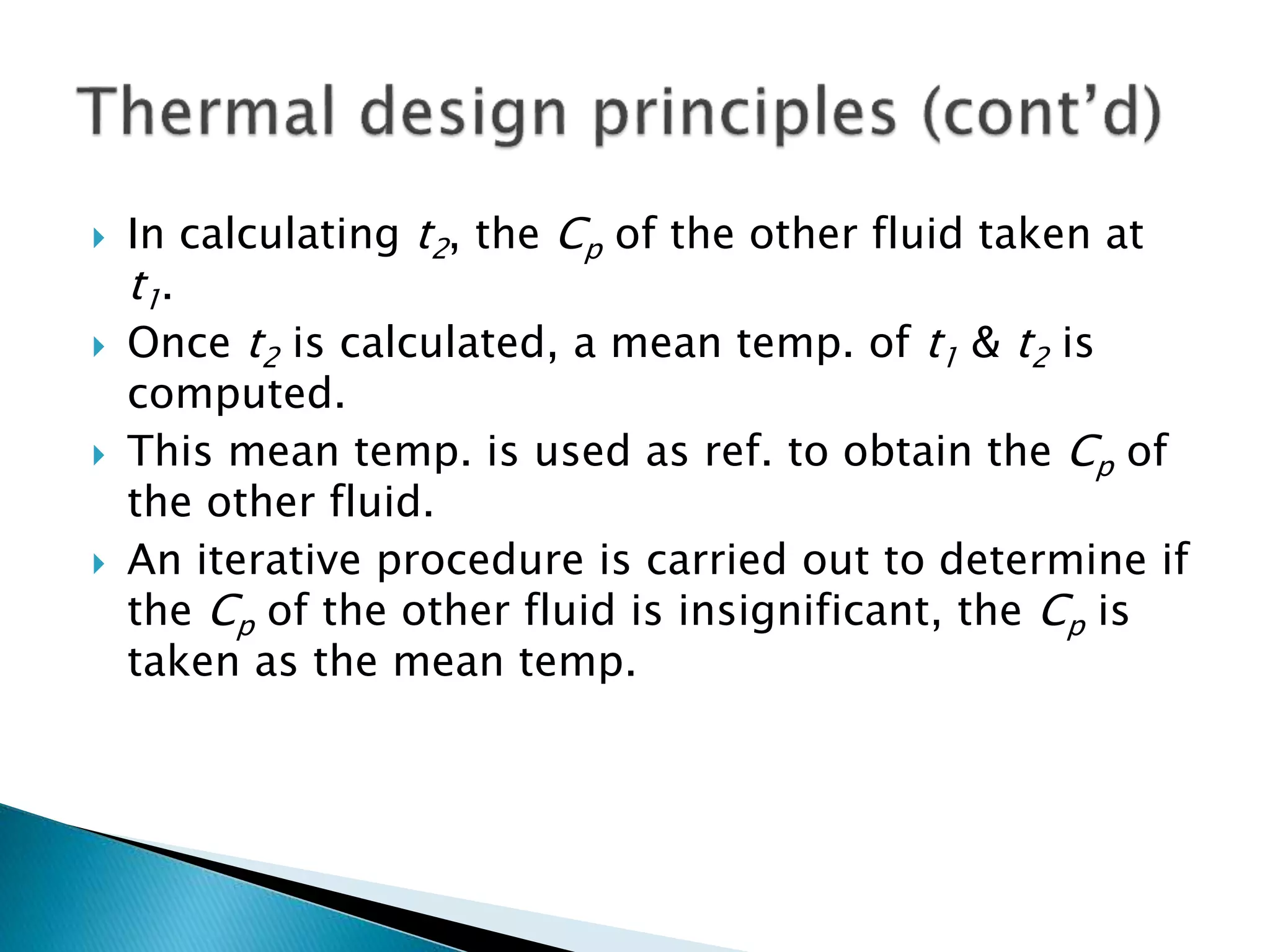
 In calculating t2, the Cp of the other fluid taken at
t1.
 Once t2 is calculated, a mean temp. of t1 & t2 is
computed.
 This mean temp. is used as ref. to obtain the Cp of
the other fluid.
 An iterative procedure is carried out to determine if
the Cp of the other fluid is insignificant, the Cp is
taken as the mean temp.
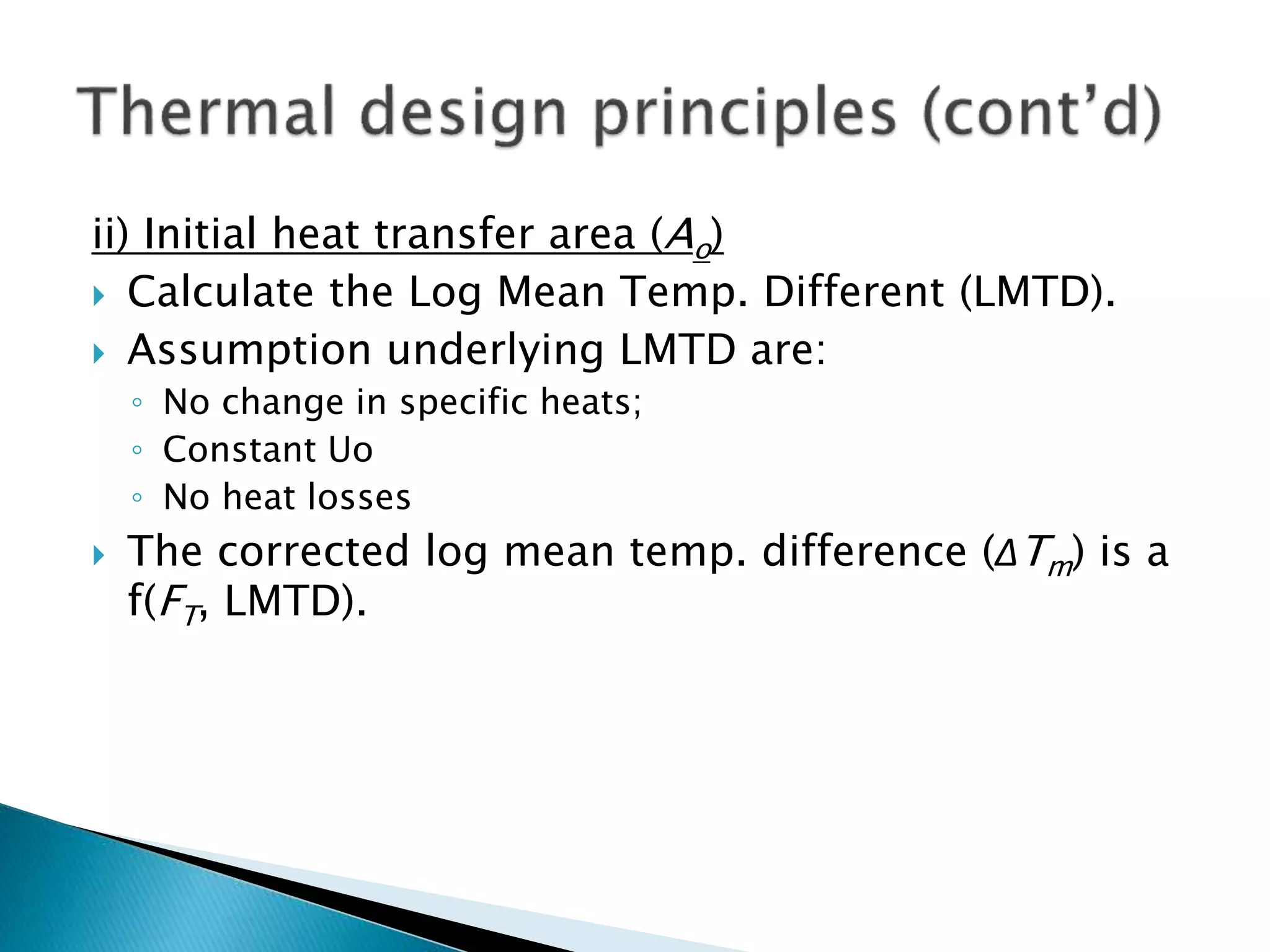
ii) Initial heat transfer area (Ao)
 Calculate the Log Mean Temp. Different (LMTD).
 Assumption underlying LMTD are:
◦ No change in specific heats;
◦ Constant Uo
◦ No heat losses
 The corrected log mean temp. difference (ΔTm) is a
f(FT, LMTD).
ii) Initial heat transfer area (Ao) (cont’d)
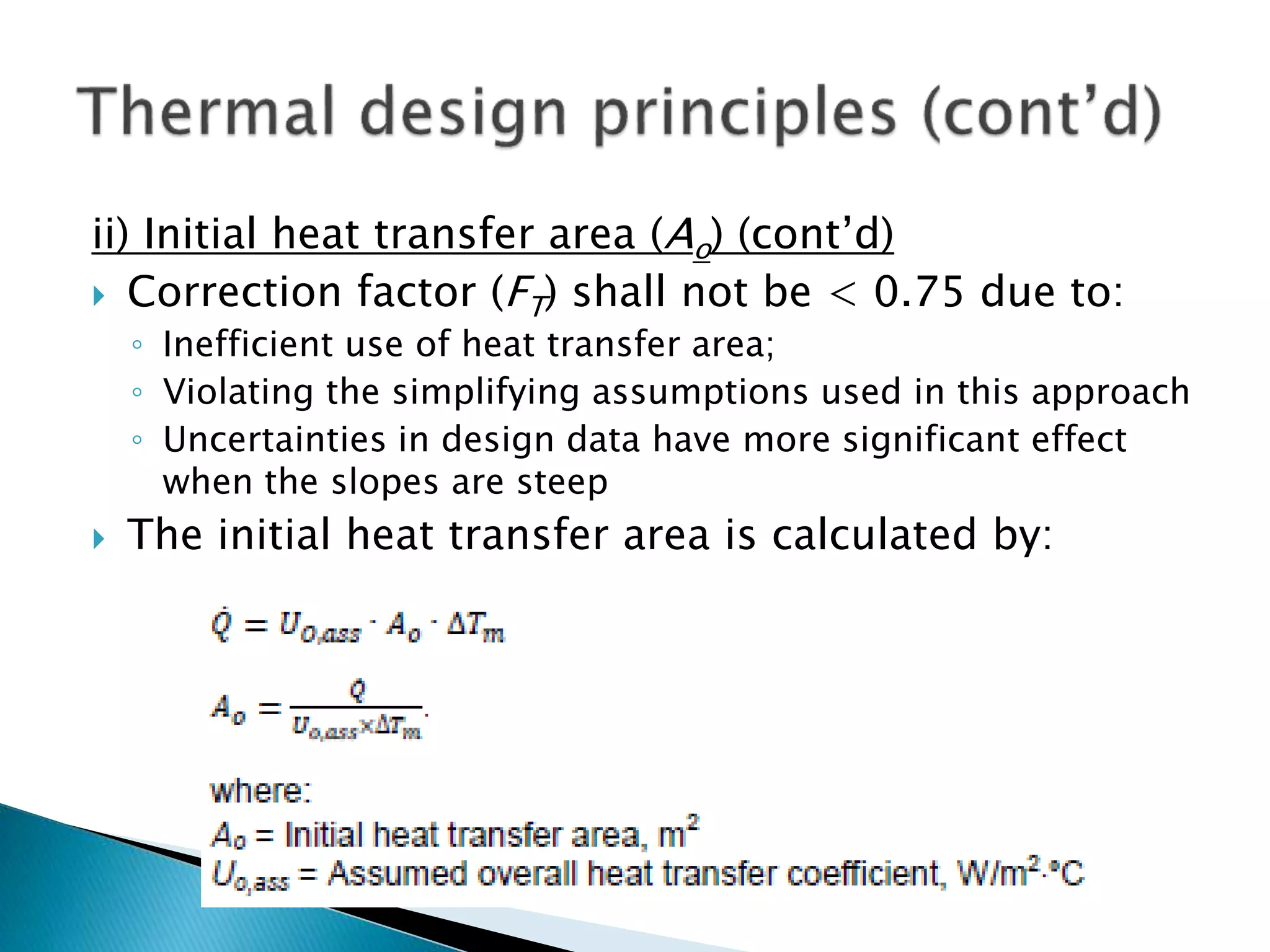
 Correction factor (FT) shall not be < 0.75 due to:
◦ Inefficient use of heat transfer area;
◦ Violating the simplifying assumptions used in this approach
◦ Uncertainties in design data have more significant effect
when the slopes are steep
 The initial heat transfer area is calculated by:
ii) Initial heat transfer area (Ao) (cont’d)
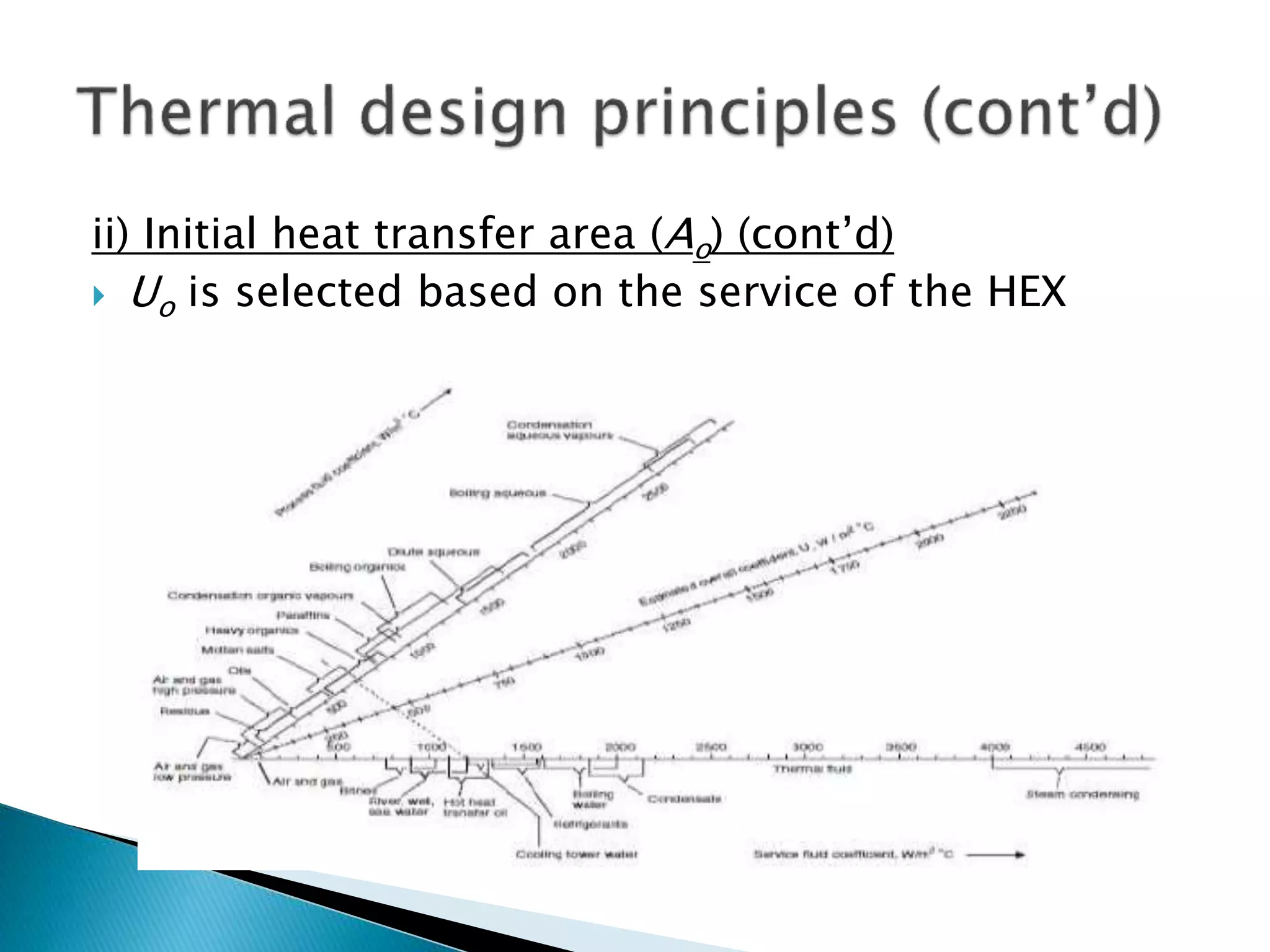
 Uo is selected based on the service of the HEX
ii) Initial heat transfer area (Ao) (cont’d)
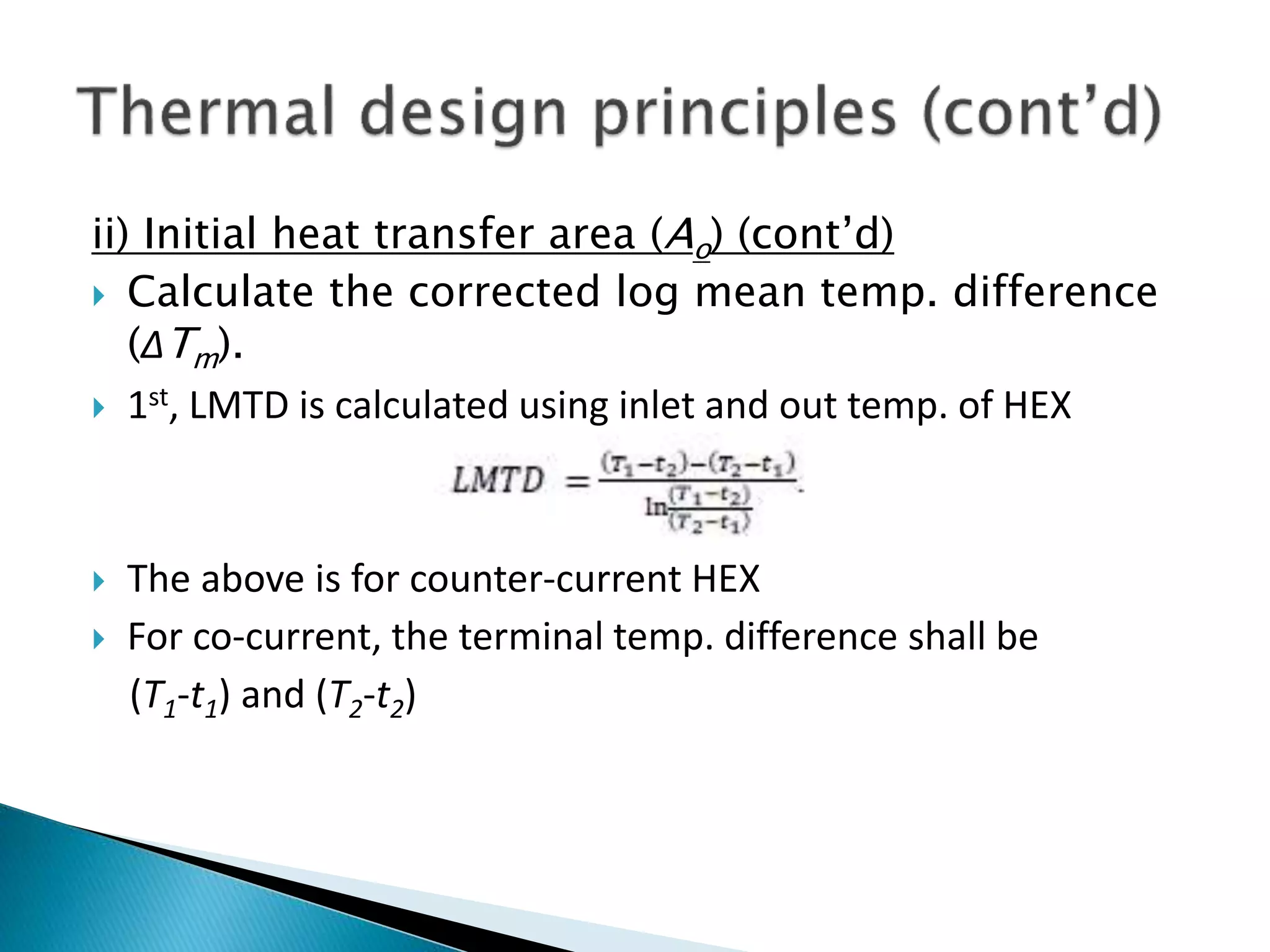
 Calculate the corrected log mean temp. difference
(ΔTm).
 1st, LMTD is calculated using inlet and out temp. of HEX
 The above is for counter-current HEX
 For co-current, the terminal temp. difference shall be
(T1-t1) and (T2-t2)
ii) Initial heat transfer area (Ao) (cont’d)
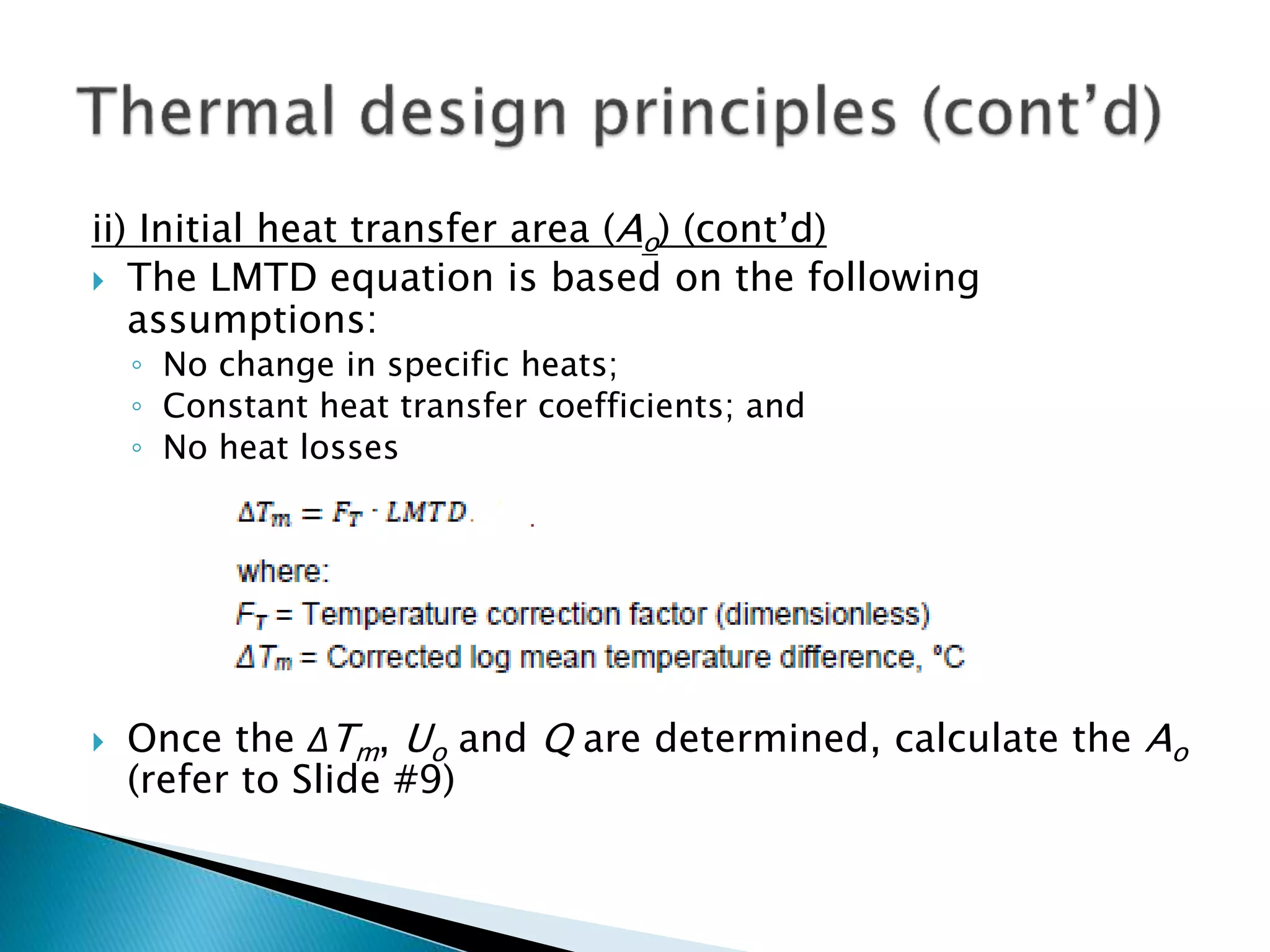
 The LMTD equation is based on the following
assumptions:
◦ No change in specific heats;
◦ Constant heat transfer coefficients; and
◦ No heat losses
 Once the ΔTm, Uo and Q are determined, calculate the Ao
(refer to Slide #9)
iii) Tube pitch, tube size, tube length & shell
diameter
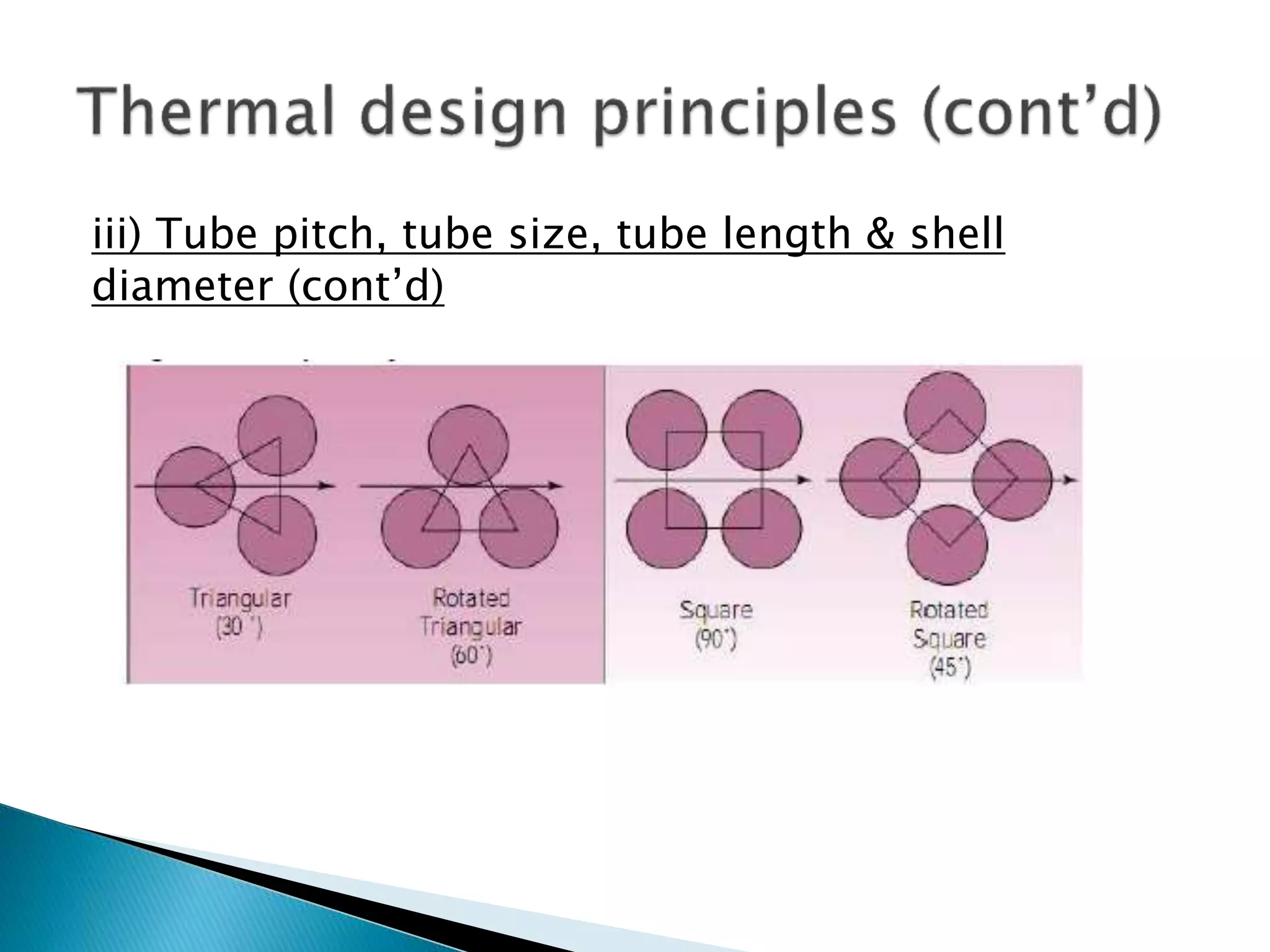
 Four (4) tube pitch layout:
◦ Triangular (30°)
◦ Rotated Triangular (60°)
◦ Square (90°)
◦ Rotated Square (45°)
 Adv. & Disadv. of triangular pitch layout?
◦ Accommodate more tubes than other patterns
◦ Produce high turbulence → better heat transfer
◦ Typical pt = 1.25do → restricts mech. cleaning of tubes to
restricted access lanes
◦ Preferred when the diff. in OP between 2 fluids are significant
iii) Tube pitch, tube size, tube length & shell
diameter (cont’d)
 Adv. & Disadv. of Triangular pitch layout? (cont’d)
◦ Limited to clean shell-side services
◦ Can be used in dirty shell-side services if a suitable &
effective chem. cleaning is available.
 Adv. & Disadv. Of Square pitch layout?
◦ Typicallly used for dirty shell-side services & when mech.
Cleaning is required
◦ Not used in the fixed head design as cleaning is unfeasible
◦ Used when the shell-side Re < 2,000 to induce higher
turbulence
iii) Tube pitch, tube size, tube length & shell
diameter (cont’d)
 pt = 1.25do → smallest shell dia. for a given number of
tubes
 Min. tube pitch for triangular pattern shall be:
◦ pt = 1.25do
 TEMA also recommends an additional min. 6mm of
cleaning lane between adjacent tubes for square pitch
 Min. tube pitch for square pitch shall be:
◦ Max (pt = 1.25do ; do + 6mm)
iii) Tube pitch, tube size, tube length & shell
diameter (cont’d)
iii) Tube pitch, tube size, tube length & shell
diameter (cont’d)
 Tube sizes ranging from ¼” (6.350mm) to 2” (50mm)
 Smaller tube size → more compact & economical size
HEX
 Larger tube size → heavy fouling & ease via mech.
Cleaning
 Preferred length of HEX tubes → 6ft (1.83m), 8ft
(2.44m), 12ft (3.66m), 16ft (4.88m), 20ft (6.10m) & 24ft
(7.32m)
iii) Tube pitch, tube size, tube length & shell
diameter (cont’d)
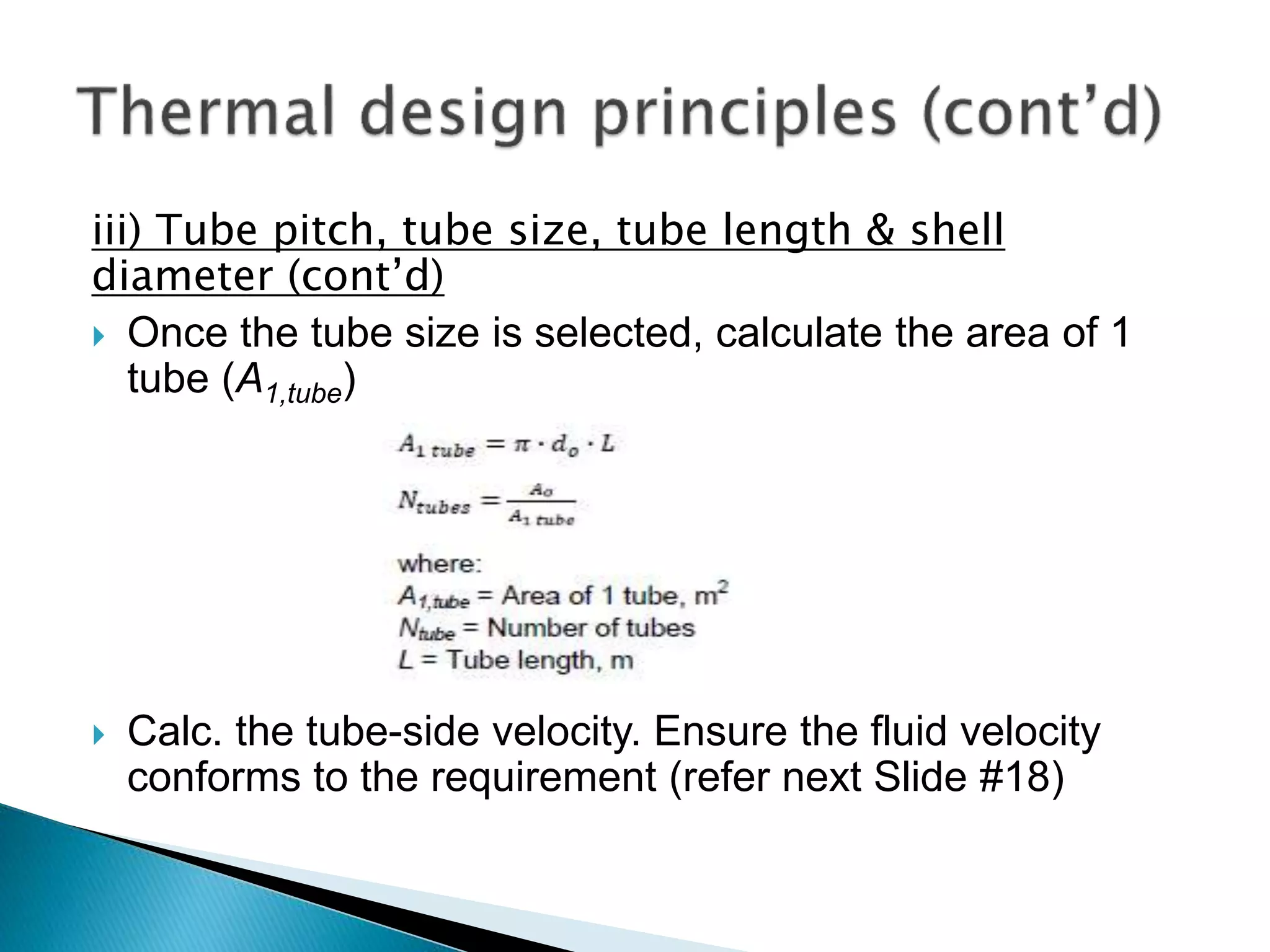
 Once the tube size is selected, calculate the area of 1
tube (A1,tube)
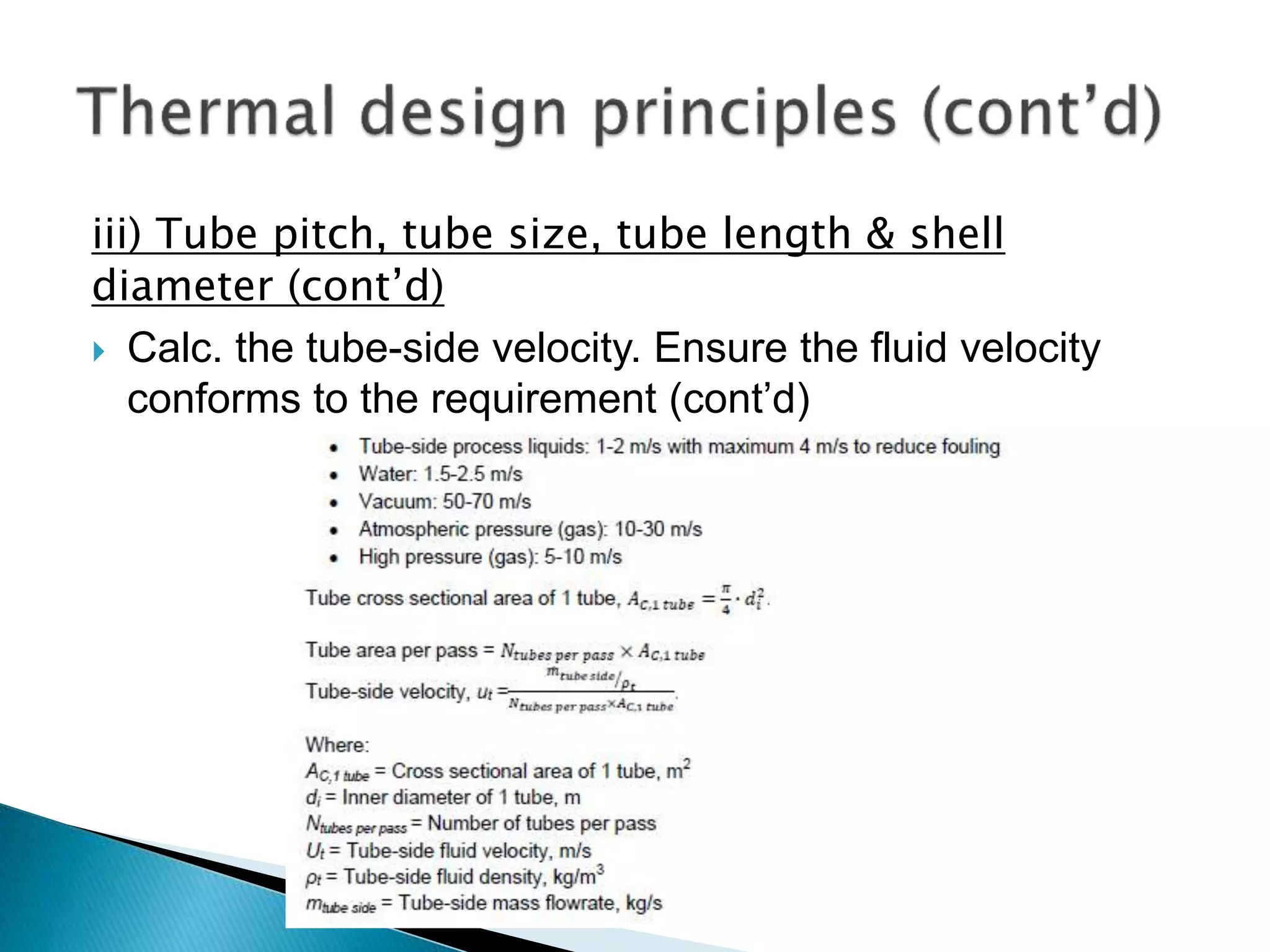
 Calc. the tube-side velocity. Ensure the fluid velocity
conforms to the requirement (refer next Slide #18)
iii) Tube pitch, tube size, tube length & shell
diameter (cont’d)
 Calc. the tube-side velocity. Ensure the fluid velocity
conforms to the requirement (cont’d)
iii) Tube pitch, tube size, tube length & shell
diameter (cont’d)
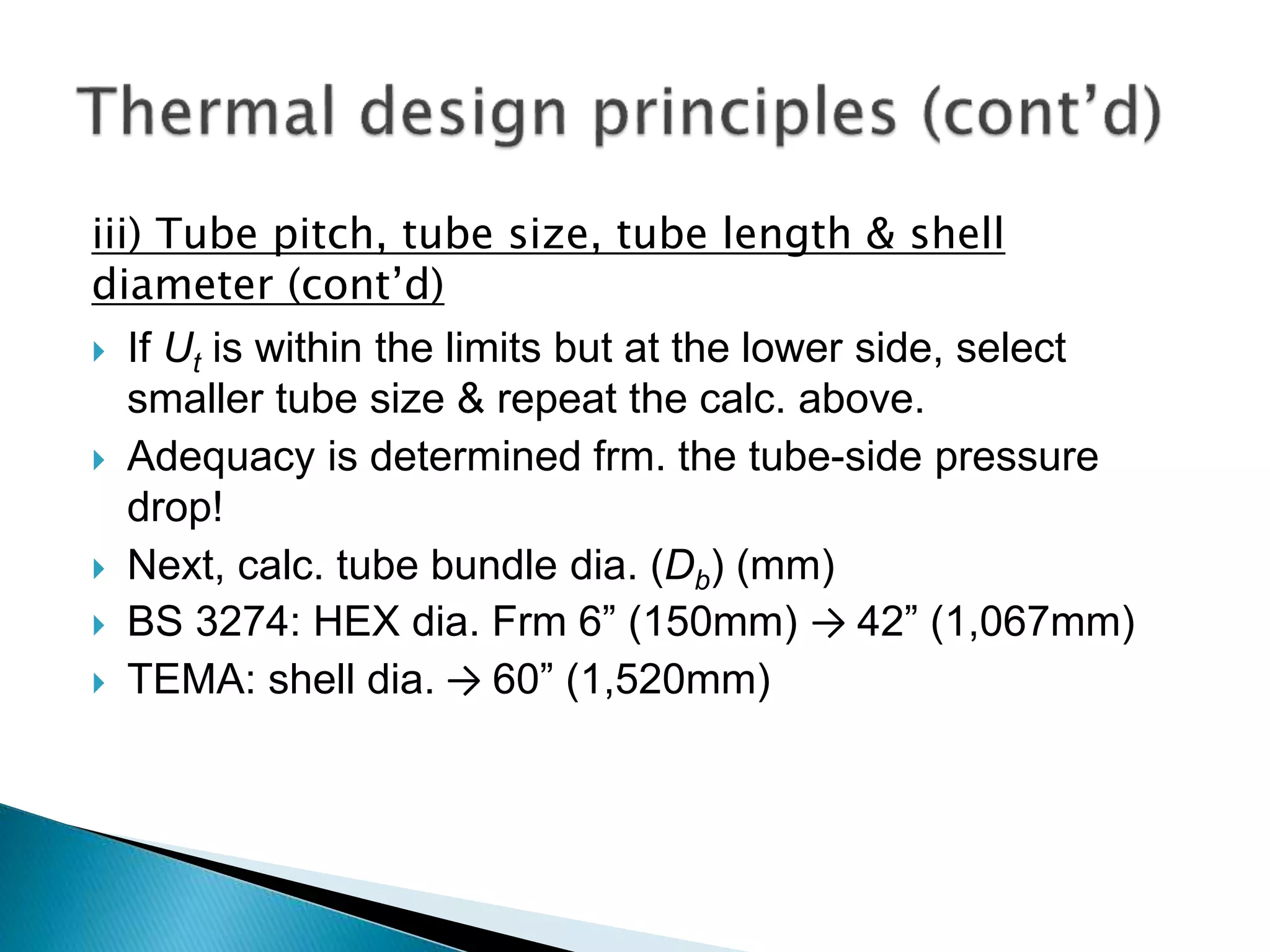
 If Ut is within the limits but at the lower side, select
smaller tube size & repeat the calc. above.
 Adequacy is determined frm. the tube-side pressure
drop!
 Next, calc. tube bundle dia. (Db) (mm)
 BS 3274: HEX dia. Frm 6” (150mm) → 42” (1,067mm)
 TEMA: shell dia. → 60” (1,520mm)
iii) Tube pitch, tube size, tube length & shell
diameter (cont’d)
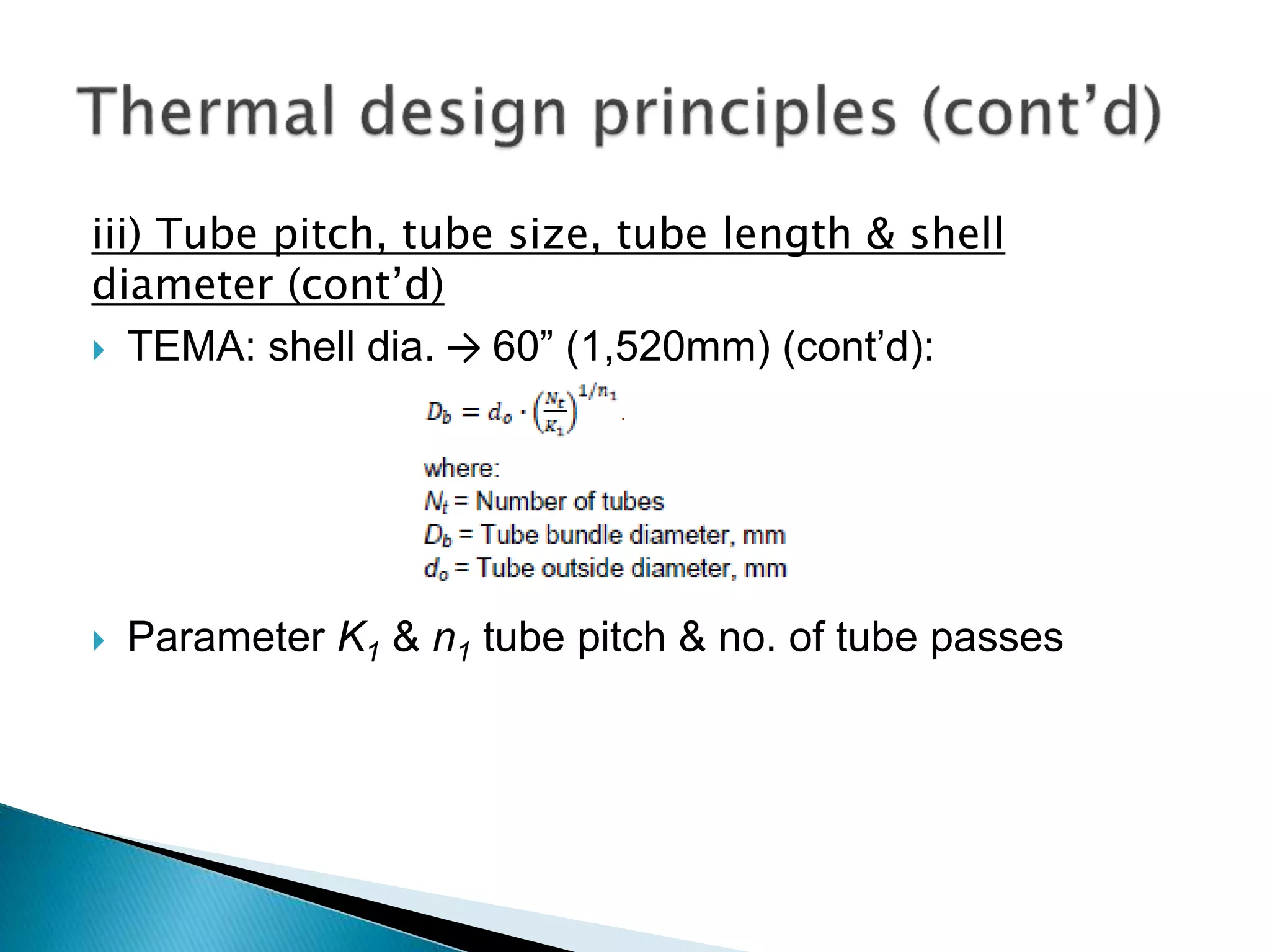
 TEMA: shell dia. → 60” (1,520mm) (cont’d):
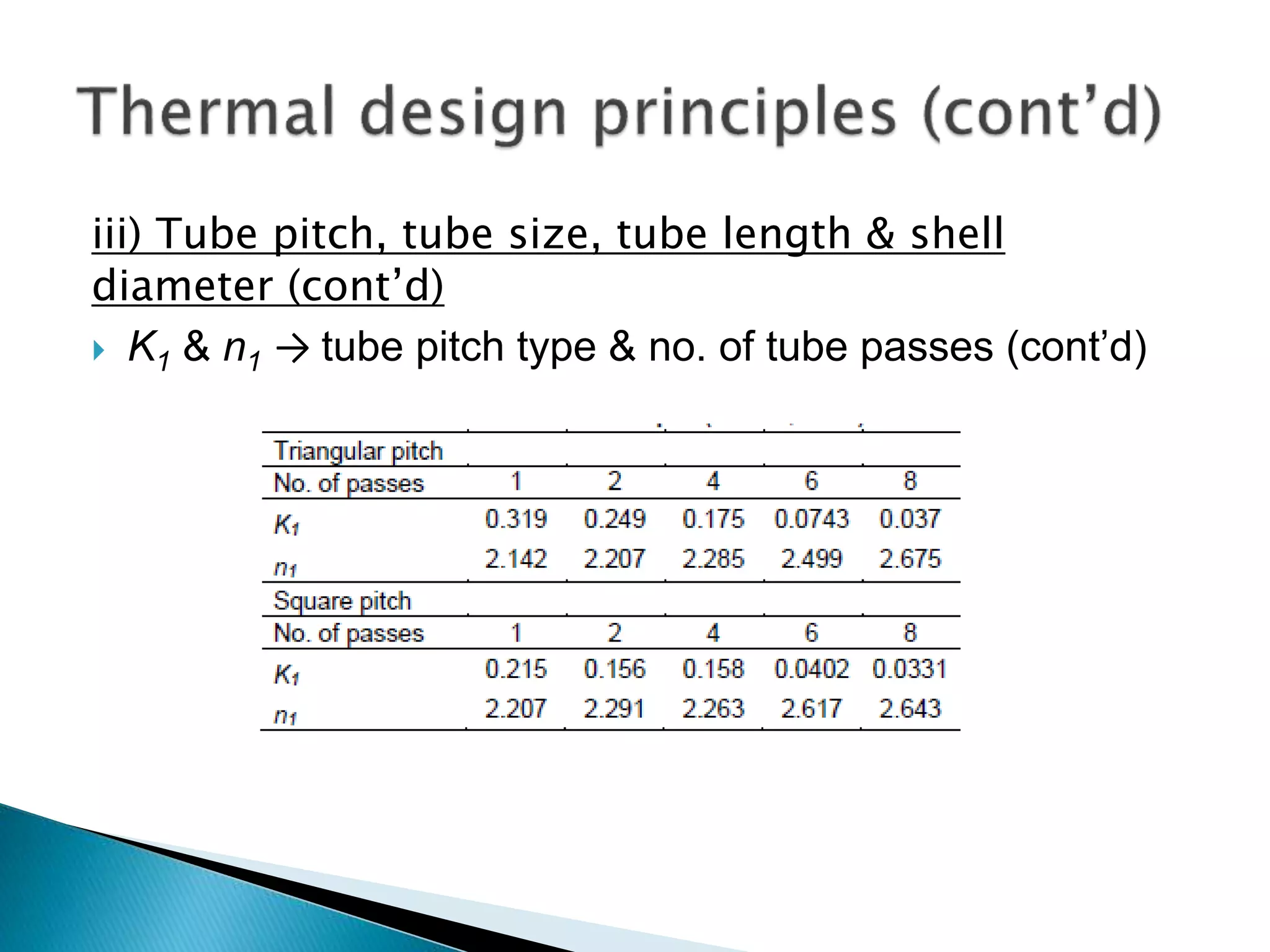
 Parameter K1 & n1 tube pitch & no. of tube passes
iii) Tube pitch, tube size, tube length & shell
diameter (cont’d)
 K1 & n1 → tube pitch type & no. of tube passes (cont’d)
iii) Tube pitch, tube size, tube length & shell
diameter (cont’d)
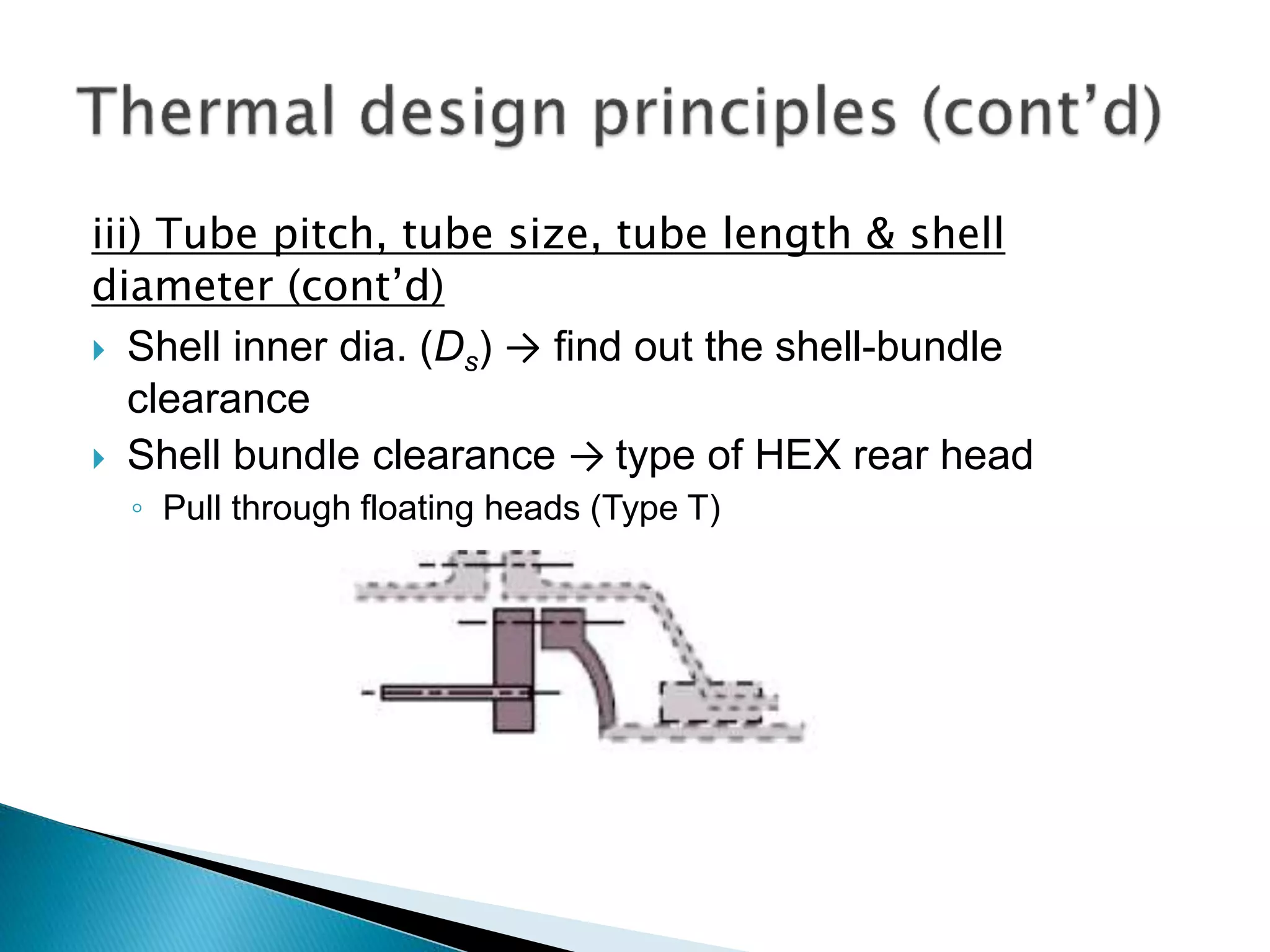
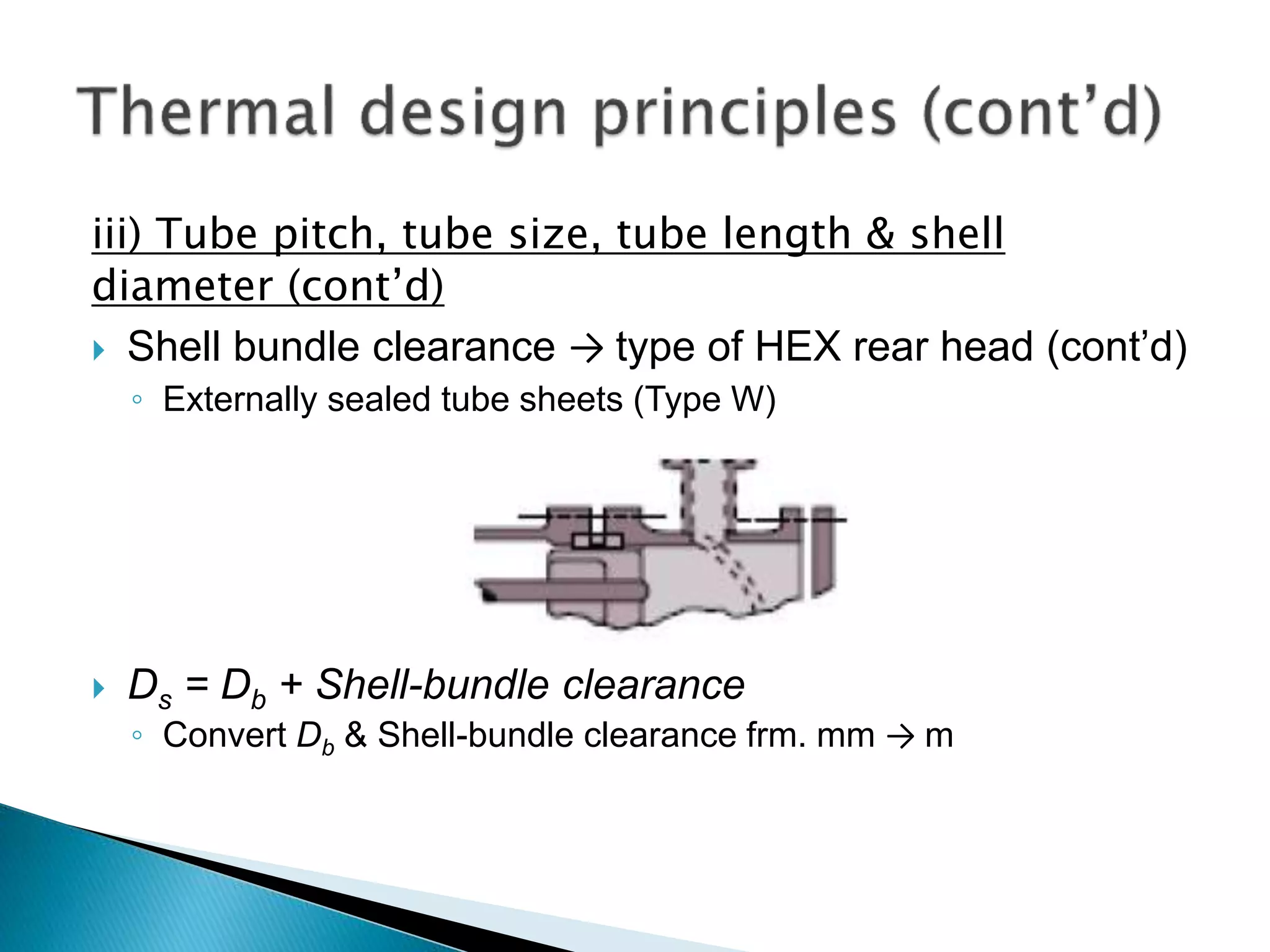
 Shell inner dia. (Ds) → find out the shell-bundle
clearance
 Shell bundle clearance → type of HEX rear head
◦ Pull through floating heads (Type T)
iii) Tube pitch, tube size, tube length & shell
diameter (cont’d)
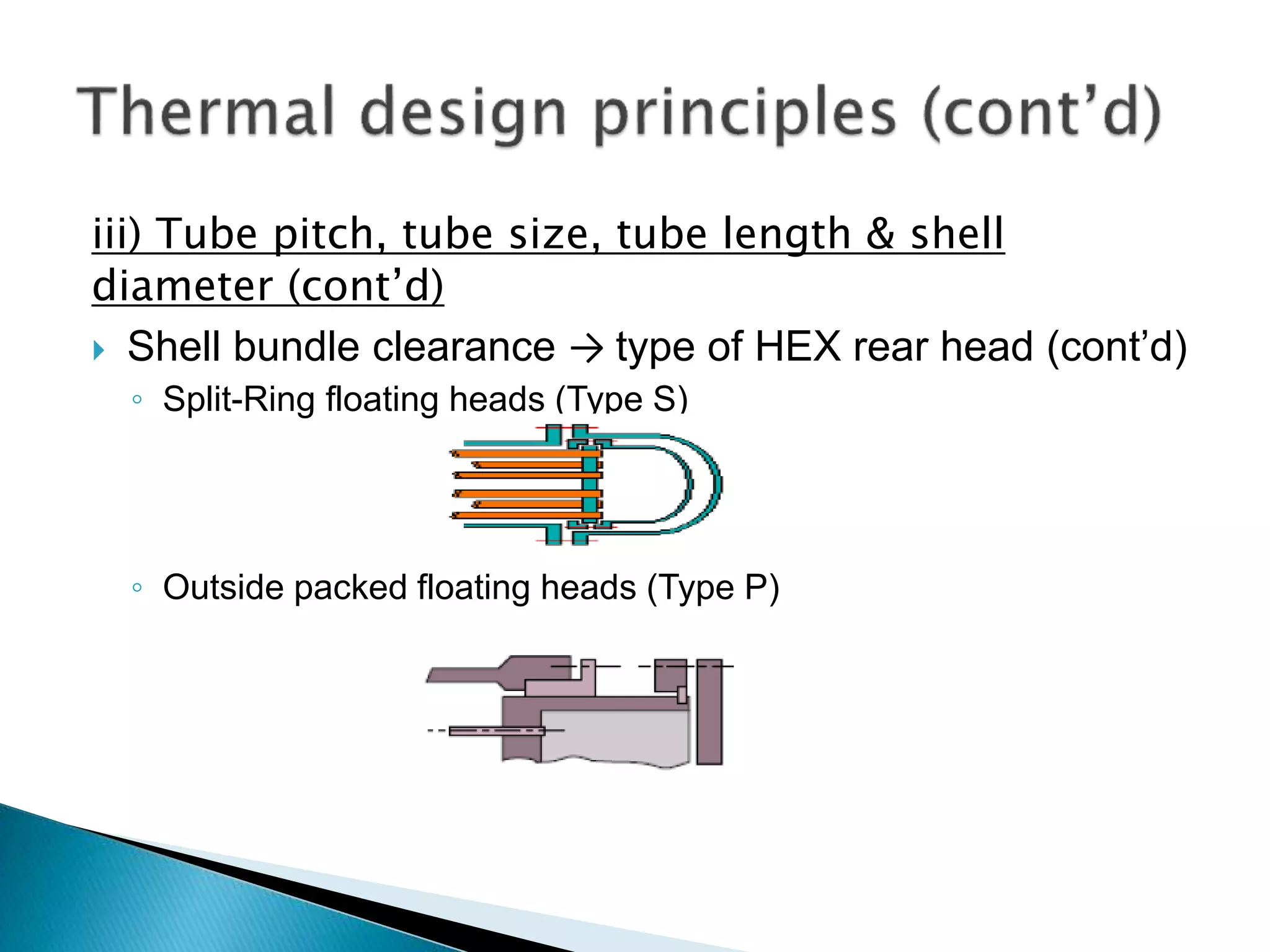
 Shell bundle clearance → type of HEX rear head (cont’d)
◦ Split-Ring floating heads (Type S)
◦ Outside packed floating heads (Type P)
iii) Tube pitch, tube size, tube length & shell
diameter (cont’d)
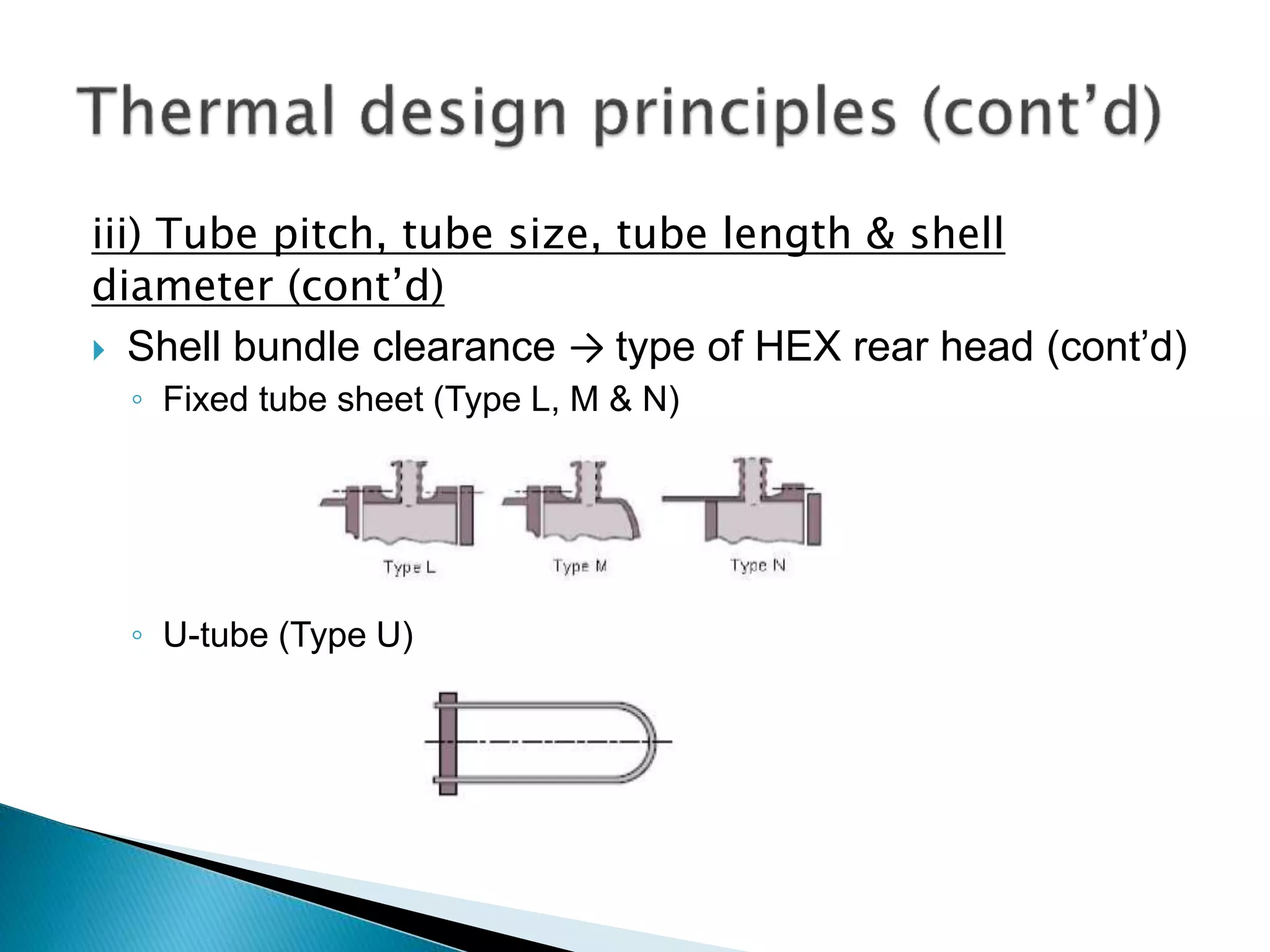
 Shell bundle clearance → type of HEX rear head (cont’d)
◦ Fixed tube sheet (Type L, M & N)
◦ U-tube (Type U)
iii) Tube pitch, tube size, tube length & shell
diameter (cont’d)
 Shell bundle clearance → type of HEX rear head (cont’d)
◦ Externally sealed tube sheets (Type W)
 Ds = Db + Shell-bundle clearance
◦ Convert Db & Shell-bundle clearance frm. mm → m
iv) Calc. tube-side heat transfer coeff. (hi)
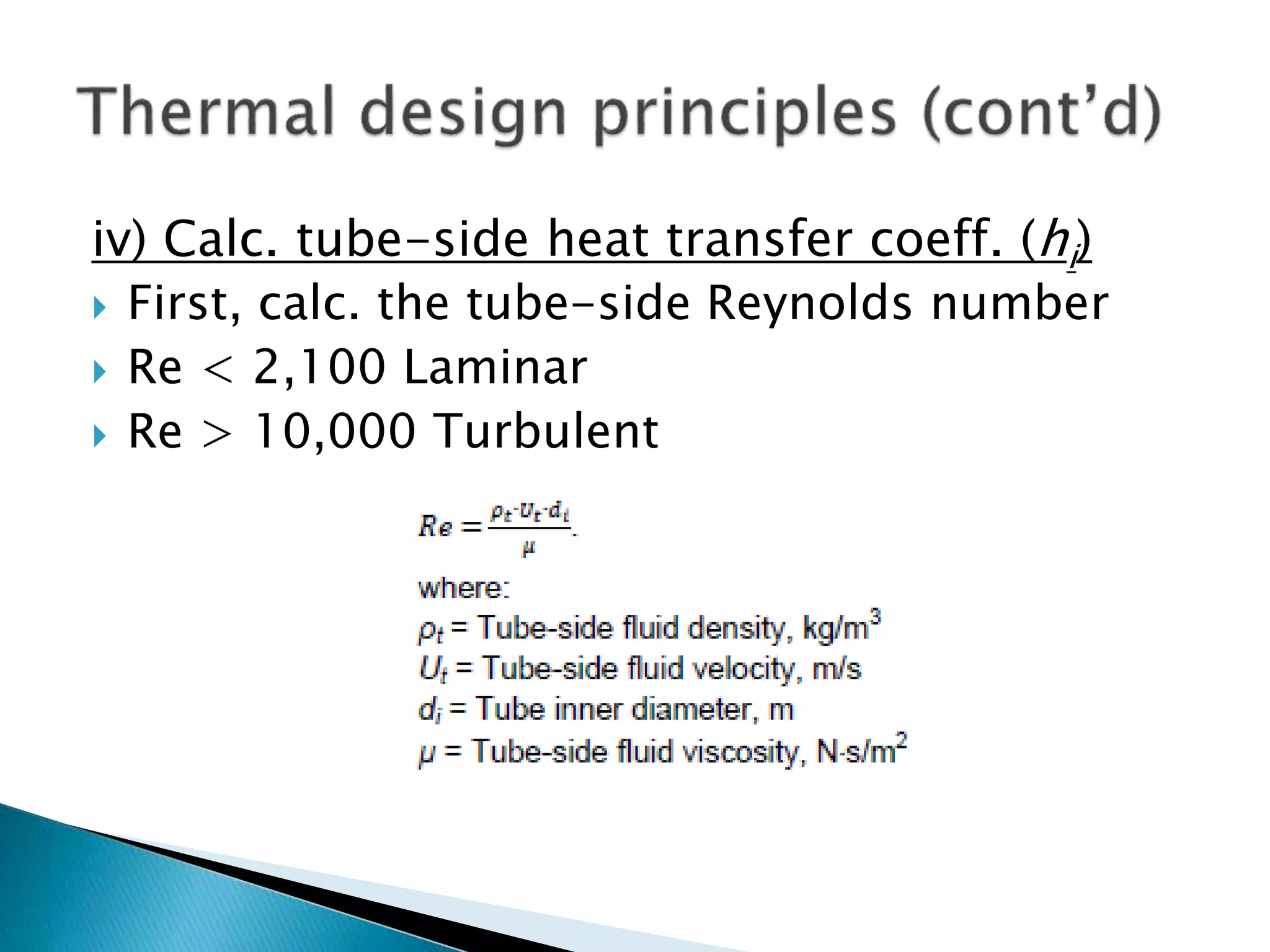
 First, calc. the tube-side Reynolds number
 Re < 2,100 Laminar
 Re > 10,000 Turbulent
iv) Calc. tube-side heat transfer coeff. (hi)
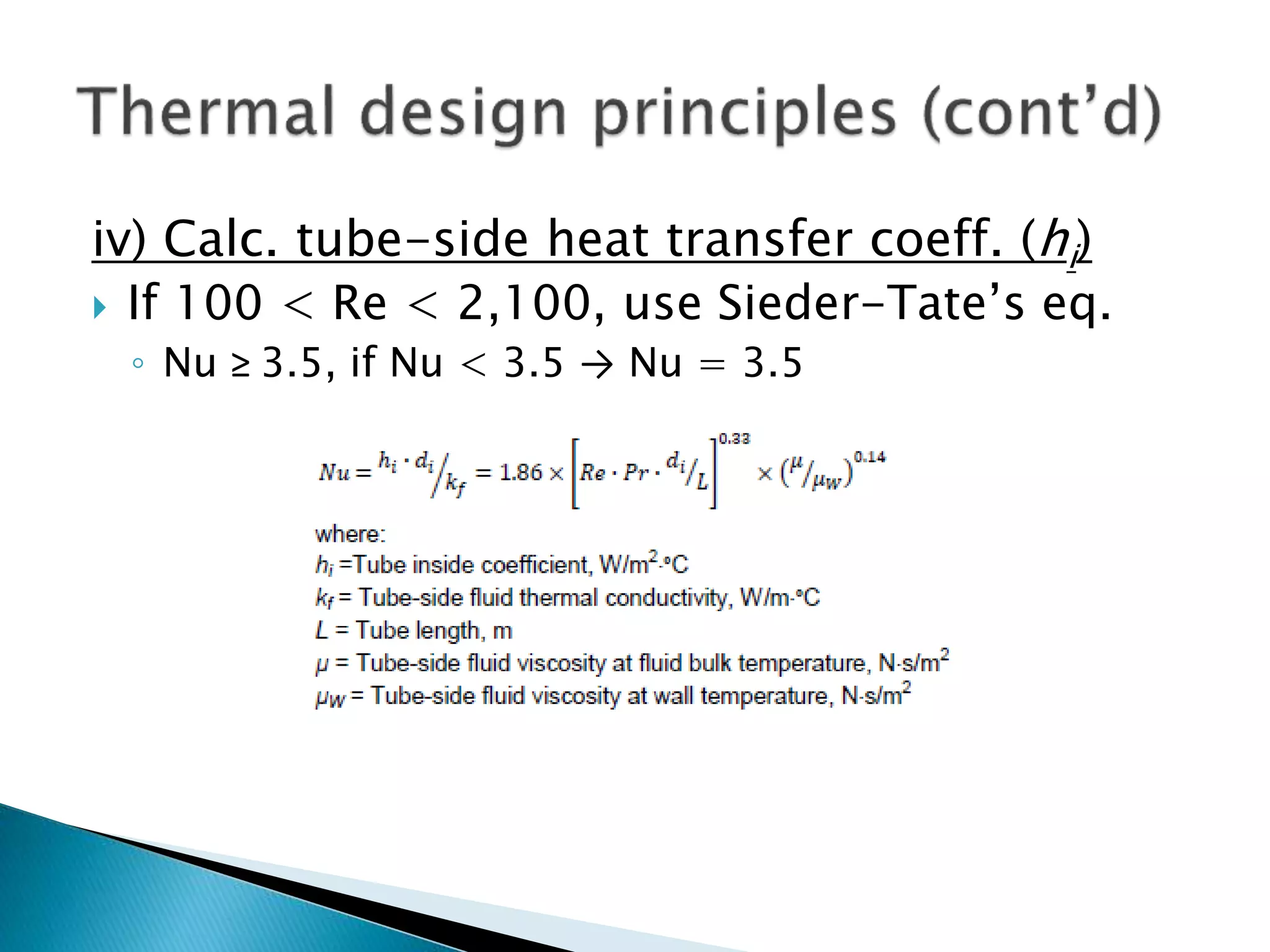
 If 100 < Re < 2,100, use Sieder-Tate’s eq.
◦ Nu ≥ 3.5, if Nu < 3.5 → Nu = 3.5
iv) Calc. tube-side heat transfer coeff. (hi)
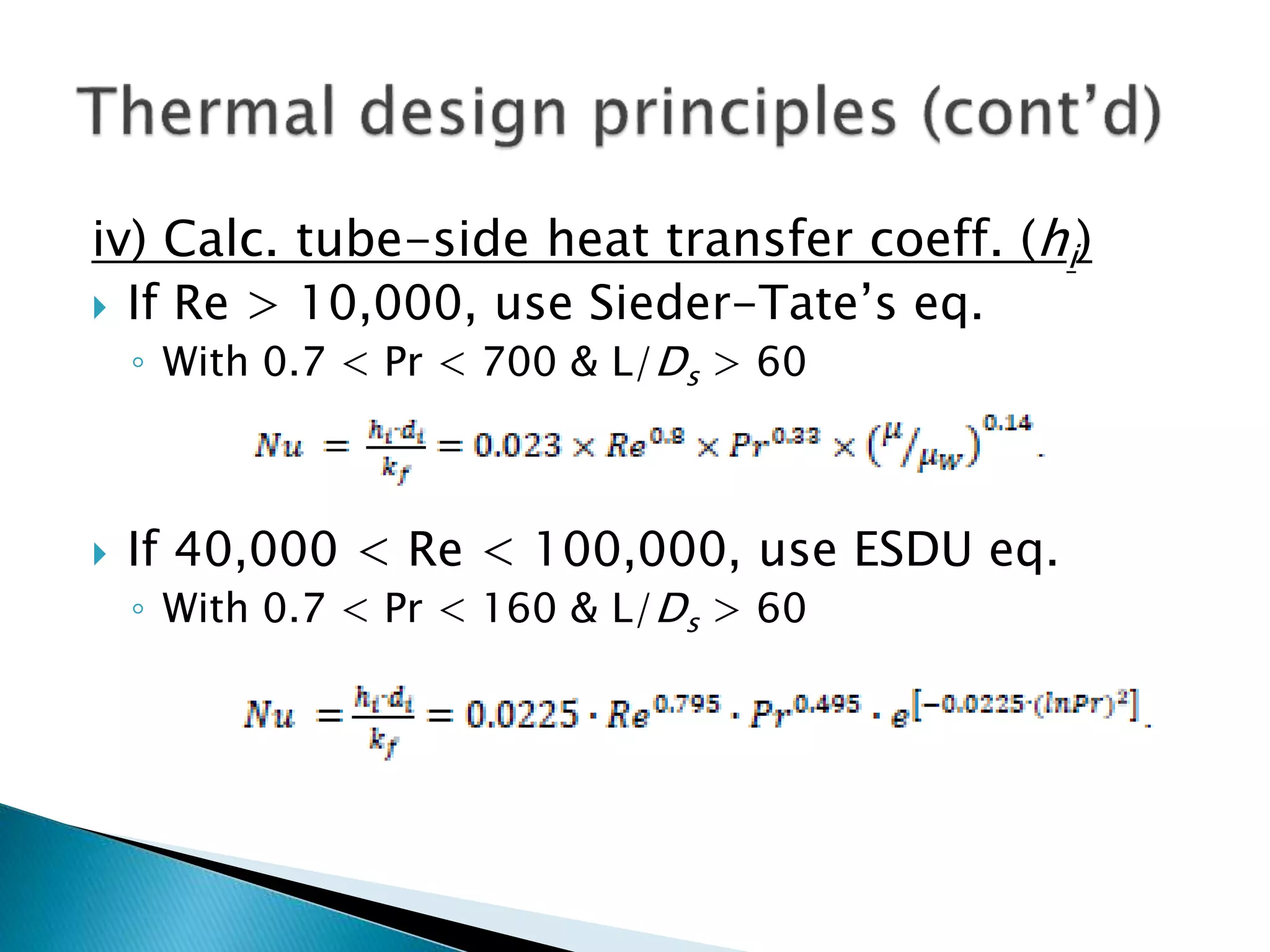
 If Re > 10,000, use Sieder-Tate’s eq.
◦ With 0.7 < Pr < 700 & L/Ds > 60
 If 40,000 < Re < 100,000, use ESDU eq.
◦ With 0.7 < Pr < 160 & L/Ds > 60
iv) Calc. tube-side heat transfer coeff. (hi)
 Transitional regime shall be avoided for
design, if cannot:
◦ Min. (Nu from Slide #28, Nu from Slide #29)
◦ Nu from Slide #28 & #29 are Sieder-Tate’s eq.
v) Calc. shell-side heat transfer coeff. (hs)
 Calc. baffle spacing (B). Why have baffles?
◦ Tube support
◦ Maintain suitable shell-side fluid velocity
◦ Prevent tube failure due to flow induced vibration
v) Calc. shell-side heat transfer coeff. (hs)
(cont’d)
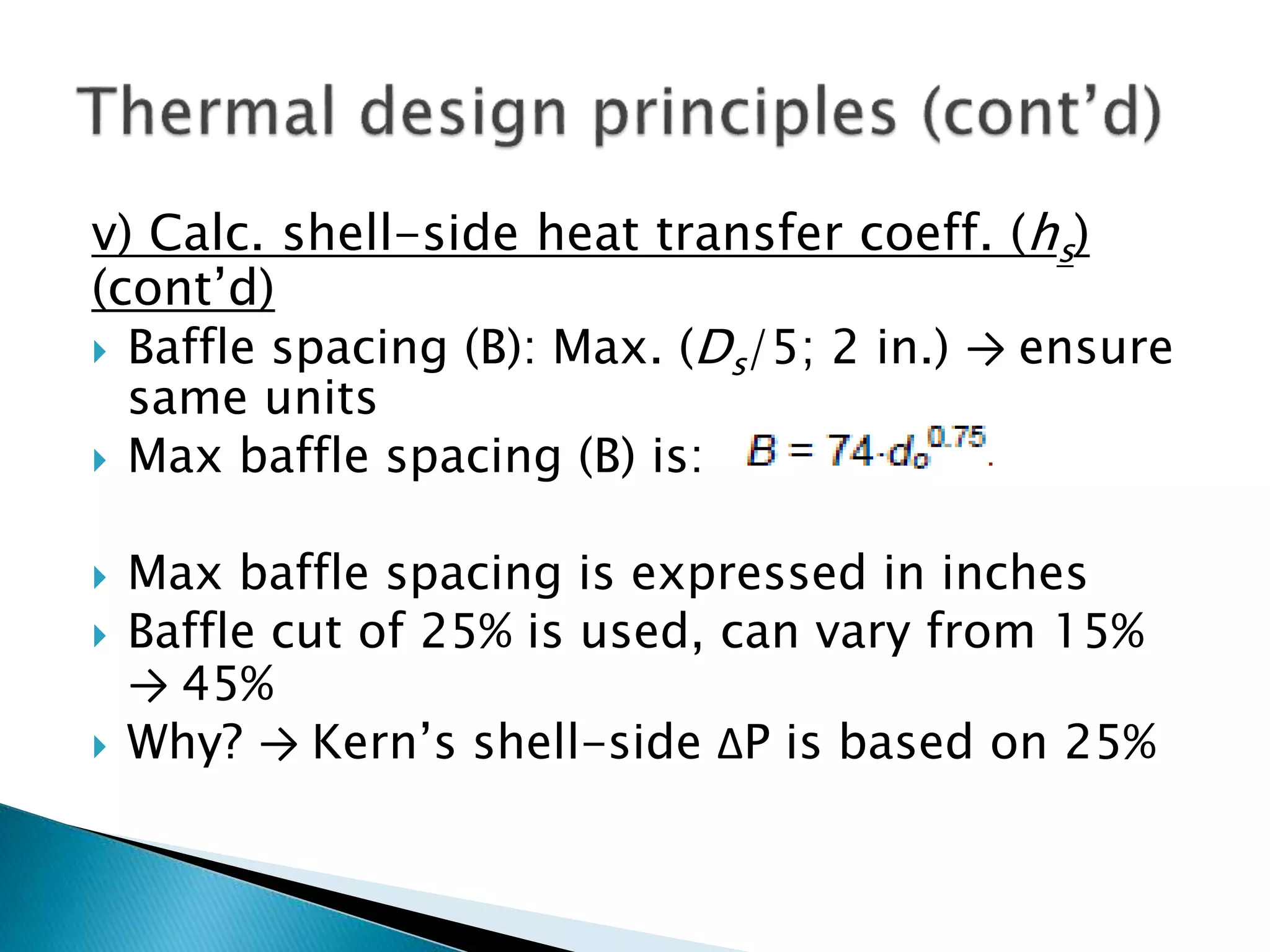
 Baffle spacing (B): Max. (Ds/5; 2 in.) → ensure
same units
 Max baffle spacing (B) is:
 Max baffle spacing is expressed in inches
 Baffle cut of 25% is used, can vary from 15%
→ 45%
 Why? → Kern’s shell-side ΔP is based on 25%
v) Calc. shell-side heat transfer coeff. (hs)
(cont’d)
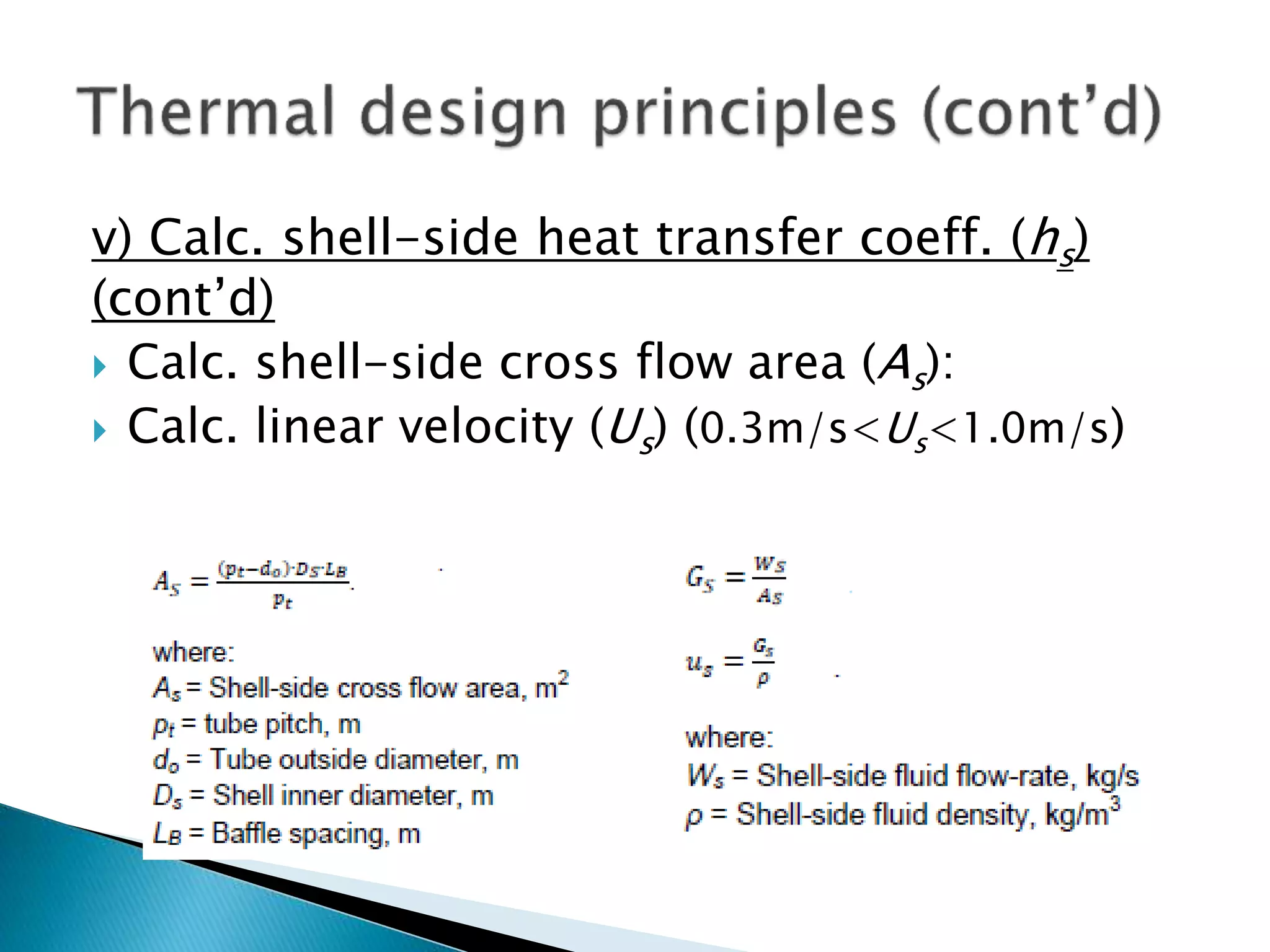
 Calc. shell-side cross flow area (As):
 Calc. linear velocity (Us) (0.3m/s<Us<1.0m/s)
v) Calc. shell-side heat transfer coeff. (hs)
(cont’d)
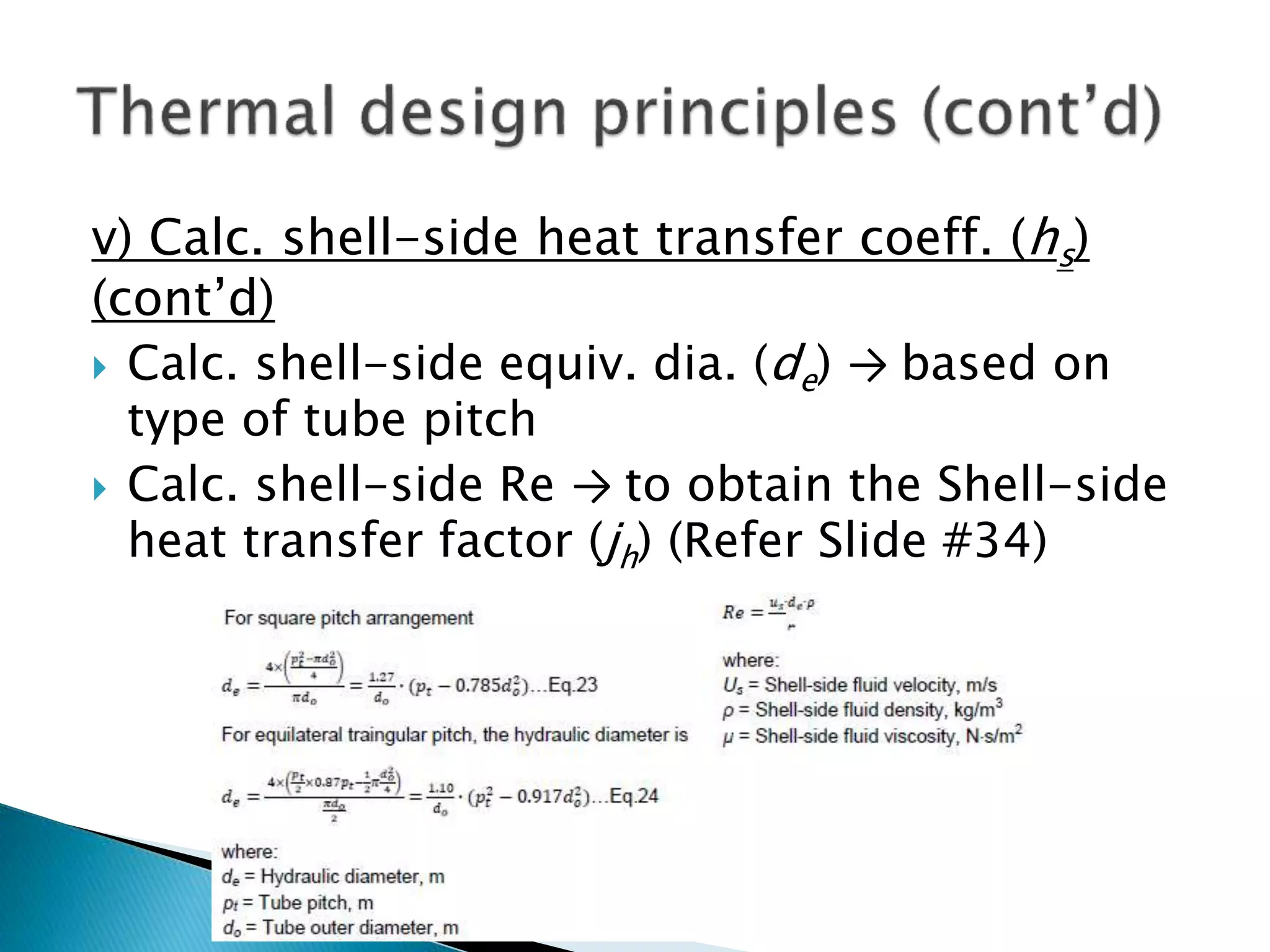
 Calc. shell-side equiv. dia. (de) → based on
type of tube pitch
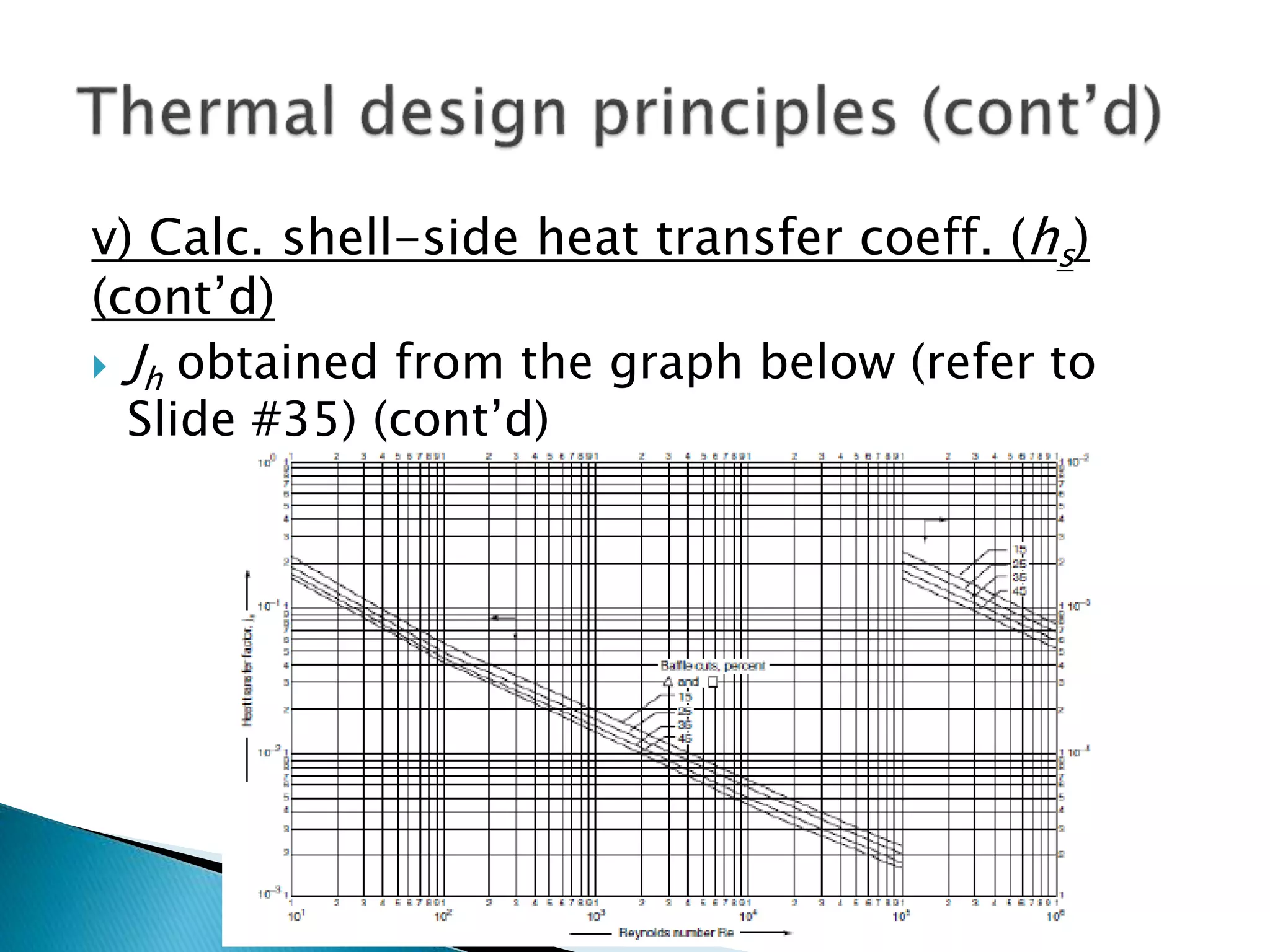
 Calc. shell-side Re → to obtain the Shell-side
heat transfer factor (jh) (Refer Slide #34)
v) Calc. shell-side heat transfer coeff. (hs)
(cont’d)
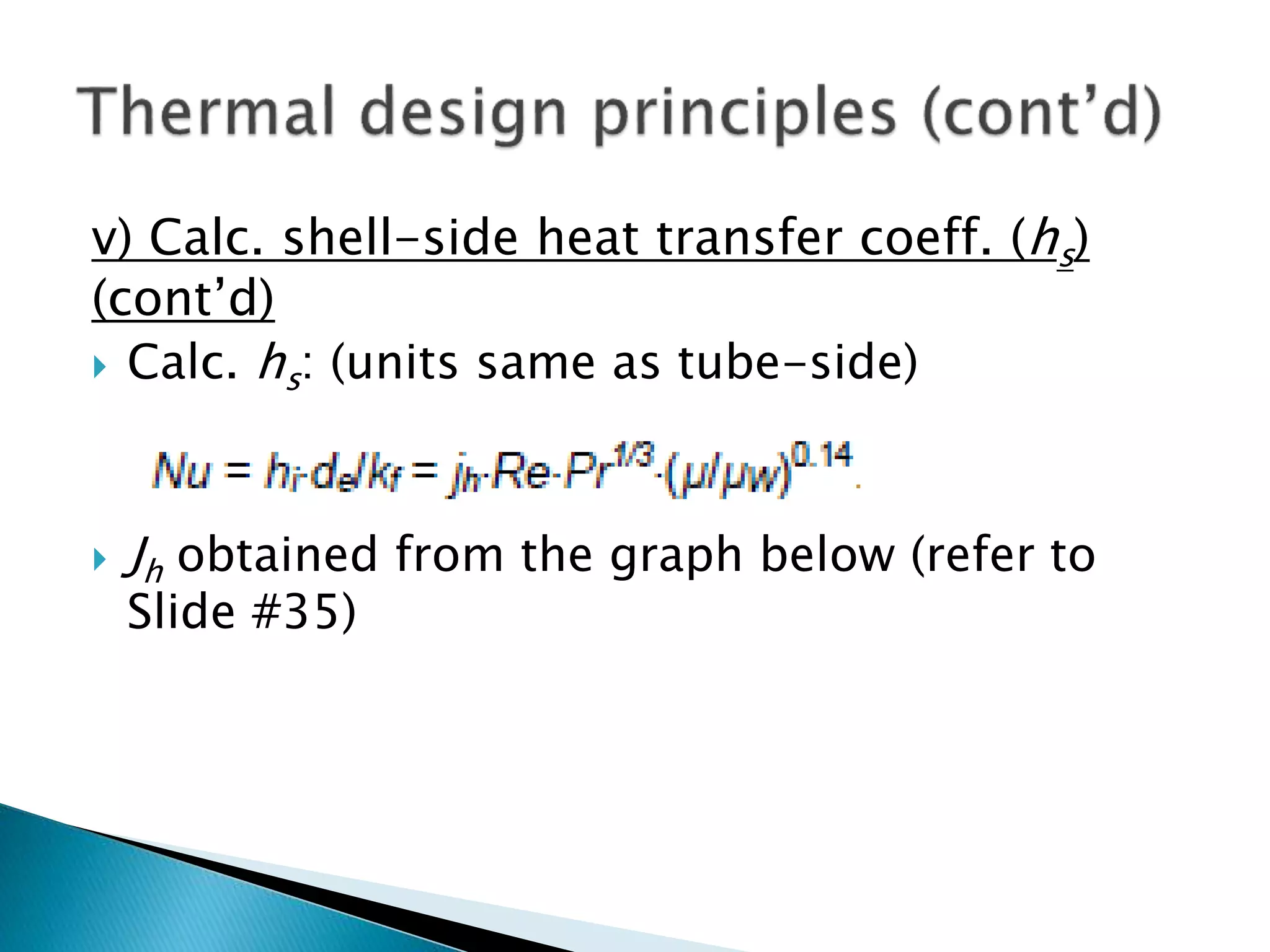
 Calc. hs: (units same as tube-side)
 Jh obtained from the graph below (refer to
Slide #35)
v) Calc. shell-side heat transfer coeff. (hs)
(cont’d)
 Jh obtained from the graph below (refer to
Slide #35) (cont’d)
vi) Calc. overall heat transfer coeff. (Uo)
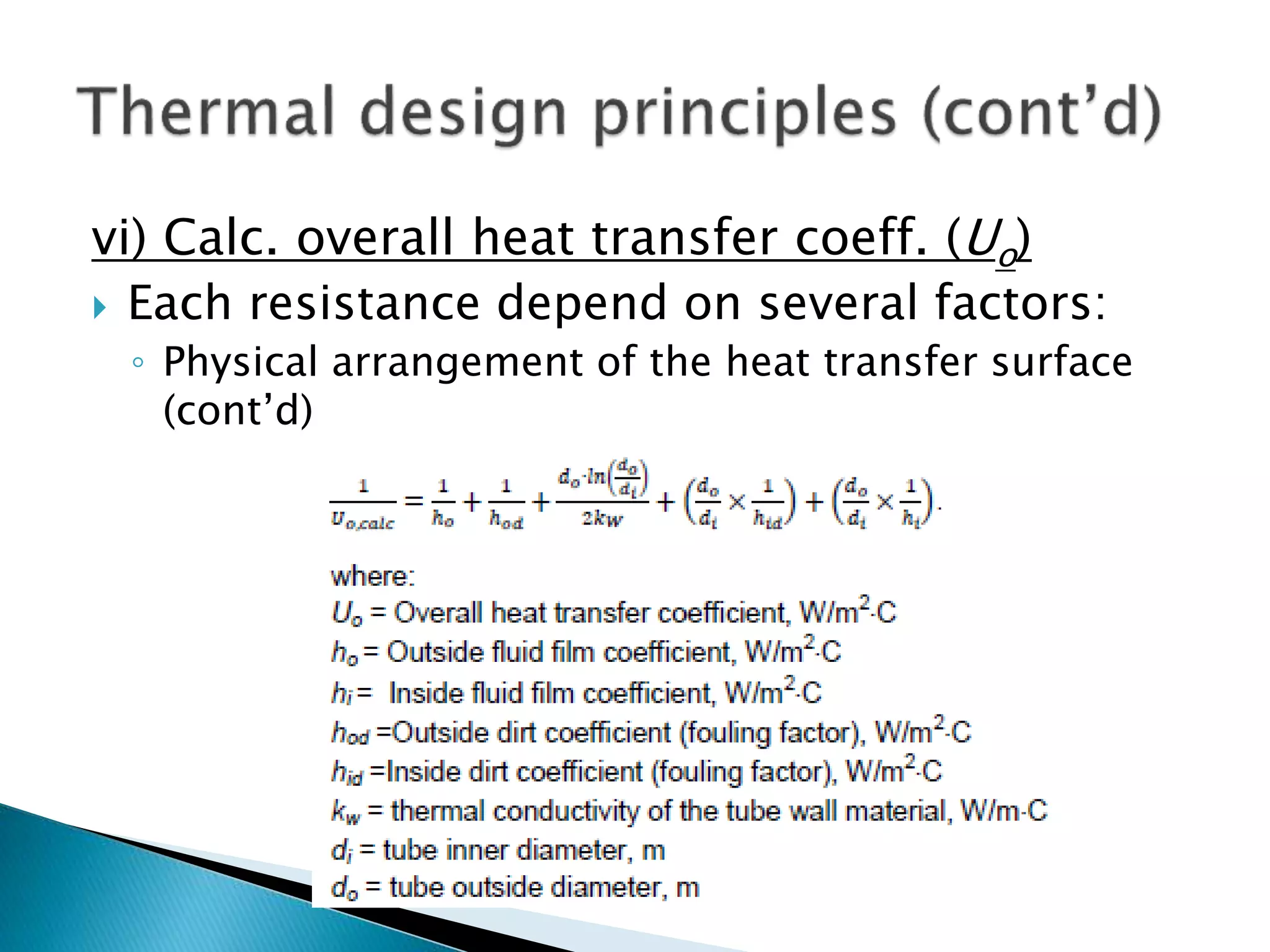
 Uo → reciprocal of the overall resistance to
heat transfer & it’s a sum of several heat
transfer resistances
 Each resistance depend on several factors:
◦ Physical properties of fluids
◦ Heat transfer process (conduction, convection,
condensation, boiling or radiation)
◦ Physical arrangement of the heat transfer surface
vi) Calc. overall heat transfer coeff. (Uo)
 Each resistance depend on several factors:
◦ Physical arrangement of the heat transfer surface
(cont’d)
vi) Calc. overall heat transfer coeff. (Uo)
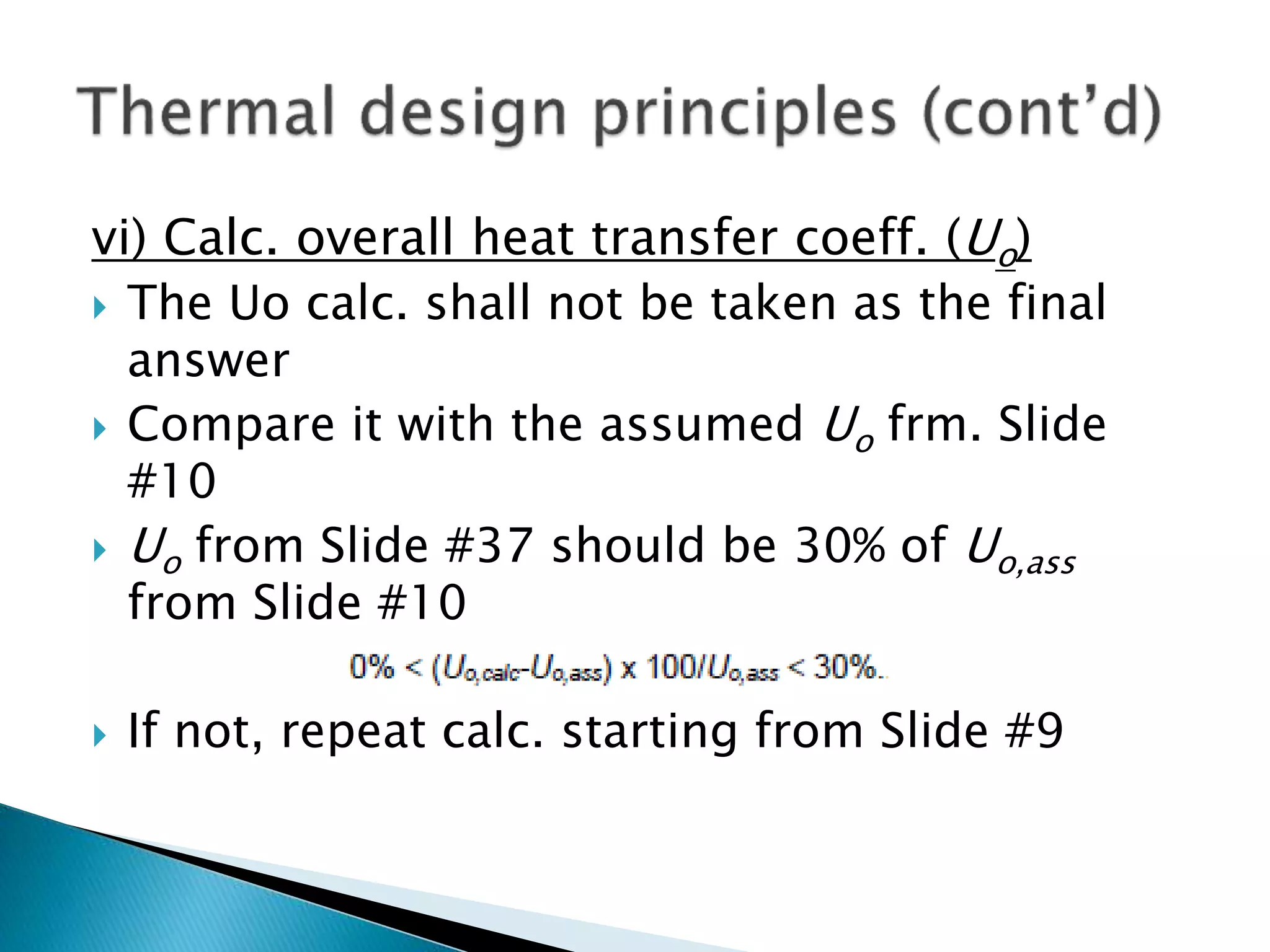
 The Uo calc. shall not be taken as the final
answer
 Compare it with the assumed Uo frm. Slide
#10
 Uo from Slide #37 should be 30% of Uo,ass
from Slide #10
 If not, repeat calc. starting from Slide #9
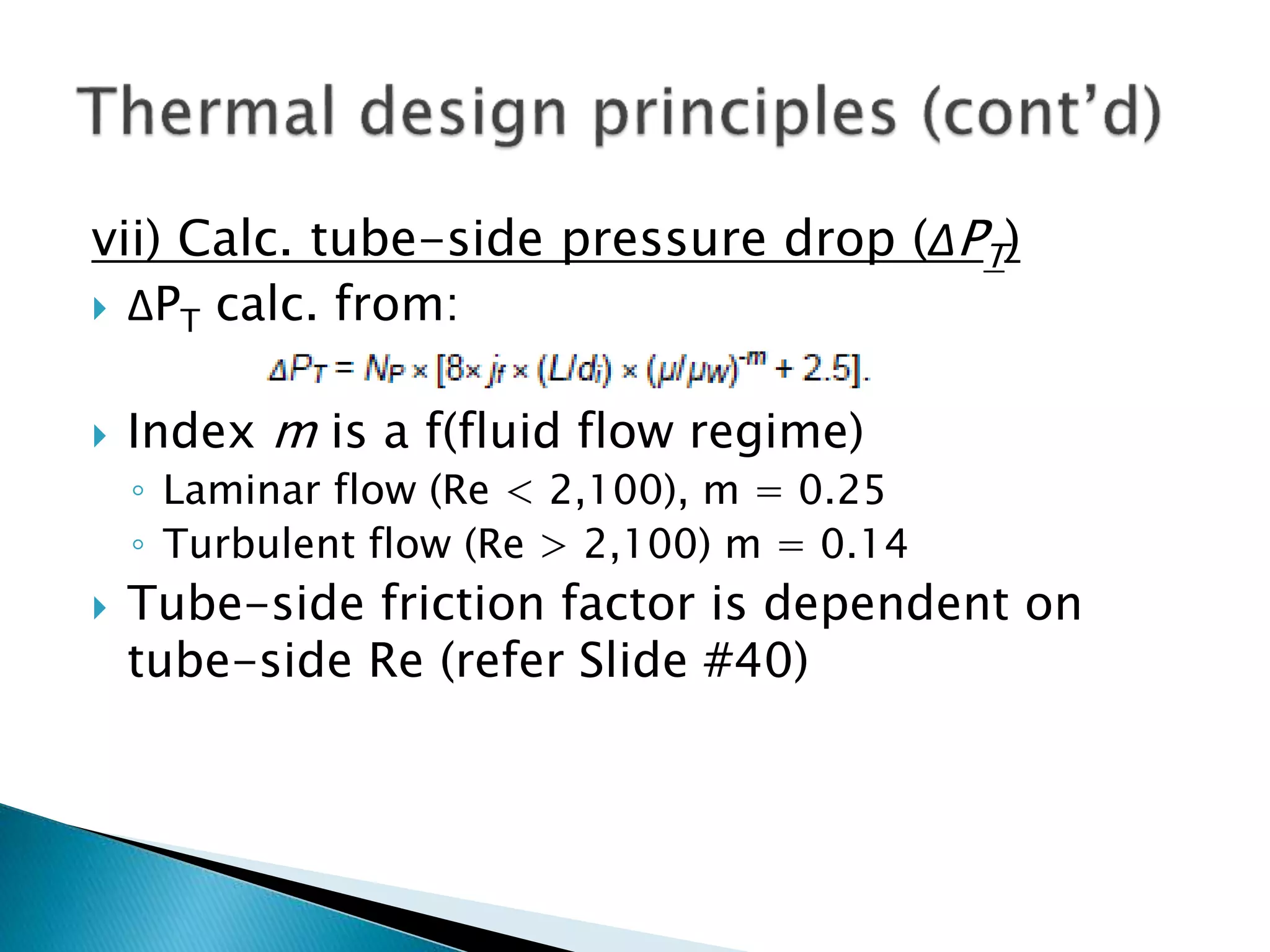
vii) Calc. tube-side pressure drop (ΔPT)
 ΔPT calc. from:
 Index m is a f(fluid flow regime)
◦ Laminar flow (Re < 2,100), m = 0.25
◦ Turbulent flow (Re > 2,100) m = 0.14
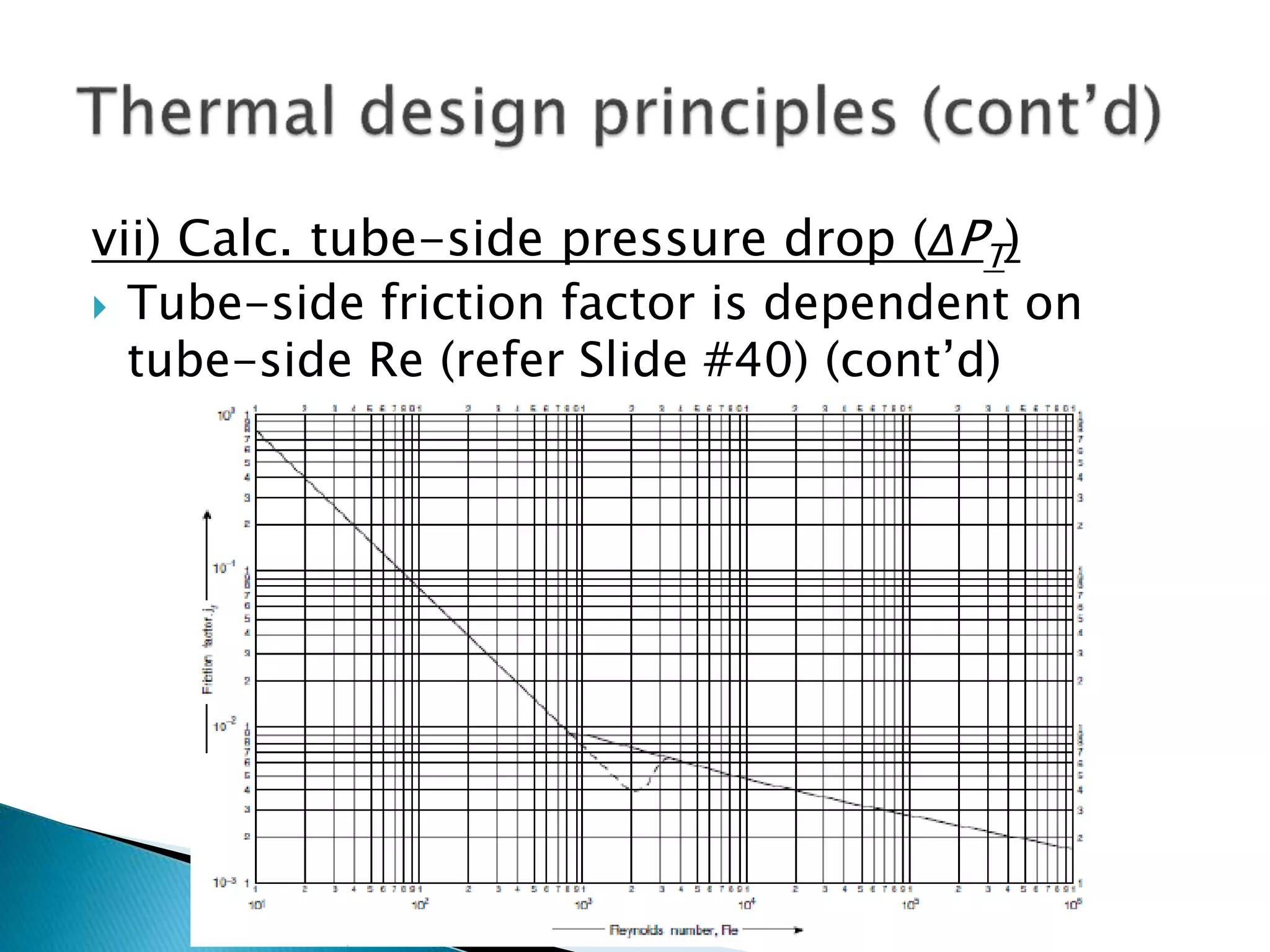
 Tube-side friction factor is dependent on
tube-side Re (refer Slide #40)
vii) Calc. tube-side pressure drop (ΔPT)
 Tube-side friction factor is dependent on
tube-side Re (refer Slide #40) (cont’d)
vii) Calc. tube-side pressure drop (ΔPT)
 ΔPT shall be within the specifications
 If lower than specs, select diff. tube dimensions &
layout, repeat the calcs. frm. Slide #18.
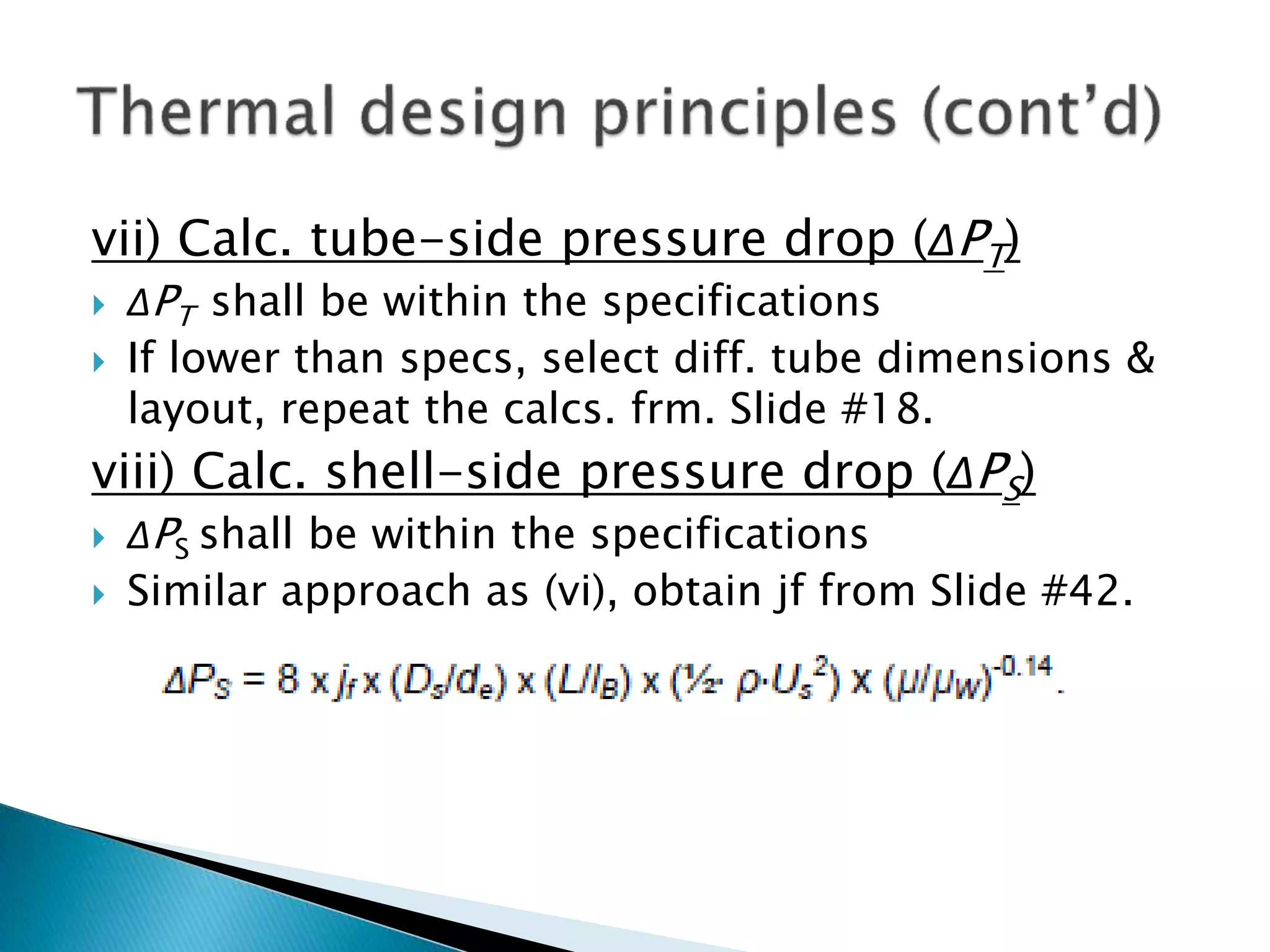
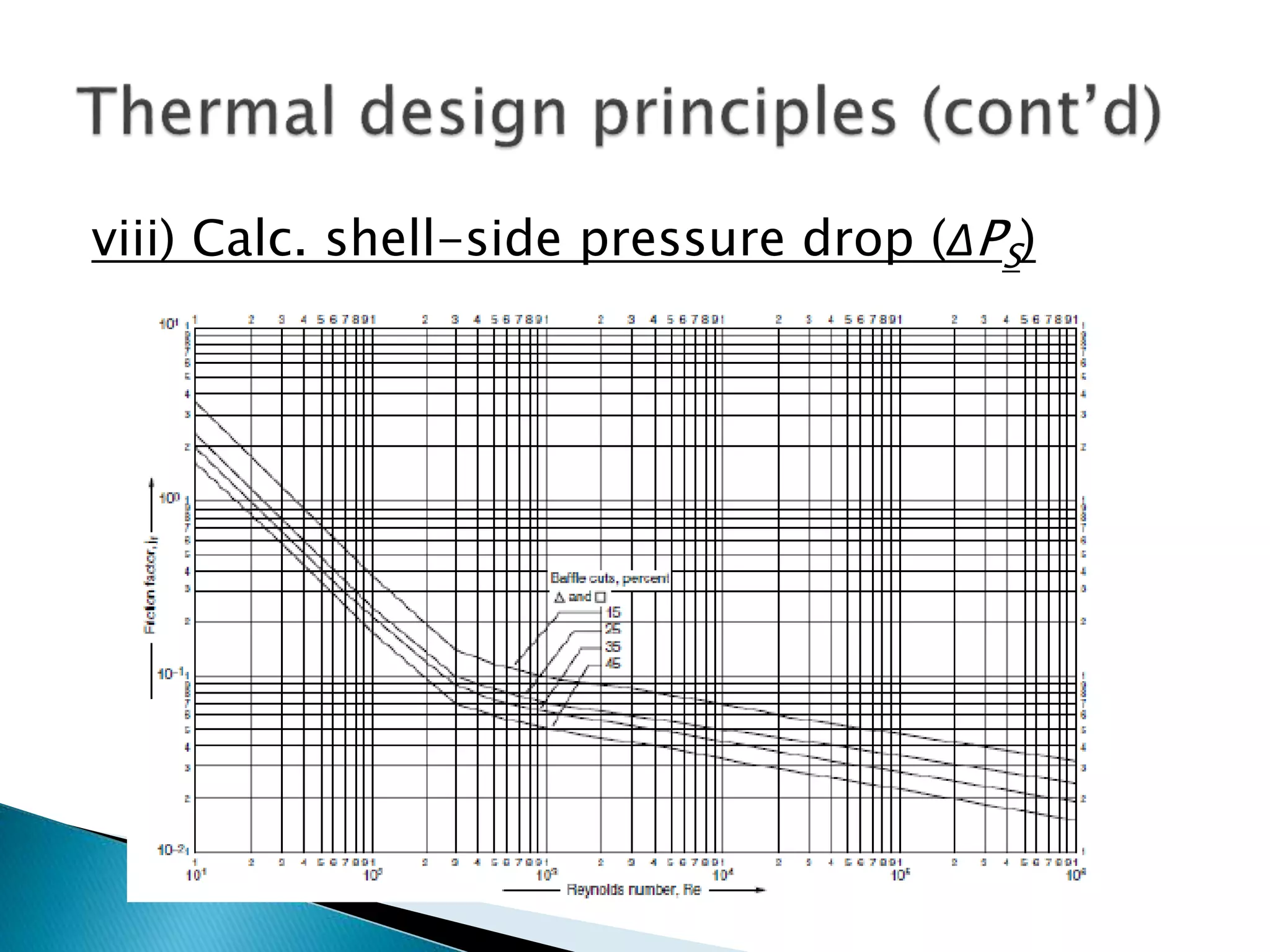
viii) Calc. shell-side pressure drop (ΔPS)
 ΔPS shall be within the specifications
 Similar approach as (vi), obtain jf from Slide #42.
viii) Calc. shell-side pressure drop (ΔPS)
Thermal rating of Shell & Tube Heat Exchanger

Thermal rating of Shell & Tube Heat Exchanger

  • 1.
    Author: Vikram Sharma Date:20th February 2017
  • 2.
     What isa S&T HEX?  Fluid flow in HEX – counter vs. co-current  Fluid allocation in S&T Heat Exchanger  Thermal design principles ◦ Overall duty determination ◦ Initial heat transfer area (Ao) ◦ Tube pitch, tube size, tube length & shell diam. ◦ Calc. tube-side heat transfer coeff. (hi) ◦ Calc. shell-side heat transfer coeff. (hs) ◦ Calc. overall heat transfer coeff. (Uo) ◦ Calc. tube-side pressure drop (ΔPT) ◦ Calc. shell-side pressure drop (ΔPS)  Summary
  • 3.
     As perWikipedia, it consist of a shell (a large pressure vessel) with a bundle of tubes inside it.  One fluid flows through the tube and the second fluid flows through the shell.  Heat transfer occurs when the fluid in the shell flows over the tubes.
  • 4.
     Counter-current flow: ◦Fluids are flowing in the opposite direction  Co-current flow: ◦ Fluids are flowing in the parallel direction  Why counter-current is preferred over co- current? ◦ Thermal stresses are minimized due to more uniform ΔT between two fluids; ◦ Cold fluid temp. can approach the inlet temp. of the hot fluid; and ◦ More uniform of HEX can be achieved – uniform ΔT throughout the HEX
  • 5.
     Fouling fluids: ◦Should be placed in tube-side;  Corrosive fluids: ◦ Should be placed in tube-side as to minimize the purchase of expensive alloys & cladding material;  High temperature fluid: ◦ Use of expensive alloys  High pressure fluid ◦ Minimize the cost of construction of mechanically strong shell.  High viscosity fluids: ◦ Shell-side provided it is at turbulent flow (Re>200). Viscous fluids in tube-side results to high ΔP
  • 6.
    i) Overall dutydetermination  Begins with the determination of duty of the heat exchanger.
  • 7.
     In calculatingt2, the Cp of the other fluid taken at t1.  Once t2 is calculated, a mean temp. of t1 & t2 is computed.  This mean temp. is used as ref. to obtain the Cp of the other fluid.  An iterative procedure is carried out to determine if the Cp of the other fluid is insignificant, the Cp is taken as the mean temp.
  • 8.
    ii) Initial heattransfer area (Ao)  Calculate the Log Mean Temp. Different (LMTD).  Assumption underlying LMTD are: ◦ No change in specific heats; ◦ Constant Uo ◦ No heat losses  The corrected log mean temp. difference (ΔTm) is a f(FT, LMTD).
  • 9.
    ii) Initial heattransfer area (Ao) (cont’d)  Correction factor (FT) shall not be < 0.75 due to: ◦ Inefficient use of heat transfer area; ◦ Violating the simplifying assumptions used in this approach ◦ Uncertainties in design data have more significant effect when the slopes are steep  The initial heat transfer area is calculated by:
  • 10.
    ii) Initial heattransfer area (Ao) (cont’d)  Uo is selected based on the service of the HEX
  • 11.
    ii) Initial heattransfer area (Ao) (cont’d)  Calculate the corrected log mean temp. difference (ΔTm).  1st, LMTD is calculated using inlet and out temp. of HEX  The above is for counter-current HEX  For co-current, the terminal temp. difference shall be (T1-t1) and (T2-t2)
  • 12.
    ii) Initial heattransfer area (Ao) (cont’d)  The LMTD equation is based on the following assumptions: ◦ No change in specific heats; ◦ Constant heat transfer coefficients; and ◦ No heat losses  Once the ΔTm, Uo and Q are determined, calculate the Ao (refer to Slide #9)
  • 13.
    iii) Tube pitch,tube size, tube length & shell diameter  Four (4) tube pitch layout: ◦ Triangular (30°) ◦ Rotated Triangular (60°) ◦ Square (90°) ◦ Rotated Square (45°)  Adv. & Disadv. of triangular pitch layout? ◦ Accommodate more tubes than other patterns ◦ Produce high turbulence → better heat transfer ◦ Typical pt = 1.25do → restricts mech. cleaning of tubes to restricted access lanes ◦ Preferred when the diff. in OP between 2 fluids are significant
  • 14.
    iii) Tube pitch,tube size, tube length & shell diameter (cont’d)  Adv. & Disadv. of Triangular pitch layout? (cont’d) ◦ Limited to clean shell-side services ◦ Can be used in dirty shell-side services if a suitable & effective chem. cleaning is available.  Adv. & Disadv. Of Square pitch layout? ◦ Typicallly used for dirty shell-side services & when mech. Cleaning is required ◦ Not used in the fixed head design as cleaning is unfeasible ◦ Used when the shell-side Re < 2,000 to induce higher turbulence
  • 15.
    iii) Tube pitch,tube size, tube length & shell diameter (cont’d)  pt = 1.25do → smallest shell dia. for a given number of tubes  Min. tube pitch for triangular pattern shall be: ◦ pt = 1.25do  TEMA also recommends an additional min. 6mm of cleaning lane between adjacent tubes for square pitch  Min. tube pitch for square pitch shall be: ◦ Max (pt = 1.25do ; do + 6mm)
  • 16.
    iii) Tube pitch,tube size, tube length & shell diameter (cont’d)
  • 17.
    iii) Tube pitch,tube size, tube length & shell diameter (cont’d)  Tube sizes ranging from ¼” (6.350mm) to 2” (50mm)  Smaller tube size → more compact & economical size HEX  Larger tube size → heavy fouling & ease via mech. Cleaning  Preferred length of HEX tubes → 6ft (1.83m), 8ft (2.44m), 12ft (3.66m), 16ft (4.88m), 20ft (6.10m) & 24ft (7.32m)
  • 18.
    iii) Tube pitch,tube size, tube length & shell diameter (cont’d)  Once the tube size is selected, calculate the area of 1 tube (A1,tube)  Calc. the tube-side velocity. Ensure the fluid velocity conforms to the requirement (refer next Slide #18)
  • 19.
    iii) Tube pitch,tube size, tube length & shell diameter (cont’d)  Calc. the tube-side velocity. Ensure the fluid velocity conforms to the requirement (cont’d)
  • 20.
    iii) Tube pitch,tube size, tube length & shell diameter (cont’d)  If Ut is within the limits but at the lower side, select smaller tube size & repeat the calc. above.  Adequacy is determined frm. the tube-side pressure drop!  Next, calc. tube bundle dia. (Db) (mm)  BS 3274: HEX dia. Frm 6” (150mm) → 42” (1,067mm)  TEMA: shell dia. → 60” (1,520mm)
  • 21.
    iii) Tube pitch,tube size, tube length & shell diameter (cont’d)  TEMA: shell dia. → 60” (1,520mm) (cont’d):  Parameter K1 & n1 tube pitch & no. of tube passes
  • 22.
    iii) Tube pitch,tube size, tube length & shell diameter (cont’d)  K1 & n1 → tube pitch type & no. of tube passes (cont’d)
  • 23.
    iii) Tube pitch,tube size, tube length & shell diameter (cont’d)  Shell inner dia. (Ds) → find out the shell-bundle clearance  Shell bundle clearance → type of HEX rear head ◦ Pull through floating heads (Type T)
  • 24.
    iii) Tube pitch,tube size, tube length & shell diameter (cont’d)  Shell bundle clearance → type of HEX rear head (cont’d) ◦ Split-Ring floating heads (Type S) ◦ Outside packed floating heads (Type P)
  • 25.
    iii) Tube pitch,tube size, tube length & shell diameter (cont’d)  Shell bundle clearance → type of HEX rear head (cont’d) ◦ Fixed tube sheet (Type L, M & N) ◦ U-tube (Type U)
  • 26.
    iii) Tube pitch,tube size, tube length & shell diameter (cont’d)  Shell bundle clearance → type of HEX rear head (cont’d) ◦ Externally sealed tube sheets (Type W)  Ds = Db + Shell-bundle clearance ◦ Convert Db & Shell-bundle clearance frm. mm → m
  • 27.
    iv) Calc. tube-sideheat transfer coeff. (hi)  First, calc. the tube-side Reynolds number  Re < 2,100 Laminar  Re > 10,000 Turbulent
  • 28.
    iv) Calc. tube-sideheat transfer coeff. (hi)  If 100 < Re < 2,100, use Sieder-Tate’s eq. ◦ Nu ≥ 3.5, if Nu < 3.5 → Nu = 3.5
  • 29.
    iv) Calc. tube-sideheat transfer coeff. (hi)  If Re > 10,000, use Sieder-Tate’s eq. ◦ With 0.7 < Pr < 700 & L/Ds > 60  If 40,000 < Re < 100,000, use ESDU eq. ◦ With 0.7 < Pr < 160 & L/Ds > 60
  • 30.
    iv) Calc. tube-sideheat transfer coeff. (hi)  Transitional regime shall be avoided for design, if cannot: ◦ Min. (Nu from Slide #28, Nu from Slide #29) ◦ Nu from Slide #28 & #29 are Sieder-Tate’s eq. v) Calc. shell-side heat transfer coeff. (hs)  Calc. baffle spacing (B). Why have baffles? ◦ Tube support ◦ Maintain suitable shell-side fluid velocity ◦ Prevent tube failure due to flow induced vibration
  • 31.
    v) Calc. shell-sideheat transfer coeff. (hs) (cont’d)  Baffle spacing (B): Max. (Ds/5; 2 in.) → ensure same units  Max baffle spacing (B) is:  Max baffle spacing is expressed in inches  Baffle cut of 25% is used, can vary from 15% → 45%  Why? → Kern’s shell-side ΔP is based on 25%
  • 32.
    v) Calc. shell-sideheat transfer coeff. (hs) (cont’d)  Calc. shell-side cross flow area (As):  Calc. linear velocity (Us) (0.3m/s<Us<1.0m/s)
  • 33.
    v) Calc. shell-sideheat transfer coeff. (hs) (cont’d)  Calc. shell-side equiv. dia. (de) → based on type of tube pitch  Calc. shell-side Re → to obtain the Shell-side heat transfer factor (jh) (Refer Slide #34)
  • 34.
    v) Calc. shell-sideheat transfer coeff. (hs) (cont’d)  Calc. hs: (units same as tube-side)  Jh obtained from the graph below (refer to Slide #35)
  • 35.
    v) Calc. shell-sideheat transfer coeff. (hs) (cont’d)  Jh obtained from the graph below (refer to Slide #35) (cont’d)
  • 36.
    vi) Calc. overallheat transfer coeff. (Uo)  Uo → reciprocal of the overall resistance to heat transfer & it’s a sum of several heat transfer resistances  Each resistance depend on several factors: ◦ Physical properties of fluids ◦ Heat transfer process (conduction, convection, condensation, boiling or radiation) ◦ Physical arrangement of the heat transfer surface
  • 37.
    vi) Calc. overallheat transfer coeff. (Uo)  Each resistance depend on several factors: ◦ Physical arrangement of the heat transfer surface (cont’d)
  • 38.
    vi) Calc. overallheat transfer coeff. (Uo)  The Uo calc. shall not be taken as the final answer  Compare it with the assumed Uo frm. Slide #10  Uo from Slide #37 should be 30% of Uo,ass from Slide #10  If not, repeat calc. starting from Slide #9
  • 39.
    vii) Calc. tube-sidepressure drop (ΔPT)  ΔPT calc. from:  Index m is a f(fluid flow regime) ◦ Laminar flow (Re < 2,100), m = 0.25 ◦ Turbulent flow (Re > 2,100) m = 0.14  Tube-side friction factor is dependent on tube-side Re (refer Slide #40)
  • 40.
    vii) Calc. tube-sidepressure drop (ΔPT)  Tube-side friction factor is dependent on tube-side Re (refer Slide #40) (cont’d)
  • 41.
    vii) Calc. tube-sidepressure drop (ΔPT)  ΔPT shall be within the specifications  If lower than specs, select diff. tube dimensions & layout, repeat the calcs. frm. Slide #18. viii) Calc. shell-side pressure drop (ΔPS)  ΔPS shall be within the specifications  Similar approach as (vi), obtain jf from Slide #42.
  • 42.
    viii) Calc. shell-sidepressure drop (ΔPS)