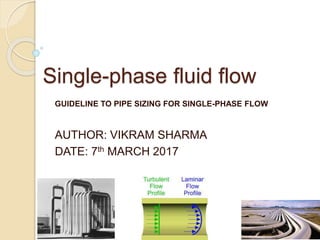
Single-phase fluid flow
GUIDELINE TO PIPE SIZING FOR SINGLE-PHASE FLOW
AUTHOR: VIKRAM SHARMA
DATE: 7th MARCH 2017
Table of Contents
 Introduction
 Bernoulli’s Equation
 Friction factor graph
 Pressure Drop in Pipe and Fittings
 Recommended fluid velocities
 Calculation Methodology
 References
Introduction
 Pipe is a common sight in chemical plant
 Pipework & fittings:
◦ ≈ 20-30% of the total design cost;
◦ ≈ 10-20% of the total plant investment; and
◦ Other added cost due to maintenance req. & energy usage
in the form of ΔP in the fluids being pumped
 The size of a pipe (diameter) is expressed in two
ways that are:
◦ Nominal Pipe Size (NPS); and
◦ Diametre Nominal (DN)
 NPS is measured in inches, DN is measured in mm
 DN is generally equiv. to NPS multiplied by 25
Introduction (cont’d)
 DN is generally equiv. to NPS multiplied by 25
except:
◦ NPS ½ is DN15
◦ NPS 3 is DN80
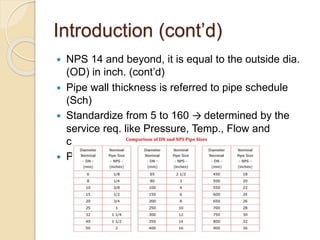
 Pipe size are designated by two numbers that are
(i) pipe diameter and (ii) thickness
 Pipe diameter is generally associated with inside
dia.
 Outside dia. is the same for a given size →
maintain certain interchangeability of pipe fittings
 NPS 14 and beyond, it is equal to the outside dia.
(OD) in inch.
Introduction (cont’d)
 NPS 14 and beyond, it is equal to the outside dia.
(OD) in inch. (cont’d)
 Pipe wall thickness is referred to pipe schedule
(Sch)
 Standardize from 5 to 160 → determined by the
service req. like Pressure, Temp., Flow and
corrosion
 Pipe wall thickness ↑ Pipe Schedule ↑
Bernoulli’s Equation
 ΔP or head loss in a piping system is caused by:
◦ Elevation;
◦ Friction;
◦ Shaft work; and
◦ Turbulence due to sudden change in direction or cross
sectional area
 Mechanical Energy Balance (MEB) eq.→ conservation of sum
of pressure, kinetic and potential energies, net heat transfer
(q), work done by the system (w) and frictional energy (ef).
 ef is usually +ve & represents the rate of irreversible
conversion of mech. energy into thermal energy
 Sometimes called head loss, friction loss or frictional
pressure drop.
Bernoulli’s Equation (cont’d)
 The first 3 terms (pressure, velocity & elevation) are
point functions → depend only on conditions at the
inlet & outlet of the system
 w and ef are path functions → depend on what is
happening to the system between the inlet and outlet
points
 ef loss due to friction and includes losses due to flow
through lengths of pipe, fittings such as elbows, valves,
orifices and pipe entrances and exits
Bernoulli’s Equation (cont’d)
 Kf is the excess head loss due to pipe or pipe fittings, v is
the fluid velocity
 Fluids flowing through pipes;
 ΔP is the same due to flow is the same whether the
pipe is horizontal, vertical or inclined
Friction factor
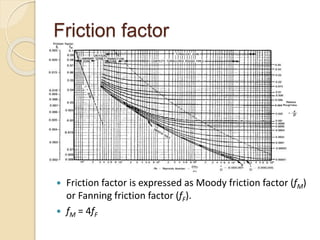
 Friction factor is expressed as Moody friction factor (fM)
or Fanning friction factor (fF).
 fM = 4fF
Friction factor (cont’d)
 Laminar region (or viscous): Re < 2,000
 “Critical zone” is the transition frm. laminar to
turbulent: 2,000 < Re < 4,000.
 Turbulent flow: Re > 4,000
 Friction factor is laminar region is not affected by the
relative roughness (ε/D) but it is influenced by the fluid
viscosity
 Friction factor at transition region strongly depends on
both the Re and ε/D
 Friction factor at turbulent region is independent of Re
and is a function of relative roughness (ε/D).
Friction factor (cont’d)
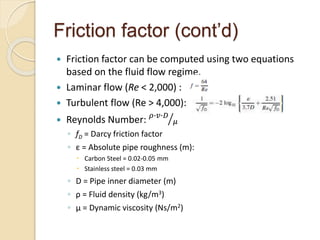
 Friction factor can be computed using two equations
based on the fluid flow regime.
 Laminar flow (Re < 2,000) :
 Turbulent flow (Re > 4,000):
 Reynolds Number: 𝜌∙𝑣∙𝐷
𝜇
◦ fD = Darcy friction factor
◦ ε = Absolute pipe roughness (m):
 Carbon Steel = 0.02-0.05 mm
 Stainless steel = 0.03 mm
◦ D = Pipe inner diameter (m)
◦ ρ = Fluid density (kg/m3)
◦ µ = Dynamic viscosity (Ns/m2)
Friction factor (cont’d)
 Colebrook’s equation require iteration to determine the
friction factor.
 Author propose Churchill (1977) equation that allows
engineers to determine the friction factor for both
laminar and turbulent flows.
Pressure Drop in Pipe and
Fittings
 ΔP for straight pipe run: ∆𝑃𝑏𝑎𝑟/100𝑚=
0.5∙𝑓 𝐷∙𝜌∙𝑣2
𝐷
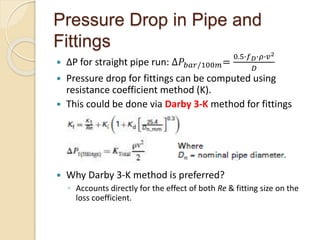
 Pressure drop for fittings can be computed using
resistance coefficient method (K).
 This could be done via Darby 3-K method for fittings
 Why Darby 3-K method is preferred?
◦ Accounts directly for the effect of both Re & fitting size on the
loss coefficient.
Pressure Drop in Pipe and
Fittings (cont’d)
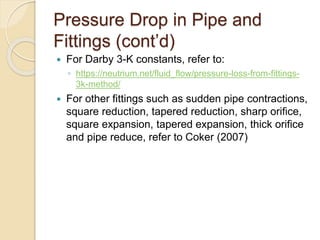
 Other option: The Equivalent Length Method (Leq/D)
 The Leq/D method assumes that:
◦ Size of fittings of a given type can be scaled corresponding to a given dia.
◦ Reynolds number on the friction loss is the same as the pipe loss
 The above assumptions are incorrect. Why?
 The laminar or turbulent flow within a valve or a fitting
is generally quite different from that of straight pipe.
 With this, there is an uncertainty when determining the
effect of Re on the loss coefficients.
 Leq/D method does not account for the lack of exact
scaling for valves and fittings
Pressure Drop in Pipe and
Fittings (cont’d)
 For Darby 3-K constants, refer to:
◦ https://neutrium.net/fluid_flow/pressure-loss-from-fittings-
3k-method/
 For other fittings such as sudden pipe contractions,
square reduction, tapered reduction, sharp orifice,
square expansion, tapered expansion, thick orifice
and pipe reduce, refer to Coker (2007)
Recommended fluid
velocities
 Typical velocities and pressure drop:
◦ Liquid (pumped, not viscous): 1-3 m/s, 0.5 kPa/m
◦ Liquid (gravity flow): - m/s , 0.05 kPa/m
◦ Gases & vapours: 15-30 m/s, 0.02 % of the line pressure
◦ HP steam (> 8 bar): 30-60 m/s, - kPa/m
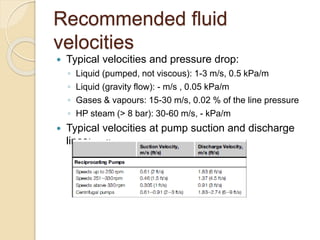
 Typical velocities at pump suction and discharge
lines:
Recommended fluid velocities
(cont’d)
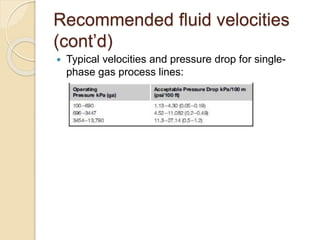
 Typical velocities and pressure drop for single-
phase gas process lines:
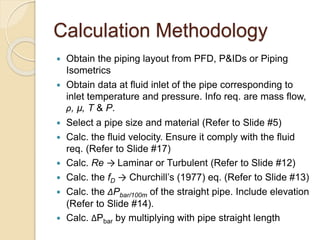
Calculation Methodology
 Obtain the piping layout from PFD, P&IDs or Piping
Isometrics
 Obtain data at fluid inlet of the pipe corresponding to
inlet temperature and pressure. Info req. are mass flow,
ρ, µ, T & P.
 Select a pipe size and material (Refer to Slide #5)
 Calc. the fluid velocity. Ensure it comply with the fluid
req. (Refer to Slide #17)
 Calc. Re → Laminar or Turbulent (Refer to Slide #12)
 Calc. the fD → Churchill’s (1977) eq. (Refer to Slide #13)
 Calc. the ΔPbar/100m of the straight pipe. Include elevation
(Refer to Slide #14).
 Calc. ΔPbar by multiplying with pipe straight length
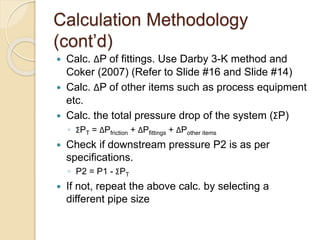
Calculation Methodology
(cont’d)
 Calc. ΔP of fittings. Use Darby 3-K method and
Coker (2007) (Refer to Slide #16 and Slide #14)
 Calc. ΔP of other items such as process equipment
etc.
 Calc. the total pressure drop of the system (ΣP)
◦ ΣPT = ΔPfriction + ΔPfittings + ΔPother items
 Check if downstream pressure P2 is as per
specifications.
◦ P2 = P1 - ΣPT
 If not, repeat the above calc. by selecting a
different pipe size
References
 Bahadori, A. (2014). Process pipe sizing for plants
location. In Natural Gas Processing: Technology and
Engineering Design (p. 83). Oxford: Gulf Professional
Publishing.
 Murty, K. K. (2010). Sizes, Schedules, And Standards.
In All-in-One Manual of Industrial Piping Practice and
Maintenance On-The-Job Solutions, Tips and Insights
(p. 52). New York: Industrial Press.
 Native Dynamics. (2012, May 19). Neutrium. Retrieved
March 7, 2017, from Absolute Roughness of Pipe
Material: https://neutrium.net/fluid_flow/absolute-
roughness/
 Sinnot, R. K. (2005). Piping and Instrumentation. In
Chemical Engineering Design (Vol. 6, p. 218). Oxford:
Elsevier.

Single phase flow line sizing

  • 1.
    Single-phase fluid flow GUIDELINETO PIPE SIZING FOR SINGLE-PHASE FLOW AUTHOR: VIKRAM SHARMA DATE: 7th MARCH 2017
  • 2.
    Table of Contents Introduction  Bernoulli’s Equation  Friction factor graph  Pressure Drop in Pipe and Fittings  Recommended fluid velocities  Calculation Methodology  References
  • 3.
    Introduction  Pipe isa common sight in chemical plant  Pipework & fittings: ◦ ≈ 20-30% of the total design cost; ◦ ≈ 10-20% of the total plant investment; and ◦ Other added cost due to maintenance req. & energy usage in the form of ΔP in the fluids being pumped  The size of a pipe (diameter) is expressed in two ways that are: ◦ Nominal Pipe Size (NPS); and ◦ Diametre Nominal (DN)  NPS is measured in inches, DN is measured in mm  DN is generally equiv. to NPS multiplied by 25
  • 4.
    Introduction (cont’d)  DNis generally equiv. to NPS multiplied by 25 except: ◦ NPS ½ is DN15 ◦ NPS 3 is DN80  Pipe size are designated by two numbers that are (i) pipe diameter and (ii) thickness  Pipe diameter is generally associated with inside dia.  Outside dia. is the same for a given size → maintain certain interchangeability of pipe fittings  NPS 14 and beyond, it is equal to the outside dia. (OD) in inch.
  • 5.
    Introduction (cont’d)  NPS14 and beyond, it is equal to the outside dia. (OD) in inch. (cont’d)  Pipe wall thickness is referred to pipe schedule (Sch)  Standardize from 5 to 160 → determined by the service req. like Pressure, Temp., Flow and corrosion  Pipe wall thickness ↑ Pipe Schedule ↑
  • 6.
    Bernoulli’s Equation  ΔPor head loss in a piping system is caused by: ◦ Elevation; ◦ Friction; ◦ Shaft work; and ◦ Turbulence due to sudden change in direction or cross sectional area  Mechanical Energy Balance (MEB) eq.→ conservation of sum of pressure, kinetic and potential energies, net heat transfer (q), work done by the system (w) and frictional energy (ef).  ef is usually +ve & represents the rate of irreversible conversion of mech. energy into thermal energy  Sometimes called head loss, friction loss or frictional pressure drop.
  • 7.
  • 8.
    Bernoulli’s Equation (cont’d) The first 3 terms (pressure, velocity & elevation) are point functions → depend only on conditions at the inlet & outlet of the system  w and ef are path functions → depend on what is happening to the system between the inlet and outlet points  ef loss due to friction and includes losses due to flow through lengths of pipe, fittings such as elbows, valves, orifices and pipe entrances and exits
  • 9.
    Bernoulli’s Equation (cont’d) Kf is the excess head loss due to pipe or pipe fittings, v is the fluid velocity  Fluids flowing through pipes;  ΔP is the same due to flow is the same whether the pipe is horizontal, vertical or inclined
  • 10.
    Friction factor  Frictionfactor is expressed as Moody friction factor (fM) or Fanning friction factor (fF).  fM = 4fF
  • 11.
    Friction factor (cont’d) Laminar region (or viscous): Re < 2,000  “Critical zone” is the transition frm. laminar to turbulent: 2,000 < Re < 4,000.  Turbulent flow: Re > 4,000  Friction factor is laminar region is not affected by the relative roughness (ε/D) but it is influenced by the fluid viscosity  Friction factor at transition region strongly depends on both the Re and ε/D  Friction factor at turbulent region is independent of Re and is a function of relative roughness (ε/D).
  • 12.
    Friction factor (cont’d) Friction factor can be computed using two equations based on the fluid flow regime.  Laminar flow (Re < 2,000) :  Turbulent flow (Re > 4,000):  Reynolds Number: 𝜌∙𝑣∙𝐷 𝜇 ◦ fD = Darcy friction factor ◦ ε = Absolute pipe roughness (m):  Carbon Steel = 0.02-0.05 mm  Stainless steel = 0.03 mm ◦ D = Pipe inner diameter (m) ◦ ρ = Fluid density (kg/m3) ◦ µ = Dynamic viscosity (Ns/m2)
  • 13.
    Friction factor (cont’d) Colebrook’s equation require iteration to determine the friction factor.  Author propose Churchill (1977) equation that allows engineers to determine the friction factor for both laminar and turbulent flows.
  • 14.
    Pressure Drop inPipe and Fittings  ΔP for straight pipe run: ∆𝑃𝑏𝑎𝑟/100𝑚= 0.5∙𝑓 𝐷∙𝜌∙𝑣2 𝐷  Pressure drop for fittings can be computed using resistance coefficient method (K).  This could be done via Darby 3-K method for fittings  Why Darby 3-K method is preferred? ◦ Accounts directly for the effect of both Re & fitting size on the loss coefficient.
  • 15.
    Pressure Drop inPipe and Fittings (cont’d)  Other option: The Equivalent Length Method (Leq/D)  The Leq/D method assumes that: ◦ Size of fittings of a given type can be scaled corresponding to a given dia. ◦ Reynolds number on the friction loss is the same as the pipe loss  The above assumptions are incorrect. Why?  The laminar or turbulent flow within a valve or a fitting is generally quite different from that of straight pipe.  With this, there is an uncertainty when determining the effect of Re on the loss coefficients.  Leq/D method does not account for the lack of exact scaling for valves and fittings
  • 16.
    Pressure Drop inPipe and Fittings (cont’d)  For Darby 3-K constants, refer to: ◦ https://neutrium.net/fluid_flow/pressure-loss-from-fittings- 3k-method/  For other fittings such as sudden pipe contractions, square reduction, tapered reduction, sharp orifice, square expansion, tapered expansion, thick orifice and pipe reduce, refer to Coker (2007)
  • 17.
    Recommended fluid velocities  Typicalvelocities and pressure drop: ◦ Liquid (pumped, not viscous): 1-3 m/s, 0.5 kPa/m ◦ Liquid (gravity flow): - m/s , 0.05 kPa/m ◦ Gases & vapours: 15-30 m/s, 0.02 % of the line pressure ◦ HP steam (> 8 bar): 30-60 m/s, - kPa/m  Typical velocities at pump suction and discharge lines:
  • 18.
    Recommended fluid velocities (cont’d) Typical velocities and pressure drop for single- phase gas process lines:
  • 19.
    Calculation Methodology  Obtainthe piping layout from PFD, P&IDs or Piping Isometrics  Obtain data at fluid inlet of the pipe corresponding to inlet temperature and pressure. Info req. are mass flow, ρ, µ, T & P.  Select a pipe size and material (Refer to Slide #5)  Calc. the fluid velocity. Ensure it comply with the fluid req. (Refer to Slide #17)  Calc. Re → Laminar or Turbulent (Refer to Slide #12)  Calc. the fD → Churchill’s (1977) eq. (Refer to Slide #13)  Calc. the ΔPbar/100m of the straight pipe. Include elevation (Refer to Slide #14).  Calc. ΔPbar by multiplying with pipe straight length
  • 20.
    Calculation Methodology (cont’d)  Calc.ΔP of fittings. Use Darby 3-K method and Coker (2007) (Refer to Slide #16 and Slide #14)  Calc. ΔP of other items such as process equipment etc.  Calc. the total pressure drop of the system (ΣP) ◦ ΣPT = ΔPfriction + ΔPfittings + ΔPother items  Check if downstream pressure P2 is as per specifications. ◦ P2 = P1 - ΣPT  If not, repeat the above calc. by selecting a different pipe size
  • 21.
    References  Bahadori, A.(2014). Process pipe sizing for plants location. In Natural Gas Processing: Technology and Engineering Design (p. 83). Oxford: Gulf Professional Publishing.  Murty, K. K. (2010). Sizes, Schedules, And Standards. In All-in-One Manual of Industrial Piping Practice and Maintenance On-The-Job Solutions, Tips and Insights (p. 52). New York: Industrial Press.  Native Dynamics. (2012, May 19). Neutrium. Retrieved March 7, 2017, from Absolute Roughness of Pipe Material: https://neutrium.net/fluid_flow/absolute- roughness/  Sinnot, R. K. (2005). Piping and Instrumentation. In Chemical Engineering Design (Vol. 6, p. 218). Oxford: Elsevier.