PUMP
SEMINAR PRESENTATION
BY:
RAHUL CHAURASIYA
INTRODUCTION
A pump is a device that moves fluids (liquids or gases), or slurries, by
mechanical action from one place to another.
Pumps operate by some mechanism (reciprocating or rotary), and
consume energy to perform mechanical work by moving the fluid.
Pumps operate via many energy sources, including manual
operation, electricity, engines, or wind power.
CLASSIFICATION
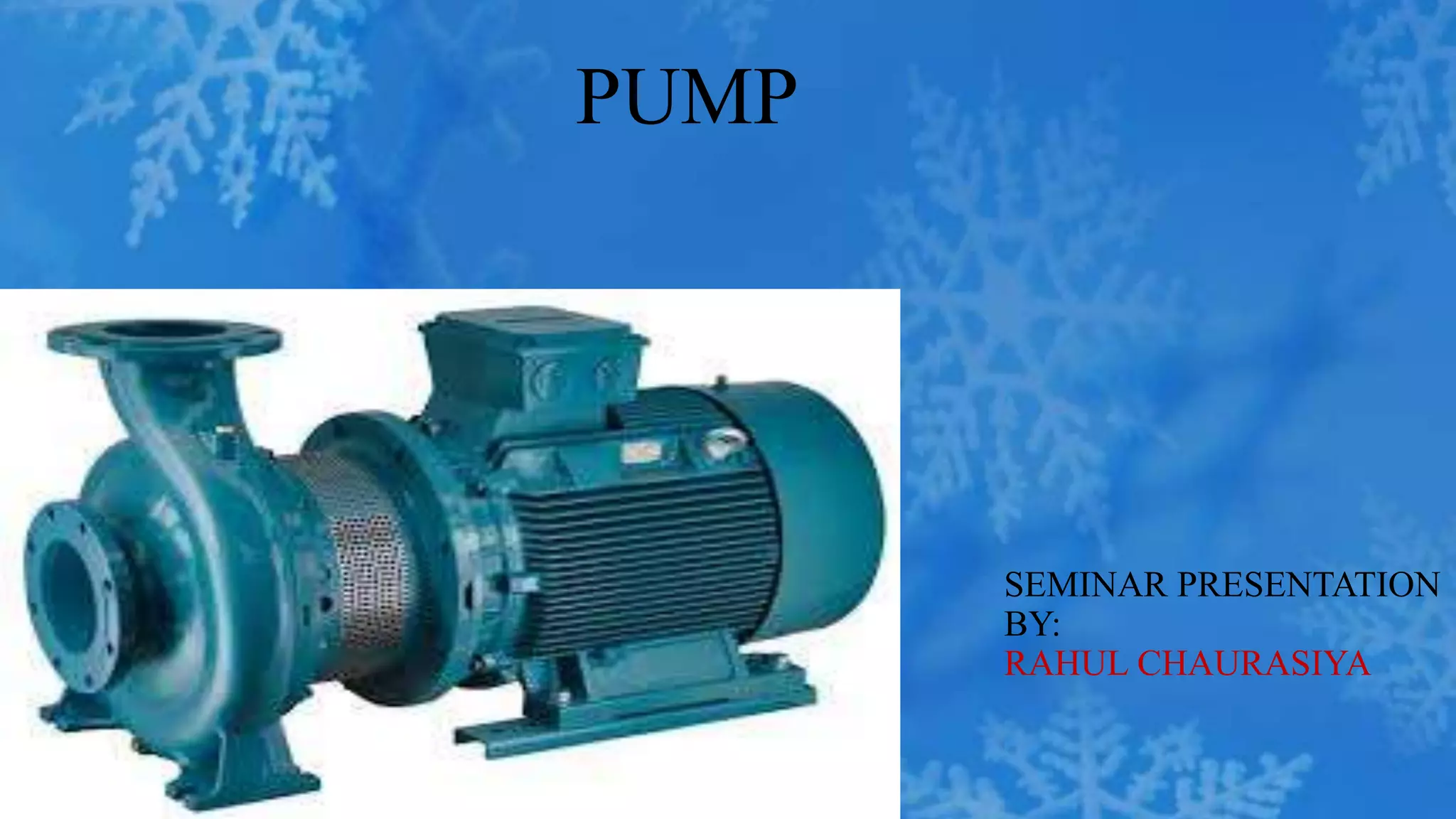
PUMP
POSITIVE
DISPLACEMENT
ROTARY
SINGLE ROTOR MULTIPLE
ROTOR
RECIPROCATING
DIAPHRAGM PISTON,PLUNGER
DYNAMIC
CENTRIFUGAL AXIAL
Positive Displacement Pump
TYPES OF Positive Displacement Pump:
1. Diaphragm Pump
2. Gear Pump
3. Lobe Pump
4. Piston Pump
5. Peristaltic Pump
Dynamic Pump
TYPES OF Dynamic Pump:
1. Centrifugal Pump
2. Submersible Pump
3. Vertical Centrifugal Pump
4. Horizontal Centrifugal Pump
5. Fire Hydrant Pump
CENTRIFUGAL PUMP
Centrifugal pumps are the most used pump type in the world due to simple
working principle and relatively inexpensive manufacturing cost.
Common uses include water, sewage, petroleum and petrochemical pumping.
Centrifugal pumps are used to transport fluids by the conversion of rotational
kinetic energy to the hydrodynamic energy of the fluid flow.
The rotational energy comes from an engine or electric motor.
How it works?
Fluid enters axially through eye of the casing, is caught up in the impeller
blades, and is whirled tangentially and radially outward until it leaves through
all circumferential parts of the impeller into the diffuser part of the casing.
The fluid gains both velocity and pressure while passing through the impeller.
The doughnut-shaped diffuser, or scroll, section of the casing decelerates the
flow and further increases the pressure.
Problems of centrifugal pumps:
These are some difficulties faced in centrifugal pumps:
Cavitation
Wear of the impeller
Corrosion inside the pump caused by the fluid properties
Overheating due to low flow
Leakage along rotating shaft.
Surge
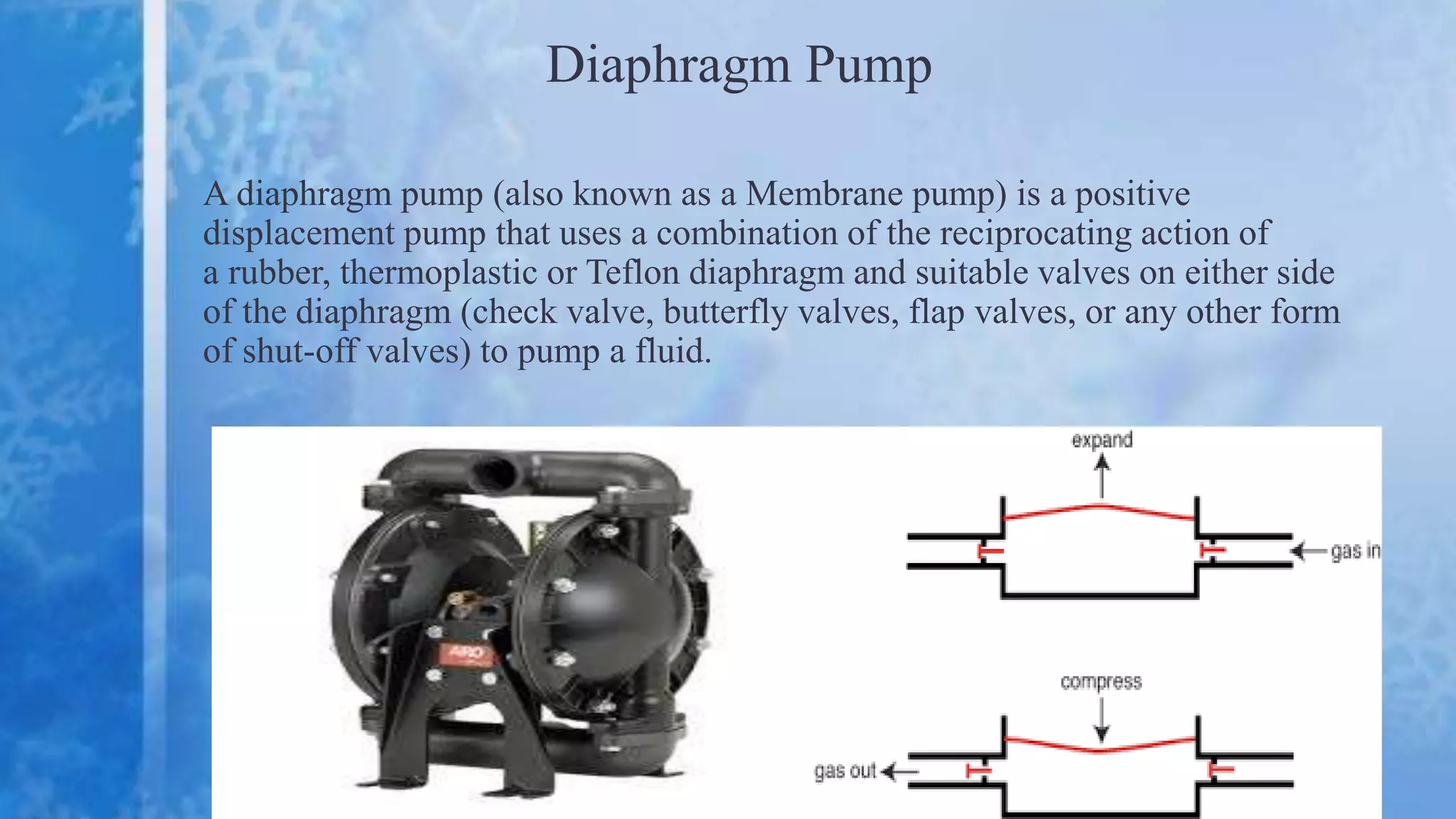
Diaphragm Pump
A diaphragm pump (also known as a Membrane pump) is a positive
displacement pump that uses a combination of the reciprocating action of
a rubber, thermoplastic or Teflon diaphragm and suitable valves on either side
of the diaphragm (check valve, butterfly valves, flap valves, or any other form
of shut-off valves) to pump a fluid.
Diaphragm pump characteristics:
Have good suction lift characteristics
They can handle sludge and slurries
Suitable for discharge pressure up to 1,200 bar
Have good dry running characteristics.
Can be used to make artificial hearts.
Are used to make air pumps for the filters on small fish tanks.
Can be up to 97% efficient.
Have good self priming capabilities.
Can handle highly viscous liquids
APPLICATIONS
Well pumps
Utility Pumps
Water Pumps
Wastewater pumps
Slurry pumps
Process pumps
Irrigation pumps
Industrial pumps
Fire pumps
Lubrication pump
THANK YOU

Pump and Types Of Pumps

  • 1.
  • 2.
    INTRODUCTION A pump isa device that moves fluids (liquids or gases), or slurries, by mechanical action from one place to another. Pumps operate by some mechanism (reciprocating or rotary), and consume energy to perform mechanical work by moving the fluid. Pumps operate via many energy sources, including manual operation, electricity, engines, or wind power.
  • 3.
  • 4.
    Positive Displacement Pump TYPESOF Positive Displacement Pump: 1. Diaphragm Pump 2. Gear Pump 3. Lobe Pump 4. Piston Pump 5. Peristaltic Pump
  • 5.
    Dynamic Pump TYPES OFDynamic Pump: 1. Centrifugal Pump 2. Submersible Pump 3. Vertical Centrifugal Pump 4. Horizontal Centrifugal Pump 5. Fire Hydrant Pump
  • 6.
    CENTRIFUGAL PUMP Centrifugal pumpsare the most used pump type in the world due to simple working principle and relatively inexpensive manufacturing cost. Common uses include water, sewage, petroleum and petrochemical pumping. Centrifugal pumps are used to transport fluids by the conversion of rotational kinetic energy to the hydrodynamic energy of the fluid flow. The rotational energy comes from an engine or electric motor.
  • 7.
    How it works? Fluidenters axially through eye of the casing, is caught up in the impeller blades, and is whirled tangentially and radially outward until it leaves through all circumferential parts of the impeller into the diffuser part of the casing. The fluid gains both velocity and pressure while passing through the impeller. The doughnut-shaped diffuser, or scroll, section of the casing decelerates the flow and further increases the pressure.
  • 8.
    Problems of centrifugalpumps: These are some difficulties faced in centrifugal pumps: Cavitation Wear of the impeller Corrosion inside the pump caused by the fluid properties Overheating due to low flow Leakage along rotating shaft. Surge
  • 9.
    Diaphragm Pump A diaphragmpump (also known as a Membrane pump) is a positive displacement pump that uses a combination of the reciprocating action of a rubber, thermoplastic or Teflon diaphragm and suitable valves on either side of the diaphragm (check valve, butterfly valves, flap valves, or any other form of shut-off valves) to pump a fluid.
  • 10.
    Diaphragm pump characteristics: Havegood suction lift characteristics They can handle sludge and slurries Suitable for discharge pressure up to 1,200 bar Have good dry running characteristics. Can be used to make artificial hearts. Are used to make air pumps for the filters on small fish tanks. Can be up to 97% efficient. Have good self priming capabilities. Can handle highly viscous liquids
  • 11.
    APPLICATIONS Well pumps Utility Pumps WaterPumps Wastewater pumps Slurry pumps Process pumps Irrigation pumps Industrial pumps Fire pumps Lubrication pump
  • 12.