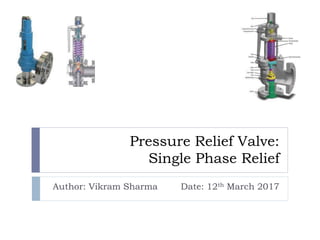
Pressure Relief Valve:
Single Phase Relief
Author: Vikram Sharma Date: 12th March 2017
Table of Contents
 Introduction
 Type of Pressure Relief Valves
 Concept of backpressure
 Pressure level settings
 Calculation methodology
 Summary
 References
Introduction
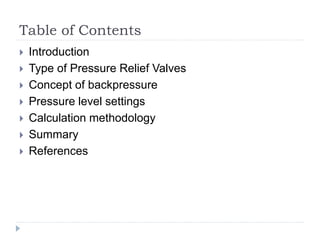
 Pressure relief valves a.k.a pressure relief devices
(PRD)
 Primary function → protect an equipment frm.
overpressure that may lead to catastrophic incident.
 Common → PRDs safety valve, PRV, safety relief
valve, PORV & rupture disk
 Focus on three types of PRVs:
 Conventional PRV
 Balanced-bellows PRV and
 Pilot Operated PRV
 Calculation as per API Std. 520 Part 1 9th Ed. (2013)
Type of Pressure Relief Valves
 Types of PRV:
 Conventional PRV;
 Balanced-Bellows PRV; and
 Pilot Operated PRV
 Conventional PRV:
 Used when the built-up backpressure should not exceed
10% of the set pressure at 10% allowable overpressure.
 Higher allowable overpressure of more than 10% may
allow a higher max. allowable built-up backpressure
provided the built-up backpressure does not exceed the
allowable overpressure.
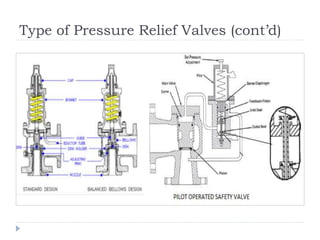
Type of Pressure Relief Valves (cont’d)
 Balanced-bellows PRV:
 Used when the built-up backpressure (superimposed +
built-up) is too high for conventional PRV.
 Used when the superimposed backpressure varies
significantly in comparison to the set pressure
 Used when the total backpressure (superimposed + built-
up) does not exceed approx. 50% of the set pressure
 Pilot Operated PRV:
 Valve lift is not affected by backpressure
Type of Pressure Relief Valves (cont’d)
Concept of Backpressure
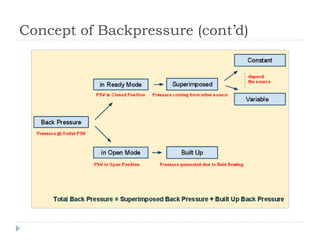
 Backpressure consist of two parts that are:
 Superimposed backpressure
 Built-up backpressure
 Superimposed backpressure:
 Pressure originating frm. other sources when the PRV is
in READY MODE.
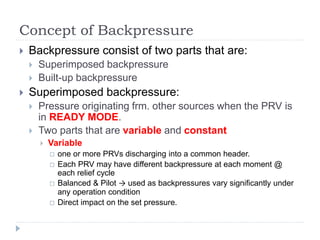
 Two parts that are variable and constant
 Variable
 one or more PRVs discharging into a common header.
 Each PRV may have different backpressure at each moment @
each relief cycle
 Balanced & Pilot → used as backpressures vary significantly under
any operation condition
 Direct impact on the set pressure.
Concept of Backpressure (cont’d)
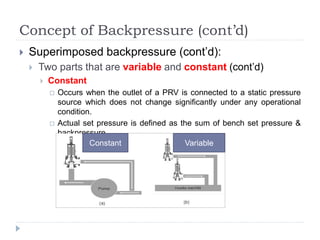
 Superimposed backpressure (cont’d):
 Two parts that are variable and constant (cont’d)
 Constant
 Occurs when the outlet of a PRV is connected to a static pressure
source which does not change significantly under any operational
condition.
 Actual set pressure is defined as the sum of bench set pressure &
backpressure
Constant Variable
Concept of Backpressure (cont’d)
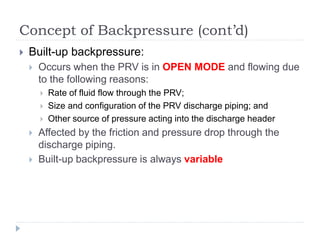
 Built-up backpressure:
 Occurs when the PRV is in OPEN MODE and flowing due
to the following reasons:
 Rate of fluid flow through the PRV;
 Size and configuration of the PRV discharge piping; and
 Other source of pressure acting into the discharge header
 Affected by the friction and pressure drop through the
discharge piping.
 Built-up backpressure is always variable
Concept of Backpressure (cont’d)
Pressure Level settings
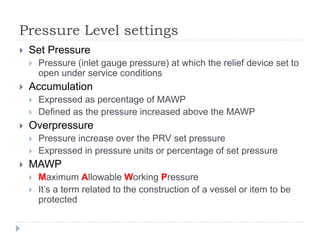
 Set Pressure
 Pressure (inlet gauge pressure) at which the relief device set to
open under service conditions
 Accumulation
 Expressed as percentage of MAWP
 Defined as the pressure increased above the MAWP
 Overpressure
 Pressure increase over the PRV set pressure
 Expressed in pressure units or percentage of set pressure
 MAWP
 Maximum Allowable Working Pressure
 It’s a term related to the construction of a vessel or item to be
protected
Pressure Level settings (cont’d)
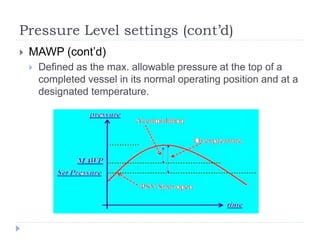
 MAWP (cont’d)
 Defined as the max. allowable pressure at the top of a
completed vessel in its normal operating position and at a
designated temperature.
Pressure Level settings (cont’d)
 Confusion between accumulation & overpressure?
 Overpressure is referenced to the set pressure which is a
property of a relief valve.
 Accumulation is related to MAWP which is a property of a
vessel or item to be protected.
 Confusion between MAWP & Design Pressure?
 MAWP → defined as the max. allowable pressure at the
top of a completed vessel in its normal operating position
and at a designated temperature.
 Design pressure → pressure with a margin above the
most severe pressure expected during normal operation
at a coincident temp.
 MAWP is normally higher than the design pressure (API
520)
Pressure Level settings (cont’d)
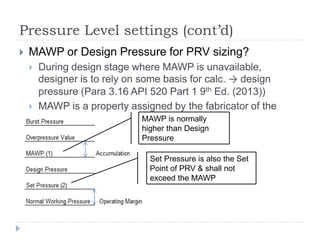
 MAWP or Design Pressure for PRV sizing?
 During design stage where MAWP is unavailable,
designer is to rely on some basis for calc. → design
pressure (Para 3.16 API 520 Part 1 9th Ed. (2013))
 MAWP is a property assigned by the fabricator of the
vessel
 ff
MAWP is normally
higher than Design
Pressure
Set Pressure is also the Set
Point of PRV & shall not
exceed the MAWP
Pressure Level settings (cont’d)
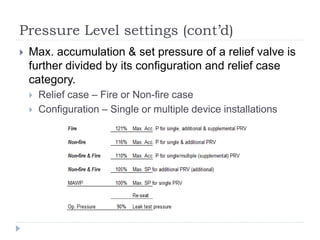
 Max. accumulation & set pressure of a relief valve is
further divided by its configuration and relief case
category.
 Relief case – Fire or Non-fire case
 Configuration – Single or multiple device installations
Calculation Methodology
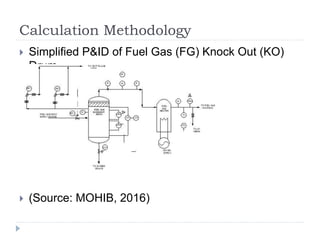
 Simplified P&ID of Fuel Gas (FG) Knock Out (KO)
Drum
 (Source: MOHIB, 2016)
Calculation Methodology (cont’d)
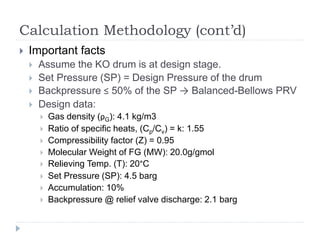
 Important facts
 Assume the KO drum is at design stage.
 Set Pressure (SP) = Design Pressure of the drum
 Backpressure ≤ 50% of the SP → Balanced-Bellows PRV
 Design data:
 Gas density (ρG): 4.1 kg/m3
 Ratio of specific heats, (Cp/Cv) = k: 1.55
 Compressibility factor (Z) = 0.95
 Molecular Weight of FG (MW): 20.0g/gmol
 Relieving Temp. (T): 20°C
 Set Pressure (SP): 4.5 barg
 Accumulation: 10%
 Backpressure @ relief valve discharge: 2.1 barg
Calculation Methodology (cont’d)
 Check if the PRV conforms to critical or sub-critical
flow condition
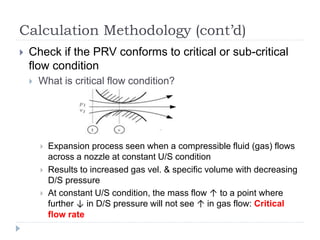
 What is critical flow condition?
 Expansion process seen when a compressible fluid (gas) flows
across a nozzle at constant U/S condition
 Results to increased gas vel. & specific volume with decreasing
D/S pressure
 At constant U/S condition, the mass flow ↑ to a point where
further ↓ in D/S pressure will not see ↑ in gas flow: Critical
flow rate
Calculation Methodology (cont’d)
 Check if the PRV conforms to critical or sub-critical
flow condition
 What is critical flow condition? (cont’d)
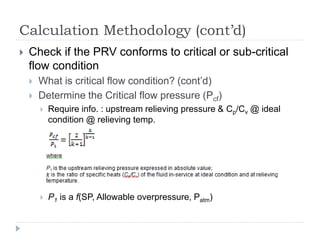
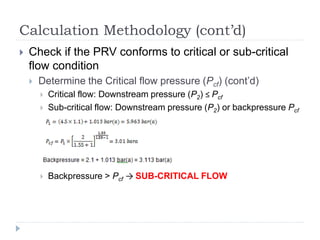
 Determine the Critical flow pressure (Pcf)
 Require info. : upstream relieving pressure & Cp/Cv @ ideal
condition @ relieving temp.
 P1 is a f(SP, Allowable overpressure, Patm)
Calculation Methodology (cont’d)
 Check if the PRV conforms to critical or sub-critical
flow condition
 Determine the Critical flow pressure (Pcf) (cont’d)
 Critical flow: Downstream pressure (P2) ≤ Pcf
 Sub-critical flow: Downstream pressure (P2) or backpressure Pcf
 Backpressure > Pcf → SUB-CRITICAL FLOW
Calculation Methodology (cont’d)
 Check if the PRV conforms to critical or sub-critical
flow condition
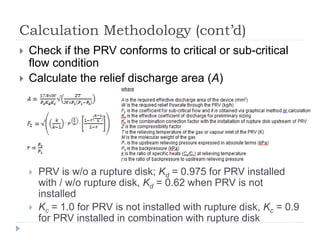
 Calculate the relief discharge area (A)
 PRV is w/o a rupture disk; Kd = 0.975 for PRV installed
with / w/o rupture disk, Kd = 0.62 when PRV is not
installed
 Kc = 1.0 for PRV is not installed with rupture disk, Kc = 0.9
for PRV installed in combination with rupture disk
Calculation Methodology (cont’d)
 Calculate the relief discharge area (A) (cont’d)
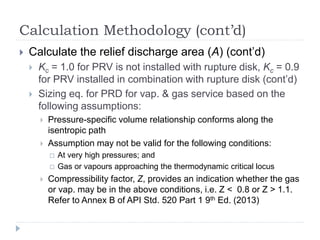
 Kc = 1.0 for PRV is not installed with rupture disk, Kc = 0.9
for PRV installed in combination with rupture disk (cont’d)
 Sizing eq. for PRD for vap. & gas service based on the
following assumptions:
 Pressure-specific volume relationship conforms along the
isentropic path
 Assumption may not be valid for the following conditions:
 At very high pressures; and
 Gas or vapours approaching the thermodynamic critical locus
 Compressibility factor, Z, provides an indication whether the gas
or vap. may be in the above conditions, i.e. Z < 0.8 or Z > 1.1.
Refer to Annex B of API Std. 520 Part 1 9th Ed. (2013)
Calculation Methodology (cont’d)
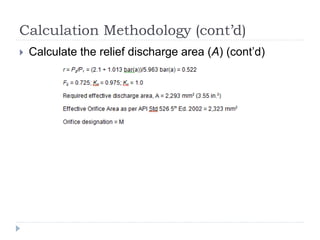
 Calculate the relief discharge area (A) (cont’d)
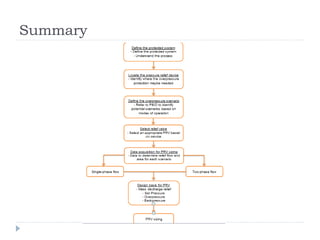
Summary
References
 "Pressure Relief Valve Sizing Calculations". (2017). Pressure Relief Valve Sizing Calculations – Subcritical Gas
Flow Service. Retrieved January 12, 2017, from Engcyclopedia: http://www.enggcyclopedia.com/2011/11/pressure-
relief-valve-sizing-calculations-subcritical-gas-flow/
 API. (2013, December). API Standard 520 Part 1. Sizing, Selection, and Installation of Pressure-relieving Devices,
9th. Washington, D.C: American Petroleum Institute.
 Coker, A. K. (2006). Process Safety and Pressure-Relieving Devices. In Applied Process Design for Chemicals and
Petrochemical Plants (4th ed., pp. 575-578). Oxford, 1: Gulf Professional Publishing.
 Coker, A. K. (2006). Process Safety and Pressure-Relieving Devices. In Applied Process Design for Chemical and
Petrochemicals (4th ed., p. 580). Oxford: Gulf Professional Publishing.
 Crowl, D. A., & Tipler, S. A. (2013, October). Sizing Pressure-Relief Devices. Chemical Engineering Progress, pp.
68-76.
 Gas flow through nozzles - sonic chokes. (n.d.). The Engineering ToolBox. Retrieved January 18, 2017, from
Nozzles: Gas flow through nozzles - sonic chokes: http://www.engineeringtoolbox.com/nozzles-d_1041.html
 Hellemans, M. (2009). Terminology. In The Safety Relief Valve handbook: Design and Use of Process Safety
Valves to ASME and International Codes and Standards (1st ed., p. 44). Burlington: Butterworth-Heinemann.
 Hellemans, M. (2009). Terminology. In The Safety Relief Valve Handbook: Design and Use of Process Safety
Valves to ASME and International Codes and Standards (1st ed., pp. 34-35). Burlington: Butterworth-Heinemann.
 MOHIB. (2016, October 9). CHEMEWORK. Retrieved January 13, 2017, from FRESH WATER AND FUEL GAS
SYSTEM [Blog post]: http://www.chemework.com/2016/10/09/fresh-water-and-fuel-gas-system/
 Triyanto SR. (n.d.). Process Engineer. Retrieved December 26, 2016, from Built Up and Superimpossed Back
Pressure [Blog post]: http://process-eng.blogspot.my/2011/02/built-up-and-superimposed-back-pressure_2304.html
 Triyanto SR. (n.d.). Process Engineer. Retrieved January 1, 2017, from Accumulation and Overpressure [Blog
post]: http://process-eng.blogspot.my/2012/03/accumulation-and-overpressure.html
 Whitesides, R. W. (2008). PDH Course M112: Selection and Sizing of Pressure Relief Valves. PDHOnline.

Pressure Relief Valve Sizing for Single Phase Flow

  • 1.
    Pressure Relief Valve: SinglePhase Relief Author: Vikram Sharma Date: 12th March 2017
  • 2.
    Table of Contents Introduction  Type of Pressure Relief Valves  Concept of backpressure  Pressure level settings  Calculation methodology  Summary  References
  • 3.
    Introduction  Pressure reliefvalves a.k.a pressure relief devices (PRD)  Primary function → protect an equipment frm. overpressure that may lead to catastrophic incident.  Common → PRDs safety valve, PRV, safety relief valve, PORV & rupture disk  Focus on three types of PRVs:  Conventional PRV  Balanced-bellows PRV and  Pilot Operated PRV  Calculation as per API Std. 520 Part 1 9th Ed. (2013)
  • 4.
    Type of PressureRelief Valves  Types of PRV:  Conventional PRV;  Balanced-Bellows PRV; and  Pilot Operated PRV  Conventional PRV:  Used when the built-up backpressure should not exceed 10% of the set pressure at 10% allowable overpressure.  Higher allowable overpressure of more than 10% may allow a higher max. allowable built-up backpressure provided the built-up backpressure does not exceed the allowable overpressure.
  • 5.
    Type of PressureRelief Valves (cont’d)  Balanced-bellows PRV:  Used when the built-up backpressure (superimposed + built-up) is too high for conventional PRV.  Used when the superimposed backpressure varies significantly in comparison to the set pressure  Used when the total backpressure (superimposed + built- up) does not exceed approx. 50% of the set pressure  Pilot Operated PRV:  Valve lift is not affected by backpressure
  • 6.
    Type of PressureRelief Valves (cont’d)
  • 7.
    Concept of Backpressure Backpressure consist of two parts that are:  Superimposed backpressure  Built-up backpressure  Superimposed backpressure:  Pressure originating frm. other sources when the PRV is in READY MODE.  Two parts that are variable and constant  Variable  one or more PRVs discharging into a common header.  Each PRV may have different backpressure at each moment @ each relief cycle  Balanced & Pilot → used as backpressures vary significantly under any operation condition  Direct impact on the set pressure.
  • 8.
    Concept of Backpressure(cont’d)  Superimposed backpressure (cont’d):  Two parts that are variable and constant (cont’d)  Constant  Occurs when the outlet of a PRV is connected to a static pressure source which does not change significantly under any operational condition.  Actual set pressure is defined as the sum of bench set pressure & backpressure Constant Variable
  • 9.
    Concept of Backpressure(cont’d)  Built-up backpressure:  Occurs when the PRV is in OPEN MODE and flowing due to the following reasons:  Rate of fluid flow through the PRV;  Size and configuration of the PRV discharge piping; and  Other source of pressure acting into the discharge header  Affected by the friction and pressure drop through the discharge piping.  Built-up backpressure is always variable
  • 10.
  • 11.
    Pressure Level settings Set Pressure  Pressure (inlet gauge pressure) at which the relief device set to open under service conditions  Accumulation  Expressed as percentage of MAWP  Defined as the pressure increased above the MAWP  Overpressure  Pressure increase over the PRV set pressure  Expressed in pressure units or percentage of set pressure  MAWP  Maximum Allowable Working Pressure  It’s a term related to the construction of a vessel or item to be protected
  • 12.
    Pressure Level settings(cont’d)  MAWP (cont’d)  Defined as the max. allowable pressure at the top of a completed vessel in its normal operating position and at a designated temperature.
  • 13.
    Pressure Level settings(cont’d)  Confusion between accumulation & overpressure?  Overpressure is referenced to the set pressure which is a property of a relief valve.  Accumulation is related to MAWP which is a property of a vessel or item to be protected.  Confusion between MAWP & Design Pressure?  MAWP → defined as the max. allowable pressure at the top of a completed vessel in its normal operating position and at a designated temperature.  Design pressure → pressure with a margin above the most severe pressure expected during normal operation at a coincident temp.  MAWP is normally higher than the design pressure (API 520)
  • 14.
    Pressure Level settings(cont’d)  MAWP or Design Pressure for PRV sizing?  During design stage where MAWP is unavailable, designer is to rely on some basis for calc. → design pressure (Para 3.16 API 520 Part 1 9th Ed. (2013))  MAWP is a property assigned by the fabricator of the vessel  ff MAWP is normally higher than Design Pressure Set Pressure is also the Set Point of PRV & shall not exceed the MAWP
  • 15.
    Pressure Level settings(cont’d)  Max. accumulation & set pressure of a relief valve is further divided by its configuration and relief case category.  Relief case – Fire or Non-fire case  Configuration – Single or multiple device installations
  • 16.
    Calculation Methodology  SimplifiedP&ID of Fuel Gas (FG) Knock Out (KO) Drum  (Source: MOHIB, 2016)
  • 17.
    Calculation Methodology (cont’d) Important facts  Assume the KO drum is at design stage.  Set Pressure (SP) = Design Pressure of the drum  Backpressure ≤ 50% of the SP → Balanced-Bellows PRV  Design data:  Gas density (ρG): 4.1 kg/m3  Ratio of specific heats, (Cp/Cv) = k: 1.55  Compressibility factor (Z) = 0.95  Molecular Weight of FG (MW): 20.0g/gmol  Relieving Temp. (T): 20°C  Set Pressure (SP): 4.5 barg  Accumulation: 10%  Backpressure @ relief valve discharge: 2.1 barg
  • 18.
    Calculation Methodology (cont’d) Check if the PRV conforms to critical or sub-critical flow condition  What is critical flow condition?  Expansion process seen when a compressible fluid (gas) flows across a nozzle at constant U/S condition  Results to increased gas vel. & specific volume with decreasing D/S pressure  At constant U/S condition, the mass flow ↑ to a point where further ↓ in D/S pressure will not see ↑ in gas flow: Critical flow rate
  • 19.
    Calculation Methodology (cont’d) Check if the PRV conforms to critical or sub-critical flow condition  What is critical flow condition? (cont’d)  Determine the Critical flow pressure (Pcf)  Require info. : upstream relieving pressure & Cp/Cv @ ideal condition @ relieving temp.  P1 is a f(SP, Allowable overpressure, Patm)
  • 20.
    Calculation Methodology (cont’d) Check if the PRV conforms to critical or sub-critical flow condition  Determine the Critical flow pressure (Pcf) (cont’d)  Critical flow: Downstream pressure (P2) ≤ Pcf  Sub-critical flow: Downstream pressure (P2) or backpressure Pcf  Backpressure > Pcf → SUB-CRITICAL FLOW
  • 21.
    Calculation Methodology (cont’d) Check if the PRV conforms to critical or sub-critical flow condition  Calculate the relief discharge area (A)  PRV is w/o a rupture disk; Kd = 0.975 for PRV installed with / w/o rupture disk, Kd = 0.62 when PRV is not installed  Kc = 1.0 for PRV is not installed with rupture disk, Kc = 0.9 for PRV installed in combination with rupture disk
  • 22.
    Calculation Methodology (cont’d) Calculate the relief discharge area (A) (cont’d)  Kc = 1.0 for PRV is not installed with rupture disk, Kc = 0.9 for PRV installed in combination with rupture disk (cont’d)  Sizing eq. for PRD for vap. & gas service based on the following assumptions:  Pressure-specific volume relationship conforms along the isentropic path  Assumption may not be valid for the following conditions:  At very high pressures; and  Gas or vapours approaching the thermodynamic critical locus  Compressibility factor, Z, provides an indication whether the gas or vap. may be in the above conditions, i.e. Z < 0.8 or Z > 1.1. Refer to Annex B of API Std. 520 Part 1 9th Ed. (2013)
  • 23.
    Calculation Methodology (cont’d) Calculate the relief discharge area (A) (cont’d)
  • 24.
  • 25.
    References  "Pressure ReliefValve Sizing Calculations". (2017). Pressure Relief Valve Sizing Calculations – Subcritical Gas Flow Service. Retrieved January 12, 2017, from Engcyclopedia: http://www.enggcyclopedia.com/2011/11/pressure- relief-valve-sizing-calculations-subcritical-gas-flow/  API. (2013, December). API Standard 520 Part 1. Sizing, Selection, and Installation of Pressure-relieving Devices, 9th. Washington, D.C: American Petroleum Institute.  Coker, A. K. (2006). Process Safety and Pressure-Relieving Devices. In Applied Process Design for Chemicals and Petrochemical Plants (4th ed., pp. 575-578). Oxford, 1: Gulf Professional Publishing.  Coker, A. K. (2006). Process Safety and Pressure-Relieving Devices. In Applied Process Design for Chemical and Petrochemicals (4th ed., p. 580). Oxford: Gulf Professional Publishing.  Crowl, D. A., & Tipler, S. A. (2013, October). Sizing Pressure-Relief Devices. Chemical Engineering Progress, pp. 68-76.  Gas flow through nozzles - sonic chokes. (n.d.). The Engineering ToolBox. Retrieved January 18, 2017, from Nozzles: Gas flow through nozzles - sonic chokes: http://www.engineeringtoolbox.com/nozzles-d_1041.html  Hellemans, M. (2009). Terminology. In The Safety Relief Valve handbook: Design and Use of Process Safety Valves to ASME and International Codes and Standards (1st ed., p. 44). Burlington: Butterworth-Heinemann.  Hellemans, M. (2009). Terminology. In The Safety Relief Valve Handbook: Design and Use of Process Safety Valves to ASME and International Codes and Standards (1st ed., pp. 34-35). Burlington: Butterworth-Heinemann.  MOHIB. (2016, October 9). CHEMEWORK. Retrieved January 13, 2017, from FRESH WATER AND FUEL GAS SYSTEM [Blog post]: http://www.chemework.com/2016/10/09/fresh-water-and-fuel-gas-system/  Triyanto SR. (n.d.). Process Engineer. Retrieved December 26, 2016, from Built Up and Superimpossed Back Pressure [Blog post]: http://process-eng.blogspot.my/2011/02/built-up-and-superimposed-back-pressure_2304.html  Triyanto SR. (n.d.). Process Engineer. Retrieved January 1, 2017, from Accumulation and Overpressure [Blog post]: http://process-eng.blogspot.my/2012/03/accumulation-and-overpressure.html  Whitesides, R. W. (2008). PDH Course M112: Selection and Sizing of Pressure Relief Valves. PDHOnline.