1 of 60
Basics of Pumps
Fazal ur Rehman Babar
2 of 60
What is Pump? ‫بمب‬ ‫هو‬ ‫ما‬
It convert mechanical energy into hydraulic energy.
‫المائية‬ ‫طاقة‬ ‫إلى‬ ‫الميكانيكية‬ ‫الطاقة‬ ‫تحويل‬ ‫ومن‬
Water or other fluid at in motion
‫الحركة‬ ‫في‬ ‫األخرى‬ ‫السوائل‬ ‫أو‬ ‫الماء‬
Need of Pump ‫الحاجة‬‫بمب‬
To increase pressure ‫الضغط‬ ‫لزيادة‬
To increase flow rate ‫النسبة‬ ‫معدل‬ ‫لزيادة‬
To move fluid from lower elevation to higher elevation
‫ارتفاع‬ ‫ألعلى‬ ‫ارتفاع‬ ‫أقل‬ ‫من‬ ‫المائع‬ ‫لنقل‬
3 of 60
Purpose of Pumps ‫بمب‬ ‫استعمال‬
Pump is a devise used to
Move liquid from low pressure area to high pressure area
Ex: Boiler feedwater pump (Multi stage centrifugal pump)
To move fluid from lower elevation to higher elevation
Ex: All the process pumps (Centrifugal pump)
To increase flow rate of the liquid
Ex: All the process pumps (Centrifugal pump)
To increase pressure of the liquid
Ex: Car washing pump (Piston pump)
To circulate the flow of liquid in closed loop system
Ex: Sealing water in LIQUID ring vacuum pump (Centrifugal pump)
4 of 60
Pump has three main characteristics ‫الخصائص‬
Pump Characteristics:
1) Pressure
2) Flow
3) Head
5 of 60
Pump design
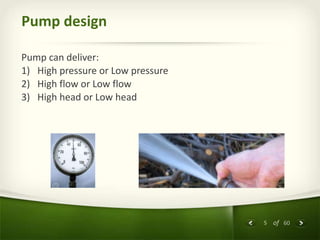
Pump can deliver:
1) High pressure or Low pressure
2) High flow or Low flow
3) High head or Low head
6 of 60
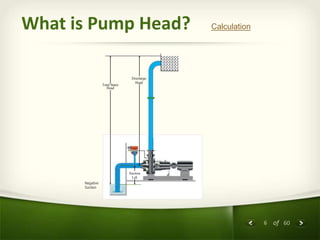
What is Pump Head?
Total Static
Head
Suction
Lift
Discharge
Head
Calculation
Negative
Suction
7 of 60
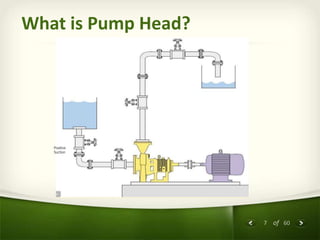
What is Pump Head?
Positive
Suction
8 of 60
Pump Selection
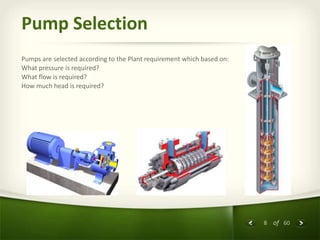
Pumps are selected according to the Plant requirement which based on:
What pressure is required?
What flow is required?
How much head is required?
9 of 60
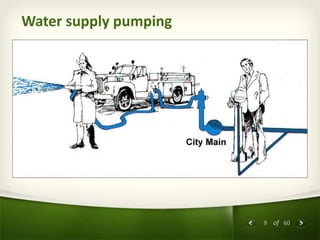
Water supply pumping
10 of 60
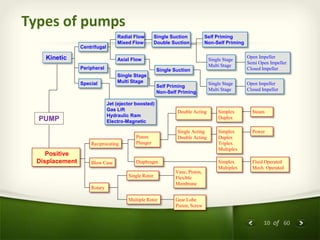
Types of pumps
PUMP
Kinetic
Self Priming
Non-Self Priming
Single Stage
Multi Stage
Single Stage
Multi Stage
Open Impeller
Closed Impeller
Single Stage
Multi Stage
Self Priming
Non-Self Priming
Jet (ejector boosted)
Gas Lift
Hydraulic Ram
Electro-Magnetic
Peripheral
Special
Centrifugal
Radial Flow
Mixed Flow
Single Suction
Double Suction
Open Impeller
Semi Open Impeller
Closed ImpellerSingle Suction
Axial Flow
Reciprocating
Positive
Displacement Blow Case Diaphragm
Piston
Plunger
Double Acting SteamSimplex
Duplex
PowerSingle Acting
Double Acting
Fluid Operated
Mech. Operated
Simplex
Multiplex
Rotary
Single Rotor
Multiple Rotor
Vane, Piston,
Flexible
Membrane
Gear Lobe
Piston, Screw
Simplex
Duplex
Triplex
Multiplex
11 of 60
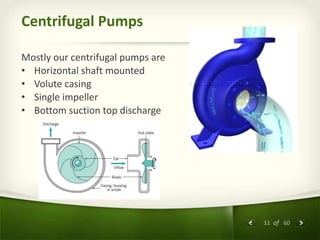
Centrifugal Pumps
Mostly our centrifugal pumps are
• Horizontal shaft mounted
• Volute casing
• Single impeller
• Bottom suction top discharge
12 of 60
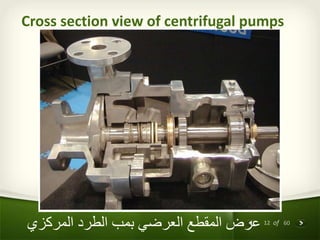
‫المركزي‬ ‫الطرد‬ ‫بمب‬ ‫العرضي‬ ‫المقطع‬ ‫عرض‬
Cross section view of centrifugal pumps
13 of 60
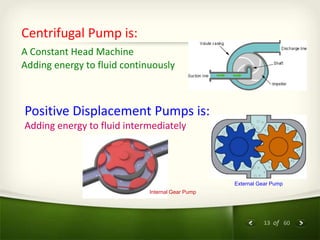
Centrifugal Pump is:
A Constant Head Machine
Adding energy to fluid continuously
Positive Displacement Pumps is:
Adding energy to fluid intermediately
External Gear Pump
Internal Gear Pump
14 of 60
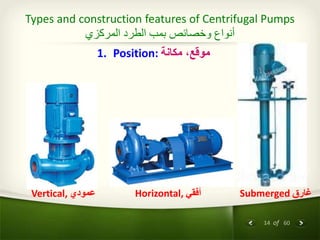
Types and construction features of Centrifugal Pumps
‫المركزي‬ ‫الطرد‬ ‫بمب‬ ‫وخصائص‬ ‫أنواع‬
1. Position: ‫مكانة‬ ،‫موقع‬
Vertical, ‫عمودي‬ Horizontal, ‫أفقي‬ Submerged ‫غارق‬
15 of 60
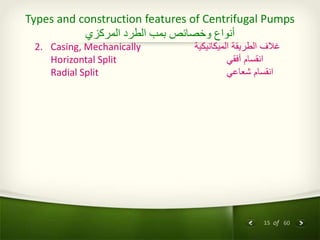
Types and construction features of Centrifugal Pumps
‫المركزي‬ ‫الطرد‬ ‫بمب‬ ‫وخصائص‬ ‫أنواع‬
2. Casing, Mechanically ‫الميكانيكية‬ ‫الطريقة‬ ‫غالف‬
Horizontal Split ‫أفقي‬ ‫انقسام‬
Radial Split ‫شعاعي‬ ‫انقسام‬
16 of 60
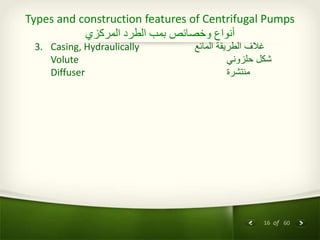
Types and construction features of Centrifugal Pumps
‫المركزي‬ ‫الطرد‬ ‫بمب‬ ‫وخصائص‬ ‫أنواع‬
3. Casing, Hydraulically ‫المائع‬ ‫الطريقة‬ ‫غالف‬
Volute ‫حلزوني‬ ‫شكل‬
Diffuser ‫منتشرة‬
17 of 60
Types and construction features of Centrifugal Pumps
‫المركزي‬ ‫الطرد‬ ‫بمب‬ ‫وخصائص‬ ‫أنواع‬
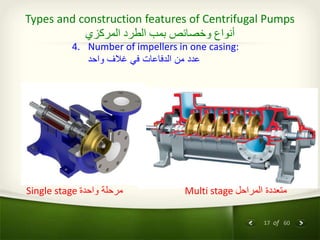
4. Number of impellers in one casing:
‫واحد‬ ‫غالف‬ ‫في‬ ‫الدفاعات‬ ‫من‬ ‫عدد‬
Single stage ‫واحدة‬ ‫مرحلة‬ Multi stage ‫المراحل‬ ‫متعددة‬
18 of 60
Types and construction features of Centrifugal Pumps
‫المركزي‬ ‫الطرد‬ ‫بمب‬ ‫وخصائص‬ ‫أنواع‬
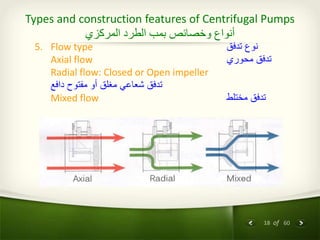
5. Flow type ‫تدفق‬ ‫نوع‬
Axial flow ‫محوري‬ ‫تدفق‬
Radial flow: Closed or Open impeller
‫دافع‬ ‫مفتوح‬ ‫أو‬ ‫مغلق‬ ‫شعاعي‬ ‫تدفق‬
Mixed flow ‫مختلط‬ ‫تدفق‬
19 of 60
Types and construction features of Centrifugal Pumps
‫المركزي‬ ‫الطرد‬ ‫بمب‬ ‫وخصائص‬ ‫أنواع‬
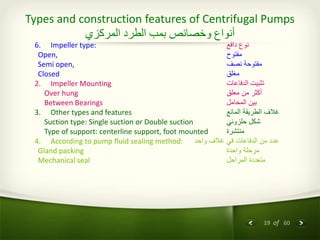
6. Impeller type: ‫دافع‬ ‫نوع‬
Open, ‫مفتوح‬
Semi open, ‫نصف‬ ‫مفتوحة‬
Closed ‫مغلق‬
2. Impeller Mounting ‫الدفاعات‬ ‫تثبيت‬
Over hung ‫معلق‬ ‫من‬ ‫أكثر‬
Between Bearings ‫المحامل‬ ‫بين‬
3. Other types and features ‫المائع‬ ‫الطريقة‬ ‫غالف‬
Suction type: Single suction or Double suction ‫حلزوني‬ ‫شكل‬
Type of support: centerline support, foot mounted ‫منتشرة‬
4. According to pump fluid sealing method: ‫واحد‬ ‫غالف‬ ‫في‬ ‫الدفاعات‬ ‫من‬ ‫عدد‬
Gland packing ‫واحدة‬ ‫مرحلة‬
Mechanical seal ‫المراحل‬ ‫متعددة‬
20 of 60
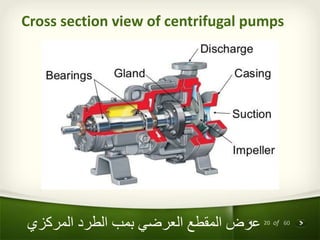
‫المركزي‬ ‫الطرد‬ ‫بمب‬ ‫العرضي‬ ‫المقطع‬ ‫عرض‬
Cross section view of centrifugal pumps
21 of 60
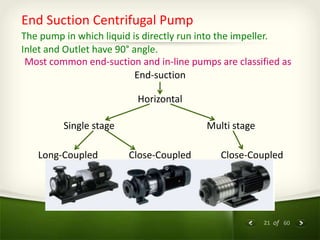
End Suction Centrifugal Pump
The pump in which liquid is directly run into the impeller.
Inlet and Outlet have 90° angle.
Most common end-suction and in-line pumps are classified as
End-suction
Horizontal
Single stage Multi stage
Long-Coupled Close-Coupled Close-Coupled
22 of 60
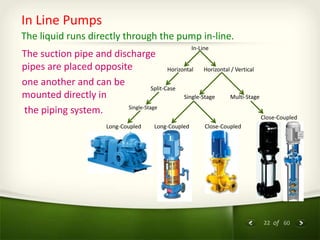
In Line Pumps
The liquid runs directly through the pump in-line.
The suction pipe and discharge
pipes are placed opposite
one another and can be
mounted directly in
the piping system.
In-Line
Horizontal / VerticalHorizontal
Split-Case
Single-Stage
Long-Coupled
Multi-StageSingle-Stage
Long-Coupled Close-Coupled
Close-Coupled
23 of 60
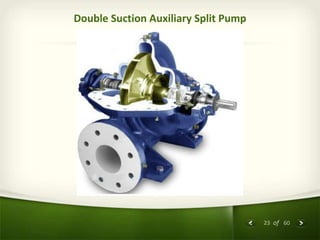
Double Suction Auxiliary Split Pump
24 of 60
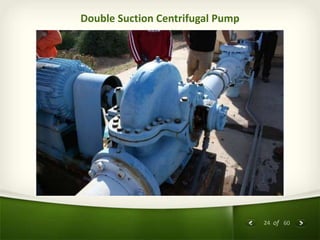
Double Suction Centrifugal Pump
25 of 60
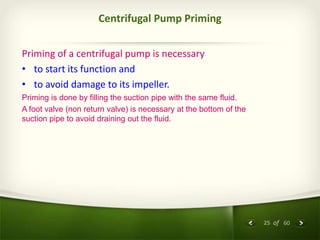
Centrifugal Pump Priming
Priming of a centrifugal pump is necessary
• to start its function and
• to avoid damage to its impeller.
Priming is done by filling the suction pipe with the same fluid.
A foot valve (non return valve) is necessary at the bottom of the
suction pipe to avoid draining out the fluid.
26 of 60
Centrifugal Pump Self-Priming
Priming of a centrifugal pump is necessary at the
beginning and after that it stay self prime.
27 of 60
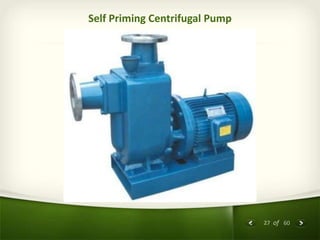
Self Priming Centrifugal Pump
28 of 60
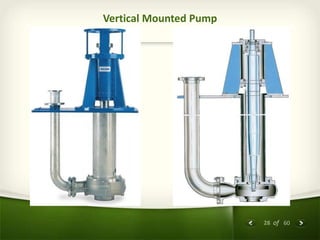
Vertical Mounted Pump
29 of 60
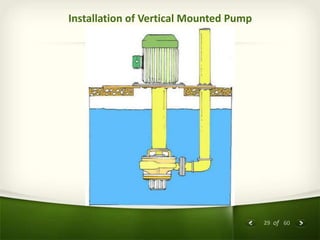
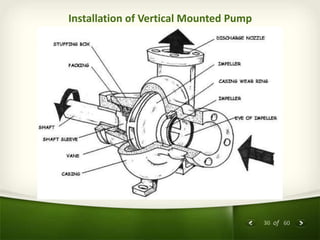
Installation of Vertical Mounted Pump
30 of 60
Installation of Vertical Mounted Pump
31 of 60
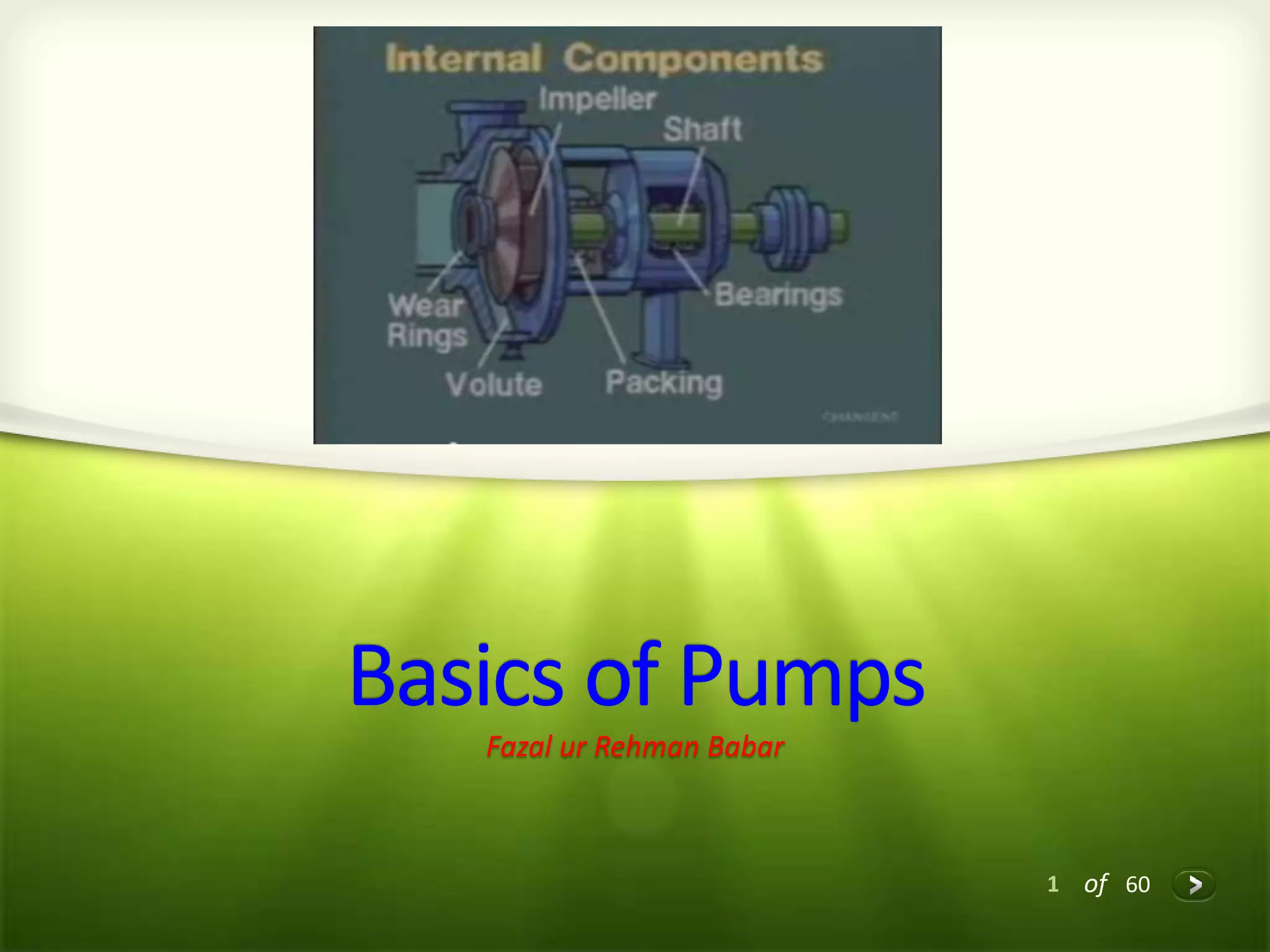
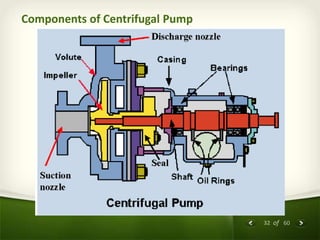
Components of Centrifugal Pumps
Main components of centrifugal pumps are
• Base Plate
• Casing
• Coupling
• Impeller
• Shaft
• Wear Ring
• Shaft Sleeve
• Stuffing box or Sealing chamber
• Packing / Mechanical Seal
• Auxiliary Piping and Instruments
32 of 60
Components of Centrifugal Pump
33 of 60
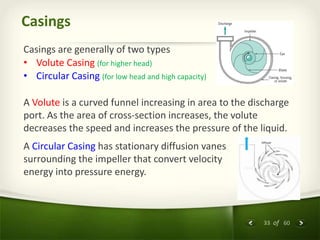
Casings
Casings are generally of two types
• Volute Casing (for higher head)
• Circular Casing (for low head and high capacity)
A Volute is a curved funnel increasing in area to the discharge
port. As the area of cross-section increases, the volute
decreases the speed and increases the pressure of the liquid.
A Circular Casing has stationary diffusion vanes
surrounding the impeller that convert velocity
energy into pressure energy.
34 of 60
Classification of Pump
35 of 60
Classification of Pump
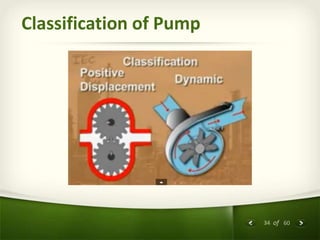
Centrifugal Pumps are Dynamic Pumps.
Displacement Pumps
Reciprocating Pumps – Piston, plunger type
Rotary Pumps –
Single Rotor – Vane pump
Multiple Rotor – Gear pump
Our study in limited to Centrifugal Pumps and Reciprocating Pumps.
Centrifugal pumps are most widely used in industry because of its
versatility and simple in construction and relatively in expensive to buy.
They are also easier and less expensive to operate, maintain and to
repair.
The overall efficiency of the centrifugal pumps are high.
36 of 60
What is a centrifugal Pump
Centrifugal Pump moves fluid by increasing fluid pressure
through centrifugal force.
Energy is imparted to the fluid by centrifugal action of
moving blades from the inner radius to the outer.
The flow of the centrifugal pump is radial outward direction.
Centrifugal force moves the object away from the center of
rotation.
When the centrifugal pump is working, Impeller rotates and
its blades stir the fluid and makes the fluid rotate along with
impeller.
37 of 60
What is a centrifugal Pump
The circular motion generates force to move the fluid away
from the center of the impeller to the tips of the impeller
blade.
The movement of the fluid to the outside edge of the
impeller creates suction at the eye of the impeller that
draws more fluid into the pump.
The outside edge of the impeller moves faster than the
inside center.
38 of 60
What is a centrifugal Pump
To stay up with the impeller the fluid has to move faster as
it moves outward. This increases the energy of the fluid.
The fluid enters the specially designed area of the casing
“VOLUTE” after leaving the outside edge of the impeller.
The volute is wider at discharge nozzle than where the fluid
leaves the impeller.
39 of 60
Volute and Energy Transformation
The volute is wider at discharge nozzle than where the fluid
leaves the impeller.
There increase in area (space) causes the fluid to slow
down, it decreases the kinetic energy of the fluid. (velocity
decreases).
This kinetic energy is converted to the pressure head. This
pressure forces the fluid out of the pump at a higher
pressure than it entered the pump.
40 of 60
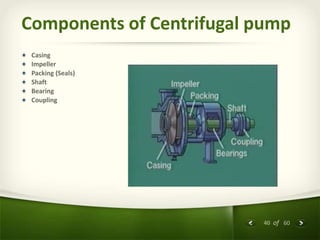
Components of Centrifugal pump
Casing
Impeller
Packing (Seals)
Shaft
Bearing
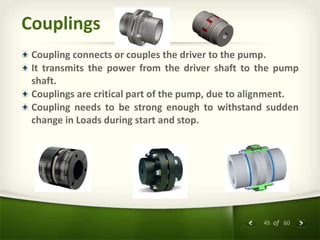
Coupling
41 of 60
Casing
The prominent and visible part of the pump.
Purpose of casing is to house and protect the pump parts
inside.
To confine the fluid.
Casing from volute and connection points for suction and
discharge pipings.
Casing can be made from Cast Iron, Steel, Aluminum, Bronze
or special materials depending on the requirement and
operation conditions.
42 of 60
Impeller
Impeller imparts energy to the fluid being pumped.
Impeller is tightly attached to the shaft and rotates at the
shaft speed.
Impeller are usually made from cast Iron.
If a corrosive fluid is to be pumped then Impellers are made
from stainless steel, plastics or special materials.
43 of 60
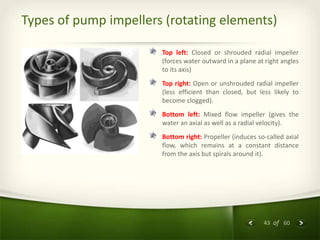
Types of pump impellers (rotating elements)
Top left: Closed or shrouded radial impeller
(forces water outward in a plane at right angles
to its axis)
Top right: Open or unshrouded radial impeller
(less efficient than closed, but less likely to
become clogged).
Bottom left: Mixed flow impeller (gives the
water an axial as well as a radial velocity).
Bottom right: Propeller (induces so-called axial
flow, which remains at a constant distance
from the axis but spirals around it).
44 of 60
Shaft
Shaft connects the impeller to the drive (can be a steam
engine, electric motor or an engine).
Shaft turns the impeller.
Steel is the most common material used for making shafts.
45 of 60
Couplings
Coupling connects or couples the driver to the pump.
It transmits the power from the driver shaft to the pump
shaft.
Couplings are critical part of the pump, due to alignment.
Coupling needs to be strong enough to withstand sudden
change in Loads during start and stop.
46 of 60
Bearings
Bearings support shafts and reduce friction when shafts
rotates in the casing.
Bearings control the forward and backward movement , the
thrust of the shaft and shaft side to side radial movement.
Bearings prevent the shaft from rubbing against the casing.
Bearings can be in the casing itself incase of small pumps.
In large pumps, they are housed in separate casings.

Very basics of pumps

  • 1.
    1 of 60 Basicsof Pumps Fazal ur Rehman Babar
  • 2.
    2 of 60 Whatis Pump? ‫بمب‬ ‫هو‬ ‫ما‬ It convert mechanical energy into hydraulic energy. ‫المائية‬ ‫طاقة‬ ‫إلى‬ ‫الميكانيكية‬ ‫الطاقة‬ ‫تحويل‬ ‫ومن‬ Water or other fluid at in motion ‫الحركة‬ ‫في‬ ‫األخرى‬ ‫السوائل‬ ‫أو‬ ‫الماء‬ Need of Pump ‫الحاجة‬‫بمب‬ To increase pressure ‫الضغط‬ ‫لزيادة‬ To increase flow rate ‫النسبة‬ ‫معدل‬ ‫لزيادة‬ To move fluid from lower elevation to higher elevation ‫ارتفاع‬ ‫ألعلى‬ ‫ارتفاع‬ ‫أقل‬ ‫من‬ ‫المائع‬ ‫لنقل‬
  • 3.
    3 of 60 Purposeof Pumps ‫بمب‬ ‫استعمال‬ Pump is a devise used to Move liquid from low pressure area to high pressure area Ex: Boiler feedwater pump (Multi stage centrifugal pump) To move fluid from lower elevation to higher elevation Ex: All the process pumps (Centrifugal pump) To increase flow rate of the liquid Ex: All the process pumps (Centrifugal pump) To increase pressure of the liquid Ex: Car washing pump (Piston pump) To circulate the flow of liquid in closed loop system Ex: Sealing water in LIQUID ring vacuum pump (Centrifugal pump)
  • 4.
    4 of 60 Pumphas three main characteristics ‫الخصائص‬ Pump Characteristics: 1) Pressure 2) Flow 3) Head
  • 5.
    5 of 60 Pumpdesign Pump can deliver: 1) High pressure or Low pressure 2) High flow or Low flow 3) High head or Low head
  • 6.
    6 of 60 Whatis Pump Head? Total Static Head Suction Lift Discharge Head Calculation Negative Suction
  • 7.
    7 of 60 Whatis Pump Head? Positive Suction
  • 8.
    8 of 60 PumpSelection Pumps are selected according to the Plant requirement which based on: What pressure is required? What flow is required? How much head is required?
  • 9.
    9 of 60 Watersupply pumping
  • 10.
    10 of 60 Typesof pumps PUMP Kinetic Self Priming Non-Self Priming Single Stage Multi Stage Single Stage Multi Stage Open Impeller Closed Impeller Single Stage Multi Stage Self Priming Non-Self Priming Jet (ejector boosted) Gas Lift Hydraulic Ram Electro-Magnetic Peripheral Special Centrifugal Radial Flow Mixed Flow Single Suction Double Suction Open Impeller Semi Open Impeller Closed ImpellerSingle Suction Axial Flow Reciprocating Positive Displacement Blow Case Diaphragm Piston Plunger Double Acting SteamSimplex Duplex PowerSingle Acting Double Acting Fluid Operated Mech. Operated Simplex Multiplex Rotary Single Rotor Multiple Rotor Vane, Piston, Flexible Membrane Gear Lobe Piston, Screw Simplex Duplex Triplex Multiplex
  • 11.
    11 of 60 CentrifugalPumps Mostly our centrifugal pumps are • Horizontal shaft mounted • Volute casing • Single impeller • Bottom suction top discharge
  • 12.
    12 of 60 ‫المركزي‬‫الطرد‬ ‫بمب‬ ‫العرضي‬ ‫المقطع‬ ‫عرض‬ Cross section view of centrifugal pumps
  • 13.
    13 of 60 CentrifugalPump is: A Constant Head Machine Adding energy to fluid continuously Positive Displacement Pumps is: Adding energy to fluid intermediately External Gear Pump Internal Gear Pump
  • 14.
    14 of 60 Typesand construction features of Centrifugal Pumps ‫المركزي‬ ‫الطرد‬ ‫بمب‬ ‫وخصائص‬ ‫أنواع‬ 1. Position: ‫مكانة‬ ،‫موقع‬ Vertical, ‫عمودي‬ Horizontal, ‫أفقي‬ Submerged ‫غارق‬
  • 15.
    15 of 60 Typesand construction features of Centrifugal Pumps ‫المركزي‬ ‫الطرد‬ ‫بمب‬ ‫وخصائص‬ ‫أنواع‬ 2. Casing, Mechanically ‫الميكانيكية‬ ‫الطريقة‬ ‫غالف‬ Horizontal Split ‫أفقي‬ ‫انقسام‬ Radial Split ‫شعاعي‬ ‫انقسام‬
  • 16.
    16 of 60 Typesand construction features of Centrifugal Pumps ‫المركزي‬ ‫الطرد‬ ‫بمب‬ ‫وخصائص‬ ‫أنواع‬ 3. Casing, Hydraulically ‫المائع‬ ‫الطريقة‬ ‫غالف‬ Volute ‫حلزوني‬ ‫شكل‬ Diffuser ‫منتشرة‬
  • 17.
    17 of 60 Typesand construction features of Centrifugal Pumps ‫المركزي‬ ‫الطرد‬ ‫بمب‬ ‫وخصائص‬ ‫أنواع‬ 4. Number of impellers in one casing: ‫واحد‬ ‫غالف‬ ‫في‬ ‫الدفاعات‬ ‫من‬ ‫عدد‬ Single stage ‫واحدة‬ ‫مرحلة‬ Multi stage ‫المراحل‬ ‫متعددة‬
  • 18.
    18 of 60 Typesand construction features of Centrifugal Pumps ‫المركزي‬ ‫الطرد‬ ‫بمب‬ ‫وخصائص‬ ‫أنواع‬ 5. Flow type ‫تدفق‬ ‫نوع‬ Axial flow ‫محوري‬ ‫تدفق‬ Radial flow: Closed or Open impeller ‫دافع‬ ‫مفتوح‬ ‫أو‬ ‫مغلق‬ ‫شعاعي‬ ‫تدفق‬ Mixed flow ‫مختلط‬ ‫تدفق‬
  • 19.
    19 of 60 Typesand construction features of Centrifugal Pumps ‫المركزي‬ ‫الطرد‬ ‫بمب‬ ‫وخصائص‬ ‫أنواع‬ 6. Impeller type: ‫دافع‬ ‫نوع‬ Open, ‫مفتوح‬ Semi open, ‫نصف‬ ‫مفتوحة‬ Closed ‫مغلق‬ 2. Impeller Mounting ‫الدفاعات‬ ‫تثبيت‬ Over hung ‫معلق‬ ‫من‬ ‫أكثر‬ Between Bearings ‫المحامل‬ ‫بين‬ 3. Other types and features ‫المائع‬ ‫الطريقة‬ ‫غالف‬ Suction type: Single suction or Double suction ‫حلزوني‬ ‫شكل‬ Type of support: centerline support, foot mounted ‫منتشرة‬ 4. According to pump fluid sealing method: ‫واحد‬ ‫غالف‬ ‫في‬ ‫الدفاعات‬ ‫من‬ ‫عدد‬ Gland packing ‫واحدة‬ ‫مرحلة‬ Mechanical seal ‫المراحل‬ ‫متعددة‬
  • 20.
    20 of 60 ‫المركزي‬‫الطرد‬ ‫بمب‬ ‫العرضي‬ ‫المقطع‬ ‫عرض‬ Cross section view of centrifugal pumps
  • 21.
    21 of 60 EndSuction Centrifugal Pump The pump in which liquid is directly run into the impeller. Inlet and Outlet have 90° angle. Most common end-suction and in-line pumps are classified as End-suction Horizontal Single stage Multi stage Long-Coupled Close-Coupled Close-Coupled
  • 22.
    22 of 60 InLine Pumps The liquid runs directly through the pump in-line. The suction pipe and discharge pipes are placed opposite one another and can be mounted directly in the piping system. In-Line Horizontal / VerticalHorizontal Split-Case Single-Stage Long-Coupled Multi-StageSingle-Stage Long-Coupled Close-Coupled Close-Coupled
  • 23.
    23 of 60 DoubleSuction Auxiliary Split Pump
  • 24.
    24 of 60 DoubleSuction Centrifugal Pump
  • 25.
    25 of 60 CentrifugalPump Priming Priming of a centrifugal pump is necessary • to start its function and • to avoid damage to its impeller. Priming is done by filling the suction pipe with the same fluid. A foot valve (non return valve) is necessary at the bottom of the suction pipe to avoid draining out the fluid.
  • 26.
    26 of 60 CentrifugalPump Self-Priming Priming of a centrifugal pump is necessary at the beginning and after that it stay self prime.
  • 27.
    27 of 60 SelfPriming Centrifugal Pump
  • 28.
    28 of 60 VerticalMounted Pump
  • 29.
    29 of 60 Installationof Vertical Mounted Pump
  • 30.
    30 of 60 Installationof Vertical Mounted Pump
  • 31.
    31 of 60 Componentsof Centrifugal Pumps Main components of centrifugal pumps are • Base Plate • Casing • Coupling • Impeller • Shaft • Wear Ring • Shaft Sleeve • Stuffing box or Sealing chamber • Packing / Mechanical Seal • Auxiliary Piping and Instruments
  • 32.
    32 of 60 Componentsof Centrifugal Pump
  • 33.
    33 of 60 Casings Casingsare generally of two types • Volute Casing (for higher head) • Circular Casing (for low head and high capacity) A Volute is a curved funnel increasing in area to the discharge port. As the area of cross-section increases, the volute decreases the speed and increases the pressure of the liquid. A Circular Casing has stationary diffusion vanes surrounding the impeller that convert velocity energy into pressure energy.
  • 34.
  • 35.
    35 of 60 Classificationof Pump Centrifugal Pumps are Dynamic Pumps. Displacement Pumps Reciprocating Pumps – Piston, plunger type Rotary Pumps – Single Rotor – Vane pump Multiple Rotor – Gear pump Our study in limited to Centrifugal Pumps and Reciprocating Pumps. Centrifugal pumps are most widely used in industry because of its versatility and simple in construction and relatively in expensive to buy. They are also easier and less expensive to operate, maintain and to repair. The overall efficiency of the centrifugal pumps are high.
  • 36.
    36 of 60 Whatis a centrifugal Pump Centrifugal Pump moves fluid by increasing fluid pressure through centrifugal force. Energy is imparted to the fluid by centrifugal action of moving blades from the inner radius to the outer. The flow of the centrifugal pump is radial outward direction. Centrifugal force moves the object away from the center of rotation. When the centrifugal pump is working, Impeller rotates and its blades stir the fluid and makes the fluid rotate along with impeller.
  • 37.
    37 of 60 Whatis a centrifugal Pump The circular motion generates force to move the fluid away from the center of the impeller to the tips of the impeller blade. The movement of the fluid to the outside edge of the impeller creates suction at the eye of the impeller that draws more fluid into the pump. The outside edge of the impeller moves faster than the inside center.
  • 38.
    38 of 60 Whatis a centrifugal Pump To stay up with the impeller the fluid has to move faster as it moves outward. This increases the energy of the fluid. The fluid enters the specially designed area of the casing “VOLUTE” after leaving the outside edge of the impeller. The volute is wider at discharge nozzle than where the fluid leaves the impeller.
  • 39.
    39 of 60 Voluteand Energy Transformation The volute is wider at discharge nozzle than where the fluid leaves the impeller. There increase in area (space) causes the fluid to slow down, it decreases the kinetic energy of the fluid. (velocity decreases). This kinetic energy is converted to the pressure head. This pressure forces the fluid out of the pump at a higher pressure than it entered the pump.
  • 40.
    40 of 60 Componentsof Centrifugal pump Casing Impeller Packing (Seals) Shaft Bearing Coupling
  • 41.
    41 of 60 Casing Theprominent and visible part of the pump. Purpose of casing is to house and protect the pump parts inside. To confine the fluid. Casing from volute and connection points for suction and discharge pipings. Casing can be made from Cast Iron, Steel, Aluminum, Bronze or special materials depending on the requirement and operation conditions.
  • 42.
    42 of 60 Impeller Impellerimparts energy to the fluid being pumped. Impeller is tightly attached to the shaft and rotates at the shaft speed. Impeller are usually made from cast Iron. If a corrosive fluid is to be pumped then Impellers are made from stainless steel, plastics or special materials.
  • 43.
    43 of 60 Typesof pump impellers (rotating elements) Top left: Closed or shrouded radial impeller (forces water outward in a plane at right angles to its axis) Top right: Open or unshrouded radial impeller (less efficient than closed, but less likely to become clogged). Bottom left: Mixed flow impeller (gives the water an axial as well as a radial velocity). Bottom right: Propeller (induces so-called axial flow, which remains at a constant distance from the axis but spirals around it).
  • 44.
    44 of 60 Shaft Shaftconnects the impeller to the drive (can be a steam engine, electric motor or an engine). Shaft turns the impeller. Steel is the most common material used for making shafts.
  • 45.
    45 of 60 Couplings Couplingconnects or couples the driver to the pump. It transmits the power from the driver shaft to the pump shaft. Couplings are critical part of the pump, due to alignment. Coupling needs to be strong enough to withstand sudden change in Loads during start and stop.
  • 46.
    46 of 60 Bearings Bearingssupport shafts and reduce friction when shafts rotates in the casing. Bearings control the forward and backward movement , the thrust of the shaft and shaft side to side radial movement. Bearings prevent the shaft from rubbing against the casing. Bearings can be in the casing itself incase of small pumps. In large pumps, they are housed in separate casings.