B.Tech Presentation
on
Vocational Training at
BHARAT PETROLEUM CARPORATION LIMITED,MUMBAI
by
VAIBHAV KUMAR ARYA
(2012UME1448)
Dr. G.D. Agarwal
Associate Professor
Dept. of Mech. Engg.
MNIT , Jaipur
Dr. Gopal Agrawal
Associate Professor
Dept. of Mech. Engg.
MNIT , Jaipur
Supervisor
Mr. K. Pradeep
Asst. Manager, Machine shop
BPCL Refinery, Mumbai
DEPARTMENT OF MECHANICAL ENGINEERING
MALAVIYA NATIONAL INSTITUTE OF TECHNOLOGY, JAIPUR
• Bharat Petroleum Corporation Limited (BPCL) is an Indian state-controlled oil and gas company headquartered
in Mumbai, Maharashtra.
• BPCL has been ranked 242th in the Fortune Global 500 rankings of the world's biggest corporations for the
year 2014.
• Bharat Petroleum operates the following refineries:
• Mumbai Refinery : It has a capacity of 12 million metric tonnes per year.
• Kochi Refineries : It has a capacity of 9.5 million metric tonnes per year.
• Bina Refinery : It has a capacity of 6 million metric tonnes per year. This refinery is operated by Bharat
Oman Refineries Limited, a joint venture between Bharat Petroleum and Oman Oil Company.
• Numaligarh Refinery : It has a capacity of 3 million metric tonnes per year.
About The Company
• In 1889 during vast industrial development, an important player in the South Asian market was the Burmah Oil
Company.
• In 1928, Asiatic Petroleum Company (India) started cooperation with Burma oil company. This alliance led to
the formation of Burmah-Shell Oil Storage and Distributing Company of India Limited.
• Bharat Petroleum Corporation ( BPCL) was established in 1952.
• On 24 January 1976, the Burmah Shell was taken over by the Government of India to form Bharat Refineries
Limited. On 1 August 1977, it was renamed Bharat Petroleum Corporation Limited. It was also the first refinery
to process newly found indigenous crude Bombay High.
Company History
Centrifugal Pumps
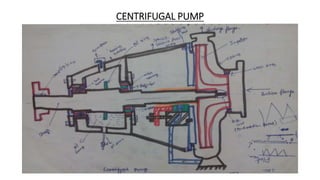
• Purpose of a Centrifugal Pump is to convert
energy of a prime mover (an electric motor or
turbine) first into velocity or kinetic energy and
then into pressure energy of a fluid that is
being pumped.
• The energy changes occur by virtue of two
main parts of the pump, the impeller and the
volute or diffuser.
• The impeller is the rotating part that converts
driver energy into the kinetic energy. The
volute or diffuser is the stationary part that
converts the K.E into pressure energy.
A Typical Centrifugal Pump
CENTRIFUGAL PUMP
Main Components
Centrifugal Pumps are made of hundreds of parts no matter how big or tiny. However, there are some major parts
which are designed to perform specific tasks.
• Impeller: Centrifugal Pumps use impeller as the primary source for their pumping action. Its function is to
increase the pressure of the liquid.
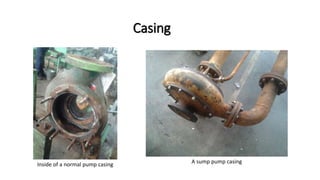
• Casing: The casing contains the liquid and acts as a pressure containment vessel that directs the flow of liquid
and out of the centrifugal pump.
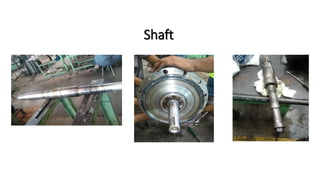
• Shaft: The main function of the shaft in a centrifugal pump is to transmit the input power from the driver to the
impeller.
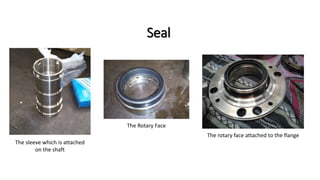
• Seal: Centrifugal Pumps can be provided with packing rings or mechanical seals which helps prevent the leakage
of the pumped liquid into the surroundings.
• Bearing: The function of the bearing is to support the weight of the shaft assembly, to carry hydraulic loads
acting on the shaft, and to keep the pump aligned to the shaft of the driver.
• Coupling: The function of couplings is to connect the pump shaft and the driver shaft, and to transmit the input
power from the driver to the pump.
Impeller
A Fully Shrouded
Impeller
A Pump using multiple impellers one after
another
One impeller from the 4 used in
the previous image
Impeller
A Semi-Shrouded Impeller A Screw-type Impeller
A Double Suction Impeller
Casing
Inside of a normal pump casing A sump pump casing
Shaft
Shaft
The Long Shaft of A Sump Pump
Seal
The sleeve which is attached
on the shaft
The rotary face attached to the flange
The Rotary Face
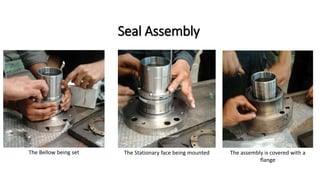
Seal Assembly
The Bellow being set The assembly is covered with a
flange
The Stationary face being mounted
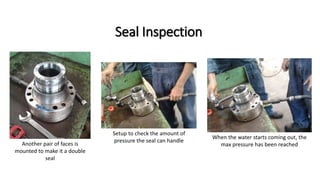
Seal Inspection
Another pair of faces is
mounted to make it a double
seal
Setup to check the amount of
pressure the seal can handle
When the water starts coming out, the
max pressure has been reached
Bearing
A Ball Bearing
Roller Bearing
A Roller Bearing with a
slightly different cage
Bearing
Broken Bearing Cage Bearing Nomenclature
Coupling
A shaft with a Lovejoy Jaw
Coupling
The other part of the
Love Jaw Coupling
A shaft with a keyway
A Key
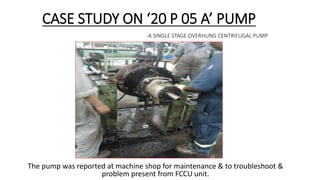
CASE STUDY ON ‘20 P 05 A’ PUMP
-A SINGLE STAGE OVERHUNG CENTRIFUGAL PUMP
The pump was reported at machine shop for maintenance & to troubleshoot &
problem present from FCCU unit.
SPECIFICATION
TYPE SINGLE STAGE CENTRIFUGAL PUMP
EQUIPMENT NO. 20 P 05 A
DEPARTMENT FCCU (Fluid catalyst & cracking unit)
MODEL NO. CPK-EM65-315 Se
COUPLING MAKE UNIQUE
RPM 2950
PUMP FLOW 55.2 m³/hr
PUMP WORKING TEMPERATURE 250 ˚C
MECHANICAL SEAL MAKE FLOWSERVE
PUMP AXIAL BEARING TYPE SKF 7311 BECBJ
PUMP RADIAL BEARING TYPE SKF 311 EC
LUBRICATION OIL TURBOL 68
HEAD 8m
COMPONENTS
• Impeller
• Impeller wearing
• Impeller locknut
• Casing
• Stuffing box
• Shaft
• Coupling
• Throat bush
• Bearing housing
• Thrust bearing
• Radial bearing
• Mechanical seal
• Spacer
• Deflector/Isolater
• Oil ring (Splasher )
• Bearing housing back cover
PROBLEM ENCOUNTERED WITH 20 P 05 A :
MECHANICAL SEAL LEAKAGE FOR OVER HAULING
DISMANTLING THE PUMP
Coupling grub screw were loosen.
Coupling/ hydraulic puller was tried to loosen coupling but it wasn’t enough so coupling was heated to
increase its diameter so that it could easily loosen from shaft.
COUPLING REMOVED
All bolts of stuffing box were removed as it was seized so sudden hydraulic pressure was imparted at
suction which provided required momentum to separate casing from remaining assembly.
Impeller locknut was removed through anticlockwise rotation as it was clockwise fastened in the
direction of rotation of impeller to make sure it didn’t come out during operation.
Impeller (closed type) was pulled out straight aligned away from pump.
Impeller locknut was screwed & through crane assembly was placed vertical.
Impeller locknut was again removed.
 spacer along with shaft & bearing housing was pulled out of stuffing box & mechanical seal assembly
straight aligned using crane.
All four bolts were removed from mechanical seal & seal was removed form stuffing box & kept with
proper care at table.
Impeller locknut was again tightened.
Mechanical single seal with bellow as
compression unit
Stationary face
Spacer was pulled out of bearing housing.
Now bearing housing needed to be dismantle most tedious job of all..
Bearing housing back cover was removed followed by isolator.
Roller (radial) bearing inner ring was pushed out of bearing housing.
Bearing
housing
back
cover of
NDU side
Gasket
Inner ring
of roller
bearing
Bearing
housing
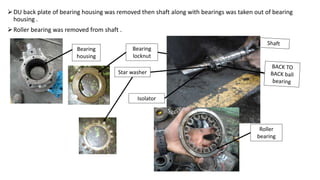
DU back plate of bearing housing was removed then shaft along with bearings was taken out of bearing
housing .
Roller bearing was removed from shaft .
Roller
bearing
Bearing
locknut
Star washer
Isolator
 Both ball back to back ball bearing ,isolator, bearing lock nut, star washer was loosened from shaft.
Ball bearing
Isolator
Back cover
(DU Side)
Back cover
(NDU Side)
 CLEANING
 Cleaning is mainly done with :
1. Kerosene mixed with oil as it could harm the skin of hand if only kerosene is used.
2. Small & big blades.
3. Wire brush.
4. Polish paper.
5. Compressed air for cleaning as well as for drying cleaned parts.
Small blade
Kerosene &
oil mix.
Polish paper
Generally following sequence during cleaning is maintained:
• Shaft coupling impeller volute casing bearing housing spacer
Stuffing box bearing cover remaining small parts
Compressed
air
Cleaning
operation
 INSPECTION
After dismantling, a visual inspection & a through check for dimensions were done using
micrometers & Vernier calipers. A check list is made along with that other supplementary
dimensions are also checked. These include coupling internal diameter (ID) , bearing (ID) ,
bearing outer diameter (OD) & the clearances with respect to the bearing housing, front &
back side wearing OD along with respect to the casing & stuffing box respectively &
impeller diameter . An overall check for the bearings, mechanical seal, impeller, hub,
spacer, coupling type impeller lock nut, coupling & impeller key, bearing housing & oil
rings & Splasher was performed. A trueness check is performed to check the trueness of
the shaft & the impeller.
Balancing of rotor done after assembly trueness of the rotor.
The rotor consists of shaft with impeller, coupling & other rotating parts on the shaft.
 PROBLEMS OBSERVED :
• The existing mechanical seal (single seal) was hydro tested at 5 kg/cm² & a leak was
found in the seal bellow.
• Rings & gaskets needed to be replaced.
• Stationary face, rotary face & compression unit were replaced.
• Non Driving end deflector was broken
• Mechanical sleeve was worn off so needed to be replaced.
 CHECK LIST
 The existing mechanical seal was hydro tested at 5 kg/cm² & a leak was found in the seal bellow.
 ASSEMBLY OF PUMP:
1. Insert the Radial & axial bearings by heating them in Induction heater to obtain proper
fit. Temperature of induction heater is 110 C. Bearings are in back to back
arrangement.
2. Tighten the axial bearing with the help of bearing locknut & locknut washer.
3. Fix the mechanical seal on the stuffing box.
4. Mount the bearing housing on the shaft.
5. Put on the Bearing cover carrying the oil isolator.
6. Then insert the deflector plate.
7. Now mount the shaft assembly on the stuffing box & mechanical seal part.
8. Now insert the impeller fitted with wearing on the shaft along with the stuffing box.
9. Insert the Impeller locknut & key & put locknut cover.
10. Now mount the assembly on the casing to obtain full assembled feed pump.
 TESTING:
Testing is done to check the proper functioning of the pump so that it will not fail on the
site after installation. It is very important part of maintenance because, if the pump fails
after installation, then it increases the cost in terms of the cost of components required
for maintenance & also in terms of manpower required to do the job again.
Pump was assembled & seal was tested at 5 kg/cm².
It was found there was no leakage.
The pump after assembly was rotated for freeness of the rotor in the pump , the pump
was inspected for any uneven or lose tightening of bolts.
After all visual inspection the pump was made ready for dispatch.
 DISPATCH:
The pump was dispatched from the machine shop area to the “FCCU UNIT”.
REFRENCES :-
• en.wikipedia.org
• www.skf.com
• www.pumpsandsystems.com
• www.advantageengineering.com
• www.centrifugal-pump.org
• www.pumpfundamentals.com
• www.compressionjobs.com
CENTRIFUGAL PUMP WITH CASE STUDY

CENTRIFUGAL PUMP WITH CASE STUDY

  • 1.
    B.Tech Presentation on Vocational Trainingat BHARAT PETROLEUM CARPORATION LIMITED,MUMBAI by VAIBHAV KUMAR ARYA (2012UME1448) Dr. G.D. Agarwal Associate Professor Dept. of Mech. Engg. MNIT , Jaipur Dr. Gopal Agrawal Associate Professor Dept. of Mech. Engg. MNIT , Jaipur Supervisor Mr. K. Pradeep Asst. Manager, Machine shop BPCL Refinery, Mumbai DEPARTMENT OF MECHANICAL ENGINEERING MALAVIYA NATIONAL INSTITUTE OF TECHNOLOGY, JAIPUR
  • 2.
    • Bharat PetroleumCorporation Limited (BPCL) is an Indian state-controlled oil and gas company headquartered in Mumbai, Maharashtra. • BPCL has been ranked 242th in the Fortune Global 500 rankings of the world's biggest corporations for the year 2014. • Bharat Petroleum operates the following refineries: • Mumbai Refinery : It has a capacity of 12 million metric tonnes per year. • Kochi Refineries : It has a capacity of 9.5 million metric tonnes per year. • Bina Refinery : It has a capacity of 6 million metric tonnes per year. This refinery is operated by Bharat Oman Refineries Limited, a joint venture between Bharat Petroleum and Oman Oil Company. • Numaligarh Refinery : It has a capacity of 3 million metric tonnes per year. About The Company
  • 3.
    • In 1889during vast industrial development, an important player in the South Asian market was the Burmah Oil Company. • In 1928, Asiatic Petroleum Company (India) started cooperation with Burma oil company. This alliance led to the formation of Burmah-Shell Oil Storage and Distributing Company of India Limited. • Bharat Petroleum Corporation ( BPCL) was established in 1952. • On 24 January 1976, the Burmah Shell was taken over by the Government of India to form Bharat Refineries Limited. On 1 August 1977, it was renamed Bharat Petroleum Corporation Limited. It was also the first refinery to process newly found indigenous crude Bombay High. Company History
  • 4.
    Centrifugal Pumps • Purposeof a Centrifugal Pump is to convert energy of a prime mover (an electric motor or turbine) first into velocity or kinetic energy and then into pressure energy of a fluid that is being pumped. • The energy changes occur by virtue of two main parts of the pump, the impeller and the volute or diffuser. • The impeller is the rotating part that converts driver energy into the kinetic energy. The volute or diffuser is the stationary part that converts the K.E into pressure energy.
  • 5.
  • 6.
  • 7.
    Main Components Centrifugal Pumpsare made of hundreds of parts no matter how big or tiny. However, there are some major parts which are designed to perform specific tasks. • Impeller: Centrifugal Pumps use impeller as the primary source for their pumping action. Its function is to increase the pressure of the liquid. • Casing: The casing contains the liquid and acts as a pressure containment vessel that directs the flow of liquid and out of the centrifugal pump. • Shaft: The main function of the shaft in a centrifugal pump is to transmit the input power from the driver to the impeller. • Seal: Centrifugal Pumps can be provided with packing rings or mechanical seals which helps prevent the leakage of the pumped liquid into the surroundings. • Bearing: The function of the bearing is to support the weight of the shaft assembly, to carry hydraulic loads acting on the shaft, and to keep the pump aligned to the shaft of the driver. • Coupling: The function of couplings is to connect the pump shaft and the driver shaft, and to transmit the input power from the driver to the pump.
  • 8.
    Impeller A Fully Shrouded Impeller APump using multiple impellers one after another One impeller from the 4 used in the previous image
  • 9.
    Impeller A Semi-Shrouded ImpellerA Screw-type Impeller A Double Suction Impeller
  • 10.
    Casing Inside of anormal pump casing A sump pump casing
  • 11.
  • 12.
    Shaft The Long Shaftof A Sump Pump
  • 13.
    Seal The sleeve whichis attached on the shaft The rotary face attached to the flange The Rotary Face
  • 14.
    Seal Assembly The Bellowbeing set The assembly is covered with a flange The Stationary face being mounted
  • 15.
    Seal Inspection Another pairof faces is mounted to make it a double seal Setup to check the amount of pressure the seal can handle When the water starts coming out, the max pressure has been reached
  • 16.
    Bearing A Ball Bearing RollerBearing A Roller Bearing with a slightly different cage
  • 17.
    Bearing Broken Bearing CageBearing Nomenclature
  • 18.
    Coupling A shaft witha Lovejoy Jaw Coupling The other part of the Love Jaw Coupling A shaft with a keyway A Key
  • 19.
    CASE STUDY ON‘20 P 05 A’ PUMP -A SINGLE STAGE OVERHUNG CENTRIFUGAL PUMP The pump was reported at machine shop for maintenance & to troubleshoot & problem present from FCCU unit.
  • 20.
    SPECIFICATION TYPE SINGLE STAGECENTRIFUGAL PUMP EQUIPMENT NO. 20 P 05 A DEPARTMENT FCCU (Fluid catalyst & cracking unit) MODEL NO. CPK-EM65-315 Se COUPLING MAKE UNIQUE RPM 2950 PUMP FLOW 55.2 m³/hr PUMP WORKING TEMPERATURE 250 ˚C MECHANICAL SEAL MAKE FLOWSERVE PUMP AXIAL BEARING TYPE SKF 7311 BECBJ PUMP RADIAL BEARING TYPE SKF 311 EC LUBRICATION OIL TURBOL 68 HEAD 8m
  • 21.
    COMPONENTS • Impeller • Impellerwearing • Impeller locknut • Casing • Stuffing box • Shaft • Coupling • Throat bush • Bearing housing • Thrust bearing • Radial bearing • Mechanical seal • Spacer • Deflector/Isolater • Oil ring (Splasher ) • Bearing housing back cover
  • 22.
    PROBLEM ENCOUNTERED WITH20 P 05 A : MECHANICAL SEAL LEAKAGE FOR OVER HAULING
  • 23.
    DISMANTLING THE PUMP Couplinggrub screw were loosen. Coupling/ hydraulic puller was tried to loosen coupling but it wasn’t enough so coupling was heated to increase its diameter so that it could easily loosen from shaft. COUPLING REMOVED
  • 24.
    All bolts ofstuffing box were removed as it was seized so sudden hydraulic pressure was imparted at suction which provided required momentum to separate casing from remaining assembly.
  • 25.
    Impeller locknut wasremoved through anticlockwise rotation as it was clockwise fastened in the direction of rotation of impeller to make sure it didn’t come out during operation. Impeller (closed type) was pulled out straight aligned away from pump.
  • 26.
    Impeller locknut wasscrewed & through crane assembly was placed vertical. Impeller locknut was again removed.  spacer along with shaft & bearing housing was pulled out of stuffing box & mechanical seal assembly straight aligned using crane.
  • 27.
    All four boltswere removed from mechanical seal & seal was removed form stuffing box & kept with proper care at table. Impeller locknut was again tightened. Mechanical single seal with bellow as compression unit Stationary face
  • 28.
    Spacer was pulledout of bearing housing. Now bearing housing needed to be dismantle most tedious job of all..
  • 29.
    Bearing housing backcover was removed followed by isolator. Roller (radial) bearing inner ring was pushed out of bearing housing. Bearing housing back cover of NDU side Gasket Inner ring of roller bearing
  • 30.
    Bearing housing DU back plateof bearing housing was removed then shaft along with bearings was taken out of bearing housing . Roller bearing was removed from shaft . Roller bearing Bearing locknut Star washer Isolator
  • 31.
     Both ballback to back ball bearing ,isolator, bearing lock nut, star washer was loosened from shaft. Ball bearing Isolator Back cover (DU Side) Back cover (NDU Side)
  • 32.
     CLEANING  Cleaningis mainly done with : 1. Kerosene mixed with oil as it could harm the skin of hand if only kerosene is used. 2. Small & big blades. 3. Wire brush. 4. Polish paper. 5. Compressed air for cleaning as well as for drying cleaned parts. Small blade Kerosene & oil mix. Polish paper
  • 33.
    Generally following sequenceduring cleaning is maintained: • Shaft coupling impeller volute casing bearing housing spacer Stuffing box bearing cover remaining small parts Compressed air Cleaning operation
  • 34.
     INSPECTION After dismantling,a visual inspection & a through check for dimensions were done using micrometers & Vernier calipers. A check list is made along with that other supplementary dimensions are also checked. These include coupling internal diameter (ID) , bearing (ID) , bearing outer diameter (OD) & the clearances with respect to the bearing housing, front & back side wearing OD along with respect to the casing & stuffing box respectively & impeller diameter . An overall check for the bearings, mechanical seal, impeller, hub, spacer, coupling type impeller lock nut, coupling & impeller key, bearing housing & oil rings & Splasher was performed. A trueness check is performed to check the trueness of the shaft & the impeller. Balancing of rotor done after assembly trueness of the rotor. The rotor consists of shaft with impeller, coupling & other rotating parts on the shaft.
  • 35.
     PROBLEMS OBSERVED: • The existing mechanical seal (single seal) was hydro tested at 5 kg/cm² & a leak was found in the seal bellow. • Rings & gaskets needed to be replaced. • Stationary face, rotary face & compression unit were replaced. • Non Driving end deflector was broken • Mechanical sleeve was worn off so needed to be replaced.
  • 36.
     CHECK LIST The existing mechanical seal was hydro tested at 5 kg/cm² & a leak was found in the seal bellow.
  • 37.
     ASSEMBLY OFPUMP: 1. Insert the Radial & axial bearings by heating them in Induction heater to obtain proper fit. Temperature of induction heater is 110 C. Bearings are in back to back arrangement. 2. Tighten the axial bearing with the help of bearing locknut & locknut washer. 3. Fix the mechanical seal on the stuffing box. 4. Mount the bearing housing on the shaft. 5. Put on the Bearing cover carrying the oil isolator. 6. Then insert the deflector plate. 7. Now mount the shaft assembly on the stuffing box & mechanical seal part. 8. Now insert the impeller fitted with wearing on the shaft along with the stuffing box. 9. Insert the Impeller locknut & key & put locknut cover. 10. Now mount the assembly on the casing to obtain full assembled feed pump.
  • 38.
     TESTING: Testing isdone to check the proper functioning of the pump so that it will not fail on the site after installation. It is very important part of maintenance because, if the pump fails after installation, then it increases the cost in terms of the cost of components required for maintenance & also in terms of manpower required to do the job again. Pump was assembled & seal was tested at 5 kg/cm². It was found there was no leakage. The pump after assembly was rotated for freeness of the rotor in the pump , the pump was inspected for any uneven or lose tightening of bolts. After all visual inspection the pump was made ready for dispatch.  DISPATCH: The pump was dispatched from the machine shop area to the “FCCU UNIT”.
  • 39.
    REFRENCES :- • en.wikipedia.org •www.skf.com • www.pumpsandsystems.com • www.advantageengineering.com • www.centrifugal-pump.org • www.pumpfundamentals.com • www.compressionjobs.com