13-11-2019 Google, Wikipedia
By
Akram khan
What is Spectroscopy ?
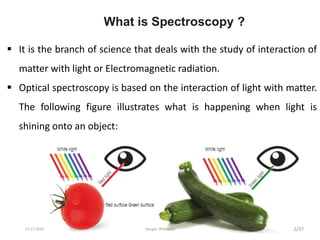
 It is the branch of science that deals with the study of interaction of
matter with light or Electromagnetic radiation.
 Optical spectroscopy is based on the interaction of light with matter.
The following figure illustrates what is happening when light is
shining onto an object:
2/3713-11-2019 Google, Wikipedia
Electromagnetic Radiation
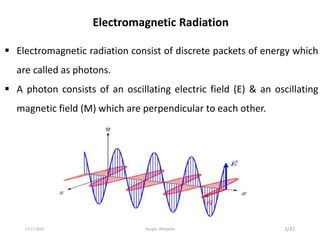
 Electromagnetic radiation consist of discrete packets of energy which
are called as photons.
 A photon consists of an oscillating electric field (E) & an oscillating
magnetic field (M) which are perpendicular to each other.
3/3713-11-2019 Google, Wikipedia
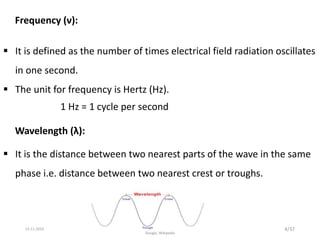
Frequency (ν):
 It is defined as the number of times electrical field radiation oscillates
in one second.
 The unit for frequency is Hertz (Hz).
1 Hz = 1 cycle per second
Wavelength (λ):
 It is the distance between two nearest parts of the wave in the same
phase i.e. distance between two nearest crest or troughs.
4/3713-11-2019
Google, Wikipedia
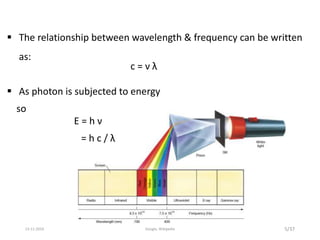
 The relationship between wavelength & frequency can be written
as:
c = ν λ
 As photon is subjected to energy
so
E = h ν
= h c / λ
5/3713-11-2019 Google, Wikipedia
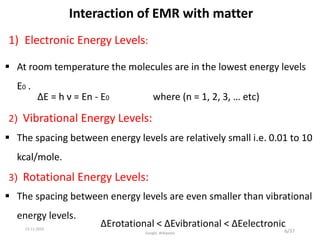
Interaction of EMR with matter
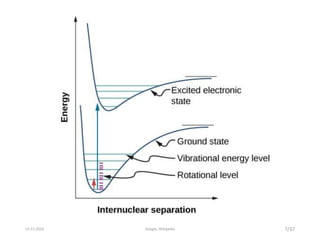
1) Electronic Energy Levels:
 At room temperature the molecules are in the lowest energy levels
E0 .
∆E = h ν = En - E0 where (n = 1, 2, 3, … etc)
2( Vibrational Energy Levels:
3( Rotational Energy Levels:
 The spacing between energy levels are relatively small i.e. 0.01 to 10
kcal/mole.
 The spacing between energy levels are even smaller than vibrational
energy levels.
∆Erotational < ∆Evibrational < ∆Eelectronic
6/3713-11-2019
Google, Wikipedia
7/3713-11-2019 Google, Wikipedia
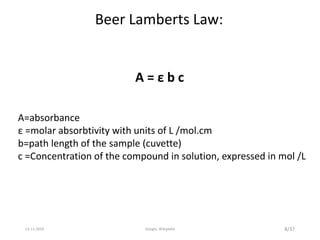
A=absorbance
ε =molar absorbtivity with units of L /mol.cm
b=path length of the sample (cuvette)
c =Concentration of the compound in solution, expressed in mol /L
A = ε b c
Beer Lamberts Law:
8/3713-11-2019 Google, Wikipedia
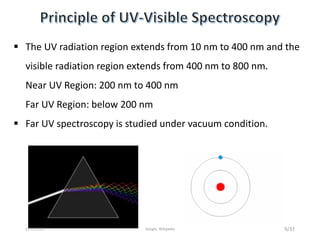
 The UV radiation region extends from 10 nm to 400 nm and the
visible radiation region extends from 400 nm to 800 nm.
Near UV Region: 200 nm to 400 nm
Far UV Region: below 200 nm
 Far UV spectroscopy is studied under vacuum condition.
9/3713-11-2019 Google, Wikipedia
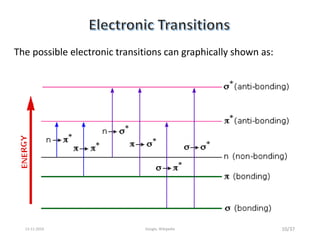
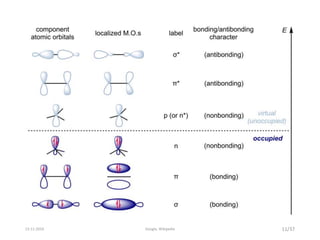
The possible electronic transitions can graphically shown as:
10/3713-11-2019 Google, Wikipedia
11/3713-11-2019 Google, Wikipedia
• σ → σ* transition
• π → π* transition
• n → σ* transition
• n → π* transition
• σ → π* transition
• π → σ* transition
1
2
3
4
5
6
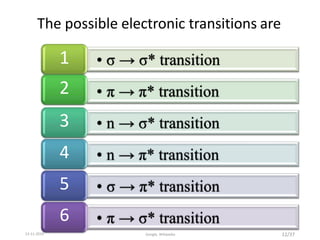
The possible electronic transitions are
12/3713-11-2019 Google, Wikipedia
• σ → σ* transition1
• σ electron from orbital is excited to corresponding anti-
bonding orbital σ*.
• The energy required is large for transition.
• e.g. Methane (CH4) has C-H bond only and can
undergo σ → σ* transition and shows absorbance
maxima at 125 nm.
13/3713-11-2019 Google, Wikipedia
• π → π* transition2
• π electron in a bonding orbital is excited to
corresponding anti-bonding orbital π*.
• Compounds containing multiple bonds like
alkenes, alkynes, carbonyl, nitriles, aromatic
compounds, etc undergo π → π* transitions.
• e.g. Alkenes generally absorb in the region
170 to 205 nm.
14/3713-11-2019 Google, Wikipedia
• n → σ* transition3
• Saturated compounds containing atoms with
lone pair of electrons like O, N, S and
halogens are capable of n → σ* transition.
• These transitions usually requires less energy
than σ → σ* transitions.
• The number of organic functional groups
with n → σ* peaks in UV region is small (150
– 250 nm). 15/3713-11-2019 Google, Wikipedia
• n → π* transition4
• An electron from non-bonding orbital is
promoted to anti-bonding π* orbital.
• Compounds containing double bond
involving hetero atoms (C=O, C≡N, N=O)
undergo such transitions.
• n → π* transitions require minimum energy
and show absorption at longer wavelength
around 300 nm. 16/3713-11-2019 Google, Wikipedia
5
6
• σ → π* transition
• π → σ* transition
&
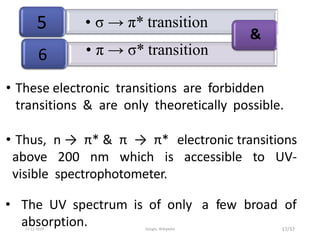
• These electronic transitions are forbidden
transitions & are only theoretically possible.
• Thus, n → π* & π → π* electronic transitions
above 200 nm which is accessible to UV-
visible spectrophotometer.
• The UV spectrum is of only a few broad of
absorption. 17/3713-11-2019 Google, Wikipedia
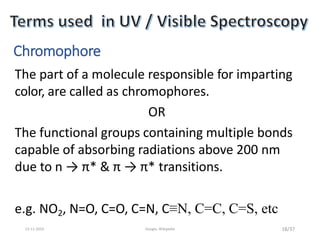
Chromophore
The part of a molecule responsible for imparting
color, are called as chromophores.
OR
The functional groups containing multiple bonds
capable of absorbing radiations above 200 nm
due to n → π* & π → π* transitions.
e.g. NO2, N=O, C=O, C=N, C≡N, C=C, C=S, etc
18/3713-11-2019 Google, Wikipedia
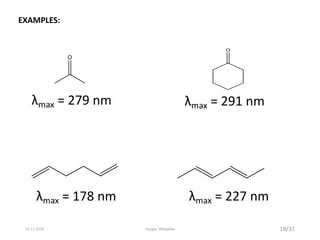
λmax = 279 nm
EXAMPLES:
λmax = 291 nm
λmax = 227 nmλmax = 178 nm
19/3713-11-2019 Google, Wikipedia
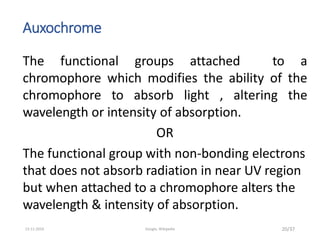
Auxochrome
The functional groups attached to a
chromophore which modifies the ability of the
chromophore to absorb light , altering the
wavelength or intensity of absorption.
OR
The functional group with non-bonding electrons
that does not absorb radiation in near UV region
but when attached to a chromophore alters the
wavelength & intensity of absorption.
20/3713-11-2019 Google, Wikipedia
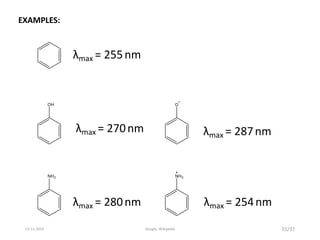
λmax = 255nm
λmax = 270nm
λmax = 280nm
λmax = 287nm
λmax = 254nm
EXAMPLES:
21/3713-11-2019 Google, Wikipedia
22/3713-11-2019 Google, Wikipedia
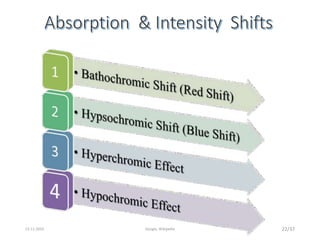
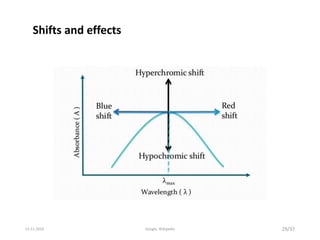
• Bathochromic Shift (Red Shift)1
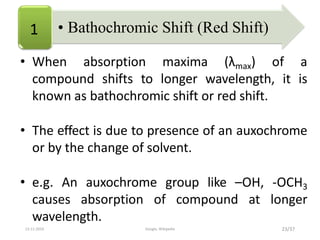
• When absorption maxima (λmax) of a
compound shifts to longer wavelength, it is
known as bathochromic shift or red shift.
• The effect is due to presence of an auxochrome
or by the change of solvent.
• e.g. An auxochrome group like –OH, -OCH3
causes absorption of compound at longer
wavelength.
23/3713-11-2019 Google, Wikipedia
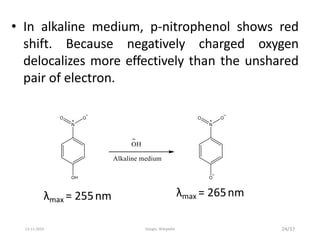
• In alkaline medium, p-nitrophenol shows red
shift. Because negatively charged oxygen
delocalizes more effectively than the unshared
pair of electron.
λmax = 255nm λmax = 265nm
24/3713-11-2019 Google, Wikipedia
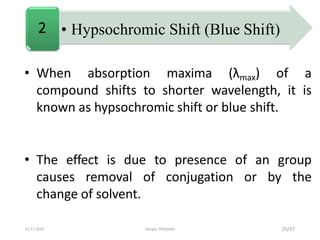
• Hypsochromic Shift (Blue Shift)2
• When absorption maxima (λmax) of a
compound shifts to shorter wavelength, it is
known as hypsochromic shift or blue shift.
• The effect is due to presence of an group
causes removal of conjugation or by the
change of solvent.
25/3713-11-2019 Google, Wikipedia
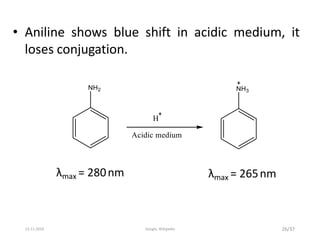
• Aniline shows blue shift in acidic medium, it
loses conjugation.
λmax = 280nm λmax = 265nm
26/3713-11-2019 Google, Wikipedia
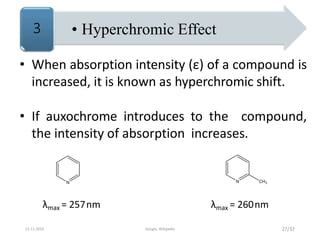
• Hyperchromic Effect3
• When absorption intensity (ε) of a compound is
increased, it is known as hyperchromic shift.
• If auxochrome introduces to the compound,
the intensity of absorption increases.
λmax = 257nm λmax = 260nm
27/3713-11-2019 Google, Wikipedia
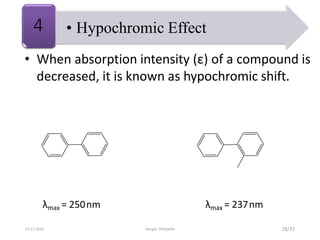
• Hypochromic Effect4
• When absorption intensity (ε) of a compound is
decreased, it is known as hypochromic shift.
λmax = 250nm λmax = 237nm
28/3713-11-2019 Google, Wikipedia
Shifts and effects
29/3713-11-2019 Google, Wikipedia
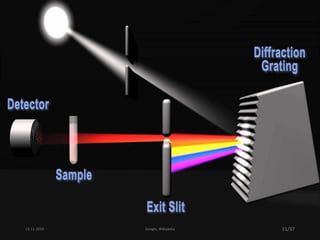
Instrumentation
Components of UV-Visible spectrophotometer
 Source
 Filters & Monochromator
 Sample compartment
 Detector
 Recorder
30/3713-11-2019 Google, Wikipedia
31/3713-11-2019 Google, Wikipedia
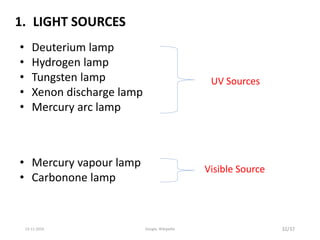
1. LIGHT SOURCES
• Deuterium lamp
• Hydrogen lamp
• Tungsten lamp
• Xenon discharge lamp
• Mercury arc lamp
• Mercury vapour lamp
• Carbonone lamp

UV Sources
Visible Source
32/3713-11-2019 Google, Wikipedia
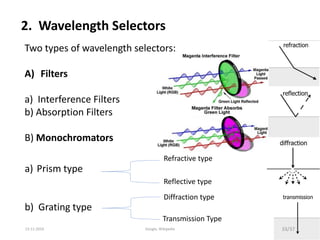
2. Wavelength Selectors
Two types of wavelength selectors:
A) Filters
a) Interference Filters
b) Absorption Filters
B) Monochromators
a) Prism type
b) Grating type
Refractive type
Reflective type
Diffraction type
Transmission Type
33/3713-11-2019 Google, Wikipedia
3. SAMPLE COMPARTMENT
• Optical Glass - 335 - 2500 nm
• Special Optical Glass – 320 - 2500 nm
• Quartz (Infrared) – 220 - 3800 nm
• Quartz (Far-UV) – 170 - 2700 nm
4. Detectors
• Barrier layer cells
• Photo emissive cell detector
• Photomultiplier
34/3713-11-2019 Google, Wikipedia
Applications
• Detection of Impurites.
• Structure elucidation of organic compounds.
• used for the quantitative and qualitative determination of
compounds that absorb UV radiation.
• This technique is used to detect the presence or absence of
functional group in the group.
• Kinetics of reaction can also be studied using uv spectroscopy.
• Molecular weights of compounds can be measured
spectrophotometrically by preparing the suitable derivatives of
these compounds.
• Uv spectrophotometer may be used as a detector for HPLC.
35/3713-11-2019 Google, Wikipedia
Advantages
• High accuracy
• Easy to handling
• Provide robust operation
• Utilized in qualitative and quantitative analysis
• Derivative graph can be obtained
• Cost effective instrument
Disadvantages
• Only those molecules are analyzed which have chromophores.
• Only liquid samples are possible to analyzed.
• Result of the absorption can be effective by pH ,temperature and
impurities.
• It takes time to get ready to use it.
• Cuvette handling can affect the reading of the sample.
36/3713-11-2019 Google, Wikipedia
UV - VISIBLE SPECTROSCOPY

UV - VISIBLE SPECTROSCOPY

  • 1.
  • 2.
    What is Spectroscopy?  It is the branch of science that deals with the study of interaction of matter with light or Electromagnetic radiation.  Optical spectroscopy is based on the interaction of light with matter. The following figure illustrates what is happening when light is shining onto an object: 2/3713-11-2019 Google, Wikipedia
  • 3.
    Electromagnetic Radiation  Electromagneticradiation consist of discrete packets of energy which are called as photons.  A photon consists of an oscillating electric field (E) & an oscillating magnetic field (M) which are perpendicular to each other. 3/3713-11-2019 Google, Wikipedia
  • 4.
    Frequency (ν):  Itis defined as the number of times electrical field radiation oscillates in one second.  The unit for frequency is Hertz (Hz). 1 Hz = 1 cycle per second Wavelength (λ):  It is the distance between two nearest parts of the wave in the same phase i.e. distance between two nearest crest or troughs. 4/3713-11-2019 Google, Wikipedia
  • 5.
     The relationshipbetween wavelength & frequency can be written as: c = ν λ  As photon is subjected to energy so E = h ν = h c / λ 5/3713-11-2019 Google, Wikipedia
  • 6.
    Interaction of EMRwith matter 1) Electronic Energy Levels:  At room temperature the molecules are in the lowest energy levels E0 . ∆E = h ν = En - E0 where (n = 1, 2, 3, … etc) 2( Vibrational Energy Levels: 3( Rotational Energy Levels:  The spacing between energy levels are relatively small i.e. 0.01 to 10 kcal/mole.  The spacing between energy levels are even smaller than vibrational energy levels. ∆Erotational < ∆Evibrational < ∆Eelectronic 6/3713-11-2019 Google, Wikipedia
  • 7.
  • 8.
    A=absorbance ε =molar absorbtivitywith units of L /mol.cm b=path length of the sample (cuvette) c =Concentration of the compound in solution, expressed in mol /L A = ε b c Beer Lamberts Law: 8/3713-11-2019 Google, Wikipedia
  • 9.
     The UVradiation region extends from 10 nm to 400 nm and the visible radiation region extends from 400 nm to 800 nm. Near UV Region: 200 nm to 400 nm Far UV Region: below 200 nm  Far UV spectroscopy is studied under vacuum condition. 9/3713-11-2019 Google, Wikipedia
  • 10.
    The possible electronictransitions can graphically shown as: 10/3713-11-2019 Google, Wikipedia
  • 11.
  • 12.
    • σ →σ* transition • π → π* transition • n → σ* transition • n → π* transition • σ → π* transition • π → σ* transition 1 2 3 4 5 6 The possible electronic transitions are 12/3713-11-2019 Google, Wikipedia
  • 13.
    • σ →σ* transition1 • σ electron from orbital is excited to corresponding anti- bonding orbital σ*. • The energy required is large for transition. • e.g. Methane (CH4) has C-H bond only and can undergo σ → σ* transition and shows absorbance maxima at 125 nm. 13/3713-11-2019 Google, Wikipedia
  • 14.
    • π →π* transition2 • π electron in a bonding orbital is excited to corresponding anti-bonding orbital π*. • Compounds containing multiple bonds like alkenes, alkynes, carbonyl, nitriles, aromatic compounds, etc undergo π → π* transitions. • e.g. Alkenes generally absorb in the region 170 to 205 nm. 14/3713-11-2019 Google, Wikipedia
  • 15.
    • n →σ* transition3 • Saturated compounds containing atoms with lone pair of electrons like O, N, S and halogens are capable of n → σ* transition. • These transitions usually requires less energy than σ → σ* transitions. • The number of organic functional groups with n → σ* peaks in UV region is small (150 – 250 nm). 15/3713-11-2019 Google, Wikipedia
  • 16.
    • n →π* transition4 • An electron from non-bonding orbital is promoted to anti-bonding π* orbital. • Compounds containing double bond involving hetero atoms (C=O, C≡N, N=O) undergo such transitions. • n → π* transitions require minimum energy and show absorption at longer wavelength around 300 nm. 16/3713-11-2019 Google, Wikipedia
  • 17.
    5 6 • σ →π* transition • π → σ* transition & • These electronic transitions are forbidden transitions & are only theoretically possible. • Thus, n → π* & π → π* electronic transitions above 200 nm which is accessible to UV- visible spectrophotometer. • The UV spectrum is of only a few broad of absorption. 17/3713-11-2019 Google, Wikipedia
  • 18.
    Chromophore The part ofa molecule responsible for imparting color, are called as chromophores. OR The functional groups containing multiple bonds capable of absorbing radiations above 200 nm due to n → π* & π → π* transitions. e.g. NO2, N=O, C=O, C=N, C≡N, C=C, C=S, etc 18/3713-11-2019 Google, Wikipedia
  • 19.
    λmax = 279nm EXAMPLES: λmax = 291 nm λmax = 227 nmλmax = 178 nm 19/3713-11-2019 Google, Wikipedia
  • 20.
    Auxochrome The functional groupsattached to a chromophore which modifies the ability of the chromophore to absorb light , altering the wavelength or intensity of absorption. OR The functional group with non-bonding electrons that does not absorb radiation in near UV region but when attached to a chromophore alters the wavelength & intensity of absorption. 20/3713-11-2019 Google, Wikipedia
  • 21.
    λmax = 255nm λmax= 270nm λmax = 280nm λmax = 287nm λmax = 254nm EXAMPLES: 21/3713-11-2019 Google, Wikipedia
  • 22.
  • 23.
    • Bathochromic Shift(Red Shift)1 • When absorption maxima (λmax) of a compound shifts to longer wavelength, it is known as bathochromic shift or red shift. • The effect is due to presence of an auxochrome or by the change of solvent. • e.g. An auxochrome group like –OH, -OCH3 causes absorption of compound at longer wavelength. 23/3713-11-2019 Google, Wikipedia
  • 24.
    • In alkalinemedium, p-nitrophenol shows red shift. Because negatively charged oxygen delocalizes more effectively than the unshared pair of electron. λmax = 255nm λmax = 265nm 24/3713-11-2019 Google, Wikipedia
  • 25.
    • Hypsochromic Shift(Blue Shift)2 • When absorption maxima (λmax) of a compound shifts to shorter wavelength, it is known as hypsochromic shift or blue shift. • The effect is due to presence of an group causes removal of conjugation or by the change of solvent. 25/3713-11-2019 Google, Wikipedia
  • 26.
    • Aniline showsblue shift in acidic medium, it loses conjugation. λmax = 280nm λmax = 265nm 26/3713-11-2019 Google, Wikipedia
  • 27.
    • Hyperchromic Effect3 •When absorption intensity (ε) of a compound is increased, it is known as hyperchromic shift. • If auxochrome introduces to the compound, the intensity of absorption increases. λmax = 257nm λmax = 260nm 27/3713-11-2019 Google, Wikipedia
  • 28.
    • Hypochromic Effect4 •When absorption intensity (ε) of a compound is decreased, it is known as hypochromic shift. λmax = 250nm λmax = 237nm 28/3713-11-2019 Google, Wikipedia
  • 29.
  • 30.
    Instrumentation Components of UV-Visiblespectrophotometer  Source  Filters & Monochromator  Sample compartment  Detector  Recorder 30/3713-11-2019 Google, Wikipedia
  • 31.
  • 32.
    1. LIGHT SOURCES •Deuterium lamp • Hydrogen lamp • Tungsten lamp • Xenon discharge lamp • Mercury arc lamp • Mercury vapour lamp • Carbonone lamp UV Sources Visible Source 32/3713-11-2019 Google, Wikipedia
  • 33.
    2. Wavelength Selectors Twotypes of wavelength selectors: A) Filters a) Interference Filters b) Absorption Filters B) Monochromators a) Prism type b) Grating type Refractive type Reflective type Diffraction type Transmission Type 33/3713-11-2019 Google, Wikipedia
  • 34.
    3. SAMPLE COMPARTMENT •Optical Glass - 335 - 2500 nm • Special Optical Glass – 320 - 2500 nm • Quartz (Infrared) – 220 - 3800 nm • Quartz (Far-UV) – 170 - 2700 nm 4. Detectors • Barrier layer cells • Photo emissive cell detector • Photomultiplier 34/3713-11-2019 Google, Wikipedia
  • 35.
    Applications • Detection ofImpurites. • Structure elucidation of organic compounds. • used for the quantitative and qualitative determination of compounds that absorb UV radiation. • This technique is used to detect the presence or absence of functional group in the group. • Kinetics of reaction can also be studied using uv spectroscopy. • Molecular weights of compounds can be measured spectrophotometrically by preparing the suitable derivatives of these compounds. • Uv spectrophotometer may be used as a detector for HPLC. 35/3713-11-2019 Google, Wikipedia
  • 36.
    Advantages • High accuracy •Easy to handling • Provide robust operation • Utilized in qualitative and quantitative analysis • Derivative graph can be obtained • Cost effective instrument Disadvantages • Only those molecules are analyzed which have chromophores. • Only liquid samples are possible to analyzed. • Result of the absorption can be effective by pH ,temperature and impurities. • It takes time to get ready to use it. • Cuvette handling can affect the reading of the sample. 36/3713-11-2019 Google, Wikipedia