Basic EmbryologyBasic Embryology
By- Dr. Armaan SinghBy- Dr. Armaan Singh
Embryology
 Definition: the study of the origin and
development of an organism
 Prenatal period: before birth
 38 weeks from conception to birth (average) “fetal”
age
 Gynecologic timing has been from LMP therefore
refers to 40 weeks “gestational” age
 Date of conception has been difficult to time
 LMP is on average two weeks before ovulation
Traditional (artificial)
division:
 “Embryonic” period: first 8 weeks
 All major organs formed
 “Fetal” period: remaining 30 weeks
 Organs grow larger and become more complex
Fertilization to Implantation
 Ovulation: egg released into the peritoneal
cavity
 Travels down fallopian tube in which fertilization
occurs
 At conception in fallopian tube, maternal and
paternal genetic material join to form a new
human life (zygote)
 Cell division occurs with travel down the tube
and into the uterus
Conception (biology) or fertilisation, the fusion of gametes to
produce a new organism of the same species (Wikipedia)
Week 1 post conception
 Zygote divides repeatedly moving down tube
toward uterus (cleavage)
 The daughter cells are called blastomeres
 Morula: the solid cluster of 12-16 blastomeres at
about 72 hours
 Day 4: late 60 cell morula enters uterus, taking up
fluid becoming blastocyst
Blastocyst stage
 Two distinct types of cells
 Inner cell mass: forms the embryo
 Trophoblast: layer of cells surrounding the cavity which
helps form the placenta
 Floats for about 3 days
 Implantation on about day 6 post conception
 Trophoblast erodes uterine wall
 Takes 1 week to complete
 If inner cell mass of a single blastocyst divides:
monozygotic (identical) twins
_____inner cell mass
______trophoblast
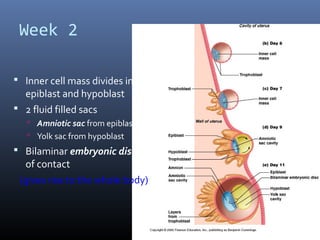
Week 2
 Inner cell mass divides into
epiblast and hypoblast
 2 fluid filled sacs
 Amniotic sac from epiblast
 Yolk sac from hypoblast
 Bilaminar embryonic disc: area
of contact
(gives rise to the whole body)
 Bilaminar to trilaminar disc
 Three primary “germ” layers: all body tissues
develop from these
 Ectoderm
 Endoderm
 Mesoderm
Week 3
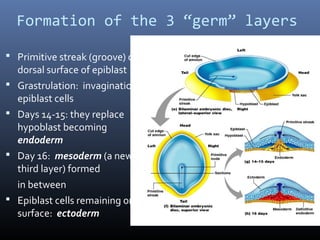
Formation of the 3 “germ” layers
 Primitive streak (groove) on
dorsal surface of epiblast
 Grastrulation: invagination of
epiblast cells
 Days 14-15: they replace
hypoblast becoming
endoderm
 Day 16: mesoderm (a new
third layer) formed
in between
 Epiblast cells remaining on
surface: ectoderm
The three “germ” tissues
 “Germ” as in germinate, not germs
 Early specialization of cells
 Are precursors
 Ectoderm and endoderm are epithelial tissue
(form sheets of tissue)
 Mesoderm is a mesenchyme tissue
 Mesenchyme cells are star shaped and do not attach
to one another, therefore migrate freely
Notochord
 Days 16-18
 Primitive node epiblast
cells invaginate and
migrate anteriorly with
some endoderm cells
 Rod defining the body
axis is formed
 Future site of the
vertebral column
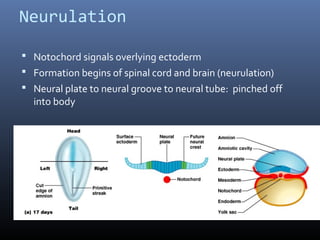
Neurulation
 Notochord signals overlying ectoderm
 Formation begins of spinal cord and brain (neurulation)
 Neural plate to neural groove to neural tube: pinched off
into body
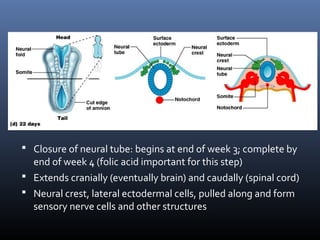
 Closure of neural tube: begins at end of week 3; complete by
end of week 4 (folic acid important for this step)
 Extends cranially (eventually brain) and caudally (spinal cord)
 Neural crest, lateral ectodermal cells, pulled along and form
sensory nerve cells and other structures
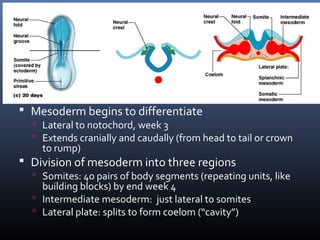
 Mesoderm begins to differentiate
 Lateral to notochord, week 3
 Extends cranially and caudally (from head to tail or crown
to rump)
 Division of mesoderm into three regions
 Somites: 40 pairs of body segments (repeating units, like
building blocks) by end week 4
 Intermediate mesoderm: just lateral to somites
 Lateral plate: splits to form coelom (“cavity”)
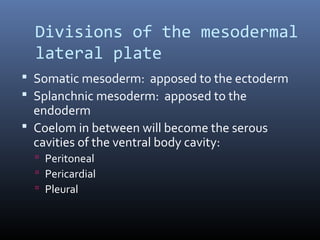
Divisions of the mesodermal
lateral plate
 Somatic mesoderm: apposed to the ectoderm
 Splanchnic mesoderm: apposed to the
endoderm
 Coelom in between will become the serous
cavities of the ventral body cavity:
 Peritoneal
 Pericardial
 Pleural
Folding begins
at week 4
(main difference
between the 3
week embryo
and the adult
body is that the
embryo is still
a flat disc)
24 day
embryro;
protrudes
into
amniotic
cavity
Day 23, beginning
to fold
Lateral folds
will join ventrally
Cylindrical
human body
plan, day 28
(about ½ cm)
Simplified
cross section
through
abdomen of
an adult
(essentially the
same as above)
Major derivatives of the embryonic germ layers
29 day embryo
(this is when the heart starts pumping,
about 4 weeks or 1 month, ½ cm size)
month 3
month 5
3 month fetus
(6 cm)
late 5th
month
(about 19 cm)
By 8 weeks, about 2 months, all
major organs are in place in at
least a rudimentary form; this is
why drugs early in pregnancy are
so important to avoid – many
cause birth defects; baby is a little
over 1” long (below right)
Basic embryology by  dr. armaan singh

Basic embryology by dr. armaan singh

  • 1.
    Basic EmbryologyBasic Embryology By-Dr. Armaan SinghBy- Dr. Armaan Singh
  • 2.
    Embryology  Definition: thestudy of the origin and development of an organism  Prenatal period: before birth  38 weeks from conception to birth (average) “fetal” age  Gynecologic timing has been from LMP therefore refers to 40 weeks “gestational” age  Date of conception has been difficult to time  LMP is on average two weeks before ovulation
  • 3.
    Traditional (artificial) division:  “Embryonic”period: first 8 weeks  All major organs formed  “Fetal” period: remaining 30 weeks  Organs grow larger and become more complex
  • 6.
  • 7.
     Ovulation: eggreleased into the peritoneal cavity  Travels down fallopian tube in which fertilization occurs  At conception in fallopian tube, maternal and paternal genetic material join to form a new human life (zygote)  Cell division occurs with travel down the tube and into the uterus Conception (biology) or fertilisation, the fusion of gametes to produce a new organism of the same species (Wikipedia)
  • 8.
    Week 1 postconception  Zygote divides repeatedly moving down tube toward uterus (cleavage)  The daughter cells are called blastomeres  Morula: the solid cluster of 12-16 blastomeres at about 72 hours  Day 4: late 60 cell morula enters uterus, taking up fluid becoming blastocyst
  • 10.
    Blastocyst stage  Twodistinct types of cells  Inner cell mass: forms the embryo  Trophoblast: layer of cells surrounding the cavity which helps form the placenta  Floats for about 3 days  Implantation on about day 6 post conception  Trophoblast erodes uterine wall  Takes 1 week to complete  If inner cell mass of a single blastocyst divides: monozygotic (identical) twins _____inner cell mass ______trophoblast
  • 11.
    Week 2  Innercell mass divides into epiblast and hypoblast  2 fluid filled sacs  Amniotic sac from epiblast  Yolk sac from hypoblast  Bilaminar embryonic disc: area of contact (gives rise to the whole body)
  • 12.
     Bilaminar totrilaminar disc  Three primary “germ” layers: all body tissues develop from these  Ectoderm  Endoderm  Mesoderm Week 3
  • 13.
    Formation of the3 “germ” layers  Primitive streak (groove) on dorsal surface of epiblast  Grastrulation: invagination of epiblast cells  Days 14-15: they replace hypoblast becoming endoderm  Day 16: mesoderm (a new third layer) formed in between  Epiblast cells remaining on surface: ectoderm
  • 14.
    The three “germ”tissues  “Germ” as in germinate, not germs  Early specialization of cells  Are precursors  Ectoderm and endoderm are epithelial tissue (form sheets of tissue)  Mesoderm is a mesenchyme tissue  Mesenchyme cells are star shaped and do not attach to one another, therefore migrate freely
  • 15.
    Notochord  Days 16-18 Primitive node epiblast cells invaginate and migrate anteriorly with some endoderm cells  Rod defining the body axis is formed  Future site of the vertebral column
  • 16.
    Neurulation  Notochord signalsoverlying ectoderm  Formation begins of spinal cord and brain (neurulation)  Neural plate to neural groove to neural tube: pinched off into body
  • 17.
     Closure ofneural tube: begins at end of week 3; complete by end of week 4 (folic acid important for this step)  Extends cranially (eventually brain) and caudally (spinal cord)  Neural crest, lateral ectodermal cells, pulled along and form sensory nerve cells and other structures
  • 18.
     Mesoderm beginsto differentiate  Lateral to notochord, week 3  Extends cranially and caudally (from head to tail or crown to rump)  Division of mesoderm into three regions  Somites: 40 pairs of body segments (repeating units, like building blocks) by end week 4  Intermediate mesoderm: just lateral to somites  Lateral plate: splits to form coelom (“cavity”)
  • 19.
    Divisions of themesodermal lateral plate  Somatic mesoderm: apposed to the ectoderm  Splanchnic mesoderm: apposed to the endoderm  Coelom in between will become the serous cavities of the ventral body cavity:  Peritoneal  Pericardial  Pleural
  • 20.
    Folding begins at week4 (main difference between the 3 week embryo and the adult body is that the embryo is still a flat disc)
  • 21.
  • 22.
    Day 23, beginning tofold Lateral folds will join ventrally
  • 23.
    Cylindrical human body plan, day28 (about ½ cm) Simplified cross section through abdomen of an adult (essentially the same as above)
  • 24.
    Major derivatives ofthe embryonic germ layers
  • 25.
    29 day embryo (thisis when the heart starts pumping, about 4 weeks or 1 month, ½ cm size)
  • 26.
    month 3 month 5 3month fetus (6 cm) late 5th month (about 19 cm)
  • 27.
    By 8 weeks,about 2 months, all major organs are in place in at least a rudimentary form; this is why drugs early in pregnancy are so important to avoid – many cause birth defects; baby is a little over 1” long (below right)