EMBRYOLOGY
I. EMBRYOLOGY:
•Deals with the period of development
prior to birth (prenatal)
•Study of development of the embryo
•Period of the embryo = first 8 weeks
The beginning…
Fertilization = the joining of
the sperm and the egg in
the fallopian tube to form a
unique human being.
For the first 8 weeks it is
known as an Embryo.
After 8 weeks it is known
as a Foetus.
an Embryo
This is a fertilized
egg only 30 hours
after conception
Embryology
A. Processes involved
1. Ovulation: release of ovum
2. Fertilization: union of sperm and
ovum
3. Mitosis of fertilized ovum
[zygote (2N)]
Processes, con’t: Cleavage
4. Cleavage: Cleavage is a series of
rapid mitotic divisions (without cell
growth)
Early cell division
a. Zygote undergoes mitosis
b. Initiated by fertilization
c. Rapid process
Processes, con’t: Cleavage
d. Continuing cleavage results in
formation of Morula
(morula - 32 cells)
1. A solid ball of cells
2. Same size as ovum
e. Complete by ~day 3
5. During cleavage:
a. Zygote moves along the
fallopian tube toward uterus
b. Takes approximately 3 days.
B. Differentiation:
1. “Process of becoming different”
a. All cells start out the same
b. Four tissue types at
c. 200 kinds of cells birth
2. Follows morula formation
3. Cell division continues
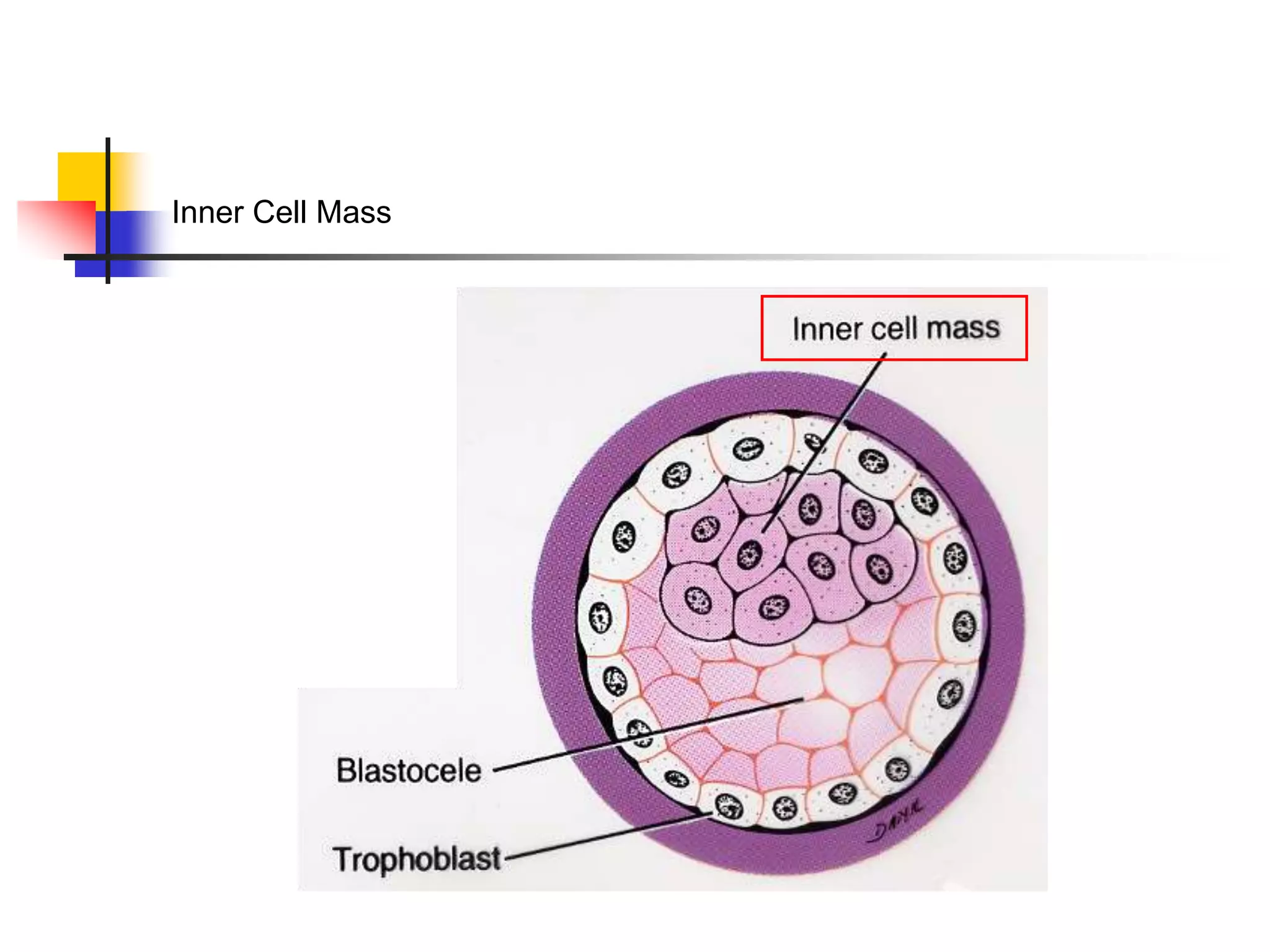
a. morula modified into two parts
b. trophoblast
- outer sphere of cells
c. inner cell mass
Inner Cell Mass
4. Trophoblast cells:
a. Outer layer of sphere
b. Secrete fluid into interior
of hollow sphere
c. Grows rapidly
Trophoblast Cells
Trophoblast Cells
5. Inner cell mass attached to one
side of trophoblast
6. Blastocoele (cavity) is full of fluid
7. Blastocyst:
a. Trophoblast + inner cell mass
b. Floats free in uterus until
implantation
C. Implantation:
1. Begins ~day 6
a. blastocyst contacts wall
b. adheres to endometrium
c. “inner cell mass first”
Implantation, cont …
2. Cells of trophoblast:
a. Secrete enzymes
b. Digest their way into
endometrium
3. Completed by 11th day after
fertilization
Implantation:
Initial events, 5-7
days after fertilization
D. Germ Layer Formation:
1. Takes place during implantation
2. Inner cell mass differentiates into:
a. ectoderm (amniotic cavity)
b. endoderm (yolk sac)
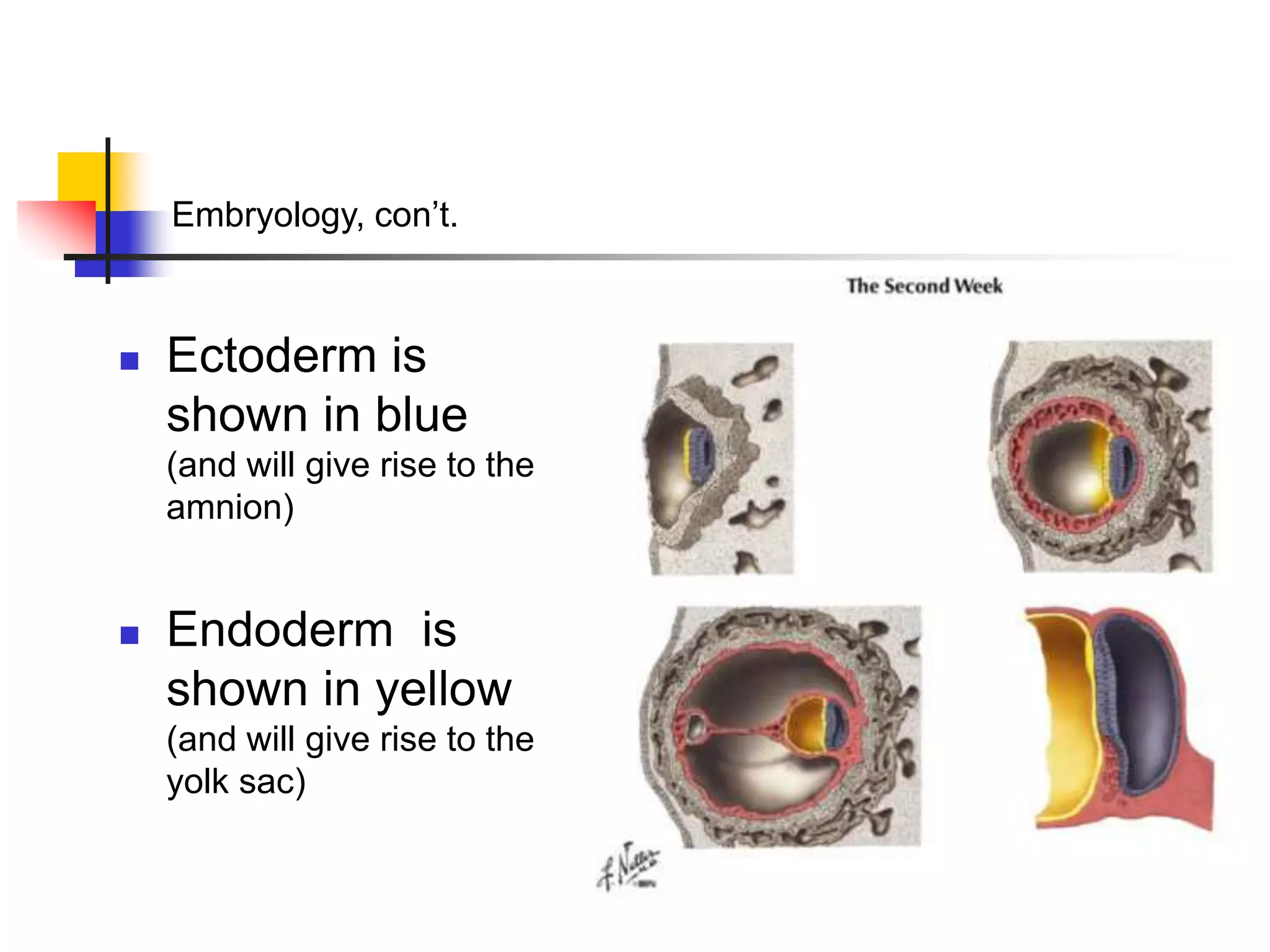
Embryology, con’t.
 Ectoderm is
shown in blue
(and will give rise to the
amnion)
 Endoderm is
shown in yellow
(and will give rise to the
yolk sac)
3. Initial placental formation
a. Extraembryonic mesoderm
[from trophoblast cell division]
b. Trophoblast + mesoderm =
chorion
c. Projections grow from chorion
1. Chorionic villi
2. Form fetal part of placenta
E. Embryonic Disc:
1. Formed at contact between
ectoderm and endoderm
2. In place by Day 14(third week)
3. Mesoderm arises between layers
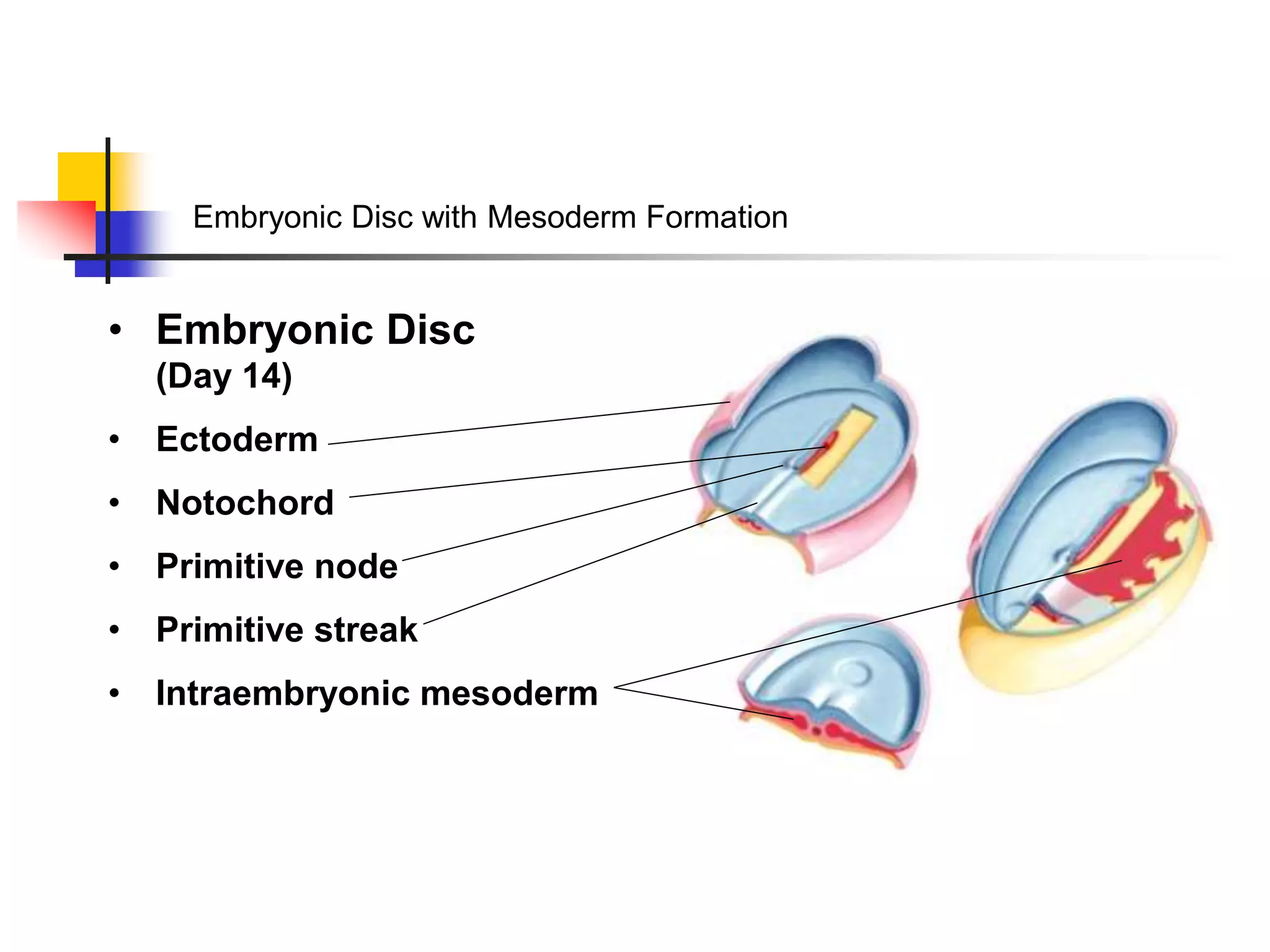
Embryonic Disc with Mesoderm Formation
• Embryonic Disc
(Day 14)
• Ectoderm
• Notochord
• Primitive node
• Primitive streak
• Intraembryonic mesoderm
Embryonic Disc, cont…
4. Day 16(4week)
a. constriction starts between
amniotic sac and yolk sac
b. causes disc to become tubular
c. head grows most rapidly
d. is being folded over
e. constriction forms gut
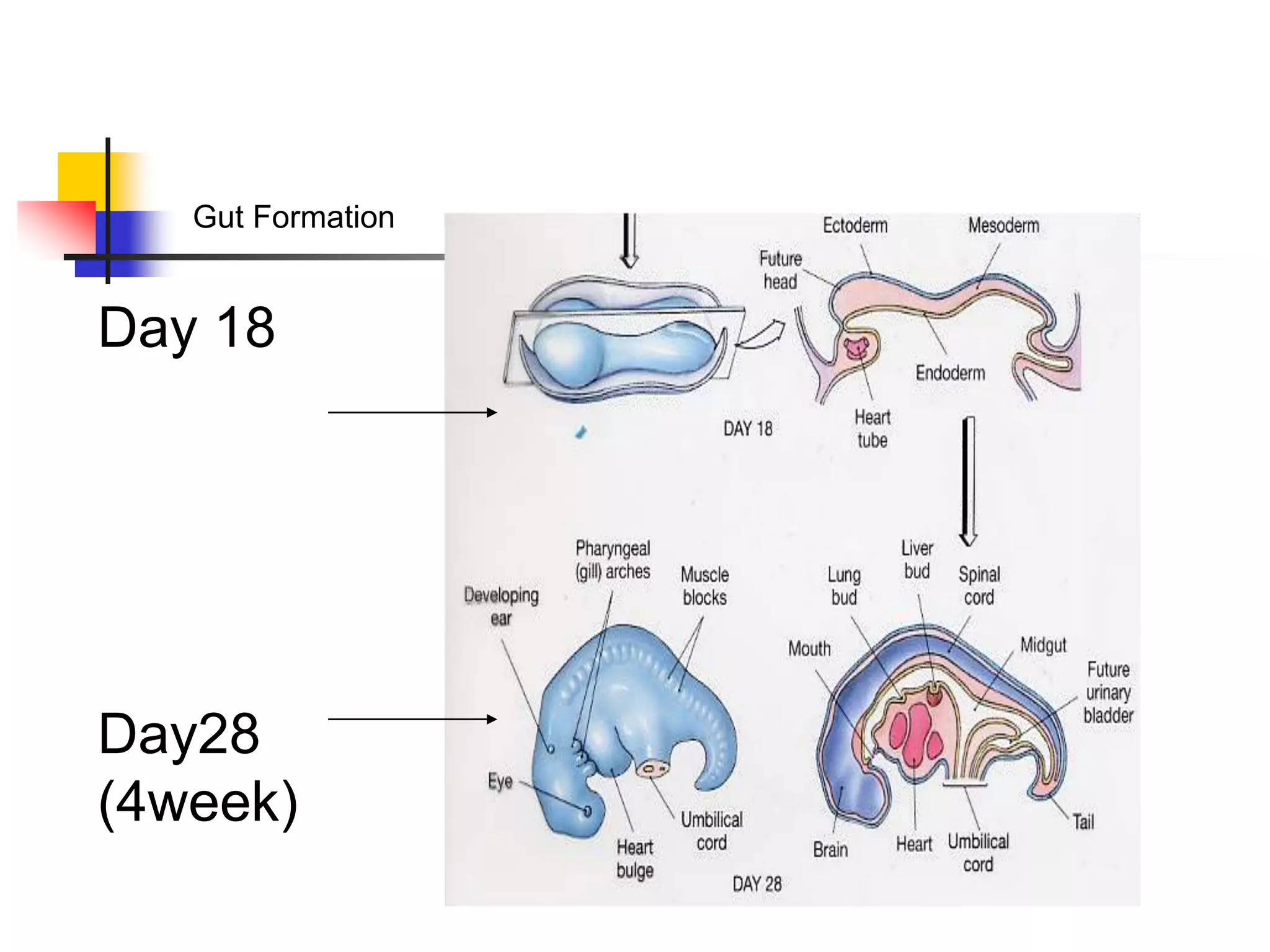
Gut Formation
Day 18
Day28
(4week)
Gut and Mesentery Formation, 18 days
Ectoderm blue
Mesoderm pink
Endoderm yellow
Gut tube
Yolk sac
Embryology, con’t.
F. Mesoderm formation:
1. Primitive groove: “dent” in disc
2. Primitive streak: cells in groove
3. Mesoderm cells proliferate from
primitive streak
4. Insert between ectoderm and
endoderm
Mesoderm formation, cont.
5. Mesoderm divides into two layers:
a. Somatopleure =
1. ectoderm + mesoderm
2. forms body walls
b. Splanchnopleure =
1. endoderm + mesoderm
2. forms viscera
c. Somites
1. Thickened mesoderm lying on
either side of notochord
[Notochord: axis of vertebral development]
2. Primary segmentation
3. Forms muscles, skeleton
Somite Development
Embryonic Inner Ear
Occipital myotomes
Cervical myotomes
Thoracic myotomes
Lumbar myotomes
Sacral myotomes
G. Neural Tube:
1. Thickened ridges appear
2. Between primitive streak, disc
3. Arise from neurectoderm
a. Neural crest cells (PNS)
b. Notochord induces formation,
differentiation of motor neurons
Neurulation
•Neurectoderm
Formation begins
~Day 15
•Embryo at 20 days
•Embryo at 21 days
Embryology, con’t…
4. Form a groove
5. Ridges join
6. Form neural tube ( CNS)
7. Develops into brain and spinal
cord
8. Ectoderm (skin, meninges)
covers it
9. In place by Day 28
Neural Tube Formation
 Embryo at 24 days
showing closed
neural tube
II. Events in Development, by Trimester
A. First Trimester(0-12week)
1. End of first month: (4week)
a. Nervous System and brain
developing
b. Somites for muscle, skeleton,
and skin in place
c. Mandible forms
d. Amnion and chorion fuse
II. Events in Development, by Trimester
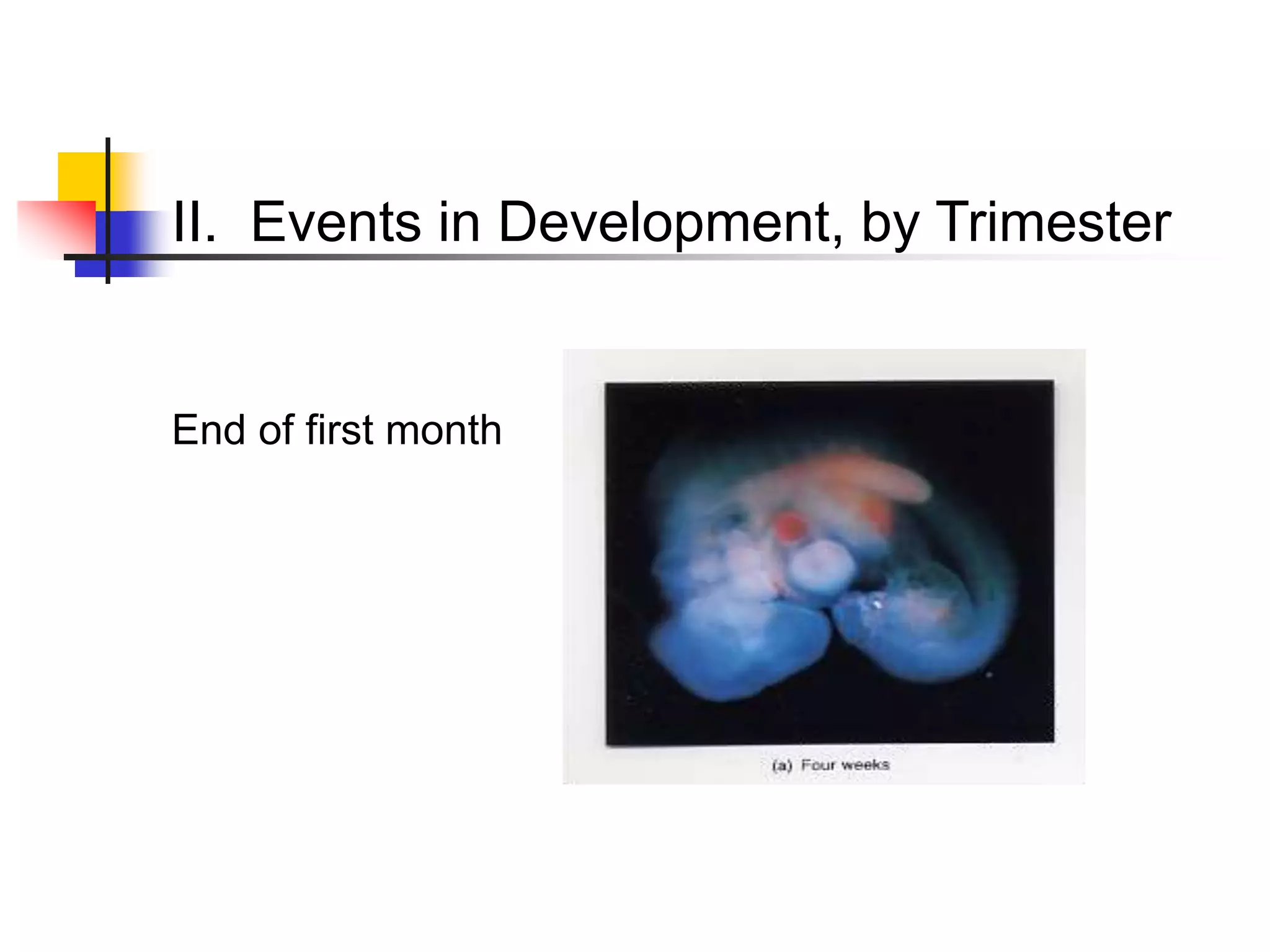
End of first month
Events by trimester, 1st, con’t.
d. Lungs begin to develop
e. Heart starts beating (day 21)
f. Blood cells arise in yolk sac, liver
g. Kidneys developing
h. Arm and leg buds appear
i. All major organ systems in place
Lung Development,First Trimester
Hyoid bone
Cricoid cartilage
Trachea
Right primary
bronchus
Right lung
Events by trimester, 1st, con’t.
2. Second month(8week)
a. Eyes, ears, jaws develop
b. Reproductive organs distinct
c. Fingers and toes apparent
d. Skeletal formation begins (~6 wks)
e. First 8 weeks: period of the embryo
Differentiation of Reproductive Organs
Male (left) vs. Female (right) Homologs
II. Events in Development, by Trimester
End of second month
Events by trimester, 1st, con’t.
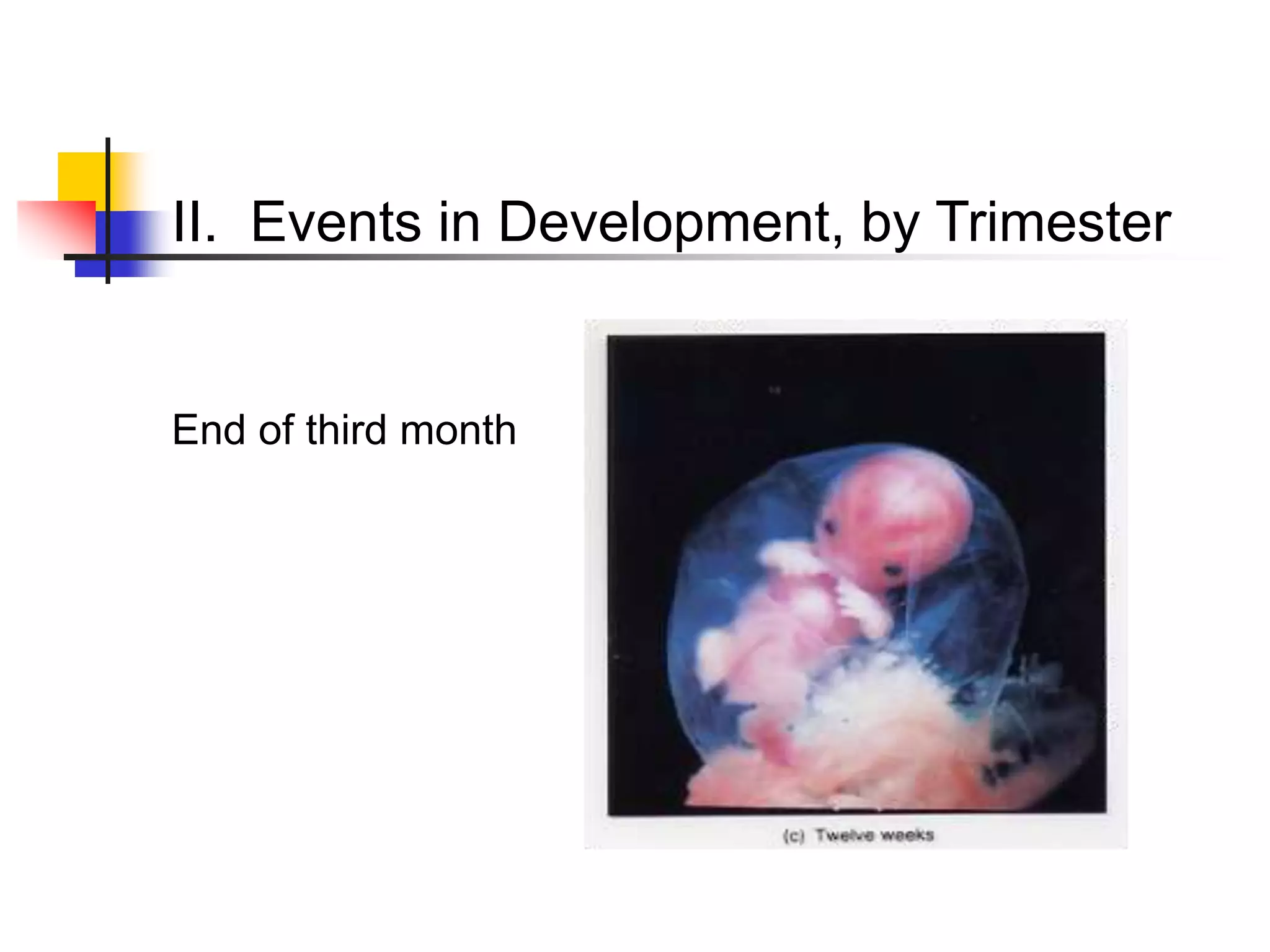
3. Third month(12 week)
a. Period of the fetus begins
b. Thumb & forefinger opposed
c. Breathing, eating, general
movements more coordinated
d. Behavior becomes individualized
Events by trimester, 1st, con’t.
d. Taste buds develop
e. Excreting urine into amniotic fluid
f. Extensive skeletal formation
g. Facial hair by day 70
II. Events in Development, by Trimester
End of third month
Events by trimester, 1st, con’t.
4. End of first trimester
a. All major organ systems in place
b. During organ formation:
1. Embryo is most susceptible to
outside insults
Events by trimester, 1st, con’t.
a. Drugs, viral diseases, radiation
b. Alcohol use, smoking,
measles, polio, HIV, etc.
2. Exposure can produce
congenital anomalies
Congenital Anomalies: NTDs
Cystic
Hygroma
Anencephaly
Encephalocele
Congenital anomalies: Cleft Palate
Events by trimester, con’t
B. The Second Trimester(13week-28week)
1. End of 4th month(16 week)
a. Weight = 4 - 6 oz
b. Length = 7 - 8 inches
c. Internal viscera enlarge, are
enclosed by abdominal wall.
Events by trimester, 2nd, con’t.
e. Can hold head erect
f. Skin well-developed enough to
distinguish finger and foot prints
g. Spontaneously stretches arms,
legs
h. Some reflex ability
Foot with Tootsies
Embryo at 16 weeks
Events by trimester, 2nd, con’t.
2. End of the 5th month(20 week)
a. Weight = 1/2 lb (8 oz)
b. Freely mobile in amniotic sac
1. ~ 350 ml/hr amniotic fluid
made/hour (8.5 liters/day)
2. Fluid protects against
trauma and temperature
changes.
Looks Like Dad…
Events by trimester, 2nd, con’.
c. Fetus looks fully formed
d. Only rarely survive on their own
e. Lungs completely formed, not
functional
f. Skin covered by vernix
1. Cheesy substance
2. Protective function
Events by trimester, 2nd, con’t.
g. Digestive organs formed, but not
yet functional
h. Infants born < 1000 grams need
complete life support
i. Reduction or loss of vestigial
structures occurs
-remnants of ~125 remain in adult
Events by trimester, 2nd, con’t.
j. Fingernails and toenails develop
k. In some organs, cells replacement
begins (by mitosis!)
l. Movement becomes constant
Events by trimester, 2nd, con’t.
m. Can identify elbows, knees and
buttocks
n. Occasionally hiccoughs
o. Load on mother’s heart, lungs, and
kidneys increases
Events by trimester, 2nd, con’t.
3. End of 6th month(24 week)
a. Weight = 1 - 1/2 lbs,
b. Length = 12 - 14 inches
c. Well-proportioned “miniature human”
d. Skin is red and wrinkled
e. Hair follicles, glands, sense receptors
develop
f. Active skeletal formation
Events by trimester, con’t
C.The Third Trimester(28week-40week)
1. Most difficult period for mother
a. Added weight of fetus
b. Increased pressure on her
organs
Events by trimester, 3rd, con’t.
c. Increased demands on mom:
1. Must breathe, digest, excrete &
circulate blood for two
2. Blood volume at 7 months:
increased 30%
Events by trimester, 3rd, con’t.
3. 16% of mother’s blood is in
uterus & placenta
4. Increased blood pressure
5. Breathing difficulties
Events by trimester, 3rd, con’t.
2. Premature births
a. 10% of 7 month babies survive
b. 70% of 8 month babies survive
c. 95% of 9 month babies survive
Events by trimester, 3rd, con’t.
3. Needs of Fetus
a. Calcium: 85% of mother’s
intake goes to fetal bone
formation
b. Iron: 85% of mother’s iron
intake used to make fetal
hemoglobin
Events by trimester, 3rd, con’t.
c. Nitrogen: Required for
nervous system development
d. Evidence that low intellect
is correlated to low protein
maternal diet in 3rd trimester
Events by trimester, 3rd, con’t.
4. Immune Transferal to Fetus
a. Infections contracted by
mother cause her to develop
antibodies
b. These are passed to fetus via fetal
circulation.
c. Antibodies will protect infant for up
to 6 months post-partum
Events by trimester, 3rd, con’t.
5. Activity of Fetus
a. Baby seems less active because it
is more confined (less space)
b. Fetal activity slows prior to birth
Events by trimester, 3rd, con’t.
6. Uterine changes
a. 60 times original volume at term
b. Amniotic fluid volume varies
1. 500 - 1000 ml (normal limits)
2. Volumes over 2500 ml are
abnormal (polyhydramnios)
Events by trimester, 3rd, con’t.
7. Preceding Birth
a. Evidence that aging placenta may
signal childbirth (more later…)
b. “Forces fetus to seek new
environment”
Why Pregnant Ladies are Grumpy!!
Embryology .ppt

Embryology .ppt

  • 1.
  • 2.
    I. EMBRYOLOGY: •Deals withthe period of development prior to birth (prenatal) •Study of development of the embryo •Period of the embryo = first 8 weeks
  • 3.
    The beginning… Fertilization =the joining of the sperm and the egg in the fallopian tube to form a unique human being. For the first 8 weeks it is known as an Embryo. After 8 weeks it is known as a Foetus. an Embryo This is a fertilized egg only 30 hours after conception
  • 4.
    Embryology A. Processes involved 1.Ovulation: release of ovum 2. Fertilization: union of sperm and ovum 3. Mitosis of fertilized ovum [zygote (2N)]
  • 6.
    Processes, con’t: Cleavage 4.Cleavage: Cleavage is a series of rapid mitotic divisions (without cell growth) Early cell division a. Zygote undergoes mitosis b. Initiated by fertilization c. Rapid process
  • 8.
    Processes, con’t: Cleavage d.Continuing cleavage results in formation of Morula (morula - 32 cells) 1. A solid ball of cells 2. Same size as ovum e. Complete by ~day 3
  • 9.
    5. During cleavage: a.Zygote moves along the fallopian tube toward uterus b. Takes approximately 3 days.
  • 11.
    B. Differentiation: 1. “Processof becoming different” a. All cells start out the same b. Four tissue types at c. 200 kinds of cells birth 2. Follows morula formation
  • 12.
    3. Cell divisioncontinues a. morula modified into two parts b. trophoblast - outer sphere of cells c. inner cell mass
  • 13.
  • 14.
    4. Trophoblast cells: a.Outer layer of sphere b. Secrete fluid into interior of hollow sphere c. Grows rapidly
  • 15.
  • 16.
    5. Inner cellmass attached to one side of trophoblast 6. Blastocoele (cavity) is full of fluid 7. Blastocyst: a. Trophoblast + inner cell mass b. Floats free in uterus until implantation
  • 18.
    C. Implantation: 1. Begins~day 6 a. blastocyst contacts wall b. adheres to endometrium c. “inner cell mass first”
  • 20.
    Implantation, cont … 2.Cells of trophoblast: a. Secrete enzymes b. Digest their way into endometrium 3. Completed by 11th day after fertilization
  • 21.
  • 22.
    D. Germ LayerFormation: 1. Takes place during implantation 2. Inner cell mass differentiates into: a. ectoderm (amniotic cavity) b. endoderm (yolk sac)
  • 23.
    Embryology, con’t.  Ectodermis shown in blue (and will give rise to the amnion)  Endoderm is shown in yellow (and will give rise to the yolk sac)
  • 24.
    3. Initial placentalformation a. Extraembryonic mesoderm [from trophoblast cell division] b. Trophoblast + mesoderm = chorion c. Projections grow from chorion 1. Chorionic villi 2. Form fetal part of placenta
  • 25.
    E. Embryonic Disc: 1.Formed at contact between ectoderm and endoderm 2. In place by Day 14(third week) 3. Mesoderm arises between layers
  • 26.
    Embryonic Disc withMesoderm Formation • Embryonic Disc (Day 14) • Ectoderm • Notochord • Primitive node • Primitive streak • Intraembryonic mesoderm
  • 27.
    Embryonic Disc, cont… 4.Day 16(4week) a. constriction starts between amniotic sac and yolk sac b. causes disc to become tubular c. head grows most rapidly d. is being folded over e. constriction forms gut
  • 28.
  • 29.
    Gut and MesenteryFormation, 18 days Ectoderm blue Mesoderm pink Endoderm yellow Gut tube Yolk sac
  • 30.
    Embryology, con’t. F. Mesodermformation: 1. Primitive groove: “dent” in disc 2. Primitive streak: cells in groove 3. Mesoderm cells proliferate from primitive streak 4. Insert between ectoderm and endoderm
  • 31.
    Mesoderm formation, cont. 5.Mesoderm divides into two layers: a. Somatopleure = 1. ectoderm + mesoderm 2. forms body walls b. Splanchnopleure = 1. endoderm + mesoderm 2. forms viscera
  • 32.
    c. Somites 1. Thickenedmesoderm lying on either side of notochord [Notochord: axis of vertebral development] 2. Primary segmentation 3. Forms muscles, skeleton
  • 33.
    Somite Development Embryonic InnerEar Occipital myotomes Cervical myotomes Thoracic myotomes Lumbar myotomes Sacral myotomes
  • 34.
    G. Neural Tube: 1.Thickened ridges appear 2. Between primitive streak, disc 3. Arise from neurectoderm a. Neural crest cells (PNS) b. Notochord induces formation, differentiation of motor neurons
  • 35.
  • 36.
    Embryology, con’t… 4. Forma groove 5. Ridges join 6. Form neural tube ( CNS) 7. Develops into brain and spinal cord 8. Ectoderm (skin, meninges) covers it 9. In place by Day 28
  • 37.
    Neural Tube Formation Embryo at 24 days showing closed neural tube
  • 38.
    II. Events inDevelopment, by Trimester A. First Trimester(0-12week) 1. End of first month: (4week) a. Nervous System and brain developing b. Somites for muscle, skeleton, and skin in place c. Mandible forms d. Amnion and chorion fuse
  • 39.
    II. Events inDevelopment, by Trimester End of first month
  • 40.
    Events by trimester,1st, con’t. d. Lungs begin to develop e. Heart starts beating (day 21) f. Blood cells arise in yolk sac, liver g. Kidneys developing h. Arm and leg buds appear i. All major organ systems in place
  • 41.
    Lung Development,First Trimester Hyoidbone Cricoid cartilage Trachea Right primary bronchus Right lung
  • 42.
    Events by trimester,1st, con’t. 2. Second month(8week) a. Eyes, ears, jaws develop b. Reproductive organs distinct c. Fingers and toes apparent d. Skeletal formation begins (~6 wks) e. First 8 weeks: period of the embryo
  • 43.
    Differentiation of ReproductiveOrgans Male (left) vs. Female (right) Homologs
  • 44.
    II. Events inDevelopment, by Trimester End of second month
  • 45.
    Events by trimester,1st, con’t. 3. Third month(12 week) a. Period of the fetus begins b. Thumb & forefinger opposed c. Breathing, eating, general movements more coordinated d. Behavior becomes individualized
  • 46.
    Events by trimester,1st, con’t. d. Taste buds develop e. Excreting urine into amniotic fluid f. Extensive skeletal formation g. Facial hair by day 70
  • 47.
    II. Events inDevelopment, by Trimester End of third month
  • 48.
    Events by trimester,1st, con’t. 4. End of first trimester a. All major organ systems in place b. During organ formation: 1. Embryo is most susceptible to outside insults
  • 49.
    Events by trimester,1st, con’t. a. Drugs, viral diseases, radiation b. Alcohol use, smoking, measles, polio, HIV, etc. 2. Exposure can produce congenital anomalies
  • 50.
  • 51.
  • 52.
    Events by trimester,con’t B. The Second Trimester(13week-28week) 1. End of 4th month(16 week) a. Weight = 4 - 6 oz b. Length = 7 - 8 inches c. Internal viscera enlarge, are enclosed by abdominal wall.
  • 53.
    Events by trimester,2nd, con’t. e. Can hold head erect f. Skin well-developed enough to distinguish finger and foot prints g. Spontaneously stretches arms, legs h. Some reflex ability
  • 54.
  • 55.
  • 56.
    Events by trimester,2nd, con’t. 2. End of the 5th month(20 week) a. Weight = 1/2 lb (8 oz) b. Freely mobile in amniotic sac 1. ~ 350 ml/hr amniotic fluid made/hour (8.5 liters/day) 2. Fluid protects against trauma and temperature changes.
  • 57.
  • 58.
    Events by trimester,2nd, con’. c. Fetus looks fully formed d. Only rarely survive on their own e. Lungs completely formed, not functional f. Skin covered by vernix 1. Cheesy substance 2. Protective function
  • 59.
    Events by trimester,2nd, con’t. g. Digestive organs formed, but not yet functional h. Infants born < 1000 grams need complete life support i. Reduction or loss of vestigial structures occurs -remnants of ~125 remain in adult
  • 60.
    Events by trimester,2nd, con’t. j. Fingernails and toenails develop k. In some organs, cells replacement begins (by mitosis!) l. Movement becomes constant
  • 61.
    Events by trimester,2nd, con’t. m. Can identify elbows, knees and buttocks n. Occasionally hiccoughs o. Load on mother’s heart, lungs, and kidneys increases
  • 62.
    Events by trimester,2nd, con’t. 3. End of 6th month(24 week) a. Weight = 1 - 1/2 lbs, b. Length = 12 - 14 inches c. Well-proportioned “miniature human” d. Skin is red and wrinkled e. Hair follicles, glands, sense receptors develop f. Active skeletal formation
  • 63.
    Events by trimester,con’t C.The Third Trimester(28week-40week) 1. Most difficult period for mother a. Added weight of fetus b. Increased pressure on her organs
  • 64.
    Events by trimester,3rd, con’t. c. Increased demands on mom: 1. Must breathe, digest, excrete & circulate blood for two 2. Blood volume at 7 months: increased 30%
  • 65.
    Events by trimester,3rd, con’t. 3. 16% of mother’s blood is in uterus & placenta 4. Increased blood pressure 5. Breathing difficulties
  • 66.
    Events by trimester,3rd, con’t. 2. Premature births a. 10% of 7 month babies survive b. 70% of 8 month babies survive c. 95% of 9 month babies survive
  • 67.
    Events by trimester,3rd, con’t. 3. Needs of Fetus a. Calcium: 85% of mother’s intake goes to fetal bone formation b. Iron: 85% of mother’s iron intake used to make fetal hemoglobin
  • 68.
    Events by trimester,3rd, con’t. c. Nitrogen: Required for nervous system development d. Evidence that low intellect is correlated to low protein maternal diet in 3rd trimester
  • 69.
    Events by trimester,3rd, con’t. 4. Immune Transferal to Fetus a. Infections contracted by mother cause her to develop antibodies b. These are passed to fetus via fetal circulation. c. Antibodies will protect infant for up to 6 months post-partum
  • 70.
    Events by trimester,3rd, con’t. 5. Activity of Fetus a. Baby seems less active because it is more confined (less space) b. Fetal activity slows prior to birth
  • 71.
    Events by trimester,3rd, con’t. 6. Uterine changes a. 60 times original volume at term b. Amniotic fluid volume varies 1. 500 - 1000 ml (normal limits) 2. Volumes over 2500 ml are abnormal (polyhydramnios)
  • 72.
    Events by trimester,3rd, con’t. 7. Preceding Birth a. Evidence that aging placenta may signal childbirth (more later…) b. “Forces fetus to seek new environment”
  • 73.
    Why Pregnant Ladiesare Grumpy!!