


BASICS OF ELECTRICAL
ENGINEERING (1ST YEAR)
INTRODUCTION TO
“FUNDAMENTAL OF ELECTRICITY”
(सरल भाषा में)
LEC#01
Prof. Prasant Kumar BEEE 1
FUNDAMENTAL OF
ELECTRICITY
LEC # 02
Prof. Prasant Kumar BEEE 2
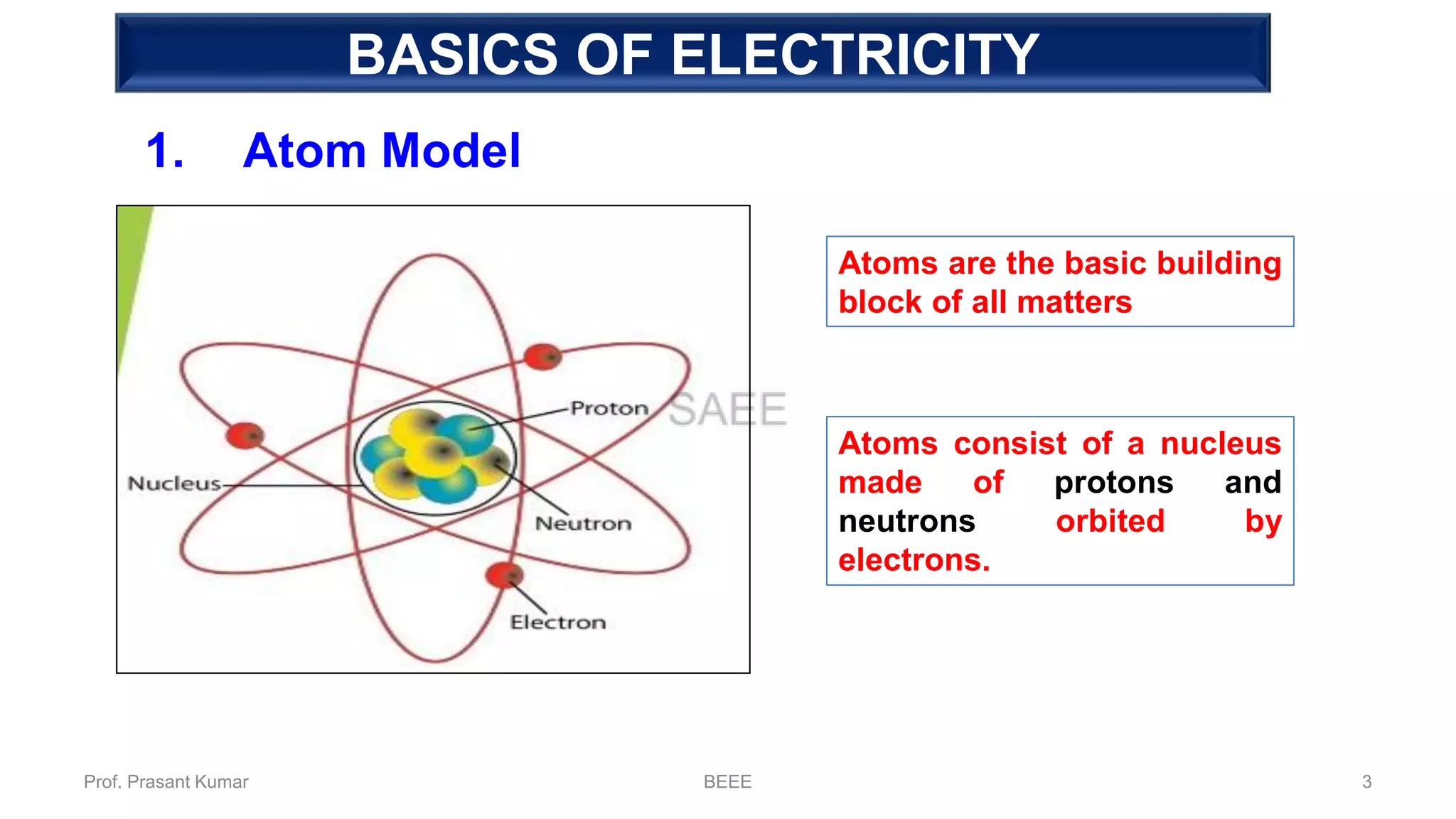
1. Atom Model
Atoms consist of a nucleus
made of protons and
neutrons orbited by
electrons.
Atoms are the basic building
block of all matters
BASICS OF ELECTRICITY
Prof. Prasant Kumar BEEE 3
Fundamental of Electricity
2. Atom
• Protons
• Neutrons
• Electrons
“Each atom has the same number of protons
and electrons.”
BASICS OF ELECTRICITY
Prof. Prasant Kumar BEEE 4
3. Proton and Electron
Protons carries positive charge
– It is relatively large mass
– Does not play active part in
electrical current flow
Electrons carries negative charge
– Light mass
– Play an important role in electrical current flow
Fundamental of ElectricityBASICS OF ELECTRICITY
Prof. Prasant Kumar BEEE 5
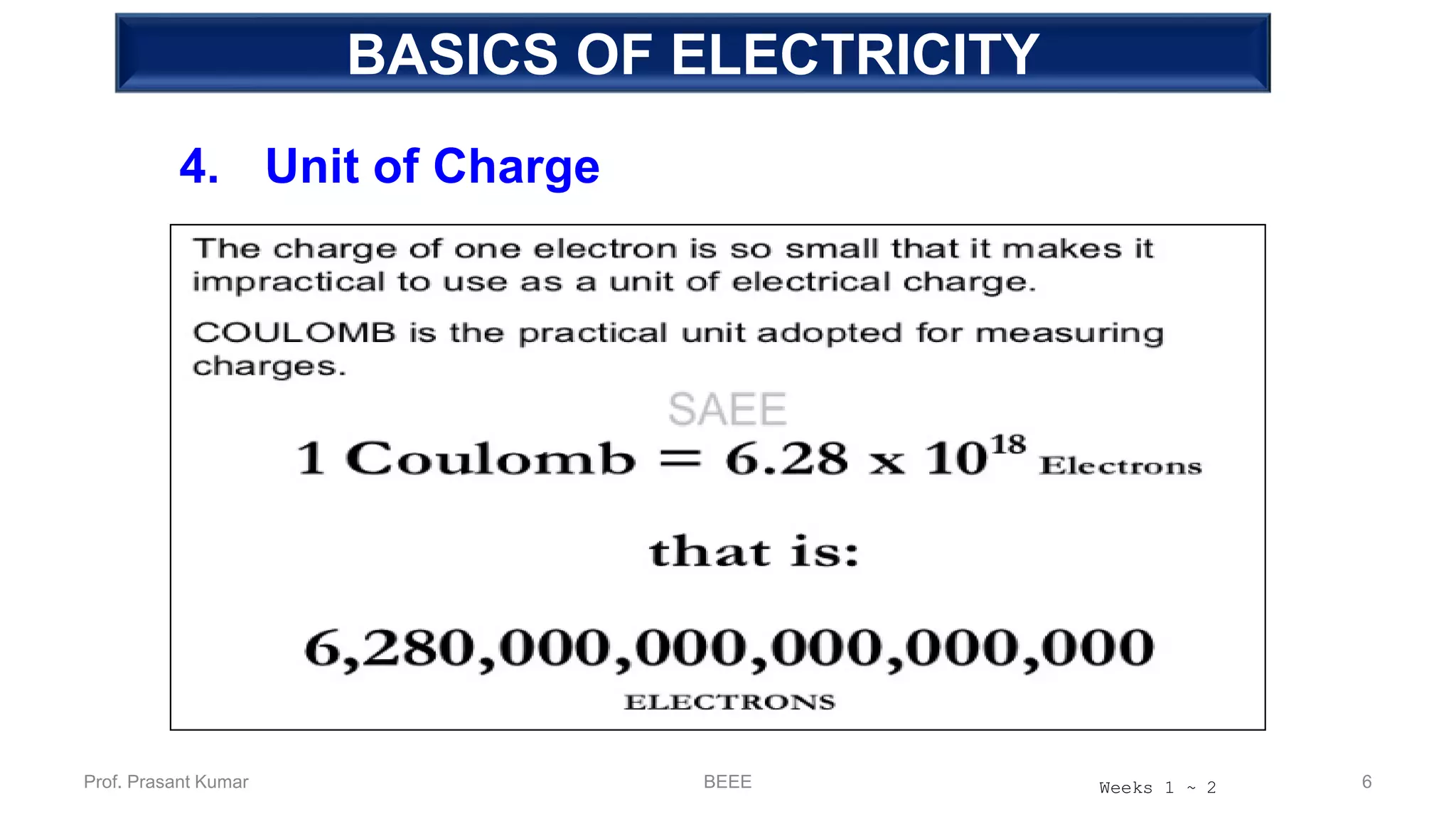
4. Unit of Charge
• Unit of Charge is called Coulomb (C)
• An electron and a proton have exactly
same amount of charge
• One coulomb of charge is equal to
approximately 628 x 1016 electron charge
Weeks 1 ~ 2
Fundamental of Electricity
BASICS OF ELECTRICITY
Prof. Prasant Kumar BEEE 6
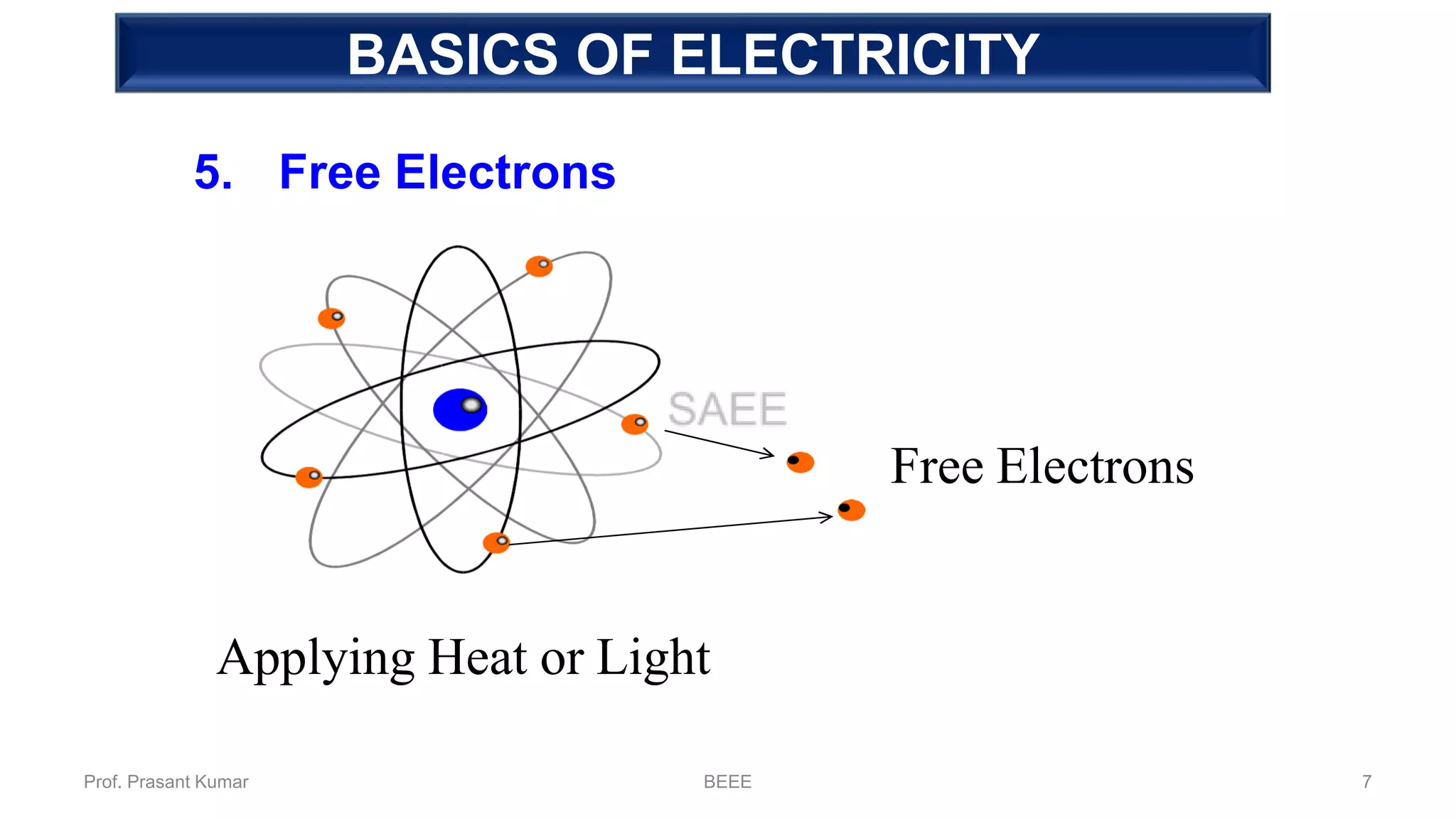
5. Free Electrons
Free Electrons
Applying Heat or Light
Fundamental of Electricity
BASICS OF ELECTRICITY
Prof. Prasant Kumar BEEE 7
Fundamental of Electricity
6. Electrical Materials
All material may be classified into three
major classes:
• Conductors (copper, aluminum, siliver,
platinum, bronz, gold)
• Insulators (glass, rubber, plastic, air,
varnish, paper, wood, mica, ceramic,
certain oils)
• Semiconductors (germanium, silicon)
BASICS OF ELECTRICITY
Prof. Prasant Kumar BEEE 8
Fundamental of Electricity
6. Electrical Materials
• Conductors have many free electrons
which will be drifting in a random
manner within the material
• Insulators have very few free electrons
• Semiconductors falls somewhere between
these two extremes
BASICS OF ELECTRICITY
Prof. Prasant Kumar BEEE 9
BASICS OF ELECTRICAL ENGINEERING
What is Electric CURRENT?
विद्युत प्रिाह क्या है?
Definition,Properties,Unit
LEC#02
Prof. Prasant Kumar BEEE 10
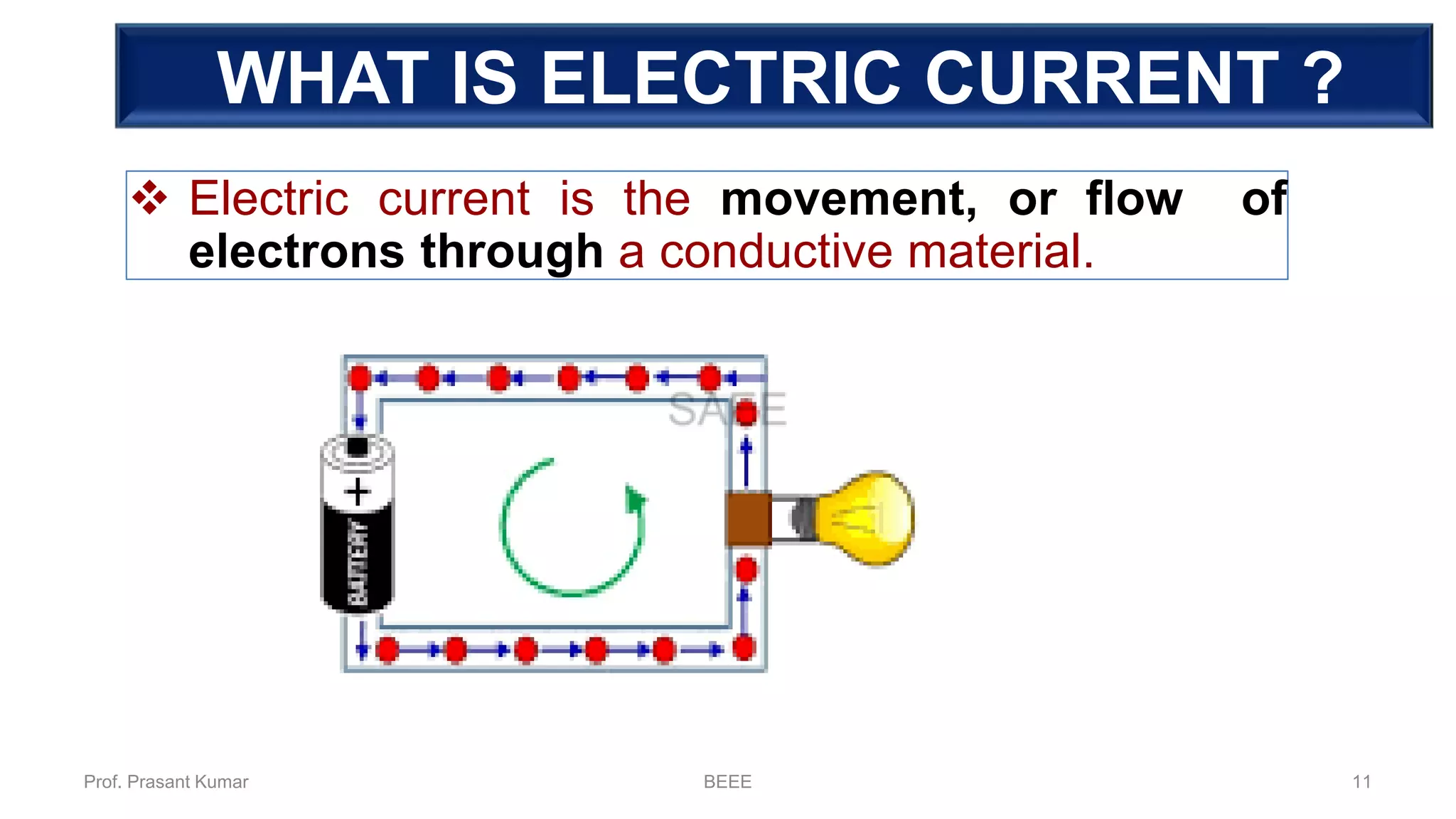
❖ Electric current is the movement, or flow of
electrons through a conductive material.
Fundamental of ElectricityWHAT IS ELECTRIC CURRENT ?
Prof. Prasant Kumar BEEE 11
Fundamental of ElectricityFORMULA & UNIT OF ELECTRIC CURRENT
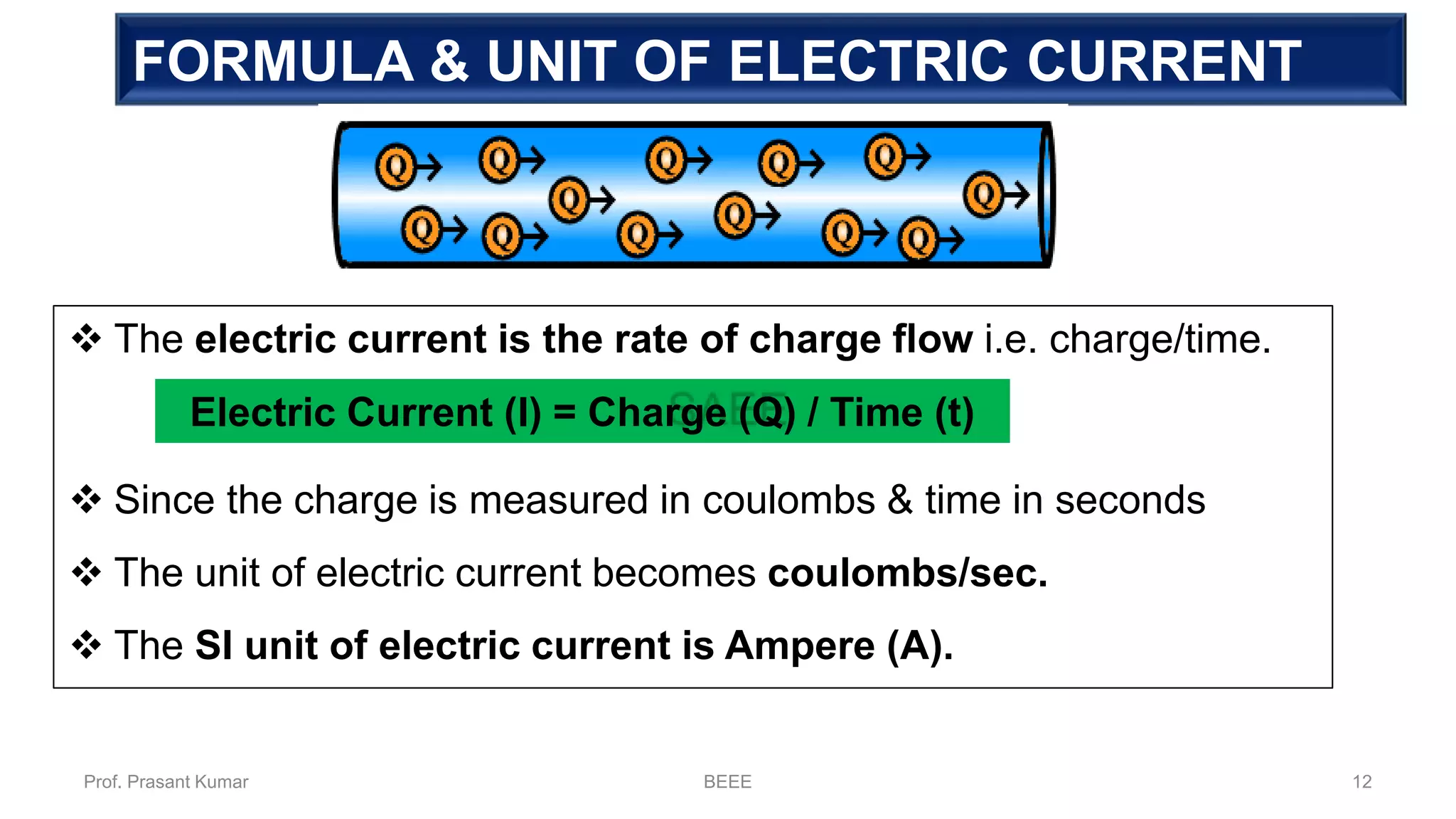
❖ The electric current is the rate of charge flow i.e. charge/time.
❖ Since the charge is measured in coulombs & time in seconds
❖ The unit of electric current becomes coulombs/sec.
❖ The SI unit of electric current is Ampere (A).
Electric Current (I) = Charge (Q) / Time (t)
Prof. Prasant Kumar BEEE 12
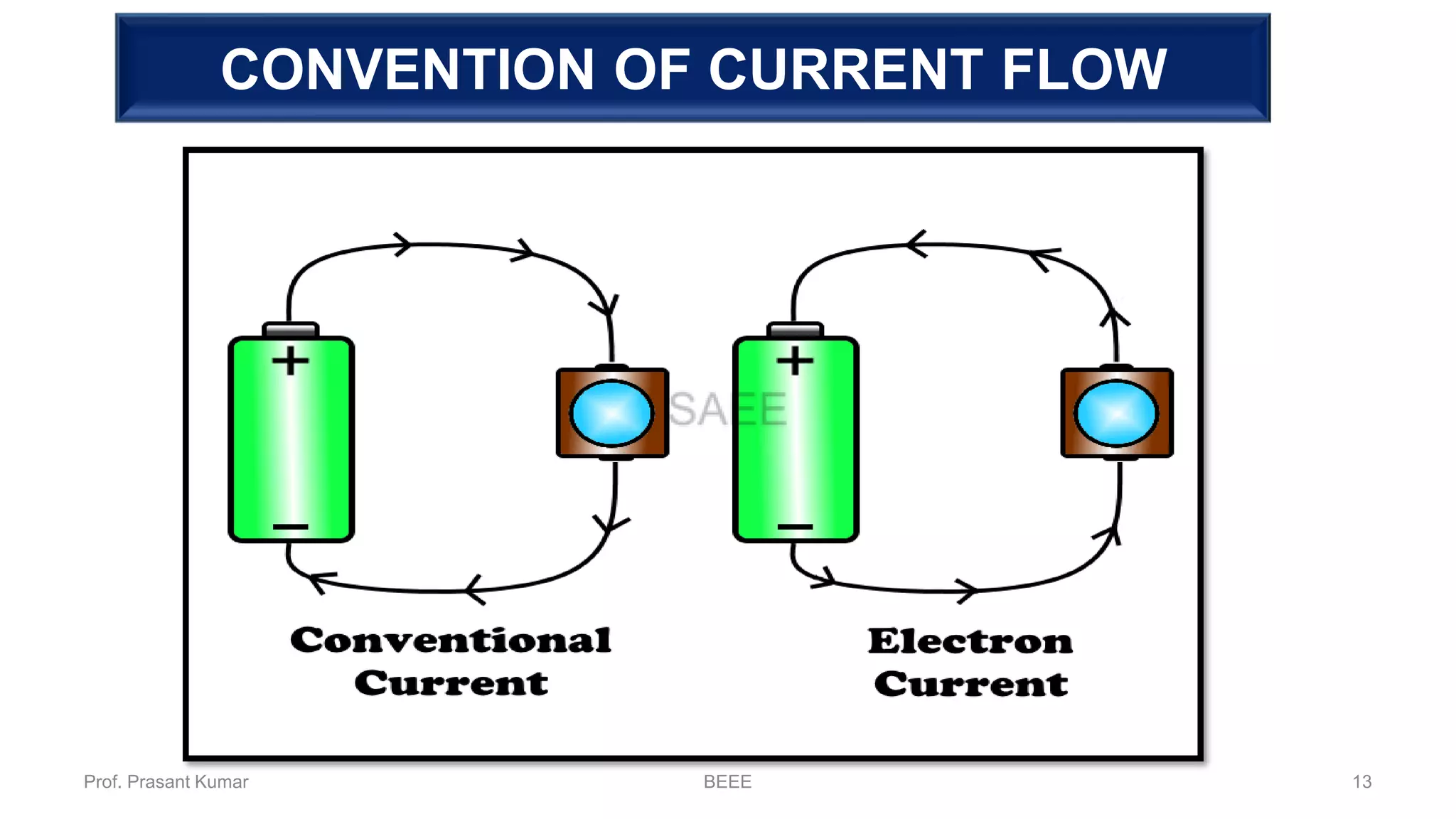
Fundamental of ElectricityCONVENTION OF CURRENT FLOW
Prof. Prasant Kumar BEEE 13
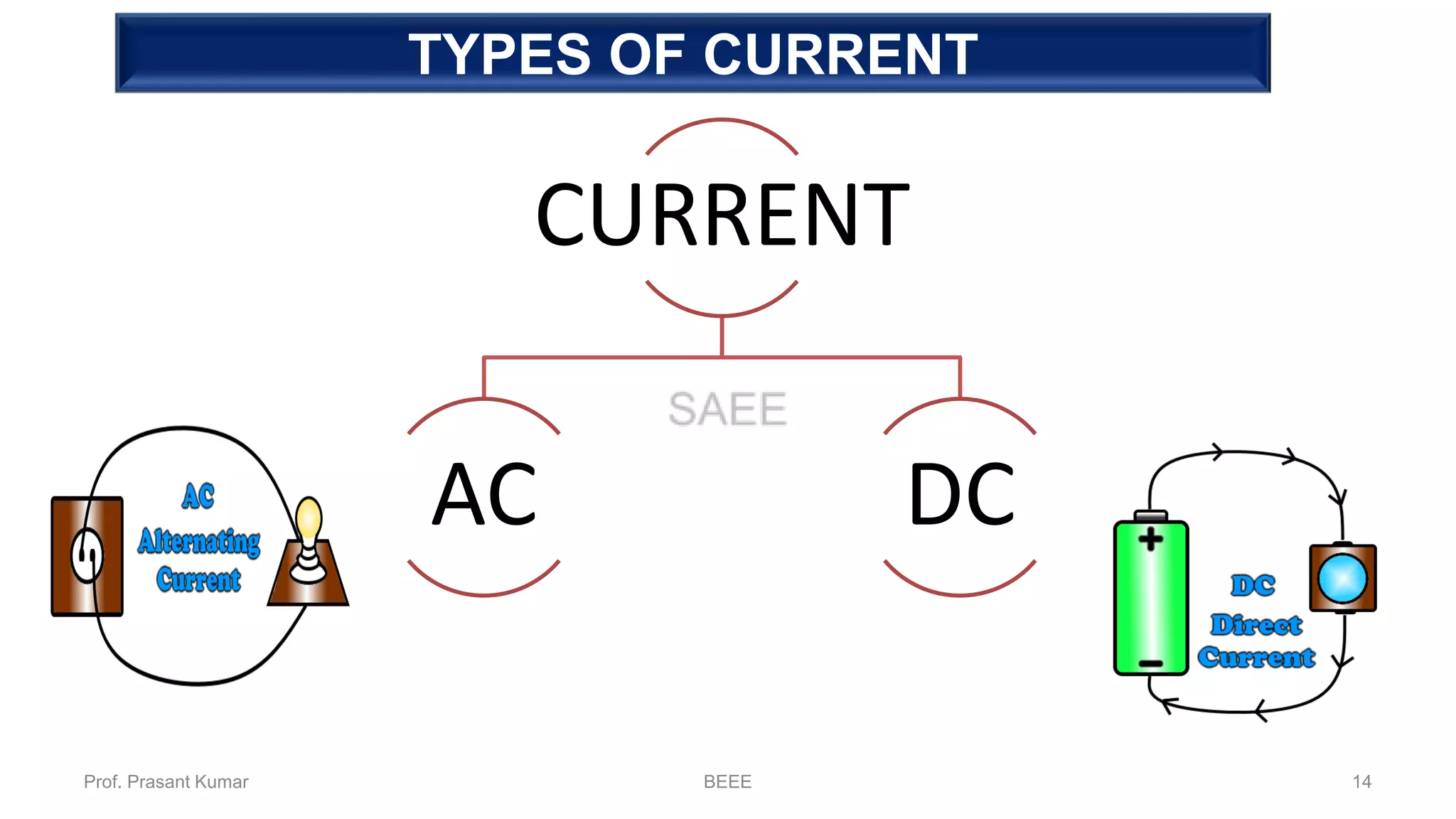
Fundamental of ElectricityTYPES OF CURRENT
CURRENT
AC DC
Prof. Prasant Kumar BEEE 14
Fundamental of ElectricityBASICS OF ELECTRICITY
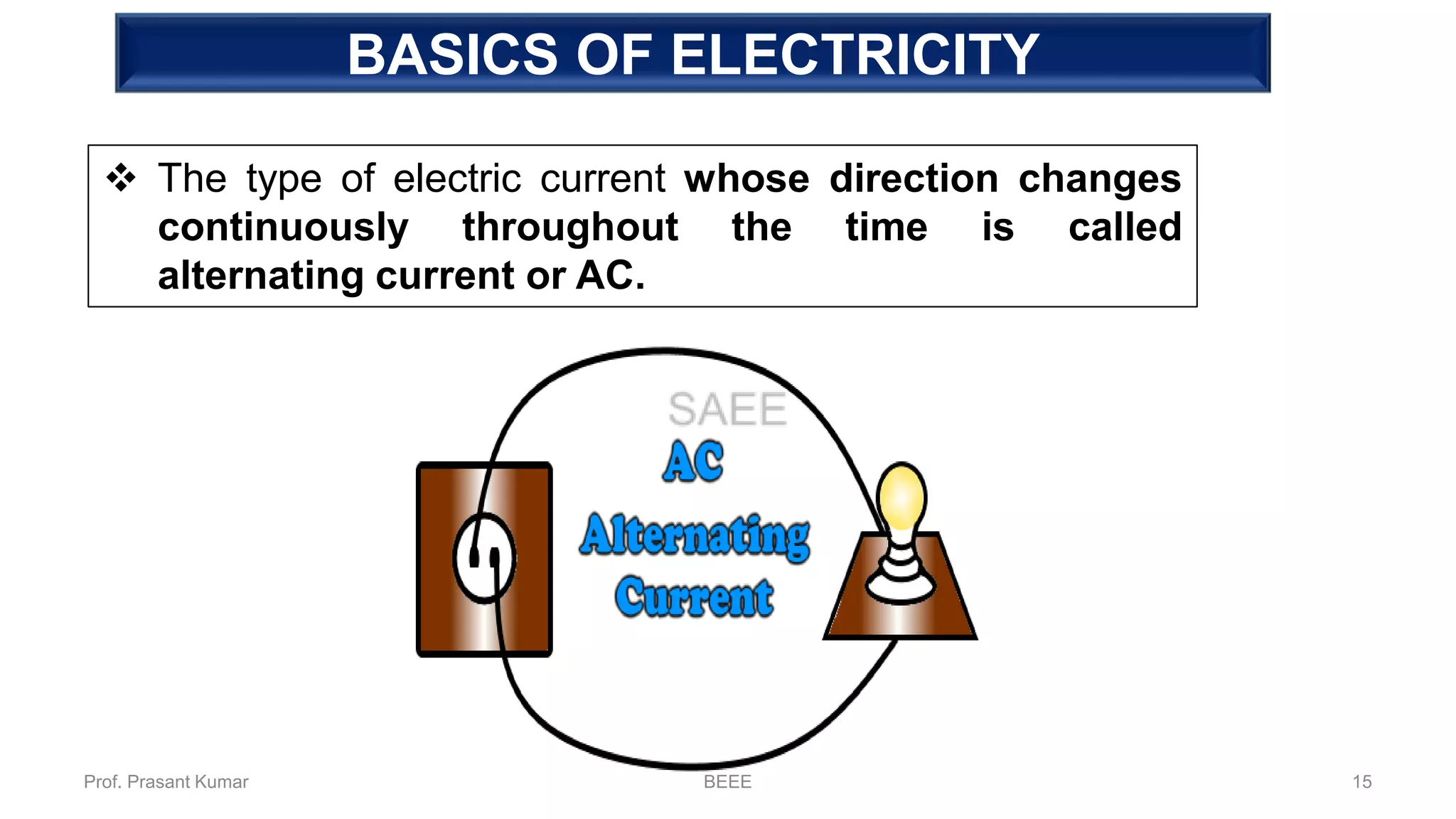
❖ The type of electric current whose direction changes
continuously throughout the time is called
alternating current or AC.
Prof. Prasant Kumar BEEE 15
Fundamental of ElectricityBASICS OF ELECTRICITY
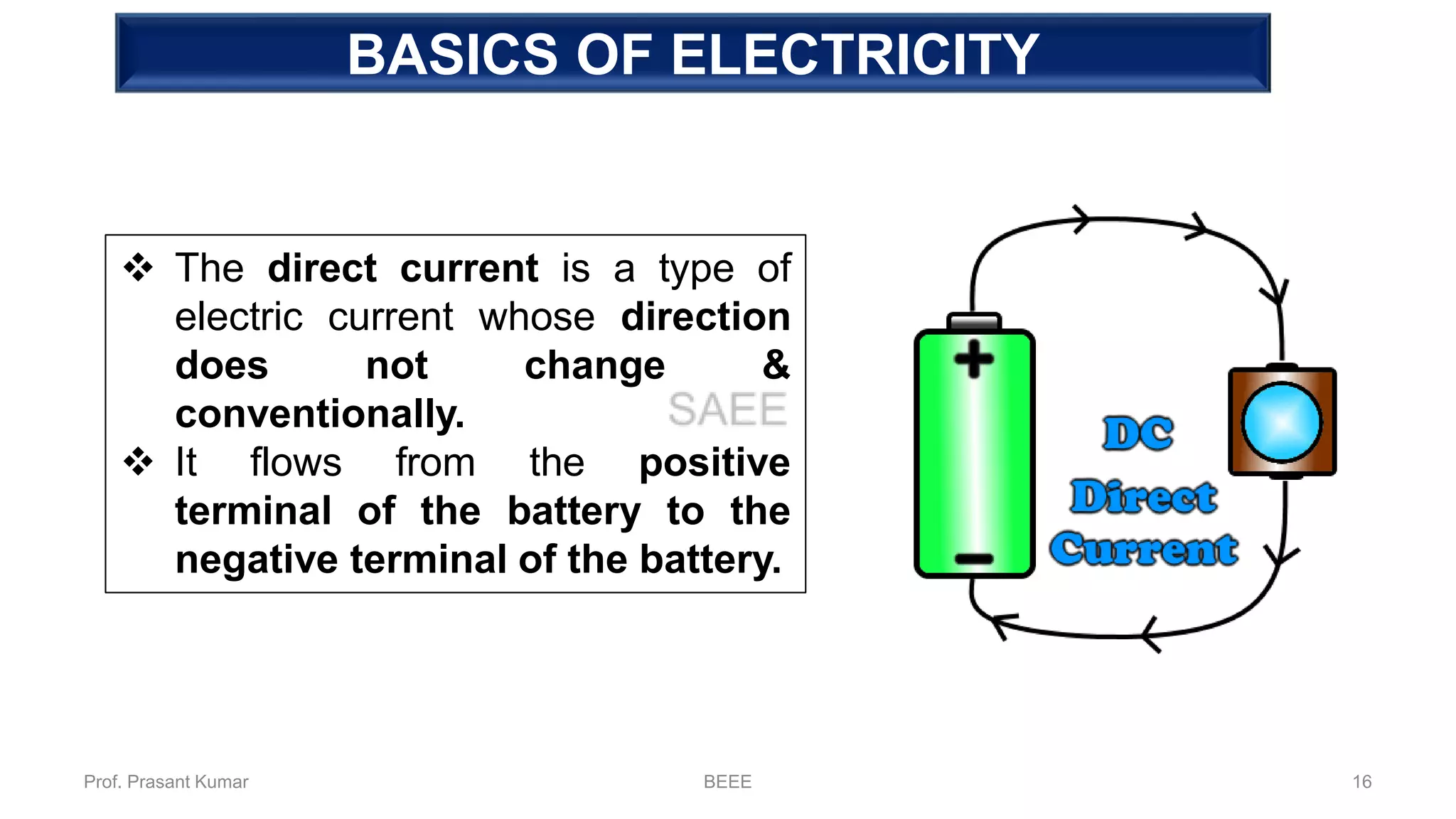
❖ The direct current is a type of
electric current whose direction
does not change &
conventionally.
❖ It flows from the positive
terminal of the battery to the
negative terminal of the battery.
Prof. Prasant Kumar BEEE 16
17Prof. Prasant Kumar BEEE
THANKS TO ALL
FOR ANY PROBLEN FEEL FREE TO VISIT YOUTUBE
FOR DETAIL UNDERSTANDING @.
BASICS OF ELECTRICAL ENGINEERING
Electromotive Force (EMF),Electric
Potential & Potential Difference
में समानता और अंतर.
LEC#03
Prof. Prasant Kumar BEEE 18
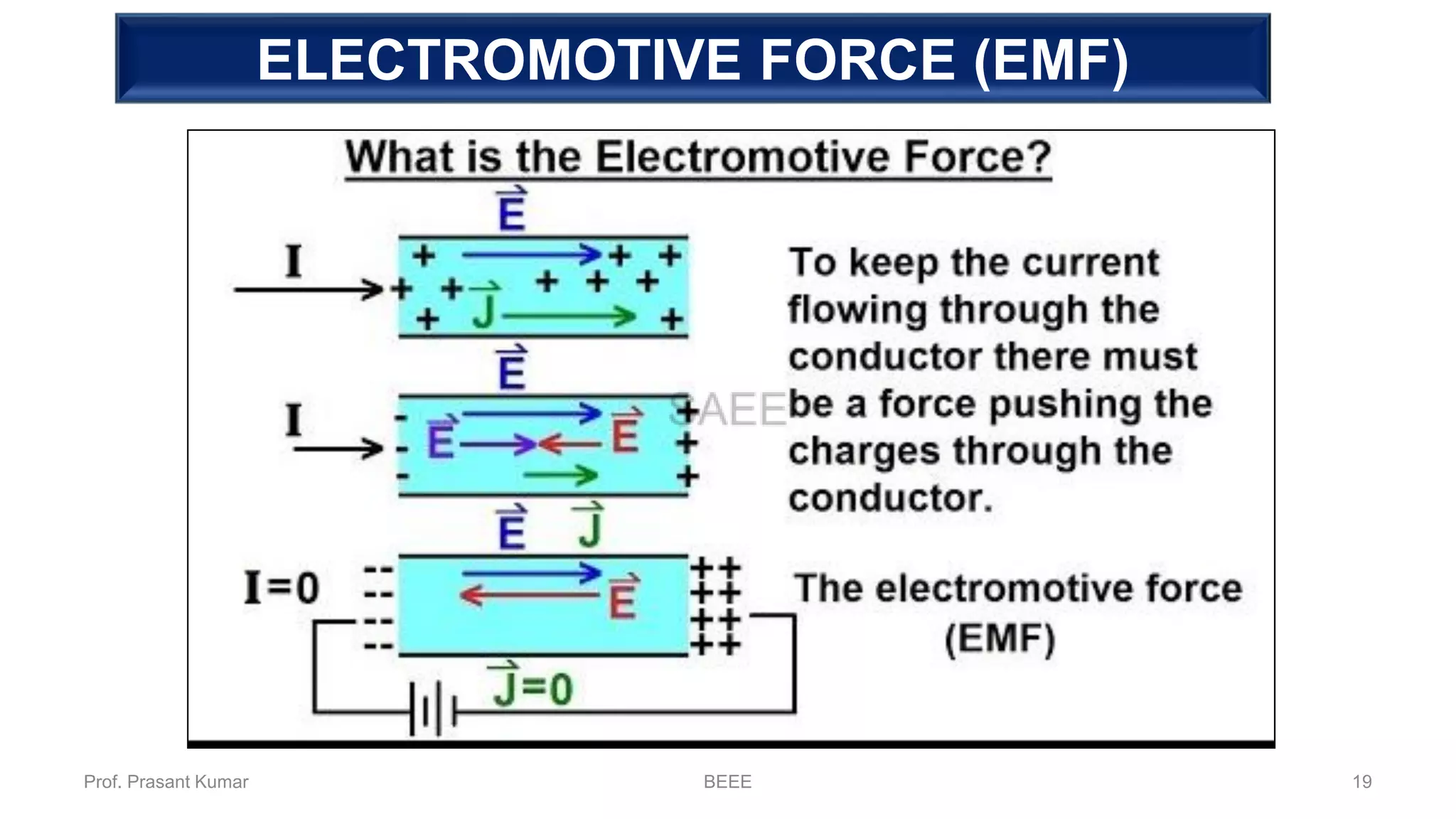
Fundamental of ElectricityELECTROMOTIVE FORCE (EMF)
Prof. Prasant Kumar BEEE 19
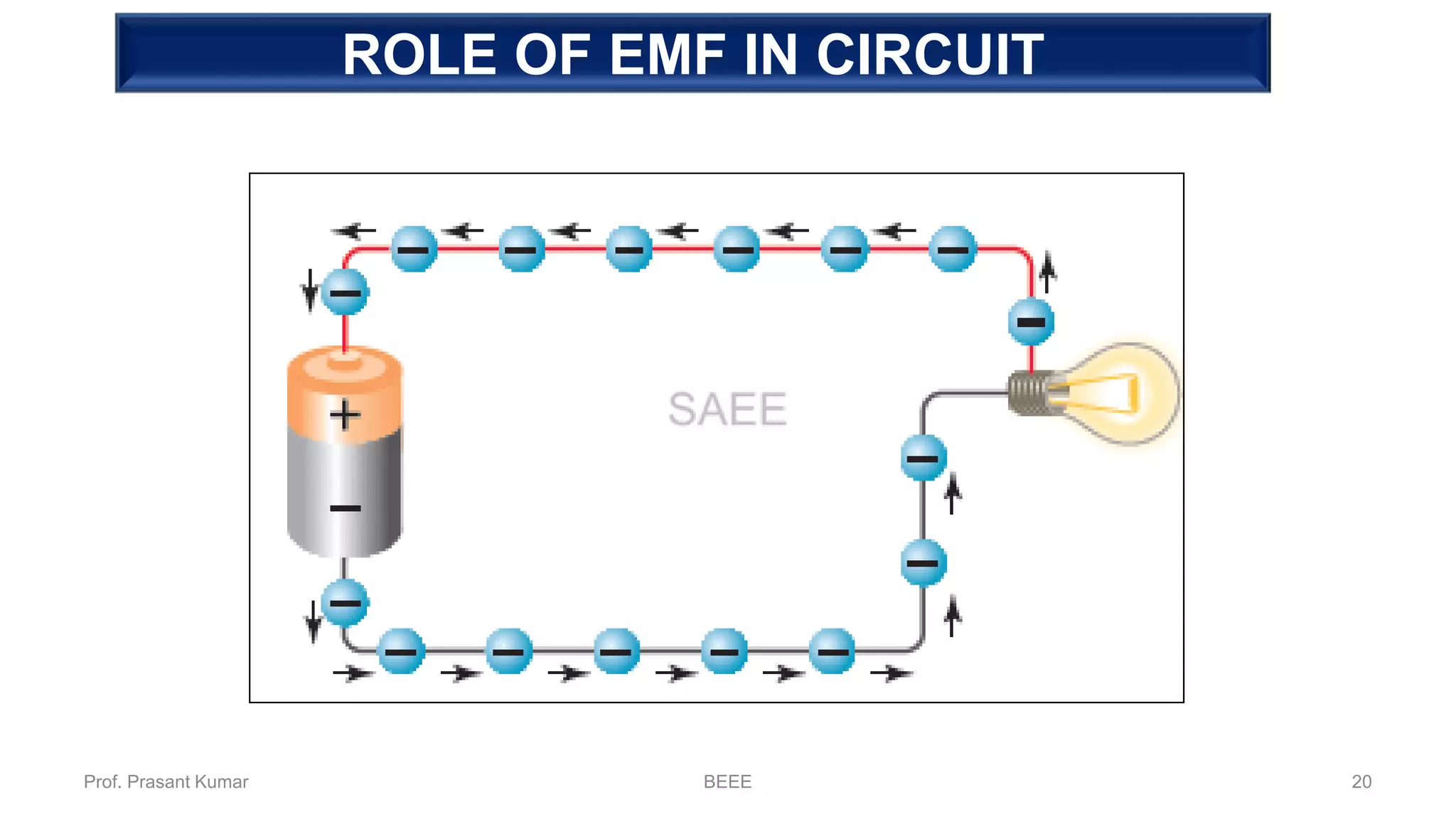
Fundamental of ElectricityROLE OF EMF IN CIRCUIT
Prof. Prasant Kumar BEEE 20
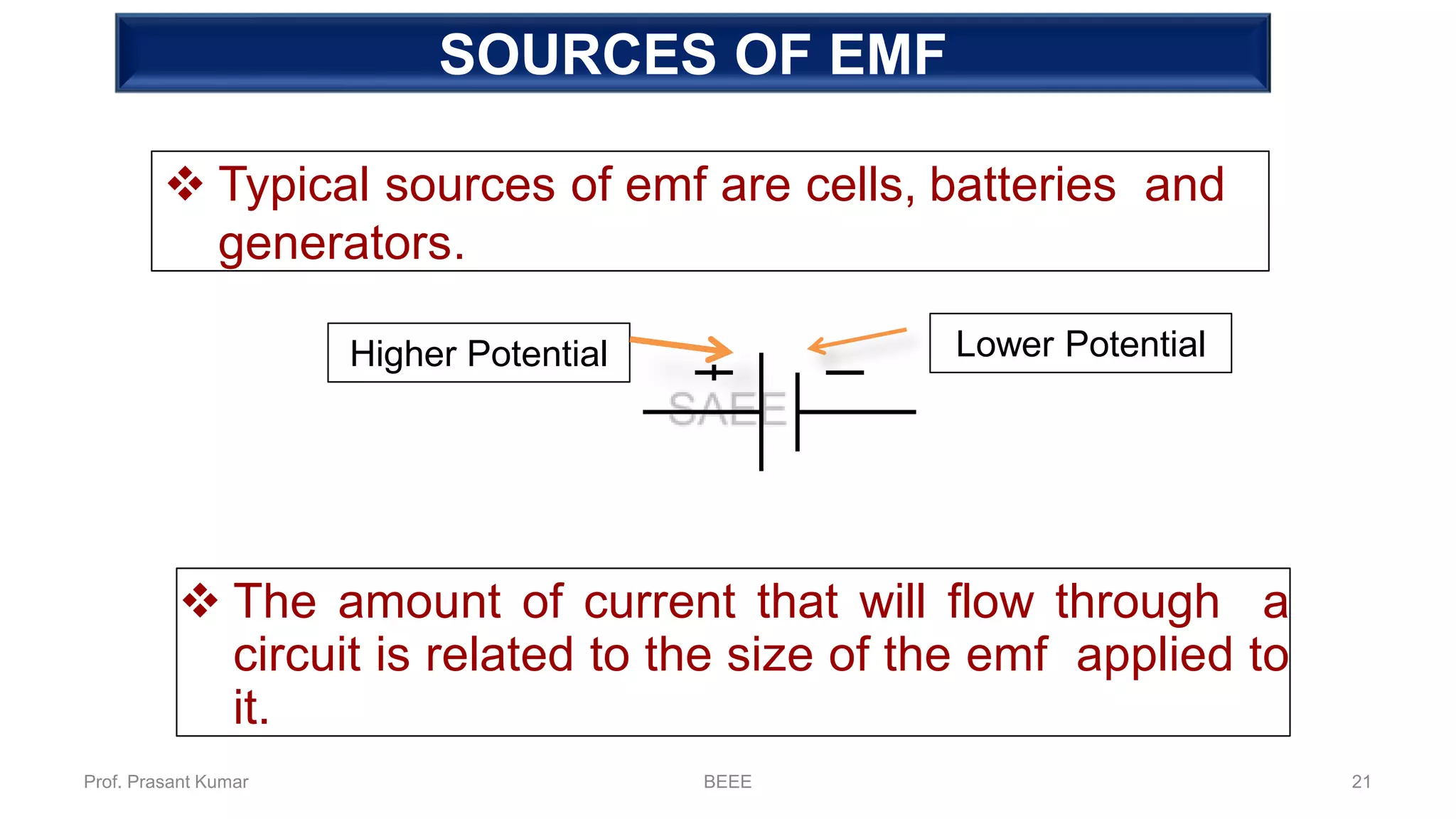
❖ Typical sources of emf are cells, batteries and
generators.
❖ The amount of current that will flow through a
circuit is related to the size of the emf applied to
it.
Fundamental of Electricity
SOURCES OF EMF
Higher Potential Lower Potential
Prof. Prasant Kumar BEEE 21
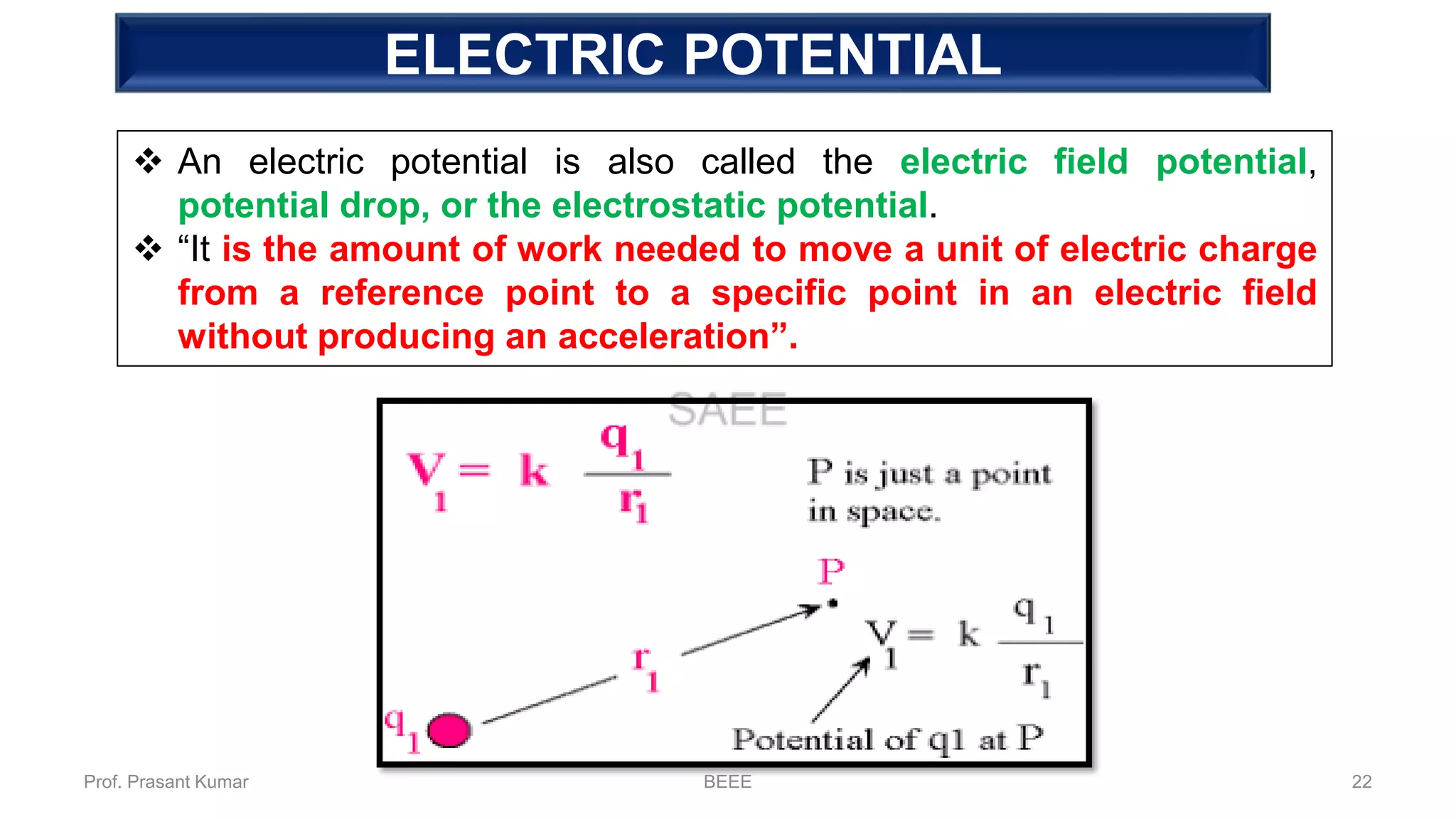
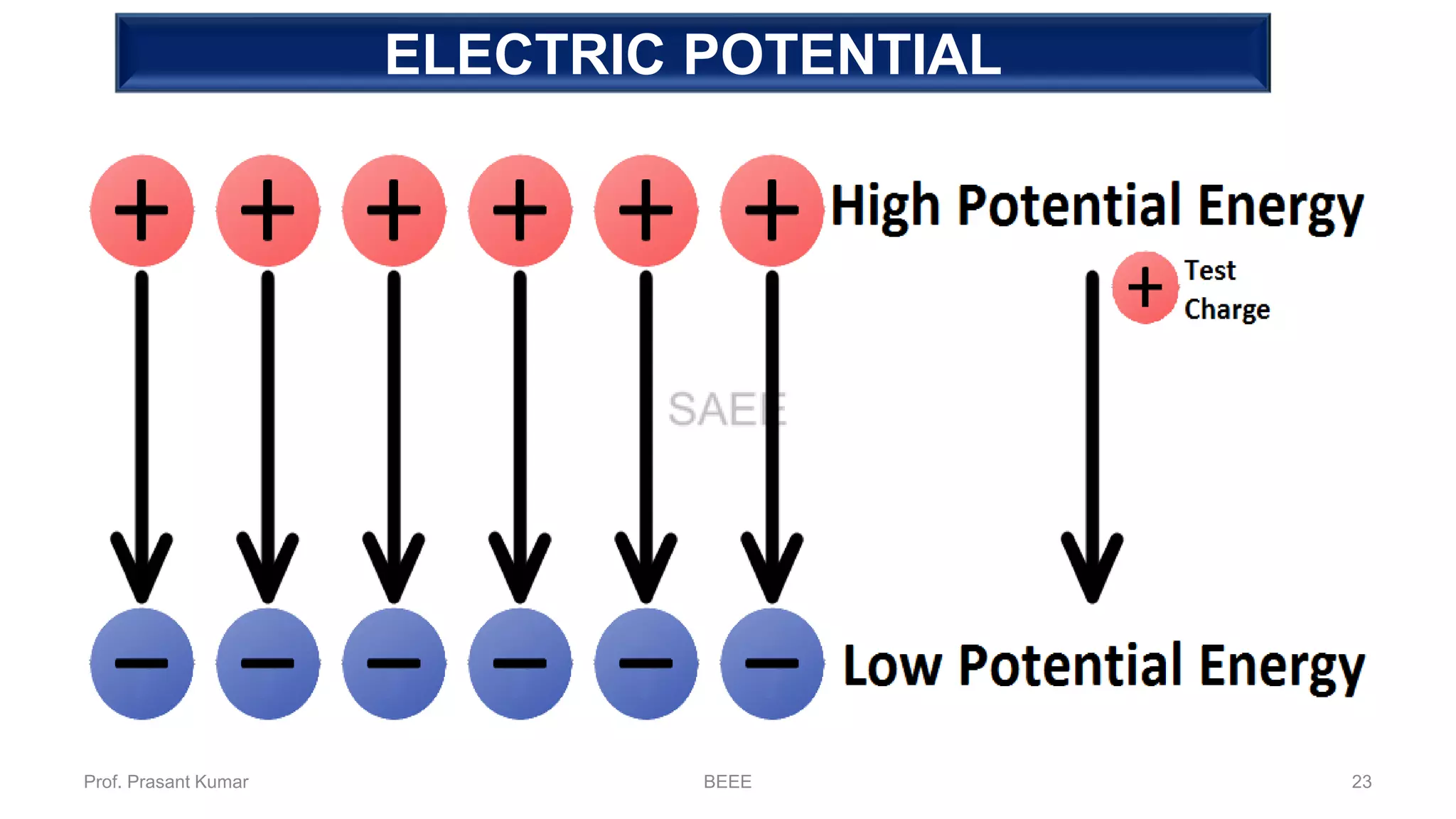
ELECTRIC POTENTIAL
❖ An electric potential is also called the electric field potential,
potential drop, or the electrostatic potential.
❖ “It is the amount of work needed to move a unit of electric charge
from a reference point to a specific point in an electric field
without producing an acceleration”.
Prof. Prasant Kumar BEEE 22
ELECTRIC POTENTIAL
Prof. Prasant Kumar BEEE 23
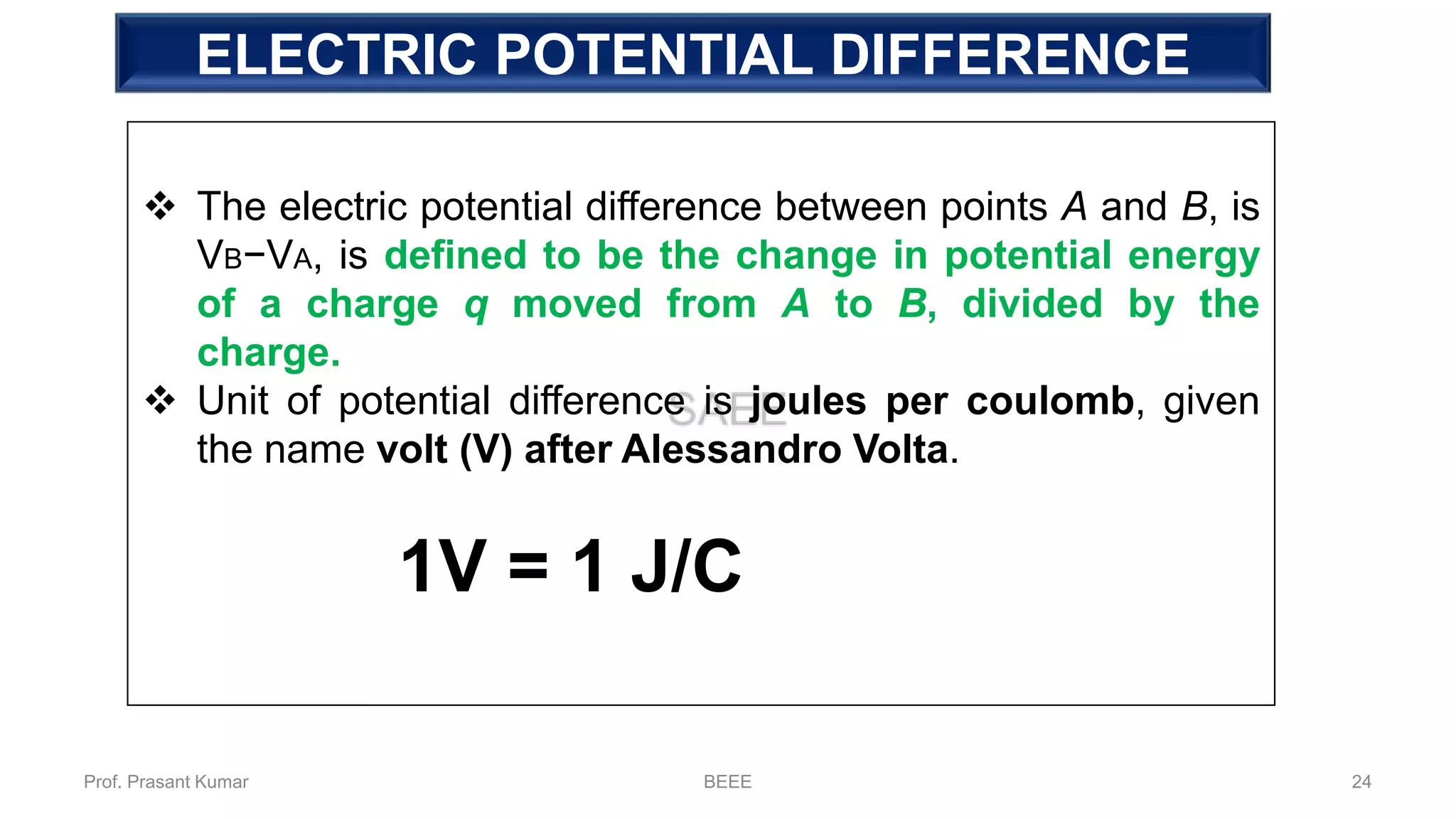
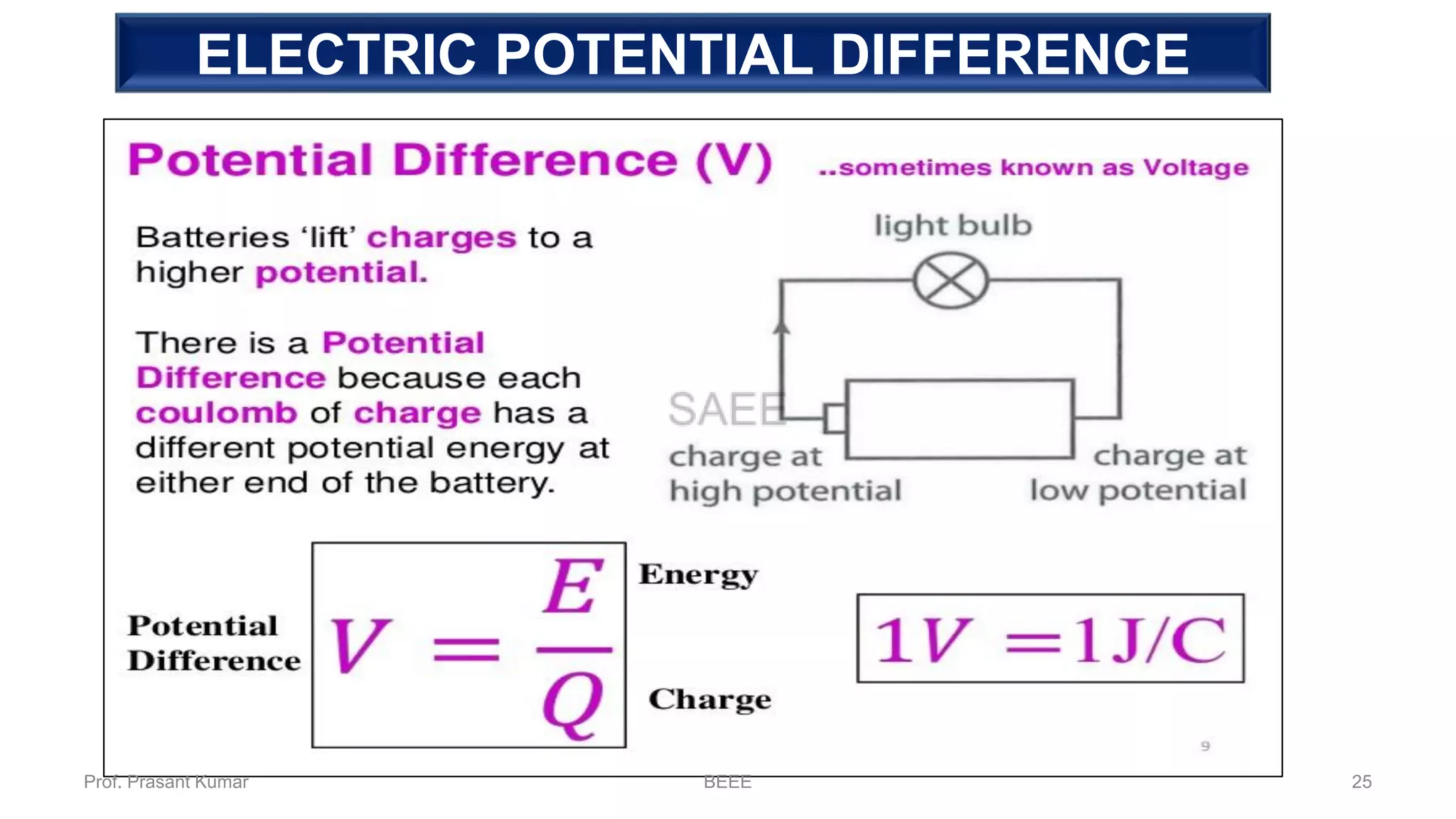
ELECTRIC POTENTIAL DIFFERENCE
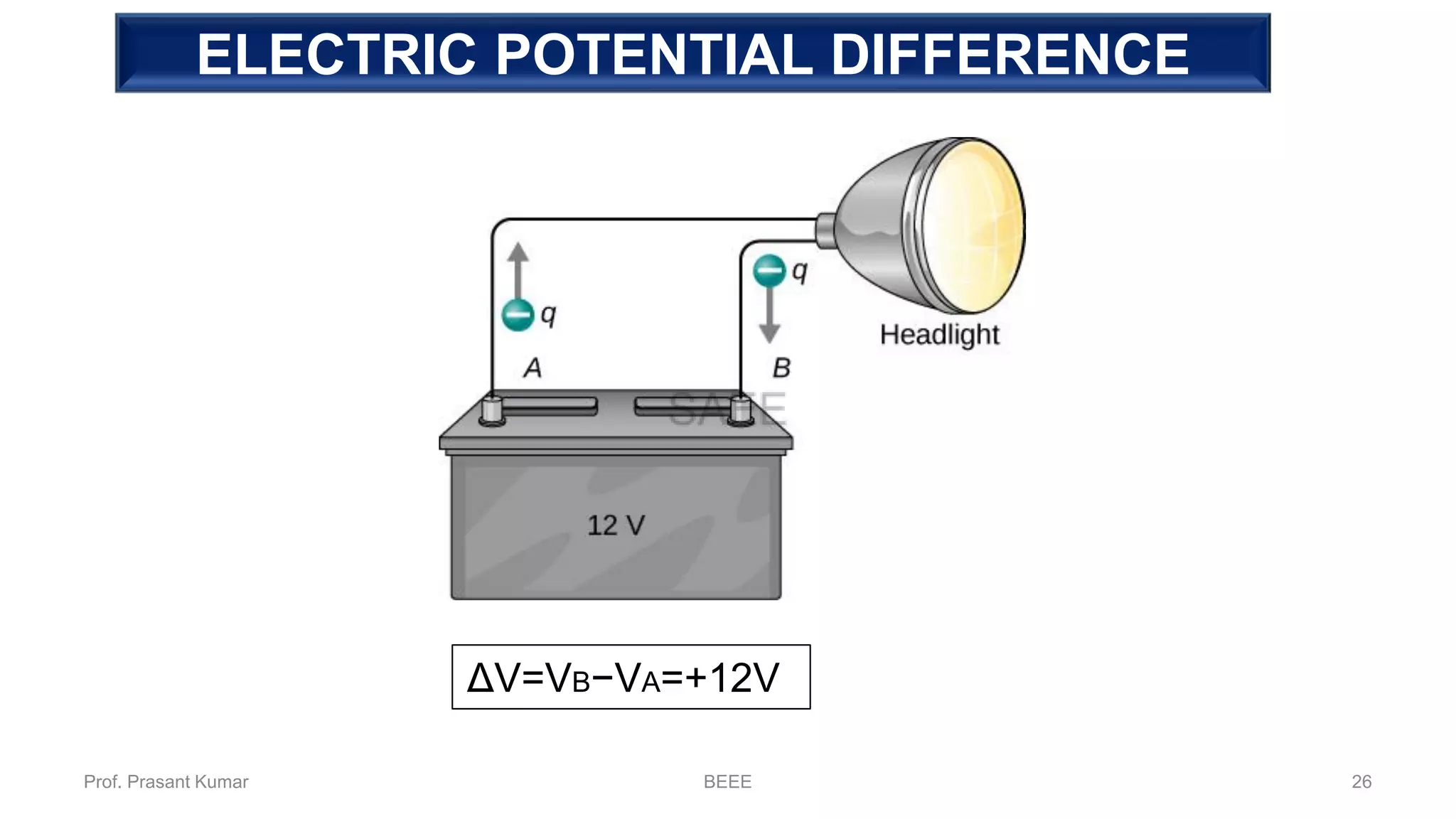
❖ The electric potential difference between points A and B, is
VB−VA, is defined to be the change in potential energy
of a charge q moved from A to B, divided by the
charge.
❖ Unit of potential difference is joules per coulomb, given
the name volt (V) after Alessandro Volta.
1V = 1 J/C
Prof. Prasant Kumar BEEE 24
ELECTRIC POTENTIAL DIFFERENCE
Prof. Prasant Kumar BEEE 25
ELECTRIC POTENTIAL DIFFERENCE
ΔV=VB−VA=+12V
Prof. Prasant Kumar BEEE 26
BASICS OF ELECTRICAL ENGINEERING
ELECTRICAL SOURCE AND TYPES
विद्युत स्रोत के प्रकार
VOLAGE,CURRENT,IDEAL&PRACTICAL SOURCE
LEC#04
Prof. Prasant Kumar BEEE 27
ELECTRIC SOURCE
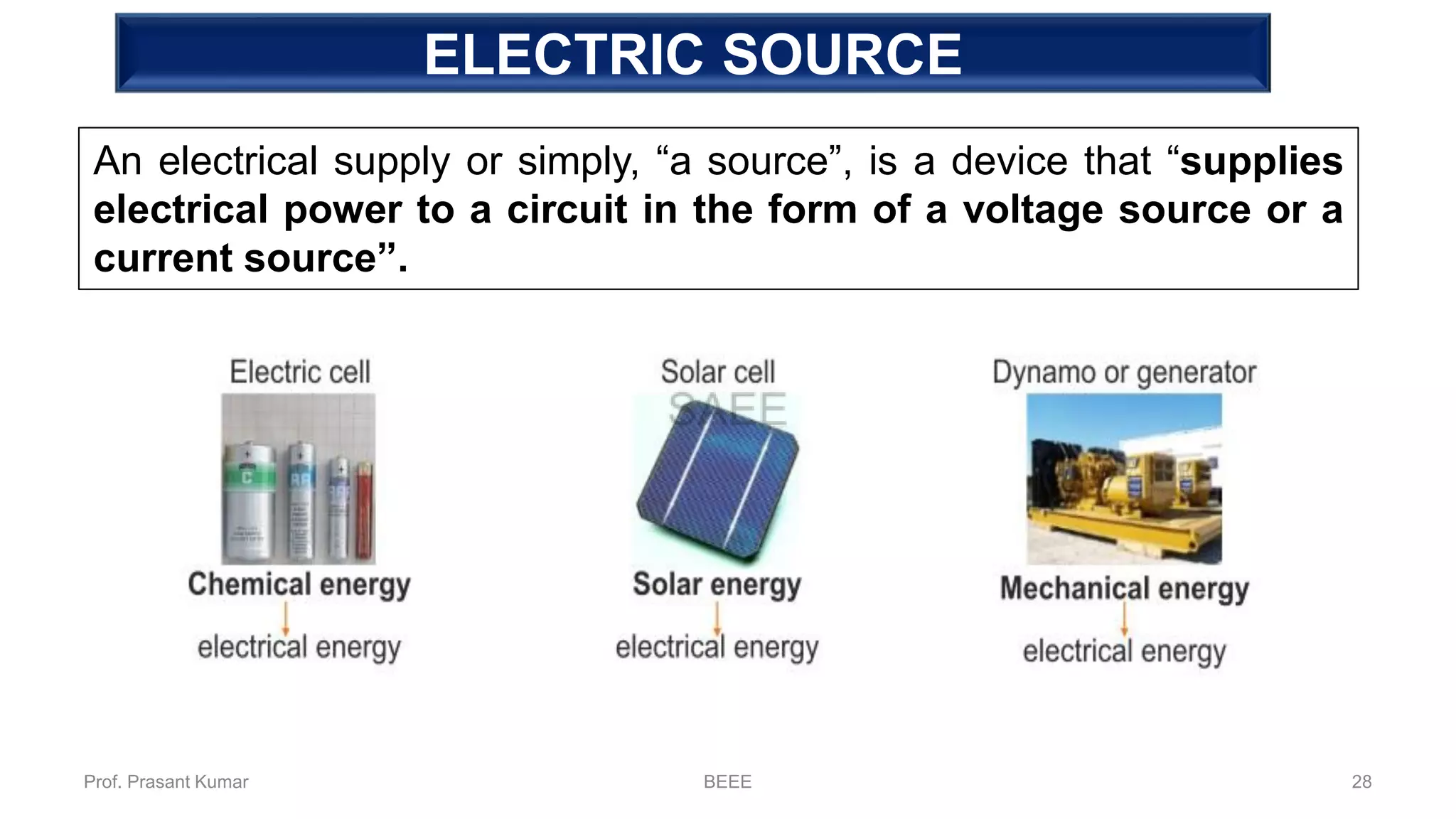
An electrical supply or simply, “a source”, is a device that “supplies
electrical power to a circuit in the form of a voltage source or a
current source”.
Prof. Prasant Kumar BEEE 28
ELECTRIC SOURCE
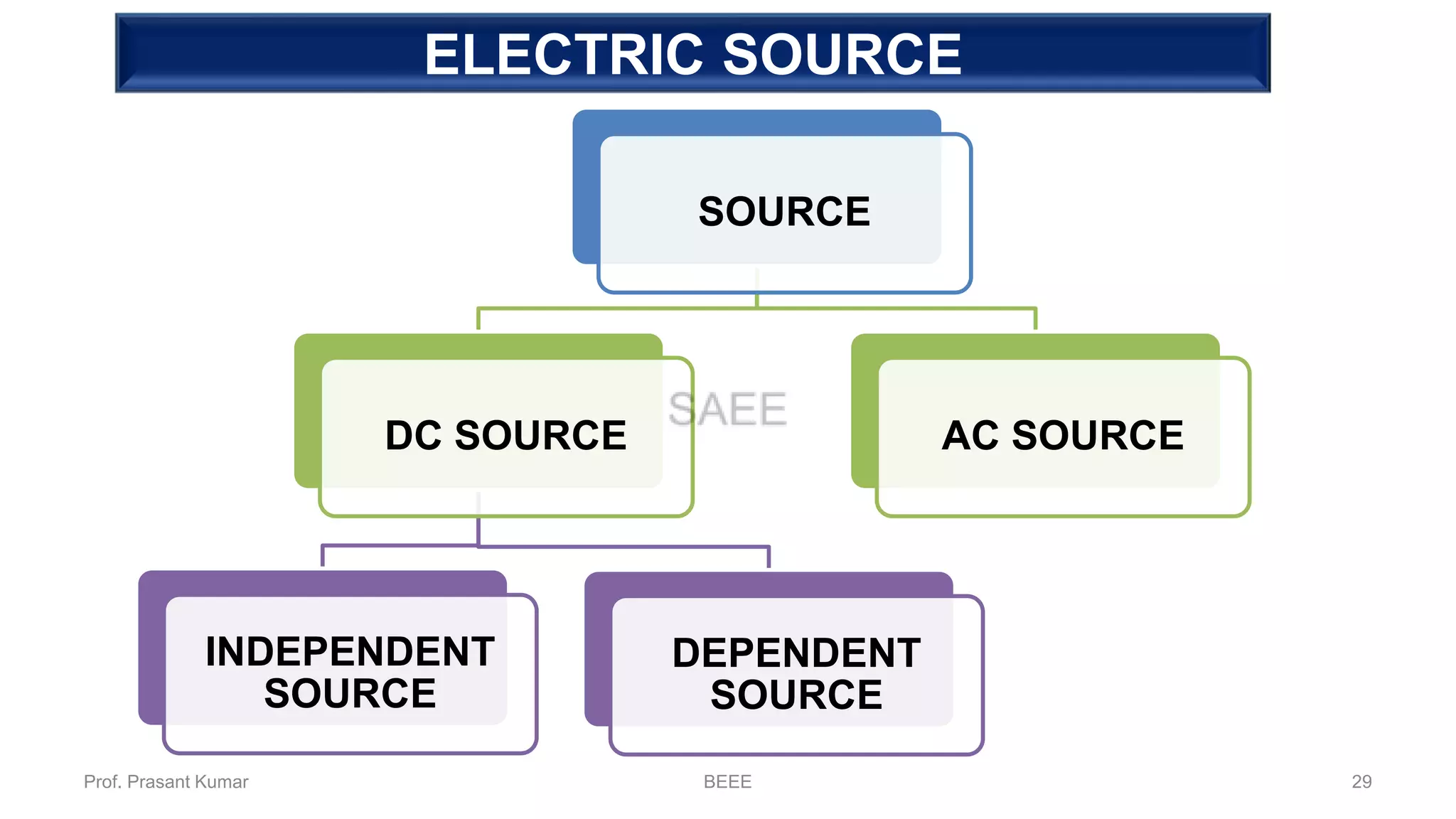
SOURCE
DC SOURCE
INDEPENDENT
SOURCE
DEPENDENT
SOURCE
AC SOURCE
Prof. Prasant Kumar BEEE 29
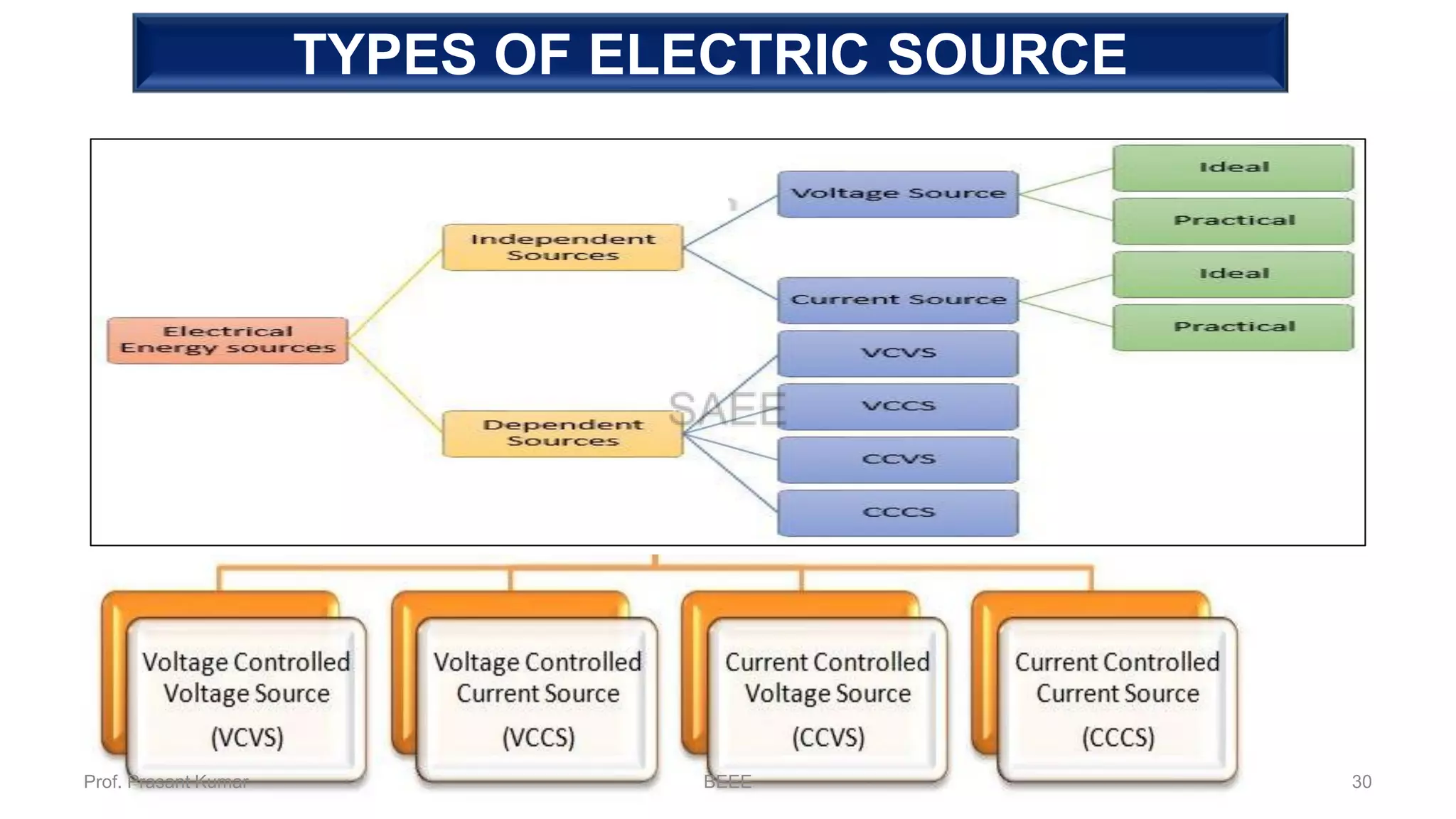
TYPES OF ELECTRIC SOURCE
Prof. Prasant Kumar BEEE 30
Prof. Prasant Kumar BEEE 31
BASICS OF ELECTRICAL ENGINEERING
AC SOURCE & DC SOURCE
क्या है?
समानता और अंतर
LEC#05
Prof. Prasant Kumar BEEE 32
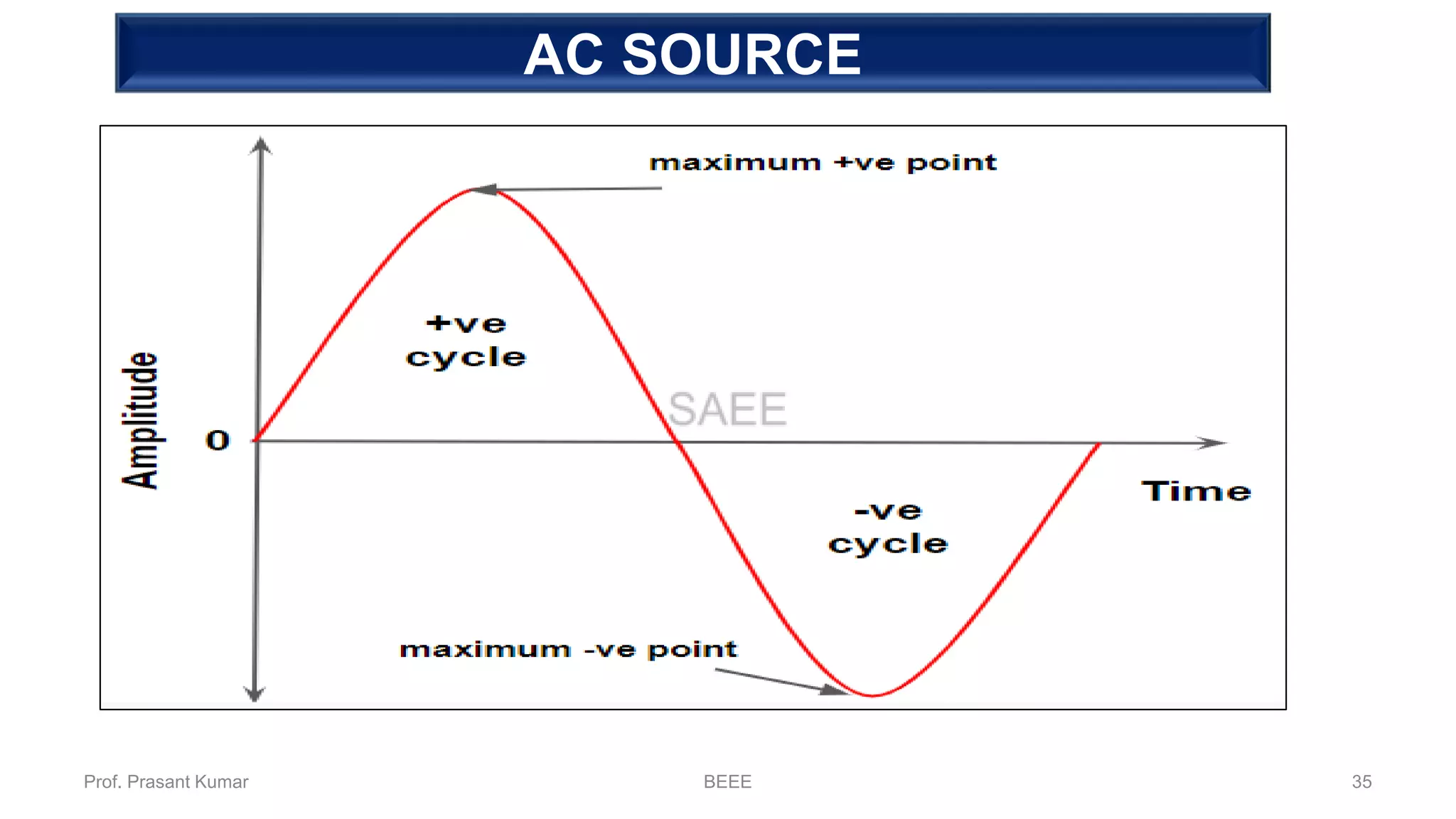
AC SOURCE
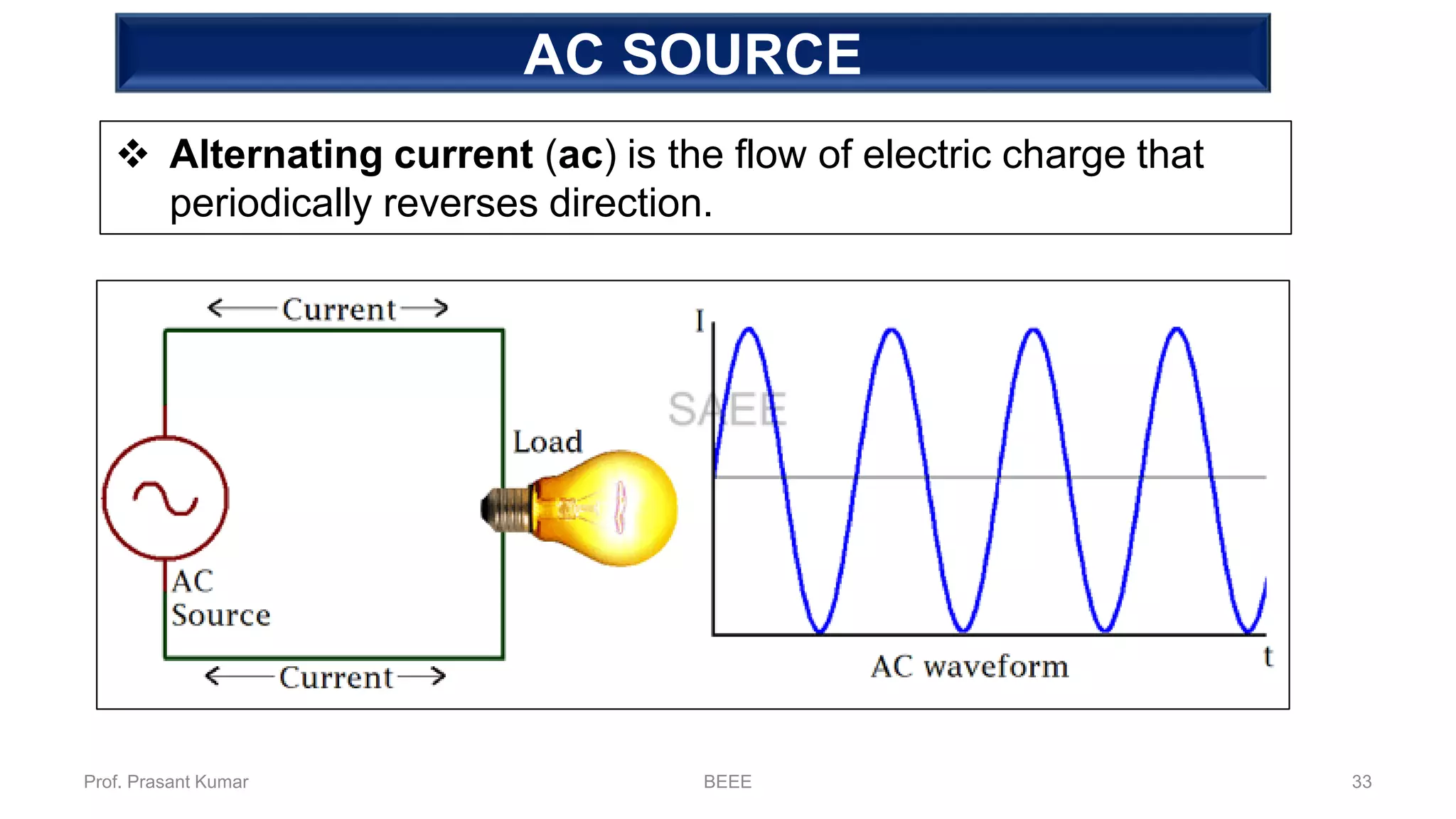
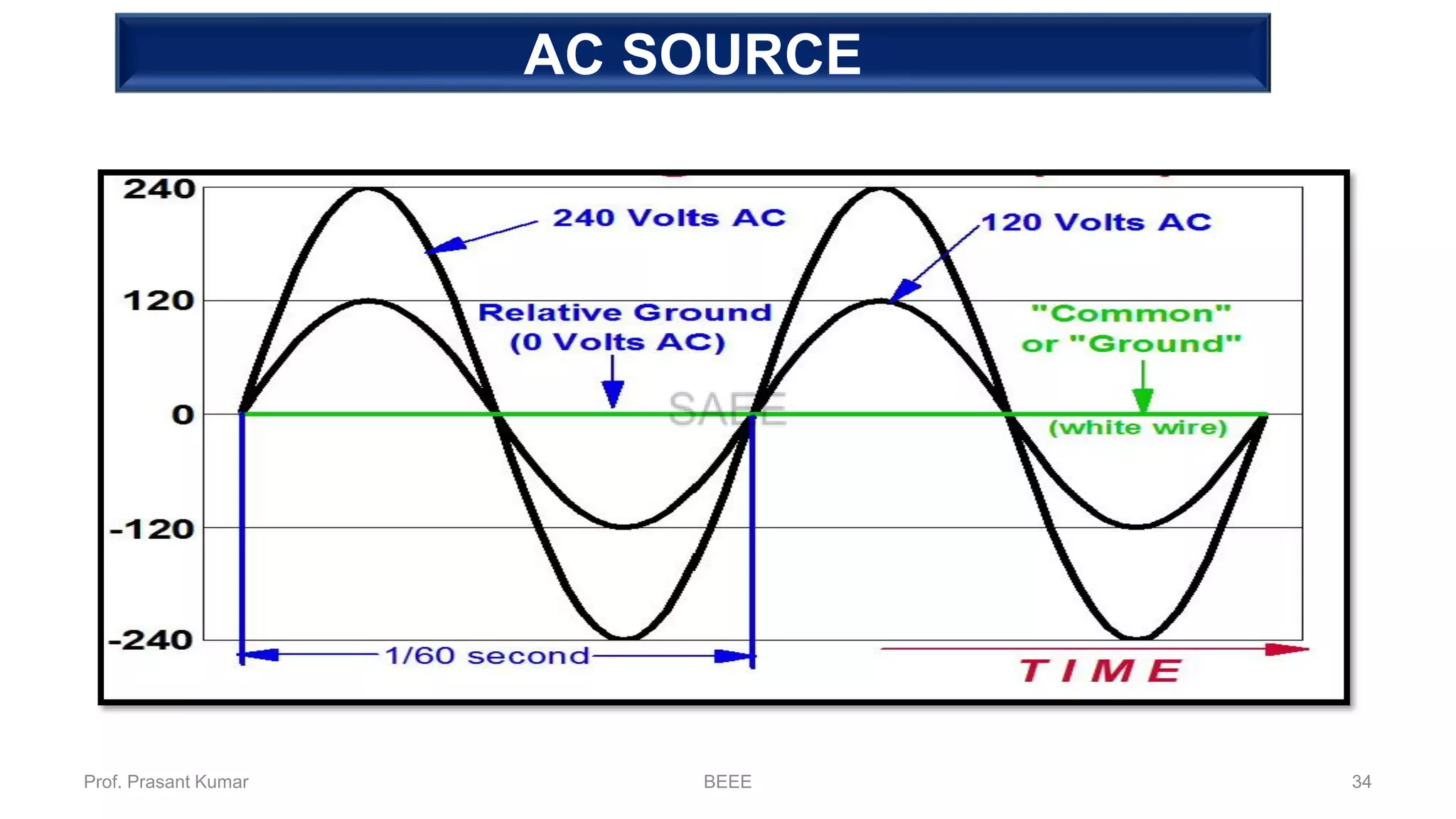
❖ Alternating current (ac) is the flow of electric charge that
periodically reverses direction.
Prof. Prasant Kumar BEEE 33
AC SOURCE
Prof. Prasant Kumar BEEE 34
AC SOURCE
Prof. Prasant Kumar BEEE 35
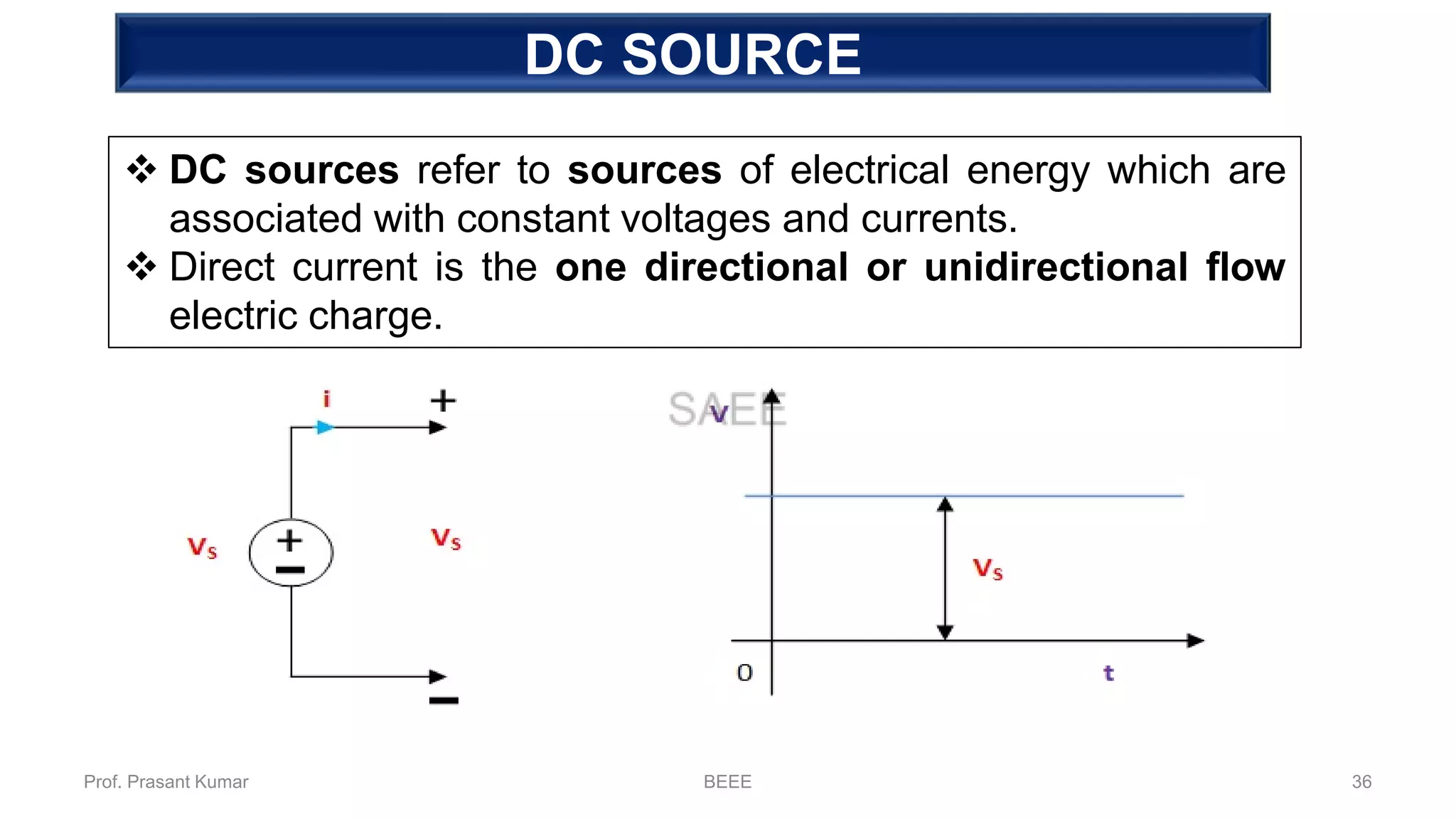
DC SOURCE
❖ DC sources refer to sources of electrical energy which are
associated with constant voltages and currents.
❖ Direct current is the one directional or unidirectional flow
electric charge.
Prof. Prasant Kumar BEEE 36
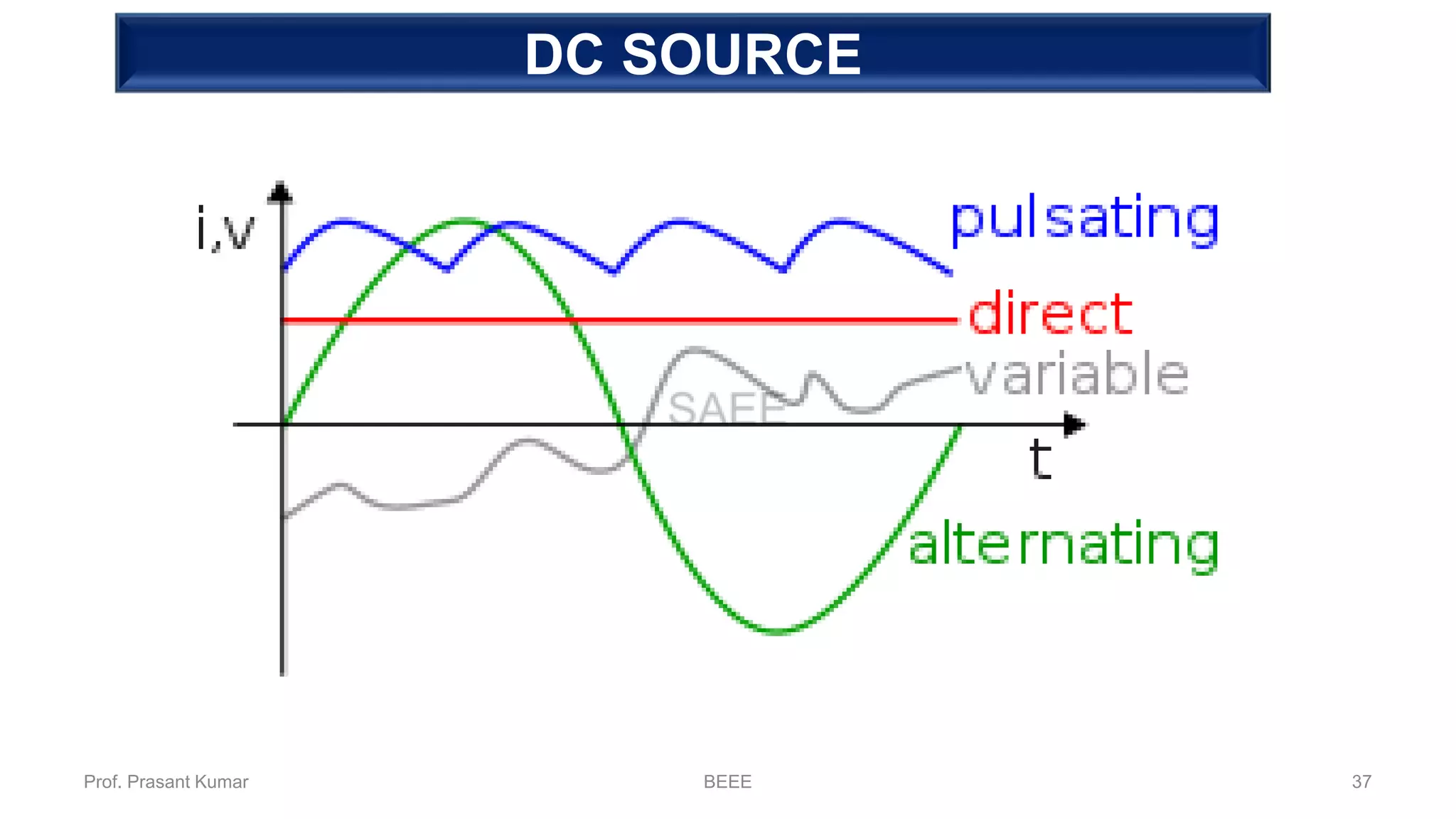
DC SOURCE
Prof. Prasant Kumar BEEE 37
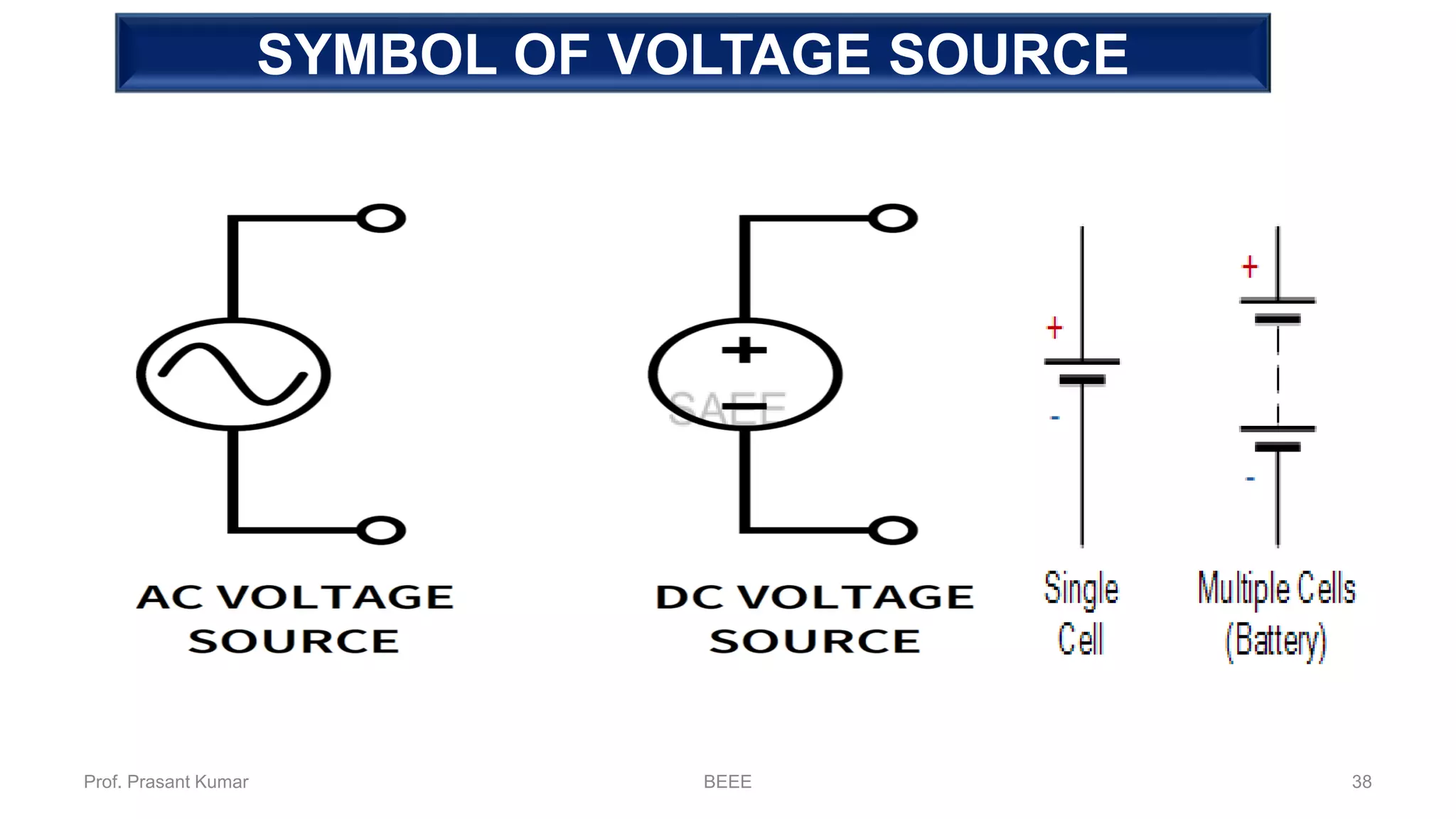
SYMBOL OF VOLTAGE SOURCE
Prof. Prasant Kumar BEEE 38
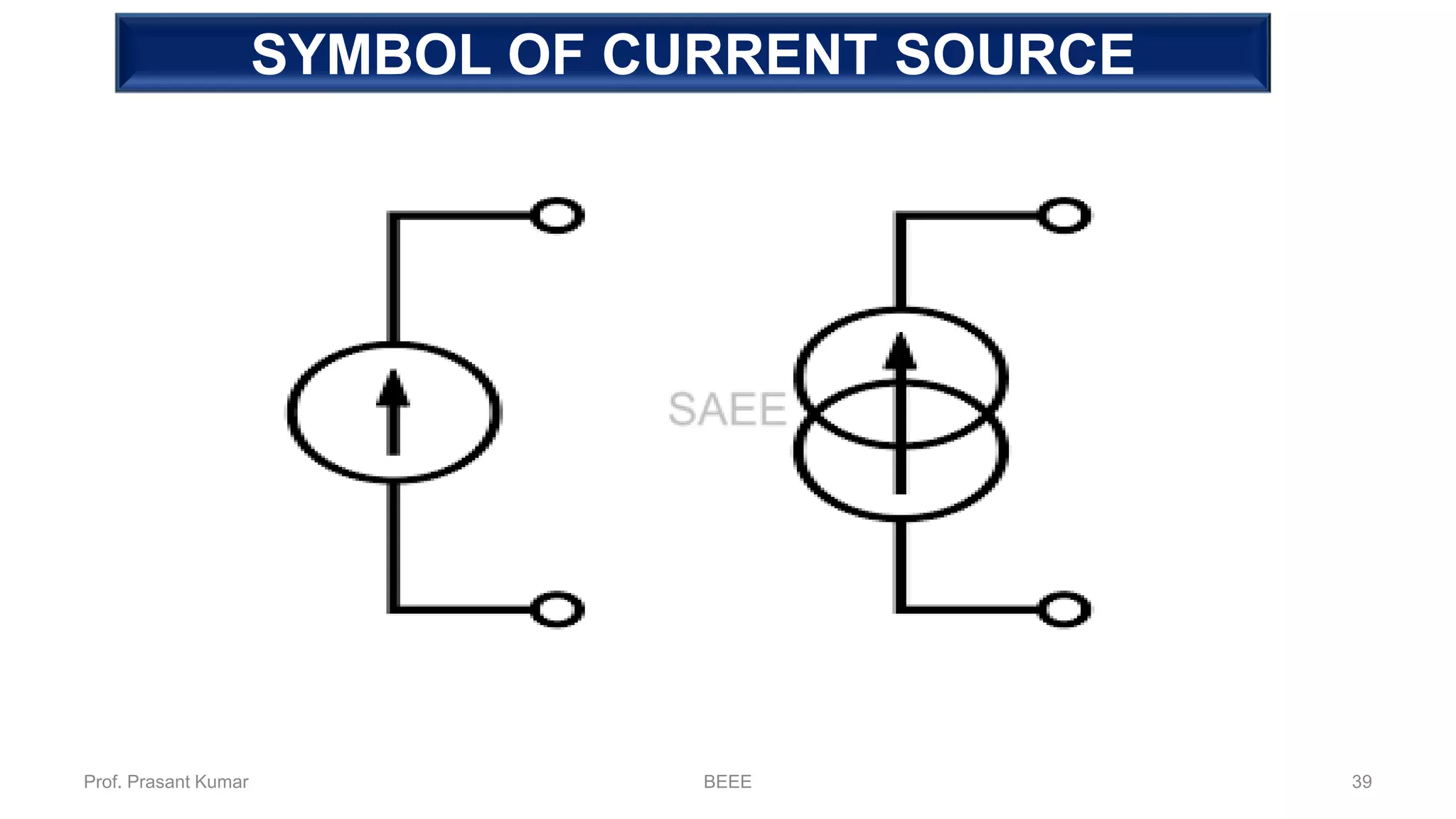
SYMBOL OF CURRENT SOURCE
Prof. Prasant Kumar BEEE 39
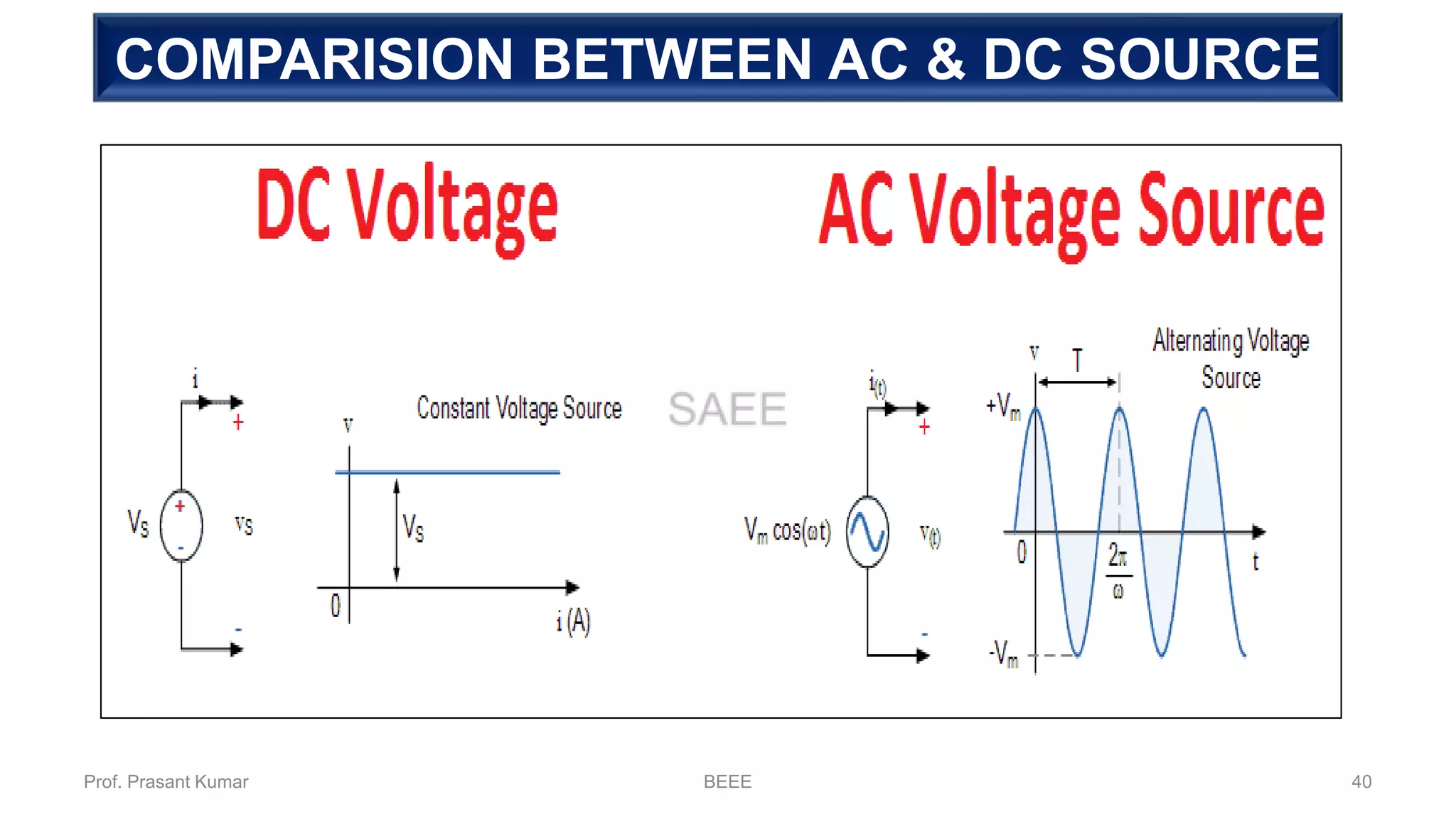
COMPARISION BETWEEN AC & DC SOURCE
Prof. Prasant Kumar BEEE 40
BASICS OF ELECTRICAL ENGINEERING
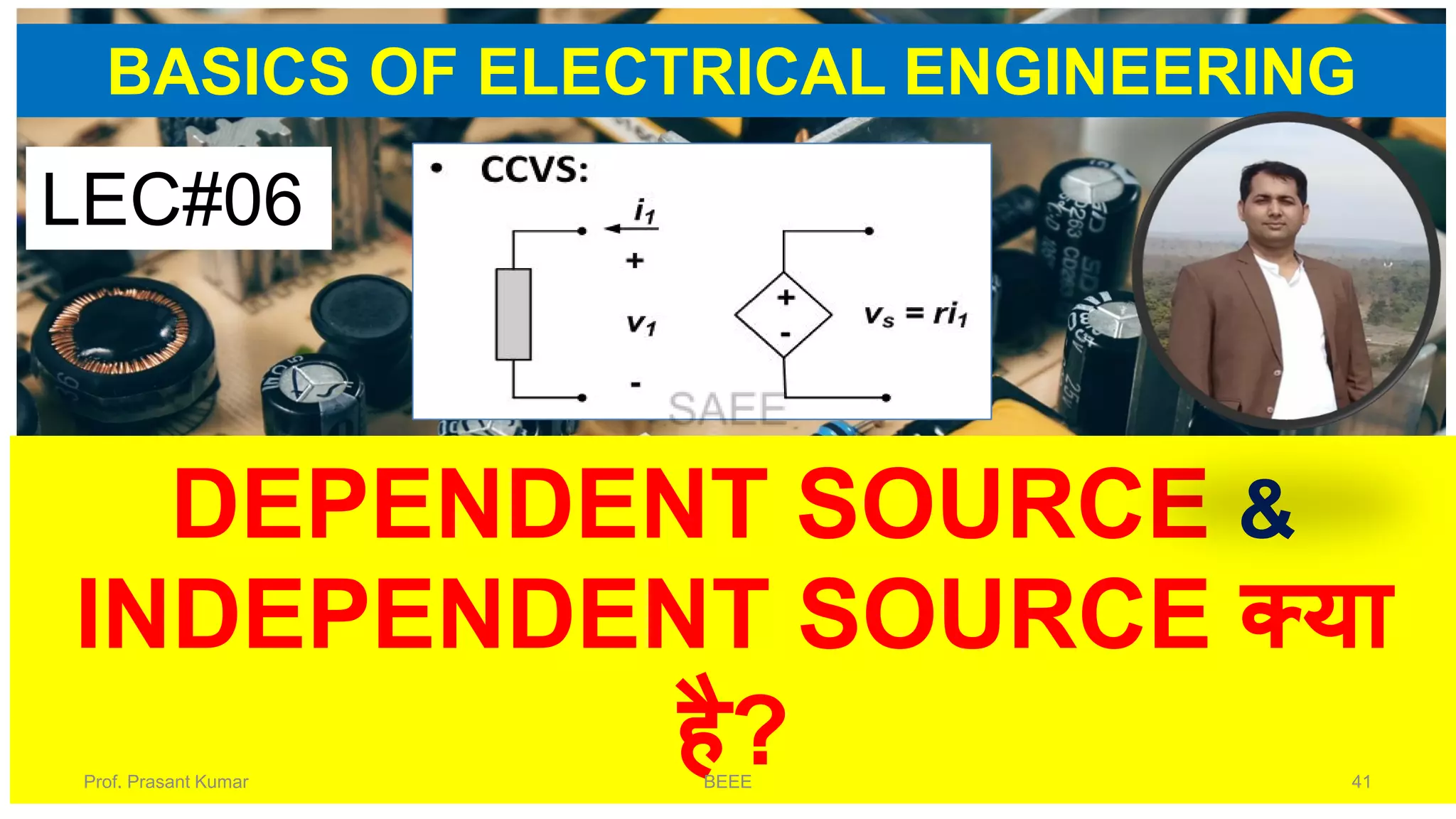
DEPENDENT SOURCE &
INDEPENDENT SOURCE क्या
है?
LEC#06
Prof. Prasant Kumar BEEE 41
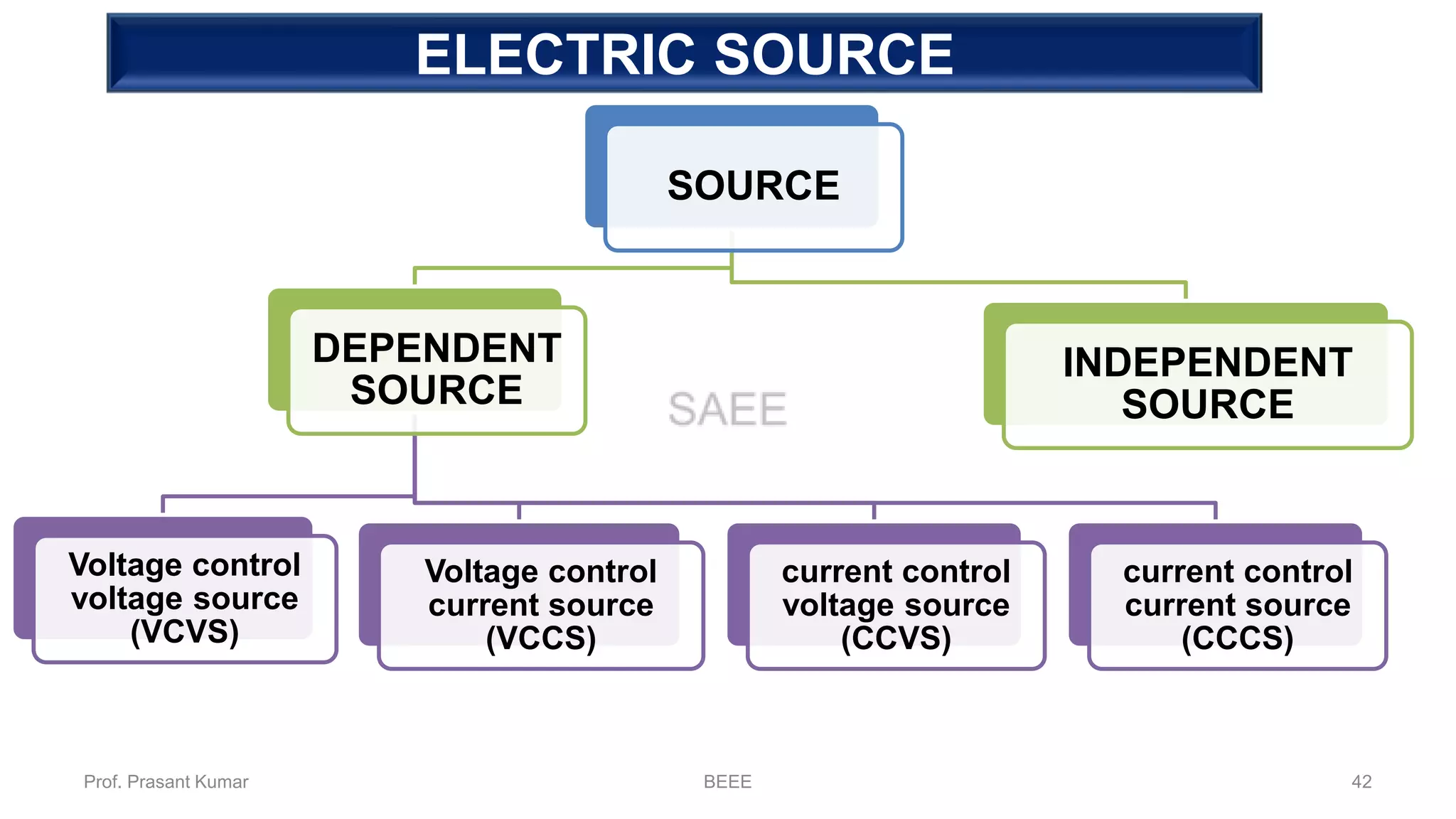
ELECTRIC SOURCE
SOURCE
DEPENDENT
SOURCE
Voltage control
voltage source
(VCVS)
Voltage control
current source
(VCCS)
current control
voltage source
(CCVS)
current control
current source
(CCCS)
INDEPENDENT
SOURCE
Prof. Prasant Kumar BEEE 42
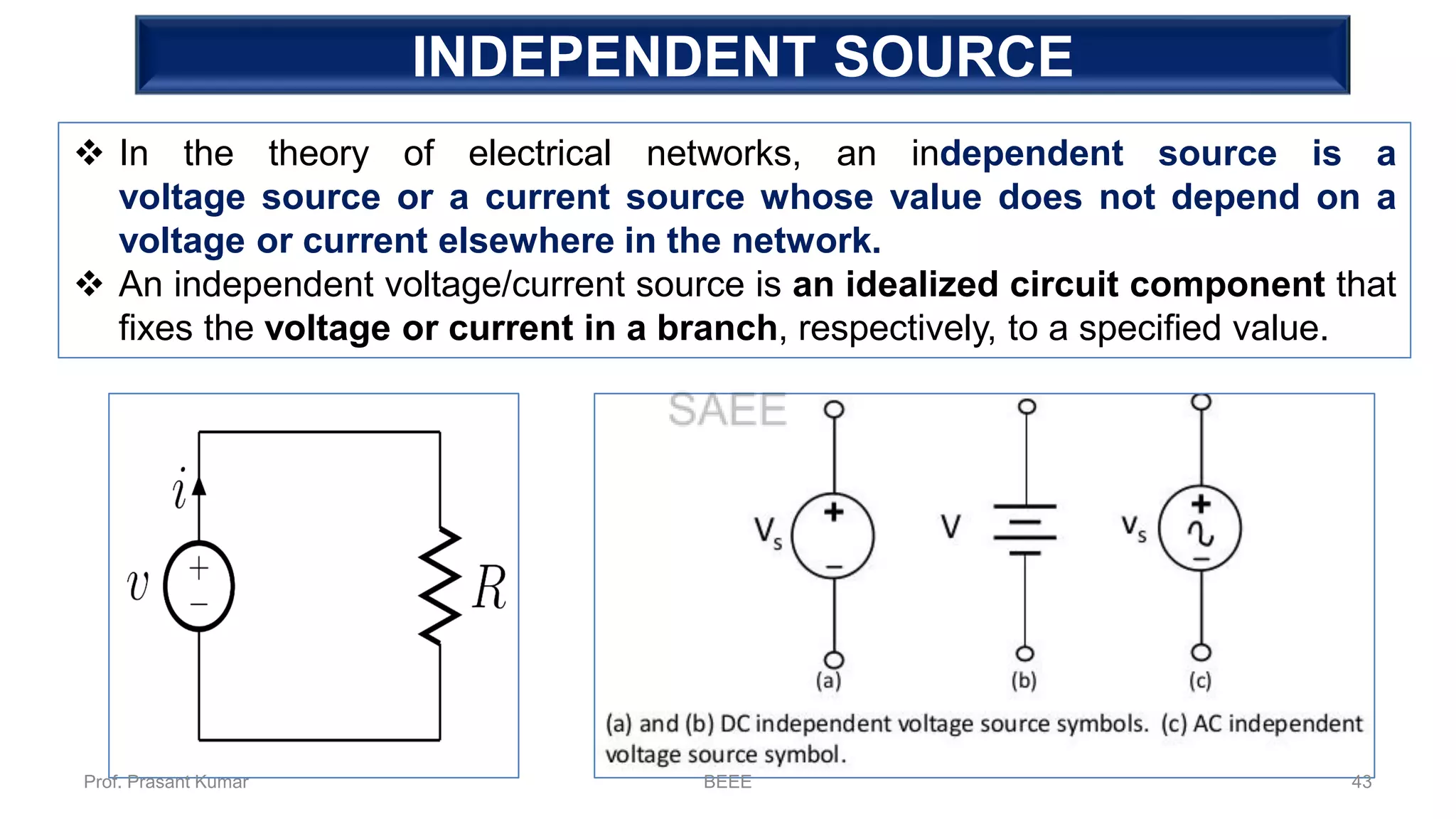
INDEPENDENT SOURCE
❖ In the theory of electrical networks, an independent source is a
voltage source or a current source whose value does not depend on a
voltage or current elsewhere in the network.
❖ An independent voltage/current source is an idealized circuit component that
fixes the voltage or current in a branch, respectively, to a specified value.
Prof. Prasant Kumar BEEE 43
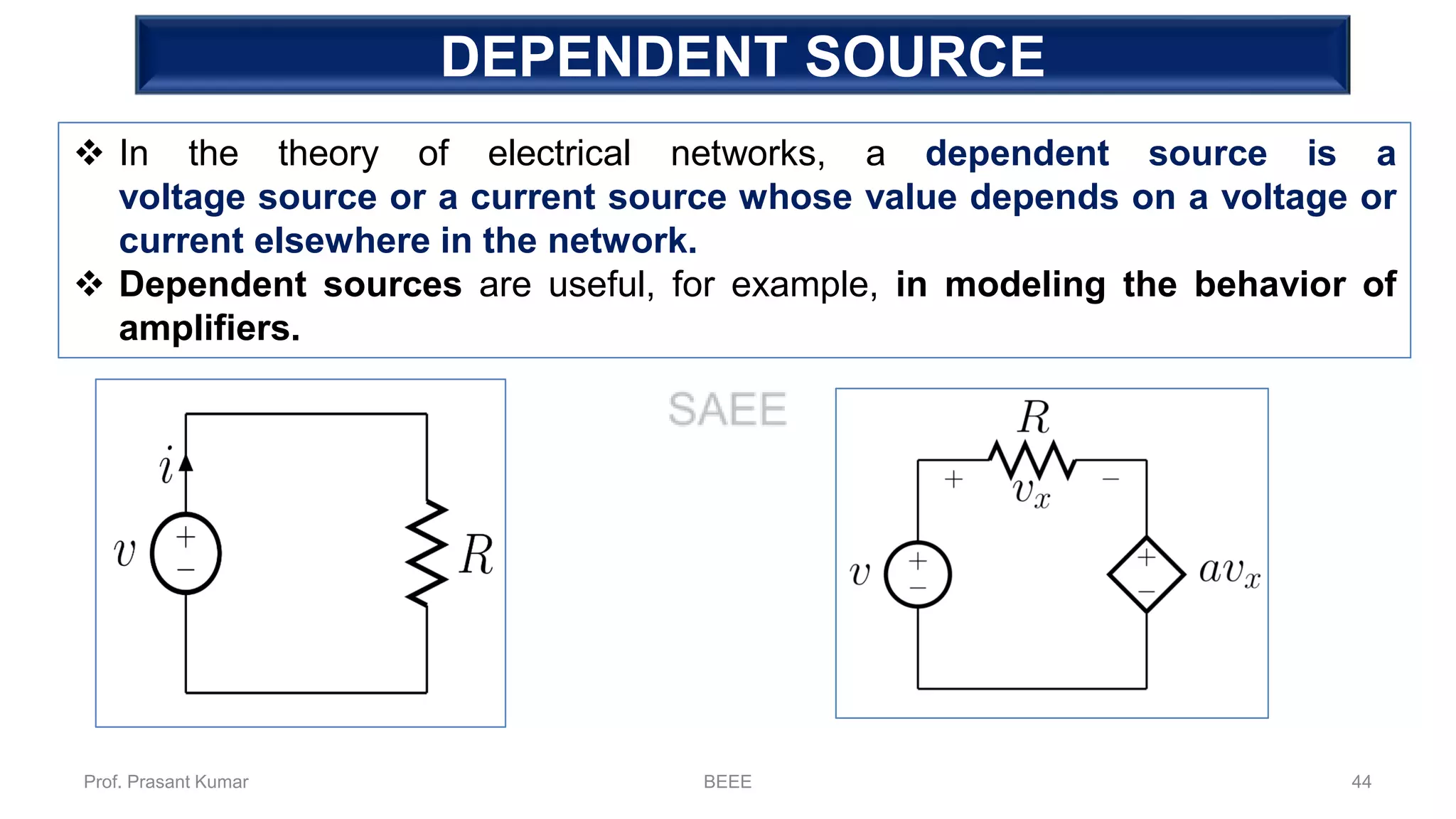
DEPENDENT SOURCE
❖ In the theory of electrical networks, a dependent source is a
voltage source or a current source whose value depends on a voltage or
current elsewhere in the network.
❖ Dependent sources are useful, for example, in modeling the behavior of
amplifiers.
Prof. Prasant Kumar BEEE 44
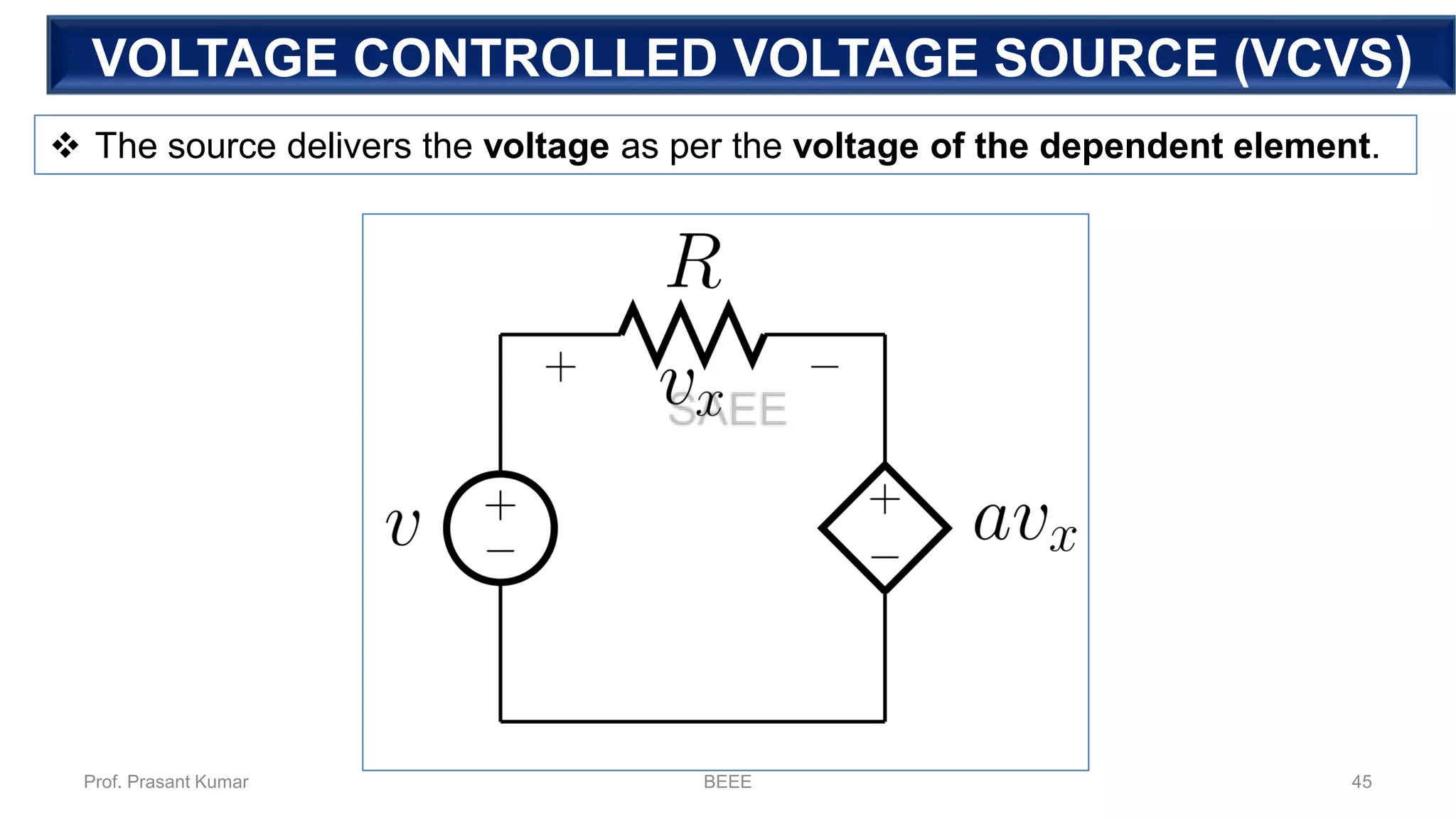
VOLTAGE CONTROLLED VOLTAGE SOURCE (VCVS)
❖ The source delivers the voltage as per the voltage of the dependent element.
Prof. Prasant Kumar BEEE 45
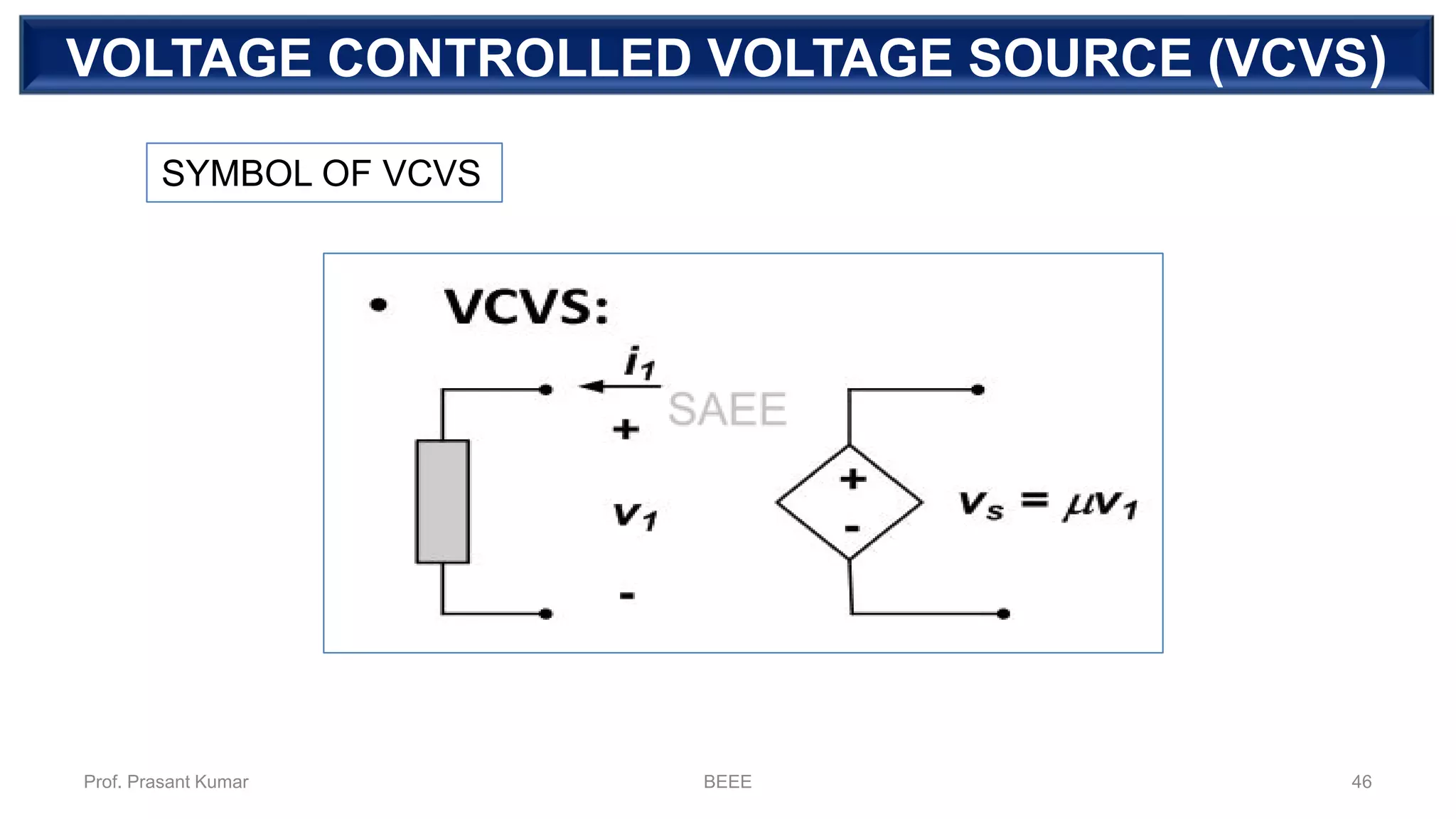
VOLTAGE CONTROLLED VOLTAGE SOURCE (VCVS)
SYMBOL OF VCVS
Prof. Prasant Kumar BEEE 46
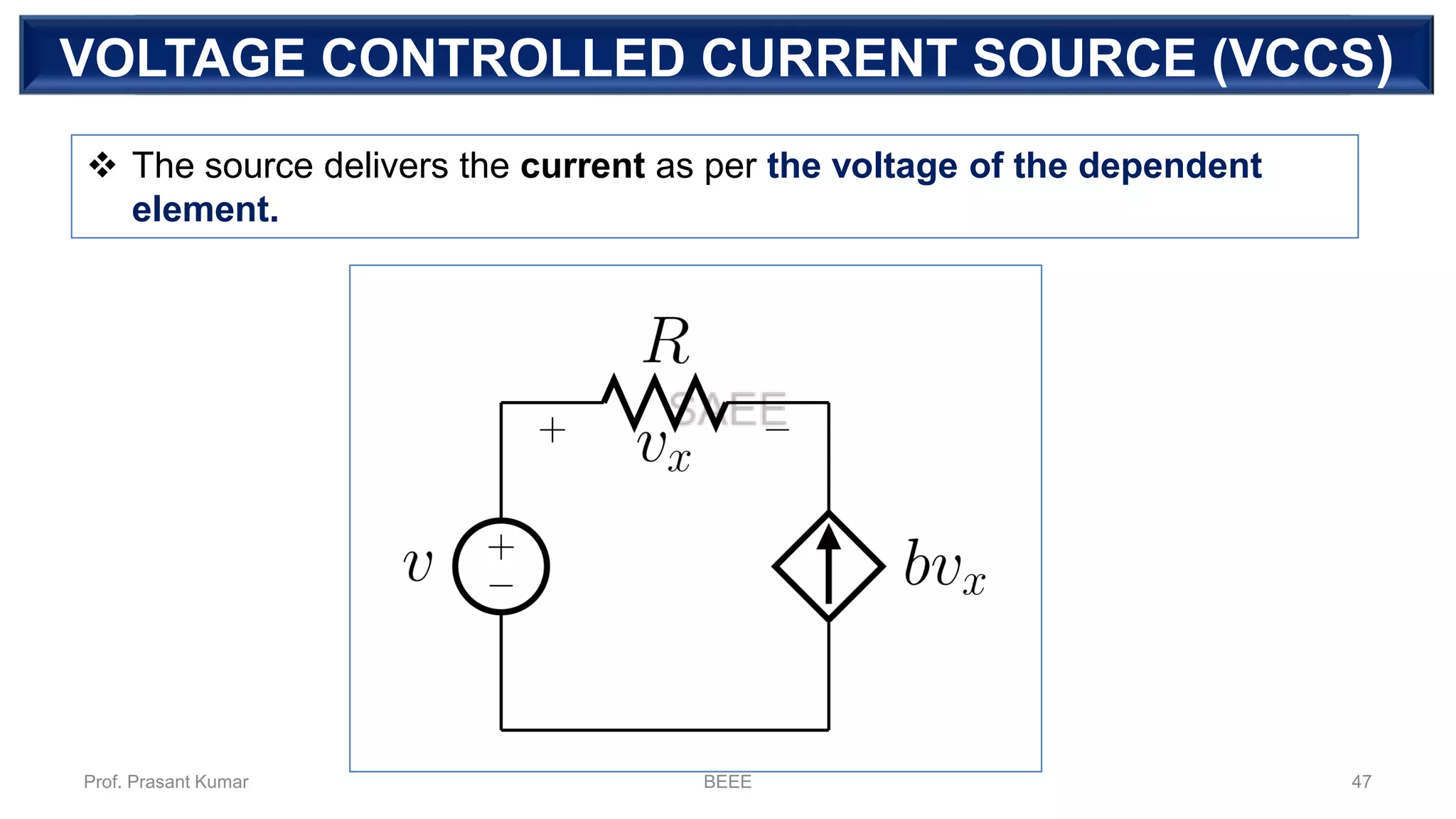
DEPENDENT SOURCEVOLTAGE CONTROLLED CURRENT SOURCE (VCCS)
❖ The source delivers the current as per the voltage of the dependent
element.
Prof. Prasant Kumar BEEE 47
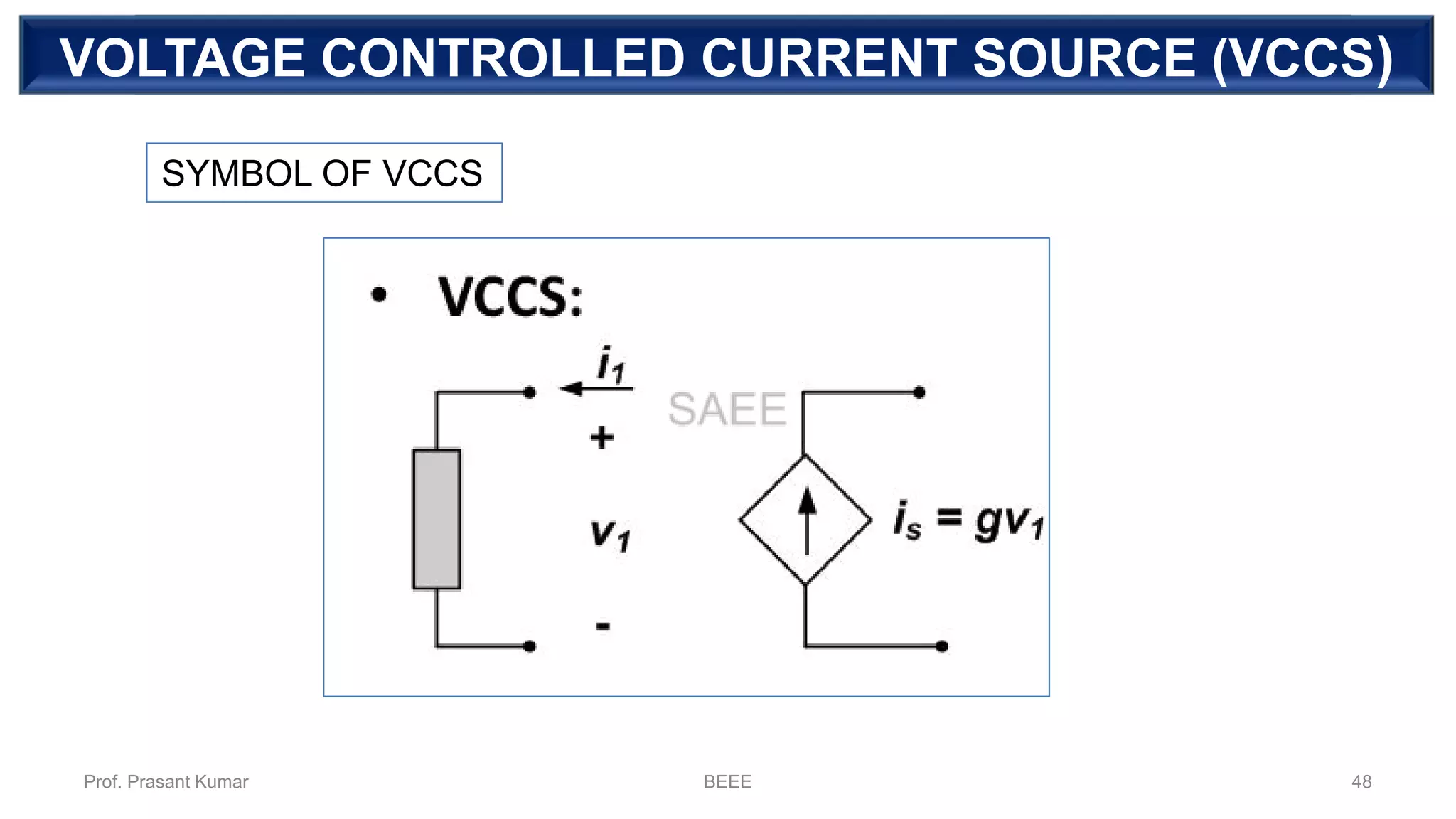
DEPENDENT SOURCEVOLTAGE CONTROLLED CURRENT SOURCE (VCCS)
SYMBOL OF VCCS
Prof. Prasant Kumar BEEE 48
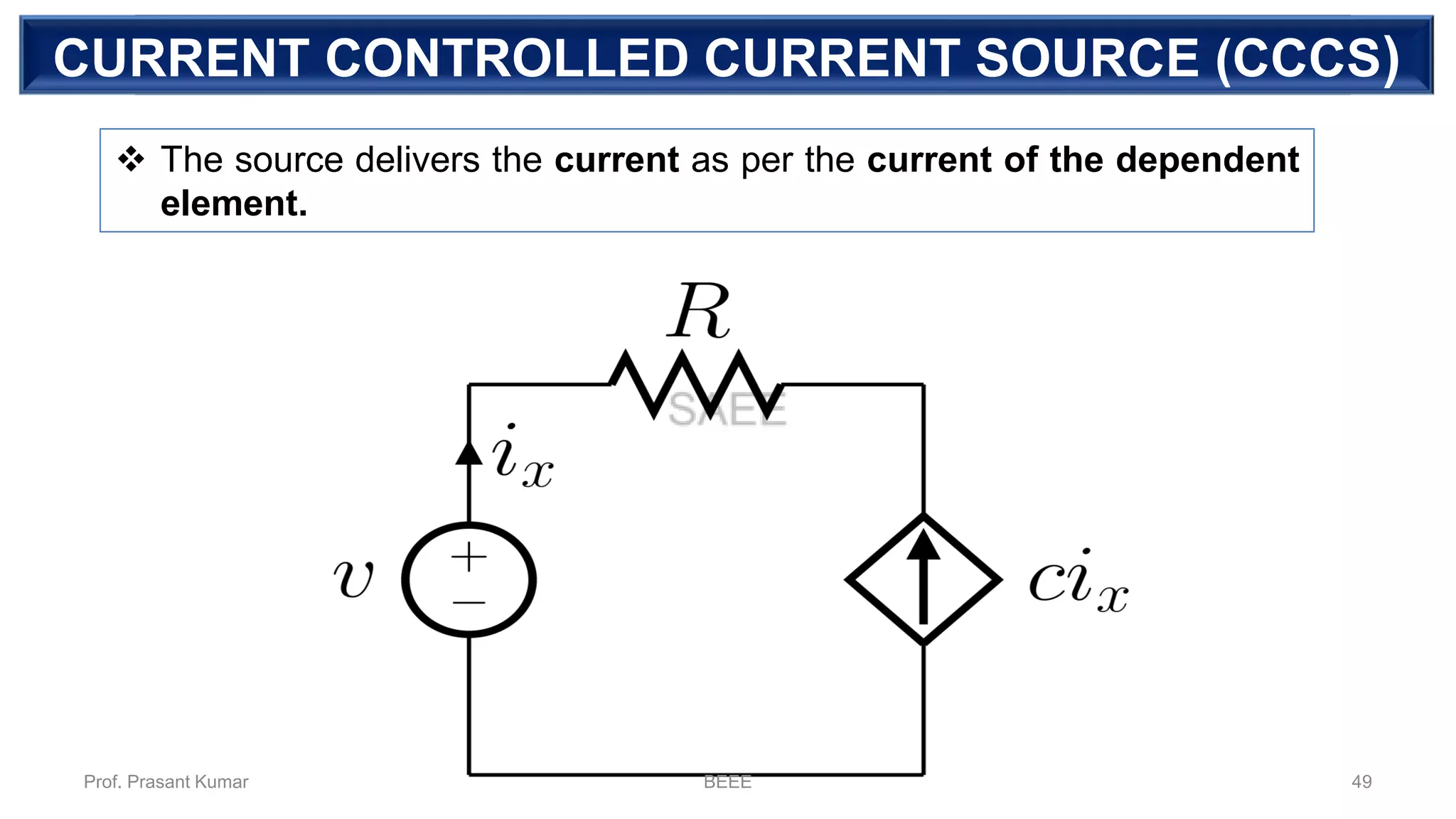
DEPENDENT SOURCECURRENT CONTROLLED CURRENT SOURCE (CCCS)
❖ The source delivers the current as per the current of the dependent
element.
Prof. Prasant Kumar BEEE 49
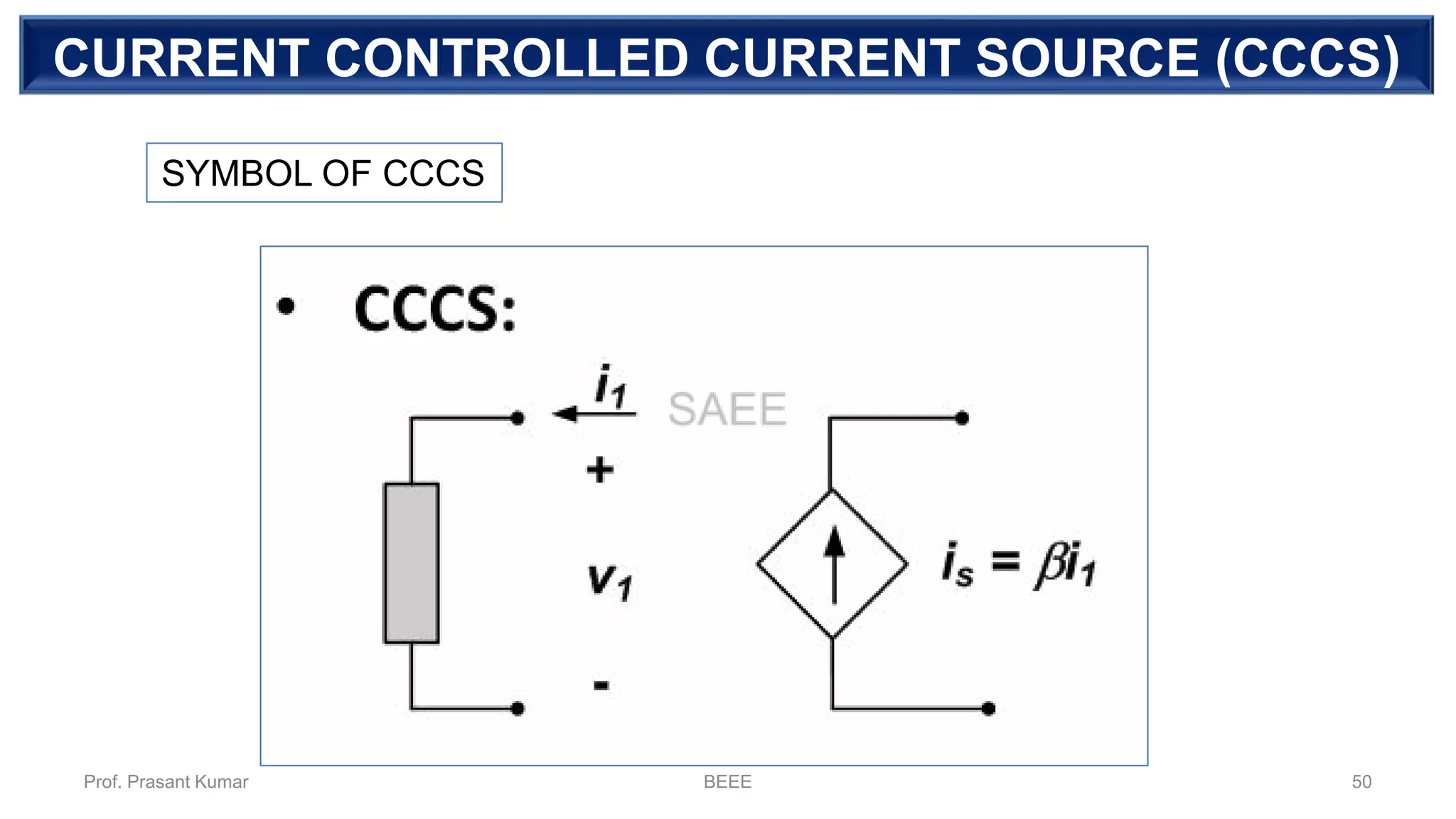
CURRENT CONTROLLED CURRENT SOURCE (CCCS)
SYMBOL OF CCCS
Prof. Prasant Kumar BEEE 50
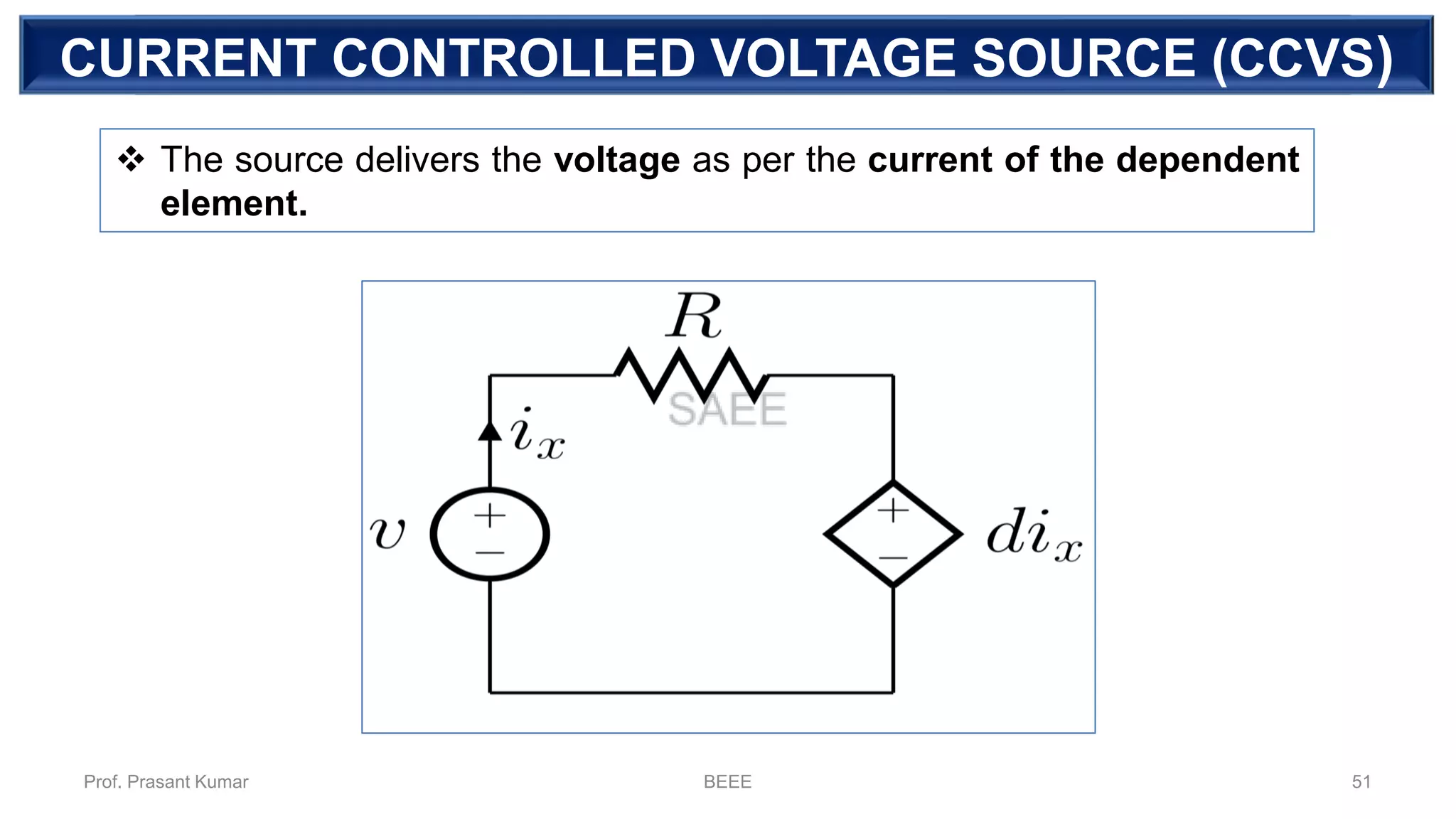
DEPENDENT SOURCECURRENT CONTROLLED VOLTAGE SOURCE (CCVS)
❖ The source delivers the voltage as per the current of the dependent
element.
Prof. Prasant Kumar BEEE 51
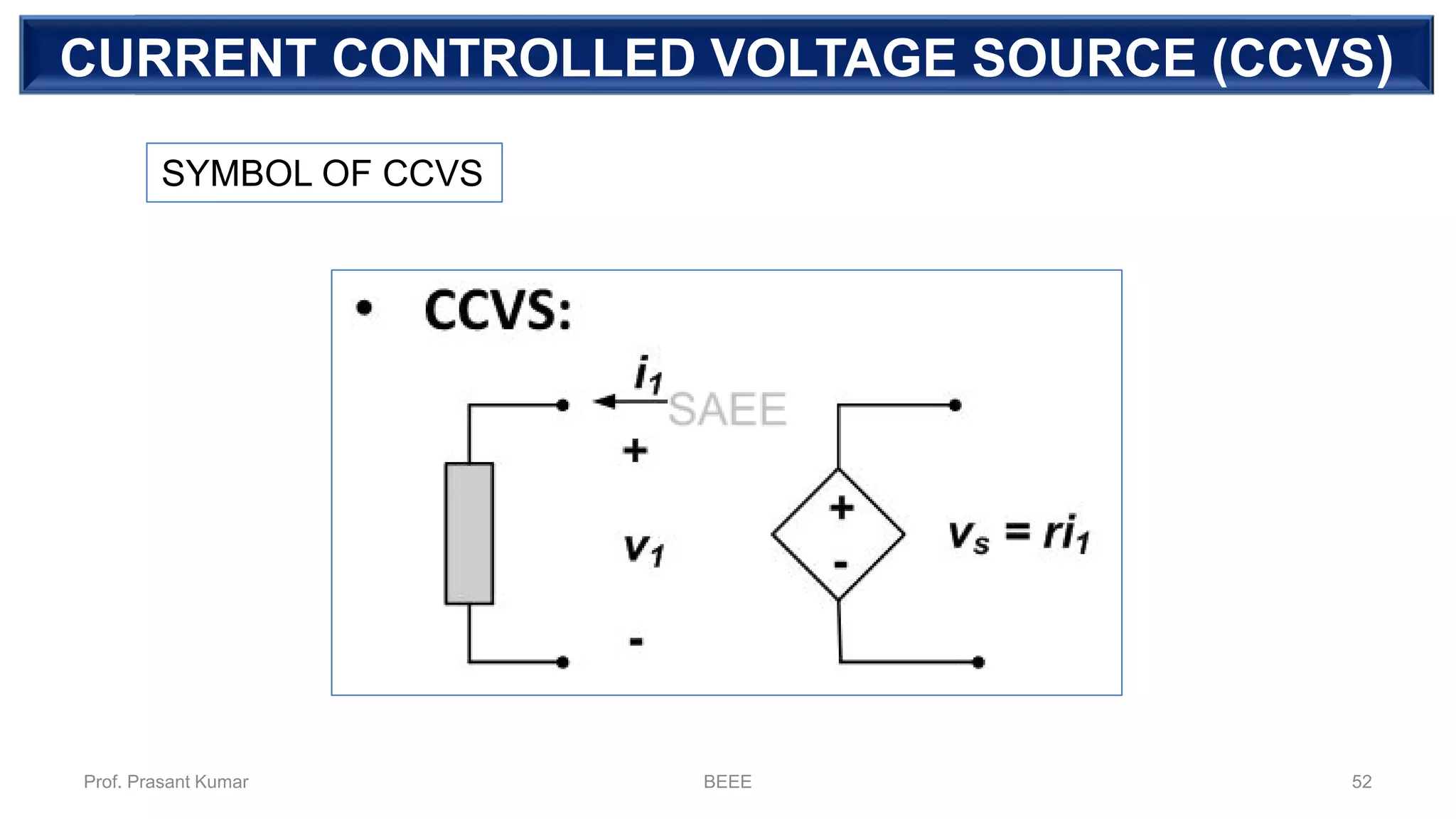
DEPENDENT SOURCECURRENT CONTROLLED VOLTAGE SOURCE (CCVS)
SYMBOL OF CCVS
Prof. Prasant Kumar BEEE 52
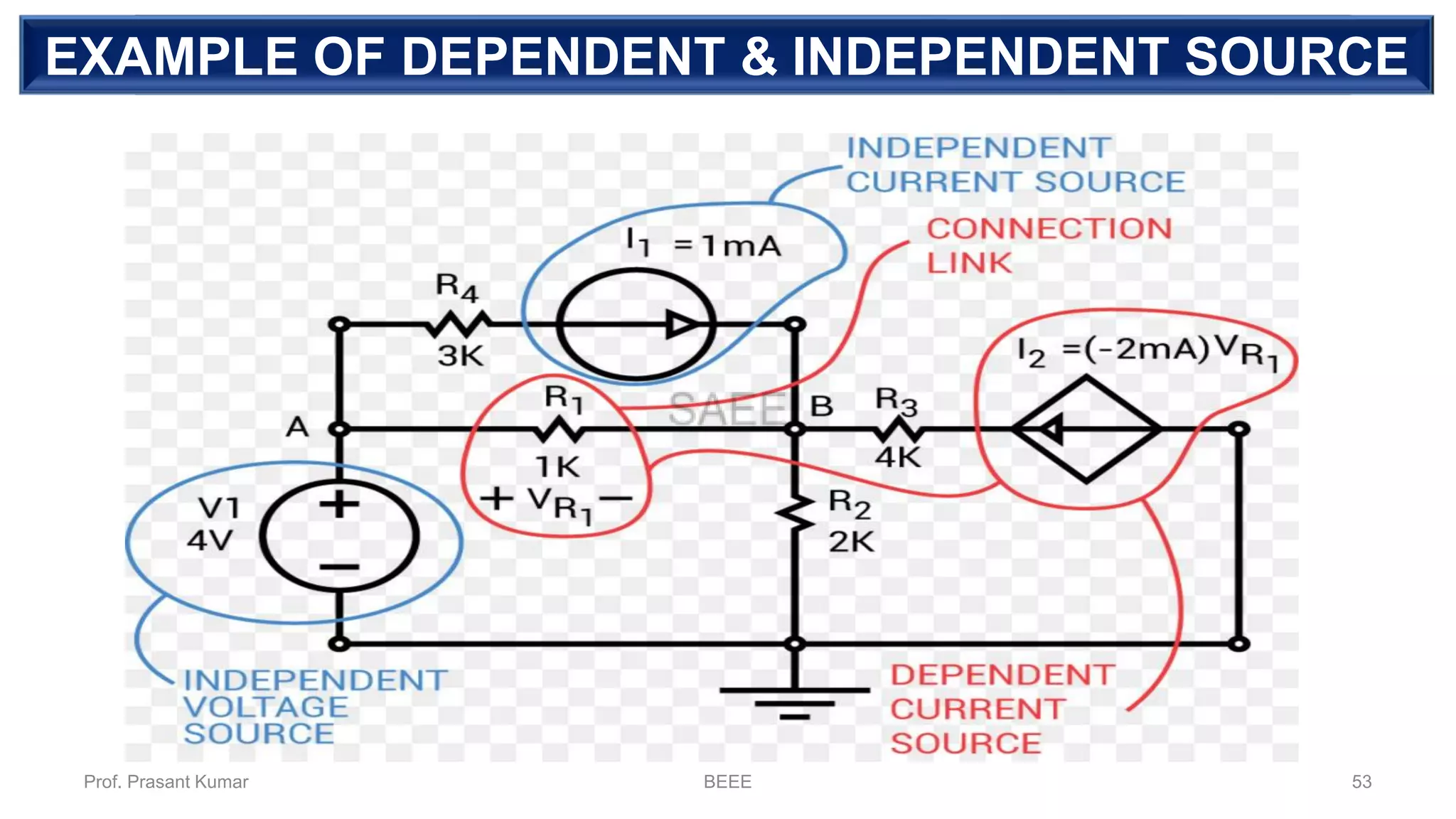
DEPENDENT SOURCEEXAMPLE OF DEPENDENT & INDEPENDENT SOURCE
Prof. Prasant Kumar BEEE 53
BASICS OF ELECTRICAL ENGINEERING
VOLTAGE SOURCE &
CURRENT SOURCE क्या है?
CIRCUIT DIAGRAM & SYMBOL
LEC#07 IN हहंINGLISH
Prof. Prasant Kumar BEEE 54
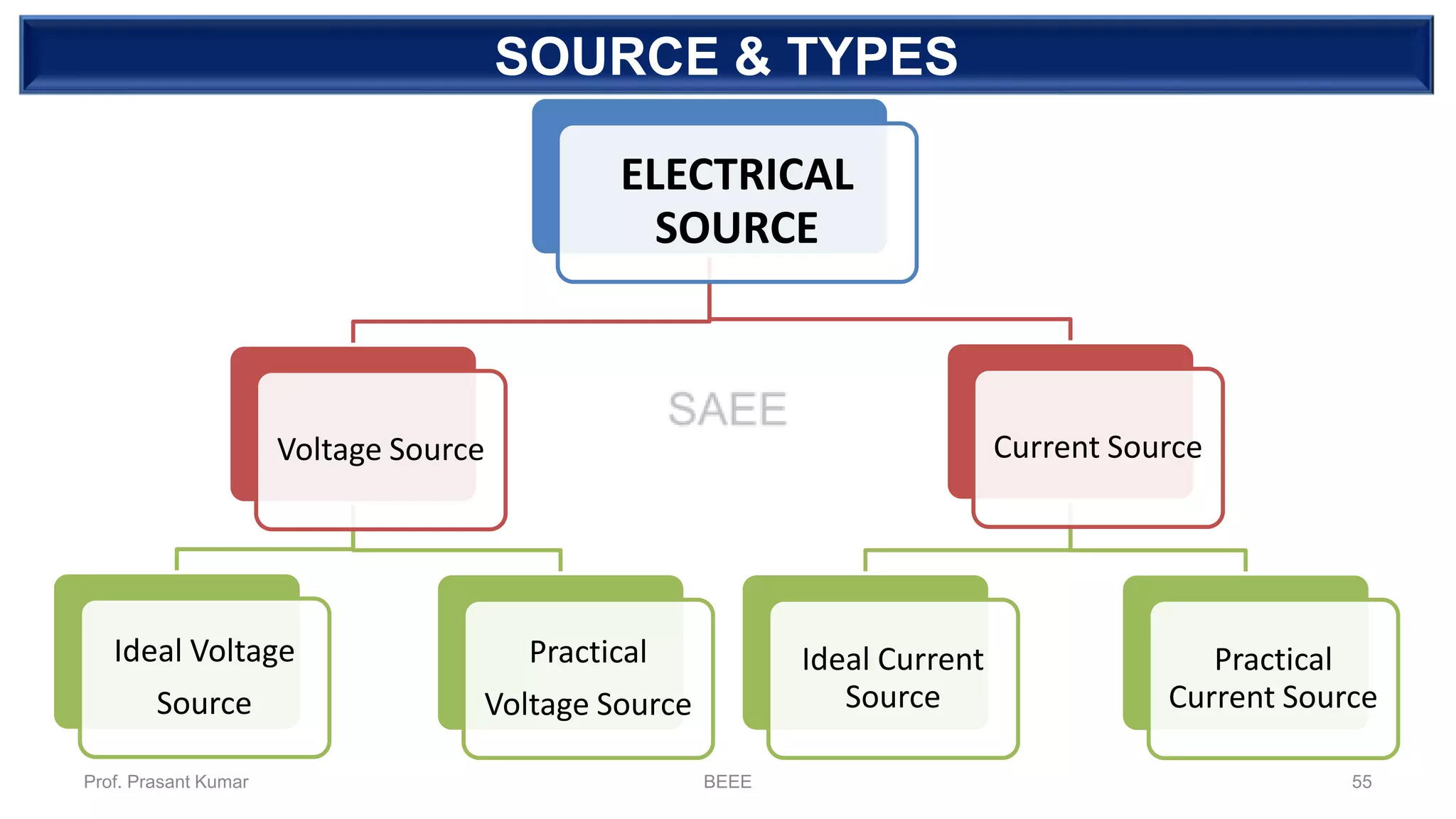
SOURCE & TYPES
ELECTRICAL
SOURCE
Voltage Source
Ideal Voltage
Source
Practical
Voltage Source
Current Source
Ideal Current
Source
Practical
Current Source
Prof. Prasant Kumar BEEE 55
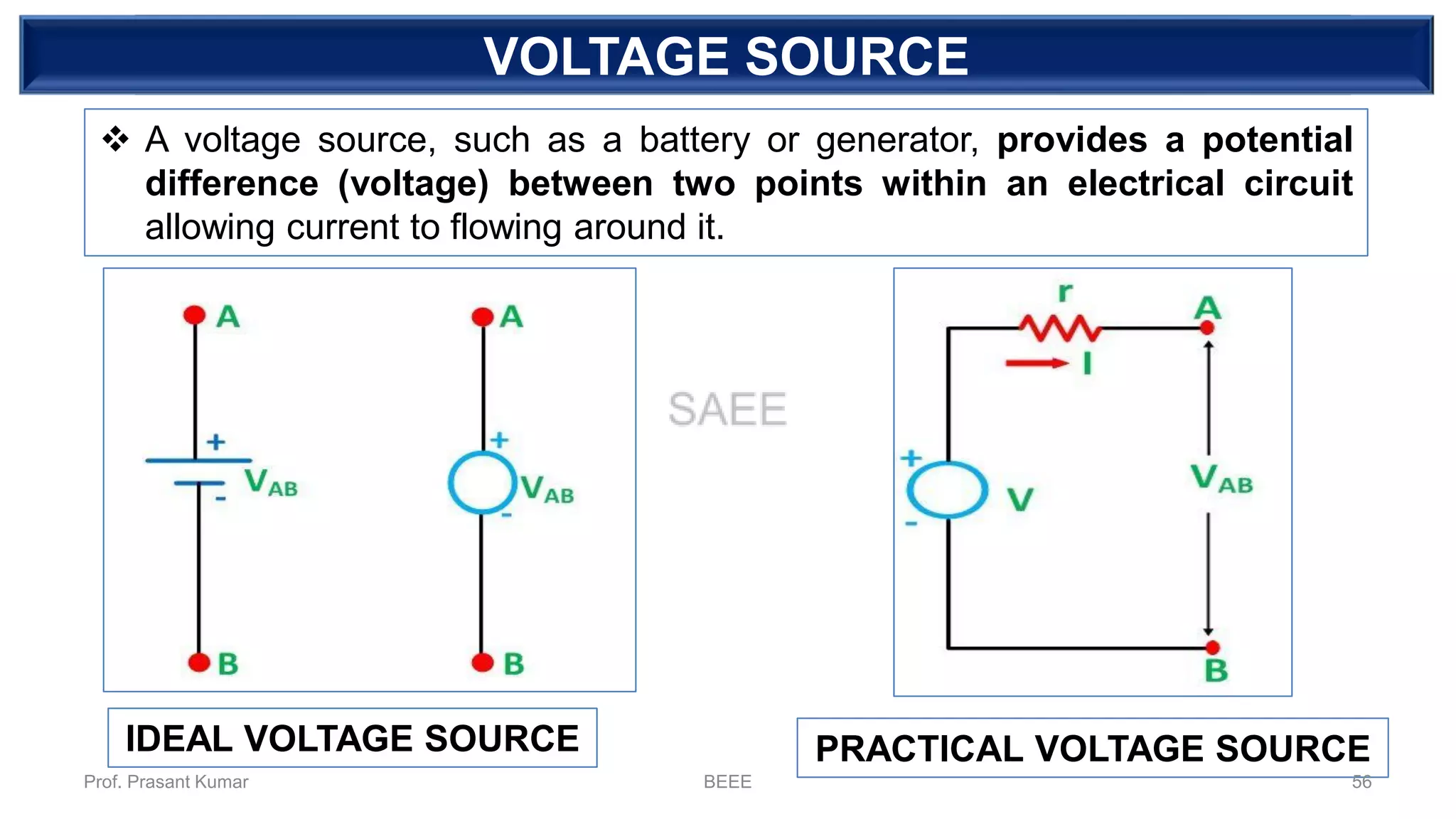
DEPENDENT SOURCEVOLTAGE SOURCE
❖ A voltage source, such as a battery or generator, provides a potential
difference (voltage) between two points within an electrical circuit
allowing current to flowing around it.
IDEAL VOLTAGE SOURCE PRACTICAL VOLTAGE SOURCE
Prof. Prasant Kumar BEEE 56
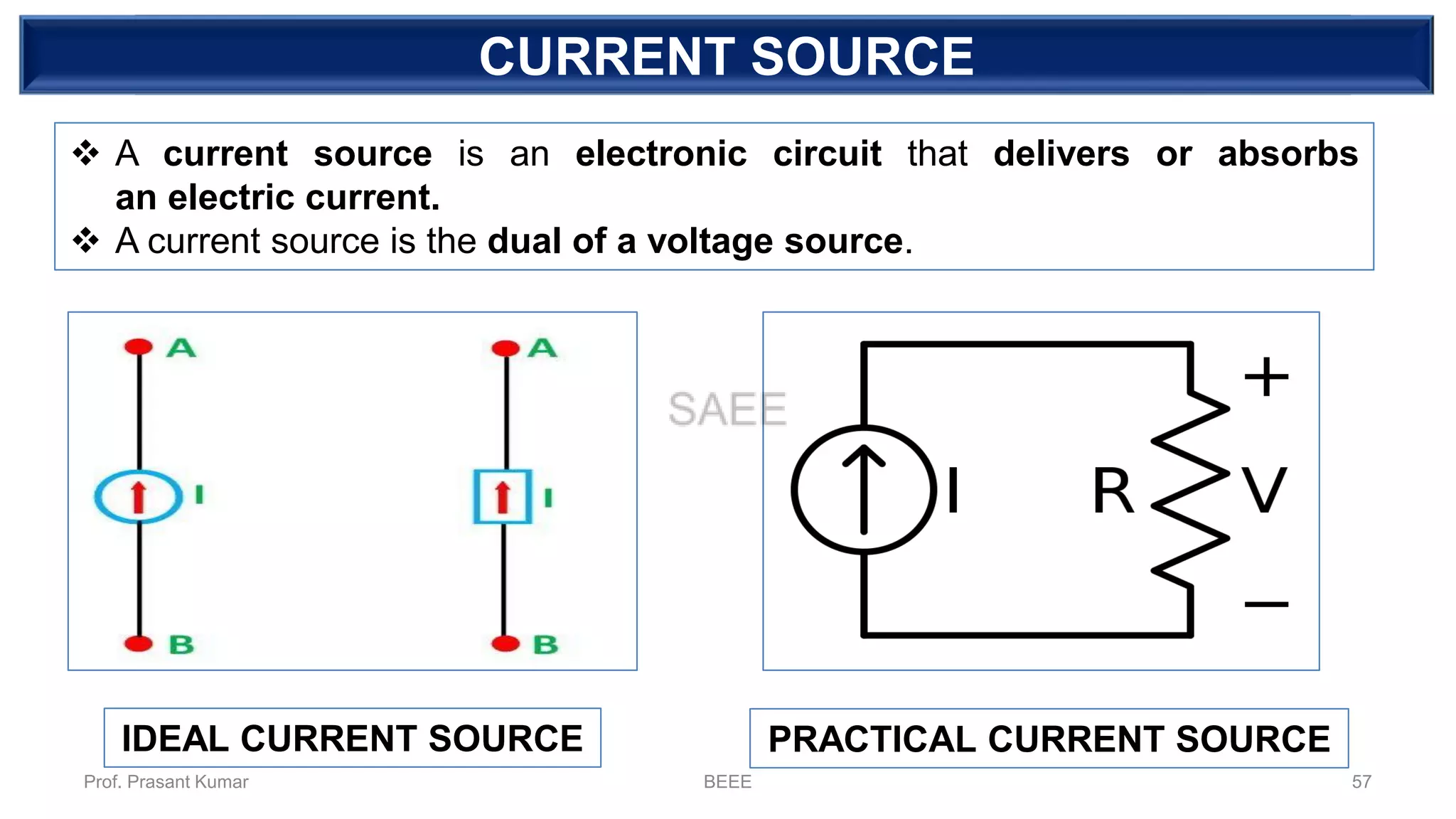
DEPENDENT SOURCECURRENT SOURCE
❖ A current source is an electronic circuit that delivers or absorbs
an electric current.
❖ A current source is the dual of a voltage source.
IDEAL CURRENT SOURCE PRACTICAL CURRENT SOURCE
Prof. Prasant Kumar BEEE 57
BASICS OF ELECTRICAL ENGINEERING
IDEAL VOLTAGE SOURCE &
PRACTICAL VOLTAGE
SOURCE क्या है?
LEC#08 IN हहंINGLISH
Prof. Prasant Kumar BEEE 58
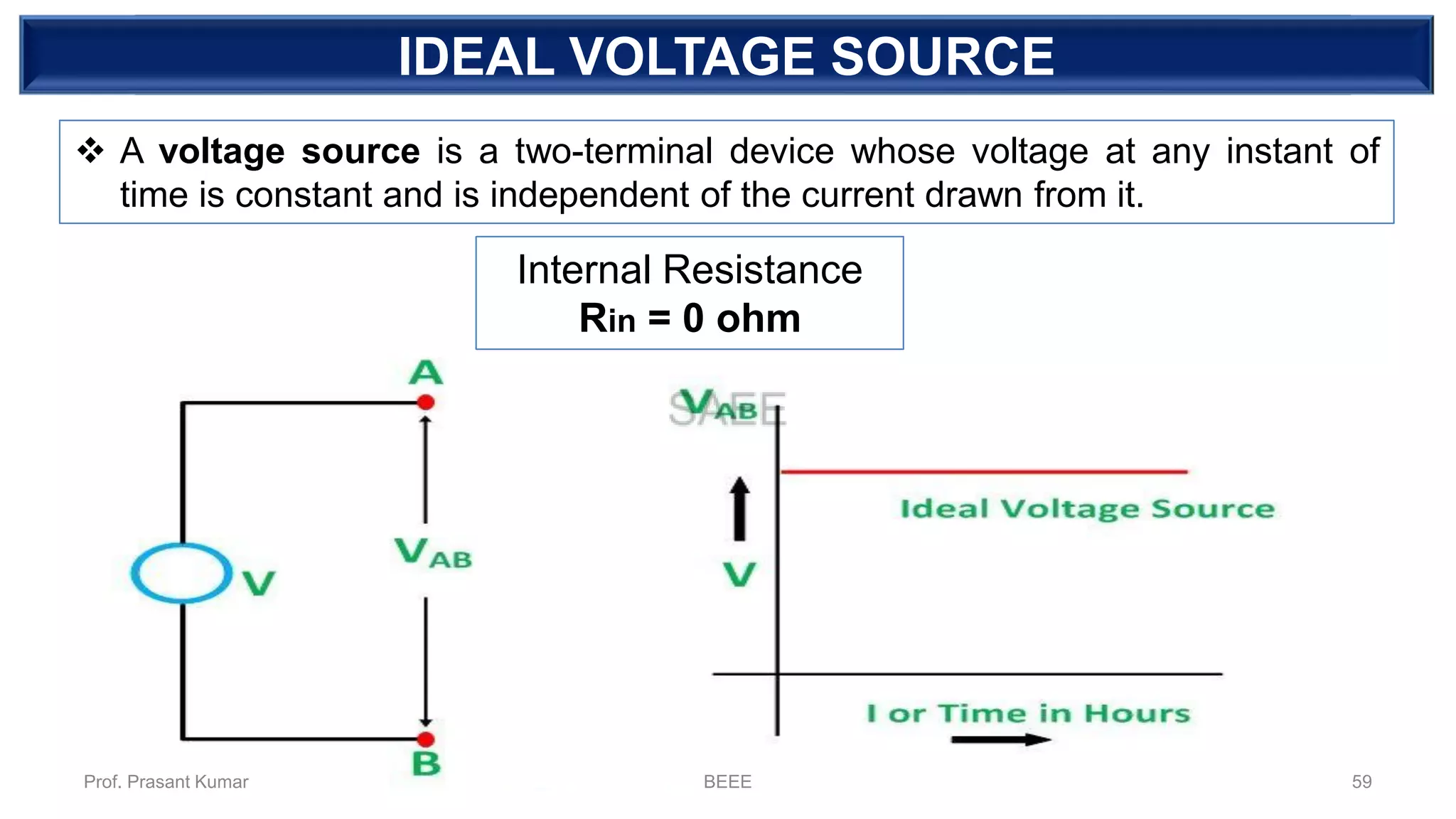
DEPENDENT SOURCEIDEAL VOLTAGE SOURCE
❖ A voltage source is a two-terminal device whose voltage at any instant of
time is constant and is independent of the current drawn from it.
Internal Resistance
Rin = 0 ohm
Prof. Prasant Kumar BEEE 59
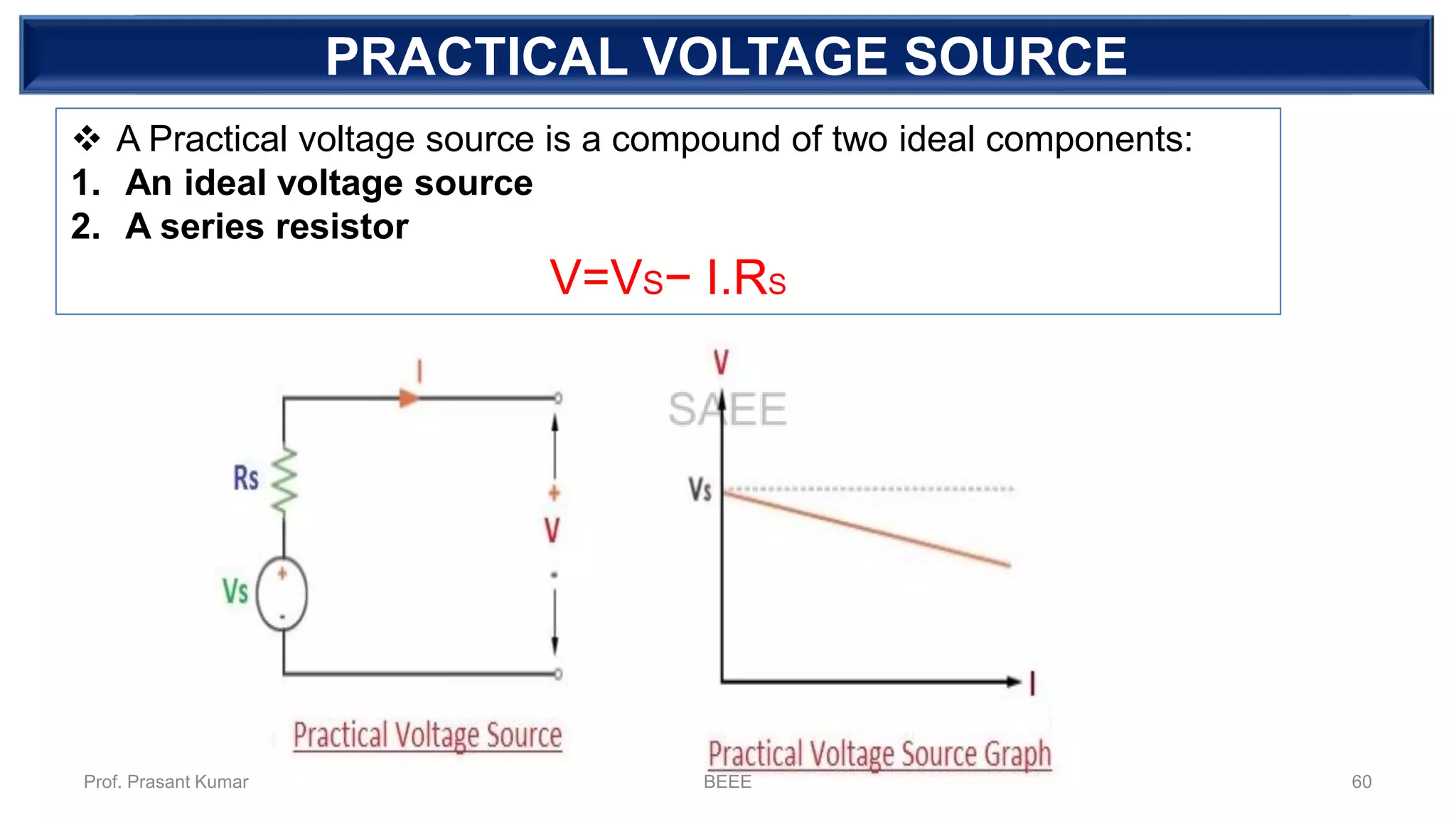
DEPENDENT SOURCEPRACTICAL VOLTAGE SOURCE
❖ A Practical voltage source is a compound of two ideal components:
1. An ideal voltage source
2. A series resistor
V=VS− I.RS
Prof. Prasant Kumar BEEE 60
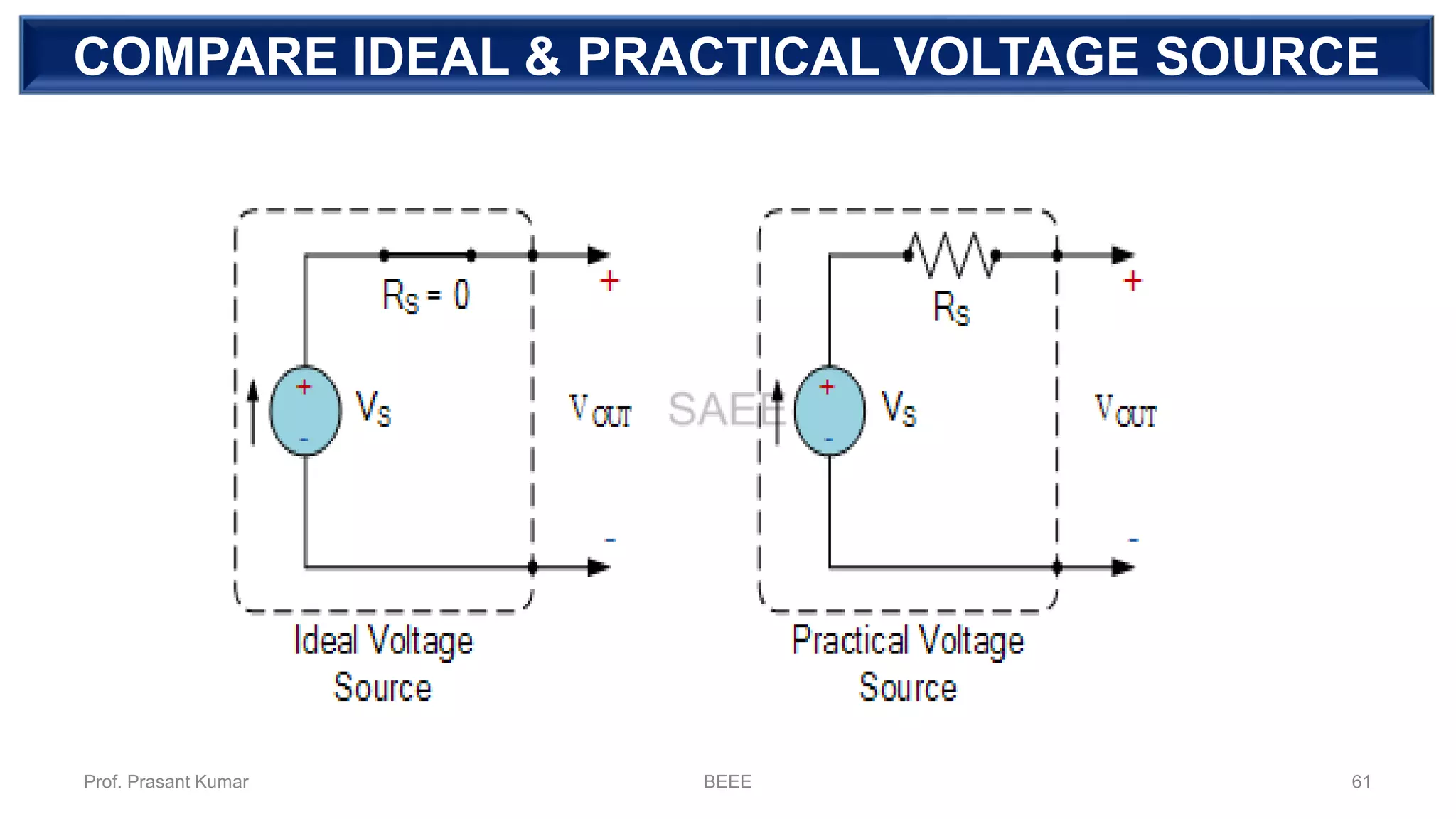
COMPARE IDEAL & PRACTICAL VOLTAGE SOURCE
Prof. Prasant Kumar BEEE 61
BASICS OF ELECTRICAL ENGINEERING
IDEAL CURRENT SOURCE &
PRACTICAL CURRENT
SOURCE क्या है?
LEC#09
Prof. Prasant Kumar BEEE 62
DEPENDENT SOURCEIDEAL CURRENT SOURCE
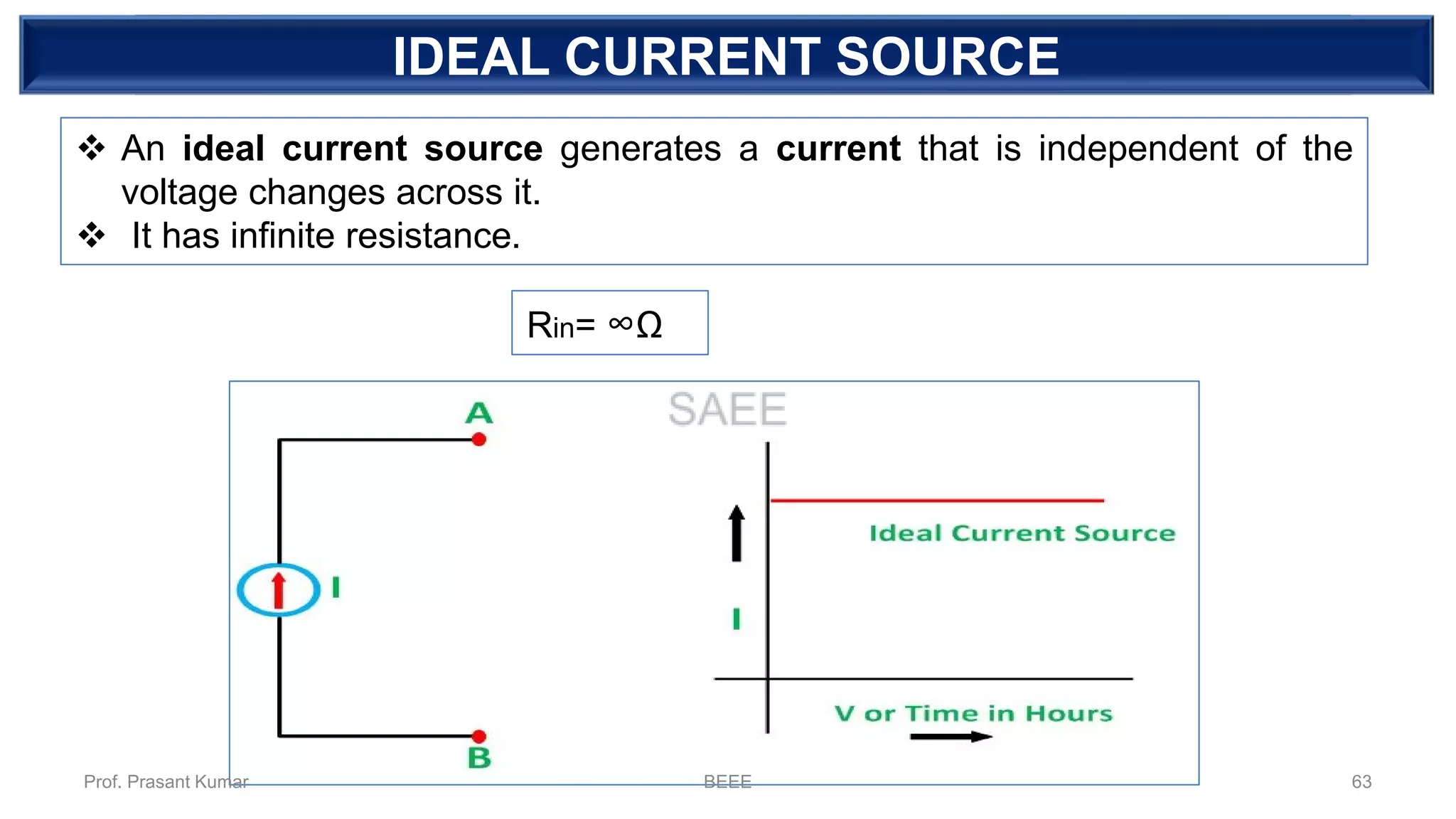
❖ An ideal current source generates a current that is independent of the
voltage changes across it.
❖ It has infinite resistance.
Rin= ∞Ω
Prof. Prasant Kumar BEEE 63
DEPENDENT SOURCEPRACTICAL CURRENT SOURCE
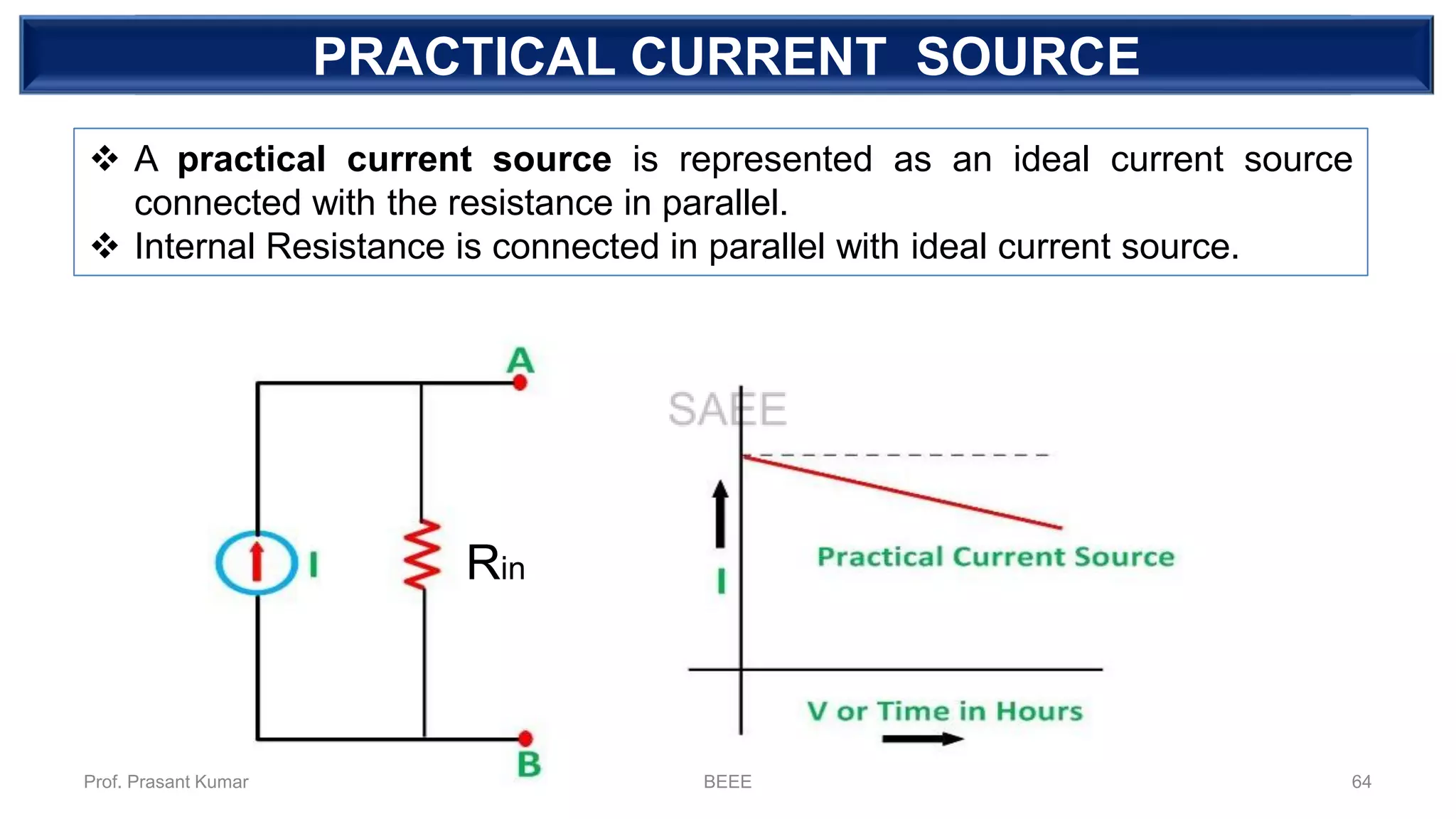
❖ A practical current source is represented as an ideal current source
connected with the resistance in parallel.
❖ Internal Resistance is connected in parallel with ideal current source.
Rin
Prof. Prasant Kumar BEEE 64
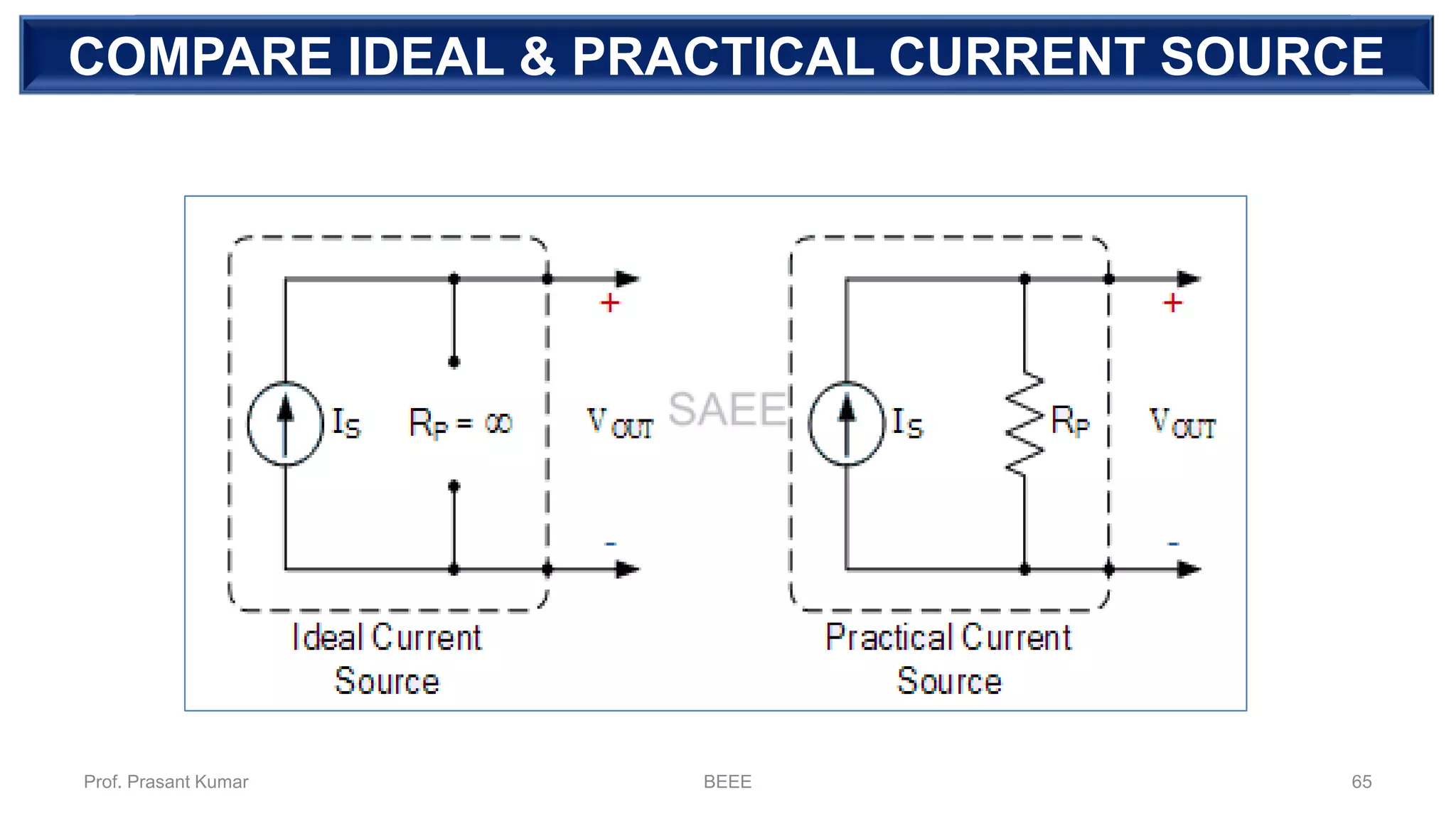
DEPENDENT SOURCECOMPARE IDEAL & PRACTICAL CURRENT SOURCE
Prof. Prasant Kumar BEEE 65
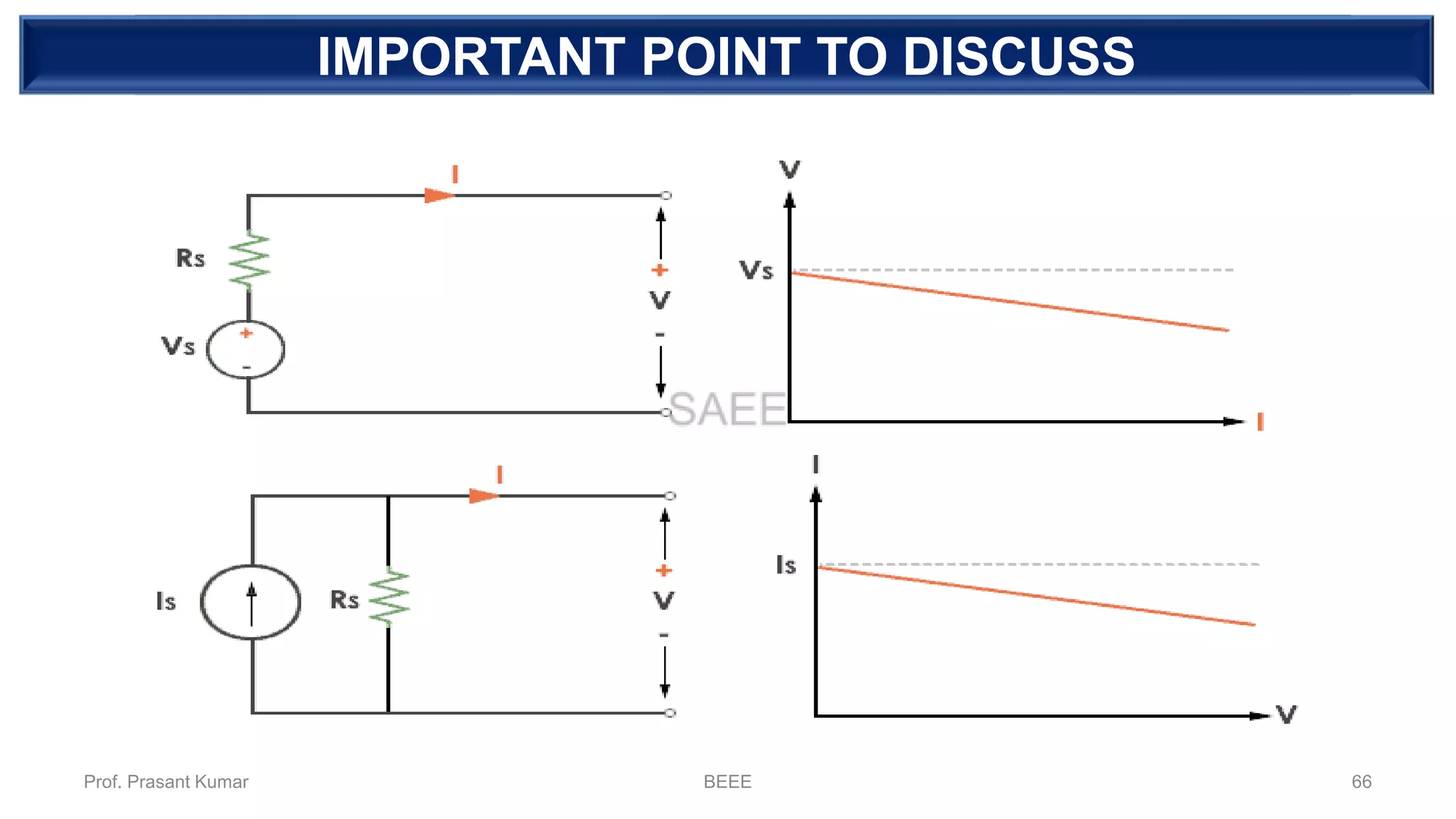
DEPENDENT SOURCEIMPORTANT POINT TO DISCUSS
Prof. Prasant Kumar BEEE 66
BASICS OF ELECTRICAL ENGINEERING
ELECTRICAL LOAD क्या है?
RESISTOR,INDUCTOR &
CAPACITOR
LEC#10 IN हहंINGLISH
Prof. Prasant Kumar BEEE 67
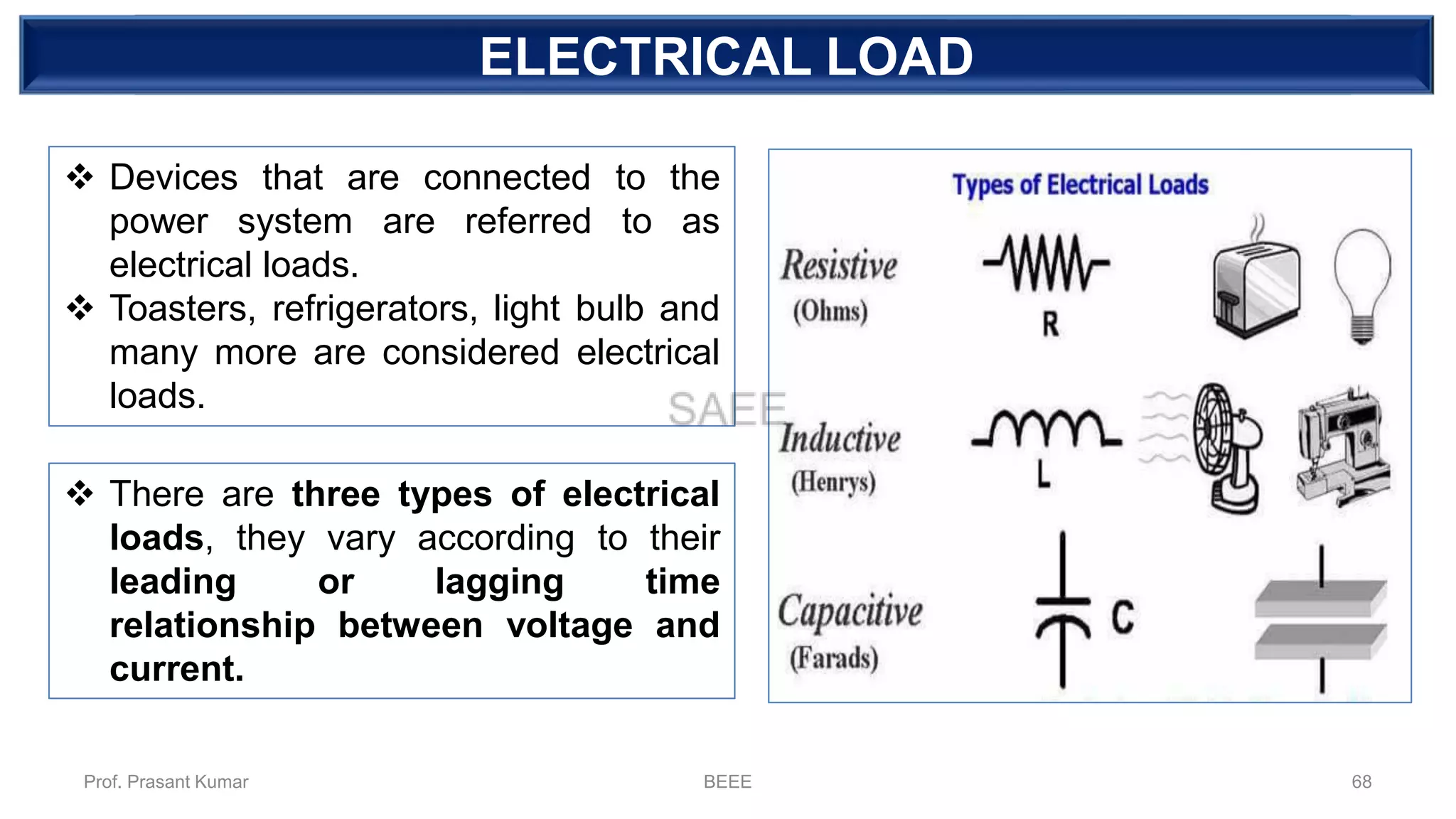
DEPENDENT SOURCEELECTRICAL LOAD
❖ Devices that are connected to the
power system are referred to as
electrical loads.
❖ Toasters, refrigerators, light bulb and
many more are considered electrical
loads.
❖ There are three types of electrical
loads, they vary according to their
leading or lagging time
relationship between voltage and
current.
Prof. Prasant Kumar BEEE 68
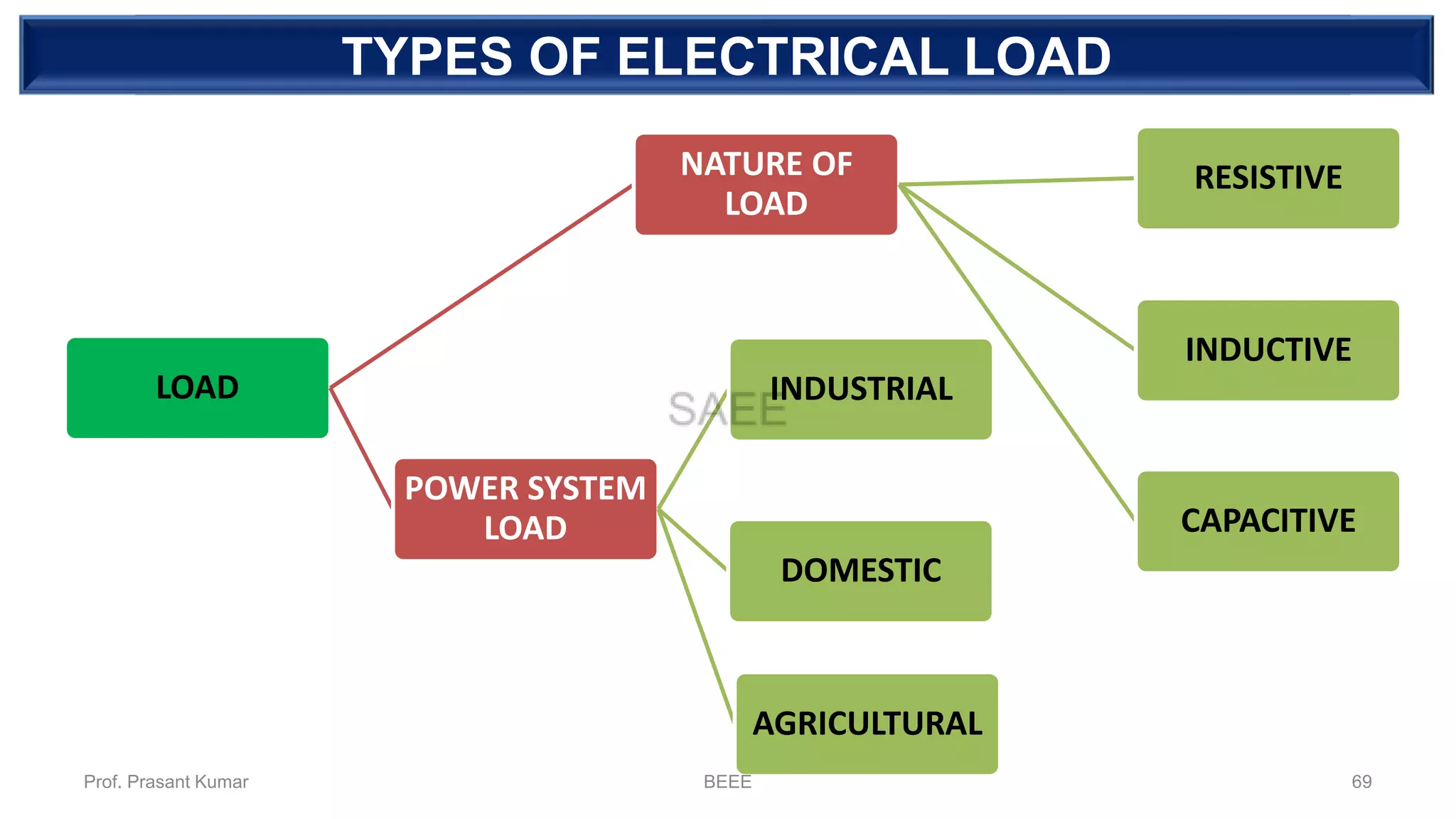
DEPENDENT SOURCETYPES OF ELECTRICAL LOAD
LOAD
NATURE OF
LOAD
RESISTIVE
INDUCTIVE
CAPACITIVE
POWER SYSTEM
LOAD
INDUSTRIAL
DOMESTIC
AGRICULTURAL
Prof. Prasant Kumar BEEE 69
Prof. Prasant Kumar BEEE 70
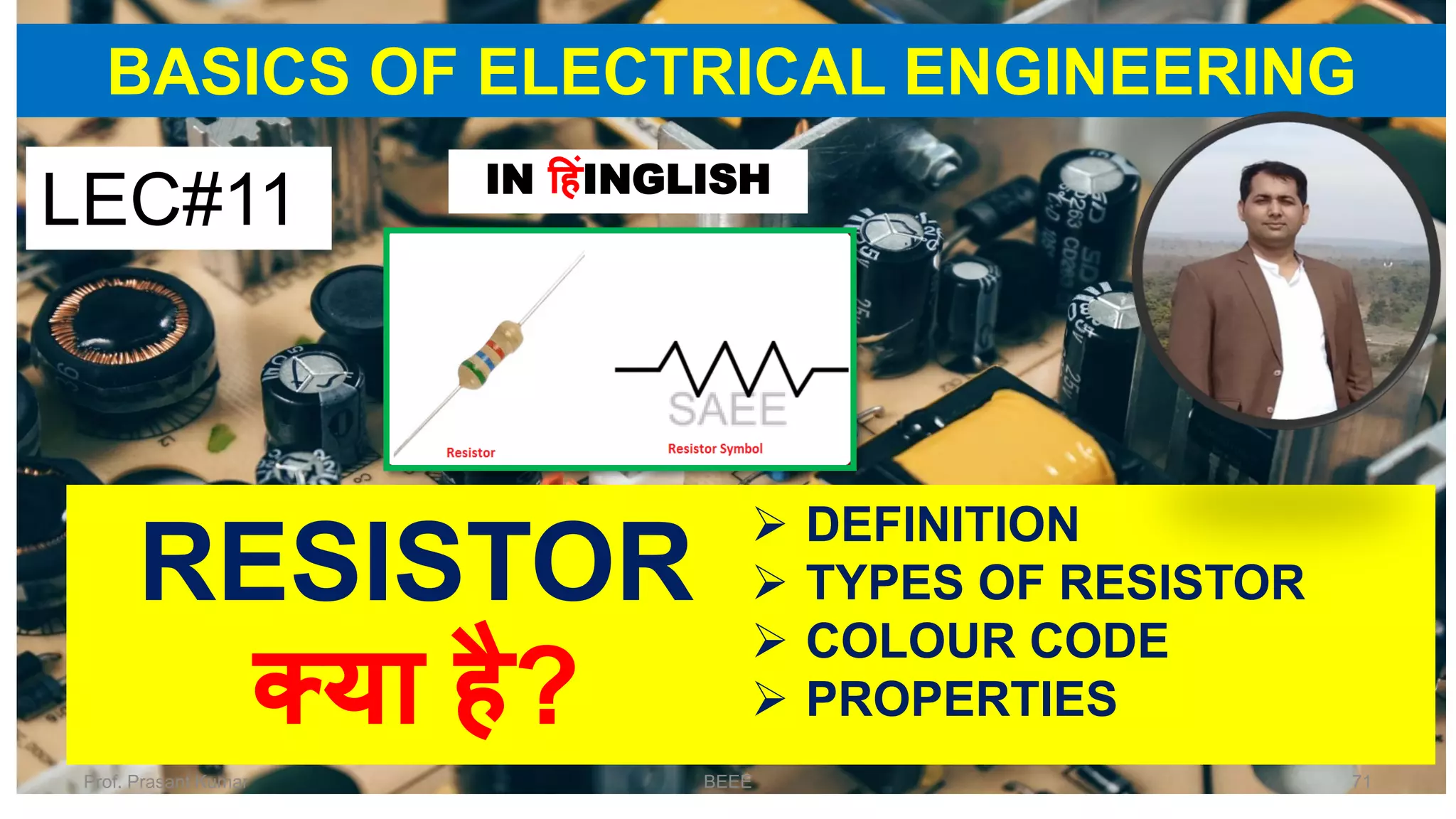
BASICS OF ELECTRICAL ENGINEERING
RESISTOR
क्या है?
➢ DEFINITION
➢ TYPES OF RESISTOR
➢ COLOUR CODE
➢ PROPERTIES
LEC#11 IN हहंINGLISH
Prof. Prasant Kumar BEEE 71
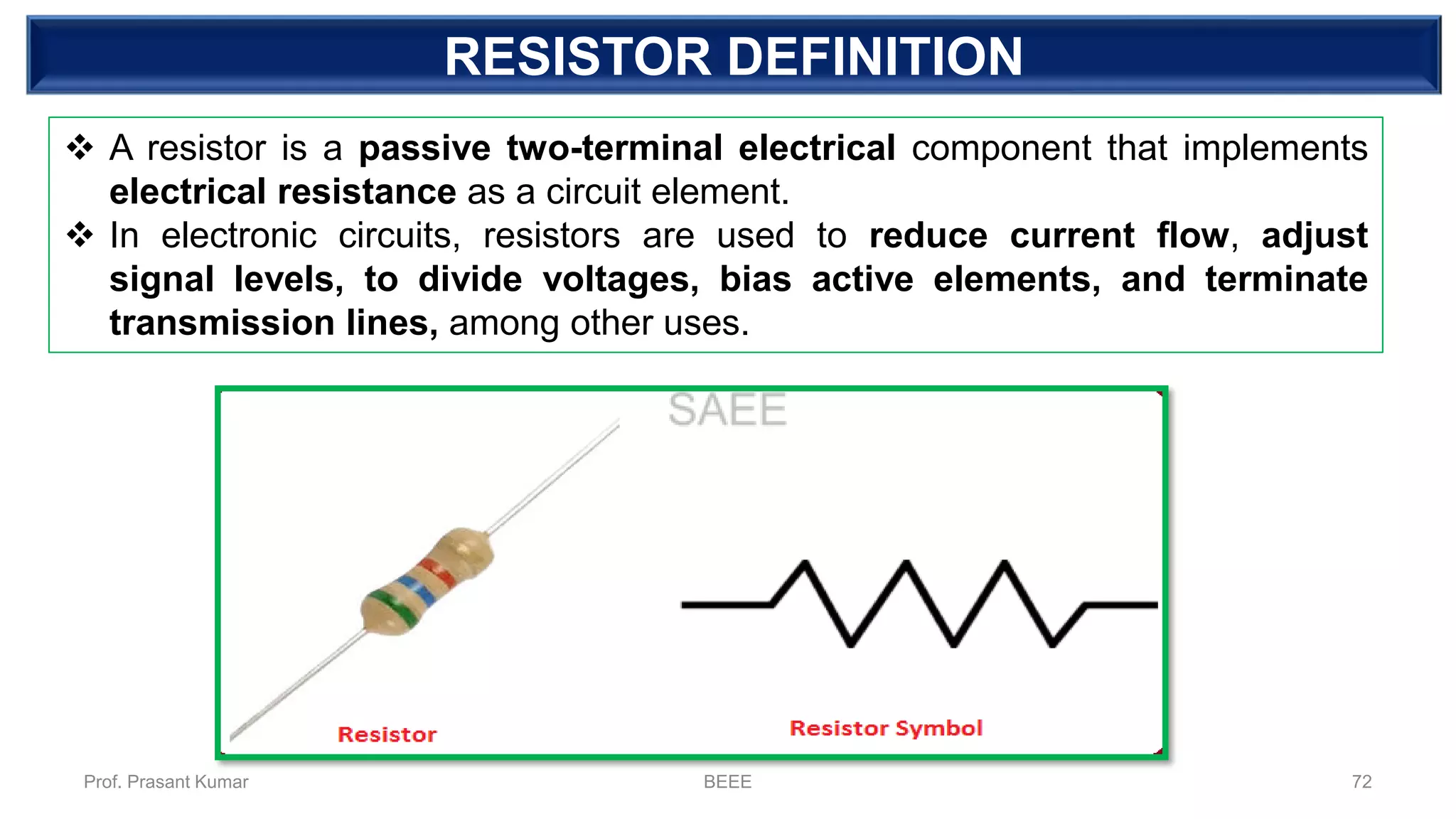
RESISTOR DEFINITION
❖ A resistor is a passive two-terminal electrical component that implements
electrical resistance as a circuit element.
❖ In electronic circuits, resistors are used to reduce current flow, adjust
signal levels, to divide voltages, bias active elements, and terminate
transmission lines, among other uses.
Prof. Prasant Kumar BEEE 72
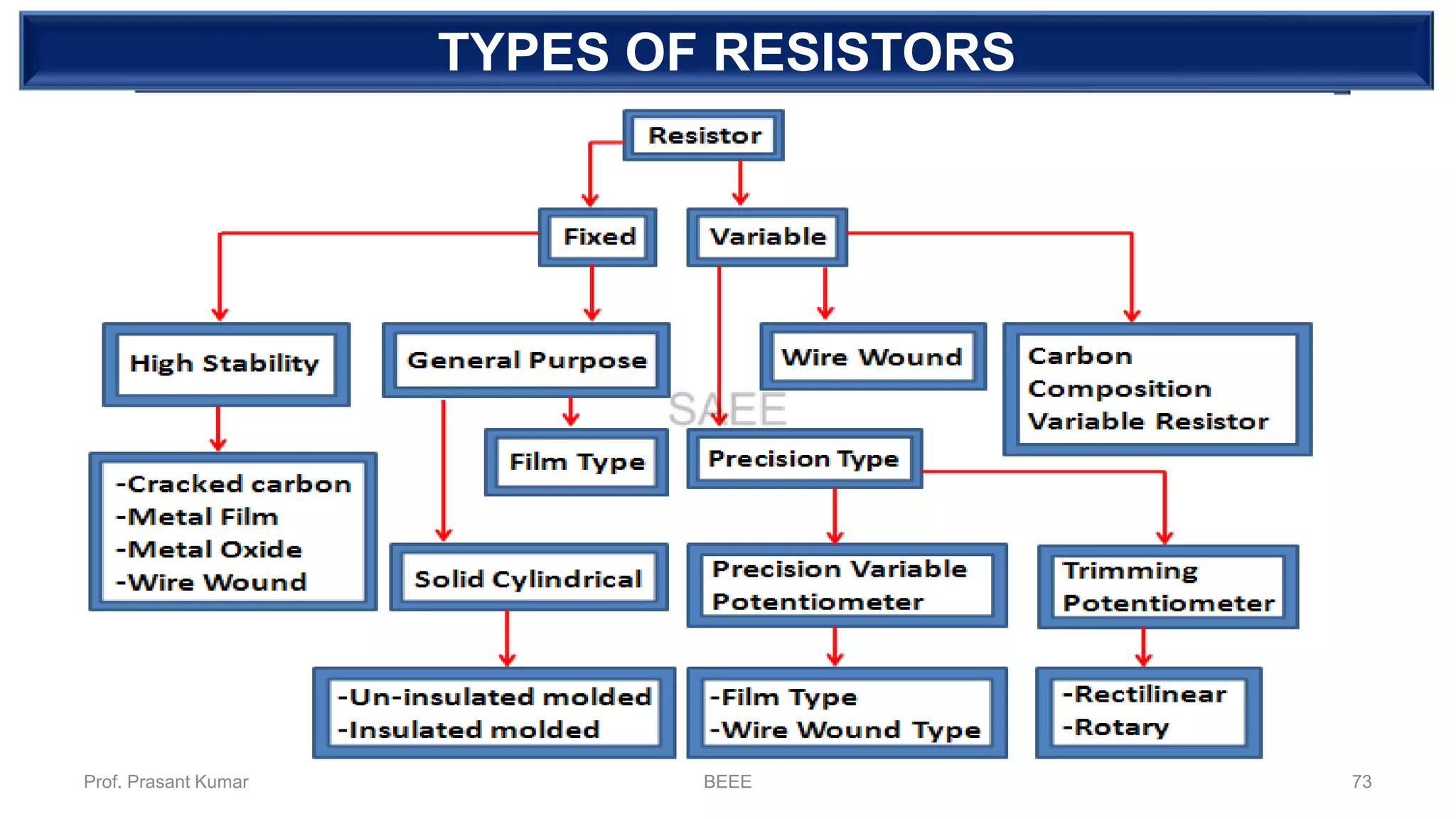
DEPENDENT SOURCETYPES OF RESISTORS
Prof. Prasant Kumar BEEE 73
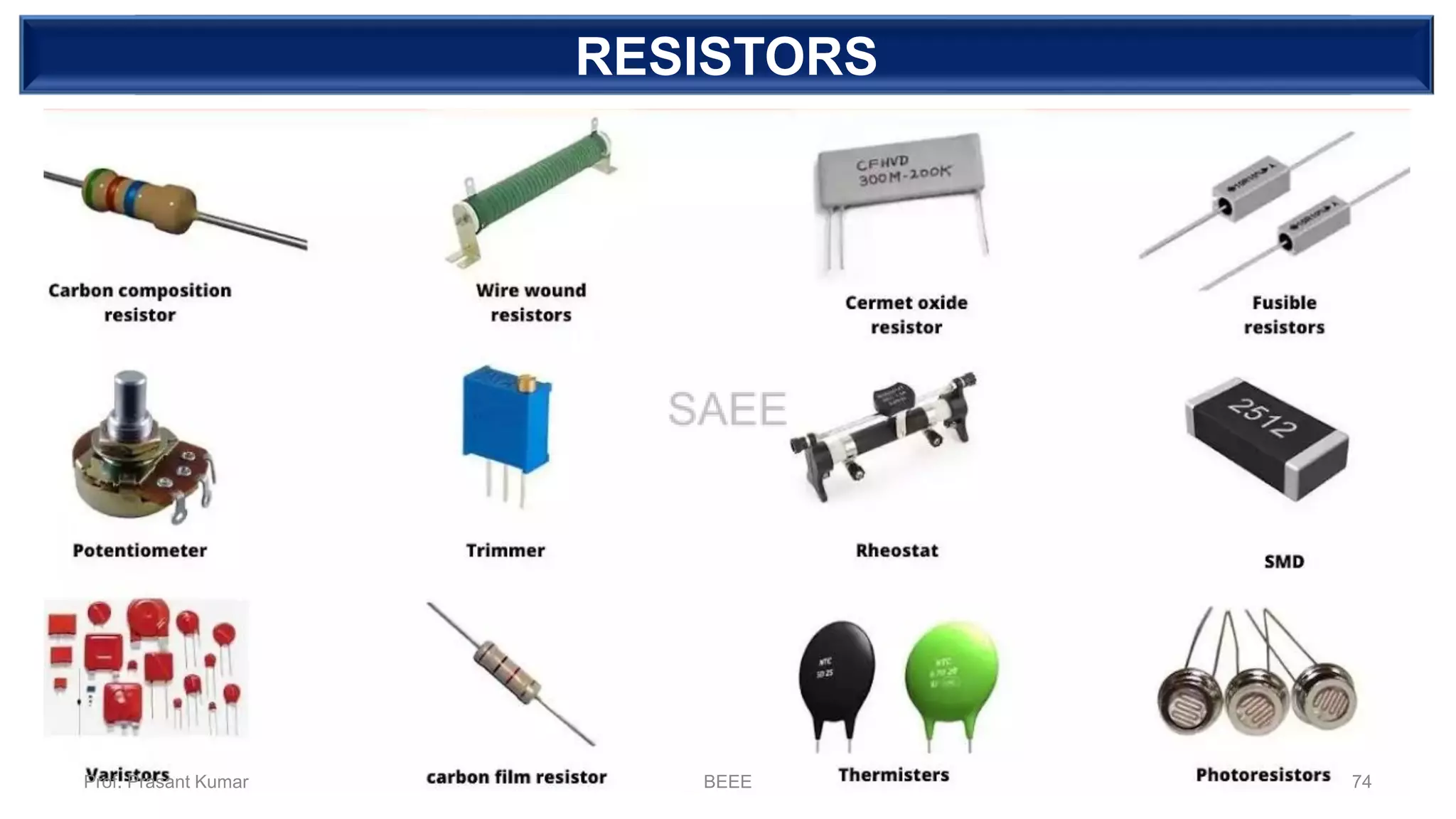
DEPENDENT SOURCERESISTORS
Prof. Prasant Kumar BEEE 74
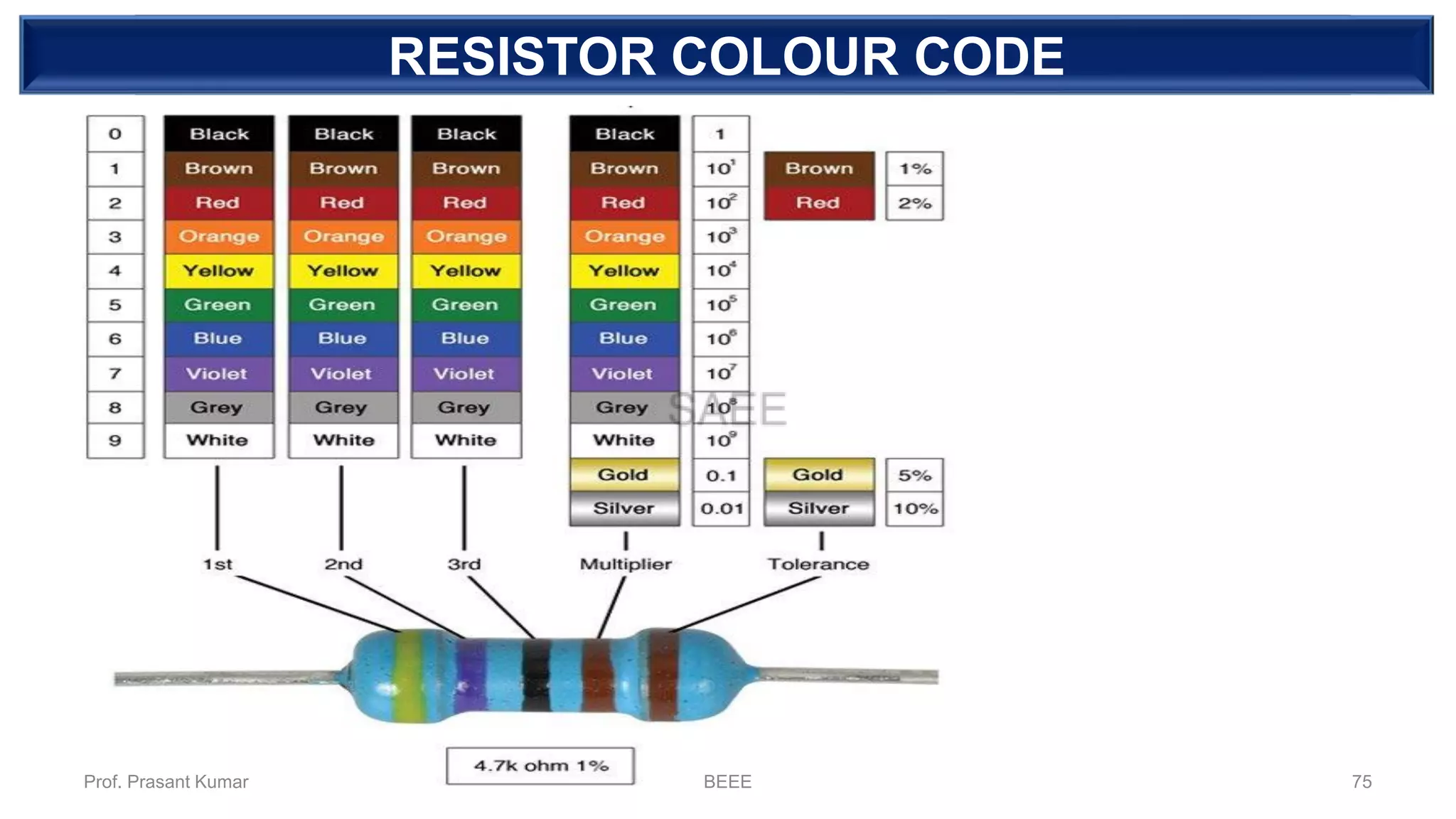
DEPENDENT SOURCERESISTOR COLOUR CODE
Prof. Prasant Kumar BEEE 75
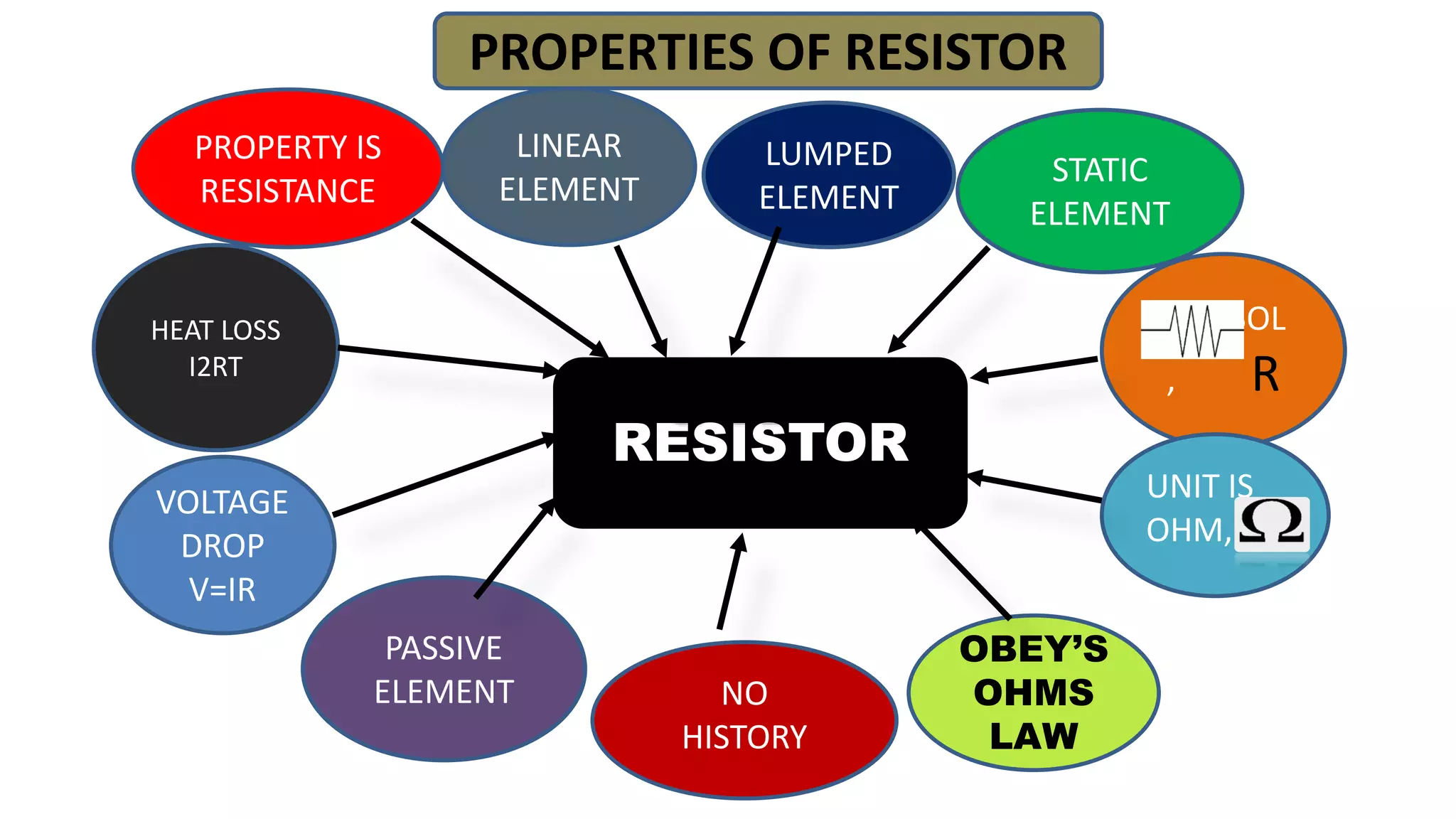
RESISTOR
HEAT LOSS
I2RT
PASSIVE
ELEMENT
PROPERTY IS
RESISTANCE
SYMBOL
, R
STATIC
ELEMENT
LINEAR
ELEMENT
NO
HISTORY
LUMPED
ELEMENT
UNIT IS
OHM,
OBEY’S
OHMS
LAW
VOLTAGE
DROP
V=IR
PROPERTIES OF RESISTOR
DEPENDENT SOURCERESISTANCE
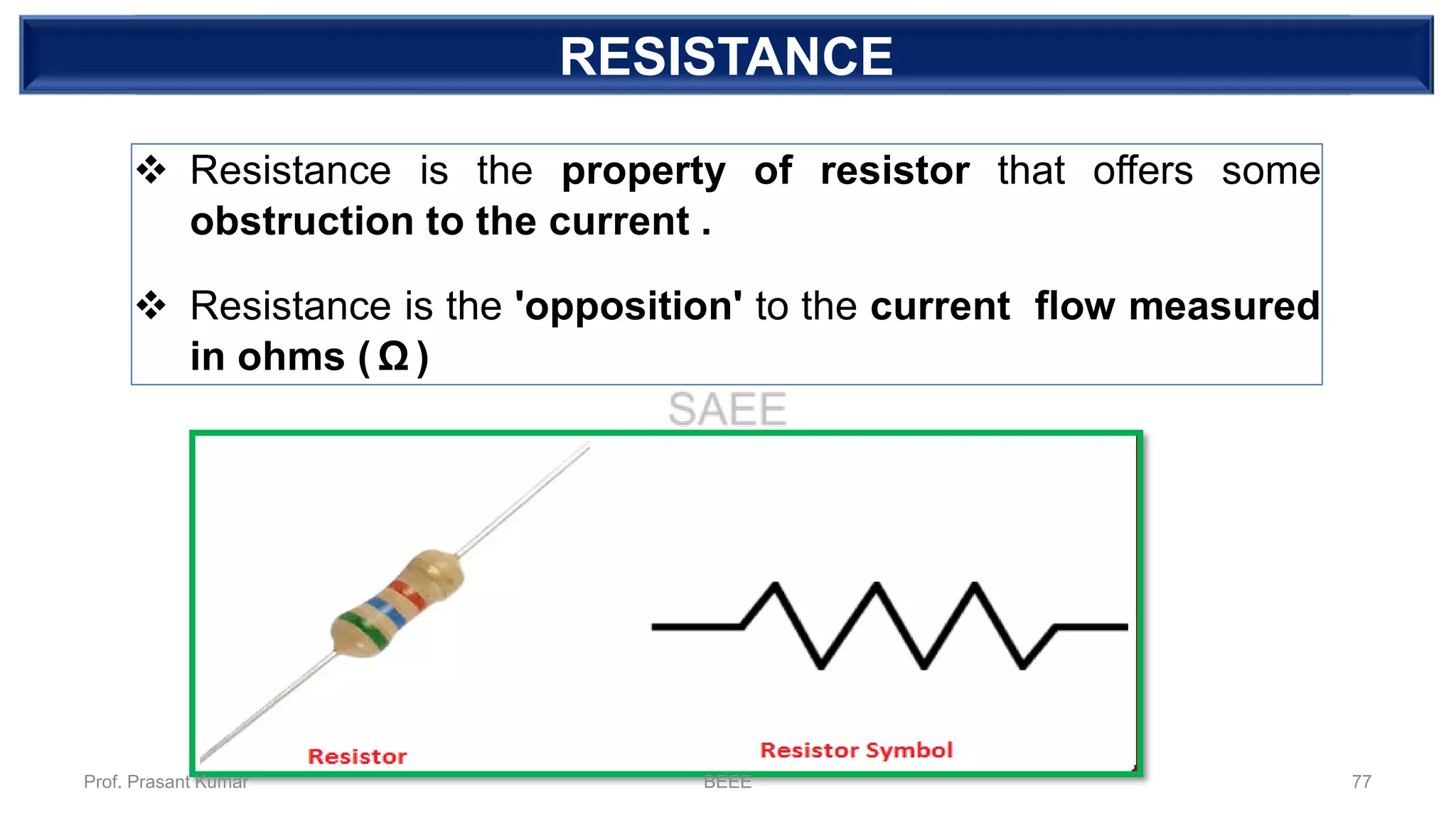
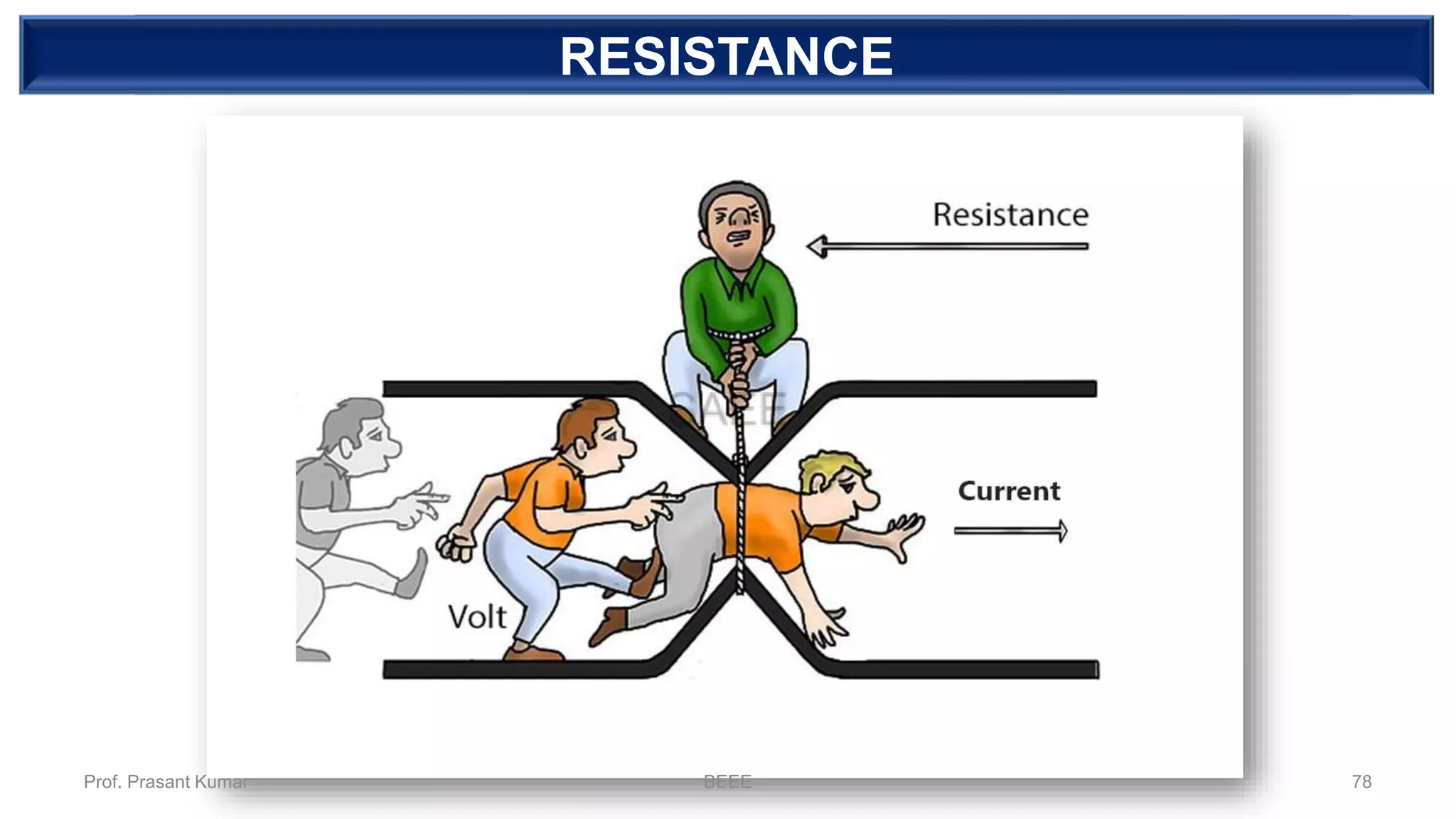
❖ Resistance is the property of resistor that offers some
obstruction to the current .
❖ Resistance is the 'opposition' to the current flow measured
in ohms ( Ω )
Prof. Prasant Kumar BEEE 77
DEPENDENT SOURCERESISTANCE
Prof. Prasant Kumar BEEE 78
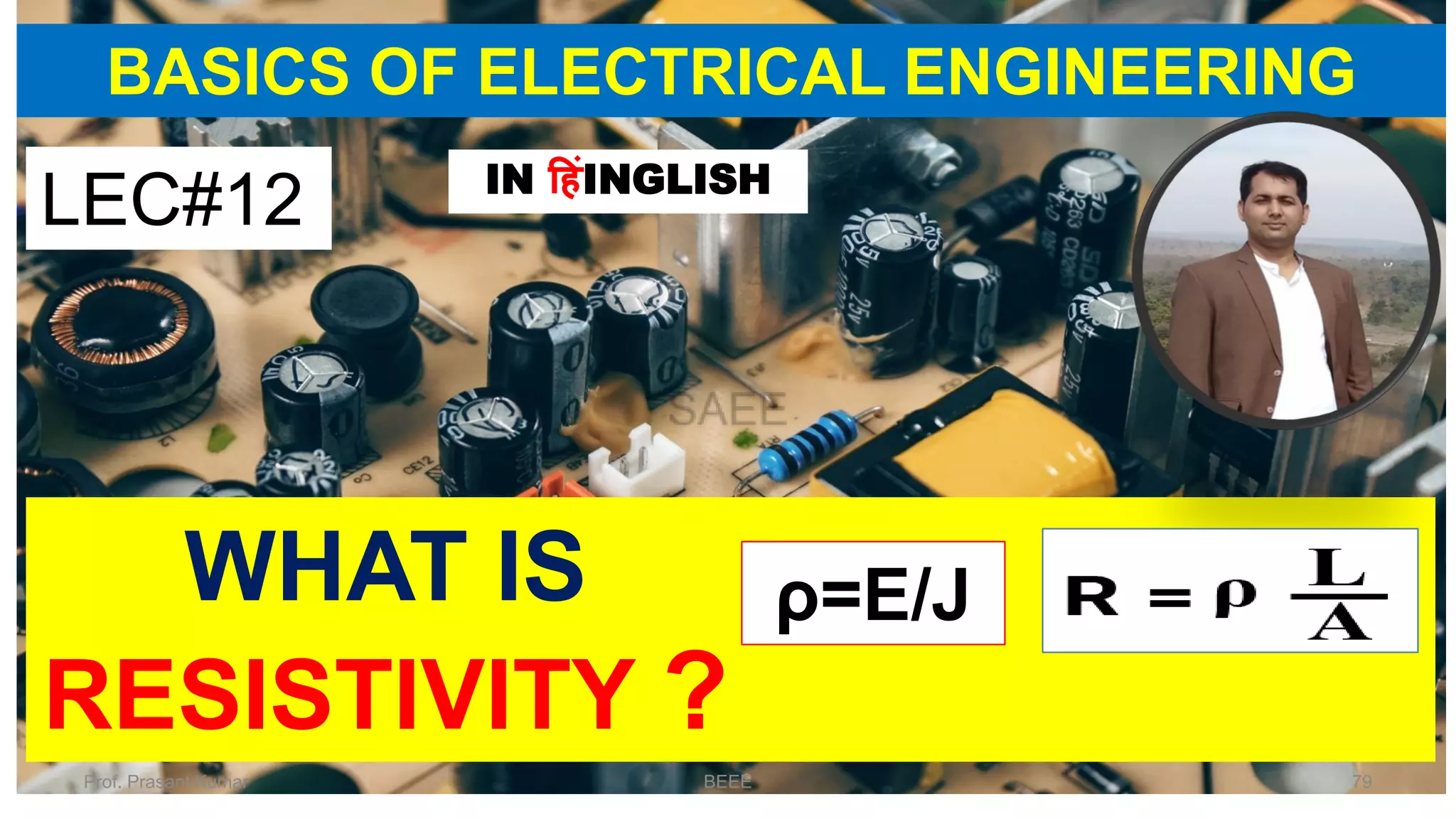
BASICS OF ELECTRICAL ENGINEERING
WHAT IS
RESISTIVITY ?
LEC#12 IN हहंINGLISH
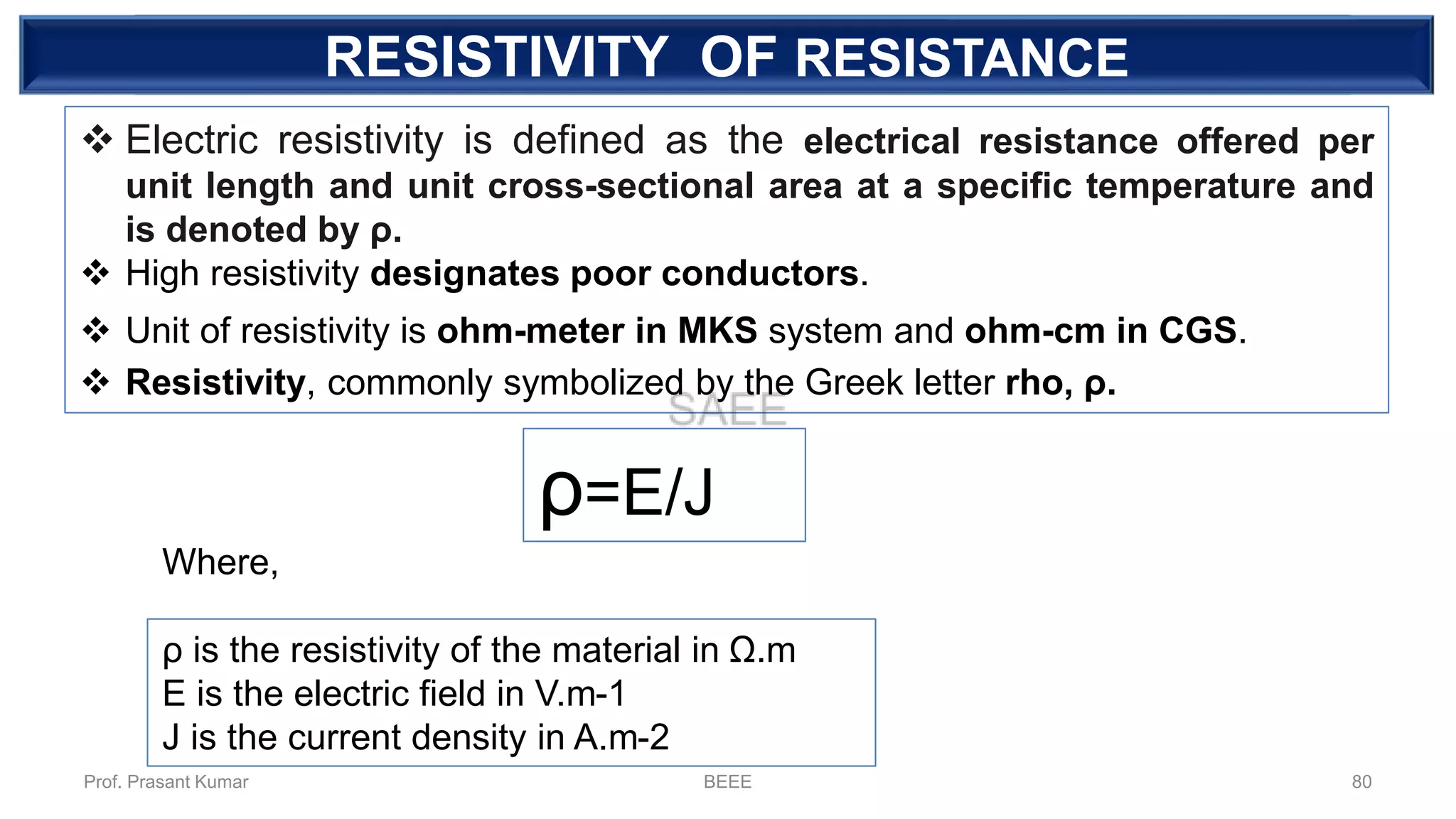
ρ=E/J
Prof. Prasant Kumar BEEE 79
DEPENDENT SOURCERESISTIVITY OF RESISTANCE
❖ Electric resistivity is defined as the electrical resistance offered per
unit length and unit cross-sectional area at a specific temperature and
is denoted by ρ.
❖ High resistivity designates poor conductors.
❖ Unit of resistivity is ohm-meter in MKS system and ohm-cm in CGS.
❖ Resistivity, commonly symbolized by the Greek letter rho, ρ.
ρ=E/J
ρ is the resistivity of the material in Ω.m
E is the electric field in V.m-1
J is the current density in A.m-2
Where,
Prof. Prasant Kumar BEEE 80
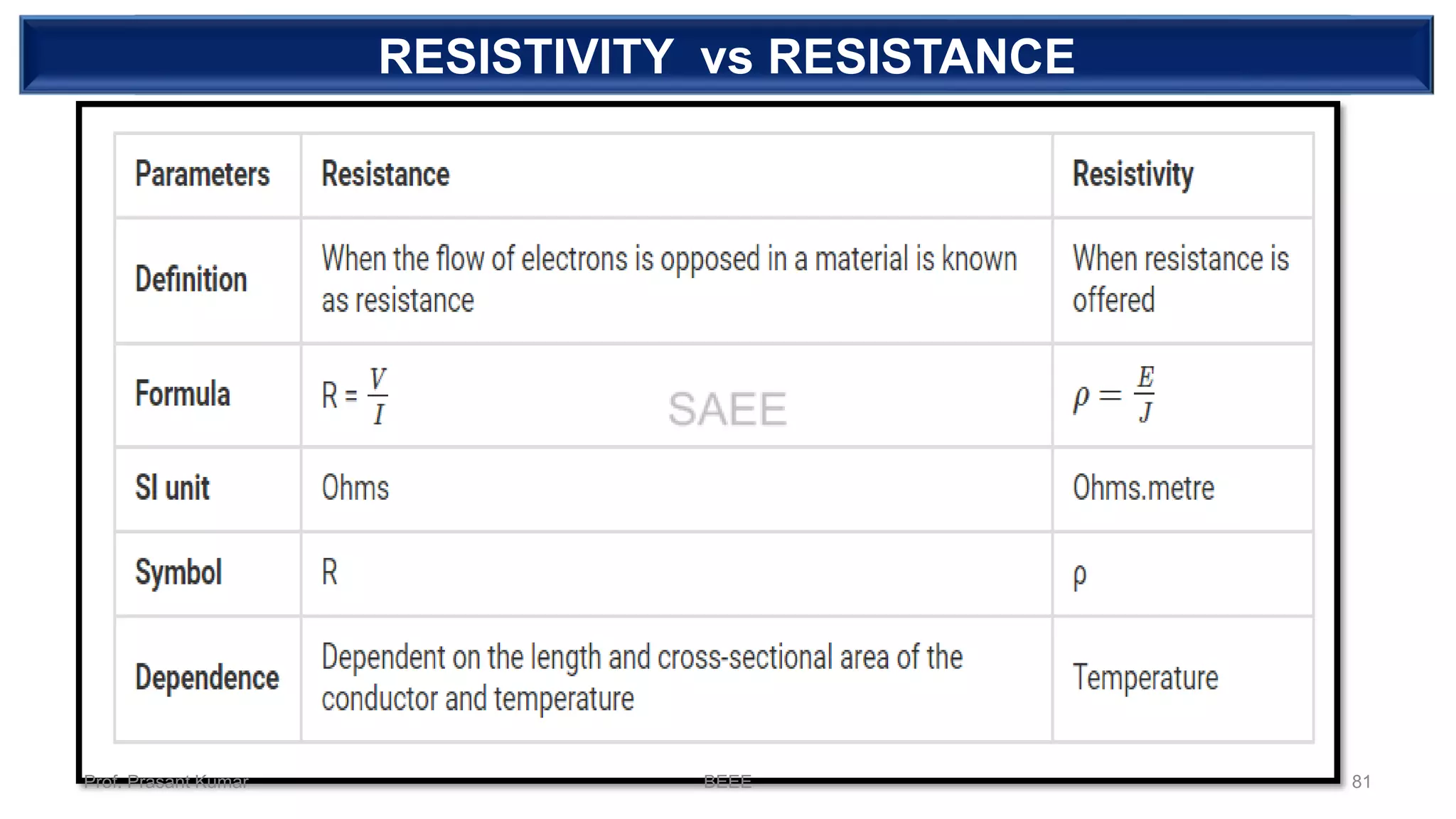
DEPENDENT SOURCERESISTIVITY vs RESISTANCE
Prof. Prasant Kumar BEEE 81
DEPENDENT SOURCEPROPERTIES OF RESISTANCE
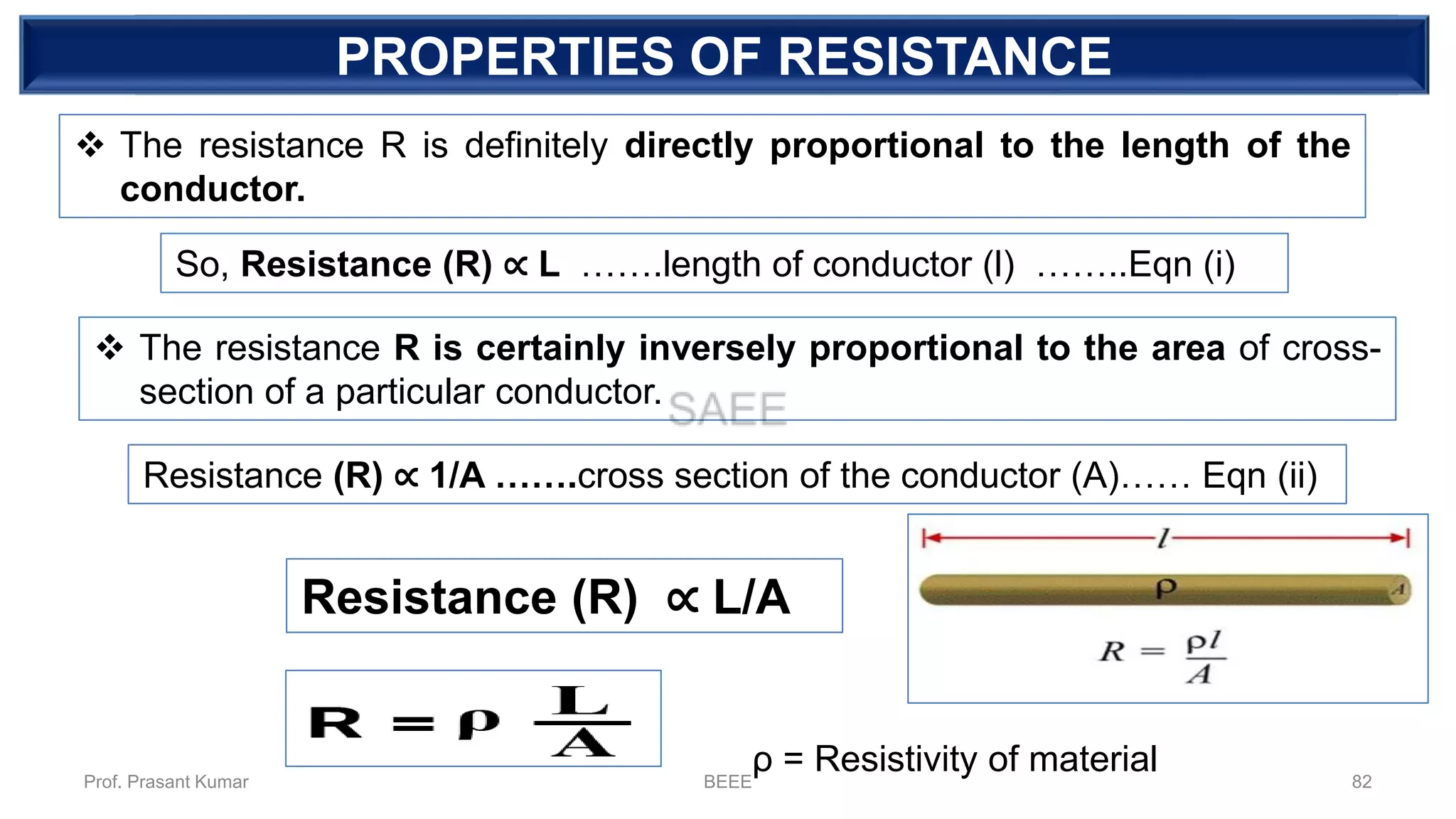
❖ The resistance R is definitely directly proportional to the length of the
conductor.
So, Resistance (R) ∝ L …….length of conductor (l) ……..Eqn (i)
❖ The resistance R is certainly inversely proportional to the area of cross-
section of a particular conductor.
Resistance (R) ∝ 1/A …….cross section of the conductor (A)…… Eqn (ii)
Resistance (R) ∝ L/A
ρ = Resistivity of materialProf. Prasant Kumar BEEE 82
BASICS OF ELECTRICAL ENGINEERING
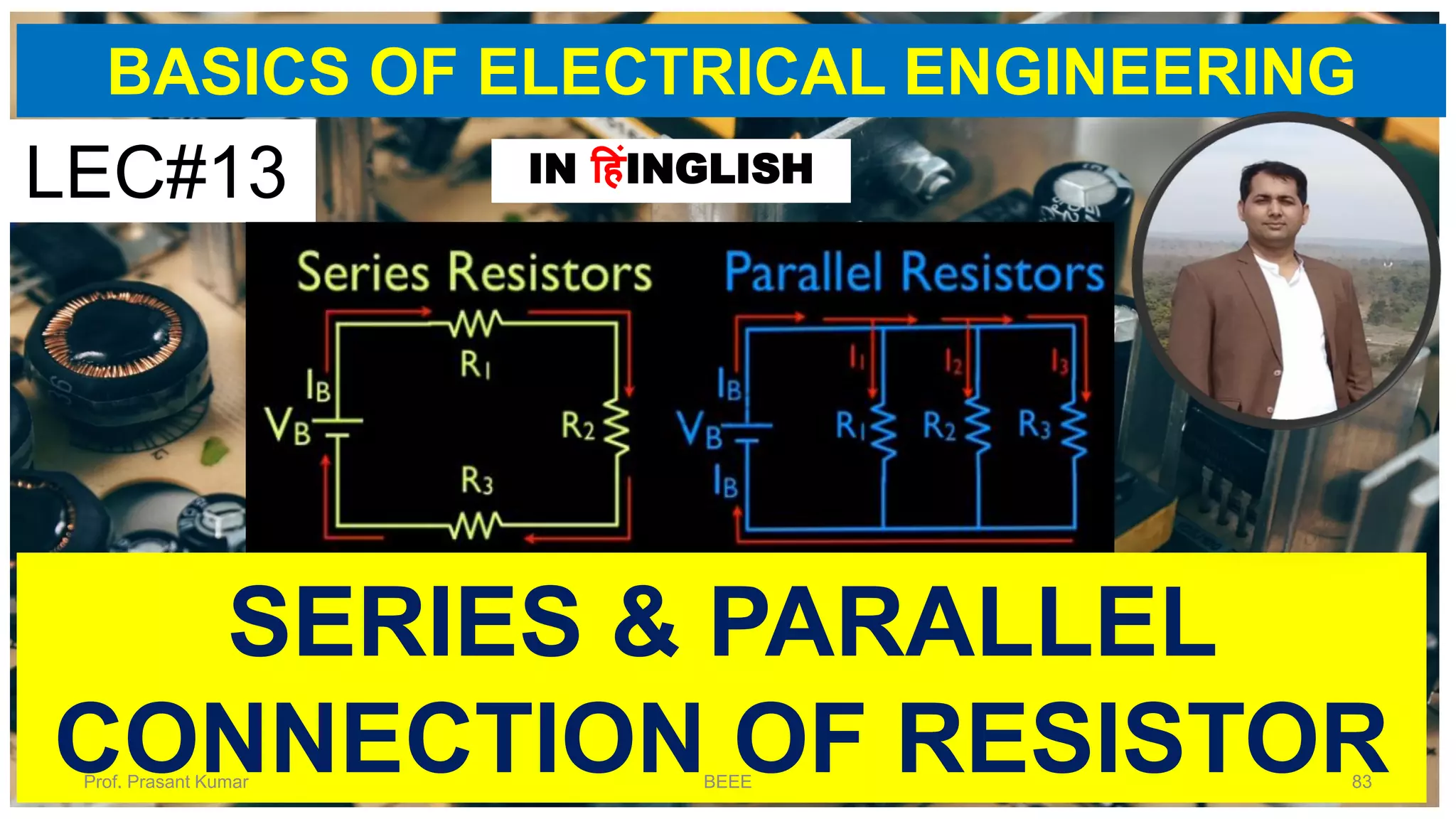
SERIES & PARALLEL
CONNECTION OF RESISTOR
LEC#13 IN हहंINGLISH
Prof. Prasant Kumar BEEE 83
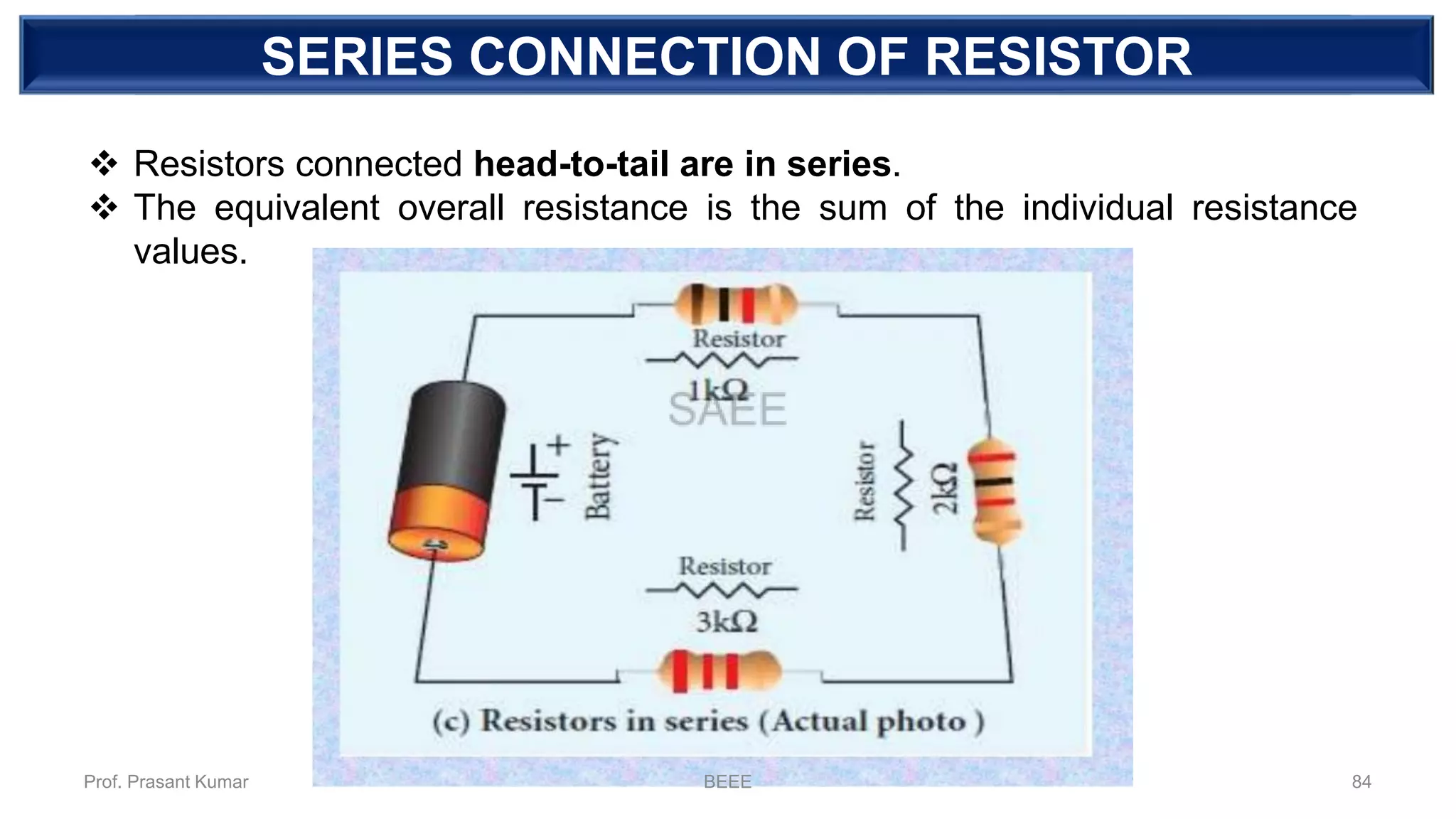
DEPENDENT SOURCESERIES CONNECTION OF RESISTOR
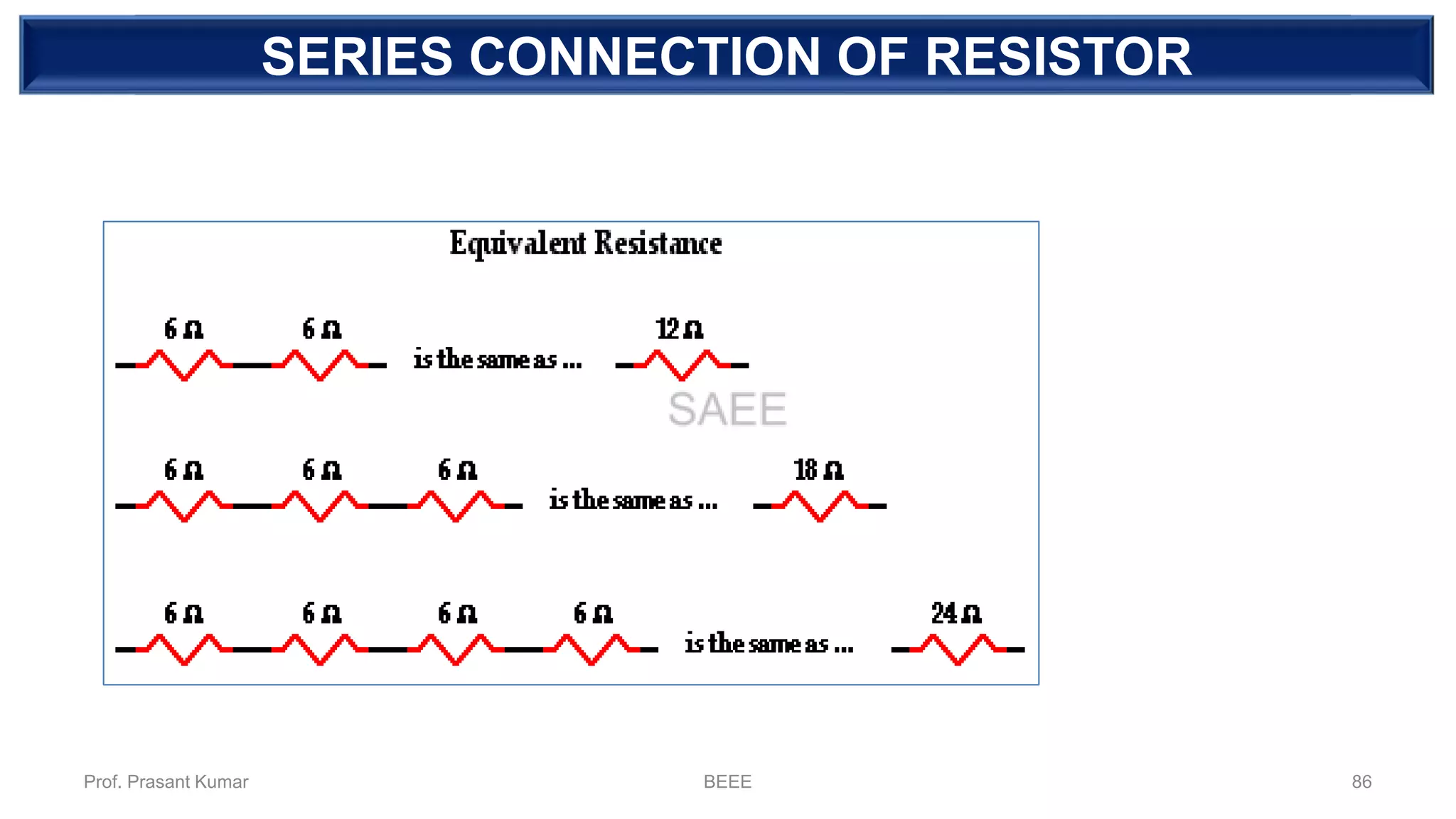
❖ Resistors connected head-to-tail are in series.
❖ The equivalent overall resistance is the sum of the individual resistance
values.
Prof. Prasant Kumar BEEE 84
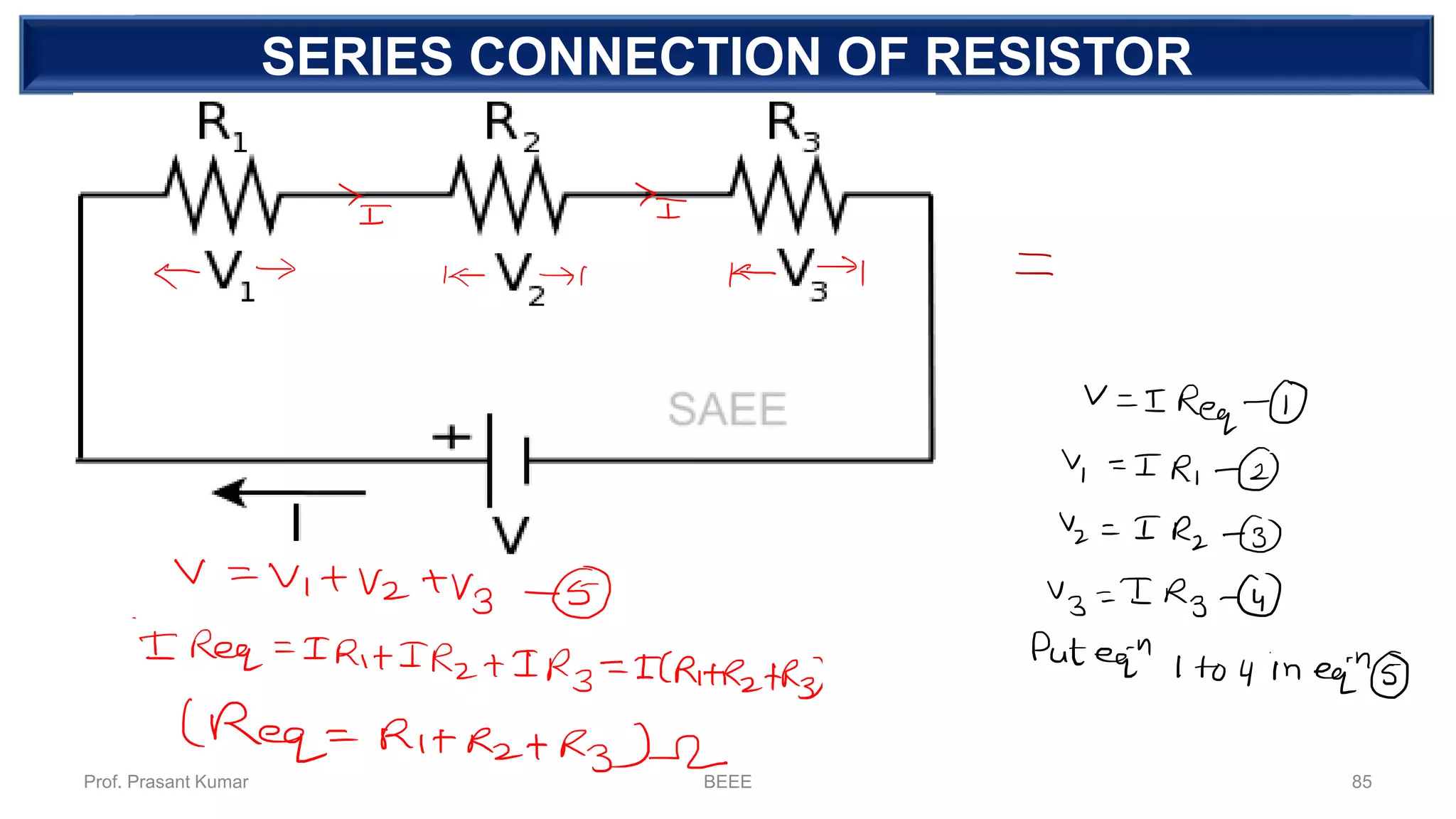
DEPENDENT SOURCESERIES CONNECTION OF RESISTOR
Prof. Prasant Kumar BEEE 85
DEPENDENT SOURCESERIES CONNECTION OF RESISTOR
Prof. Prasant Kumar BEEE 86
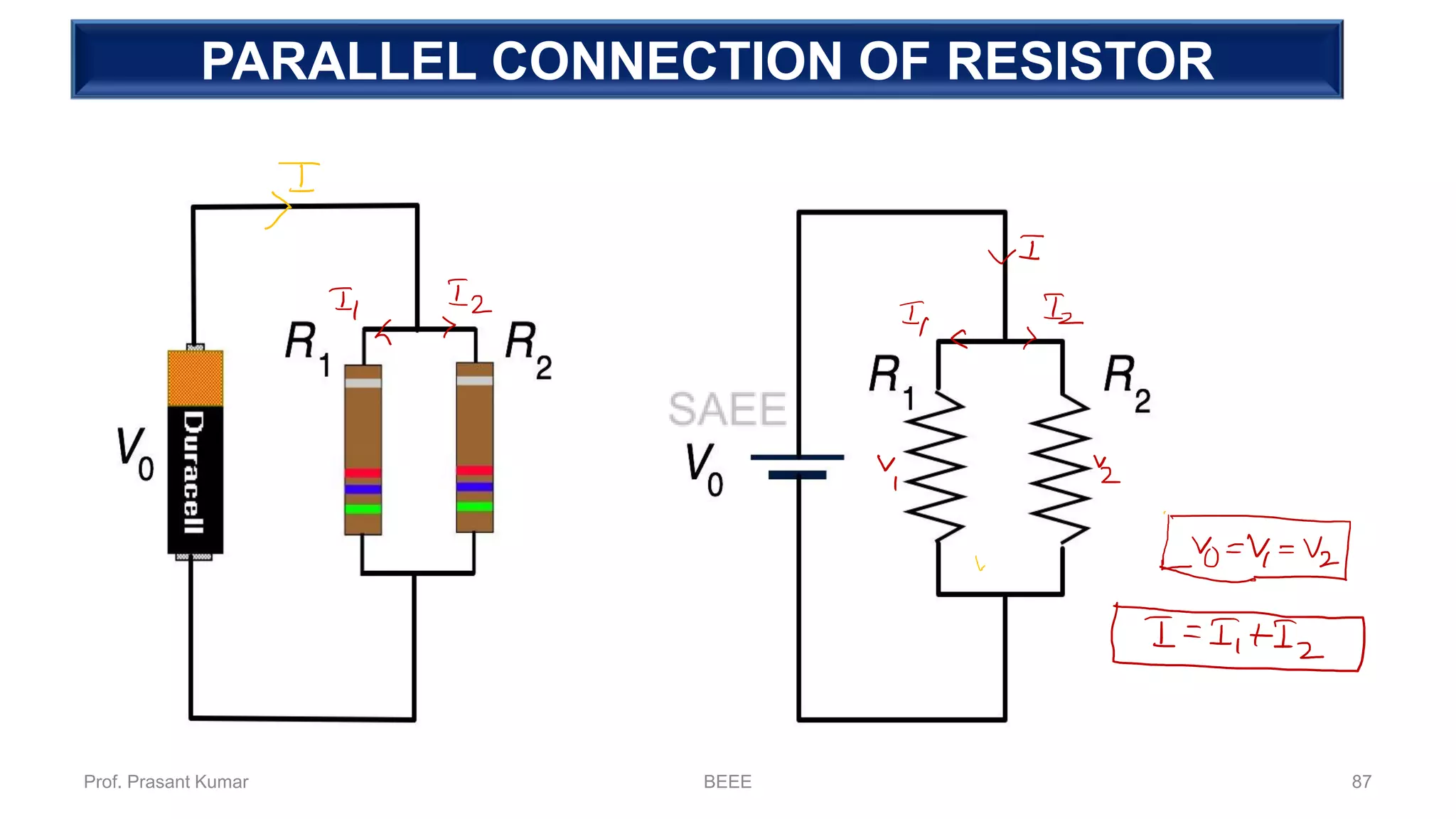
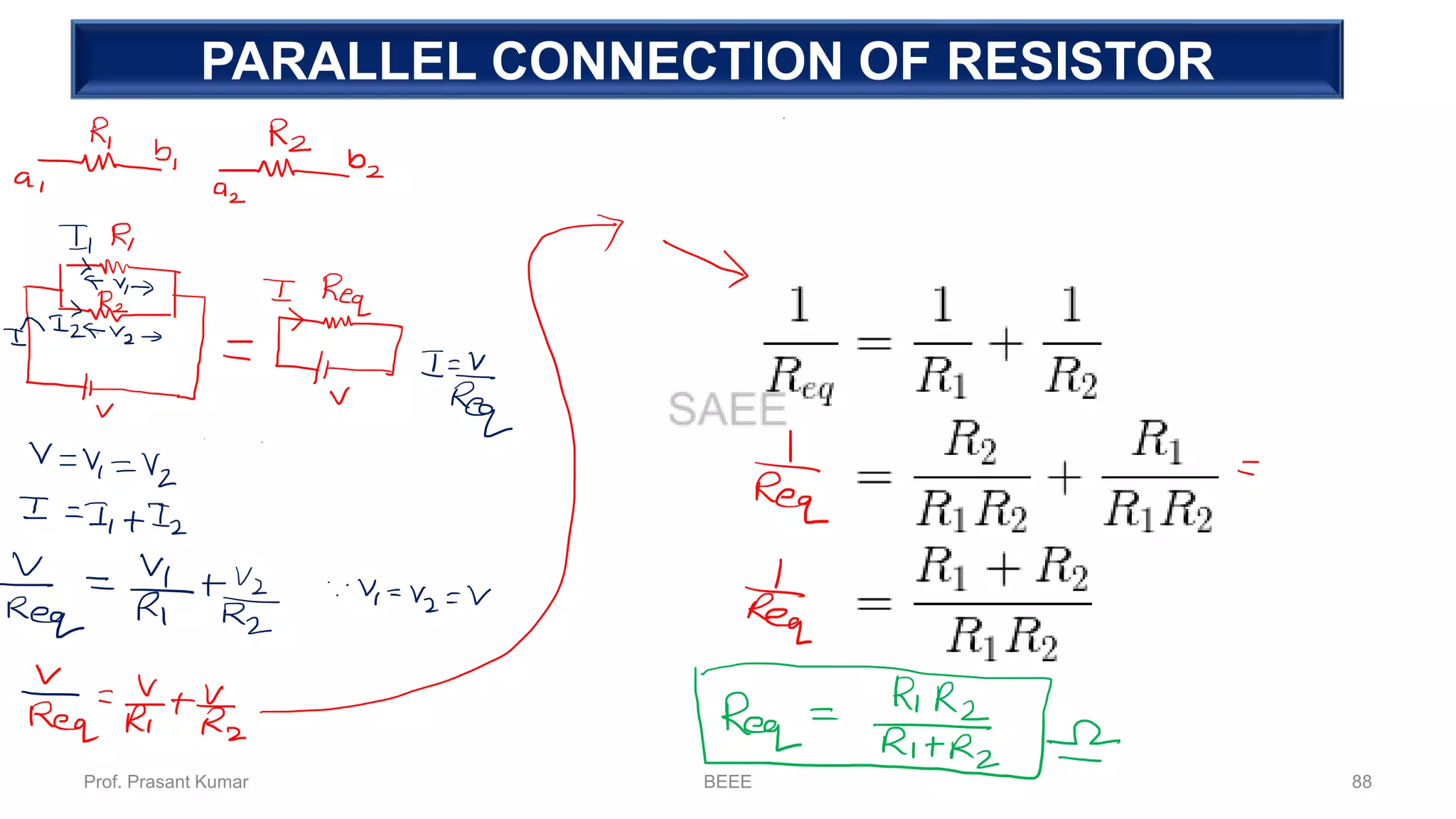
PARALLEL CONNECTION OF RESISTOR
Prof. Prasant Kumar BEEE 87
PARALLEL CONNECTION OF RESISTOR
Prof. Prasant Kumar BEEE 88
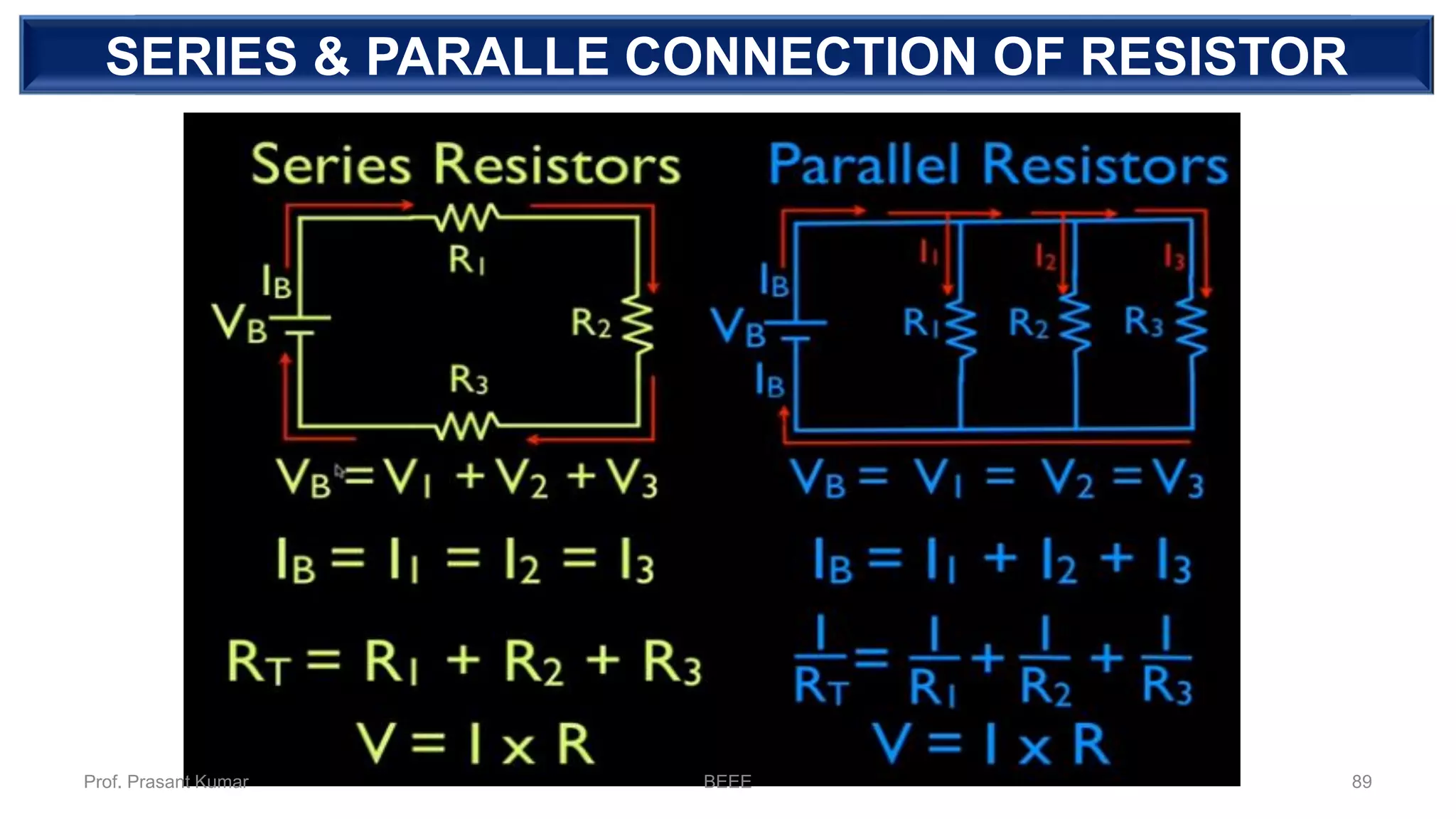
DEPENDENT SOURCESERIES & PARALLE CONNECTION OF RESISTOR
Prof. Prasant Kumar BEEE 89
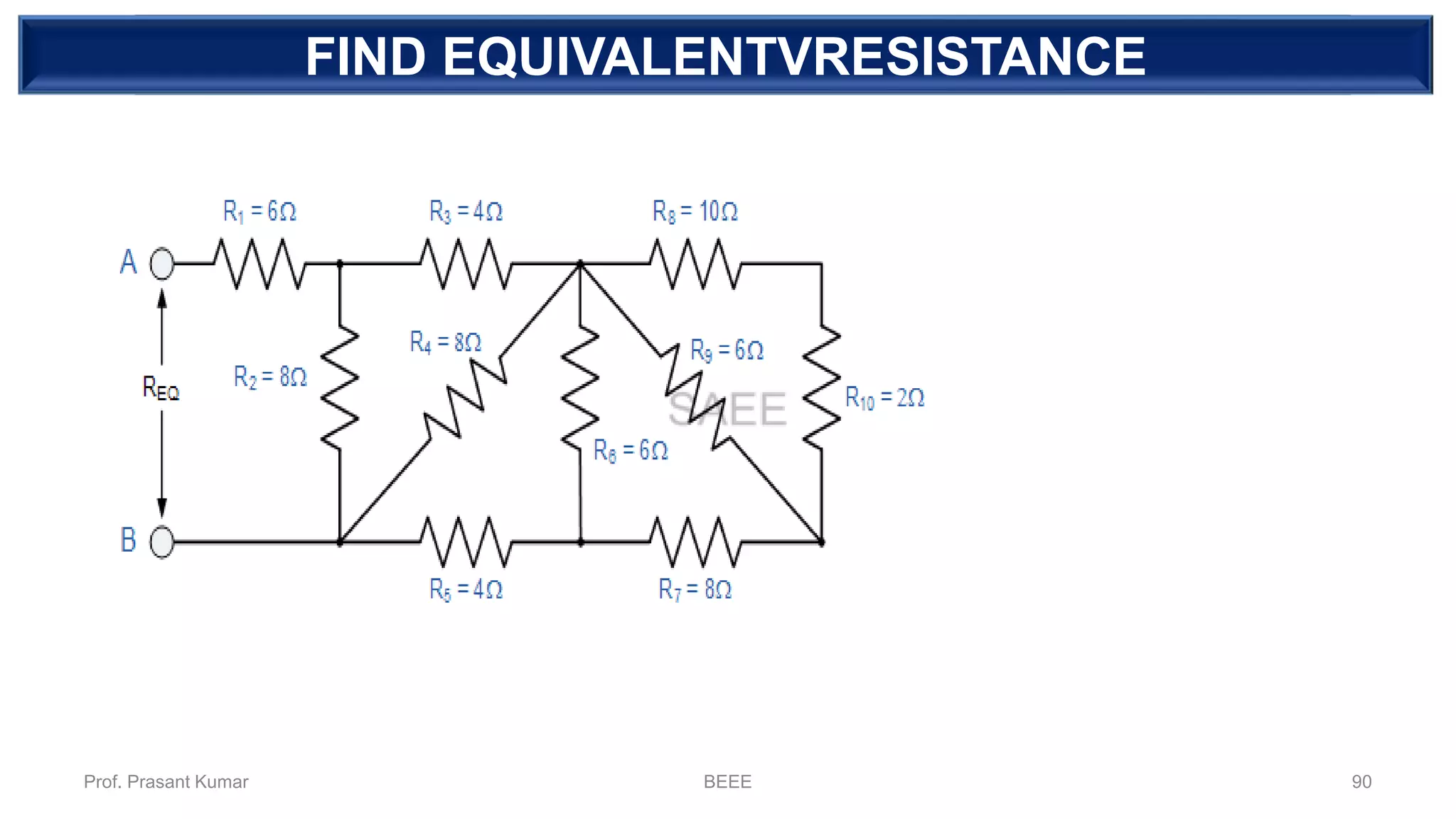
DEPENDENT SOURCEFIND EQUIVALENTVRESISTANCE
Prof. Prasant Kumar BEEE 90
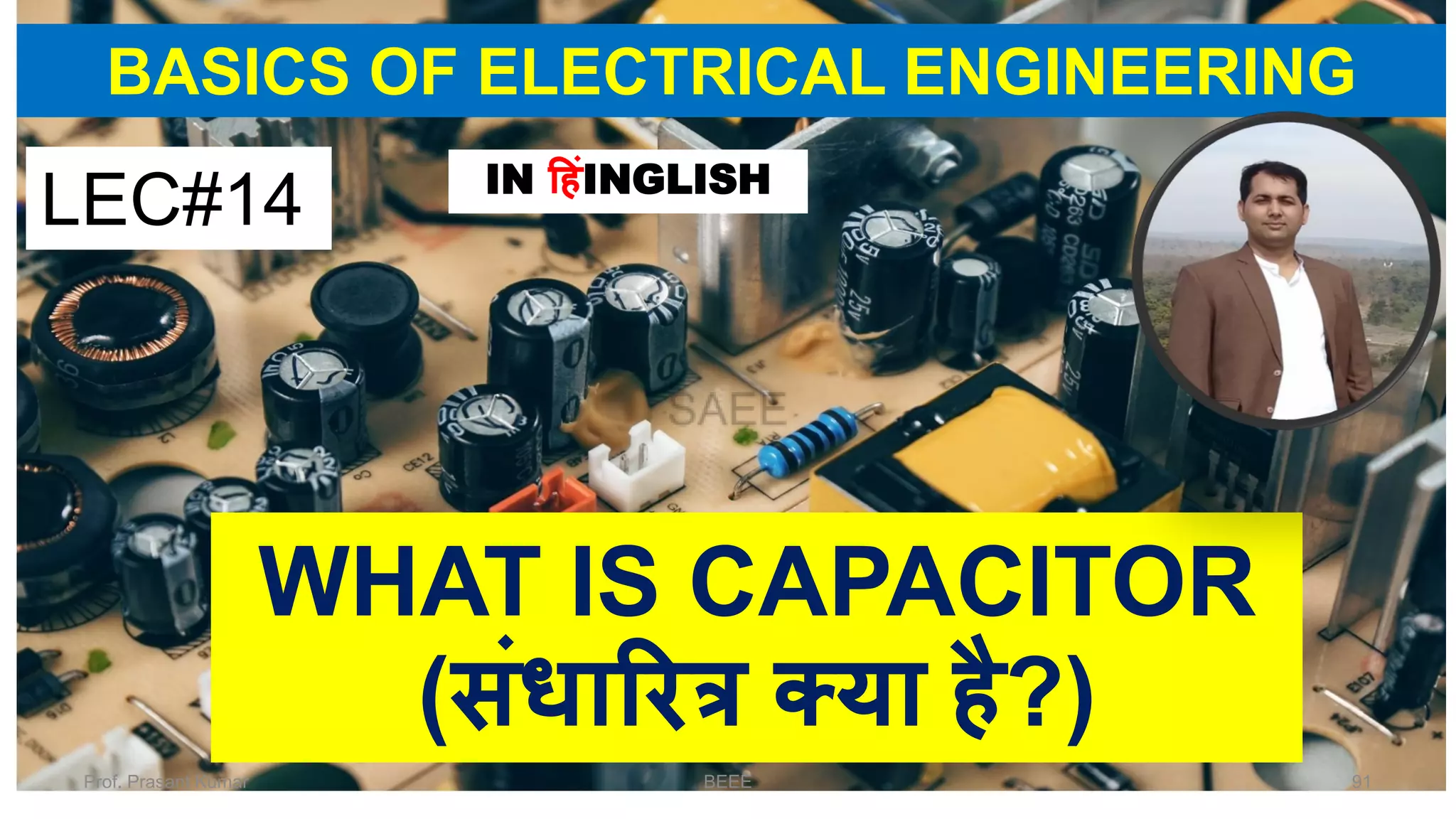
BASICS OF ELECTRICAL ENGINEERING
WHAT IS CAPACITOR
(संधाररत्र क्या है?)
LEC#14 IN हहंINGLISH
Prof. Prasant Kumar BEEE 91
DEPENDENT SOURCECAPACITOR
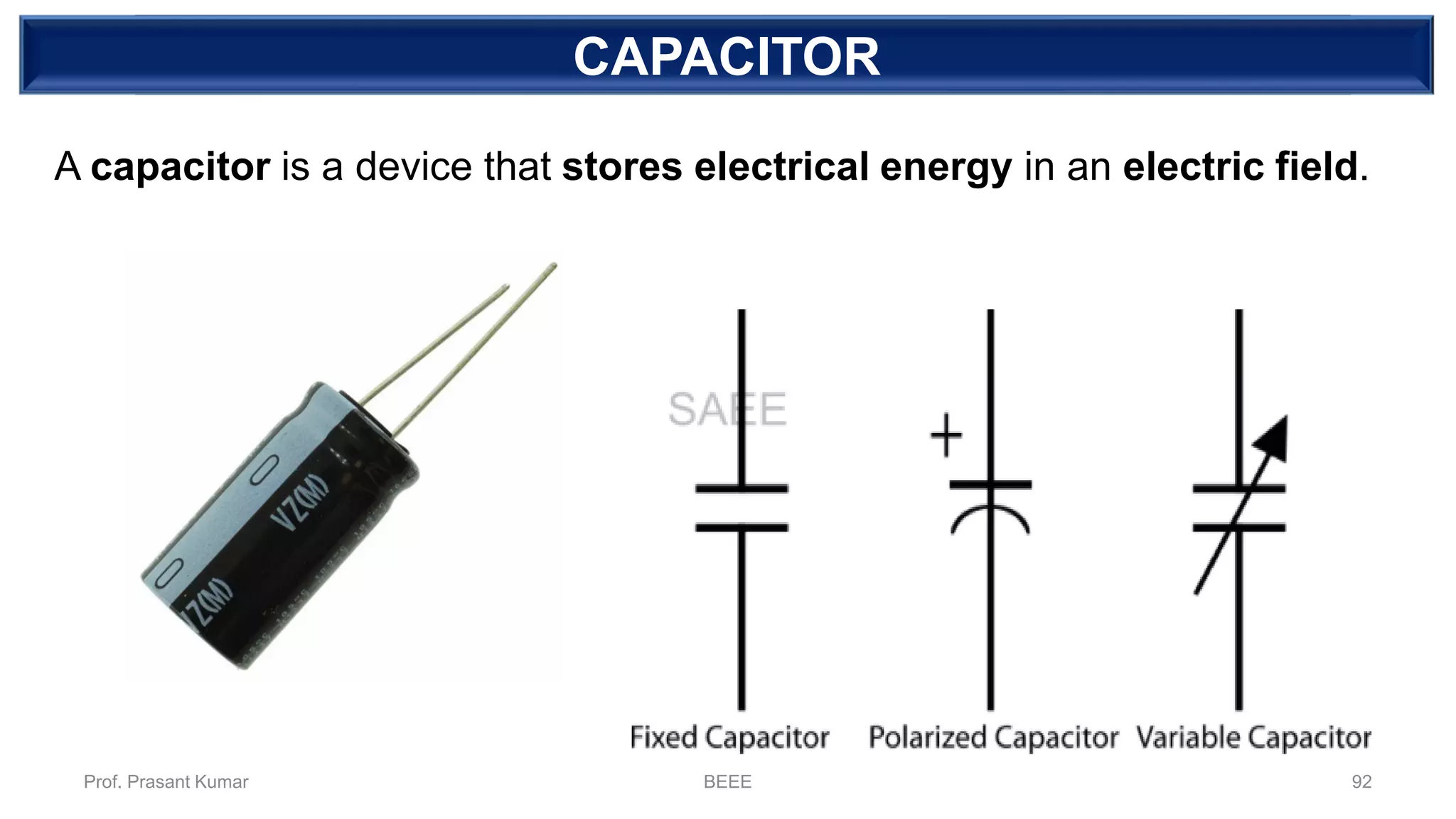
A capacitor is a device that stores electrical energy in an electric field.
Prof. Prasant Kumar BEEE 92
DEPENDENT SOURCECAPACITOR
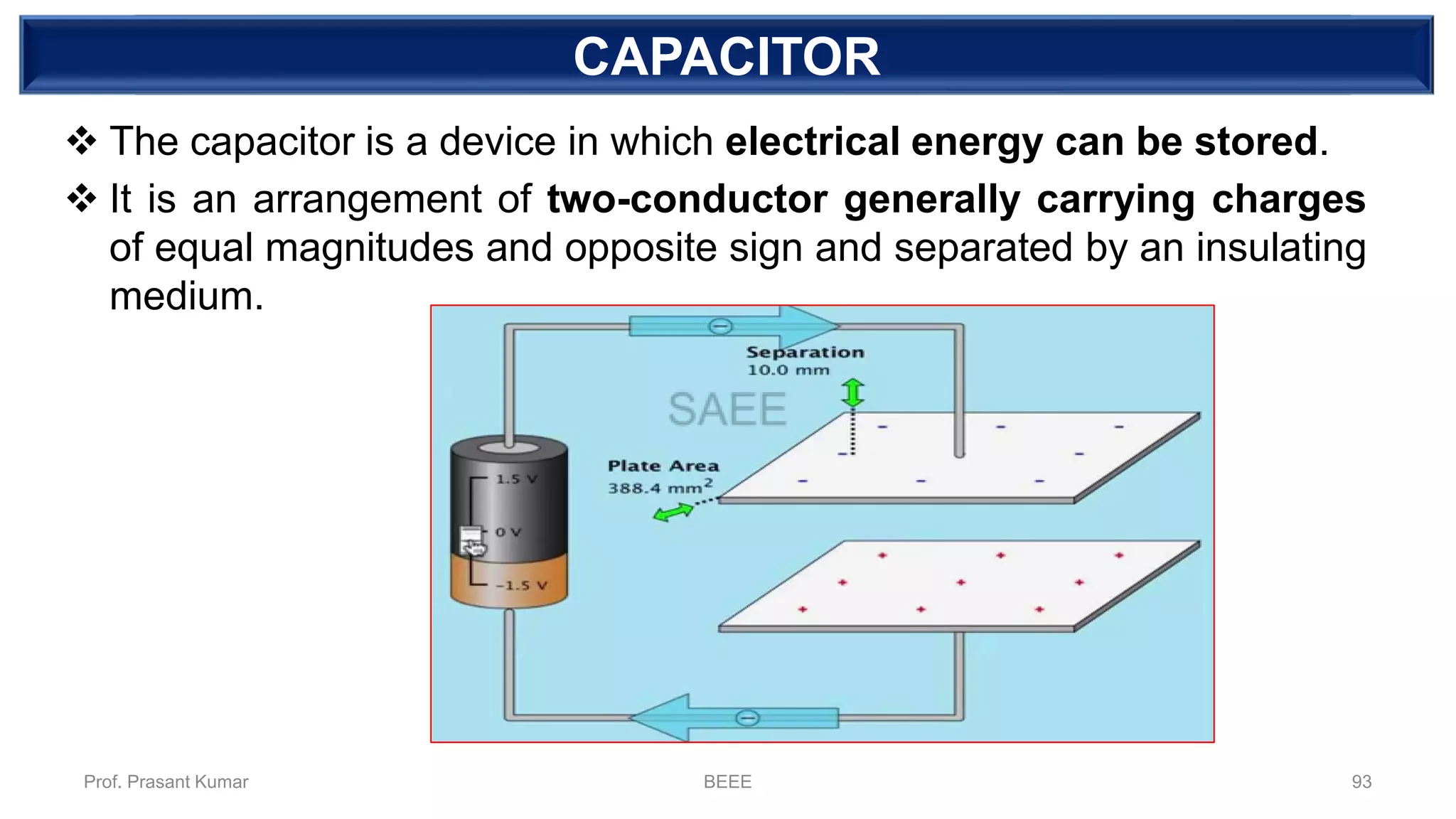
❖ The capacitor is a device in which electrical energy can be stored.
❖ It is an arrangement of two-conductor generally carrying charges
of equal magnitudes and opposite sign and separated by an insulating
medium.
Prof. Prasant Kumar BEEE 93
DEPENDENT SOURCEWHAT ARE CAPACITORS USED FOR?
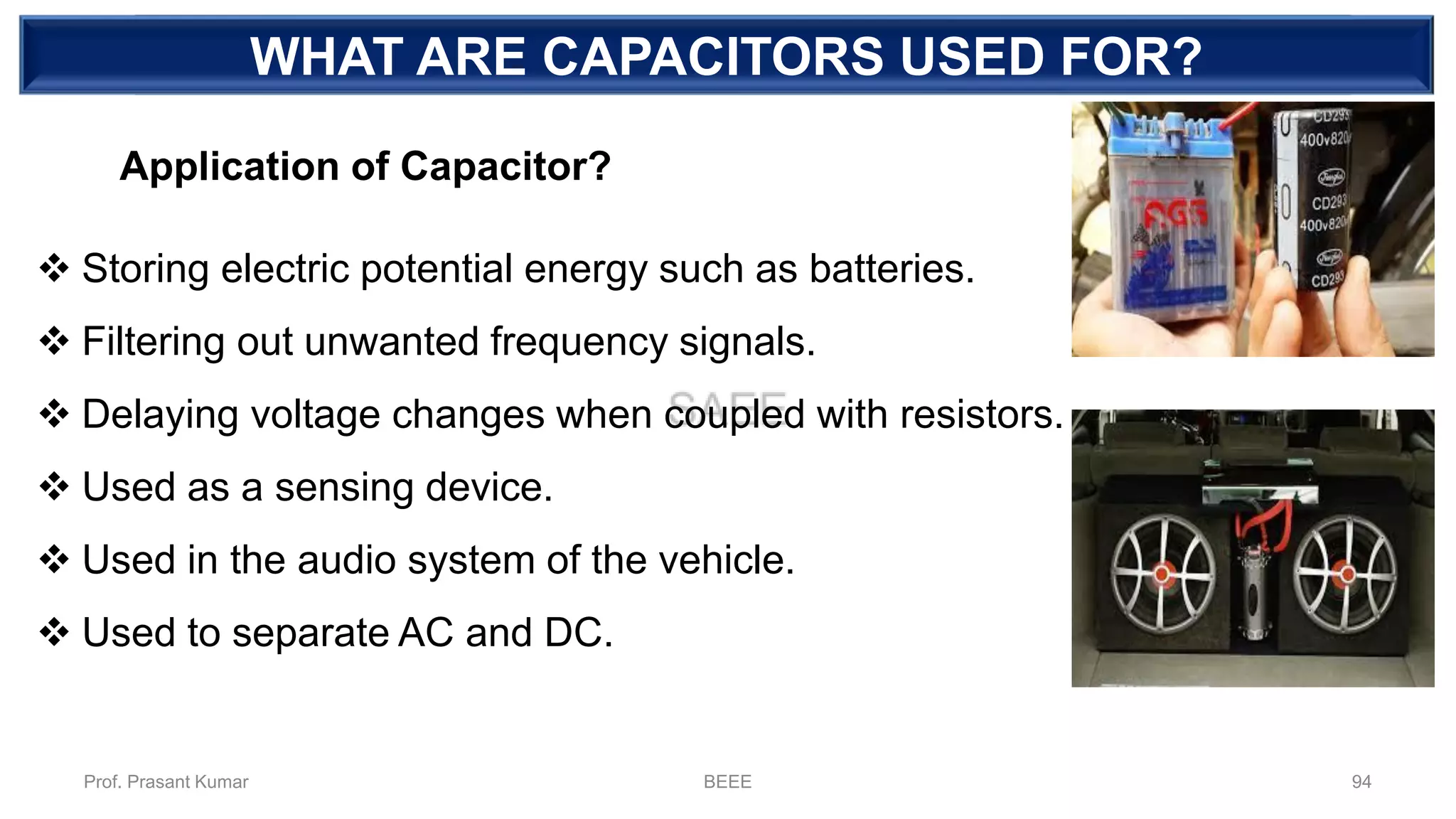
❖ Storing electric potential energy such as batteries.
❖ Filtering out unwanted frequency signals.
❖ Delaying voltage changes when coupled with resistors.
❖ Used as a sensing device.
❖ Used in the audio system of the vehicle.
❖ Used to separate AC and DC.
Application of Capacitor?
Prof. Prasant Kumar BEEE 94
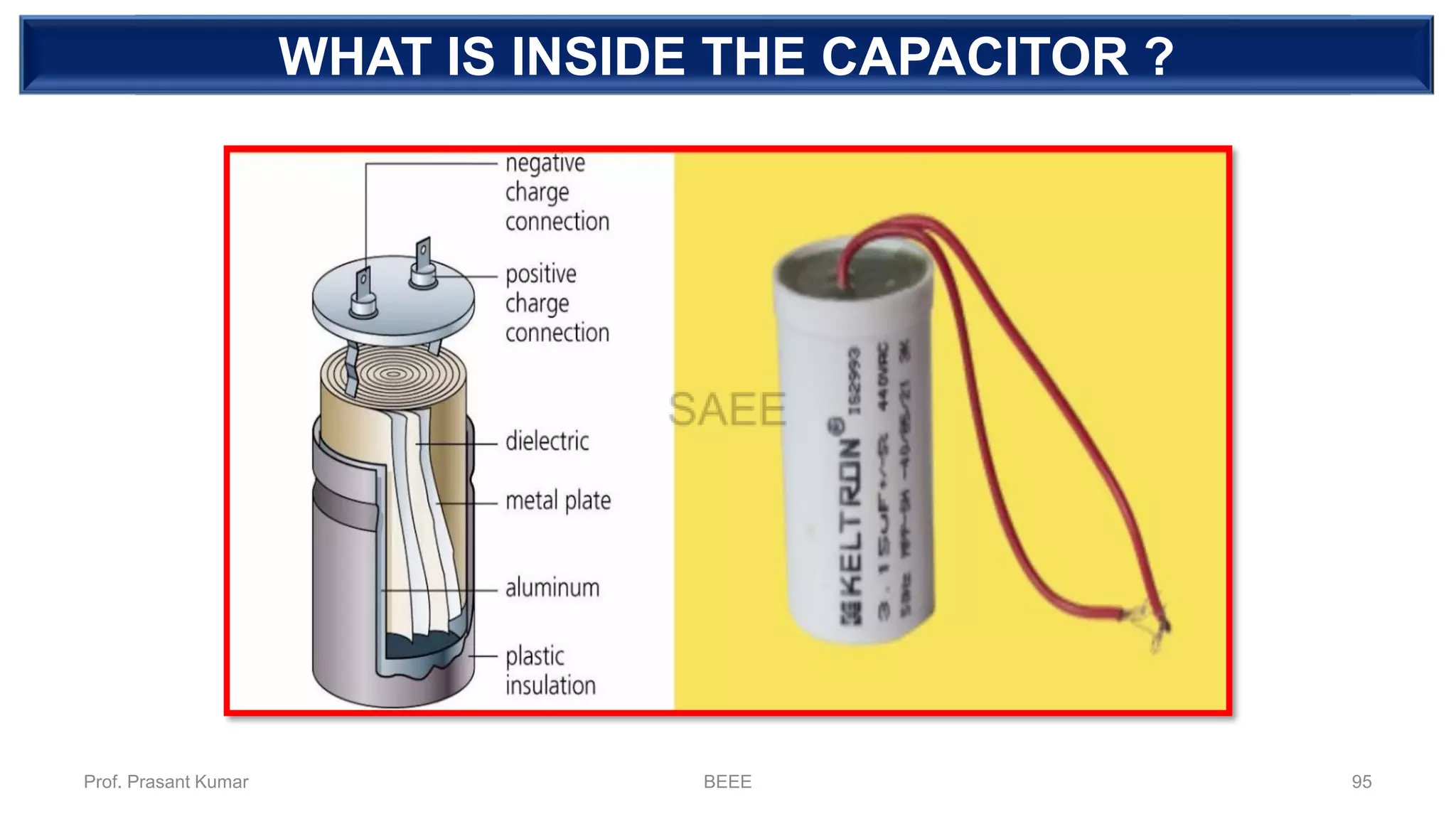
DEPENDENT SOURCEWHAT IS INSIDE THE CAPACITOR ?
Prof. Prasant Kumar BEEE 95
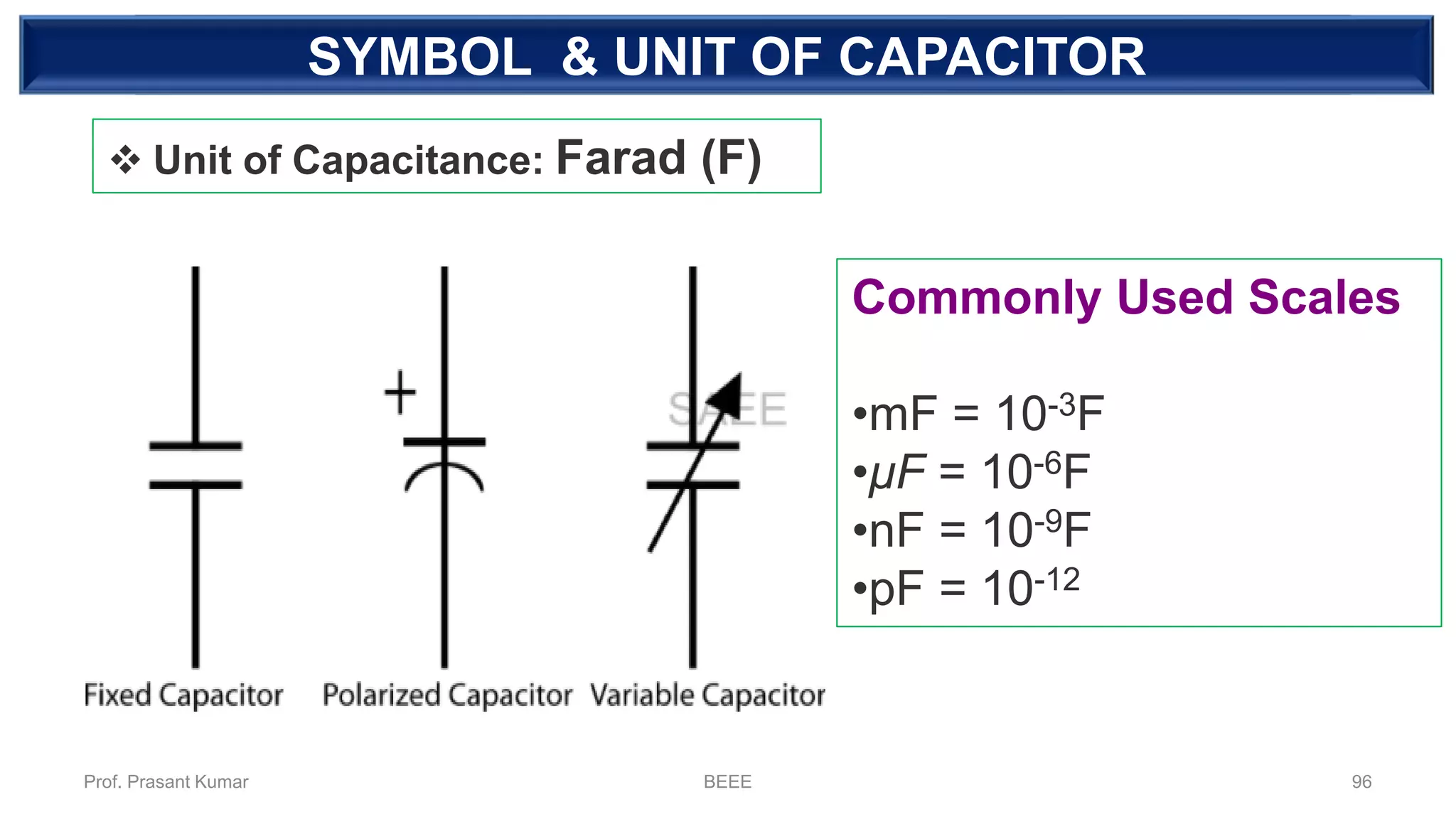
DEPENDENT SOURCESYMBOL & UNIT OF CAPACITOR
❖ Unit of Capacitance: Farad (F)
Commonly Used Scales
•mF = 10-3F
•μF = 10-6F
•nF = 10-9F
•pF = 10-12
Prof. Prasant Kumar BEEE 96
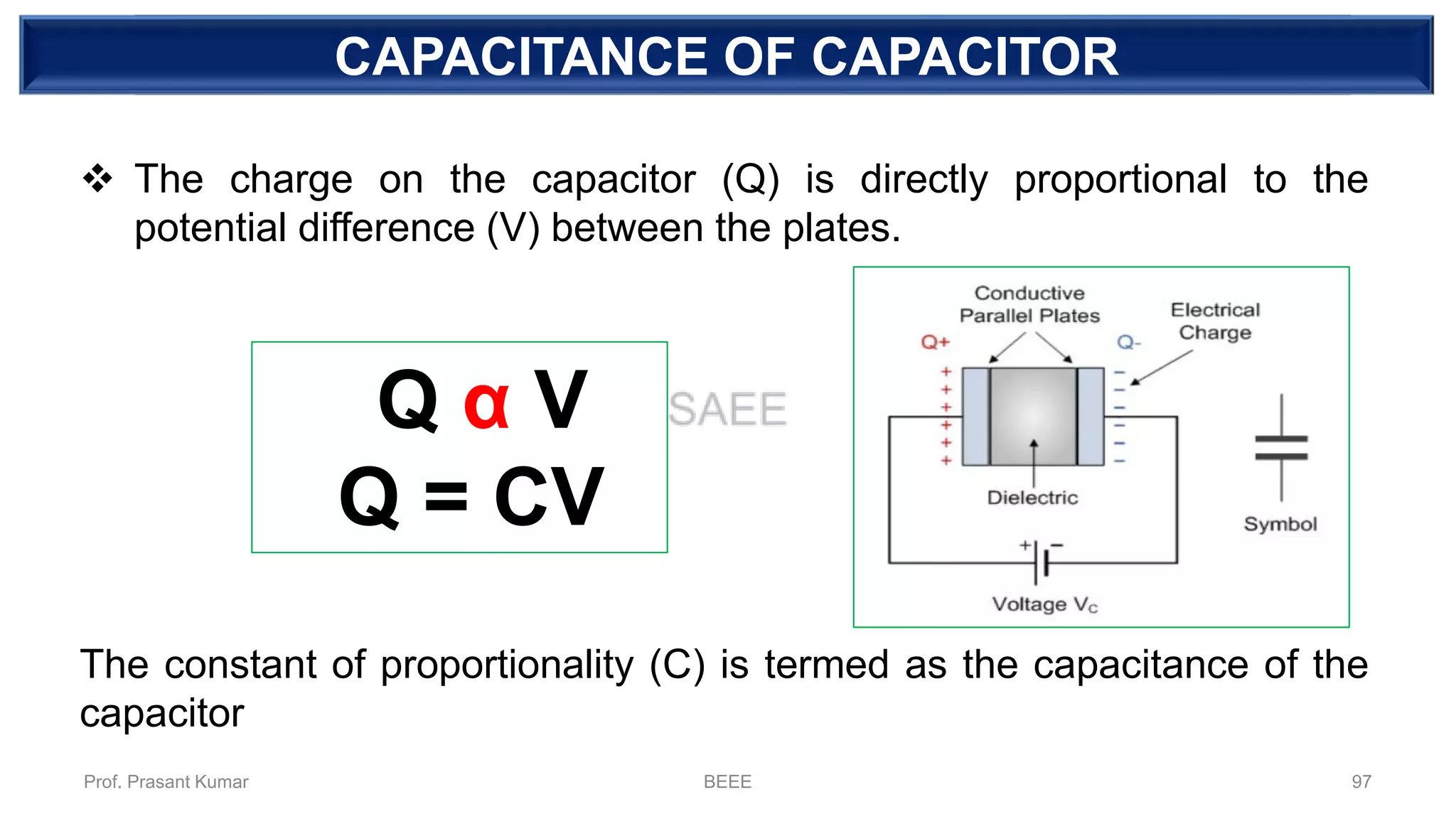
DEPENDENT SOURCECAPACITANCE OF CAPACITOR
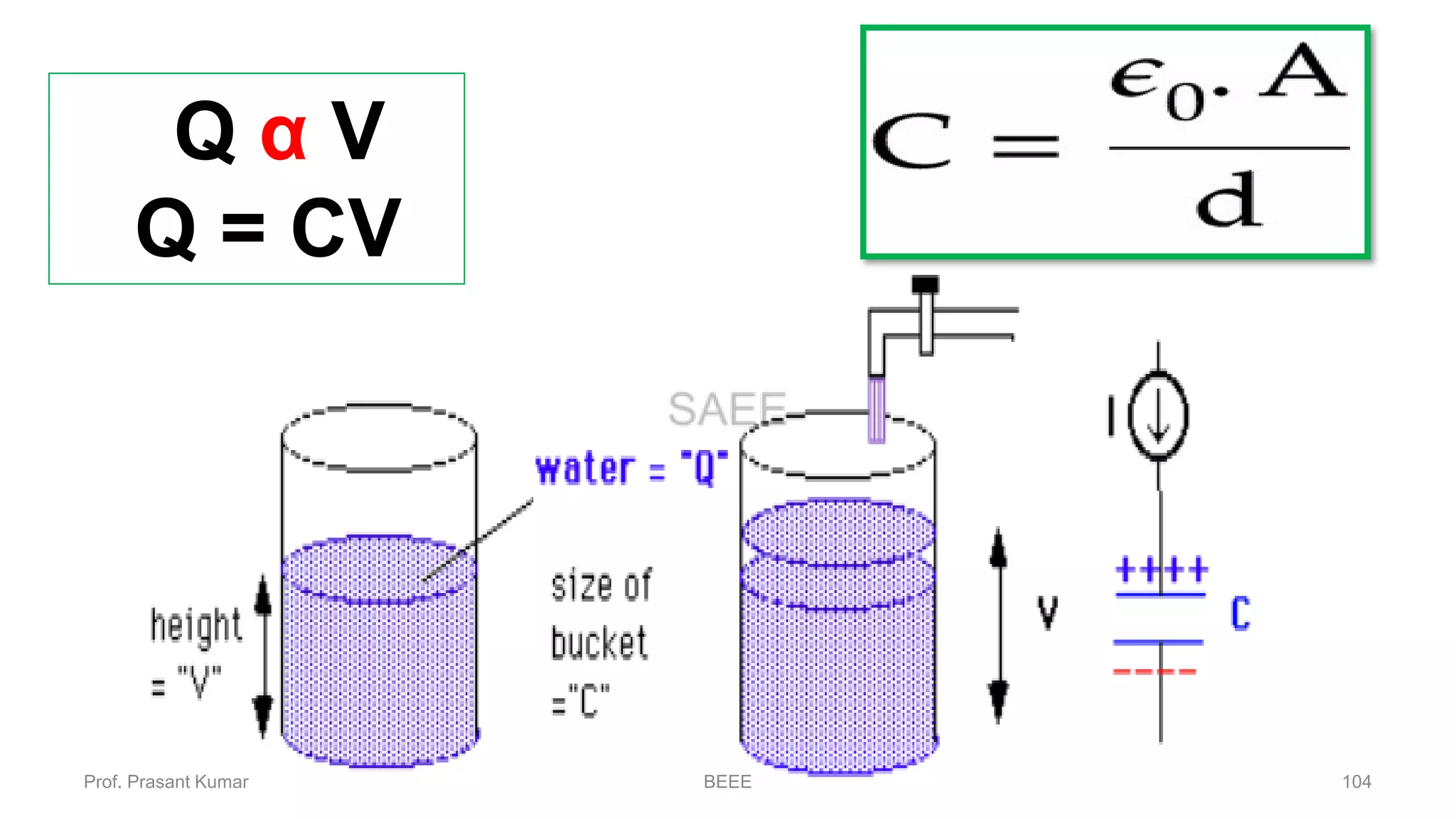
❖ The charge on the capacitor (Q) is directly proportional to the
potential difference (V) between the plates.
The constant of proportionality (C) is termed as the capacitance of the
capacitor
Q α V
Q = CV
Prof. Prasant Kumar BEEE 97
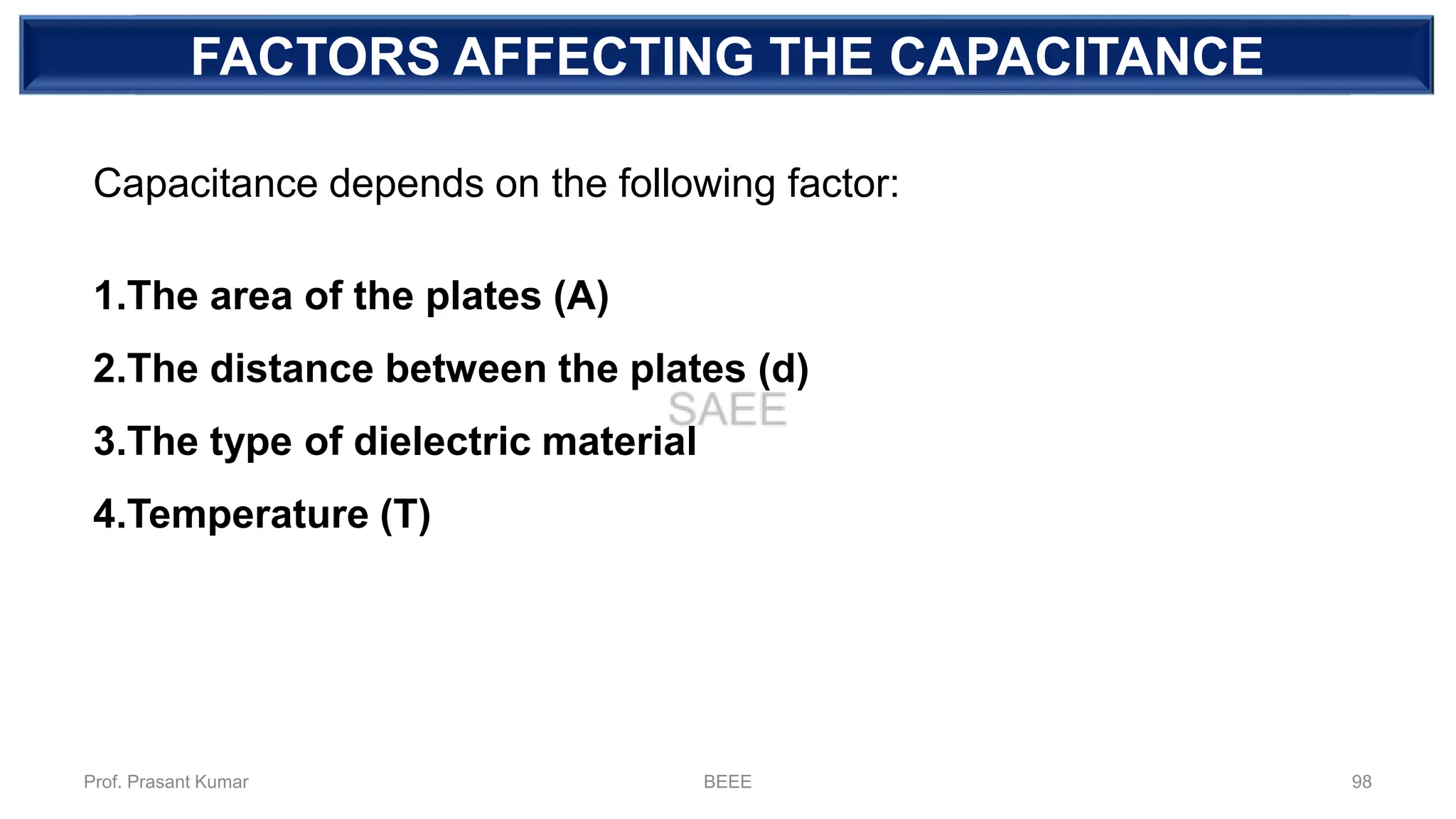
DEPENDENT SOURCEFACTORS AFFECTING THE CAPACITANCE
Capacitance depends on the following factor:
1.The area of the plates (A)
2.The distance between the plates (d)
3.The type of dielectric material
4.Temperature (T)
Prof. Prasant Kumar BEEE 98
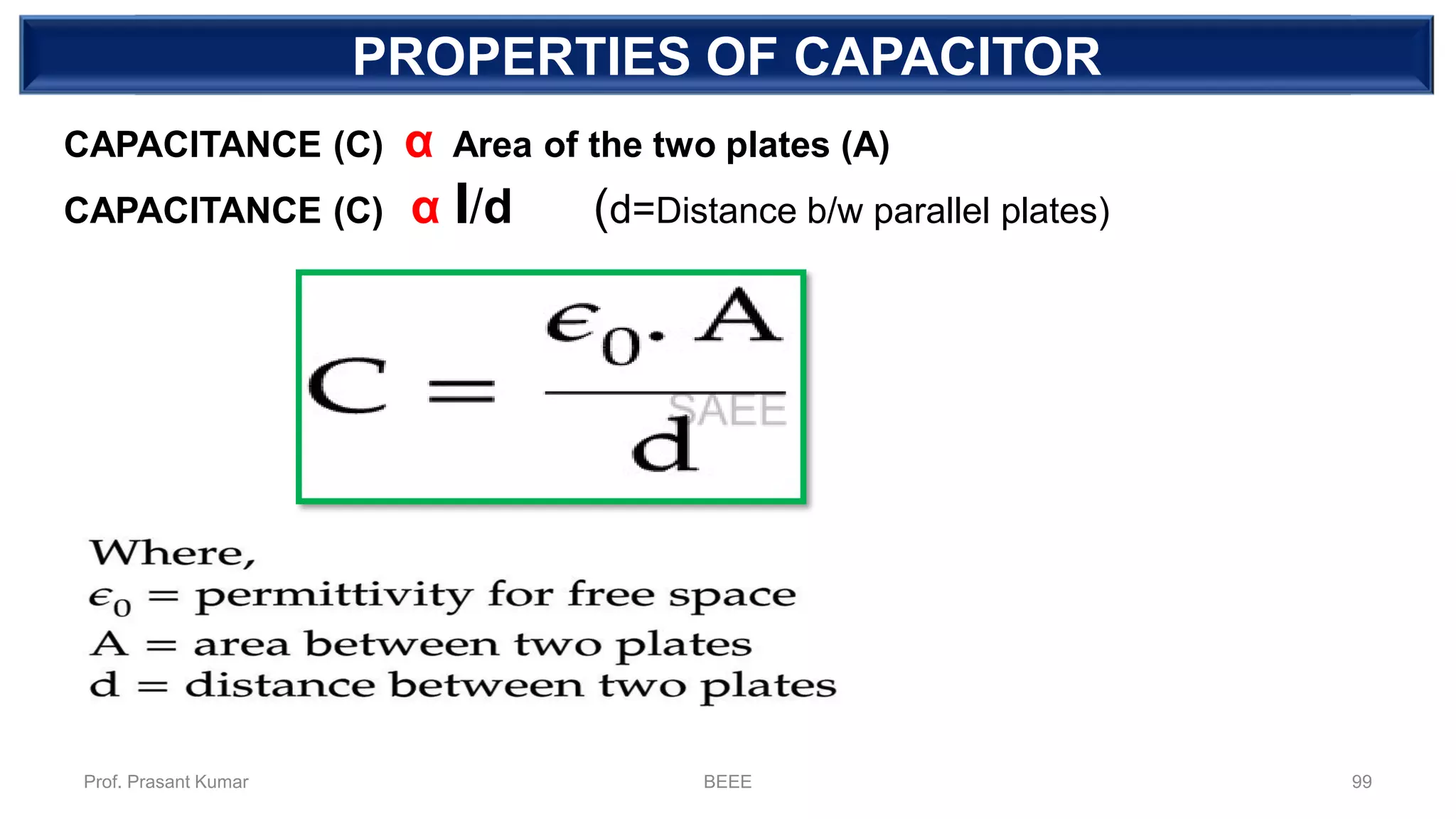
DEPENDENT SOURCEPROPERTIES OF CAPACITOR
CAPACITANCE (C) α Area of the two plates (A)
CAPACITANCE (C) α I/d (d=Distance b/w parallel plates)
Prof. Prasant Kumar BEEE 99
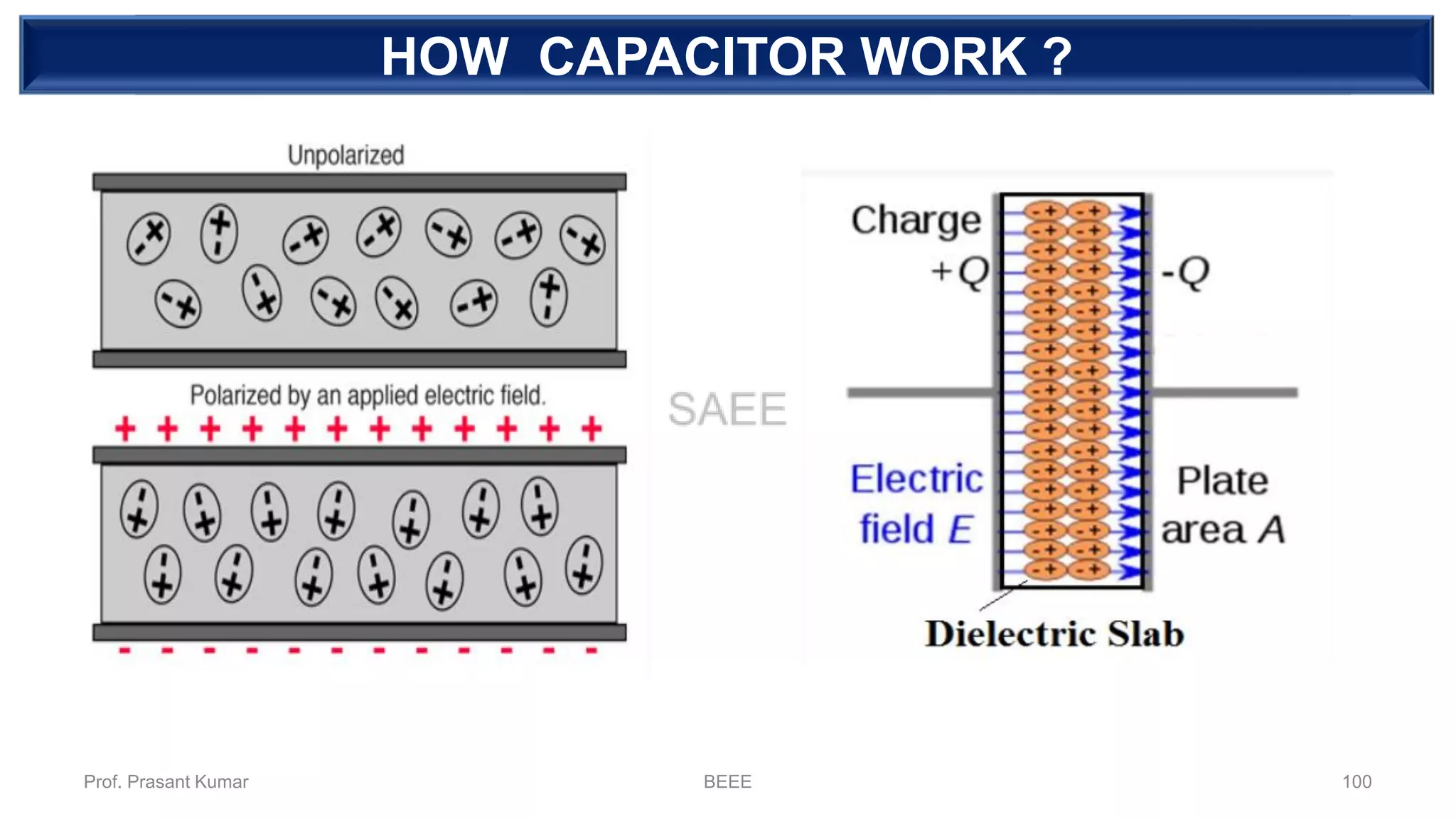
DEPENDENT SOURCEHOW CAPACITOR WORK ?
Prof. Prasant Kumar BEEE 100
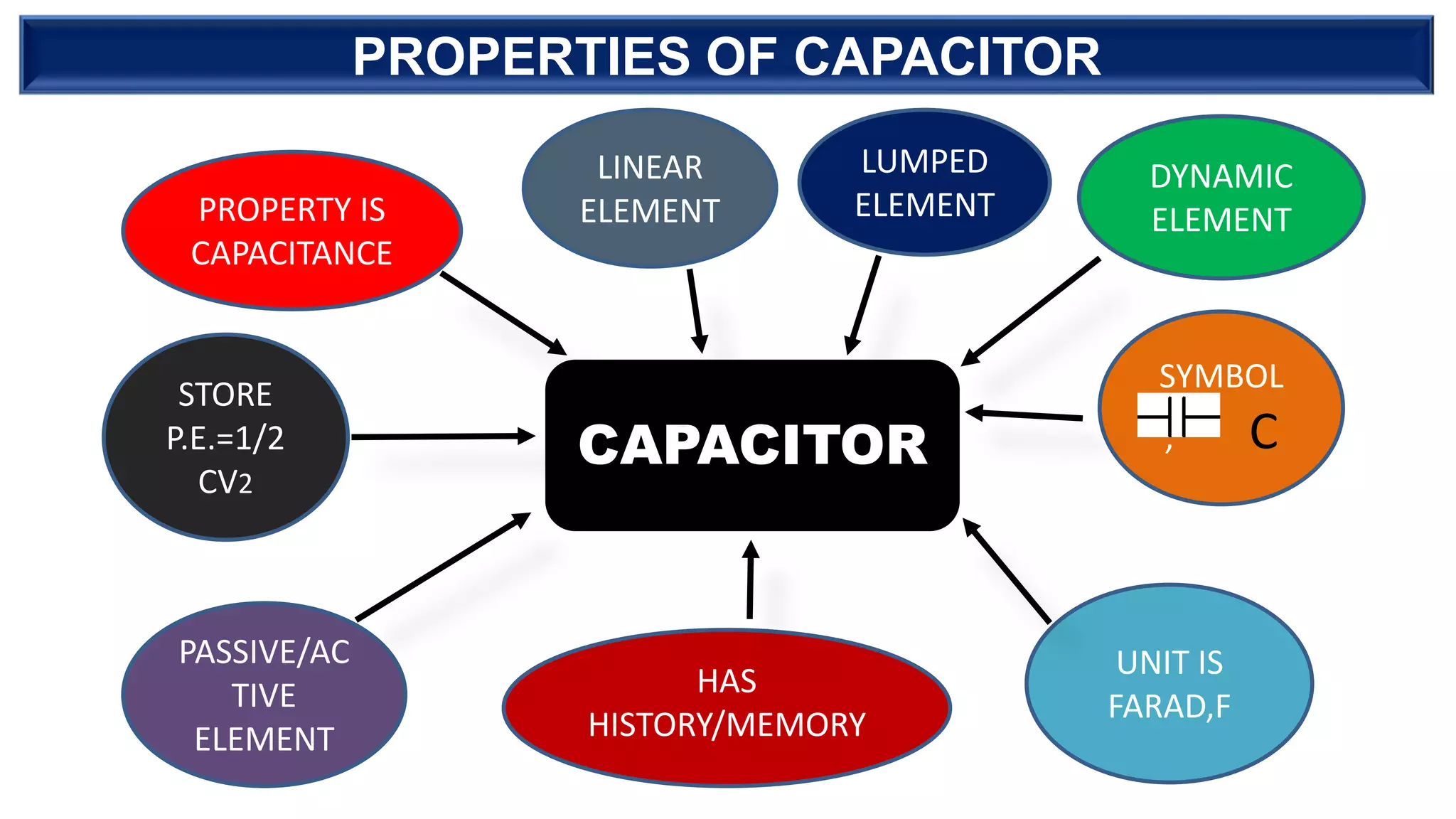
CAPACITOR
STORE
P.E.=1/2
CV2
PASSIVE/AC
TIVE
ELEMENT
PROPERTY IS
CAPACITANCE
SYMBOL
, C
DYNAMIC
ELEMENT
LINEAR
ELEMENT
HAS
HISTORY/MEMORY
LUMPED
ELEMENT
UNIT IS
FARAD,F
PROPERTIES OF CAPACITOR
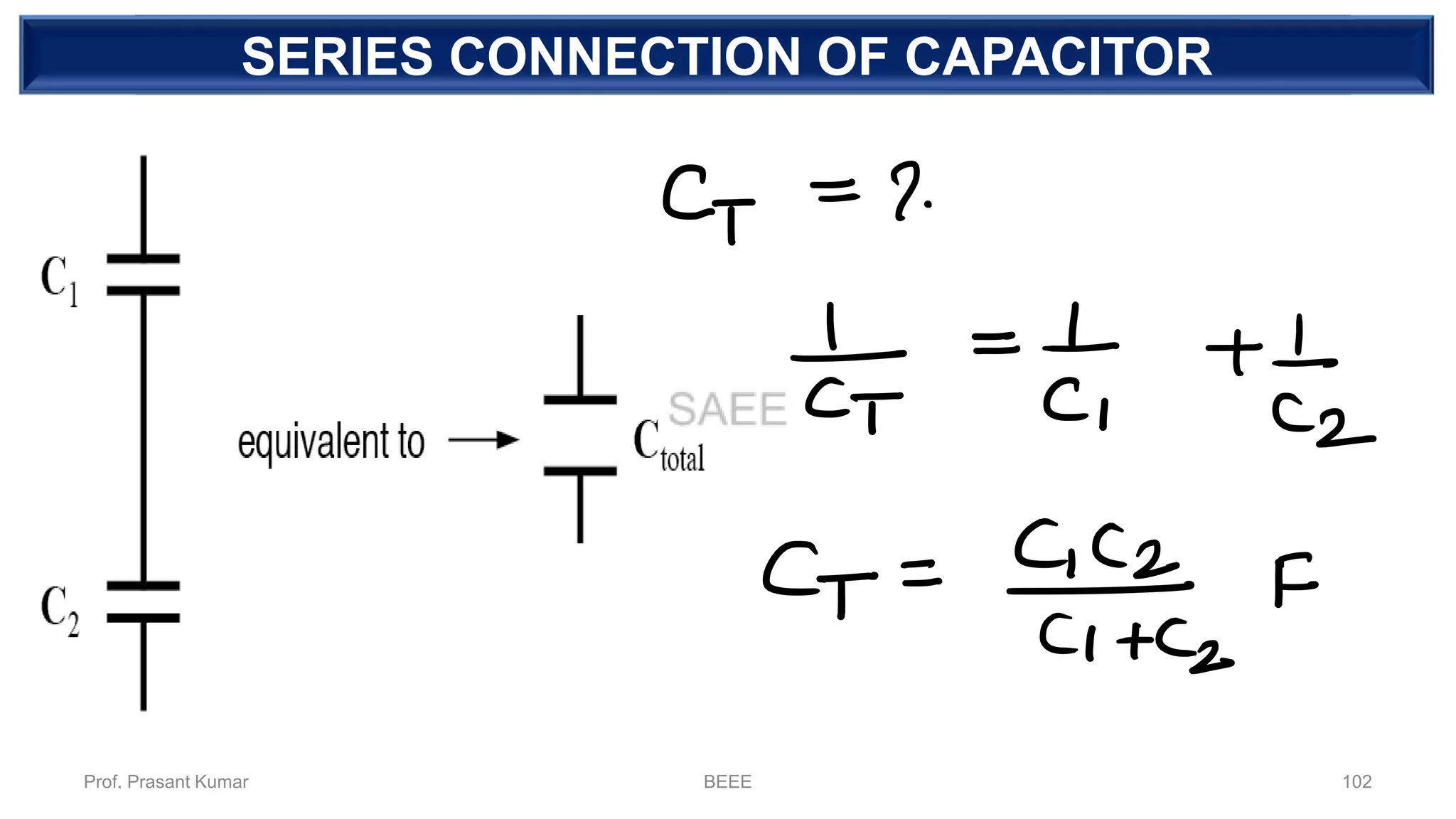
DEPENDENT SOURCESERIES CONNECTION OF CAPACITOR
Prof. Prasant Kumar BEEE 102
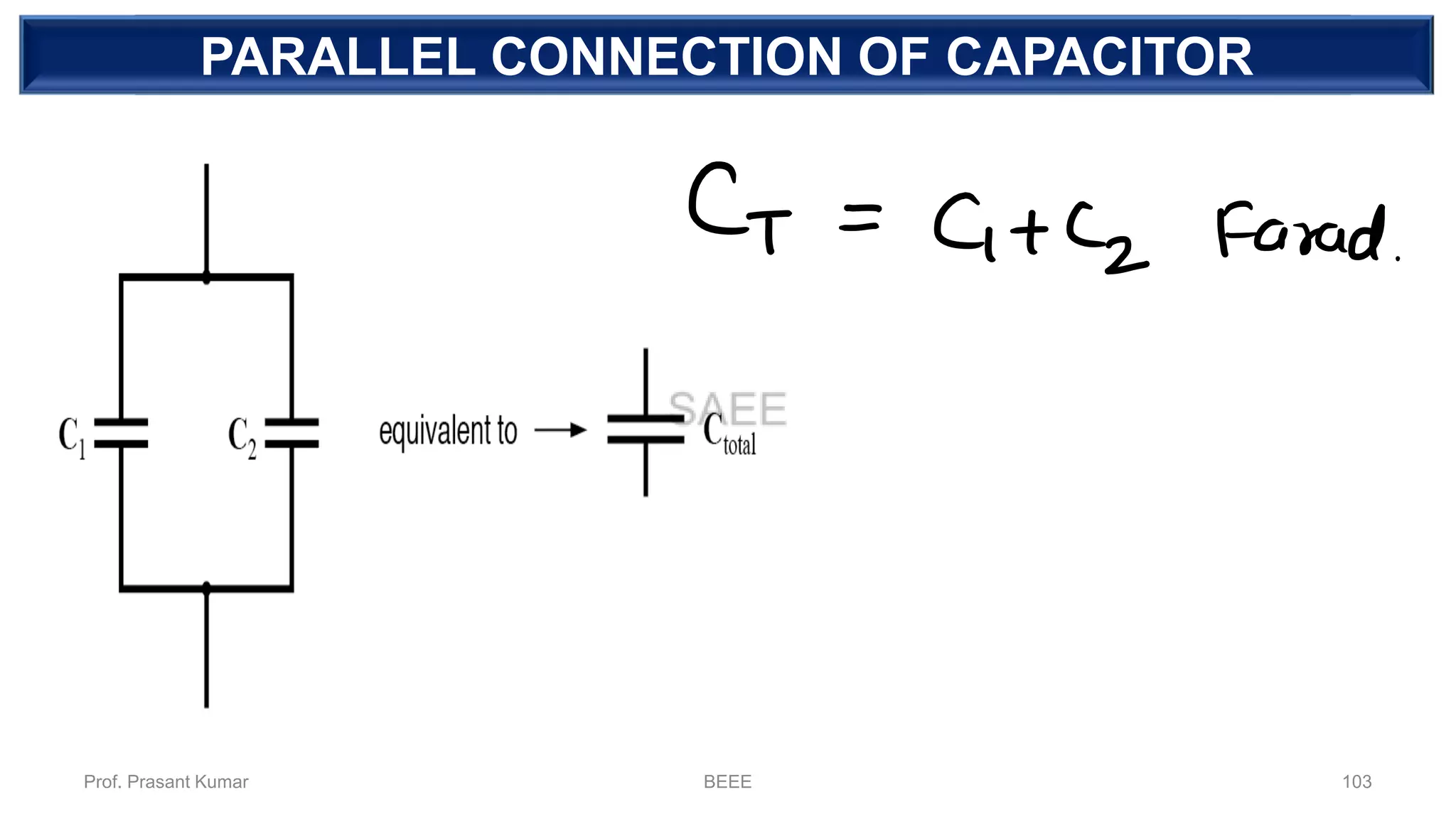
DEPENDENT SOURCEPARALLEL CONNECTION OF CAPACITOR
Prof. Prasant Kumar BEEE 103
Q α V
Q = CV
Prof. Prasant Kumar BEEE 104
BASICS OF ELECTRICAL ENGINEERING
LEC#15
IN हहंINGLISH
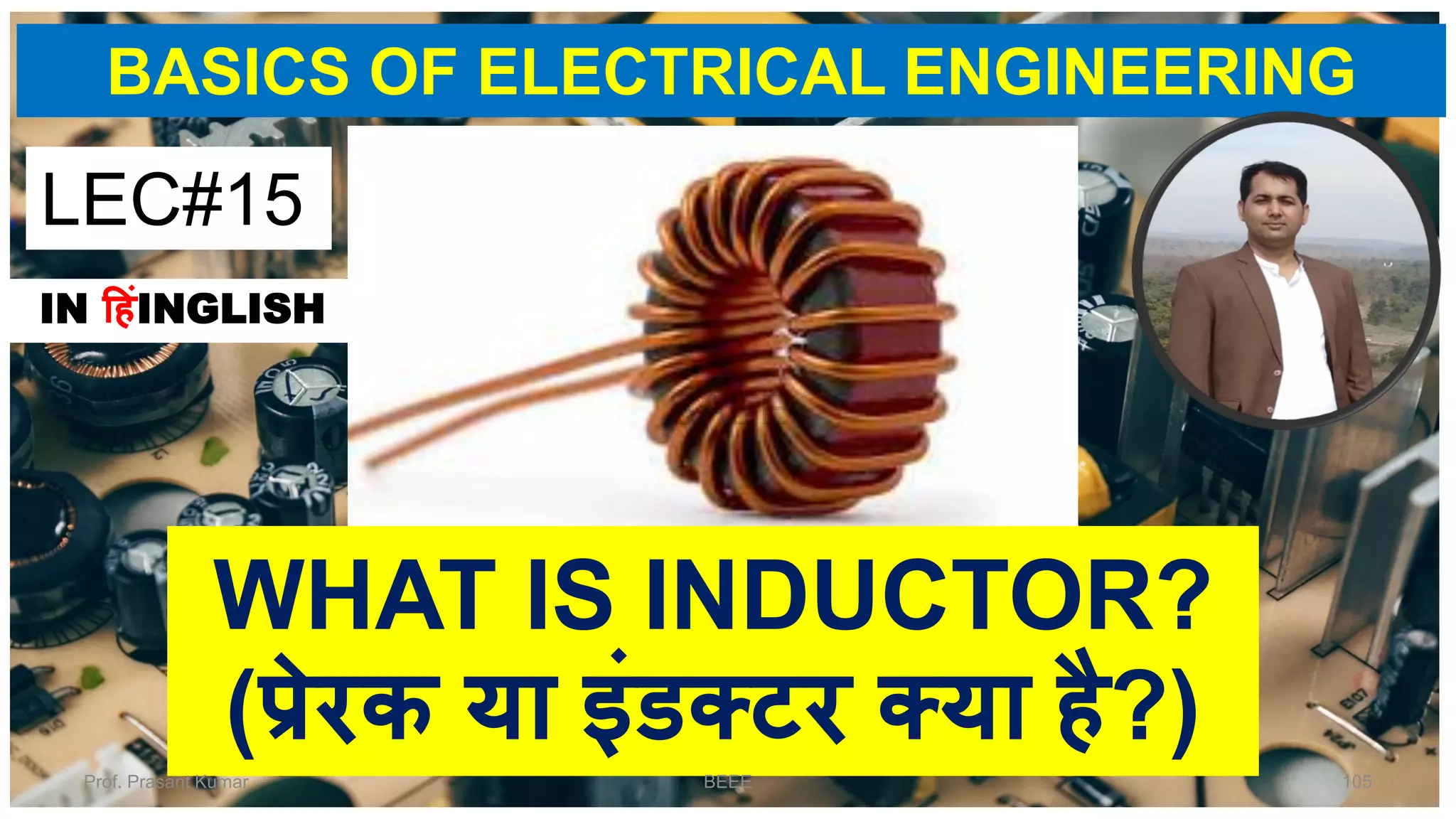
WHAT IS INDUCTOR?
(प्रेरक या इंडक्टर क्या है?)
Prof. Prasant Kumar BEEE 105
WHAT IS INDUCTOR?
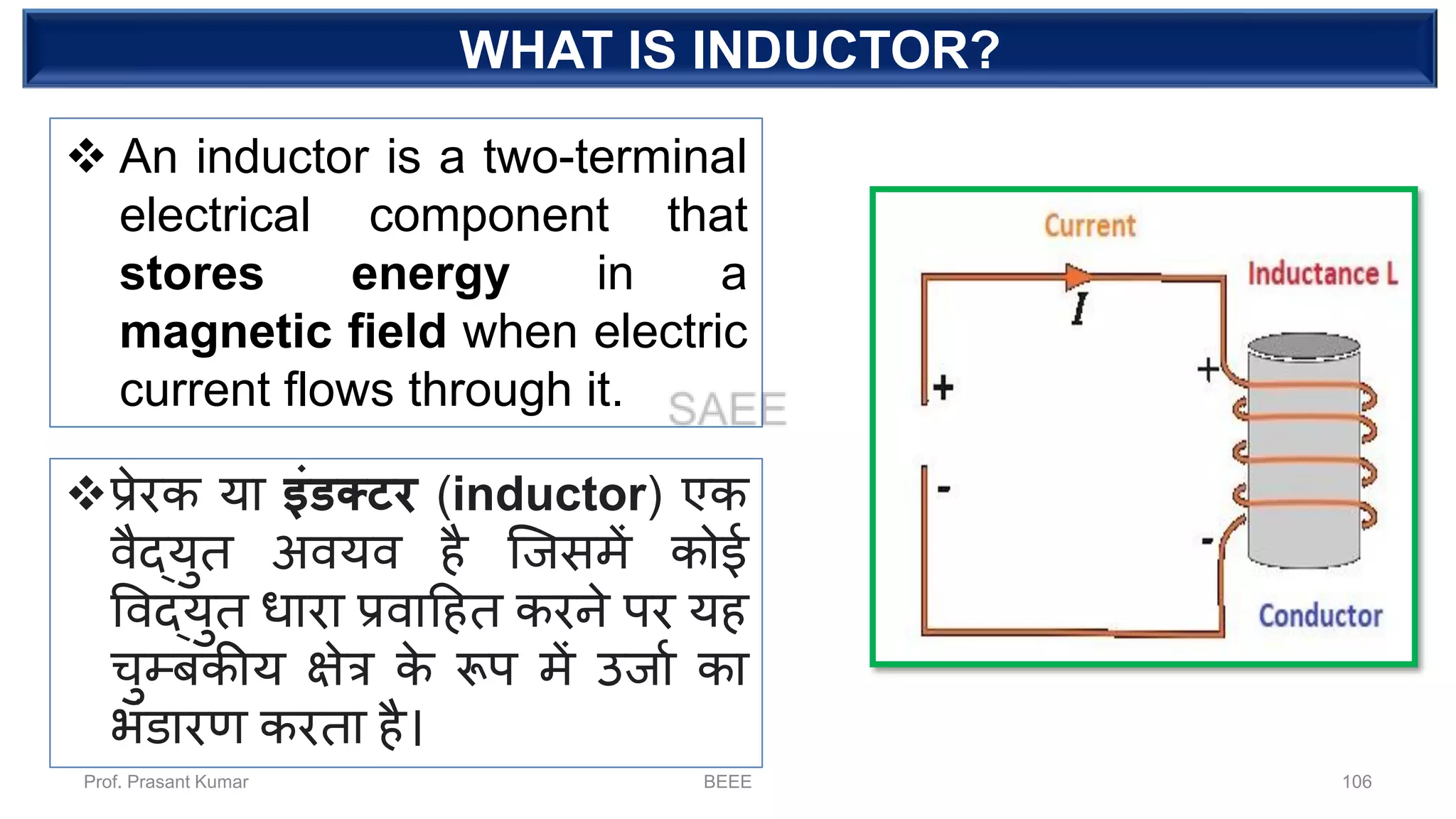
❖ An inductor is a two-terminal
electrical component that
stores energy in a
magnetic field when electric
current flows through it.
❖प्रेरक या इंडक्टर (inductor) एक
वैद्युत अवयव है जिसमें कोई
ववद्युत धारा प्रवाहहत करने पर यह
चुम्बकीय क्षेत्र के रूप में उिाा का
भंडारण करता है।
Prof. Prasant Kumar BEEE 106
DEPENDENT SOURCEWHAT IS INDUCTOR?
Prof. Prasant Kumar BEEE 107
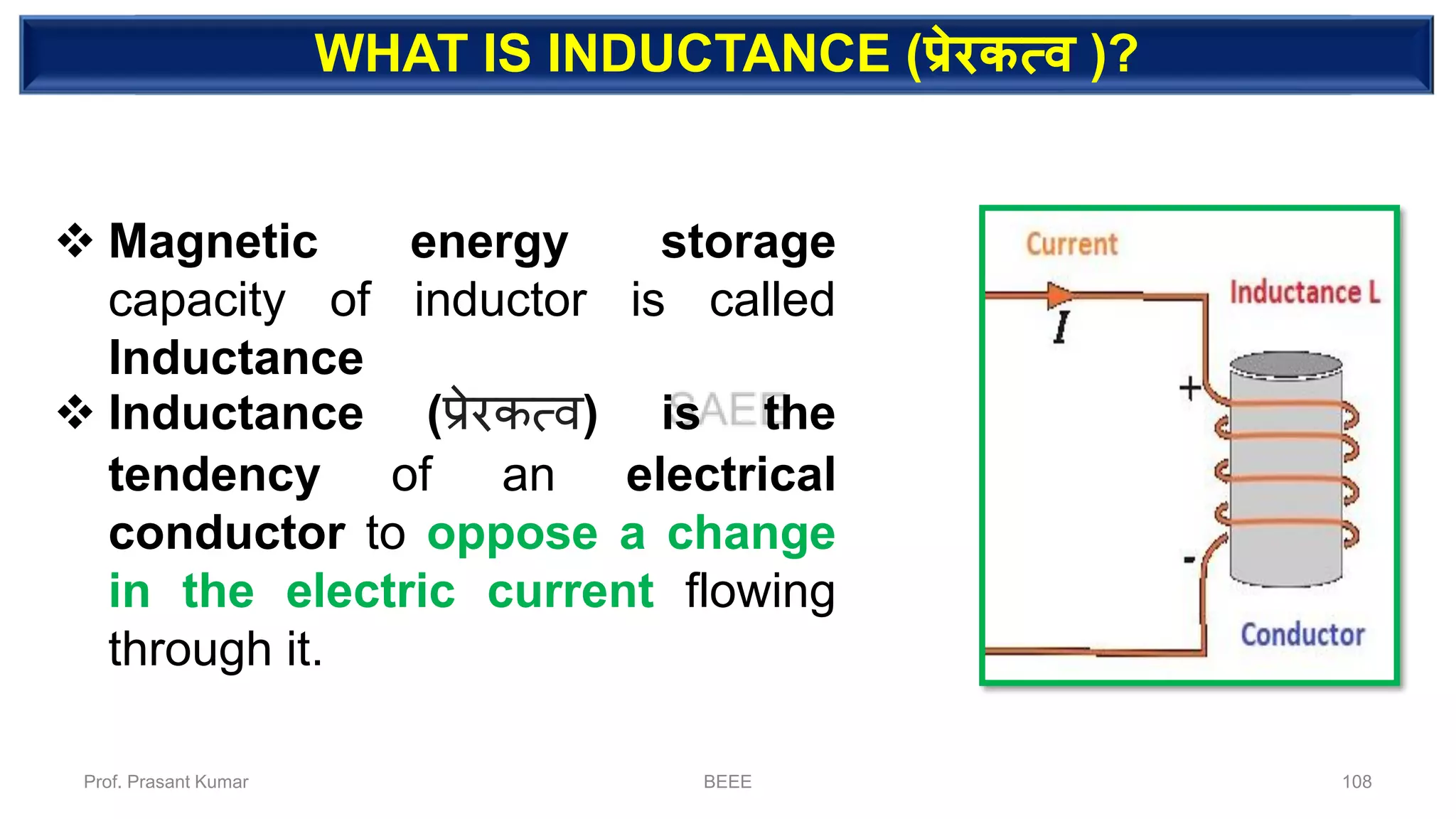
DEPENDENT SOURCEWHAT IS INDUCTANCE (प्रेरकत्ि )?
❖ Magnetic energy storage
capacity of inductor is called
Inductance
❖ Inductance (प्रेरकत्व) is the
tendency of an electrical
conductor to oppose a change
in the electric current flowing
through it.
Prof. Prasant Kumar BEEE 108
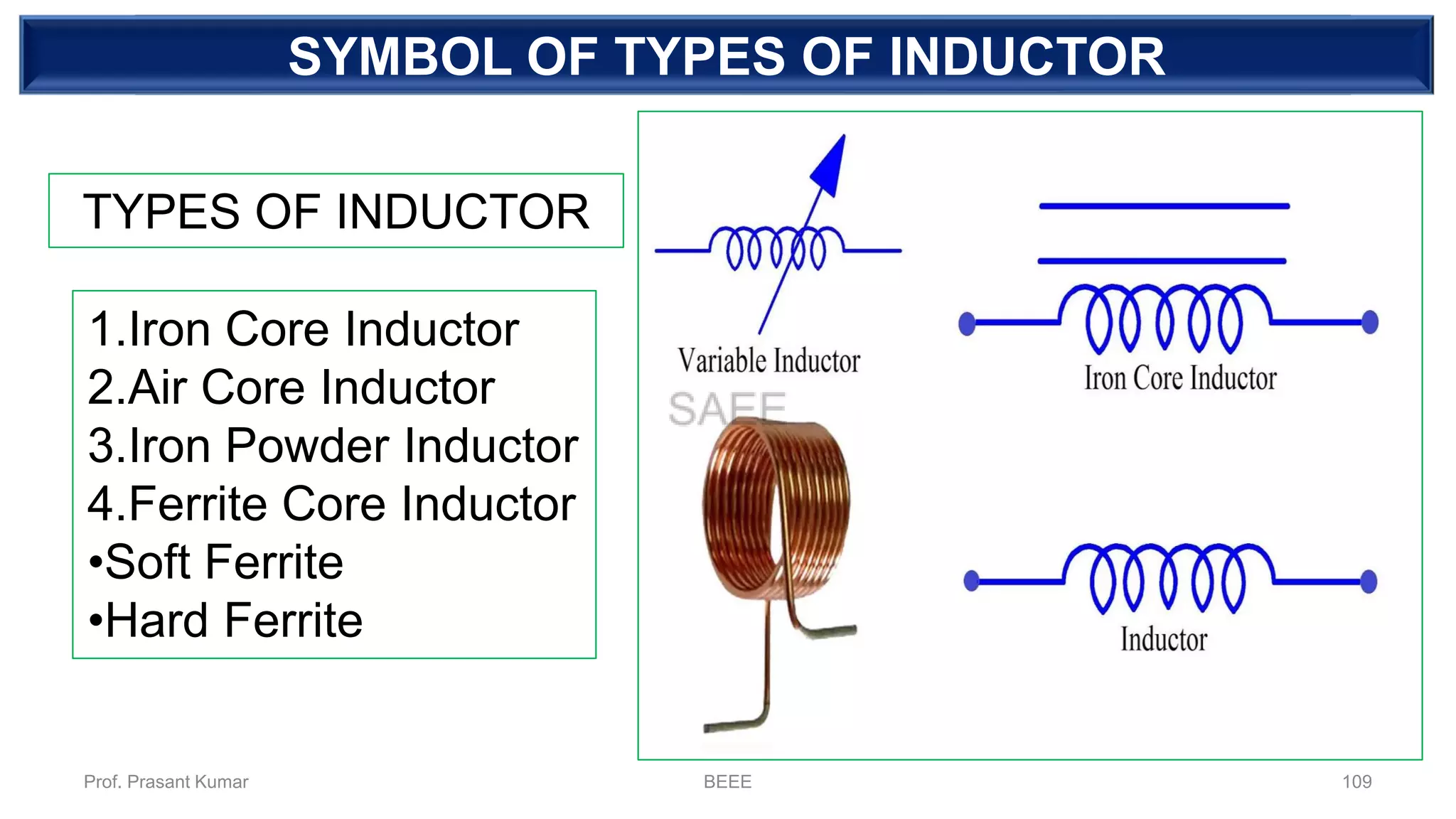
DEPENDENT SOURCESYMBOL OF TYPES OF INDUCTOR
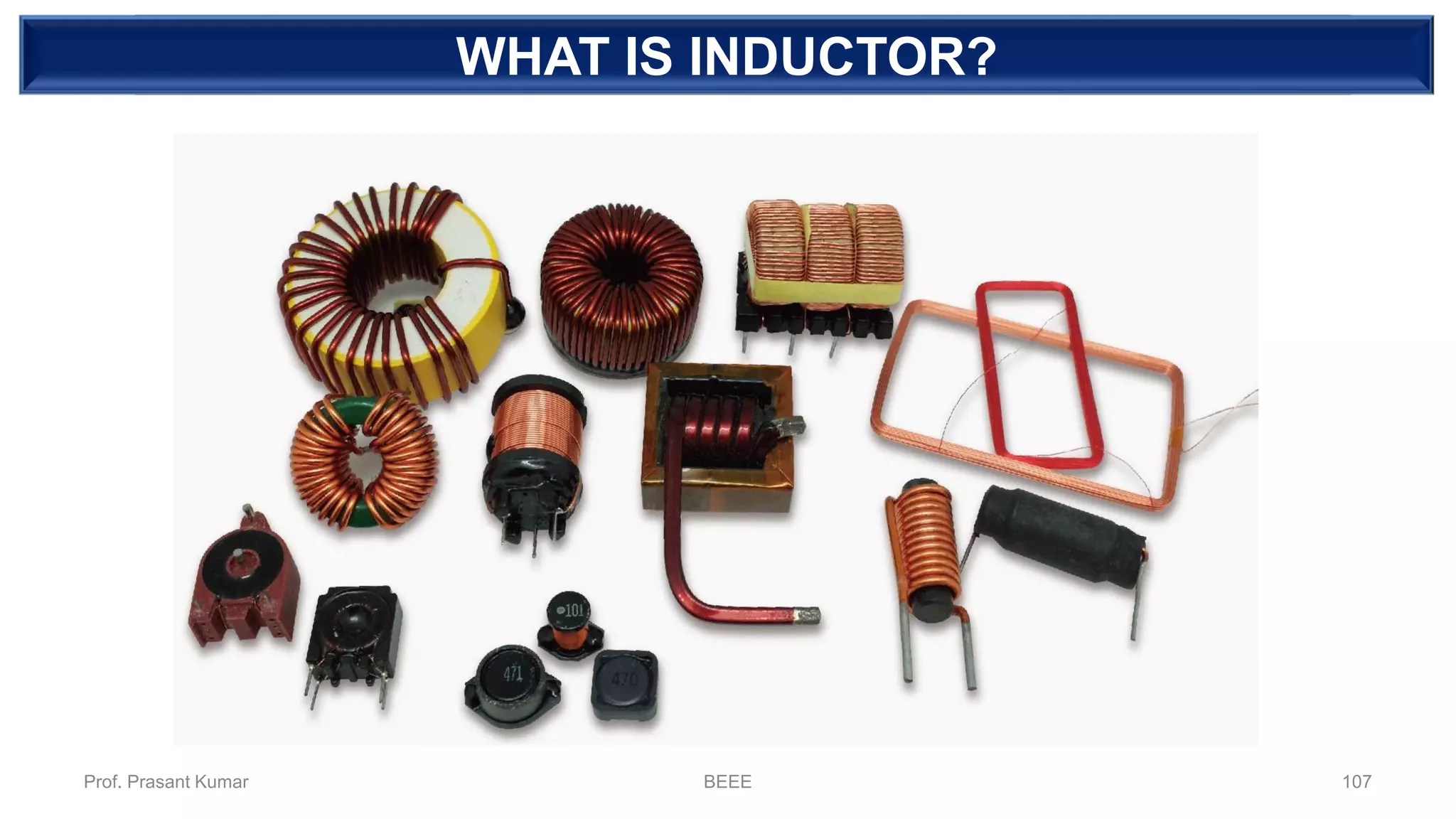
1.Iron Core Inductor
2.Air Core Inductor
3.Iron Powder Inductor
4.Ferrite Core Inductor
•Soft Ferrite
•Hard Ferrite
TYPES OF INDUCTOR
Prof. Prasant Kumar BEEE 109
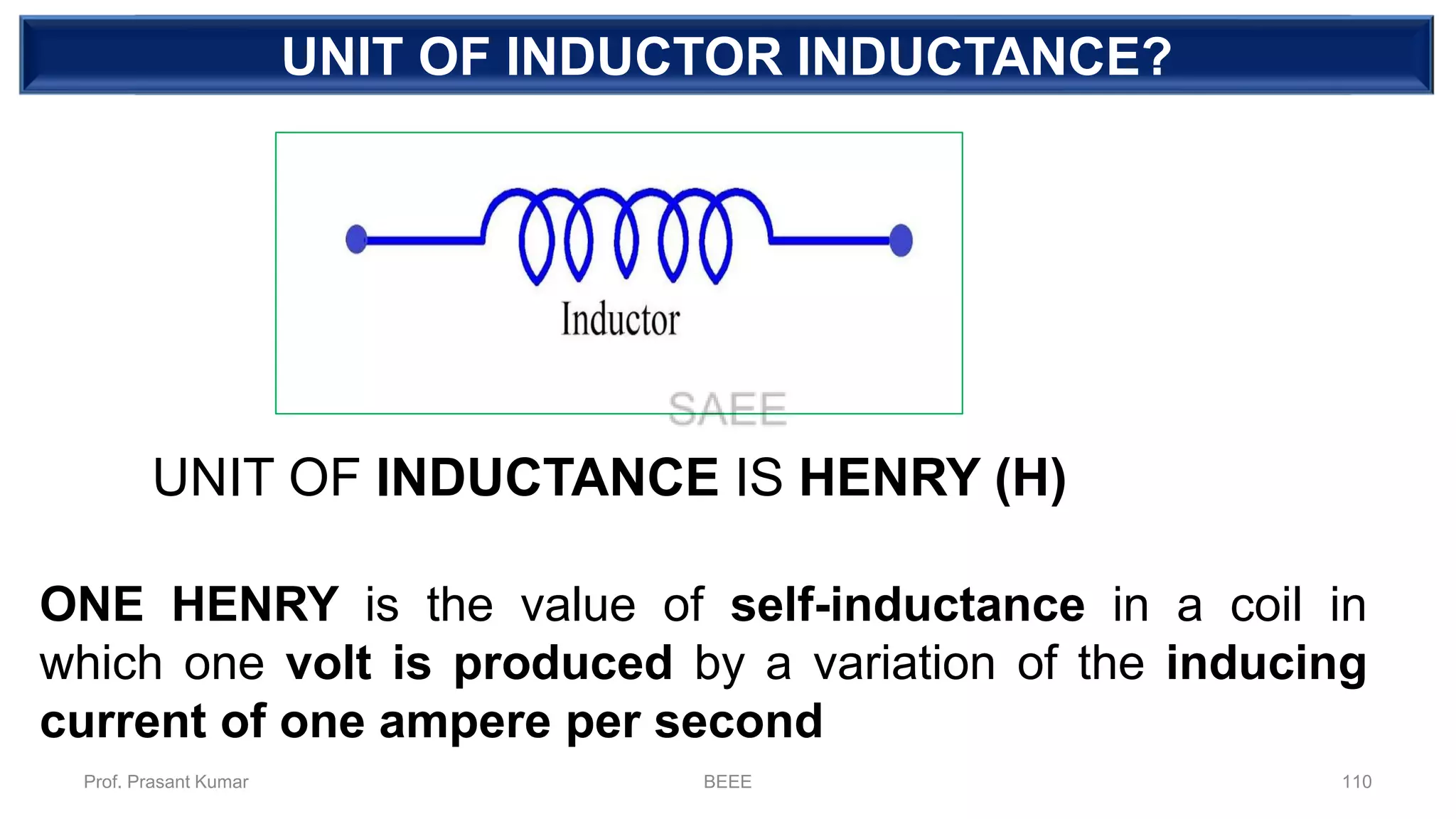
DEPENDENT SOURCEUNIT OF INDUCTOR INDUCTANCE?
UNIT OF INDUCTANCE IS HENRY (H)
ONE HENRY is the value of self-inductance in a coil in
which one volt is produced by a variation of the inducing
current of one ampere per second
Prof. Prasant Kumar BEEE 110
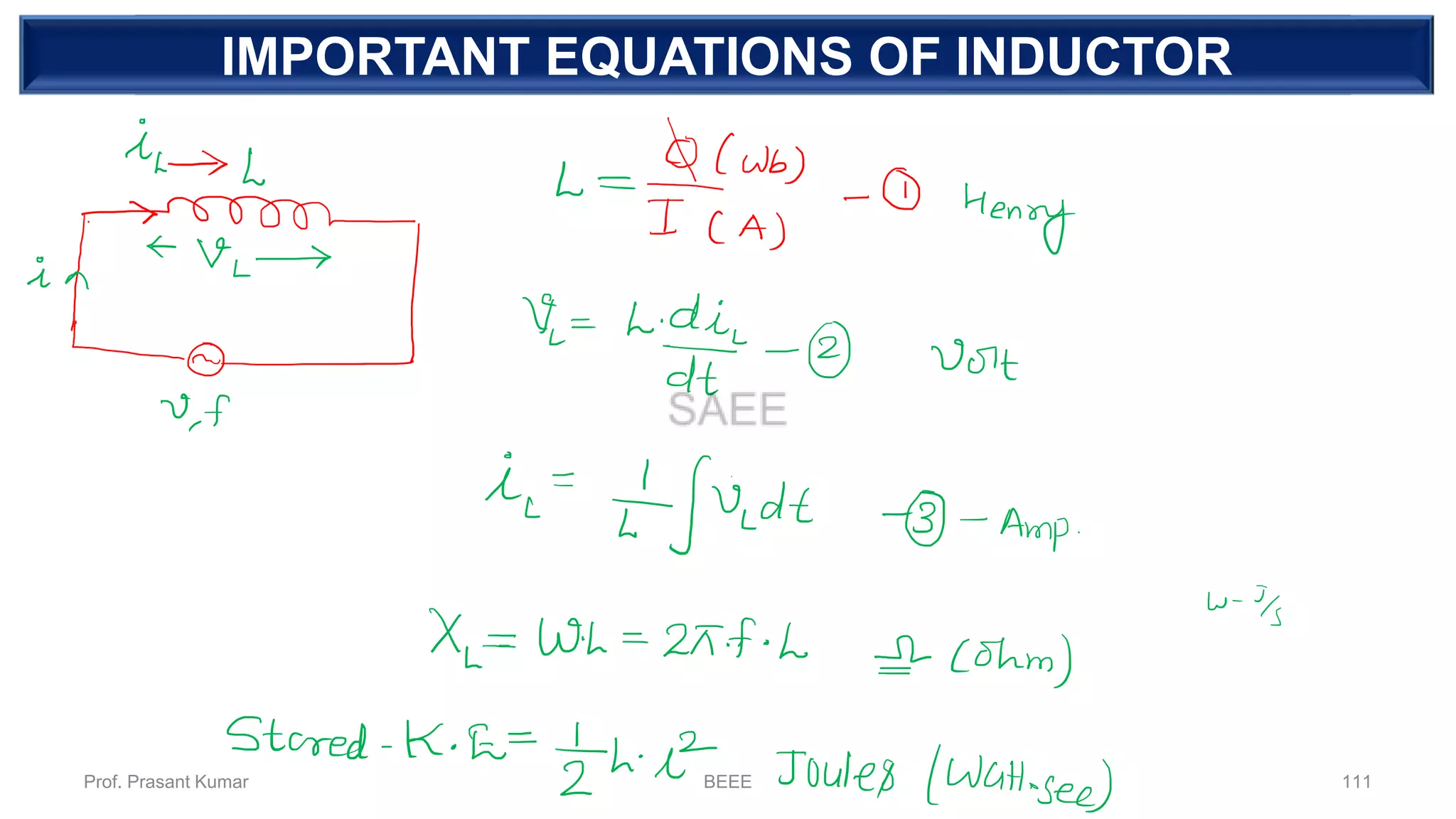
DEPENDENT SOURCEIMPORTANT EQUATIONS OF INDUCTOR
Prof. Prasant Kumar BEEE 111
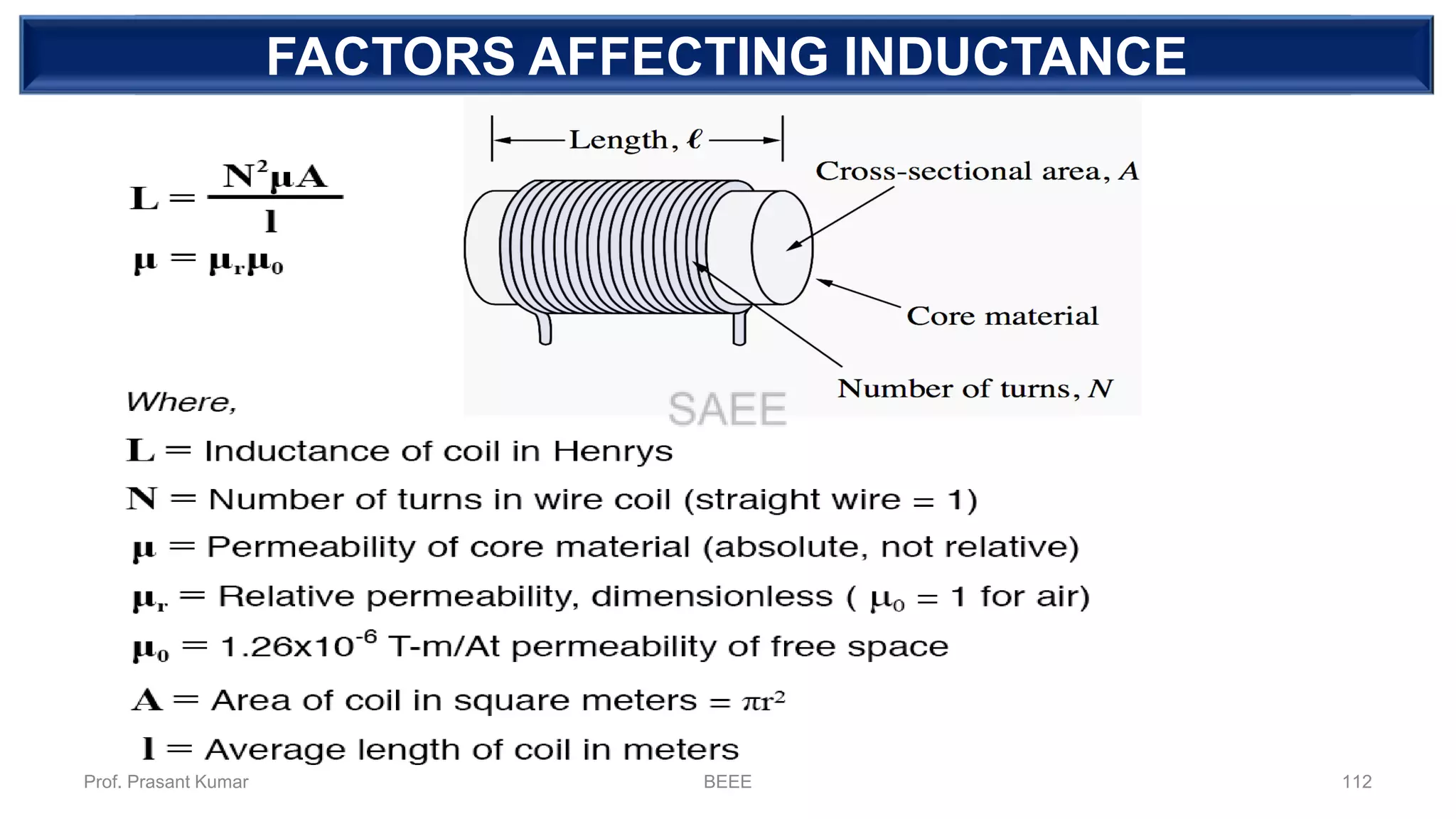
DEPENDENT SOURCEFACTORS AFFECTING INDUCTANCE
Prof. Prasant Kumar BEEE 112
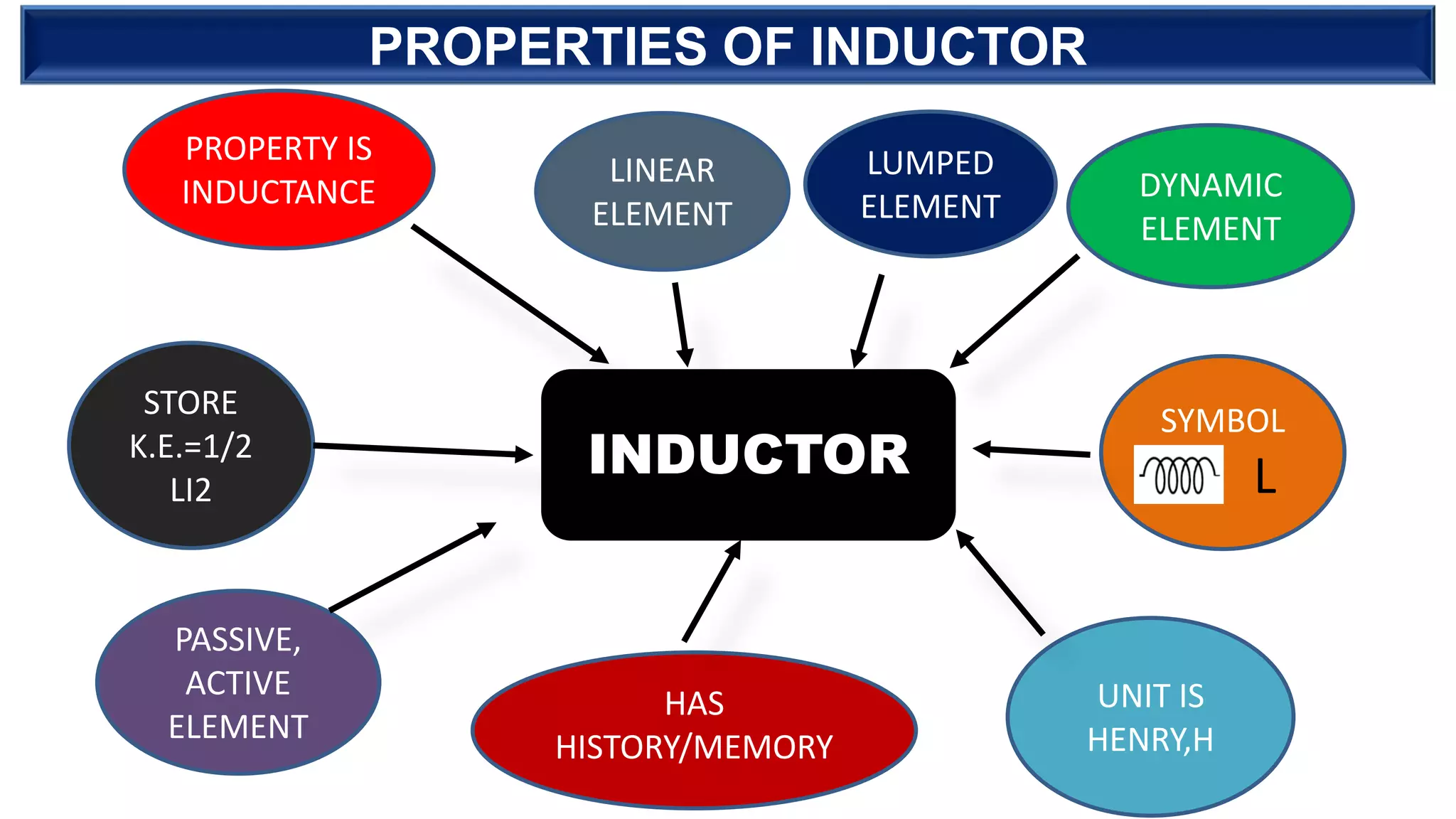
INDUCTOR
STORE
K.E.=1/2
LI2
PASSIVE,
ACTIVE
ELEMENT
PROPERTY IS
INDUCTANCE
SYMBOL
, L
DYNAMIC
ELEMENT
LINEAR
ELEMENT
HAS
HISTORY/MEMORY
LUMPED
ELEMENT
UNIT IS
HENRY,H
PROPERTIES OF INDUCTOR
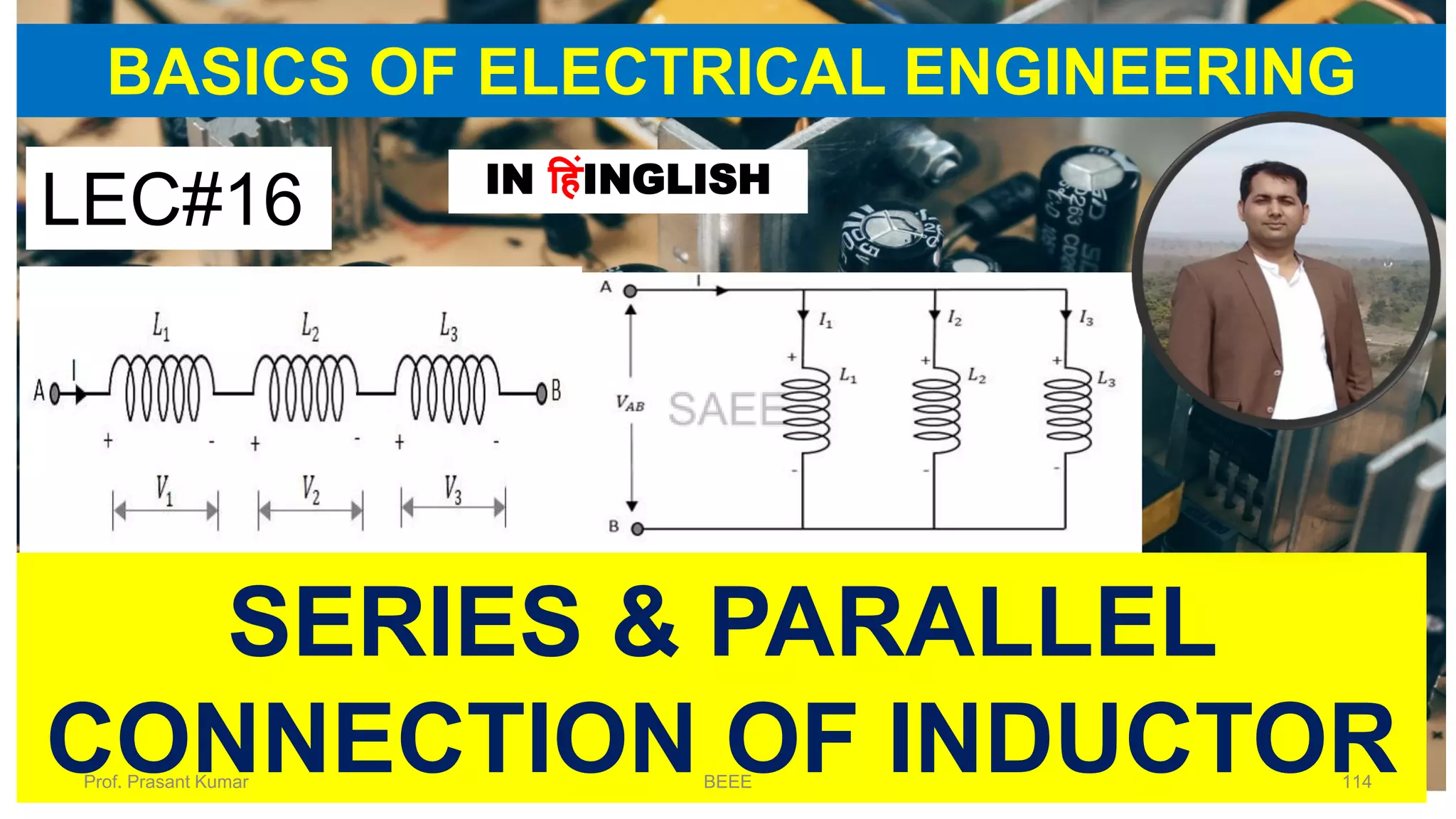
BASICS OF ELECTRICAL ENGINEERING
LEC#16 IN हहंINGLISH
SERIES & PARALLEL
CONNECTION OF INDUCTORProf. Prasant Kumar BEEE 114
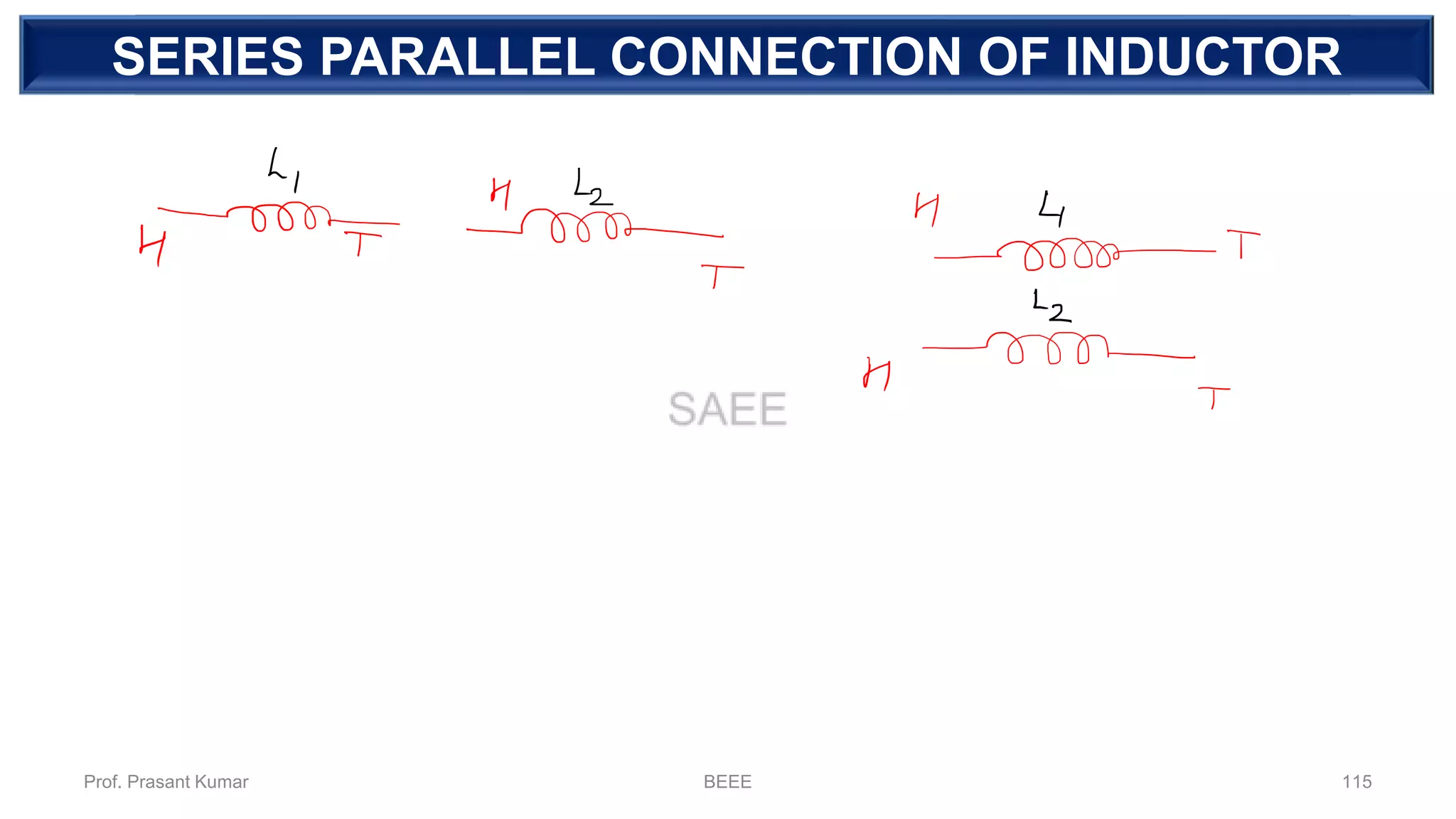
DEPENDENT SOURCESERIES PARALLEL CONNECTION OF INDUCTOR
Prof. Prasant Kumar BEEE 115
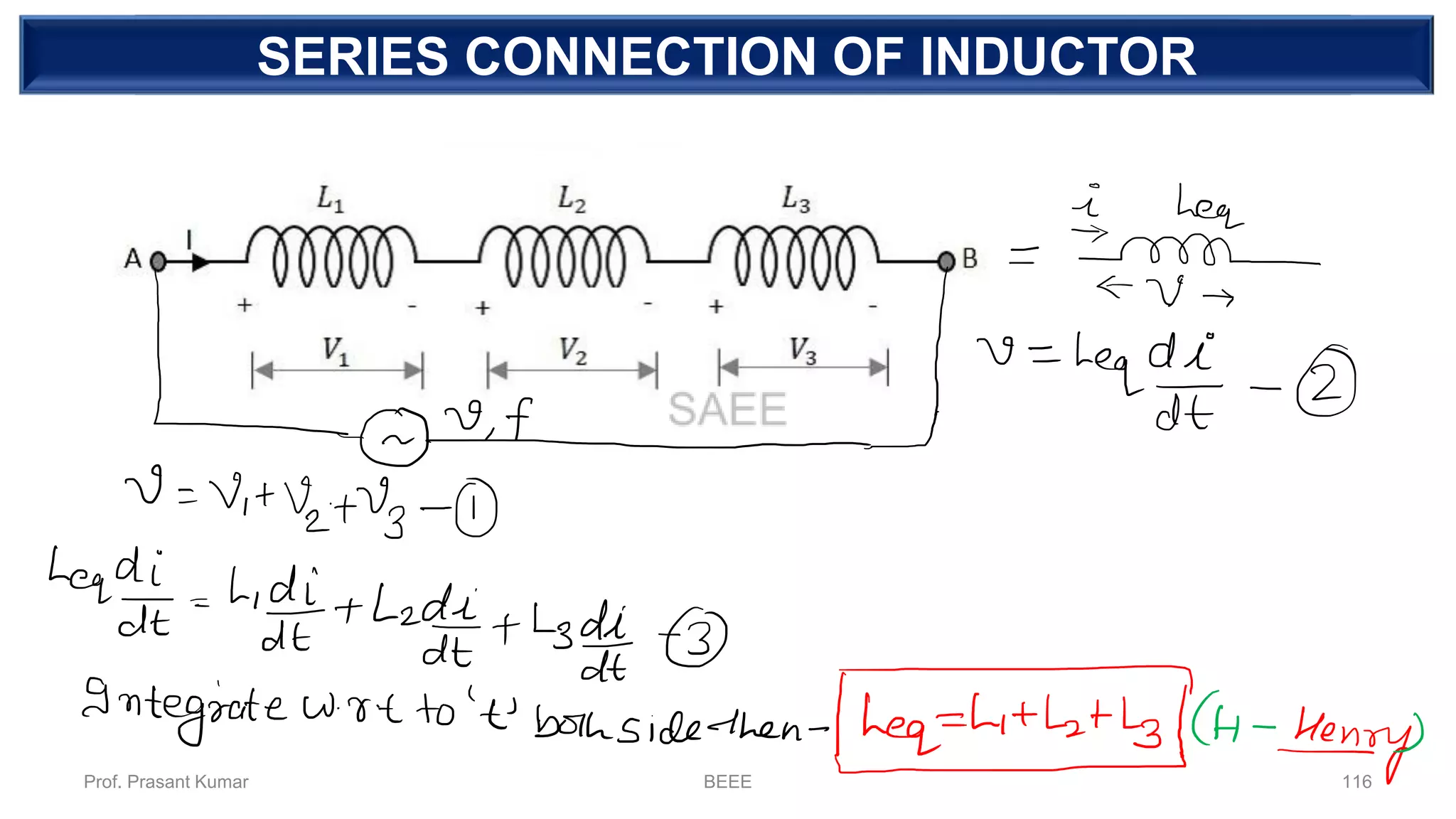
DEPENDENT SOURCESERIES CONNECTION OF INDUCTOR
Prof. Prasant Kumar BEEE 116
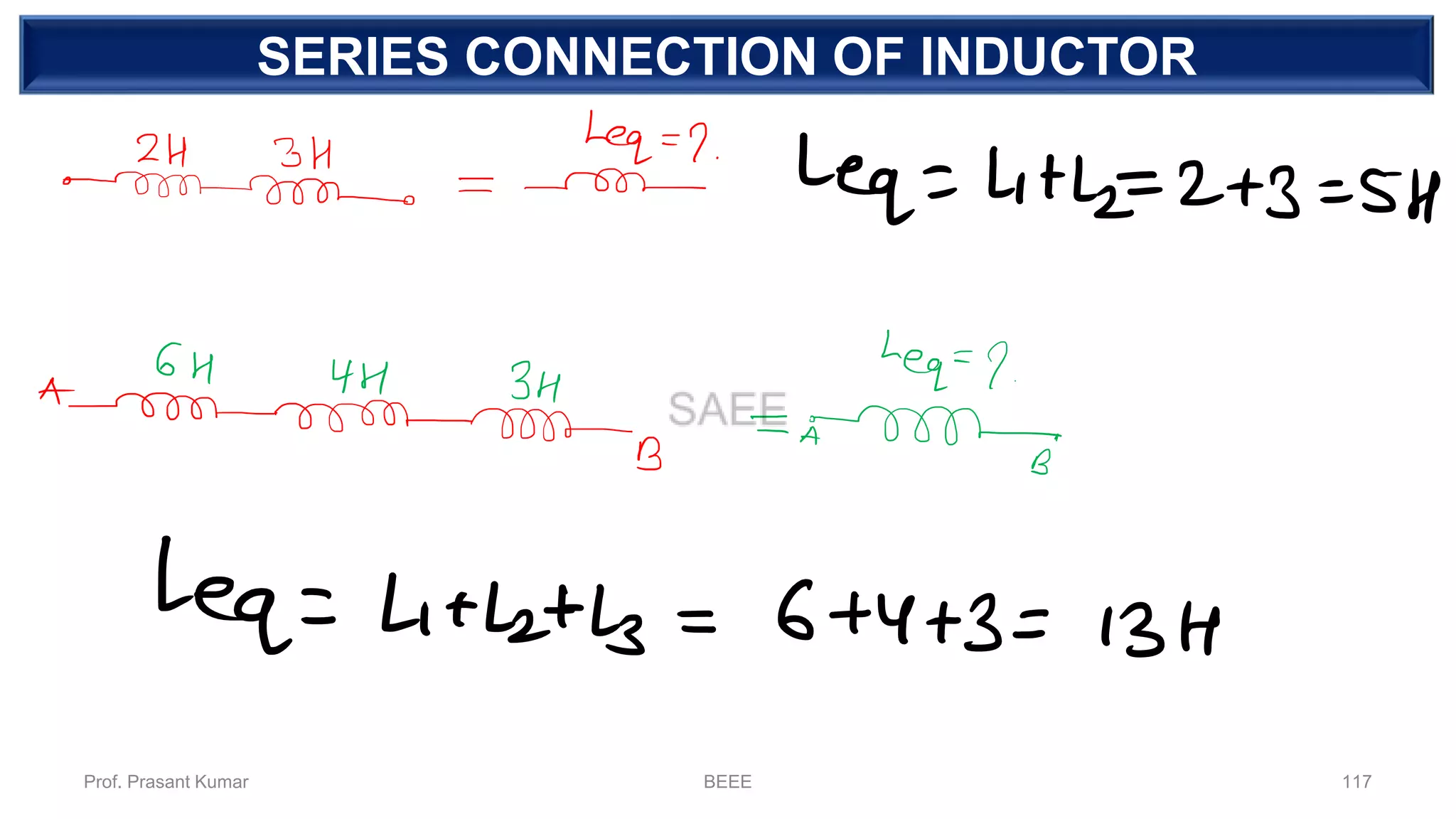
SERIES CONNECTION OF INDUCTOR
Prof. Prasant Kumar BEEE 117
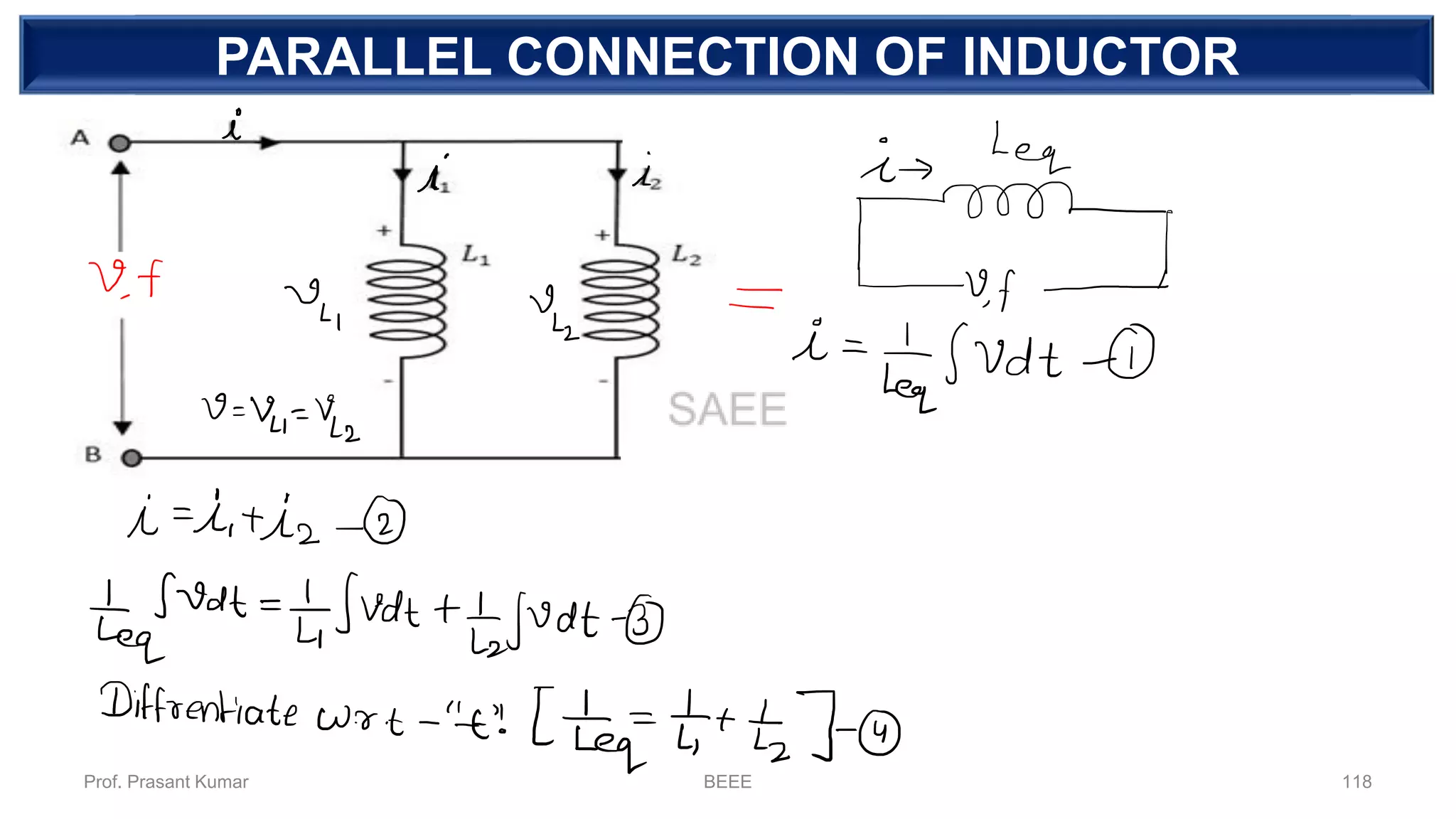
DEPENDENT SOURCEPARALLEL CONNECTION OF INDUCTOR
Prof. Prasant Kumar BEEE 118
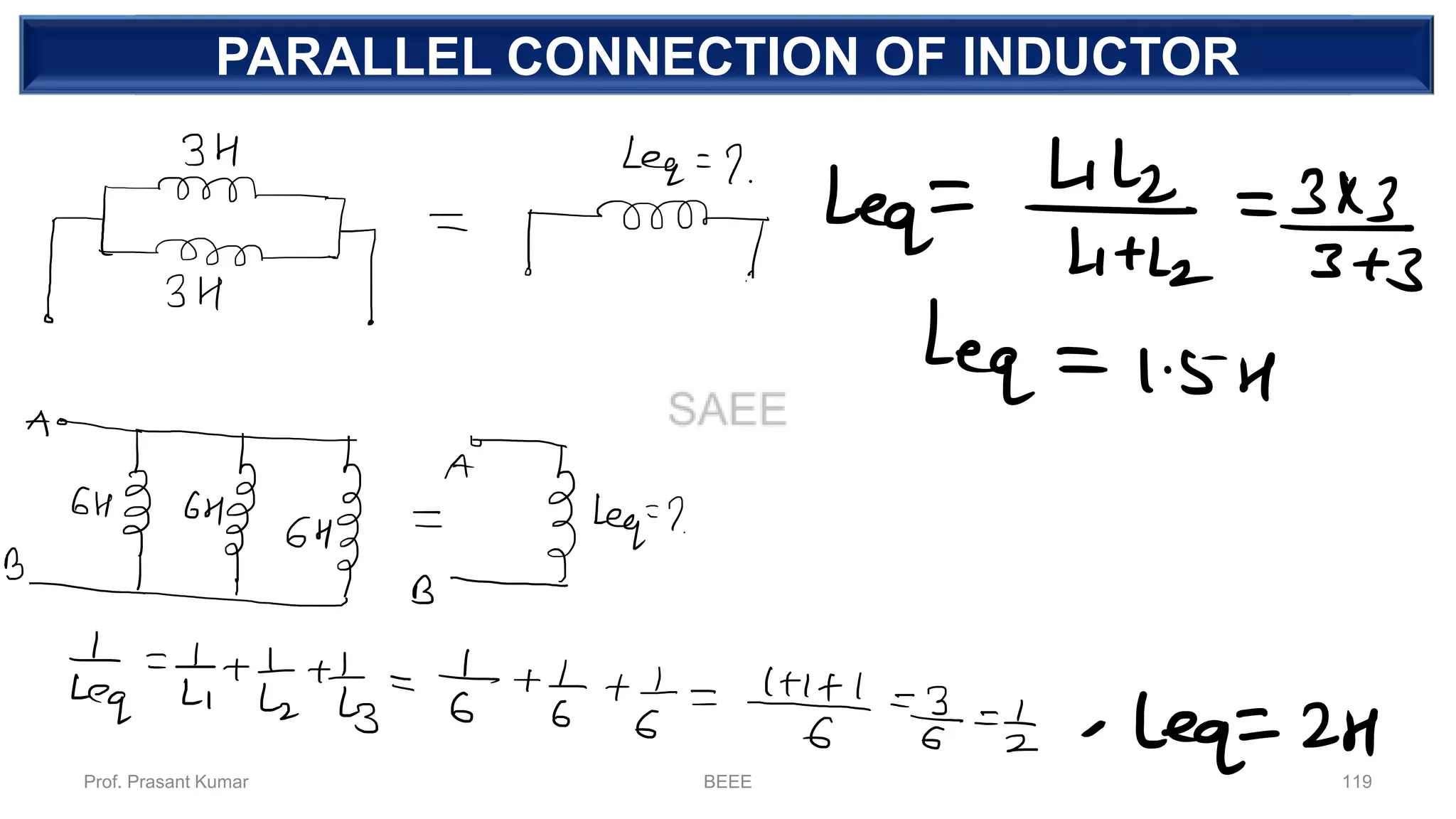
DEPENDENT SOURCEPARALLEL CONNECTION OF INDUCTOR
Prof. Prasant Kumar BEEE 119
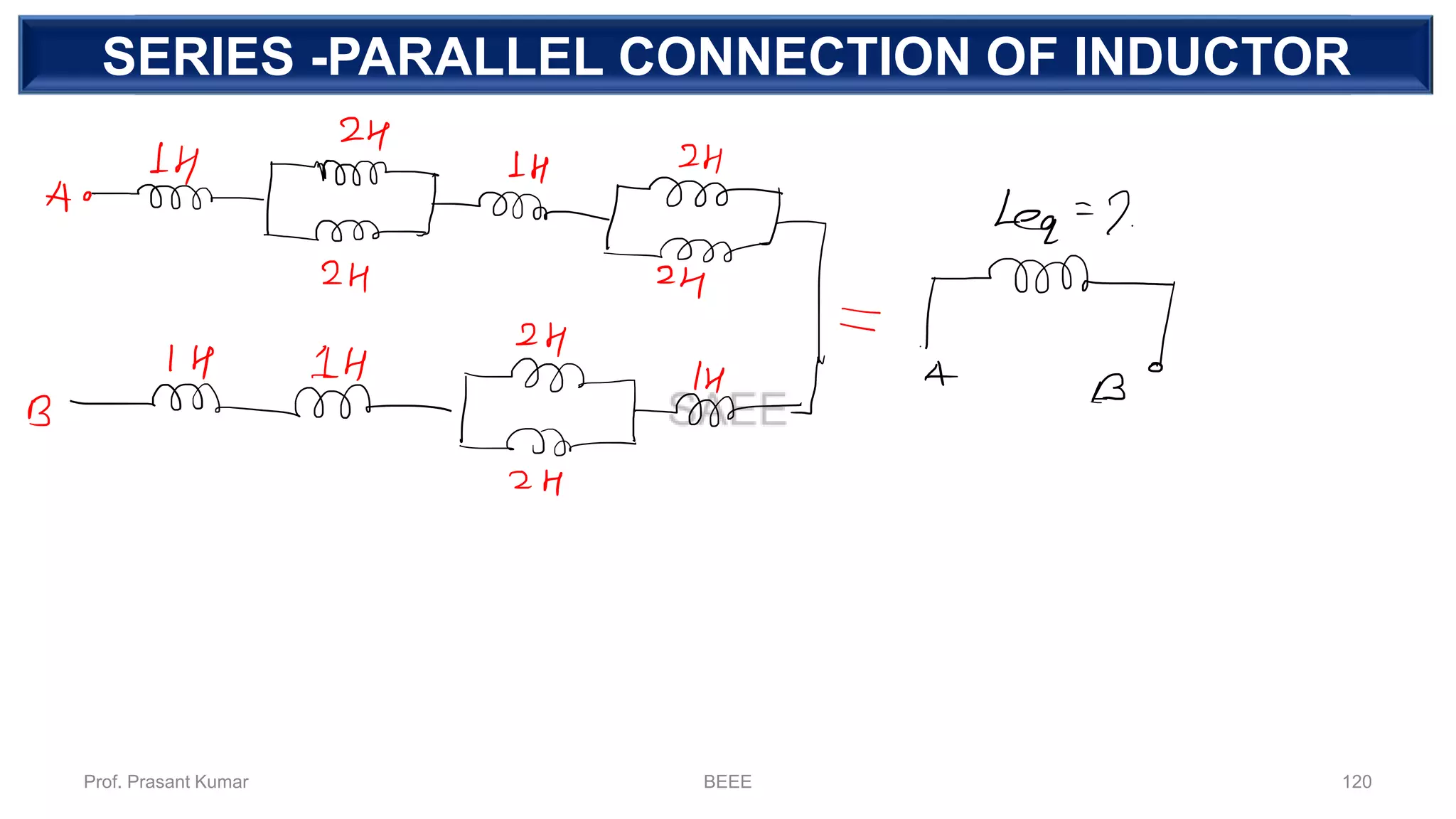
DEPENDENT SOURCESERIES -PARALLEL CONNECTION OF INDUCTOR
Prof. Prasant Kumar BEEE 120
BASICS OF ELECTRICAL ENGINEERING
LEC#17
IN हहंINGLISH
OHM’S LAWProf. Prasant Kumar BEEE 121
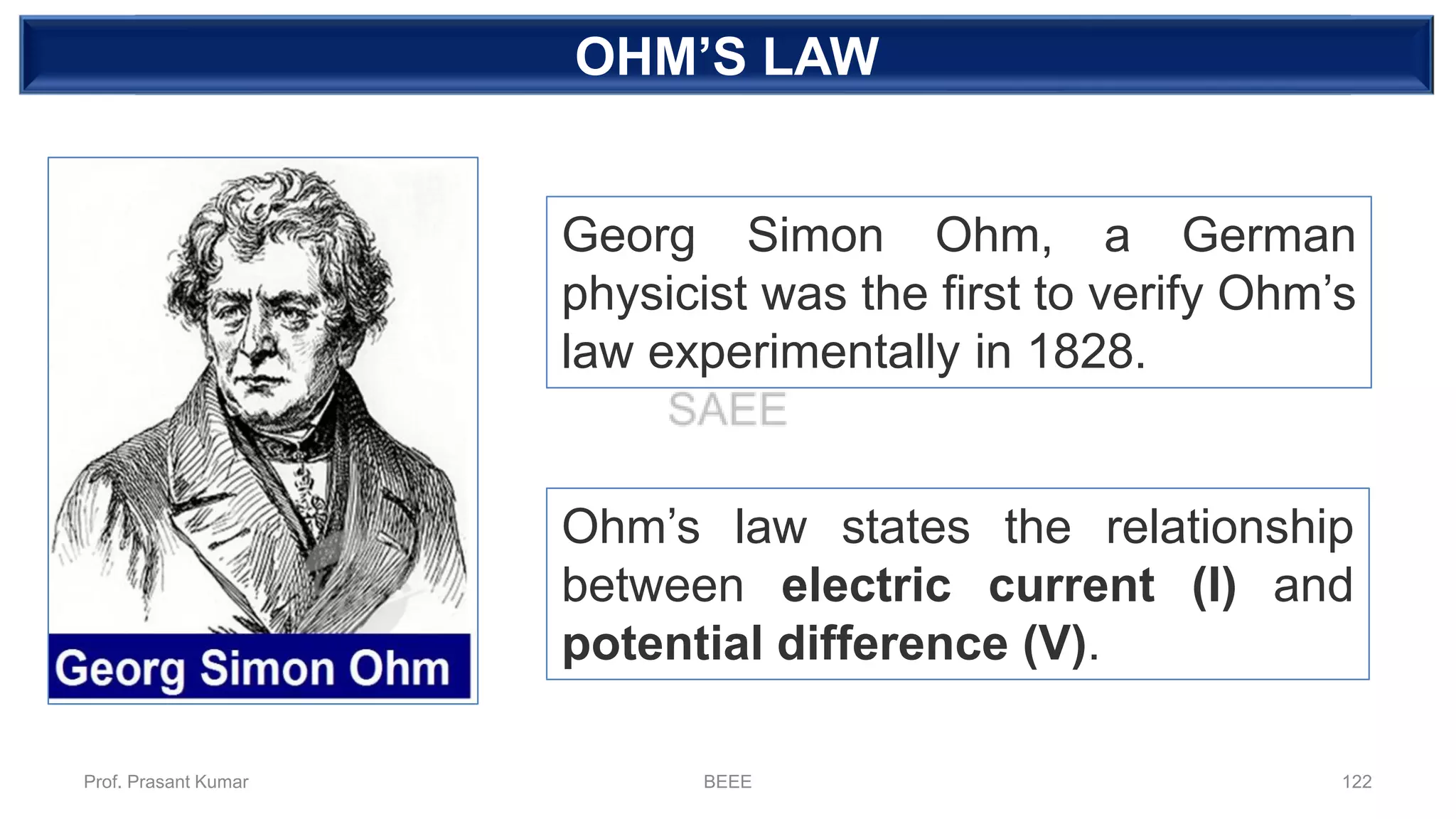
DEPENDENT SOURCEOHM’S LAW
Georg Simon Ohm, a German
physicist was the first to verify Ohm’s
law experimentally in 1828.
Ohm’s law states the relationship
between electric current (I) and
potential difference (V).
Prof. Prasant Kumar BEEE 122
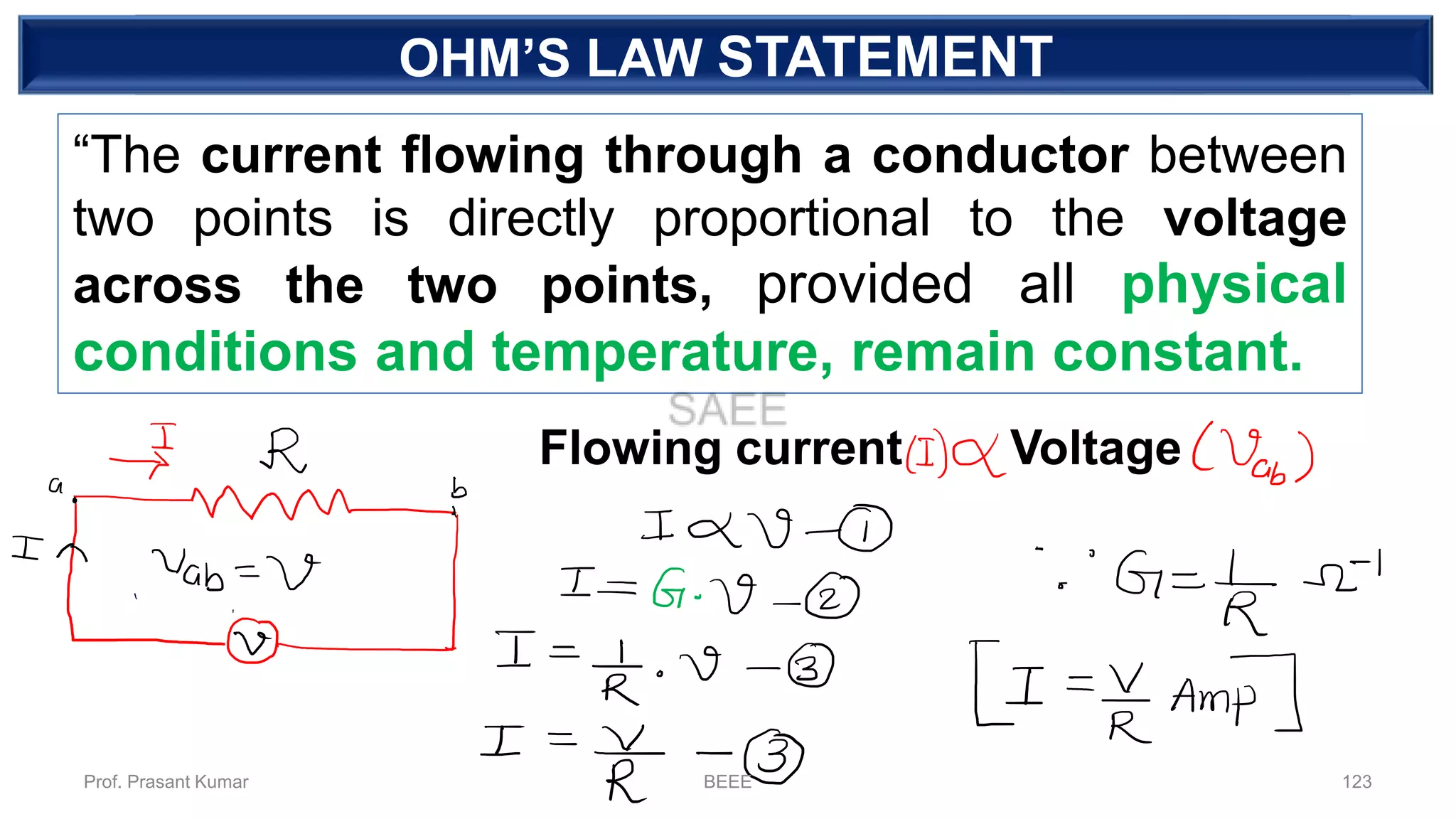
DEPENDENT SOURCEOHM’S LAW STATEMENT
“The current flowing through a conductor between
two points is directly proportional to the voltage
across the two points, provided all physical
conditions and temperature, remain constant.
Flowing current Voltage
Prof. Prasant Kumar BEEE 123
DEPENDENT SOURCEOHM’S LAW STATEMENT
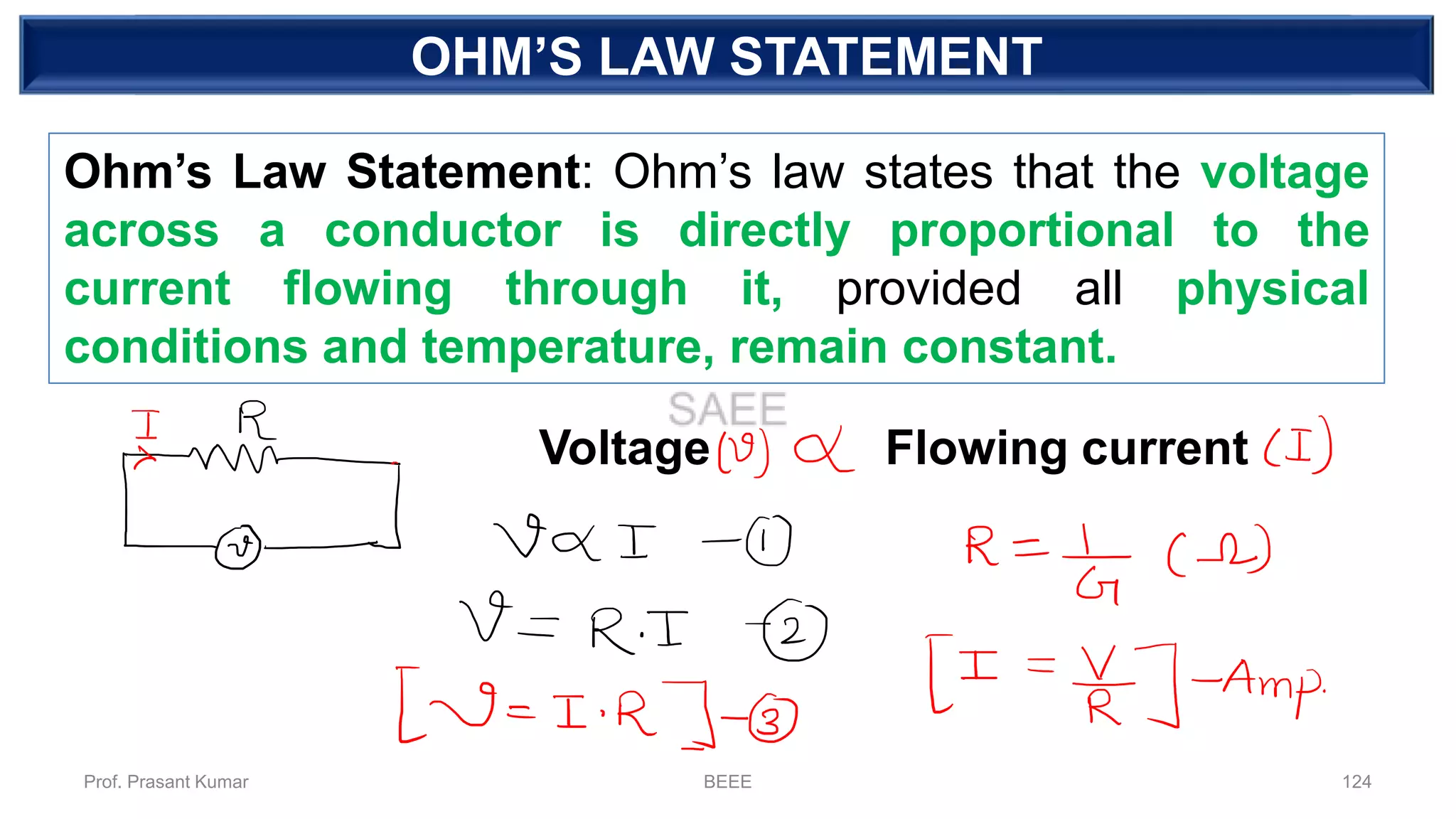
Ohm’s Law Statement: Ohm’s law states that the voltage
across a conductor is directly proportional to the
current flowing through it, provided all physical
conditions and temperature, remain constant.
Voltage Flowing current
Prof. Prasant Kumar BEEE 124
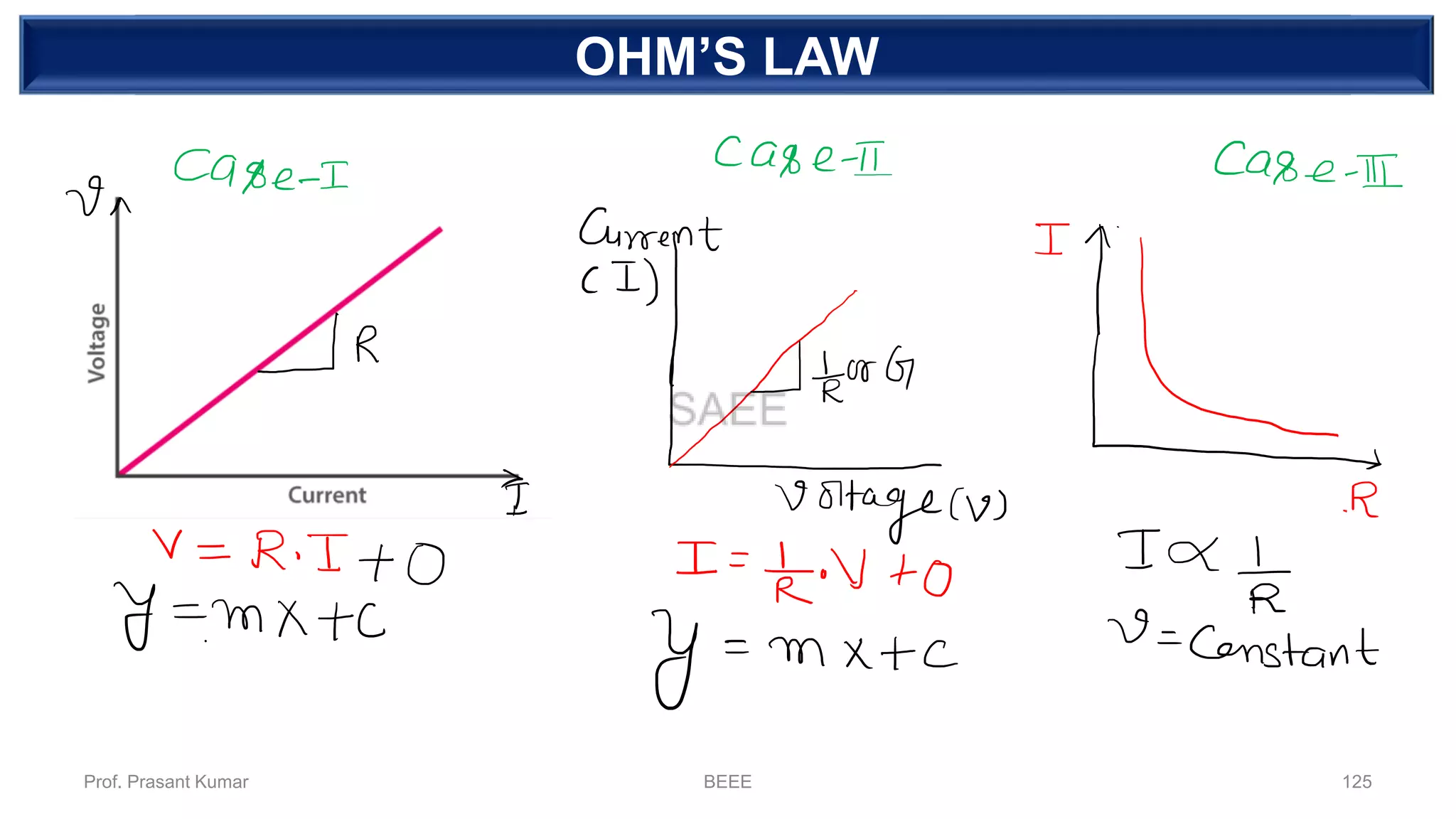
DEPENDENT SOURCEOHM’S LAW
Prof. Prasant Kumar BEEE 125
DEPENDENT SOURCEOHM’S LAW
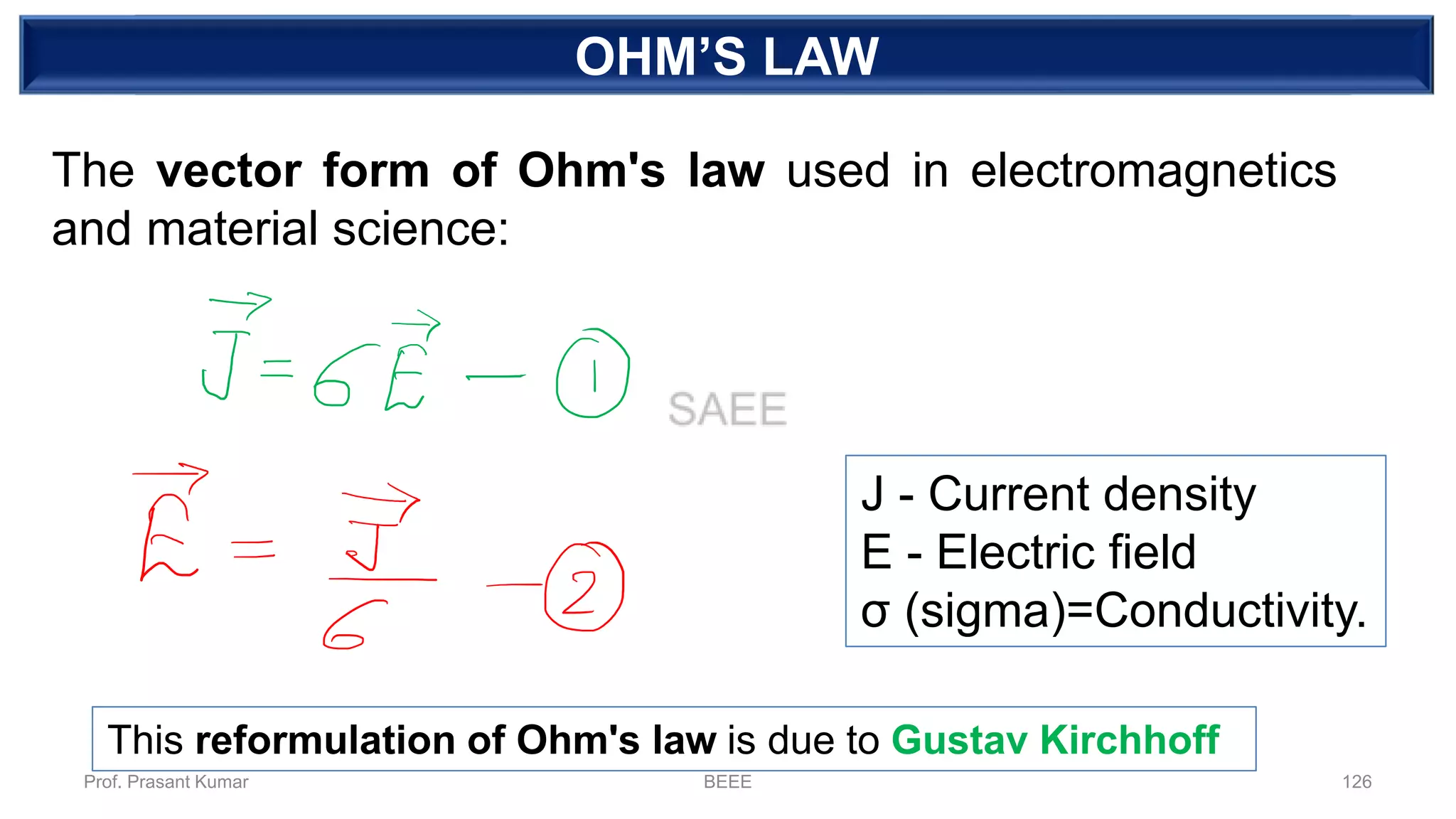
The vector form of Ohm's law used in electromagnetics
and material science:
J - Current density
E - Electric field
σ (sigma)=Conductivity.
This reformulation of Ohm's law is due to Gustav Kirchhoff
Prof. Prasant Kumar BEEE 126
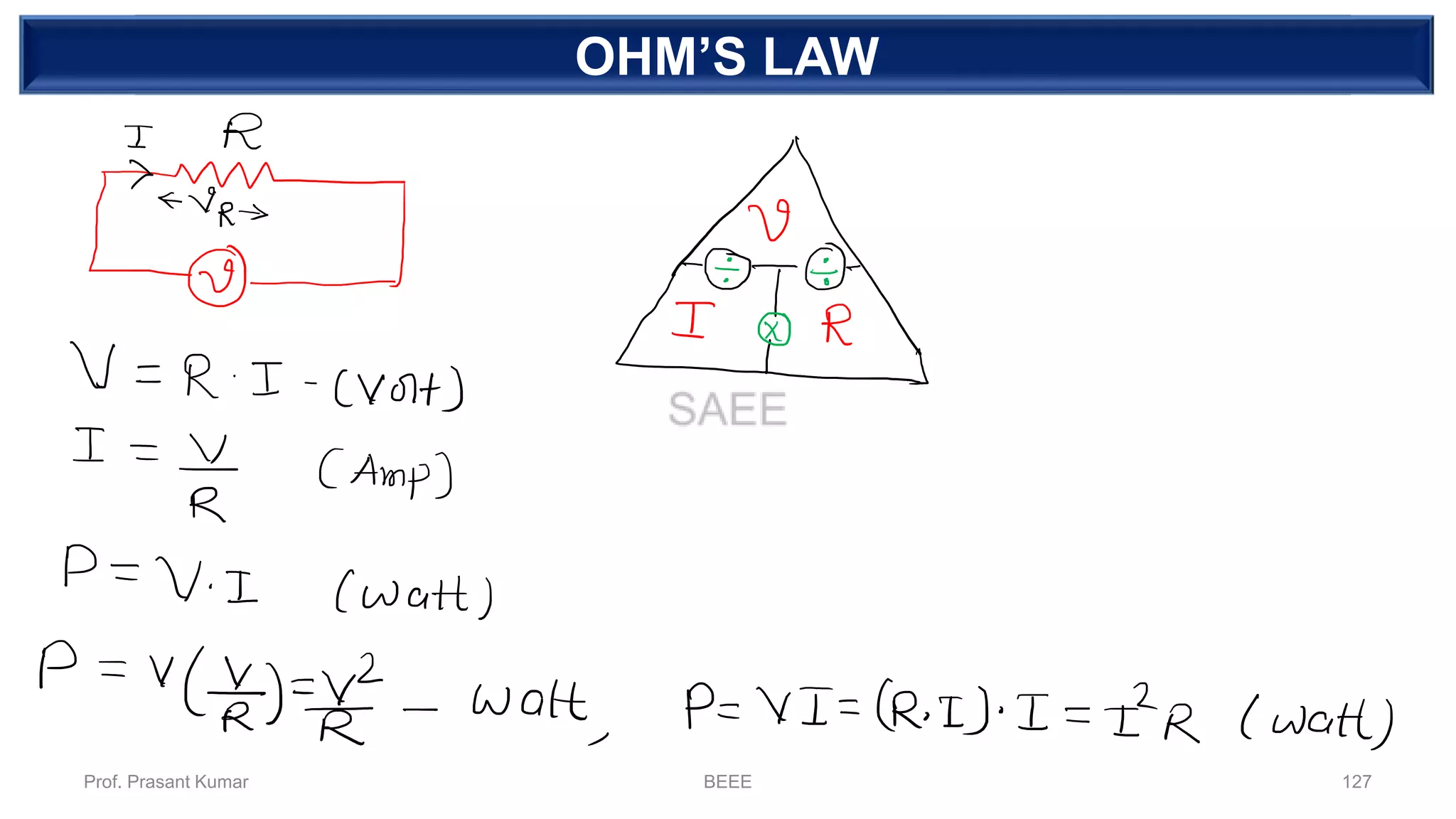
DEPENDENT SOURCEOHM’S LAW
Prof. Prasant Kumar BEEE 127
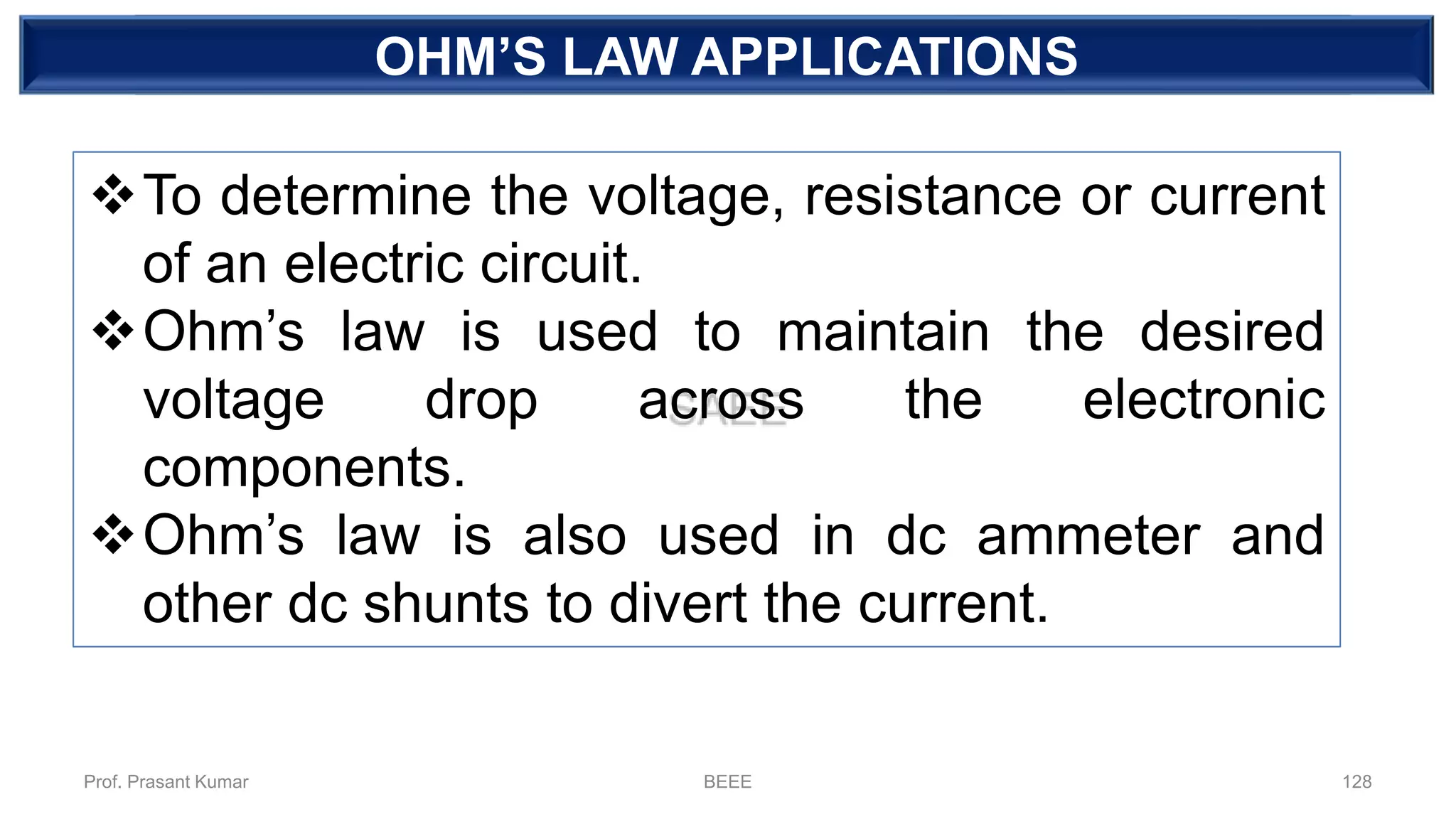
DEPENDENT SOURCEOHM’S LAW APPLICATIONS
❖To determine the voltage, resistance or current
of an electric circuit.
❖Ohm’s law is used to maintain the desired
voltage drop across the electronic
components.
❖Ohm’s law is also used in dc ammeter and
other dc shunts to divert the current.
Prof. Prasant Kumar BEEE 128
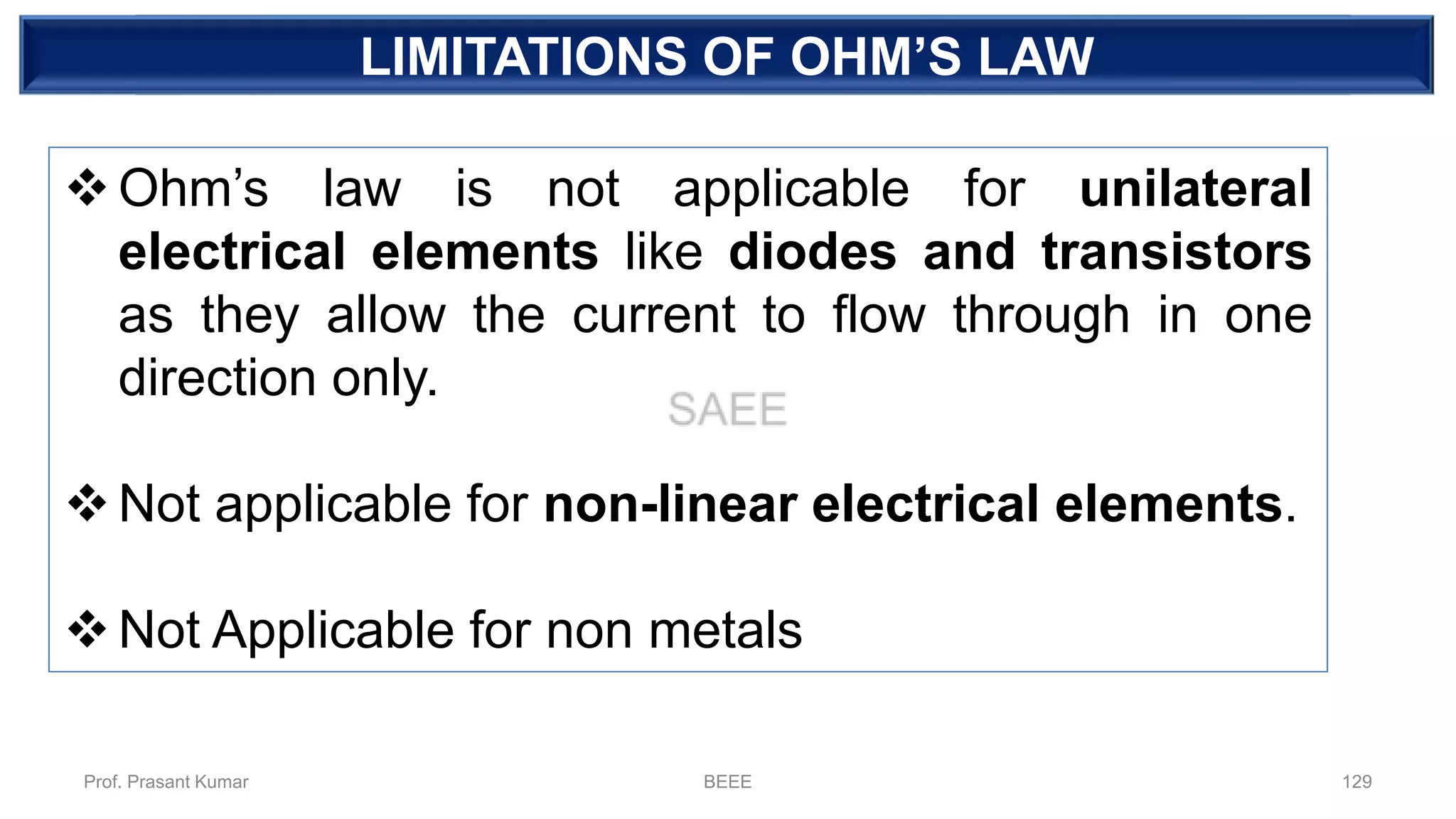
DEPENDENT SOURCELIMITATIONS OF OHM’S LAW
❖Ohm’s law is not applicable for unilateral
electrical elements like diodes and transistors
as they allow the current to flow through in one
direction only.
❖Not applicable for non-linear electrical elements.
❖Not Applicable for non metals
Prof. Prasant Kumar BEEE 129
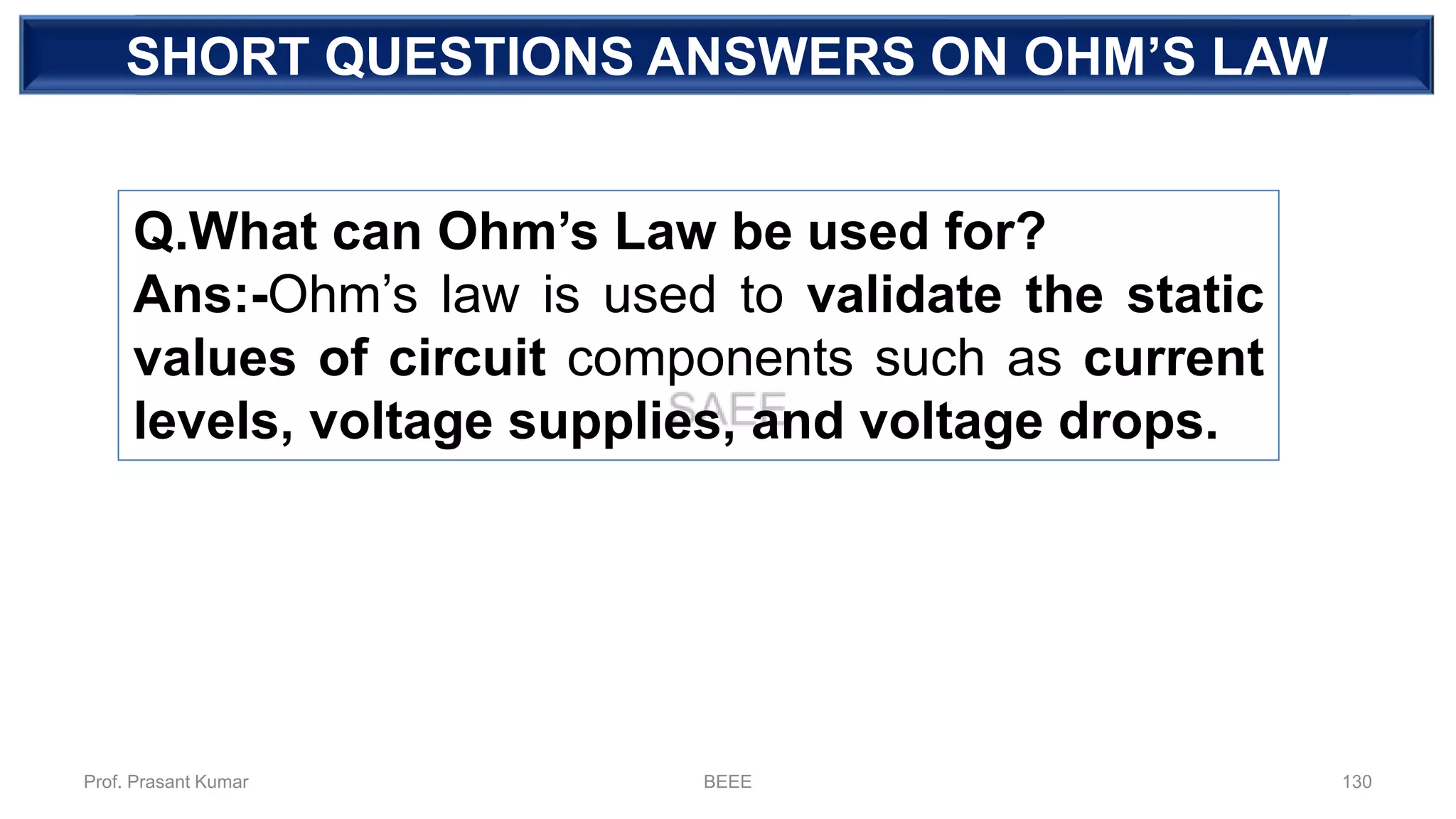
DEPENDENT SOURCESHORT QUESTIONS ANSWERS ON OHM’S LAW
Q.What can Ohm’s Law be used for?
Ans:-Ohm’s law is used to validate the static
values of circuit components such as current
levels, voltage supplies, and voltage drops.
Prof. Prasant Kumar BEEE 130
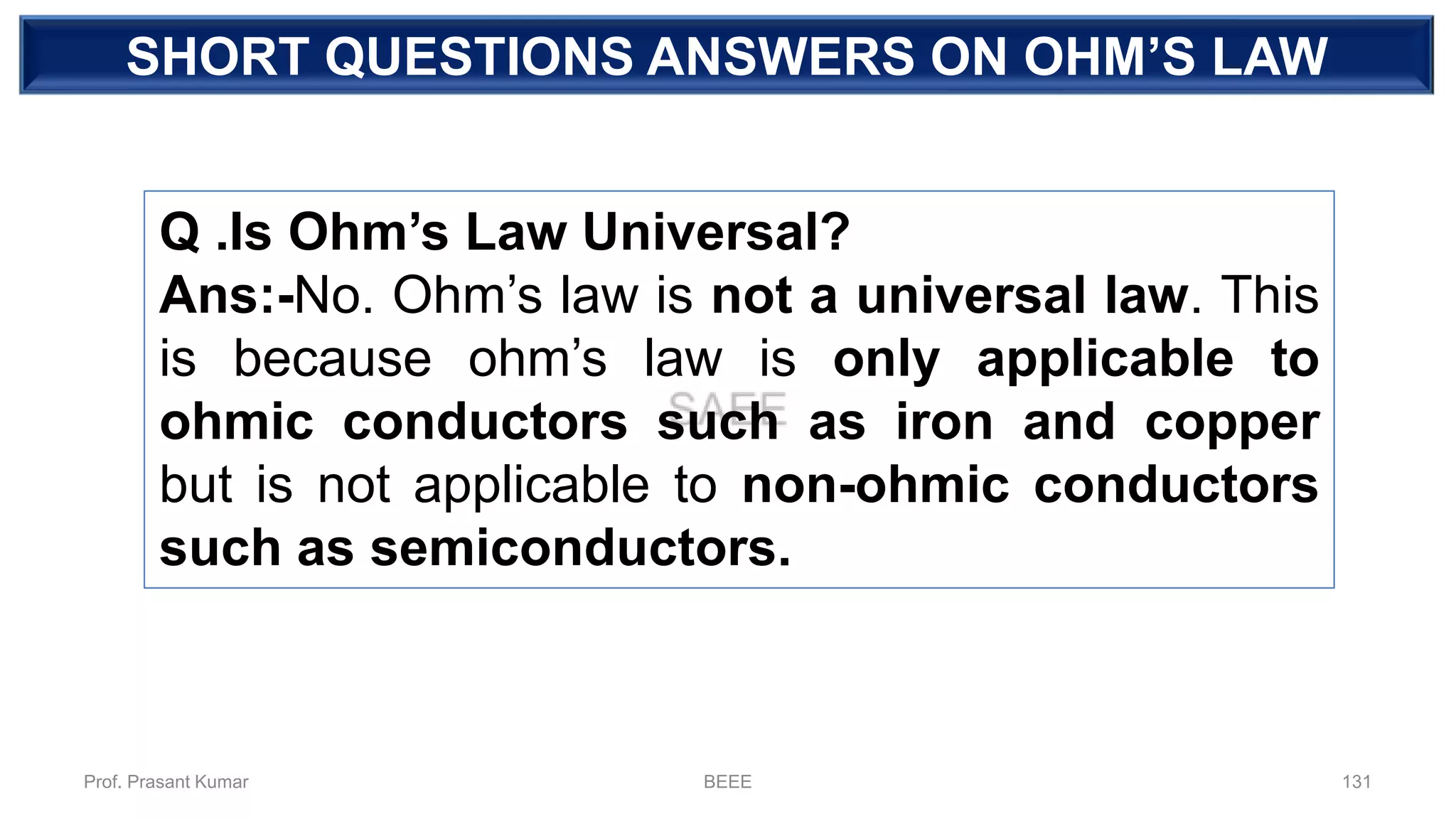
SHORT QUESTIONS ANSWERS ON OHM’S LAW
Q .Is Ohm’s Law Universal?
Ans:-No. Ohm’s law is not a universal law. This
is because ohm’s law is only applicable to
ohmic conductors such as iron and copper
but is not applicable to non-ohmic conductors
such as semiconductors.
Prof. Prasant Kumar BEEE 131
DEPENDENT SOURCESHORT QUESTIONS ANSWERS ON OHM’S LAW
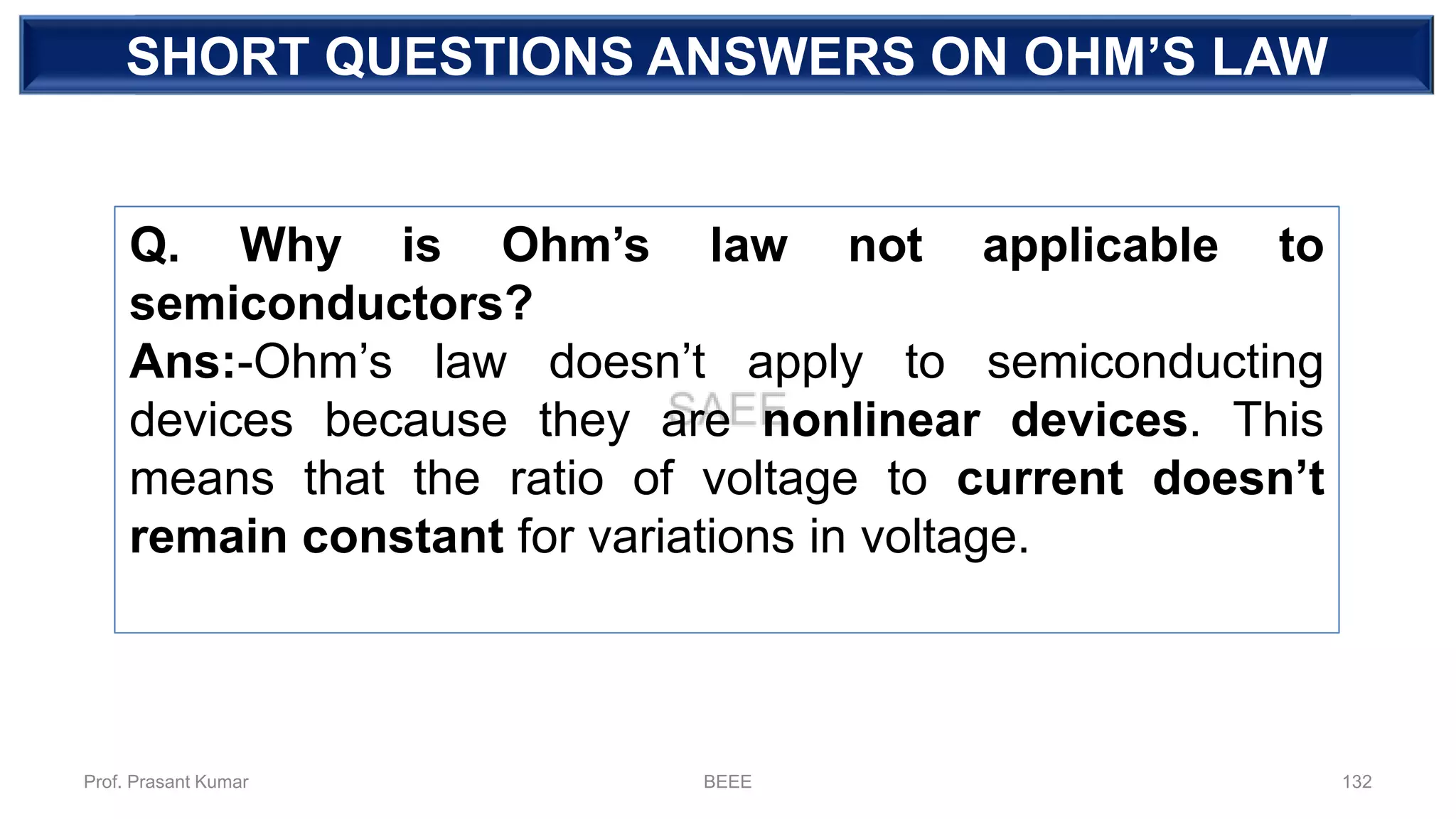
Q. Why is Ohm’s law not applicable to
semiconductors?
Ans:-Ohm’s law doesn’t apply to semiconducting
devices because they are nonlinear devices. This
means that the ratio of voltage to current doesn’t
remain constant for variations in voltage.
Prof. Prasant Kumar BEEE 132
DEPENDENT SOURCE
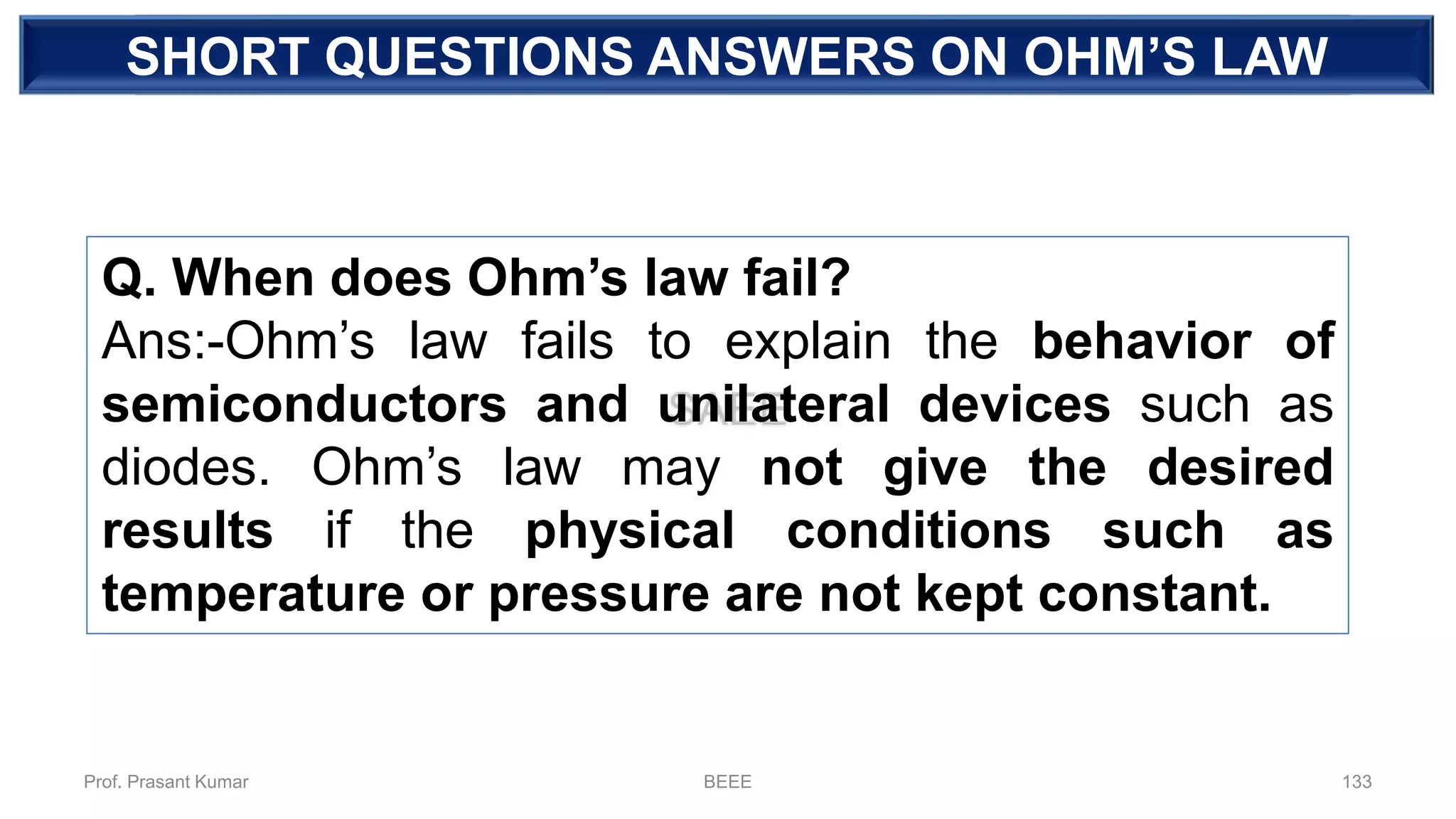
Q. When does Ohm’s law fail?
Ans:-Ohm’s law fails to explain the behavior of
semiconductors and unilateral devices such as
diodes. Ohm’s law may not give the desired
results if the physical conditions such as
temperature or pressure are not kept constant.
SHORT QUESTIONS ANSWERS ON OHM’S LAW
Prof. Prasant Kumar BEEE 133

BASIC ELECTRICAL ENGINEERING DC CIRCUITS UNIT 1 PART 1 NOTES

  • 1.
    BASICS OF ELECTRICAL ENGINEERING(1ST YEAR) INTRODUCTION TO “FUNDAMENTAL OF ELECTRICITY” (सरल भाषा में) LEC#01 Prof. Prasant Kumar BEEE 1
  • 2.
    FUNDAMENTAL OF ELECTRICITY LEC #02 Prof. Prasant Kumar BEEE 2
  • 3.
    1. Atom Model Atomsconsist of a nucleus made of protons and neutrons orbited by electrons. Atoms are the basic building block of all matters BASICS OF ELECTRICITY Prof. Prasant Kumar BEEE 3
  • 4.
    Fundamental of Electricity 2.Atom • Protons • Neutrons • Electrons “Each atom has the same number of protons and electrons.” BASICS OF ELECTRICITY Prof. Prasant Kumar BEEE 4
  • 5.
    3. Proton andElectron Protons carries positive charge – It is relatively large mass – Does not play active part in electrical current flow Electrons carries negative charge – Light mass – Play an important role in electrical current flow Fundamental of ElectricityBASICS OF ELECTRICITY Prof. Prasant Kumar BEEE 5
  • 6.
    4. Unit ofCharge • Unit of Charge is called Coulomb (C) • An electron and a proton have exactly same amount of charge • One coulomb of charge is equal to approximately 628 x 1016 electron charge Weeks 1 ~ 2 Fundamental of Electricity BASICS OF ELECTRICITY Prof. Prasant Kumar BEEE 6
  • 7.
    5. Free Electrons FreeElectrons Applying Heat or Light Fundamental of Electricity BASICS OF ELECTRICITY Prof. Prasant Kumar BEEE 7
  • 8.
    Fundamental of Electricity 6.Electrical Materials All material may be classified into three major classes: • Conductors (copper, aluminum, siliver, platinum, bronz, gold) • Insulators (glass, rubber, plastic, air, varnish, paper, wood, mica, ceramic, certain oils) • Semiconductors (germanium, silicon) BASICS OF ELECTRICITY Prof. Prasant Kumar BEEE 8
  • 9.
    Fundamental of Electricity 6.Electrical Materials • Conductors have many free electrons which will be drifting in a random manner within the material • Insulators have very few free electrons • Semiconductors falls somewhere between these two extremes BASICS OF ELECTRICITY Prof. Prasant Kumar BEEE 9
  • 10.
    BASICS OF ELECTRICALENGINEERING What is Electric CURRENT? विद्युत प्रिाह क्या है? Definition,Properties,Unit LEC#02 Prof. Prasant Kumar BEEE 10
  • 11.
    ❖ Electric currentis the movement, or flow of electrons through a conductive material. Fundamental of ElectricityWHAT IS ELECTRIC CURRENT ? Prof. Prasant Kumar BEEE 11
  • 12.
    Fundamental of ElectricityFORMULA& UNIT OF ELECTRIC CURRENT ❖ The electric current is the rate of charge flow i.e. charge/time. ❖ Since the charge is measured in coulombs & time in seconds ❖ The unit of electric current becomes coulombs/sec. ❖ The SI unit of electric current is Ampere (A). Electric Current (I) = Charge (Q) / Time (t) Prof. Prasant Kumar BEEE 12
  • 13.
    Fundamental of ElectricityCONVENTIONOF CURRENT FLOW Prof. Prasant Kumar BEEE 13
  • 14.
    Fundamental of ElectricityTYPESOF CURRENT CURRENT AC DC Prof. Prasant Kumar BEEE 14
  • 15.
    Fundamental of ElectricityBASICSOF ELECTRICITY ❖ The type of electric current whose direction changes continuously throughout the time is called alternating current or AC. Prof. Prasant Kumar BEEE 15
  • 16.
    Fundamental of ElectricityBASICSOF ELECTRICITY ❖ The direct current is a type of electric current whose direction does not change & conventionally. ❖ It flows from the positive terminal of the battery to the negative terminal of the battery. Prof. Prasant Kumar BEEE 16
  • 17.
    17Prof. Prasant KumarBEEE THANKS TO ALL FOR ANY PROBLEN FEEL FREE TO VISIT YOUTUBE FOR DETAIL UNDERSTANDING @.
  • 18.
    BASICS OF ELECTRICALENGINEERING Electromotive Force (EMF),Electric Potential & Potential Difference में समानता और अंतर. LEC#03 Prof. Prasant Kumar BEEE 18
  • 19.
    Fundamental of ElectricityELECTROMOTIVEFORCE (EMF) Prof. Prasant Kumar BEEE 19
  • 20.
    Fundamental of ElectricityROLEOF EMF IN CIRCUIT Prof. Prasant Kumar BEEE 20
  • 21.
    ❖ Typical sourcesof emf are cells, batteries and generators. ❖ The amount of current that will flow through a circuit is related to the size of the emf applied to it. Fundamental of Electricity SOURCES OF EMF Higher Potential Lower Potential Prof. Prasant Kumar BEEE 21
  • 22.
    ELECTRIC POTENTIAL ❖ Anelectric potential is also called the electric field potential, potential drop, or the electrostatic potential. ❖ “It is the amount of work needed to move a unit of electric charge from a reference point to a specific point in an electric field without producing an acceleration”. Prof. Prasant Kumar BEEE 22
  • 23.
  • 24.
    ELECTRIC POTENTIAL DIFFERENCE ❖The electric potential difference between points A and B, is VB−VA, is defined to be the change in potential energy of a charge q moved from A to B, divided by the charge. ❖ Unit of potential difference is joules per coulomb, given the name volt (V) after Alessandro Volta. 1V = 1 J/C Prof. Prasant Kumar BEEE 24
  • 25.
  • 26.
  • 27.
    BASICS OF ELECTRICALENGINEERING ELECTRICAL SOURCE AND TYPES विद्युत स्रोत के प्रकार VOLAGE,CURRENT,IDEAL&PRACTICAL SOURCE LEC#04 Prof. Prasant Kumar BEEE 27
  • 28.
    ELECTRIC SOURCE An electricalsupply or simply, “a source”, is a device that “supplies electrical power to a circuit in the form of a voltage source or a current source”. Prof. Prasant Kumar BEEE 28
  • 29.
  • 30.
    TYPES OF ELECTRICSOURCE Prof. Prasant Kumar BEEE 30
  • 31.
  • 32.
    BASICS OF ELECTRICALENGINEERING AC SOURCE & DC SOURCE क्या है? समानता और अंतर LEC#05 Prof. Prasant Kumar BEEE 32
  • 33.
    AC SOURCE ❖ Alternatingcurrent (ac) is the flow of electric charge that periodically reverses direction. Prof. Prasant Kumar BEEE 33
  • 34.
  • 35.
  • 36.
    DC SOURCE ❖ DCsources refer to sources of electrical energy which are associated with constant voltages and currents. ❖ Direct current is the one directional or unidirectional flow electric charge. Prof. Prasant Kumar BEEE 36
  • 37.
  • 38.
    SYMBOL OF VOLTAGESOURCE Prof. Prasant Kumar BEEE 38
  • 39.
    SYMBOL OF CURRENTSOURCE Prof. Prasant Kumar BEEE 39
  • 40.
    COMPARISION BETWEEN AC& DC SOURCE Prof. Prasant Kumar BEEE 40
  • 41.
    BASICS OF ELECTRICALENGINEERING DEPENDENT SOURCE & INDEPENDENT SOURCE क्या है? LEC#06 Prof. Prasant Kumar BEEE 41
  • 42.
    ELECTRIC SOURCE SOURCE DEPENDENT SOURCE Voltage control voltagesource (VCVS) Voltage control current source (VCCS) current control voltage source (CCVS) current control current source (CCCS) INDEPENDENT SOURCE Prof. Prasant Kumar BEEE 42
  • 43.
    INDEPENDENT SOURCE ❖ Inthe theory of electrical networks, an independent source is a voltage source or a current source whose value does not depend on a voltage or current elsewhere in the network. ❖ An independent voltage/current source is an idealized circuit component that fixes the voltage or current in a branch, respectively, to a specified value. Prof. Prasant Kumar BEEE 43
  • 44.
    DEPENDENT SOURCE ❖ Inthe theory of electrical networks, a dependent source is a voltage source or a current source whose value depends on a voltage or current elsewhere in the network. ❖ Dependent sources are useful, for example, in modeling the behavior of amplifiers. Prof. Prasant Kumar BEEE 44
  • 45.
    VOLTAGE CONTROLLED VOLTAGESOURCE (VCVS) ❖ The source delivers the voltage as per the voltage of the dependent element. Prof. Prasant Kumar BEEE 45
  • 46.
    VOLTAGE CONTROLLED VOLTAGESOURCE (VCVS) SYMBOL OF VCVS Prof. Prasant Kumar BEEE 46
  • 47.
    DEPENDENT SOURCEVOLTAGE CONTROLLEDCURRENT SOURCE (VCCS) ❖ The source delivers the current as per the voltage of the dependent element. Prof. Prasant Kumar BEEE 47
  • 48.
    DEPENDENT SOURCEVOLTAGE CONTROLLEDCURRENT SOURCE (VCCS) SYMBOL OF VCCS Prof. Prasant Kumar BEEE 48
  • 49.
    DEPENDENT SOURCECURRENT CONTROLLEDCURRENT SOURCE (CCCS) ❖ The source delivers the current as per the current of the dependent element. Prof. Prasant Kumar BEEE 49
  • 50.
    CURRENT CONTROLLED CURRENTSOURCE (CCCS) SYMBOL OF CCCS Prof. Prasant Kumar BEEE 50
  • 51.
    DEPENDENT SOURCECURRENT CONTROLLEDVOLTAGE SOURCE (CCVS) ❖ The source delivers the voltage as per the current of the dependent element. Prof. Prasant Kumar BEEE 51
  • 52.
    DEPENDENT SOURCECURRENT CONTROLLEDVOLTAGE SOURCE (CCVS) SYMBOL OF CCVS Prof. Prasant Kumar BEEE 52
  • 53.
    DEPENDENT SOURCEEXAMPLE OFDEPENDENT & INDEPENDENT SOURCE Prof. Prasant Kumar BEEE 53
  • 54.
    BASICS OF ELECTRICALENGINEERING VOLTAGE SOURCE & CURRENT SOURCE क्या है? CIRCUIT DIAGRAM & SYMBOL LEC#07 IN हहंINGLISH Prof. Prasant Kumar BEEE 54
  • 55.
    SOURCE & TYPES ELECTRICAL SOURCE VoltageSource Ideal Voltage Source Practical Voltage Source Current Source Ideal Current Source Practical Current Source Prof. Prasant Kumar BEEE 55
  • 56.
    DEPENDENT SOURCEVOLTAGE SOURCE ❖A voltage source, such as a battery or generator, provides a potential difference (voltage) between two points within an electrical circuit allowing current to flowing around it. IDEAL VOLTAGE SOURCE PRACTICAL VOLTAGE SOURCE Prof. Prasant Kumar BEEE 56
  • 57.
    DEPENDENT SOURCECURRENT SOURCE ❖A current source is an electronic circuit that delivers or absorbs an electric current. ❖ A current source is the dual of a voltage source. IDEAL CURRENT SOURCE PRACTICAL CURRENT SOURCE Prof. Prasant Kumar BEEE 57
  • 58.
    BASICS OF ELECTRICALENGINEERING IDEAL VOLTAGE SOURCE & PRACTICAL VOLTAGE SOURCE क्या है? LEC#08 IN हहंINGLISH Prof. Prasant Kumar BEEE 58
  • 59.
    DEPENDENT SOURCEIDEAL VOLTAGESOURCE ❖ A voltage source is a two-terminal device whose voltage at any instant of time is constant and is independent of the current drawn from it. Internal Resistance Rin = 0 ohm Prof. Prasant Kumar BEEE 59
  • 60.
    DEPENDENT SOURCEPRACTICAL VOLTAGESOURCE ❖ A Practical voltage source is a compound of two ideal components: 1. An ideal voltage source 2. A series resistor V=VS− I.RS Prof. Prasant Kumar BEEE 60
  • 61.
    COMPARE IDEAL &PRACTICAL VOLTAGE SOURCE Prof. Prasant Kumar BEEE 61
  • 62.
    BASICS OF ELECTRICALENGINEERING IDEAL CURRENT SOURCE & PRACTICAL CURRENT SOURCE क्या है? LEC#09 Prof. Prasant Kumar BEEE 62
  • 63.
    DEPENDENT SOURCEIDEAL CURRENTSOURCE ❖ An ideal current source generates a current that is independent of the voltage changes across it. ❖ It has infinite resistance. Rin= ∞Ω Prof. Prasant Kumar BEEE 63
  • 64.
    DEPENDENT SOURCEPRACTICAL CURRENTSOURCE ❖ A practical current source is represented as an ideal current source connected with the resistance in parallel. ❖ Internal Resistance is connected in parallel with ideal current source. Rin Prof. Prasant Kumar BEEE 64
  • 65.
    DEPENDENT SOURCECOMPARE IDEAL& PRACTICAL CURRENT SOURCE Prof. Prasant Kumar BEEE 65
  • 66.
    DEPENDENT SOURCEIMPORTANT POINTTO DISCUSS Prof. Prasant Kumar BEEE 66
  • 67.
    BASICS OF ELECTRICALENGINEERING ELECTRICAL LOAD क्या है? RESISTOR,INDUCTOR & CAPACITOR LEC#10 IN हहंINGLISH Prof. Prasant Kumar BEEE 67
  • 68.
    DEPENDENT SOURCEELECTRICAL LOAD ❖Devices that are connected to the power system are referred to as electrical loads. ❖ Toasters, refrigerators, light bulb and many more are considered electrical loads. ❖ There are three types of electrical loads, they vary according to their leading or lagging time relationship between voltage and current. Prof. Prasant Kumar BEEE 68
  • 69.
    DEPENDENT SOURCETYPES OFELECTRICAL LOAD LOAD NATURE OF LOAD RESISTIVE INDUCTIVE CAPACITIVE POWER SYSTEM LOAD INDUSTRIAL DOMESTIC AGRICULTURAL Prof. Prasant Kumar BEEE 69
  • 70.
  • 71.
    BASICS OF ELECTRICALENGINEERING RESISTOR क्या है? ➢ DEFINITION ➢ TYPES OF RESISTOR ➢ COLOUR CODE ➢ PROPERTIES LEC#11 IN हहंINGLISH Prof. Prasant Kumar BEEE 71
  • 72.
    RESISTOR DEFINITION ❖ Aresistor is a passive two-terminal electrical component that implements electrical resistance as a circuit element. ❖ In electronic circuits, resistors are used to reduce current flow, adjust signal levels, to divide voltages, bias active elements, and terminate transmission lines, among other uses. Prof. Prasant Kumar BEEE 72
  • 73.
    DEPENDENT SOURCETYPES OFRESISTORS Prof. Prasant Kumar BEEE 73
  • 74.
  • 75.
    DEPENDENT SOURCERESISTOR COLOURCODE Prof. Prasant Kumar BEEE 75
  • 76.
    RESISTOR HEAT LOSS I2RT PASSIVE ELEMENT PROPERTY IS RESISTANCE SYMBOL ,R STATIC ELEMENT LINEAR ELEMENT NO HISTORY LUMPED ELEMENT UNIT IS OHM, OBEY’S OHMS LAW VOLTAGE DROP V=IR PROPERTIES OF RESISTOR
  • 77.
    DEPENDENT SOURCERESISTANCE ❖ Resistanceis the property of resistor that offers some obstruction to the current . ❖ Resistance is the 'opposition' to the current flow measured in ohms ( Ω ) Prof. Prasant Kumar BEEE 77
  • 78.
  • 79.
    BASICS OF ELECTRICALENGINEERING WHAT IS RESISTIVITY ? LEC#12 IN हहंINGLISH ρ=E/J Prof. Prasant Kumar BEEE 79
  • 80.
    DEPENDENT SOURCERESISTIVITY OFRESISTANCE ❖ Electric resistivity is defined as the electrical resistance offered per unit length and unit cross-sectional area at a specific temperature and is denoted by ρ. ❖ High resistivity designates poor conductors. ❖ Unit of resistivity is ohm-meter in MKS system and ohm-cm in CGS. ❖ Resistivity, commonly symbolized by the Greek letter rho, ρ. ρ=E/J ρ is the resistivity of the material in Ω.m E is the electric field in V.m-1 J is the current density in A.m-2 Where, Prof. Prasant Kumar BEEE 80
  • 81.
    DEPENDENT SOURCERESISTIVITY vsRESISTANCE Prof. Prasant Kumar BEEE 81
  • 82.
    DEPENDENT SOURCEPROPERTIES OFRESISTANCE ❖ The resistance R is definitely directly proportional to the length of the conductor. So, Resistance (R) ∝ L …….length of conductor (l) ……..Eqn (i) ❖ The resistance R is certainly inversely proportional to the area of cross- section of a particular conductor. Resistance (R) ∝ 1/A …….cross section of the conductor (A)…… Eqn (ii) Resistance (R) ∝ L/A ρ = Resistivity of materialProf. Prasant Kumar BEEE 82
  • 83.
    BASICS OF ELECTRICALENGINEERING SERIES & PARALLEL CONNECTION OF RESISTOR LEC#13 IN हहंINGLISH Prof. Prasant Kumar BEEE 83
  • 84.
    DEPENDENT SOURCESERIES CONNECTIONOF RESISTOR ❖ Resistors connected head-to-tail are in series. ❖ The equivalent overall resistance is the sum of the individual resistance values. Prof. Prasant Kumar BEEE 84
  • 85.
    DEPENDENT SOURCESERIES CONNECTIONOF RESISTOR Prof. Prasant Kumar BEEE 85
  • 86.
    DEPENDENT SOURCESERIES CONNECTIONOF RESISTOR Prof. Prasant Kumar BEEE 86
  • 87.
    PARALLEL CONNECTION OFRESISTOR Prof. Prasant Kumar BEEE 87
  • 88.
    PARALLEL CONNECTION OFRESISTOR Prof. Prasant Kumar BEEE 88
  • 89.
    DEPENDENT SOURCESERIES &PARALLE CONNECTION OF RESISTOR Prof. Prasant Kumar BEEE 89
  • 90.
  • 91.
    BASICS OF ELECTRICALENGINEERING WHAT IS CAPACITOR (संधाररत्र क्या है?) LEC#14 IN हहंINGLISH Prof. Prasant Kumar BEEE 91
  • 92.
    DEPENDENT SOURCECAPACITOR A capacitoris a device that stores electrical energy in an electric field. Prof. Prasant Kumar BEEE 92
  • 93.
    DEPENDENT SOURCECAPACITOR ❖ Thecapacitor is a device in which electrical energy can be stored. ❖ It is an arrangement of two-conductor generally carrying charges of equal magnitudes and opposite sign and separated by an insulating medium. Prof. Prasant Kumar BEEE 93
  • 94.
    DEPENDENT SOURCEWHAT ARECAPACITORS USED FOR? ❖ Storing electric potential energy such as batteries. ❖ Filtering out unwanted frequency signals. ❖ Delaying voltage changes when coupled with resistors. ❖ Used as a sensing device. ❖ Used in the audio system of the vehicle. ❖ Used to separate AC and DC. Application of Capacitor? Prof. Prasant Kumar BEEE 94
  • 95.
    DEPENDENT SOURCEWHAT ISINSIDE THE CAPACITOR ? Prof. Prasant Kumar BEEE 95
  • 96.
    DEPENDENT SOURCESYMBOL &UNIT OF CAPACITOR ❖ Unit of Capacitance: Farad (F) Commonly Used Scales •mF = 10-3F •μF = 10-6F •nF = 10-9F •pF = 10-12 Prof. Prasant Kumar BEEE 96
  • 97.
    DEPENDENT SOURCECAPACITANCE OFCAPACITOR ❖ The charge on the capacitor (Q) is directly proportional to the potential difference (V) between the plates. The constant of proportionality (C) is termed as the capacitance of the capacitor Q α V Q = CV Prof. Prasant Kumar BEEE 97
  • 98.
    DEPENDENT SOURCEFACTORS AFFECTINGTHE CAPACITANCE Capacitance depends on the following factor: 1.The area of the plates (A) 2.The distance between the plates (d) 3.The type of dielectric material 4.Temperature (T) Prof. Prasant Kumar BEEE 98
  • 99.
    DEPENDENT SOURCEPROPERTIES OFCAPACITOR CAPACITANCE (C) α Area of the two plates (A) CAPACITANCE (C) α I/d (d=Distance b/w parallel plates) Prof. Prasant Kumar BEEE 99
  • 100.
    DEPENDENT SOURCEHOW CAPACITORWORK ? Prof. Prasant Kumar BEEE 100
  • 101.
  • 102.
    DEPENDENT SOURCESERIES CONNECTIONOF CAPACITOR Prof. Prasant Kumar BEEE 102
  • 103.
    DEPENDENT SOURCEPARALLEL CONNECTIONOF CAPACITOR Prof. Prasant Kumar BEEE 103
  • 104.
    Q α V Q= CV Prof. Prasant Kumar BEEE 104
  • 105.
    BASICS OF ELECTRICALENGINEERING LEC#15 IN हहंINGLISH WHAT IS INDUCTOR? (प्रेरक या इंडक्टर क्या है?) Prof. Prasant Kumar BEEE 105
  • 106.
    WHAT IS INDUCTOR? ❖An inductor is a two-terminal electrical component that stores energy in a magnetic field when electric current flows through it. ❖प्रेरक या इंडक्टर (inductor) एक वैद्युत अवयव है जिसमें कोई ववद्युत धारा प्रवाहहत करने पर यह चुम्बकीय क्षेत्र के रूप में उिाा का भंडारण करता है। Prof. Prasant Kumar BEEE 106
  • 107.
    DEPENDENT SOURCEWHAT ISINDUCTOR? Prof. Prasant Kumar BEEE 107
  • 108.
    DEPENDENT SOURCEWHAT ISINDUCTANCE (प्रेरकत्ि )? ❖ Magnetic energy storage capacity of inductor is called Inductance ❖ Inductance (प्रेरकत्व) is the tendency of an electrical conductor to oppose a change in the electric current flowing through it. Prof. Prasant Kumar BEEE 108
  • 109.
    DEPENDENT SOURCESYMBOL OFTYPES OF INDUCTOR 1.Iron Core Inductor 2.Air Core Inductor 3.Iron Powder Inductor 4.Ferrite Core Inductor •Soft Ferrite •Hard Ferrite TYPES OF INDUCTOR Prof. Prasant Kumar BEEE 109
  • 110.
    DEPENDENT SOURCEUNIT OFINDUCTOR INDUCTANCE? UNIT OF INDUCTANCE IS HENRY (H) ONE HENRY is the value of self-inductance in a coil in which one volt is produced by a variation of the inducing current of one ampere per second Prof. Prasant Kumar BEEE 110
  • 111.
    DEPENDENT SOURCEIMPORTANT EQUATIONSOF INDUCTOR Prof. Prasant Kumar BEEE 111
  • 112.
    DEPENDENT SOURCEFACTORS AFFECTINGINDUCTANCE Prof. Prasant Kumar BEEE 112
  • 113.
  • 114.
    BASICS OF ELECTRICALENGINEERING LEC#16 IN हहंINGLISH SERIES & PARALLEL CONNECTION OF INDUCTORProf. Prasant Kumar BEEE 114
  • 115.
    DEPENDENT SOURCESERIES PARALLELCONNECTION OF INDUCTOR Prof. Prasant Kumar BEEE 115
  • 116.
    DEPENDENT SOURCESERIES CONNECTIONOF INDUCTOR Prof. Prasant Kumar BEEE 116
  • 117.
    SERIES CONNECTION OFINDUCTOR Prof. Prasant Kumar BEEE 117
  • 118.
    DEPENDENT SOURCEPARALLEL CONNECTIONOF INDUCTOR Prof. Prasant Kumar BEEE 118
  • 119.
    DEPENDENT SOURCEPARALLEL CONNECTIONOF INDUCTOR Prof. Prasant Kumar BEEE 119
  • 120.
    DEPENDENT SOURCESERIES -PARALLELCONNECTION OF INDUCTOR Prof. Prasant Kumar BEEE 120
  • 121.
    BASICS OF ELECTRICALENGINEERING LEC#17 IN हहंINGLISH OHM’S LAWProf. Prasant Kumar BEEE 121
  • 122.
    DEPENDENT SOURCEOHM’S LAW GeorgSimon Ohm, a German physicist was the first to verify Ohm’s law experimentally in 1828. Ohm’s law states the relationship between electric current (I) and potential difference (V). Prof. Prasant Kumar BEEE 122
  • 123.
    DEPENDENT SOURCEOHM’S LAWSTATEMENT “The current flowing through a conductor between two points is directly proportional to the voltage across the two points, provided all physical conditions and temperature, remain constant. Flowing current Voltage Prof. Prasant Kumar BEEE 123
  • 124.
    DEPENDENT SOURCEOHM’S LAWSTATEMENT Ohm’s Law Statement: Ohm’s law states that the voltage across a conductor is directly proportional to the current flowing through it, provided all physical conditions and temperature, remain constant. Voltage Flowing current Prof. Prasant Kumar BEEE 124
  • 125.
    DEPENDENT SOURCEOHM’S LAW Prof.Prasant Kumar BEEE 125
  • 126.
    DEPENDENT SOURCEOHM’S LAW Thevector form of Ohm's law used in electromagnetics and material science: J - Current density E - Electric field σ (sigma)=Conductivity. This reformulation of Ohm's law is due to Gustav Kirchhoff Prof. Prasant Kumar BEEE 126
  • 127.
    DEPENDENT SOURCEOHM’S LAW Prof.Prasant Kumar BEEE 127
  • 128.
    DEPENDENT SOURCEOHM’S LAWAPPLICATIONS ❖To determine the voltage, resistance or current of an electric circuit. ❖Ohm’s law is used to maintain the desired voltage drop across the electronic components. ❖Ohm’s law is also used in dc ammeter and other dc shunts to divert the current. Prof. Prasant Kumar BEEE 128
  • 129.
    DEPENDENT SOURCELIMITATIONS OFOHM’S LAW ❖Ohm’s law is not applicable for unilateral electrical elements like diodes and transistors as they allow the current to flow through in one direction only. ❖Not applicable for non-linear electrical elements. ❖Not Applicable for non metals Prof. Prasant Kumar BEEE 129
  • 130.
    DEPENDENT SOURCESHORT QUESTIONSANSWERS ON OHM’S LAW Q.What can Ohm’s Law be used for? Ans:-Ohm’s law is used to validate the static values of circuit components such as current levels, voltage supplies, and voltage drops. Prof. Prasant Kumar BEEE 130
  • 131.
    SHORT QUESTIONS ANSWERSON OHM’S LAW Q .Is Ohm’s Law Universal? Ans:-No. Ohm’s law is not a universal law. This is because ohm’s law is only applicable to ohmic conductors such as iron and copper but is not applicable to non-ohmic conductors such as semiconductors. Prof. Prasant Kumar BEEE 131
  • 132.
    DEPENDENT SOURCESHORT QUESTIONSANSWERS ON OHM’S LAW Q. Why is Ohm’s law not applicable to semiconductors? Ans:-Ohm’s law doesn’t apply to semiconducting devices because they are nonlinear devices. This means that the ratio of voltage to current doesn’t remain constant for variations in voltage. Prof. Prasant Kumar BEEE 132
  • 133.
    DEPENDENT SOURCE Q. Whendoes Ohm’s law fail? Ans:-Ohm’s law fails to explain the behavior of semiconductors and unilateral devices such as diodes. Ohm’s law may not give the desired results if the physical conditions such as temperature or pressure are not kept constant. SHORT QUESTIONS ANSWERS ON OHM’S LAW Prof. Prasant Kumar BEEE 133