EEE 1131
BASIC ELECTRICAL CIRCUITS
Course Credit 3.0
Nadim Reza
Lecturer, CSE, VU
Slide courtesy: Arifa Ferdousi, Assistant Professor, CSE, VU
BOOKS to Follow:
Author:
Robert L. Boylestad
Author:
Charles K. Alexander,
Matthew N.O. Sadiku
Author:
B. L. Theraja
A.K. Theraja
Fundamental Electrical Concept and Measuring Units
ENERGY
Energy is defined as the ability to do work. For instance, we’re
all familiar with light, heat, and electrical energy.
TYPES OF ENERGY
• Potential Energy
• Kinetic Energy
• Mechanical Energy
• Thermal Energy
• Light Energy
• Electrical Energy
Why Electrical Energy is chosen
over other form of energy?
•Transmission
•Distribution
•Conversion
Fundamental Electrical Concept and Measuring Units
What Is Electrical Energy?
Electrical energy is a form of energy resulting from the flow of electric charge
Unit of the electrical energy : Joule (or watt-second).
Example : Lightning, batteries and even electric eels are
examples of electrical energy in action!
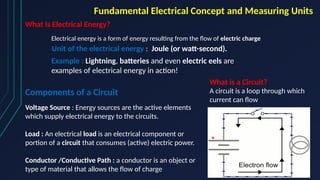
What is a Circuit?
A circuit is a loop through which
current can flow
Components of a Circuit
Voltage Source : Energy sources are the active elements
which supply electrical energy to the circuits.
Load : An electrical load is an electrical component or
portion of a circuit that consumes (active) electric power.
Conductor /Conductive Path : a conductor is an object or
type of material that allows the flow of charge
Fundamental Electrical Concept and Measuring Units
Charge
Charge is an electrical property of the atomic particles of which matter
consists, measured in coulombs (C).
Unit: Unit of Charge is Coulomb (C)
One coulomb of charge is the total charge associated with 6.242 X 10¹⁸
electrons
Types of Charge
Positive charge ( Proton )
Negative Charge ( electrons)
Properties of Charge :
1. Like Charges repel while unlike charges
attract each other.
2. Charge is transferrable.
3. Charge is always associated with mass
Fundamental Electrical Concept and Measuring Units
Properties of Charge :
4. The coulomb is a large unit for charges. In 1 C of charge, there are 1/ (1.602 × 10 -
19
) = 6.24 × 10 18
electrons. Thus realistic or laboratory values of charges are on the
order of pC, nC, or µ C.
5. Charge is quantized :According to experimental observations, the only charges
that occur in nature are integral multiples of the electronic charge e = -1.602 × 10 -19
C.
6. The law of conservation of charge states that charge can neither be created nor
destroyed, only transferred. Thus the algebraic sum of the electric charges in a
system does not change Valence Band,
Valence electrons
Conduction band ,
Conduction electrons or free e
lectrons.
(1min 40 sec )
Fundamental Electrical Concept and Measuring Units
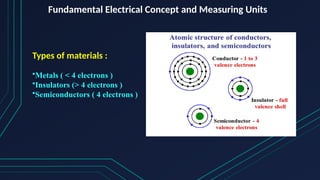
Types of materials :
•Metals ( < 4 electrons )
•Insulators (> 4 electrons )
•Semiconductors ( 4 electrons )
Fundamental Electrical Concept and Measuring Units
Electric Current
Electric current Theory
This is the rate at which free electrons can be
made to drift through a materials in a particular
direction.
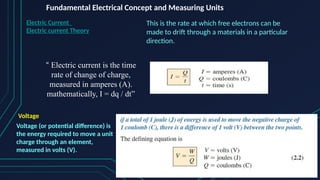
“ Electric current is the time
rate of change of charge,
measured in amperes (A).
mathematically, I = dq / dt”
Voltage
Voltage (or potential difference) is
the energy required to move a unit
charge through an element,
measured in volts (V).
Fundamental Electrical Concept and Measuring Units
Voltage Sources:
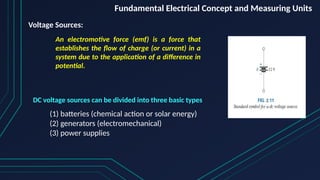
An electromotive force (emf) is a force that
establishes the flow of charge (or current) in a
system due to the application of a difference in
potential.
DC voltage sources can be divided into three basic types
(1) batteries (chemical action or solar energy)
(2) generators (electromechanical)
(3) power supplies
Fundamental Electrical Concept and Measuring Units
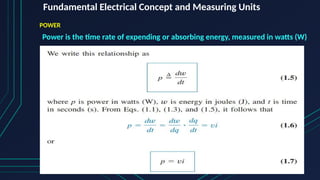
POWER
Power is the time rate of expending or absorbing energy, measured in watts (W)
Fundamental Electrical Concept and Measuring Units
POWER
If the power has a sign, power is being delivered to or absorbed by the element. If, on the other
hand, the power has a sign, power is being supplied by the element.
Circuit Element
An element is the basic building block of a circuit. An electric circuit is simply an interconnection of the
elements.
Circuit Analysis
Circuit analysis is the process of determining voltages across (or the currents through) the elements of
the circuit
Types of Circuit Element
There are two types of elements found
in electric circuits:
• passive elements and
• active elements.
Active Elements An active element is capable of
generating energy Typical active
elements include generators,
batteries, diode, transistor and
operational amplifiers
Passive Elements
Passive element is not capable of
generating energy Examples of
passive elements are resistors,
capacitors, and inductors.
Fundamental Electrical Concept and Measuring Units
Type of sources
• Independent sources
• Dependent sources
Ideal Independent Sources
An ideal independent source is an active element that provides a specified
voltage or current that is completely independent of other circuit elements.
Ideal dependent Sources
An ideal dependent (or controlled) source is an active element in which
the source quantity is controlled by another voltage or current
Fundamental Electrical Concept and Measuring Units
Four possible types of dependent sources, namely
1. A voltage-controlled voltage source (VCVS)
2. A current-controlled voltage source (CCVS)
3. A voltage-controlled current source (VCCS)
4. A current-controlled current source (CCCS)
Fundamental Electrical Concept and Measuring Units
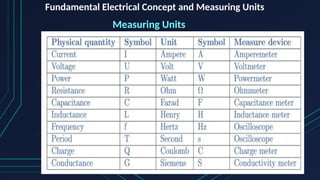
Measuring Units
RESISTOR
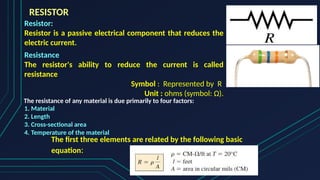
Resistor:
Resistor is a passive electrical component that reduces the
electric current.
Resistance
The resistor's ability to reduce the current is called
resistance
Symbol : Represented by R
Unit : ohms (symbol: Ω).
The resistance of any material is due primarily to four factors:
1. Material
2. Length
3. Cross-sectional area
4. Temperature of the material
The first three elements are related by the following basic
equation:
RESISTORS
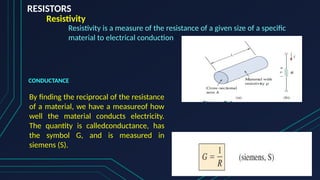
Resistivity
Resistivity is a measure of the resistance of a given size of a specific
material to electrical conduction
CONDUCTANCE
By finding the reciprocal of the resistance
of a material, we have a measureof how
well the material conducts electricity.
The quantity is calledconductance, has
the symbol G, and is measured in
siemens (S).
THERMISTORS
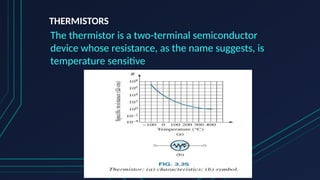
The thermistor is a two-terminal semiconductor
device whose resistance, as the name suggests, is
temperature sensitive
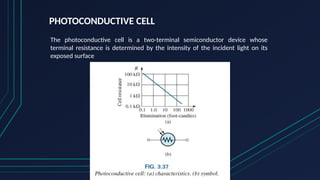
PHOTOCONDUCTIVE CELL
The photoconductive cell is a two-terminal semiconductor device whose
terminal resistance is determined by the intensity of the incident light on its
exposed surface
PRACTICAL APPLICATION OF RESISTOR
Resistance can be used to perform a variety of tasks, from heating to measuring
the stress or strain on a supporting member of a structure. In general, resistance is
a component of every electrical or electronic application.
1. Heating Element
2. Design Variable Resistors
3. LEDs Manufacturing
4. Frequency & Timing Devices
PRACTICAL APPLICATION OF THE MOTION OF ELECTRONS
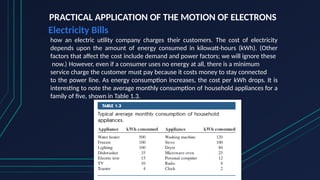
Electricity Bills
how an electric utility company charges their customers. The cost of electricity
depends upon the amount of energy consumed in kilowatt-hours (kWh). (Other
factors that affect the cost include demand and power factors; we will ignore these
now.) However, even if a consumer uses no energy at all, there is a minimum
service charge the customer must pay because it costs money to stay connected
to the power line. As energy consumption increases, the cost per kWh drops. It is
interesting to note the average monthly consumption of household appliances for a
family of five, shown in Table 1.3.
PRACTICAL APPLICATION OF THE MOTION OF ELECTRONS
Electricity Bills
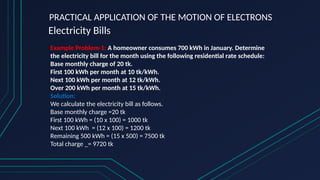
Example Problem-1: A homeowner consumes 700 kWh in January. Determine
the electricity bill for the month using the following residential rate schedule:
Base monthly charge of 20 tk.
First 100 kWh per month at 10 tk/kWh.
Next 100 kWh per month at 12 tk/kWh.
Over 200 kWh per month at 15 tk/kWh.
Solution:
We calculate the electricity bill as follows.
Base monthly charge =20 tk
First 100 kWh = (10 x 100) = 1000 tk
Next 100 kWh = (12 x 100) = 1200 tk
Remaining 500 kWh = (15 x 500) = 7500 tk
Total charge _= 9720 tk
HOME WORK
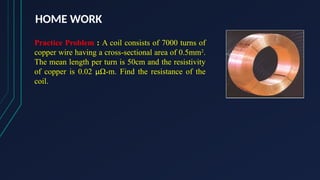
Practice Problem : A coil consists of 7000 turns of
copper wire having a cross-sectional area of 0.5mm2
.
The mean length per turn is 50cm and the resistivity
of copper is 0.02 µΩ-m. Find the resistance of the
coil.
Thank You

Basic Electrical Circuit in the Varendra University

  • 1.
    EEE 1131 BASIC ELECTRICALCIRCUITS Course Credit 3.0 Nadim Reza Lecturer, CSE, VU Slide courtesy: Arifa Ferdousi, Assistant Professor, CSE, VU
  • 2.
    BOOKS to Follow: Author: RobertL. Boylestad Author: Charles K. Alexander, Matthew N.O. Sadiku Author: B. L. Theraja A.K. Theraja
  • 3.
    Fundamental Electrical Conceptand Measuring Units ENERGY Energy is defined as the ability to do work. For instance, we’re all familiar with light, heat, and electrical energy. TYPES OF ENERGY • Potential Energy • Kinetic Energy • Mechanical Energy • Thermal Energy • Light Energy • Electrical Energy Why Electrical Energy is chosen over other form of energy? •Transmission •Distribution •Conversion
  • 4.
    Fundamental Electrical Conceptand Measuring Units What Is Electrical Energy? Electrical energy is a form of energy resulting from the flow of electric charge Unit of the electrical energy : Joule (or watt-second). Example : Lightning, batteries and even electric eels are examples of electrical energy in action! What is a Circuit? A circuit is a loop through which current can flow Components of a Circuit Voltage Source : Energy sources are the active elements which supply electrical energy to the circuits. Load : An electrical load is an electrical component or portion of a circuit that consumes (active) electric power. Conductor /Conductive Path : a conductor is an object or type of material that allows the flow of charge
  • 5.
    Fundamental Electrical Conceptand Measuring Units Charge Charge is an electrical property of the atomic particles of which matter consists, measured in coulombs (C). Unit: Unit of Charge is Coulomb (C) One coulomb of charge is the total charge associated with 6.242 X 10¹⁸ electrons Types of Charge Positive charge ( Proton ) Negative Charge ( electrons) Properties of Charge : 1. Like Charges repel while unlike charges attract each other. 2. Charge is transferrable. 3. Charge is always associated with mass
  • 6.
    Fundamental Electrical Conceptand Measuring Units Properties of Charge : 4. The coulomb is a large unit for charges. In 1 C of charge, there are 1/ (1.602 × 10 - 19 ) = 6.24 × 10 18 electrons. Thus realistic or laboratory values of charges are on the order of pC, nC, or µ C. 5. Charge is quantized :According to experimental observations, the only charges that occur in nature are integral multiples of the electronic charge e = -1.602 × 10 -19 C. 6. The law of conservation of charge states that charge can neither be created nor destroyed, only transferred. Thus the algebraic sum of the electric charges in a system does not change Valence Band, Valence electrons Conduction band , Conduction electrons or free e lectrons. (1min 40 sec )
  • 7.
    Fundamental Electrical Conceptand Measuring Units Types of materials : •Metals ( < 4 electrons ) •Insulators (> 4 electrons ) •Semiconductors ( 4 electrons )
  • 8.
    Fundamental Electrical Conceptand Measuring Units Electric Current Electric current Theory This is the rate at which free electrons can be made to drift through a materials in a particular direction. “ Electric current is the time rate of change of charge, measured in amperes (A). mathematically, I = dq / dt” Voltage Voltage (or potential difference) is the energy required to move a unit charge through an element, measured in volts (V).
  • 9.
    Fundamental Electrical Conceptand Measuring Units Voltage Sources: An electromotive force (emf) is a force that establishes the flow of charge (or current) in a system due to the application of a difference in potential. DC voltage sources can be divided into three basic types (1) batteries (chemical action or solar energy) (2) generators (electromechanical) (3) power supplies
  • 10.
    Fundamental Electrical Conceptand Measuring Units POWER Power is the time rate of expending or absorbing energy, measured in watts (W)
  • 11.
    Fundamental Electrical Conceptand Measuring Units POWER If the power has a sign, power is being delivered to or absorbed by the element. If, on the other hand, the power has a sign, power is being supplied by the element. Circuit Element An element is the basic building block of a circuit. An electric circuit is simply an interconnection of the elements. Circuit Analysis Circuit analysis is the process of determining voltages across (or the currents through) the elements of the circuit Types of Circuit Element There are two types of elements found in electric circuits: • passive elements and • active elements. Active Elements An active element is capable of generating energy Typical active elements include generators, batteries, diode, transistor and operational amplifiers Passive Elements Passive element is not capable of generating energy Examples of passive elements are resistors, capacitors, and inductors.
  • 12.
    Fundamental Electrical Conceptand Measuring Units Type of sources • Independent sources • Dependent sources Ideal Independent Sources An ideal independent source is an active element that provides a specified voltage or current that is completely independent of other circuit elements. Ideal dependent Sources An ideal dependent (or controlled) source is an active element in which the source quantity is controlled by another voltage or current
  • 13.
    Fundamental Electrical Conceptand Measuring Units Four possible types of dependent sources, namely 1. A voltage-controlled voltage source (VCVS) 2. A current-controlled voltage source (CCVS) 3. A voltage-controlled current source (VCCS) 4. A current-controlled current source (CCCS)
  • 14.
    Fundamental Electrical Conceptand Measuring Units Measuring Units
  • 15.
    RESISTOR Resistor: Resistor is apassive electrical component that reduces the electric current. Resistance The resistor's ability to reduce the current is called resistance Symbol : Represented by R Unit : ohms (symbol: Ω). The resistance of any material is due primarily to four factors: 1. Material 2. Length 3. Cross-sectional area 4. Temperature of the material The first three elements are related by the following basic equation:
  • 16.
    RESISTORS Resistivity Resistivity is ameasure of the resistance of a given size of a specific material to electrical conduction CONDUCTANCE By finding the reciprocal of the resistance of a material, we have a measureof how well the material conducts electricity. The quantity is calledconductance, has the symbol G, and is measured in siemens (S).
  • 17.
    THERMISTORS The thermistor isa two-terminal semiconductor device whose resistance, as the name suggests, is temperature sensitive
  • 18.
    PHOTOCONDUCTIVE CELL The photoconductivecell is a two-terminal semiconductor device whose terminal resistance is determined by the intensity of the incident light on its exposed surface
  • 19.
    PRACTICAL APPLICATION OFRESISTOR Resistance can be used to perform a variety of tasks, from heating to measuring the stress or strain on a supporting member of a structure. In general, resistance is a component of every electrical or electronic application. 1. Heating Element 2. Design Variable Resistors 3. LEDs Manufacturing 4. Frequency & Timing Devices
  • 20.
    PRACTICAL APPLICATION OFTHE MOTION OF ELECTRONS Electricity Bills how an electric utility company charges their customers. The cost of electricity depends upon the amount of energy consumed in kilowatt-hours (kWh). (Other factors that affect the cost include demand and power factors; we will ignore these now.) However, even if a consumer uses no energy at all, there is a minimum service charge the customer must pay because it costs money to stay connected to the power line. As energy consumption increases, the cost per kWh drops. It is interesting to note the average monthly consumption of household appliances for a family of five, shown in Table 1.3.
  • 21.
    PRACTICAL APPLICATION OFTHE MOTION OF ELECTRONS Electricity Bills Example Problem-1: A homeowner consumes 700 kWh in January. Determine the electricity bill for the month using the following residential rate schedule: Base monthly charge of 20 tk. First 100 kWh per month at 10 tk/kWh. Next 100 kWh per month at 12 tk/kWh. Over 200 kWh per month at 15 tk/kWh. Solution: We calculate the electricity bill as follows. Base monthly charge =20 tk First 100 kWh = (10 x 100) = 1000 tk Next 100 kWh = (12 x 100) = 1200 tk Remaining 500 kWh = (15 x 500) = 7500 tk Total charge _= 9720 tk
  • 22.
    HOME WORK Practice Problem: A coil consists of 7000 turns of copper wire having a cross-sectional area of 0.5mm2 . The mean length per turn is 50cm and the resistivity of copper is 0.02 µΩ-m. Find the resistance of the coil.
  • 23.