Introduction
• Electric circuittheory and electromagnetic theory are the two
fundamental theories upon which all branches of electrical
engineering are built.
• Many branches of electrical engineering, such as power, electric
machines, control, electronics, communications, and
instrumentation, are based on electric circuit theory. Therefore,
the basic electric circuit theory course is the most important
course for an electrical engineering student, and always an
excellent starting point for a beginning student in electrical
engineering education.
3.
Introduction
• Circuit theoryis also valuable to students specializing in
other branches of the physical sciences because circuits are
a good model for the study of energy systems in general,
and because of the applied mathematics, physics, and
topology involved.
• We are often interested in communicating or transferring
energy from one point to another. To do this requires an
interconnection of electrical devices.
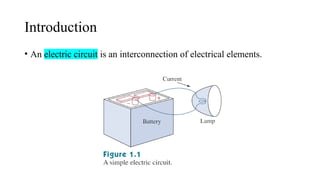
• Such interconnection is referred to as an electric circuit, and
each component of the circuit is known as an element.
4.
Introduction
• Circuit theoryis also valuable to students
specializing in other branches of the physical
sciences because circuits are a good model for the
study of energy systems in general, and because of
the applied mathematics, physics, and topology
involved.
• we are often interested in communicating or
transferring energy from one point to another. To do
this requires an interconnection of electrical devices.
Charge and Current
•The concept of electric charge is the underlying principle for
explaining all electrical phenomena. Which is the most basic quantity
in an electric circuit is the electric charge.
• Charge is an electrical property of the atomic particles of which matter
consists, measured in coulombs (C).
• All matter is made of fundamental building blocks known as atoms
and that each atom consists of electrons, protons, and neutrons.
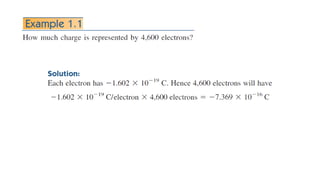
• We also know that the charge e on an electron is negative and equal in
magnitude to 1.602x10^19.
9.
Charge and Current
•The following points should be noted about electric charge:
1. The coulomb is a large unit for charges. In 1 C of charge, there
are 1/(1.602x10^-19) = 6.24x10^18 electrons. Thus realistic or
laboratory values of charges are on the order of pC, nC, or C.
2. According to experimental observations, the only charges that
occur in nature are integral multiples of the electronic charge
3. The law of conservation of charge states that charge can
neither be created nor destroyed, only transferred. Thus the
algebraic sum of the electric charges in a system does not
change.uld be noted about electric charge:
10.
Charge and Current
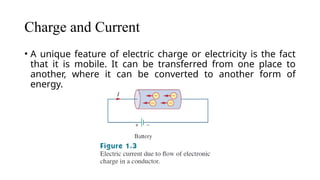
•A unique feature of electric charge or electricity is the fact
that it is mobile. It can be transferred from one place to
another, where it can be converted to another form of
energy.
11.
Charge and Current
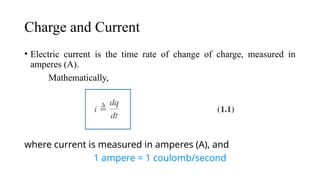
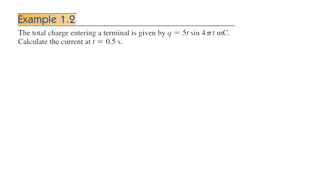
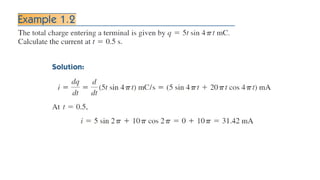
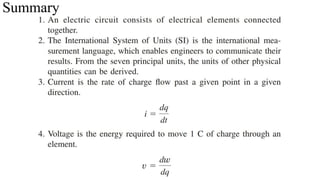
•Electric current is the time rate of change of charge, measured in
amperes (A).
Mathematically,
where current is measured in amperes (A), and
1 ampere = 1 coulomb/second
12.
Charge and Current
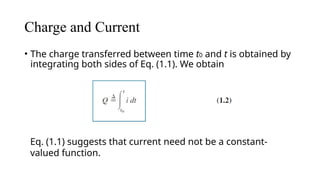
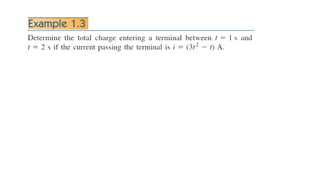
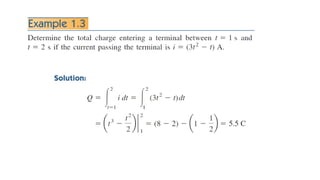
•The charge transferred between time t0 and t is obtained by
integrating both sides of Eq. (1.1). We obtain
Eq. (1.1) suggests that current need not be a constant-
valued function.
13.
Charge and Current
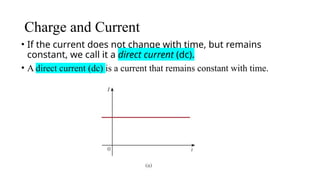
•If the current does not change with time, but remains
constant, we call it a direct current (dc).
• A direct current (dc) is a current that remains constant with time.
14.
Charge and Current
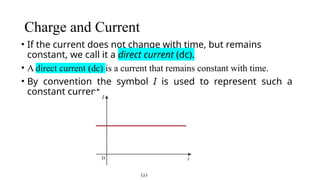
•If the current does not change with time, but remains
constant, we call it a direct current (dc).
• A direct current (dc) is a current that remains constant with time.
• By convention the symbol I is used to represent such a
constant current.
15.
Charge and Current
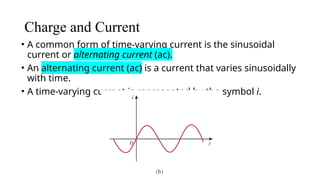
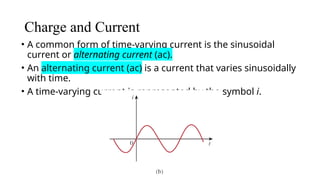
•A common form of time-varying current is the sinusoidal
current or alternating current (ac).
• An alternating current (ac) is a current that varies sinusoidally
with time.
• A time-varying current is represented by the symbol i.
16.
Charge and Current
•A common form of time-varying current is the sinusoidal
current or alternating current (ac).
• An alternating current (ac) is a current that varies sinusoidally
with time.
• A time-varying current is represented by the symbol i.
17.
Charge and Current
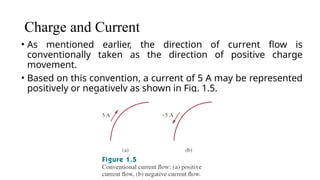
•As mentioned earlier, the direction of current flow is
conventionally taken as the direction of positive charge
movement.
• Based on this convention, a current of 5 A may be represented
positively or negatively as shown in Fig. 1.5.
24.
Voltage
• To movethe electron in a conductor in a particular direction
requires some work or energy transfer. This work is
performed by an external electromotive force (emf), typically
represented by a battery.
• This emf is also known as voltage or potential difference.
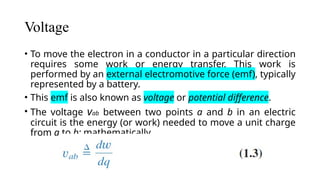
• The voltage vab between two points a and b in an electric
circuit is the energy (or work) needed to move a unit charge
from a to b; mathematically,
25.
Voltage
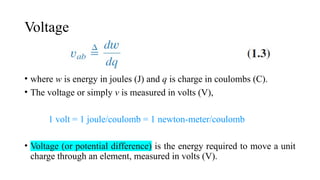
• where wis energy in joules (J) and q is charge in coulombs (C).
• The voltage or simply v is measured in volts (V),
1 volt = 1 joule/coulomb = 1 newton-meter/coulomb
• Voltage (or potential difference) is the energy required to move a unit
charge through an element, measured in volts (V).
26.
Voltage
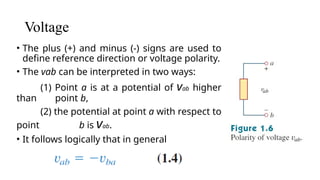
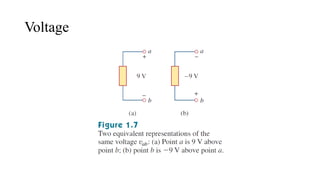
• The plus(+) and minus (-) signs are used to
define reference direction or voltage polarity.
• The vab can be interpreted in two ways:
(1) Point a is at a potential of vab higher
than point b,
(2) the potential at point a with respect to
point b is vab.
• It follows logically that in general
Voltage
• Like electriccurrent, a constant voltage is called a dc voltage and is
represented by V, whereas a sinusoidally time-varying voltage is called
an ac voltage and is represented by v.
• A dc voltage is commonly produced by a battery.
• ac voltage is produced by an electric generator.
Keep in mind that electric current is always through an element and that
electric voltage is always across the element or between two points.
29.
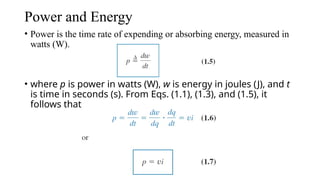
Power and Energy
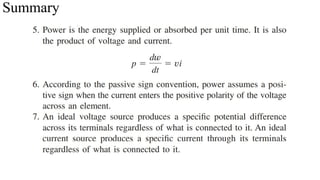
•Power is the time rate of expending or absorbing energy, measured in
watts (W).
• where p is power in watts (W), w is energy in joules (J), and t
is time in seconds (s). From Eqs. (1.1), (1.3), and (1.5), it
follows that
30.
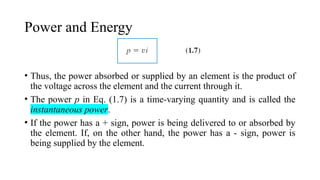
Power and Energy
•Thus, the power absorbed or supplied by an element is the product of
the voltage across the element and the current through it.
• The power p in Eq. (1.7) is a time-varying quantity and is called the
instantaneous power.
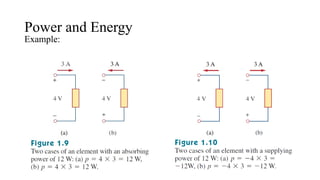
• If the power has a + sign, power is being delivered to or absorbed by
the element. If, on the other hand, the power has a - sign, power is
being supplied by the element.
31.
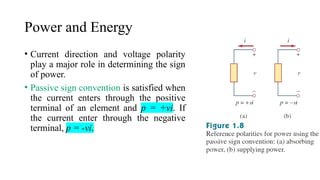
Power and Energy
•Current direction and voltage polarity
play a major role in determining the sign
of power.
• Passive sign convention is satisfied when
the current enters through the positive
terminal of an element and p = +vi. If
the current enter through the negative
terminal, p = -vi.
Power and Energy
Ingeneral,
+ Power absorbed = - Power supplied
• The law of conservation of energy must be obeyed in any
electric circuit.
34.
Power and Energy
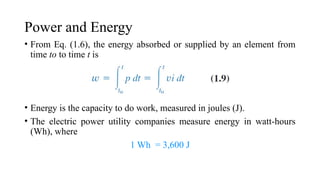
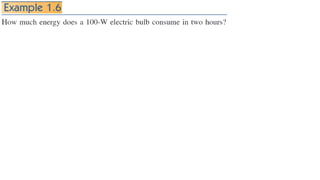
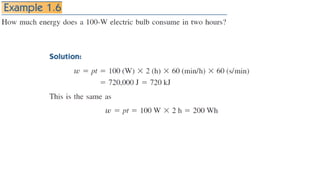
•From Eq. (1.6), the energy absorbed or supplied by an element from
time to to time t is
• Energy is the capacity to do work, measured in joules (J).
• The electric power utility companies measure energy in watt-hours
(Wh), where
1 Wh = 3,600 J
35.
Power and Energy
Ingeneral,
+ Power absorbed = - Power supplied
• The law of conservation of energy must be obeyed in any
electric circuit.
42.
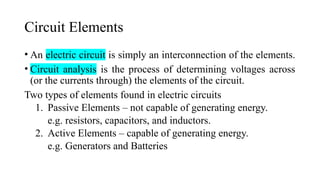
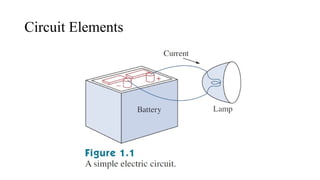
Circuit Elements
• Anelectric circuit is simply an interconnection of the elements.
• Circuit analysis is the process of determining voltages across
(or the currents through) the elements of the circuit.
Two types of elements found in electric circuits
1. Passive Elements – not capable of generating energy.
e.g. resistors, capacitors, and inductors.
2. Active Elements – capable of generating energy.
e.g. Generators and Batteries
Circuit Elements
• Themost important active elements are voltage or current
sources that generally deliver power to the circuit connected
to them.
• There are two kinds of sources:
1.Ideal Independent Source is an active element that
provides a specified voltage or current that is completely
independent of other circuit elements
2.Ideal Dependent Sources ideal dependent (or controlled)
source is an active element in which the source quantity is
controlled by another voltage or current.
45.
Circuit Elements
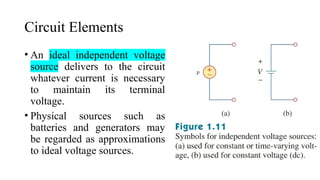
• Anideal independent voltage
source delivers to the circuit
whatever current is necessary
to maintain its terminal
voltage.
• Physical sources such as
batteries and generators may
be regarded as approximations
to ideal voltage sources.
46.
Circuit Elements
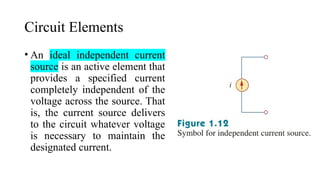
• Anideal independent current
source is an active element that
provides a specified current
completely independent of the
voltage across the source. That
is, the current source delivers
to the circuit whatever voltage
is necessary to maintain the
designated current.
47.
Circuit Elements
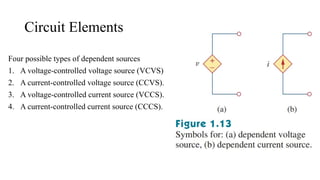
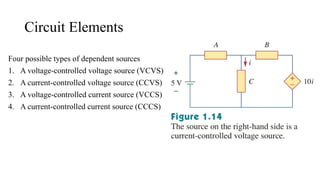
Four possibletypes of dependent sources
1. A voltage-controlled voltage source (VCVS)
2. A current-controlled voltage source (CCVS).
3. A voltage-controlled current source (VCCS).
4. A current-controlled current source (CCCS).
48.
Circuit Elements
Four possibletypes of dependent sources
1. A voltage-controlled voltage source (VCVS)
2. A current-controlled voltage source (CCVS)
3. A voltage-controlled current source (VCCS)
4. A current-controlled current source (CCCS)
50.
Application
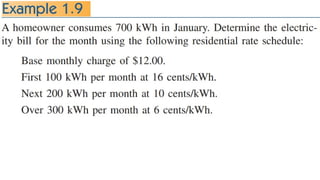
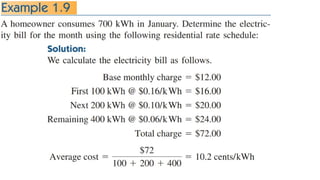
• Electricity Bills
•The cost of electricity depends upon the amount of energy
consumed in kilowatt-hours (kWh).
• However, even if a consumer uses no energy at all, there is
a minimum service charge the customer must pay because
it costs money to stay connected to the power line.
• As energy consumption increases, the cost per kWh drops.


![UNIT-I Final (1)[1].pptfgcvhvjgbjhbjgbjhhvhvhvh](https://cdn.slidesharecdn.com/ss_thumbnails/unit-ifinal11-251129122433-e786871d-thumbnail.jpg?width=640&height=640&fit=bounds)


