INFINITE BUS BAR IN
POWER SYSTEM
SUBMITTED TO SUBMITTED BY
PROF. J. SANDEEP SONI EKLAVYA SHARMA
INFINITE BUS
 Infinite bus bar is one which keeps constant voltage and
frequency although the load varies. Thus it may behave like a
voltage source with zero internal impedance and infinite
rotational inertia.
 Any alternator switched on to or off, the infinite bus does not
cause any change in the voltage and frequency of the system.
EXAMPLE OF INFINITE BUS
 When number of alternators are interconnected forming a
system can be considered as an infinite bus.
 Any alternator switched on to or off, the infinite bus does not
cause any change in the voltage and frequency of the system.
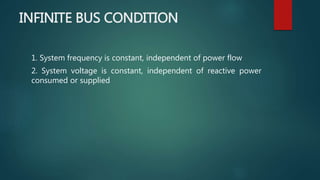
INFINITE BUS CONDITION
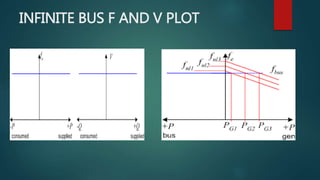
1. System frequency is constant, independent of power flow
2. System voltage is constant, independent of reactive power
consumed or supplied
INFINITE BUS F AND V PLOT
OPERATING A GENERATOR
CONNECTED TO AN INFINITE BUS
If a generator is operated off an infinite bus:
1. Terminal voltage and frequency (and hence speed) are
constant
2. The no-load settings of the mechanical system governor can
be adjusted to supply more or less power
PHASOR DIAGRAMS
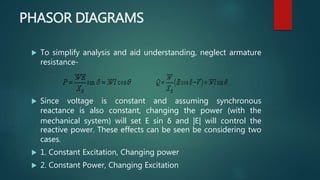
 To simplify analysis and aid understanding, neglect armature
resistance-
 Since voltage is constant and assuming synchronous
reactance is also constant, changing the power (with the
mechanical system) will set E sin δ and |E| will control the
reactive power. These effects can be seen be considering two
cases.
 1. Constant Excitation, Changing power
 2. Constant Power, Changing Excitation
SYNCHRONOUS MACHINE ON
INFINITE BUS-BARS
 A synchronous machine connected to a network having zero
impedance and infinite rotational inertias said to be operating
on infinite bus-bars.
 Practically all synchronous motors and generators in normal
industrial use on large power supply systems can be
considered as connected to infinite bus-bars.
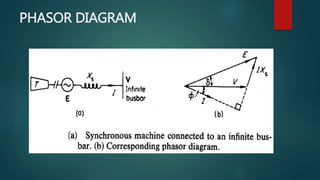
PHASOR DIAGRAM
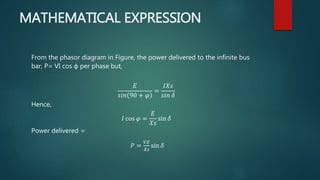
MATHEMATICAL EXPRESSION
From the phasor diagram in Figure, the power delivered to the infinite bus
bar, P= VI cos φ per phase but,
𝐸
𝑠𝑖𝑛 90 + 𝜑
=
𝐼𝑋𝑠
𝑠𝑖𝑛 𝛿
Hence,
𝐼 cos 𝜑 =
𝐸
𝑋𝑠
sin 𝛿
Power delivered =
𝑃 =
𝑉𝐸
𝑋𝑠
sin 𝛿

Infinite bus bar in power system

  • 1.
    INFINITE BUS BARIN POWER SYSTEM SUBMITTED TO SUBMITTED BY PROF. J. SANDEEP SONI EKLAVYA SHARMA
  • 2.
    INFINITE BUS  Infinitebus bar is one which keeps constant voltage and frequency although the load varies. Thus it may behave like a voltage source with zero internal impedance and infinite rotational inertia.  Any alternator switched on to or off, the infinite bus does not cause any change in the voltage and frequency of the system.
  • 3.
    EXAMPLE OF INFINITEBUS  When number of alternators are interconnected forming a system can be considered as an infinite bus.  Any alternator switched on to or off, the infinite bus does not cause any change in the voltage and frequency of the system.
  • 4.
    INFINITE BUS CONDITION 1.System frequency is constant, independent of power flow 2. System voltage is constant, independent of reactive power consumed or supplied
  • 5.
    INFINITE BUS FAND V PLOT
  • 6.
    OPERATING A GENERATOR CONNECTEDTO AN INFINITE BUS If a generator is operated off an infinite bus: 1. Terminal voltage and frequency (and hence speed) are constant 2. The no-load settings of the mechanical system governor can be adjusted to supply more or less power
  • 7.
    PHASOR DIAGRAMS  Tosimplify analysis and aid understanding, neglect armature resistance-  Since voltage is constant and assuming synchronous reactance is also constant, changing the power (with the mechanical system) will set E sin δ and |E| will control the reactive power. These effects can be seen be considering two cases.  1. Constant Excitation, Changing power  2. Constant Power, Changing Excitation
  • 8.
    SYNCHRONOUS MACHINE ON INFINITEBUS-BARS  A synchronous machine connected to a network having zero impedance and infinite rotational inertias said to be operating on infinite bus-bars.  Practically all synchronous motors and generators in normal industrial use on large power supply systems can be considered as connected to infinite bus-bars.
  • 9.
  • 10.
    MATHEMATICAL EXPRESSION From thephasor diagram in Figure, the power delivered to the infinite bus bar, P= VI cos φ per phase but, 𝐸 𝑠𝑖𝑛 90 + 𝜑 = 𝐼𝑋𝑠 𝑠𝑖𝑛 𝛿 Hence, 𝐼 cos 𝜑 = 𝐸 𝑋𝑠 sin 𝛿 Power delivered = 𝑃 = 𝑉𝐸 𝑋𝑠 sin 𝛿