FUNDAMENTALS OF ELECTRICAL
ENGINEERING
NTRODUCTION TO ELECTRIC CIRCUIT
S. P, Nanda
CONTENTS
 Introduction
 The International System of Units
 Current And Charge
 Voltage
 Power and Energy
Introduction :
An Overview of Electrical Engineering:
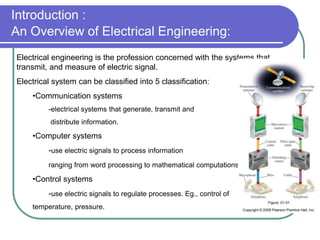
Electrical engineering is the profession concerned with the systems that
transmit, and measure of electric signal.
Electrical system can be classified into 5 classification:
•Communication systems
-electrical systems that generate, transmit and
distribute information.
•Computer systems
-use electric signals to process information
ranging from word processing to mathematical computations
•Control systems
-use electric signals to regulate processes. Eg., control of
temperature, pressure.
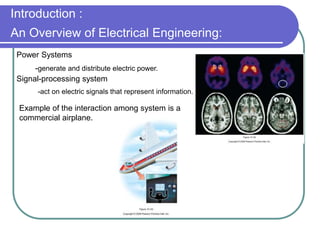
Power Systems
-generate and distribute electric power.
Signal-processing system
-act on electric signals that represent information.
Example of the interaction among system is a
commercial airplane.
Introduction :
An Overview of Electrical Engineering:
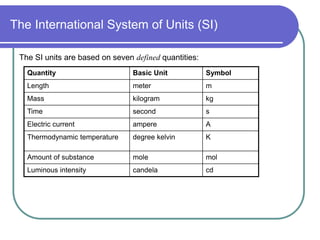
The International System of Units (SI)
The SI units are based on seven defined quantities:
Quantity Basic Unit Symbol
Length meter m
Mass kilogram kg
Time second s
Electric current ampere A
Thermodynamic temperature degree kelvin K
Amount of substance mole mol
Luminous intensity candela cd
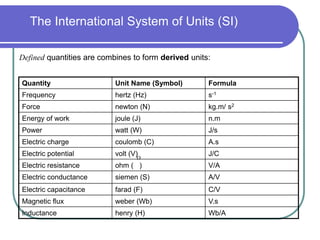
The International System of Units (SI)
Defined quantities are combines to form derived units:
Quantity Unit Name (Symbol) Formula
Frequency hertz (Hz) s-1
Force newton (N) kg.m/ s2
Energy of work joule (J) n.m
Power watt (W) J/s
Electric charge coulomb (C) A.s
Electric potential volt (V) J/C
Electric resistance ohm ( ) V/A
Electric conductance siemen (S) A/V
Electric capacitance farad (F) C/V
Magnetic flux weber (Wb) V.s
Inductance henry (H) Wb/A

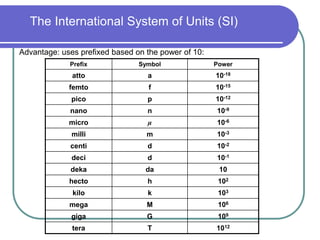
The International System of Units (SI)
Advantage: uses prefixed based on the power of 10:
Prefix Symbol Power
atto a 10-18
femto f 10-15
pico p 10-12
nano n 10-9
micro µ 10-6
milli m 10-3
centi d 10-2
deci d 10-1
deka da 10
hecto h 102
kilo k 103
mega M 106
giga G 109
tera T 1012
Charge and Current
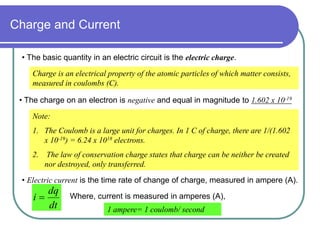
• The basic quantity in an electric circuit is the electric charge.
Charge is an electrical property of the atomic particles of which matter consists,
measured in coulombs (C).
• The charge on an electron is negative and equal in magnitude to 1.602 x 10⁻¹⁹
Note:
1. The Coulomb is a large unit for charges. In 1 C of charge, there are 1/(1.602
x 10-19) = 6.24 x 10¹⁸ electrons.
2. The law of conservation charge states that charge can be neither be created
nor destroyed, only transferred.
• Electric current is the time rate of change of charge, measured in ampere (A).
dt
dq
i  Where, current is measured in amperes (A),
1 ampere= 1 coulomb/ second
Charge and Current
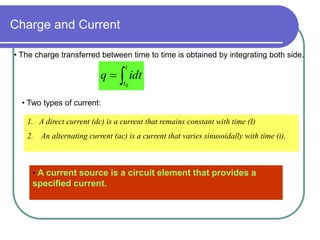
• The charge transferred between time to time is obtained by integrating both side.
dt
i
q
t
t


0
• Two types of current:
1. A direct current (dc) is a current that remains constant with time (I)
2. An alternating current (ac) is a current that varies sinusoidally with time (i).
• A current source is a circuit element that provides a
specified current.
Voltage
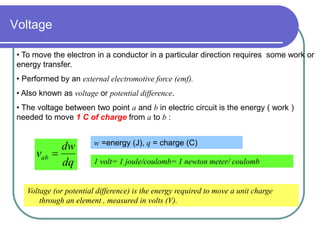
• To move the electron in a conductor in a particular direction requires some work or
energy transfer.
• Performed by an external electromotive force (emf).
• Also known as voltage or potential difference.
• The voltage between two point a and b in electric circuit is the energy ( work )
needed to move 1 C of charge from a to b :
Voltage (or potential difference) is the energy required to move a unit charge
through an element , measured in volts (V).
dq
dw
vab 
w =energy (J), q = charge (C)
1 volt= 1 joule/coulomb= 1 newton meter/ coulomb
Charge and Current
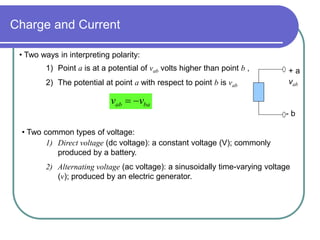
• Two ways in interpreting polarity:
1) Point a is at a potential of vab volts higher than point b ,
2) The potential at point a with respect to point b is vab
+ a
- b
ba
ab v
v 

vab
• Two common types of voltage:
1) Direct voltage (dc voltage): a constant voltage (V); commonly
produced by a battery.
2) Alternating voltage (ac voltage): a sinusoidally time-varying voltage
(v); produced by an electric generator.
Power and Energy
dt
dw
p 
vi
dt
dq
dq
dw
dt
dw
p 



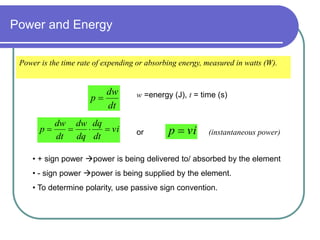
• + sign power power is being delivered to/ absorbed by the element
• - sign power power is being supplied by the element.
• To determine polarity, use passive sign convention.
Power is the time rate of expending or absorbing energy, measured in watts (W).
w =energy (J), t = time (s)
vi
p 
or (instantaneous power)
Power and Energy
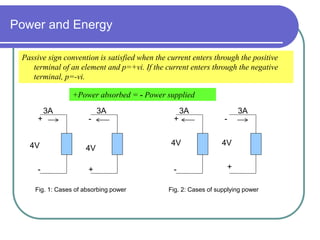
Passive sign convention is satisfied when the current enters through the positive
terminal of an element and p=+vi. If the current enters through the negative
terminal, p=-vi.
+Power absorbed = - Power supplied
+ -
+
+
-
-
- +
4V
4V
4V
4V
3A 3A 3A 3A
Fig. 1: Cases of absorbing power Fig. 2: Cases of supplying power
Power and Energy
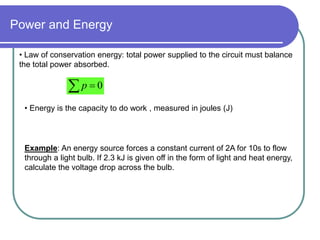
• Law of conservation energy: total power supplied to the circuit must balance
the total power absorbed.
  0
p
• Energy is the capacity to do work , measured in joules (J)
Example: An energy source forces a constant current of 2A for 10s to flow
through a light bulb. If 2.3 kJ is given off in the form of light and heat energy,
calculate the voltage drop across the bulb.
Circuit Elements
• An electric circuit is simply an interconnection of the elements .
• There are two types of elements:
• Passive elements – not capable of generating energy (resistors, capacitors,
inductors.)
• Active elements – capable of generating energy( generators, batteries,
operational amplifiers)
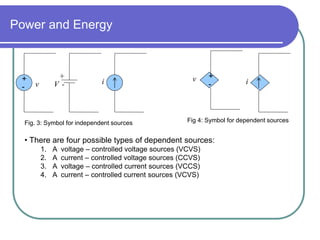
• The most important active elements are voltage or current sources
• Two kinds of sources: independent and dependent sources
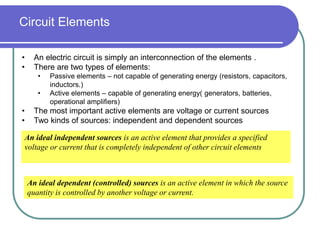
An ideal independent sources is an active element that provides a specified
voltage or current that is completely independent of other circuit elements
An ideal dependent (controlled) sources is an active element in which the source
quantity is controlled by another voltage or current.
Power and Energy
+
-
i
V
v
+
-
Fig. 3: Symbol for independent sources
+
- i
v
Fig 4: Symbol for dependent sources
• There are four possible types of dependent sources:
1. A voltage – controlled voltage sources (VCVS)
2. A current – controlled voltage sources (CCVS)
3. A voltage – controlled current sources (VCCS)
4. A current – controlled current sources (VCVS)
THANK YOU ALL

Electrical_Engg_Basic.PPT

  • 1.
  • 2.
    CONTENTS  Introduction  TheInternational System of Units  Current And Charge  Voltage  Power and Energy
  • 3.
    Introduction : An Overviewof Electrical Engineering: Electrical engineering is the profession concerned with the systems that transmit, and measure of electric signal. Electrical system can be classified into 5 classification: •Communication systems -electrical systems that generate, transmit and distribute information. •Computer systems -use electric signals to process information ranging from word processing to mathematical computations •Control systems -use electric signals to regulate processes. Eg., control of temperature, pressure.
  • 4.
    Power Systems -generate anddistribute electric power. Signal-processing system -act on electric signals that represent information. Example of the interaction among system is a commercial airplane. Introduction : An Overview of Electrical Engineering:
  • 5.
    The International Systemof Units (SI) The SI units are based on seven defined quantities: Quantity Basic Unit Symbol Length meter m Mass kilogram kg Time second s Electric current ampere A Thermodynamic temperature degree kelvin K Amount of substance mole mol Luminous intensity candela cd
  • 6.
    The International Systemof Units (SI) Defined quantities are combines to form derived units: Quantity Unit Name (Symbol) Formula Frequency hertz (Hz) s-1 Force newton (N) kg.m/ s2 Energy of work joule (J) n.m Power watt (W) J/s Electric charge coulomb (C) A.s Electric potential volt (V) J/C Electric resistance ohm ( ) V/A Electric conductance siemen (S) A/V Electric capacitance farad (F) C/V Magnetic flux weber (Wb) V.s Inductance henry (H) Wb/A 
  • 7.
    The International Systemof Units (SI) Advantage: uses prefixed based on the power of 10: Prefix Symbol Power atto a 10-18 femto f 10-15 pico p 10-12 nano n 10-9 micro µ 10-6 milli m 10-3 centi d 10-2 deci d 10-1 deka da 10 hecto h 102 kilo k 103 mega M 106 giga G 109 tera T 1012
  • 8.
    Charge and Current •The basic quantity in an electric circuit is the electric charge. Charge is an electrical property of the atomic particles of which matter consists, measured in coulombs (C). • The charge on an electron is negative and equal in magnitude to 1.602 x 10⁻¹⁹ Note: 1. The Coulomb is a large unit for charges. In 1 C of charge, there are 1/(1.602 x 10-19) = 6.24 x 10¹⁸ electrons. 2. The law of conservation charge states that charge can be neither be created nor destroyed, only transferred. • Electric current is the time rate of change of charge, measured in ampere (A). dt dq i  Where, current is measured in amperes (A), 1 ampere= 1 coulomb/ second
  • 9.
    Charge and Current •The charge transferred between time to time is obtained by integrating both side. dt i q t t   0 • Two types of current: 1. A direct current (dc) is a current that remains constant with time (I) 2. An alternating current (ac) is a current that varies sinusoidally with time (i). • A current source is a circuit element that provides a specified current.
  • 10.
    Voltage • To movethe electron in a conductor in a particular direction requires some work or energy transfer. • Performed by an external electromotive force (emf). • Also known as voltage or potential difference. • The voltage between two point a and b in electric circuit is the energy ( work ) needed to move 1 C of charge from a to b : Voltage (or potential difference) is the energy required to move a unit charge through an element , measured in volts (V). dq dw vab  w =energy (J), q = charge (C) 1 volt= 1 joule/coulomb= 1 newton meter/ coulomb
  • 11.
    Charge and Current •Two ways in interpreting polarity: 1) Point a is at a potential of vab volts higher than point b , 2) The potential at point a with respect to point b is vab + a - b ba ab v v   vab • Two common types of voltage: 1) Direct voltage (dc voltage): a constant voltage (V); commonly produced by a battery. 2) Alternating voltage (ac voltage): a sinusoidally time-varying voltage (v); produced by an electric generator.
  • 12.
    Power and Energy dt dw p vi dt dq dq dw dt dw p     • + sign power power is being delivered to/ absorbed by the element • - sign power power is being supplied by the element. • To determine polarity, use passive sign convention. Power is the time rate of expending or absorbing energy, measured in watts (W). w =energy (J), t = time (s) vi p  or (instantaneous power)
  • 13.
    Power and Energy Passivesign convention is satisfied when the current enters through the positive terminal of an element and p=+vi. If the current enters through the negative terminal, p=-vi. +Power absorbed = - Power supplied + - + + - - - + 4V 4V 4V 4V 3A 3A 3A 3A Fig. 1: Cases of absorbing power Fig. 2: Cases of supplying power
  • 14.
    Power and Energy •Law of conservation energy: total power supplied to the circuit must balance the total power absorbed.   0 p • Energy is the capacity to do work , measured in joules (J) Example: An energy source forces a constant current of 2A for 10s to flow through a light bulb. If 2.3 kJ is given off in the form of light and heat energy, calculate the voltage drop across the bulb.
  • 15.
    Circuit Elements • Anelectric circuit is simply an interconnection of the elements . • There are two types of elements: • Passive elements – not capable of generating energy (resistors, capacitors, inductors.) • Active elements – capable of generating energy( generators, batteries, operational amplifiers) • The most important active elements are voltage or current sources • Two kinds of sources: independent and dependent sources An ideal independent sources is an active element that provides a specified voltage or current that is completely independent of other circuit elements An ideal dependent (controlled) sources is an active element in which the source quantity is controlled by another voltage or current.
  • 16.
    Power and Energy + - i V v + - Fig.3: Symbol for independent sources + - i v Fig 4: Symbol for dependent sources • There are four possible types of dependent sources: 1. A voltage – controlled voltage sources (VCVS) 2. A current – controlled voltage sources (CCVS) 3. A voltage – controlled current sources (VCCS) 4. A current – controlled current sources (VCVS)
  • 17.