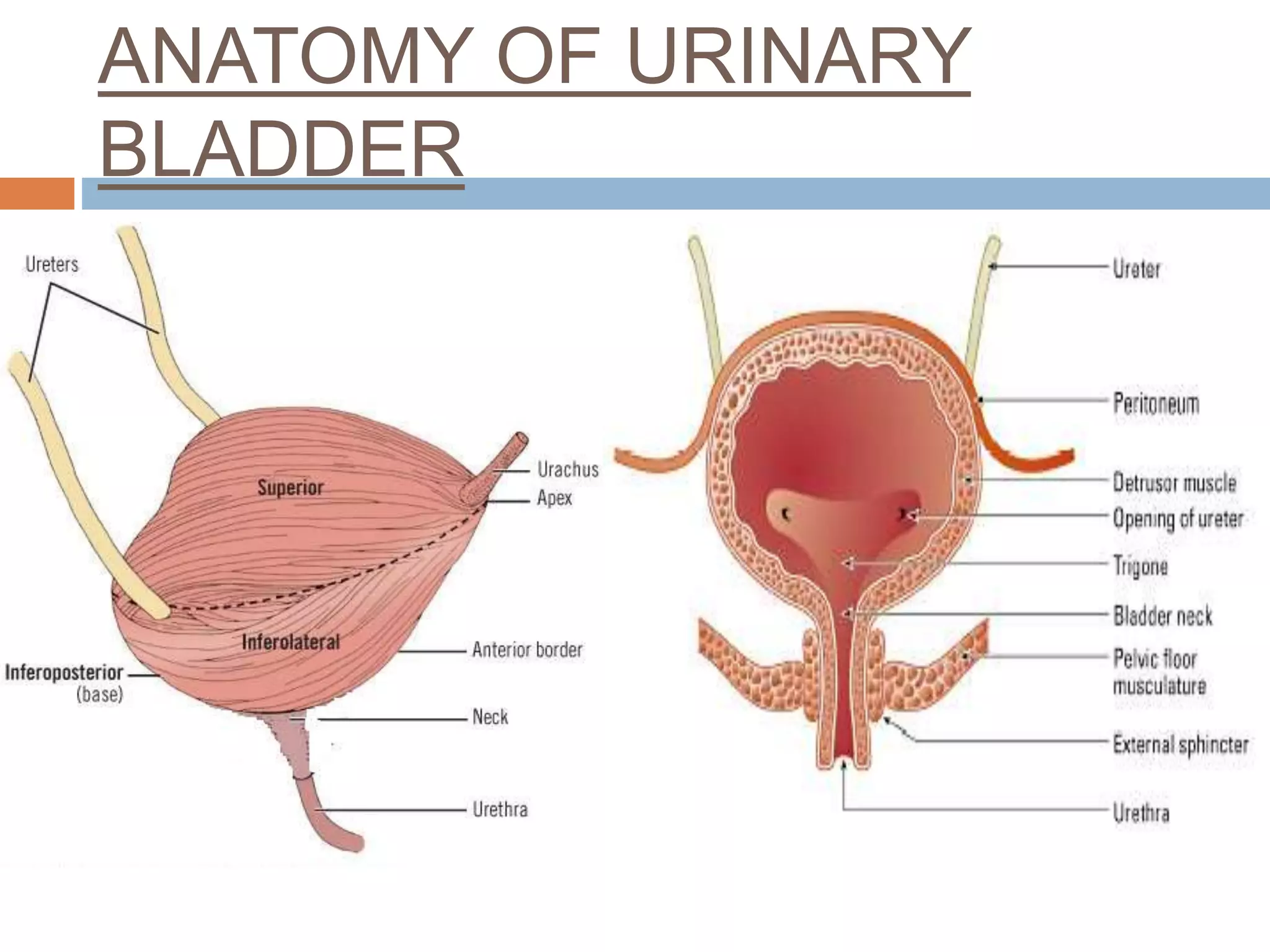
ANATOMY OF URINARY
BLADDER
ANATOMY OF URINARY
BLADDER (Cont…)
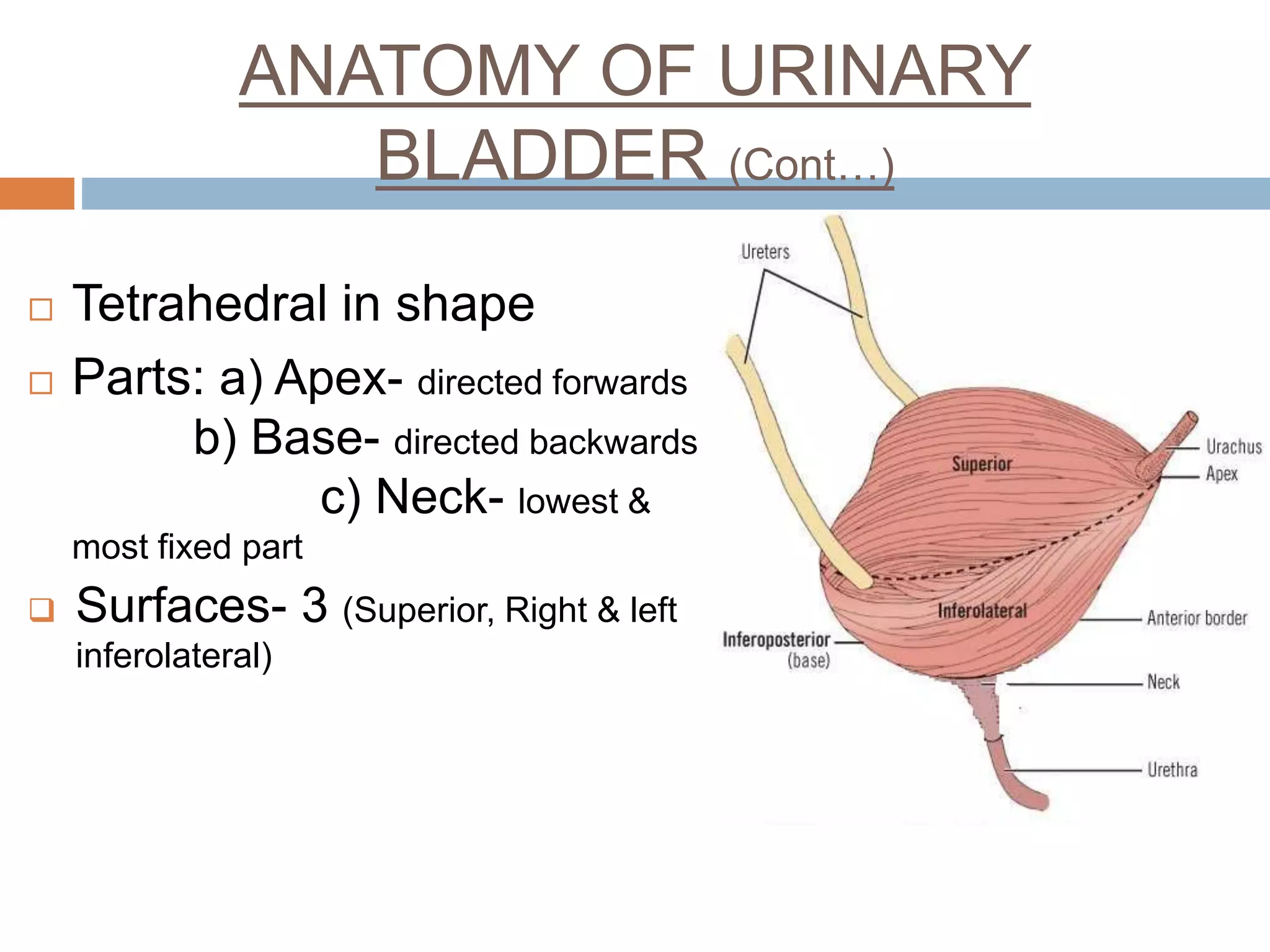
 Tetrahedral in shape
 Parts: a) Apex- directed forwards
b) Base- directed backwards
c) Neck- lowest &
most fixed part
 Surfaces- 3 (Superior, Right & left
inferolateral)
ANATOMY OF URINARY
BLADDER (Cont…)
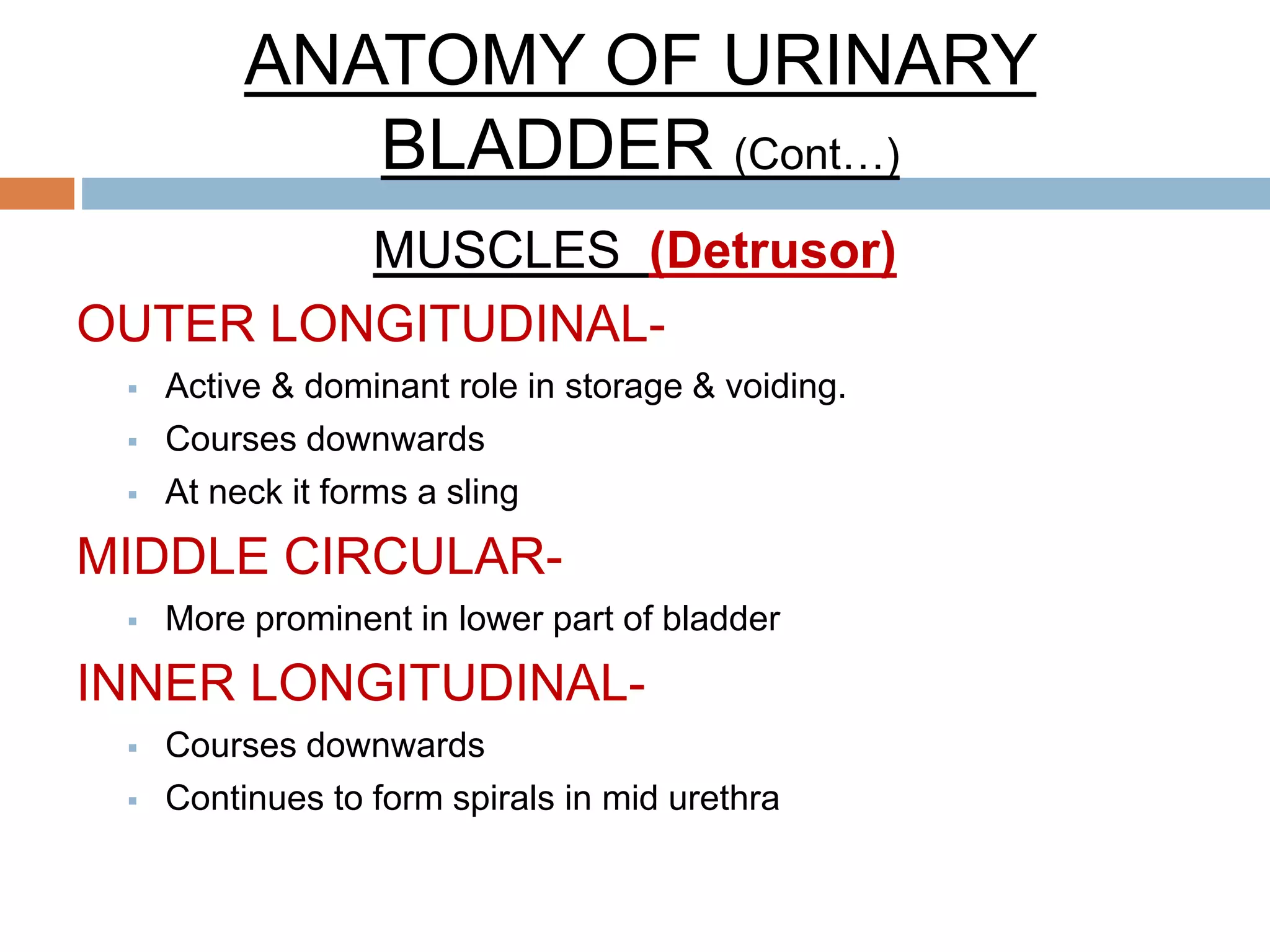
MUSCLES (Detrusor)
OUTER LONGITUDINAL-
 Active & dominant role in storage & voiding.
 Courses downwards
 At neck it forms a sling
MIDDLE CIRCULAR-
 More prominent in lower part of bladder
INNER LONGITUDINAL-
 Courses downwards
 Continues to form spirals in mid urethra
ANATOMY OF URINARY
BLADDER (Cont…)
TRIGONE
 Formed by the absorption of mesonephric
ducts
 Muscle is mesodermal in origin
 Epithelium is endodermal as of whole bladder
 Cholinergic nerve supply
ANATOMY OF URINARY
BLADDER (Cont…)
BLADDER NECK
 Muscle bundles are largely oblique or
longitudinal
 Little or no sphincteric action
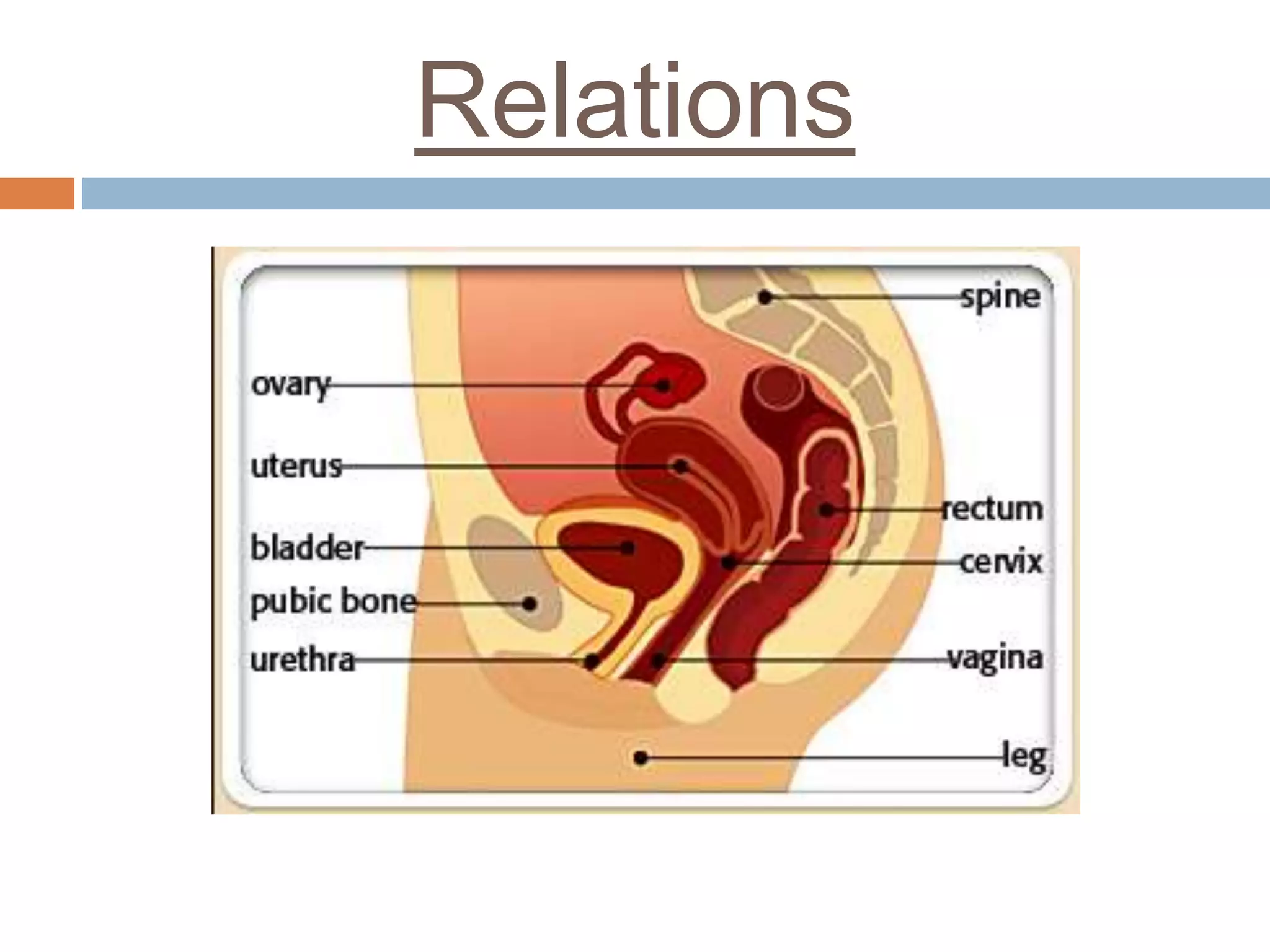
Relations
SUPPORTS OF URINARY
BLADDER
 Lateral true ligament- From the side of bladder
to the arcus tendinalis
 Pubovesical / pubourethral ligament
 Median umbilical ligament
 Posterior ligament- From base to pelvic wall
ANATOMY OF URETHRA
3 PARTS- Proximal, mid & distal urethra
 Proximal urethra- weakest part
 Fails to withstand rise of intra-vesical or intra-abdominal
pressure
 Mid urethra- strongest part
 It has got additional support by:
 Intrinsic striated muscles- Rhabdomyosphincter urethrae
(Urethral closure at rest)
 Extrinsic periurethral muscle- Levator Ani
(Support urethra on stress)
 Distal urethra- Passive conduit
ANATOMY OF URETHRA
(Cont…)
 Submucous layer- Vascular layer
Venous plexi present in submucous layer
Supports urethra by its plasticity
Maintain resting urethral pressure
 Mucous layer- arranged in longitudinal folds
SUPPORTS OF BLADDER NECK &
URETHRA
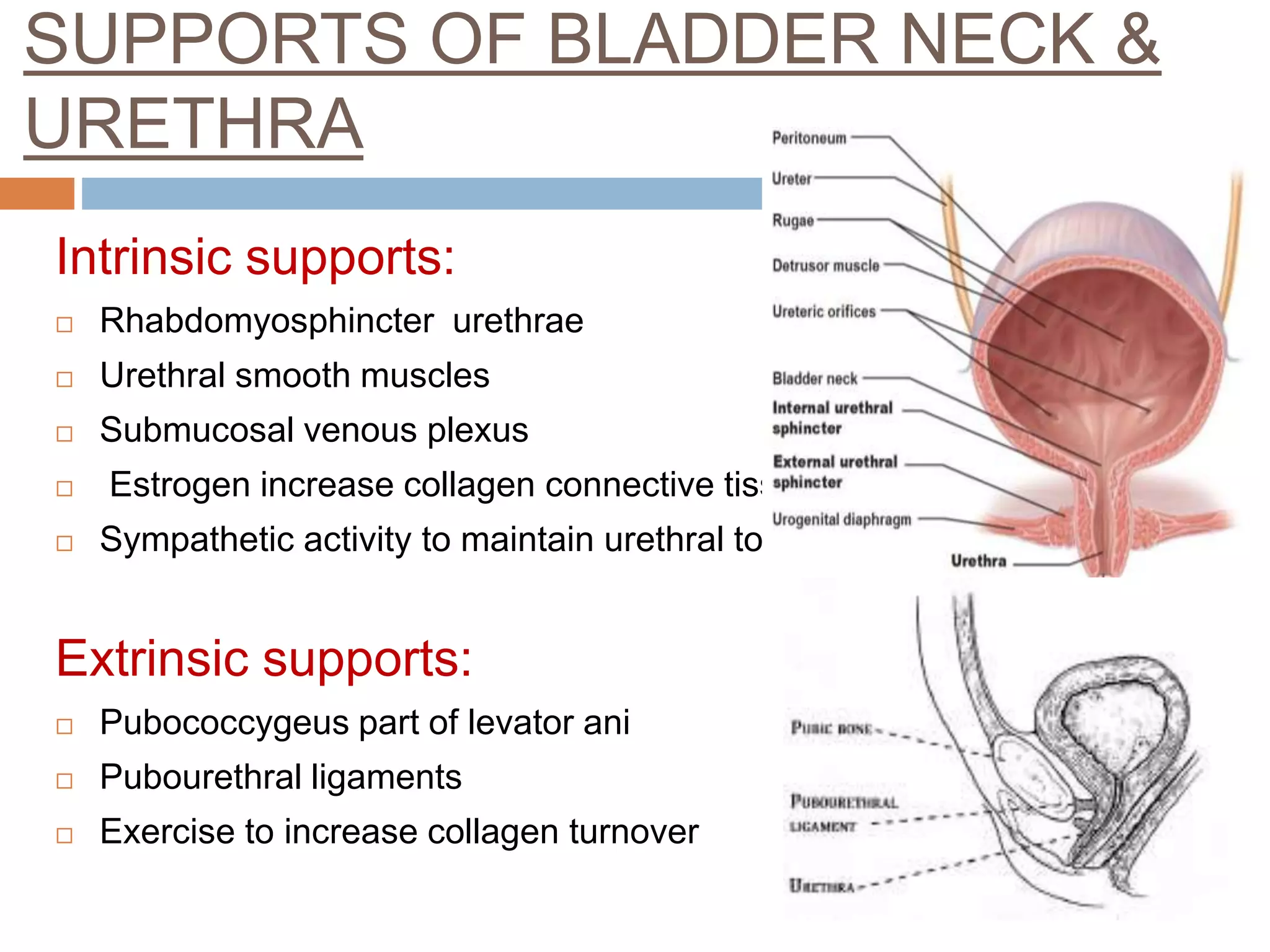
Intrinsic supports:
 Rhabdomyosphincter urethrae
 Urethral smooth muscles
 Submucosal venous plexus
 Estrogen increase collagen connective tissue
 Sympathetic activity to maintain urethral tone
Extrinsic supports:
 Pubococcygeus part of levator ani
 Pubourethral ligaments
 Exercise to increase collagen turnover
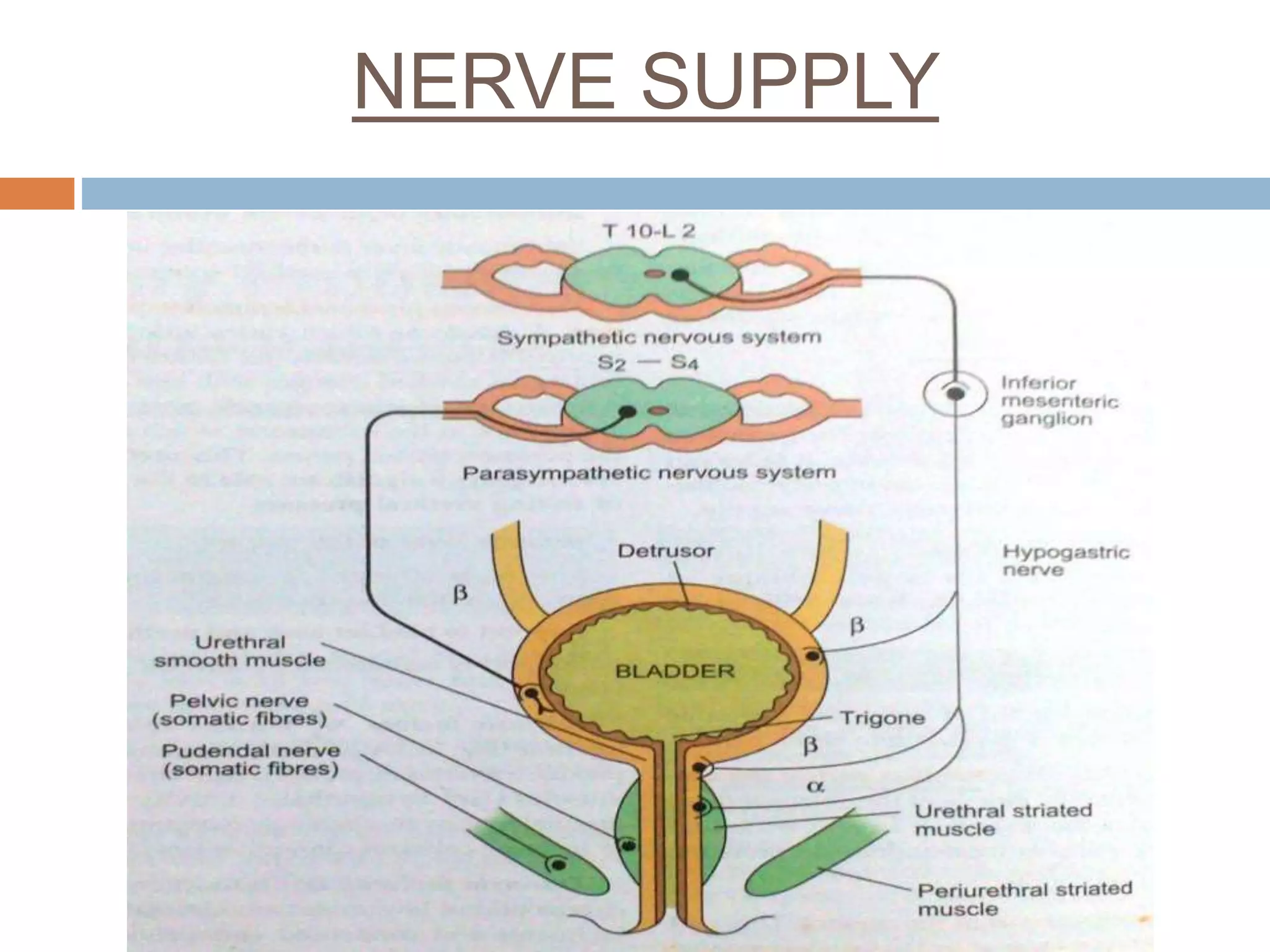
NERVE SUPPLY
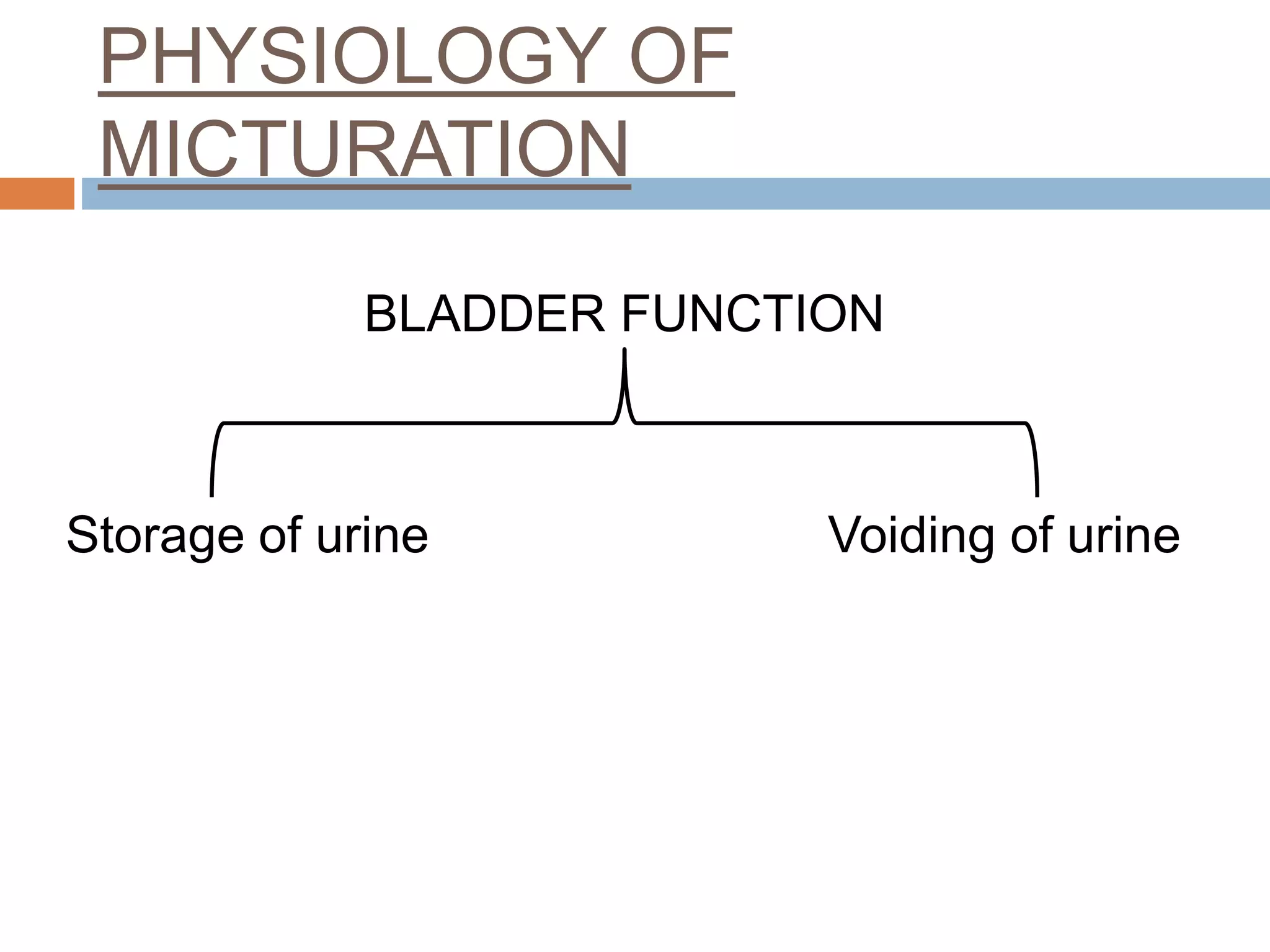
PHYSIOLOGY OF
MICTURATION
BLADDER FUNCTION
Storage of urine Voiding of urine
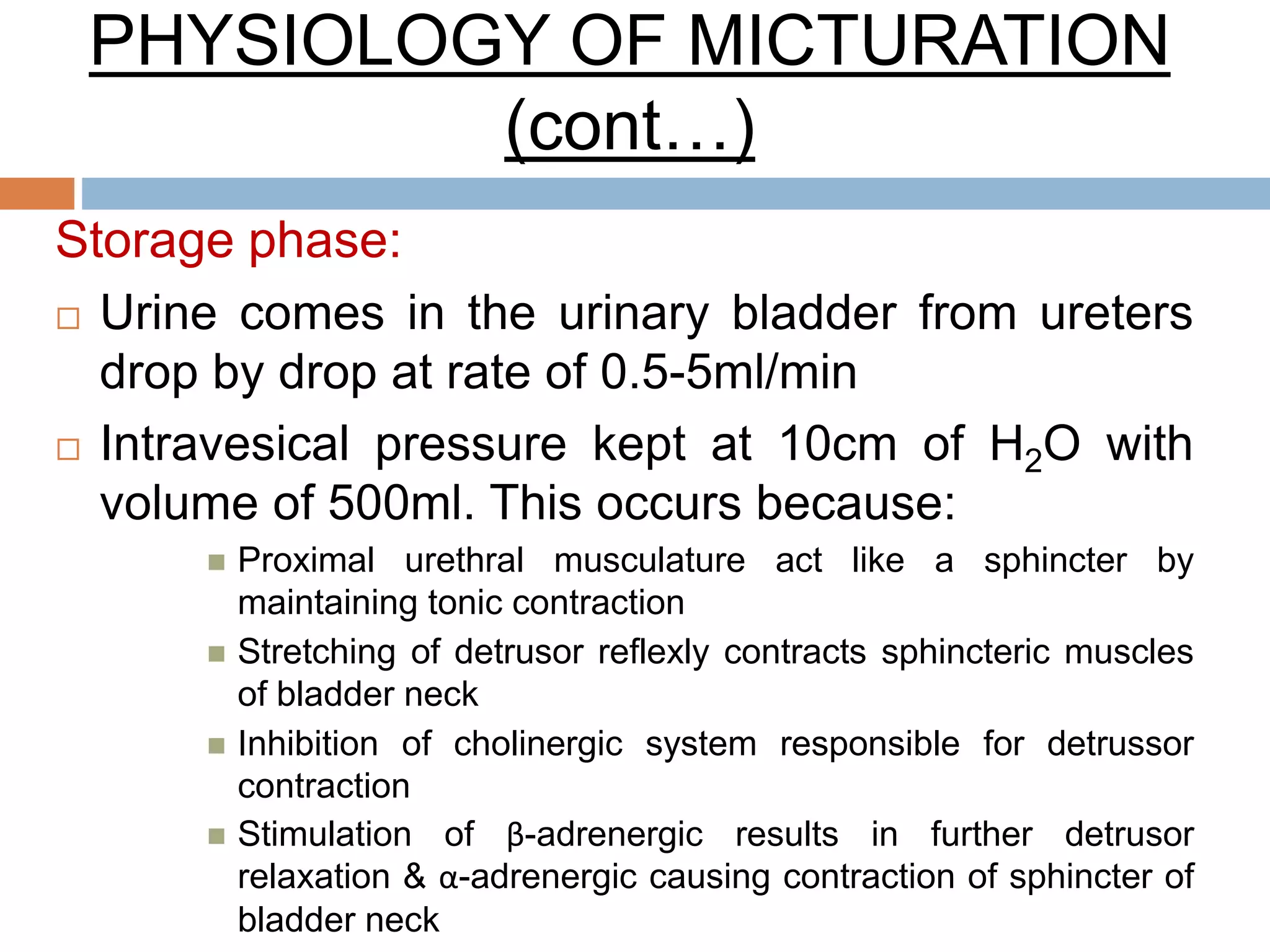
PHYSIOLOGY OF MICTURATION
(cont…)
Storage phase:
 Urine comes in the urinary bladder from ureters
drop by drop at rate of 0.5-5ml/min
 Intravesical pressure kept at 10cm of H2O with
volume of 500ml. This occurs because:
 Proximal urethral musculature act like a sphincter by
maintaining tonic contraction
 Stretching of detrusor reflexly contracts sphincteric muscles
of bladder neck
 Inhibition of cholinergic system responsible for detrussor
contraction
 Stimulation of β-adrenergic results in further detrusor
relaxation & α-adrenergic causing contraction of sphincter of
bladder neck
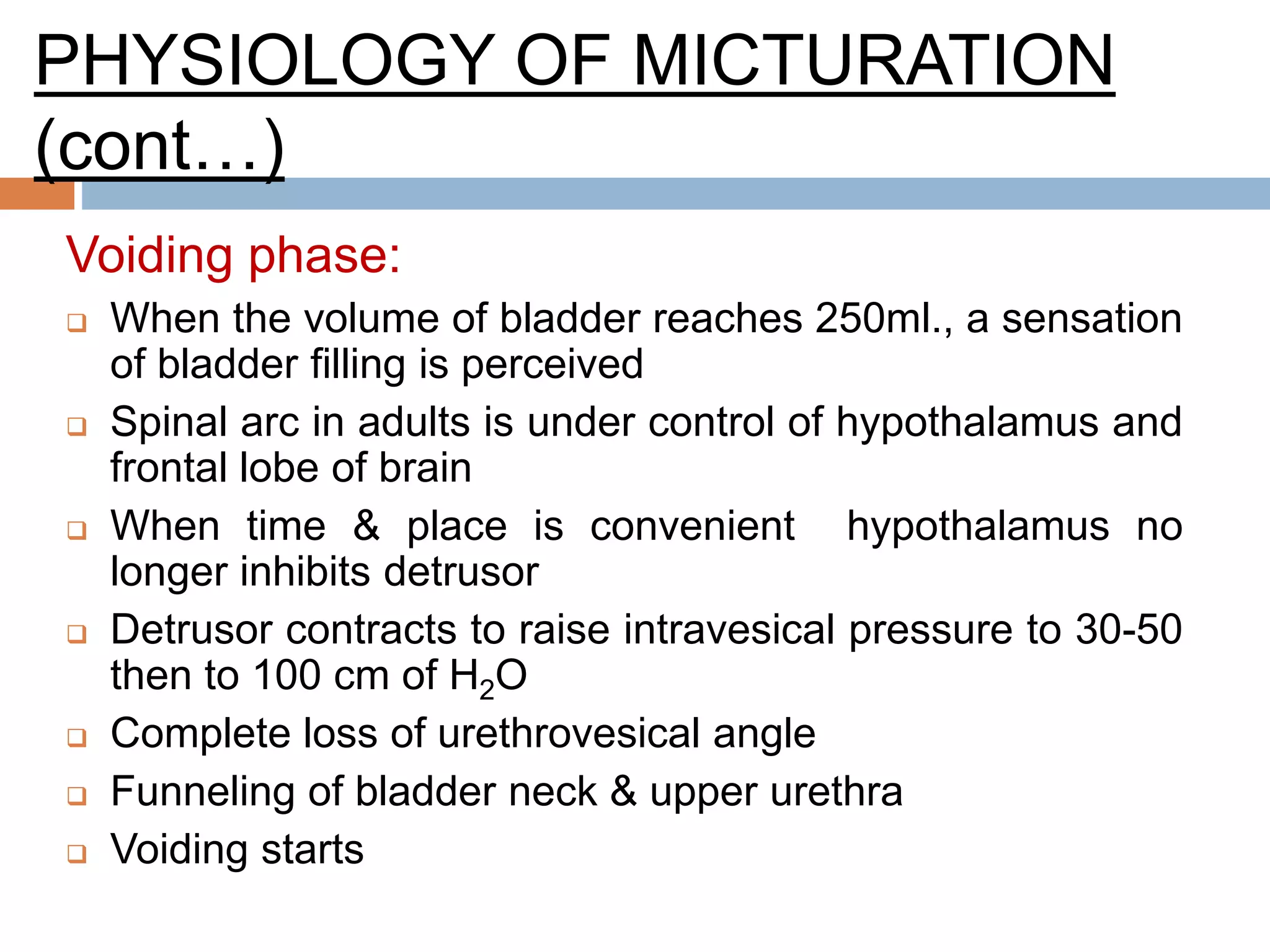
PHYSIOLOGY OF MICTURATION
(cont…)
Voiding phase:
 When the volume of bladder reaches 250ml., a sensation
of bladder filling is perceived
 Spinal arc in adults is under control of hypothalamus and
frontal lobe of brain
 When time & place is convenient hypothalamus no
longer inhibits detrusor
 Detrusor contracts to raise intravesical pressure to 30-50
then to 100 cm of H2O
 Complete loss of urethrovesical angle
 Funneling of bladder neck & upper urethra
 Voiding starts
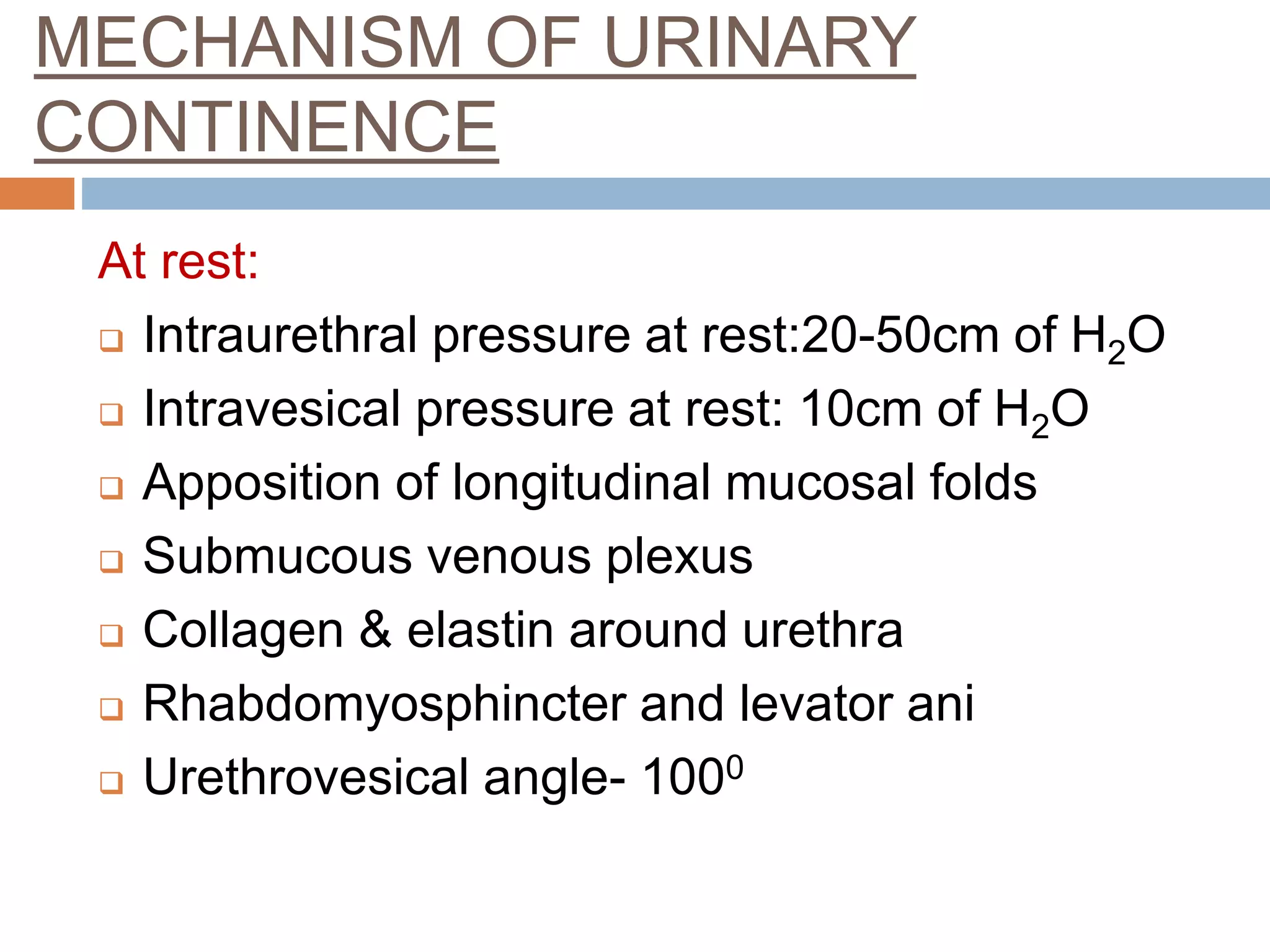
MECHANISM OF URINARY
CONTINENCE
At rest:
 Intraurethral pressure at rest:20-50cm of H2O
 Intravesical pressure at rest: 10cm of H2O
 Apposition of longitudinal mucosal folds
 Submucous venous plexus
 Collagen & elastin around urethra
 Rhabdomyosphincter and levator ani
 Urethrovesical angle- 1000
MECHANISM OF URINARY
CONTINENCE (cont…)
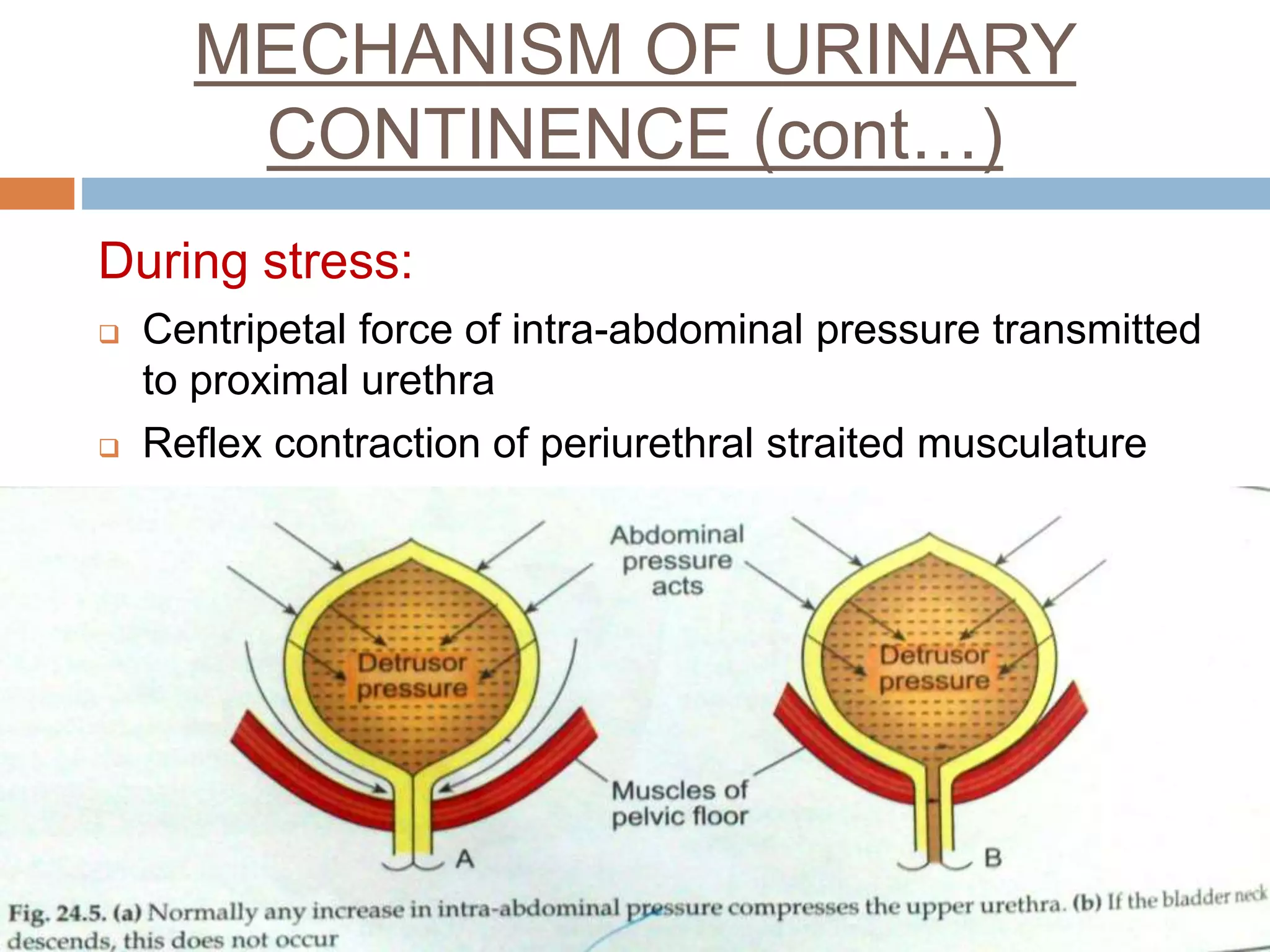
During stress:
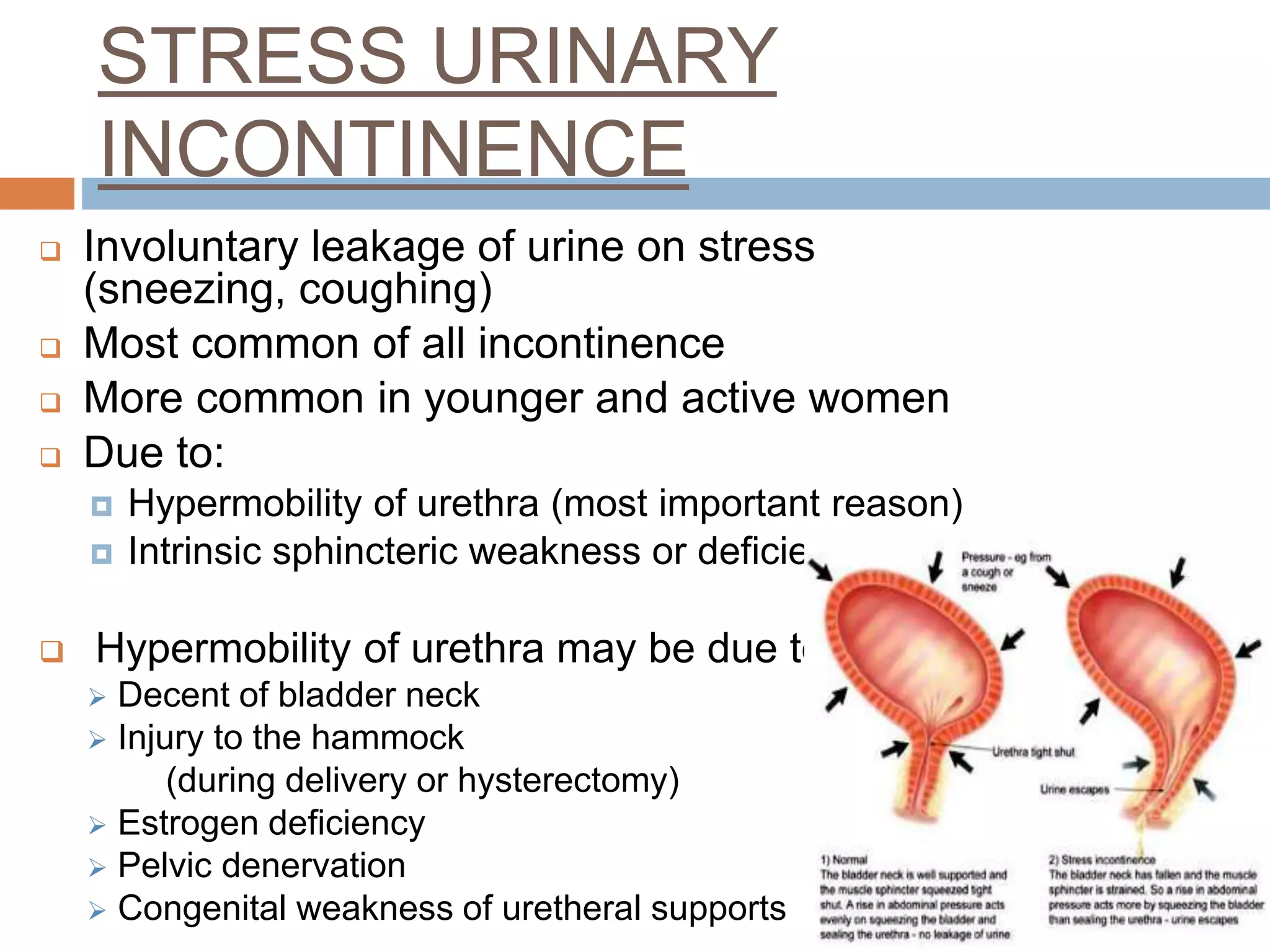
 Centripetal force of intra-abdominal pressure transmitted
to proximal urethra
 Reflex contraction of periurethral straited musculature
MECHANISM OF URINARY
CONTINENCE (cont…)
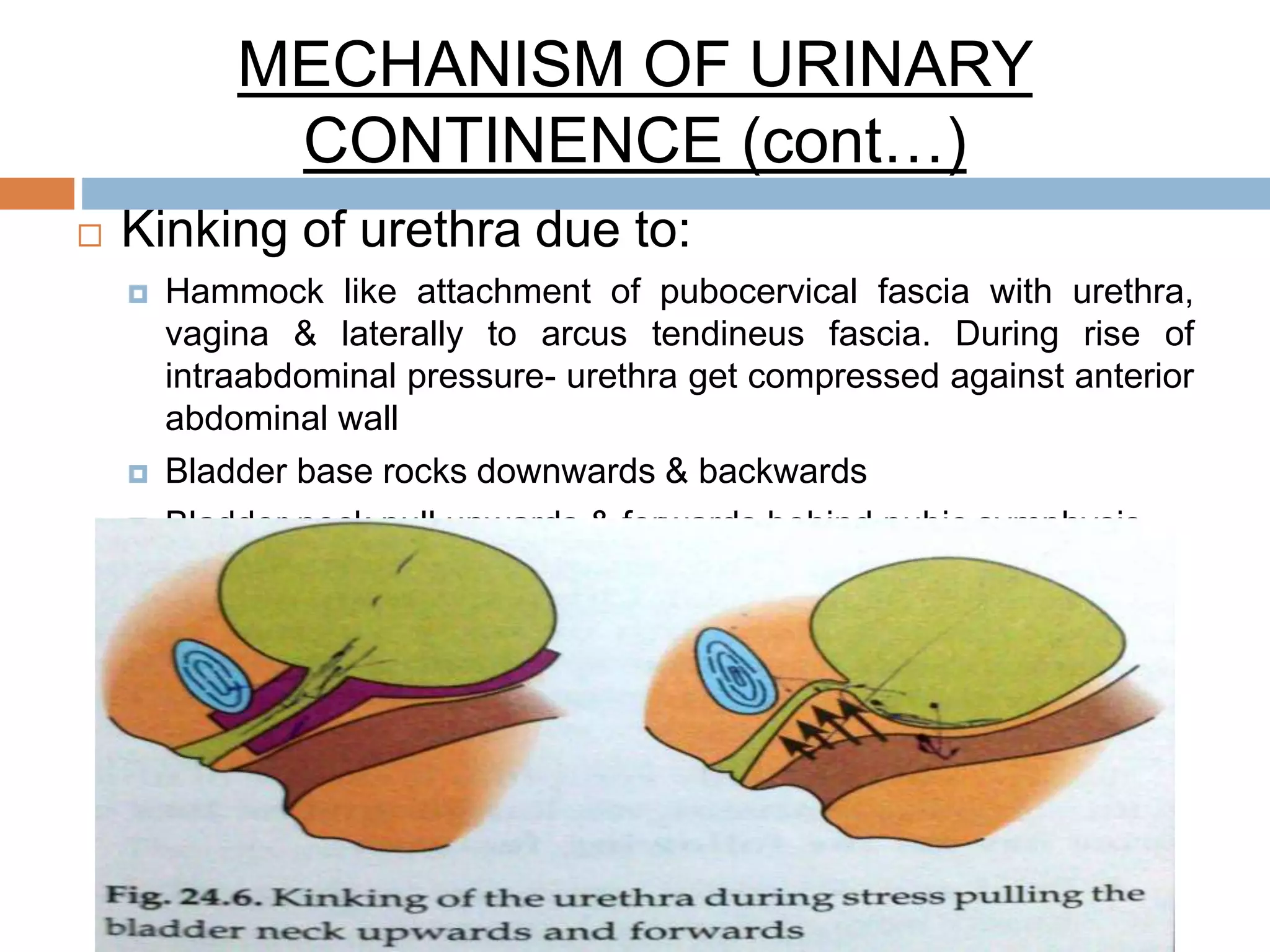
 Kinking of urethra due to:
 Hammock like attachment of pubocervical fascia with urethra,
vagina & laterally to arcus tendineus fascia. During rise of
intraabdominal pressure- urethra get compressed against anterior
abdominal wall
 Bladder base rocks downwards & backwards
 Bladder neck pull upwards & forwards behind pubic symphysis
CLASSIFICATION OF URINARY
INCONTINENCE
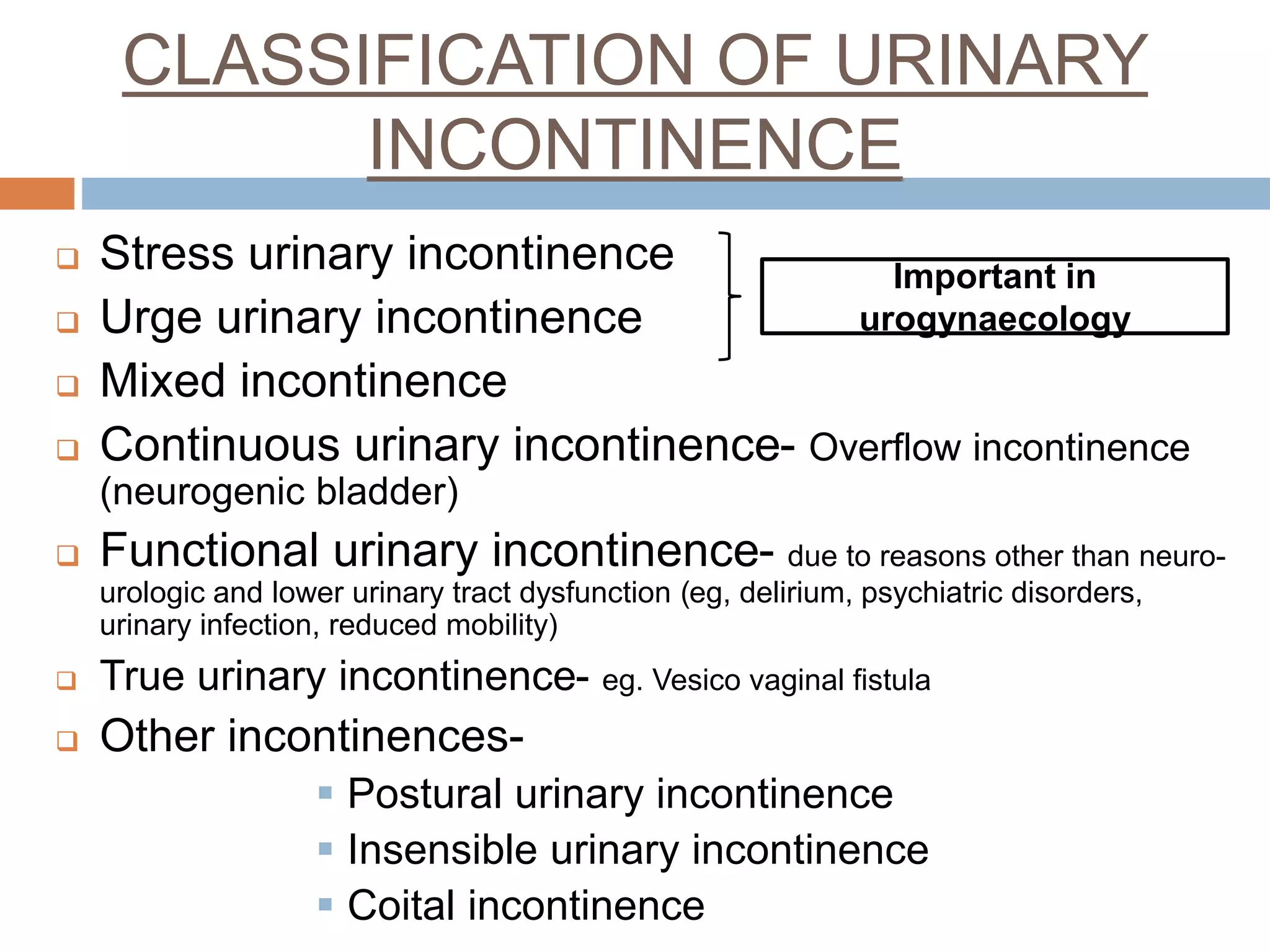
 Stress urinary incontinence
 Urge urinary incontinence
 Mixed incontinence
 Continuous urinary incontinence- Overflow incontinence
(neurogenic bladder)
 Functional urinary incontinence- due to reasons other than neuro-
urologic and lower urinary tract dysfunction (eg, delirium, psychiatric disorders,
urinary infection, reduced mobility)
 True urinary incontinence- eg. Vesico vaginal fistula
 Other incontinences-
 Postural urinary incontinence
 Insensible urinary incontinence
 Coital incontinence
Important in
urogynaecology
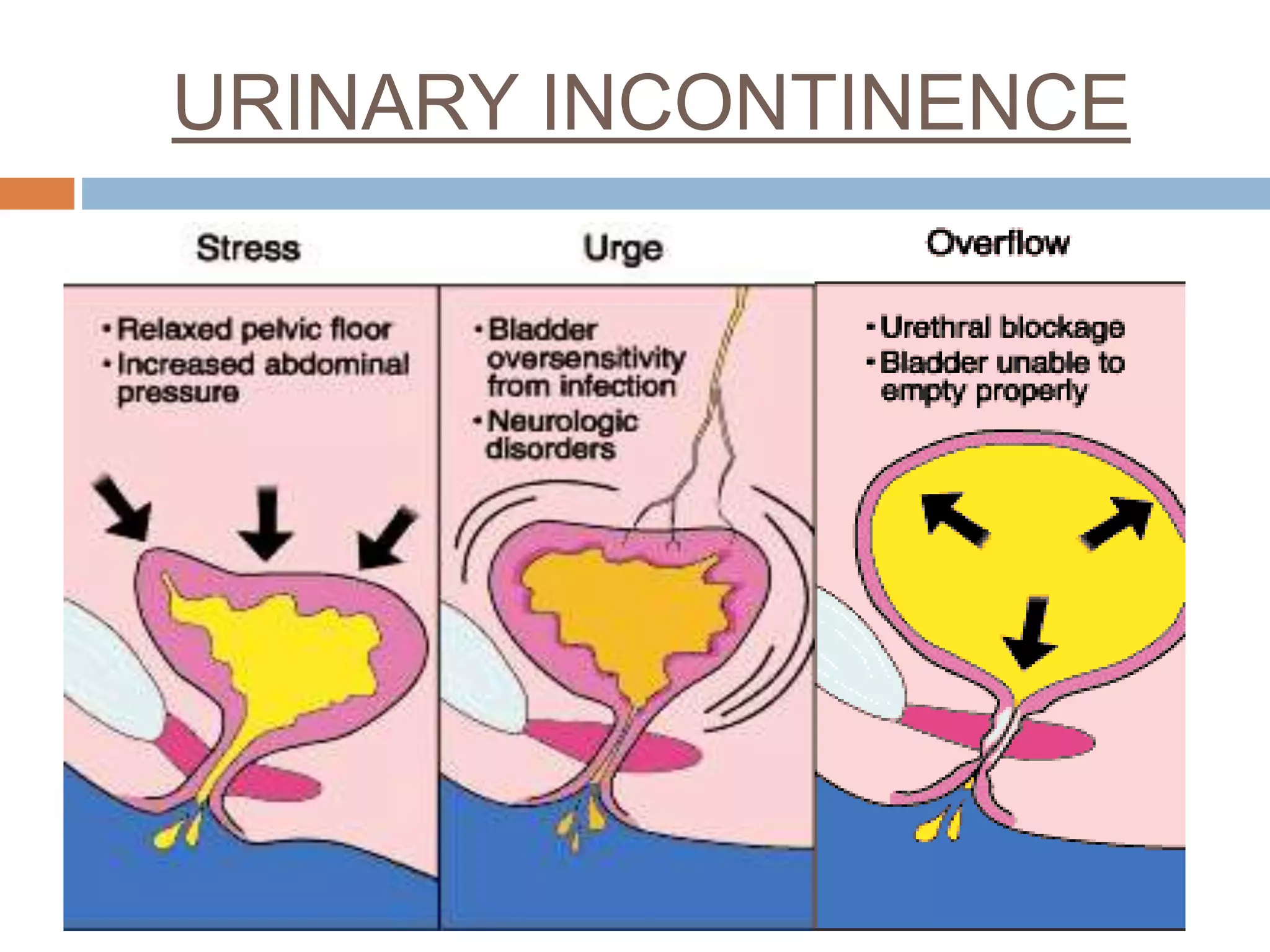
URINARY INCONTINENCE
STRESS URINARY
INCONTINENCE
 Involuntary leakage of urine on stress
(sneezing, coughing)
 Most common of all incontinence
 More common in younger and active women
 Due to:
 Hypermobility of urethra (most important reason)
 Intrinsic sphincteric weakness or deficiency
 Hypermobility of urethra may be due to:
 Decent of bladder neck
 Injury to the hammock
(during delivery or hysterectomy)
 Estrogen deficiency
 Pelvic denervation
 Congenital weakness of uretheral supports
Stress urinary incontinence
(cont…)
 Management:
 Behavioral modification & lifestyle changes
 Kegel’s exercise
 Postural change during stress
 Fluid management
 Vaginal & urethral devices
 Medications: α-agonists (Imipramine, ephedrine,
pseudoephidrine, phenylpropanolamine)but none of the drugs are
FDA approved
 Surgical treatment- Fixation of bladder neck & proximal
urethra to prevent its undue moblility & its decent.
URGE URINARY
INCONTINENCE
 Involuntary leakage of urine associated with
urgency
 More common in older women
 Urgency, Increase day time frequency &
nocturia
 Occurs due to detrusor instability and detrusor
overactivity
Urge urinary incontinence
(cont…)
Management:
 Lifestyle changes: Weight loss, smoking, alcohol, caffeine
cessation
 Behavioural therapy: Yoga, Silent singing, deep breathing
 Bladder training, Schedule toileting program
 Fluid management
 Vaginal and Urethral devices
 Medications: Anticholinergics (oxybutynin, tolterodine,
festerodine, darifenacin, solefenacin)
 β3agonist- Mirabagone, solebagone
 Neurokinin inhibitors
 Neuromodulation: Sacral nerve or percutaneous
tibial nerve stimulation
THANK YOU

Basic concepts in urogynaecology

  • 2.
  • 3.
    ANATOMY OF URINARY BLADDER(Cont…)  Tetrahedral in shape  Parts: a) Apex- directed forwards b) Base- directed backwards c) Neck- lowest & most fixed part  Surfaces- 3 (Superior, Right & left inferolateral)
  • 4.
    ANATOMY OF URINARY BLADDER(Cont…) MUSCLES (Detrusor) OUTER LONGITUDINAL-  Active & dominant role in storage & voiding.  Courses downwards  At neck it forms a sling MIDDLE CIRCULAR-  More prominent in lower part of bladder INNER LONGITUDINAL-  Courses downwards  Continues to form spirals in mid urethra
  • 5.
    ANATOMY OF URINARY BLADDER(Cont…) TRIGONE  Formed by the absorption of mesonephric ducts  Muscle is mesodermal in origin  Epithelium is endodermal as of whole bladder  Cholinergic nerve supply
  • 6.
    ANATOMY OF URINARY BLADDER(Cont…) BLADDER NECK  Muscle bundles are largely oblique or longitudinal  Little or no sphincteric action
  • 7.
  • 8.
    SUPPORTS OF URINARY BLADDER Lateral true ligament- From the side of bladder to the arcus tendinalis  Pubovesical / pubourethral ligament  Median umbilical ligament  Posterior ligament- From base to pelvic wall
  • 9.
    ANATOMY OF URETHRA 3PARTS- Proximal, mid & distal urethra  Proximal urethra- weakest part  Fails to withstand rise of intra-vesical or intra-abdominal pressure  Mid urethra- strongest part  It has got additional support by:  Intrinsic striated muscles- Rhabdomyosphincter urethrae (Urethral closure at rest)  Extrinsic periurethral muscle- Levator Ani (Support urethra on stress)  Distal urethra- Passive conduit
  • 10.
    ANATOMY OF URETHRA (Cont…) Submucous layer- Vascular layer Venous plexi present in submucous layer Supports urethra by its plasticity Maintain resting urethral pressure  Mucous layer- arranged in longitudinal folds
  • 11.
    SUPPORTS OF BLADDERNECK & URETHRA Intrinsic supports:  Rhabdomyosphincter urethrae  Urethral smooth muscles  Submucosal venous plexus  Estrogen increase collagen connective tissue  Sympathetic activity to maintain urethral tone Extrinsic supports:  Pubococcygeus part of levator ani  Pubourethral ligaments  Exercise to increase collagen turnover
  • 12.
  • 13.
  • 14.
    PHYSIOLOGY OF MICTURATION (cont…) Storagephase:  Urine comes in the urinary bladder from ureters drop by drop at rate of 0.5-5ml/min  Intravesical pressure kept at 10cm of H2O with volume of 500ml. This occurs because:  Proximal urethral musculature act like a sphincter by maintaining tonic contraction  Stretching of detrusor reflexly contracts sphincteric muscles of bladder neck  Inhibition of cholinergic system responsible for detrussor contraction  Stimulation of β-adrenergic results in further detrusor relaxation & α-adrenergic causing contraction of sphincter of bladder neck
  • 15.
    PHYSIOLOGY OF MICTURATION (cont…) Voidingphase:  When the volume of bladder reaches 250ml., a sensation of bladder filling is perceived  Spinal arc in adults is under control of hypothalamus and frontal lobe of brain  When time & place is convenient hypothalamus no longer inhibits detrusor  Detrusor contracts to raise intravesical pressure to 30-50 then to 100 cm of H2O  Complete loss of urethrovesical angle  Funneling of bladder neck & upper urethra  Voiding starts
  • 16.
    MECHANISM OF URINARY CONTINENCE Atrest:  Intraurethral pressure at rest:20-50cm of H2O  Intravesical pressure at rest: 10cm of H2O  Apposition of longitudinal mucosal folds  Submucous venous plexus  Collagen & elastin around urethra  Rhabdomyosphincter and levator ani  Urethrovesical angle- 1000
  • 17.
    MECHANISM OF URINARY CONTINENCE(cont…) During stress:  Centripetal force of intra-abdominal pressure transmitted to proximal urethra  Reflex contraction of periurethral straited musculature
  • 18.
    MECHANISM OF URINARY CONTINENCE(cont…)  Kinking of urethra due to:  Hammock like attachment of pubocervical fascia with urethra, vagina & laterally to arcus tendineus fascia. During rise of intraabdominal pressure- urethra get compressed against anterior abdominal wall  Bladder base rocks downwards & backwards  Bladder neck pull upwards & forwards behind pubic symphysis
  • 19.
    CLASSIFICATION OF URINARY INCONTINENCE Stress urinary incontinence  Urge urinary incontinence  Mixed incontinence  Continuous urinary incontinence- Overflow incontinence (neurogenic bladder)  Functional urinary incontinence- due to reasons other than neuro- urologic and lower urinary tract dysfunction (eg, delirium, psychiatric disorders, urinary infection, reduced mobility)  True urinary incontinence- eg. Vesico vaginal fistula  Other incontinences-  Postural urinary incontinence  Insensible urinary incontinence  Coital incontinence Important in urogynaecology
  • 20.
  • 21.
    STRESS URINARY INCONTINENCE  Involuntaryleakage of urine on stress (sneezing, coughing)  Most common of all incontinence  More common in younger and active women  Due to:  Hypermobility of urethra (most important reason)  Intrinsic sphincteric weakness or deficiency  Hypermobility of urethra may be due to:  Decent of bladder neck  Injury to the hammock (during delivery or hysterectomy)  Estrogen deficiency  Pelvic denervation  Congenital weakness of uretheral supports
  • 22.
    Stress urinary incontinence (cont…) Management:  Behavioral modification & lifestyle changes  Kegel’s exercise  Postural change during stress  Fluid management  Vaginal & urethral devices  Medications: α-agonists (Imipramine, ephedrine, pseudoephidrine, phenylpropanolamine)but none of the drugs are FDA approved  Surgical treatment- Fixation of bladder neck & proximal urethra to prevent its undue moblility & its decent.
  • 23.
    URGE URINARY INCONTINENCE  Involuntaryleakage of urine associated with urgency  More common in older women  Urgency, Increase day time frequency & nocturia  Occurs due to detrusor instability and detrusor overactivity
  • 24.
    Urge urinary incontinence (cont…) Management: Lifestyle changes: Weight loss, smoking, alcohol, caffeine cessation  Behavioural therapy: Yoga, Silent singing, deep breathing  Bladder training, Schedule toileting program  Fluid management  Vaginal and Urethral devices  Medications: Anticholinergics (oxybutynin, tolterodine, festerodine, darifenacin, solefenacin)  β3agonist- Mirabagone, solebagone  Neurokinin inhibitors  Neuromodulation: Sacral nerve or percutaneous tibial nerve stimulation
  • 25.