July 19, 2016
Dhaval P Shah
Anatomy of
Test Driven Development
June 23, 2016
Ground Rules !
June 23, 2016
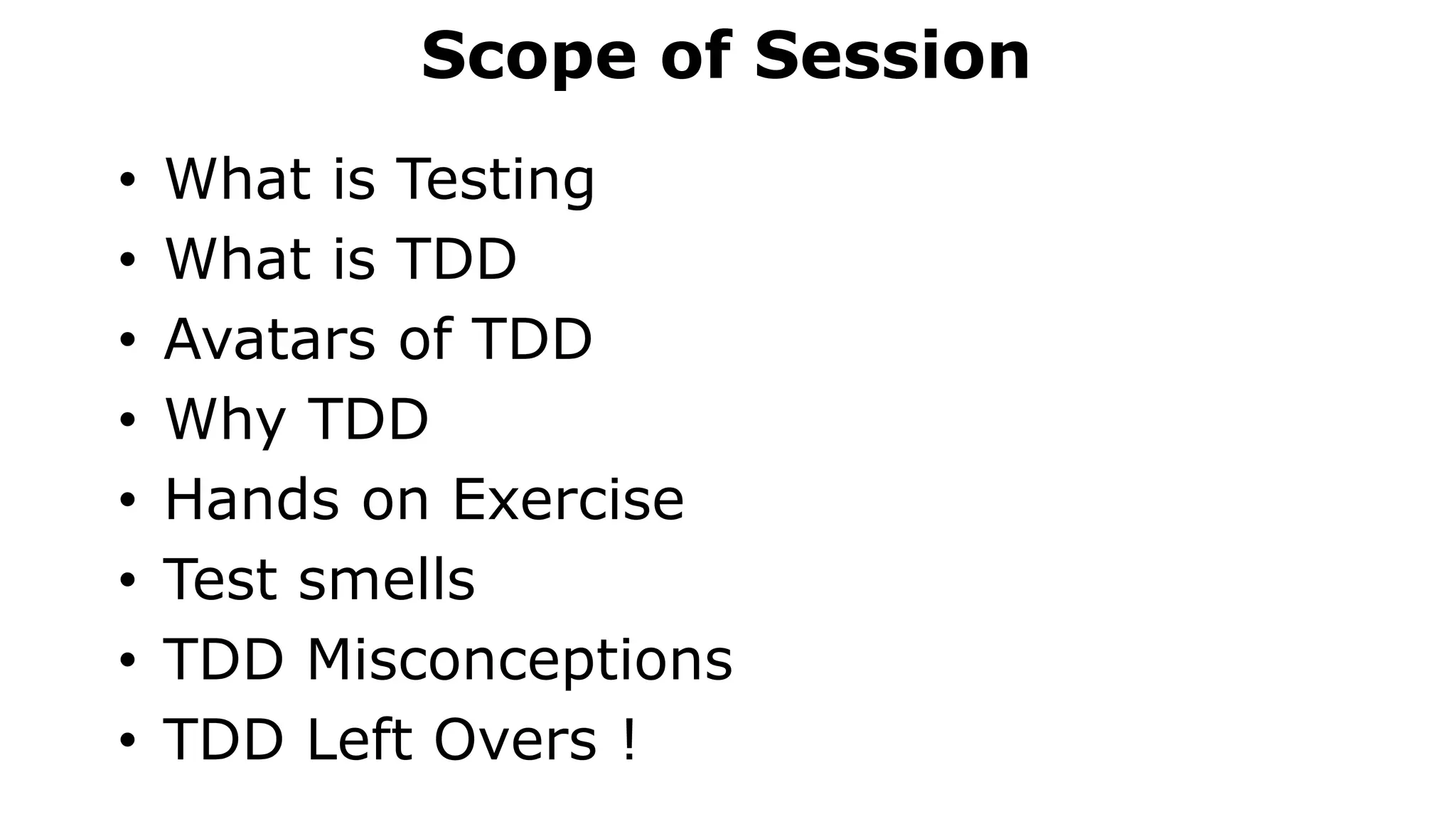
Scope of Session
• What is Testing
• What is TDD
• Avatars of TDD
• Why TDD
• Hands on Exercise
• Test smells
• TDD Misconceptions
• TDD Left Overs !
4
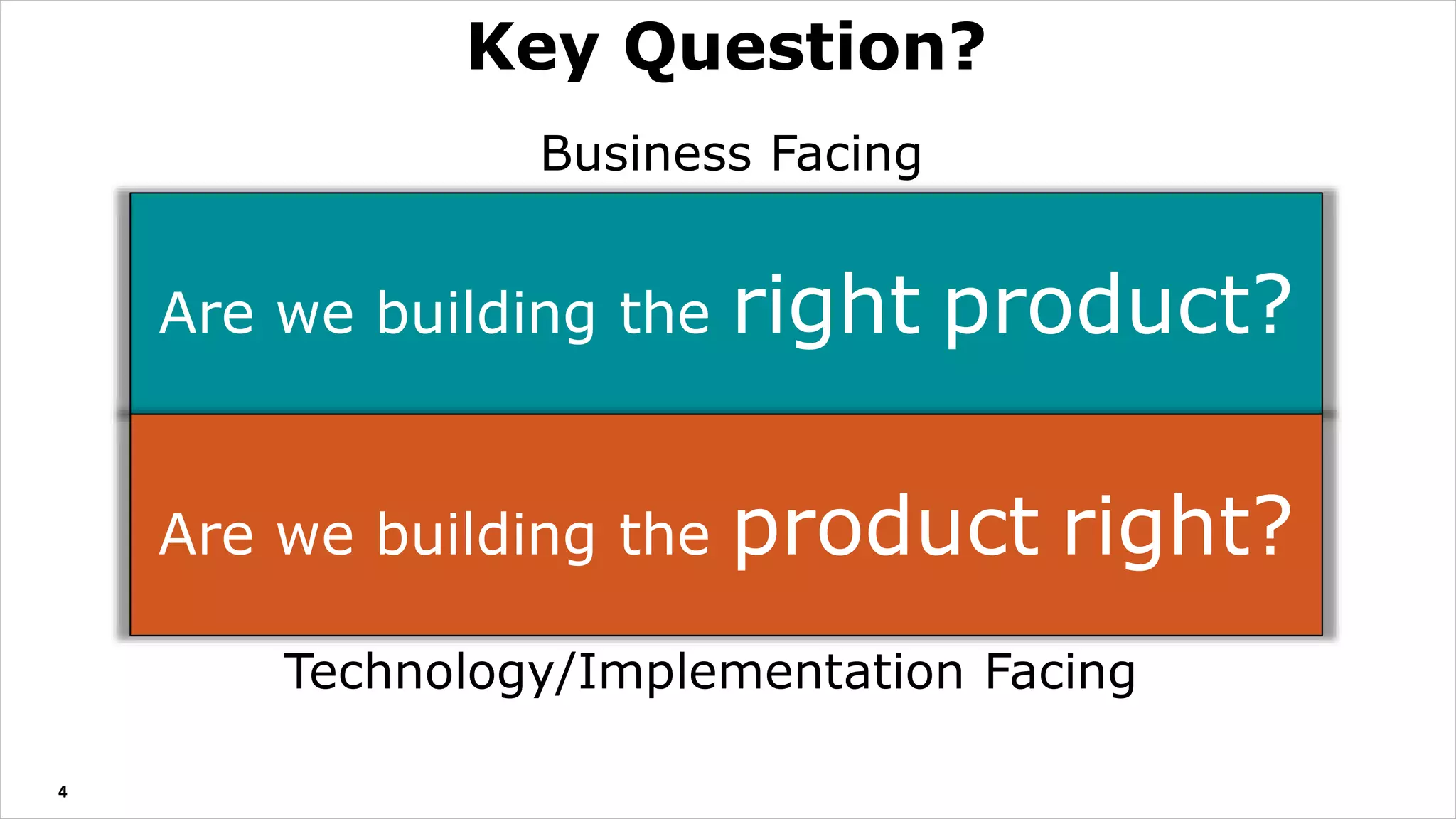
Key Question?
Are we building the right product?
Are we building the product right?
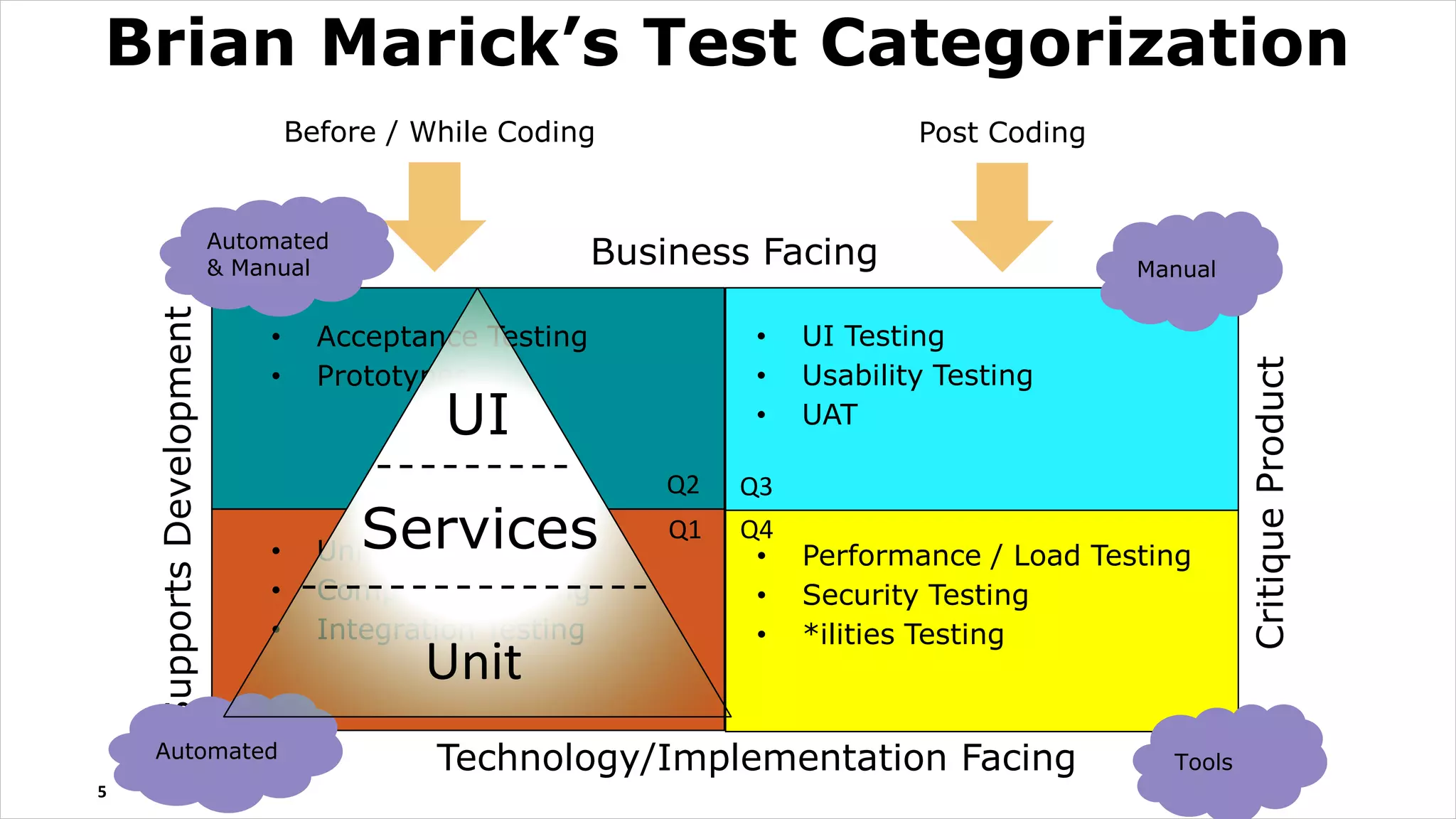
Business Facing
Technology/Implementation Facing
5
Brian Marick’s Test Categorization
Business Facing
Technology/Implementation Facing
SupportsDevelopment
CritiqueProduct
Before / While Coding Post Coding
• Performance / Load Testing
• Security Testing
• *ilities Testing
• UI Testing
• Usability Testing
• UAT
• Acceptance Testing
• Prototypes
• Unit Testing
• Component Testing
• Integration Testing
Automated
& Manual
Automated Tools
Manual
UI
Services
Unit
Q1 Q4
Q3Q2
What ?
7
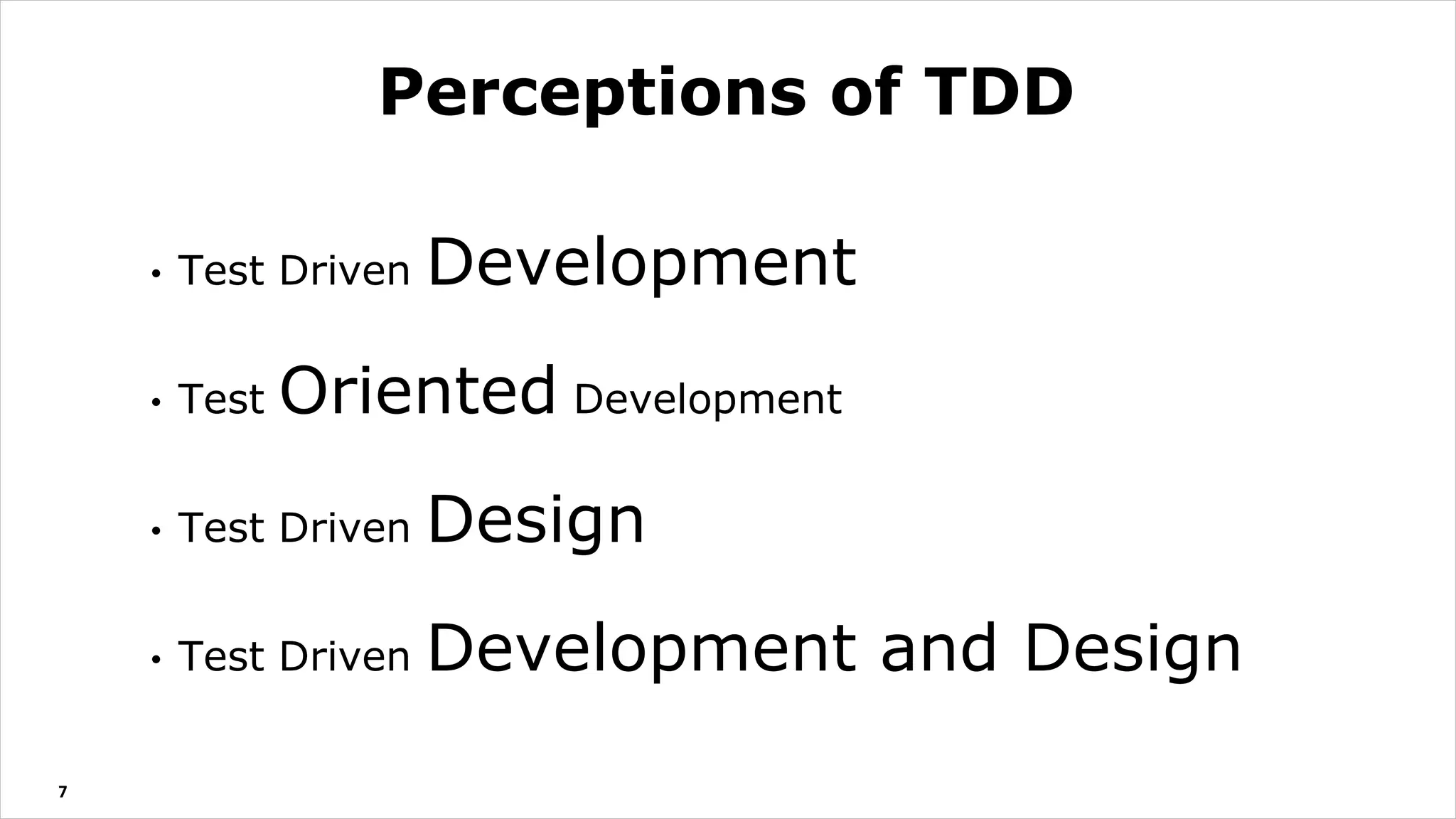
• Test Driven Development
• Test Oriented Development
• Test Driven Design
• Test Driven Development and Design
Perceptions of TDD
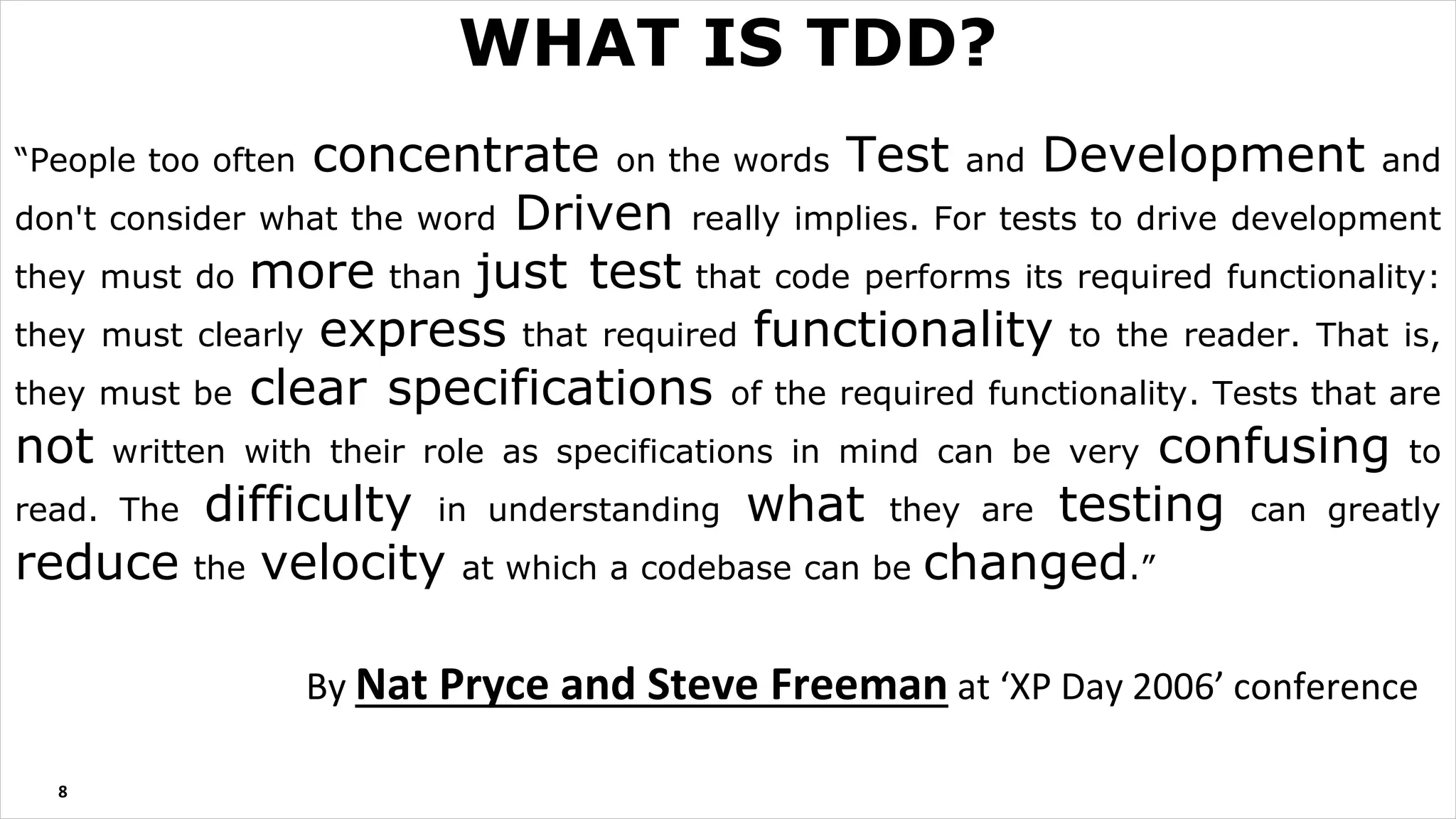
“People too often concentrate on the words Test and Development and
don't consider what the word Driven really implies. For tests to drive development
they must do more than just test that code performs its required functionality:
they must clearly express that required functionality to the reader. That is,
they must be clear specifications of the required functionality. Tests that are
not written with their role as specifications in mind can be very confusing to
read. The difficulty in understanding what they are testing can greatly
reduce the velocity at which a codebase can be changed.”
By Nat Pryce and Steve Freeman at ‘XP Day 2006’ conference
8
WHAT IS TDD?
June 23, 20169
TDD Cycle - Test, Code & Refactor
4 rules of simple design
- All tests passes
- No code smells
- Code communicates
- Minimalism
10
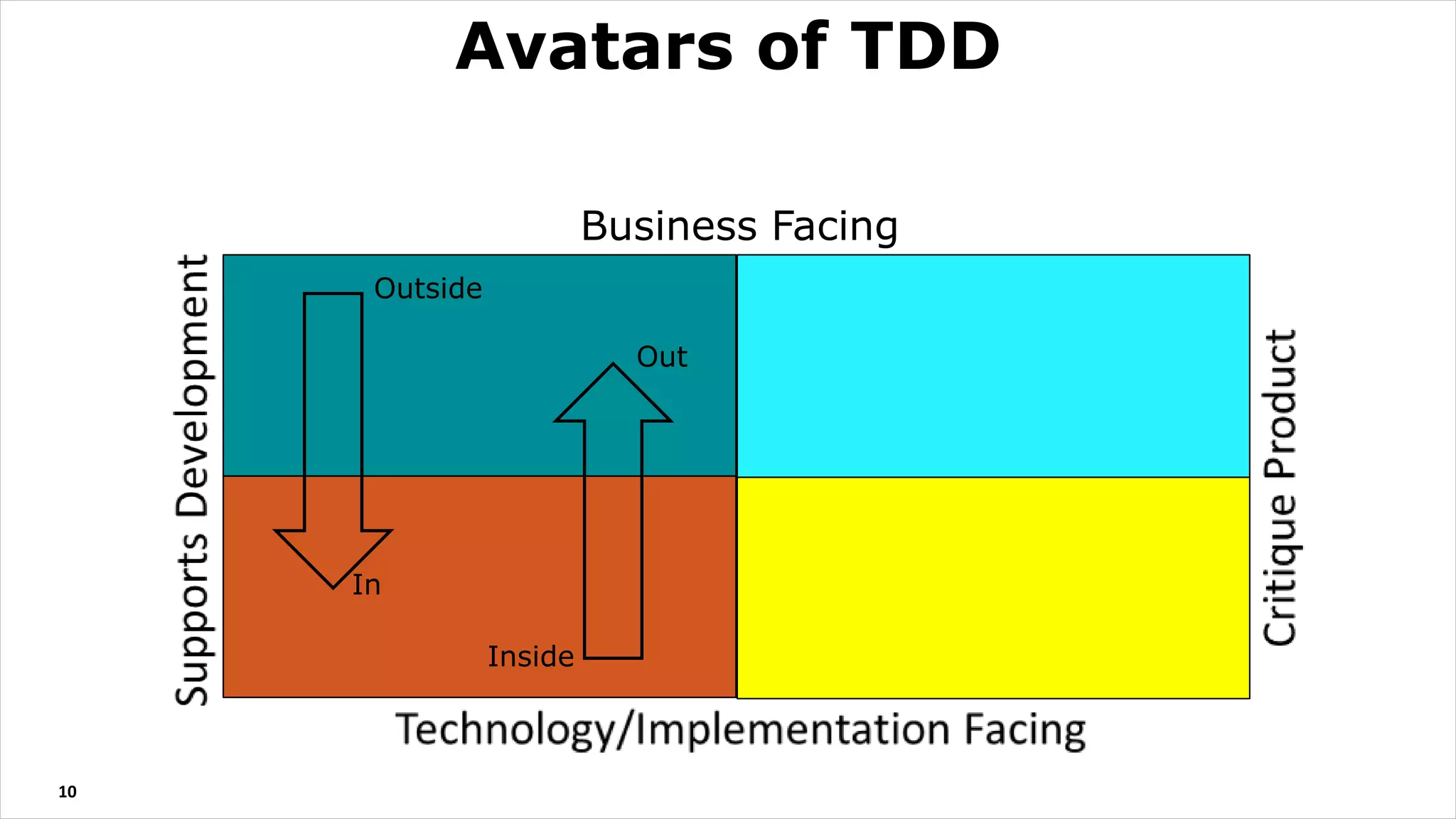
Avatars of TDD
Business Facing
Outside
In
Out
Inside
11
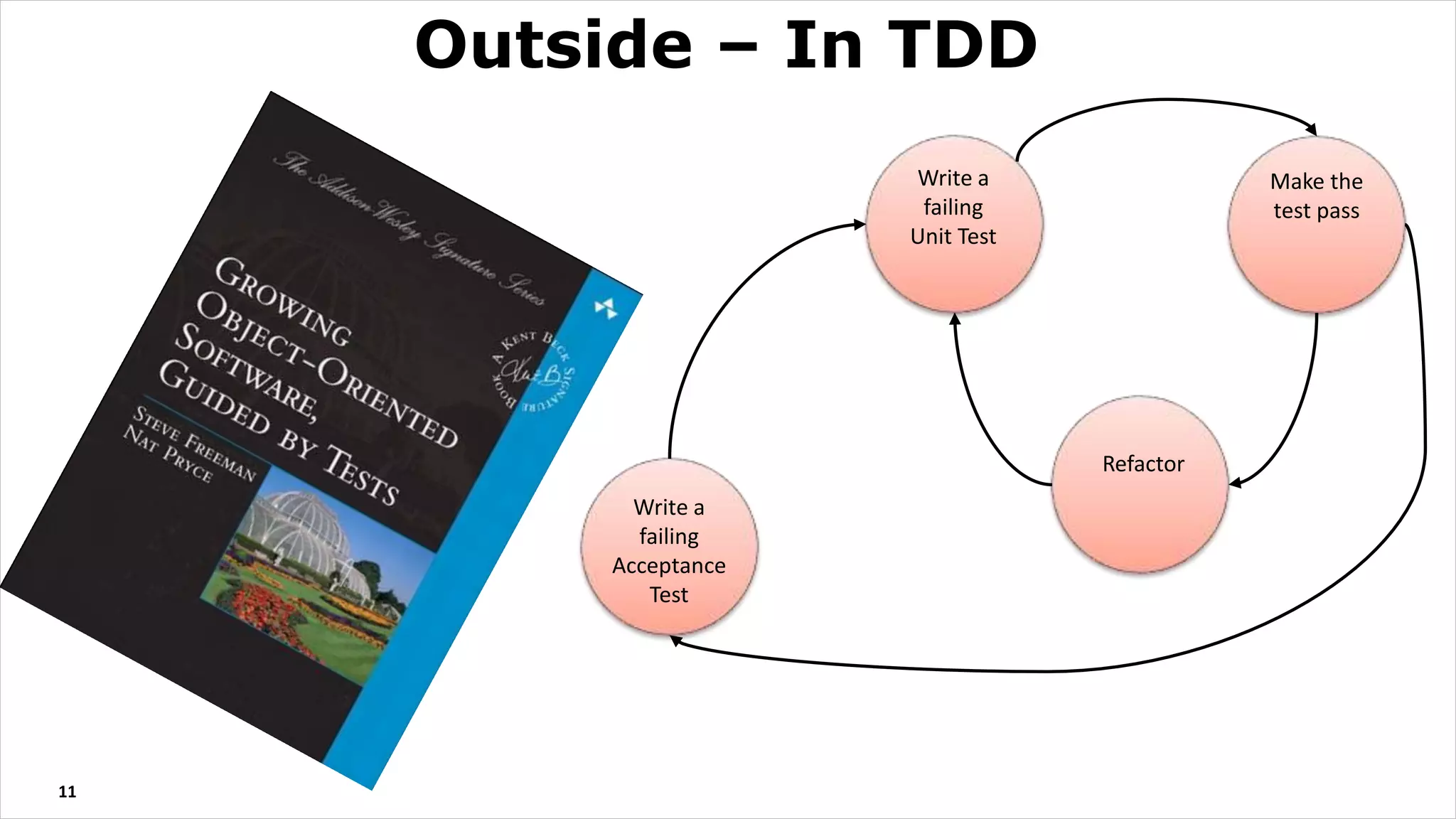
Outside – In TDD
Write a
failing
Acceptance
Test
Write a
failing
Unit Test
Make the
test pass
Refactor
12
Basket
?
Outside – In TDD (Contd.)
?
TEST
[Calculate total
price]
Mockery
Expectations
Loyalty Point
Calculator
Promotion
Target Object
/ CUT
13
Inside – Out TDD
Basket
Loyalty
Point
Calculator
Promotions
TEST
[Calculate total
price]
Target Object
/ CUT
14
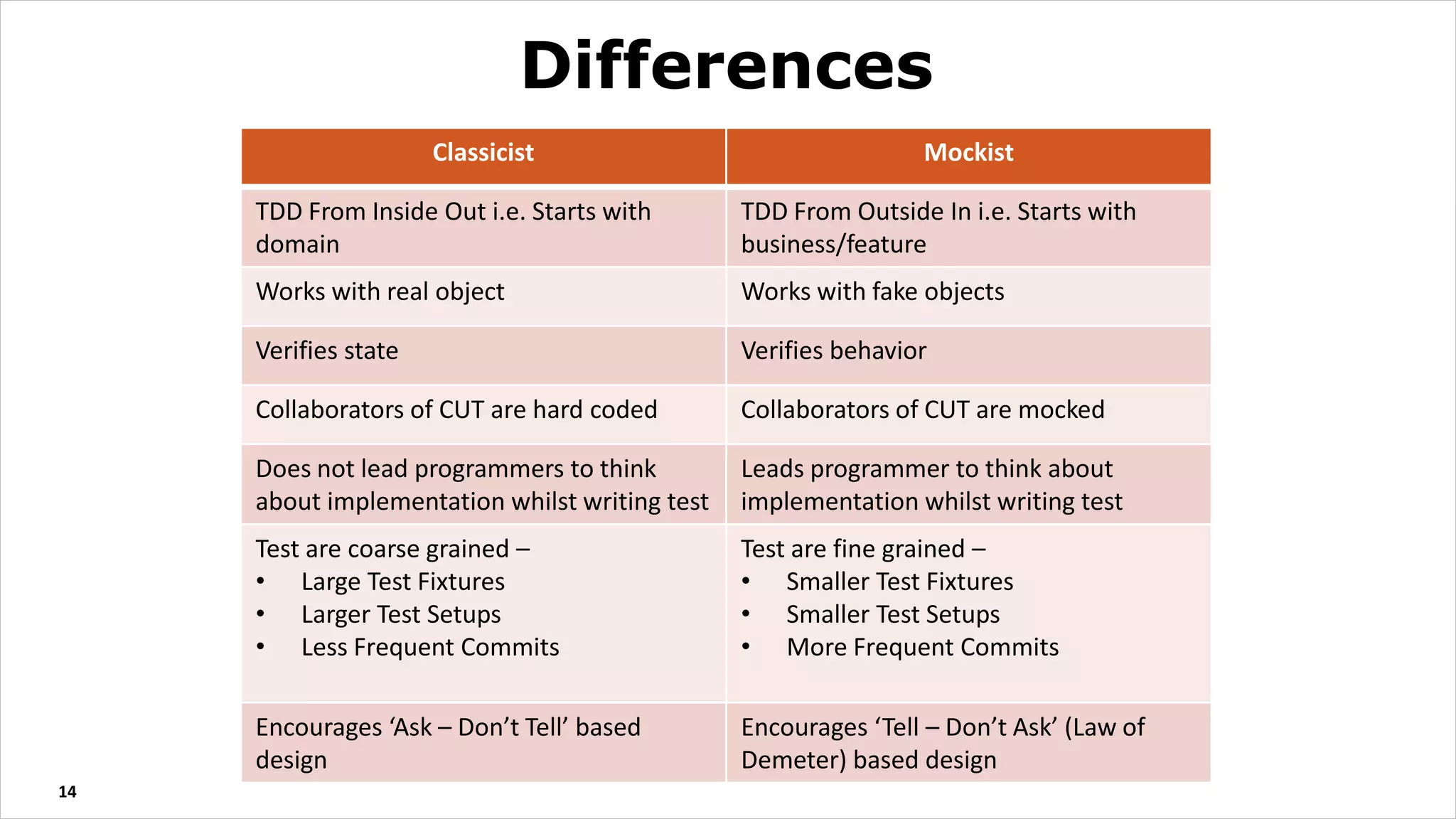
Differences
Classicist Mockist
TDD From Inside Out i.e. Starts with
domain
TDD From Outside In i.e. Starts with
business/feature
Works with real object Works with fake objects
Verifies state Verifies behavior
Collaborators of CUT are hard coded Collaborators of CUT are mocked
Does not lead programmers to think
about implementation whilst writing test
Leads programmer to think about
implementation whilst writing test
Test are coarse grained –
• Large Test Fixtures
• Larger Test Setups
• Less Frequent Commits
Test are fine grained –
• Smaller Test Fixtures
• Smaller Test Setups
• More Frequent Commits
Encourages ‘Ask – Don’t Tell’ based
design
Encourages ‘Tell – Don’t Ask’ (Law of
Demeter) based design
Why practicing TDD is
so important?
16
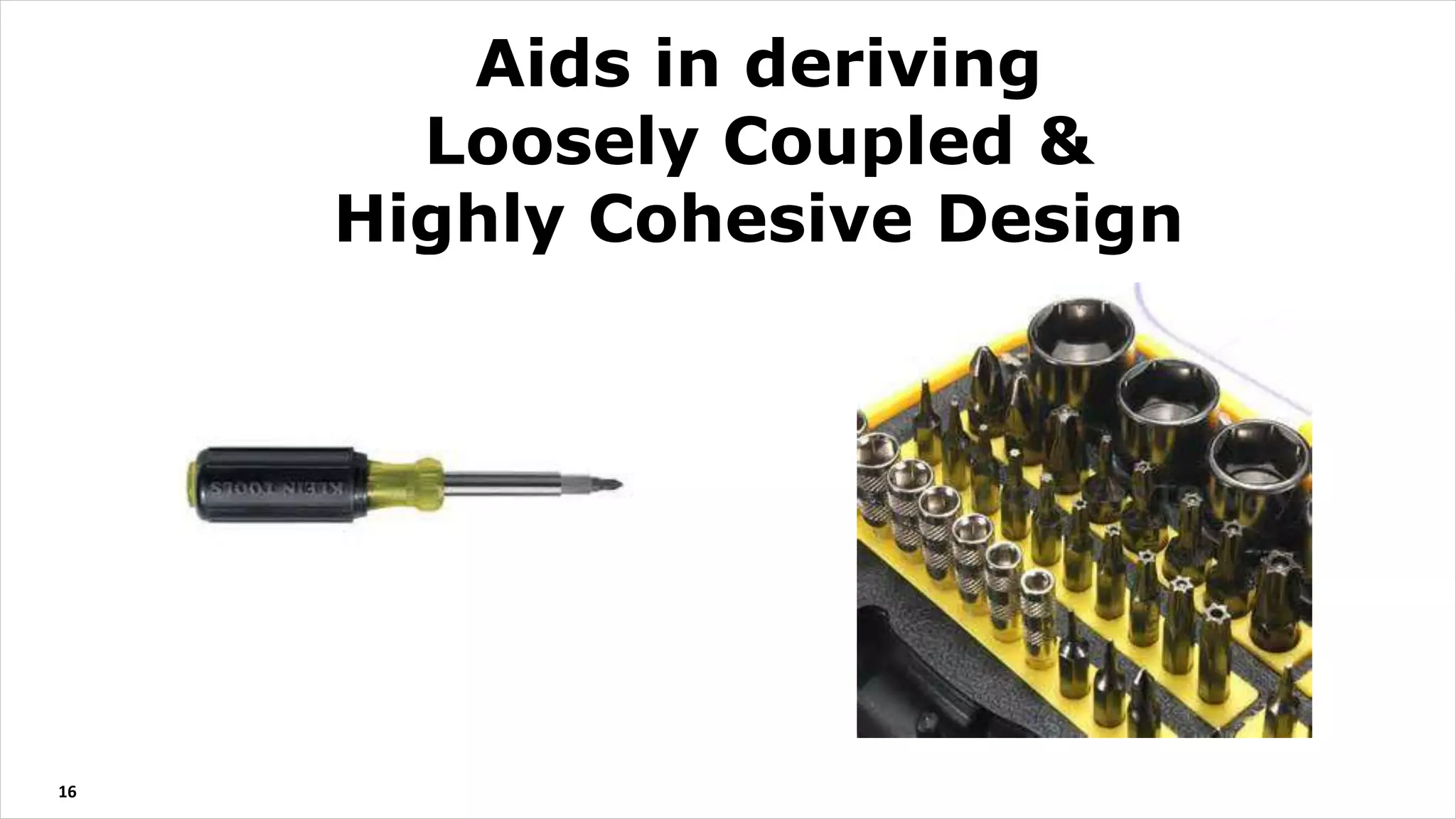
Aids in deriving
Loosely Coupled &
Highly Cohesive Design
17
Caveat !
18
Helps creating live up to date
specifications
19
Promotes Refactoring
20
Manual (Monkey) checking by
Developers and Testers
21
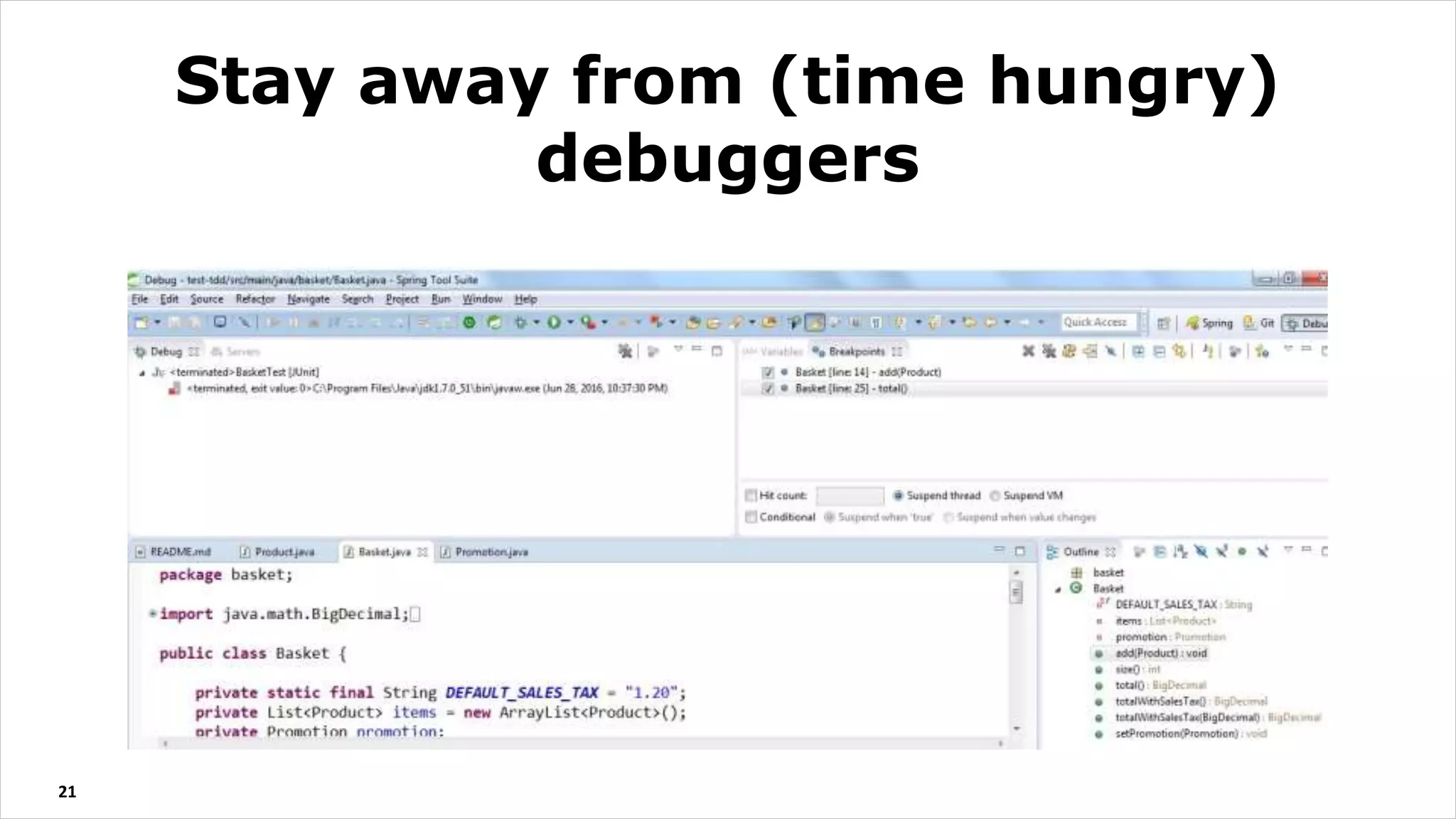
Stay away from (time hungry)
debuggers
22
Helps developer to maintain
focus
23
Instills Confidence
24
Ease of code understanding
25
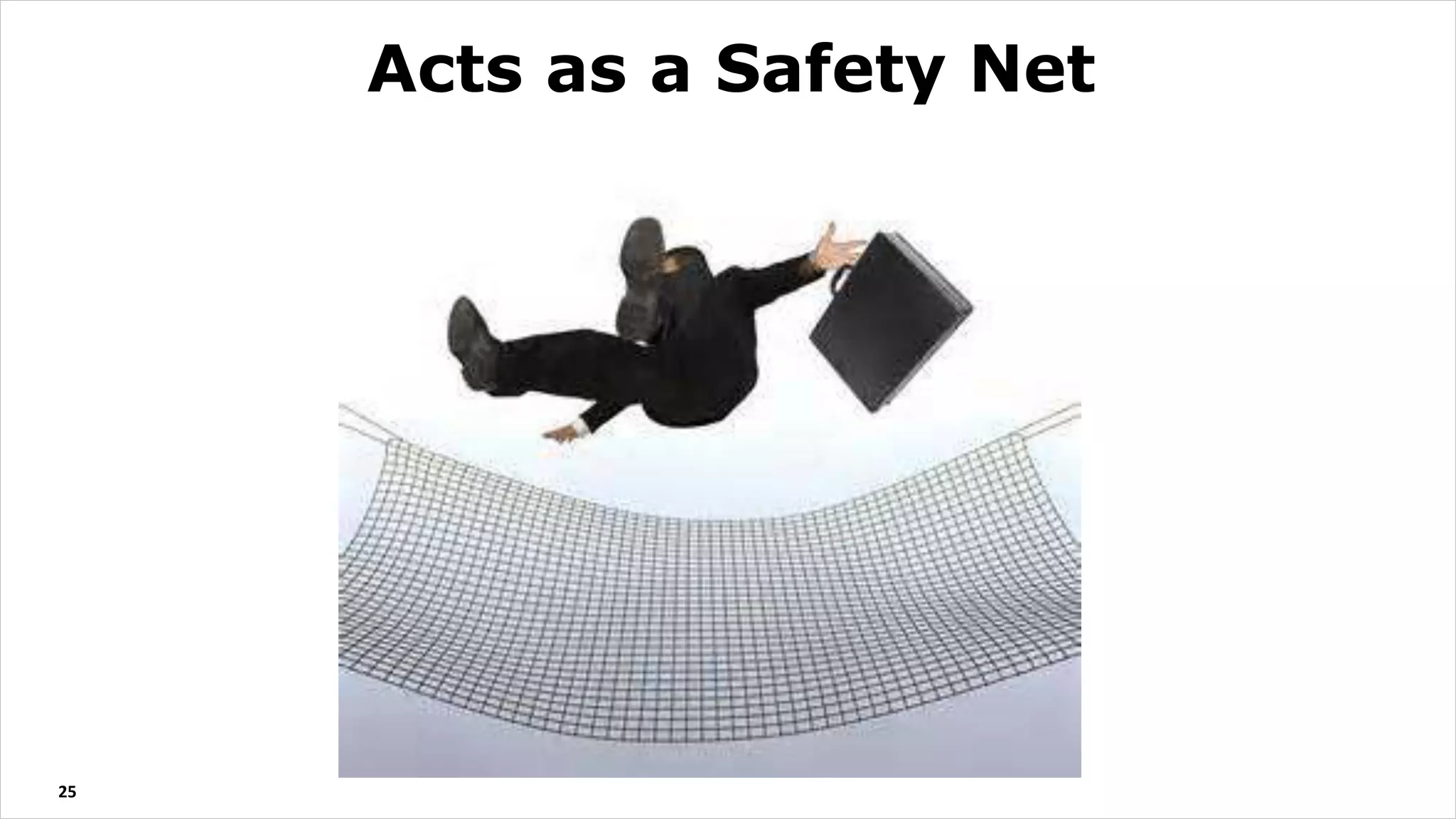
Acts as a Safety Net
Hands on Exercise
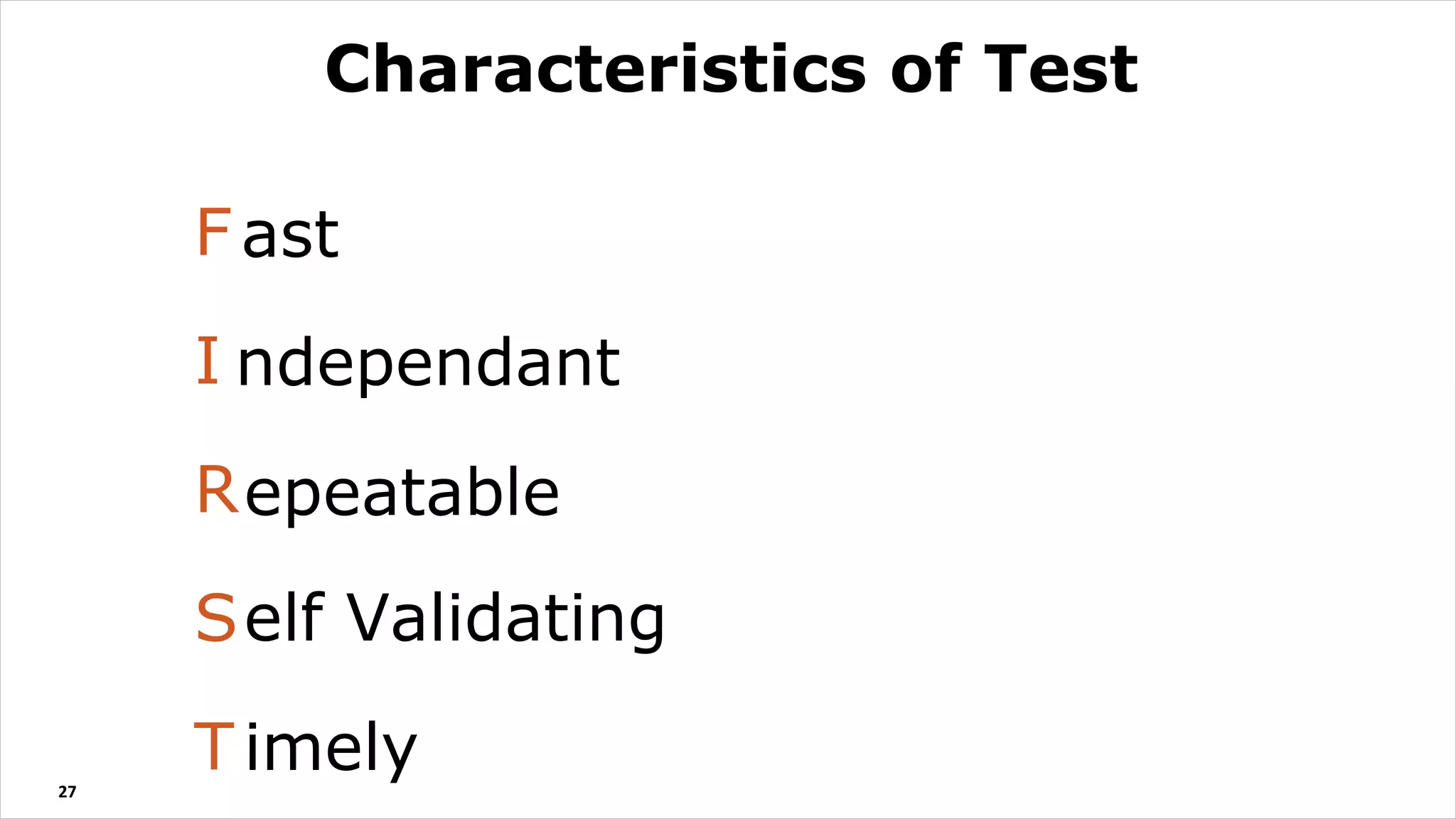
F
I
R
S
T27
Characteristics of Test
ast
ndependant
epeatable
elf Validating
imely
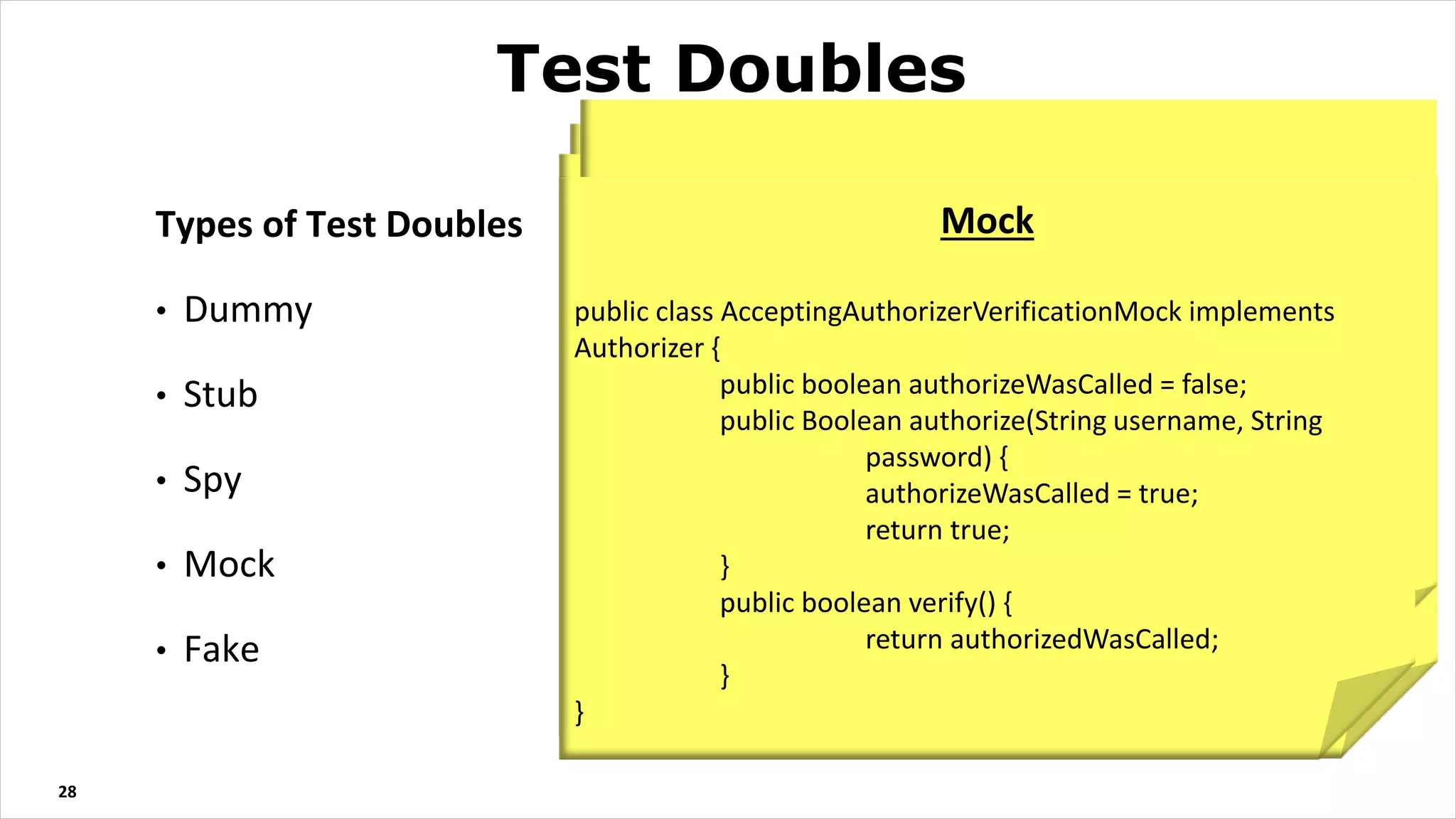
Types of Test Doubles
• Dummy
• Stub
• Spy
• Mock
• Fake
28
Test Doubles
Dummy Test
public class DummyAuthorizer implements Authorizer {
public Boolean authorize(String username, String
password) {
return null;
}
}
@Test
public void newlyCreatedSystem_hasNoLoggedInUsers() {
System system = new System(new
DummyAuthorizer());
assertThat(system.loginCount(), is(0));
}
Fake
public class AcceptingAuthorizerFake implements Authorizer {
public Boolean authorize(String username, String
password) {
return username.equals("Bob");
}
}
Stub
public class AcceptingAuthorizerStub implements Authorizer {
public Boolean authorize(String username, String
password) {
return true;
}
}
Spy
public class AcceptingAuthorizerSpy implements Authorizer {
public boolean authorizeWasCalled = false;
public Boolean authorize(String username, String
password) {
authorizeWasCalled = true;
return true;
}
}
Mock
public class AcceptingAuthorizerVerificationMock implements
Authorizer {
public boolean authorizeWasCalled = false;
public Boolean authorize(String username, String
password) {
authorizeWasCalled = true;
return true;
}
public boolean verify() {
return authorizedWasCalled;
}
}
Test Smells
June 23, 2016
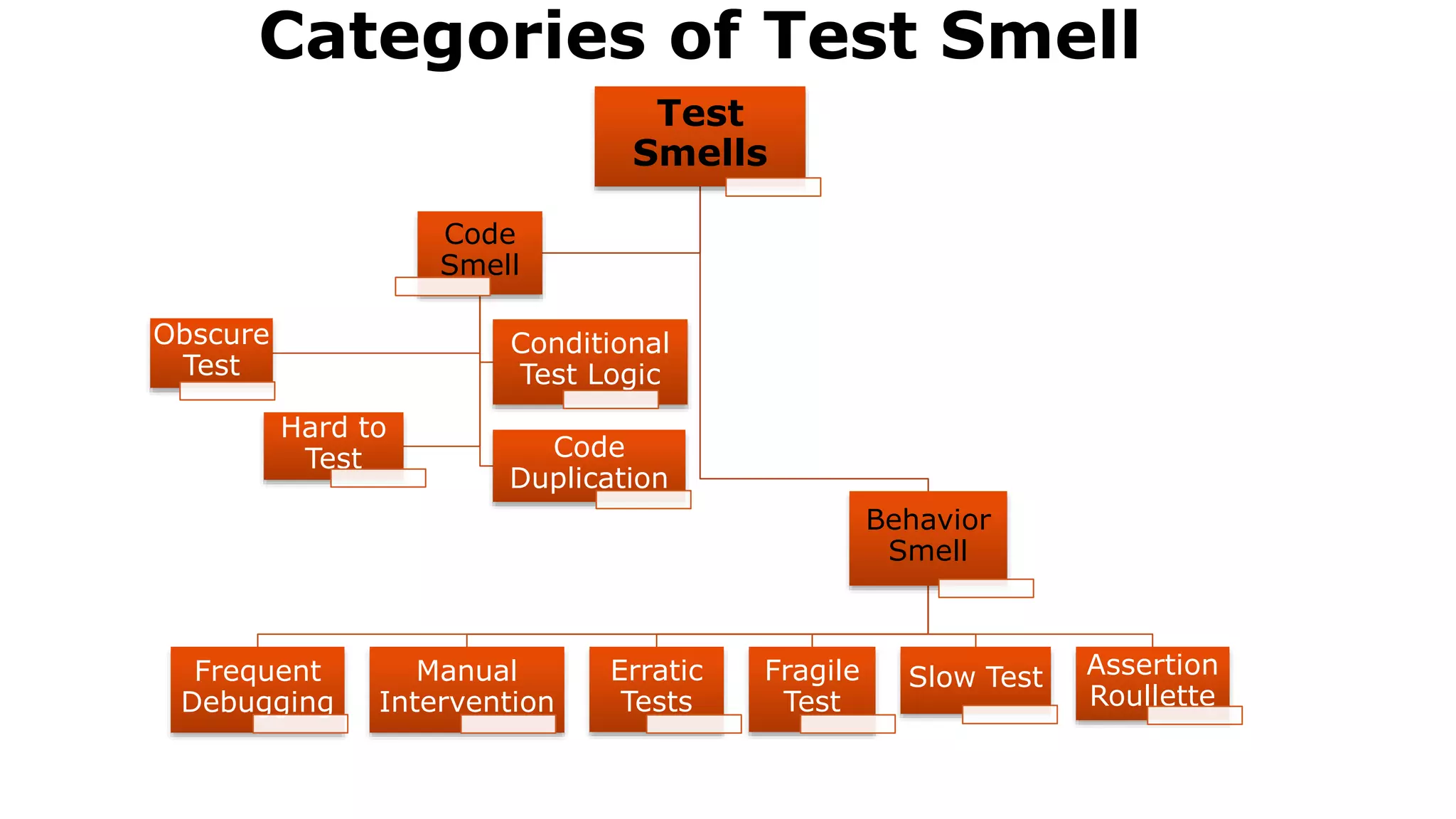
Categories of Test Smell
Test
Smells
Behavior
Smell
Frequent
Debugging
Manual
Intervention
Erratic
Tests
Fragile
Test
Slow Test Assertion
Roullette
Code
Smell
Obscure
Test
Conditional
Test Logic
Hard to
Test Code
Duplication
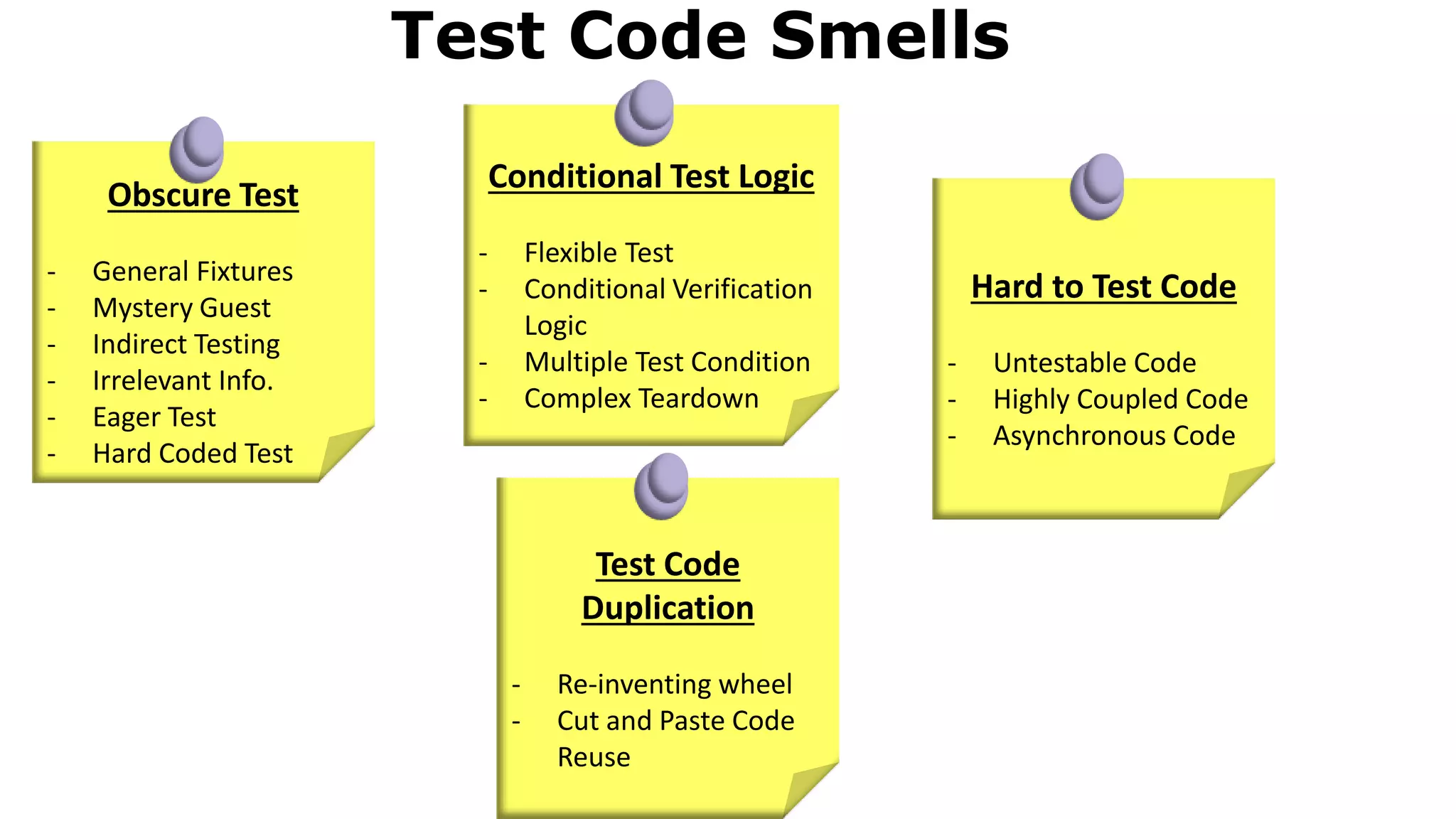
Obscure Test
- General Fixtures
- Mystery Guest
- Indirect Testing
- Irrelevant Info.
- Eager Test
- Hard Coded Test
Test Code Smells
Conditional Test Logic
- Flexible Test
- Conditional Verification
Logic
- Multiple Test Condition
- Complex Teardown
Hard to Test Code
- Untestable Code
- Highly Coupled Code
- Asynchronous Code
Test Code
Duplication
- Re-inventing wheel
- Cut and Paste Code
Reuse
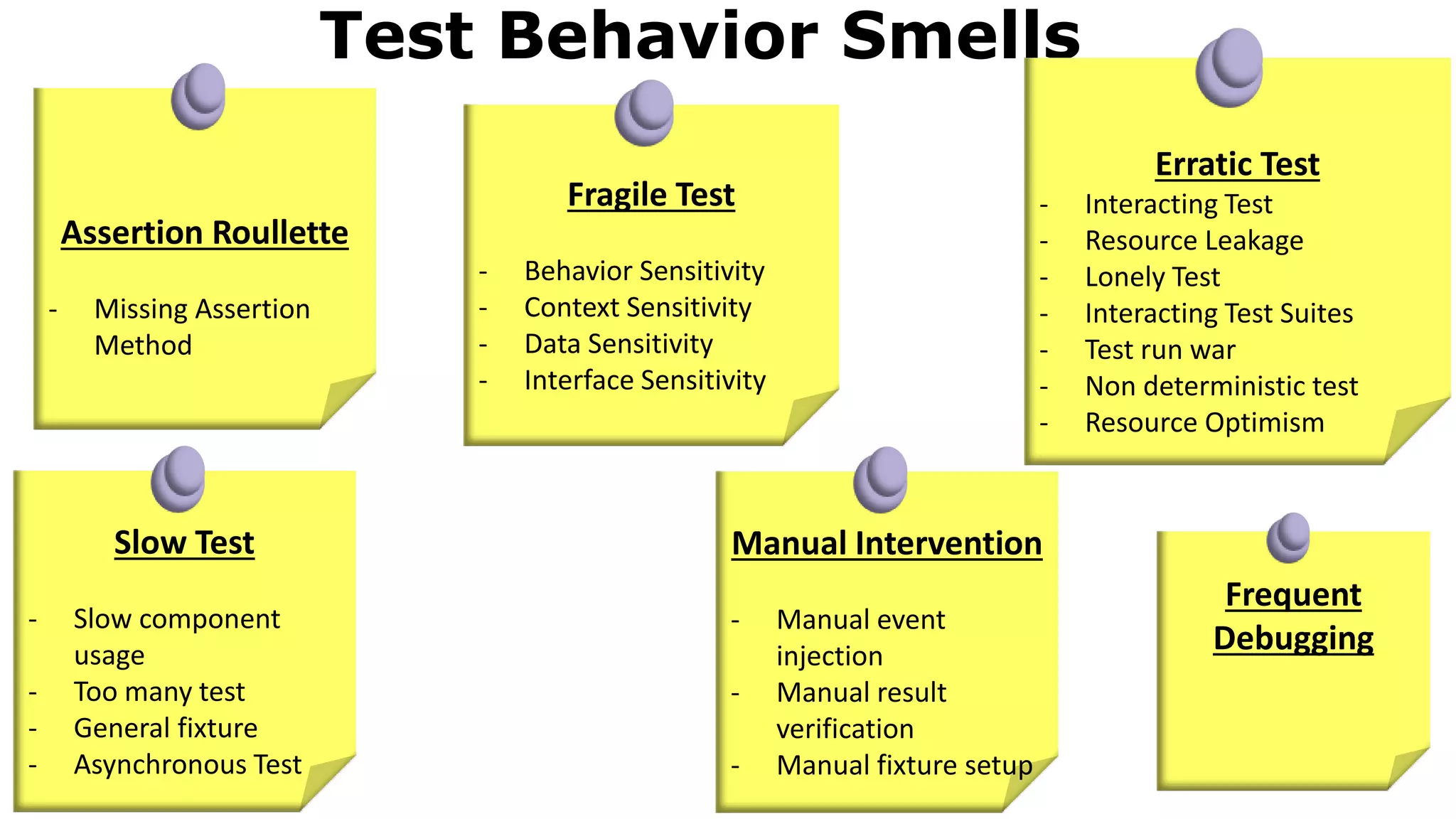
Assertion Roullette
- Missing Assertion
Method
Test Behavior Smells
Fragile Test
- Behavior Sensitivity
- Context Sensitivity
- Data Sensitivity
- Interface Sensitivity
Erratic Test
- Interacting Test
- Resource Leakage
- Lonely Test
- Interacting Test Suites
- Test run war
- Non deterministic test
- Resource Optimism
Slow Test
- Slow component
usage
- Too many test
- General fixture
- Asynchronous Test
Manual Intervention
- Manual event
injection
- Manual result
verification
- Manual fixture setup
Frequent
Debugging
TDD Misconceptions !
June 23, 201634
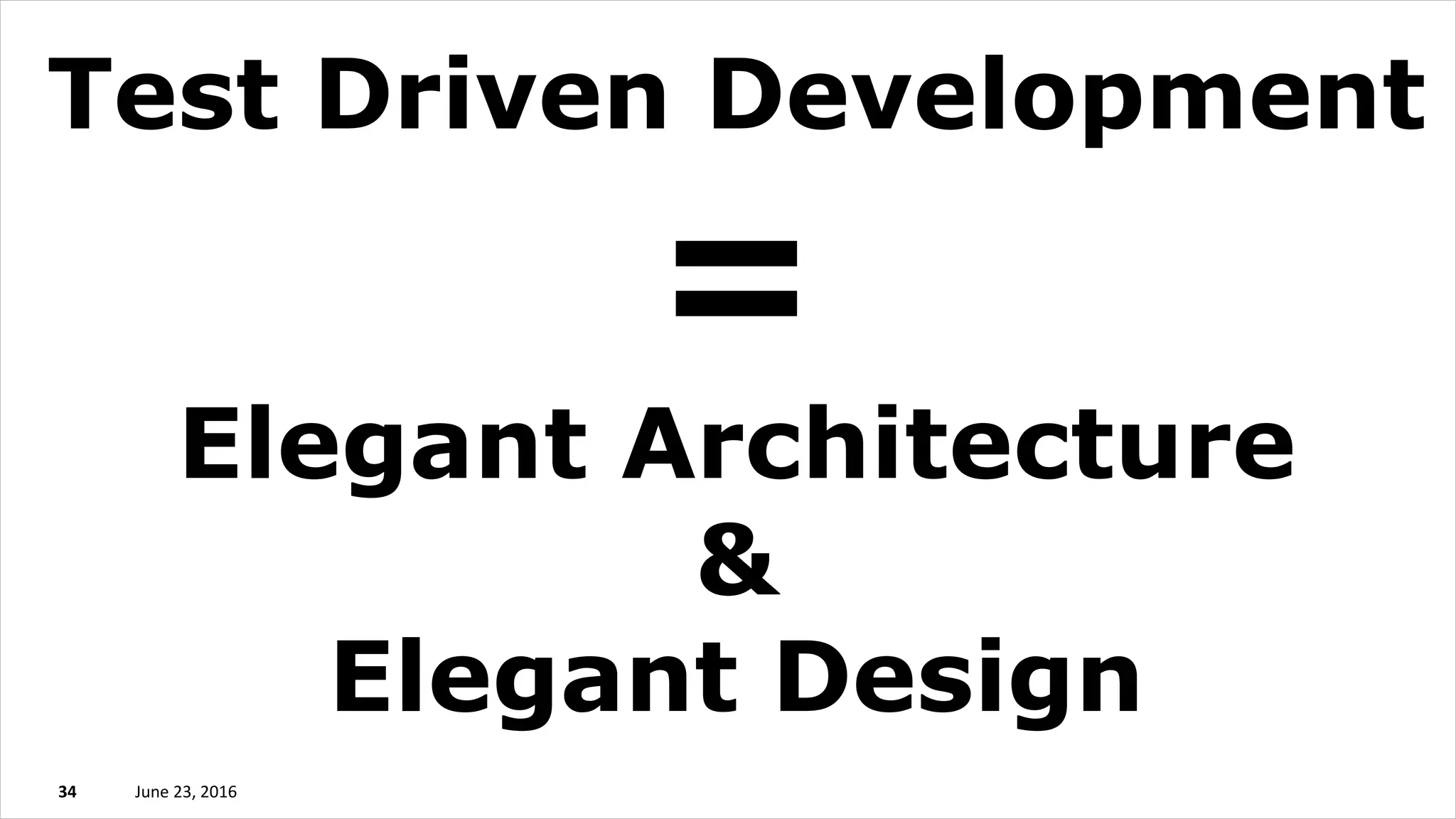
Test Driven Development
=
Elegant Architecture
&
Elegant Design
June 23, 201635
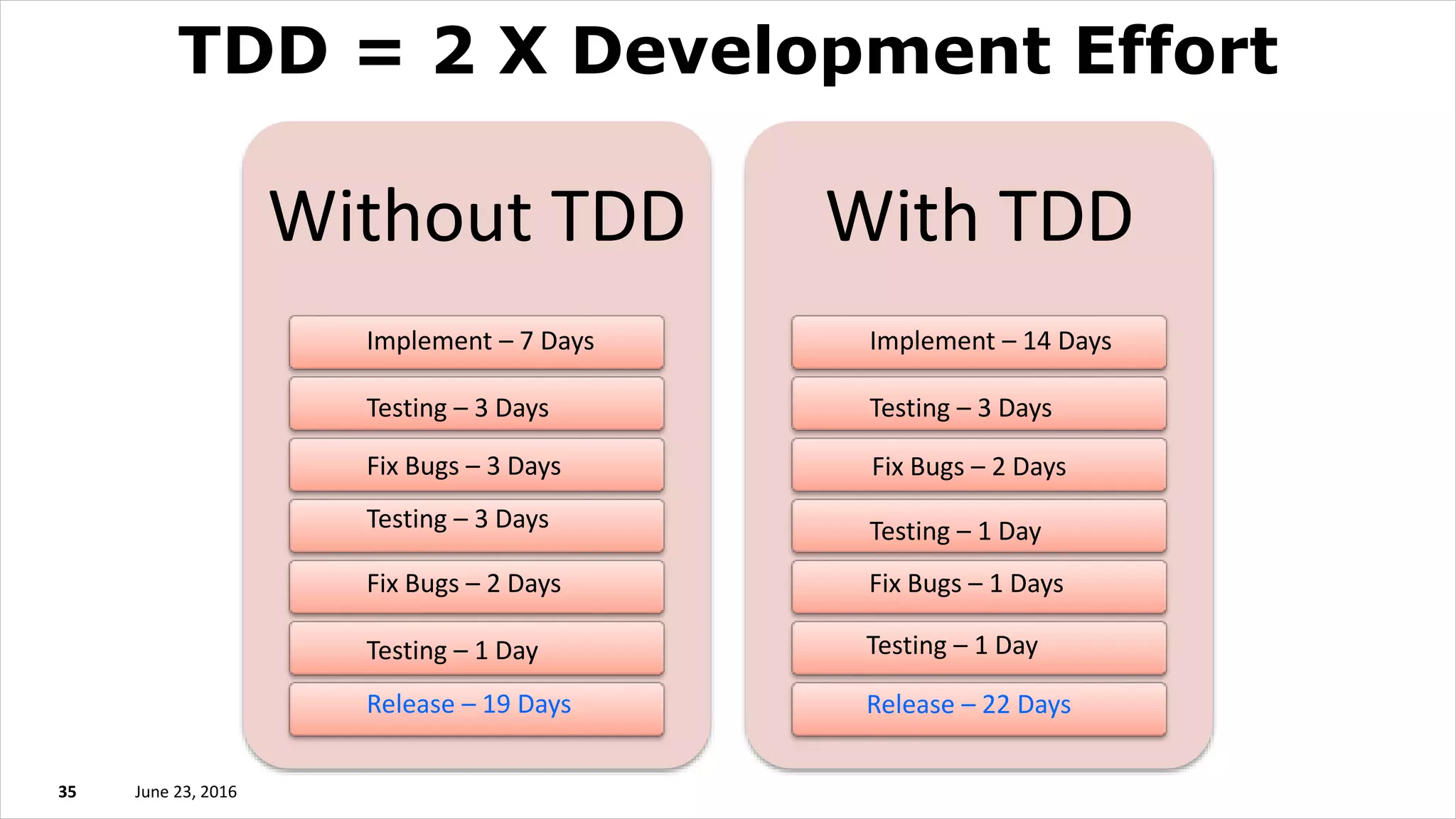
TDD = 2 X Development Effort
Without TDD With TDD
Implement – 7 Days Implement – 14 Days
Testing – 3 Days Testing – 3 Days
Fix Bugs – 3 Days
Testing – 3 Days
Fix Bugs – 2 Days
Testing – 1 Day
Release – 19 Days
Fix Bugs – 2 Days
Testing – 1 Day
Fix Bugs – 1 Days
Testing – 1 Day
Release – 22 Days
June 23, 201636
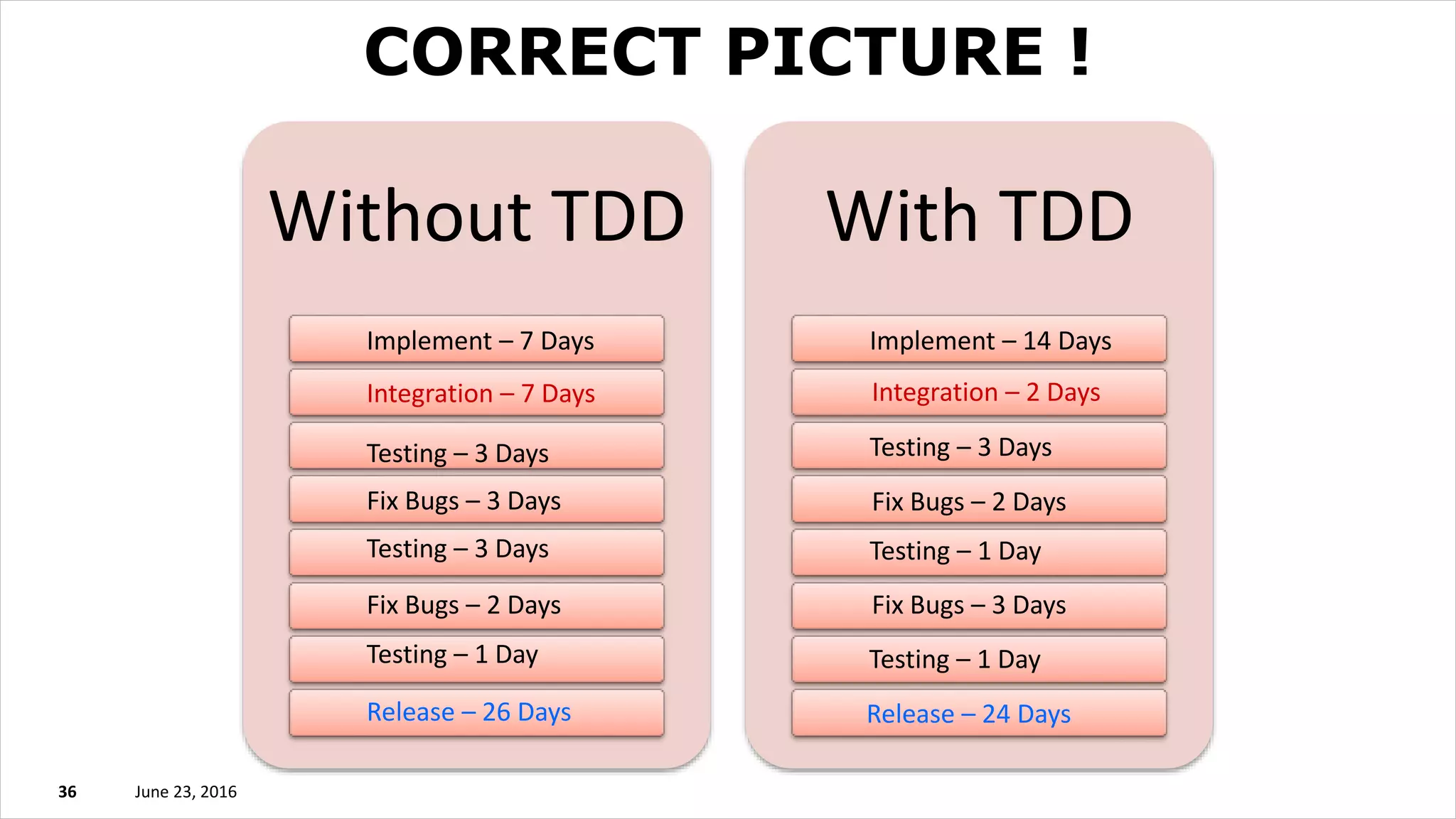
Without TDD With TDD
Implement – 7 Days Implement – 14 Days
Testing – 3 Days Testing – 3 Days
Fix Bugs – 3 Days
Testing – 3 Days
Fix Bugs – 2 Days
Testing – 1 Day
Release – 26 Days
Fix Bugs – 2 Days
Testing – 1 Day
Fix Bugs – 3 Days
Testing – 1 Day
Release – 24 Days
Integration – 7 Days Integration – 2 Days
CORRECT PICTURE !
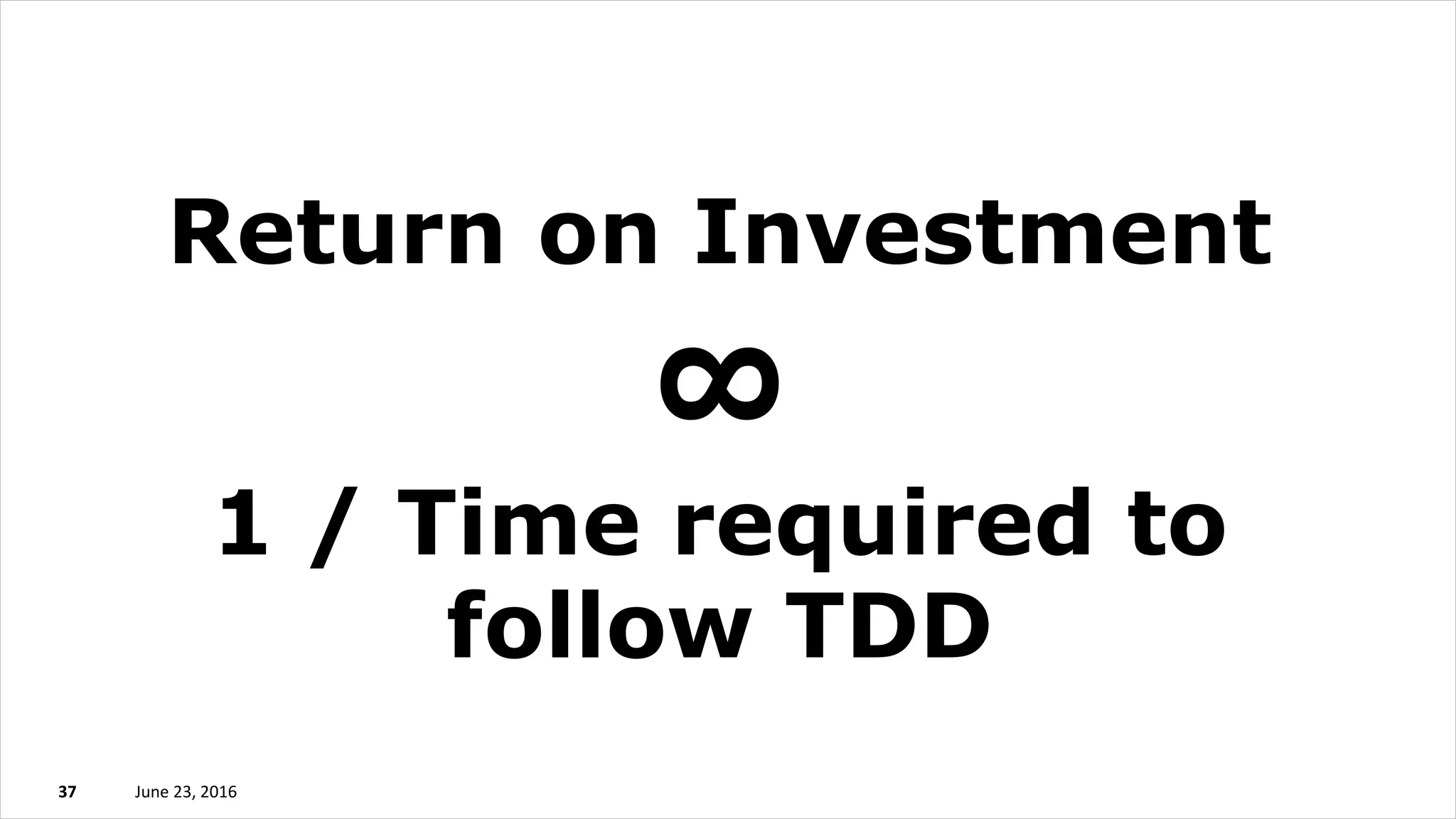
Return on Investment
∞
1 / Time required to
follow TDD
June 23, 201637
TDD Leftovers !
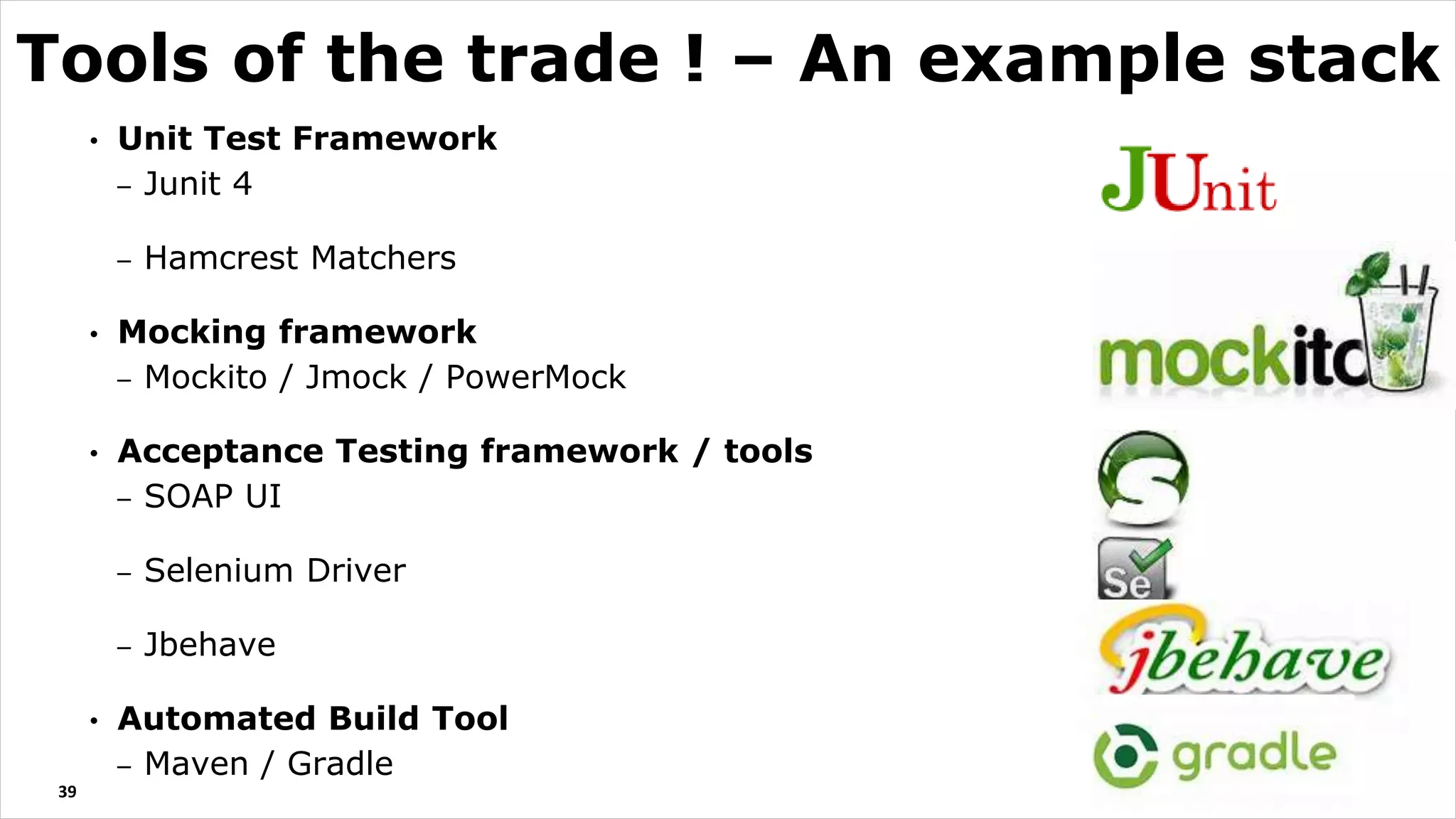
• Unit Test Framework
– Junit 4
– Hamcrest Matchers
• Mocking framework
– Mockito / Jmock / PowerMock
• Acceptance Testing framework / tools
– SOAP UI
– Selenium Driver
– Jbehave
• Automated Build Tool
– Maven / Gradle
39
Tools of the trade ! – An example stack
• Should be on every software craftsman’s desk
– Clean Code (Uncle Bob)
– Refactoring (Fowler)
– Refactoring to Patterns (Joshua)
– Growing Object Oriented Software guided by Test (Pryce and Freeman)
• Nice to have
– Practical Unit testing with Junit and Mockito
40
Some resources related to TDD
41
Thank You !
shah_d_p@yahoo.com
@dhaval201279
https://in.linkedin.com/in/dhavalshah201279

Anatomy of Test Driven Development

  • 1.
    July 19, 2016 DhavalP Shah Anatomy of Test Driven Development
  • 2.
  • 3.
    June 23, 2016 Scopeof Session • What is Testing • What is TDD • Avatars of TDD • Why TDD • Hands on Exercise • Test smells • TDD Misconceptions • TDD Left Overs !
  • 4.
    4 Key Question? Are webuilding the right product? Are we building the product right? Business Facing Technology/Implementation Facing
  • 5.
    5 Brian Marick’s TestCategorization Business Facing Technology/Implementation Facing SupportsDevelopment CritiqueProduct Before / While Coding Post Coding • Performance / Load Testing • Security Testing • *ilities Testing • UI Testing • Usability Testing • UAT • Acceptance Testing • Prototypes • Unit Testing • Component Testing • Integration Testing Automated & Manual Automated Tools Manual UI Services Unit Q1 Q4 Q3Q2
  • 6.
  • 7.
    7 • Test DrivenDevelopment • Test Oriented Development • Test Driven Design • Test Driven Development and Design Perceptions of TDD
  • 8.
    “People too oftenconcentrate on the words Test and Development and don't consider what the word Driven really implies. For tests to drive development they must do more than just test that code performs its required functionality: they must clearly express that required functionality to the reader. That is, they must be clear specifications of the required functionality. Tests that are not written with their role as specifications in mind can be very confusing to read. The difficulty in understanding what they are testing can greatly reduce the velocity at which a codebase can be changed.” By Nat Pryce and Steve Freeman at ‘XP Day 2006’ conference 8 WHAT IS TDD?
  • 9.
    June 23, 20169 TDDCycle - Test, Code & Refactor 4 rules of simple design - All tests passes - No code smells - Code communicates - Minimalism
  • 10.
    10 Avatars of TDD BusinessFacing Outside In Out Inside
  • 11.
    11 Outside – InTDD Write a failing Acceptance Test Write a failing Unit Test Make the test pass Refactor
  • 12.
    12 Basket ? Outside – InTDD (Contd.) ? TEST [Calculate total price] Mockery Expectations Loyalty Point Calculator Promotion Target Object / CUT
  • 13.
    13 Inside – OutTDD Basket Loyalty Point Calculator Promotions TEST [Calculate total price] Target Object / CUT
  • 14.
    14 Differences Classicist Mockist TDD FromInside Out i.e. Starts with domain TDD From Outside In i.e. Starts with business/feature Works with real object Works with fake objects Verifies state Verifies behavior Collaborators of CUT are hard coded Collaborators of CUT are mocked Does not lead programmers to think about implementation whilst writing test Leads programmer to think about implementation whilst writing test Test are coarse grained – • Large Test Fixtures • Larger Test Setups • Less Frequent Commits Test are fine grained – • Smaller Test Fixtures • Smaller Test Setups • More Frequent Commits Encourages ‘Ask – Don’t Tell’ based design Encourages ‘Tell – Don’t Ask’ (Law of Demeter) based design
  • 15.
    Why practicing TDDis so important?
  • 16.
    16 Aids in deriving LooselyCoupled & Highly Cohesive Design
  • 17.
  • 18.
    18 Helps creating liveup to date specifications
  • 19.
  • 20.
    20 Manual (Monkey) checkingby Developers and Testers
  • 21.
    21 Stay away from(time hungry) debuggers
  • 22.
    22 Helps developer tomaintain focus
  • 23.
  • 24.
    24 Ease of codeunderstanding
  • 25.
    25 Acts as aSafety Net
  • 26.
  • 27.
  • 28.
    Types of TestDoubles • Dummy • Stub • Spy • Mock • Fake 28 Test Doubles Dummy Test public class DummyAuthorizer implements Authorizer { public Boolean authorize(String username, String password) { return null; } } @Test public void newlyCreatedSystem_hasNoLoggedInUsers() { System system = new System(new DummyAuthorizer()); assertThat(system.loginCount(), is(0)); } Fake public class AcceptingAuthorizerFake implements Authorizer { public Boolean authorize(String username, String password) { return username.equals("Bob"); } } Stub public class AcceptingAuthorizerStub implements Authorizer { public Boolean authorize(String username, String password) { return true; } } Spy public class AcceptingAuthorizerSpy implements Authorizer { public boolean authorizeWasCalled = false; public Boolean authorize(String username, String password) { authorizeWasCalled = true; return true; } } Mock public class AcceptingAuthorizerVerificationMock implements Authorizer { public boolean authorizeWasCalled = false; public Boolean authorize(String username, String password) { authorizeWasCalled = true; return true; } public boolean verify() { return authorizedWasCalled; } }
  • 29.
  • 30.
    June 23, 2016 Categoriesof Test Smell Test Smells Behavior Smell Frequent Debugging Manual Intervention Erratic Tests Fragile Test Slow Test Assertion Roullette Code Smell Obscure Test Conditional Test Logic Hard to Test Code Duplication
  • 31.
    Obscure Test - GeneralFixtures - Mystery Guest - Indirect Testing - Irrelevant Info. - Eager Test - Hard Coded Test Test Code Smells Conditional Test Logic - Flexible Test - Conditional Verification Logic - Multiple Test Condition - Complex Teardown Hard to Test Code - Untestable Code - Highly Coupled Code - Asynchronous Code Test Code Duplication - Re-inventing wheel - Cut and Paste Code Reuse
  • 32.
    Assertion Roullette - MissingAssertion Method Test Behavior Smells Fragile Test - Behavior Sensitivity - Context Sensitivity - Data Sensitivity - Interface Sensitivity Erratic Test - Interacting Test - Resource Leakage - Lonely Test - Interacting Test Suites - Test run war - Non deterministic test - Resource Optimism Slow Test - Slow component usage - Too many test - General fixture - Asynchronous Test Manual Intervention - Manual event injection - Manual result verification - Manual fixture setup Frequent Debugging
  • 33.
  • 34.
    June 23, 201634 TestDriven Development = Elegant Architecture & Elegant Design
  • 35.
    June 23, 201635 TDD= 2 X Development Effort Without TDD With TDD Implement – 7 Days Implement – 14 Days Testing – 3 Days Testing – 3 Days Fix Bugs – 3 Days Testing – 3 Days Fix Bugs – 2 Days Testing – 1 Day Release – 19 Days Fix Bugs – 2 Days Testing – 1 Day Fix Bugs – 1 Days Testing – 1 Day Release – 22 Days
  • 36.
    June 23, 201636 WithoutTDD With TDD Implement – 7 Days Implement – 14 Days Testing – 3 Days Testing – 3 Days Fix Bugs – 3 Days Testing – 3 Days Fix Bugs – 2 Days Testing – 1 Day Release – 26 Days Fix Bugs – 2 Days Testing – 1 Day Fix Bugs – 3 Days Testing – 1 Day Release – 24 Days Integration – 7 Days Integration – 2 Days CORRECT PICTURE !
  • 37.
    Return on Investment ∞ 1/ Time required to follow TDD June 23, 201637
  • 38.
  • 39.
    • Unit TestFramework – Junit 4 – Hamcrest Matchers • Mocking framework – Mockito / Jmock / PowerMock • Acceptance Testing framework / tools – SOAP UI – Selenium Driver – Jbehave • Automated Build Tool – Maven / Gradle 39 Tools of the trade ! – An example stack
  • 40.
    • Should beon every software craftsman’s desk – Clean Code (Uncle Bob) – Refactoring (Fowler) – Refactoring to Patterns (Joshua) – Growing Object Oriented Software guided by Test (Pryce and Freeman) • Nice to have – Practical Unit testing with Junit and Mockito 40 Some resources related to TDD
  • 41.