LIMIT OF A
FUNCTION
MATH 209
Objectives:
1. Illustrate the limit of a function using table of values
and the graph of the functions.
2.Distinguishes between lim ƒ(x) andƒ(c)
x→c
3. Illustrate the limit theorems and
4. Apply the limit theorem in evaluating the limit of a
functions.
Consider a function ƒ of a single variable x. Consider a constant c
which the variable x will approach.( c may or may not be in the
domain of ƒ).The limit, to be denoted by L, is the unique real value
that ƒ(x) will approach x approaches c. In symbols, we write this
process as
lim ƒ(x) = L
x→c
Example 1. lim (1+3x )
x→2
Here, ƒ(x) = 1+3x and the constant c, which x will approach, is 2. To
evaluate the given limit, we will
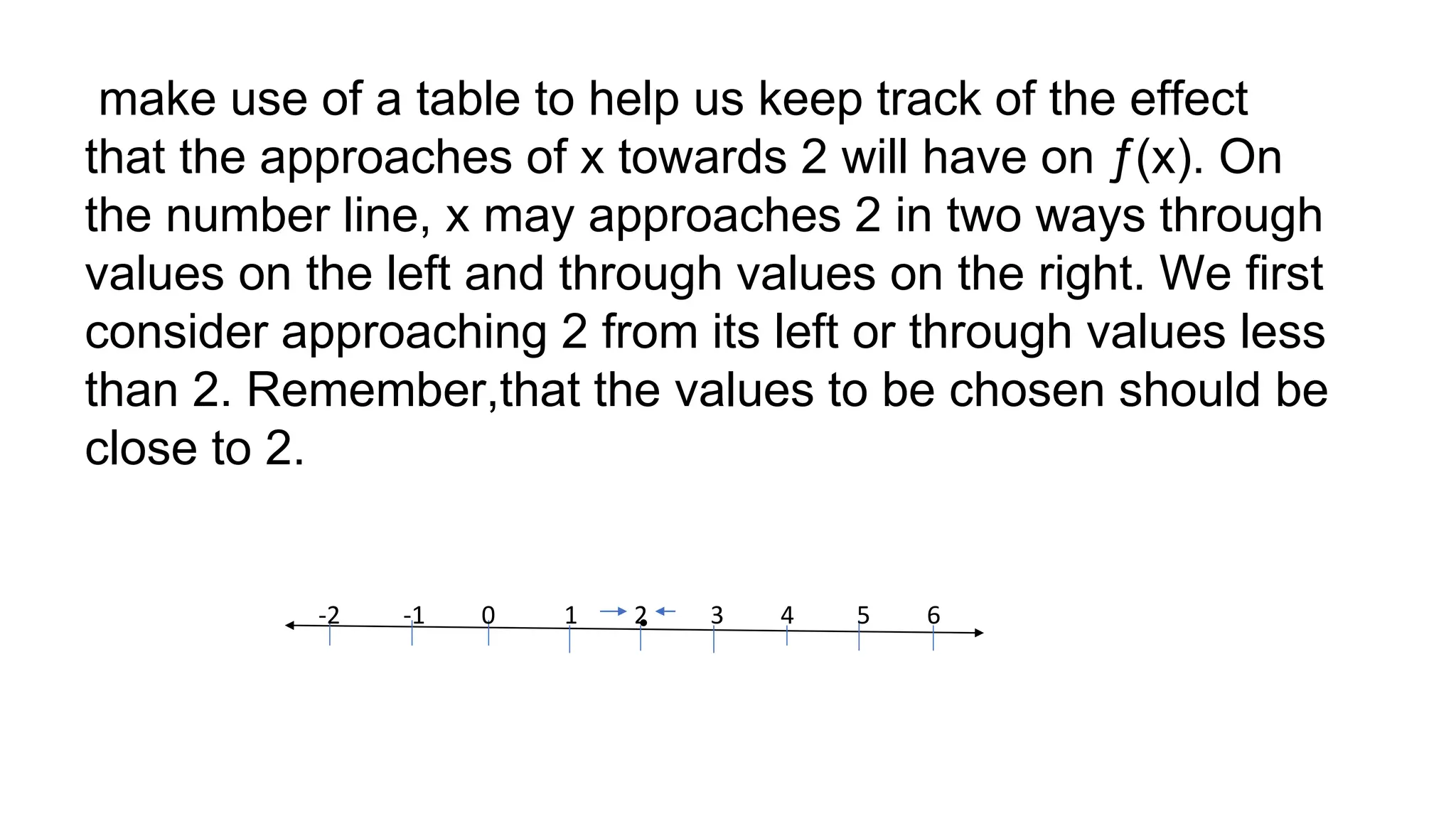
make use of a table to help us keep track of the effect
that the approaches of x towards 2 will have on ƒ(x). On
the number line, x may approaches 2 in two ways through
values on the left and through values on the right. We first
consider approaching 2 from its left or through values less
than 2. Remember,that the values to be chosen should be
close to 2.
-2 -1 0 1 2 3 4 5 6
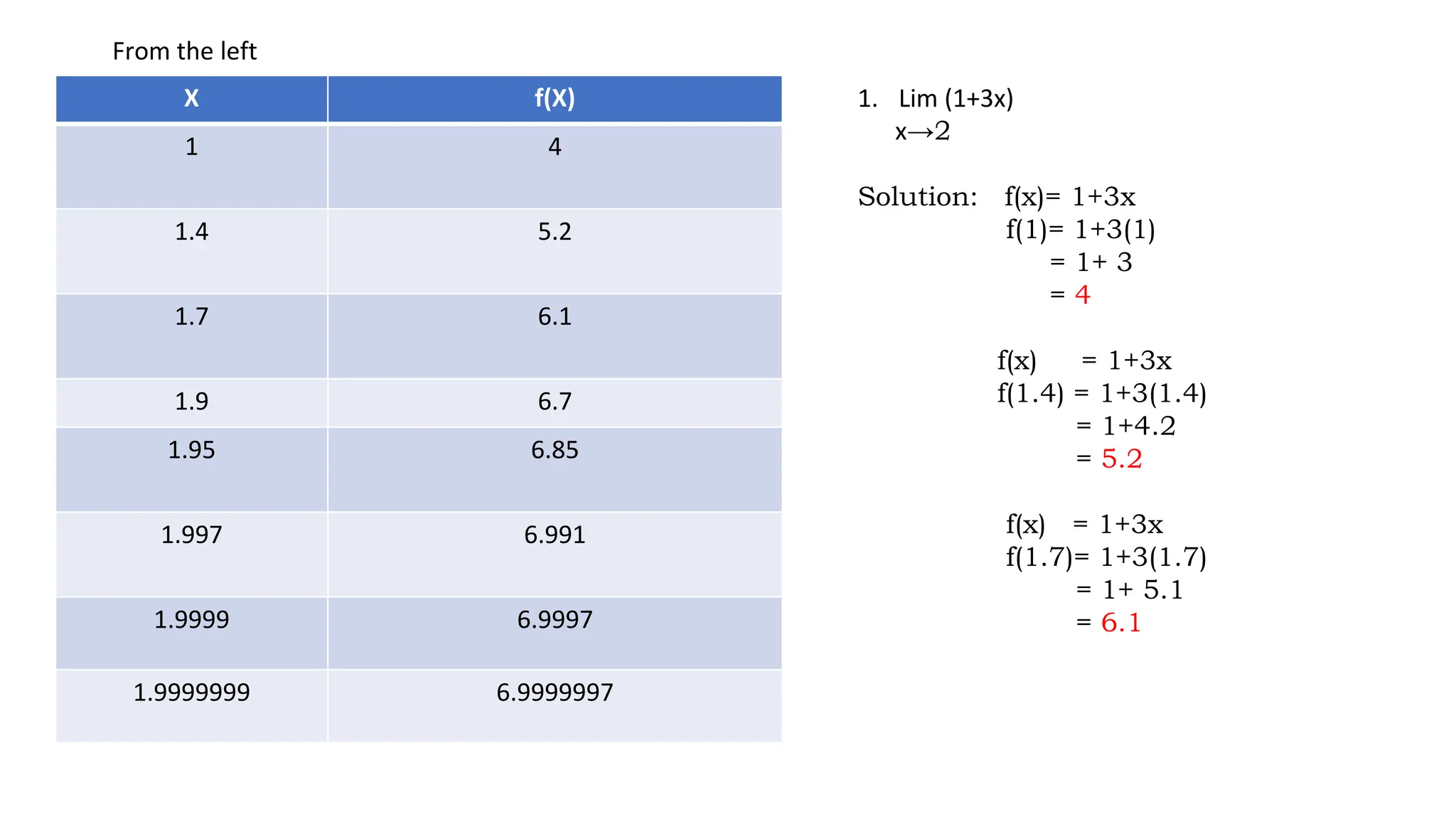
X f(X)
1 4
1.4 5.2
1.7 6.1
1.9 6.7
1.95 6.85
1.997 6.991
1.9999 6.9997
1.9999999 6.9999997
1. Lim (1+3x)
x→2
Solution: f(x)= 1+3x
f(1)= 1+3(1)
= 1+ 3
= 4
f(x) = 1+3x
f(1.4) = 1+3(1.4)
= 1+4.2
= 5.2
f(x) = 1+3x
f(1.7)= 1+3(1.7)
= 1+ 5.1
= 6.1
From the left
Now we consider approaching 2 from its right or through
values greater than but close to 2.
X ƒ(X)
3 10
2.5 8.5
2.2 7.6
2.1 7.3
2.03 7.09
2.009 7.027
2.0005 7.0015
2.0000001 7,0000003
From the right
Lim f(x) = (1+3x)
x→2
Solution: f(x) = 1+3x
f(3) = 1+3(3)
= 1+9
= 10
f(x) = 1+3x
f(2.5)= 1+3(2.5)
= 1+ 7.5
= 8.5
f(x) = 1+3x
f(2.2) = 1+ 3(2.2)
= 1+6.6
= 7.6
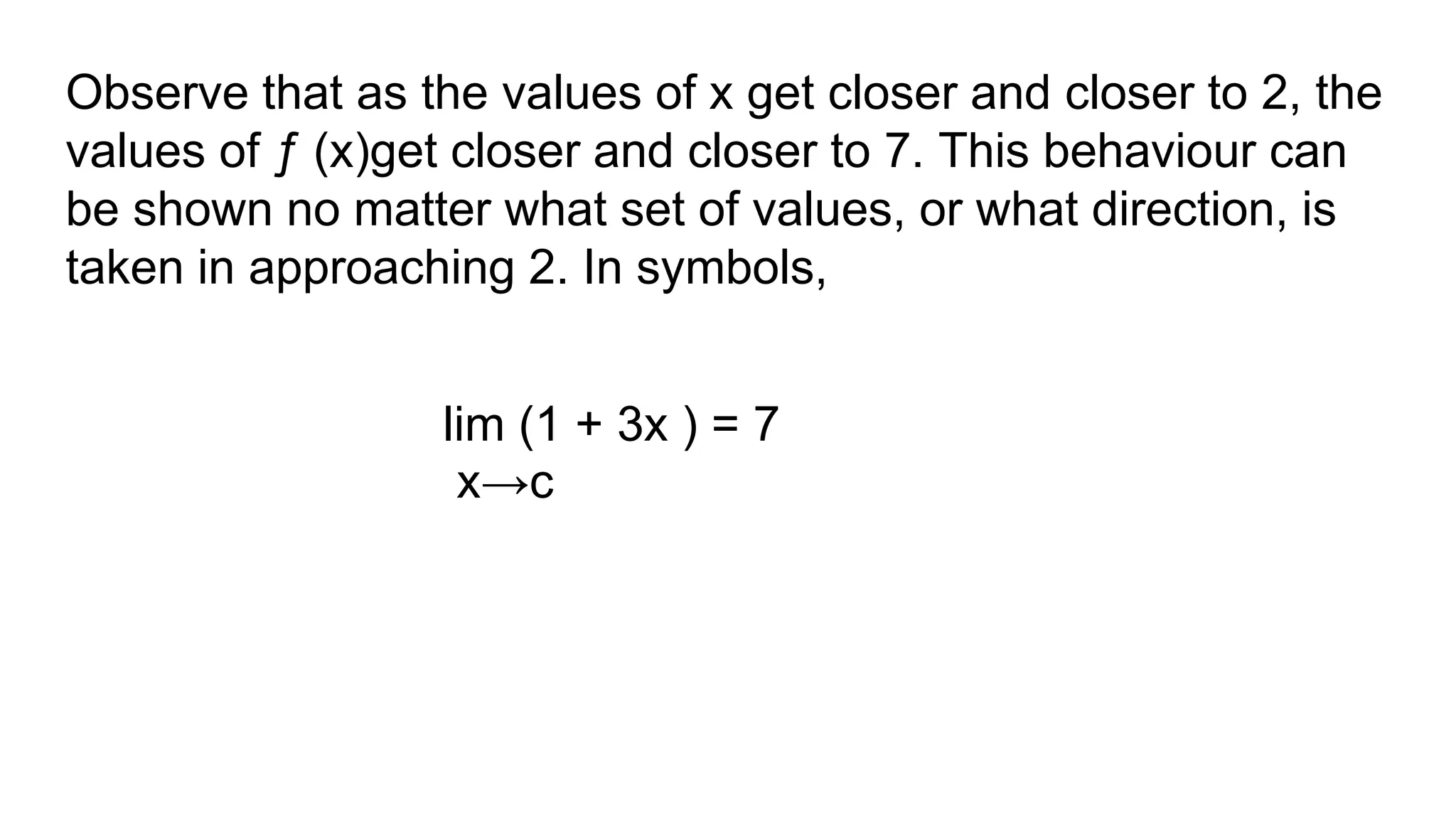
Observe that as the values of x get closer and closer to 2, the
values of ƒ (x)get closer and closer to 7. This behaviour can
be shown no matter what set of values, or what direction, is
taken in approaching 2. In symbols,
lim (1 + 3x ) = 7
x→c
Example 1. Investigate
lim (x + 2 )
x→4
By constructing tables of values.Here, c =4 and ƒ(x) = x + 2.
We start again by approaching 4 from the left.
-2 -1 0 1 2 3 4 5 6
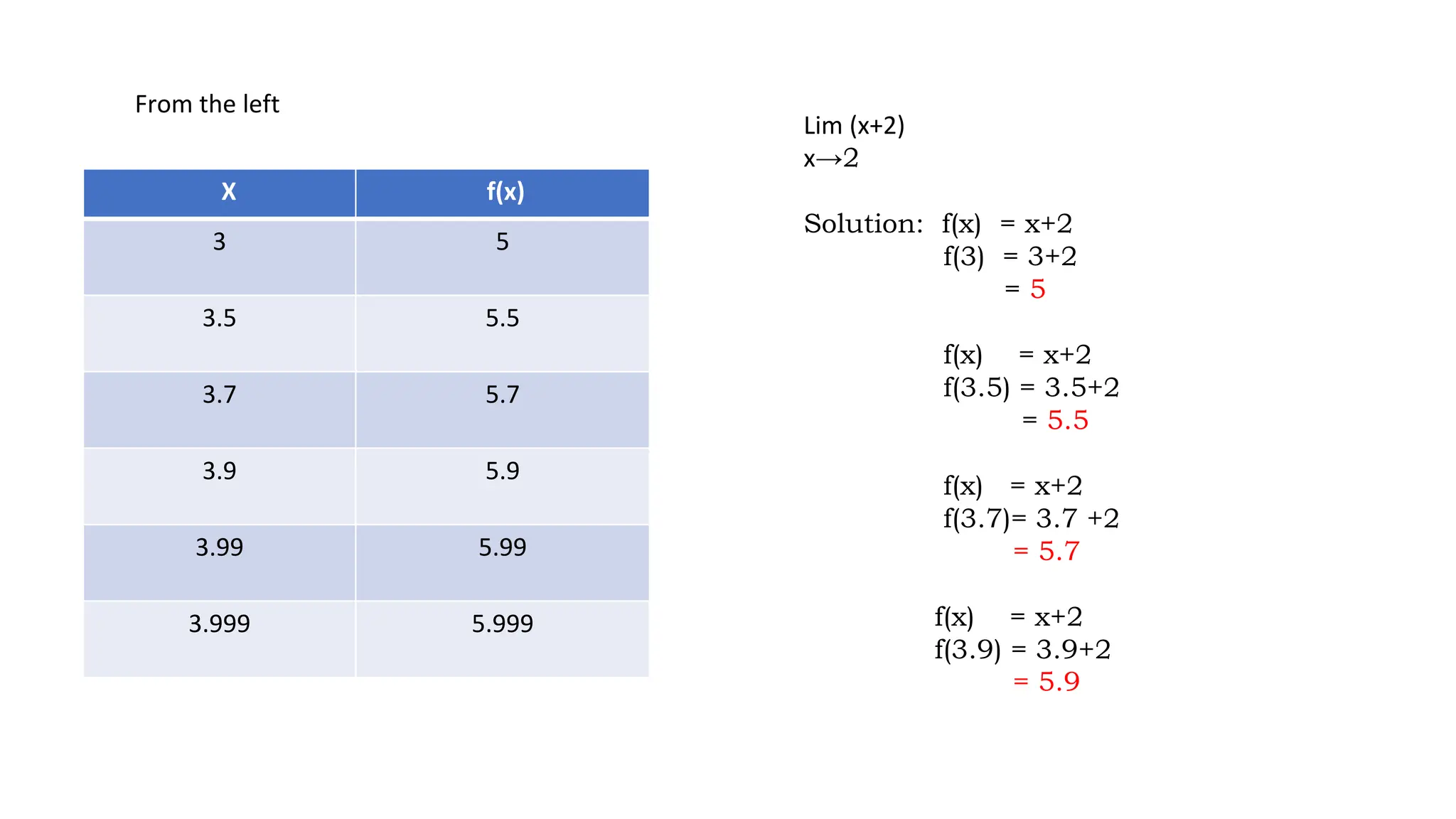
From the left
X f(x)
3 5
3.5 5.5
3.7 5.7
3.9 5.9
3.99 5.99
3.999 5.999
Lim (x+2)
x→2
Solution: f(x) = x+2
f(3) = 3+2
= 5
f(x) = x+2
f(3.5) = 3.5+2
= 5.5
f(x) = x+2
f(3.7)= 3.7 +2
= 5.7
f(x) = x+2
f(3.9) = 3.9+2
= 5.9
Now approach 4 from the right.
The tables show that as x approaches 4,ƒ(x) approaches 2.
In symbols,
lim ( x+ 2 ) = 6
X f(X)
5 7
4.7 6.7
4.5 6.5
4.1 6.1
4.01 6.01
4.0001 6.0001
Lim (x+2)
x→4
Solution: f(x) = x+2
f(5) = 5+2
= 7
f(x) = x+2
f(4.7) =4.7+2
= 6.7
LOOKING AT THE GRAPH OF Y = ƒ(X)
If one knows the graph of ƒ(x), it will be easier to determine
its limit as x approaches given values of c.
> Consider again ƒ(x)=1+3x. Its graph is the straight line
with slope 3 and intercepts (0,1) and (-1/3,0).look at the
graph in the vicinity of x=2.
You can easily see the points
(from the table of values
(1,4)(1.4,5.2)(1.7,6.1) and so
on, approaching the level
where y =7, the same can be
seen from the right Hence,
the graph clearly confirms
that
lim(1+3x)=7
x→2
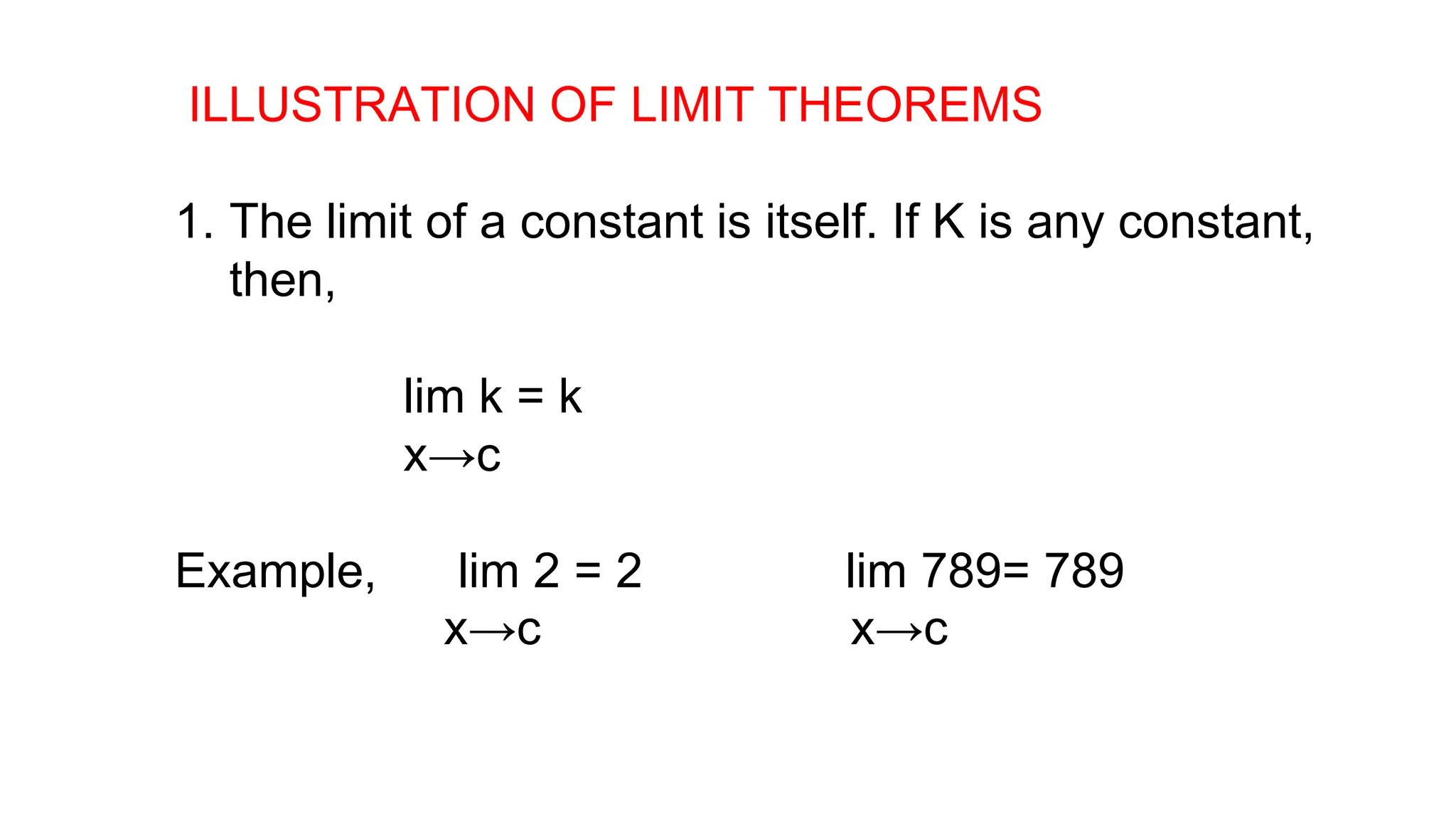
ILLUSTRATION OF LIMIT THEOREMS
1. The limit of a constant is itself. If K is any constant,
then,
lim k = k
x→c
Example, lim 2 = 2 lim 789= 789
x→c x→c
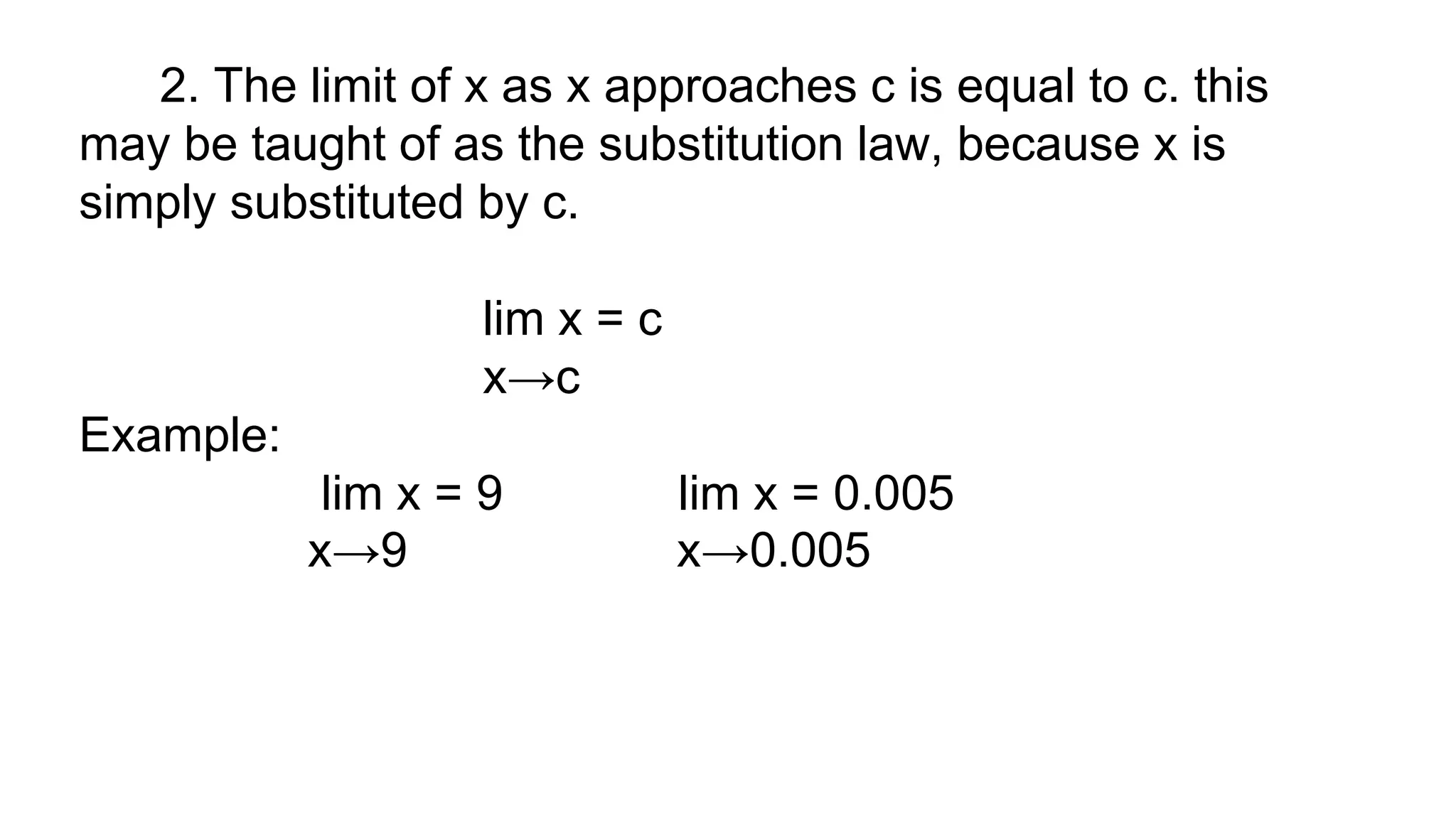
2. The limit of x as x approaches c is equal to c. this
may be taught of as the substitution law, because x is
simply substituted by c.
lim x = c
x→c
Example:
lim x = 9 lim x = 0.005
x→9 x→0.005
3. The Constant Multiple Theorem: This may says that
the limit of a multiple of a function is simply that multiple of
the limit of the function.
lim ƒ(x) = L, and lim g(x) = M
x→c x→c
Example: if lim ƒ(x) = 4, then
x→c
Lim 8.ƒ(x) = 8.lim ƒ(x) = 8.4 = 32
x→c x→c
lim -11.ƒ(x) = -11.limƒ(x) = -11.4 = -44
x→c x→c
4. The Addition Theorem: This says that the limit of a sum
of functions is the sum of the limits of the individual
functions. Subtraction is also included in this law, that is,
the limit of a difference of function is difference of their
limits.
lim ƒ(x) + g(x) = limƒ(x) + lim g(x) = L + M
x→c x→c
lim(ƒ(x) – g(x) = lim ƒ(x) – lim g(x) = L – M
x→c x→c x→c
Example: if limƒ(x) = 4 and lim g(x) = -5, then,
x→c x→c
lim (ƒ(x) + g(x) = limƒ(x) + lim g(x) = 4 +(-5)=-1
x→c x→c x→c
Lim (ƒ(x) – g(x) = limƒ(x) – lim g(x) = 4-(-5) = 9
x→c x→c x→c
5. The Multiplication Theorem: This is similar to the Addition
Theorem, with multiplication replacing addition as the
operation involved. Thus, the limit of a product of functions is
equal to the product of their limits.
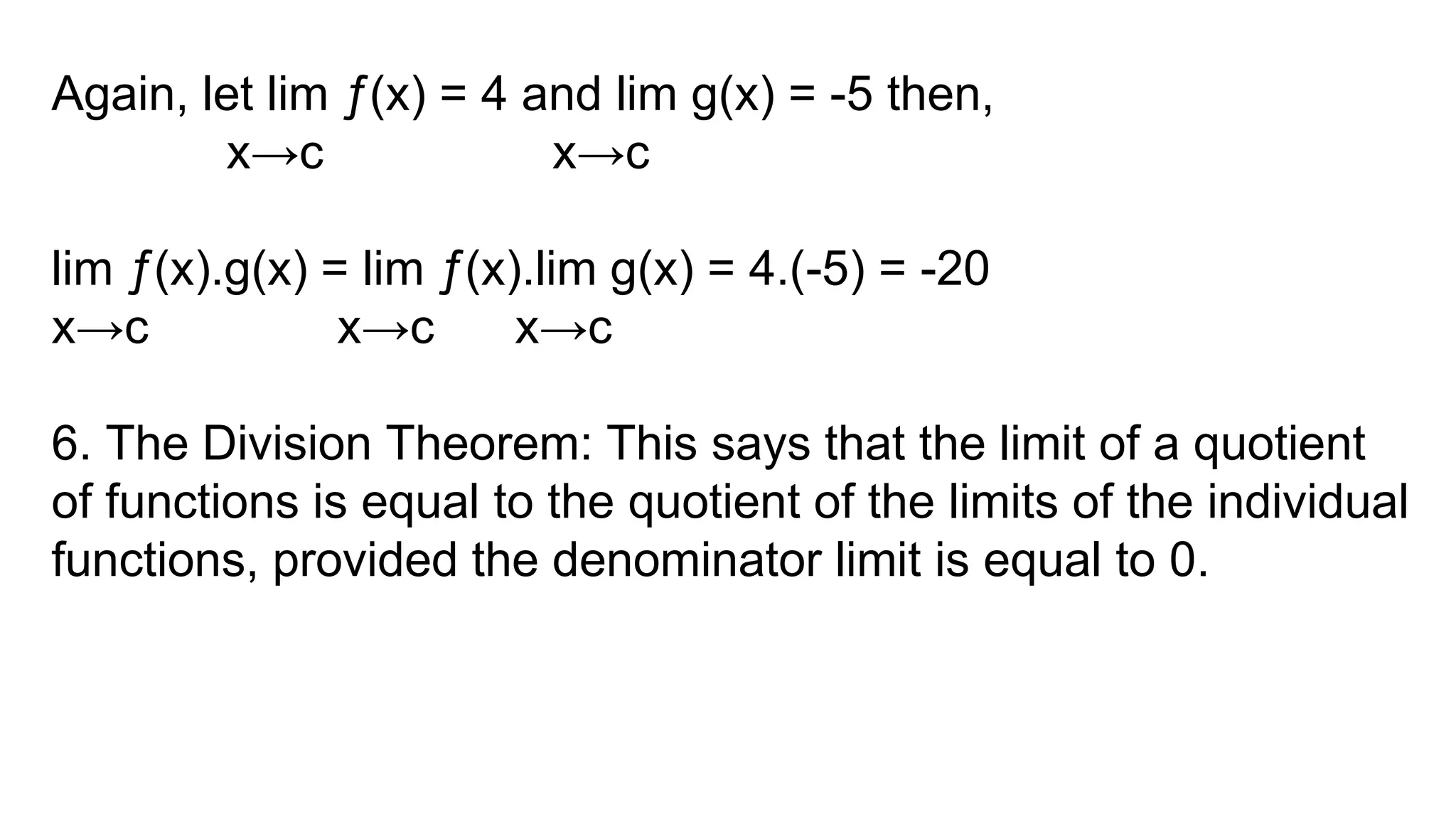
lim(ƒ(x).g(x) = limƒ(x).lim g(x) = L.M
x→c x→c x→c
Again, let lim ƒ(x) = 4 and lim g(x) = -5 then,
x→c x→c
lim ƒ(x).g(x) = lim ƒ(x).lim g(x) = 4.(-5) = -20
x→c x→c x→c
6. The Division Theorem: This says that the limit of a quotient
of functions is equal to the quotient of the limits of the individual
functions, provided the denominator limit is equal to 0.
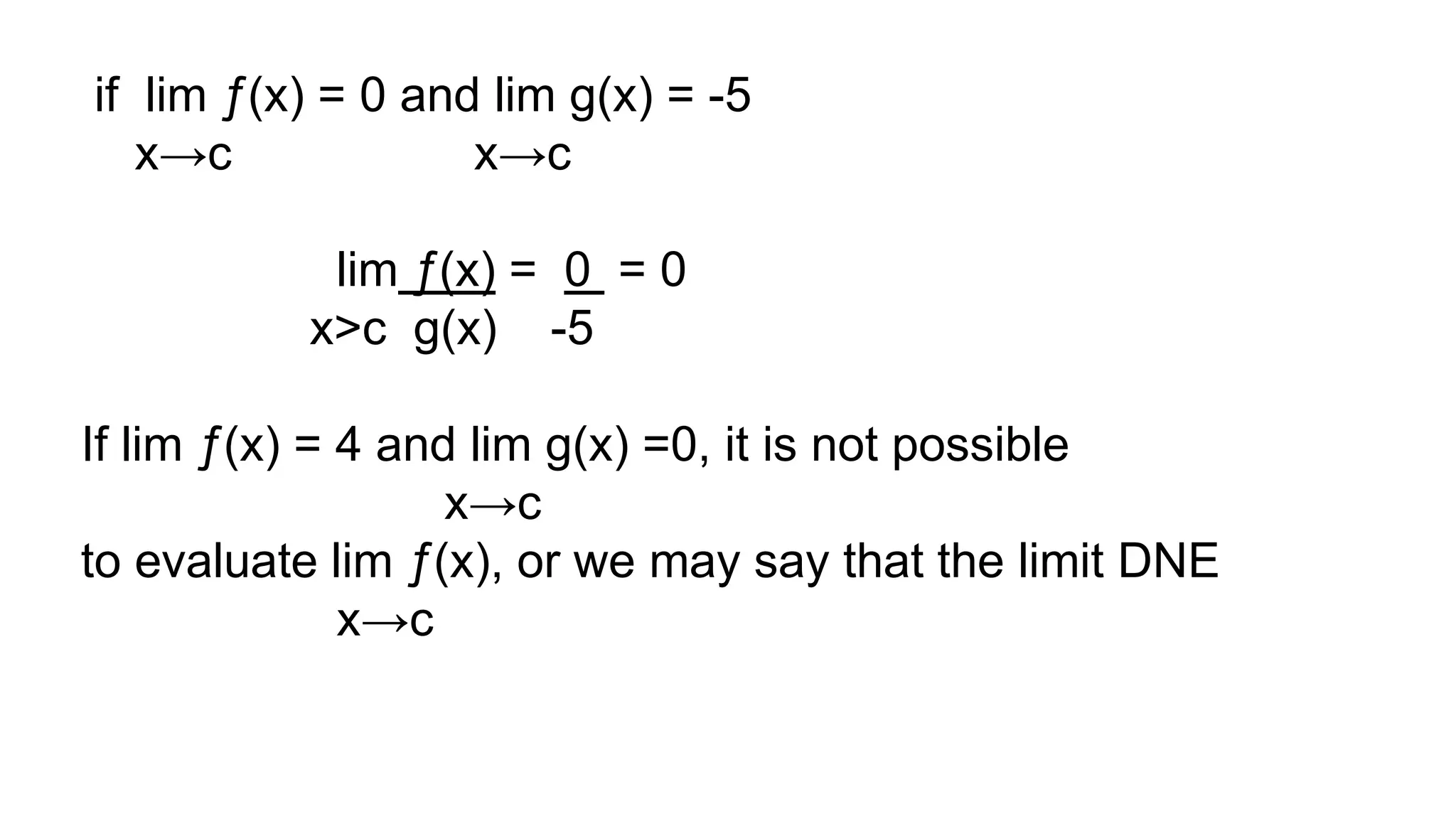
if lim ƒ(x) = 0 and lim g(x) = -5
x→c x→c
lim ƒ(x) = 0 = 0
x>c g(x) -5
If lim ƒ(x) = 4 and lim g(x) =0, it is not possible
x→c
to evaluate lim ƒ(x), or we may say that the limit DNE
x→c
7. The Power Theorem: This theorem states that the limit of an
integer power p of a function is just that power of the limit of the
function.
lim (ƒ(x) = L
x>c
Example: if lim ƒ(x) = 4, then
x→c
lim(ƒ(x))³ = (limƒ(x)³ = 4³ = 64
x→c x→c
If lim ƒ(x) = 4, then
x→c
lim(ƒ(x))-² = (lim ƒ(x))−² = 4−² = 1 = 1
x→c x→c 4² 16
8. The Radical/Root Theorem:This theorem states that if n is a
positive integer, the limit of the nth root of a function is just the
nth of a function, provided the nth of the limit is a
9.Limit of a Polynomial Function
lim ƒ(x) = L, and lim g(x) = M
x→c x→c
Lim P(x) = P(a) lim P(x) = P(a) if g(a) ≠ 0
x→c x→c g(x) g(a)
Example: lim (9x³-7x²+2) = ƒ(2)
x→c
9(2)³ - 7(2) + 2 = 9(8) – 7(4) + 2
= 72 – 28 + 2
= 46
lim x² + 3 = (-3)² + 3 = 9 + 3 = 12/4 = 3
x→c x³-2x+1 (-3)³-2(-3)+1 -27+6+1 -20 /4 5
THANK YOU
ACTIVITY:
⮚ Use limit theorems to evaluate the following limits.
1. Determine lim (2x+1)
x→1
2. Determine lim (2x³ - 4x² + 1)
x→-1
3. Evaluate lim (f(x) +g(x) if lim f(x) =2 and lim g(x)=-1
x→1 x→1 x→1

LIMIT OF A FUNCTIONs in mathematics 2017

  • 1.
  • 2.
    Objectives: 1. Illustrate thelimit of a function using table of values and the graph of the functions. 2.Distinguishes between lim ƒ(x) andƒ(c) x→c 3. Illustrate the limit theorems and 4. Apply the limit theorem in evaluating the limit of a functions.
  • 3.
    Consider a functionƒ of a single variable x. Consider a constant c which the variable x will approach.( c may or may not be in the domain of ƒ).The limit, to be denoted by L, is the unique real value that ƒ(x) will approach x approaches c. In symbols, we write this process as lim ƒ(x) = L x→c Example 1. lim (1+3x ) x→2 Here, ƒ(x) = 1+3x and the constant c, which x will approach, is 2. To evaluate the given limit, we will
  • 4.
    make use ofa table to help us keep track of the effect that the approaches of x towards 2 will have on ƒ(x). On the number line, x may approaches 2 in two ways through values on the left and through values on the right. We first consider approaching 2 from its left or through values less than 2. Remember,that the values to be chosen should be close to 2. -2 -1 0 1 2 3 4 5 6
  • 5.
    X f(X) 1 4 1.45.2 1.7 6.1 1.9 6.7 1.95 6.85 1.997 6.991 1.9999 6.9997 1.9999999 6.9999997 1. Lim (1+3x) x→2 Solution: f(x)= 1+3x f(1)= 1+3(1) = 1+ 3 = 4 f(x) = 1+3x f(1.4) = 1+3(1.4) = 1+4.2 = 5.2 f(x) = 1+3x f(1.7)= 1+3(1.7) = 1+ 5.1 = 6.1 From the left
  • 6.
    Now we considerapproaching 2 from its right or through values greater than but close to 2. X ƒ(X) 3 10 2.5 8.5 2.2 7.6 2.1 7.3 2.03 7.09 2.009 7.027 2.0005 7.0015 2.0000001 7,0000003 From the right Lim f(x) = (1+3x) x→2 Solution: f(x) = 1+3x f(3) = 1+3(3) = 1+9 = 10 f(x) = 1+3x f(2.5)= 1+3(2.5) = 1+ 7.5 = 8.5 f(x) = 1+3x f(2.2) = 1+ 3(2.2) = 1+6.6 = 7.6
  • 7.
    Observe that asthe values of x get closer and closer to 2, the values of ƒ (x)get closer and closer to 7. This behaviour can be shown no matter what set of values, or what direction, is taken in approaching 2. In symbols, lim (1 + 3x ) = 7 x→c
  • 8.
    Example 1. Investigate lim(x + 2 ) x→4 By constructing tables of values.Here, c =4 and ƒ(x) = x + 2. We start again by approaching 4 from the left. -2 -1 0 1 2 3 4 5 6
  • 9.
    From the left Xf(x) 3 5 3.5 5.5 3.7 5.7 3.9 5.9 3.99 5.99 3.999 5.999 Lim (x+2) x→2 Solution: f(x) = x+2 f(3) = 3+2 = 5 f(x) = x+2 f(3.5) = 3.5+2 = 5.5 f(x) = x+2 f(3.7)= 3.7 +2 = 5.7 f(x) = x+2 f(3.9) = 3.9+2 = 5.9
  • 10.
    Now approach 4from the right. The tables show that as x approaches 4,ƒ(x) approaches 2. In symbols, lim ( x+ 2 ) = 6 X f(X) 5 7 4.7 6.7 4.5 6.5 4.1 6.1 4.01 6.01 4.0001 6.0001 Lim (x+2) x→4 Solution: f(x) = x+2 f(5) = 5+2 = 7 f(x) = x+2 f(4.7) =4.7+2 = 6.7
  • 11.
    LOOKING AT THEGRAPH OF Y = ƒ(X) If one knows the graph of ƒ(x), it will be easier to determine its limit as x approaches given values of c. > Consider again ƒ(x)=1+3x. Its graph is the straight line with slope 3 and intercepts (0,1) and (-1/3,0).look at the graph in the vicinity of x=2.
  • 12.
    You can easilysee the points (from the table of values (1,4)(1.4,5.2)(1.7,6.1) and so on, approaching the level where y =7, the same can be seen from the right Hence, the graph clearly confirms that lim(1+3x)=7 x→2
  • 13.
    ILLUSTRATION OF LIMITTHEOREMS 1. The limit of a constant is itself. If K is any constant, then, lim k = k x→c Example, lim 2 = 2 lim 789= 789 x→c x→c
  • 14.
    2. The limitof x as x approaches c is equal to c. this may be taught of as the substitution law, because x is simply substituted by c. lim x = c x→c Example: lim x = 9 lim x = 0.005 x→9 x→0.005
  • 15.
    3. The ConstantMultiple Theorem: This may says that the limit of a multiple of a function is simply that multiple of the limit of the function. lim ƒ(x) = L, and lim g(x) = M x→c x→c Example: if lim ƒ(x) = 4, then x→c Lim 8.ƒ(x) = 8.lim ƒ(x) = 8.4 = 32 x→c x→c
  • 16.
    lim -11.ƒ(x) =-11.limƒ(x) = -11.4 = -44 x→c x→c 4. The Addition Theorem: This says that the limit of a sum of functions is the sum of the limits of the individual functions. Subtraction is also included in this law, that is, the limit of a difference of function is difference of their limits.
  • 17.
    lim ƒ(x) +g(x) = limƒ(x) + lim g(x) = L + M x→c x→c lim(ƒ(x) – g(x) = lim ƒ(x) – lim g(x) = L – M x→c x→c x→c Example: if limƒ(x) = 4 and lim g(x) = -5, then, x→c x→c lim (ƒ(x) + g(x) = limƒ(x) + lim g(x) = 4 +(-5)=-1 x→c x→c x→c
  • 18.
    Lim (ƒ(x) –g(x) = limƒ(x) – lim g(x) = 4-(-5) = 9 x→c x→c x→c 5. The Multiplication Theorem: This is similar to the Addition Theorem, with multiplication replacing addition as the operation involved. Thus, the limit of a product of functions is equal to the product of their limits. lim(ƒ(x).g(x) = limƒ(x).lim g(x) = L.M x→c x→c x→c
  • 19.
    Again, let limƒ(x) = 4 and lim g(x) = -5 then, x→c x→c lim ƒ(x).g(x) = lim ƒ(x).lim g(x) = 4.(-5) = -20 x→c x→c x→c 6. The Division Theorem: This says that the limit of a quotient of functions is equal to the quotient of the limits of the individual functions, provided the denominator limit is equal to 0.
  • 21.
    if lim ƒ(x)= 0 and lim g(x) = -5 x→c x→c lim ƒ(x) = 0 = 0 x>c g(x) -5 If lim ƒ(x) = 4 and lim g(x) =0, it is not possible x→c to evaluate lim ƒ(x), or we may say that the limit DNE x→c
  • 22.
    7. The PowerTheorem: This theorem states that the limit of an integer power p of a function is just that power of the limit of the function. lim (ƒ(x) = L x>c Example: if lim ƒ(x) = 4, then x→c lim(ƒ(x))³ = (limƒ(x)³ = 4³ = 64 x→c x→c
  • 23.
    If lim ƒ(x)= 4, then x→c lim(ƒ(x))-² = (lim ƒ(x))−² = 4−² = 1 = 1 x→c x→c 4² 16 8. The Radical/Root Theorem:This theorem states that if n is a positive integer, the limit of the nth root of a function is just the nth of a function, provided the nth of the limit is a
  • 26.
    9.Limit of aPolynomial Function lim ƒ(x) = L, and lim g(x) = M x→c x→c Lim P(x) = P(a) lim P(x) = P(a) if g(a) ≠ 0 x→c x→c g(x) g(a) Example: lim (9x³-7x²+2) = ƒ(2) x→c
  • 27.
    9(2)³ - 7(2)+ 2 = 9(8) – 7(4) + 2 = 72 – 28 + 2 = 46 lim x² + 3 = (-3)² + 3 = 9 + 3 = 12/4 = 3 x→c x³-2x+1 (-3)³-2(-3)+1 -27+6+1 -20 /4 5
  • 28.
  • 29.
    ACTIVITY: ⮚ Use limittheorems to evaluate the following limits. 1. Determine lim (2x+1) x→1 2. Determine lim (2x³ - 4x² + 1) x→-1 3. Evaluate lim (f(x) +g(x) if lim f(x) =2 and lim g(x)=-1 x→1 x→1 x→1