INDUS INSTITUTE OF
TECHNOLOGY & ENGINEERING

          DEPARTMENT OF
      MECHANICAL ENGINEERING

            Name : Keval Patel

               Subject Code :
      Subject Name : Mechanics of solid

 B.E Mechanical Engineering , 1st Semester
                                             1
LOAD
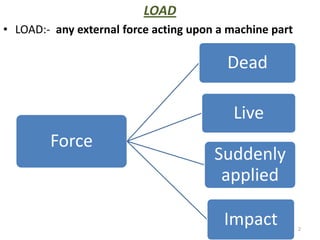
• LOAD:- any external force acting upon a machine part

                                         Dead

                                          Live
        Force
                                       Suddenly
                                        applied

                                         Impact          2
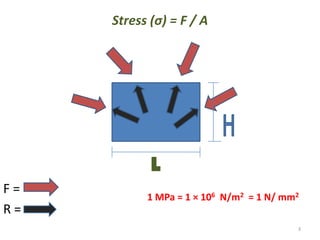
Stress (σ) = F / A


F=
           1 MPa = 1 × 10⁶ N/m2 = 1 N/ mm2
R=
                                         3
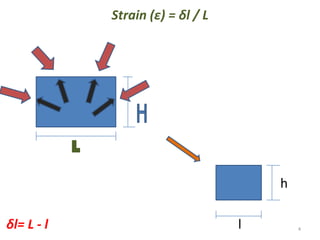
Strain (ε) = δl / L


                                      h

δl= L - l                         l       4
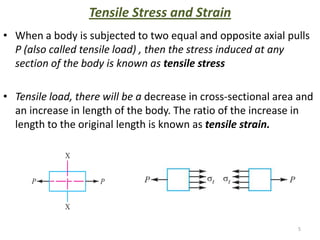
Tensile Stress and Strain
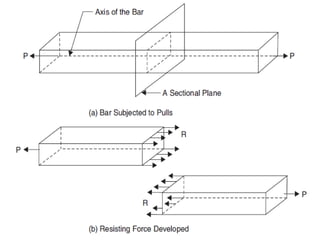
• When a body is subjected to two equal and opposite axial pulls
  P (also called tensile load) , then the stress induced at any
  section of the body is known as tensile stress

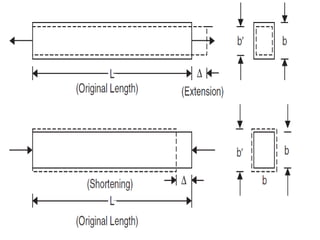
• Tensile load, there will be a decrease in cross-sectional area and
  an increase in length of the body. The ratio of the increase in
  length to the original length is known as tensile strain.


                                                                5
6
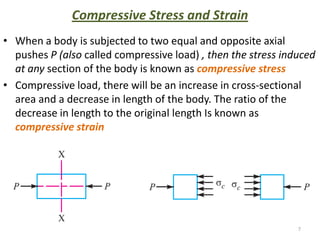
Compressive Stress and Strain
• When a body is subjected to two equal and opposite axial
  pushes P (also called compressive load) , then the stress induced
  at any section of the body is known as compressive stress
• Compressive load, there will be an increase in cross-sectional
  area and a decrease in length of the body. The ratio of the
  decrease in length to the original length Is known as
  compressive strain


                                                               7
8
Young's Modulus or Modulus of Elasticity
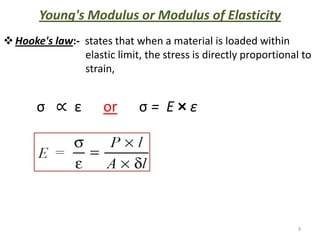
 Hooke's law:- states that when a material is loaded within
                elastic limit, the stress is directly proportional to
                strain,


       σ ∝ ε          or      σ= E×ε


                                                                  9
Example
1. A circular rod of diameter 16 mm and 500 mm long
   is subjected to a tensile force 40 kN. The modulus
   of elasticity for steel may be taken as 200 kN/mm2.
   Find stress, strain and elongation of the bar due to
   applied load.


                                                   10
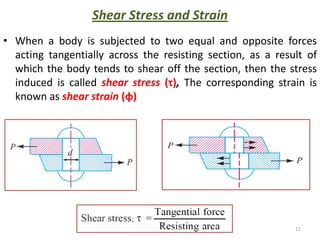
Shear Stress and Strain
• When a body is subjected to two equal and opposite forces
  acting tangentially across the resisting section, as a result of
  which the body tends to shear off the section, then the stress
  induced is called shear stress (τ), The corresponding strain is
  known as shear strain (φ)


                                                             11
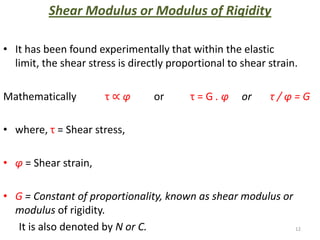
Shear Modulus or Modulus of Rigidity

• It has been found experimentally that within the elastic
  limit, the shear stress is directly proportional to shear strain.

Mathematically         τ∝φ        or      τ=G.φ       or    τ/φ=G

• where, τ = Shear stress,

• φ = Shear strain,

• G = Constant of proportionality, known as shear modulus or
  modulus of rigidity.
  It is also denoted by N or C.                              12
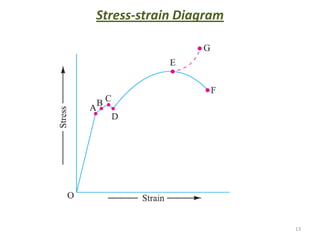
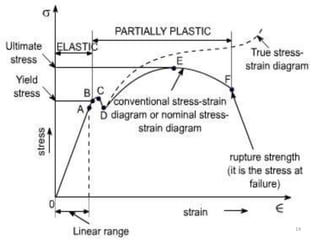
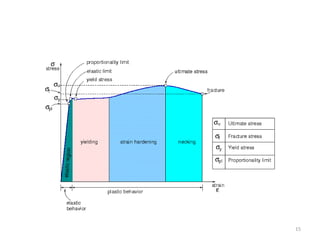
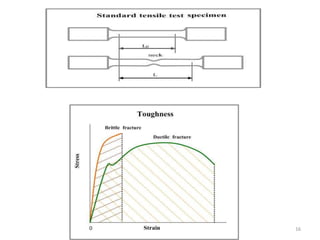
Stress-strain Diagram


                        13
14
15
16
Working Stress

• When designing machine parts, it is desirable to keep the stress
  lower than the maximum or ultimate stress at which failure of
  the material takes place. This stress is known as the working
  stress or design stress.

• It is also known as safe or allowable stress.


  working stress = design stress = safe stress = allowable stress


                                                              17
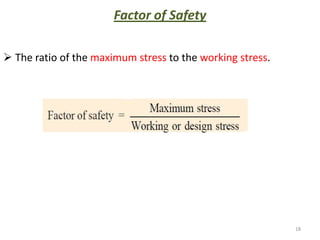
Factor of Safety

 The ratio of the maximum stress to the working stress.


                                                           18
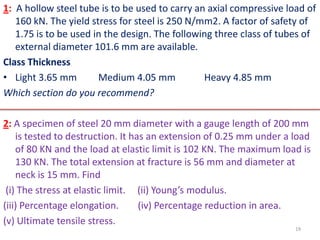
1: A hollow steel tube is to be used to carry an axial compressive load of
   160 kN. The yield stress for steel is 250 N/mm2. A factor of safety of
   1.75 is to be used in the design. The following three class of tubes of
   external diameter 101.6 mm are available.
Class Thickness
• Light 3.65 mm        Medium 4.05 mm           Heavy 4.85 mm
Which section do you recommend?

2: A specimen of steel 20 mm diameter with a gauge length of 200 mm
    is tested to destruction. It has an extension of 0.25 mm under a load
    of 80 KN and the load at elastic limit is 102 KN. The maximum load is
    130 KN. The total extension at fracture is 56 mm and diameter at
    neck is 15 mm. Find
 (i) The stress at elastic limit. (ii) Young’s modulus.
(iii) Percentage elongation.       (iv) Percentage reduction in area.
(v) Ultimate tensile stress.
                                                                     19
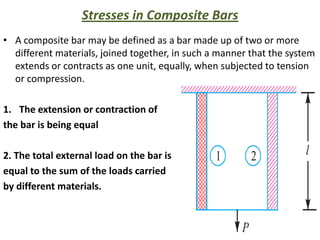
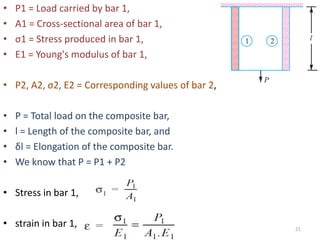
Stresses in Composite Bars
• A composite bar may be defined as a bar made up of two or more
  different materials, joined together, in such a manner that the system
  extends or contracts as one unit, equally, when subjected to tension
  or compression.

1. The extension or contraction of
the bar is being equal

2. The total external load on the bar is
equal to the sum of the loads carried
by different materials.


                                                                   20
•   P1 = Load carried by bar 1,
•   A1 = Cross-sectional area of bar 1,
•   σ1 = Stress produced in bar 1,
•   E1 = Young's modulus of bar 1,

• P2, A2, σ2, E2 = Corresponding values of bar 2,

•   P = Total load on the composite bar,
•   l = Length of the composite bar, and
•   δl = Elongation of the composite bar.
•   We know that P = P1 + P2

• Stress in bar 1,

• strain in bar 1,                                  21
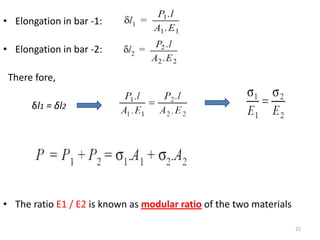
• Elongation in bar -1:

• Elongation in bar -2:

 There fore,

      δl1 = δl2


• The ratio E1 / E2 is known as modular ratio of the two materials

                                                                     22
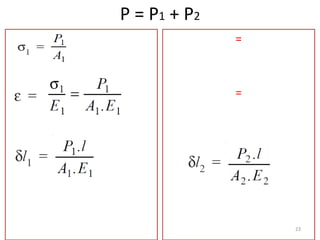
P = P1 + P2
              =


              =


                  23
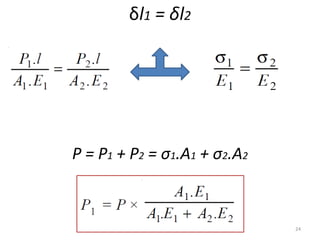
δl1 = δl2


P = P1 + P2 = σ1.A1 + σ2.A2


                              24
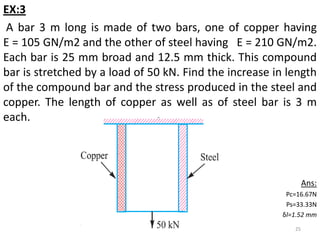
EX:3
 A bar 3 m long is made of two bars, one of copper having
E = 105 GN/m2 and the other of steel having E = 210 GN/m2.
Each bar is 25 mm broad and 12.5 mm thick. This compound
bar is stretched by a load of 50 kN. Find the increase in length
of the compound bar and the stress produced in the steel and
copper. The length of copper as well as of steel bar is 3 m
each.


                                                                 Ans:
                                                          Pc=16.67N
                                                          Ps=33.33N
                                                         δl=1.52 mm
                                                            25
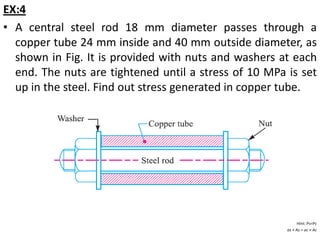
EX:4
• A central steel rod 18 mm diameter passes through a
  copper tube 24 mm inside and 40 mm outside diameter, as
  shown in Fig. It is provided with nuts and washers at each
  end. The nuts are tightened until a stress of 10 MPa is set
  up in the steel. Find out stress generated in copper tube.


                                                             Hint: Ps=Pc
                                                       σs × As = σc × Ac
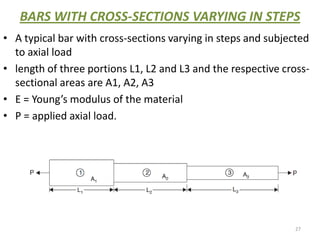
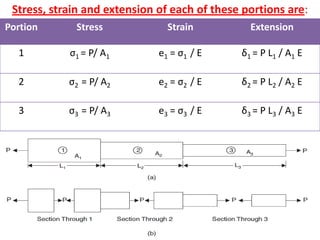
BARS WITH CROSS-SECTIONS VARYING IN STEPS
• A typical bar with cross-sections varying in steps and subjected
  to axial load
• length of three portions L1, L2 and L3 and the respective cross-
  sectional areas are A1, A2, A3
• E = Young’s modulus of the material
• P = applied axial load.


                                                              27
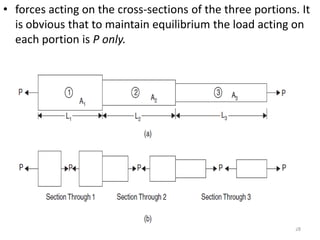
• forces acting on the cross-sections of the three portions. It
  is obvious that to maintain equilibrium the load acting on
  each portion is P only.


                                                           28
Stress, strain and extension of each of these portions are:
Portion      Stress             Strain          Extension

  1         σ1 = P/ A1        e1 = σ1 / E     δ1 = P L1 / A1 E

  2         σ2 = P/ A2        e2 = σ2 / E     δ2 = P L2 / A2 E

  3         σ3 = P/ A3        e3 = σ3 / E     δ3 = P L3 / A3 E


                                                            29
Total Elongation: δ


δ1 + δ2 + δ3 = [P L1 / A1 E] + [P L2 / A2 E] + [P L3 / A3 E]


                                                          30
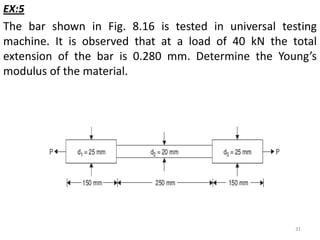
EX:5
The bar shown in Fig. 8.16 is tested in universal testing
machine. It is observed that at a load of 40 kN the total
extension of the bar is 0.280 mm. Determine the Young’s
modulus of the material.


                                                     31
Thermal Stresses
 Stresses due to Change in Temperature

 Whenever there is some increase or decrease in the
  temperature of a body, it causes the body to expand or
  contract.

 If the body is allowed to expand or contract freely, with the rise
  or fall of the temperature, no stresses are induced in the body.

 But, if the deformation of the body is prevented, some stresses
  are induced in the body. Such stresses are known as thermal
  stresses.
                                                                32
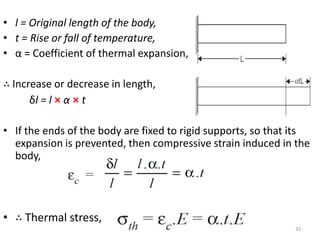
• l = Original length of the body,
• t = Rise or fall of temperature,
• α = Coefficient of thermal expansion,

∴ Increase or decrease in length,
      δl = l × α × t

• If the ends of the body are fixed to rigid supports, so that its
  expansion is prevented, then compressive strain induced in the
  body,


• ∴ Thermal stress,
                                                              33
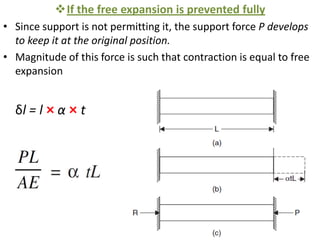
If the free expansion is prevented fully
• Since support is not permitting it, the support force P develops
  to keep it at the original position.
• Magnitude of this force is such that contraction is equal to free
  expansion


  δl = l × α × t


                                                               34
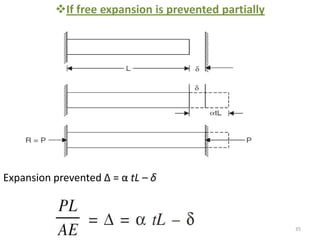
If free expansion is prevented partially


Expansion prevented Δ = α tL – δ


                                                      35
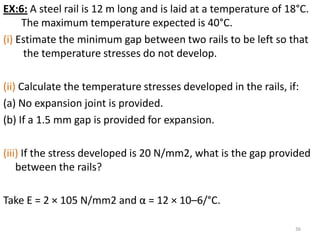
EX:6: A steel rail is 12 m long and is laid at a temperature of 18°C.
     The maximum temperature expected is 40°C.
(i) Estimate the minimum gap between two rails to be left so that
     the temperature stresses do not develop.

(ii) Calculate the temperature stresses developed in the rails, if:
(a) No expansion joint is provided.
(b) If a 1.5 mm gap is provided for expansion.

(iii) If the stress developed is 20 N/mm2, what is the gap provided
    between the rails?

Take E = 2 × 10⁵ N/mm2 and α = 12 × 10–6/°C.

                                                                  36
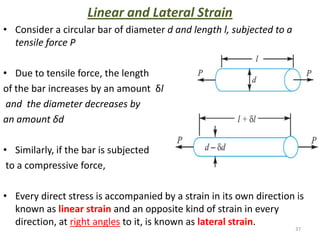
Linear and Lateral Strain
• Consider a circular bar of diameter d and length l, subjected to a
  tensile force P

• Due to tensile force, the length
of the bar increases by an amount δl
 and the diameter decreases by
an amount δd

• Similarly, if the bar is subjected
 to a compressive force,

• Every direct stress is accompanied by a strain in its own direction is
  known as linear strain and an opposite kind of strain in every
  direction, at right angles to it, is known as lateral strain.
                                                                       37
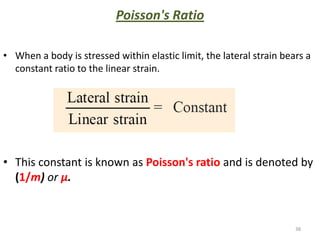
Poisson's Ratio

• When a body is stressed within elastic limit, the lateral strain bears a
  constant ratio to the linear strain.


• This constant is known as Poisson's ratio and is denoted by
  (1/m) or μ.


                                                                      38
Volumetric Strain
• When a body is subjected to a system of forces, it undergoes some
  changes in its dimensions. The volume of the body is changed.
• The ratio of the change in volume to the original volume is known as
  volumetric strain.
• Volumetric strain, εv = δV / V               ; δV = Change in
  volume,                                              ; V = Original
  volume.

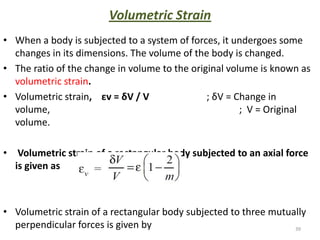
• Volumetric strain of a rectangular body subjected to an axial force
  is given as


• Volumetric strain of a rectangular body subjected to three mutually
  perpendicular forces is given by                                39
Bulk Modulus
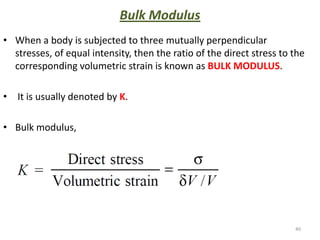
• When a body is subjected to three mutually perpendicular
  stresses, of equal intensity, then the ratio of the direct stress to the
  corresponding volumetric strain is known as BULK MODULUS.

• It is usually denoted by K.

• Bulk modulus,


                                                                       40
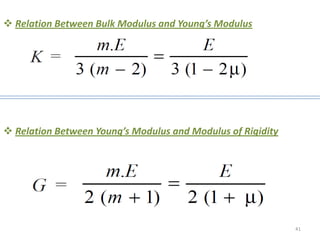
 Relation Between Bulk Modulus and Young’s Modulus


 Relation Between Young’s Modulus and Modulus of Rigidity


                                                             41
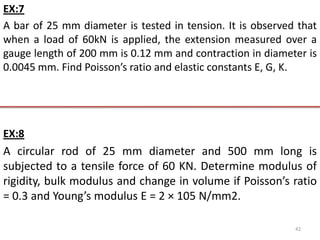
EX:7
A bar of 25 mm diameter is tested in tension. It is observed that
when a load of 60kN is applied, the extension measured over a
gauge length of 200 mm is 0.12 mm and contraction in diameter is
0.0045 mm. Find Poisson’s ratio and elastic constants E, G, K.


EX:8
A circular rod of 25 mm diameter and 500 mm long is
subjected to a tensile force of 60 KN. Determine modulus of
rigidity, bulk modulus and change in volume if Poisson’s ratio
= 0.3 and Young’s modulus E = 2 × 10⁵ N/mm2.

                                                            42
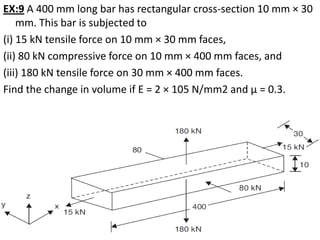
EX:9 A 400 mm long bar has rectangular cross-section 10 mm × 30
    mm. This bar is subjected to
(i) 15 kN tensile force on 10 mm × 30 mm faces,
(ii) 80 kN compressive force on 10 mm × 400 mm faces, and
(iii) 180 kN tensile force on 30 mm × 400 mm faces.
Find the change in volume if E = 2 × 10⁵ N/mm2 and μ = 0.3.


                                                           43
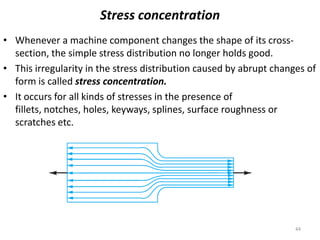
Stress concentration
• Whenever a machine component changes the shape of its cross-
  section, the simple stress distribution no longer holds good.
• This irregularity in the stress distribution caused by abrupt changes of
  form is called stress concentration.
• It occurs for all kinds of stresses in the presence of
  fillets, notches, holes, keyways, splines, surface roughness or
  scratches etc.


                                                                     44
Thank You…


             45

Simpale stress and simple strain

  • 1.
    INDUS INSTITUTE OF TECHNOLOGY& ENGINEERING DEPARTMENT OF MECHANICAL ENGINEERING Name : Keval Patel Subject Code : Subject Name : Mechanics of solid B.E Mechanical Engineering , 1st Semester 1
  • 2.
    LOAD • LOAD:- anyexternal force acting upon a machine part Dead Live Force Suddenly applied Impact 2
  • 3.
    Stress (σ) =F / A F= 1 MPa = 1 × 10⁶ N/m2 = 1 N/ mm2 R= 3
  • 4.
    Strain (ε) =δl / L h δl= L - l l 4
  • 5.
    Tensile Stress andStrain • When a body is subjected to two equal and opposite axial pulls P (also called tensile load) , then the stress induced at any section of the body is known as tensile stress • Tensile load, there will be a decrease in cross-sectional area and an increase in length of the body. The ratio of the increase in length to the original length is known as tensile strain. 5
  • 6.
  • 7.
    Compressive Stress andStrain • When a body is subjected to two equal and opposite axial pushes P (also called compressive load) , then the stress induced at any section of the body is known as compressive stress • Compressive load, there will be an increase in cross-sectional area and a decrease in length of the body. The ratio of the decrease in length to the original length Is known as compressive strain 7
  • 8.
  • 9.
    Young's Modulus orModulus of Elasticity  Hooke's law:- states that when a material is loaded within elastic limit, the stress is directly proportional to strain, σ ∝ ε or σ= E×ε 9
  • 10.
    Example 1. A circularrod of diameter 16 mm and 500 mm long is subjected to a tensile force 40 kN. The modulus of elasticity for steel may be taken as 200 kN/mm2. Find stress, strain and elongation of the bar due to applied load. 10
  • 11.
    Shear Stress andStrain • When a body is subjected to two equal and opposite forces acting tangentially across the resisting section, as a result of which the body tends to shear off the section, then the stress induced is called shear stress (τ), The corresponding strain is known as shear strain (φ) 11
  • 12.
    Shear Modulus orModulus of Rigidity • It has been found experimentally that within the elastic limit, the shear stress is directly proportional to shear strain. Mathematically τ∝φ or τ=G.φ or τ/φ=G • where, τ = Shear stress, • φ = Shear strain, • G = Constant of proportionality, known as shear modulus or modulus of rigidity. It is also denoted by N or C. 12
  • 13.
  • 14.
  • 15.
  • 16.
  • 17.
    Working Stress • Whendesigning machine parts, it is desirable to keep the stress lower than the maximum or ultimate stress at which failure of the material takes place. This stress is known as the working stress or design stress. • It is also known as safe or allowable stress. working stress = design stress = safe stress = allowable stress 17
  • 18.
    Factor of Safety The ratio of the maximum stress to the working stress. 18
  • 19.
    1: A hollowsteel tube is to be used to carry an axial compressive load of 160 kN. The yield stress for steel is 250 N/mm2. A factor of safety of 1.75 is to be used in the design. The following three class of tubes of external diameter 101.6 mm are available. Class Thickness • Light 3.65 mm Medium 4.05 mm Heavy 4.85 mm Which section do you recommend? 2: A specimen of steel 20 mm diameter with a gauge length of 200 mm is tested to destruction. It has an extension of 0.25 mm under a load of 80 KN and the load at elastic limit is 102 KN. The maximum load is 130 KN. The total extension at fracture is 56 mm and diameter at neck is 15 mm. Find (i) The stress at elastic limit. (ii) Young’s modulus. (iii) Percentage elongation. (iv) Percentage reduction in area. (v) Ultimate tensile stress. 19
  • 20.
    Stresses in CompositeBars • A composite bar may be defined as a bar made up of two or more different materials, joined together, in such a manner that the system extends or contracts as one unit, equally, when subjected to tension or compression. 1. The extension or contraction of the bar is being equal 2. The total external load on the bar is equal to the sum of the loads carried by different materials. 20
  • 21.
    P1 = Load carried by bar 1, • A1 = Cross-sectional area of bar 1, • σ1 = Stress produced in bar 1, • E1 = Young's modulus of bar 1, • P2, A2, σ2, E2 = Corresponding values of bar 2, • P = Total load on the composite bar, • l = Length of the composite bar, and • δl = Elongation of the composite bar. • We know that P = P1 + P2 • Stress in bar 1, • strain in bar 1, 21
  • 22.
    • Elongation inbar -1: • Elongation in bar -2: There fore, δl1 = δl2 • The ratio E1 / E2 is known as modular ratio of the two materials 22
  • 23.
    P = P1+ P2 = = 23
  • 24.
    δl1 = δl2 P= P1 + P2 = σ1.A1 + σ2.A2 24
  • 25.
    EX:3 A bar3 m long is made of two bars, one of copper having E = 105 GN/m2 and the other of steel having E = 210 GN/m2. Each bar is 25 mm broad and 12.5 mm thick. This compound bar is stretched by a load of 50 kN. Find the increase in length of the compound bar and the stress produced in the steel and copper. The length of copper as well as of steel bar is 3 m each. Ans: Pc=16.67N Ps=33.33N δl=1.52 mm 25
  • 26.
    EX:4 • A centralsteel rod 18 mm diameter passes through a copper tube 24 mm inside and 40 mm outside diameter, as shown in Fig. It is provided with nuts and washers at each end. The nuts are tightened until a stress of 10 MPa is set up in the steel. Find out stress generated in copper tube. Hint: Ps=Pc σs × As = σc × Ac
  • 27.
    BARS WITH CROSS-SECTIONSVARYING IN STEPS • A typical bar with cross-sections varying in steps and subjected to axial load • length of three portions L1, L2 and L3 and the respective cross- sectional areas are A1, A2, A3 • E = Young’s modulus of the material • P = applied axial load. 27
  • 28.
    • forces actingon the cross-sections of the three portions. It is obvious that to maintain equilibrium the load acting on each portion is P only. 28
  • 29.
    Stress, strain andextension of each of these portions are: Portion Stress Strain Extension 1 σ1 = P/ A1 e1 = σ1 / E δ1 = P L1 / A1 E 2 σ2 = P/ A2 e2 = σ2 / E δ2 = P L2 / A2 E 3 σ3 = P/ A3 e3 = σ3 / E δ3 = P L3 / A3 E 29
  • 30.
    Total Elongation: δ δ1+ δ2 + δ3 = [P L1 / A1 E] + [P L2 / A2 E] + [P L3 / A3 E] 30
  • 31.
    EX:5 The bar shownin Fig. 8.16 is tested in universal testing machine. It is observed that at a load of 40 kN the total extension of the bar is 0.280 mm. Determine the Young’s modulus of the material. 31
  • 32.
    Thermal Stresses  Stressesdue to Change in Temperature  Whenever there is some increase or decrease in the temperature of a body, it causes the body to expand or contract.  If the body is allowed to expand or contract freely, with the rise or fall of the temperature, no stresses are induced in the body.  But, if the deformation of the body is prevented, some stresses are induced in the body. Such stresses are known as thermal stresses. 32
  • 33.
    • l =Original length of the body, • t = Rise or fall of temperature, • α = Coefficient of thermal expansion, ∴ Increase or decrease in length, δl = l × α × t • If the ends of the body are fixed to rigid supports, so that its expansion is prevented, then compressive strain induced in the body, • ∴ Thermal stress, 33
  • 34.
    If the freeexpansion is prevented fully • Since support is not permitting it, the support force P develops to keep it at the original position. • Magnitude of this force is such that contraction is equal to free expansion δl = l × α × t 34
  • 35.
    If free expansionis prevented partially Expansion prevented Δ = α tL – δ 35
  • 36.
    EX:6: A steelrail is 12 m long and is laid at a temperature of 18°C. The maximum temperature expected is 40°C. (i) Estimate the minimum gap between two rails to be left so that the temperature stresses do not develop. (ii) Calculate the temperature stresses developed in the rails, if: (a) No expansion joint is provided. (b) If a 1.5 mm gap is provided for expansion. (iii) If the stress developed is 20 N/mm2, what is the gap provided between the rails? Take E = 2 × 10⁵ N/mm2 and α = 12 × 10–6/°C. 36
  • 37.
    Linear and LateralStrain • Consider a circular bar of diameter d and length l, subjected to a tensile force P • Due to tensile force, the length of the bar increases by an amount δl and the diameter decreases by an amount δd • Similarly, if the bar is subjected to a compressive force, • Every direct stress is accompanied by a strain in its own direction is known as linear strain and an opposite kind of strain in every direction, at right angles to it, is known as lateral strain. 37
  • 38.
    Poisson's Ratio • Whena body is stressed within elastic limit, the lateral strain bears a constant ratio to the linear strain. • This constant is known as Poisson's ratio and is denoted by (1/m) or μ. 38
  • 39.
    Volumetric Strain • Whena body is subjected to a system of forces, it undergoes some changes in its dimensions. The volume of the body is changed. • The ratio of the change in volume to the original volume is known as volumetric strain. • Volumetric strain, εv = δV / V ; δV = Change in volume, ; V = Original volume. • Volumetric strain of a rectangular body subjected to an axial force is given as • Volumetric strain of a rectangular body subjected to three mutually perpendicular forces is given by 39
  • 40.
    Bulk Modulus • Whena body is subjected to three mutually perpendicular stresses, of equal intensity, then the ratio of the direct stress to the corresponding volumetric strain is known as BULK MODULUS. • It is usually denoted by K. • Bulk modulus, 40
  • 41.
     Relation BetweenBulk Modulus and Young’s Modulus  Relation Between Young’s Modulus and Modulus of Rigidity 41
  • 42.
    EX:7 A bar of25 mm diameter is tested in tension. It is observed that when a load of 60kN is applied, the extension measured over a gauge length of 200 mm is 0.12 mm and contraction in diameter is 0.0045 mm. Find Poisson’s ratio and elastic constants E, G, K. EX:8 A circular rod of 25 mm diameter and 500 mm long is subjected to a tensile force of 60 KN. Determine modulus of rigidity, bulk modulus and change in volume if Poisson’s ratio = 0.3 and Young’s modulus E = 2 × 10⁵ N/mm2. 42
  • 43.
    EX:9 A 400mm long bar has rectangular cross-section 10 mm × 30 mm. This bar is subjected to (i) 15 kN tensile force on 10 mm × 30 mm faces, (ii) 80 kN compressive force on 10 mm × 400 mm faces, and (iii) 180 kN tensile force on 30 mm × 400 mm faces. Find the change in volume if E = 2 × 10⁵ N/mm2 and μ = 0.3. 43
  • 44.
    Stress concentration • Whenevera machine component changes the shape of its cross- section, the simple stress distribution no longer holds good. • This irregularity in the stress distribution caused by abrupt changes of form is called stress concentration. • It occurs for all kinds of stresses in the presence of fillets, notches, holes, keyways, splines, surface roughness or scratches etc. 44
  • 45.