subject : Applied fluid mechanicsBVRIT
Prepared by:
Ravaliya Nirmal
1. Introduction to Dimensions & Units
2. Use of DimensionalAnalysis
3. Dimensional Homogeneity
4. Methods of DimensionalAnalysis
5. Rayleigh’s Method
6. Buckingham’s Method
7. Model Analysis
8. Similitude
9. Model Laws or Similarity Laws
10. Model and Prototype Relations
Many practical real flow problems in fluid mechanics can be solved by using
equations and analytical procedures. However, solutions of some real flow
problems depend heavily on experimental data.
Sometimes, the experimental work in the laboratory is not only time-consuming,
but also expensive. So, the main goal is to extract maximum information from
fewest experiments.
In this regard, dimensional analysis is an important tool that helps in correlating
analytical results with experimental data and to predict the prototype behavior from
the measurements on the model.
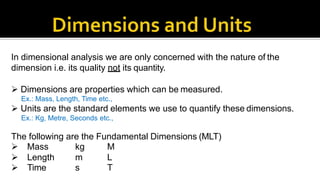
In dimensional analysis we are only concerned with the nature of the
dimension i.e. its quality not its quantity.
 Dimensions are properties which can be measured.
Ex.: Mass, Length, Time etc.,
 Units are the standard elements we use to quantify these dimensions.
Ex.: Kg, Metre, Seconds etc.,
The following are the Fundamental Dimensions (MLT)
 Mass
 Length
kg
m
M
L
 Time s T
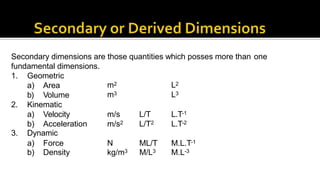
Secondary dimensions are those quantities which posses more than one
fundamental dimensions.
1. Geometric
a) Area
b) Volume
m2
m3
L2
L3
2. Kinematic
a) Velocity
b) Acceleration
3. Dynamic
m/s
m/s2
L/T
L/T2
L.T-1
L.T-2
a) Force N ML/T M.L.T-1
b) Density kg/m3 M/L3 M.L-3
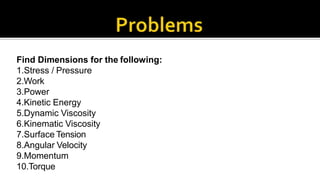
Find Dimensions for the following:
1.Stress / Pressure
2.Work
3.Power
4.Kinetic Energy
5.Dynamic Viscosity
6.Kinematic Viscosity
7.Surface Tension
8.Angular Velocity
9.Momentum
10.Torque
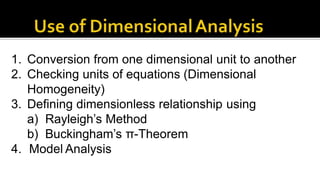
1. Conversion from one dimensional unit to another
2. Checking units of equations (Dimensional
Homogeneity)
3. Defining dimensionless relationship using
a) Rayleigh’s Method
b) Buckingham’s π-Theorem
4. Model Analysis
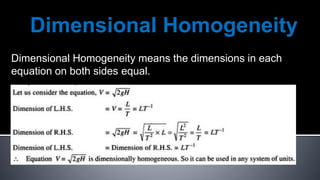
Dimensional Homogeneity
Dimensional Homogeneity means the dimensions in each
equation on both sides equal.
To define relationship among variables
This method is used for determining the
expression for a variable which depends upon
maximum three or four variables only.
To define relationship among variables
This method is used for determining the
expression for a variable which depends upon
maximum three or four variables only.
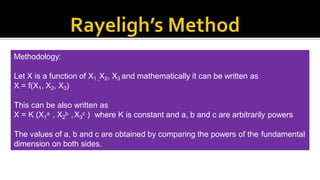
Methodology:
Let X is a function of X1 ,X2, X3 and mathematically it can be written as
X = f(X1, X2, X3)
This can be also written as
X = K (X1
a , X2
b ,X3
c ) where K is constant and a, b and c are arbitrarily powers
The values of a, b and c are obtained by comparing the powers of the fundamental
dimension on both sides.
To define relationship among variables
This method is used for determining the
expression for a variable which depends upon
maximum three or four variables only.
Methodology:
Let X is a function of X1 ,X2, X3 and mathematically it can be written as
X = f(X1, X2, X3)
This can be also written as
X = K (X1
a , X2
b ,X3
c ) where K is constant and a, b and c are arbitrarily powers
The values of a, b and c are obtained by comparing the powers of the fundamental
dimension on both sides.
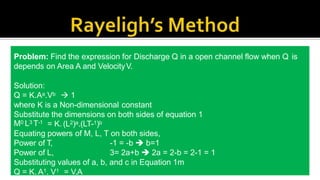
Problem: Find the expression for Discharge Q in a open channel flow when Q is
depends on Area A and VelocityV.
Solution:
Q = K.Aa.Vb  1
where K is a Non-dimensional constant
Substitute the dimensions on both sides of equation 1
M0 L3 T-1 = K. (L2)a.(LT-1)b
Equating powers of M, L, T on both sides,
Power of T,
Power of L,
-1 = -b  b=1
3= 2a+b  2a = 2-b = 2-1 = 1
Substituting values of a, b, and c in Equation 1m
Q = K. A1. V1 = V.A
To define relationship among variables
This method is used for determining the
expression for a variable which depends upon
maximum three or four variables only.
Rayeligh’s Method
Methodology:
Let X is a function of X1 ,X2, X3 and mathematically it can be written as
X = f(X1, X2, X3)
This can be also written as
X = K (X1
a , X2
b ,X3
c ) where K is constant and a, b and c are arbitrarily powers
The values of a, b and c are obtained by comparing the powers of the fundamental
dimension on both sides.
To define relationship among variables
This method is used for determining the
expression for a variable which depends upon
maximum three or four variables only.
Rayeligh’s Method
Methodology:
Let X is a function of X1 ,X2, X3 and mathematically it can be written as
X = f(X1, X2, X3)
This can be also written as
X = K (X1
a , X2
b ,X3
c ) where K is constant and a, b and c are arbitrarily powers
The values of a, b and c are obtained by comparing the powers of the fundamental
dimension on both sides.
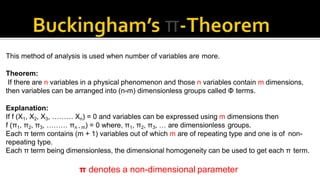
This method of analysis is used when number of variables are more.
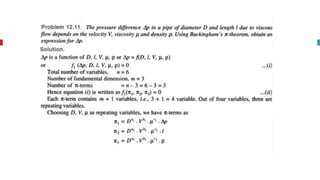
Theorem:
If there are n variables in a physical phenomenon and those n variables contain m dimensions,
then variables can be arranged into (n-m) dimensionless groups called Φ terms.
Explanation:
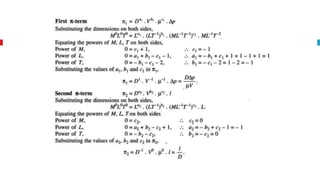
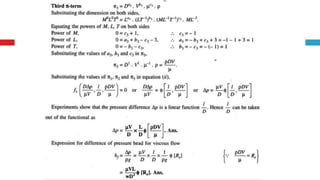
If f (X1, X2, X3, ……… Xn) = 0 and variables can be expressed using m dimensions then
f (π1, π2, π3, ……… πn - m) = 0 where, π1, π2, π3, … are dimensionless groups.
Each π term contains (m + 1) variables out of which m are of repeating type and one is of non-
repeating type.
Each π term being dimensionless, the dimensional homogeneity can be used to get each π term.
π denotes a non-dimensional parameter
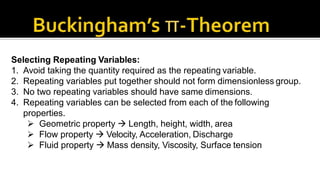
Selecting Repeating Variables:
1. Avoid taking the quantity required as the repeating variable.
2. Repeating variables put together should not form dimensionless group.
3. No two repeating variables should have same dimensions.
4. Repeating variables can be selected from each of the following
properties.
 Geometric property  Length, height, width, area
 Flow property  Velocity, Acceleration, Discharge
 Fluid property  Mass density, Viscosity, Surface tension
Exampl
e
Exampl
e
Exampl
e
For predicting the performance of the hydraulic structures (such as dams, spillways
etc.) or hydraulic machines (such as turbines, pumps etc.) before actually
constructing or manufacturing, models of the structures or machines are made and
tests are conducted on them to obtain the desired information.
Model is a small replica of the actual structure or machine
The actual structure or machine is called as Prototype
Models can be smaller or larger than the Prototype
Model Analysis is actually an experimental method of finding solutionsof
complex flow problems.
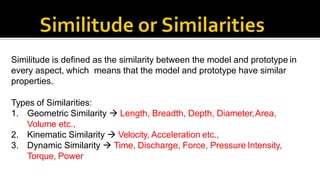
Similitude is defined as the similarity between the model and prototype in
every aspect, which means that the model and prototype have similar
properties.
Types of Similarities:
1. Geometric Similarity  Length, Breadth, Depth, Diameter,Area,
Volume etc.,
2. Kinematic Similarity  Velocity, Acceleration etc.,
3. Dynamic Similarity  Time, Discharge, Force, Pressure Intensity,
Torque, Power
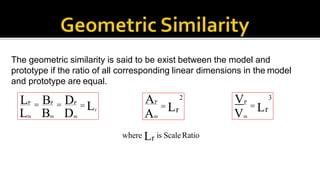
The geometric similarity is said to be exist between the model and
prototype if the ratio of all corresponding linear dimensions in the model
and prototype are equal.
L B D r
m m m
 LLP
 BP
 DP
r
2
L
AP
Am
 r
3
L
VP
Vm

where Lr is ScaleRatio
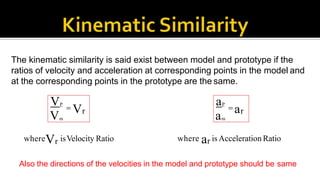
The kinematic similarity is said exist between model and prototype if the
ratios of velocity and acceleration at corresponding points in the model and
at the corresponding points in the prototype are the same.
VP
Vm
 Vr
aP
am
 ar
whereVr isVelocity Ratio where ar is Acceleration Ratio
Also the directions of the velocities in the model and prototype should be same
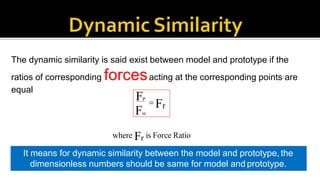
The dynamic similarity is said exist between model and prototype if the
ratios of corresponding forcesacting at the corresponding points are
equal
FP
Fm
 Fr
where Fr is Force Ratio
Also the directions of the velocities in the model and prototype should be same
It means for dynamic similarity between the model and prototype, the
dimensionless numbers should be same for model and prototype.
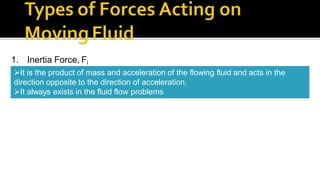
1. Inertia Force, Fi
It is the product of mass and acceleration of the flowing fluid and acts in the
direction opposite to the direction of acceleration.
It always exists in the fluid flow problems
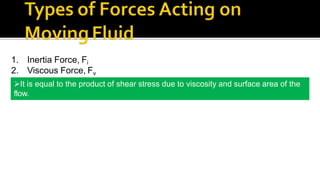
1. Inertia Force, Fi
2. Viscous Force, Fv
It is equal to the product of shear stress due to viscosity and surface area of the
flow.
1. Inertia Force, Fi
2. Viscous Force, Fv
3. Gravity Force, Fg
 It is equal to the product of mass and acceleration due to gravity of the flowing
fluid.
1. Inertia Force, Fi
2. Viscous Force, Fv
3. Gravity Force, Fg
4. Pressure Force, Fp
 It is equal to the product of pressure intensity and cross sectional area of
flowing fluid
1. Inertia Force, Fi
2. Viscous Force, Fv
3. Gravity Force, Fg
4. Pressure Force, Fp
5. Surface Tension Force, Fs
 It is equal to the product of surface tension and length of surface of the flowing
1. Inertia Force, Fi
2. Viscous Force, Fv
3. Gravity Force, Fg
4. Pressure Force, Fp
5. Surface Tension Force, Fs
6. Elastic Force, Fe
 It is equal to the product of elastic stress and area of the flowing fluid
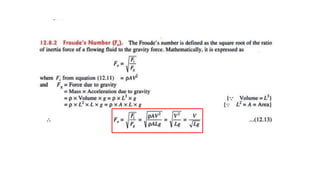
V
Lg
InertiaForce
Gravity Force

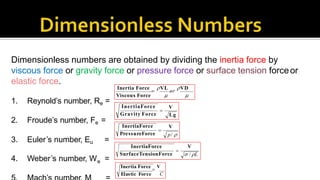
Dimensionless numbers are obtained by dividing the inertia force by
viscous force or gravity force or pressure force or surface tension forceor
elastic force.
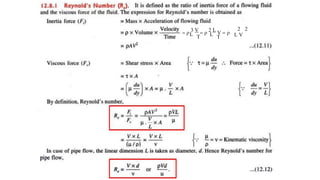
1. Reynold’s number, Re =
2. Froude’s number, Fe =
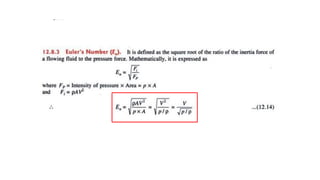
3. Euler’s number, Eu =
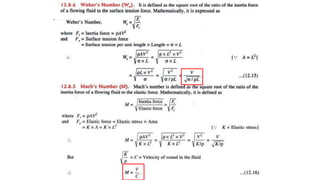
e4. Weber’s number, W =
V
p/ 
InertiaForce
PressureForce

InertiaForce V
SurfaceTensionForce  / L

 Viscous Force
Inertia Force

VL
or
VD
Inertia Force

V
Elastic Force C
2 2
L VT TL L ρ 3 V
 ρ 2 L
V  ρ
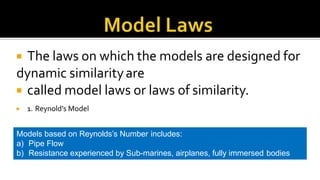
 The laws on which the models are designed for
dynamic similarityare
 called model laws or laws of similarity.
 1. Reynold’s Model
Models based on Reynolds’s Number includes:
a) Pipe Flow
b) Resistance experienced by Sub-marines, airplanes, fully immersed bodies
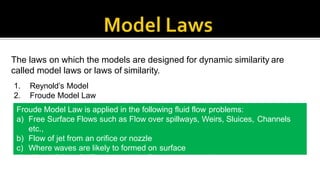
The laws on which the models are designed for dynamic similarity are
called model laws or laws of similarity.
1. Reynold’s Model
2. Froude Model Law
Froude Model Law is applied in the following fluid flow problems:
a) Free Surface Flows such as Flow over spillways, Weirs, Sluices, Channels
etc.,
b) Flow of jet from an orifice or nozzle
c) Where waves are likely to formed on surface
d) Where fluids of different densities flow over one another
The laws on which the models are designed for dynamic similarity are
called model laws or laws of similarity.
1. Reynold’s Model
2. Froude Model Law
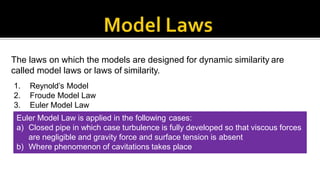
3. Euler Model Law
Euler Model Law is applied in the following cases:
a) Closed pipe in which case turbulence is fully developed so that viscous forces
are negligible and gravity force and surface tension is absent
b) Where phenomenon of cavitations takes place
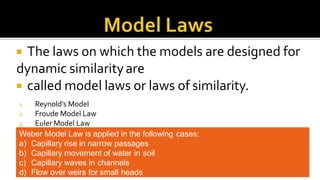
 The laws on which the models are designed for
dynamic similarityare
 called model laws or laws of similarity.
1. Reynold’s Model
2. Froude Model Law
3. Euler Model Law
4. Weber Model LawWeber Model Law is applied in the following cases:
a) Capillary rise in narrow passages
b) Capillary movement of water in soil
c) Capillary waves in channels
d) Flow over weirs for small heads
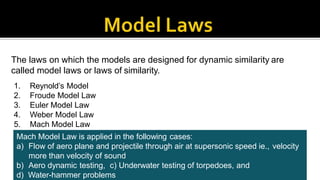
The laws on which the models are designed for dynamic similarity are
called model laws or laws of similarity.
1. Reynold’s Model
2. Froude Model Law
3. Euler Model Law
4. Weber Model Law
5. Mach Model Law
Mach Model Law is applied in the following cases:
a) Flow of aero plane and projectile through air at supersonic speed ie., velocity
more than velocity of sound
b) Aero dynamic testing, c) Underwater testing of torpedoes, and
d) Water-hammer problems
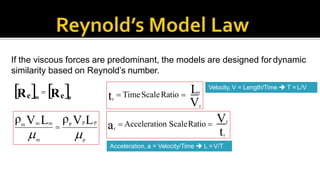
If the viscous forces are predominant, the models are designed fordynamic
similarity based on Reynold’s number.
 p
P PP
m
m mm V LρV Lρ

V
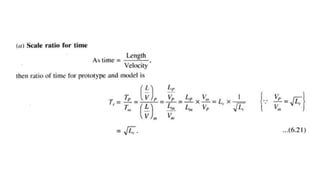
L
t r
r
r
 TimeScaleRatio 
Velocity, V = Length/Time  T = L/V
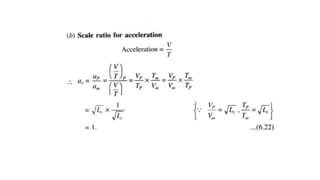
t
a
r
Vr
r
 Acceleration ScaleRatio 
Acceleration, a = Velocity/Time  L =V/T
   R Ree pm

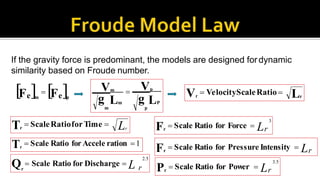
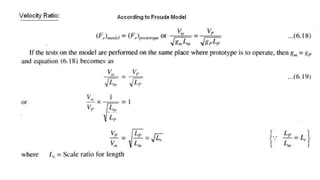
If the gravity force is predominant, the models are designed fordynamic
similarity based on Froude number.
LrTr
 ScaleRatioforTime 
g Lm g LP
m p
Vm
 Vp
LrVr
 VelocityScaleRatio    F Fee pm

Tr
 Scale Ratio for Accele ration 1
r
2.5
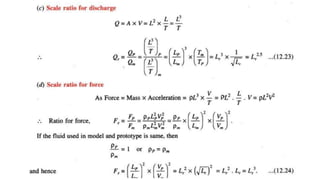
Q  Scale Ratio for Discharge  Lr
3
Fr
 Scale Ratio for Force  Lr
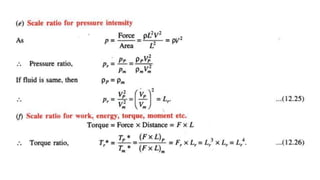
Fr
 Scale Ratio for Pressure Intensity  Lr
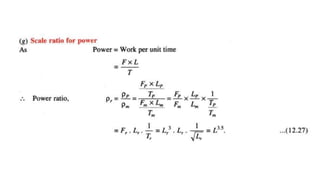
3.5
Pr
 Scale Ratio for Power  Lr
Chapter 12
A Textbook of Fluid Mechanics and
Hydraulic Machines
Dr. R. K. Bansal
Laxmi Publications

Dimension Analysis in Fluid mechanics

  • 1.
    subject : Appliedfluid mechanicsBVRIT Prepared by: Ravaliya Nirmal
  • 2.
    1. Introduction toDimensions & Units 2. Use of DimensionalAnalysis 3. Dimensional Homogeneity 4. Methods of DimensionalAnalysis 5. Rayleigh’s Method
  • 3.
    6. Buckingham’s Method 7.Model Analysis 8. Similitude 9. Model Laws or Similarity Laws 10. Model and Prototype Relations
  • 4.
    Many practical realflow problems in fluid mechanics can be solved by using equations and analytical procedures. However, solutions of some real flow problems depend heavily on experimental data. Sometimes, the experimental work in the laboratory is not only time-consuming, but also expensive. So, the main goal is to extract maximum information from fewest experiments. In this regard, dimensional analysis is an important tool that helps in correlating analytical results with experimental data and to predict the prototype behavior from the measurements on the model.
  • 5.
    In dimensional analysiswe are only concerned with the nature of the dimension i.e. its quality not its quantity.  Dimensions are properties which can be measured. Ex.: Mass, Length, Time etc.,  Units are the standard elements we use to quantify these dimensions. Ex.: Kg, Metre, Seconds etc., The following are the Fundamental Dimensions (MLT)  Mass  Length kg m M L  Time s T
  • 6.
    Secondary dimensions arethose quantities which posses more than one fundamental dimensions. 1. Geometric a) Area b) Volume m2 m3 L2 L3 2. Kinematic a) Velocity b) Acceleration 3. Dynamic m/s m/s2 L/T L/T2 L.T-1 L.T-2 a) Force N ML/T M.L.T-1 b) Density kg/m3 M/L3 M.L-3
  • 7.
    Find Dimensions forthe following: 1.Stress / Pressure 2.Work 3.Power 4.Kinetic Energy 5.Dynamic Viscosity 6.Kinematic Viscosity 7.Surface Tension 8.Angular Velocity 9.Momentum 10.Torque
  • 8.
    1. Conversion fromone dimensional unit to another 2. Checking units of equations (Dimensional Homogeneity) 3. Defining dimensionless relationship using a) Rayleigh’s Method b) Buckingham’s π-Theorem 4. Model Analysis
  • 9.
    Dimensional Homogeneity Dimensional Homogeneitymeans the dimensions in each equation on both sides equal.
  • 10.
    To define relationshipamong variables This method is used for determining the expression for a variable which depends upon maximum three or four variables only.
  • 11.
    To define relationshipamong variables This method is used for determining the expression for a variable which depends upon maximum three or four variables only. Methodology: Let X is a function of X1 ,X2, X3 and mathematically it can be written as X = f(X1, X2, X3) This can be also written as X = K (X1 a , X2 b ,X3 c ) where K is constant and a, b and c are arbitrarily powers The values of a, b and c are obtained by comparing the powers of the fundamental dimension on both sides.
  • 12.
    To define relationshipamong variables This method is used for determining the expression for a variable which depends upon maximum three or four variables only. Methodology: Let X is a function of X1 ,X2, X3 and mathematically it can be written as X = f(X1, X2, X3) This can be also written as X = K (X1 a , X2 b ,X3 c ) where K is constant and a, b and c are arbitrarily powers The values of a, b and c are obtained by comparing the powers of the fundamental dimension on both sides. Problem: Find the expression for Discharge Q in a open channel flow when Q is depends on Area A and VelocityV. Solution: Q = K.Aa.Vb  1 where K is a Non-dimensional constant Substitute the dimensions on both sides of equation 1 M0 L3 T-1 = K. (L2)a.(LT-1)b Equating powers of M, L, T on both sides, Power of T, Power of L, -1 = -b  b=1 3= 2a+b  2a = 2-b = 2-1 = 1 Substituting values of a, b, and c in Equation 1m Q = K. A1. V1 = V.A
  • 13.
    To define relationshipamong variables This method is used for determining the expression for a variable which depends upon maximum three or four variables only. Rayeligh’s Method Methodology: Let X is a function of X1 ,X2, X3 and mathematically it can be written as X = f(X1, X2, X3) This can be also written as X = K (X1 a , X2 b ,X3 c ) where K is constant and a, b and c are arbitrarily powers The values of a, b and c are obtained by comparing the powers of the fundamental dimension on both sides.
  • 14.
    To define relationshipamong variables This method is used for determining the expression for a variable which depends upon maximum three or four variables only. Rayeligh’s Method Methodology: Let X is a function of X1 ,X2, X3 and mathematically it can be written as X = f(X1, X2, X3) This can be also written as X = K (X1 a , X2 b ,X3 c ) where K is constant and a, b and c are arbitrarily powers The values of a, b and c are obtained by comparing the powers of the fundamental dimension on both sides.
  • 15.
    This method ofanalysis is used when number of variables are more. Theorem: If there are n variables in a physical phenomenon and those n variables contain m dimensions, then variables can be arranged into (n-m) dimensionless groups called Φ terms. Explanation: If f (X1, X2, X3, ……… Xn) = 0 and variables can be expressed using m dimensions then f (π1, π2, π3, ……… πn - m) = 0 where, π1, π2, π3, … are dimensionless groups. Each π term contains (m + 1) variables out of which m are of repeating type and one is of non- repeating type. Each π term being dimensionless, the dimensional homogeneity can be used to get each π term. π denotes a non-dimensional parameter
  • 16.
    Selecting Repeating Variables: 1.Avoid taking the quantity required as the repeating variable. 2. Repeating variables put together should not form dimensionless group. 3. No two repeating variables should have same dimensions. 4. Repeating variables can be selected from each of the following properties.  Geometric property  Length, height, width, area  Flow property  Velocity, Acceleration, Discharge  Fluid property  Mass density, Viscosity, Surface tension
  • 17.
  • 18.
  • 19.
  • 20.
    For predicting theperformance of the hydraulic structures (such as dams, spillways etc.) or hydraulic machines (such as turbines, pumps etc.) before actually constructing or manufacturing, models of the structures or machines are made and tests are conducted on them to obtain the desired information. Model is a small replica of the actual structure or machine The actual structure or machine is called as Prototype Models can be smaller or larger than the Prototype Model Analysis is actually an experimental method of finding solutionsof complex flow problems.
  • 21.
    Similitude is definedas the similarity between the model and prototype in every aspect, which means that the model and prototype have similar properties. Types of Similarities: 1. Geometric Similarity  Length, Breadth, Depth, Diameter,Area, Volume etc., 2. Kinematic Similarity  Velocity, Acceleration etc., 3. Dynamic Similarity  Time, Discharge, Force, Pressure Intensity, Torque, Power
  • 22.
    The geometric similarityis said to be exist between the model and prototype if the ratio of all corresponding linear dimensions in the model and prototype are equal. L B D r m m m  LLP  BP  DP r 2 L AP Am  r 3 L VP Vm  where Lr is ScaleRatio
  • 23.
    The kinematic similarityis said exist between model and prototype if the ratios of velocity and acceleration at corresponding points in the model and at the corresponding points in the prototype are the same. VP Vm  Vr aP am  ar whereVr isVelocity Ratio where ar is Acceleration Ratio Also the directions of the velocities in the model and prototype should be same
  • 24.
    The dynamic similarityis said exist between model and prototype if the ratios of corresponding forcesacting at the corresponding points are equal FP Fm  Fr where Fr is Force Ratio Also the directions of the velocities in the model and prototype should be same It means for dynamic similarity between the model and prototype, the dimensionless numbers should be same for model and prototype.
  • 25.
    1. Inertia Force,Fi It is the product of mass and acceleration of the flowing fluid and acts in the direction opposite to the direction of acceleration. It always exists in the fluid flow problems
  • 26.
    1. Inertia Force,Fi 2. Viscous Force, Fv It is equal to the product of shear stress due to viscosity and surface area of the flow.
  • 27.
    1. Inertia Force,Fi 2. Viscous Force, Fv 3. Gravity Force, Fg  It is equal to the product of mass and acceleration due to gravity of the flowing fluid.
  • 28.
    1. Inertia Force,Fi 2. Viscous Force, Fv 3. Gravity Force, Fg 4. Pressure Force, Fp  It is equal to the product of pressure intensity and cross sectional area of flowing fluid
  • 29.
    1. Inertia Force,Fi 2. Viscous Force, Fv 3. Gravity Force, Fg 4. Pressure Force, Fp 5. Surface Tension Force, Fs  It is equal to the product of surface tension and length of surface of the flowing
  • 30.
    1. Inertia Force,Fi 2. Viscous Force, Fv 3. Gravity Force, Fg 4. Pressure Force, Fp 5. Surface Tension Force, Fs 6. Elastic Force, Fe  It is equal to the product of elastic stress and area of the flowing fluid
  • 31.
    V Lg InertiaForce Gravity Force  Dimensionless numbersare obtained by dividing the inertia force by viscous force or gravity force or pressure force or surface tension forceor elastic force. 1. Reynold’s number, Re = 2. Froude’s number, Fe = 3. Euler’s number, Eu = e4. Weber’s number, W = V p/  InertiaForce PressureForce  InertiaForce V SurfaceTensionForce  / L   Viscous Force Inertia Force  VL or VD Inertia Force  V Elastic Force C
  • 32.
    2 2 L VTTL L ρ 3 V  ρ 2 L V  ρ
  • 36.
     The lawson which the models are designed for dynamic similarityare  called model laws or laws of similarity.  1. Reynold’s Model Models based on Reynolds’s Number includes: a) Pipe Flow b) Resistance experienced by Sub-marines, airplanes, fully immersed bodies
  • 37.
    The laws onwhich the models are designed for dynamic similarity are called model laws or laws of similarity. 1. Reynold’s Model 2. Froude Model Law Froude Model Law is applied in the following fluid flow problems: a) Free Surface Flows such as Flow over spillways, Weirs, Sluices, Channels etc., b) Flow of jet from an orifice or nozzle c) Where waves are likely to formed on surface d) Where fluids of different densities flow over one another
  • 38.
    The laws onwhich the models are designed for dynamic similarity are called model laws or laws of similarity. 1. Reynold’s Model 2. Froude Model Law 3. Euler Model Law Euler Model Law is applied in the following cases: a) Closed pipe in which case turbulence is fully developed so that viscous forces are negligible and gravity force and surface tension is absent b) Where phenomenon of cavitations takes place
  • 39.
     The lawson which the models are designed for dynamic similarityare  called model laws or laws of similarity. 1. Reynold’s Model 2. Froude Model Law 3. Euler Model Law 4. Weber Model LawWeber Model Law is applied in the following cases: a) Capillary rise in narrow passages b) Capillary movement of water in soil c) Capillary waves in channels d) Flow over weirs for small heads
  • 40.
    The laws onwhich the models are designed for dynamic similarity are called model laws or laws of similarity. 1. Reynold’s Model 2. Froude Model Law 3. Euler Model Law 4. Weber Model Law 5. Mach Model Law Mach Model Law is applied in the following cases: a) Flow of aero plane and projectile through air at supersonic speed ie., velocity more than velocity of sound b) Aero dynamic testing, c) Underwater testing of torpedoes, and d) Water-hammer problems
  • 41.
    If the viscousforces are predominant, the models are designed fordynamic similarity based on Reynold’s number.  p P PP m m mm V LρV Lρ  V L t r r r  TimeScaleRatio  Velocity, V = Length/Time  T = L/V t a r Vr r  Acceleration ScaleRatio  Acceleration, a = Velocity/Time  L =V/T    R Ree pm 
  • 44.
    If the gravityforce is predominant, the models are designed fordynamic similarity based on Froude number. LrTr  ScaleRatioforTime  g Lm g LP m p Vm  Vp LrVr  VelocityScaleRatio    F Fee pm  Tr  Scale Ratio for Accele ration 1 r 2.5 Q  Scale Ratio for Discharge  Lr 3 Fr  Scale Ratio for Force  Lr Fr  Scale Ratio for Pressure Intensity  Lr 3.5 Pr  Scale Ratio for Power  Lr
  • 51.
    Chapter 12 A Textbookof Fluid Mechanics and Hydraulic Machines Dr. R. K. Bansal Laxmi Publications