FLUID DYNAMICS
GOAL
Apply principle of fluid dynamics to determine pressure and
velocity in a variety of typical fluid systems
THE PROPERTIES OF FLUID DYNAMICS
1-The flow
2-Viscosity
3- Bernoulli's equation
At first the flow
What is the flow?
It is the movement of a fluid in a certain direction
Notes
1-THE layers
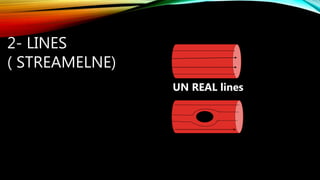
2- LINES
( STREAMELNE)
UN REAL lines
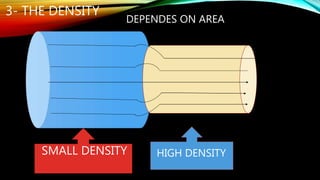
3- THE DENSITY
DEPENDES ON AREA
SMALL DENSITY HIGH DENSITY
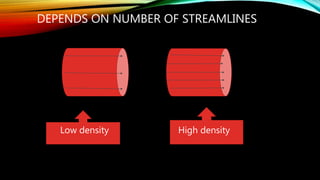
High densityLow density
DEPENDS ON NUMBER OF STREAMLINES
THE DENSITY OF
STREAMLINES
IT IS THE NUMBER OF STREAMLINES THAT PASSING
PERPENDICULAR TO A UNIT AREA AT A CERTAIN
POINT.
STREAMLINES
It is un real lines that determine the path for each part of a liquid
during the flow inside the tube by steady flow
PROPERTIES OF STREAMLINES
1- un real lines , not intersect each other.
2 - The number of streamlines not change by changing the
area , but the density of streamlines change.
3 – In high velocity the streamlines becomes near
to each other, and
In low velocity the streamlines becomes far to
each other.
4 – The tangent for any point at the streamline
determine the direction of instantaneous
velocity for each small amount of liquid
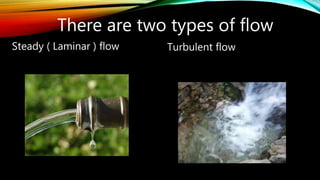
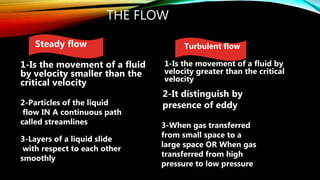
There are two types of flow
Steady ( Laminar ) flow Turbulent flow
THE FLOW
1-Is the movement of a fluid
by velocity smaller than the
critical velocity
1-Is the movement of a fluid by
velocity greater than the critical
velocity
Steady flow Turbulent flow
3-Layers of a liquid slide
with respect to each other
smoothly
2-Particles of the liquid
flow IN A continuous path
called streamlines 3-When gas transferred
from small space to a
large space OR When gas
transferred from high
pressure to low pressure
2-It distinguish by
presence of eddy
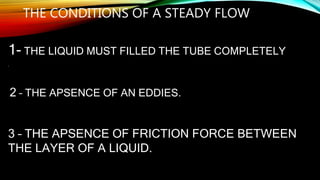
THE CONDITIONS OF A STEADY FLOW
1- THE LIQUID MUST FILLED THE TUBE COMPLETELY.
•
2 – THE APSENCE OF AN EDDIES.
3 – THE APSENCE OF FRICTION FORCE BETWEEN
THE LAYER OF A LIQUID.
4 - THE VELOCITY OF A FLUID NOT INCREASE
THAN THE CRITICAL VELOCITY.
5 - THE QUANTITY OF A FLUID WHICH INTERING FROM ONE
END OF THE TUBE EQUALS THE QUANTITY OF A FLUID
WHICH EMERGING FROM THE OTHER END.
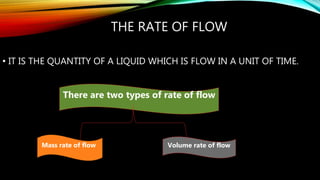
THE RATE OF FLOW
• IT IS THE QUANTITY OF A LIQUID WHICH IS FLOW IN A UNIT OF TIME.
There are two types of rate of flow
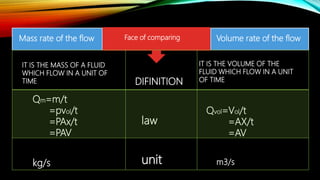
Mass rate of flow Volume rate of flow
Mass rate of the flow Volume rate of the flowFace of comparing
DIFINITION
IT IS THE MASS OF A FLUID
WHICH FLOW IN A UNIT OF
TIME
IT IS THE VOLUME OF THE
FLUID WHICH FLOW IN A UNIT
OF TIME
Qm=m/t
=pvol/t
=PAx/t
=PAV
Qvol=Vol/t
=AX/t
=AV
kg/s m3/s
law
unit
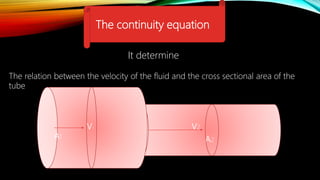
The continuity equation
The relation between the velocity of the fluid and the cross sectional area of the
tube
It determine
A1
V1
A2
V2
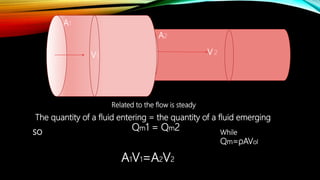
A1
V1
A2
V 2
Related to the flow is steady
The quantity of a fluid entering = the quantity of a fluid emerging
so Qm1 = Qm2 While
Qm=ρAVol
A1V1=A2V2
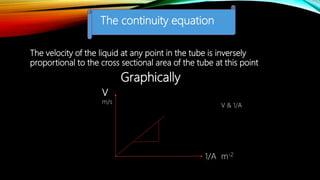
The continuity equation
The velocity of the liquid at any point in the tube is inversely
proportional to the cross sectional area of the tube at this point
Graphically
V
m/s
1/A m-2
V & 1/A
Notes
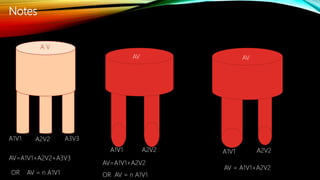
A V
A1V1 A2V2 A3V3
AV=A1V1+A2V2+A3V3
A1V1
AV
A2V2
AV=A1V1+A2V2
OR AV = n A1V1 OR AV = n A1V1
A1V1
AV
A2V2
AV = A1V1+A2V2
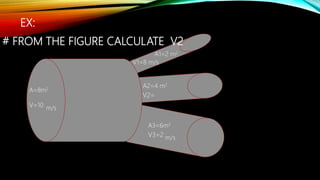
EX:
# FROM THE FIGURE CALCULATE V2
A=8m2
V=10 m/s
A1=2 m2
V1=8 m/s
A2=4 m2
V2=
A3=6m2
V3=2 m/s
The Answer
VISCOSITY
Practical work
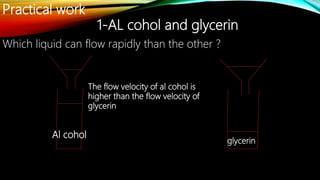
1-AL cohol and glycerin
Al cohol
glycerin
The flow velocity of al cohol is
higher than the flow velocity of
glycerin
Which liquid can flow rapidly than the other ?
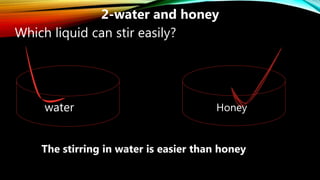
Honey
2-water and honey
water
Which liquid can stir easily?
The stirring in water is easier than honey
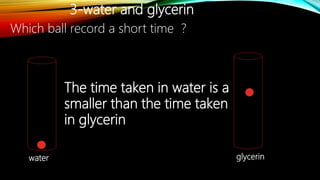
3-water and glycerin
water glycerin
Which ball record a short time ?
The time taken in water is a
smaller than the time taken
in glycerin
From the previous experiments
We can found that
Some liquids as ( water and al cohol ) have high flow and
less resistance to allow object to move inside it
This means that they are low viscosity
Some liquids as ( honey and glycerin ) have low flow and
high resistance to allow object to move inside it
This means that they are low viscosity
viscosity
It is the property which is responsible for the resistance or friction
between the liquid layers and prevents sliding of layers above each
other
Explaining the viscosity
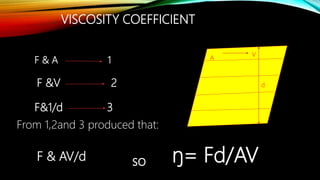
1- friction force
2- force similar to the friction force
VISCOSITY COEFFICIENT
V
A
d
F & A 1
F &V 2
F&1/d 3
From 1,2and 3 produced that:
F & AV/d so ŋ= Fd/AV
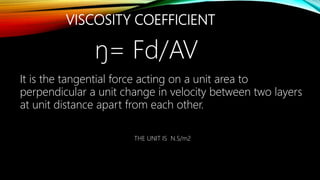
VISCOSITY COEFFICIENT
It is the tangential force acting on a unit area to
perpendicular a unit change in velocity between two layers
at unit distance apart from each other.
ŋ= Fd/AV
THE UNIT IS N.S/m2
Factors affecting viscosity
1-Velocity
2- Area
3-Distance
4- viscosity coefficient
Bernoulli's Equation
1-Conservation law of energy
It is the relation which explain:
2- the relation between velocity and pressure
OR
Explain the relation between pressure, potential
and kinetic energy
Notes FOR APPLYING Bernoulli's EQUATION
1-THE KINETIC ENERGY MUSTNOT CHANGE TO HEAT ENERGY
Or any other form of energy DURING THE FLOW TO KEEP THE
MECHANICAL ENERGY CONESTANT
3- BERNOULLIS CONSTANT CHANGE FROM ONE TUBE TO
OTHER TUBE
2- we apply this equation in the same streameline inside
the tube
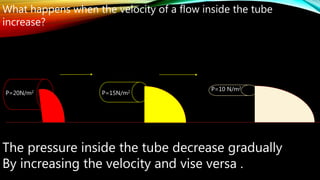
What happens when the velocity of a flow inside the tube
increase?
The pressure inside the tube decrease gradually
By increasing the velocity and vise versa .
P=20N/m2 P=15N/m2
P=10 N/m2
so
Bernoulli's determine the relation between the
pressure, kinetic energy and potential energy
function
Bernoulli'sprinciple
The sum of pressure ,velocity and stored potential
energy in a unit volume from the fluid equals constant
value
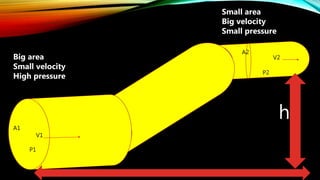
A1
V1
P1
h
Big area
Small velocity
High pressure
Small area
Big velocity
Small pressure
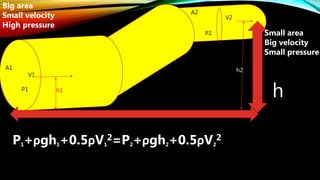
A1
V1
P1
h
Big area
Small velocity
High pressure
Small area
Big velocity
Small pressure
P1+ρgh1+0.5ρV1
2=P2+ρgh2+0.5ρV2
2
h1
h2
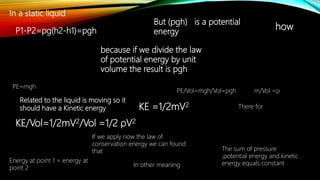
In a static liquid
P1-P2=pg(h2-h1)=pgh
But (pgh) is a potential
energy
because if we divide the law
of potential energy by unit
volume the result is pgh
PE/Vol=mgh/Vol=pgh m/Vol =ρ
There for
Related to the liquid is moving so it
should have a Kinetic energy
KE/Vol=1/2mV2/Vol =1/2 ρV2
KE =1/2mV2
If we apply now the law of
conservation energy we can found
that The sum of pressure
,potential energy and kinetic
energy equals constantIn other meaning
Energy at point 1 = energy at
point 2
how
PE=mgh
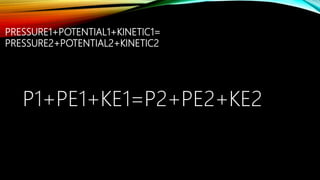
PRESSURE1+POTENTIAL1+KINETIC1=
PRESSURE2+POTENTIAL2+KINETIC2
P1+PE1+KE1=P2+PE2+KE2
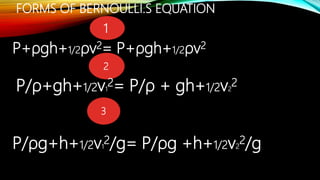
FORMS OF BERNOULLI.S EQUATION
2
1
P+ρgh+1/2ρv2= P+ρgh+1/2ρv2
P/ρ+gh+1/2v1
2= P/ρ + gh+1/2v2
2
P/ρg+h+1/2v1
2/g= P/ρg +h+1/2v2
2/g
3
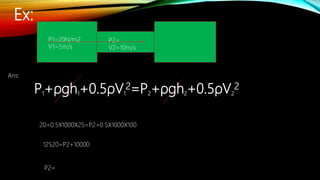
Ex:
P1=20N/m2
V1=5m/s
P2=
V2=10m/s
Ans:
P1+ρgh1+0.5ρV1
2=P2+ρgh2+0.5ρV2
2
20+0.5X1000X25=P2+0.5X1000X100
12520=P2+10000
P2=

Fluid dynamics

  • 1.
  • 2.
    GOAL Apply principle offluid dynamics to determine pressure and velocity in a variety of typical fluid systems
  • 3.
    THE PROPERTIES OFFLUID DYNAMICS 1-The flow 2-Viscosity 3- Bernoulli's equation
  • 4.
    At first theflow What is the flow? It is the movement of a fluid in a certain direction
  • 5.
  • 6.
  • 7.
    3- THE DENSITY DEPENDESON AREA SMALL DENSITY HIGH DENSITY
  • 8.
    High densityLow density DEPENDSON NUMBER OF STREAMLINES
  • 9.
    THE DENSITY OF STREAMLINES ITIS THE NUMBER OF STREAMLINES THAT PASSING PERPENDICULAR TO A UNIT AREA AT A CERTAIN POINT.
  • 10.
    STREAMLINES It is unreal lines that determine the path for each part of a liquid during the flow inside the tube by steady flow
  • 11.
    PROPERTIES OF STREAMLINES 1-un real lines , not intersect each other. 2 - The number of streamlines not change by changing the area , but the density of streamlines change. 3 – In high velocity the streamlines becomes near to each other, and In low velocity the streamlines becomes far to each other. 4 – The tangent for any point at the streamline determine the direction of instantaneous velocity for each small amount of liquid
  • 12.
    There are twotypes of flow Steady ( Laminar ) flow Turbulent flow
  • 13.
    THE FLOW 1-Is themovement of a fluid by velocity smaller than the critical velocity 1-Is the movement of a fluid by velocity greater than the critical velocity Steady flow Turbulent flow 3-Layers of a liquid slide with respect to each other smoothly 2-Particles of the liquid flow IN A continuous path called streamlines 3-When gas transferred from small space to a large space OR When gas transferred from high pressure to low pressure 2-It distinguish by presence of eddy

  • 14.
    THE CONDITIONS OFA STEADY FLOW 1- THE LIQUID MUST FILLED THE TUBE COMPLETELY. • 2 – THE APSENCE OF AN EDDIES. 3 – THE APSENCE OF FRICTION FORCE BETWEEN THE LAYER OF A LIQUID.
  • 15.
    4 - THEVELOCITY OF A FLUID NOT INCREASE THAN THE CRITICAL VELOCITY. 5 - THE QUANTITY OF A FLUID WHICH INTERING FROM ONE END OF THE TUBE EQUALS THE QUANTITY OF A FLUID WHICH EMERGING FROM THE OTHER END.
  • 16.
    THE RATE OFFLOW • IT IS THE QUANTITY OF A LIQUID WHICH IS FLOW IN A UNIT OF TIME. There are two types of rate of flow Mass rate of flow Volume rate of flow
  • 17.
    Mass rate ofthe flow Volume rate of the flowFace of comparing DIFINITION IT IS THE MASS OF A FLUID WHICH FLOW IN A UNIT OF TIME IT IS THE VOLUME OF THE FLUID WHICH FLOW IN A UNIT OF TIME Qm=m/t =pvol/t =PAx/t =PAV Qvol=Vol/t =AX/t =AV kg/s m3/s law unit
  • 18.
    The continuity equation Therelation between the velocity of the fluid and the cross sectional area of the tube It determine A1 V1 A2 V2
  • 19.
    A1 V1 A2 V 2 Related tothe flow is steady The quantity of a fluid entering = the quantity of a fluid emerging so Qm1 = Qm2 While Qm=ρAVol A1V1=A2V2
  • 20.
    The continuity equation Thevelocity of the liquid at any point in the tube is inversely proportional to the cross sectional area of the tube at this point Graphically V m/s 1/A m-2 V & 1/A
  • 21.
    Notes A V A1V1 A2V2A3V3 AV=A1V1+A2V2+A3V3 A1V1 AV A2V2 AV=A1V1+A2V2 OR AV = n A1V1 OR AV = n A1V1 A1V1 AV A2V2 AV = A1V1+A2V2
  • 22.
    EX: # FROM THEFIGURE CALCULATE V2 A=8m2 V=10 m/s A1=2 m2 V1=8 m/s A2=4 m2 V2= A3=6m2 V3=2 m/s
  • 23.
  • 24.
  • 25.
    Practical work 1-AL coholand glycerin Al cohol glycerin The flow velocity of al cohol is higher than the flow velocity of glycerin Which liquid can flow rapidly than the other ?
  • 26.
    Honey 2-water and honey water Whichliquid can stir easily? The stirring in water is easier than honey
  • 27.
    3-water and glycerin waterglycerin Which ball record a short time ? The time taken in water is a smaller than the time taken in glycerin
  • 28.
    From the previousexperiments We can found that Some liquids as ( water and al cohol ) have high flow and less resistance to allow object to move inside it This means that they are low viscosity Some liquids as ( honey and glycerin ) have low flow and high resistance to allow object to move inside it This means that they are low viscosity
  • 29.
    viscosity It is theproperty which is responsible for the resistance or friction between the liquid layers and prevents sliding of layers above each other
  • 30.
    Explaining the viscosity 1-friction force 2- force similar to the friction force
  • 31.
    VISCOSITY COEFFICIENT V A d F &A 1 F &V 2 F&1/d 3 From 1,2and 3 produced that: F & AV/d so ŋ= Fd/AV
  • 32.
    VISCOSITY COEFFICIENT It isthe tangential force acting on a unit area to perpendicular a unit change in velocity between two layers at unit distance apart from each other. ŋ= Fd/AV THE UNIT IS N.S/m2
  • 33.
    Factors affecting viscosity 1-Velocity 2-Area 3-Distance 4- viscosity coefficient
  • 34.
  • 35.
    1-Conservation law ofenergy It is the relation which explain: 2- the relation between velocity and pressure OR Explain the relation between pressure, potential and kinetic energy
  • 36.
    Notes FOR APPLYINGBernoulli's EQUATION 1-THE KINETIC ENERGY MUSTNOT CHANGE TO HEAT ENERGY Or any other form of energy DURING THE FLOW TO KEEP THE MECHANICAL ENERGY CONESTANT 3- BERNOULLIS CONSTANT CHANGE FROM ONE TUBE TO OTHER TUBE 2- we apply this equation in the same streameline inside the tube
  • 37.
    What happens whenthe velocity of a flow inside the tube increase? The pressure inside the tube decrease gradually By increasing the velocity and vise versa . P=20N/m2 P=15N/m2 P=10 N/m2
  • 38.
  • 39.
    Bernoulli's determine therelation between the pressure, kinetic energy and potential energy function
  • 40.
    Bernoulli'sprinciple The sum ofpressure ,velocity and stored potential energy in a unit volume from the fluid equals constant value
  • 41.
    A1 V1 P1 h Big area Small velocity Highpressure Small area Big velocity Small pressure
  • 42.
    A1 V1 P1 h Big area Small velocity Highpressure Small area Big velocity Small pressure P1+ρgh1+0.5ρV1 2=P2+ρgh2+0.5ρV2 2 h1 h2
  • 43.
    In a staticliquid P1-P2=pg(h2-h1)=pgh But (pgh) is a potential energy because if we divide the law of potential energy by unit volume the result is pgh PE/Vol=mgh/Vol=pgh m/Vol =ρ There for Related to the liquid is moving so it should have a Kinetic energy KE/Vol=1/2mV2/Vol =1/2 ρV2 KE =1/2mV2 If we apply now the law of conservation energy we can found that The sum of pressure ,potential energy and kinetic energy equals constantIn other meaning Energy at point 1 = energy at point 2 how PE=mgh
  • 44.
  • 45.
    FORMS OF BERNOULLI.SEQUATION 2 1 P+ρgh+1/2ρv2= P+ρgh+1/2ρv2 P/ρ+gh+1/2v1 2= P/ρ + gh+1/2v2 2 P/ρg+h+1/2v1 2/g= P/ρg +h+1/2v2 2/g 3
  • 46.