Name : Vadadoriya Subhash S.
En No. : 120590116011
Sem. : 5th
Branch : Information & Technology
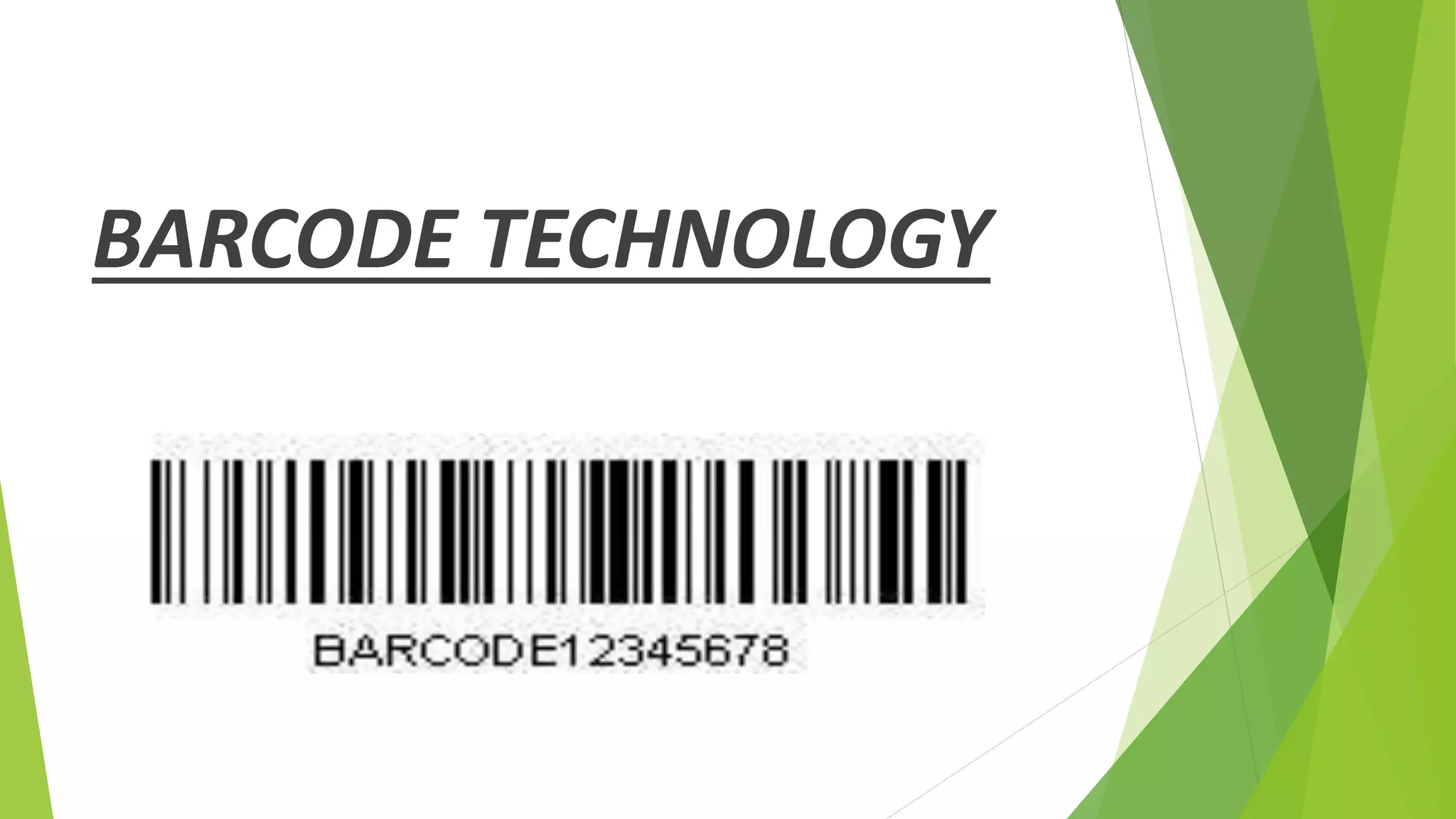
BARCODE TECHNOLOGY
Key Points :
• What is barcode?
• Why use barcodes?
• Barcode types
• Application of barcode
• Evaluation of barcode
• Barcode Scanner
• Advantages
• Disadvantages
What is barcode?
 It is an automatic identification technology
 Bar code is a predefined format of dark bars and white
spaces
 Structured to contain a specific piece of information
 It allows real-time data to be collected accurately and
rapidly
 Combination of barcode technology with computer and
application software improves performance,
productivity and profitability
Why use barcodes?
 As far back as the 1960s, barcodes were used in
industrial work environments. Some of the early
implementations of barcodes included the ability
identify rail,road,cars,etc……
 In the early 1970s, common barcodes started appearing
on grocery shelves. To automate the process of
identifying grocery items, UPC barcodes were placed on
products.
 Today, barcodes are just about everywhere and are
used for identification in almost all types of business.
 When barcodes are used in the business process,
procedures are automated to increase productivity and
reduce human error.
 Whenever there is a need to accurately identify or track
something, bar-coding should be used. For example, in
a data entry work environment, workers may be
required to enter an enormous amount of data into a
customer database system.
 Instead of manually typing a customer identification
number into a database, if the information is contained
in a barcode, a data entry operator may scan it in. This
would increase automation and reduce human error.
Barcode Types
 The type of barcode to use for a particular situation
depends upon:
1. The use.
2. The data encoded in the barcode.
3. How the barcode will be printed.
There are two types of barcodes:
1. Linear barcodes
2. 2D barcodes.
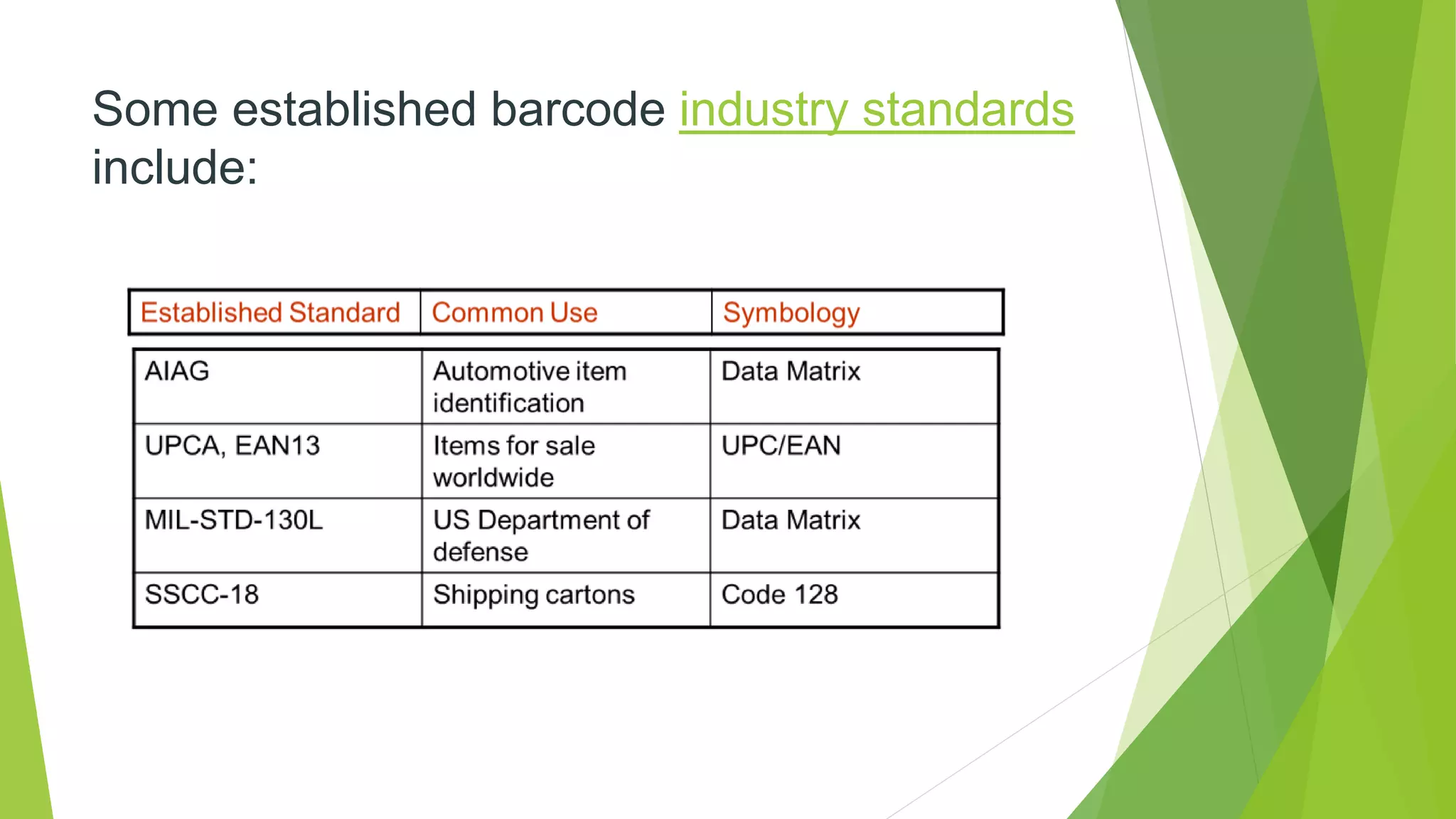
Some established barcode industry standards
include:
Application of Barcode
 FOR LABORATORIES
 BCA provides labels, printers and bar code scanners specifically for the
LABORATORY environment. Our labels, suitable for all printers and most
software packages, can withstand moisture, refrigeration and a variety of
solutions. The adhesive can also be glove free.
Application of Barcode
 FOR LIBRARIES
 BCA provides consultation, equipment from a variety of manufacturers and 25
years experience in the data collection market. We provide the solutions to
your situation, not an off the shelf packaged solution.
Application of Barcode
 FOR INDUSTRY
 BCA provides consultation, equipment from a variety of manufacturers and 25
years experience in the data collection market. We provide the solutions to
your situation, not an off the shelf packaged solution.
Evaluation of Barcode
 One of the most common tools for reading barcodes is the hand
held barcode scanner. All of the barcode scanners recommended
and sold by ID Automation have built-in decoders that can read
several different bar code types.
 Most of the scanners sold by ID Automation receive their power
from the PC keyboard or USB port so no external power supply is
required. When a barcode is scanned, the data is sent to the PC
as if it was typed using a keyboard.
 Not all scanners can scan barcodes that are printed at very small
x dimensions (the x dimension is the width of the narrow bar in
the code), so it is advisable to check the barcode scanner manual
to make sure the scanner can read the small x dimension
barcodes. Also, make sure the printer can accurately reproduce
small x dimension barcodes.
 The ID Automation Plug ‘n Play Barcode Scanner will scan linear
bar codes consistently at 4 to 32 mils in size and up to 4.2" in
width from a distance of 4" to 8" at 200 scans per second and
can be programmed to scan function keys from barcodes.
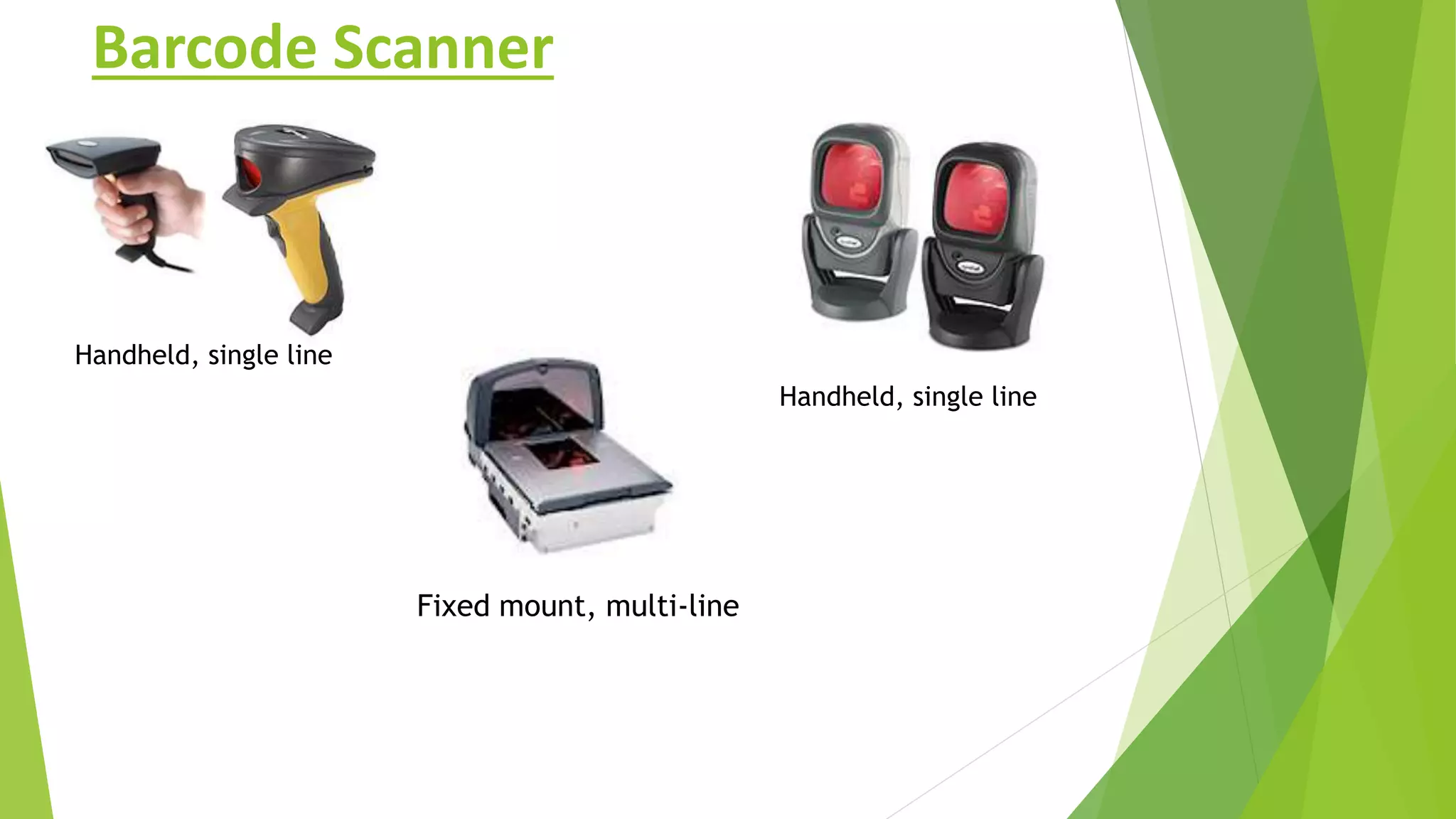
Barcode Scanner
Handheld, single line
Fixed mount, multi-line
Advantages
 REPRESENT UNIQUE IDENTITY OF A
PRODUCT
 ACCURACY OF DATA INPUT (ERROR
FREE)
 LABOUR SAVINGS BY AVOIDING
MANUAL SYSTEM
 MORE ACCURATE DESPATCH
 COST EFFICIENT
 REAL TIME DATA COLLECTION
 MEASUREMENT OF WORK IN
PROGRESS THROUGHOUT THE
FACTORY
 RAPID ACCESS TO TOTAL PRODUCTION
COSTS
Disadvantages
 System Failure may cost more delays.
 Scratched or crumpled barcodes may cause problems
 Data must be coded in the barcode
 In laser scanning, durability and cost are the two
disadvantages
Thank You!

Barcode technology

  • 1.
    Name : VadadoriyaSubhash S. En No. : 120590116011 Sem. : 5th Branch : Information & Technology
  • 2.
  • 3.
    Key Points : •What is barcode? • Why use barcodes? • Barcode types • Application of barcode • Evaluation of barcode • Barcode Scanner • Advantages • Disadvantages
  • 4.
    What is barcode? It is an automatic identification technology  Bar code is a predefined format of dark bars and white spaces  Structured to contain a specific piece of information  It allows real-time data to be collected accurately and rapidly  Combination of barcode technology with computer and application software improves performance, productivity and profitability
  • 5.
    Why use barcodes? As far back as the 1960s, barcodes were used in industrial work environments. Some of the early implementations of barcodes included the ability identify rail,road,cars,etc……  In the early 1970s, common barcodes started appearing on grocery shelves. To automate the process of identifying grocery items, UPC barcodes were placed on products.  Today, barcodes are just about everywhere and are used for identification in almost all types of business.
  • 6.
     When barcodesare used in the business process, procedures are automated to increase productivity and reduce human error.  Whenever there is a need to accurately identify or track something, bar-coding should be used. For example, in a data entry work environment, workers may be required to enter an enormous amount of data into a customer database system.  Instead of manually typing a customer identification number into a database, if the information is contained in a barcode, a data entry operator may scan it in. This would increase automation and reduce human error.
  • 7.
    Barcode Types  Thetype of barcode to use for a particular situation depends upon: 1. The use. 2. The data encoded in the barcode. 3. How the barcode will be printed.
  • 8.
    There are twotypes of barcodes: 1. Linear barcodes 2. 2D barcodes.
  • 9.
    Some established barcodeindustry standards include:
  • 10.
    Application of Barcode FOR LABORATORIES  BCA provides labels, printers and bar code scanners specifically for the LABORATORY environment. Our labels, suitable for all printers and most software packages, can withstand moisture, refrigeration and a variety of solutions. The adhesive can also be glove free.
  • 11.
    Application of Barcode FOR LIBRARIES  BCA provides consultation, equipment from a variety of manufacturers and 25 years experience in the data collection market. We provide the solutions to your situation, not an off the shelf packaged solution.
  • 12.
    Application of Barcode FOR INDUSTRY  BCA provides consultation, equipment from a variety of manufacturers and 25 years experience in the data collection market. We provide the solutions to your situation, not an off the shelf packaged solution.
  • 13.
    Evaluation of Barcode One of the most common tools for reading barcodes is the hand held barcode scanner. All of the barcode scanners recommended and sold by ID Automation have built-in decoders that can read several different bar code types.  Most of the scanners sold by ID Automation receive their power from the PC keyboard or USB port so no external power supply is required. When a barcode is scanned, the data is sent to the PC as if it was typed using a keyboard.
  • 14.
     Not allscanners can scan barcodes that are printed at very small x dimensions (the x dimension is the width of the narrow bar in the code), so it is advisable to check the barcode scanner manual to make sure the scanner can read the small x dimension barcodes. Also, make sure the printer can accurately reproduce small x dimension barcodes.  The ID Automation Plug ‘n Play Barcode Scanner will scan linear bar codes consistently at 4 to 32 mils in size and up to 4.2" in width from a distance of 4" to 8" at 200 scans per second and can be programmed to scan function keys from barcodes.
  • 15.
    Barcode Scanner Handheld, singleline Handheld, single line Fixed mount, multi-line
  • 16.
    Advantages  REPRESENT UNIQUEIDENTITY OF A PRODUCT  ACCURACY OF DATA INPUT (ERROR FREE)  LABOUR SAVINGS BY AVOIDING MANUAL SYSTEM  MORE ACCURATE DESPATCH  COST EFFICIENT  REAL TIME DATA COLLECTION  MEASUREMENT OF WORK IN PROGRESS THROUGHOUT THE FACTORY  RAPID ACCESS TO TOTAL PRODUCTION COSTS
  • 17.
    Disadvantages  System Failuremay cost more delays.  Scratched or crumpled barcodes may cause problems  Data must be coded in the barcode  In laser scanning, durability and cost are the two disadvantages
  • 18.