Seed technology
Represent By :
Newar Hishyar
Aedin Rebar
Araz kindl
Radio-Frequency Identification
Supervised By :
Dr.sana
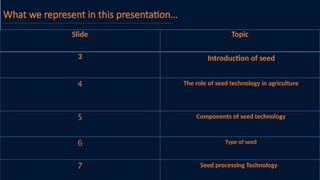
What we represent in this presentation…
Slide Topic
3 Introduction of seed
4 The role of seed technology in agriculture
5 Components of seed technology
6 Type of seed
7 Seed processing Technology
Introduction of Seed
Definition of Seed Technology ?
Definition of Seed Technology: Seed technology
refers to the science of producing, processing,
testing, and preserving seeds for improved
agricultural productivity.
Important of Seed
● Seeds are the foundation of agricultural systems;
advancements in seed technology enable higher
yields, better quality crops, and more sustainable
farming practices.
The role of Seed Technology in agriculture
● Historical significance:
Early cultivation practices relied on traditional seed saving,
but modern agriculture benefits from advanced seed
technologies.
● Key Benefits:
Improved crop resilience, higher productivity, reduced
resource use, and better adaptation to change climates.
Count….
1. RFID Tag
RFID tags are small devices that consist of an electronic microchip embedded inside and an
antenna. The microchip has the unique identification number of the RFID tag.
Types of Tags
Passive Tags: Does not have a power source, uses power from the reader to
operate.
Battery-Assisted Passive Tags: The logic circuit chip uses battery power. Need RF
signals from the reader to activate and function.
Active Tags: Uses a power source like a battery and does not require power from the
source/reader.
2. Antenna
RFID antennas are designed to operate at a specific frequency for each application in which it
operates. These antennas are often mounted on the RFID reader and easily accessible for tags
to tap on it.
Count….
In some handheld devices,
the antenna is often attached to the device.
The size and shape of the antenna depend on the application and the system’s
operating frequency.
3. RFID Reader
The RFID reader is one of the significant hardware components in the RFID system, which
reads information from the RFID devices/tags and connects to the network to transfer the
information to the database.
Count….
Frequency Band Range Data Rate
LF: 120–150 kHz 10 cm Low
HF: 13.56 MHz 0.1–1 m Low to moderate
UHF: 433 MHz 1–100 m Moderate
UHF: 865–868 MHz 1–120 m Moderate to high
Specification of RFID Reader
Frequency: Operating frequency is one of the specifications of the RFID reader.
4. Software
RFID technology uses specific software depending on service providers. This software
controls the RFID reader, initiates a scan, retrieves information from the tags, and stores the
information on a local computer or sends it to the cloud storage.
RFID tags can be erased and re-used using control software.
Count….
How does RFID work?
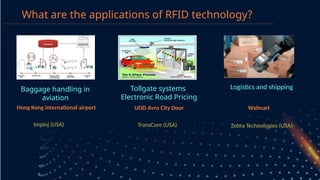
Logistics and shipping
What are the applications of RFID technology?
Baggage handling in
aviation
Tollgate systems
Electronic Road Pricing
Hong Kong international airport UOD Avro City Door Walmart
TransCore (USA) Zebra Technologies (USA)
Impinj (USA)
Count…
Medical and hospital
Access control
Nedap (Netherlands)
HID Global (USA) Terso Solutions (USA)
Stanley Healthcare (USA)
Mayo Clinic (USA)
Advantages of RFID technology
🔹 RFID allows instant scanning without the need for direct line-of-sight (unlike barcodes).
🔹 Multiple tags can be scanned simultaneously, increasing efficiency.
Improved Security & Authentication
2️
2️
⃣
🔹 RFID tags can store encrypted data, making them harder to duplicate.
🔹 Used for access control, anti-theft, and authentication in businesses and security systems.
3 ️
3️⃣Better Inventory & Asset Tracking
🔹 Real-time tracking of inventory, equipment, or people in warehouses, hospitals, or offices.
🔹 Reduces manual errors and improves stock management.
Durability & Long Lifespan
4️
⃣
🔹 Unlike barcodes, RFID tags are waterproof, dustproof, and resistant to wear & tear.
🔹 Some RFID tags (like passive ones) can last 10+ years without needing power..
Enhances Automation & Reduces Costs
5️
5️
⃣
🔹 Used in automated checkouts, employee attendance systems, and logistics.
🔹 Saves labor costs by reducing manual tracking and scanning.
Fast & Automatic Data Capture
1️
⃣
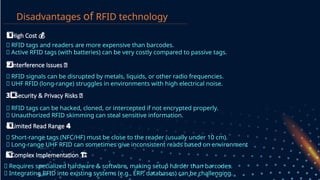
Disadvantages of RFID technology
🔹 RFID tags and readers are more expensive than barcodes.
🔹 Active RFID tags (with batteries) can be very costly compared to passive tags.
Interference Issues
2️
2️
⃣ 📡
🔹 RFID signals can be disrupted by metals, liquids, or other radio frequencies.
🔹 UHF RFID (long-range) struggles in environments with high electrical noise.
Security & Privacy Risks 🔓
3 ️
⃣
🔹 RFID tags can be hacked, cloned, or intercepted if not encrypted properly.
🔹 Unauthorized RFID skimming can steal sensitive information.
Limited Read Range 4️
4️
⃣
🔹 Short-range tags (NFC/HF) must be close to the reader (usually under 10 cm).
🔹 Long-range UHF RFID can sometimes give inconsistent reads based on environment.
Complex Implementation
5️
5️
⃣ ️
🏗️
🔹 Requires specialized hardware & software, making setup harder than barcodes.
🔹 Integrating RFID into existing systems (e.g., ERP, databases) can be challenging.
High Cost
1️
1️
⃣ 💰
Parameter Barcode RFID
Technology Optical scanning. Wireless (radio waves).
Read Range Few centimeters (line of sight). Passive: Up to 12 m. Active: Up to 100 m.
Data Storage Low (few characters). Passive: Up to 8 KB. Active: Larger.
Power Source None (passive). Passive: None. Active: Battery.
Line of Sight Required. Not required.
Cost Very low. High.
Durability Low (easily damaged). High.
Security Low. Moderate to high.
Applications Retail, inventory. Supply chain, asset tracking.
differences between Barcode, and RFID:
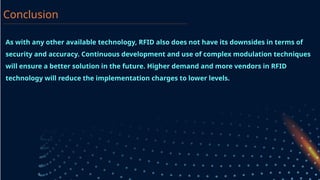
As with any other available technology, RFID also does not have its downsides in terms of
security and accuracy. Continuous development and use of complex modulation techniques
will ensure a better solution in the future. Higher demand and more vendors in RFID
technology will reduce the implementation charges to lower levels.
Conclusion
Any Question…?
Thank you…

New Microsoft PowerPoint Presentation.pptx

  • 1.
    Seed technology Represent By: Newar Hishyar Aedin Rebar Araz kindl Radio-Frequency Identification Supervised By : Dr.sana
  • 2.
    What we representin this presentation… Slide Topic 3 Introduction of seed 4 The role of seed technology in agriculture 5 Components of seed technology 6 Type of seed 7 Seed processing Technology
  • 3.
    Introduction of Seed Definitionof Seed Technology ? Definition of Seed Technology: Seed technology refers to the science of producing, processing, testing, and preserving seeds for improved agricultural productivity. Important of Seed ● Seeds are the foundation of agricultural systems; advancements in seed technology enable higher yields, better quality crops, and more sustainable farming practices.
  • 4.
    The role ofSeed Technology in agriculture ● Historical significance: Early cultivation practices relied on traditional seed saving, but modern agriculture benefits from advanced seed technologies. ● Key Benefits: Improved crop resilience, higher productivity, reduced resource use, and better adaptation to change climates.
  • 5.
    Count…. 1. RFID Tag RFIDtags are small devices that consist of an electronic microchip embedded inside and an antenna. The microchip has the unique identification number of the RFID tag. Types of Tags Passive Tags: Does not have a power source, uses power from the reader to operate. Battery-Assisted Passive Tags: The logic circuit chip uses battery power. Need RF signals from the reader to activate and function. Active Tags: Uses a power source like a battery and does not require power from the source/reader.
  • 6.
    2. Antenna RFID antennasare designed to operate at a specific frequency for each application in which it operates. These antennas are often mounted on the RFID reader and easily accessible for tags to tap on it. Count…. In some handheld devices, the antenna is often attached to the device. The size and shape of the antenna depend on the application and the system’s operating frequency.
  • 7.
    3. RFID Reader TheRFID reader is one of the significant hardware components in the RFID system, which reads information from the RFID devices/tags and connects to the network to transfer the information to the database. Count…. Frequency Band Range Data Rate LF: 120–150 kHz 10 cm Low HF: 13.56 MHz 0.1–1 m Low to moderate UHF: 433 MHz 1–100 m Moderate UHF: 865–868 MHz 1–120 m Moderate to high Specification of RFID Reader Frequency: Operating frequency is one of the specifications of the RFID reader.
  • 8.
    4. Software RFID technologyuses specific software depending on service providers. This software controls the RFID reader, initiates a scan, retrieves information from the tags, and stores the information on a local computer or sends it to the cloud storage. RFID tags can be erased and re-used using control software. Count…. How does RFID work?
  • 9.
    Logistics and shipping Whatare the applications of RFID technology? Baggage handling in aviation Tollgate systems Electronic Road Pricing Hong Kong international airport UOD Avro City Door Walmart TransCore (USA) Zebra Technologies (USA) Impinj (USA)
  • 10.
    Count… Medical and hospital Accesscontrol Nedap (Netherlands) HID Global (USA) Terso Solutions (USA) Stanley Healthcare (USA) Mayo Clinic (USA)
  • 11.
    Advantages of RFIDtechnology 🔹 RFID allows instant scanning without the need for direct line-of-sight (unlike barcodes). 🔹 Multiple tags can be scanned simultaneously, increasing efficiency. Improved Security & Authentication 2️ 2️ ⃣ 🔹 RFID tags can store encrypted data, making them harder to duplicate. 🔹 Used for access control, anti-theft, and authentication in businesses and security systems. 3 ️ 3️⃣Better Inventory & Asset Tracking 🔹 Real-time tracking of inventory, equipment, or people in warehouses, hospitals, or offices. 🔹 Reduces manual errors and improves stock management. Durability & Long Lifespan 4️ ⃣ 🔹 Unlike barcodes, RFID tags are waterproof, dustproof, and resistant to wear & tear. 🔹 Some RFID tags (like passive ones) can last 10+ years without needing power.. Enhances Automation & Reduces Costs 5️ 5️ ⃣ 🔹 Used in automated checkouts, employee attendance systems, and logistics. 🔹 Saves labor costs by reducing manual tracking and scanning. Fast & Automatic Data Capture 1️ ⃣
  • 12.
    Disadvantages of RFIDtechnology 🔹 RFID tags and readers are more expensive than barcodes. 🔹 Active RFID tags (with batteries) can be very costly compared to passive tags. Interference Issues 2️ 2️ ⃣ 📡 🔹 RFID signals can be disrupted by metals, liquids, or other radio frequencies. 🔹 UHF RFID (long-range) struggles in environments with high electrical noise. Security & Privacy Risks 🔓 3 ️ ⃣ 🔹 RFID tags can be hacked, cloned, or intercepted if not encrypted properly. 🔹 Unauthorized RFID skimming can steal sensitive information. Limited Read Range 4️ 4️ ⃣ 🔹 Short-range tags (NFC/HF) must be close to the reader (usually under 10 cm). 🔹 Long-range UHF RFID can sometimes give inconsistent reads based on environment. Complex Implementation 5️ 5️ ⃣ ️ 🏗️ 🔹 Requires specialized hardware & software, making setup harder than barcodes. 🔹 Integrating RFID into existing systems (e.g., ERP, databases) can be challenging. High Cost 1️ 1️ ⃣ 💰
  • 13.
    Parameter Barcode RFID TechnologyOptical scanning. Wireless (radio waves). Read Range Few centimeters (line of sight). Passive: Up to 12 m. Active: Up to 100 m. Data Storage Low (few characters). Passive: Up to 8 KB. Active: Larger. Power Source None (passive). Passive: None. Active: Battery. Line of Sight Required. Not required. Cost Very low. High. Durability Low (easily damaged). High. Security Low. Moderate to high. Applications Retail, inventory. Supply chain, asset tracking. differences between Barcode, and RFID:
  • 15.
    As with anyother available technology, RFID also does not have its downsides in terms of security and accuracy. Continuous development and use of complex modulation techniques will ensure a better solution in the future. Higher demand and more vendors in RFID technology will reduce the implementation charges to lower levels. Conclusion
  • 16.
  • 17.