Presentation by
                                     Existco

Barcode & RFiD in Supply Chain
Putting the Pieces Together
                 13th April 2009, Perth, Australia
Who am I – Eli Abitbol
• Director of Existco
• B.Eng (Hon) Electronic Systems
• Involved In Barcoding, RFiD, POS, Mobility in the Past 15 Years.

Who is Existco
• Small Business, Specialising in Barcoding, RFiD, Point of Sales, Wireless
  and Mobility Solutions
• Microsoft Certified Partner
• GS1 Alliance Partner
• Various Vendors
  Partner
Agenda
         Barcode

         RFiD

         Supply Chain

         Summary

         Questions
Add text title

Barcodes – What is It ?
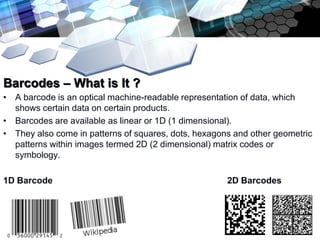
• A barcode is an optical machine-readable representation of data, which
  shows certain data on certain products.
• Barcodes are available as linear or 1D (1 dimensional).
• They also come in patterns of squares, dots, hexagons and other geometric
  patterns within images termed 2D (2 dimensional) matrix codes or
  symbology.

1D Barcode                                            2D Barcodes
Add text title

Barcodes – Who is GS1 ?
• GS1 is an international not-for-profit association dedicated to the
  development and implementation of global standards and solutions to
  improve the efficiency and visibility of supply and demand chains globally
  and across multiple sectors. The GS1 System of standards is the most
  widely-used supply-chain standards system in the world.
• GS1's main activity is the development of the GS1 System, a series of
  standards designed to improve supply-chain management. The GS1 System
  is composed of four key standards: Barcodes (used to automatically identify
  things), eCom (electronic business messaging standards allowing automatic
  electronic transmission of data), GDSN (Global Data Synchronisation
  standards which allow business partners to have consistent item data in
  their systems at the same time) and EPCGlobal (which uses RFID
  technology to immediately track an item).
Add text title

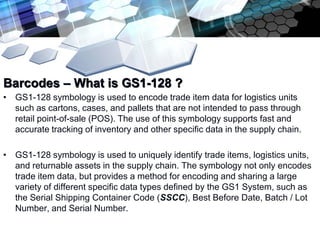
Barcodes – What is GS1-128 ?
• GS1-128 symbology is used to encode trade item data for logistics units
  such as cartons, cases, and pallets that are not intended to pass through
  retail point-of-sale (POS). The use of this symbology supports fast and
  accurate tracking of inventory and other specific data in the supply chain.

• GS1-128 symbology is used to uniquely identify trade items, logistics units,
  and returnable assets in the supply chain. The symbology not only encodes
  trade item data, but provides a method for encoding and sharing a large
  variety of different specific data types defined by the GS1 System, such as
  the Serial Shipping Container Code (SSCC), Best Before Date, Batch / Lot
  Number, and Serial Number.
Add text title

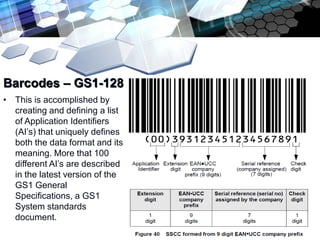
Barcodes – GS1-128
• This is accomplished by
  creating and defining a list
  of Application Identifiers
  (AI’s) that uniquely defines
  both the data format and its
  meaning. More that 100
  different AI’s are described
  in the latest version of the
  GS1 General
  Specifications, a GS1
  System standards
  document.
Add text title

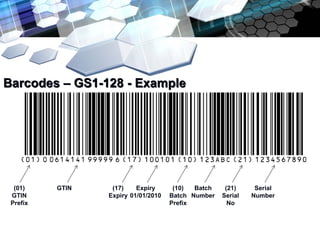
Barcodes – GS1-128 - Example


  (01)    GTIN    (17)    Expiry      (10)  Batch    (21)     Serial
 GTIN            Expiry 01/01/2010   Batch Number   Serial   Number
 Prefix                              Prefix           No
Add text title

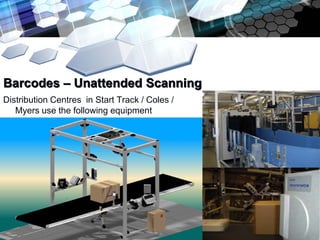
Barcodes – Unattended Scanning
Distribution Centres in Start Track / Coles /
   Myers use the following equipment
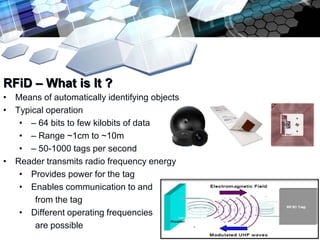
RFiD – What is It ?
• Means of automatically identifying objects
• Typical operation
   • – 64 bits to few kilobits of data
   • – Range ~1cm to ~10m
   • – 50-1000 tags per second
• Reader transmits radio frequency energy
   • Provides power for the tag
   • Enables communication to and
       from the tag
   • Different operating frequencies
       are possible
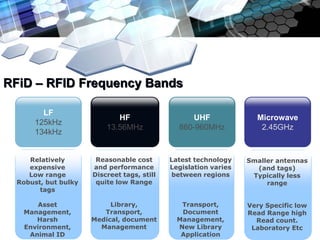
RFiD – RFID Frequency Bands

         LF
                             HF                    UHF              Microwave
       125kHz
                          13.56MHz             860-960MHz            2.45GHz
       134kHz


     Relatively        Reasonable cost       Latest technology    Smaller antennas
     expensive        and performance        Legislation varies     (and tags)
     Low range        Discreet tags, still   between regions       Typically less
  Robust, but bulky    quite low Range                                 range
        tags

       Asset               Library,             Transport,        Very Specific low
   Management,           Transport,             Document          Read Range high
      Harsh           Medical, document        Management,          Read count.
   Environment,         Management             New Library         Laboratory Etc
    Animal ID                                   Application
RFiD – UHF Band Legislation
• Most Promising RFiD Band – Suitable for Supply chain, but there are
  International considerations.
• Need to consider performance implications
• Numerous conflicts still to be resolved
RFiD – Power
• Systems discussed so far are passive
   • No battery in tag; all power comes
     from reader Carrier RF Wave
• Possible to build a battery into the tag
   • Increased complexity,                    Passive     Cheapest, no battery
     size and cost
                                           Semi-passive Much more range
   • Improved performance (range)
                                              (battery            and
     & functionality
                                             assisted)         reliability
                                           Active (battery High performance,
                                             powered)        sensors, cost!
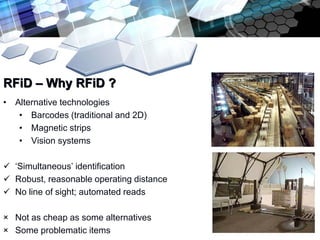
RFiD – Why RFiD ?
• Alternative technologies
   • Barcodes (traditional and 2D)
   • Magnetic strips
   • Vision systems

 ‘Simultaneous’ identification
 Robust, reasonable operating distance
 No line of sight; automated reads

× Not as cheap as some alternatives
× Some problematic items
RFiD – EPC – Electronic Product Code
• UPC as defined by GS1
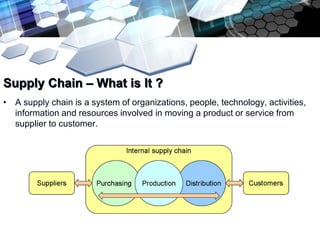
Supply Chain – What is It ?
• A supply chain is a system of organizations, people, technology, activities,
  information and resources involved in moving a product or service from
  supplier to customer.
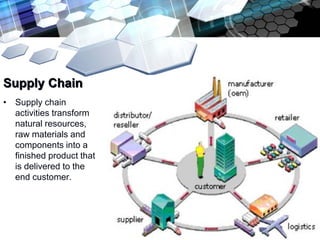
Supply Chain
• Supply chain
  activities transform
  natural resources,
  raw materials and
  components into a
  finished product that
  is delivered to the
  end customer.
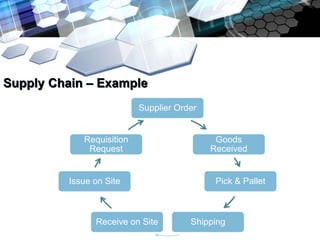
Supply Chain – Example
                           Supplier Order


             Requisition                     Goods
              Request                       Received


          Issue on Site                      Pick & Pallet


                Receive on Site        Shipping
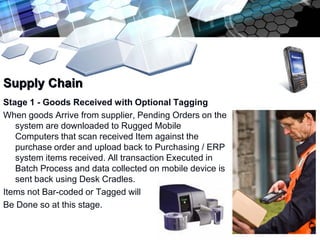
Supply Chain
Stage 1 - Goods Received with Optional Tagging
When goods Arrive from supplier, Pending Orders on the
   system are downloaded to Rugged Mobile
   Computers that scan received Item against the
   purchase order and upload back to Purchasing / ERP
   system items received. All transaction Executed in
   Batch Process and data collected on mobile device is
   sent back using Desk Cradles.
Items not Bar-coded or Tagged will
Be Done so at this stage.
Supply Chain
Stage 2 – Picking and Palletising
Replenish Request from sites are then picked from
    warehouse, and at the same time palletising.
Pallets include a mixture of Products, but Each Pallet
    Label or Tag associated all items on the pallet.
All operations executed using Rugged Mobile
    Computers and uploaded to ERP system.
Supply Chain
Stage 3 – Shipping
Pallets are then associated with a container.
Each container has an RFiD Tag.
Containers are then shipped by Truck, Ship etc with a
   destination associated with.
Supply Chain
Stage 4 – Received on Site
Each container as arrives on site is scanned to indicate
   received on site.
Each container as unpacked and opened is scanned
   and pallet unpacked also associated with storage
   location.
Supply Chain
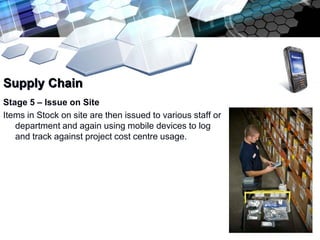
Stage 5 – Issue on Site
Items in Stock on site are then issued to various staff or
   department and again using mobile devices to log
   and track against project cost centre usage.
Supply Chain
Stage 6 – Requisition Request
Remote sites are raising requisition requests to
   replenish required inventory. Again this can be done
   using rugged mobile computers.
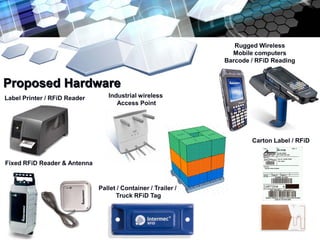
Rugged Wireless
                                                                 Mobile computers
                                                               Barcode / RFiD Reading


Proposed Hardware
Label Printer / RFiD Reader      Industrial wireless
                                    Access Point


                                                                       Carton Label / RFiD


Fixed RFiD Reader & Antenna


                              Pallet / Container / Trailer /
                                    Truck RFiD Tag
Summary
• Barcoding , RFiD and Mobility Technologies are already available, and
  proven. Recommend to use GS1-128 Barcodes and GS1 EPCGlobal RFiD.
• Industry standards are in place and managed by GS1 globally.
• Recommend to use both Barcoding and RFiD in final solution to Be more
  cost effective. Barcoding for Lowest SKU and Cartons, and RFiD for Pallet /
  Container / Trailer / Vehicles etc.
• Work closely with suppliers so they provide inventory already bar-coded, to
  reduce Running costs (Prevent Labelling on goods Received).
• Select appropriate Hardware and software to fulfil Chevrons requirements.
  Intermec is highly recommended brand By Existco.
• Plant and test with small scale pilot to prove processes re working as
  required.
Extra Documentation
•   Existco Brochure www.existco.com.au
•   Intermec Product Range
•   Intermec Case Studies
•   GS1 Australia – www.gs1au.org
•   SSCC Label formats
Questions
www.existco.com.au

Barcode & RFiD in Supply Chain

  • 1.
    Presentation by Existco Barcode & RFiD in Supply Chain Putting the Pieces Together 13th April 2009, Perth, Australia
  • 2.
    Who am I– Eli Abitbol • Director of Existco • B.Eng (Hon) Electronic Systems • Involved In Barcoding, RFiD, POS, Mobility in the Past 15 Years. Who is Existco • Small Business, Specialising in Barcoding, RFiD, Point of Sales, Wireless and Mobility Solutions • Microsoft Certified Partner • GS1 Alliance Partner • Various Vendors Partner
  • 3.
    Agenda Barcode RFiD Supply Chain Summary Questions
  • 4.
    Add text title Barcodes– What is It ? • A barcode is an optical machine-readable representation of data, which shows certain data on certain products. • Barcodes are available as linear or 1D (1 dimensional). • They also come in patterns of squares, dots, hexagons and other geometric patterns within images termed 2D (2 dimensional) matrix codes or symbology. 1D Barcode 2D Barcodes
  • 5.
    Add text title Barcodes– Who is GS1 ? • GS1 is an international not-for-profit association dedicated to the development and implementation of global standards and solutions to improve the efficiency and visibility of supply and demand chains globally and across multiple sectors. The GS1 System of standards is the most widely-used supply-chain standards system in the world. • GS1's main activity is the development of the GS1 System, a series of standards designed to improve supply-chain management. The GS1 System is composed of four key standards: Barcodes (used to automatically identify things), eCom (electronic business messaging standards allowing automatic electronic transmission of data), GDSN (Global Data Synchronisation standards which allow business partners to have consistent item data in their systems at the same time) and EPCGlobal (which uses RFID technology to immediately track an item).
  • 6.
    Add text title Barcodes– What is GS1-128 ? • GS1-128 symbology is used to encode trade item data for logistics units such as cartons, cases, and pallets that are not intended to pass through retail point-of-sale (POS). The use of this symbology supports fast and accurate tracking of inventory and other specific data in the supply chain. • GS1-128 symbology is used to uniquely identify trade items, logistics units, and returnable assets in the supply chain. The symbology not only encodes trade item data, but provides a method for encoding and sharing a large variety of different specific data types defined by the GS1 System, such as the Serial Shipping Container Code (SSCC), Best Before Date, Batch / Lot Number, and Serial Number.
  • 7.
    Add text title Barcodes– GS1-128 • This is accomplished by creating and defining a list of Application Identifiers (AI’s) that uniquely defines both the data format and its meaning. More that 100 different AI’s are described in the latest version of the GS1 General Specifications, a GS1 System standards document.
  • 8.
    Add text title Barcodes– GS1-128 - Example (01) GTIN (17) Expiry (10) Batch (21) Serial GTIN Expiry 01/01/2010 Batch Number Serial Number Prefix Prefix No
  • 9.
    Add text title Barcodes– Unattended Scanning Distribution Centres in Start Track / Coles / Myers use the following equipment
  • 10.
    RFiD – Whatis It ? • Means of automatically identifying objects • Typical operation • – 64 bits to few kilobits of data • – Range ~1cm to ~10m • – 50-1000 tags per second • Reader transmits radio frequency energy • Provides power for the tag • Enables communication to and from the tag • Different operating frequencies are possible
  • 11.
    RFiD – RFIDFrequency Bands LF HF UHF Microwave 125kHz 13.56MHz 860-960MHz 2.45GHz 134kHz Relatively Reasonable cost Latest technology Smaller antennas expensive and performance Legislation varies (and tags) Low range Discreet tags, still between regions Typically less Robust, but bulky quite low Range range tags Asset Library, Transport, Very Specific low Management, Transport, Document Read Range high Harsh Medical, document Management, Read count. Environment, Management New Library Laboratory Etc Animal ID Application
  • 12.
    RFiD – UHFBand Legislation • Most Promising RFiD Band – Suitable for Supply chain, but there are International considerations. • Need to consider performance implications • Numerous conflicts still to be resolved
  • 13.
    RFiD – Power •Systems discussed so far are passive • No battery in tag; all power comes from reader Carrier RF Wave • Possible to build a battery into the tag • Increased complexity, Passive Cheapest, no battery size and cost Semi-passive Much more range • Improved performance (range) (battery and & functionality assisted) reliability Active (battery High performance, powered) sensors, cost!
  • 14.
    RFiD – WhyRFiD ? • Alternative technologies • Barcodes (traditional and 2D) • Magnetic strips • Vision systems  ‘Simultaneous’ identification  Robust, reasonable operating distance  No line of sight; automated reads × Not as cheap as some alternatives × Some problematic items
  • 15.
    RFiD – EPC– Electronic Product Code • UPC as defined by GS1
  • 16.
    Supply Chain –What is It ? • A supply chain is a system of organizations, people, technology, activities, information and resources involved in moving a product or service from supplier to customer.
  • 17.
    Supply Chain • Supplychain activities transform natural resources, raw materials and components into a finished product that is delivered to the end customer.
  • 18.
    Supply Chain –Example Supplier Order Requisition Goods Request Received Issue on Site Pick & Pallet Receive on Site Shipping
  • 19.
    Supply Chain Stage 1- Goods Received with Optional Tagging When goods Arrive from supplier, Pending Orders on the system are downloaded to Rugged Mobile Computers that scan received Item against the purchase order and upload back to Purchasing / ERP system items received. All transaction Executed in Batch Process and data collected on mobile device is sent back using Desk Cradles. Items not Bar-coded or Tagged will Be Done so at this stage.
  • 20.
    Supply Chain Stage 2– Picking and Palletising Replenish Request from sites are then picked from warehouse, and at the same time palletising. Pallets include a mixture of Products, but Each Pallet Label or Tag associated all items on the pallet. All operations executed using Rugged Mobile Computers and uploaded to ERP system.
  • 21.
    Supply Chain Stage 3– Shipping Pallets are then associated with a container. Each container has an RFiD Tag. Containers are then shipped by Truck, Ship etc with a destination associated with.
  • 22.
    Supply Chain Stage 4– Received on Site Each container as arrives on site is scanned to indicate received on site. Each container as unpacked and opened is scanned and pallet unpacked also associated with storage location.
  • 23.
    Supply Chain Stage 5– Issue on Site Items in Stock on site are then issued to various staff or department and again using mobile devices to log and track against project cost centre usage.
  • 24.
    Supply Chain Stage 6– Requisition Request Remote sites are raising requisition requests to replenish required inventory. Again this can be done using rugged mobile computers.
  • 25.
    Rugged Wireless Mobile computers Barcode / RFiD Reading Proposed Hardware Label Printer / RFiD Reader Industrial wireless Access Point Carton Label / RFiD Fixed RFiD Reader & Antenna Pallet / Container / Trailer / Truck RFiD Tag
  • 26.
    Summary • Barcoding ,RFiD and Mobility Technologies are already available, and proven. Recommend to use GS1-128 Barcodes and GS1 EPCGlobal RFiD. • Industry standards are in place and managed by GS1 globally. • Recommend to use both Barcoding and RFiD in final solution to Be more cost effective. Barcoding for Lowest SKU and Cartons, and RFiD for Pallet / Container / Trailer / Vehicles etc. • Work closely with suppliers so they provide inventory already bar-coded, to reduce Running costs (Prevent Labelling on goods Received). • Select appropriate Hardware and software to fulfil Chevrons requirements. Intermec is highly recommended brand By Existco. • Plant and test with small scale pilot to prove processes re working as required.
  • 27.
    Extra Documentation • Existco Brochure www.existco.com.au • Intermec Product Range • Intermec Case Studies • GS1 Australia – www.gs1au.org • SSCC Label formats
  • 28.
  • 29.