Traceability in Manufacturing
Manufacturers today are facing ever increasing
competitive pressure. Process visibility, customer
satisfaction and project compliance are pushing many
manufacturers to look at traceability as a long-term
strategy. Manufacturers have discovered that
implementing a traceability program is a proven method
to meet their strategic goals.
Manufacturers utilize traceability to make improvements
in the following areas:
1. Comply with regulatory and quality standards
2. Improve customer safety, customer satisfaction, and
profit margin
3. Manage product quality and reduce the cost of
nonconformance
4. Manage product recalls with real time corrective
action
Previously, vision identification technologies, such as
barcode and QR code were commonly used to monitor
and track processes, as well as store product
information during production. However, the need to
input more product data, manufacturers are moving
towards the use of a more sophisticated solution, radio
frequency identification (RFID), for enhanced visibility
throughout the chain of distribution.
Currently, two technologies rule the marketplace for
industrial track and trace: Barcode/2D matrix and
Radio Frequency Identification (RFID). Both are
engineered to deliver specific information about
products from the production line to distribution.
ISSUE: 01
Nov 2018
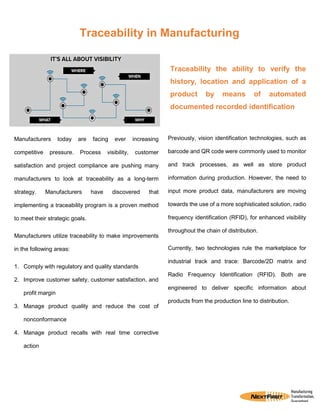
Traceability the ability to verify the
history, location and application of a
product by means of automated
documented recorded identification
Barcode
Barcode technology is an optical machine readable
representation of data that stores information about the
product. Originally, barcodes convey data by varying the
widths and spacings of parallel lines, presented in linear
or one-dimensional shapes. Barcodes have evolved to
include rectangles, dots, hexagons and other two-
dimensional shapes for increased application compatibility
and readability. However, users cannot add or make
changes to the information already written on to the
barcode during production process as barcodes are read
only.
Barcodes in industrial application face certain limitations.
For instance, to obtain readings and access data,
barcodes are needed to be in line-of sight with the reader,
which means a product must be properly aligned in order
for a barcode reader to identify the product by its code. In
manufacturing, time is money and achievement of ideal
alignment after several attempts will be time-consuming
process that will have impact on cycle time, operator
productivity and overall profitability.
Radio Frequency Identification (RFID)
RFID delivers a more sophisticated approach for track
and trace applications . RFID is capable of intelligent,
advanced data management that enhances product
visibility throughout the production as well as
distribution. Further, RFID enables users to both read
and write information on the tag—even at diverse
distances.
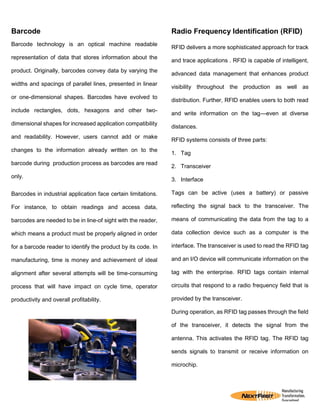
RFID systems consists of three parts:
1. Tag
2. Transceiver
3. Interface
Tags can be active (uses a battery) or passive
reflecting the signal back to the transceiver. The
means of communicating the data from the tag to a
data collection device such as a computer is the
interface. The transceiver is used to read the RFID tag
and an I/O device will communicate information on the
tag with the enterprise. RFID tags contain internal
circuits that respond to a radio frequency field that is
provided by the transceiver.
During operation, as RFID tag passes through the field
of the transceiver, it detects the signal from the
antenna. This activates the RFID tag. The RFID tag
sends signals to transmit or receive information on
microchip.
proprius. In consequat os quae nulla magna. Delenit
abdo esse quia, te huic. Ratis neque ymo, venio illum
pala damnum. Aptent nulla aliquip camur ut consequa.
Aptent. Adipiscing magna
jumentum velit iriure
obruo vel.Volutpat mos
at neque nulla lobortis
dignissim conventio, orqueo, acsi roto modo.
Feugait in obruo quae ingenium
tristique elit vel natu meus.
Tech Times Issue 00 Month Year
NextFirst Engineering Technologies Pvt Ltd.
#60/3, 1st Cross, GNC Industrial Area,
Thathaguni, Kanakapura Road, Bangalore –
560082
Contact us at:
General Info - info@nextfirst.com
Enquiries - bd@nextfirst.com
Sales - sales@nextfirst.com
Originally, this technology was developed as a method to
remotely gather data through tags or transceivers.
However, due to better data storage capacities,
manufacturers embed these tags to product during
production process. By gathering more data through tags,
RFID allows users to read and write data on to the tag.
Driving Industry 4.0: Data
RFID information can be used to ensure that the correct
labor, machine, tooling, and components are available
and ready to use at each processing step. This eliminates
paperwork, and reduces downtime. The process steps
could be controlled, modified, and even reconfigured in
real-time as inbound raw materials, parts and assemblies
move through manufacturing. However, barcode unlike
RFID is a read only and require human intervention. Basic
component information such as part number, serial
number, batch number, date of manufacturing and
material details can be stored in barcodes. RFID can
provide additional information streams to enable tighter
tracking, verification and validation of processes for
manufacturing operations that require high degree of
compliance with quality standards.

Traceability in Manufacturing

  • 1.
    Traceability in Manufacturing Manufacturerstoday are facing ever increasing competitive pressure. Process visibility, customer satisfaction and project compliance are pushing many manufacturers to look at traceability as a long-term strategy. Manufacturers have discovered that implementing a traceability program is a proven method to meet their strategic goals. Manufacturers utilize traceability to make improvements in the following areas: 1. Comply with regulatory and quality standards 2. Improve customer safety, customer satisfaction, and profit margin 3. Manage product quality and reduce the cost of nonconformance 4. Manage product recalls with real time corrective action Previously, vision identification technologies, such as barcode and QR code were commonly used to monitor and track processes, as well as store product information during production. However, the need to input more product data, manufacturers are moving towards the use of a more sophisticated solution, radio frequency identification (RFID), for enhanced visibility throughout the chain of distribution. Currently, two technologies rule the marketplace for industrial track and trace: Barcode/2D matrix and Radio Frequency Identification (RFID). Both are engineered to deliver specific information about products from the production line to distribution. ISSUE: 01 Nov 2018 Traceability the ability to verify the history, location and application of a product by means of automated documented recorded identification
  • 2.
    Barcode Barcode technology isan optical machine readable representation of data that stores information about the product. Originally, barcodes convey data by varying the widths and spacings of parallel lines, presented in linear or one-dimensional shapes. Barcodes have evolved to include rectangles, dots, hexagons and other two- dimensional shapes for increased application compatibility and readability. However, users cannot add or make changes to the information already written on to the barcode during production process as barcodes are read only. Barcodes in industrial application face certain limitations. For instance, to obtain readings and access data, barcodes are needed to be in line-of sight with the reader, which means a product must be properly aligned in order for a barcode reader to identify the product by its code. In manufacturing, time is money and achievement of ideal alignment after several attempts will be time-consuming process that will have impact on cycle time, operator productivity and overall profitability. Radio Frequency Identification (RFID) RFID delivers a more sophisticated approach for track and trace applications . RFID is capable of intelligent, advanced data management that enhances product visibility throughout the production as well as distribution. Further, RFID enables users to both read and write information on the tag—even at diverse distances. RFID systems consists of three parts: 1. Tag 2. Transceiver 3. Interface Tags can be active (uses a battery) or passive reflecting the signal back to the transceiver. The means of communicating the data from the tag to a data collection device such as a computer is the interface. The transceiver is used to read the RFID tag and an I/O device will communicate information on the tag with the enterprise. RFID tags contain internal circuits that respond to a radio frequency field that is provided by the transceiver. During operation, as RFID tag passes through the field of the transceiver, it detects the signal from the antenna. This activates the RFID tag. The RFID tag sends signals to transmit or receive information on microchip.
  • 3.
    proprius. In consequatos quae nulla magna. Delenit abdo esse quia, te huic. Ratis neque ymo, venio illum pala damnum. Aptent nulla aliquip camur ut consequa. Aptent. Adipiscing magna jumentum velit iriure obruo vel.Volutpat mos at neque nulla lobortis dignissim conventio, orqueo, acsi roto modo. Feugait in obruo quae ingenium tristique elit vel natu meus. Tech Times Issue 00 Month Year NextFirst Engineering Technologies Pvt Ltd. #60/3, 1st Cross, GNC Industrial Area, Thathaguni, Kanakapura Road, Bangalore – 560082 Contact us at: General Info - info@nextfirst.com Enquiries - bd@nextfirst.com Sales - sales@nextfirst.com Originally, this technology was developed as a method to remotely gather data through tags or transceivers. However, due to better data storage capacities, manufacturers embed these tags to product during production process. By gathering more data through tags, RFID allows users to read and write data on to the tag. Driving Industry 4.0: Data RFID information can be used to ensure that the correct labor, machine, tooling, and components are available and ready to use at each processing step. This eliminates paperwork, and reduces downtime. The process steps could be controlled, modified, and even reconfigured in real-time as inbound raw materials, parts and assemblies move through manufacturing. However, barcode unlike RFID is a read only and require human intervention. Basic component information such as part number, serial number, batch number, date of manufacturing and material details can be stored in barcodes. RFID can provide additional information streams to enable tighter tracking, verification and validation of processes for manufacturing operations that require high degree of compliance with quality standards.