MLT
Equipments Required
LAF
FiltrationAssembly
Sterile 0.45 micronmembrane filter
Sterile Pipettes – 1 ml and 10 ml
2.0 Material Required
Sterile 0.1% w/v peptone 3 X 100 ml
70% IPA solution
Sample for testing
SCDA and SCDA plates
SDA and SDA plates
SCDM 3 X 100 ml
3.0 Procedure:
3.1 Total Aerobic Microbial Count:
3.1.1 Collect the sample to be testedfor microbial limittest as per sampling plan.
3.1.2 Use specifiedquantityof sample for each of the test specifiedinthe individual
monograph and pre-treat the sample as following method-
3.1.3 Water Soluble Product: Dissolve 10 gm or dilute 10 ml of sample, unless otherwise
specified, insterile 90ml peptone water or bufferedsodium chloride-peptonesolutionpH 7.0
3.1.4 Product InsolubleInWater: Suspend 10 gm or 10 ml sample, unless otherwise
specified, insterile 90ml peptone water with 0.1% polysorbate 80 or bufferedsodium
chloride-peptone solutionpH 7.0
3.1.5 FattyProducts: Homogenize 10 gm or 10 ml of the sample, unless otherwise
specified, with5 g of polysorbate 80. If necessaryheat to not more than 40°C. Mixcarefully
while maintaining temperature onwater bath. Add 85 ml of sterile peptone water or buffered
sodium chloride-peptonesolutionpH 7.0
3.2 Examination of sample by Membrane Filtration Method:
3.2.1 Asepticallyconnect the rubber tube of sterile manifold to receiver tankand receiver
tank rubber pipe to vacuum pump.
3.2.2 Using sterile smoothtipforceps, place a47 mm diameter 0.45m sterile membrane
filter onthe center of the filter support screen. Without disturbingthe filter, place the funnel
on topof the filter holder base.
3.2.3 Separatelytransfer 10 ml of pretreatedsample from stepno. 3.1.3 to eachtwo 90 ml of
sterile 0.1% peptone water. Mixwell and transfer the whole quantity of dilutionto each of
two membrane filters andfilter immediately.
3.2.4 Wash both the membrane filter witheach 3 x 100 ml of sterile 0.1% peptone water into
the filtrationfunnel and filter under partial vacuum
3.2.5 After completionof filtration process, shut off the vacuum with the helpof vacuum
control key.
3.2.6 Transfer one of the membrane filters, intendedfor the enumerationof bacteria, to the
surface of the plate containing SCDA and other, intendedfor the enumerationof fungi, to the
surface of the plate of SDA.
3.2.7 For positive control carryout the same procedure induplicate except for sample use
100 ml fluid A inoculatedwith 100 bacterial cells andanother 100 ml fluid A is inoculated
with c.albicans intended for identificationof total aerobic andfungal count respectively.
3.2.8 For negative control carryout the same procedure except for sample use 100 ml sterile
0.1% peptone water.
5.3.2.9 Incubate the plates for 5 days, unless a more reliable count is obtainedin shorter
time, at 30 to 35°C in the test of bacteriaand 20 to 25°C in the test for fungi.
3.2.10 Count the number of coloniesthat are formed. Calculate the number of cfu
per gram or per ml of the sample being examined.
3.3 Examination of sample Plate Count Method:
3.3.1 Use this methodfor fatty products and product insoluble inwater.
3.3.2 Use 90 mm sterile petriplate. Take a four-petri plate and label two plates for bacteria
and remaining two for fungi count. Transfer 1 ml quantity of each pretreateddilutionsample
solutionto eachof four petri plates.
3.3.3 Add 15 ml of sterile liquefiedSCDA at not more than 45°C, in to two plates labeled
for bacterial count.
3.3.4 Then add 15 ml of sterile liquefiedSDA at not more than 45°C, into two plates labeled
for fungal count.
3.3.5 Allow to solidifythe plates at room temperature, invert and incubate at 30 to 35°C for
5 days and 20 to 25°C for 5 days respectively.
3.3.6 Count the number of colonies that are formed. Calculate the number of cfu
per gram or per ml of the sample being examined.
3.4 Test For Specified Microorganisms:
3.5 For Membrane FiltrationMethod:
3.5.1 Follow the same procedure describedunder 3.2.1 to 3.2.5, transfer one of the
membrane filter, intendedfor enrichment of E. coli and Salmonella to atube containing 100
ml of sterile nutrient broth, and other membrane intendedfor enrichment of Pseudomonas
aeruginosa andStaphylococcusaureus, to atube containing100 ml of sterile Soybeancasein
digest medium.
3.5.2 For positive control carryout the same filtrationprocedure induplicate except for
sample use 100 of peptone water inoculatedwith approx 100 cells of E. coli or Salmonella
and another 100 ml of peptone water inoculate with Staph. aureus or Ps. aeruginosaand
transfer the membrane to 100 ml of sterile nutrient brothand soyabean caseindigest medium
respectively.
3.5.3 For negative control carryout the same procedure except for sample use 100 ml of
sterile peptone water for boththe tubes.
3.6 For Plate count method (Direct Inoculation)
3.6.1 Use this methodfor Fatty products and Product insoluble inwater.
3.6.2 Transfer separately1 ml quantity of pretreatedsample from stepno. 3.1.4 and 3.1.5 to
a tube containing 100 ml of sterile nutrient brothand soybeancaseindigest medium.
3.6.3 For positive control inoculate approx10 to 100 cells of E. coli or salmonella into
nutrient brothand Staph. aureus or Ps. aeruginosa inSoybeancaseindigest medium.
3.6.4 For Negative control inoculate 1 ml of sterilepeptone water in boththe medium.
3.6.5 Incubate all the tubes at 35 – 37°C for 18 to 24 hours.
3.6.6 Observe the tubes for growth, by means of turbidity. If the growth is present in sample
tube and positive control tube and absent in negative control tube, proceedfor further
identificationof specificmicroorganisms i.e. E. coli, Salmonella, Ps
aeruginosa andStaphylococcusaureus.
3.6.7 If growth is not observedin sample tube and negative control tube and observed in
positive control tube, neednot proceedfor further identificationof specific microorganisms
i.e. E. coli, Salmonella, Ps aeruginosa andStaphylococcus aureus.
3.7 Escherichiacoli:
3.7.1 By means of inoculatingloop, streaka portionfrom enrichment culture(obtainedfrom
nutrient brothof previous test) onthe surface ofMacConkeys agar plate.
3.7.2 Simultaneouslycarryout the positive control bystreaking a growth of E. coli onthe
surface of MacConkeys agar plate. For negative control incubate the plate as it is without
inoculation.
3.7.3 Invert and incubate all the plates at 35 to 37°C for 24 hours.
3.7.4 Upon examination, if none of the colonies are brickredincolour and have a
surrounding zone of precipitatedbile, the sample meets the requirementsof the test for the
absence of Escherichia coli.
3.7.5 If the coloniesdescribedabove are found, transfer the suspect colonies individuallyto
the surface of Levine eosin-methylene blue agarmedium.
3.7.6 Simultaneouslycarryout the positive control bystreaking a growth of E. coli onthe
surface of MacConkeys agar plate. For negative control incubate the plate as it is without
inoculation
3.7.7 Invert and incubate all the plates at 35 to 37°C for 24 hours
3.7.8 Upon examination, if none of the colonies exhibits bothacharacteristicmetallicsheen
under reflectedlight, the sample meets the requirements of the test for the absence
of Escherichia coli
3.8 Salmonella:
3.8.1 Primary Test: Asepticallyadd1.0 ml of the enrichment culture (obtainedfrom nutrient
brothof previous test) to eachof two tubes containing (a) 10 ml of sterile SeleniteF
broth and (b) tetrathionate-bile-brilliant greenbroth andincubate at 35 to 37°C for 24 to 48
hours.
3.8.2 From each of these two cultures subculture onat least two of the followingfour agar
media: Bismuth sulphiteagar, Brilliant green agar, Deoxycholate-citrate agar and Xylose-
lysine-deoxycholate agar.
3.8.3 Simultaneouslycarryout the positive control bystreaking a loopfull growth
of Salmonella onsurface of one of the above media, which is usedfor testing. For negative
control incubate the agar plate without streakingor inoculation.
3.8.4 Invert and incubate all the plates at 35 to 37°C for 18 to 24 hours.
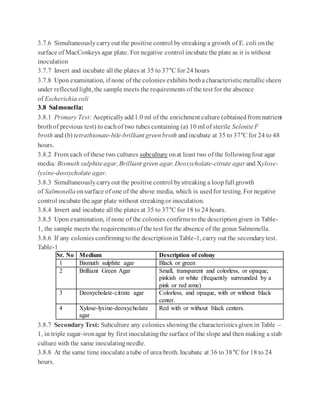
3.8.5 Upon examination, if none of the colonies confirmsto the descriptiongiven in Table-
1, the sample meets the requirementsof the test for the absence of the genus Salmonella.
3.8.6 If any colonies confirmingto the descriptioninTable-1, carry out the secondarytest.
Table-1
Sr. No Medium Description of colony
1 Bismuth sulphite agar Black or green
2 Brilliant Green Agar Small, transparent and colorless, or opaque,
pinkish or white (frequently surrounded by a
pink or red zone)
3 Deoxycholate-citrate agar Colorless, and opaque, with or without black
center.
4 Xylose-lysine-deoxycholate
agar
Red with or without black centers.
3.8.7 SecondaryTest: Subculture any colonies showingthe characteristicsgiven in Table –
1, in triple sugar-ironagar by first inoculatingthe surface of the slope and then making a stab
culture with the same inoculatingneedle.
3.8.8 At the same time inoculate atube of urea broth. Incubate at 36 to 38°C for 18 to 24
hours.
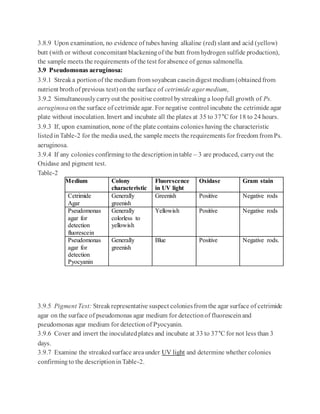
3.8.9 Upon examination, no evidence of tubes having alkaline (red) slant and acid (yellow)
butt (with or without concomitant blackeningof the butt from hydrogen sulfide production),
the sample meets the requirements of the test forabsence of genus salmonella.
3.9 Pseudomonas aeruginosa:
3.9.1 Streaka portionof the medium from soyabean caseindigest medium (obtainedfrom
nutrient brothof previous test) onthe surface of cetrimide agarmedium,
3.9.2 Simultaneouslycarryout the positive control bystreaking a loopfull growth of Ps.
aeruginosa onthe surface of cetrimide agar. For negative control incubate the cetrimide agar
plate without inoculation. Invert and incubate all the plates at 35 to 37°C for 18 to 24 hours.
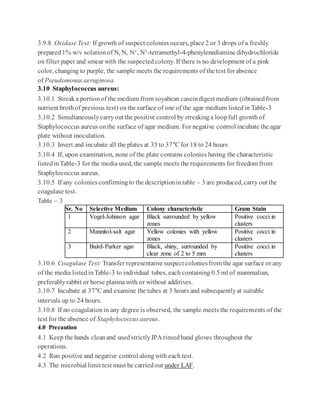
3.9.3 If, upon examination, none of the plate contains colonies having the characteristic
listedinTable-2 for the media used, the sample meets the requirements for freedom from Ps.
aeruginosa.
3.9.4 If any colonies confirmingto the descriptionintable – 3 are produced, carryout the
Oxidase and pigment test.
Table-2
Medium Colony
characteristic
Fluorescence
in UV light
Oxidase Gram stain
Cetrimide
Agar
Generally
greenish
Greenish Positive Negative rods
Pseudomonas
agar for
detection
fluorescein
Generally
colorless to
yellowish
Yellowish Positive Negative rods
Pseudomonas
agar for
detection
Pyocyanin
Generally
greenish
Blue Positive Negative rods.
3.9.5 Pigment Test: Streakrepresentative suspect coloniesfrom the agar surface of cetrimide
agar on the surface of pseudomonas agar medium for detectionof fluoresceinand
pseudomonas agar medium for detectionof Pyocyanin.
3.9.6 Cover and invert the inoculatedplates and incubate at 33 to 37°C for not less than 3
days.
3.9.7 Examine the streakedsurface areaunder UV light and determine whether colonies
confirmingto the descriptioninTable-2.
3.9.8 OxidaseTest: If growth of suspect colonies occurs, place 2 or 3 drops of a freshly
prepared1% w/v solutionof N, N, N1, N1-tetramethyl-4-phenylenediamine dihydrochloride
on filter paper and smear with the suspectedcolony. If there is no development of a pink
color, changing to purple, the sample meets the requirements of the test forabsence
of Pseudomonas aeruginosa.
3.10 Staphylococcus aureus:
3.10.1 Streaka portion of the medium from soyabean caseindigest medium (obtainedfrom
nutrient brothof previous test) onthe surface of one of the agar medium listedin Table-3
3.10.2 Simultaneouslycarryout the positive control by streakinga loopfull growth of
Staphylococcus aureus onthe surface of agar medium. For negative control incubate the agar
plate without inoculation.
3.10.3 Invert and incubate all the plates at 35 to 37°C for 18 to 24 hours
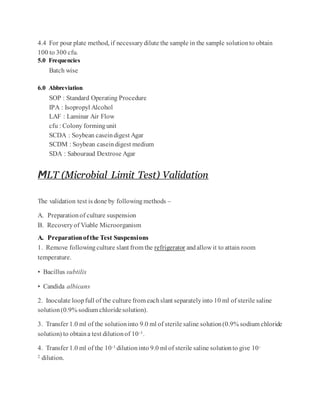
3.10.4 If, upon examination, none of the plate contains colonies having the characteristic
listedinTable-3 for the media used, the sample meets the requirements for freedom from
Staphylococcus aureus.
3.10.5 If any coloniesconfirmingto the descriptionintable – 3 are produced, carry out the
coagulase test.
Table – 3
Sr. No Selective Medium Colony characteristic Gram Stain
1 Vogel-Johnson agar Black surrounded by yellow
zones
Positive cocci in
clusters
2 Mannitol-salt agar Yellow colonies with yellow
zones
Positive cocci in
clusters
3 Baird-Parker agar Black, shiny, surrounded by
clear zone of 2 to 5 mm
Positive cocci in
clusters
3.10.6 Coagulase Test: Transfer representative suspect coloniesfrom the agar surface or any
of the media listedinTable-3 to individual tubes, each containing 0.5 ml of mammalian,
preferablyrabbit or horse plasmawith or without additives.
3.10.7 Incubate at 37°C and examine the tubes at 3 hours and subsequentlyat suitable
intervals up to 24 hours.
3.10.8 If no coagulationin any degree is observed, the sample meets the requirements of the
test for the absence of Staphylococcusaureus.
4.0 Precaution
4.1 Keep the hands cleanand usedstrictlyIPA rinsedhand gloves throughout the
operations.
4.2 Run positive and negative control alongwith each test.
4.3 The microbial limit test must be carriedout under LAF.
4.4 For pour plate method, if necessarydilute the sample in the sample solutionto obtain
100 to 300 cfu.
5.0 Frequencies
Batch wise
6.0 Abbreviation
SOP : Standard Operating Procedure
IPA : Isopropyl Alcohol
LAF : Laminar Air Flow
cfu : Colony formingunit
SCDA : Soybean caseindigest Agar
SCDM : Soybean casein digest medium
SDA : Sabouraud Dextrose Agar
MLT (Microbial Limit Test) Validation
The validation test is done by followingmethods –
A. Preparationof culture suspension
B. Recoveryof Viable Microorganism
A. Preparationofthe Test Suspensions
1. Remove followingculture slant from the refrigerator andallow it to attain room
temperature.
• Bacillus subtilis
• Candida albicans
2. Inoculate loopfull of the culture from eachslant separatelyinto 10 ml of sterile saline
solution(0.9% sodium chloridesolution).
3. Transfer 1.0 ml of the solutioninto 9.0 ml of sterile saline solution(0.9% sodium chloride
solution) to obtaina test dilutionof 10-1.
4. Transfer 1.0 ml of the 10-1 dilutioninto 9.0 ml of sterile saline solutionto give 10-
2 dilution.
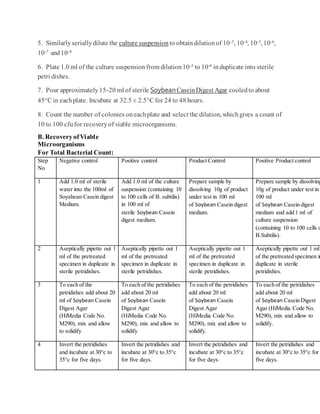
5. Similarlyseriallydilute the culture suspension to obtaindilutionof 10-3, 10-4, 10-5, 10-6,
10-7 and10-8
6. Plate 1.0 ml of the culture suspensionfrom dilution10-3 to 10-8 induplicate into sterile
petri dishes.
7. Pour approximately15-20 ml of sterile SoybeanCaseinDigest Agar cooledto about
45°C in eachplate. Incubate at 32.5 ± 2.5°C for 24 to 48 hours.
8. Count the number of colonies oneachplate and select the dilution, whichgives a count of
10 to 100 cfufor recoveryof viable microorganisms.
B. RecoveryofViable
Microorganisms
For Total Bacterial Count:
Step
No
Negative control Positive control Product Control Positive Product control
1 Add 1.0 ml of sterile
water into the 100ml of
Soyabean Casein digest
Medium.
Add 1.0 ml of the culture
suspension (containing 10
to 100 cells of B. subtilis)
in 100 ml of
sterile Soybean Casein
digest medium.
Prepare sample by
dissolving 10g of product
under test in 100 ml
of Soybean Casein digest
medium.
Prepare sample by dissolving
10g of product under test in
100 ml
of Soybean Casein digest
medium and add 1 ml of
culture suspension
(containing 10 to 100 cells o
B.Subtilis).
2 Aseptically pipette out 1
ml of the pretreated
specimen in duplicate in
sterile petridishes.
Aseptically pipette out 1
ml of the pretreated
specimen in duplicate in
sterile petridishes.
Aseptically pipette out 1
ml of the pretreated
specimen in duplicate in
sterile petridishes.
Aseptically pipette out 1 ml
of the pretreated specimen in
duplicate in sterile
petridishes.
3 To each of the
petridishes add about 20
ml of Soybean Casein
Digest Agar
(HiMedia Code No.
M290), mix and allow
to solidify
To each of the petridishes
add about 20 ml
of Soybean Casein
Digest Agar
(HiMedia Code No.
M290), mix and allow to
solidify
To each of the petridishes
add about 20 ml
of Soybean Casein
Digest Agar
(HiMedia Code No.
M290), mix and allow to
solidify.
To each of the petridishes
add about 20 ml
of Soybean Casein Digest
Agar (HiMedia Code No.
M290), mix and allow to
solidify.
4 Invert the petridishes
and incubate at 30°c to
35°c for five days.
Invert the petridishes and
incubate at 30°c to 35°c
for five days.
Invert the petridishes and
incubate at 30°c to 35°c
for five days.
Invert the petridishes and
incubate at 30°c to 35°c for
five days.
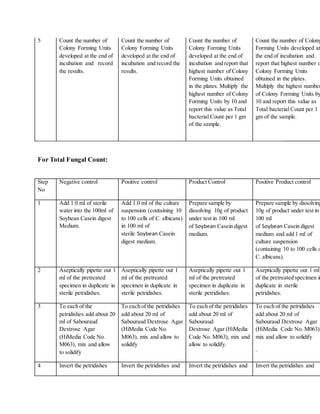
5 Count the number of
Colony Forming Units
developed at the end of
incubation and record
the results.
Count the number of
Colony Forming Units
developed at the end of
incubation and record the
results.
Count the number of
Colony Forming Units
developed at the end of
incubation and report that
highest number of Colony
Forming Units obtained
in the plates. Multiply the
highest number of Colony
Forming Units by 10 and
report this value as Total
bacterial Count per 1 gm
of the sample.
Count the number of Colony
Forming Units developed at
the end of incubation and
report that highest number o
Colony Forming Units
obtained in the plates.
Multiply the highest number
of Colony Forming Units by
10 and report this value as
Total bacterial Count per 1
gm of the sample.
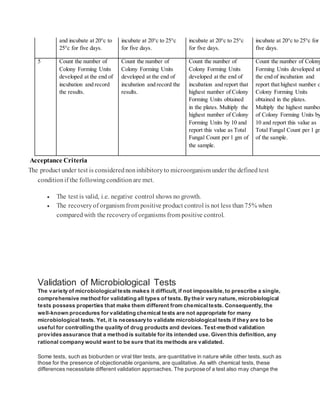
For Total Fungal Count:
Step
No
Negative control Positive control Product Control Positive Product control
1 Add 1.0 ml of sterile
water into the 100ml of
Soybean Casein digest
Medium.
Add 1.0 ml of the culture
suspension (containing 10
to 100 cells of C. albicans)
in 100 ml of
sterile Soybean Casein
digest medium.
Prepare sample by
dissolving 10g of product
under test in 100 ml
of Soybean Casein digest
medium.
Prepare sample by dissolving
10g of product under test in
100 ml
of Soybean Casein digest
medium and add 1 ml of
culture suspension
(containing 10 to 100 cells o
C. albicans).
2 Aseptically pipette out 1
ml of the pretreated
specimen in duplicate in
sterile petridishes.
Aseptically pipette out 1
ml of the pretreated
specimen in duplicate in
sterile petridishes.
Aseptically pipette out 1
ml of the pretreated
specimen in duplicate in
sterile petridishes.
Aseptically pipette out 1 ml
of the pretreated specimen in
duplicate in sterile
petridishes.
3 To each of the
petridishes add about 20
ml of Sabouraud
Dextrose Agar
(HiMedia Code No.
M063), mix and allow
to solidify
To each of the petridishes
add about 20 ml of
Sabouraud Dextrose Agar
(HiMedia Code No.
M063), mix and allow to
solidify
To each of the petridishes
add about 20 ml of
Sabouraud
Dextrose Agar (HiMedia
Code No. M063), mix and
allow to solidify.
To each of the petridishes
add about 20 ml of
Sabouraud Dextrose Agar
(HiMedia Code No. M063),
mix and allow to solidify
.
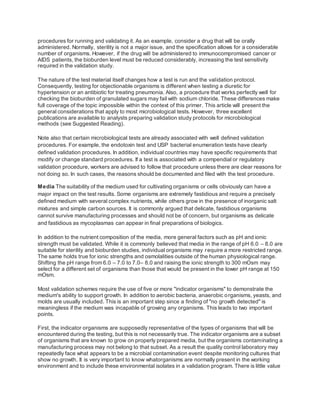
4 Invert the petridishes Invert the petridishes and Invert the petridishes and Invert the petridishes and
and incubate at 20°c to
25°c for five days.
incubate at 20°c to 25°c
for five days.
incubate at 20°c to 25°c
for five days.
incubate at 20°c to 25°c for
five days.
5 Count the number of
Colony Forming Units
developed at the end of
incubation and record
the results.
Count the number of
Colony Forming Units
developed at the end of
incubation and record the
results.
Count the number of
Colony Forming Units
developed at the end of
incubation and report that
highest number of Colony
Forming Units obtained
in the plates. Multiply the
highest number of Colony
Forming Units by 10 and
report this value as Total
Fungal Count per 1 gm of
the sample.
Count the number of Colony
Forming Units developed at
the end of incubation and
report that highest number o
Colony Forming Units
obtained in the plates.
Multiply the highest number
of Colony Forming Units by
10 and report this value as
Total Fungal Count per 1 gm
of the sample.
Acceptance Criteria
The product under test is considerednoninhibitoryto microorganism under the defined test
conditionif the followingconditionare met.
 The test is valid, i.e. negative control shows no growth.
 The recoveryof organism from positive product control is not less than75% when
comparedwith the recoveryof organisms from positive control.
Validation of Microbiological Tests
The variety of microbiological tests makes it difficult, if not impossible,to prescribe a single,
comprehensive method for validating all types of tests. By their very nature, microbiological
tests possess properties that make them different from chemicaltests. Consequently, the
well-known procedures for validating chemical tests are not appropriate for many
microbiological tests. Yet, it is necessary to validate microbiological tests if they are to be
useful for controlling the quality of drug products and devices. Test-method validation
provides assurance that a method is suitable for its intended use. Given this definition, any
rational company would want to be sure that its methods are validated.
Some tests, such as bioburden or viral titer tests, are quantitative in nature while other tests, such as
those for the presence of objectionable organisms, are qualitative. As with chemical tests, these
differences necessitate different validation approaches. The purpose of a test also may change the
procedures for running and validating it. As an example, consider a drug that will be orally
administered. Normally, sterility is not a major issue, and the specification allows for a considerable
number of organisms. However, if the drug will be administered to immunocompromised cancer or
AIDS patients, the bioburden level must be reduced considerably, increasing the test sensitivity
required in the validation study.
The nature of the test material itself changes how a test is run and the validation protocol.
Consequently, testing for objectionable organisms is different when testing a diuretic for
hypertension or an antibiotic for treating pneumonia. Also, a procedure that works perfectly well for
checking the bioburden of granulated sugars may fail with sodium chloride. These differences make
full coverage of the topic impossible within the context of this primer. This article will present the
general considerations that apply to most microbiological tests. However, three excellent
publications are available to analysts preparing validation study protocols for microbiological
methods (see Suggested Reading).
Note also that certain microbiological tests are already associated with well defined validation
procedures. For example, the endotoxin test and USP bacterial enumeration tests have clearly
defined validation procedures. In addition, individual countries may have specific requirements that
modify or change standard procedures. If a test is associated with a compendial or regulatory
validation procedure, workers are advised to follow that procedure unless there are clear reasons for
not doing so. In such cases, the reasons should be documented and filed with the test procedure.
Media The suitability of the medium used for cultivating organisms or cells obviously can have a
major impact on the test results. Some organisms are extremely fastidious and require a precisely
defined medium with several complex nutrients, while others grow in the presence of inorganic salt
mixtures and simple carbon sources. It is commonly argued that delicate, fastidious organisms
cannot survive manufacturing processes and should not be of concern, but organisms as delicate
and fastidious as mycoplasmas can appear in final preparations of biologics.
In addition to the nutrient composition of the media, more general factors such as pH and ionic
strength must be validated. While it is commonly believed that media in the range of pH 6.0 – 8.0 are
suitable for sterility and bioburden studies, individual organisms may require a more restricted range.
The same holds true for ionic strengths and osmolalities outside of the human physiological range.
Shifting the pH range from 6.0 – 7.0 to 7.0– 8.0 and raising the ionic strength to 300 mOsm may
select for a different set of organisms than those that would be present in the lower pH range at 150
mOsm.
Most validation schemes require the use of five or more "indicator organisms" to demonstrate the
medium's ability to support growth. In addition to aerobic bacteria, anaerobic organisms, yeasts, and
molds are usually included. This is an important step since a finding of "no growth detected" is
meaningless if the medium was incapable of growing any organisms. This leads to two important
points.
First, the indicator organisms are supposedly representative of the types of organisms that will be
encountered during the testing, but this is not necessarily true. The indicator organisms are a subset
of organisms that are known to grow on properly prepared media, but the organisms contaminating a
manufacturing process may not belong to that subset. As a result the quality control laboratory may
repeatedly face what appears to be a microbial contamination event despite monitoring cultures that
show no growth. It is very important to know whatorganisms are normally present in the working
environment and to include these environmental isolates in a validation program. There is little value
in proving that a medium will support the growth of indicator organisms if the environment is full of
organisms with very different cultivation requirements.
The second issue involves media handling. The qualification or validation study may require
autoclaving the medium and then pouring culture plates as the autoclaved material cools. In
laboratories with a low testing load, the excess material is often poured into large tubes or culture
flasks to cool and solidify and then stored for future use, usually in a refrigerator. However, when
future testing is done, the second heating of the medium may not be captured in the qualification or
validation check and may not even be mentioned in the test procedure. If the agar is melted under
gentle conditions and quickly poured, there may be no problem, but in some cases, technicians have
placed the flasks in microwave ovens to heat the medium while taking a short break. With a powerful
microwave oven it is easy to boil the medium for an unknown period of time. This can destroy
nutrients or produce toxic or inhibitory substances. Consequently, in laboratories where this second
heating is a common practice, this procedure must be captured in the validation and described
exactly in the test procedures.
When preparing the validation protocol, the analyst should specify the recovery level expected for
each of the indicator organisms. Generally, recovery of at least 80% of the inoculum or control is
desirable. Recovery of less than 50% is usually unacceptable and should raise questions about the
presence of inhibitory substances, especially when the testing is taking place in the presence of a
raw material or product intermediate. It may be necessary to introduce — and validatethe
performance of — an agent that inactivates the inhibitor. It is important to set the specifications
before the study is conducted and to hold to these specifications. If specifications are not pre-set and
the test system cannot meet general acceptance specifications, it is very easy to set "acceptable"
specifications that would otherwise have been unacceptable. The other problem is the "specification
creep" that occurs when a recovery of 78% is found and the specification is 80%. A quality
assurance or quality control worker who allows the 78% to pass will soon face the expectation that
75% should pass because it is "only slightly different from the other one." Over the course of a few
years, an 80% specification can gradually turn into a 70%, then 65%, specification.
Environment The incubation temperature can have a major effect on the ability of an organism to
grow in a given medium. It is well known that yeasts and molds require a different incubation
temperature than bacteria in a sterility test. Similarly,cells in tissue culture are often extremely
sensitive to small changes in temperature, not only for their growth but also in their susceptibility to
being infected or lysed by viruses. The analyst may need to develop temperature curves to justify
the incubation temperatures used for the test. It is also important to verify the incubator's ability to
maintain the set temperature within the specified range. If a four-degree temperature variation can
cause a significant change in the test results, the incubator's ability to hold a ±1° C range at all
internal locations is critical. This may not be covered in a validation study, but it should be included
in the incubator's qualification studies.
In addition to the usual range from 20 – 40° C, it may be necessary to demonstrate the ability to
grow organisms at extreme temperatures. If it is necessary to monitor the presence of microbes in a
hot or cold room, it will be necessary to demonstrate an ability to cultivate thermophiles or
psychrophiles in addition to organisms that grow under more normal conditions. While the
significance of these extremophiles may be open to question, their presence and the possibility that
they may leave residues such as endotoxins must be considered.
The atmosphere in which the test system is immersed can have a major effect. Anaerobic organisms
cannot grow in the presence of oxygen, and tissue cultures may require the presence of 5% CO2 to
grow well. Certain facultative organisms will adjust their metabolic paths to cope with reduced levels
of oxygen. This, in turn, can affect their growth rates. When media for general purposes, such as
sterility tests, are being considered, it is normal to include one medium that provides anaerobic
conditions. The detection of anaerobes is important as they include toxin-producing and other
pathogenic bacteria.
Quantitative Issues One of the problems with quantitative microbiological tests is that as microbe
counts become smaller, straight-forward linear behavior is less common than that which follows the
Poisson distribution. This is because random distribution is not even distribution. Most quantitative
tests for microorganisms require the plating of dilute liquid samples, and it is normal to prepare
samples to ensure the dispersion of microbes and a random distribution of bacteria or viruses. When
concentrations are high, the lack of even distribution is not a problem; simple linear averaging
methods can compensate for the uneven distribution. Problems arise with smaller numbers of
microbes.
Consider an example where there are exactly 100,000 organisms per mL. If 0.1 mL is taken and
mixed with 0.9 mL of a diluent, it is highly unlikely that the new suspension will contain exactly
10,000 organisms; it would not be surprising to have anywhere from 9,800 – 10,200 organisms.
Back-calculating the result produces a range from 98,000 – 102,000 organisms in the original
sample, and, if there were enough replicates, the results could be averaged to obtain a number
indistinguishable from 100,000. This is the result that would be expected based on linear thinking.
However, if there were only 10 organisms per mL, it is quite possible that a 0.1 mL aliquot would not
contain any organisms at all. In fact, in this situation about one third of the aliquots will not contain a
single organism. This could lead to the conclusion, on averaging, that the sample only contained 6.7
organisms per mL, which is a significant deviation from the true value.
A transition occurred from a high density that produces a fairly smooth, homogeneous distribution of
organisms to a low density that results in organisms that are distributed with significant distances
between them. Under these conditions, the suspension behaves according to the Poisson
distribution and assumptions related to a normal distribution no longer hold. The Poisson distribution
is an exponential function. The problem is that parameters such as the standard deviations may be
logarithmic in nature, and when attempts are made to make these numbers "real" by taking the
antilogarithms, the results may actually have no "real" meaning. This can cause great difficulties
when attempting to validate quantitative microbial test procedures.
When it is necessary to deal with the Poisson distribution, it is wise to consult a statistician who is
versed in the use of this distribution. It appears that the transition to the Poisson distribution occurs
when approximately 100 colonies or plaques are counted. This is unfortunate because at this level
many analysts will declare a colony or plaque count to be "too numerous to count" (TNTC) to avoid
the tedium of these measurements. Therefore, most colony or plaque counting procedures actually
operate under the Poisson distribution and calculations based on the normal distribution will be
incorrect.
Revalidation The frequency of revalidation is a contentious question. There are many tests, such as
the growth promotion test on culture media, that are essentially self-validating and are run
frequently. It could be argued that if performance parameters (for example, percent recovery of
indicator organisms) are monitored via control charting and no significant changes are seen,
revalidation is unnecessary. However, control charting usually does not measure all the parameters
included in validation studies. Consequently, it is wise to revalidate tests after any major change in
constituents or procedures; in fact, revalidation may be needed to justify the changes. Changes in
suppliers (especially of media components) and changes in the composition of test samples have
resulted in major changes in microbiological tests. Finally, it is probably wise to revalidate
procedures approximately every second year to protect against unseen or unreported changes. A
media supplier may change its own suppliers or change its processing procedures without notifying
customers. The supplier may have no idea of the impact these changes could have on the end use
of their product. In addition, personnel changes in the laboratory and the maturing of analysts'
techniques can have an effect.
Suggested Reading Carroll MC. A multifaceted look at the microbial limits test. In: R Prince,
editor. Microbiology in Pharmaceutical Manufacturing. Baltimore, MD: PDA; 2001. pp. 519–535.
PDA. Evaluation, validation and implementation of new microbiological testing methods: PDA
Technical Report No. 33. PDA Journal of Pharmaceutical Science and Technology 2000; 54(Suppl.
TR33).
Petitti DM. Practical considerations for the development, validation, and transfer of analytical test
methods. In: R Prince, editor. Microbiology in Pharmaceutical Manufacturing. Baltimore, MD: PDA;
2001. pp. 723–746.
Steven S. Kuwahara, Ph.D., is the principal consultant and founder of GXP BioTechnology LLC,
PMB 506, 1669-2 Hollenbeck Avenue, Sunnyvale, CA 94087-5042, 408.530.9338
Obtainingsuccessful validationsofcertainrawmaterials andfinishedproducts can betricky.Researchingthe
materialsbeforehand is important.By working closely withdevelopment scientists andchemists,setting
appropriatespecifications, and performingresearch, method developmenttrialscan bestreamlinedto produce
an adequatemethod. Key factorsin developing a propermethodincludesomeexperimentation as well as
knowledgeofthepHofthe material,thewateractivityofthematerial, thewatersolubilityofthematerial, and
any antimicrobial propertiesofthematerial, to namea few. Risk assessments canbe used to determinewhatto
test, howfrequently to test,thestabilityprogram,andobjectionable microorganismidentification. Clear
documentationandadequatescientifically soundjustifications arenecessary so that theany futurequestions
can be easily answered.
Introduction
The Harmonized Microbial LimitTest(HMLT) was made effectivein May 2009.The international
harmonization includedUnitedStates Pharmacopeia(USP),JapanesePharmacopeia (JP), andEuropean
Pharmacopeia(EP). Companies wereencouraged to revalidate theirrawmaterials andfinishedproducts in
order to obtain complianceto theenhancedguidancedocuments priorto theimplementation date. Thispaper
providesinsight to thetestand strategiesfor obtainingsuccessful validationsofthetest.
Application of the Harmonized Microbial Limits
Test
The HMLTis used to evaluaterawmaterials andnon-sterileproducts foracceptablemicrobialquality. It
involves theexamination ofnon-sterileproducts thatwill determinewhethera substanceorpreparation
complies with establishedspecificationsformicrobiological quality (1).
The HMLTwas not originally designedas a qualitycontrol test.It wasdesignedas a referee test to demonstrate
compliancewithmonographrequirements(2).However,many companies usethe testas a meansto determine
the quality oftheir finishedproductsorrawmaterials.Microbiallimittestingis seen as an attribute ofgood
manufacturingpractice(GMP) andofquality assurance (3).
The testsallowquantitativeenumerationofmesophilic bacteriaandfungi thatgrowunderaerobic conditions
(1). Certain microorganisms canadversely impact(reduce or inactivate) theactivity ofcertain products(4). Itis
important to understand themicrobial loadoftherawmaterials or finishedproductsin orderto determineif
the productwillreacttheway it was intended.
Microorganismscanalso affectthehealth ofthe patients (4).Knowingtheamount andtypesof
microorganisms in a product or deviceis importantto patientsafety.
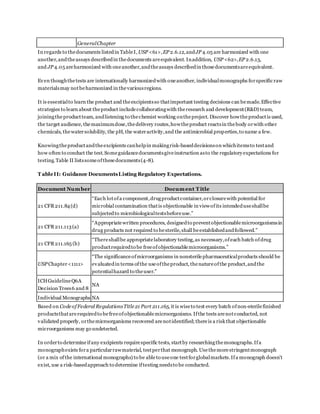
The guidancedocuments listedin TableI governtheMicrobialLimitsTest. Thismay not bean all-inclusivelist.
T ableI: Governing Documents for theMicrobial Limits Test
Document
Number
DocumentTitle
USP <61> Microbiological Examination ofNonsterile Products: Microbial Enumeration Tests
USP <62> Microbiological Examination ofNonsterileProducts: Tests for Specified Microorganisms
USP <1111>
Microbiological Examination ofNonsterile Products: AcceptanceCriteria for
PharmaceuticalPreparationsand Substances for Pharmaceutical Use
EP 2.6.12. Microbiological Examination ofNon-SterileProducts: MicrobialEnumerationTests
EP 2.6.13. Microbiological Examination ofNon-SterileProducts: Testfor SpecifiedMicro-Organisms
JP 4.05 Microbial LimitTest
ICHGuidance
QB4
Evaluation andRecommendationofPharmacopoeial Textsfor Usein theICHRegionson
Microbiological Examination ofNon-SterileProducts: MicrobialEnumerationTests
GeneralChapter
In regards to thedocuments listedin TableI, USP <61>,EP 2.6.12,andJP 4.05 are harmonized with one
another,andtheassays describedin thedocuments areequivalent. Inaddition, USP <62>,EP 2.6.13,
and JP 4.05 areharmonized with oneanother,andtheassays describedin thosedocumentsareequivalent.
Even thoughthetests are internationally harmonizedwith oneanother, individualmonographs forspecific raw
materialsmay notbeharmonized in thevariousregions.
It is essentialto learn the product and theexcipientsso thatimportant testing decisions can bemade.Effective
strategies to learn about theproduct includecollaboratingwith theresearch and development(R&D) team,
joiningtheproductteam, andlistening to thechemist working ontheproject. Discover howtheproductis used,
the target audience, themaximumdose,thedelivery routes,howtheproduct reactsin thebody orwith other
chemicals, thewatersolubility, the pH, the wateractivity,and the antimicrobial properties,to name a few.
Knowingtheproductandtheexcipients canhelpin makingrisk-baseddecisionson whichitemsto testand
how often to conduct the test.Someguidancedocumentsgiveinstruction asto the regulatoryexpectations for
testing.Table II listssomeofthesedocuments(4-8).
T ableII: Guidance DocumentsListing Regulatory Expectations.
Document Number Document T itle
21 CFR211.84(d)
“Each lotofa component,drugproductcontainer,orclosurewith potential for
microbial contamination thatis objectionable in viewofits intendeduseshallbe
subjectedto microbiologicaltestsbeforeuse.”
21 CFR211.113(a)
“Appropriatewritten procedures, designedto preventobjectionablemicroorganismsin
drug products not required to besterile,shall beestablishedandfollowed.”
21 CFR211.165 (b)
“Thereshallbe appropriatelaboratory testing,as necessary,ofeach batch ofdrug
productrequiredto be freeofobjectionablemicroorganisms.”
USP Chapter<1111>
“The significanceofmicroorganisms in nonsterilepharmaceuticalproducts should be
evaluatedin terms ofthe useoftheproduct, thenatureofthe product,andthe
potentialhazard to theuser.”
ICHGuidelineQ6A
Decision Trees6 and 8
NA
Individual Monographs NA
Based on CodeofFederal RegulationsTitle21 Part 211.165, it is wiseto test every batch ofnon-sterilefinished
productsthatarerequiredto befreeofobjectionablemicroorganisms. Ifthe tests arenotconducted, not
validated properly, orthemicroorganisms recovered arenotidentified;thereis a risk that objectionable
microorganisms may go undetected.
In orderto determineifany excipients requirespecific tests, startby researchingthemonographs.Ifa
monographexists fora particularrawmaterial, testperthat monograph. Usethemorestringentmonograph
(or a mix ofthe international monographs) to be ableto useone testforglobalmarkets.Ifa monograph doesn’t
exist, use a risk-basedapproach to determine iftesting needsto be conducted.
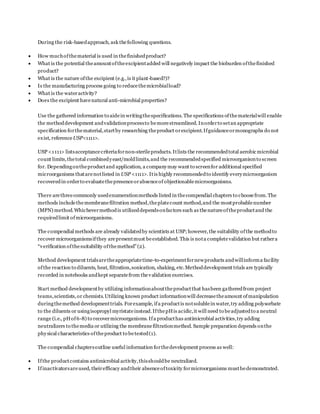
During the risk-basedapproach, ask thefollowing questions.
 How muchofthematerial is used in thefinishedproduct?
 What is the potential theamountoftheexcipientadded will negatively impact the bioburden ofthefinished
product?
 What is the nature ofthe excipient (e.g.,is it plant-based?)?
 Is the manufacturing process going to reducethemicrobialload?
 What is the wateractivity?
 Does the excipient havenatural anti-microbial properties?
Use the gathered information to aidein writingthespecifications. The specifications ofthematerialwill enable
the methoddevelopment andvalidationprocessto bemorestreamlined. Inorderto setan appropriate
specification forthematerial,startby researching theproduct orexcipient.Ifguidanceormonographs do not
exist, referenceUSP<1111>.
USP <1111> listsacceptancecriteriafornon-sterileproducts. Itlists the recommendedtotal aerobic microbial
count limits,thetotal combinedyeast/moldlimits,and the recommendedspecified microorganismto screen
for. Dependingontheproductand application, a companymay want to screenfor additional specified
microorganisms thatarenotlisted in USP <1111>. Itis highly recommendedto identify everymicroorganism
recoveredin orderto evaluatethepresenceorabsenceof objectionablemicroorganisms.
There arethreecommonly usedenumerationmethods listed in thecompendial chapters to choosefrom.The
methods includethemembranefiltration method,theplatecount method,and the mostprobablenumber
(MPN) method.Whichevermethodis utilizeddependsonfactors such as thenatureoftheproductand the
requiredlimit ofmicroorganisms.
The compendial methods are already validatedby scientists at USP;however, the suitability ofthe methodto
recover microorganismsifthey arepresentmust beestablished. This is nota completevalidation but rathera
“verification ofthesuitability ofthemethod”(2).
Method development trialsaretheappropriatetime-to-experimentfornewproducts andwillinforma facility
ofthe reaction to diluents, heat, filtration,sonication, shaking, etc.Methoddevelopment trials are typically
recorded in notebooks andkept separatefrom thevalidation exercises.
Start method developmentby utilizing informationabouttheproductthat hasbeen gatheredfrom project
teams,scientists,or chemists.Utilizing known product informationwill decreasetheamount ofmanipulation
duringthemethod developmenttrials. Forexample, ifa productis notsolublein water,try adding polysorbate
to the diluents or usingisopropyl myristateinstead.IfthepHis acidic,it will need to beadjustedto a neutral
range (i.e., pHof6-8) to recovermicroorganisms. Ifa producthas antimicrobial activities,try adding
neutralizers to themedia or utilizing the membranefiltrationmethod. Sample preparation depends onthe
physical characteristics oftheproduct to betested(1).
The compendial chaptersoutline useful information forthedevelopment process as well:
 Ifthe productcontains antimicrobial activity,thisshouldbe neutralized.
 Ifinactivatorsareused, theirefficacy andtheir absenceoftoxicity formicroorganisms mustbedemonstrated.
 Common neutralizingagents and methodsincludetheaddition ofpolysorbate, the addition oflecithin,and/or
dilutionmethods(1).
USP <61>states thatifno suitableneutralizingmethodcanbefound, it can beassumedthat thefailureto
isolate the inoculatedmicroorganismsis attributable to themicrobialactivityoftheproduct(1).Proceed by
performing the test with thehighest dilution factorcompatiblewithmicrobial growthandthespecific
acceptancecriterion in caseothermicroorganisms are notinhibitedby the product (1). USP <62>continues on
to say thatfora given product,ifthe antimicrobial activitywithrespect to a microorganismforwhich testing is
prescribedcannot beneutralized, then it is to beassumedthat theinhibited microorganismwillnotbepresent
in the product(10).Most companiescontinuein themethod developmenttrialsuntil a suitablemethod is
identified.
Dependingon thenature ofthe product andtherequiredlimitofmicroorganismsallowed,choose the
appropriatemethodto usein the method development trials. Again, themethodsincludethe membrane
filtration method,theplatecountmethod, andtheMPN method.
For the membranefiltrationmethod, filtration mustbeperformed with filtersthat havea poresizenot greater
than 0.45m(1).Thetypeoffiltermaterial is chosenin such a way that the bacteria-retainingefficiencyis not
affectedby the componentsofthesample (1). Common filtermaterialsinclude cellulose, nylon, and
Polyvinylidene fluoride(PVDF).
Membrane Filtration Example
1. Transfera suitablequantityofthesampleprepared(preferablyrepresenting 1 gram[g] oftheproduct) to the
membraneandfilterimmediately. Rinsethefilterwithan appropriatediluent(1).
2. For Total Aerobic Microbial Counts (TAMC),transferthefilter to soybean-caseindigest agar.
3. For Total YeastMicrobial Counts (TYMC),transfer the filterto sabourauddextroseagar.
4. Incubate alloftheplatesaccordingto the compendialguidance(1).
There aretwo methods listedin the compendialchaptersfortheplatecountmethods.They arethepourplate
methodandthesurface-spreadmethod.
Pour Plate MethodExample:
1. Add 1 milliliter (mL) ofthesamplepreparationto duplicatepetri dishes.
2. Cover the sample with 15-20 mL ofmolten media (cooled to ~45C).
3. Allowtheplatesto solidify atroomtemperature.
4. Inverttheplates andincubateaccordingto thecompendial guidance(1).
Spread Plate MethodExample:
1. Add media to sterilepetridishes andallowthemedia to solidify.
2. Add a measured amountofnotless than0.1 mL oftheprepared sampleto duplicatesolidifiedmedia plates.
Spreadthesampleoverthemedia surface.
3. Inverttheplates andincubateaccordingto thecompendial guidance(1).
Anothermethoddescribedin thecompendial chaptersis theMPN method.The precisionandaccuracyofthe
MPN methodis lessthanthat ofthe membranefiltrationmethod or the plate-count method.Unreliableresults
are obtainedparticularly fortheenumeration ofmold (1). TheMPN method may beappropriatewith products
with very low bioburden ifno othermethodis available(1).
ExampleofMPN Method:
1. A series ofat least threeserial10-folddilutionsoftheproduct/rawmaterial areprepared.Fromeach levelof
dilution, threealiquots of1 g or 1 mL areusedto inoculatethreetubes with 9 to 10 mLofsoybean-casein digest
broth.Neutralizersmay beadded to themedia ifneeded.
2. Incubate alltubes at30-35 Cfor no morethan threedays.
3. Ifreading theresultsis difficult,subculture to soybean-caseindigest agarandincubateat thesametemperature
for one to two days.
4. Use Table3 fromUSP <61>to determinetheMPN ofmicroorganismsperg ormL (1).
Whichevermethod is chosen,it is imperativeto provethesuitability ofthetestto recovermicroorganisms. To
do this appropriately,themediautilizedmustbe properly growth promotedas describedin thecompendial
chapters (USPandUSP). Properpositiveandnegativecontrolsalong with titer plates mustalso beutilized
throughouttheprocess. Fresh microorganismdilutions mustbe used(no morethanfivepassagesfromthe
originalmasterseed-lot) (1,10). Microorganismsmay bepurchased fromvendors in a ready-to-useformator
preparedas describedin thecompendial chapters.
USP <62> covers thetesting ofthefollowing specifiedorganisms:
 Bile-TolerantGram-Negativebacteria
 Escherichiacoli
 Salmonella
 Pseudomonas aeruginosa
 Staphylococcus aureus
 Clostridia
 Candida albicans.
Under eachsection, USP stateshowmuch ofthe product or excipient is to beexaminedandhowto incubate
with each type ofmediawithproductin orderto isolateany ofthepotential“specified”microorganismswithin
that product.Thesespecified microorganismchallenges must bevalidated to recover microbial growth as well.
This portionofthemicrobial limits testis a presence/absencetest. Dependingon theproductor excipient, one
may chooseto validateany numberofthespecifiedmicroorganisms from USP <62>.
It is importantto statewhichmicroorganisms arevalidatedin thespecifications appropriately. Ifa company
says,“Comply withcurrent USP <62>,” withoutdelineating whichofthespecifiedmicroorganisms were
validated, onecouldassumethat thecompany validatedall ofthespecified microorganisms fromthatchapter.
To savetime and money duringtheinitial methoddevelopmenttrials,usea subset ofmicroorganismsto test
the productreactions. Forexample:
 An antibiotic thattargets gram-negative bacteria needsto be tested. Theproductis readily solublein water.
 The productis dilutedin Phosphate BufferpH7.2and the membranefiltrationmethodis chosen.
 Because theproducttargets gramnegativebacteria, varyingdilutionsand rinsingagentsareutilizedwith gram
negativebacteriaforthemethoddevelopmenttrials.
 Afteran acceptablemethodhas been identified,thefull compendialpanelofmicroorganismsareperformedto
assurethat alloftherequiredmicroorganismscan berecoveredaccurately utilizingtheemployedmethod.
Remember,during methoddevelopment,becreative!This is therighttimeto learntheproductorexcipient:
 How doesthematerialreactto varyingscenarios?
 How doesthematerialdissolve?
 How easily/accurately areinoculatedmicroorganisms recovered?
 Does the pHneed to beadjusted?
 Which method(membranefiltration, pourplate, or MPN) is therightmethod?
 Which neutralizersareneeded, ifany?
 CreativeExample: One may need to filterthespecified microorganismchallenges andthenputthefilterinto
the media.
Once datahas been collectedanda reasonable method has been identified,go back overthedata to makesure
the bestmethodis chosen and can berepeated duringthevalidationexercises.Ifa methodis validated in the
United States, it shouldberepeatablein Japan.
By this point, oneshouldhaveidentifieda method,a diluent,a dilution factor,a samplepreparation,any
neutralizers,how to adjust thepH, and,possibly,thewater activity ofthe material.
Knowingthewater activityis nota requirement forthevalidation, butit is a usefultool.Wateractivity is
discussedinUSP <1112>ApplicationofWater ActivityDetermination To NonsterilePharmaceutical Products.
Microorganismsmay stillbepresent atlevels of<0.6aw,buttheywill not proliferate.Thetest aids in the
decisions relatingto the following:
 Optimizing productformulations to improveantimicrobial effectivenessofpreservativesystems
 Reducingthedegradation ofactivepharmaceutical ingredients within product formulation susceptibleto
chemical hydrolysis
 Reducingthesusceptibilityofformulations (especially liquids, ointments,lotions, andcreams) to microbial
contamination
 Providing a tool fortherationaleforreducing thefrequencyofmicrobial limittestingand screening for
objectionablemicroorganismsforproductreleaseand stability testing usingmethods containedin the general
chapters <61>and<62>
 Reducingwater activityto greatly assistin thepreventionofmicrobial proliferation (11).
Afterthemethod developmentdata has been evaluated,choosethe methodin which the compendial
microorganisms can berecovered by at least50%ofthepositivecontrols.
Other points to consider:
 Is the method onethat any analyst can easily performwithouteasily contaminating thesample?
 Are therecovery counts at least 50%ofthe positivecontrols?
 Growthshouldnotbeinhibited(reductionby a factor greater thantwo)(1).
 Does the pHneed to beadjustedforthevalidation?Ifso,thepHwill needto beadjustedforroutinetesting.
The validation exercises shouldbeperformed undermethodvalidationprotocols thatarecontrolledlikeother
cGMP documents. Thevalidationis moreofa “verification”ofthemethod suitability to recovermicroorganisms
from thetestingmaterial(2).Typicalanalyticalvalidations considerthefollowing:
 Accuracy
 Precision
 Repeatability
 IntermediatePrecision
 Specificity
 DetectionLimit
 Quantitation Limit
 Linearity
 Range.
Alternativemicrobiological procedures,including automatedmethods,may beused aslong as thesemethods
havebeendemonstratedto beequivalentto the Pharmacopeia method(1). One may need to performside-by-
side comparisonswiththetraditionalmethodsandalternative method to showequivalencyto thecompendial
methods.
Preparethesampleto be testedaccordingto the protocol(which should match the method development
preparation).Unlessotherwisedirected (e.g.,in a monograph),use10 g or 10 mL of theproductto be examined
to preparethesamplepreparation(1).
The amountto be testedmay bereduced foractivesubstancesif:
 The amountper dosage(tablet,capsule, etc.) is lessthan orequal to 1 mg.
 The amountper g ormL (forpreparations notpresentedin doseunits) is lessthan 1 mg.
Therefore,theamount ofsampleto be testedis notlessthan theamountpresentin 10 dosage units or10 g/10
mL ofthe product
For materialsusedas activesubstances wherethesamplequantityis limited or batch size is extremely small
(less than1000 mL or1000 g),theamounttested shallbe 1%ofthebatch unlessa smalleramount is prescribed
or justifiedandauthorized. Forproducts wherethetotal numberofentities in a batchis lessthan200,the
samplesizemay bereduceto two unitsoroneunit ifthe samplesize is less than100..
Samples should beat
randomfromthebulk material or fromavailablecontainers ofthe preparation.To obtain therequiredquantity,
mix thecontentsofa sufficient numberof containersto providethesample(1).
Method validation is typicallyperformed onthreelots ofmaterial to demonstratetherobustness ofthe method.
The first step ofthe validation is thetotal aerobic/yeastandmoldcountportion ofthevalidation (1).I noculate
separateportions ofthe sample preparation thatareequivalent to 1 g or 1 mLofthematerialbeingexamined
(1).Theinoculumsaremadewithless than 100 cfu ofthemicroorganisms specifiedin USP <61>.The
inoculums mustnot exceed 1%ofthevolumeofthediluted product (1).
Ifthe pour platemethod is used, inoculatethesampleso that1 mL ofthedilution willcontain<100cfu ofthe
challengedmicroorganism.Otherwise, theplated samplemay notcontain growth.
For the membranefiltrationmethod, transferthefilters onto tryptic soy agar (TSA) plates orsabouraud
dextroseagar(SDA) platesafter filtering. IncubatetheTSA platesforno morethan threedaysat 30–35C.This
is belowtheincubationrangeofthreeto fivedays;thereby,thisproves thatrecovery can beobtainedby the
minimumofthreedays. Un-inoculated product plates should beincubated forthethreeto five day incubation
range (1).
Incubate theSDA plates fornot morethan fivedays at20–25C. Thisis below the incubation rangeoffiveto
seven days,proving thatrecoverycan beobtainedby theminimumoffivedays. Un-inoculatedproductplates
shouldbeincubated forthethreeto five-dayincubation range(1).
Afterincubation,calculatethenumber ofcfu per g orpermL ofthe testedmaterial.
For the platecountmethod, preparesampleas statedin the protocol. Inoculate duplicate sterilepetri dishes
with the inoculated product sample.Coverthedisheswithmedia (or spreadthesampleonto themedia forthe
spread plate method). IncubatetheTSA platesforno morethan threedaysat 30–35C. This is belowthe
incubationrangeofthreeto fivedays, proving thatrecoverycan beobtained by theminimum ofthreedays. Un-
inoculatedproductplatesshouldbeincubatedforthethreeto five-day incubation range.
Incubate theSDA plates forno morethan fivedaysat 20–25C.This is belowtheincubationrangeoffiveto
seven days,thus provingthat recovery canbe obtainedby theminimumoffivedays.Un-inoculatedproduct
platesshouldbeincubatedforthethreeto five-day incubation range.
Selecttheplatescorresponding to a givendilution andshowthehighest numberofcoloniesless than 250 for
TAMCand 50 forTYMC(1).Takethemean perculturemedium ofthe counts andcalculatethenumberofcfu
per g or permL ofproduct (1).
For the MPN method,incubatealltubes fornot morethan threedays at30–35 C. Subculture,ifnecessary,
using theprocedureshownto be suitable.Foreach levelofdilution,record the numberoftubesshowing
microbial growth. DeterminetheMPN ofmicroorganisms perg or mL ofthe product to beexamined from
Table 3 in USP <61>.
The specifiedmicroorganismportionofthevalidationis secondstep ofthevalidation (9).Inoculateseparate
portionsofthesamplepreparationthatareequivalentto 1 g or 1 mL ofthematerial being examined (thismay
be a 1 in 10 dilution) (10)..
Theinoculumsaremadewith less than100 cfu ofthespecifiedmicroorganisms being
examined in USP<62>.
Incubate eachstepofthe specifiedmicroorganismchallenges usingthelessertimeoftheincubation range.For
example, iftheincubation rangeis 18–24hours, removethevalidationsample at18hours.
The first step in USP <62>is dilution ofthe product in an enrichment mediato encouragelow-levelsof
microbial growth(2).The second stepis to subculturethemicrobialgrowthsuspensionson selectiveagar to
depress generalmicrobial growth and allow forthespecifiedmicroorganismsto grow(2).The differential
media was designedto distinguish the colonymorphology ofthespecified microorganisms therebyallowing
visual identification (2).
For many companies, the question ofhow to treatclinical productsverses commercial productsarisesin
meeting rooms.Forcommercial products, most companies agreethat theindustry practiceis to validatethree
lots at a minimumfor method validations.
What about clinical products?Clinical productsarea differentstory. Itis difficultsometimes to havethree lots
ofproductin orderto performa completevalidation.Smallamountsofproduct areoftenmadeforusein
clinics.Formulations change frequently depending on fieldstudies anddevelopmentsdiscoveredthroughout
the early phases ofa project. Itis acceptableto perform method validation ononelot forclinical products.
Chances are thecompany will beredeveloping andrevalidatingwitheach formulation changeoftheproduct. It
may take yearsfora product to reach commercial launch.
Keep an eyeontheproduct, however.The moment theproduct moves to commercial manufacturing,a three-
lot validation needs to occur.
Validationacceptancecriteriais essentialwhen determining ifa methodwas properlyvalidated.When verifying
the suitability ofthemembranefiltration or the Plate-Count Method,“a mean count ofany ofthetest
organismsnotdifferingby a factorgreater than2 fromthevalue ofthe control in theabsenceofproductmust
be obtained”(1).In other words,thepercent recoverybetweentheinoculatedproductdilutions andthepositive
controls mustbeat least50%.Somecompanies usean internal70%recovery criterionthat is acceptable
becauseit is morestringent.
The compendial chaptersgiveadditional detailto the validation criteriafortheMPN method.“When verifying
the suitability oftheMPN Method,thecalculatedvaluefromtheinoculums mustbewithin95%confidence
limits oftheresults obtainedwith thecontrol”(1). Ifthe criterioncannotbe metfor oneormore ofthe
organismstestedwith any ofthedescribedmethods,themethodand testconditions that comeclosestto the
criteria areusedto testtheproduct(1).
Specifiedmicroorganismsmustbe recovered duringthevalidationfortheassayto bevalid. Thetiterplates
must demonstratenotmorethan 100 cfuwas utilizedto achievethepositiveresults (10).
Aftervalidations arecomplete,routine testing maybegin. Followingvalidation activities, reportsareusually
written to approvethestudies andmethods (or standard operating procedures[SOPs]) arewritten to lock down
the way thetests are routinelyperformed.
Routinetesting fortheHMLTwill containtheTAMC, the TYMC, and any specified microorganismchallenges.
All representativecolonies ofgrowth obtainedfromany portionofthetest needsto be identified to thespecies
level ifpossible. Themicroorganismsneedto be researched anddeterminedifthey areobjectionable
microorganisms.
There is a regulatoryexpectation that recovered microorganismsareidentifiedfrom nonsterileproducts.There
havebeenwarningletters issuedto companies failingto comply withthisexpectation.Product recallshavealso
occurred.
In orderto determineifa microorganismis objectionable, USP <1111>provides information to aide in therisk
assessment.Themicroorganisms’ significanceshouldbe evaluated by researchingthefollowing:
 Number ofmicroorganisms (1 cfuor1X106
cfu)
 Microorganisms’ characteristics
 Use ofthe product/routeofadministration
 The natureoftheproduct:Doesit supportgrowth?Does it haveantimicrobial preservatives?Whatis thewater
activity?
 The method ofapplication
 The intendedrecipient(e.g., elderly,infants, etc.)
 Potential impactto patients
 Use ofimmunosuppressive agents
 The presenceofdisease,wounds,ororgan damage
 Does the microorganismhave a historyofcausing infections?
There aremany sources to researchmicroorganisms ontheInternet. A good sourceofreferenceforresearching
potentialobjectionablemicroorganismsis theFDA Bad Bug Book.Thereis not an all-inclusive list of
objectionablemicroorganisms. Microorganisms mustbe identified and evaluated to determine the potential
impact to patient health.
To determinethefrequency oftesting,onecanutilizea risk-based approach. Liketheobjectionable
microorganisms,thisis going to bea product-by-productrisk assessment.
ICHQA6, HarmonisedTripartiteGuideline: Specifications: Test Procedures and AcceptanceCriteriafor New
Drug SubstancesandNew Drug Products: Chemical Substances providessomeguidanceon determining the
appropriatetestingintervals:
“In general, it is advisableto testthedrugproductunless itscomponentsaretested beforemanufactureandthe
manufacturingprocessis known, through validationstudies,notto carrya significant risk ofmicrobial
contaminationorproliferation”(3).
With acceptablescientific justification, it maybe possibleto propose no microbial limittestingforsolidoral
dosage formsor skiplot testing.
ICHQ6A DecisionTree Number6:Microbiological Quality AttributesofDrug Substances and Excipientswalks
througha series ofquestionsabout thedrug substanceandexcipients to aid in therisk-baseddecisionsabout
the frequencyofroutinetesting.
ICHQ6A DecisionTree Number8:Microbiological Attributes ofNon-SterileDrugProducts is anotherdecision
tree.It walksthrougha series ofquestions about thedrugproductto aidein therisk-baseddecisionsaboutthe
frequencyofroutine testing.
Stability testing is performedundervarious temperaturesandhumidity set-points. Microbial limitstesting
performedfor stability testing is typically performedat initial, six months, 12months,24 months, etc. When
designingtheprogram,takeinto accountthe productformulations,strengths, andpackaging configurations.It
may beappropriateto leveragebracketingormatrixingstabilitytestingdesignsas allowed underICHQ1D.
Bracketing or matrixing cangreatly reduce the testsamplesneededforthestability program.
Conclusion
Learn aboutthematerial beforebeginning. Set appropriate specifications so that the methodcan be
appropriately targeted. Forinternational compliance,usethemost stringent international methodora mixture
ofthe methods.
When developing methods, becreative!Learnas much as possiblefrom developmentscientists, chemists,
research,andproject teamsto aidein themethoddevelopmenttrials.Utilizetheinformationto target the
methoddevelopmenttrials in order to savetimeand money.Oncea suitablemethodhasbeenidentified,
performa trial as onewould do duringthevalidationwithall ofthemicroorganisms to demonstratethemethod
will work properly. Performthese trials in a notebook andkeepexcellent notesaboutthetrials.Be sureto test
the pHand choosethebestsuitablemethod fortheapplication.Don’tunderestimatethevalueofknowingthe
wateractivity.
During validation,writea method validation protocol utilizing the method developed in thetrialruns.Be
certainthat the method is performedthesame way eachtime andthatit is repeatable.For clinical products, a
one-lotvalidationis sufficient dueto various clinical constraints.Forcommercial products,a minimum ofa
three-lot validation shouldbeperformed.
Createa cleanvalidationpackage forregulatory audits. Duringroutinetesting, lock down themethodso that it
is performed the sameway every time. Bracketingormatrixingcan beutilizedin decreasingthevolume of
stability testing(12).
Risk-basedapproachesshouldbeutilizedin investigatingobjectionable microorganisms and in determiningthe
testingfrequencies.Clear documentation andjustificationsshouldbe maintained so that decisions canbe
clearly understoodin thefuture.
References
1. USP Chapter<61>, MicrobiologicalExaminationofNonsterileProducts: Microbial EnumerationTests.
2. S. Sutton"Does International HarmonizationoftheUSP Microbial LimitsTestsRequireRe-Validation of
Finished ProductTests?", JournalofValidationTechnology16 (3), 2009.
3. ICHQ6A, Specifications: TestProcedures for New Drug Substances andNew Drug Products:Chemical
Substances.
4. USP Chapter<1111>, Microbiological Examination ofNonsterileProducts: AcceptanceCriteria for
PharmaceuticalPreparationsand Substances for Pharmaceutical Use.
5. Code ofFederal Regulations, Title21,FoodandDrugs(GovernmentPrintingOffice,Washington, DC), Part
211.84(d).
6. Code ofFederal Regulations, Title21,FoodandDrugs(GovernmentPrintingOffice,Washington, DC), Part
211.113(a).
7. Code ofFederal Regulations, Title21,FoodandDrugs(GovernmentPrintingOffice,Washington, DC), Part
211.165(b).
8. ICHGuidelineQ6A, DecisionTrees6 and 8.
9. USP Chapter<62>,Microbiological ExaminationofNonsterile Products: Tests for SpecifiedMicroorganisms.
10. USP Chapter<1112>, Application ofWater ActivityDetermination To NonsterilePharmaceutical Products.
11. ICHQ2(R1), ValidationofAnalyticalProcedures: Text and Methodology.
12. ICHQ1D, BracketingandMatrixingDesignsfor StabilityTesting ofNew Drug SubstancesandProducts.
Microbial limit test 112070804013
1. 1. MICROBIAL LIMIT TEST
2. 2. • This test are designed to perform qualitative quantitative estimation of the no of
viable aerobic micro-organisms present or detecting the presence of designated
microbial species in pharmaceutical product.• The term ‘growth’ is used to designate the
presence & presumed proliferation of viable micro-organism.• The most care must be
taken while performing microbial test so that contamination from outside can be avoided.
3. 3. Preliminary testing:• The method given herein are invalid unless it is demonstrated
that the test specimen to which they are applied do not themselves inhibit the
multiplication of under the test condition of micro- organism that can be present.•
Therefore, inoculate diluted specimen of substance being examined with separate viable
culture of (1)E.coli (2)S.aures (3)S.typhi (4)Psudomonas aeruginosa
4. 4. • If organism fails to grow in medium the procedure should be modified by: a)
incresing the volume diluents with quantity of diluents remain same, or b) incresing a
sufficient quantity of inactivating agent in diluents ,or c) combining aforementioned
modification so as to permit growth of organisms in media.
5. 5. • If inhibitory subtances are present in sample,0.5% soyalecithin & 4%of polysorbate
20 may be added to the culture medium.• Repeat the same procedure using fluid casin
digest –soyslecithin,-polysorbate20 medium to demonstrate neutralization of
preservative or other antimicrobial agent in test material.• Where inhibitory substance
are contained in product & latter is soluble, the Membrane filtration method may be
used.
6. 6. • If inspite of incorporation of suitable inactivating agent & a substantial increase in
volume of diluents it is still not possible to recover the viable culture described above &
where article is not suitable for applying the membrane filtration method it can be
assumed that the failure to isolate the inoculated organism may be due to the
bactericidal activity of product.• This may be indicated that the article not likely to be
contaminated with the given species of organism.• Monitoring should be continued to
establish the spectrum of inhibition & bactericidal activity of product.
7. 7. Media:• culture media may be as per procedure & they have similar ingredient &/or
yield media comparable to those obtained from the formula.• Where agar specified in
formula, use agar that has moisture content nmt15 %.• Where water is mention in
formula, use purified water.• Media should be sterilized by heating in autoclave at 115°c
for 30 min.
8. 8. • In preparing media as per formula, dissolve the soluble solid in water, using the heat
if necessary to effect complete solution & add HCL & NaOH in sufficient quantities to
yield require pH in medium.• SAMPLING: USE 10ML OR 10G SPECIMEN FOR EACH
OF TEST.
9. 9. METHODS(1)TOTAL AEROBIC MICROBIAL COUNT MEMBRANE FILTRATION -
METHOD PLATE COUNT METHOD POURED PLATE SPREAD PLATE MUTIPLE OR
SERIAL – DILUTION METHOD
10. 10. PREPARATION OF TEST FLUID:• Water soluble product: Dissolve 10g or 10ml of
the sample in buffer or fluid medium( 1) TOTAL AEROBIC MICROBIALCOUNT &
adjust volume to 100ml.• Product insoluble in water(non fatty): Take 10g of sample, grind
to fine powder & suspend it in buffer or fluid medium & adjust the volume to 100ml.
11. 11. A suitable surface-active agent such as 0.1%w/v of polysorbate 80 may be added to
assist the suspension of poorly wettable substance.• Fatty product: Homogenise 10g or
10ml of sample with 5g ofpolysorbate20 or polysorbate80. -If necessary ,heat to nmt
40`c for 30min. -Add 85ml of buffer or fluid medium. -Adjust the PH to about 7.
Membrane filtration:• Use membrane filter 50mm in diameter & having nominal pore size
NGT 0.45 um orless.
12. 12. • Sterilized the filters,filteration apparatus,media & other apparatus used.• Transfer
10ml or quantity of each dilution contain 1g of preparation being examined to each of
two membrane filter & filter immediately.• If necessary dilute the pretreated preparation
so that 10-100 colony count may be expectd.• After filtration wash the each filter three or
more time with appropriate fluid such as phosphate buffer,sodium chloride-peptone
buffer or fluid medium.• For fatty susbtance add polysorbate20 or polysorbate80 to
washing.
13. 13. • Transfer one of the membrane filter, intended for enumeration of bacteria to surface
of plate of casein soyabean digest agar & intend for enumeration of fungi to surface if
sabouraud dextrose agar with antibiotics.• Incubate the plate for 5 days, unless more
reliable count is obtanied in shorter time,at 30 to 35°c in test for bacteria & 20 to 25°c in
test for fungi.• Count the number of colonies that are formed.• Calculate the no of
organism per g or ml of preparation being examined.
14. 14. POUR PLATE METHOD• FOR BACTERIA: Use Petri dish 9 to 10 cm diameter, add
to each dish a mixture of 1ml of the pretreated preparation & about 15ml of liquefied
casein soyabean digest agar at NMT 45°c• If necessary dilute the preparation as
described above so that colony count NMT300 may be expected.• Incubate the plate at
30 to 35 °c for 5 days unless more reliable count is obtained in shorter time.• Calculate
the result using plate with greatest no. of colonies but taking 300 colonies per plate as
maximum consistent with good evaluation.
15. 15. • FOR FUNGI: Use saboraud dextrose agar with antibiotics & incubate the plate at
20 to 25 °c for 5 days.• Calculate the result using plate with nmt 100 colonies. SPREAD
PLATE METHOD• Place 0.05-.2 ml of test fluid on solidified dried surface of agar
medium spread it uniformly using spreader.• Proceed under same condition as for the
pour plate method.
16. 16. MULTIPLE TUBE METHOD• Use 12 test tubes : 9 containing 9 ml of soybean-
casein digest medium each and 3 containing 10 ml of the same medium each for control.
Prepare dilutions using the 9 tubes.• First, add 1 ml of the test fluid to each of three test
tubes and mix to make 10- times dilutions.(100ul)• Second, add 1 ml of each of the 10-
times dilutions to each of another three test tubes and mix to make 100- times
dilutions.(10ul)
17. 17. • Third, add 1 ml of each of the 100-times dilutions to each of the remaining three
test tubes and mix to make 1,000- times dilutions (1ul)• Incubate all 12 test tubes for at
least 5 days at 30 - 35°c.• No microbial growth should be observed for the control test
tubes.• If the determination of the result is difficult or if the result is not reliable, take a
0.1ml fluid from each of the9 test tubes and place it to an agar medium or fluid medium,
incubate all media for 24 - 72 hours at 30 - 35°c, and check them for the absence or
presence of microbial growth.• Calculate the most probable number of microorganisms
per ml or gram of the sample.
18. 18. • Test for specified micro organism• - E.COLI: Place the prescribed quantity in sterile
screw-capped container, add 50ml of nutrient broth, shake allow to stand for 1hr
&incubate at 37° for 18 to 24hr.• Primary test: Add 1ml of enrichment culture to tube
contain 5ml MacConkey broth&incubate in water bath at 36 to 38° for 48hr.
19. 19. • If content show acid &gas carry out secondary test. • Secondary test: Add 0.1ml of
content of tube containing (a)5 ml of MacConkey broth (b)5ml of peptone water incubate
in a water bath at 43.5 to 44.5° for 24hr &examine tube for (a) acid &gas (b) indole• For
indole: Add 0.5 ml of kovac’s reagent, if red colour is produced ,indole is present.
20. 20. • That indicates presence of e.coli.• For control: Repeat primary &secondary test
adding 1.0ml of enrichment culture &volume of broth containing 10 to 50 e.coli
organism,prepared from 24hr culture in nutient broth,to 5ml MacConkey broth. The test
is not valid unless the result indicate that the control contain e.coli.
21. 21. • OTHER TEST: streak a portion from enrichment culture on surface of
MacConkey agar medium.cover the dish &incubate.• -If none of the colonies are brick-
red in colour, sample meet the requirement of test for absence of e.coli.• If colony
described above are found, transfer the suspect colony to surface of Levine eosin
ethylene blue agar medium. cover &incubate.
22. 22. • Upon examination, none of colony exhibit both metallic sheen under reflected light
& blue-black under transmitted light ,sample meet requirement test for absence of
E.coli. • SALMONELLA: Transfer a quantity of pretreaed prepration being
examined containing 1g or 1ml of product to 100ml of nutrient broth in sterile screw
capped jar ,shake & incubate at 35 to 37 for 24hr.
23. 23. • Preliminary test; Add 1.0 ml of enrichment culture to each of two tubes
containing(A)10ml of selenite F broth & (B)tetrathionet -bile- briliant green broth
&incubate at 36 to38° for 48 hr.• From each of this two cultures subculture on following
four agar medium & incubate at 36 to 38°for24 hr• if none of colonies conform to
description given in table, sample meet requirment for absence of salmonella.
24. 24. Characteristic Colonial MorphologySelective Medium Brilliant Green Small,
transparent, colorless or pink to white Agar Medium opaque (frequently surrounded by
pink to red zone) Xylose-Lysine- Red, with or without black centers Desoxycholate Agar
Medium Bismuth Sulfite Black or green Agar Medium
25. 25. • Secondary test: subculture any colonies showing characteristics given in table
in triple sugar-iron agar by first inoculating the surface of slope & at the same time
inoculate a tube of urea broth &incubate both at 36 to 38 for 18 to 24 hr. • The absence
of acidity from the surface growth in triple sugar iron agar & together with absence of red
colour in urea broth, indicates the presence of salmonella.
26. 26. • FOR CONTORL: Repeat the primary &secondary test using 1.0ml of
enrichment culture& volume of broth containing 10 to 50 salmonella organism, prepare
from 24hr broth culture in nutrient broth, for inoculation of tubes (a) &(b).• The result is
not valid unless the result indicate that the control contains salmonella.
27. 27. • PSUDOMONAS AERUGINOSA: • Inoculate 100ml of fluid soyabean casein digest
medium with quantity of solution ,suspension or emulsion thus obtained containing 1g or
1ml of preparation being examined &incubate at 35 to 37for 24 to 48hr
28. 28. Characteristic Fluorescence Selective Colonial in Medium Morphology UV Light
Oxidase Test Gram Stain Centrimide Generally Greenish Positive Negative rodsAgar
Medium greenishPseudomonas Generally Yellowish Positive Negative rodsAgar
Medium colorless to for yellowishDetection of FluorescinPseudomonas Generally Blue
Positive Negative rodsAgar Medium greenish forDetection of Pyocyanin
29. 29. • If upon examination none of colonies having characteristics listed in table for media
used, sample meet requirement for absence of micro- organisms.• If colony conform to
description in table ,carry out oxidase & pigment test.• OXIDASE &PIGMENT TEST:•
Streak representative suspect colony from cetrimide agar medium on surface of
pseudomonas agar medium for
30. 30. detection of florescein &pseudomonas agar medium for detection of pyocyanin
contained in Petri dish & incubate at 33 to 37 °for NLT 3 days.• Examine the streak
surface under u.v light.• Examine plate to determine whether colonies conforming to
description in table are present.
31. 31. • If, growth of suspect colonies occur ,place 2 or 3 drops freshly prepared 1%w/v
solution of N,N- tetramethyl-4-phenylenediamine dihydrochloride on filter paper &smear
with colony.• If there is no development of pink colour changing to purple, the sample
meet requirements of test for absence of pseudomonas aeruginosa.
32. 32. • STAPHAYLOCOCCUS AURES:• Proceed as described under psudomonas
aeruginosa ,if upon examination of incubate plate. none of them contain colony having
characteristic listed table sample meet requirment for absence of S.aures.• If, growth
occurs ,carry out COAGULASE test. Transfer repsentative suspect colony from agar
surface to individual tubes, each contain 0.5ml of mammalian,
33. 33. • preferably horse or rabbit plasma with or without additive.• Incubate in water bath
at 37 °examine tubes at 3hr & subsequently at suitable interval up to 24hr.• If no
coaggulation is observed sample meet requirment of test for absence of S.aures
34. 34. CharacteristicSelective Medium Colonial Morphology Gram Stain Vogel-Johnson
Black Surrounded by yellow Positive cocci Agar Medium zone (in clusters) Mannital-Salt
Yellow colonies with yellow Positive cocci Agar Medium zones (in clusters) Baird-Parker
Black, shiny, surrounded by Positive coccid Agar Medium clear zones 2 to 5 mm (in
clusters)
35. 35. • REFERENCES:• (1)INDIAN PHARMACOPIEA• (2)U .S. P• (3) BY: JAMES
SWARBRICK ENCYCLOPEDIA OF PHARMACEUTICAL• TECHNOLOGY,THIRD
EDITION ,VOL-1• (4) BY: GILBERT S. BANKER• MARTIN M . RIGER•
PHARMACEUTICAL DOSAGE FORM DISPERSE SYSTEM, VOL-2

Mlt

  • 1.
    MLT Equipments Required LAF FiltrationAssembly Sterile 0.45micronmembrane filter Sterile Pipettes – 1 ml and 10 ml 2.0 Material Required Sterile 0.1% w/v peptone 3 X 100 ml 70% IPA solution Sample for testing SCDA and SCDA plates SDA and SDA plates SCDM 3 X 100 ml 3.0 Procedure: 3.1 Total Aerobic Microbial Count: 3.1.1 Collect the sample to be testedfor microbial limittest as per sampling plan. 3.1.2 Use specifiedquantityof sample for each of the test specifiedinthe individual monograph and pre-treat the sample as following method- 3.1.3 Water Soluble Product: Dissolve 10 gm or dilute 10 ml of sample, unless otherwise specified, insterile 90ml peptone water or bufferedsodium chloride-peptonesolutionpH 7.0 3.1.4 Product InsolubleInWater: Suspend 10 gm or 10 ml sample, unless otherwise specified, insterile 90ml peptone water with 0.1% polysorbate 80 or bufferedsodium chloride-peptone solutionpH 7.0 3.1.5 FattyProducts: Homogenize 10 gm or 10 ml of the sample, unless otherwise specified, with5 g of polysorbate 80. If necessaryheat to not more than 40°C. Mixcarefully while maintaining temperature onwater bath. Add 85 ml of sterile peptone water or buffered sodium chloride-peptonesolutionpH 7.0 3.2 Examination of sample by Membrane Filtration Method: 3.2.1 Asepticallyconnect the rubber tube of sterile manifold to receiver tankand receiver tank rubber pipe to vacuum pump. 3.2.2 Using sterile smoothtipforceps, place a47 mm diameter 0.45m sterile membrane filter onthe center of the filter support screen. Without disturbingthe filter, place the funnel on topof the filter holder base. 3.2.3 Separatelytransfer 10 ml of pretreatedsample from stepno. 3.1.3 to eachtwo 90 ml of sterile 0.1% peptone water. Mixwell and transfer the whole quantity of dilutionto each of two membrane filters andfilter immediately.
  • 2.
    3.2.4 Wash boththe membrane filter witheach 3 x 100 ml of sterile 0.1% peptone water into the filtrationfunnel and filter under partial vacuum 3.2.5 After completionof filtration process, shut off the vacuum with the helpof vacuum control key. 3.2.6 Transfer one of the membrane filters, intendedfor the enumerationof bacteria, to the surface of the plate containing SCDA and other, intendedfor the enumerationof fungi, to the surface of the plate of SDA. 3.2.7 For positive control carryout the same procedure induplicate except for sample use 100 ml fluid A inoculatedwith 100 bacterial cells andanother 100 ml fluid A is inoculated with c.albicans intended for identificationof total aerobic andfungal count respectively. 3.2.8 For negative control carryout the same procedure except for sample use 100 ml sterile 0.1% peptone water. 5.3.2.9 Incubate the plates for 5 days, unless a more reliable count is obtainedin shorter time, at 30 to 35°C in the test of bacteriaand 20 to 25°C in the test for fungi. 3.2.10 Count the number of coloniesthat are formed. Calculate the number of cfu per gram or per ml of the sample being examined. 3.3 Examination of sample Plate Count Method: 3.3.1 Use this methodfor fatty products and product insoluble inwater. 3.3.2 Use 90 mm sterile petriplate. Take a four-petri plate and label two plates for bacteria and remaining two for fungi count. Transfer 1 ml quantity of each pretreateddilutionsample solutionto eachof four petri plates. 3.3.3 Add 15 ml of sterile liquefiedSCDA at not more than 45°C, in to two plates labeled for bacterial count. 3.3.4 Then add 15 ml of sterile liquefiedSDA at not more than 45°C, into two plates labeled for fungal count. 3.3.5 Allow to solidifythe plates at room temperature, invert and incubate at 30 to 35°C for 5 days and 20 to 25°C for 5 days respectively. 3.3.6 Count the number of colonies that are formed. Calculate the number of cfu per gram or per ml of the sample being examined. 3.4 Test For Specified Microorganisms: 3.5 For Membrane FiltrationMethod: 3.5.1 Follow the same procedure describedunder 3.2.1 to 3.2.5, transfer one of the membrane filter, intendedfor enrichment of E. coli and Salmonella to atube containing 100 ml of sterile nutrient broth, and other membrane intendedfor enrichment of Pseudomonas aeruginosa andStaphylococcusaureus, to atube containing100 ml of sterile Soybeancasein digest medium.
  • 3.
    3.5.2 For positivecontrol carryout the same filtrationprocedure induplicate except for sample use 100 of peptone water inoculatedwith approx 100 cells of E. coli or Salmonella and another 100 ml of peptone water inoculate with Staph. aureus or Ps. aeruginosaand transfer the membrane to 100 ml of sterile nutrient brothand soyabean caseindigest medium respectively. 3.5.3 For negative control carryout the same procedure except for sample use 100 ml of sterile peptone water for boththe tubes. 3.6 For Plate count method (Direct Inoculation) 3.6.1 Use this methodfor Fatty products and Product insoluble inwater. 3.6.2 Transfer separately1 ml quantity of pretreatedsample from stepno. 3.1.4 and 3.1.5 to a tube containing 100 ml of sterile nutrient brothand soybeancaseindigest medium. 3.6.3 For positive control inoculate approx10 to 100 cells of E. coli or salmonella into nutrient brothand Staph. aureus or Ps. aeruginosa inSoybeancaseindigest medium. 3.6.4 For Negative control inoculate 1 ml of sterilepeptone water in boththe medium. 3.6.5 Incubate all the tubes at 35 – 37°C for 18 to 24 hours. 3.6.6 Observe the tubes for growth, by means of turbidity. If the growth is present in sample tube and positive control tube and absent in negative control tube, proceedfor further identificationof specificmicroorganisms i.e. E. coli, Salmonella, Ps aeruginosa andStaphylococcusaureus. 3.6.7 If growth is not observedin sample tube and negative control tube and observed in positive control tube, neednot proceedfor further identificationof specific microorganisms i.e. E. coli, Salmonella, Ps aeruginosa andStaphylococcus aureus. 3.7 Escherichiacoli: 3.7.1 By means of inoculatingloop, streaka portionfrom enrichment culture(obtainedfrom nutrient brothof previous test) onthe surface ofMacConkeys agar plate. 3.7.2 Simultaneouslycarryout the positive control bystreaking a growth of E. coli onthe surface of MacConkeys agar plate. For negative control incubate the plate as it is without inoculation. 3.7.3 Invert and incubate all the plates at 35 to 37°C for 24 hours. 3.7.4 Upon examination, if none of the colonies are brickredincolour and have a surrounding zone of precipitatedbile, the sample meets the requirementsof the test for the absence of Escherichia coli. 3.7.5 If the coloniesdescribedabove are found, transfer the suspect colonies individuallyto the surface of Levine eosin-methylene blue agarmedium.
  • 4.
    3.7.6 Simultaneouslycarryout thepositive control bystreaking a growth of E. coli onthe surface of MacConkeys agar plate. For negative control incubate the plate as it is without inoculation 3.7.7 Invert and incubate all the plates at 35 to 37°C for 24 hours 3.7.8 Upon examination, if none of the colonies exhibits bothacharacteristicmetallicsheen under reflectedlight, the sample meets the requirements of the test for the absence of Escherichia coli 3.8 Salmonella: 3.8.1 Primary Test: Asepticallyadd1.0 ml of the enrichment culture (obtainedfrom nutrient brothof previous test) to eachof two tubes containing (a) 10 ml of sterile SeleniteF broth and (b) tetrathionate-bile-brilliant greenbroth andincubate at 35 to 37°C for 24 to 48 hours. 3.8.2 From each of these two cultures subculture onat least two of the followingfour agar media: Bismuth sulphiteagar, Brilliant green agar, Deoxycholate-citrate agar and Xylose- lysine-deoxycholate agar. 3.8.3 Simultaneouslycarryout the positive control bystreaking a loopfull growth of Salmonella onsurface of one of the above media, which is usedfor testing. For negative control incubate the agar plate without streakingor inoculation. 3.8.4 Invert and incubate all the plates at 35 to 37°C for 18 to 24 hours. 3.8.5 Upon examination, if none of the colonies confirmsto the descriptiongiven in Table- 1, the sample meets the requirementsof the test for the absence of the genus Salmonella. 3.8.6 If any colonies confirmingto the descriptioninTable-1, carry out the secondarytest. Table-1 Sr. No Medium Description of colony 1 Bismuth sulphite agar Black or green 2 Brilliant Green Agar Small, transparent and colorless, or opaque, pinkish or white (frequently surrounded by a pink or red zone) 3 Deoxycholate-citrate agar Colorless, and opaque, with or without black center. 4 Xylose-lysine-deoxycholate agar Red with or without black centers. 3.8.7 SecondaryTest: Subculture any colonies showingthe characteristicsgiven in Table – 1, in triple sugar-ironagar by first inoculatingthe surface of the slope and then making a stab culture with the same inoculatingneedle. 3.8.8 At the same time inoculate atube of urea broth. Incubate at 36 to 38°C for 18 to 24 hours.
  • 5.
    3.8.9 Upon examination,no evidence of tubes having alkaline (red) slant and acid (yellow) butt (with or without concomitant blackeningof the butt from hydrogen sulfide production), the sample meets the requirements of the test forabsence of genus salmonella. 3.9 Pseudomonas aeruginosa: 3.9.1 Streaka portionof the medium from soyabean caseindigest medium (obtainedfrom nutrient brothof previous test) onthe surface of cetrimide agarmedium, 3.9.2 Simultaneouslycarryout the positive control bystreaking a loopfull growth of Ps. aeruginosa onthe surface of cetrimide agar. For negative control incubate the cetrimide agar plate without inoculation. Invert and incubate all the plates at 35 to 37°C for 18 to 24 hours. 3.9.3 If, upon examination, none of the plate contains colonies having the characteristic listedinTable-2 for the media used, the sample meets the requirements for freedom from Ps. aeruginosa. 3.9.4 If any colonies confirmingto the descriptionintable – 3 are produced, carryout the Oxidase and pigment test. Table-2 Medium Colony characteristic Fluorescence in UV light Oxidase Gram stain Cetrimide Agar Generally greenish Greenish Positive Negative rods Pseudomonas agar for detection fluorescein Generally colorless to yellowish Yellowish Positive Negative rods Pseudomonas agar for detection Pyocyanin Generally greenish Blue Positive Negative rods. 3.9.5 Pigment Test: Streakrepresentative suspect coloniesfrom the agar surface of cetrimide agar on the surface of pseudomonas agar medium for detectionof fluoresceinand pseudomonas agar medium for detectionof Pyocyanin. 3.9.6 Cover and invert the inoculatedplates and incubate at 33 to 37°C for not less than 3 days. 3.9.7 Examine the streakedsurface areaunder UV light and determine whether colonies confirmingto the descriptioninTable-2.
  • 6.
    3.9.8 OxidaseTest: Ifgrowth of suspect colonies occurs, place 2 or 3 drops of a freshly prepared1% w/v solutionof N, N, N1, N1-tetramethyl-4-phenylenediamine dihydrochloride on filter paper and smear with the suspectedcolony. If there is no development of a pink color, changing to purple, the sample meets the requirements of the test forabsence of Pseudomonas aeruginosa. 3.10 Staphylococcus aureus: 3.10.1 Streaka portion of the medium from soyabean caseindigest medium (obtainedfrom nutrient brothof previous test) onthe surface of one of the agar medium listedin Table-3 3.10.2 Simultaneouslycarryout the positive control by streakinga loopfull growth of Staphylococcus aureus onthe surface of agar medium. For negative control incubate the agar plate without inoculation. 3.10.3 Invert and incubate all the plates at 35 to 37°C for 18 to 24 hours 3.10.4 If, upon examination, none of the plate contains colonies having the characteristic listedinTable-3 for the media used, the sample meets the requirements for freedom from Staphylococcus aureus. 3.10.5 If any coloniesconfirmingto the descriptionintable – 3 are produced, carry out the coagulase test. Table – 3 Sr. No Selective Medium Colony characteristic Gram Stain 1 Vogel-Johnson agar Black surrounded by yellow zones Positive cocci in clusters 2 Mannitol-salt agar Yellow colonies with yellow zones Positive cocci in clusters 3 Baird-Parker agar Black, shiny, surrounded by clear zone of 2 to 5 mm Positive cocci in clusters 3.10.6 Coagulase Test: Transfer representative suspect coloniesfrom the agar surface or any of the media listedinTable-3 to individual tubes, each containing 0.5 ml of mammalian, preferablyrabbit or horse plasmawith or without additives. 3.10.7 Incubate at 37°C and examine the tubes at 3 hours and subsequentlyat suitable intervals up to 24 hours. 3.10.8 If no coagulationin any degree is observed, the sample meets the requirements of the test for the absence of Staphylococcusaureus. 4.0 Precaution 4.1 Keep the hands cleanand usedstrictlyIPA rinsedhand gloves throughout the operations. 4.2 Run positive and negative control alongwith each test. 4.3 The microbial limit test must be carriedout under LAF.
  • 7.
    4.4 For pourplate method, if necessarydilute the sample in the sample solutionto obtain 100 to 300 cfu. 5.0 Frequencies Batch wise 6.0 Abbreviation SOP : Standard Operating Procedure IPA : Isopropyl Alcohol LAF : Laminar Air Flow cfu : Colony formingunit SCDA : Soybean caseindigest Agar SCDM : Soybean casein digest medium SDA : Sabouraud Dextrose Agar MLT (Microbial Limit Test) Validation The validation test is done by followingmethods – A. Preparationof culture suspension B. Recoveryof Viable Microorganism A. Preparationofthe Test Suspensions 1. Remove followingculture slant from the refrigerator andallow it to attain room temperature. • Bacillus subtilis • Candida albicans 2. Inoculate loopfull of the culture from eachslant separatelyinto 10 ml of sterile saline solution(0.9% sodium chloridesolution). 3. Transfer 1.0 ml of the solutioninto 9.0 ml of sterile saline solution(0.9% sodium chloride solution) to obtaina test dilutionof 10-1. 4. Transfer 1.0 ml of the 10-1 dilutioninto 9.0 ml of sterile saline solutionto give 10- 2 dilution.
  • 8.
    5. Similarlyseriallydilute theculture suspension to obtaindilutionof 10-3, 10-4, 10-5, 10-6, 10-7 and10-8 6. Plate 1.0 ml of the culture suspensionfrom dilution10-3 to 10-8 induplicate into sterile petri dishes. 7. Pour approximately15-20 ml of sterile SoybeanCaseinDigest Agar cooledto about 45°C in eachplate. Incubate at 32.5 ± 2.5°C for 24 to 48 hours. 8. Count the number of colonies oneachplate and select the dilution, whichgives a count of 10 to 100 cfufor recoveryof viable microorganisms. B. RecoveryofViable Microorganisms For Total Bacterial Count: Step No Negative control Positive control Product Control Positive Product control 1 Add 1.0 ml of sterile water into the 100ml of Soyabean Casein digest Medium. Add 1.0 ml of the culture suspension (containing 10 to 100 cells of B. subtilis) in 100 ml of sterile Soybean Casein digest medium. Prepare sample by dissolving 10g of product under test in 100 ml of Soybean Casein digest medium. Prepare sample by dissolving 10g of product under test in 100 ml of Soybean Casein digest medium and add 1 ml of culture suspension (containing 10 to 100 cells o B.Subtilis). 2 Aseptically pipette out 1 ml of the pretreated specimen in duplicate in sterile petridishes. Aseptically pipette out 1 ml of the pretreated specimen in duplicate in sterile petridishes. Aseptically pipette out 1 ml of the pretreated specimen in duplicate in sterile petridishes. Aseptically pipette out 1 ml of the pretreated specimen in duplicate in sterile petridishes. 3 To each of the petridishes add about 20 ml of Soybean Casein Digest Agar (HiMedia Code No. M290), mix and allow to solidify To each of the petridishes add about 20 ml of Soybean Casein Digest Agar (HiMedia Code No. M290), mix and allow to solidify To each of the petridishes add about 20 ml of Soybean Casein Digest Agar (HiMedia Code No. M290), mix and allow to solidify. To each of the petridishes add about 20 ml of Soybean Casein Digest Agar (HiMedia Code No. M290), mix and allow to solidify. 4 Invert the petridishes and incubate at 30°c to 35°c for five days. Invert the petridishes and incubate at 30°c to 35°c for five days. Invert the petridishes and incubate at 30°c to 35°c for five days. Invert the petridishes and incubate at 30°c to 35°c for five days.
  • 9.
    5 Count thenumber of Colony Forming Units developed at the end of incubation and record the results. Count the number of Colony Forming Units developed at the end of incubation and record the results. Count the number of Colony Forming Units developed at the end of incubation and report that highest number of Colony Forming Units obtained in the plates. Multiply the highest number of Colony Forming Units by 10 and report this value as Total bacterial Count per 1 gm of the sample. Count the number of Colony Forming Units developed at the end of incubation and report that highest number o Colony Forming Units obtained in the plates. Multiply the highest number of Colony Forming Units by 10 and report this value as Total bacterial Count per 1 gm of the sample. For Total Fungal Count: Step No Negative control Positive control Product Control Positive Product control 1 Add 1.0 ml of sterile water into the 100ml of Soybean Casein digest Medium. Add 1.0 ml of the culture suspension (containing 10 to 100 cells of C. albicans) in 100 ml of sterile Soybean Casein digest medium. Prepare sample by dissolving 10g of product under test in 100 ml of Soybean Casein digest medium. Prepare sample by dissolving 10g of product under test in 100 ml of Soybean Casein digest medium and add 1 ml of culture suspension (containing 10 to 100 cells o C. albicans). 2 Aseptically pipette out 1 ml of the pretreated specimen in duplicate in sterile petridishes. Aseptically pipette out 1 ml of the pretreated specimen in duplicate in sterile petridishes. Aseptically pipette out 1 ml of the pretreated specimen in duplicate in sterile petridishes. Aseptically pipette out 1 ml of the pretreated specimen in duplicate in sterile petridishes. 3 To each of the petridishes add about 20 ml of Sabouraud Dextrose Agar (HiMedia Code No. M063), mix and allow to solidify To each of the petridishes add about 20 ml of Sabouraud Dextrose Agar (HiMedia Code No. M063), mix and allow to solidify To each of the petridishes add about 20 ml of Sabouraud Dextrose Agar (HiMedia Code No. M063), mix and allow to solidify. To each of the petridishes add about 20 ml of Sabouraud Dextrose Agar (HiMedia Code No. M063), mix and allow to solidify . 4 Invert the petridishes Invert the petridishes and Invert the petridishes and Invert the petridishes and
  • 10.
    and incubate at20°c to 25°c for five days. incubate at 20°c to 25°c for five days. incubate at 20°c to 25°c for five days. incubate at 20°c to 25°c for five days. 5 Count the number of Colony Forming Units developed at the end of incubation and record the results. Count the number of Colony Forming Units developed at the end of incubation and record the results. Count the number of Colony Forming Units developed at the end of incubation and report that highest number of Colony Forming Units obtained in the plates. Multiply the highest number of Colony Forming Units by 10 and report this value as Total Fungal Count per 1 gm of the sample. Count the number of Colony Forming Units developed at the end of incubation and report that highest number o Colony Forming Units obtained in the plates. Multiply the highest number of Colony Forming Units by 10 and report this value as Total Fungal Count per 1 gm of the sample. Acceptance Criteria The product under test is considerednoninhibitoryto microorganism under the defined test conditionif the followingconditionare met.  The test is valid, i.e. negative control shows no growth.  The recoveryof organism from positive product control is not less than75% when comparedwith the recoveryof organisms from positive control. Validation of Microbiological Tests The variety of microbiological tests makes it difficult, if not impossible,to prescribe a single, comprehensive method for validating all types of tests. By their very nature, microbiological tests possess properties that make them different from chemicaltests. Consequently, the well-known procedures for validating chemical tests are not appropriate for many microbiological tests. Yet, it is necessary to validate microbiological tests if they are to be useful for controlling the quality of drug products and devices. Test-method validation provides assurance that a method is suitable for its intended use. Given this definition, any rational company would want to be sure that its methods are validated. Some tests, such as bioburden or viral titer tests, are quantitative in nature while other tests, such as those for the presence of objectionable organisms, are qualitative. As with chemical tests, these differences necessitate different validation approaches. The purpose of a test also may change the
  • 11.
    procedures for runningand validating it. As an example, consider a drug that will be orally administered. Normally, sterility is not a major issue, and the specification allows for a considerable number of organisms. However, if the drug will be administered to immunocompromised cancer or AIDS patients, the bioburden level must be reduced considerably, increasing the test sensitivity required in the validation study. The nature of the test material itself changes how a test is run and the validation protocol. Consequently, testing for objectionable organisms is different when testing a diuretic for hypertension or an antibiotic for treating pneumonia. Also, a procedure that works perfectly well for checking the bioburden of granulated sugars may fail with sodium chloride. These differences make full coverage of the topic impossible within the context of this primer. This article will present the general considerations that apply to most microbiological tests. However, three excellent publications are available to analysts preparing validation study protocols for microbiological methods (see Suggested Reading). Note also that certain microbiological tests are already associated with well defined validation procedures. For example, the endotoxin test and USP bacterial enumeration tests have clearly defined validation procedures. In addition, individual countries may have specific requirements that modify or change standard procedures. If a test is associated with a compendial or regulatory validation procedure, workers are advised to follow that procedure unless there are clear reasons for not doing so. In such cases, the reasons should be documented and filed with the test procedure. Media The suitability of the medium used for cultivating organisms or cells obviously can have a major impact on the test results. Some organisms are extremely fastidious and require a precisely defined medium with several complex nutrients, while others grow in the presence of inorganic salt mixtures and simple carbon sources. It is commonly argued that delicate, fastidious organisms cannot survive manufacturing processes and should not be of concern, but organisms as delicate and fastidious as mycoplasmas can appear in final preparations of biologics. In addition to the nutrient composition of the media, more general factors such as pH and ionic strength must be validated. While it is commonly believed that media in the range of pH 6.0 – 8.0 are suitable for sterility and bioburden studies, individual organisms may require a more restricted range. The same holds true for ionic strengths and osmolalities outside of the human physiological range. Shifting the pH range from 6.0 – 7.0 to 7.0– 8.0 and raising the ionic strength to 300 mOsm may select for a different set of organisms than those that would be present in the lower pH range at 150 mOsm. Most validation schemes require the use of five or more "indicator organisms" to demonstrate the medium's ability to support growth. In addition to aerobic bacteria, anaerobic organisms, yeasts, and molds are usually included. This is an important step since a finding of "no growth detected" is meaningless if the medium was incapable of growing any organisms. This leads to two important points. First, the indicator organisms are supposedly representative of the types of organisms that will be encountered during the testing, but this is not necessarily true. The indicator organisms are a subset of organisms that are known to grow on properly prepared media, but the organisms contaminating a manufacturing process may not belong to that subset. As a result the quality control laboratory may repeatedly face what appears to be a microbial contamination event despite monitoring cultures that show no growth. It is very important to know whatorganisms are normally present in the working environment and to include these environmental isolates in a validation program. There is little value
  • 12.
    in proving thata medium will support the growth of indicator organisms if the environment is full of organisms with very different cultivation requirements. The second issue involves media handling. The qualification or validation study may require autoclaving the medium and then pouring culture plates as the autoclaved material cools. In laboratories with a low testing load, the excess material is often poured into large tubes or culture flasks to cool and solidify and then stored for future use, usually in a refrigerator. However, when future testing is done, the second heating of the medium may not be captured in the qualification or validation check and may not even be mentioned in the test procedure. If the agar is melted under gentle conditions and quickly poured, there may be no problem, but in some cases, technicians have placed the flasks in microwave ovens to heat the medium while taking a short break. With a powerful microwave oven it is easy to boil the medium for an unknown period of time. This can destroy nutrients or produce toxic or inhibitory substances. Consequently, in laboratories where this second heating is a common practice, this procedure must be captured in the validation and described exactly in the test procedures. When preparing the validation protocol, the analyst should specify the recovery level expected for each of the indicator organisms. Generally, recovery of at least 80% of the inoculum or control is desirable. Recovery of less than 50% is usually unacceptable and should raise questions about the presence of inhibitory substances, especially when the testing is taking place in the presence of a raw material or product intermediate. It may be necessary to introduce — and validatethe performance of — an agent that inactivates the inhibitor. It is important to set the specifications before the study is conducted and to hold to these specifications. If specifications are not pre-set and the test system cannot meet general acceptance specifications, it is very easy to set "acceptable" specifications that would otherwise have been unacceptable. The other problem is the "specification creep" that occurs when a recovery of 78% is found and the specification is 80%. A quality assurance or quality control worker who allows the 78% to pass will soon face the expectation that 75% should pass because it is "only slightly different from the other one." Over the course of a few years, an 80% specification can gradually turn into a 70%, then 65%, specification. Environment The incubation temperature can have a major effect on the ability of an organism to grow in a given medium. It is well known that yeasts and molds require a different incubation temperature than bacteria in a sterility test. Similarly,cells in tissue culture are often extremely sensitive to small changes in temperature, not only for their growth but also in their susceptibility to being infected or lysed by viruses. The analyst may need to develop temperature curves to justify the incubation temperatures used for the test. It is also important to verify the incubator's ability to maintain the set temperature within the specified range. If a four-degree temperature variation can cause a significant change in the test results, the incubator's ability to hold a ±1° C range at all internal locations is critical. This may not be covered in a validation study, but it should be included in the incubator's qualification studies. In addition to the usual range from 20 – 40° C, it may be necessary to demonstrate the ability to grow organisms at extreme temperatures. If it is necessary to monitor the presence of microbes in a hot or cold room, it will be necessary to demonstrate an ability to cultivate thermophiles or psychrophiles in addition to organisms that grow under more normal conditions. While the significance of these extremophiles may be open to question, their presence and the possibility that they may leave residues such as endotoxins must be considered. The atmosphere in which the test system is immersed can have a major effect. Anaerobic organisms cannot grow in the presence of oxygen, and tissue cultures may require the presence of 5% CO2 to grow well. Certain facultative organisms will adjust their metabolic paths to cope with reduced levels
  • 13.
    of oxygen. This,in turn, can affect their growth rates. When media for general purposes, such as sterility tests, are being considered, it is normal to include one medium that provides anaerobic conditions. The detection of anaerobes is important as they include toxin-producing and other pathogenic bacteria. Quantitative Issues One of the problems with quantitative microbiological tests is that as microbe counts become smaller, straight-forward linear behavior is less common than that which follows the Poisson distribution. This is because random distribution is not even distribution. Most quantitative tests for microorganisms require the plating of dilute liquid samples, and it is normal to prepare samples to ensure the dispersion of microbes and a random distribution of bacteria or viruses. When concentrations are high, the lack of even distribution is not a problem; simple linear averaging methods can compensate for the uneven distribution. Problems arise with smaller numbers of microbes. Consider an example where there are exactly 100,000 organisms per mL. If 0.1 mL is taken and mixed with 0.9 mL of a diluent, it is highly unlikely that the new suspension will contain exactly 10,000 organisms; it would not be surprising to have anywhere from 9,800 – 10,200 organisms. Back-calculating the result produces a range from 98,000 – 102,000 organisms in the original sample, and, if there were enough replicates, the results could be averaged to obtain a number indistinguishable from 100,000. This is the result that would be expected based on linear thinking. However, if there were only 10 organisms per mL, it is quite possible that a 0.1 mL aliquot would not contain any organisms at all. In fact, in this situation about one third of the aliquots will not contain a single organism. This could lead to the conclusion, on averaging, that the sample only contained 6.7 organisms per mL, which is a significant deviation from the true value. A transition occurred from a high density that produces a fairly smooth, homogeneous distribution of organisms to a low density that results in organisms that are distributed with significant distances between them. Under these conditions, the suspension behaves according to the Poisson distribution and assumptions related to a normal distribution no longer hold. The Poisson distribution is an exponential function. The problem is that parameters such as the standard deviations may be logarithmic in nature, and when attempts are made to make these numbers "real" by taking the antilogarithms, the results may actually have no "real" meaning. This can cause great difficulties when attempting to validate quantitative microbial test procedures. When it is necessary to deal with the Poisson distribution, it is wise to consult a statistician who is versed in the use of this distribution. It appears that the transition to the Poisson distribution occurs when approximately 100 colonies or plaques are counted. This is unfortunate because at this level many analysts will declare a colony or plaque count to be "too numerous to count" (TNTC) to avoid the tedium of these measurements. Therefore, most colony or plaque counting procedures actually operate under the Poisson distribution and calculations based on the normal distribution will be incorrect. Revalidation The frequency of revalidation is a contentious question. There are many tests, such as the growth promotion test on culture media, that are essentially self-validating and are run frequently. It could be argued that if performance parameters (for example, percent recovery of indicator organisms) are monitored via control charting and no significant changes are seen, revalidation is unnecessary. However, control charting usually does not measure all the parameters included in validation studies. Consequently, it is wise to revalidate tests after any major change in constituents or procedures; in fact, revalidation may be needed to justify the changes. Changes in suppliers (especially of media components) and changes in the composition of test samples have resulted in major changes in microbiological tests. Finally, it is probably wise to revalidate
  • 14.
    procedures approximately everysecond year to protect against unseen or unreported changes. A media supplier may change its own suppliers or change its processing procedures without notifying customers. The supplier may have no idea of the impact these changes could have on the end use of their product. In addition, personnel changes in the laboratory and the maturing of analysts' techniques can have an effect. Suggested Reading Carroll MC. A multifaceted look at the microbial limits test. In: R Prince, editor. Microbiology in Pharmaceutical Manufacturing. Baltimore, MD: PDA; 2001. pp. 519–535. PDA. Evaluation, validation and implementation of new microbiological testing methods: PDA Technical Report No. 33. PDA Journal of Pharmaceutical Science and Technology 2000; 54(Suppl. TR33). Petitti DM. Practical considerations for the development, validation, and transfer of analytical test methods. In: R Prince, editor. Microbiology in Pharmaceutical Manufacturing. Baltimore, MD: PDA; 2001. pp. 723–746. Steven S. Kuwahara, Ph.D., is the principal consultant and founder of GXP BioTechnology LLC, PMB 506, 1669-2 Hollenbeck Avenue, Sunnyvale, CA 94087-5042, 408.530.9338 Obtainingsuccessful validationsofcertainrawmaterials andfinishedproducts can betricky.Researchingthe materialsbeforehand is important.By working closely withdevelopment scientists andchemists,setting appropriatespecifications, and performingresearch, method developmenttrialscan bestreamlinedto produce an adequatemethod. Key factorsin developing a propermethodincludesomeexperimentation as well as knowledgeofthepHofthe material,thewateractivityofthematerial, thewatersolubilityofthematerial, and any antimicrobial propertiesofthematerial, to namea few. Risk assessments canbe used to determinewhatto test, howfrequently to test,thestabilityprogram,andobjectionable microorganismidentification. Clear documentationandadequatescientifically soundjustifications arenecessary so that theany futurequestions can be easily answered.
  • 15.
    Introduction The Harmonized MicrobialLimitTest(HMLT) was made effectivein May 2009.The international harmonization includedUnitedStates Pharmacopeia(USP),JapanesePharmacopeia (JP), andEuropean Pharmacopeia(EP). Companies wereencouraged to revalidate theirrawmaterials andfinishedproducts in order to obtain complianceto theenhancedguidancedocuments priorto theimplementation date. Thispaper providesinsight to thetestand strategiesfor obtainingsuccessful validationsofthetest. Application of the Harmonized Microbial Limits Test The HMLTis used to evaluaterawmaterials andnon-sterileproducts foracceptablemicrobialquality. It involves theexamination ofnon-sterileproducts thatwill determinewhethera substanceorpreparation complies with establishedspecificationsformicrobiological quality (1). The HMLTwas not originally designedas a qualitycontrol test.It wasdesignedas a referee test to demonstrate compliancewithmonographrequirements(2).However,many companies usethe testas a meansto determine the quality oftheir finishedproductsorrawmaterials.Microbiallimittestingis seen as an attribute ofgood manufacturingpractice(GMP) andofquality assurance (3). The testsallowquantitativeenumerationofmesophilic bacteriaandfungi thatgrowunderaerobic conditions (1). Certain microorganisms canadversely impact(reduce or inactivate) theactivity ofcertain products(4). Itis important to understand themicrobial loadoftherawmaterials or finishedproductsin orderto determineif the productwillreacttheway it was intended. Microorganismscanalso affectthehealth ofthe patients (4).Knowingtheamount andtypesof microorganisms in a product or deviceis importantto patientsafety. The guidancedocuments listedin TableI governtheMicrobialLimitsTest. Thismay not bean all-inclusivelist. T ableI: Governing Documents for theMicrobial Limits Test Document Number DocumentTitle USP <61> Microbiological Examination ofNonsterile Products: Microbial Enumeration Tests USP <62> Microbiological Examination ofNonsterileProducts: Tests for Specified Microorganisms USP <1111> Microbiological Examination ofNonsterile Products: AcceptanceCriteria for PharmaceuticalPreparationsand Substances for Pharmaceutical Use EP 2.6.12. Microbiological Examination ofNon-SterileProducts: MicrobialEnumerationTests EP 2.6.13. Microbiological Examination ofNon-SterileProducts: Testfor SpecifiedMicro-Organisms JP 4.05 Microbial LimitTest ICHGuidance QB4 Evaluation andRecommendationofPharmacopoeial Textsfor Usein theICHRegionson Microbiological Examination ofNon-SterileProducts: MicrobialEnumerationTests
  • 16.
    GeneralChapter In regards tothedocuments listedin TableI, USP <61>,EP 2.6.12,andJP 4.05 are harmonized with one another,andtheassays describedin thedocuments areequivalent. Inaddition, USP <62>,EP 2.6.13, and JP 4.05 areharmonized with oneanother,andtheassays describedin thosedocumentsareequivalent. Even thoughthetests are internationally harmonizedwith oneanother, individualmonographs forspecific raw materialsmay notbeharmonized in thevariousregions. It is essentialto learn the product and theexcipientsso thatimportant testing decisions can bemade.Effective strategies to learn about theproduct includecollaboratingwith theresearch and development(R&D) team, joiningtheproductteam, andlistening to thechemist working ontheproject. Discover howtheproductis used, the target audience, themaximumdose,thedelivery routes,howtheproduct reactsin thebody orwith other chemicals, thewatersolubility, the pH, the wateractivity,and the antimicrobial properties,to name a few. Knowingtheproductandtheexcipients canhelpin makingrisk-baseddecisionson whichitemsto testand how often to conduct the test.Someguidancedocumentsgiveinstruction asto the regulatoryexpectations for testing.Table II listssomeofthesedocuments(4-8). T ableII: Guidance DocumentsListing Regulatory Expectations. Document Number Document T itle 21 CFR211.84(d) “Each lotofa component,drugproductcontainer,orclosurewith potential for microbial contamination thatis objectionable in viewofits intendeduseshallbe subjectedto microbiologicaltestsbeforeuse.” 21 CFR211.113(a) “Appropriatewritten procedures, designedto preventobjectionablemicroorganismsin drug products not required to besterile,shall beestablishedandfollowed.” 21 CFR211.165 (b) “Thereshallbe appropriatelaboratory testing,as necessary,ofeach batch ofdrug productrequiredto be freeofobjectionablemicroorganisms.” USP Chapter<1111> “The significanceofmicroorganisms in nonsterilepharmaceuticalproducts should be evaluatedin terms ofthe useoftheproduct, thenatureofthe product,andthe potentialhazard to theuser.” ICHGuidelineQ6A Decision Trees6 and 8 NA Individual Monographs NA Based on CodeofFederal RegulationsTitle21 Part 211.165, it is wiseto test every batch ofnon-sterilefinished productsthatarerequiredto befreeofobjectionablemicroorganisms. Ifthe tests arenotconducted, not validated properly, orthemicroorganisms recovered arenotidentified;thereis a risk that objectionable microorganisms may go undetected. In orderto determineifany excipients requirespecific tests, startby researchingthemonographs.Ifa monographexists fora particularrawmaterial, testperthat monograph. Usethemorestringentmonograph (or a mix ofthe international monographs) to be ableto useone testforglobalmarkets.Ifa monograph doesn’t exist, use a risk-basedapproach to determine iftesting needsto be conducted.
  • 17.
    During the risk-basedapproach,ask thefollowing questions.  How muchofthematerial is used in thefinishedproduct?  What is the potential theamountoftheexcipientadded will negatively impact the bioburden ofthefinished product?  What is the nature ofthe excipient (e.g.,is it plant-based?)?  Is the manufacturing process going to reducethemicrobialload?  What is the wateractivity?  Does the excipient havenatural anti-microbial properties? Use the gathered information to aidein writingthespecifications. The specifications ofthematerialwill enable the methoddevelopment andvalidationprocessto bemorestreamlined. Inorderto setan appropriate specification forthematerial,startby researching theproduct orexcipient.Ifguidanceormonographs do not exist, referenceUSP<1111>. USP <1111> listsacceptancecriteriafornon-sterileproducts. Itlists the recommendedtotal aerobic microbial count limits,thetotal combinedyeast/moldlimits,and the recommendedspecified microorganismto screen for. Dependingontheproductand application, a companymay want to screenfor additional specified microorganisms thatarenotlisted in USP <1111>. Itis highly recommendedto identify everymicroorganism recoveredin orderto evaluatethepresenceorabsenceof objectionablemicroorganisms. There arethreecommonly usedenumerationmethods listed in thecompendial chapters to choosefrom.The methods includethemembranefiltration method,theplatecount method,and the mostprobablenumber (MPN) method.Whichevermethodis utilizeddependsonfactors such as thenatureoftheproductand the requiredlimit ofmicroorganisms. The compendial methods are already validatedby scientists at USP;however, the suitability ofthe methodto recover microorganismsifthey arepresentmust beestablished. This is nota completevalidation but rathera “verification ofthesuitability ofthemethod”(2). Method development trialsaretheappropriatetime-to-experimentfornewproducts andwillinforma facility ofthe reaction to diluents, heat, filtration,sonication, shaking, etc.Methoddevelopment trials are typically recorded in notebooks andkept separatefrom thevalidation exercises. Start method developmentby utilizing informationabouttheproductthat hasbeen gatheredfrom project teams,scientists,or chemists.Utilizing known product informationwill decreasetheamount ofmanipulation duringthemethod developmenttrials. Forexample, ifa productis notsolublein water,try adding polysorbate to the diluents or usingisopropyl myristateinstead.IfthepHis acidic,it will need to beadjustedto a neutral range (i.e., pHof6-8) to recovermicroorganisms. Ifa producthas antimicrobial activities,try adding neutralizers to themedia or utilizing the membranefiltrationmethod. Sample preparation depends onthe physical characteristics oftheproduct to betested(1). The compendial chaptersoutline useful information forthedevelopment process as well:  Ifthe productcontains antimicrobial activity,thisshouldbe neutralized.  Ifinactivatorsareused, theirefficacy andtheir absenceoftoxicity formicroorganisms mustbedemonstrated.
  • 18.
     Common neutralizingagentsand methodsincludetheaddition ofpolysorbate, the addition oflecithin,and/or dilutionmethods(1). USP <61>states thatifno suitableneutralizingmethodcanbefound, it can beassumedthat thefailureto isolate the inoculatedmicroorganismsis attributable to themicrobialactivityoftheproduct(1).Proceed by performing the test with thehighest dilution factorcompatiblewithmicrobial growthandthespecific acceptancecriterion in caseothermicroorganisms are notinhibitedby the product (1). USP <62>continues on to say thatfora given product,ifthe antimicrobial activitywithrespect to a microorganismforwhich testing is prescribedcannot beneutralized, then it is to beassumedthat theinhibited microorganismwillnotbepresent in the product(10).Most companiescontinuein themethod developmenttrialsuntil a suitablemethod is identified. Dependingon thenature ofthe product andtherequiredlimitofmicroorganismsallowed,choose the appropriatemethodto usein the method development trials. Again, themethodsincludethe membrane filtration method,theplatecountmethod, andtheMPN method. For the membranefiltrationmethod, filtration mustbeperformed with filtersthat havea poresizenot greater than 0.45m(1).Thetypeoffiltermaterial is chosenin such a way that the bacteria-retainingefficiencyis not affectedby the componentsofthesample (1). Common filtermaterialsinclude cellulose, nylon, and Polyvinylidene fluoride(PVDF). Membrane Filtration Example 1. Transfera suitablequantityofthesampleprepared(preferablyrepresenting 1 gram[g] oftheproduct) to the membraneandfilterimmediately. Rinsethefilterwithan appropriatediluent(1). 2. For Total Aerobic Microbial Counts (TAMC),transferthefilter to soybean-caseindigest agar. 3. For Total YeastMicrobial Counts (TYMC),transfer the filterto sabourauddextroseagar. 4. Incubate alloftheplatesaccordingto the compendialguidance(1). There aretwo methods listedin the compendialchaptersfortheplatecountmethods.They arethepourplate methodandthesurface-spreadmethod. Pour Plate MethodExample: 1. Add 1 milliliter (mL) ofthesamplepreparationto duplicatepetri dishes. 2. Cover the sample with 15-20 mL ofmolten media (cooled to ~45C). 3. Allowtheplatesto solidify atroomtemperature. 4. Inverttheplates andincubateaccordingto thecompendial guidance(1). Spread Plate MethodExample: 1. Add media to sterilepetridishes andallowthemedia to solidify. 2. Add a measured amountofnotless than0.1 mL oftheprepared sampleto duplicatesolidifiedmedia plates. Spreadthesampleoverthemedia surface. 3. Inverttheplates andincubateaccordingto thecompendial guidance(1).
  • 19.
    Anothermethoddescribedin thecompendial chaptersistheMPN method.The precisionandaccuracyofthe MPN methodis lessthanthat ofthe membranefiltrationmethod or the plate-count method.Unreliableresults are obtainedparticularly fortheenumeration ofmold (1). TheMPN method may beappropriatewith products with very low bioburden ifno othermethodis available(1). ExampleofMPN Method: 1. A series ofat least threeserial10-folddilutionsoftheproduct/rawmaterial areprepared.Fromeach levelof dilution, threealiquots of1 g or 1 mL areusedto inoculatethreetubes with 9 to 10 mLofsoybean-casein digest broth.Neutralizersmay beadded to themedia ifneeded. 2. Incubate alltubes at30-35 Cfor no morethan threedays. 3. Ifreading theresultsis difficult,subculture to soybean-caseindigest agarandincubateat thesametemperature for one to two days. 4. Use Table3 fromUSP <61>to determinetheMPN ofmicroorganismsperg ormL (1). Whichevermethod is chosen,it is imperativeto provethesuitability ofthetestto recovermicroorganisms. To do this appropriately,themediautilizedmustbe properly growth promotedas describedin thecompendial chapters (USPandUSP). Properpositiveandnegativecontrolsalong with titer plates mustalso beutilized throughouttheprocess. Fresh microorganismdilutions mustbe used(no morethanfivepassagesfromthe originalmasterseed-lot) (1,10). Microorganismsmay bepurchased fromvendors in a ready-to-useformator preparedas describedin thecompendial chapters. USP <62> covers thetesting ofthefollowing specifiedorganisms:  Bile-TolerantGram-Negativebacteria  Escherichiacoli  Salmonella  Pseudomonas aeruginosa  Staphylococcus aureus  Clostridia  Candida albicans. Under eachsection, USP stateshowmuch ofthe product or excipient is to beexaminedandhowto incubate with each type ofmediawithproductin orderto isolateany ofthepotential“specified”microorganismswithin that product.Thesespecified microorganismchallenges must bevalidated to recover microbial growth as well. This portionofthemicrobial limits testis a presence/absencetest. Dependingon theproductor excipient, one may chooseto validateany numberofthespecifiedmicroorganisms from USP <62>. It is importantto statewhichmicroorganisms arevalidatedin thespecifications appropriately. Ifa company says,“Comply withcurrent USP <62>,” withoutdelineating whichofthespecifiedmicroorganisms were validated, onecouldassumethat thecompany validatedall ofthespecified microorganisms fromthatchapter. To savetime and money duringtheinitial methoddevelopmenttrials,usea subset ofmicroorganismsto test the productreactions. Forexample:  An antibiotic thattargets gram-negative bacteria needsto be tested. Theproductis readily solublein water.
  • 20.
     The productisdilutedin Phosphate BufferpH7.2and the membranefiltrationmethodis chosen.  Because theproducttargets gramnegativebacteria, varyingdilutionsand rinsingagentsareutilizedwith gram negativebacteriaforthemethoddevelopmenttrials.  Afteran acceptablemethodhas been identified,thefull compendialpanelofmicroorganismsareperformedto assurethat alloftherequiredmicroorganismscan berecoveredaccurately utilizingtheemployedmethod. Remember,during methoddevelopment,becreative!This is therighttimeto learntheproductorexcipient:  How doesthematerialreactto varyingscenarios?  How doesthematerialdissolve?  How easily/accurately areinoculatedmicroorganisms recovered?  Does the pHneed to beadjusted?  Which method(membranefiltration, pourplate, or MPN) is therightmethod?  Which neutralizersareneeded, ifany?  CreativeExample: One may need to filterthespecified microorganismchallenges andthenputthefilterinto the media. Once datahas been collectedanda reasonable method has been identified,go back overthedata to makesure the bestmethodis chosen and can berepeated duringthevalidationexercises.Ifa methodis validated in the United States, it shouldberepeatablein Japan. By this point, oneshouldhaveidentifieda method,a diluent,a dilution factor,a samplepreparation,any neutralizers,how to adjust thepH, and,possibly,thewater activity ofthe material. Knowingthewater activityis nota requirement forthevalidation, butit is a usefultool.Wateractivity is discussedinUSP <1112>ApplicationofWater ActivityDetermination To NonsterilePharmaceutical Products. Microorganismsmay stillbepresent atlevels of<0.6aw,buttheywill not proliferate.Thetest aids in the decisions relatingto the following:  Optimizing productformulations to improveantimicrobial effectivenessofpreservativesystems  Reducingthedegradation ofactivepharmaceutical ingredients within product formulation susceptibleto chemical hydrolysis  Reducingthesusceptibilityofformulations (especially liquids, ointments,lotions, andcreams) to microbial contamination  Providing a tool fortherationaleforreducing thefrequencyofmicrobial limittestingand screening for objectionablemicroorganismsforproductreleaseand stability testing usingmethods containedin the general chapters <61>and<62>  Reducingwater activityto greatly assistin thepreventionofmicrobial proliferation (11). Afterthemethod developmentdata has been evaluated,choosethe methodin which the compendial microorganisms can berecovered by at least50%ofthepositivecontrols. Other points to consider:  Is the method onethat any analyst can easily performwithouteasily contaminating thesample?  Are therecovery counts at least 50%ofthe positivecontrols?
  • 21.
     Growthshouldnotbeinhibited(reductionby afactor greater thantwo)(1).  Does the pHneed to beadjustedforthevalidation?Ifso,thepHwill needto beadjustedforroutinetesting. The validation exercises shouldbeperformed undermethodvalidationprotocols thatarecontrolledlikeother cGMP documents. Thevalidationis moreofa “verification”ofthemethod suitability to recovermicroorganisms from thetestingmaterial(2).Typicalanalyticalvalidations considerthefollowing:  Accuracy  Precision  Repeatability  IntermediatePrecision  Specificity  DetectionLimit  Quantitation Limit  Linearity  Range. Alternativemicrobiological procedures,including automatedmethods,may beused aslong as thesemethods havebeendemonstratedto beequivalentto the Pharmacopeia method(1). One may need to performside-by- side comparisonswiththetraditionalmethodsandalternative method to showequivalencyto thecompendial methods. Preparethesampleto be testedaccordingto the protocol(which should match the method development preparation).Unlessotherwisedirected (e.g.,in a monograph),use10 g or 10 mL of theproductto be examined to preparethesamplepreparation(1). The amountto be testedmay bereduced foractivesubstancesif:  The amountper dosage(tablet,capsule, etc.) is lessthan orequal to 1 mg.  The amountper g ormL (forpreparations notpresentedin doseunits) is lessthan 1 mg. Therefore,theamount ofsampleto be testedis notlessthan theamountpresentin 10 dosage units or10 g/10 mL ofthe product For materialsusedas activesubstances wherethesamplequantityis limited or batch size is extremely small (less than1000 mL or1000 g),theamounttested shallbe 1%ofthebatch unlessa smalleramount is prescribed or justifiedandauthorized. Forproducts wherethetotal numberofentities in a batchis lessthan200,the samplesizemay bereduceto two unitsoroneunit ifthe samplesize is less than100.. Samples should beat randomfromthebulk material or fromavailablecontainers ofthe preparation.To obtain therequiredquantity, mix thecontentsofa sufficient numberof containersto providethesample(1). Method validation is typicallyperformed onthreelots ofmaterial to demonstratetherobustness ofthe method. The first step ofthe validation is thetotal aerobic/yeastandmoldcountportion ofthevalidation (1).I noculate separateportions ofthe sample preparation thatareequivalent to 1 g or 1 mLofthematerialbeingexamined (1).Theinoculumsaremadewithless than 100 cfu ofthemicroorganisms specifiedin USP <61>.The inoculums mustnot exceed 1%ofthevolumeofthediluted product (1).
  • 22.
    Ifthe pour platemethodis used, inoculatethesampleso that1 mL ofthedilution willcontain<100cfu ofthe challengedmicroorganism.Otherwise, theplated samplemay notcontain growth. For the membranefiltrationmethod, transferthefilters onto tryptic soy agar (TSA) plates orsabouraud dextroseagar(SDA) platesafter filtering. IncubatetheTSA platesforno morethan threedaysat 30–35C.This is belowtheincubationrangeofthreeto fivedays;thereby,thisproves thatrecovery can beobtainedby the minimumofthreedays. Un-inoculated product plates should beincubated forthethreeto five day incubation range (1). Incubate theSDA plates fornot morethan fivedays at20–25C. Thisis below the incubation rangeoffiveto seven days,proving thatrecoverycan beobtainedby theminimumoffivedays. Un-inoculatedproductplates shouldbeincubated forthethreeto five-dayincubation range(1). Afterincubation,calculatethenumber ofcfu per g orpermL ofthe testedmaterial. For the platecountmethod, preparesampleas statedin the protocol. Inoculate duplicate sterilepetri dishes with the inoculated product sample.Coverthedisheswithmedia (or spreadthesampleonto themedia forthe spread plate method). IncubatetheTSA platesforno morethan threedaysat 30–35C. This is belowthe incubationrangeofthreeto fivedays, proving thatrecoverycan beobtained by theminimum ofthreedays. Un- inoculatedproductplatesshouldbeincubatedforthethreeto five-day incubation range. Incubate theSDA plates forno morethan fivedaysat 20–25C.This is belowtheincubationrangeoffiveto seven days,thus provingthat recovery canbe obtainedby theminimumoffivedays.Un-inoculatedproduct platesshouldbeincubatedforthethreeto five-day incubation range. Selecttheplatescorresponding to a givendilution andshowthehighest numberofcoloniesless than 250 for TAMCand 50 forTYMC(1).Takethemean perculturemedium ofthe counts andcalculatethenumberofcfu per g or permL ofproduct (1). For the MPN method,incubatealltubes fornot morethan threedays at30–35 C. Subculture,ifnecessary, using theprocedureshownto be suitable.Foreach levelofdilution,record the numberoftubesshowing microbial growth. DeterminetheMPN ofmicroorganisms perg or mL ofthe product to beexamined from Table 3 in USP <61>. The specifiedmicroorganismportionofthevalidationis secondstep ofthevalidation (9).Inoculateseparate portionsofthesamplepreparationthatareequivalentto 1 g or 1 mL ofthematerial being examined (thismay be a 1 in 10 dilution) (10).. Theinoculumsaremadewith less than100 cfu ofthespecifiedmicroorganisms being examined in USP<62>. Incubate eachstepofthe specifiedmicroorganismchallenges usingthelessertimeoftheincubation range.For example, iftheincubation rangeis 18–24hours, removethevalidationsample at18hours. The first step in USP <62>is dilution ofthe product in an enrichment mediato encouragelow-levelsof microbial growth(2).The second stepis to subculturethemicrobialgrowthsuspensionson selectiveagar to depress generalmicrobial growth and allow forthespecifiedmicroorganismsto grow(2).The differential media was designedto distinguish the colonymorphology ofthespecified microorganisms therebyallowing visual identification (2).
  • 23.
    For many companies,the question ofhow to treatclinical productsverses commercial productsarisesin meeting rooms.Forcommercial products, most companies agreethat theindustry practiceis to validatethree lots at a minimumfor method validations. What about clinical products?Clinical productsarea differentstory. Itis difficultsometimes to havethree lots ofproductin orderto performa completevalidation.Smallamountsofproduct areoftenmadeforusein clinics.Formulations change frequently depending on fieldstudies anddevelopmentsdiscoveredthroughout the early phases ofa project. Itis acceptableto perform method validation ononelot forclinical products. Chances are thecompany will beredeveloping andrevalidatingwitheach formulation changeoftheproduct. It may take yearsfora product to reach commercial launch. Keep an eyeontheproduct, however.The moment theproduct moves to commercial manufacturing,a three- lot validation needs to occur. Validationacceptancecriteriais essentialwhen determining ifa methodwas properlyvalidated.When verifying the suitability ofthemembranefiltration or the Plate-Count Method,“a mean count ofany ofthetest organismsnotdifferingby a factorgreater than2 fromthevalue ofthe control in theabsenceofproductmust be obtained”(1).In other words,thepercent recoverybetweentheinoculatedproductdilutions andthepositive controls mustbeat least50%.Somecompanies usean internal70%recovery criterionthat is acceptable becauseit is morestringent. The compendial chaptersgiveadditional detailto the validation criteriafortheMPN method.“When verifying the suitability oftheMPN Method,thecalculatedvaluefromtheinoculums mustbewithin95%confidence limits oftheresults obtainedwith thecontrol”(1). Ifthe criterioncannotbe metfor oneormore ofthe organismstestedwith any ofthedescribedmethods,themethodand testconditions that comeclosestto the criteria areusedto testtheproduct(1). Specifiedmicroorganismsmustbe recovered duringthevalidationfortheassayto bevalid. Thetiterplates must demonstratenotmorethan 100 cfuwas utilizedto achievethepositiveresults (10). Aftervalidations arecomplete,routine testing maybegin. Followingvalidation activities, reportsareusually written to approvethestudies andmethods (or standard operating procedures[SOPs]) arewritten to lock down the way thetests are routinelyperformed. Routinetesting fortheHMLTwill containtheTAMC, the TYMC, and any specified microorganismchallenges. All representativecolonies ofgrowth obtainedfromany portionofthetest needsto be identified to thespecies level ifpossible. Themicroorganismsneedto be researched anddeterminedifthey areobjectionable microorganisms. There is a regulatoryexpectation that recovered microorganismsareidentifiedfrom nonsterileproducts.There havebeenwarningletters issuedto companies failingto comply withthisexpectation.Product recallshavealso occurred. In orderto determineifa microorganismis objectionable, USP <1111>provides information to aide in therisk assessment.Themicroorganisms’ significanceshouldbe evaluated by researchingthefollowing:  Number ofmicroorganisms (1 cfuor1X106 cfu)
  • 24.
     Microorganisms’ characteristics Use ofthe product/routeofadministration  The natureoftheproduct:Doesit supportgrowth?Does it haveantimicrobial preservatives?Whatis thewater activity?  The method ofapplication  The intendedrecipient(e.g., elderly,infants, etc.)  Potential impactto patients  Use ofimmunosuppressive agents  The presenceofdisease,wounds,ororgan damage  Does the microorganismhave a historyofcausing infections? There aremany sources to researchmicroorganisms ontheInternet. A good sourceofreferenceforresearching potentialobjectionablemicroorganismsis theFDA Bad Bug Book.Thereis not an all-inclusive list of objectionablemicroorganisms. Microorganisms mustbe identified and evaluated to determine the potential impact to patient health. To determinethefrequency oftesting,onecanutilizea risk-based approach. Liketheobjectionable microorganisms,thisis going to bea product-by-productrisk assessment. ICHQA6, HarmonisedTripartiteGuideline: Specifications: Test Procedures and AcceptanceCriteriafor New Drug SubstancesandNew Drug Products: Chemical Substances providessomeguidanceon determining the appropriatetestingintervals: “In general, it is advisableto testthedrugproductunless itscomponentsaretested beforemanufactureandthe manufacturingprocessis known, through validationstudies,notto carrya significant risk ofmicrobial contaminationorproliferation”(3). With acceptablescientific justification, it maybe possibleto propose no microbial limittestingforsolidoral dosage formsor skiplot testing. ICHQ6A DecisionTree Number6:Microbiological Quality AttributesofDrug Substances and Excipientswalks througha series ofquestionsabout thedrug substanceandexcipients to aid in therisk-baseddecisionsabout the frequencyofroutinetesting. ICHQ6A DecisionTree Number8:Microbiological Attributes ofNon-SterileDrugProducts is anotherdecision tree.It walksthrougha series ofquestions about thedrugproductto aidein therisk-baseddecisionsaboutthe frequencyofroutine testing. Stability testing is performedundervarious temperaturesandhumidity set-points. Microbial limitstesting performedfor stability testing is typically performedat initial, six months, 12months,24 months, etc. When designingtheprogram,takeinto accountthe productformulations,strengths, andpackaging configurations.It may beappropriateto leveragebracketingormatrixingstabilitytestingdesignsas allowed underICHQ1D. Bracketing or matrixing cangreatly reduce the testsamplesneededforthestability program. Conclusion
  • 25.
    Learn aboutthematerial beforebeginning.Set appropriate specifications so that the methodcan be appropriately targeted. Forinternational compliance,usethemost stringent international methodora mixture ofthe methods. When developing methods, becreative!Learnas much as possiblefrom developmentscientists, chemists, research,andproject teamsto aidein themethoddevelopmenttrials.Utilizetheinformationto target the methoddevelopmenttrials in order to savetimeand money.Oncea suitablemethodhasbeenidentified, performa trial as onewould do duringthevalidationwithall ofthemicroorganisms to demonstratethemethod will work properly. Performthese trials in a notebook andkeepexcellent notesaboutthetrials.Be sureto test the pHand choosethebestsuitablemethod fortheapplication.Don’tunderestimatethevalueofknowingthe wateractivity. During validation,writea method validation protocol utilizing the method developed in thetrialruns.Be certainthat the method is performedthesame way eachtime andthatit is repeatable.For clinical products, a one-lotvalidationis sufficient dueto various clinical constraints.Forcommercial products,a minimum ofa three-lot validation shouldbeperformed. Createa cleanvalidationpackage forregulatory audits. Duringroutinetesting, lock down themethodso that it is performed the sameway every time. Bracketingormatrixingcan beutilizedin decreasingthevolume of stability testing(12). Risk-basedapproachesshouldbeutilizedin investigatingobjectionable microorganisms and in determiningthe testingfrequencies.Clear documentation andjustificationsshouldbe maintained so that decisions canbe clearly understoodin thefuture. References 1. USP Chapter<61>, MicrobiologicalExaminationofNonsterileProducts: Microbial EnumerationTests. 2. S. Sutton"Does International HarmonizationoftheUSP Microbial LimitsTestsRequireRe-Validation of Finished ProductTests?", JournalofValidationTechnology16 (3), 2009. 3. ICHQ6A, Specifications: TestProcedures for New Drug Substances andNew Drug Products:Chemical Substances. 4. USP Chapter<1111>, Microbiological Examination ofNonsterileProducts: AcceptanceCriteria for PharmaceuticalPreparationsand Substances for Pharmaceutical Use. 5. Code ofFederal Regulations, Title21,FoodandDrugs(GovernmentPrintingOffice,Washington, DC), Part 211.84(d). 6. Code ofFederal Regulations, Title21,FoodandDrugs(GovernmentPrintingOffice,Washington, DC), Part 211.113(a). 7. Code ofFederal Regulations, Title21,FoodandDrugs(GovernmentPrintingOffice,Washington, DC), Part 211.165(b). 8. ICHGuidelineQ6A, DecisionTrees6 and 8. 9. USP Chapter<62>,Microbiological ExaminationofNonsterile Products: Tests for SpecifiedMicroorganisms. 10. USP Chapter<1112>, Application ofWater ActivityDetermination To NonsterilePharmaceutical Products. 11. ICHQ2(R1), ValidationofAnalyticalProcedures: Text and Methodology. 12. ICHQ1D, BracketingandMatrixingDesignsfor StabilityTesting ofNew Drug SubstancesandProducts.
  • 26.
    Microbial limit test112070804013 1. 1. MICROBIAL LIMIT TEST 2. 2. • This test are designed to perform qualitative quantitative estimation of the no of viable aerobic micro-organisms present or detecting the presence of designated microbial species in pharmaceutical product.• The term ‘growth’ is used to designate the presence & presumed proliferation of viable micro-organism.• The most care must be taken while performing microbial test so that contamination from outside can be avoided. 3. 3. Preliminary testing:• The method given herein are invalid unless it is demonstrated that the test specimen to which they are applied do not themselves inhibit the multiplication of under the test condition of micro- organism that can be present.• Therefore, inoculate diluted specimen of substance being examined with separate viable culture of (1)E.coli (2)S.aures (3)S.typhi (4)Psudomonas aeruginosa 4. 4. • If organism fails to grow in medium the procedure should be modified by: a) incresing the volume diluents with quantity of diluents remain same, or b) incresing a sufficient quantity of inactivating agent in diluents ,or c) combining aforementioned modification so as to permit growth of organisms in media. 5. 5. • If inhibitory subtances are present in sample,0.5% soyalecithin & 4%of polysorbate 20 may be added to the culture medium.• Repeat the same procedure using fluid casin digest –soyslecithin,-polysorbate20 medium to demonstrate neutralization of preservative or other antimicrobial agent in test material.• Where inhibitory substance are contained in product & latter is soluble, the Membrane filtration method may be used. 6. 6. • If inspite of incorporation of suitable inactivating agent & a substantial increase in volume of diluents it is still not possible to recover the viable culture described above & where article is not suitable for applying the membrane filtration method it can be assumed that the failure to isolate the inoculated organism may be due to the bactericidal activity of product.• This may be indicated that the article not likely to be
  • 27.
    contaminated with thegiven species of organism.• Monitoring should be continued to establish the spectrum of inhibition & bactericidal activity of product. 7. 7. Media:• culture media may be as per procedure & they have similar ingredient &/or yield media comparable to those obtained from the formula.• Where agar specified in formula, use agar that has moisture content nmt15 %.• Where water is mention in formula, use purified water.• Media should be sterilized by heating in autoclave at 115°c for 30 min. 8. 8. • In preparing media as per formula, dissolve the soluble solid in water, using the heat if necessary to effect complete solution & add HCL & NaOH in sufficient quantities to yield require pH in medium.• SAMPLING: USE 10ML OR 10G SPECIMEN FOR EACH OF TEST. 9. 9. METHODS(1)TOTAL AEROBIC MICROBIAL COUNT MEMBRANE FILTRATION - METHOD PLATE COUNT METHOD POURED PLATE SPREAD PLATE MUTIPLE OR SERIAL – DILUTION METHOD 10. 10. PREPARATION OF TEST FLUID:• Water soluble product: Dissolve 10g or 10ml of the sample in buffer or fluid medium( 1) TOTAL AEROBIC MICROBIALCOUNT & adjust volume to 100ml.• Product insoluble in water(non fatty): Take 10g of sample, grind to fine powder & suspend it in buffer or fluid medium & adjust the volume to 100ml. 11. 11. A suitable surface-active agent such as 0.1%w/v of polysorbate 80 may be added to assist the suspension of poorly wettable substance.• Fatty product: Homogenise 10g or 10ml of sample with 5g ofpolysorbate20 or polysorbate80. -If necessary ,heat to nmt 40`c for 30min. -Add 85ml of buffer or fluid medium. -Adjust the PH to about 7. Membrane filtration:• Use membrane filter 50mm in diameter & having nominal pore size NGT 0.45 um orless. 12. 12. • Sterilized the filters,filteration apparatus,media & other apparatus used.• Transfer 10ml or quantity of each dilution contain 1g of preparation being examined to each of two membrane filter & filter immediately.• If necessary dilute the pretreated preparation so that 10-100 colony count may be expectd.• After filtration wash the each filter three or more time with appropriate fluid such as phosphate buffer,sodium chloride-peptone buffer or fluid medium.• For fatty susbtance add polysorbate20 or polysorbate80 to washing. 13. 13. • Transfer one of the membrane filter, intended for enumeration of bacteria to surface of plate of casein soyabean digest agar & intend for enumeration of fungi to surface if sabouraud dextrose agar with antibiotics.• Incubate the plate for 5 days, unless more reliable count is obtanied in shorter time,at 30 to 35°c in test for bacteria & 20 to 25°c in test for fungi.• Count the number of colonies that are formed.• Calculate the no of organism per g or ml of preparation being examined. 14. 14. POUR PLATE METHOD• FOR BACTERIA: Use Petri dish 9 to 10 cm diameter, add to each dish a mixture of 1ml of the pretreated preparation & about 15ml of liquefied casein soyabean digest agar at NMT 45°c• If necessary dilute the preparation as described above so that colony count NMT300 may be expected.• Incubate the plate at 30 to 35 °c for 5 days unless more reliable count is obtained in shorter time.• Calculate the result using plate with greatest no. of colonies but taking 300 colonies per plate as maximum consistent with good evaluation. 15. 15. • FOR FUNGI: Use saboraud dextrose agar with antibiotics & incubate the plate at 20 to 25 °c for 5 days.• Calculate the result using plate with nmt 100 colonies. SPREAD PLATE METHOD• Place 0.05-.2 ml of test fluid on solidified dried surface of agar medium spread it uniformly using spreader.• Proceed under same condition as for the pour plate method. 16. 16. MULTIPLE TUBE METHOD• Use 12 test tubes : 9 containing 9 ml of soybean- casein digest medium each and 3 containing 10 ml of the same medium each for control.
  • 28.
    Prepare dilutions usingthe 9 tubes.• First, add 1 ml of the test fluid to each of three test tubes and mix to make 10- times dilutions.(100ul)• Second, add 1 ml of each of the 10- times dilutions to each of another three test tubes and mix to make 100- times dilutions.(10ul) 17. 17. • Third, add 1 ml of each of the 100-times dilutions to each of the remaining three test tubes and mix to make 1,000- times dilutions (1ul)• Incubate all 12 test tubes for at least 5 days at 30 - 35°c.• No microbial growth should be observed for the control test tubes.• If the determination of the result is difficult or if the result is not reliable, take a 0.1ml fluid from each of the9 test tubes and place it to an agar medium or fluid medium, incubate all media for 24 - 72 hours at 30 - 35°c, and check them for the absence or presence of microbial growth.• Calculate the most probable number of microorganisms per ml or gram of the sample. 18. 18. • Test for specified micro organism• - E.COLI: Place the prescribed quantity in sterile screw-capped container, add 50ml of nutrient broth, shake allow to stand for 1hr &incubate at 37° for 18 to 24hr.• Primary test: Add 1ml of enrichment culture to tube contain 5ml MacConkey broth&incubate in water bath at 36 to 38° for 48hr. 19. 19. • If content show acid &gas carry out secondary test. • Secondary test: Add 0.1ml of content of tube containing (a)5 ml of MacConkey broth (b)5ml of peptone water incubate in a water bath at 43.5 to 44.5° for 24hr &examine tube for (a) acid &gas (b) indole• For indole: Add 0.5 ml of kovac’s reagent, if red colour is produced ,indole is present. 20. 20. • That indicates presence of e.coli.• For control: Repeat primary &secondary test adding 1.0ml of enrichment culture &volume of broth containing 10 to 50 e.coli organism,prepared from 24hr culture in nutient broth,to 5ml MacConkey broth. The test is not valid unless the result indicate that the control contain e.coli. 21. 21. • OTHER TEST: streak a portion from enrichment culture on surface of MacConkey agar medium.cover the dish &incubate.• -If none of the colonies are brick- red in colour, sample meet the requirement of test for absence of e.coli.• If colony described above are found, transfer the suspect colony to surface of Levine eosin ethylene blue agar medium. cover &incubate. 22. 22. • Upon examination, none of colony exhibit both metallic sheen under reflected light & blue-black under transmitted light ,sample meet requirement test for absence of E.coli. • SALMONELLA: Transfer a quantity of pretreaed prepration being examined containing 1g or 1ml of product to 100ml of nutrient broth in sterile screw capped jar ,shake & incubate at 35 to 37 for 24hr. 23. 23. • Preliminary test; Add 1.0 ml of enrichment culture to each of two tubes containing(A)10ml of selenite F broth & (B)tetrathionet -bile- briliant green broth &incubate at 36 to38° for 48 hr.• From each of this two cultures subculture on following four agar medium & incubate at 36 to 38°for24 hr• if none of colonies conform to description given in table, sample meet requirment for absence of salmonella. 24. 24. Characteristic Colonial MorphologySelective Medium Brilliant Green Small, transparent, colorless or pink to white Agar Medium opaque (frequently surrounded by pink to red zone) Xylose-Lysine- Red, with or without black centers Desoxycholate Agar Medium Bismuth Sulfite Black or green Agar Medium 25. 25. • Secondary test: subculture any colonies showing characteristics given in table in triple sugar-iron agar by first inoculating the surface of slope & at the same time inoculate a tube of urea broth &incubate both at 36 to 38 for 18 to 24 hr. • The absence of acidity from the surface growth in triple sugar iron agar & together with absence of red colour in urea broth, indicates the presence of salmonella. 26. 26. • FOR CONTORL: Repeat the primary &secondary test using 1.0ml of enrichment culture& volume of broth containing 10 to 50 salmonella organism, prepare
  • 29.
    from 24hr brothculture in nutrient broth, for inoculation of tubes (a) &(b).• The result is not valid unless the result indicate that the control contains salmonella. 27. 27. • PSUDOMONAS AERUGINOSA: • Inoculate 100ml of fluid soyabean casein digest medium with quantity of solution ,suspension or emulsion thus obtained containing 1g or 1ml of preparation being examined &incubate at 35 to 37for 24 to 48hr 28. 28. Characteristic Fluorescence Selective Colonial in Medium Morphology UV Light Oxidase Test Gram Stain Centrimide Generally Greenish Positive Negative rodsAgar Medium greenishPseudomonas Generally Yellowish Positive Negative rodsAgar Medium colorless to for yellowishDetection of FluorescinPseudomonas Generally Blue Positive Negative rodsAgar Medium greenish forDetection of Pyocyanin 29. 29. • If upon examination none of colonies having characteristics listed in table for media used, sample meet requirement for absence of micro- organisms.• If colony conform to description in table ,carry out oxidase & pigment test.• OXIDASE &PIGMENT TEST:• Streak representative suspect colony from cetrimide agar medium on surface of pseudomonas agar medium for 30. 30. detection of florescein &pseudomonas agar medium for detection of pyocyanin contained in Petri dish & incubate at 33 to 37 °for NLT 3 days.• Examine the streak surface under u.v light.• Examine plate to determine whether colonies conforming to description in table are present. 31. 31. • If, growth of suspect colonies occur ,place 2 or 3 drops freshly prepared 1%w/v solution of N,N- tetramethyl-4-phenylenediamine dihydrochloride on filter paper &smear with colony.• If there is no development of pink colour changing to purple, the sample meet requirements of test for absence of pseudomonas aeruginosa. 32. 32. • STAPHAYLOCOCCUS AURES:• Proceed as described under psudomonas aeruginosa ,if upon examination of incubate plate. none of them contain colony having characteristic listed table sample meet requirment for absence of S.aures.• If, growth occurs ,carry out COAGULASE test. Transfer repsentative suspect colony from agar surface to individual tubes, each contain 0.5ml of mammalian, 33. 33. • preferably horse or rabbit plasma with or without additive.• Incubate in water bath at 37 °examine tubes at 3hr & subsequently at suitable interval up to 24hr.• If no coaggulation is observed sample meet requirment of test for absence of S.aures 34. 34. CharacteristicSelective Medium Colonial Morphology Gram Stain Vogel-Johnson Black Surrounded by yellow Positive cocci Agar Medium zone (in clusters) Mannital-Salt Yellow colonies with yellow Positive cocci Agar Medium zones (in clusters) Baird-Parker Black, shiny, surrounded by Positive coccid Agar Medium clear zones 2 to 5 mm (in clusters) 35. 35. • REFERENCES:• (1)INDIAN PHARMACOPIEA• (2)U .S. P• (3) BY: JAMES SWARBRICK ENCYCLOPEDIA OF PHARMACEUTICAL• TECHNOLOGY,THIRD EDITION ,VOL-1• (4) BY: GILBERT S. BANKER• MARTIN M . RIGER• PHARMACEUTICAL DOSAGE FORM DISPERSE SYSTEM, VOL-2