BACTERIAL ENDOTOXINS TESTS
D.MAHALAXM
ISaturday, September 23, 2017 1
DEFINiTION:
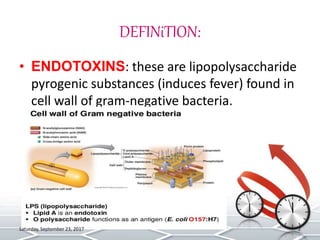
• ENDOTOXINS: these are lipopolysaccharide
pyrogenic substances (induces fever) found in
cell wall of gram-negative bacteria.
Saturday, September 23, 2017 2
• BACTERIAL ENDOTOXIN TEST: To
detect and quantify the endotoxins from
gram-negative bacterial origin using
amoebocyte lysate from horseshoe
crab(limulus polyphemus and tachypleus
tridentatus,tachypleus gigas,carcinoscropius
rotundicauda)
• Sterilization does not remove any endotoxins
as they are heat stable.
DEFINiTION:
Saturday, September 23, 2017 3
“Why” ????
To protect against adverse reactions
(sepsis) in humans and animals
FDA and USP guidelines require final product
testing on all parenterals and medical devices
To safeguard against diminished effectiveness
of a product due to endotoxin
Saturday, September 23, 2017 4
• APPARATUS:
• Depyrogenated
• Free of detectable endototxins
• Should not interfere with test
• REAGENTS AND TESTS SOLUTIONS:
• Amoebocyte lysate : Lyophilised
product-lysate of amoebocytes-horseshoe
crab (limulus polyphemus or tachypleus
tridentatus).
• Water for Bacterial Endotoxins
Test: Use water for injection
• Lysate TS: Dissolve Amoebocyte lysate in
water for BET or in buffer recommended
by lysate manufacturer.
• [ Note:use lysate TS having
sensitivity of NLT-0.15
Endotoxin Unit per mL]
Temperature-
250 degrees
Time-30 min’s
Saturday, September 23, 2017 5
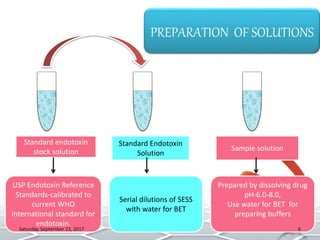
Standard endotoxin
stock solution
USP Endotoxin Reference
Standards-calibrated to
current WHO
international standard for
endotoxin.
Standard Endotoxin
Solution
Serial dilutions of SESS
with water for BET
Sample solution
Prepared by dissolving drug
pH-6.0-8.0,
Use water for BET for
preparing buffers
PREPARATION OF SOLUTIONS
Saturday, September 23, 2017 6
Determination of maximum valid dilution [mvd]
• It is max. allowable dilution at which endotoxin limit can be determined
• Endotoxin limit-for parentals =K/M where K is threshold pyrogenic dose of
endotoxin per Kg of body weight & M is maximum total dose of product per
Kg of body weight
EU/mL ,EU/mg ,EU/unit of biological activity
• Product concentration –mg/mL [in weight-EU/mg]
Endotoxin limit *product concentration
Lysate sensitivity
MVD=
Saturday, September 23, 2017 7
• V-Maximum dose in mL
• For drugs administrated per square meter of body surface
(Anticancer drugs)-K is EU/m2
Drugs
Radiopharmaceutical
s-formula
Route of administration
K-
(EU/mg)
5
0.2
175(EU/V)
14(EU/V)
Any –Except intrathecal
route
Intrathecal
Determination of maximum valid dilution [mvd]
Saturday, September 23, 2017 8
TESTS
Techinques
Gel formation
Turbidity formation-
cleavage of an
endogenous
substrate
Colour
formation-
cleavage of
synthetic
peptide
chromogenic
complex
chromogenic Gel-cloth
turbidity
metric
Saturday, September 23, 2017 9
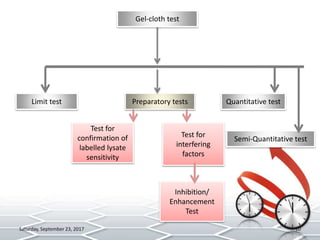
Gel-cloth test
Preparatory tests
Inhibition/
Enhancement
Test
Test for
confirmation of
labelled lysate
sensitivity
Test for
interfering
factors
Limit test Quantitative test
Semi-Quantitative test
Saturday, September 23, 2017 10
Gel-cloth technique
• The gel-clot technique is used for detecting or quantifying endotoxins
based on clotting of the lysate reagent in test tubes in the presence of
endotoxin. The minimum concentration of endotoxin required to cause
the lysate to clot under standard conditions is the labeled sensitivity of
the lysate reactivity .
• To ensure both the precision and validity of the test perform the tests
for confirming the labeled lysate sensitivity and for interfering factors.
Saturday, September 23, 2017 11
1.Preparatory testing
1.Confirmation of labelled lysate sensitivity:
Confirm in 4 replicates –labelled sensitivity( ) - [EU/mL ].
2 1 0.5 0.25 Prepare standard solutions of
at least 4 concentrations
equivalent to 2λ, λ, 0.5λ and
0.25λ by diluting the standard
endotoxin stock solution with
water for BET+0.1mL lysate TS
Transfer to vials-
incubate 37 ± 1°
for 60 ± 2 min)
To test integrity of
gel-invert 180
degrees in one
smooth motion
Positive
Negative
Saturday, September 23, 2017 12
Saturday, September 23, 2017 13
• Test is valid –low concentration endotoxin standard solution –
negative results
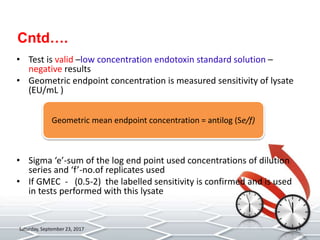
• Geometric endpoint concentration is measured sensitivity of lysate
(EU/mL )
• Sigma ‘e’-sum of the log end point used concentrations of dilution
series and ‘f’-no.of replicates used
• If GMEC - (0.5-2) the labelled sensitivity is confirmed and is used
in tests performed with this lysate
Geometric mean endpoint concentration = antilog (Se/f)
Cntd….
Saturday, September 23, 2017 14
Procedure is
same for
remaining all
tests as that
of
confirmation
of lysate
procedure.
Saturday, September 23, 2017 15
2.Test for interfering
factors
Saturday, September 23, 2017 16
Cntd….
• Perform inhibition & enchancemant test on the sample solutions at
dilution less than MVD
• Repeated when any conditional changes influence the results of
test.
• The test is valid –
• 1. All replicates of solution A & D –no reaction
• 2.solution C-confirms the labelled sensitivity
• 3.solution B-0.5-2 labelled sensitivity-indicates no interfers
• If test not complied use greater dilution not exceeding MVD
• Interference can be removed by neutralisation,dialysis,
filtering and dialysis.
Saturday, September 23, 2017 17
2.Limit test
Saturday, September 23, 2017 18
Cntd….
• Test is valid-
• 1. two replicates solutions of B&C-positive
• 2.two replicates solutions of D-negative
• 3.two replicates solutions of A-negative(comply the test)
• If positive in the case of A than repeat the test
• If test doesn’t complied with dilution less than MVD, repeat the test
using greater dilution not exceeding MVD.
Saturday, September 23, 2017 19
3.Quantitative test
Saturday, September 23, 2017 20
Cntd….
• INTERPRETATION:
• The test quantifies the bacterial endotoxins in sample solution
• The test is valid-
• 1.Both replicates of negative control solution D are negative
• 2.Both replicates of positive product control solution B are
positive
3.GMEC concentration of solution C-0.5-2
• The endotoxin concentration in the sample solution is endpoint
concentration of replicates,so endpoint concentration can be
calculate by multiplying the endpoint dilution factor by
labelled sensitivity.
• The test is considered as valid when endotoxin concentration
in the both replicates is less than that specified in
individual monograph.
Saturday, September 23, 2017 21
Photometric quantitative technique
Turbidimetric technique Chromogenic technique
Endpoint-turbidimetric assay
Kinetic-turbidimetric assay
Endpoint-chromogenic assay
Kinetic-chromogenic assay
Saturday, September 23, 2017 22
1.Turbidimetric technique
• Measures the reactant turbidity
• The endpoint –turbidimetric assay is based on the quantitative
relationship between the concentration of endotoxins and turbidity
(absorbance or transmission) of the reaction mixture at the end of
incubation period.
• The kinetic-turbidimetric assay is a method to measure the either
the time needed to reach a predetermined absorbance or
transmission of a reaction mixture or rate of turbidity
development,this test is carried out at incubation temperature
recommended by lysate manufacture (37 ± 1°) .
Saturday, September 23, 2017 23
2.Chromogenic technique
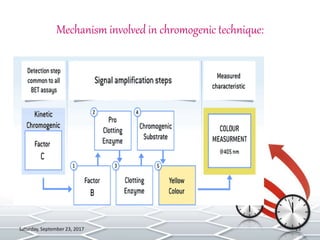
• Measures the chromophore released from the suitable
chromogenic peptide by the reaction of endotoxins with lysate.
• The endpoint-chromogenic assay is based on the quantitative
relationship between the concentration of endotoxins and release
of chromophore at the end of an incubation period.
• The kinetic-chromogenic assay is a method to measure either time
(onset time) needed to reach a predetermined absorbance of a
reaction mixture or a rate of color development- (37 ± 1°) .
Saturday, September 23, 2017 24
Mechanism involved in chromogenic technique:
Saturday, September 23, 2017 25
3.Preparatory testing
1.To assure precision or validity of turbidimetric and
chromogenic tests.
2.To assure criteria for standard curve is statisfied and test
solution doesn’t interfere with test.
3.Any changes in experimental conditions
influence –results of test .
Saturday, September 23, 2017 26
1.Assurance of criteria for
standard curve:
• Prepare atleast 3 endotoxins concentrations to generate standard curve
using standard endotoxins solutions.
• Perform test using atleast 3 replicates of each standard endotoxin
solutions.
• If desired range >2 in kinetic methods than additional standards included
to bracket –each log increase in the range of standard curve.
• The absolute value of ‘r’ should be = or > than 0.980.
2.Testing for interfering factors:
• select an endotoxin concentration at or near the middle of
standard endotoxin curve.
• Prepare solutions A,B,C,&D as per below table .perform
the tests on atleast 2 replicates of these solutions.
Saturday, September 23, 2017 27
Saturday, September 23, 2017
28
Calculation:
1.Calculate - mean recovery of the added endotoxin by subtracting
the mean endotoxin concentration in the solution from the solution
containing the added endotoxin concentration.
2. The test solution - free of interfering factors the measured
concentration of the endotoxin added to the test solution is - 50-
200 per cent of the known added endotoxin concentration, after
subtraction of any endotoxin detected in the solution without
added endotoxin.
3. When the endotoxin recovery is out of the specified ranges, the
interfering factors must be removed as described in
the section Gel-clot technique, under
(i) Preparatory testing, (ii)Testforinterferingfactors.
Saturday, September 23, 2017 29
Interpretation:
• The preparation being examined complies with the
test if the mean endotoxin concentration of the
replicates of solution A, after correction for dilution
and concentration, is less than the endotoxin limit for
the product.
Saturday, September 23, 2017 30
References:
Saturday, September 23, 2017 31
Saturday, September 23, 2017 32

Bacterial Endotoxins test

  • 1.
  • 2.
    DEFINiTION: • ENDOTOXINS: theseare lipopolysaccharide pyrogenic substances (induces fever) found in cell wall of gram-negative bacteria. Saturday, September 23, 2017 2
  • 3.
    • BACTERIAL ENDOTOXINTEST: To detect and quantify the endotoxins from gram-negative bacterial origin using amoebocyte lysate from horseshoe crab(limulus polyphemus and tachypleus tridentatus,tachypleus gigas,carcinoscropius rotundicauda) • Sterilization does not remove any endotoxins as they are heat stable. DEFINiTION: Saturday, September 23, 2017 3
  • 4.
    “Why” ???? To protectagainst adverse reactions (sepsis) in humans and animals FDA and USP guidelines require final product testing on all parenterals and medical devices To safeguard against diminished effectiveness of a product due to endotoxin Saturday, September 23, 2017 4
  • 5.
    • APPARATUS: • Depyrogenated •Free of detectable endototxins • Should not interfere with test • REAGENTS AND TESTS SOLUTIONS: • Amoebocyte lysate : Lyophilised product-lysate of amoebocytes-horseshoe crab (limulus polyphemus or tachypleus tridentatus). • Water for Bacterial Endotoxins Test: Use water for injection • Lysate TS: Dissolve Amoebocyte lysate in water for BET or in buffer recommended by lysate manufacturer. • [ Note:use lysate TS having sensitivity of NLT-0.15 Endotoxin Unit per mL] Temperature- 250 degrees Time-30 min’s Saturday, September 23, 2017 5
  • 6.
    Standard endotoxin stock solution USPEndotoxin Reference Standards-calibrated to current WHO international standard for endotoxin. Standard Endotoxin Solution Serial dilutions of SESS with water for BET Sample solution Prepared by dissolving drug pH-6.0-8.0, Use water for BET for preparing buffers PREPARATION OF SOLUTIONS Saturday, September 23, 2017 6
  • 7.
    Determination of maximumvalid dilution [mvd] • It is max. allowable dilution at which endotoxin limit can be determined • Endotoxin limit-for parentals =K/M where K is threshold pyrogenic dose of endotoxin per Kg of body weight & M is maximum total dose of product per Kg of body weight EU/mL ,EU/mg ,EU/unit of biological activity • Product concentration –mg/mL [in weight-EU/mg] Endotoxin limit *product concentration Lysate sensitivity MVD= Saturday, September 23, 2017 7
  • 8.
    • V-Maximum dosein mL • For drugs administrated per square meter of body surface (Anticancer drugs)-K is EU/m2 Drugs Radiopharmaceutical s-formula Route of administration K- (EU/mg) 5 0.2 175(EU/V) 14(EU/V) Any –Except intrathecal route Intrathecal Determination of maximum valid dilution [mvd] Saturday, September 23, 2017 8
  • 9.
    TESTS Techinques Gel formation Turbidity formation- cleavageof an endogenous substrate Colour formation- cleavage of synthetic peptide chromogenic complex chromogenic Gel-cloth turbidity metric Saturday, September 23, 2017 9
  • 10.
    Gel-cloth test Preparatory tests Inhibition/ Enhancement Test Testfor confirmation of labelled lysate sensitivity Test for interfering factors Limit test Quantitative test Semi-Quantitative test Saturday, September 23, 2017 10
  • 11.
    Gel-cloth technique • Thegel-clot technique is used for detecting or quantifying endotoxins based on clotting of the lysate reagent in test tubes in the presence of endotoxin. The minimum concentration of endotoxin required to cause the lysate to clot under standard conditions is the labeled sensitivity of the lysate reactivity . • To ensure both the precision and validity of the test perform the tests for confirming the labeled lysate sensitivity and for interfering factors. Saturday, September 23, 2017 11
  • 12.
    1.Preparatory testing 1.Confirmation oflabelled lysate sensitivity: Confirm in 4 replicates –labelled sensitivity( ) - [EU/mL ]. 2 1 0.5 0.25 Prepare standard solutions of at least 4 concentrations equivalent to 2λ, λ, 0.5λ and 0.25λ by diluting the standard endotoxin stock solution with water for BET+0.1mL lysate TS Transfer to vials- incubate 37 ± 1° for 60 ± 2 min) To test integrity of gel-invert 180 degrees in one smooth motion Positive Negative Saturday, September 23, 2017 12
  • 13.
  • 14.
    • Test isvalid –low concentration endotoxin standard solution – negative results • Geometric endpoint concentration is measured sensitivity of lysate (EU/mL ) • Sigma ‘e’-sum of the log end point used concentrations of dilution series and ‘f’-no.of replicates used • If GMEC - (0.5-2) the labelled sensitivity is confirmed and is used in tests performed with this lysate Geometric mean endpoint concentration = antilog (Se/f) Cntd…. Saturday, September 23, 2017 14
  • 15.
    Procedure is same for remainingall tests as that of confirmation of lysate procedure. Saturday, September 23, 2017 15
  • 16.
  • 17.
    Cntd…. • Perform inhibition& enchancemant test on the sample solutions at dilution less than MVD • Repeated when any conditional changes influence the results of test. • The test is valid – • 1. All replicates of solution A & D –no reaction • 2.solution C-confirms the labelled sensitivity • 3.solution B-0.5-2 labelled sensitivity-indicates no interfers • If test not complied use greater dilution not exceeding MVD • Interference can be removed by neutralisation,dialysis, filtering and dialysis. Saturday, September 23, 2017 17
  • 18.
  • 19.
    Cntd…. • Test isvalid- • 1. two replicates solutions of B&C-positive • 2.two replicates solutions of D-negative • 3.two replicates solutions of A-negative(comply the test) • If positive in the case of A than repeat the test • If test doesn’t complied with dilution less than MVD, repeat the test using greater dilution not exceeding MVD. Saturday, September 23, 2017 19
  • 20.
  • 21.
    Cntd…. • INTERPRETATION: • Thetest quantifies the bacterial endotoxins in sample solution • The test is valid- • 1.Both replicates of negative control solution D are negative • 2.Both replicates of positive product control solution B are positive 3.GMEC concentration of solution C-0.5-2 • The endotoxin concentration in the sample solution is endpoint concentration of replicates,so endpoint concentration can be calculate by multiplying the endpoint dilution factor by labelled sensitivity. • The test is considered as valid when endotoxin concentration in the both replicates is less than that specified in individual monograph. Saturday, September 23, 2017 21
  • 22.
    Photometric quantitative technique Turbidimetrictechnique Chromogenic technique Endpoint-turbidimetric assay Kinetic-turbidimetric assay Endpoint-chromogenic assay Kinetic-chromogenic assay Saturday, September 23, 2017 22
  • 23.
    1.Turbidimetric technique • Measuresthe reactant turbidity • The endpoint –turbidimetric assay is based on the quantitative relationship between the concentration of endotoxins and turbidity (absorbance or transmission) of the reaction mixture at the end of incubation period. • The kinetic-turbidimetric assay is a method to measure the either the time needed to reach a predetermined absorbance or transmission of a reaction mixture or rate of turbidity development,this test is carried out at incubation temperature recommended by lysate manufacture (37 ± 1°) . Saturday, September 23, 2017 23
  • 24.
    2.Chromogenic technique • Measuresthe chromophore released from the suitable chromogenic peptide by the reaction of endotoxins with lysate. • The endpoint-chromogenic assay is based on the quantitative relationship between the concentration of endotoxins and release of chromophore at the end of an incubation period. • The kinetic-chromogenic assay is a method to measure either time (onset time) needed to reach a predetermined absorbance of a reaction mixture or a rate of color development- (37 ± 1°) . Saturday, September 23, 2017 24
  • 25.
    Mechanism involved inchromogenic technique: Saturday, September 23, 2017 25
  • 26.
    3.Preparatory testing 1.To assureprecision or validity of turbidimetric and chromogenic tests. 2.To assure criteria for standard curve is statisfied and test solution doesn’t interfere with test. 3.Any changes in experimental conditions influence –results of test . Saturday, September 23, 2017 26
  • 27.
    1.Assurance of criteriafor standard curve: • Prepare atleast 3 endotoxins concentrations to generate standard curve using standard endotoxins solutions. • Perform test using atleast 3 replicates of each standard endotoxin solutions. • If desired range >2 in kinetic methods than additional standards included to bracket –each log increase in the range of standard curve. • The absolute value of ‘r’ should be = or > than 0.980. 2.Testing for interfering factors: • select an endotoxin concentration at or near the middle of standard endotoxin curve. • Prepare solutions A,B,C,&D as per below table .perform the tests on atleast 2 replicates of these solutions. Saturday, September 23, 2017 27
  • 28.
  • 29.
    Calculation: 1.Calculate - meanrecovery of the added endotoxin by subtracting the mean endotoxin concentration in the solution from the solution containing the added endotoxin concentration. 2. The test solution - free of interfering factors the measured concentration of the endotoxin added to the test solution is - 50- 200 per cent of the known added endotoxin concentration, after subtraction of any endotoxin detected in the solution without added endotoxin. 3. When the endotoxin recovery is out of the specified ranges, the interfering factors must be removed as described in the section Gel-clot technique, under (i) Preparatory testing, (ii)Testforinterferingfactors. Saturday, September 23, 2017 29
  • 30.
    Interpretation: • The preparationbeing examined complies with the test if the mean endotoxin concentration of the replicates of solution A, after correction for dilution and concentration, is less than the endotoxin limit for the product. Saturday, September 23, 2017 30
  • 31.
  • 32.