Limulus Amoebocyte Lysate Test and its alternatives
1.
Professor & Head,Department of Pharmaceuti
St. Peter’s Institute of Pharmaceutical Sciences
Hanumakonda, Telangana, India.
The BACTERIAL
ENDOTOXIN TEST
(LAL Assay) and
its alternatives
2.
Introduction
1
The Bacterial EndotoxinTest, is another name for the Limulus amoebocyte
lysate [LAL] test.
The presence and concentration of bacterial endotoxins (pyrogens) in an
aqueous parenteral preparation are determined using this in vitro assay.
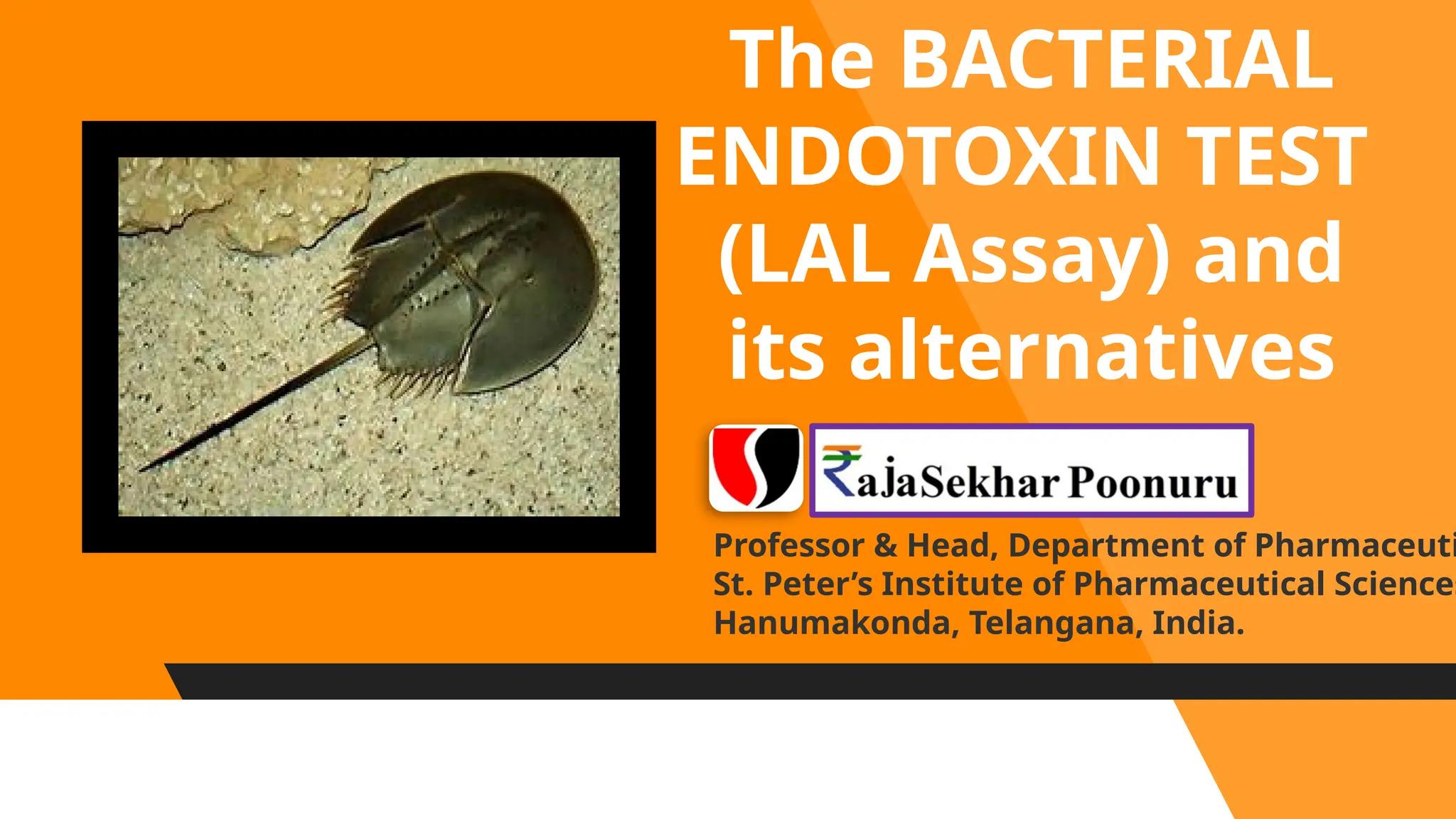
Limulus amoebocyte lysate (LAL) extracted from the blood of Limulus
polyphemus, a horse shoe crab.
The activated enzyme coagulase is created when the proenzyme in the LAL
reagent combines with the Gram-negative bacterial endotoxin
lipopolysaccharide (LPS).
Now, the activated enzyme (coagulase) hydrolyzes part of the bonds in the
coagulogen (clotting protein), which is also included in the LAL reagent.
3.
FDA-approved techniques toidentify clot type
generated.
2
1.The gel clot Method
2.Recombinant Factor C Test (rFC)
3.The spectrophotometric Method and
4.Chromogenic assay
4.
1. The gelclot Method
3
Based on the lysate reagent's ability to clot in test tubes
when endotoxins are present, the gel-clot technique is
used to detect endotoxins.
The lowest endotoxin concentration necessary for the
lysate to clot under typical circumstances.
It's a qualitative approach.
5.
2. Recombinant FactorC Test (rFC)
4
The solution fluoresces when the activated rFC enzyme cleaves a synthetic flu
orogenic
substrate in response to endotoxin's binding to recombinant Factor C
Without using horseshoe crabs, the recombinant Factor C test provides the
same level of dependability as LAL approach using a single enzymatic step.
The rFC assay has a sensitivity of 0.005 EU/mL and is performed using a
synthetic reagent which contains a recombinant form of Factor C that has
been constructed in vitro. The assay is not susceptible to false positives due
to beta-glucans, which come from cellulose and other plant-based products,
as the BETs are. As the rFC is synthetic, use of the rFC assay may result in a
more sustainable testing plan while also being more environmentally friendly
by helping reduce the need for the horseshoe crab blood.
6.
3. The spectrophotometricMethod
5
It is a photometric test that gauges the rise in turbidity
brought on by the endotoxin and lysate response.
In this context, a spectrophotometer is employed.
This process creates turbidity following the cleavage of
an endogenous substrate.
7.
4. Chromogenic assay
6
Developedby the chromophore and released by the
chromogenic substrate through the interaction with
endotoxin lysate, the chromogenic method is also a
photometric assay that measures colour.
The endotoxin concentration in the sample is determined
by measuring the reaction's colour using the
spectrophotometric technique.
A peptide linked to the yellow clottable coagulant p-
nitroaneline serves as the chromogenic reagent in this
8.
4. Chromogenic assaycontd..
7
There are typically two types of chromogenic techniques.
The Endpoint Chromatogenic Technique, which measures colour after
the LAL enzymatic reaction is complete.
The kinetic chromogenic technique which after adding the
chromogenic substrate to the test sample, measures the colour at
various points in time.
9.
Monocyte Activation Test(MAT)
8
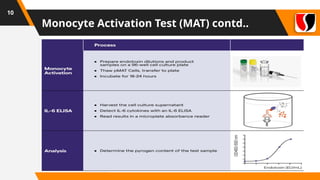
The MAT (Monocyte Activation Test) is a cellular based assay to detect
a broad range of pyrogens (both endotoxins and non-endotoxins) in
pharmaceutical products (e.g. vaccines, monoclonal antibodies,
hormone preparations).
It uses human immune cells and measures the immune reaction to
pyrogenic contaminations.
By incubating monocytes with the tested sample, the monocyte
activation test simulates the human immune response.
When pyrogens are present, monocytes get activated and release
cytokines, which are inflammatory chemicals that cause a fever.
CONCLUSION
11
21
The rabbit pyrogentest shows a lack of robustness as an
animal reaction can differ greatly from a human reaction.
In the LAL test, only endotoxins are detected causing a
safety risk by ignoring non-endotoxin pyrogens that could
be present in the tested sample.
Both endotoxins and non endotoxins can be detected by
MAT.
12.
References
1. D. Ogoina.Fever, fever patterns and diseases called ‘fever’—a review. J. Infect. Public Health(2011)
2. M.B. Gorbet et al. Endotoxin: the uninvited guest. Biomaterials. (2005)
3. Y. Rosenfeld et al. Lipopolysaccharide (Endotoxin)-host defense antibacterial peptides
interactions: role in bacterial resistance and prevention of sepsis. Biochim. Biophys. Acta (BBA)—
Biomembr (2006)
4. Y.C. Lu et al.LPS/TLR4 signal transduction pathway. Cytokine. (2008)
5. G. Lopez-Castejon et al. Understanding the mechanism of IL-1β secretion. Cytokine Growth Factor
Rev. (2011)
6. H.I. Nakamura et al. Recombinant human tumor necrosis factor causes long-lasting and
prostaglandin-mediated fever, with little tolerance, in rabbits. J. Pharmacol. Exp. Ther. (1988)
7. C. Popa et al. The role of TNF-α in chronic inflammatory conditions, intermediary metabolism, and
cardiovascular risk. J. Lipid Res.(2007).
8. M. Rincon. Interleukin-6: from an inflammatory marker to a target for inflammatory diseases.
Trends Immunol. (2012)
34
13.
22
THANK You!
Any questions?
Youcan find me at
yuppieraj@gmail.com &
contact me at +91-9949611237
Dr. Rajasekhar Reddy
Poonuru
Professor & Head, Department of
Pharmaceutics
St. Peter’s Institute of Pharmaceutical
Sciences, Hanumakonda

![Introduction
1
The Bacterial Endotoxin Test, is another name for the Limulus amoebocyte
lysate [LAL] test.
The presence and concentration of bacterial endotoxins (pyrogens) in an
aqueous parenteral preparation are determined using this in vitro assay.
Limulus amoebocyte lysate (LAL) extracted from the blood of Limulus
polyphemus, a horse shoe crab.
The activated enzyme coagulase is created when the proenzyme in the LAL
reagent combines with the Gram-negative bacterial endotoxin
lipopolysaccharide (LPS).
Now, the activated enzyme (coagulase) hydrolyzes part of the bonds in the
coagulogen (clotting protein), which is also included in the LAL reagent.](https://image.slidesharecdn.com/laltestanditsalternatives-250301040550-96db791f/85/Limulus-Amoebocyte-Lysate-Test-and-its-alternatives-2-320.jpg)





![PERI-PROSTHETIC FRACTURE NAIL-PLATE CONSTRUCT [NPC].pptx](https://cdn.slidesharecdn.com/ss_thumbnails/drarunkumardrmohamedashrafperiprostheticfrasturenail-plateconstructnpc-260209164459-7e9d15a1-thumbnail.jpg?width=640&height=640&fit=bounds)


