Download to read offline
![USP requirements
• LAL
• A lyophilized product obtained from the lysate of
amoebocytes (white blood cells) from the horseshoe crab
(Limulus polyphemus or Tachypleus tridentatus). This reagent
refers only to a product manufactured in accordance with the
regulations of the competent authority.
• [NOTE—AMOEBOCYTE LYSATE REACTS TO SOME Β-GLUCANS IN
ADDITION TO ENDOTOXINS. AMOEBOCYTE LYSATE PREPARATIONS
THAT DO NOT REACT TO GLUCANS ARE AVAILABLE: THEY ARE
PREPARED BY REMOVING THE G FACTOR REACTING TO GLUCANS
FROM AMOEBOCYTE LYSATE OR BY INHIBITING THE G FACTOR
REACTING SYSTEM OF AMOEBOCYTE LYSATE AND MAY BE USED
FOR ENDOTOXIN TESTING IN THE PRESENCE OF GLUCANS.]](https://image.slidesharecdn.com/bet-230519110334-2aef7dff/85/BET-pptx-6-320.jpg)
![USP requirements
• PREPARATION OF SOLUTIONS
• Standard Endotoxin Stock Solution
• A Standard Endotoxin Stock Solution is prepared from a USP Endotoxin Reference Standard that
has been calibrated to the current WHO International Standard for Endotoxin. Follow the
specifications in the package leaflet and on the label for preparation and storage of the Standard
Endotoxin Stock Solution. Endotoxin is expressed in Endotoxin Units (EU). [NOTE—ONE USP
ENDOTOXIN UNIT (EU) IS EQUAL TO ONE INTERNATIONAL UNIT (IU) OF ENDOTOXIN.]
• Standard Endotoxin Solutions
• After mixing the Standard Endotoxin Stock Solution vigorously, prepare appropriate serial dilutions
of Standard Endotoxin Solution, using Water for BET. Use dilutions as soon as possible to avoid
loss of activity by adsorption.](https://image.slidesharecdn.com/bet-230519110334-2aef7dff/85/BET-pptx-7-320.jpg)
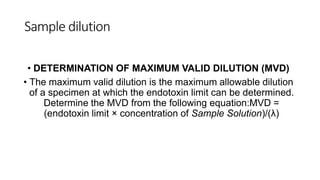
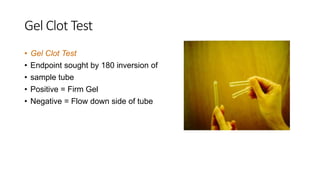
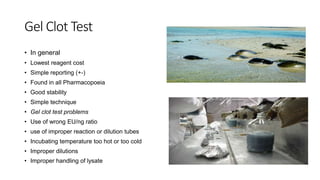
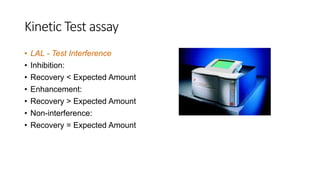

The document discusses the bacterial endotoxin test (BET) which uses the limulus amoebocyte lysate (LAL) from horseshoe crabs to detect endotoxins from gram-negative bacteria. The BET involves using LAL to detect endotoxins via gel clot tests or kinetic chromogenic/turbidimetric assays. Standards and sample solutions are prepared according to USP guidelines to determine if samples meet specified endotoxin limits. The kinetic LAL assays provide quantitative results while gel clot tests provide binary positive/negative results. Interference testing is also conducted to identify non-interfering sample dilutions for accurate BET results.


