Department of Sport & Exercise
                   Science


PRINSIP DAN PRESKRIPSI
 EVALUASI KECERGASAN
      (DKK 3104)
         Bab 7
 Latihan Rintangan
      Khairul Azlan Taib
      BSc .(hons) UiTM
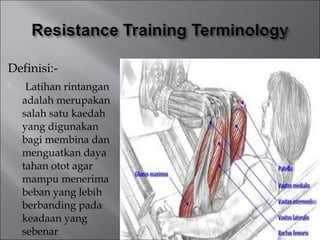
Definisi:-
  Latihan rintangan
  adalah merupakan
  salah satu kaedah
  yang digunakan
  bagi membina dan
  menguatkan daya
  tahan otot agar
  mampu menerima
  beban yang lebih
  berbanding pada
  keadaan yang
  sebenar
   Menguatkan otot.

   Meningkatkan daya tahan otot.

    Meningkatkan kepantasan dan kelajuan
    pergerakan.

    Meningkatkan kadar kestabilan dan
    koordinasi.
   Everyone can gain strength and
    endurance
   NOT everyone will improve to the same
    extent (genetic predisposition)
     Adaptations depend largely on the
      muscle fibers type distribution. Fast
      twitch muscle fibers adapt more readily.
• ↑ kepadatan otot
• ↑ kekuatan & kuasa
• mencegah osteoporasis
• mencegah sakit belakang & ketidak upayaan
   lain.
• ↑ insulin resistance,
• ↑ resting metabolic rate,
• ↑ glucose metabolism,
• ↓ blood pressure,
• ↓ body fat
Kelebihan FW

• kepelbagaian senaman
• keseimbangan otot
• kestabilan sendi
• pergerakan pelbagai arah
Kelebihan Weight Machines
• pengkhususan otot
• sesuai bagi atlet yg cedera
• mudah dipelajari
• lebih selamat
Melakukan julat pergerakan yang penuh
Isolation (pengasingan latihan)
Mengawal kelajuan pergerakan semasa latihan
Melakukan pernafasan yang betul
  Otot bekerja hembus nafas
  Otot dalam waktu rehat tarik nafas
Pastikan berat bar dikedua dua belah adalah sama.

Pastikan lifter menggunakan genggaman yg
seimbang.

Bantu lifter mengeluarkan bar drpd rak.

sentiasa bersedia utk membantu lifter sekiranya dia
hilang imbangan @ tidak mampu mengangkat lagi.

Bantu lifter untuk meletakkan bar ke rak semula.
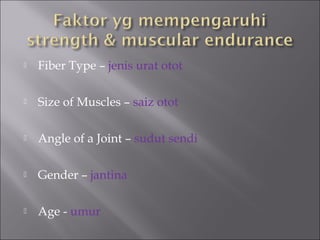
   Fiber Type – jenis urat otot

   Size of Muscles – saiz otot

   Angle of a Joint – sudut sendi

   Gender – jantina

   Age - umur
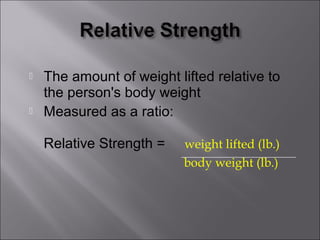
   The amount of weight lifted relative to
    the person's body weight
   Measured as a ratio:

    Relative Strength =    weight lifted (lb.)
                           body weight (lb.)
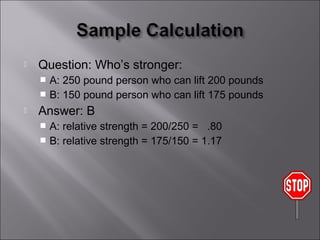
   Question: Who’s stronger:
     A: 250 pound person who can lift 200 pounds
     B: 150 pound person who can lift 175 pounds
   Answer: B
     A: relative strength = 200/250 = .80
     B: relative strength = 175/150 = 1.17
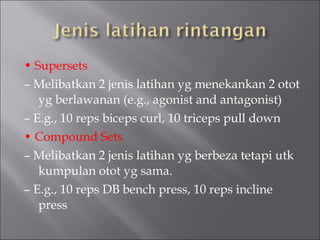
• Supersets
– Melibatkan 2 jenis latihan yg menekankan 2 otot
   yg berlawanan (e.g., agonist and antagonist)
– E.g., 10 reps biceps curl, 10 triceps pull down
• Compound Sets
– Melibatkan 2 jenis latihan yg berbeza tetapi utk
   kumpulan otot yg sama.
– E.g., 10 reps DB bench press, 10 reps incline
   press
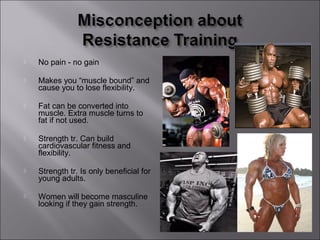
   No pain - no gain

   Makes you “muscle bound” and
    cause you to lose flexibility.

   Fat can be converted into
    muscle. Extra muscle turns to
    fat if not used.

   Strength tr. Can build
    cardiovascular fitness and
    flexibility.

   Strength tr. Is only beneficial for
    young adults.

   Women will become masculine
    looking if they gain strength.
¤   Warm up 10 minutes before workout and stay warm during workout.

¤   Do not hold breath while lifting .

¤   Avoids hyperventilation before lifting a weight.

¤   Avoids dangerous or high risk exercises and progress slowly

¤   Use good shoes with good traction

¤   Keep the weight close to the body

¤   When lifting from the floor, do not let the hips come up before your upper body.

¤   Overload but don’t overwhelm! A program that is too intense can cause injuries.

¤   Do not pause between repetition and keep a steady rhythm.
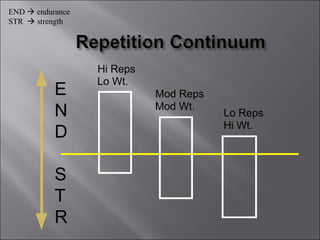
END  endurance
STR  strength


                  Hi Reps
                  Lo Wt.
           E                Mod Reps
                            Mod Wt.
           N                           Lo Reps
                                       Hi Wt.
           D

           S
           T
           R
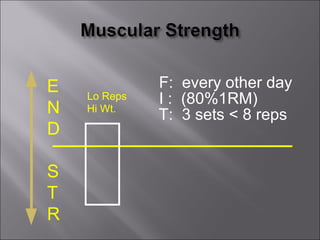
E             F: every other day
    Lo Reps   I : (80%1RM)
N   Hi Wt.
              T: 3 sets < 8 reps
D

S
T
R
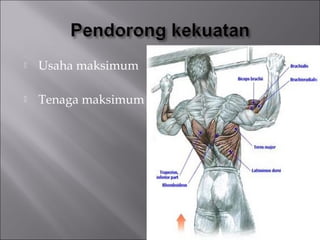
   Usaha maksimum

   Tenaga maksimum
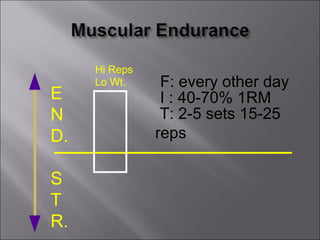
Hi Reps
     Lo Wt.     F: every other day
E               I : 40-70% 1RM
N               T: 2-5 sets 15-25
D.             reps

S
T
R.
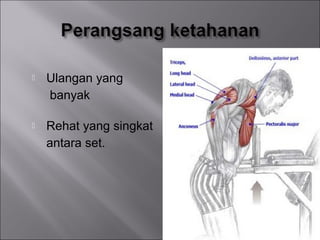
   Ulangan yang
    banyak

   Rehat yang singkat
    antara set.
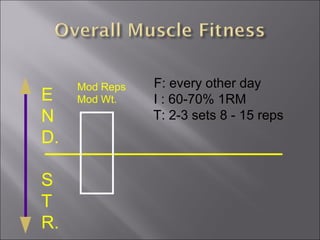
Mod Reps   F: every other day
E    Mod Wt.    I : 60-70% 1RM
N               T: 2-3 sets 8 - 15 reps
D.

S
T
R.
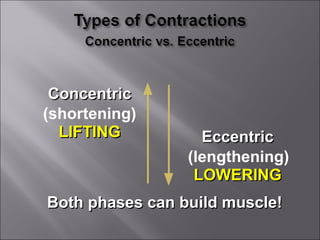
Concentric
(shortening)
  LIFTING          Eccentric
                 (lengthening)
                  LOWERING
Both phases can build muscle!
   • Choose a mode of exercise (free weights,
    band or machine) that is comfortable.
   • Perform 8 to 10 separate exercise that train
    the major muscle group (arms, shoulders,
    chest, abdomen, back, hips and legs)
   • Perform 1 set of each exercise to the point of
    volitional fatigue
   • Choose range of reps between 3 and 20 (e.g.,
    3 to 5, 8 to 10, 12 to 15) and moderate tempo
    (3:1:3)
   • Exercise each muscle group 2 to 3 non-
    consecutive d/wk.
   • Individuals primarily interested in
    developing muscular endurance as well as
    older (50 to 60 years or more frail) 10 to 15 reps
    may be more appropriate
   • Adhere as closely as possible to the specific
    techniques for performing a given exercise
   • Perform every exercise through full ROM
   • Perform both concentric and eccentric
    exercises in a controlled manner
   • Maintain a normal breathing pattern: breath-
    holding (valsalva maneuver) can induce
    excessive increase in BP
   • If possible, exercise with a training partner
    feedback, assistance & motivation
Age Related
Differences & their
Implications for RT
Potential Benefits

• ↑ kekuatan,ketahanan & kuasa otot.
• Mengelakkan kecederaan semasa bersukan & melakukan
   aktiviti rekreasi.
• Membantu menguatkan tulang.
• ↑ prestasi dalam sukan & aktiviti rekreasi.
• memupuk minat sukakan gaya hidup aktif@sihat.
• ↑ kesihatan & kecergasan.
• aktiviti altenatif bg mengelakkan perbuatan negatif.
• Social & personal benefits (self esteem, improving body
   image & self confidence)
Children under 7 years old.
   – Not permitted to engage in any resistance
    training activities with FW or any exercise
    devices/machines in facilities design for use of
    adults and adolescents.
Children between 7 – 14 years old.
   – Children who have reached a level of
    maturity, are allow to engage a specific RT
    activities with FW or any exercise
    devices/machines in facilities design for use of
    adults and adolescents.
   – Must be individually assessed
   – Greater degree of instruction & supervision
Children over 14 years old.
   – Are allow to engage a specific RT activities
    with FW or any exercise devices/machines in
    facilities design for use of adults and
    adolescents.
   – Greater degree of instruction & supervision
• Perform exercise in full range of motion
• Perform multi joint exercise as apposed to
  single joint
• Avoid repetitive used of maximal amount of
  weight
• Exercise must not be perform to near or severe
  muscle fatigue
• Limit strength training 2 times a week
Exercise strategies (high velocity training)
  should designed to increase muscle power
  (ACSM, 2000)

• Leg power is more important than strength for
  performing daily activities.
• However, participant need to develop general
  strength prior to power training.
Potential Benefits
• ↑ kekuatan otot
• ↑ kuasa
• Mengelakkan ketidakupayaan
• ↑ pergerakan
• ↓ kemurungan
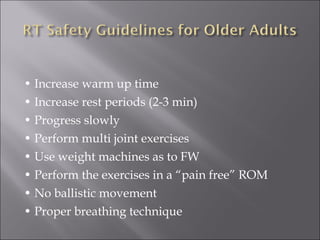
• Increase warm up time
• Increase rest periods (2-3 min)
• Progress slowly
• Perform multi joint exercises
• Use weight machines as to FW
• Perform the exercises in a “pain free” ROM
• No ballistic movement
• Proper breathing technique
Bab 7  latihan rintangan

Bab 7 latihan rintangan

  • 1.
    Department of Sport& Exercise Science PRINSIP DAN PRESKRIPSI EVALUASI KECERGASAN (DKK 3104) Bab 7 Latihan Rintangan Khairul Azlan Taib BSc .(hons) UiTM
  • 2.
    Definisi:-   Latihan rintangan adalah merupakan salah satu kaedah yang digunakan bagi membina dan menguatkan daya tahan otot agar mampu menerima beban yang lebih berbanding pada keadaan yang sebenar
  • 3.
    Menguatkan otot.  Meningkatkan daya tahan otot.   Meningkatkan kepantasan dan kelajuan pergerakan.   Meningkatkan kadar kestabilan dan koordinasi.
  • 4.
    Everyone can gain strength and endurance  NOT everyone will improve to the same extent (genetic predisposition)  Adaptations depend largely on the muscle fibers type distribution. Fast twitch muscle fibers adapt more readily.
  • 5.
    • ↑ kepadatanotot • ↑ kekuatan & kuasa • mencegah osteoporasis • mencegah sakit belakang & ketidak upayaan lain. • ↑ insulin resistance, • ↑ resting metabolic rate, • ↑ glucose metabolism, • ↓ blood pressure, • ↓ body fat
  • 6.
    Kelebihan FW • kepelbagaiansenaman • keseimbangan otot • kestabilan sendi • pergerakan pelbagai arah
  • 7.
    Kelebihan Weight Machines •pengkhususan otot • sesuai bagi atlet yg cedera • mudah dipelajari • lebih selamat
  • 8.
    Melakukan julat pergerakanyang penuh Isolation (pengasingan latihan) Mengawal kelajuan pergerakan semasa latihan Melakukan pernafasan yang betul Otot bekerja hembus nafas Otot dalam waktu rehat tarik nafas
  • 9.
    Pastikan berat bardikedua dua belah adalah sama. Pastikan lifter menggunakan genggaman yg seimbang. Bantu lifter mengeluarkan bar drpd rak. sentiasa bersedia utk membantu lifter sekiranya dia hilang imbangan @ tidak mampu mengangkat lagi. Bantu lifter untuk meletakkan bar ke rak semula.
  • 10.
    Fiber Type – jenis urat otot  Size of Muscles – saiz otot  Angle of a Joint – sudut sendi  Gender – jantina  Age - umur
  • 11.
    The amount of weight lifted relative to the person's body weight  Measured as a ratio: Relative Strength = weight lifted (lb.) body weight (lb.)
  • 12.
    Question: Who’s stronger:  A: 250 pound person who can lift 200 pounds  B: 150 pound person who can lift 175 pounds  Answer: B  A: relative strength = 200/250 = .80  B: relative strength = 175/150 = 1.17
  • 13.
    • Supersets – Melibatkan2 jenis latihan yg menekankan 2 otot yg berlawanan (e.g., agonist and antagonist) – E.g., 10 reps biceps curl, 10 triceps pull down • Compound Sets – Melibatkan 2 jenis latihan yg berbeza tetapi utk kumpulan otot yg sama. – E.g., 10 reps DB bench press, 10 reps incline press
  • 14.
    No pain - no gain  Makes you “muscle bound” and cause you to lose flexibility.  Fat can be converted into muscle. Extra muscle turns to fat if not used.  Strength tr. Can build cardiovascular fitness and flexibility.  Strength tr. Is only beneficial for young adults.  Women will become masculine looking if they gain strength.
  • 15.
    ¤ Warm up 10 minutes before workout and stay warm during workout. ¤ Do not hold breath while lifting . ¤ Avoids hyperventilation before lifting a weight. ¤ Avoids dangerous or high risk exercises and progress slowly ¤ Use good shoes with good traction ¤ Keep the weight close to the body ¤ When lifting from the floor, do not let the hips come up before your upper body. ¤ Overload but don’t overwhelm! A program that is too intense can cause injuries. ¤ Do not pause between repetition and keep a steady rhythm.
  • 16.
    END  endurance STR strength Hi Reps Lo Wt. E Mod Reps Mod Wt. N Lo Reps Hi Wt. D S T R
  • 17.
    E F: every other day Lo Reps I : (80%1RM) N Hi Wt. T: 3 sets < 8 reps D S T R
  • 18.
    Usaha maksimum  Tenaga maksimum
  • 19.
    Hi Reps Lo Wt. F: every other day E I : 40-70% 1RM N T: 2-5 sets 15-25 D. reps S T R.
  • 20.
    Ulangan yang banyak  Rehat yang singkat antara set.
  • 21.
    Mod Reps F: every other day E Mod Wt. I : 60-70% 1RM N T: 2-3 sets 8 - 15 reps D. S T R.
  • 22.
    Concentric (shortening) LIFTING Eccentric (lengthening) LOWERING Both phases can build muscle!
  • 23.
    • Choose a mode of exercise (free weights, band or machine) that is comfortable.  • Perform 8 to 10 separate exercise that train the major muscle group (arms, shoulders, chest, abdomen, back, hips and legs)  • Perform 1 set of each exercise to the point of volitional fatigue  • Choose range of reps between 3 and 20 (e.g., 3 to 5, 8 to 10, 12 to 15) and moderate tempo (3:1:3)
  • 24.
    • Exercise each muscle group 2 to 3 non- consecutive d/wk.  • Individuals primarily interested in developing muscular endurance as well as older (50 to 60 years or more frail) 10 to 15 reps may be more appropriate  • Adhere as closely as possible to the specific techniques for performing a given exercise  • Perform every exercise through full ROM
  • 25.
    • Perform both concentric and eccentric exercises in a controlled manner  • Maintain a normal breathing pattern: breath- holding (valsalva maneuver) can induce excessive increase in BP  • If possible, exercise with a training partner feedback, assistance & motivation
  • 26.
    Age Related Differences &their Implications for RT
  • 27.
    Potential Benefits • ↑kekuatan,ketahanan & kuasa otot. • Mengelakkan kecederaan semasa bersukan & melakukan aktiviti rekreasi. • Membantu menguatkan tulang. • ↑ prestasi dalam sukan & aktiviti rekreasi. • memupuk minat sukakan gaya hidup aktif@sihat. • ↑ kesihatan & kecergasan. • aktiviti altenatif bg mengelakkan perbuatan negatif. • Social & personal benefits (self esteem, improving body image & self confidence)
  • 28.
    Children under 7years old.  – Not permitted to engage in any resistance training activities with FW or any exercise devices/machines in facilities design for use of adults and adolescents.
  • 29.
    Children between 7– 14 years old.  – Children who have reached a level of maturity, are allow to engage a specific RT activities with FW or any exercise devices/machines in facilities design for use of adults and adolescents.  – Must be individually assessed  – Greater degree of instruction & supervision
  • 30.
    Children over 14years old.  – Are allow to engage a specific RT activities with FW or any exercise devices/machines in facilities design for use of adults and adolescents.  – Greater degree of instruction & supervision
  • 31.
    • Perform exercisein full range of motion • Perform multi joint exercise as apposed to single joint • Avoid repetitive used of maximal amount of weight • Exercise must not be perform to near or severe muscle fatigue • Limit strength training 2 times a week
  • 32.
    Exercise strategies (highvelocity training) should designed to increase muscle power (ACSM, 2000) • Leg power is more important than strength for performing daily activities. • However, participant need to develop general strength prior to power training.
  • 33.
    Potential Benefits • ↑kekuatan otot • ↑ kuasa • Mengelakkan ketidakupayaan • ↑ pergerakan • ↓ kemurungan
  • 34.
    • Increase warmup time • Increase rest periods (2-3 min) • Progress slowly • Perform multi joint exercises • Use weight machines as to FW • Perform the exercises in a “pain free” ROM • No ballistic movement • Proper breathing technique

Editor's Notes

  • #3 4 Review terminology: Reps = number of repetitions Sets = number of sets performed in the workout RM = Repetition Maximum = maximum weight that can be lifted a specified number of times. 1RM is the amount of weight that can be lifted 1 time. 10RM is the amount of weight that can be lifted 10 times in succession The 1RM amount is often used to calculate the correct amount of weight for training (i.e.. a certain percent of your 1RM max).
  • #5 Review the facts about resistance training and point out the illusion that everyone can develop huge muscles. Most people have body types and genetics that limit the capacity for this type of development.
  • #12 4 Discuss the concept of relative strength. An effective way is to ask students who is stronger Person A or Person B? Person A: Weighs 180 pounds and can lift 200 pounds Person B: Weighs 100 pounds and can lift 150 pounds Person B has more relative strength because he/she can lift more weight per pound of body weight than person A. When strength is relative to body weight or to Lean Body Mass females and males have nearly comparable strength. Therefore, the main reason that males are stronger than females is the amount of muscle mass.
  • #13 Go through sample calculation for relative strength. Students typically have difficult time with this type of calculation so it is worth covering.
  • #15 14 Go over each myth No Pain No Gain: You don&apos;t need to hurt to get benefits from exercise. The myth is based on overload principle which states that you must challenge your body to improve. Muscle Bound: Weight training can increase flexibility if through full ROM Fat converts into muscle Fat and muscle are separate tissues and you can&apos;t promote local fat loss by exercising a certain area. Muscle turns into fat if not used. A higher muscle mass causes a corresponding increase in BMR and total energy expenditure. Without training, muscle mass is lost. If a person ceases training and keeps eating the same amount, the extra calories are converted to fat. (Muscle does not turn into fat) Masculinizing Women won&apos;t develop same muscles as men because they do not have as much testosterone
  • #17 5 Diagram shows the repetition continuum Strength is developed with Hi weight / Lo reps Endurance is developed with Lo weights / Hi reps Review the concept so that students know that different gains will result from different types of training The following slides illustrate the concepts in greater detail and provide the FIT prescription for each type of program.
  • #18 6 Muscular Strength is best developed using heavy weights to maximally overload the muscles F: every other day (need time to rest) I: maximum weight (about 80% 1RM) T: 3 sets of 3-5 repetitions
  • #19 7 Review the stimulus for strength development - maximal exertion - maximal force
  • #20 8 Muscular endurance is best developed using low weights and high repetitions. F: every other day I: moderate intensity (40-70% 1RM) T: 2-5 sets with higher repetitions (15-25)
  • #21 9 Review stimulus for muscular endurance - higher number of repetitions - short rest intervals
  • #22 10 A general muscular fitness program should develop some strength and some endurance. The program should incorporate exercises for every major muscle group. Muscle imbalances can lead to injury and are not attractive (give example of Popeye - big arms, small legs) F: every other day (3x per week) I: 60-70% of 1 repetition maximum T: 2-3 sets of 8-15 repetitions
  • #23 20 Diagram shows that both phases of the lift can promote strength gains. By lifting in a slow and controlled manner you can increase the overload on the muscle and make quicker gains.