Dr.Ashish Phulkar
STRENGTH
 It is a psycho-physical ability that defines
performance and created by muscle tension
enabling to overcome relatively high
resistance. The force is produced by the
muscles which create movement and win over
resistance with the help of the joints and
system of bones.
 In the thickening of the muscles the period of
tension plays a crucial role while the measure
of tension depends on the number of
stimulated motor units and relates to the
magnitude of force exerted. (Harsanyi, 2001)
Introduction
 Strength training is the functional application
of Newton's second law of physics, which
defines force as the product of a mass and
its acceleration (Force = MA)
 strength is the ability to accelerate a mass
from a state of rest, which results in the
production of muscular force
 From a physiological perspective, strength is
the ability to activate muscle motor neurons and
their attached muscle fibers (together called a
motor unit) to generate the force necessary to
achieve a specific outcome.
 To achieve a strength-based goal, it is
important to first define the specific type of
strength required for success and then design
an exercise program to develop that strength.
 The magnitude and rate of force production
are determined by the efficiency at which all
of the involved muscle motor units are
recruited.
 Both intramuscular coordination (the ability to
recruit all of the motor units within a specific
muscle) and intermuscular coordination (the
ability to have a number of different muscles
working together to generate a force) are
required to achieve optimal levels of
strength.
Five Factors That Determine
Strength
 No matter how hard you train, you may face
limitations when it comes to developing muscle
strength. Two people following the same diet
and training schedule may never achieve the
same level of strength. To understand why this
occurs, it's helpful to know how strength is
affected by external factors, over which you may
have no control.
 Genetics
 Training
 Gender
 Age
 Adrenaline
Genetics
 Although genetics can be overcome with hard
work and determination, there is no denying that
heredity plays at least some part in your athletic
strength and ability.
 You may inherit your grandfather's leaping skills
on the basketball court, or your mother's strong
athletic thighs, and this can give you a distinct
advantage over someone else who has no athletic
skills in the family tree.
 Atlas Sports Genetics even offers a test that
screens for the ACTN3 gene, which is linked to the
alpha-actinin-3 muscle protein associated with
high-speed, powerful muscle contractions
Training
 Training is an important factor in developing
strength and endurance in any sport or physical
challenge.
 If you don't continue to work the muscles on a
regular basis, you may lose the strength you built.
Returning to a sport or physical activity after an
extended absence, you may notice that you feel
weak and tired much sooner. Typically, with a little
perseverance, you can regain that strength.
Gender
 Although there are exceptions, gender also plays
a factor in strength.
 Certainly there are many females who are
measurably stronger than some men, but
generally speaking, the male physique is
genetically predisposed to having more muscle
tissue.
 A higher quantity of muscle can affect strength,
and it may even supersede muscle quality, notes
Chad Tackett, president of Global Health and
Fitness.
Age
 Age also has some influence over your level of
strength. As your body ages, muscle mass
begins to decrease.
 Leading an active lifestyle can preserve your
muscle tissue and physical strength well into
your golden years, but it cannot cure the natural
muscle deterioration that comes with aging.
Even with regular training, you may lose muscle
strength as you get older
Adrenaline
 As part of the body's innate fight or flight
response, adrenaline is a hormone secreted by
the adrenal glands during high-stress situations.
Adrenaline jump-starts the heart rate and
contracts blood vessels throughout the body to
increase blood flow to the muscles. Although the
effects may be temporary, adrenaline can give
your body a boost to power through a workout. In
rare cases, it has been known to give an
individual incredible strength and stamina.
Why Strength ?
 Strength training: Get stronger, leaner,
healthier
 Strength training is an important part of an
overall fitness program
 With a regular strength training program, you
can reduce your body fat, increase your lean
muscle mass and burn calories more efficiently.
Use it or lose it……..
 Muscle mass naturally diminishes with age. "If
you don't do anything to replace the lean
muscle you lose, you'll increase the percentage
of fat in your body,"
 says Edward Laskowski, M.D., a physical
medicine and rehabilitation specialist at Mayo
Clinic, Rochester, Minn., and co-director of the
Mayo Clinic Sports Medicine Center. “
 But strength training can help you preserve and
enhance your muscle mass — at any age."
Strength training also helps
you: Develop strong bones. By stressing your bones,
strength training increases bone density and reduces
the risk of osteoporosis.
 Control your weight. As you gain muscle, your body
gains a bigger "engine" to burn calories more
efficiently — which can result in weight loss. The
more toned your muscles, the easier it is to control
your weight.
 Reduce your risk of injury. Building muscle helps
protect your joints from injury. It also contributes to
better balance, which can help you maintain
independence as you age.
 Boost your stamina. As you get stronger, you won't
fatigue as easily.
Strength training also helps
you….
 Manage chronic conditions. Strength
training can reduce the signs and symptoms
of many chronic conditions, including arthritis,
back pain, depression, diabetes, obesity and
osteoporosis.
 Sharpen your focus. Some research
suggests that regular strength training helps
improve attention for older adults.
Types
of
Strengths
Types of Strength
 AGILE STRENGTH
 STRENGTH ENDURANCE
 EXPLOSIVE STRENGTH
 MAXIMUM STRENGTH
 RELATIVE STRENGTH
 SPEED STRENGTH
 STARTING STRENGTH
 FUNCTIONAL STRENGTH
AGILE STRENGTH
 The ability to decelerate, control and generate
muscle force in a multiplanar environment.
 Traditional strength training focuses on
producing a shortening muscle action to move
a load through a single plane of motion;
however, many tasks require the ability to
move a mass through gravity in multiple
planes of motion.
 Examples: Picking up and carrying a young
child, laundry basket or duffle bag
 AGILE STRENGTH…………………….
 BENEFITS
 Generate the force required to move objects from one location to
the next.
 Improve resiliency of muscle and connective tissue to reduce the
risk of injuries such as sprains or muscle pulls.
 Enhance performance of specific sports or activities of daily
living (ADLs).
 TRAINING STRATEGY
 Exercise selection: Multiplanar movements using a variety of free
weights (dumbbells, medicine balls, sandbags, etc.) or cable
machines
 Intensity: Low-to-moderate, approximately 50-75% of the
estimate 1 repetition maximum (1RM) for a particular exercise
 Reps: 12-15+
 Tempo: Variable speeds: slow to fast
 Sets: 2-5+
 Rest interval: 30-90 seconds
STRENGTH ENDURANCE
 The ability to maintain muscular contractions
or a consistent level of muscle force for
extended periods of time.
 Relies upon aerobic efficiency to supply
oxygen and nutrients to the working muscles
while removing metabolic waste.
 Examples: An endurance event like a 10K,
marathon or triathlon; doing yard work or
other vigorous household chores; high
volume bodybuilding-type training
 BENEFITS
 Maintain good postural stabilization for an extended
period of time.
 Improve the aerobic capacity of working muscles.
 Enhance ability to perform many functional tasks and
ADLs.
 TRAINING STRATEGY
 Exercise selection: Compound and single-joint
movements using a variety of equipment; body-weight
exercises
 Intensity: Low-to-moderate, approximately 40-80% of
1RM
 Reps: 10+
 Tempo: Consistent: slow to moderate
 Sets: 2-5+
 Rest interval: 30-60 seconds
EXPLOSIVE STRENGTH
 Produce a maximal amount of force in a minimal
amount of time; muscle lengthening followed by
rapid acceleration through the shortening phase.
Focus is on the speed of movement through a
range of motion (ROM).
 Explosive strength is based on the ability of the
contractile element to rapidly generate tension,
while power enhances the ability of elastic tissue
to minimize the transition time from lengthening
to shortening during the stretch-shorten cycle.
 Examples: Throwing a shot-put, Olympic lifts
such as the snatch and clean-and-jerk; quickly
moving out of the way of danger
 BENEFITS
 Improve the speed of motor unit recruitment and
enhance intramuscular coordination.
 Reduce reaction time.
 Improve the resiliency of muscle and connective
tissue.
 Activate type II muscle fibers.
 TRAINING STRATEGY
 Exercise selection: Compound and single-joint
movements using a variety of free weights
 Intensity: 40-75% 1RM
 Reps: 1-6
 Tempo: Fast as possible
 Sets: 2-5+
 Rest interval: 30-90 seconds
MAXIMUM STRENGTH
 The highest level of muscle force that can be
produced, maximum strength is the ability of a
muscle or specific group of muscles to recruit
and engage all motor units to generate maximal
tension against an external resistance.
 Requires high levels of neuromuscular efficiency
to enhance both intra- and intermuscular
coordination.
 Examples: Powerlifting, squat, deadlift and
bench press and strongman competitions
 BENEFITS
 Activate type II (fast twitch) muscle fibers capable of
generating high levels of force.
 Increase levels of muscle-building hormones.
 Increase bone density and strength.
 Improve performance in many sports and ADLs.
 TRAINING STRATEGY
 Exercise Selection: Compound and single-joint
movements using free weights or selectorized machines
 Intensity: 90-100% 1RM
 Reps: 1-4
 Tempo: Slow-to-fast (even though the lifter is attempting
to use maximum speed the weight is moving slowly)
 Sets: 3-4+
 Rest interval: 2-4 minutes
RELATIVE STRENGTH
 Amount of force generated per unit of bodyweight.
Can be increased by using all of the various types of
strength training to improve the magnitude of force
production while maintaining or reducing total body
mass.
 If neuromuscular efficiency and muscle force
production increase while maintaining a consistent
body mass, relative strength will increase.
 Example: Two women each weigh 154 pounds.
The first can do 4 pull-ups and dead lift 200 pounds,
while the second can do 8 pull-ups and deadlight
220 pounds. Therefore, the second woman is
capable of producing more force per pound of body
weight.
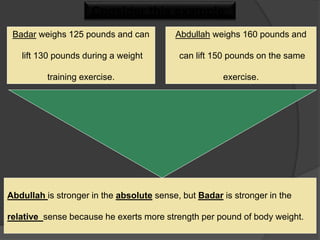
Consider this example:
Badar weighs 125 pounds and can
lift 130 pounds during a weight
training exercise.
Abdullah weighs 160 pounds and
can lift 150 pounds on the same
exercise.
Abdullah is stronger in the absolute sense, but Badar is stronger in the
relative sense because he exerts more strength per pound of body weight.
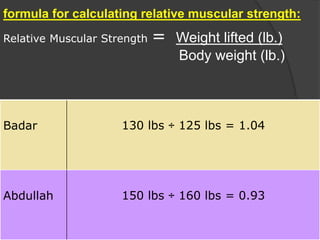
formula for calculating relative muscular strength:
Relative Muscular Strength = Weight lifted (lb.)
Body weight (lb.)
Badar 130 lbs ÷ 125 lbs = 1.04
Abdullah 150 lbs ÷ 160 lbs = 0.93
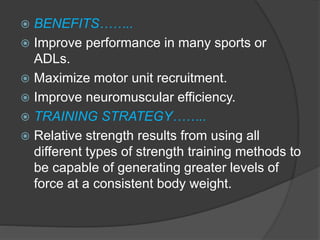
 BENEFITS……..
 Improve performance in many sports or
ADLs.
 Maximize motor unit recruitment.
 Improve neuromuscular efficiency.
 TRAINING STRATEGY……..
 Relative strength results from using all
different types of strength training methods to
be capable of generating greater levels of
force at a consistent body weight.
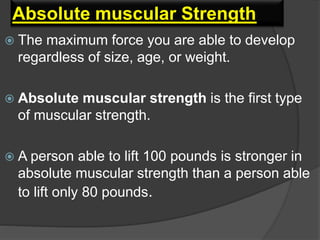
Absolute muscular Strength
 The maximum force you are able to develop
regardless of size, age, or weight.
 Absolute muscular strength is the first type
of muscular strength.
 A person able to lift 100 pounds is stronger in
absolute muscular strength than a person able
to lift only 80 pounds.
SPEED STRENGTH
 The maximal force capable of being produced
during a high-speed movement; trained with
either bodyweight or a minimal amount of
resistance, allowing the movement to be
executed as fast as possible.
 Examples: Throwing a baseball, swinging a
golf club, running a sprint
 BENEFITS
 Minimize reaction times.
 Enhance athletic performance.
 Reduce time of the stretch-shorten cycle.
 TRAINING STRATEGY
 Exercise selection: Compound movements using
a variety of free weights; unloaded body-weight
movements
 Intensity: 30-50% 1RM
 Reps: 1-6
 Tempo: Fast, explosive
 Sets: 2-6+
 Rest interval: 30 seconds - 2 minutes
STARTING STRENGTH
 Produce force at the beginning of a movement
without momentum or a pre-stretch to load
mechanical energy; start moving from a
stationary position
 An isometric contraction creates tension, which
allows the surrounding elastic fascia and
connective tissue to lengthen and store
mechanical energy for a rapid rate of force
production.
 Examples: A track start, a football linemen in his
stance before the ball is snapped, getting up
from a seated position
 BENEFITS
 Improve the ability of muscle and connective tissue to
increase the rate of force production.
 Reduce starting time for sports that require an athlete to
move from a stationary position.
 Enhance the ability to transition from seated to standing.
 TRAINING STRATEGY
 Exercise selection: Compound and single-joint movements
using a variety of types of resistance to focus on force
production in the initial ROM from a stationary position.
 Intensity: 50-90% 1RM
 Reps: 1-6
 Tempo: Fast, explosive
 Sets: 2-6+
 Rest interval: 45 seconds - 3 minutes

FUNCTIONAL STRENGTH
 Functional strength has a use or purpose
beyond the training itself, whether for sport,
fighting or life in general. It is characterized by
all-round strength, not just one type, and
generally goes hand-in-hand with good fitness
and conditioning.
 Functional strength training therefore includes
all the types of strength training identified
above: maximal, explosive and endurance.
 Functional training is defined as movements or
exercises that improve a person’s ability to
 complete their daily activities or to achieve a specific
goal.
 A quality program focuses on weak areas and sets
specific goals for the client. It is important to
understand
 how to progress someone from simple smaller
targeted movements to more complex multi joint
 movements. Training someone functionally can range
from having a tennis player lunge to a chop
 or a body builder do a slow curl for bigger biceps; its
all about the goal. Keep in mind performing
 complex movements before the client is ready will do
more harm than good.
 Proponents of functional strength often
incorporate objects from life, such as tyres,
sledgehammers and sandbags, to highlight
the functionality of the training.
 Trainees are encouraged to use whatever is
around them or build up their own gym at
home. Using one’s own bodyweight as
resistance is a key part of functional strength
training – what could be more convenient or
useful?
 Functional strength training is often used to
train fighters, soldiers and law enforcement
officers.
Methods of Strength
Training
 Simple Method or System
 Combination Method or System
 Super set system
 Pyramid Method
 Plyometrics
 Circuit Training

Concept of strength

  • 1.
  • 2.
    STRENGTH  It isa psycho-physical ability that defines performance and created by muscle tension enabling to overcome relatively high resistance. The force is produced by the muscles which create movement and win over resistance with the help of the joints and system of bones.  In the thickening of the muscles the period of tension plays a crucial role while the measure of tension depends on the number of stimulated motor units and relates to the magnitude of force exerted. (Harsanyi, 2001)
  • 3.
    Introduction  Strength trainingis the functional application of Newton's second law of physics, which defines force as the product of a mass and its acceleration (Force = MA)  strength is the ability to accelerate a mass from a state of rest, which results in the production of muscular force
  • 4.
     From aphysiological perspective, strength is the ability to activate muscle motor neurons and their attached muscle fibers (together called a motor unit) to generate the force necessary to achieve a specific outcome.  To achieve a strength-based goal, it is important to first define the specific type of strength required for success and then design an exercise program to develop that strength.
  • 5.
     The magnitudeand rate of force production are determined by the efficiency at which all of the involved muscle motor units are recruited.  Both intramuscular coordination (the ability to recruit all of the motor units within a specific muscle) and intermuscular coordination (the ability to have a number of different muscles working together to generate a force) are required to achieve optimal levels of strength.
  • 6.
    Five Factors ThatDetermine Strength  No matter how hard you train, you may face limitations when it comes to developing muscle strength. Two people following the same diet and training schedule may never achieve the same level of strength. To understand why this occurs, it's helpful to know how strength is affected by external factors, over which you may have no control.  Genetics  Training  Gender  Age  Adrenaline
  • 7.
    Genetics  Although geneticscan be overcome with hard work and determination, there is no denying that heredity plays at least some part in your athletic strength and ability.  You may inherit your grandfather's leaping skills on the basketball court, or your mother's strong athletic thighs, and this can give you a distinct advantage over someone else who has no athletic skills in the family tree.  Atlas Sports Genetics even offers a test that screens for the ACTN3 gene, which is linked to the alpha-actinin-3 muscle protein associated with high-speed, powerful muscle contractions
  • 8.
    Training  Training isan important factor in developing strength and endurance in any sport or physical challenge.  If you don't continue to work the muscles on a regular basis, you may lose the strength you built. Returning to a sport or physical activity after an extended absence, you may notice that you feel weak and tired much sooner. Typically, with a little perseverance, you can regain that strength.
  • 9.
    Gender  Although thereare exceptions, gender also plays a factor in strength.  Certainly there are many females who are measurably stronger than some men, but generally speaking, the male physique is genetically predisposed to having more muscle tissue.  A higher quantity of muscle can affect strength, and it may even supersede muscle quality, notes Chad Tackett, president of Global Health and Fitness.
  • 10.
    Age  Age alsohas some influence over your level of strength. As your body ages, muscle mass begins to decrease.  Leading an active lifestyle can preserve your muscle tissue and physical strength well into your golden years, but it cannot cure the natural muscle deterioration that comes with aging. Even with regular training, you may lose muscle strength as you get older
  • 11.
    Adrenaline  As partof the body's innate fight or flight response, adrenaline is a hormone secreted by the adrenal glands during high-stress situations. Adrenaline jump-starts the heart rate and contracts blood vessels throughout the body to increase blood flow to the muscles. Although the effects may be temporary, adrenaline can give your body a boost to power through a workout. In rare cases, it has been known to give an individual incredible strength and stamina.
  • 12.
    Why Strength ? Strength training: Get stronger, leaner, healthier  Strength training is an important part of an overall fitness program  With a regular strength training program, you can reduce your body fat, increase your lean muscle mass and burn calories more efficiently.
  • 13.
    Use it orlose it……..  Muscle mass naturally diminishes with age. "If you don't do anything to replace the lean muscle you lose, you'll increase the percentage of fat in your body,"  says Edward Laskowski, M.D., a physical medicine and rehabilitation specialist at Mayo Clinic, Rochester, Minn., and co-director of the Mayo Clinic Sports Medicine Center. “  But strength training can help you preserve and enhance your muscle mass — at any age."
  • 14.
    Strength training alsohelps you: Develop strong bones. By stressing your bones, strength training increases bone density and reduces the risk of osteoporosis.  Control your weight. As you gain muscle, your body gains a bigger "engine" to burn calories more efficiently — which can result in weight loss. The more toned your muscles, the easier it is to control your weight.  Reduce your risk of injury. Building muscle helps protect your joints from injury. It also contributes to better balance, which can help you maintain independence as you age.  Boost your stamina. As you get stronger, you won't fatigue as easily.
  • 15.
    Strength training alsohelps you….  Manage chronic conditions. Strength training can reduce the signs and symptoms of many chronic conditions, including arthritis, back pain, depression, diabetes, obesity and osteoporosis.  Sharpen your focus. Some research suggests that regular strength training helps improve attention for older adults.
  • 16.
  • 17.
    Types of Strength AGILE STRENGTH  STRENGTH ENDURANCE  EXPLOSIVE STRENGTH  MAXIMUM STRENGTH  RELATIVE STRENGTH  SPEED STRENGTH  STARTING STRENGTH  FUNCTIONAL STRENGTH
  • 18.
    AGILE STRENGTH  Theability to decelerate, control and generate muscle force in a multiplanar environment.  Traditional strength training focuses on producing a shortening muscle action to move a load through a single plane of motion; however, many tasks require the ability to move a mass through gravity in multiple planes of motion.  Examples: Picking up and carrying a young child, laundry basket or duffle bag
  • 19.
     AGILE STRENGTH……………………. BENEFITS  Generate the force required to move objects from one location to the next.  Improve resiliency of muscle and connective tissue to reduce the risk of injuries such as sprains or muscle pulls.  Enhance performance of specific sports or activities of daily living (ADLs).  TRAINING STRATEGY  Exercise selection: Multiplanar movements using a variety of free weights (dumbbells, medicine balls, sandbags, etc.) or cable machines  Intensity: Low-to-moderate, approximately 50-75% of the estimate 1 repetition maximum (1RM) for a particular exercise  Reps: 12-15+  Tempo: Variable speeds: slow to fast  Sets: 2-5+  Rest interval: 30-90 seconds
  • 20.
    STRENGTH ENDURANCE  Theability to maintain muscular contractions or a consistent level of muscle force for extended periods of time.  Relies upon aerobic efficiency to supply oxygen and nutrients to the working muscles while removing metabolic waste.  Examples: An endurance event like a 10K, marathon or triathlon; doing yard work or other vigorous household chores; high volume bodybuilding-type training
  • 21.
     BENEFITS  Maintaingood postural stabilization for an extended period of time.  Improve the aerobic capacity of working muscles.  Enhance ability to perform many functional tasks and ADLs.  TRAINING STRATEGY  Exercise selection: Compound and single-joint movements using a variety of equipment; body-weight exercises  Intensity: Low-to-moderate, approximately 40-80% of 1RM  Reps: 10+  Tempo: Consistent: slow to moderate  Sets: 2-5+  Rest interval: 30-60 seconds
  • 22.
    EXPLOSIVE STRENGTH  Producea maximal amount of force in a minimal amount of time; muscle lengthening followed by rapid acceleration through the shortening phase. Focus is on the speed of movement through a range of motion (ROM).  Explosive strength is based on the ability of the contractile element to rapidly generate tension, while power enhances the ability of elastic tissue to minimize the transition time from lengthening to shortening during the stretch-shorten cycle.  Examples: Throwing a shot-put, Olympic lifts such as the snatch and clean-and-jerk; quickly moving out of the way of danger
  • 24.
     BENEFITS  Improvethe speed of motor unit recruitment and enhance intramuscular coordination.  Reduce reaction time.  Improve the resiliency of muscle and connective tissue.  Activate type II muscle fibers.  TRAINING STRATEGY  Exercise selection: Compound and single-joint movements using a variety of free weights  Intensity: 40-75% 1RM  Reps: 1-6  Tempo: Fast as possible  Sets: 2-5+  Rest interval: 30-90 seconds
  • 25.
    MAXIMUM STRENGTH  Thehighest level of muscle force that can be produced, maximum strength is the ability of a muscle or specific group of muscles to recruit and engage all motor units to generate maximal tension against an external resistance.  Requires high levels of neuromuscular efficiency to enhance both intra- and intermuscular coordination.  Examples: Powerlifting, squat, deadlift and bench press and strongman competitions
  • 26.
     BENEFITS  Activatetype II (fast twitch) muscle fibers capable of generating high levels of force.  Increase levels of muscle-building hormones.  Increase bone density and strength.  Improve performance in many sports and ADLs.  TRAINING STRATEGY  Exercise Selection: Compound and single-joint movements using free weights or selectorized machines  Intensity: 90-100% 1RM  Reps: 1-4  Tempo: Slow-to-fast (even though the lifter is attempting to use maximum speed the weight is moving slowly)  Sets: 3-4+  Rest interval: 2-4 minutes
  • 27.
    RELATIVE STRENGTH  Amountof force generated per unit of bodyweight. Can be increased by using all of the various types of strength training to improve the magnitude of force production while maintaining or reducing total body mass.  If neuromuscular efficiency and muscle force production increase while maintaining a consistent body mass, relative strength will increase.  Example: Two women each weigh 154 pounds. The first can do 4 pull-ups and dead lift 200 pounds, while the second can do 8 pull-ups and deadlight 220 pounds. Therefore, the second woman is capable of producing more force per pound of body weight.
  • 28.
    Consider this example: Badarweighs 125 pounds and can lift 130 pounds during a weight training exercise. Abdullah weighs 160 pounds and can lift 150 pounds on the same exercise. Abdullah is stronger in the absolute sense, but Badar is stronger in the relative sense because he exerts more strength per pound of body weight.
  • 29.
    formula for calculatingrelative muscular strength: Relative Muscular Strength = Weight lifted (lb.) Body weight (lb.) Badar 130 lbs ÷ 125 lbs = 1.04 Abdullah 150 lbs ÷ 160 lbs = 0.93
  • 30.
     BENEFITS……..  Improveperformance in many sports or ADLs.  Maximize motor unit recruitment.  Improve neuromuscular efficiency.  TRAINING STRATEGY……..  Relative strength results from using all different types of strength training methods to be capable of generating greater levels of force at a consistent body weight.
  • 31.
    Absolute muscular Strength The maximum force you are able to develop regardless of size, age, or weight.  Absolute muscular strength is the first type of muscular strength.  A person able to lift 100 pounds is stronger in absolute muscular strength than a person able to lift only 80 pounds.
  • 32.
    SPEED STRENGTH  Themaximal force capable of being produced during a high-speed movement; trained with either bodyweight or a minimal amount of resistance, allowing the movement to be executed as fast as possible.  Examples: Throwing a baseball, swinging a golf club, running a sprint
  • 33.
     BENEFITS  Minimizereaction times.  Enhance athletic performance.  Reduce time of the stretch-shorten cycle.  TRAINING STRATEGY  Exercise selection: Compound movements using a variety of free weights; unloaded body-weight movements  Intensity: 30-50% 1RM  Reps: 1-6  Tempo: Fast, explosive  Sets: 2-6+  Rest interval: 30 seconds - 2 minutes
  • 34.
    STARTING STRENGTH  Produceforce at the beginning of a movement without momentum or a pre-stretch to load mechanical energy; start moving from a stationary position  An isometric contraction creates tension, which allows the surrounding elastic fascia and connective tissue to lengthen and store mechanical energy for a rapid rate of force production.  Examples: A track start, a football linemen in his stance before the ball is snapped, getting up from a seated position
  • 35.
     BENEFITS  Improvethe ability of muscle and connective tissue to increase the rate of force production.  Reduce starting time for sports that require an athlete to move from a stationary position.  Enhance the ability to transition from seated to standing.  TRAINING STRATEGY  Exercise selection: Compound and single-joint movements using a variety of types of resistance to focus on force production in the initial ROM from a stationary position.  Intensity: 50-90% 1RM  Reps: 1-6  Tempo: Fast, explosive  Sets: 2-6+  Rest interval: 45 seconds - 3 minutes 
  • 36.
    FUNCTIONAL STRENGTH  Functionalstrength has a use or purpose beyond the training itself, whether for sport, fighting or life in general. It is characterized by all-round strength, not just one type, and generally goes hand-in-hand with good fitness and conditioning.  Functional strength training therefore includes all the types of strength training identified above: maximal, explosive and endurance.
  • 37.
     Functional trainingis defined as movements or exercises that improve a person’s ability to  complete their daily activities or to achieve a specific goal.  A quality program focuses on weak areas and sets specific goals for the client. It is important to understand  how to progress someone from simple smaller targeted movements to more complex multi joint  movements. Training someone functionally can range from having a tennis player lunge to a chop  or a body builder do a slow curl for bigger biceps; its all about the goal. Keep in mind performing  complex movements before the client is ready will do more harm than good.
  • 38.
     Proponents offunctional strength often incorporate objects from life, such as tyres, sledgehammers and sandbags, to highlight the functionality of the training.  Trainees are encouraged to use whatever is around them or build up their own gym at home. Using one’s own bodyweight as resistance is a key part of functional strength training – what could be more convenient or useful?  Functional strength training is often used to train fighters, soldiers and law enforcement officers.
  • 39.
    Methods of Strength Training Simple Method or System  Combination Method or System  Super set system  Pyramid Method  Plyometrics  Circuit Training