
VIRAL
BIOPESTICIDES
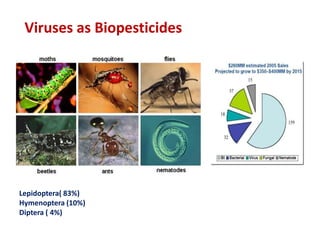
Viruses as Biopesticides


                    Vgydgwuy


Lepidoptera( 83%)
Hymenoptera (10%)
Diptera ( 4%)
Classification
• Baculoviruses


Nuclear Polyhedrosis    Granulosis Virus
      Virus

•  Nucleic acid-single molecule of circular super
   coiled DNA
• Virion structurally complex with 10 -25
  polypeptides 4-11 associated with nucleocapsid
• Replication in host cell nuclei


• Cytoplasm Polyhedrosis
  Virus
Nuclear Polyhedrosis Virus
• 41% of arthropod viruses develop in host cell
nuclei, virions occluded singly/groups in
polyhedral inclusion bodies.

• Rod shaped, double stranded; POBs 0.2-15µm in
diameter

• Highly host specific

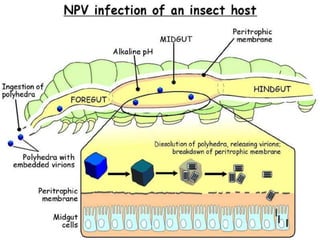
• Enters through injection of plant material into
insect gut through mouth &cuticle

• Symptoms are:
      - Discoloration (brown and yellow)
       -Stress
       -Decomposition (liquification)
      -Lethargy
      -Infected larvae hang invertedly from twigs
      - host will become visibly swollen with fluid
containing the virus and will eventually die
turning black with decay
Left: A larvae of H. armigera that died of NPV on chickpea plant in India; note
the characteristic hanging stance. Right: A larvae of H. armigera that died of NPV
on cotton plant in India; note the characteristic hanging stance.
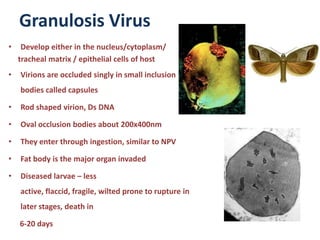
Granulosis Virus
•    Develop either in the nucleus/cytoplasm/
    tracheal matrix / epithelial cells of host
•   Virions are occluded singly in small inclusion
    bodies called capsules

•   Rod shaped virion, Ds DNA

•   Oval occlusion bodies about 200x400nm

•   They enter through ingestion, similar to NPV

•   Fat body is the major organ invaded

•   Diseased larvae – less
    active, flaccid, fragile, wilted prone to rupture in
    later stages, death in

    6-20 days
Western grapeleaf skeletonizer is a pest of grapes that periodically defoliates vineyards
Cytoplasm Polyhedrosis Virus
•   Develop only in cytoplam of host
    midgut epithelial cells
•   Virions occluded singly in polyhedral
    inclusion bodies, Ds RNA
•   Average diameter is 60nm
•   POBs range from 0.5-15µm in
    diameter
•   Infection confined to midgut and
    does not spread to other tissues
•   Infection not always lethal but shows
    larval growth reduction
•   Continuosly shed infective polyhedra
    in faeces
Heterocampa guttivitta larva infected with
cytoplasmic polyhedrosis virus (CPV)
Large Scale Production
• In vivo
  - applying the virus against the host insect in the field and collecting diseased or dead larvae


   -producing the target insect in the laboratory on an artificial diet


• In vitro
 - Baculovirus production in insect cell cultures
A clonal cell line Spex-II-A and a clonal cell line Hz-AM-1-1
infected with HaNPV, which established in the laboratory
Genetic Engineering
• Narrow Host Range

• Environmentally Safe, No Risk of Toxicity

• No Adverse Effects on Other Species, Insect
  Pollinators remain unharmed
Drawbacks
• Chemical Pesticides cause more effective reduction
  of insect population and better crop protection
• Viral pesticides require more involved monitoring
  system
• The number of application on a particular area is
  more than chemical pesticides
• Viral pesticides cannot be stored for longer periods
  of incubation
• Producers more comfortable and experienced with
  use of chemical pesticides- marketing problems
References
• Baculoviruses as biopesticides
 -Seema Mishra (Eukaryotic Gene Expression Laboratory, National Institute of
   Immunology, Aruna Asaf Ali Marg, New Delhi 110 067, India)
• Baculovirus Biopesticides
   -Boguslaw Szewczyk*, Marlinda Lobo de Souza, Maria Elita Batista de
   Castro, Mauricio Lara Moscardi and Flavio Moscardi (Department of
   Molecular Virology, University of Gdansk and Medical University of
   Gdansk)

www.biopesticideindustryalliance.org/microbialviruses.php

www.scribd.com/doc/78234955/22/b-3-Viral-Biopesticides

www.sciencedaily.com/releases/2010/08/100820133238.htm

Viral Biopesticides

  • 1.
  • 2.
    Viruses as Biopesticides Vgydgwuy Lepidoptera( 83%) Hymenoptera (10%) Diptera ( 4%)
  • 3.
    Classification • Baculoviruses Nuclear Polyhedrosis Granulosis Virus Virus • Nucleic acid-single molecule of circular super coiled DNA • Virion structurally complex with 10 -25 polypeptides 4-11 associated with nucleocapsid • Replication in host cell nuclei • Cytoplasm Polyhedrosis Virus
  • 4.
    Nuclear Polyhedrosis Virus •41% of arthropod viruses develop in host cell nuclei, virions occluded singly/groups in polyhedral inclusion bodies. • Rod shaped, double stranded; POBs 0.2-15µm in diameter • Highly host specific • Enters through injection of plant material into insect gut through mouth &cuticle • Symptoms are: - Discoloration (brown and yellow) -Stress -Decomposition (liquification) -Lethargy -Infected larvae hang invertedly from twigs - host will become visibly swollen with fluid containing the virus and will eventually die turning black with decay
  • 5.
    Left: A larvaeof H. armigera that died of NPV on chickpea plant in India; note the characteristic hanging stance. Right: A larvae of H. armigera that died of NPV on cotton plant in India; note the characteristic hanging stance.
  • 8.
    Granulosis Virus • Develop either in the nucleus/cytoplasm/ tracheal matrix / epithelial cells of host • Virions are occluded singly in small inclusion bodies called capsules • Rod shaped virion, Ds DNA • Oval occlusion bodies about 200x400nm • They enter through ingestion, similar to NPV • Fat body is the major organ invaded • Diseased larvae – less active, flaccid, fragile, wilted prone to rupture in later stages, death in 6-20 days
  • 9.
    Western grapeleaf skeletonizeris a pest of grapes that periodically defoliates vineyards
  • 10.
    Cytoplasm Polyhedrosis Virus • Develop only in cytoplam of host midgut epithelial cells • Virions occluded singly in polyhedral inclusion bodies, Ds RNA • Average diameter is 60nm • POBs range from 0.5-15µm in diameter • Infection confined to midgut and does not spread to other tissues • Infection not always lethal but shows larval growth reduction • Continuosly shed infective polyhedra in faeces
  • 11.
    Heterocampa guttivitta larvainfected with cytoplasmic polyhedrosis virus (CPV)
  • 13.
    Large Scale Production •In vivo - applying the virus against the host insect in the field and collecting diseased or dead larvae -producing the target insect in the laboratory on an artificial diet • In vitro - Baculovirus production in insect cell cultures
  • 14.
    A clonal cellline Spex-II-A and a clonal cell line Hz-AM-1-1 infected with HaNPV, which established in the laboratory
  • 16.
  • 17.
    • Narrow HostRange • Environmentally Safe, No Risk of Toxicity • No Adverse Effects on Other Species, Insect Pollinators remain unharmed
  • 18.
    Drawbacks • Chemical Pesticidescause more effective reduction of insect population and better crop protection • Viral pesticides require more involved monitoring system • The number of application on a particular area is more than chemical pesticides • Viral pesticides cannot be stored for longer periods of incubation • Producers more comfortable and experienced with use of chemical pesticides- marketing problems
  • 19.
    References • Baculoviruses asbiopesticides -Seema Mishra (Eukaryotic Gene Expression Laboratory, National Institute of Immunology, Aruna Asaf Ali Marg, New Delhi 110 067, India) • Baculovirus Biopesticides -Boguslaw Szewczyk*, Marlinda Lobo de Souza, Maria Elita Batista de Castro, Mauricio Lara Moscardi and Flavio Moscardi (Department of Molecular Virology, University of Gdansk and Medical University of Gdansk) www.biopesticideindustryalliance.org/microbialviruses.php www.scribd.com/doc/78234955/22/b-3-Viral-Biopesticides www.sciencedaily.com/releases/2010/08/100820133238.htm