Presented By-
Nischitha R.
1st M.Sc., 2nd Semester.
CONTENTS
• Introduction
• Types of mycorrhizae
• Mycorrhizal biofertilizer
• Applications of mycorrhizae
• Conclusion
• References
Introduction :
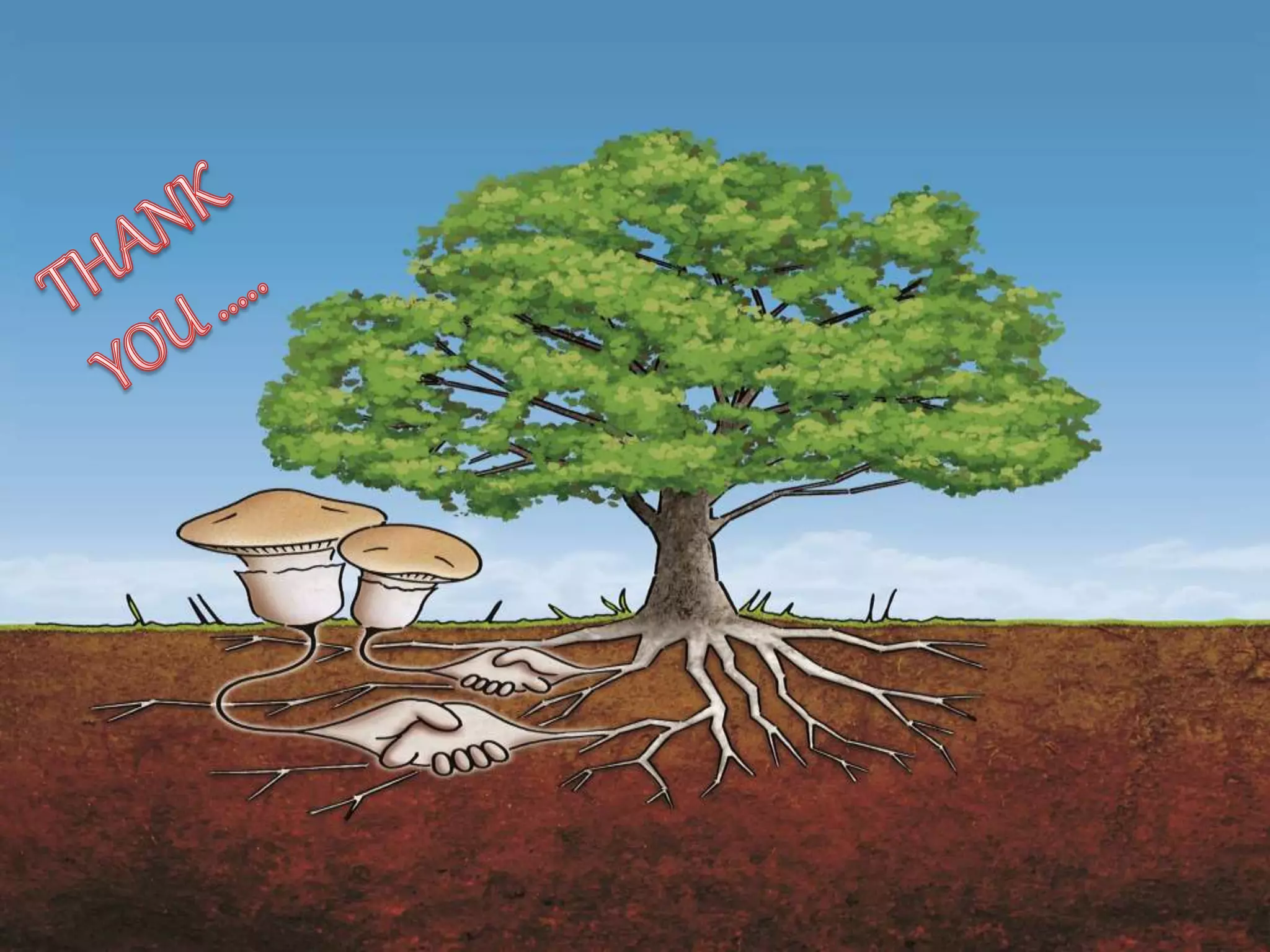
Mycorrhizae are mutualistic symbiotic associations
formed between the roots of higher plants and fungi.
It is an Greek word, mykes: mushroom or fungi; rhiza:
root.
Fungal roots were discovered by the German botanist
A B Frank in the last century (1855) in forest trees such
as pine.
In nature approximately 90% of plants are infected
with mycorrhizae. 83% Dicots,79% Monocots and 100%
Gymnosperms.
Convert insoluble form of phosphorous in soil into
soluble form.
Types of mycorrhizae :
On the basis of morphological and anatomical
features, mycorrhizae are divided into the three
types.
1. Endomycorrhizae
2. Ectomycorrhizae
3. Ectendomycorrhizae
Endomycorrhizae further classified in to five types.
1. VAM fungi (vesicular arbuscular mycorrhizae)
2. Orchidoid mycorrhizae
3. Monotropoid mycorrhizae
4. Ericoid Mycorrhizae
5. Arbutoid mycorrhizae
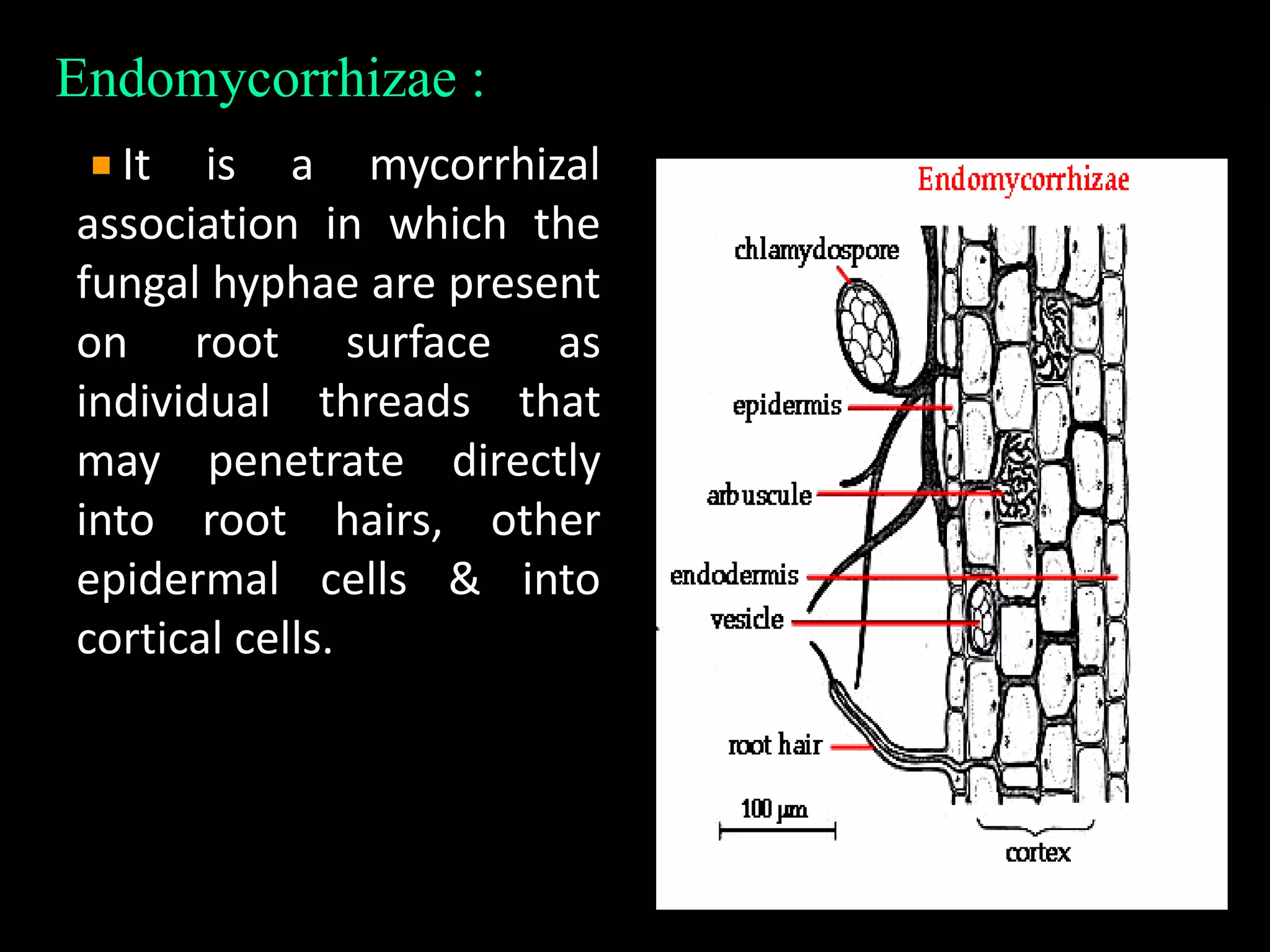
Endomycorrhizae :
It is a mycorrhizal
association in which the
fungal hyphae are present
on root surface as
individual threads that
may penetrate directly
into root hairs, other
epidermal cells & into
cortical cells.
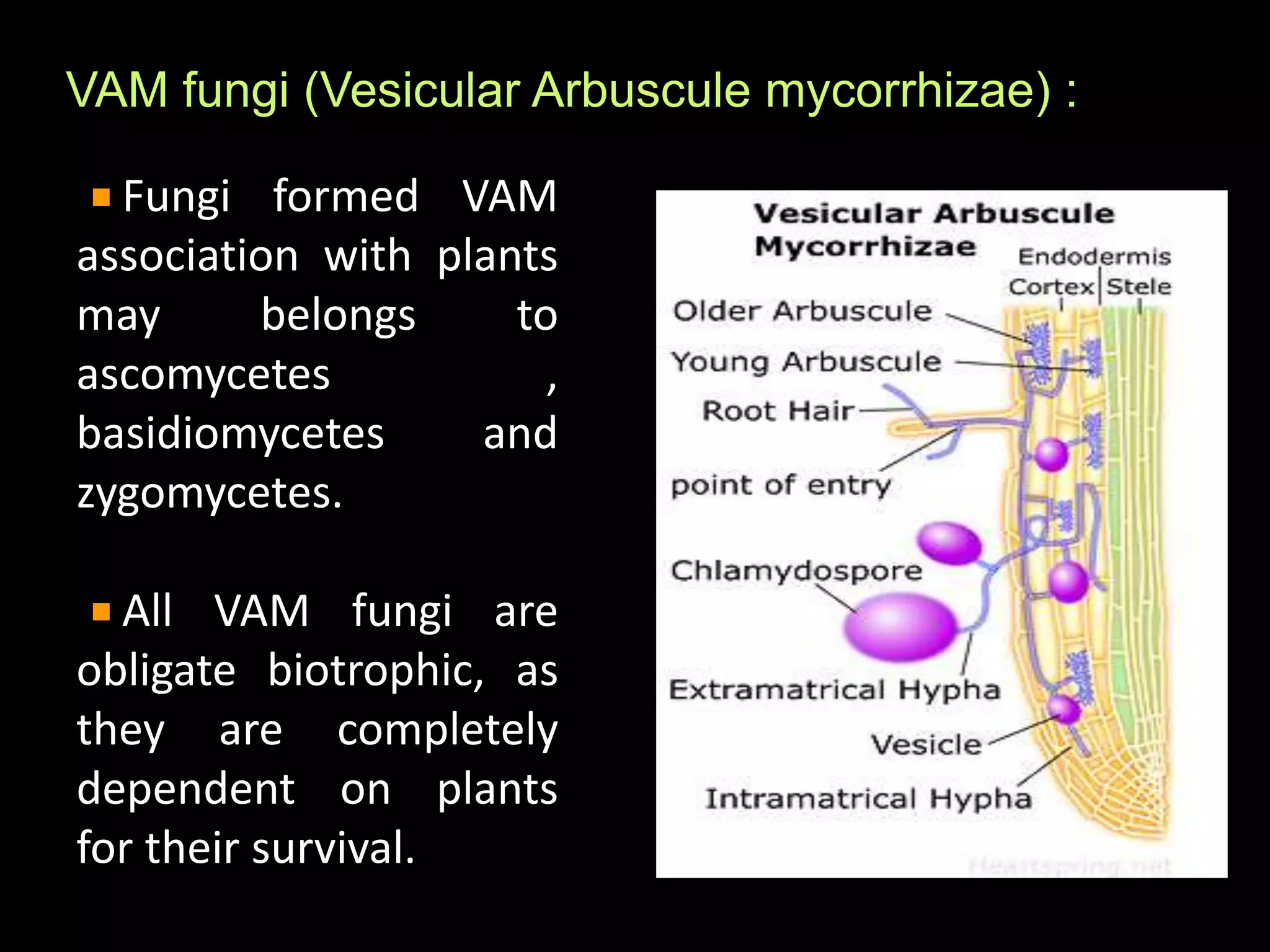
VAM fungi (Vesicular Arbuscule mycorrhizae) :
Fungi formed VAM
association with plants
may belongs to
ascomycetes ,
basidiomycetes and
zygomycetes.
All VAM fungi are
obligate biotrophic, as
they are completely
dependent on plants
for their survival.
Orchidoid Mycorrhizae :
Fungi belongs to basidiomycotina and colonize only
member of family orchidaceae. This association is
probably pseudomycorrhizal but play an important role
in establishment of orchid seedlings.
Ericoid Mycorrhizae :
Fungal members are usually basidiomycetous and
Ascomycotina. This is found in roots of plants belonging
to order ericales. Rootlets are covered by a loosely
woven mesh of dark brown septate hyphae from which
branches penetrate the cortical cells.
Arbutoid Mycorrhizae :
Arbutoid mycorrhizal associations are variants of
ectomycorrhizae found in certain plants in the ericaceae
characterized by hyphae coils in epidermal cells.
A major difference between the arbutoid and
ectomycorrhizal association is that the hyphae of the
former actually penetrate the outer cortical cells and fill
them with coils.
Monotropoid Mycorrhizae :
The fungi belong to basidiomycotina, colonizing
achlorophyllous members of angiosperms belonging to
family monotropaceae. Fungal sheath present.
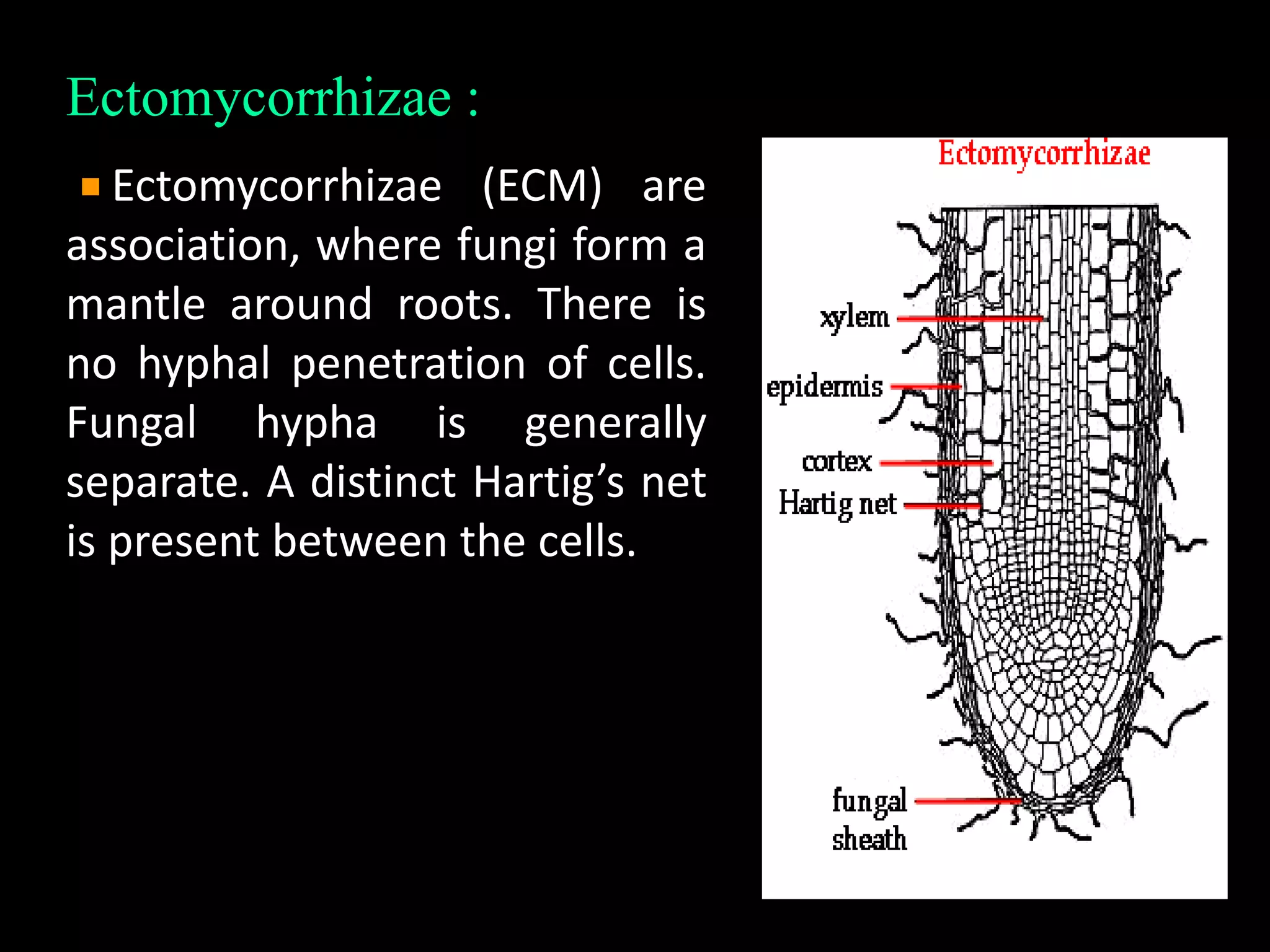
Ectomycorrhizae :
e Ectomycorrhizae (ECM) are
association, where fungi form a
mantle around roots. There is
no hyphal penetration of cells.
Fungal hypha is generally
separate. A distinct Hartig’s net
is present between the cells..
Ectendomycorrhizae :
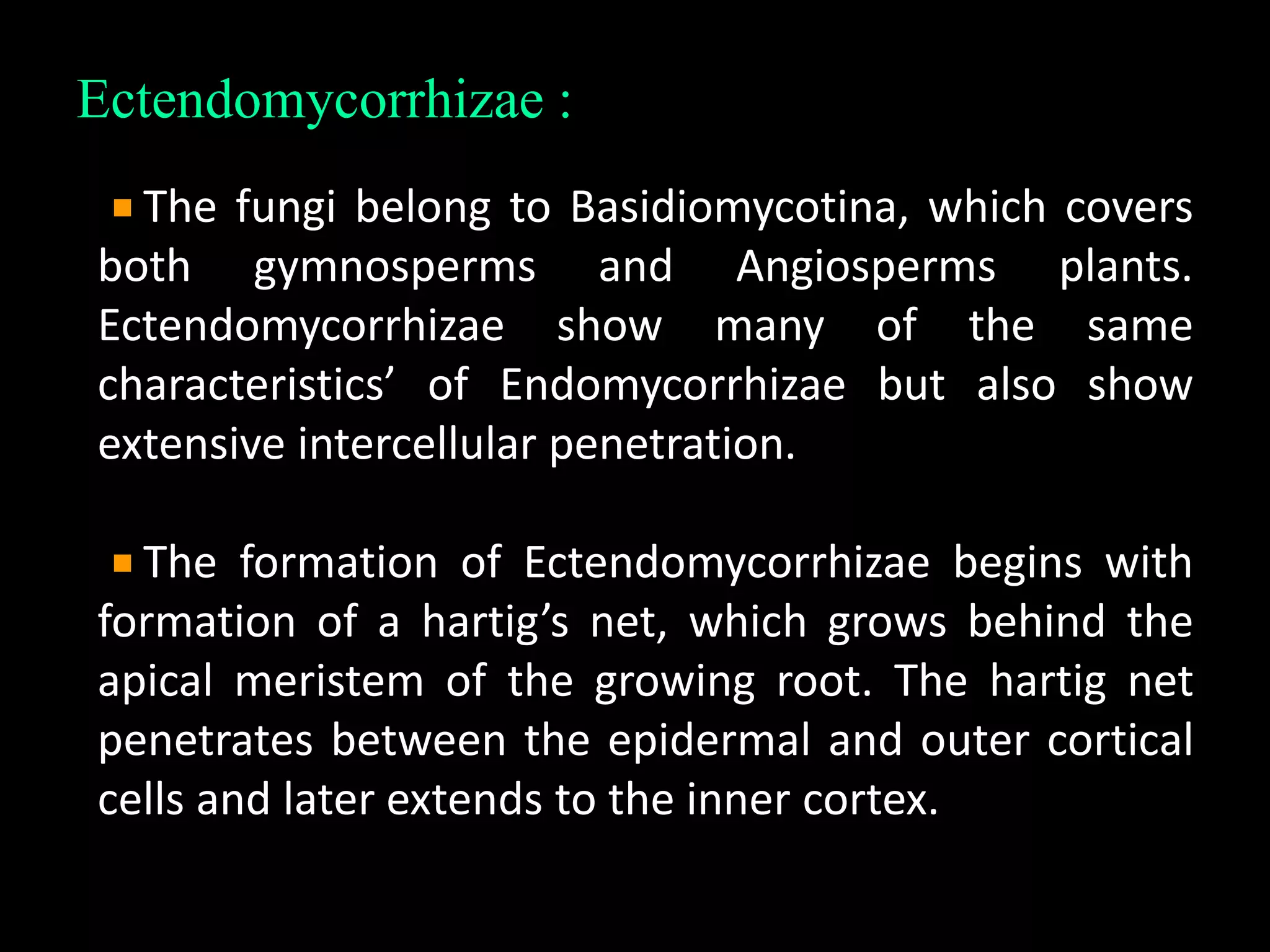
The fungi belong to Basidiomycotina, which covers
both gymnosperms and Angiosperms plants.
Ectendomycorrhizae show many of the same
characteristics’ of Endomycorrhizae but also show
extensive intercellular penetration.
The formation of Ectendomycorrhizae begins with
formation of a hartig’s net, which grows behind the
apical meristem of the growing root. The hartig net
penetrates between the epidermal and outer cortical
cells and later extends to the inner cortex.
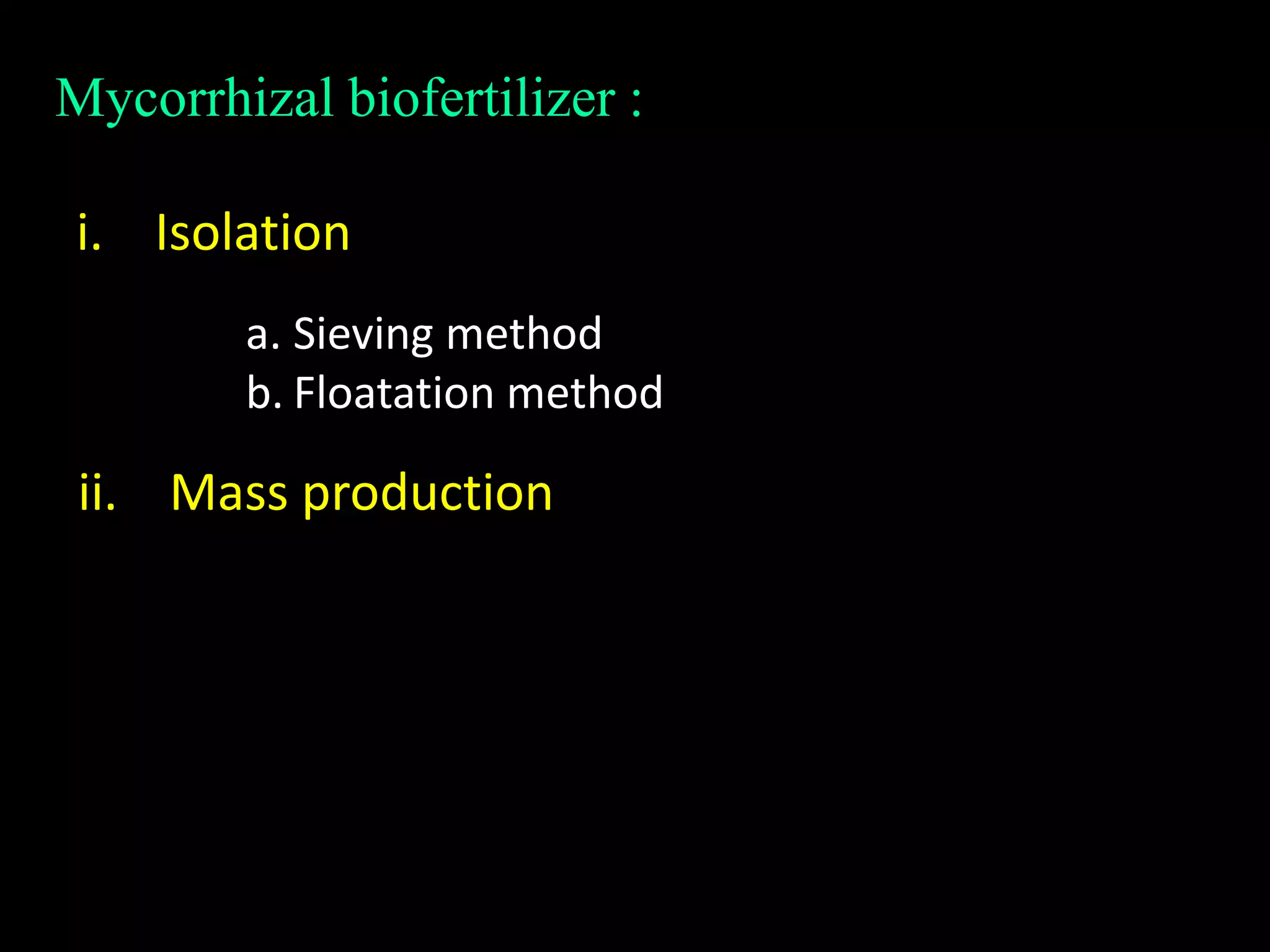
Mycorrhizal biofertilizer :
i. Isolation
a. Sieving method
b. Floatation method
ii. Mass production
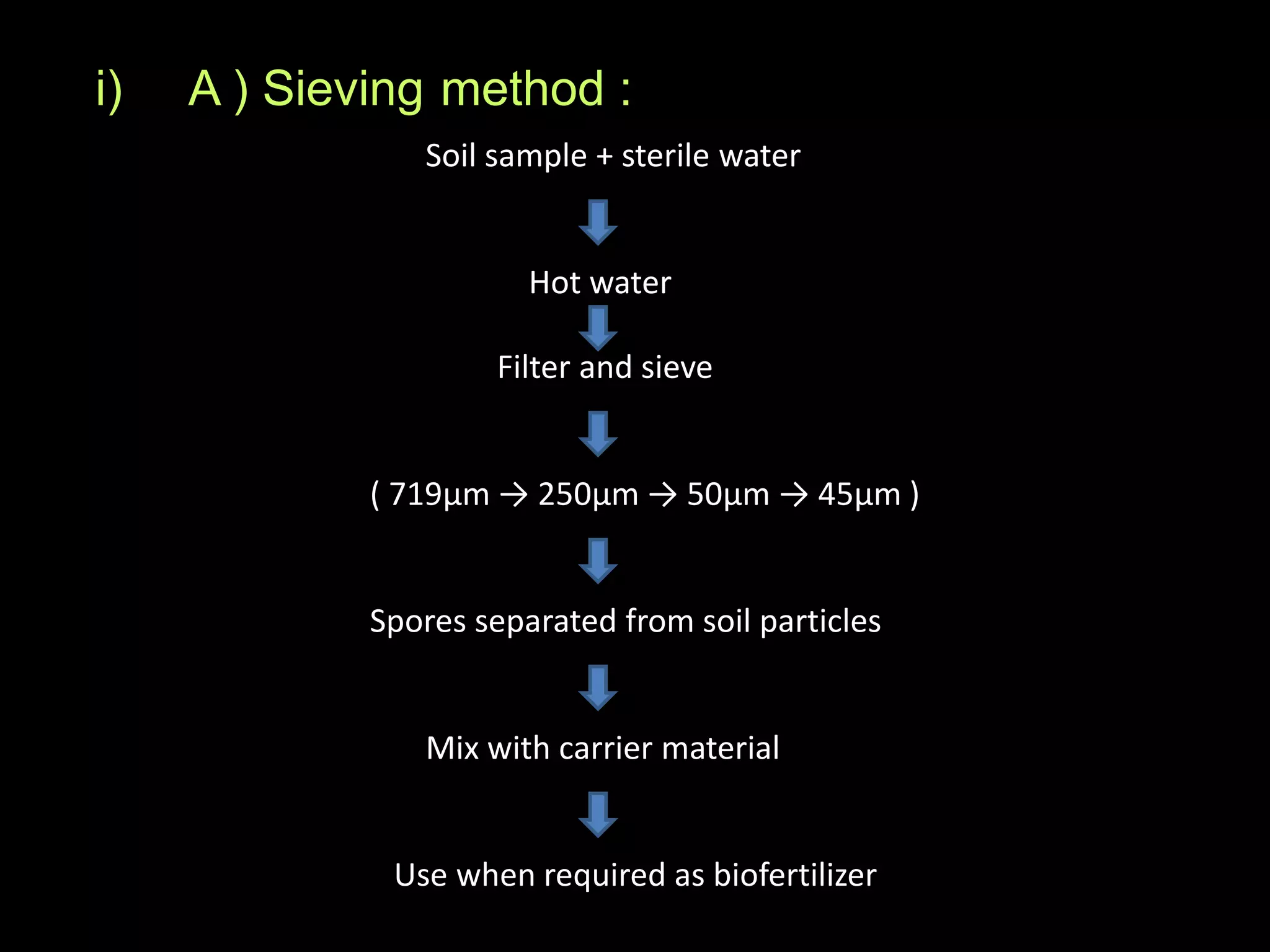
Soil sample + sterile water
Hot water
Filter and sieve
( 719μm → 250μm → 50μm → 45μm )
Spores separated from soil particles
Mix with carrier material
Use when required as biofertilizer
i) A ) Sieving method :
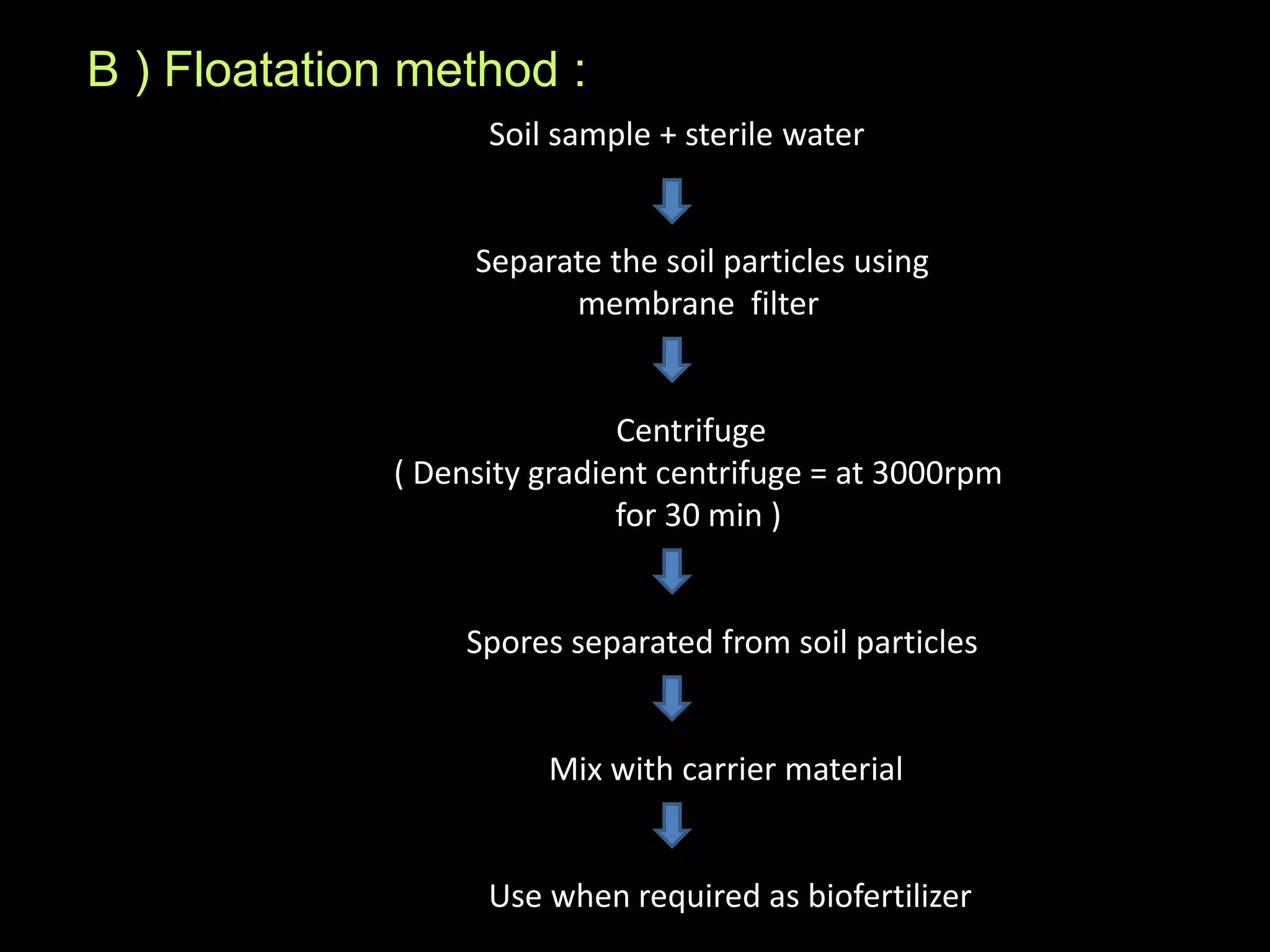
B ) Floatation method :
Soil sample + sterile water
Separate the soil particles using
membrane filter
Centrifuge
( Density gradient centrifuge = at 3000rpm
for 30 min )
Spores separated from soil particles
Mix with carrier material
Use when required as biofertilizer
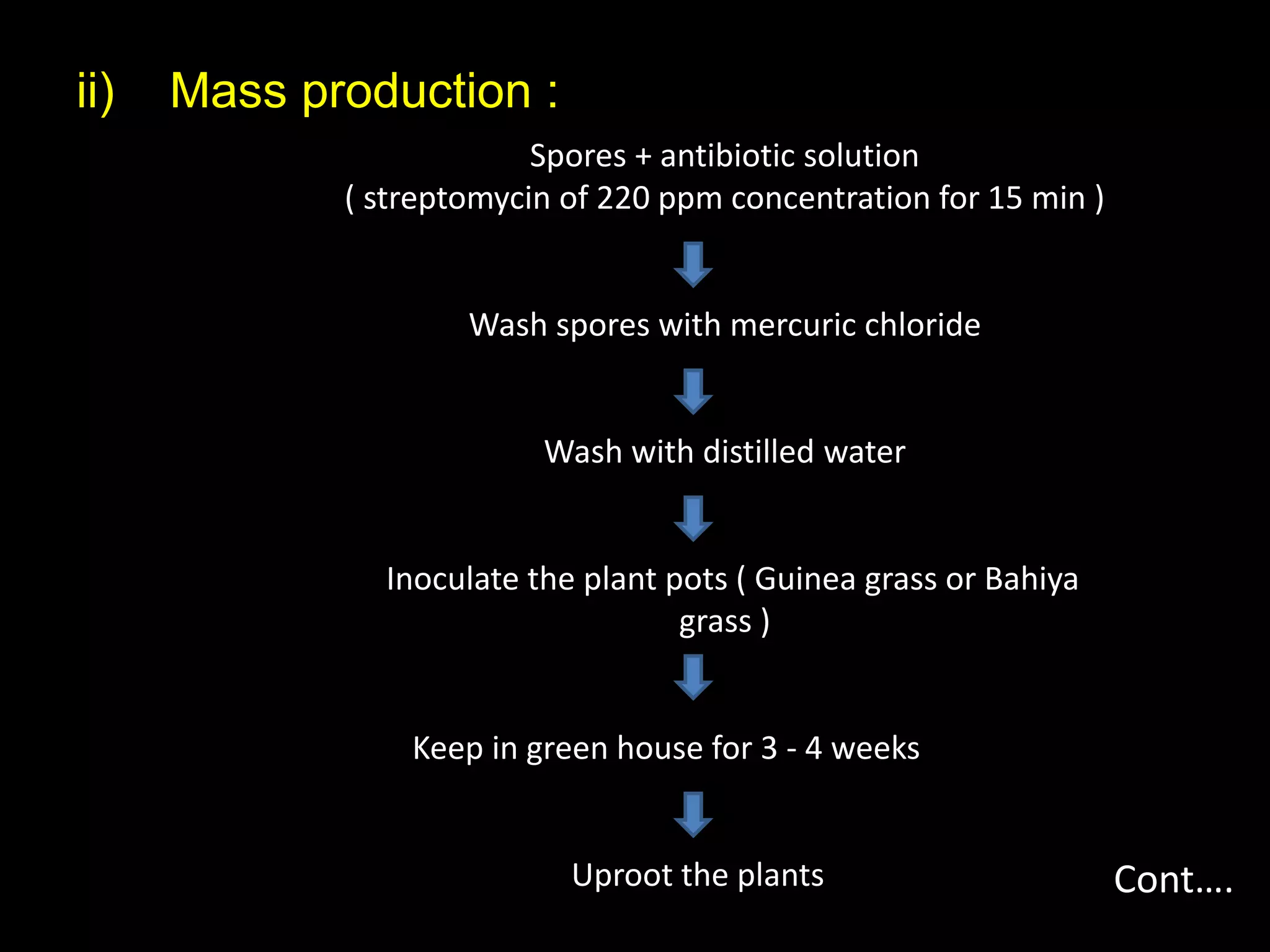
ii) Mass production :
Spores + antibiotic solution
( streptomycin of 220 ppm concentration for 15 min )
Wash spores with mercuric chloride
Wash with distilled water
Inoculate the plant pots ( Guinea grass or Bahiya
grass )
Keep in green house for 3 - 4 weeks
Uproot the plants Cont….
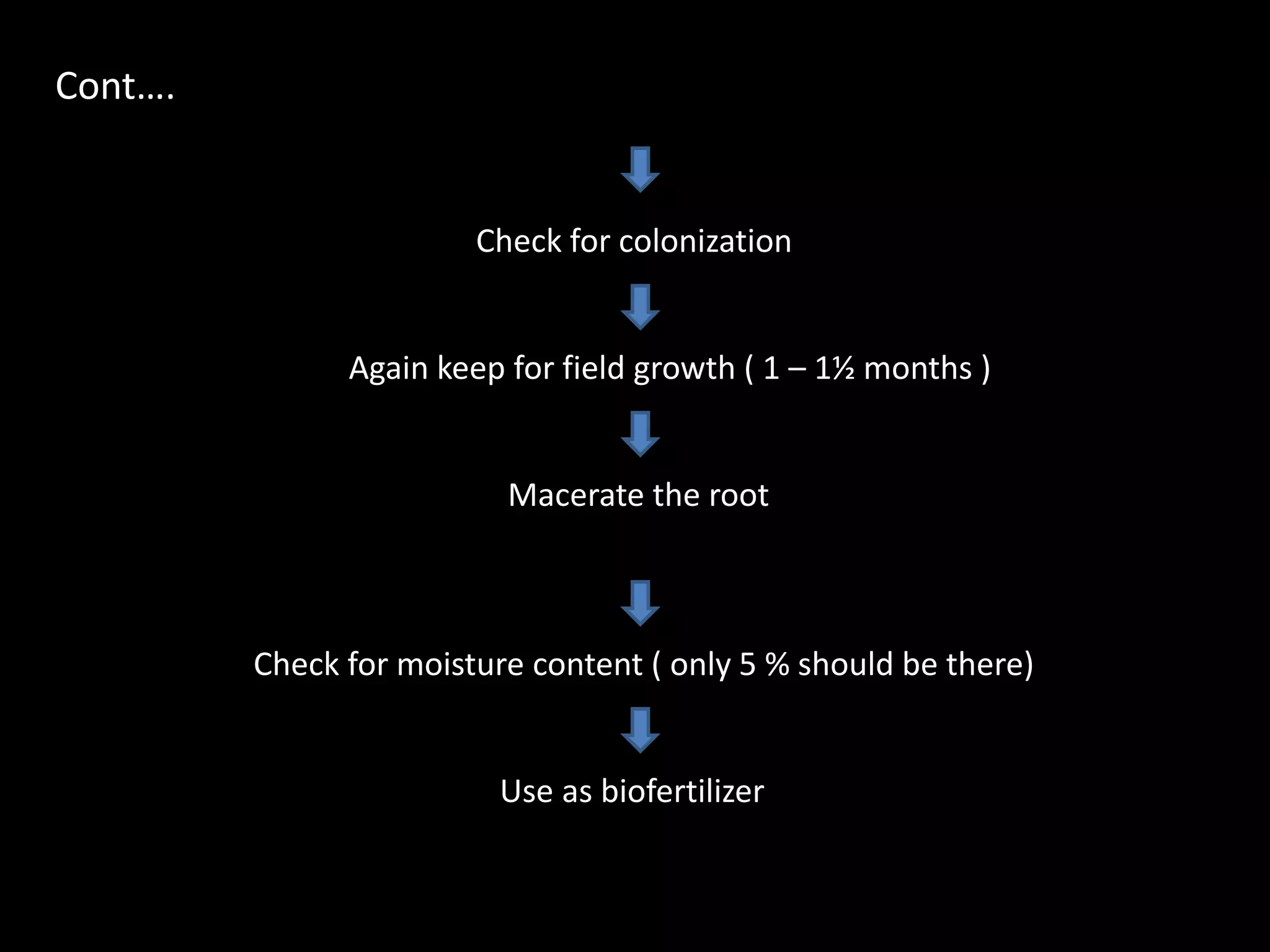
Cont….
Check for colonization
Again keep for field growth ( 1 – 1½ months )
Macerate the root
Check for moisture content ( only 5 % should be there)
Use as biofertilizer
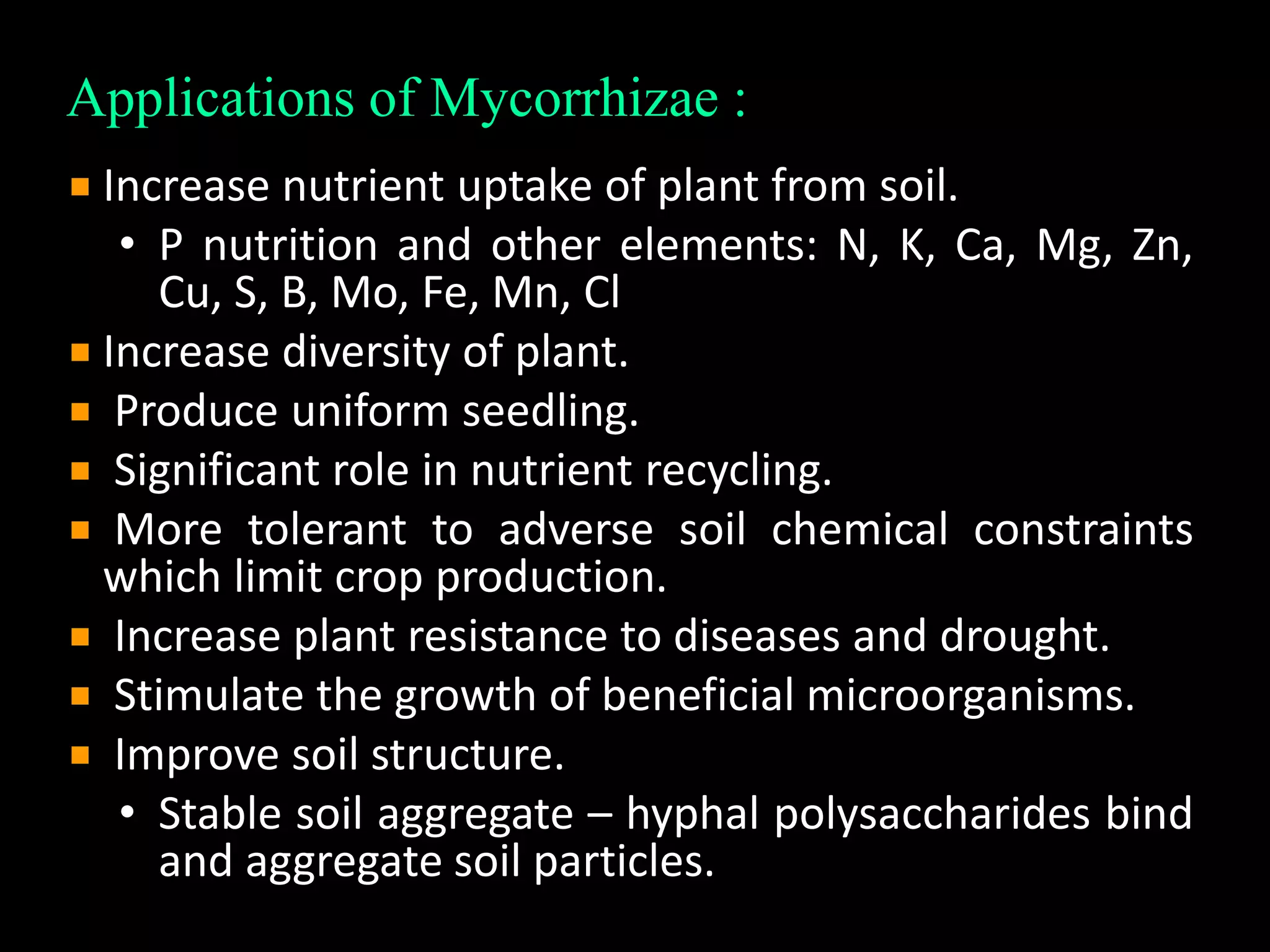
Applications of Mycorrhizae :
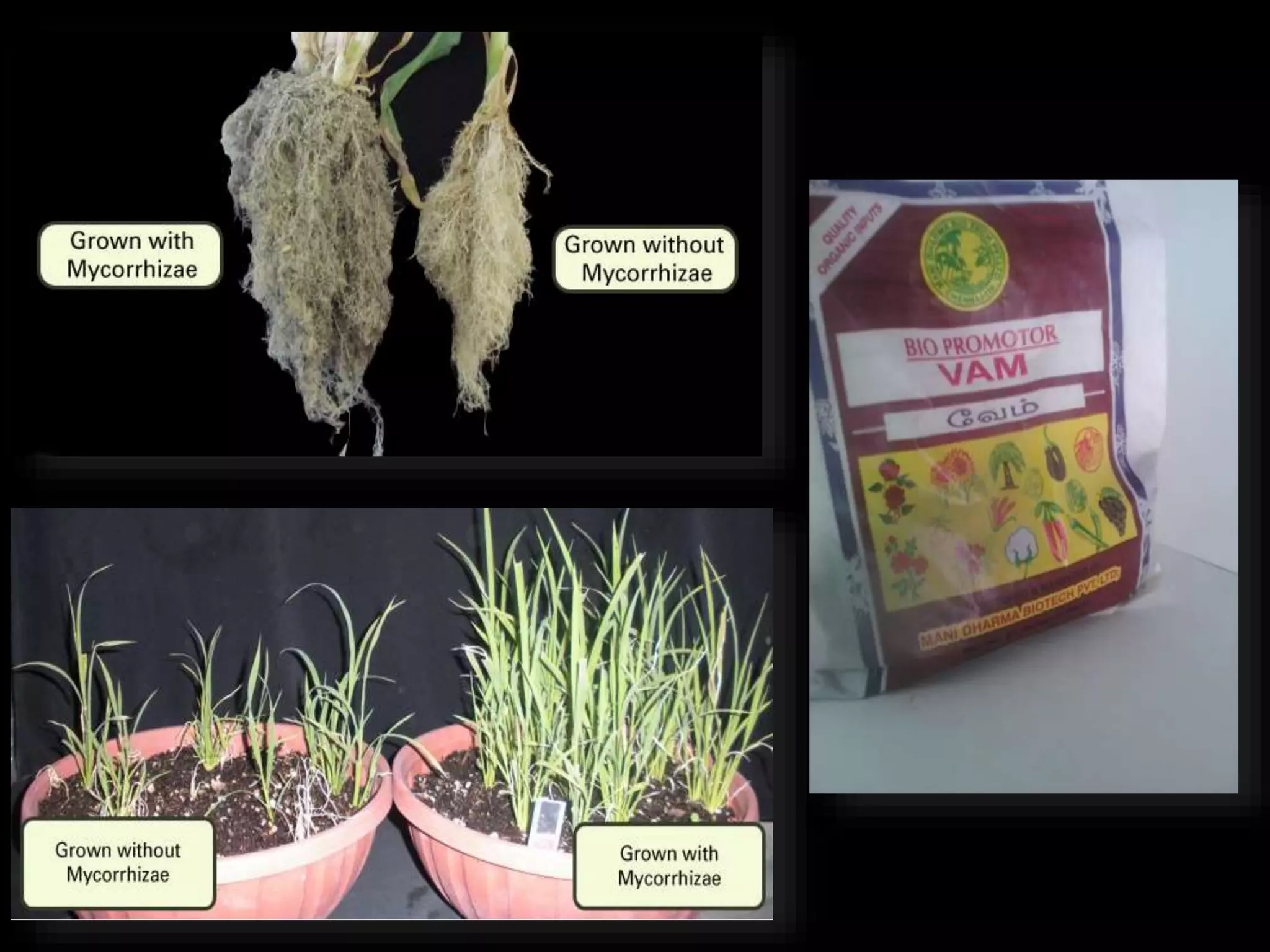
Increase nutrient uptake of plant from soil.
• P nutrition and other elements: N, K, Ca, Mg, Zn,
Cu, S, B, Mo, Fe, Mn, Cl
Increase diversity of plant.
Produce uniform seedling.
Significant role in nutrient recycling.
More tolerant to adverse soil chemical constraints
which limit crop production.
Increase plant resistance to diseases and drought.
Stimulate the growth of beneficial microorganisms.
Improve soil structure.
• Stable soil aggregate – hyphal polysaccharides bind
and aggregate soil particles.
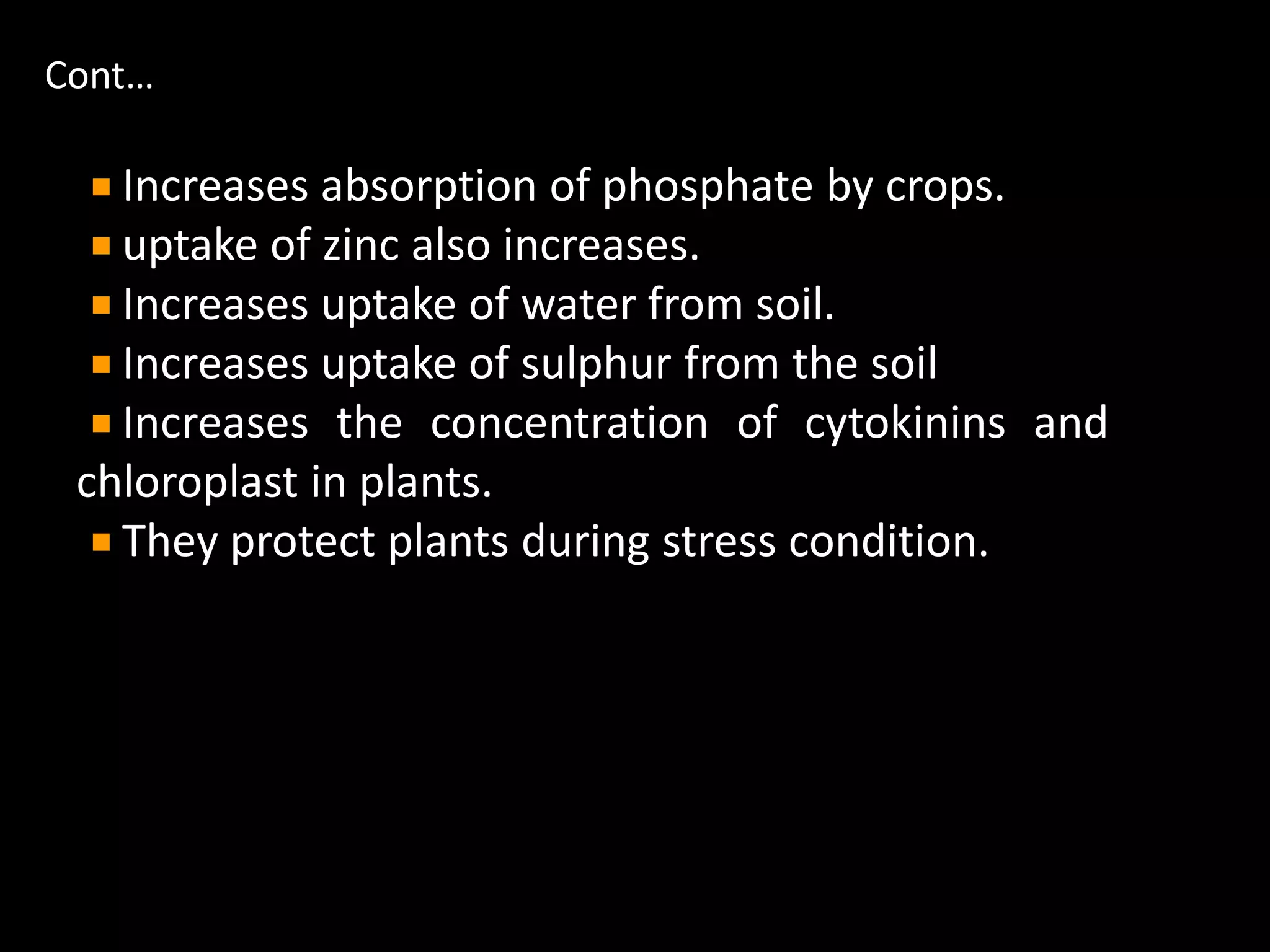
Cont…
Increases absorption of phosphate by crops.
uptake of zinc also increases.
Increases uptake of water from soil.
Increases uptake of sulphur from the soil
Increases the concentration of cytokinins and
chloroplast in plants.
They protect plants during stress condition.
Conclusion :
Mycorrhizal association is very essential for the plants
because it has several benefits like absorption of
nutrients, increases drought resistance, enhance plant
efficiency in absorbing water and nutrients from soil.
Especially, AM fungi are very useful in the agriculture
because it serves as biofertilizers as it helps in the
absorption of phosphorus, and other nutrient uptake.
References :
•N S subba Rao, Soil microorganisms and plant growth and 3rd edition. Oxford & IBH publishing co. Pvt. Ltd, New Delhi, page no 287-296.
•Tanuja Sing, S S Purohit and Pradeep Pairhar, Soil microbiology. Agrobios (India), page no 383-405.
•S B Sullia and S Shantharam, General microbiology, 2nd edition, Oxford & IBH publishing co. Pvt. Ltd, New Delhi, page no 286-291.
•Himadri Panda and Dharamvir Hota, Biofertilizers and organic farming, 2007 gene- Tech books New Delhi, page no 147-187.
•Rangaswamy G and Bhagyaraj. Agricultural microbiology and 2nd edition. Prentice- hall of Indian private limited.
•Dr. H A Modi, Biofertilizers & organic forming, Aaviahkar publishers, Distrubutros jaipur 302003(Raj) India.
• Tanuja Sing, S S Purohit and Pradeep Pairhar, Soil
microbiology. Agrobios (India), page no 383-405.
• Himadri Panda and Dharamvir Hota, Biofertilizers and organic
farming, 2007 gene- Tech books New Delhi, page no 147-187.
• Rangaswamy G and Bhagyaraj. Agricultural microbiology and
2nd edition. Prentice- hall of Indian private limited.
• Dr. H A Modi, Biofertilizers & organic forming, Aaviahkar
publishers, Distrubutros jaipur 302003(Raj) India.
• N S subba Rao, Soil microorganisms and plant growth, 3rd
edition. Oxford & IBH publishing co. Pvt. Ltd, New Delhi, page no
287-296.
Mycorrhizae  types and applications

Mycorrhizae types and applications

  • 2.
    Presented By- Nischitha R. 1stM.Sc., 2nd Semester.
  • 3.
    CONTENTS • Introduction • Typesof mycorrhizae • Mycorrhizal biofertilizer • Applications of mycorrhizae • Conclusion • References
  • 4.
    Introduction : Mycorrhizae aremutualistic symbiotic associations formed between the roots of higher plants and fungi. It is an Greek word, mykes: mushroom or fungi; rhiza: root. Fungal roots were discovered by the German botanist A B Frank in the last century (1855) in forest trees such as pine. In nature approximately 90% of plants are infected with mycorrhizae. 83% Dicots,79% Monocots and 100% Gymnosperms. Convert insoluble form of phosphorous in soil into soluble form.
  • 5.
    Types of mycorrhizae: On the basis of morphological and anatomical features, mycorrhizae are divided into the three types. 1. Endomycorrhizae 2. Ectomycorrhizae 3. Ectendomycorrhizae Endomycorrhizae further classified in to five types. 1. VAM fungi (vesicular arbuscular mycorrhizae) 2. Orchidoid mycorrhizae 3. Monotropoid mycorrhizae 4. Ericoid Mycorrhizae 5. Arbutoid mycorrhizae
  • 6.
    Endomycorrhizae : It isa mycorrhizal association in which the fungal hyphae are present on root surface as individual threads that may penetrate directly into root hairs, other epidermal cells & into cortical cells.
  • 7.
    VAM fungi (VesicularArbuscule mycorrhizae) : Fungi formed VAM association with plants may belongs to ascomycetes , basidiomycetes and zygomycetes. All VAM fungi are obligate biotrophic, as they are completely dependent on plants for their survival.
  • 8.
    Orchidoid Mycorrhizae : Fungibelongs to basidiomycotina and colonize only member of family orchidaceae. This association is probably pseudomycorrhizal but play an important role in establishment of orchid seedlings. Ericoid Mycorrhizae : Fungal members are usually basidiomycetous and Ascomycotina. This is found in roots of plants belonging to order ericales. Rootlets are covered by a loosely woven mesh of dark brown septate hyphae from which branches penetrate the cortical cells.
  • 9.
    Arbutoid Mycorrhizae : Arbutoidmycorrhizal associations are variants of ectomycorrhizae found in certain plants in the ericaceae characterized by hyphae coils in epidermal cells. A major difference between the arbutoid and ectomycorrhizal association is that the hyphae of the former actually penetrate the outer cortical cells and fill them with coils. Monotropoid Mycorrhizae : The fungi belong to basidiomycotina, colonizing achlorophyllous members of angiosperms belonging to family monotropaceae. Fungal sheath present.
  • 10.
    Ectomycorrhizae : e Ectomycorrhizae(ECM) are association, where fungi form a mantle around roots. There is no hyphal penetration of cells. Fungal hypha is generally separate. A distinct Hartig’s net is present between the cells..
  • 11.
    Ectendomycorrhizae : The fungibelong to Basidiomycotina, which covers both gymnosperms and Angiosperms plants. Ectendomycorrhizae show many of the same characteristics’ of Endomycorrhizae but also show extensive intercellular penetration. The formation of Ectendomycorrhizae begins with formation of a hartig’s net, which grows behind the apical meristem of the growing root. The hartig net penetrates between the epidermal and outer cortical cells and later extends to the inner cortex.
  • 12.
    Mycorrhizal biofertilizer : i.Isolation a. Sieving method b. Floatation method ii. Mass production
  • 13.
    Soil sample +sterile water Hot water Filter and sieve ( 719μm → 250μm → 50μm → 45μm ) Spores separated from soil particles Mix with carrier material Use when required as biofertilizer i) A ) Sieving method :
  • 14.
    B ) Floatationmethod : Soil sample + sterile water Separate the soil particles using membrane filter Centrifuge ( Density gradient centrifuge = at 3000rpm for 30 min ) Spores separated from soil particles Mix with carrier material Use when required as biofertilizer
  • 15.
    ii) Mass production: Spores + antibiotic solution ( streptomycin of 220 ppm concentration for 15 min ) Wash spores with mercuric chloride Wash with distilled water Inoculate the plant pots ( Guinea grass or Bahiya grass ) Keep in green house for 3 - 4 weeks Uproot the plants Cont….
  • 16.
    Cont…. Check for colonization Againkeep for field growth ( 1 – 1½ months ) Macerate the root Check for moisture content ( only 5 % should be there) Use as biofertilizer
  • 17.
    Applications of Mycorrhizae: Increase nutrient uptake of plant from soil. • P nutrition and other elements: N, K, Ca, Mg, Zn, Cu, S, B, Mo, Fe, Mn, Cl Increase diversity of plant. Produce uniform seedling. Significant role in nutrient recycling. More tolerant to adverse soil chemical constraints which limit crop production. Increase plant resistance to diseases and drought. Stimulate the growth of beneficial microorganisms. Improve soil structure. • Stable soil aggregate – hyphal polysaccharides bind and aggregate soil particles.
  • 18.
    Cont… Increases absorption ofphosphate by crops. uptake of zinc also increases. Increases uptake of water from soil. Increases uptake of sulphur from the soil Increases the concentration of cytokinins and chloroplast in plants. They protect plants during stress condition.
  • 20.
    Conclusion : Mycorrhizal associationis very essential for the plants because it has several benefits like absorption of nutrients, increases drought resistance, enhance plant efficiency in absorbing water and nutrients from soil. Especially, AM fungi are very useful in the agriculture because it serves as biofertilizers as it helps in the absorption of phosphorus, and other nutrient uptake.
  • 21.
    References : •N Ssubba Rao, Soil microorganisms and plant growth and 3rd edition. Oxford & IBH publishing co. Pvt. Ltd, New Delhi, page no 287-296. •Tanuja Sing, S S Purohit and Pradeep Pairhar, Soil microbiology. Agrobios (India), page no 383-405. •S B Sullia and S Shantharam, General microbiology, 2nd edition, Oxford & IBH publishing co. Pvt. Ltd, New Delhi, page no 286-291. •Himadri Panda and Dharamvir Hota, Biofertilizers and organic farming, 2007 gene- Tech books New Delhi, page no 147-187. •Rangaswamy G and Bhagyaraj. Agricultural microbiology and 2nd edition. Prentice- hall of Indian private limited. •Dr. H A Modi, Biofertilizers & organic forming, Aaviahkar publishers, Distrubutros jaipur 302003(Raj) India. • Tanuja Sing, S S Purohit and Pradeep Pairhar, Soil microbiology. Agrobios (India), page no 383-405. • Himadri Panda and Dharamvir Hota, Biofertilizers and organic farming, 2007 gene- Tech books New Delhi, page no 147-187. • Rangaswamy G and Bhagyaraj. Agricultural microbiology and 2nd edition. Prentice- hall of Indian private limited. • Dr. H A Modi, Biofertilizers & organic forming, Aaviahkar publishers, Distrubutros jaipur 302003(Raj) India. • N S subba Rao, Soil microorganisms and plant growth, 3rd edition. Oxford & IBH publishing co. Pvt. Ltd, New Delhi, page no 287-296.