BY-
CHANDRANI GOSWAMI
DEPT. OF VETERINARY PUBLIC HEALTH
MASTITIS
 Refers to inflammation of the
mammary gland, which is
characterized by physical, chemical
as well as bacteriological changes in
the milk and pathological changes in
the udder tissues.
ETIOLOGY
 Streptococcus agalactiae
 Staphylococcus aureus
FORMS
 CLINICAL
 SUBCLINICAL
CLINICAL MASTITIS
 Characterized by visible abnormalities in the milk or
the udder.
 Here milk appears abnormal with the presence of
flakes, clots, strings or watery.
 The mammary gland may also be warm or hard to
touch or may have increased sensitivity
 In severe cases, signs like fever, anorexia may be seen
SUBCLINICAL MASTITIS
 Inflammation of the mammary gland that does not
create visible changes in the milk or the udder
 Sub clinically infected cows will produce less milk, and
the quality of the milk will be reduced.
 Infected cows can be a source of infection to other
animals in the herd.
 Here milk and mammary gland appears normal
CLINICAL MASTITIS
 Visual observation and palpating the udder for signs of
inflammation
 Stripping milk into a strip cup at the beginning of
milking to check for abnormalities such as clots and
flakes.
SUBCLINICAL MASTITIS
 Requires special diagnostic tests for detection.
 California Mastitis Test (CMT)/ Cow Side Test
 Somatic cell count (SCC) is the most common test to
detect changes in the milk due to the inflammatory
process.
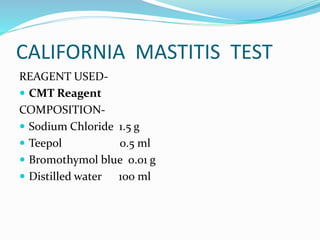
CALIFORNIA MASTITIS TEST
REAGENT USED-
 CMT Reagent
COMPOSITION-
 Sodium Chloride 1.5 g
 Teepol 0.5 ml
 Bromothymol blue 0.01 g
 Distilled water 100 ml
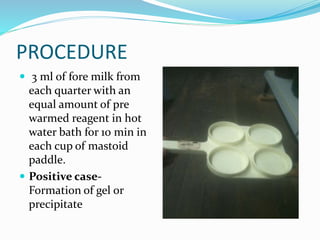
PROCEDURE
 3 ml of fore milk from
each quarter with an
equal amount of pre
warmed reagent in hot
water bath for 10 min in
each cup of mastoid
paddle.
 Positive case-
Formation of gel or
precipitate
PRINCIPLE
 CMT Reagent is a Detergent with a pH indicator
added
 When milk and CMT reagent mixed together in equal
amount
 CMT reagent dissolves or disrupts the outer cell wall or
nuclear cell wall of any leukocyte which are primarily
fat (detergents dissolves fat)
 DNA is now released from the nuclei
 DNA will string or gel together
SOMATIC CELL COUNT
 Somatic cells are primarily White Blood Cells.
 The term "somatic" means "derived from the body".
All milk contains white blood cells known as
leukocytes which constitute the majority of somatic
cells. The cell count for "normal" milk is nearly always
less than 100,000 cells/ml
 Higher counts are considered abnormal and indicate
probable infection. Higher counts are also associated
with decreased production.
REAGENT USED
Newman Lampert Stain
COMPOSITION-
 Methylene blue chloride 0.6 g
Ethanol (95%) 52 mL
Tetrachloroethane 44 mL
Glacial acetic acid 4 ml
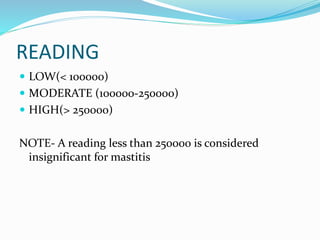
READING
 LOW(< 100000)
 MODERATE (100000-250000)
 HIGH(> 250000)
NOTE- A reading less than 250000 is considered
insignificant for mastitis
THANK YOU

Mastitis

  • 1.
    BY- CHANDRANI GOSWAMI DEPT. OFVETERINARY PUBLIC HEALTH
  • 2.
    MASTITIS  Refers toinflammation of the mammary gland, which is characterized by physical, chemical as well as bacteriological changes in the milk and pathological changes in the udder tissues.
  • 3.
  • 4.
  • 5.
    CLINICAL MASTITIS  Characterizedby visible abnormalities in the milk or the udder.  Here milk appears abnormal with the presence of flakes, clots, strings or watery.  The mammary gland may also be warm or hard to touch or may have increased sensitivity  In severe cases, signs like fever, anorexia may be seen
  • 6.
    SUBCLINICAL MASTITIS  Inflammationof the mammary gland that does not create visible changes in the milk or the udder  Sub clinically infected cows will produce less milk, and the quality of the milk will be reduced.  Infected cows can be a source of infection to other animals in the herd.  Here milk and mammary gland appears normal
  • 8.
    CLINICAL MASTITIS  Visualobservation and palpating the udder for signs of inflammation  Stripping milk into a strip cup at the beginning of milking to check for abnormalities such as clots and flakes.
  • 9.
    SUBCLINICAL MASTITIS  Requiresspecial diagnostic tests for detection.  California Mastitis Test (CMT)/ Cow Side Test  Somatic cell count (SCC) is the most common test to detect changes in the milk due to the inflammatory process.
  • 10.
    CALIFORNIA MASTITIS TEST REAGENTUSED-  CMT Reagent COMPOSITION-  Sodium Chloride 1.5 g  Teepol 0.5 ml  Bromothymol blue 0.01 g  Distilled water 100 ml
  • 11.
    PROCEDURE  3 mlof fore milk from each quarter with an equal amount of pre warmed reagent in hot water bath for 10 min in each cup of mastoid paddle.  Positive case- Formation of gel or precipitate
  • 12.
    PRINCIPLE  CMT Reagentis a Detergent with a pH indicator added  When milk and CMT reagent mixed together in equal amount  CMT reagent dissolves or disrupts the outer cell wall or nuclear cell wall of any leukocyte which are primarily fat (detergents dissolves fat)  DNA is now released from the nuclei  DNA will string or gel together
  • 13.
    SOMATIC CELL COUNT Somatic cells are primarily White Blood Cells.  The term "somatic" means "derived from the body". All milk contains white blood cells known as leukocytes which constitute the majority of somatic cells. The cell count for "normal" milk is nearly always less than 100,000 cells/ml  Higher counts are considered abnormal and indicate probable infection. Higher counts are also associated with decreased production.
  • 14.
    REAGENT USED Newman LampertStain COMPOSITION-  Methylene blue chloride 0.6 g Ethanol (95%) 52 mL Tetrachloroethane 44 mL Glacial acetic acid 4 ml
  • 15.
    READING  LOW(< 100000) MODERATE (100000-250000)  HIGH(> 250000) NOTE- A reading less than 250000 is considered insignificant for mastitis
  • 16.