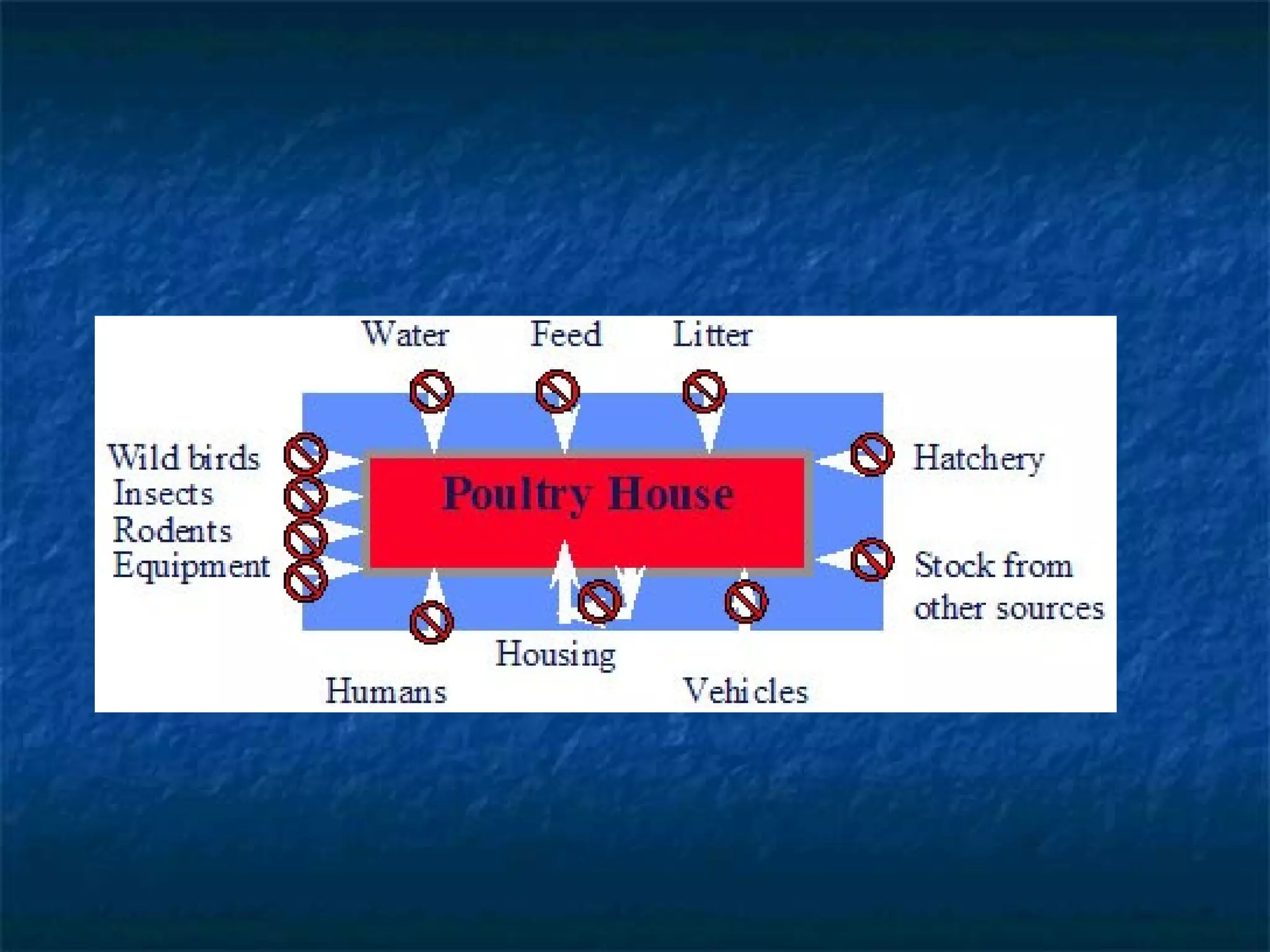
BIOSECURITY DEFINITION : all procedures used to prevent the introduction and spread of disease OBJECTIVES :  - prevent the entry of disease - control the spread of disease Simple Biosecurity Model                                                          
 
BENEFITS HELPS KEEP OUT diseases REDUCES THE RISK of zoonotic diseases LIMITS THE SPREAD of diseases HELPS PROTECT the public health IMPROVES the overall flock health CUTS COSTS of disease treatment REDUCES LOSSES and improves profitability
Classification system for poultry production systems (FAO 2004) Birds and products consumed locally Birds usually sold in live bird markets Usually commercial Commercial Bird and product marketing Minimal Low to minimal Moderate to high High Biosecurity Village or backyard Commercial Commercial Industrial integrated System Sector4 Sector 3 Sector 2 Sector1
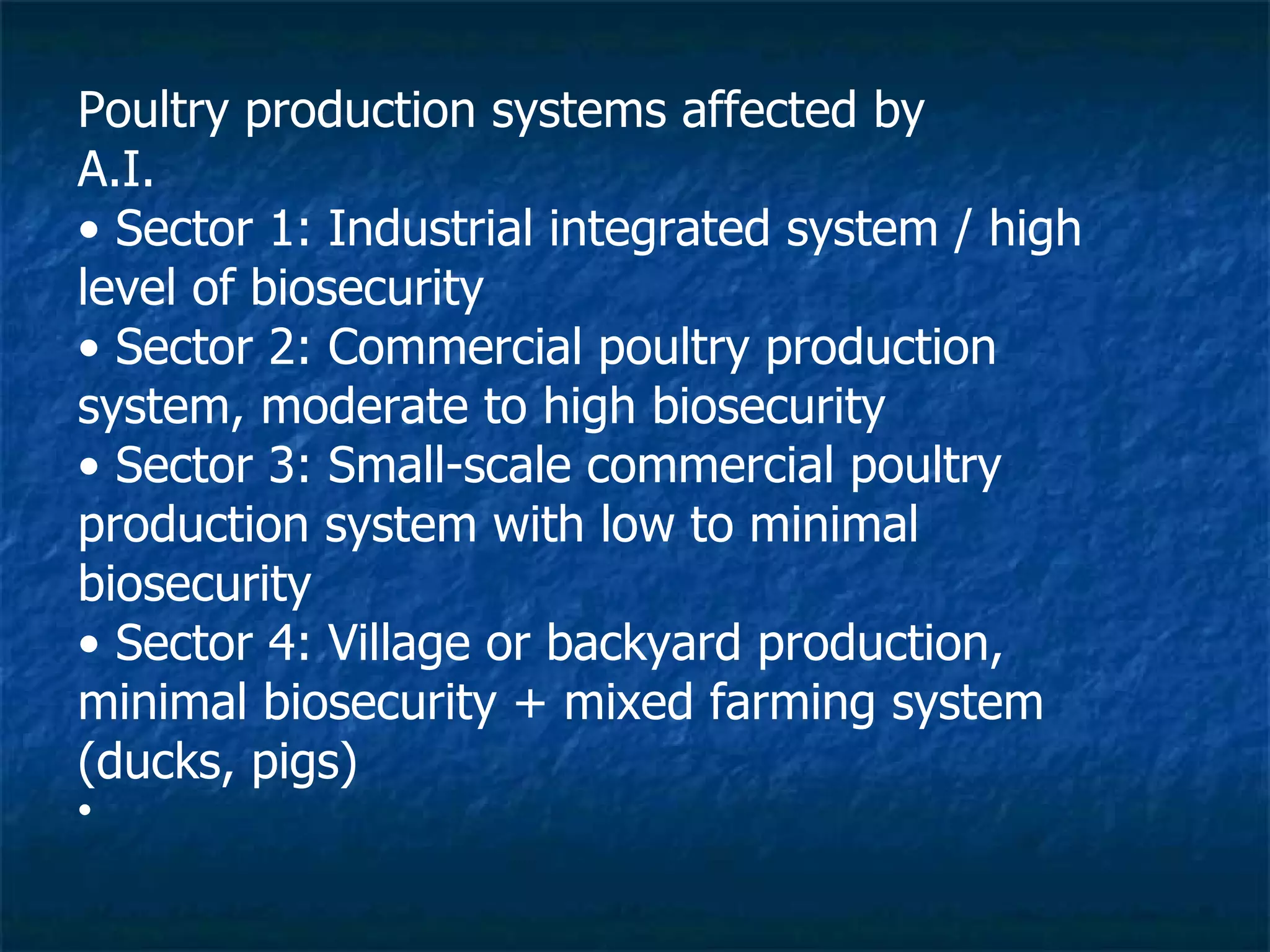
Poultry production systems affected by  A.I. •  Sector 1: Industrial integrated system / high level of biosecurity •  Sector 2: Commercial poultry production system, moderate to high biosecurity •  Sector 3: Small-scale commercial poultry production system with low to minimal biosecurity  •  Sector 4: Village or backyard production, minimal biosecurity + mixed farming system (ducks, pigs) •
HOW DISEASES SPREAD MOVEMENT of people, animals, equipment, vehicles CONTACT with neighboring flock CONTACT with insects, rodents, stray animals and pets CONTAMINATED water & feeds INADEQUATE cleaning and disinfection
BIOSECURITY INFORMATION STRICTLY limit and control access to the farm – fencing / controlled entry point KEEP an all-in, all-out flock management PROVIDE a security or decontamination area REQUIRE all persons entering the farm to sign a visitor’s logbook; vehicle plate numbers must also be recorded
CLEAN & DIRTY areas should be well-defined THOROUGHLY clean and disinfect all equipment & vehicles entering AND leaving the farm BETTER NOT to borrow equipment or vehicles from other farms DON’T USE same vehicles for transporting birds, feeds, equipment or waste products
KEEP WILD BIRDS off– bird-proofing KEEP other animals, pets / livestock out of the farm PEST & RODENT control program PROPER DISPOSAL of damaged eggs, dead birds, litter or manure REGULARLY clean & disinfect all equipment & vehicles before and after use
AFTER EVERY CYCLE, thoroughly clean & disinfect all houses & equipment ONCE CLEANED, a farm should be closed & left idle;  the longer the down time, the better the results.
Pathogenicity of AI AI strains characterized by pathogenicity in chickens LPAI  (Low-pathogenic avian influenza) Mild disease in poultry Most strains are LPAI LPAI H5 and H7 strains can mutate into HPAI HPAI  (Highly pathogenic avian influenza) Severe illness and high fatality in poultry Some birds have no illness
Signs of LPAI Influenza in Poultry Wild waterfowl, gulls, shorebirds are natural hosts for influenza viruses  Usually no symptoms Infection in non-reservoir can result in either: No outward disease (LPAI) Mild infection (LPAI) Ruffled feathers Reduced egg production Respiratory symptoms Can be easy to miss!
Development of HPAI Low pathogenic AI strains that are most capable of mutating into HPAI and causing epizootics H5 and H7  Most H5 and H7 are LPAI Disease Human HPAI  infection via contact with infected sick or dead birds Mild human LPAI infections have been documented  Wild birds can introduce LPAI into domestic flocks Can evolve into HPAI
Signs of HPAI Infection in Birds Causes more lethal infection  Difficult to miss - severe disease/sudden onset Facial edema, swollen and cyanotic combs and wattles, drastic decline in egg production  Internal hemorrhages of lungs and other organs Rapid spread  Mortality near 100% within 48 hours
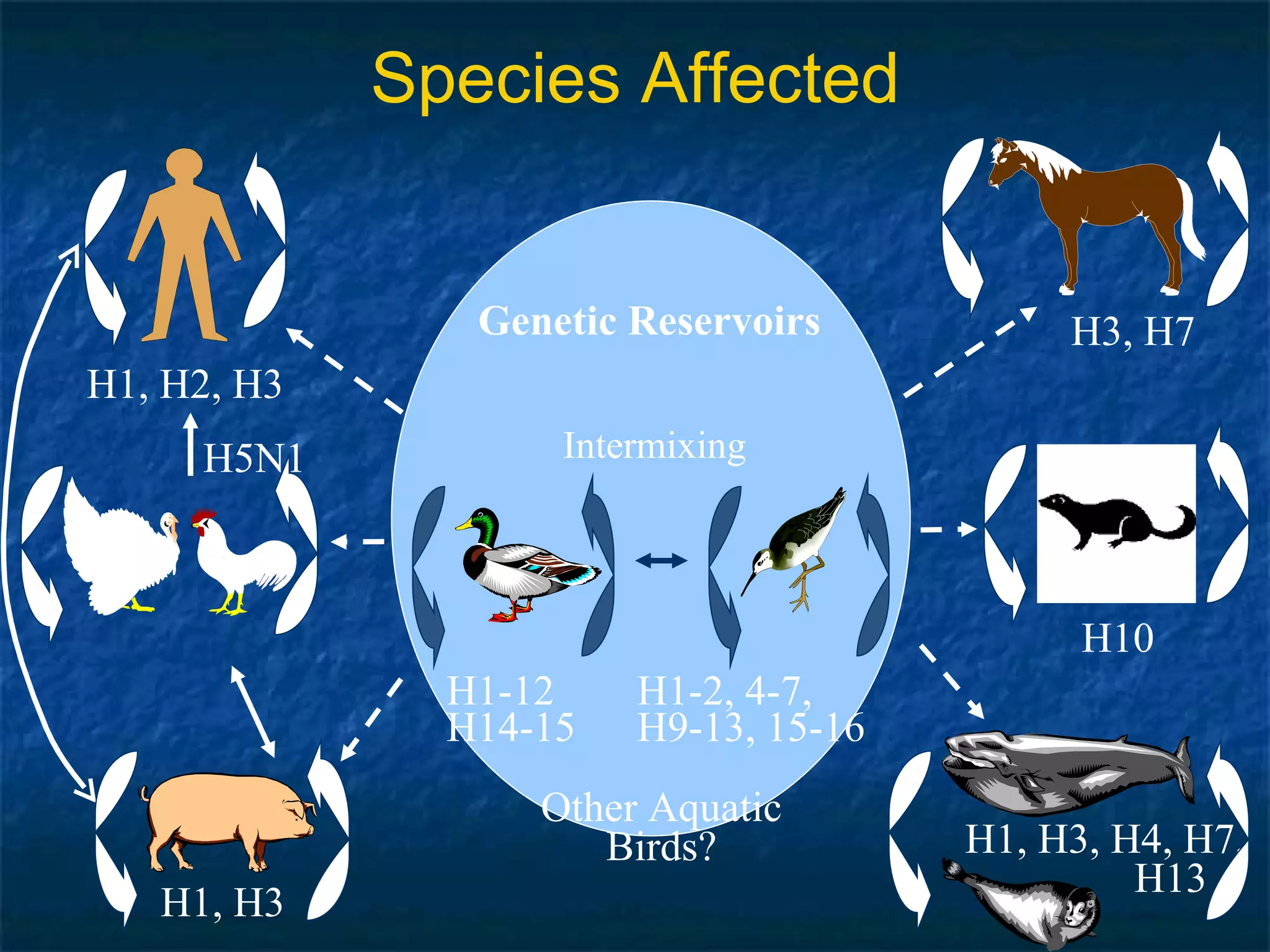
Species Affected Genetic Reservoirs Intermixing H1, H3 H1, H2, H3 H3, H7 H1-12 H14-15 H1-2, 4-7, H9-13, 15-16 H10 H1, H3, H4, H7,  H13 Other Aquatic Birds? H5N1
Avian Influenza in other Animals Domestic and wild birds  Ducks, geese, sparrows, poultry, pets Pigs, horses, marine mammals, ferrets, minks  Natural infection contracted from exposure to birds Tigers, leopards, domestic cats, dogs H5N1 infections from ingestion of infected poultry
Control Biosecurity Quarantine Intensify disinfecting measures Monitoring/Surveillance Stamping Out / Depopulation DIVA Vaccination - only for LPAI and not for HPAI because it might prolong the shedding of the virus Proper Disposal
Ensure Biosecurity through Bio- exclusion Keep poultry indoors Separate from the outside world Remove or disinfect all sources of infection Prevent unknown birds from entering flock Control human, vehicular, and equipment traffic onto the farm
Use “all in – all out” production Separate new poultry from flock Clean and disinfect when “all out”   AI can remain viable in tissue, faeces and water for a long period of time (days to weeks)
Bio containment on Infected Farms Depopulation of infected and exposed birds Movement control  On and off farm Bird markets closed and disinfected Testing of potentially infected birds Surveillance for illness in birds
Destruction and Disposal of Birds in Affected Area Humanely depopulate birds and other animals Carbon dioxide Dislocate neck Others Effective disposal Incineration Bury Compost Digestion Rendering Cleaning and disinfection
1.  Select a site that is well drained and not subject to flooding.  2.  Keep away scavengers  3.  Lay an 18 inch deep bed of coarse wood chips, 8-12 feet wide  4. Add a 12-15 inch layer of litter and birds, then cover with a 12-15 inch layer of wood chips or other carbon sources. Add another layer of litter and birds until it is two or three layers high and as long as needed. 6.If there is a disease outbreak, make sure that workers wear personal protective equipment and are properly sanitized when done. Workers should be vaccinated if applicable.
 
 
Build Pile 5.
IMPORTANT REMINDERS MAKE a flock health plan that includes basic biosecurity measures ENSURE that all records are accurate & up-to-date ALL poultry personnel should be trained LOOK OUT for signs of disease – REPORT immediately if disease is suspected
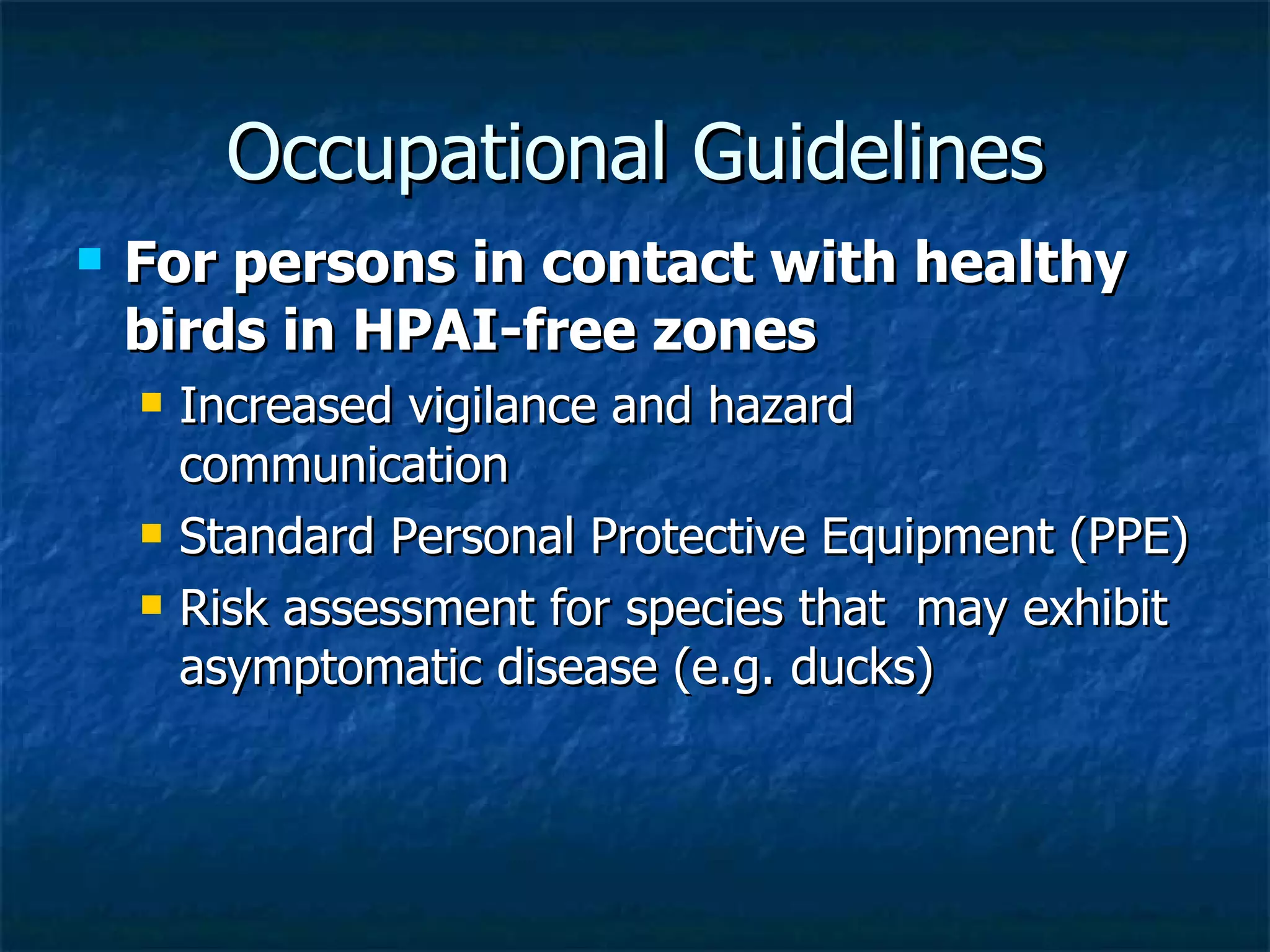
Occupational Guidelines For persons in contact with healthy birds in HPAI-free zones Increased vigilance and hazard communication Standard Personal Protective Equipment (PPE)   Risk assessment for species that  may exhibit asymptomatic disease (e.g. ducks)
 
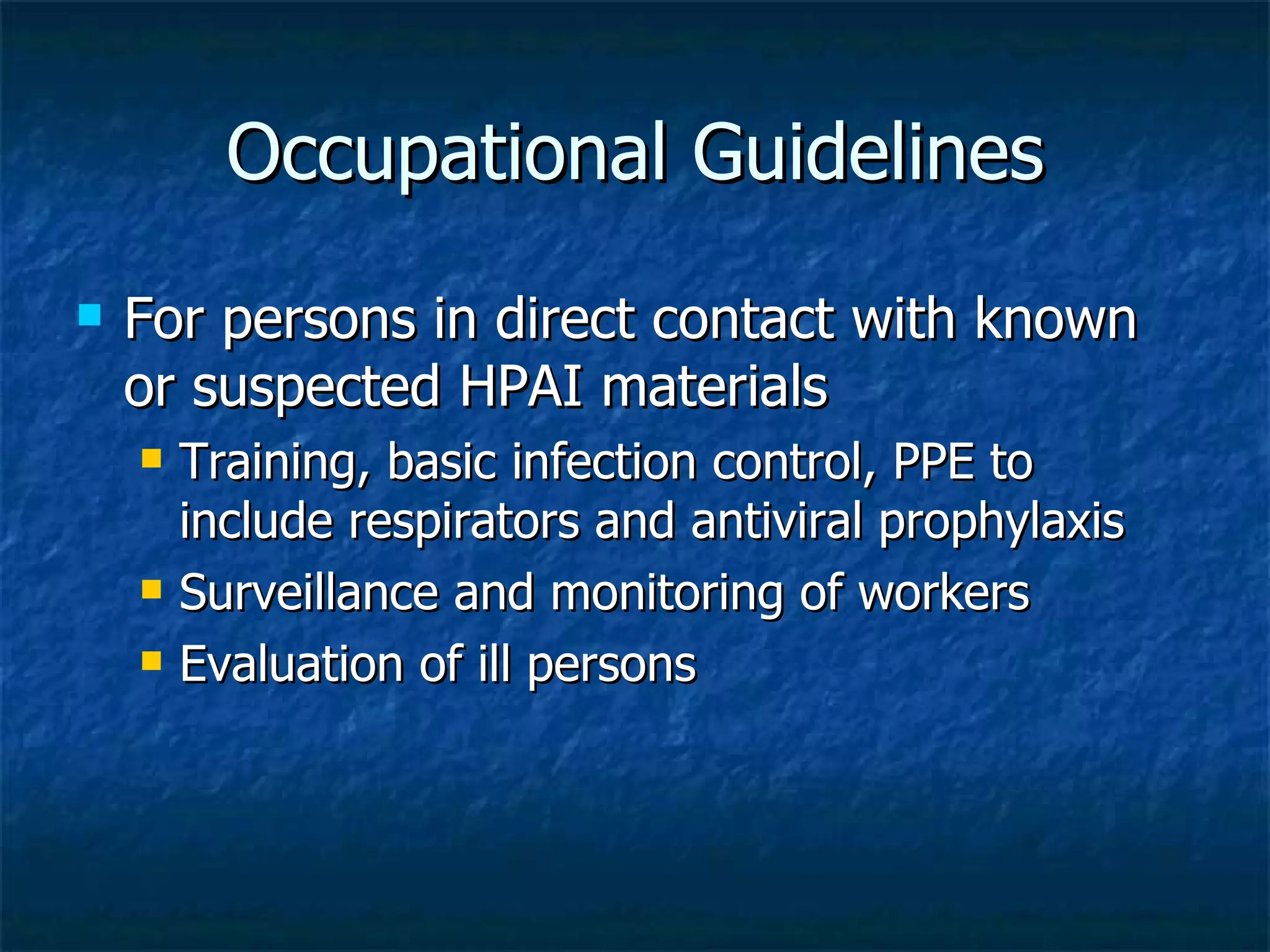
Occupational Guidelines For persons in direct contact with known or suspected HPAI materials Training, basic infection control, PPE to include respirators and antiviral prophylaxis Surveillance and monitoring of workers Evaluation of ill persons
Occupational Guidelines For exposure to a known HPAI source Disposable particulate respirators (N-95 or greater); or powered air purifying respirator Current season influenza vaccine Reduces possibility of dual infection with human and avian influenza, which could lead to reassortment
Occupational Guidelines For persons in contact with live or dead poultry or materials later identified as HPAI Medical evaluation  If symptomatic, collection of specimens for viral testing Post-exposure prophylaxis Surveillance for respiratory-related symptoms Fever Respiratory symptoms Conjunctivitis
General precautions Wear a mask and gloves if using poultry manure, then wash your hands afterwards. Wear gloves if touching sick or dead birds.  Monitor your neighborhood for any bird or poultry deaths. If there are bird or poultry deaths, report this to your local veterinarian.
 
Do not touch nose, eyes, mouth with dirty hands. Wash hands frequently with soap and water. Use separate chopping boards for vegetables, cooked foods, raw foods. Wash chopping boards with soap and water immediately after chopping.
1.  Conventional cooking will inactivate the H5N1 virus. Well cooked poultry meat is therefore safe to consume. 2.  The H5N1 virus, if present in poultry meat, is not killed by refrigeration or freezing. 3.  Home slaughtering and preparation of sick or dead poultry for food is hazardous: this practice should be avoided
4.  Eggs can contain H5N1 virus both on the outside and the inside. Eggs from H5N1 infected areas should not be consumed raw or partially cooked. Don’t use uncooked tin foods that will not be cooked.  5.  Greatest risk of exposure to the virus is by handling and slaughtering live infected poultry. Cover your nose, mouth and hands in handing sick animals.
THANK YOU
Vaccination for Poultry Inactivated whole AI virus Effective against H5 subtype Reduced amount of virus in environment May have sub clinical infection Can still shed virus Administered by injection Vaccination may   limit export Recombinant vaccines under development H5 and H7 vaccination requires Govt approval
Helpful web sites Centers for Disease Control:  www.cdc.gov World Health Organization:  www.who.int /en/ World Organization for Animal Health:  www.oie.int UN Food and Agriculture Organization:  www.fao.org US poultry and Egg Industry Association   http://www.poultryegg.org/   USDA Avian Influenza website  http://www.usda.gov/wps/portal/usdahome?navid=AVIAN_INFLUENZA&navtype=SU
Choose fresh poultry meat carefully. Don’t buy meat or poultry that is dying/dead from disease (such as dark, bruised meat or hemorrhagic spots).  For eggs: choose new, clean, solid shells, and no poultry feces or feathers on the eggshell. Clean well before cooking.
Reminders Effective Bird Proofing Working Pest Control Program For Rodents and Fly No other animals especially waterfowl Sign – in Log Book Power Sprayer at the farm gate Separate foot wear/Foot Dip Sanitation/disinfection
The  sequence  for wearing  the PPE  is as under: 1. Wear  shoe  cover 2. Wash hands 3. Wear  'Dangri' 4. Put on  the  face mask/ mask with hepa  filter  (N95  standard) 5. Fix protective glasses over eyes  (goggles)  6. Fix hood over head 7. Put on gloves The  sequence of  removing PPE  should be  followed as below 1. Remove  shoe  covers 2. Remove house gloves 3. Wash hands 4. Remove  'Dangri' with attached hood  5. Remove disposable protective glasses  (goggles) 6. Remove  face masks  (for other  than direct handlers)/  face  mask with hepa  filter , N95  standard  (for direct handlers) 7. Discard all 8. Wash hands
Antivirals Antivirals use only for humans On March 20, 2006, the FDA proposed to prohibit the use in poultry of two classes of approved human antiviral drugs in treating influenza to help preserve the effectiveness of these drugs for treating or preventing influenza infections in humans. Prohibits the use by veterinarians of anti-influenza drugs adamantane (amantadine and rimantadine) and neuraminidase inhibitor (oseltamivir and zanamivir) drugs in chickens, turkeys, and ducks.
Self- -Assessment Guide  Farm location & layout Access deterrents  Building Entryways Pest control programs Truck Traffic Deliveries  Visitor concerns Tools & equipment  Cleaning & disinfection Water sanitation Employee concerns Multi farm management Flock health management Carcass/manure  management
A public announcement was made a day before carrying out culling of birds asking poultry owners not to release the birds in the morning and that veterinarians would collect the birds the next morning against cash  payment.  Poultry  owners  were  also  advised  to  observe precautions such as cover face, nose etc. when handling the birds.  The  co-operation  of  the  local  bodies  is  necessary  for  backyard operations.  A  common  ground was  identified  for  the  culling  and disposal of the culled birds in consultation with the local bodies. The birds were collected by veterinarian / para-veterinarian in morning & carried  to  disposal  sites.
Waste, organic and all other non-disinfectable material present  on  the  farm -litter ,  eggs,  egg  products,  hay,  animal feed/feed  materials,  feathers  and  egg-trays  must  be  destroyed  litter can be either buried in the  pit  with  animal  carcasses  or  burnt.  Eggs/  Egg products  may  be  buried  in  the  pit  with  the  animal carcasses.  Straw may be burnt. The  crops grown  in  the  farm  should be uprooted and buried/ burnt.  The  protective  clothing  used  by  the  staff  should also be burnt. Feathers  are  to  be  disposed  off by use of  flame guns. Water should not be allowed to accumulate in the farm premises and particularly  in and around disposal  sites.
Washing and disinfection of walls, floors and ceilings of the  infected .  All  sheds  in  the premises should be cleaned which  includes washing of floors  &  walls  with  3%  calcium  hydroxide  solution;  sprinkling of bleaching powder and lime on the floors of the  sheds  and  farm  areas; white-washing  of  concrete areas with  lime;  spraying  the areas with 4%  formalin;  fumigation of closed chambers and sheds with KMnO4  and  formalin;  treating  all equipments with 2% sodium hypochlorite solution for 48 hrs  Metal  structures  such  as  cages  may  be decontaminated by heat  treatment. All units connected to the  establishment  (i.e.  hatchery,  egg  storage  rooms, packaging rooms, egg trolleys, egg product plants) must be properly disinfected.  Vehicles, used  for  transporting live  animals,  eggs  and  animal  feed  must  also  be disinfected. All equipment inside the house such as drinkers and food hoppers must be washed and treated with a disinfectant for at  least 48 hours.  Water  reservoirs  must  also  be  emptied,  washed  and disinfected. Feed tanks (silos) need to be emptied, washed with a hot water-pressure pump and  subsequently  fumigated. After  washing  and  disinfecting,  all  units  must  be fumigated  twice  with  at  least  two  weeks  between fumigations.
Rectified spirit or Savlon or Dettol (1 % solution) for  cleaning  of  hands,  feet  of  farm workers  (ii) 2% solution of NaOH should be used at the entrance on foot mats to clean the shoes. /  scrub and  clean gumboots and other  items.  (iii) Sodium  hypochlorite  :  2%  active  chlorine  solution (disinfection of equipment)  (iv) Quaternary ammonium salts: 4% solution (treatment of walls,  floors,  ceilings and equipment). (v) Calcium Hydroxide: 3% solution (walls and floors).  (vi) Cresolic acid 2.2%  solution:  (floors).  (vii) Synthetic phenols 2%  solution:  (floors). (viii) Vircon-S@ and Trilocid  concentrate where available. (ix) Formalin and potassium permanganate  for  fumigation.
i) Burn all the temporary cages, litter , baskets, feed and egg trays of all  the poultry  in  the  infected  zone. ii)  Remove and burn all litter from permanent cages and clean the  cages. iii)  Burn garbage around poultry  keeping area. iv)  Spray  all  the  houses  within  infected  zone irrespective of the presence or absence of poultry with 2% sodium hypochlorite  solution. v)  Spray poultry rearing houses  in surveillance zone with 2% sodium hypochlorite  solution. vi)  Spray  all  the  damp  areas,  drains  etc.  with  4%  formalin. in  the  inhabited dwellings sodium  hypochlorite  or Trilocid  concentrate  or  Vircon-'S'  may  be  substituted.  vii)  Sprinkle  lime on  the  roads, streets etc  in all  the villages under the operation. viii)  White wash  the poultry  rearing houses  in  the  infected  zone.
Take Home Message Isolate domestic birds from wild birds and waterfowl Practice good biosecurity in all flocks Need adequate surveillance system Early detection and rapid response AI response is always a joint effort
Based on Post Operation Surveillance, the farms  will  be  allowed  to  restock  poultry. by keeping sentinel birds in each of the shed of the farms, for 21 days @ minimum 50 birds per shed up to the capacity  of  8000  layers  or  10,000  brooders  or  growers  and  a minimum of 100 birds per shed for more than 8000 layers or 10,000 brooders or  growers. 1. On 0 Day Serum sample from 5 birds per shed are to be collected to know the initial antibody status of birds.  2. On  the  12  day  cloacal  /  pharyngeal  /nasal  swabs  are  to collected for virus isolation. One pooled sample of 5 birds from each shed is to be collected and sent to Bhopal for testing viral antigen/  virus  isolation. 3. On 21  day again serum samples from the same birds are to be  collected  to assess  the antibody  status of  such birds.  4. Any mortality is to be investigated and reported to  Govt. of India  immediately. 5. It is emphasised that if the farmer does not cooperate and does not follow the restocking protocol he/she will not be allowed to  restock  the birds.  6. During  the  restocking  operation  the  local  veterinarian  is required  to  visit each  farm at  least once  in a week.
The birds killed in operations can be disposed off by burning in pyre  or burial. Approximately 5 quintals of wood per 100 kg of dead birds  would be required for burning. It should be ensured that carcasses  are completely burnt.  burial . For this, a pit must be prepared - size of the pit must be at least two meters long, two  meters wide and  two meters deep, and  this enables disposal of about 1800 birds. If it is made one meter deeper the capacity increases to 3000 birds.  It must be ensured  that  the pits are sufficiently deep. JCB  machines  were  deployed  in  recent  operations  to  dig  pits.  Burial  should be such  that  the disposed material  is kept well below  the  ground  level  to ensure  that  rodents or  stray animals  cannot access  it.  The  carcasses must be  covered with a  layer of  calcium hydroxide, and  then with a layer of earth (at least 40 cm deep) thus alternating one  with the other till the pit is covered upto the ground level. The burial  ground  is  to be suitably marked and should not be opened  for at  least  five years. The ground must be watched for settlement, if any and  periodically filled with earth and lime if it shows signs of sinking over  time.
Terminology  „ „ Biosafety– – In the context of the BTWC, biosafety  describes the containment principles, technologies and practices that are to be implemented to prevent unintentional exposure to pathogens and toxins, or  their accidental release.
 
Sectors 1 and 2 Sector 2 Moderate to high bio-security Birds/products often marketed commercially Sector 1 High level bio-security Birds/products marketed commercially

Biosecurity

  • 1.
    BIOSECURITY DEFINITION :all procedures used to prevent the introduction and spread of disease OBJECTIVES : - prevent the entry of disease - control the spread of disease Simple Biosecurity Model                                                        
  • 2.
  • 3.
    BENEFITS HELPS KEEPOUT diseases REDUCES THE RISK of zoonotic diseases LIMITS THE SPREAD of diseases HELPS PROTECT the public health IMPROVES the overall flock health CUTS COSTS of disease treatment REDUCES LOSSES and improves profitability
  • 4.
    Classification system forpoultry production systems (FAO 2004) Birds and products consumed locally Birds usually sold in live bird markets Usually commercial Commercial Bird and product marketing Minimal Low to minimal Moderate to high High Biosecurity Village or backyard Commercial Commercial Industrial integrated System Sector4 Sector 3 Sector 2 Sector1
  • 5.
    Poultry production systemsaffected by A.I. • Sector 1: Industrial integrated system / high level of biosecurity • Sector 2: Commercial poultry production system, moderate to high biosecurity • Sector 3: Small-scale commercial poultry production system with low to minimal biosecurity • Sector 4: Village or backyard production, minimal biosecurity + mixed farming system (ducks, pigs) •
  • 6.
    HOW DISEASES SPREADMOVEMENT of people, animals, equipment, vehicles CONTACT with neighboring flock CONTACT with insects, rodents, stray animals and pets CONTAMINATED water & feeds INADEQUATE cleaning and disinfection
  • 7.
    BIOSECURITY INFORMATION STRICTLYlimit and control access to the farm – fencing / controlled entry point KEEP an all-in, all-out flock management PROVIDE a security or decontamination area REQUIRE all persons entering the farm to sign a visitor’s logbook; vehicle plate numbers must also be recorded
  • 8.
    CLEAN & DIRTYareas should be well-defined THOROUGHLY clean and disinfect all equipment & vehicles entering AND leaving the farm BETTER NOT to borrow equipment or vehicles from other farms DON’T USE same vehicles for transporting birds, feeds, equipment or waste products
  • 9.
    KEEP WILD BIRDSoff– bird-proofing KEEP other animals, pets / livestock out of the farm PEST & RODENT control program PROPER DISPOSAL of damaged eggs, dead birds, litter or manure REGULARLY clean & disinfect all equipment & vehicles before and after use
  • 10.
    AFTER EVERY CYCLE,thoroughly clean & disinfect all houses & equipment ONCE CLEANED, a farm should be closed & left idle; the longer the down time, the better the results.
  • 11.
    Pathogenicity of AIAI strains characterized by pathogenicity in chickens LPAI (Low-pathogenic avian influenza) Mild disease in poultry Most strains are LPAI LPAI H5 and H7 strains can mutate into HPAI HPAI (Highly pathogenic avian influenza) Severe illness and high fatality in poultry Some birds have no illness
  • 12.
    Signs of LPAIInfluenza in Poultry Wild waterfowl, gulls, shorebirds are natural hosts for influenza viruses Usually no symptoms Infection in non-reservoir can result in either: No outward disease (LPAI) Mild infection (LPAI) Ruffled feathers Reduced egg production Respiratory symptoms Can be easy to miss!
  • 13.
    Development of HPAILow pathogenic AI strains that are most capable of mutating into HPAI and causing epizootics H5 and H7 Most H5 and H7 are LPAI Disease Human HPAI infection via contact with infected sick or dead birds Mild human LPAI infections have been documented Wild birds can introduce LPAI into domestic flocks Can evolve into HPAI
  • 14.
    Signs of HPAIInfection in Birds Causes more lethal infection Difficult to miss - severe disease/sudden onset Facial edema, swollen and cyanotic combs and wattles, drastic decline in egg production Internal hemorrhages of lungs and other organs Rapid spread Mortality near 100% within 48 hours
  • 15.
    Species Affected GeneticReservoirs Intermixing H1, H3 H1, H2, H3 H3, H7 H1-12 H14-15 H1-2, 4-7, H9-13, 15-16 H10 H1, H3, H4, H7, H13 Other Aquatic Birds? H5N1
  • 16.
    Avian Influenza inother Animals Domestic and wild birds Ducks, geese, sparrows, poultry, pets Pigs, horses, marine mammals, ferrets, minks Natural infection contracted from exposure to birds Tigers, leopards, domestic cats, dogs H5N1 infections from ingestion of infected poultry
  • 17.
    Control Biosecurity QuarantineIntensify disinfecting measures Monitoring/Surveillance Stamping Out / Depopulation DIVA Vaccination - only for LPAI and not for HPAI because it might prolong the shedding of the virus Proper Disposal
  • 18.
    Ensure Biosecurity throughBio- exclusion Keep poultry indoors Separate from the outside world Remove or disinfect all sources of infection Prevent unknown birds from entering flock Control human, vehicular, and equipment traffic onto the farm
  • 19.
    Use “all in– all out” production Separate new poultry from flock Clean and disinfect when “all out” AI can remain viable in tissue, faeces and water for a long period of time (days to weeks)
  • 20.
    Bio containment onInfected Farms Depopulation of infected and exposed birds Movement control On and off farm Bird markets closed and disinfected Testing of potentially infected birds Surveillance for illness in birds
  • 21.
    Destruction and Disposalof Birds in Affected Area Humanely depopulate birds and other animals Carbon dioxide Dislocate neck Others Effective disposal Incineration Bury Compost Digestion Rendering Cleaning and disinfection
  • 22.
    1. Selecta site that is well drained and not subject to flooding. 2. Keep away scavengers 3. Lay an 18 inch deep bed of coarse wood chips, 8-12 feet wide 4. Add a 12-15 inch layer of litter and birds, then cover with a 12-15 inch layer of wood chips or other carbon sources. Add another layer of litter and birds until it is two or three layers high and as long as needed. 6.If there is a disease outbreak, make sure that workers wear personal protective equipment and are properly sanitized when done. Workers should be vaccinated if applicable.
  • 23.
  • 24.
  • 25.
  • 26.
    IMPORTANT REMINDERS MAKEa flock health plan that includes basic biosecurity measures ENSURE that all records are accurate & up-to-date ALL poultry personnel should be trained LOOK OUT for signs of disease – REPORT immediately if disease is suspected
  • 27.
    Occupational Guidelines Forpersons in contact with healthy birds in HPAI-free zones Increased vigilance and hazard communication Standard Personal Protective Equipment (PPE) Risk assessment for species that may exhibit asymptomatic disease (e.g. ducks)
  • 28.
  • 29.
    Occupational Guidelines Forpersons in direct contact with known or suspected HPAI materials Training, basic infection control, PPE to include respirators and antiviral prophylaxis Surveillance and monitoring of workers Evaluation of ill persons
  • 30.
    Occupational Guidelines Forexposure to a known HPAI source Disposable particulate respirators (N-95 or greater); or powered air purifying respirator Current season influenza vaccine Reduces possibility of dual infection with human and avian influenza, which could lead to reassortment
  • 31.
    Occupational Guidelines Forpersons in contact with live or dead poultry or materials later identified as HPAI Medical evaluation If symptomatic, collection of specimens for viral testing Post-exposure prophylaxis Surveillance for respiratory-related symptoms Fever Respiratory symptoms Conjunctivitis
  • 32.
    General precautions Weara mask and gloves if using poultry manure, then wash your hands afterwards. Wear gloves if touching sick or dead birds. Monitor your neighborhood for any bird or poultry deaths. If there are bird or poultry deaths, report this to your local veterinarian.
  • 33.
  • 34.
    Do not touchnose, eyes, mouth with dirty hands. Wash hands frequently with soap and water. Use separate chopping boards for vegetables, cooked foods, raw foods. Wash chopping boards with soap and water immediately after chopping.
  • 35.
    1. Conventionalcooking will inactivate the H5N1 virus. Well cooked poultry meat is therefore safe to consume. 2. The H5N1 virus, if present in poultry meat, is not killed by refrigeration or freezing. 3. Home slaughtering and preparation of sick or dead poultry for food is hazardous: this practice should be avoided
  • 36.
    4. Eggscan contain H5N1 virus both on the outside and the inside. Eggs from H5N1 infected areas should not be consumed raw or partially cooked. Don’t use uncooked tin foods that will not be cooked. 5. Greatest risk of exposure to the virus is by handling and slaughtering live infected poultry. Cover your nose, mouth and hands in handing sick animals.
  • 37.
  • 38.
    Vaccination for PoultryInactivated whole AI virus Effective against H5 subtype Reduced amount of virus in environment May have sub clinical infection Can still shed virus Administered by injection Vaccination may limit export Recombinant vaccines under development H5 and H7 vaccination requires Govt approval
  • 39.
    Helpful web sitesCenters for Disease Control: www.cdc.gov World Health Organization: www.who.int /en/ World Organization for Animal Health: www.oie.int UN Food and Agriculture Organization: www.fao.org US poultry and Egg Industry Association http://www.poultryegg.org/ USDA Avian Influenza website http://www.usda.gov/wps/portal/usdahome?navid=AVIAN_INFLUENZA&navtype=SU
  • 40.
    Choose fresh poultrymeat carefully. Don’t buy meat or poultry that is dying/dead from disease (such as dark, bruised meat or hemorrhagic spots). For eggs: choose new, clean, solid shells, and no poultry feces or feathers on the eggshell. Clean well before cooking.
  • 41.
    Reminders Effective BirdProofing Working Pest Control Program For Rodents and Fly No other animals especially waterfowl Sign – in Log Book Power Sprayer at the farm gate Separate foot wear/Foot Dip Sanitation/disinfection
  • 42.
    The sequence for wearing the PPE is as under: 1. Wear shoe cover 2. Wash hands 3. Wear 'Dangri' 4. Put on the face mask/ mask with hepa filter (N95 standard) 5. Fix protective glasses over eyes (goggles) 6. Fix hood over head 7. Put on gloves The sequence of removing PPE should be followed as below 1. Remove shoe covers 2. Remove house gloves 3. Wash hands 4. Remove 'Dangri' with attached hood 5. Remove disposable protective glasses (goggles) 6. Remove face masks (for other than direct handlers)/ face mask with hepa filter , N95 standard (for direct handlers) 7. Discard all 8. Wash hands
  • 43.
    Antivirals Antivirals useonly for humans On March 20, 2006, the FDA proposed to prohibit the use in poultry of two classes of approved human antiviral drugs in treating influenza to help preserve the effectiveness of these drugs for treating or preventing influenza infections in humans. Prohibits the use by veterinarians of anti-influenza drugs adamantane (amantadine and rimantadine) and neuraminidase inhibitor (oseltamivir and zanamivir) drugs in chickens, turkeys, and ducks.
  • 44.
    Self- -Assessment Guide Farm location & layout Access deterrents Building Entryways Pest control programs Truck Traffic Deliveries Visitor concerns Tools & equipment Cleaning & disinfection Water sanitation Employee concerns Multi farm management Flock health management Carcass/manure management
  • 45.
    A public announcementwas made a day before carrying out culling of birds asking poultry owners not to release the birds in the morning and that veterinarians would collect the birds the next morning against cash payment. Poultry owners were also advised to observe precautions such as cover face, nose etc. when handling the birds. The co-operation of the local bodies is necessary for backyard operations. A common ground was identified for the culling and disposal of the culled birds in consultation with the local bodies. The birds were collected by veterinarian / para-veterinarian in morning & carried to disposal sites.
  • 46.
    Waste, organic andall other non-disinfectable material present on the farm -litter , eggs, egg products, hay, animal feed/feed materials, feathers and egg-trays must be destroyed litter can be either buried in the pit with animal carcasses or burnt. Eggs/ Egg products may be buried in the pit with the animal carcasses. Straw may be burnt. The crops grown in the farm should be uprooted and buried/ burnt. The protective clothing used by the staff should also be burnt. Feathers are to be disposed off by use of flame guns. Water should not be allowed to accumulate in the farm premises and particularly in and around disposal sites.
  • 47.
    Washing and disinfectionof walls, floors and ceilings of the infected . All sheds in the premises should be cleaned which includes washing of floors & walls with 3% calcium hydroxide solution; sprinkling of bleaching powder and lime on the floors of the sheds and farm areas; white-washing of concrete areas with lime; spraying the areas with 4% formalin; fumigation of closed chambers and sheds with KMnO4 and formalin; treating all equipments with 2% sodium hypochlorite solution for 48 hrs Metal structures such as cages may be decontaminated by heat treatment. All units connected to the establishment (i.e. hatchery, egg storage rooms, packaging rooms, egg trolleys, egg product plants) must be properly disinfected. Vehicles, used for transporting live animals, eggs and animal feed must also be disinfected. All equipment inside the house such as drinkers and food hoppers must be washed and treated with a disinfectant for at least 48 hours. Water reservoirs must also be emptied, washed and disinfected. Feed tanks (silos) need to be emptied, washed with a hot water-pressure pump and subsequently fumigated. After washing and disinfecting, all units must be fumigated twice with at least two weeks between fumigations.
  • 48.
    Rectified spirit orSavlon or Dettol (1 % solution) for cleaning of hands, feet of farm workers (ii) 2% solution of NaOH should be used at the entrance on foot mats to clean the shoes. / scrub and clean gumboots and other items. (iii) Sodium hypochlorite : 2% active chlorine solution (disinfection of equipment) (iv) Quaternary ammonium salts: 4% solution (treatment of walls, floors, ceilings and equipment). (v) Calcium Hydroxide: 3% solution (walls and floors). (vi) Cresolic acid 2.2% solution: (floors). (vii) Synthetic phenols 2% solution: (floors). (viii) Vircon-S@ and Trilocid concentrate where available. (ix) Formalin and potassium permanganate for fumigation.
  • 49.
    i) Burn allthe temporary cages, litter , baskets, feed and egg trays of all the poultry in the infected zone. ii) Remove and burn all litter from permanent cages and clean the cages. iii) Burn garbage around poultry keeping area. iv) Spray all the houses within infected zone irrespective of the presence or absence of poultry with 2% sodium hypochlorite solution. v) Spray poultry rearing houses in surveillance zone with 2% sodium hypochlorite solution. vi) Spray all the damp areas, drains etc. with 4% formalin. in the inhabited dwellings sodium hypochlorite or Trilocid concentrate or Vircon-'S' may be substituted. vii) Sprinkle lime on the roads, streets etc in all the villages under the operation. viii) White wash the poultry rearing houses in the infected zone.
  • 50.
    Take Home MessageIsolate domestic birds from wild birds and waterfowl Practice good biosecurity in all flocks Need adequate surveillance system Early detection and rapid response AI response is always a joint effort
  • 51.
    Based on PostOperation Surveillance, the farms will be allowed to restock poultry. by keeping sentinel birds in each of the shed of the farms, for 21 days @ minimum 50 birds per shed up to the capacity of 8000 layers or 10,000 brooders or growers and a minimum of 100 birds per shed for more than 8000 layers or 10,000 brooders or growers. 1. On 0 Day Serum sample from 5 birds per shed are to be collected to know the initial antibody status of birds. 2. On the 12 day cloacal / pharyngeal /nasal swabs are to collected for virus isolation. One pooled sample of 5 birds from each shed is to be collected and sent to Bhopal for testing viral antigen/ virus isolation. 3. On 21 day again serum samples from the same birds are to be collected to assess the antibody status of such birds. 4. Any mortality is to be investigated and reported to Govt. of India immediately. 5. It is emphasised that if the farmer does not cooperate and does not follow the restocking protocol he/she will not be allowed to restock the birds. 6. During the restocking operation the local veterinarian is required to visit each farm at least once in a week.
  • 52.
    The birds killedin operations can be disposed off by burning in pyre or burial. Approximately 5 quintals of wood per 100 kg of dead birds would be required for burning. It should be ensured that carcasses are completely burnt. burial . For this, a pit must be prepared - size of the pit must be at least two meters long, two meters wide and two meters deep, and this enables disposal of about 1800 birds. If it is made one meter deeper the capacity increases to 3000 birds. It must be ensured that the pits are sufficiently deep. JCB machines were deployed in recent operations to dig pits. Burial should be such that the disposed material is kept well below the ground level to ensure that rodents or stray animals cannot access it. The carcasses must be covered with a layer of calcium hydroxide, and then with a layer of earth (at least 40 cm deep) thus alternating one with the other till the pit is covered upto the ground level. The burial ground is to be suitably marked and should not be opened for at least five years. The ground must be watched for settlement, if any and periodically filled with earth and lime if it shows signs of sinking over time.
  • 53.
    Terminology „„ Biosafety– – In the context of the BTWC, biosafety describes the containment principles, technologies and practices that are to be implemented to prevent unintentional exposure to pathogens and toxins, or their accidental release.
  • 54.
  • 55.
    Sectors 1 and2 Sector 2 Moderate to high bio-security Birds/products often marketed commercially Sector 1 High level bio-security Birds/products marketed commercially