BROILER MANAGEMENT
DR. MD. RAMZAN ALI
DVM
(HSTU)
Poultry
Consultant
Dhaka,
Bangladesh
TOPICS
Houses Preparation and
Biosecurity
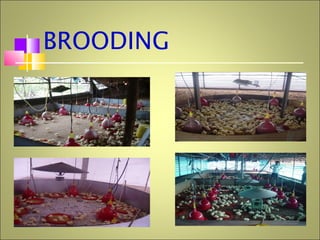
Management in Brooding
Water Managemnt
Litter Mananagement
Vaccination Schedule
Heat Stress and controll
Some Important Diseases
PLACE SELECTION
 Poultry house should be
dry, up ground & away
from locality.
 Ensure pure water &
electricity supply.
 Predators & others
animal are not allowed
in the farm.
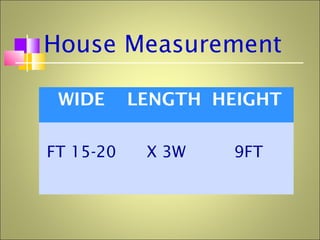
House Measurement
WIDE LENGTH HEIGHT
15-20FT X 3W 9FT
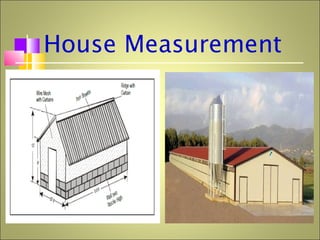
House Measurement
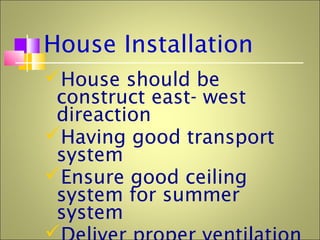
House Installation
House should be
construct east- west
direaction
Having good transport
system
Ensure good ceiling
system for summer
system

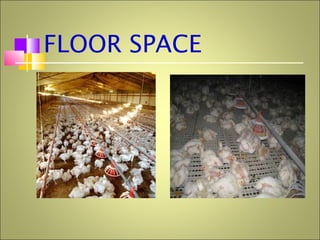
FLOOR SPACE
First 2 week 0.5
sqft/chick should
provided
In summer season 1.2
sqft and winter 1 sqft
place should be provided.
FLOOR SPACE
BIOSECURITY
Farm Metarials: Feeder,
waterer, fan, door, window,
fan, hover, net should
washed following way:
Detergent
Washing Soda
Disinfactant
BIOSECURITY
Floor:
Firstly:
Costic Soda- 1.02gm/sqft
Washing Soda- 6gm/ sqft
Spray floor & keep 12-18 hrs
Secondly (for 500 sqft)
Calcium Carbonate-1000gm
Bleaching powder- 250 gm
Copper Sulphate- 250 gm
Water – 5 litre
Finally washout the floor
BIOSECURITY
Fumigation: (for 200 sqft)
Potassium per
menganate- 40 gm
Formalin- 80 gm
Note: Formalin should be
BIOSECURITY
All house Spray:
Water- 5 litre
Formalin- 1 litre
Spray all side of shed and
out side also
MANAGEMENT IN
BROODING
Chick Guard:
For 1000 chicks, it should be
24 ft long & 12 ft width
Light:
In summer- 1.5 watt/chicks
In winter- 2 watt/ chick
Heat should be provided.
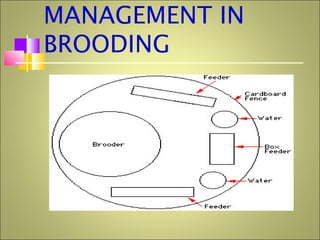
MANAGEMENT IN
BROODING
PREPARATION FOR CHICK
ARRIVAL
Litter material should be
spread evenly to a depth o
f 3–4 in (7.5–10 cm) and t
hen levelled and compacte
d in the brooding area.
The necessary equipment
must be assembled in the
appropriate configuration
as-
PREPARATION FOR CHICK
ARRIVAL
 Equipment in the house
(i.e., feeders, drinkers, heate
rs and fans) should be arran
ged to allow chicks to mainta
in body temperature without
dehydration and to find feed
and water easily.
 Configuration will depend
on the brooding system and
on other equipment being us
PREPARATION FOR CHICK
ARRIVAL
 Supplementary feeders
and drinkers shouldbe pla
ced in close proximity to t
he main systems.
PREPARATION FOR CHICK
ARRIVAL
Houses should be pre-heated
for a sufficient period to achieve
target house and litter temperat
ures prior to chick arrival.
Temperature should be
monitored regularly to ensure a
uniform environment exists thro
ughout the whole brooding area
.
AFTER ARRIVAL
Firstly provide lukeworm water
for 2-3 hrs then provide
following solution-
Glucose-50gm/ litre
Multivitamine-1gm/4
litre
Electrolytes- 1gm/ 2
litre
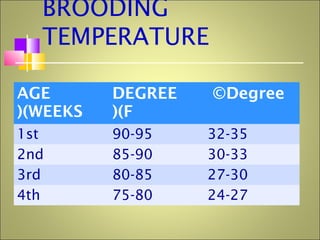
BROODING
TEMPERATURE
AGE
(WEEKS(
DEGREE
(F(
Degree©
1st 90-95 32-35
2nd 85-90 30-33
3rd 80-85 27-30
4th 75-80 24-27
BROODING
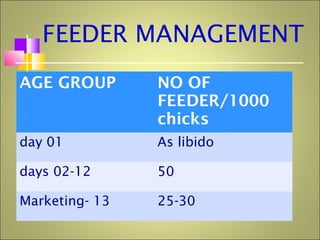
FEEDER MANAGEMENT
AGE GROUP NO OF
FEEDER/1000
chicks
01day As libido
02-12days 50
13-Marketing 25-30
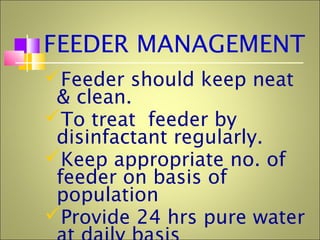
FEEDER MANAGEMENT
Feeder should keep neat
& clean.
To treat feeder by
disinfactant regularly.
Keep appropriate no. of
feeder on basis of
population
Provide 24 hrs pure water
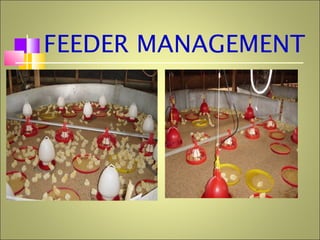
FEEDER MANAGEMENT
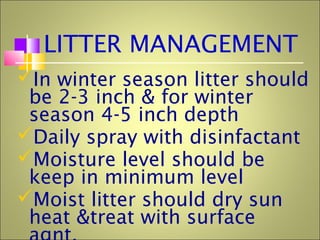
LITTER MANAGEMENT
In winter season litter should
be 2-3 inch & for winter
season 4-5 inch depth
Daily spray with disinfactant
Moisture level should be
keep in minimum level
Moist litter should dry sun
heat &treat with surface
LITTER MANAGEMENT
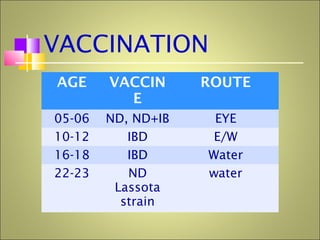
VACCINATION
AGE VACCIN
E
ROUTE
05-06 ND, ND+IB EYE
10-12 IBD E/W
16-18 IBD Water
22-23 ND
Lassota
strain
water
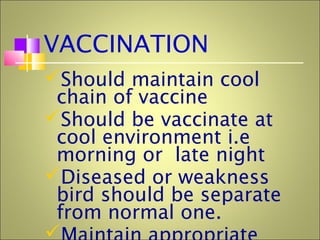
VACCINATION
Should maintain cool
chain of vaccine
Should be vaccinate at
cool environment i.e
morning or late night
Diseased or weakness
bird should be separate
from normal one.

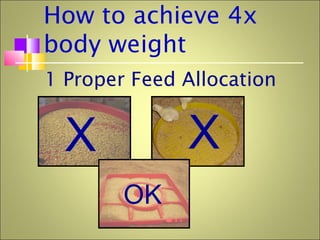
How to achieve 4x
body weight
1 Proper Feed Allocation
X X
OK
How to achieve 4x
body weight
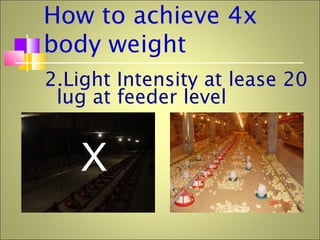
2.Light Intensity at lease 20
lug at feeder level
X
How to achieve 4x
body weight
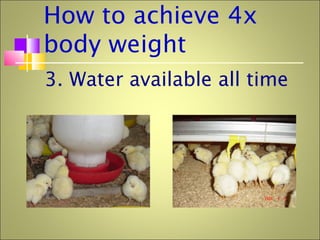
3. Water available all time
How to achieve 4x
body weight
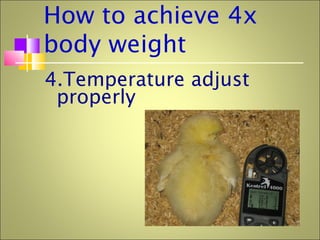
4.Temperature adjust
properly
How to achieve 4x
body weight
5.Ventilation
VENTILATION
Air quality is critical during the
brooding period.

Ventilation is required during
the brooding period to maintain
temperatures at the targeted lev
el and to allow sufficient air exc
hange to prevent the accumulati
on of harmful gases such as car
bon monoxide, carbon dioxide a
nd ammonia.
VENTILATION
Establishing minimum
ventilation rates from one
day of age will ensure fres
h air is supplied to chicks
at frequent, regular interv
als.
 Stirring fans can be used
to maintain evenness of ai
MONITORING EARLY
CHICK PERFORMANCE
MONITORING EARLY CHICK
PERFORMANCE
As a result of continued
genetic gains in growth ra
te, brooding has become a
n increasingly greater pro
portion of the life of the fl
ock. In addition,
MONITORING EARLY CHICK
PERFORMANCE
Seven-day body weight is
highly correlated to market a
ge weight.
 It is strongly recommended
that a sample of each flock b
e weighed at seven days to e
valuate growth performance
against standards for the giv
en product.
MONITORING EARLY CHICK
PERFORMANCE
Scales used should be
capable of weighing in 1 g in
crements.
Minimum sample size
should be 1 percent of the fl
ock,
 With sampling done in at
least three separate areas of
the house.
MONITORING EARLY CHICK
PERFORMANCE
A general rule of thumb
would be a seven-day target
of 4x dayold chick weight.
 Average weights below 130
g should prompt investigatio
n as to causative reasons.
Seven days weight below 1g
release 6g at 42 days.
HUMIDITY
Relative humidity (RH) in the
hatcher, at the end of the inc
ubation process will be high
(approx. 80 percent).
 Houses with whole house
heating, especially where nip
ple drinkers are used, can ha
ve RH levels as low as 25 per
cent.
HUMIDITY
Houses with more
conventional equipment (i.
e., spot brooders, which p
roduce moisture as a bypr
oduct of combustion and
bell drinkers, which have
open water surfaces) have
a much higher RH (usually
over 50 percent).
HUMIDITY
To limit the shock to the
chicks of transfer from the
incubator,
RH levels in the first three
days should be
maintained near 70 perce
nt.
HUMIDITY
RH within the broiler house
should be monitored daily.
If it falls below 50 percent in
the first week, chicks will begin
to dehydrate,
Causing negative effects on
performance.
 In such cases, action should be
taken to increase RH.
HUMIDITY
If the house is fitted with
high-pressure spray nozzles
(i.e.,foggers) for cooling in hi
gh temperatures, then these
can be used to increase RH d
uring brooding.
Chicks kept at appropriate
humidity levels are less pron
HUMIDITY
As the chick grows, ideal
RH falls.
 High RH from 18 days
onward can cause wet litte
r and its associated proble
ms.
As broilers increase in live
weight, RH levels can be
controlled using ventilatio
HEAT STRESS
Heat stress negatively affects
growth rate and livability.
 Effects of heat stress can be
minimized by altering the enviro
nment to reduce the temperatur
e experienced by the bird.
CONTROL OF HEAT
STRESS
Normal body temperature of a
broiler chicken is 106ºF
(41ºC).
Absolute temperature at which a
broiler is under heat
stress is related to its age,
temperature and RH.
 As a rule of thumb, for fully
feathered birds, a “heat stress inde
x” (RH plus temperature in ºF) of 16
0 is considered heat stress.
CONTROL OF HEAT
STRESS
Broilers regulate their body
temperature by two methods:
radiation/convection of heat and
evaporative cooling through
respiration.
 Within the temperature range
55–77ºF (13–25ºC), heat loss is
mainly accomplished through p
hysical radiation and convection
to the cooler environment.
CONTROL OF HEAT
STRESS
As the temperature rises
above 86ºF (30ºC) the majori
ty of heat loss is accomplish
ed by evaporative cooling an
d panting, and increased res
piration rate.
CONTROL OF HEAT
STRESS
Panting allows the bird to
control body temperature by ev
aporation of water from the res
piratory surfaces and air sacs.
The process uses energy. In
conditions of high humidity, pa
nting is less effective.
 Where high temperatures are
maintained for long periods, or
humidity is very high, panting m
CONTROL OF HEAT
STRESS
As the bird passes into a
condition of heat stress, r
ectal temperature rises, he
art rate and metabolic rate
increase and oxygenation
of the blood decreases.
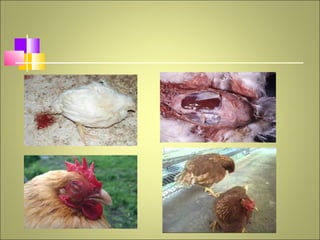
SOME IMPORTANT
DISEASE
Diseases Clinical Sign Control/Trea
tment
Newcastle Disease Green diarrhoea,
torticolitis,
Anorexia
Prevent by
Vaccination
Infactious Bursal
Disease
Whitish diarrhoea,
hyperthermia,
dullness
Prevent by
Vaccination
Coccidiosis Bloody enteritis,
dehydration,
anorxia
Applied proper
anticoccidial
Mycoplasosis Hacking cough, Apply proper
THANK
YOU

Broiler management by DR. Md. Ramzan Ali

  • 1.
    BROILER MANAGEMENT DR. MD.RAMZAN ALI DVM (HSTU) Poultry Consultant Dhaka, Bangladesh
  • 2.
    TOPICS Houses Preparation and Biosecurity Managementin Brooding Water Managemnt Litter Mananagement Vaccination Schedule Heat Stress and controll Some Important Diseases
  • 3.
    PLACE SELECTION  Poultryhouse should be dry, up ground & away from locality.  Ensure pure water & electricity supply.  Predators & others animal are not allowed in the farm.
  • 5.
    House Measurement WIDE LENGTHHEIGHT 15-20FT X 3W 9FT
  • 6.
  • 7.
    House Installation House shouldbe construct east- west direaction Having good transport system Ensure good ceiling system for summer system 
  • 8.
    FLOOR SPACE First 2week 0.5 sqft/chick should provided In summer season 1.2 sqft and winter 1 sqft place should be provided.
  • 9.
  • 10.
    BIOSECURITY Farm Metarials: Feeder, waterer,fan, door, window, fan, hover, net should washed following way: Detergent Washing Soda Disinfactant
  • 11.
    BIOSECURITY Floor: Firstly: Costic Soda- 1.02gm/sqft WashingSoda- 6gm/ sqft Spray floor & keep 12-18 hrs Secondly (for 500 sqft) Calcium Carbonate-1000gm Bleaching powder- 250 gm Copper Sulphate- 250 gm Water – 5 litre Finally washout the floor
  • 12.
    BIOSECURITY Fumigation: (for 200sqft) Potassium per menganate- 40 gm Formalin- 80 gm Note: Formalin should be
  • 13.
    BIOSECURITY All house Spray: Water-5 litre Formalin- 1 litre Spray all side of shed and out side also
  • 14.
    MANAGEMENT IN BROODING Chick Guard: For1000 chicks, it should be 24 ft long & 12 ft width Light: In summer- 1.5 watt/chicks In winter- 2 watt/ chick Heat should be provided.
  • 15.
  • 16.
    PREPARATION FOR CHICK ARRIVAL Littermaterial should be spread evenly to a depth o f 3–4 in (7.5–10 cm) and t hen levelled and compacte d in the brooding area. The necessary equipment must be assembled in the appropriate configuration as-
  • 17.
    PREPARATION FOR CHICK ARRIVAL Equipment in the house (i.e., feeders, drinkers, heate rs and fans) should be arran ged to allow chicks to mainta in body temperature without dehydration and to find feed and water easily.  Configuration will depend on the brooding system and on other equipment being us
  • 18.
    PREPARATION FOR CHICK ARRIVAL Supplementary feeders and drinkers shouldbe pla ced in close proximity to t he main systems.
  • 19.
    PREPARATION FOR CHICK ARRIVAL Housesshould be pre-heated for a sufficient period to achieve target house and litter temperat ures prior to chick arrival. Temperature should be monitored regularly to ensure a uniform environment exists thro ughout the whole brooding area .
  • 20.
    AFTER ARRIVAL Firstly providelukeworm water for 2-3 hrs then provide following solution- Glucose-50gm/ litre Multivitamine-1gm/4 litre Electrolytes- 1gm/ 2 litre
  • 21.
  • 22.
  • 23.
    FEEDER MANAGEMENT AGE GROUPNO OF FEEDER/1000 chicks 01day As libido 02-12days 50 13-Marketing 25-30
  • 24.
    FEEDER MANAGEMENT Feeder shouldkeep neat & clean. To treat feeder by disinfactant regularly. Keep appropriate no. of feeder on basis of population Provide 24 hrs pure water
  • 25.
  • 26.
    LITTER MANAGEMENT In winterseason litter should be 2-3 inch & for winter season 4-5 inch depth Daily spray with disinfactant Moisture level should be keep in minimum level Moist litter should dry sun heat &treat with surface
  • 27.
  • 28.
    VACCINATION AGE VACCIN E ROUTE 05-06 ND,ND+IB EYE 10-12 IBD E/W 16-18 IBD Water 22-23 ND Lassota strain water
  • 29.
    VACCINATION Should maintain cool chainof vaccine Should be vaccinate at cool environment i.e morning or late night Diseased or weakness bird should be separate from normal one. 
  • 30.
    How to achieve4x body weight 1 Proper Feed Allocation X X OK
  • 31.
    How to achieve4x body weight 2.Light Intensity at lease 20 lug at feeder level X
  • 32.
    How to achieve4x body weight 3. Water available all time
  • 33.
    How to achieve4x body weight 4.Temperature adjust properly
  • 34.
    How to achieve4x body weight 5.Ventilation
  • 35.
    VENTILATION Air quality iscritical during the brooding period. Ventilation is required during the brooding period to maintain temperatures at the targeted lev el and to allow sufficient air exc hange to prevent the accumulati on of harmful gases such as car bon monoxide, carbon dioxide a nd ammonia.
  • 36.
    VENTILATION Establishing minimum ventilation ratesfrom one day of age will ensure fres h air is supplied to chicks at frequent, regular interv als.  Stirring fans can be used to maintain evenness of ai
  • 37.
  • 38.
    MONITORING EARLY CHICK PERFORMANCE Asa result of continued genetic gains in growth ra te, brooding has become a n increasingly greater pro portion of the life of the fl ock. In addition,
  • 39.
    MONITORING EARLY CHICK PERFORMANCE Seven-daybody weight is highly correlated to market a ge weight.  It is strongly recommended that a sample of each flock b e weighed at seven days to e valuate growth performance against standards for the giv en product.
  • 40.
    MONITORING EARLY CHICK PERFORMANCE Scalesused should be capable of weighing in 1 g in crements. Minimum sample size should be 1 percent of the fl ock,  With sampling done in at least three separate areas of the house.
  • 41.
    MONITORING EARLY CHICK PERFORMANCE Ageneral rule of thumb would be a seven-day target of 4x dayold chick weight.  Average weights below 130 g should prompt investigatio n as to causative reasons. Seven days weight below 1g release 6g at 42 days.
  • 42.
    HUMIDITY Relative humidity (RH)in the hatcher, at the end of the inc ubation process will be high (approx. 80 percent).  Houses with whole house heating, especially where nip ple drinkers are used, can ha ve RH levels as low as 25 per cent.
  • 43.
    HUMIDITY Houses with more conventionalequipment (i. e., spot brooders, which p roduce moisture as a bypr oduct of combustion and bell drinkers, which have open water surfaces) have a much higher RH (usually over 50 percent).
  • 44.
    HUMIDITY To limit theshock to the chicks of transfer from the incubator, RH levels in the first three days should be maintained near 70 perce nt.
  • 45.
    HUMIDITY RH within thebroiler house should be monitored daily. If it falls below 50 percent in the first week, chicks will begin to dehydrate, Causing negative effects on performance.  In such cases, action should be taken to increase RH.
  • 46.
    HUMIDITY If the houseis fitted with high-pressure spray nozzles (i.e.,foggers) for cooling in hi gh temperatures, then these can be used to increase RH d uring brooding. Chicks kept at appropriate humidity levels are less pron
  • 47.
    HUMIDITY As the chickgrows, ideal RH falls.  High RH from 18 days onward can cause wet litte r and its associated proble ms. As broilers increase in live weight, RH levels can be controlled using ventilatio
  • 48.
    HEAT STRESS Heat stressnegatively affects growth rate and livability.  Effects of heat stress can be minimized by altering the enviro nment to reduce the temperatur e experienced by the bird.
  • 49.
    CONTROL OF HEAT STRESS Normalbody temperature of a broiler chicken is 106ºF (41ºC). Absolute temperature at which a broiler is under heat stress is related to its age, temperature and RH.  As a rule of thumb, for fully feathered birds, a “heat stress inde x” (RH plus temperature in ºF) of 16 0 is considered heat stress.
  • 50.
    CONTROL OF HEAT STRESS Broilersregulate their body temperature by two methods: radiation/convection of heat and evaporative cooling through respiration.  Within the temperature range 55–77ºF (13–25ºC), heat loss is mainly accomplished through p hysical radiation and convection to the cooler environment.
  • 51.
    CONTROL OF HEAT STRESS Asthe temperature rises above 86ºF (30ºC) the majori ty of heat loss is accomplish ed by evaporative cooling an d panting, and increased res piration rate.
  • 52.
    CONTROL OF HEAT STRESS Pantingallows the bird to control body temperature by ev aporation of water from the res piratory surfaces and air sacs. The process uses energy. In conditions of high humidity, pa nting is less effective.  Where high temperatures are maintained for long periods, or humidity is very high, panting m
  • 53.
    CONTROL OF HEAT STRESS Asthe bird passes into a condition of heat stress, r ectal temperature rises, he art rate and metabolic rate increase and oxygenation of the blood decreases.
  • 54.
    SOME IMPORTANT DISEASE Diseases ClinicalSign Control/Trea tment Newcastle Disease Green diarrhoea, torticolitis, Anorexia Prevent by Vaccination Infactious Bursal Disease Whitish diarrhoea, hyperthermia, dullness Prevent by Vaccination Coccidiosis Bloody enteritis, dehydration, anorxia Applied proper anticoccidial Mycoplasosis Hacking cough, Apply proper
  • 56.

Editor's Notes

  • #4 การจัดไก่ลงเล้าต้องเป็นลูกไก่จากแม่ไก่ฝูงเดียวกัน หรืออายุเท่าๆกัน
  • #8 tio
  • #17 วัสดุรองพื้นต้องกระจายให้เรียบร้อย และในพื้นที่กกต้องมีความหนา 3-4 นิ้ว อุปกรณ์ที่จำเป็นต้องเตรียมให้พร้อม และอยู่ในที่ที่เหมาะสม
  • #18 อุปกรณ์ในเล้า เช่น feeder drinkers heaters ต้องจัดเตรียมให้พร้อมและเหมาะสม เพื่อให้ลูกไก่สามารถรักษาอุณหภูมิของร่างการ และหาน้ำและอาหารได้อย่างง่ายดาย
  • #19 ถาดอาหารเสริม ให้วางใกล้ที่ให้อาหารหลัก และที่ให้น้ำเสริมต้องวางให้ใกล้ชิดกับที่ให้น้ำหลัก
  • #20 ต้องทำการอุ่นเล้าและวัสดุรองพื้นให้ได้อุณหภูมิตามที่ต้องการก่อนลูกไก่มาถึง ต้องตรวจสอบอุณหภูมิให้มีความสม่ำเสมอตลอดพื้นที่การกก