AUTOTRONICS
Presented by
NAME : S.ARUNKUMAR
YEAR : IV YEAR
DEPARTMENT : MECHANICAL ENGINEERING
COLLEGE : SUDHARASAN ENGG COLLEGE
DEFINITION
•The Autotronics is referred to as modern
automotive technology and also
commonly known as Automotive
Mechatronics.
•Autotronics is the combination of
automobile and electronics while hybrid
refers to technology that uses two or more
distinct power sources to move the
vehicle.
HISTORY
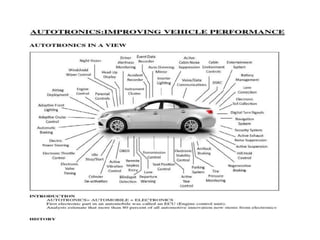
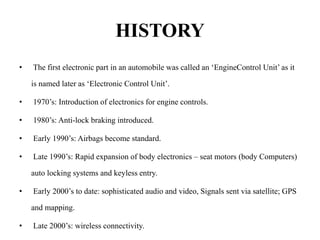
• The first electronic part in an automobile was called an ‘EngineControl Unit’ as it
is named later as ‘Electronic Control Unit’.
• 1970’s: Introduction of electronics for engine controls.
• 1980’s: Anti-lock braking introduced.
• Early 1990’s: Airbags become standard.
• Late 1990’s: Rapid expansion of body electronics – seat motors (body Computers)
auto locking systems and keyless entry.
• Early 2000’s to date: sophisticated audio and video, Signals sent via satellite; GPS
and mapping.
• Late 2000’s: wireless connectivity.
AUTOMOBILE APPLICATION
FOR AUTOTRONICS
• Braking system
• Steering system
• Suspension system
• Transmission system
• Engine (fuel intake)
BRAKING SYSTEM
• EBS increases traffic safety through reduced
stopping distance and improved brake stability.
• Functions In ECB:
• Anti-lock braking system (ABS)
• Traction control system (TCS)
• Brake lining wear control
STEERING SYSTEM
• The self-alignment estimation control uses both the
EPS sensor information and internally programmed
EPS control.
• Speed sensitive steering system:
• Used to control the power steering pump pressure in
relation to vehicle speed.
• Below 10mph (16km/h) the computer operates the
steering
• This action reduces the steering effort during low
speed maneuver and parking.
SUSPENSION SYSTEM
• Suspension systems in most vehicles on the road today are
passive.
• Shock absorbers help to dissipate the energy applied to
the springs and damp the oscillations .
• Active Roll Control Systems :
• Vehicles lean when cornering due to the weight transfer
imposed by lateral acceleration.
• ARC system uses hydraulic and electronic technology to
the
• vehicle roll angle in cornering, which improves handling.
TRANSMISSION SYSTEM
• Mainly it controls the shifting process of the gears.
• Electronically controlled transmissions were
introduced on BMW products in 1986 on 5 and7
series vehicles.
• The TCM also adapts to changing conditions within
the transmission by monitoring slip ratios .
• The TCM controls the operation of the Lock-Up
Torque Converter which further increases economy
ELECTRONIC FUEL INJECTION
• EFI system electronically meters the fuel so that
the exact amount needed is provided to the
engine.
• EFI uses to fuel to power the engine by pumping
it forcibly by using high pressure through a small
nozzle or valve.
• A high-pressure fuel pump that produces high
fuel
• pressures (5 to 12 MPa)
ADAPTIVE CRUISE CONTROL
• Adaptive Cruise Control (ACC) technology
automatically adjusts the vehicle speed and
distance to that of a target vehicle.
• ACC uses a long range radar sensor to detect a
target vehicle up to 200 mts.
• Automatically decelerates or accelerates the
vehicle.
LATEST RESEARCH
• Active bumper system,
• Active hood lift system,
• Vehicle to vehicle communication
• Camber thrust in F 1 vehicles
• Global Positioning System
• Rain sensing wipers
• Adaptive light system
CONCLUSION
• We briefly presented current and future vehicular
electronics system.
• An approach that uses modern technique to solve
most of the local vehicular problems.
• The automobile industry and will likely continue as
people always want and expect more from their cars.
THANK YOU

AUTOTRONICS

  • 1.
    AUTOTRONICS Presented by NAME :S.ARUNKUMAR YEAR : IV YEAR DEPARTMENT : MECHANICAL ENGINEERING COLLEGE : SUDHARASAN ENGG COLLEGE
  • 2.
    DEFINITION •The Autotronics isreferred to as modern automotive technology and also commonly known as Automotive Mechatronics. •Autotronics is the combination of automobile and electronics while hybrid refers to technology that uses two or more distinct power sources to move the vehicle.
  • 4.
    HISTORY • The firstelectronic part in an automobile was called an ‘EngineControl Unit’ as it is named later as ‘Electronic Control Unit’. • 1970’s: Introduction of electronics for engine controls. • 1980’s: Anti-lock braking introduced. • Early 1990’s: Airbags become standard. • Late 1990’s: Rapid expansion of body electronics – seat motors (body Computers) auto locking systems and keyless entry. • Early 2000’s to date: sophisticated audio and video, Signals sent via satellite; GPS and mapping. • Late 2000’s: wireless connectivity.
  • 5.
    AUTOMOBILE APPLICATION FOR AUTOTRONICS •Braking system • Steering system • Suspension system • Transmission system • Engine (fuel intake)
  • 6.
    BRAKING SYSTEM • EBSincreases traffic safety through reduced stopping distance and improved brake stability. • Functions In ECB: • Anti-lock braking system (ABS) • Traction control system (TCS) • Brake lining wear control
  • 7.
    STEERING SYSTEM • Theself-alignment estimation control uses both the EPS sensor information and internally programmed EPS control. • Speed sensitive steering system: • Used to control the power steering pump pressure in relation to vehicle speed. • Below 10mph (16km/h) the computer operates the steering • This action reduces the steering effort during low speed maneuver and parking.
  • 8.
    SUSPENSION SYSTEM • Suspensionsystems in most vehicles on the road today are passive. • Shock absorbers help to dissipate the energy applied to the springs and damp the oscillations . • Active Roll Control Systems : • Vehicles lean when cornering due to the weight transfer imposed by lateral acceleration. • ARC system uses hydraulic and electronic technology to the • vehicle roll angle in cornering, which improves handling.
  • 9.
    TRANSMISSION SYSTEM • Mainlyit controls the shifting process of the gears. • Electronically controlled transmissions were introduced on BMW products in 1986 on 5 and7 series vehicles. • The TCM also adapts to changing conditions within the transmission by monitoring slip ratios . • The TCM controls the operation of the Lock-Up Torque Converter which further increases economy
  • 10.
    ELECTRONIC FUEL INJECTION •EFI system electronically meters the fuel so that the exact amount needed is provided to the engine. • EFI uses to fuel to power the engine by pumping it forcibly by using high pressure through a small nozzle or valve. • A high-pressure fuel pump that produces high fuel • pressures (5 to 12 MPa)
  • 11.
    ADAPTIVE CRUISE CONTROL •Adaptive Cruise Control (ACC) technology automatically adjusts the vehicle speed and distance to that of a target vehicle. • ACC uses a long range radar sensor to detect a target vehicle up to 200 mts. • Automatically decelerates or accelerates the vehicle.
  • 12.
    LATEST RESEARCH • Activebumper system, • Active hood lift system, • Vehicle to vehicle communication • Camber thrust in F 1 vehicles • Global Positioning System • Rain sensing wipers • Adaptive light system
  • 13.
    CONCLUSION • We brieflypresented current and future vehicular electronics system. • An approach that uses modern technique to solve most of the local vehicular problems. • The automobile industry and will likely continue as people always want and expect more from their cars.
  • 14.