BRAKING SYSTEM
Presented by
NAME : S.ARUNKUMAR
DEPARTMENT : MECHANICAL ENGINEERING
COLLEGE : SUDHARASAN ENGG COLLEGE
INTRODUCTION
Brake is a device used for slowing ,stopping &
controlling the vehicle.
Braking operation based on kinetic energy of vehicle
is to converting into heat, which dissipated into
atmosphere.
While driving the vehicle, torque of the engine
produces the tractive effort due to periphery of driving
vehicle.
When the brakes are applied it produces negative
tractive effort on wheel.
While, this help to slow down an vehicle
Main functions of braking system
To stop the vehicle safely in shortest possible
distance in case of emergency.
To control the vehicle when it is descending
along the hills
To keep the vehicle in desired position after
bringing in at rest
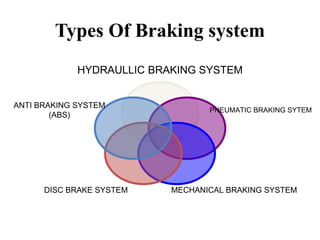
Types Of Braking system
HYDRAULLIC BRAKING SYSTEM
PNEUMATIC BRAKING SYTEM
MECHANICAL BRAKING SYSTEMDISC BRAKE SYSTEM
ANTI BRAKING SYSTEM
(ABS)
HYDRAULIC BRAKING
SYSYTEM
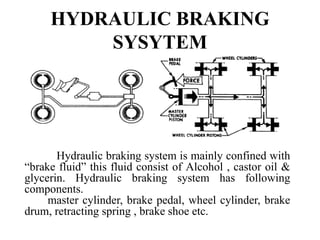
Hydraulic braking system is mainly confined with
“brake fluid” this fluid consist of Alcohol , castor oil &
glycerin. Hydraulic braking system has following
components.
master cylinder, brake pedal, wheel cylinder, brake
drum, retracting spring , brake shoe etc.
WORKING SYSTEM
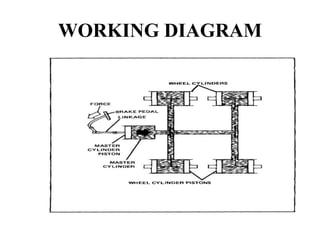
The brake pedal is connected to the master cylinder
by means of piston for application of brake driver presses
the brake pedal, which moves the master cylinder.
In master cylinder pressure is instantly transferred to
all four wheels. The brakes shoe moves against the brake
drum to apply brakes.
When driver releases the brake pedal, the master
cylinder piston returns to its original position due to
return springs, dropping fluid pressure. Brake shoe
retracting spring pulls the brake shoe from drum to their
original position & brakes are released.
WORKING DIAGRAM
Pneumatic Braking System
Air Compressor:
• Its composes of generally Build the air pressure by driven
of engine.
UNLOADER VALVE:
• Its is device maintain constant pressure in reservoir. The
excess of pressure is safely removed.
Reservoir:
• it’s a tank in which high pressure air is stored
Brake Valve:
• its is located between air reservoir and brake cylinder
Mechanical Braking System
Mechanical Braking System, brakes are available in
following construction
1.Drum type
2.Disc type
Drum type Brake:
There are generally of two types
 Internal expanding drum brake.
 External expanding drum brake.
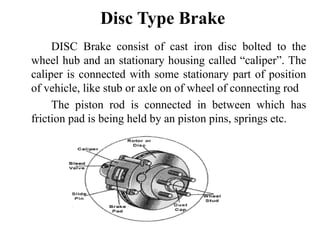
Disc Type Brake
DISC Brake consist of cast iron disc bolted to the
wheel hub and an stationary housing called “caliper”. The
caliper is connected with some stationary part of position
of vehicle, like stub or axle on of wheel of connecting rod
The piston rod is connected in between which has
friction pad is being held by an piston pins, springs etc.
ANTILOCKING BRAKING
SYSTEM(ABS)
Anti-lock braking system (ABS) is an automobile
safety system that allows the wheels on a motor vehicle to
maintain tractive contact with the road surface according
to driver inputs while braking, preventing the wheels
from locking up (ceasing rotation) and avoiding
uncontrolled skidding.
It is an automated system that uses the principles of
threshold braking and cadence braking which were
practiced by skillful drivers with previous generation
braking systems. It does this at a much faster rate and
with better control than a driver could manage
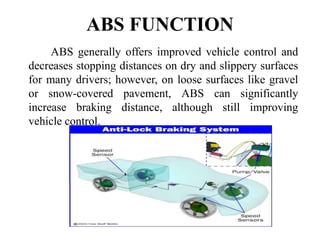
ABS FUNCTION
ABS generally offers improved vehicle control and
decreases stopping distances on dry and slippery surfaces
for many drivers; however, on loose surfaces like gravel
or snow-covered pavement, ABS can significantly
increase braking distance, although still improving
vehicle control.
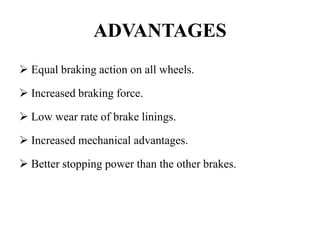
ADVANTAGES
 Equal braking action on all wheels.
 Increased braking force.
 Low wear rate of brake linings.
 Increased mechanical advantages.
 Better stopping power than the other brakes.
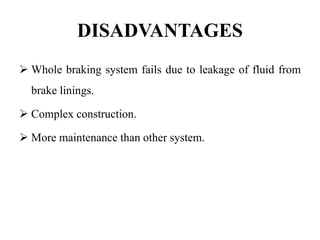
DISADVANTAGES
 Whole braking system fails due to leakage of fluid from
brake linings.
 Complex construction.
 More maintenance than other system.
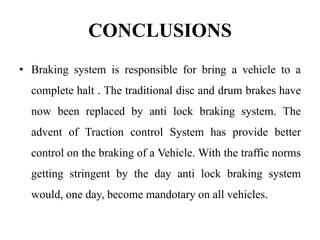
CONCLUSIONS
• Braking system is responsible for bring a vehicle to a
complete halt . The traditional disc and drum brakes have
now been replaced by anti lock braking system. The
advent of Traction control System has provide better
control on the braking of a Vehicle. With the traffic norms
getting stringent by the day anti lock braking system
would, one day, become mandotary on all vehicles.

BRAKING SYSTEM

  • 1.
    BRAKING SYSTEM Presented by NAME: S.ARUNKUMAR DEPARTMENT : MECHANICAL ENGINEERING COLLEGE : SUDHARASAN ENGG COLLEGE
  • 2.
    INTRODUCTION Brake is adevice used for slowing ,stopping & controlling the vehicle. Braking operation based on kinetic energy of vehicle is to converting into heat, which dissipated into atmosphere. While driving the vehicle, torque of the engine produces the tractive effort due to periphery of driving vehicle. When the brakes are applied it produces negative tractive effort on wheel. While, this help to slow down an vehicle
  • 3.
    Main functions ofbraking system To stop the vehicle safely in shortest possible distance in case of emergency. To control the vehicle when it is descending along the hills To keep the vehicle in desired position after bringing in at rest
  • 4.
    Types Of Brakingsystem HYDRAULLIC BRAKING SYSTEM PNEUMATIC BRAKING SYTEM MECHANICAL BRAKING SYSTEMDISC BRAKE SYSTEM ANTI BRAKING SYSTEM (ABS)
  • 5.
    HYDRAULIC BRAKING SYSYTEM Hydraulic brakingsystem is mainly confined with “brake fluid” this fluid consist of Alcohol , castor oil & glycerin. Hydraulic braking system has following components. master cylinder, brake pedal, wheel cylinder, brake drum, retracting spring , brake shoe etc.
  • 6.
    WORKING SYSTEM The brakepedal is connected to the master cylinder by means of piston for application of brake driver presses the brake pedal, which moves the master cylinder. In master cylinder pressure is instantly transferred to all four wheels. The brakes shoe moves against the brake drum to apply brakes. When driver releases the brake pedal, the master cylinder piston returns to its original position due to return springs, dropping fluid pressure. Brake shoe retracting spring pulls the brake shoe from drum to their original position & brakes are released.
  • 7.
  • 8.
    Pneumatic Braking System AirCompressor: • Its composes of generally Build the air pressure by driven of engine. UNLOADER VALVE: • Its is device maintain constant pressure in reservoir. The excess of pressure is safely removed. Reservoir: • it’s a tank in which high pressure air is stored Brake Valve: • its is located between air reservoir and brake cylinder
  • 9.
    Mechanical Braking System MechanicalBraking System, brakes are available in following construction 1.Drum type 2.Disc type Drum type Brake: There are generally of two types  Internal expanding drum brake.  External expanding drum brake.
  • 10.
    Disc Type Brake DISCBrake consist of cast iron disc bolted to the wheel hub and an stationary housing called “caliper”. The caliper is connected with some stationary part of position of vehicle, like stub or axle on of wheel of connecting rod The piston rod is connected in between which has friction pad is being held by an piston pins, springs etc.
  • 11.
    ANTILOCKING BRAKING SYSTEM(ABS) Anti-lock brakingsystem (ABS) is an automobile safety system that allows the wheels on a motor vehicle to maintain tractive contact with the road surface according to driver inputs while braking, preventing the wheels from locking up (ceasing rotation) and avoiding uncontrolled skidding. It is an automated system that uses the principles of threshold braking and cadence braking which were practiced by skillful drivers with previous generation braking systems. It does this at a much faster rate and with better control than a driver could manage
  • 12.
    ABS FUNCTION ABS generallyoffers improved vehicle control and decreases stopping distances on dry and slippery surfaces for many drivers; however, on loose surfaces like gravel or snow-covered pavement, ABS can significantly increase braking distance, although still improving vehicle control.
  • 13.
    ADVANTAGES  Equal brakingaction on all wheels.  Increased braking force.  Low wear rate of brake linings.  Increased mechanical advantages.  Better stopping power than the other brakes.
  • 14.
    DISADVANTAGES  Whole brakingsystem fails due to leakage of fluid from brake linings.  Complex construction.  More maintenance than other system.
  • 15.
    CONCLUSIONS • Braking systemis responsible for bring a vehicle to a complete halt . The traditional disc and drum brakes have now been replaced by anti lock braking system. The advent of Traction control System has provide better control on the braking of a Vehicle. With the traffic norms getting stringent by the day anti lock braking system would, one day, become mandotary on all vehicles.