UNDER THE GUIDENCE OF
PROF.Q.REHMAN
SUBMITTED BY
AMAR
3GN11ME011
contents
 Introduction.
 History.
 Meaning and systems involved.
 Adaptive cruise control.
 Airbags.
 Comparison.
 Advantages and dis-advantages.
 Conclusion.
 Reference.
INTRODUCTION
 Autotronics is the blend of Automobile +Electronics.
 Analysts estimate that more than 80 percent of all
automotive innovation now stems from electronics.
 Anti-lock brakes, airbag deployment, engine Control, GPS
navigation,the CAN etc are implemented.
 Electronic systems are embedded mixed-signal systems
because they feature multiple analog sensors and analog
motor controls under digital control.
History
 The first electronic part in an automobile was called an ‘Engine
Control Unit’ as it is named later as ‘Electronic Control Unit’.
 1970’s: Introduction of electronics for engine controls.
 1980’s: Anti-lock braking introduced.
 Early 1990’s: Airbags become standard.
 Late 1990’s: Rapid expansion of body electronics – seat motors
(body Computers) auto locking systems and keyless entry.
 Early 2000’s to date: sophisticated audio and video, Signals sent
via satellite; GPS and mapping.
 Late 2000’s: wireless connectivity.
Meaning and systems involved.
 It is the Implementation of electronics in the field of automobile
to improve the performance of the vehicle.
 The main functional areas of automobile industries are strongly
influenced by the field of electronics and these systems are
involved to achieve high performance-
1)Braking system
2)Steering system
3)Suspension system
4)Transmission system
5)Engine system
Braking system
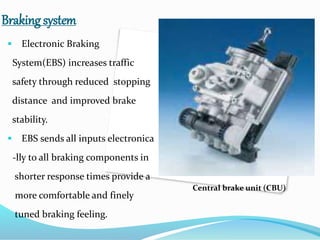
 Electronic Braking
System(EBS) increases traffic
safety through reduced stopping
distance and improved brake
stability.
 EBS sends all inputs electronica
-lly to all braking components in
shorter response times provide a
more comfortable and finely
tuned braking feeling.
Central brake unit (CBU)
Steering system
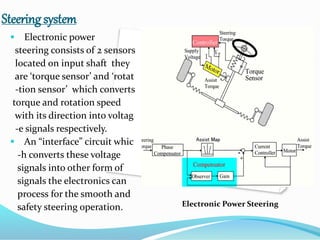
 Electronic power
steering consists of 2 sensors
located on input shaft they
are ‘torque sensor’ and ‘rotat
-tion sensor’ which converts
torque and rotation speed
with its direction into voltag
-e signals respectively.
 An “interface” circuit whic
-h converts these voltage
signals into other form of
signals the electronics can
process for the smooth and
safety steering operation. Electronic Power Steering
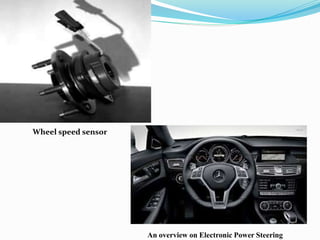
Wheel speed sensor
An overview on Electronic Power Steering
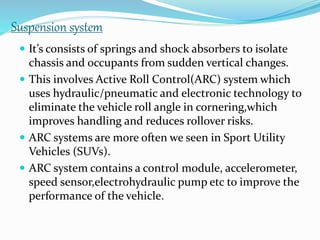
Suspension system
 It’s consists of springs and shock absorbers to isolate
chassis and occupants from sudden vertical changes.
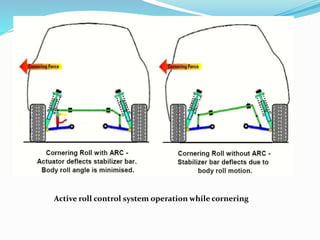
 This involves Active Roll Control(ARC) system which
uses hydraulic/pneumatic and electronic technology to
eliminate the vehicle roll angle in cornering,which
improves handling and reduces rollover risks.
 ARC systems are more often we seen in Sport Utility
Vehicles (SUVs).
 ARC system contains a control module, accelerometer,
speed sensor,electrohydraulic pump etc to improve the
performance of the vehicle.
Active roll control system operation while cornering
Transmission system
 This system mainly controls the shifting process of the
gears.
 Many semi-automatic transmissions which have a fully
automatic or semi-automatic clutch uses electronics for
its operation and control.
 5 and 7 series vehicles of BMW products are installed
these systems in 1986.
 Increased fuel economy,increased driving safety,
improved shift comfort and modifying line pressures are
the benefits achieved by installing this system.
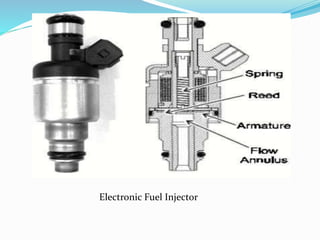
Engine system
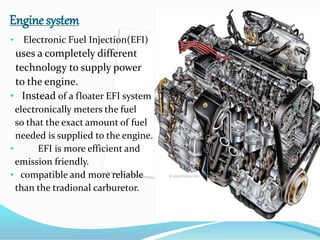
• Electronic Fuel Injection(EFI)
uses a completely different
technology to supply power
to the engine.
• Instead of a floater EFI system
electronically meters the fuel
so that the exact amount of fuel
needed is supplied to the engine.
• EFI is more efficient and
emission friendly.
• compatible and more reliable
than the tradional carburetor.
Electronic Fuel Injector
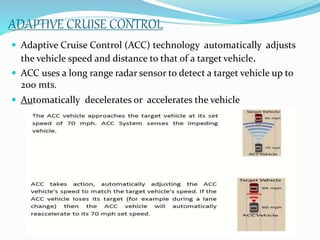
ADAPTIVE CRUISE CONTROL
 Adaptive Cruise Control (ACC) technology automatically adjusts
the vehicle speed and distance to that of a target vehicle.
 ACC uses a long range radar sensor to detect a target vehicle up to
200 mts.
 Automatically decelerates or accelerates the vehicle
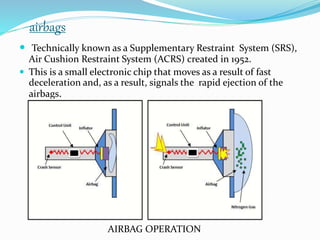
airbags
 Technically known as a Supplementary Restraint System (SRS),
Air Cushion Restraint System (ACRS) created in 1952.
 This is a small electronic chip that moves as a result of fast
deceleration and, as a result, signals the rapid ejection of the
airbags.
AIRBAG OPERATION
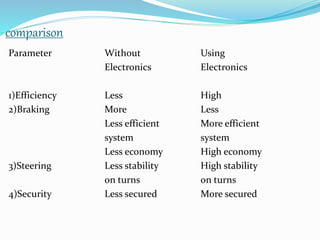
comparison
Parameter Without Using
Electronics Electronics
1)Efficiency Less High
2)Braking More Less
Less efficient More efficient
system system
Less economy High economy
3)Steering Less stability High stability
on turns on turns
4)Security Less secured More secured
ADVANTAGES
 Improves the vehicle performance.
 Efficient and highly reliable.
 Increased safety and comfortable environment.
 Implementing electronics will create a healthy
atmosphere by reducing air and noise pollution.
 Smarter way of achieving high performance.
Dis-advantages
 High cost to implement.
 Extra care should be taked to maintain.
 Lifespan of the electronic equipments are less
compared to mechanical equipments.
conclusion
 A modern car may have up to 100 electronic
control units and a commercial vehicle up to 40. With brilliant
minds working in the auto industry, there are limitless
possibilities to what the manufacturers will include in their
products in the coming years.
reference
 www.wikipedia.com
 www.altera.com
 Applying Model-Based Design to Commercial Vehicle
Electronics Systems”; Tom Egel, Michael
Burke,Michael Carone, Wensi Jin
The Math Works, Inc.; 2008.
 www.sciencedirect.com
Any queries?
Thanks to one and all….

autotronics:improving vehicle performance.

  • 1.
    UNDER THE GUIDENCEOF PROF.Q.REHMAN SUBMITTED BY AMAR 3GN11ME011
  • 2.
    contents  Introduction.  History. Meaning and systems involved.  Adaptive cruise control.  Airbags.  Comparison.  Advantages and dis-advantages.  Conclusion.  Reference.
  • 3.
    INTRODUCTION  Autotronics isthe blend of Automobile +Electronics.  Analysts estimate that more than 80 percent of all automotive innovation now stems from electronics.  Anti-lock brakes, airbag deployment, engine Control, GPS navigation,the CAN etc are implemented.  Electronic systems are embedded mixed-signal systems because they feature multiple analog sensors and analog motor controls under digital control.
  • 4.
    History  The firstelectronic part in an automobile was called an ‘Engine Control Unit’ as it is named later as ‘Electronic Control Unit’.  1970’s: Introduction of electronics for engine controls.  1980’s: Anti-lock braking introduced.  Early 1990’s: Airbags become standard.  Late 1990’s: Rapid expansion of body electronics – seat motors (body Computers) auto locking systems and keyless entry.  Early 2000’s to date: sophisticated audio and video, Signals sent via satellite; GPS and mapping.  Late 2000’s: wireless connectivity.
  • 5.
    Meaning and systemsinvolved.  It is the Implementation of electronics in the field of automobile to improve the performance of the vehicle.  The main functional areas of automobile industries are strongly influenced by the field of electronics and these systems are involved to achieve high performance- 1)Braking system 2)Steering system 3)Suspension system 4)Transmission system 5)Engine system
  • 6.
    Braking system  ElectronicBraking System(EBS) increases traffic safety through reduced stopping distance and improved brake stability.  EBS sends all inputs electronica -lly to all braking components in shorter response times provide a more comfortable and finely tuned braking feeling. Central brake unit (CBU)
  • 7.
    Steering system  Electronicpower steering consists of 2 sensors located on input shaft they are ‘torque sensor’ and ‘rotat -tion sensor’ which converts torque and rotation speed with its direction into voltag -e signals respectively.  An “interface” circuit whic -h converts these voltage signals into other form of signals the electronics can process for the smooth and safety steering operation. Electronic Power Steering
  • 8.
    Wheel speed sensor Anoverview on Electronic Power Steering
  • 9.
    Suspension system  It’sconsists of springs and shock absorbers to isolate chassis and occupants from sudden vertical changes.  This involves Active Roll Control(ARC) system which uses hydraulic/pneumatic and electronic technology to eliminate the vehicle roll angle in cornering,which improves handling and reduces rollover risks.  ARC systems are more often we seen in Sport Utility Vehicles (SUVs).  ARC system contains a control module, accelerometer, speed sensor,electrohydraulic pump etc to improve the performance of the vehicle.
  • 10.
    Active roll controlsystem operation while cornering
  • 11.
    Transmission system  Thissystem mainly controls the shifting process of the gears.  Many semi-automatic transmissions which have a fully automatic or semi-automatic clutch uses electronics for its operation and control.  5 and 7 series vehicles of BMW products are installed these systems in 1986.  Increased fuel economy,increased driving safety, improved shift comfort and modifying line pressures are the benefits achieved by installing this system.
  • 12.
    Engine system • ElectronicFuel Injection(EFI) uses a completely different technology to supply power to the engine. • Instead of a floater EFI system electronically meters the fuel so that the exact amount of fuel needed is supplied to the engine. • EFI is more efficient and emission friendly. • compatible and more reliable than the tradional carburetor.
  • 13.
  • 14.
    ADAPTIVE CRUISE CONTROL Adaptive Cruise Control (ACC) technology automatically adjusts the vehicle speed and distance to that of a target vehicle.  ACC uses a long range radar sensor to detect a target vehicle up to 200 mts.  Automatically decelerates or accelerates the vehicle
  • 15.
    airbags  Technically knownas a Supplementary Restraint System (SRS), Air Cushion Restraint System (ACRS) created in 1952.  This is a small electronic chip that moves as a result of fast deceleration and, as a result, signals the rapid ejection of the airbags. AIRBAG OPERATION
  • 16.
    comparison Parameter Without Using ElectronicsElectronics 1)Efficiency Less High 2)Braking More Less Less efficient More efficient system system Less economy High economy 3)Steering Less stability High stability on turns on turns 4)Security Less secured More secured
  • 17.
    ADVANTAGES  Improves thevehicle performance.  Efficient and highly reliable.  Increased safety and comfortable environment.  Implementing electronics will create a healthy atmosphere by reducing air and noise pollution.  Smarter way of achieving high performance.
  • 18.
    Dis-advantages  High costto implement.  Extra care should be taked to maintain.  Lifespan of the electronic equipments are less compared to mechanical equipments.
  • 19.
    conclusion  A moderncar may have up to 100 electronic control units and a commercial vehicle up to 40. With brilliant minds working in the auto industry, there are limitless possibilities to what the manufacturers will include in their products in the coming years.
  • 20.
    reference  www.wikipedia.com  www.altera.com Applying Model-Based Design to Commercial Vehicle Electronics Systems”; Tom Egel, Michael Burke,Michael Carone, Wensi Jin The Math Works, Inc.; 2008.  www.sciencedirect.com
  • 21.
  • 22.
    Thanks to oneand all….