LEAN MANUFACTURING
Presented by
NAME : S.ARUNKUMAR
YEAR : IV YEAR
DEPARTMENT : MECHANICAL ENGINEERING
COLLEGE : SUDHARASAN ENGG COLLEGE
INTRODUCTION
A systematic approach to identifying and
eliminating waste (non-value-added activities)
through continuous improvement by flowing the
product at the pull of the customer in pursuit of
perfection.
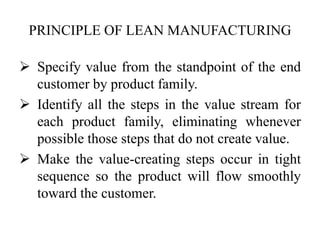
PRINCIPLE OF LEAN MANUFACTURING
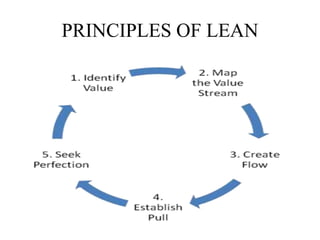
 Specify value from the standpoint of the end
customer by product family.
 Identify all the steps in the value stream for
each product family, eliminating whenever
possible those steps that do not create value.
 Make the value-creating steps occur in tight
sequence so the product will flow smoothly
toward the customer.
 As flow is introduced, let customers pull
value from the next upstream activity.
 As value is specified, value streams are
identified, wasted steps are removed, and
flow and pull are introduced, begin the
process again and continue it until a state of
perfection is reached in which perfect value is
created with no waste.
PRINCIPLES OF LEAN
COMPARISON BETWEEN TRADITIONAL AND
LEAN MANUFACTURING
For years manufacturers have created products
in anticipation of having a market for them.
Operations have traditionally been driven by
sales forecasts and firms tended to stockpile
inventories in case they were needed.
Lean organizations are capable of producing
high-quality products economically in lower
volumes and bringing them to market faster
than mass producers.
7 WASTES OF LEAN MANUFACTURING
ADVANTAGES
Reduced scrap and waste
Reduced inventory costs
Cross-trained employees
Reduced cycle time
Reduced obsolescence
Lower space/facility requirements
DIADVANTAGES
Lack of resources
Lack of expertise
Initial high cost which includes the cost of
resources as well as expertise.
Poor supply chain structure.- Ineffective
training and development of work force in the
company
Absence of continuous assessment of every
individual in the organization.
CONCLUSION
 “LEAN” can be said as adding value by eliminating
waste being responsive to change, focusing on quality
and enhancing the effectiveness of the work force.
 Although lean has its origin in the automobile industry
it is being successfully used in other production
industries. Lean manufacturing is now extended to
fields like I.T, service etc in order to reduce production
cost and meet changing customer needs.
 Since lean is completely customer oriented it is here to
stay. It is also important as it emphasis customer
satisfaction.

LEAN MANUFACTURING

  • 1.
    LEAN MANUFACTURING Presented by NAME: S.ARUNKUMAR YEAR : IV YEAR DEPARTMENT : MECHANICAL ENGINEERING COLLEGE : SUDHARASAN ENGG COLLEGE
  • 2.
    INTRODUCTION A systematic approachto identifying and eliminating waste (non-value-added activities) through continuous improvement by flowing the product at the pull of the customer in pursuit of perfection.
  • 3.
    PRINCIPLE OF LEANMANUFACTURING  Specify value from the standpoint of the end customer by product family.  Identify all the steps in the value stream for each product family, eliminating whenever possible those steps that do not create value.  Make the value-creating steps occur in tight sequence so the product will flow smoothly toward the customer.
  • 4.
     As flowis introduced, let customers pull value from the next upstream activity.  As value is specified, value streams are identified, wasted steps are removed, and flow and pull are introduced, begin the process again and continue it until a state of perfection is reached in which perfect value is created with no waste.
  • 5.
  • 6.
    COMPARISON BETWEEN TRADITIONALAND LEAN MANUFACTURING For years manufacturers have created products in anticipation of having a market for them. Operations have traditionally been driven by sales forecasts and firms tended to stockpile inventories in case they were needed. Lean organizations are capable of producing high-quality products economically in lower volumes and bringing them to market faster than mass producers.
  • 7.
    7 WASTES OFLEAN MANUFACTURING
  • 8.
    ADVANTAGES Reduced scrap andwaste Reduced inventory costs Cross-trained employees Reduced cycle time Reduced obsolescence Lower space/facility requirements
  • 9.
    DIADVANTAGES Lack of resources Lackof expertise Initial high cost which includes the cost of resources as well as expertise. Poor supply chain structure.- Ineffective training and development of work force in the company Absence of continuous assessment of every individual in the organization.
  • 10.
    CONCLUSION  “LEAN” canbe said as adding value by eliminating waste being responsive to change, focusing on quality and enhancing the effectiveness of the work force.  Although lean has its origin in the automobile industry it is being successfully used in other production industries. Lean manufacturing is now extended to fields like I.T, service etc in order to reduce production cost and meet changing customer needs.  Since lean is completely customer oriented it is here to stay. It is also important as it emphasis customer satisfaction.