Technology Outline
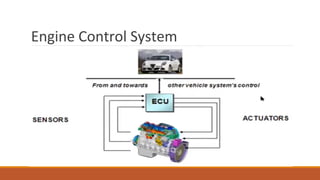
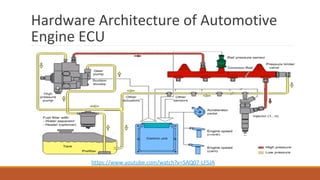
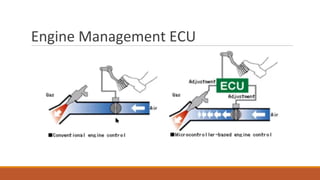
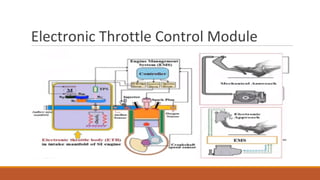
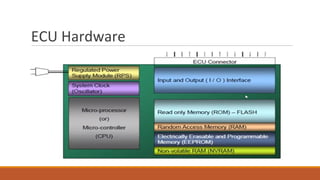
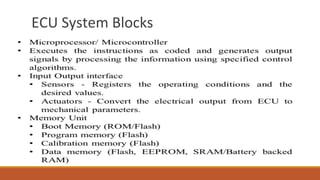
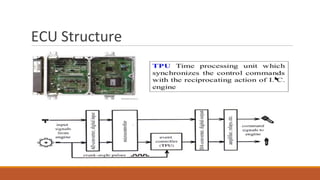
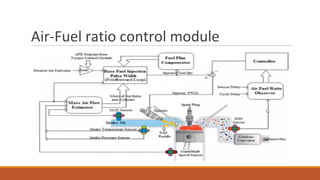
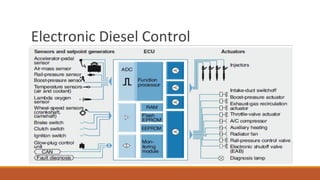
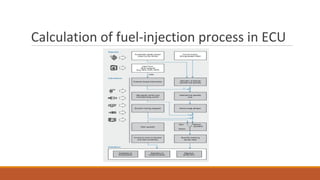
The EngineManagement System (EMS) is responsible for controlling the amount of fuel
being injected and for adjusting the ignition timing. Optimum functioning of the EMS
assures maximum engine power, with the lowest amount of exhaust emissions and the
lowest fuel consumption.
3.
▪Why there isa need to study of engine management
system?
4.
Tasks of EMS
Whilestudying engine management system, it is important to understand the primary
tasks of EMS.
❖To adjust the torque desired and the input given by driver depressing the accelerator
pedal.
❖To operate the engine in such a away as to comply with the requirements of
uncompromising emission control.
❖To ensure the lowest possible fuel consumption.
❖To guarantee high levels of driving comfort and pleasure.
5.
Important aspects ofEMS
When studying EMS, it is important to understand two aspects:
❖Function and
❖Performance
6.
Engine Management System
Aself contained custom built computer which controls the running of an engine by monitoring
❖The engine speed
❖The engine load and
❖The engine temperature
Providing the ignition spark at the right time for prevailing conditions and metering the fuel to
the engine in the exact quantity required.
7.
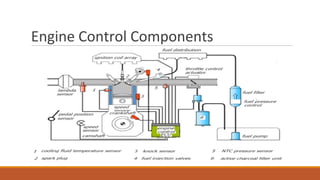
Components of EMS
❖Airsystem
❖Fuel system
❖Ignition system
❖Crankshaft control
❖External exhaust gas recirculation
❖Exhaust gas turbocharging and
❖Emission control system
Ignition System
What isan Ignition system?
Why is it essential to use a ignition system in a spark ignition engine?
What are the types of ignition systems we use?
22.
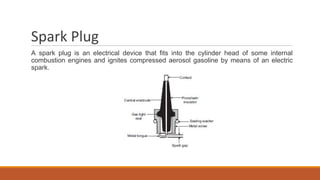
Spark Plug
A sparkplug is an electrical device that fits into the cylinder head of some internal
combustion engines and ignites compressed aerosol gasoline by means of an electric
spark.
23.
Types of IgnitionSystems
Basically conventional Ignition Systems are of two types.
❖Battery or Coil ignition system and
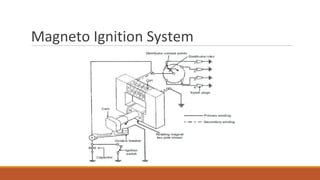
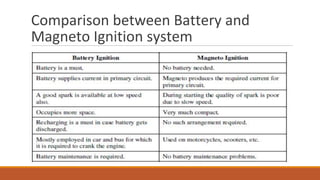
❖Magneto ignition system
24.
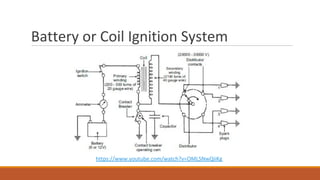
Battery or CoilIgnition System
https://www.youtube.com/watch?v=OMLSNwQiiKg
Automotive Lighting Technology
Thelighting system of an automobile comprises of various lighting and signalling devices of
components fixed to front, rear and to the sides of the vehicle.
30.
Automotive Lighting Technology
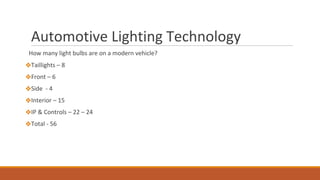
Howmany light bulbs are on a modern vehicle?
❖Taillights – 8
❖Front – 6
❖Side - 4
❖Interior – 15
❖IP & Controls – 22 – 24
❖Total - 56
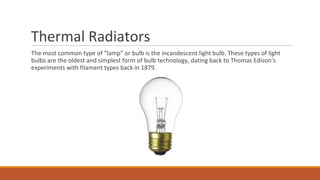
Thermal Radiators
The mostcommon type of “lamp” or bulb is the incandescent light bulb. These types of light
bulbs are the oldest and simplest form of bulb technology, dating back to Thomas Edison’s
experiments with filament types back in 1879.
33.
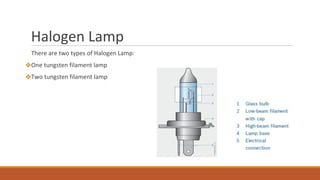
Halogen Lamp
There aretwo types of Halogen Lamp:
❖One tungsten filament lamp
❖Two tungsten filament lamp
34.
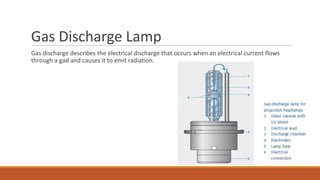
Gas Discharge Lamp
Gasdischarge describes the electrical discharge that occurs when an electrical current flows
through a gad and causes it to emit radiation.
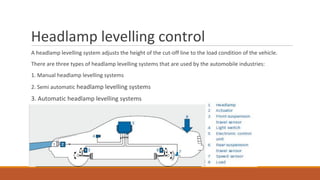
Headlamp levelling control
Aheadlamp levelling system adjusts the height of the cut-off line to the load condition of the vehicle.
There are three types of headlamp levelling systems that are used by the automobile industries:
1. Manual headlamp levelling systems
2. Semi automatic headlamp levelling systems
3. Automatic headlamp levelling systems
38.
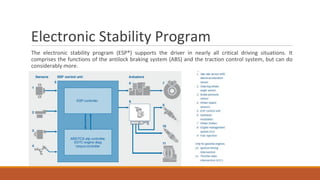
Electronic Stability Program
Theelectronic stability program (ESP®) supports the driver in nearly all critical driving situations. It
comprises the functions of the antilock braking system (ABS) and the traction control system, but can do
considerably more.
39.
ESP BENEFITS FORDRIVER
•Counteracts vehicle skidding
•Provides effective support in critical driving situations
•Value-added functions provide additional driving safety, and enhanced driving comfort
and driving agility
https://www.youtube.com/watch?v=5IP-pgKrNV8
40.
Anti-lock Braking System
Anti-lockbraking system is an automobile safety system which is used to prevent the wheel
locking.
❖The ABS was 1st
developed in the year 1929
❖In 1985, 1st
time ABS was installed on US vehicles
41.
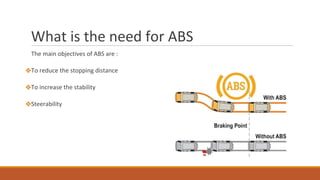
What is theneed for ABS
The main objectives of ABS are :
❖To reduce the stopping distance
❖To increase the stability
❖Steerability
42.
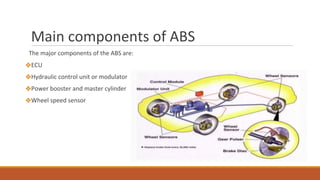
Main components ofABS
The major components of the ABS are:
❖ECU
❖Hydraulic control unit or modulator
❖Power booster and master cylinder
❖Wheel speed sensor
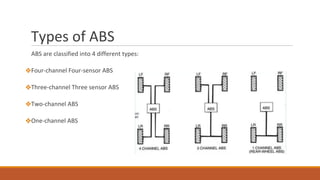
Types of ABS
ABSare classified into 4 different types:
❖Four-channel Four-sensor ABS
❖Three-channel Three sensor ABS
❖Two-channel ABS
❖One-channel ABS
46.
Advantages
❖It allows thedriver to maintain directional stability and control over steering during breaking.
❖Safe and effective driving.
❖Automatically changes the brake fluid pressure at each wheel to maintain optimum brake
performance.
❖ABS absorbs the unwanted turbulence shock waves and modulates the pulses thus permitting
the wheel to continue turning under maximum braking pressure.
47.
ADAS
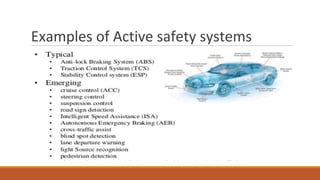
ADA systems aredesigned to increase the car safety, more generally road safety.
The different examples of driver assistance systems designed to maximise the driver safety are
❖Antilock Braking System
❖Adaptive Cruise Control
❖Blind spot detection
❖Driver drowsiness detection
❖Electronic stability program
❖Emergency braking system, etc…
48.
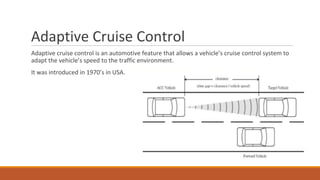
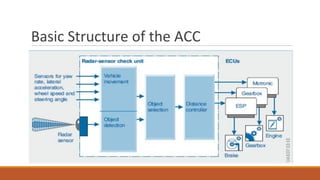
Adaptive Cruise Control
Adaptivecruise control is an automotive feature that allows a vehicle’s cruise control system to
adapt the vehicle’s speed to the traffic environment.
It was introduced in 1970’s in USA.
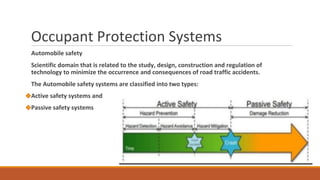
Occupant Protection Systems
Automobilesafety
Scientific domain that is related to the study, design, construction and regulation of
technology to minimize the occurrence and consequences of road traffic accidents.
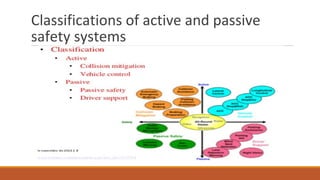
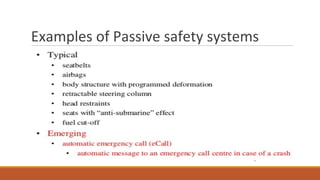
The Automobile safety systems are classified into two types:
❖Active safety systems and
❖Passive safety systems
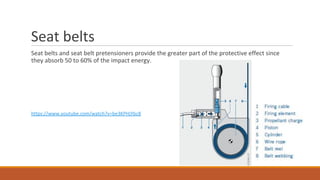
Seat belts
Seat beltsand seat belt pretensioners provide the greater part of the protective effect since
they absorb 50 to 60% of the impact energy.
https://www.youtube.com/watch?v=be3KPHjYbc8