DIESEL ENGINE
Presented by
NAME : S.ARUNKUMAR
DEPARTMENT : MECHANICAL ENGINEERING
COLLEGE : SUDHARASAN ENGG COLLEGE
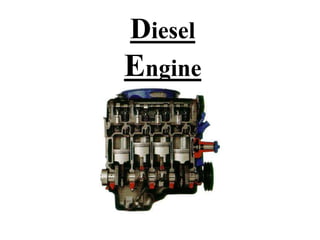
Diesel
Engine
History
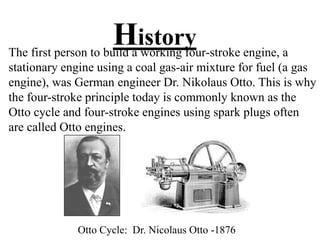
Otto Cycle: Dr. Nicolaus Otto -1876
The first person to build a working four-stroke engine, a
stationary engine using a coal gas-air mixture for fuel (a gas
engine), was German engineer Dr. Nikolaus Otto. This is why
the four-stroke principle today is commonly known as the
Otto cycle and four-stroke engines using spark plugs often
are called Otto engines.
Four Stroke Diesel Engine
Four stroke engine was first demonstrate by Nikolaus Otto in
1876,hence it is also known as Otto cycle. It consist of 4
stroke ,one cycle operation is completed in 4 stroke of the
piston, That is one cycle is completed in every 2 revolutions of
the crankshaft. Each stroke consist of 180°,of crankshaft
rotation and hence a cycle consist of 720°,of crankshaft
rotation.
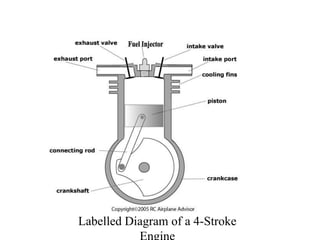
Labelled Diagram of a 4-Stroke
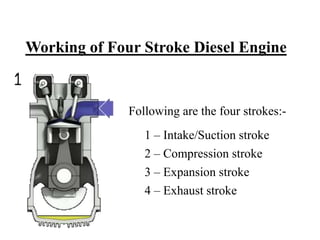
Working of Four Stroke Diesel Engine
Following are the four strokes:-
1 – Intake/Suction stroke
2 – Compression stroke
3 – Expansion stroke
4 – Exhaust stroke
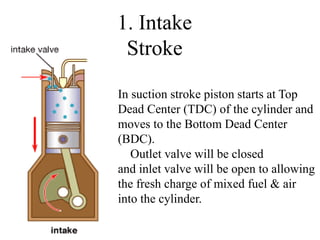
1. Intake
Stroke
In suction stroke piston starts at Top
Dead Center (TDC) of the cylinder and
moves to the Bottom Dead Center
(BDC).
Outlet valve will be closed
and inlet valve will be open to allowing
the fresh charge of mixed fuel & air
into the cylinder.
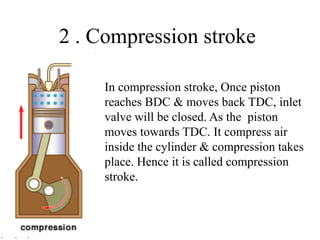
2 . Compression stroke
In compression stroke, Once piston
reaches BDC & moves back TDC, inlet
valve will be closed. As the piston
moves towards TDC. It compress air
inside the cylinder & compression takes
place. Hence it is called compression
stroke.
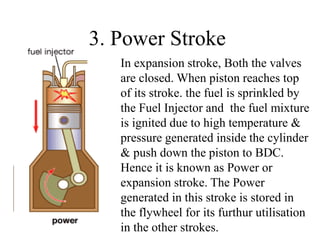
3. Power Stroke
In expansion stroke, Both the valves
are closed. When piston reaches top
of its stroke. the fuel is sprinkled by
the Fuel Injector and the fuel mixture
is ignited due to high temperature &
pressure generated inside the cylinder
& push down the piston to BDC.
Hence it is known as Power or
expansion stroke. The Power
generated in this stroke is stored in
the flywheel for its furthur utilisation
in the other strokes.
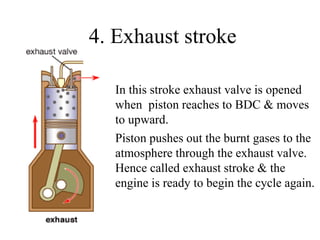
4. Exhaust stroke
In this stroke exhaust valve is opened
when piston reaches to BDC & moves
to upward.
Piston pushes out the burnt gases to the
atmosphere through the exhaust valve.
Hence called exhaust stroke & the
engine is ready to begin the cycle again.
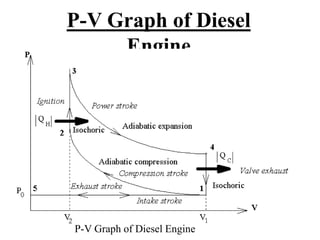
P-V Graph of Diesel
Engine
P-V Graph of Diesel Engine
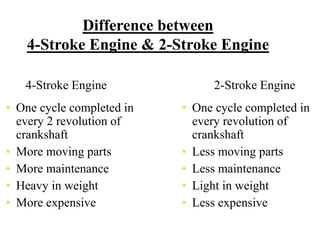
Difference between
4-Stroke Engine & 2-Stroke Engine
• One cycle completed in
every 2 revolution of
crankshaft
• More moving parts
• More maintenance
• Heavy in weight
• More expensive
• One cycle completed in
every revolution of
crankshaft
• Less moving parts
• Less maintenance
• Light in weight
• Less expensive
4-Stroke Engine 2-Stroke Engine
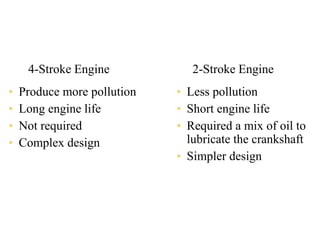
• Produce more pollution
• Long engine life
• Not required
• Complex design
• Less pollution
• Short engine life
• Required a mix of oil to
lubricate the crankshaft
• Simpler design
4-Stroke Engine 2-Stroke Engine
DIESEL ENGINES

DIESEL ENGINES

  • 1.
    DIESEL ENGINE Presented by NAME: S.ARUNKUMAR DEPARTMENT : MECHANICAL ENGINEERING COLLEGE : SUDHARASAN ENGG COLLEGE
  • 2.
  • 3.
    History Otto Cycle: Dr.Nicolaus Otto -1876 The first person to build a working four-stroke engine, a stationary engine using a coal gas-air mixture for fuel (a gas engine), was German engineer Dr. Nikolaus Otto. This is why the four-stroke principle today is commonly known as the Otto cycle and four-stroke engines using spark plugs often are called Otto engines.
  • 4.
    Four Stroke DieselEngine Four stroke engine was first demonstrate by Nikolaus Otto in 1876,hence it is also known as Otto cycle. It consist of 4 stroke ,one cycle operation is completed in 4 stroke of the piston, That is one cycle is completed in every 2 revolutions of the crankshaft. Each stroke consist of 180°,of crankshaft rotation and hence a cycle consist of 720°,of crankshaft rotation.
  • 5.
  • 6.
    Working of FourStroke Diesel Engine Following are the four strokes:- 1 – Intake/Suction stroke 2 – Compression stroke 3 – Expansion stroke 4 – Exhaust stroke
  • 7.
    1. Intake Stroke In suctionstroke piston starts at Top Dead Center (TDC) of the cylinder and moves to the Bottom Dead Center (BDC). Outlet valve will be closed and inlet valve will be open to allowing the fresh charge of mixed fuel & air into the cylinder.
  • 8.
    2 . Compressionstroke In compression stroke, Once piston reaches BDC & moves back TDC, inlet valve will be closed. As the piston moves towards TDC. It compress air inside the cylinder & compression takes place. Hence it is called compression stroke.
  • 9.
    3. Power Stroke Inexpansion stroke, Both the valves are closed. When piston reaches top of its stroke. the fuel is sprinkled by the Fuel Injector and the fuel mixture is ignited due to high temperature & pressure generated inside the cylinder & push down the piston to BDC. Hence it is known as Power or expansion stroke. The Power generated in this stroke is stored in the flywheel for its furthur utilisation in the other strokes.
  • 10.
    4. Exhaust stroke Inthis stroke exhaust valve is opened when piston reaches to BDC & moves to upward. Piston pushes out the burnt gases to the atmosphere through the exhaust valve. Hence called exhaust stroke & the engine is ready to begin the cycle again.
  • 11.
    P-V Graph ofDiesel Engine P-V Graph of Diesel Engine
  • 12.
    Difference between 4-Stroke Engine& 2-Stroke Engine • One cycle completed in every 2 revolution of crankshaft • More moving parts • More maintenance • Heavy in weight • More expensive • One cycle completed in every revolution of crankshaft • Less moving parts • Less maintenance • Light in weight • Less expensive 4-Stroke Engine 2-Stroke Engine
  • 13.
    • Produce morepollution • Long engine life • Not required • Complex design • Less pollution • Short engine life • Required a mix of oil to lubricate the crankshaft • Simpler design 4-Stroke Engine 2-Stroke Engine