VEHICLE DYNAMICS
BY
G.SARATH REDDY
STEADY STATE HANDLING CHARACTERISTICS
HOW TO HANDLE THE VEHICLE….?
• Ackermann Steering Geometry
ACKERMANN STEERING GEOMETRY
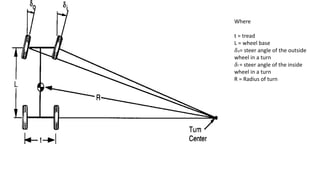
• Ackermann steering geometry is a geometric arrangement of linkages in the
steering of a car or other vehicle designed to solve the problem of wheels on the
inside and outside of a turn needing to trace out circles of different radii.
• The use of such geometry helps reduce tyre temperatures during high-speed
cornering but compromises performance in low speed .
• The intention of Ackermann geometry is to avoid the need for tyre to slip
sideways when following the path around a curve.
• As the rear wheels are fixed, this centre point must be on a line extended from
the rear axle
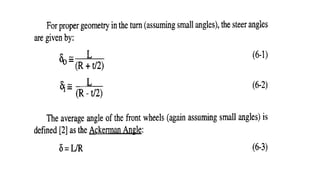
• Intersecting the axes of the front wheels on this line as well requires that the
inside front wheel is turned, when steering, through a greater angle than the
outside wheel .
Where
t = tread
L = wheel base
𝛿o= steer angle of the outside
wheel in a turn
𝛿I = steer angle of the inside
wheel in a turn
R = Radius of turn
High Speed Cornering
• High speed cornering produces different equations with respect to
low speed cornering.
• Tires must develop significant lateral forces to counteract the lateral
acceleration.
• Slip angles will be present at each wheel
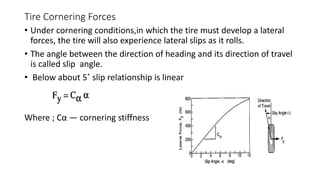
Tire Cornering Forces
• Under cornering conditions,in which the tire must develop a lateral
forces, the tire will also experience lateral slips as it rolls.
• The angle between the direction of heading and its direction of travel
is called slip angle.
• Below about 5˚ slip relationship is linear
Where ; Cα — cornering stiffness
ackerman steering geometry and cornering

ackerman steering geometry and cornering

  • 1.
  • 2.
    STEADY STATE HANDLINGCHARACTERISTICS HOW TO HANDLE THE VEHICLE….? • Ackermann Steering Geometry
  • 3.
    ACKERMANN STEERING GEOMETRY •Ackermann steering geometry is a geometric arrangement of linkages in the steering of a car or other vehicle designed to solve the problem of wheels on the inside and outside of a turn needing to trace out circles of different radii. • The use of such geometry helps reduce tyre temperatures during high-speed cornering but compromises performance in low speed . • The intention of Ackermann geometry is to avoid the need for tyre to slip sideways when following the path around a curve.
  • 4.
    • As therear wheels are fixed, this centre point must be on a line extended from the rear axle • Intersecting the axes of the front wheels on this line as well requires that the inside front wheel is turned, when steering, through a greater angle than the outside wheel .
  • 5.
    Where t = tread L= wheel base 𝛿o= steer angle of the outside wheel in a turn 𝛿I = steer angle of the inside wheel in a turn R = Radius of turn
  • 8.
    High Speed Cornering •High speed cornering produces different equations with respect to low speed cornering. • Tires must develop significant lateral forces to counteract the lateral acceleration. • Slip angles will be present at each wheel
  • 9.
    Tire Cornering Forces •Under cornering conditions,in which the tire must develop a lateral forces, the tire will also experience lateral slips as it rolls. • The angle between the direction of heading and its direction of travel is called slip angle. • Below about 5˚ slip relationship is linear Where ; Cα — cornering stiffness