AUTOMOBILE DIFFERENTIAL
UNIT
A MECHANICAL GEAR ASSEMBLY UNIT WHICH PROVIDE DIFFERENT
SPEED/TORQUE TO SAME AXLE WHEELS
SIVARAMAN.K M.Tech-AEES ARAI
AUTOMOBILE DIFFERENTIAL UNIT
REQUIREMENT
• Transfers power from driveshaft to the wheels
• Provides final gear reduction
• Splits amount of torque going to each wheel
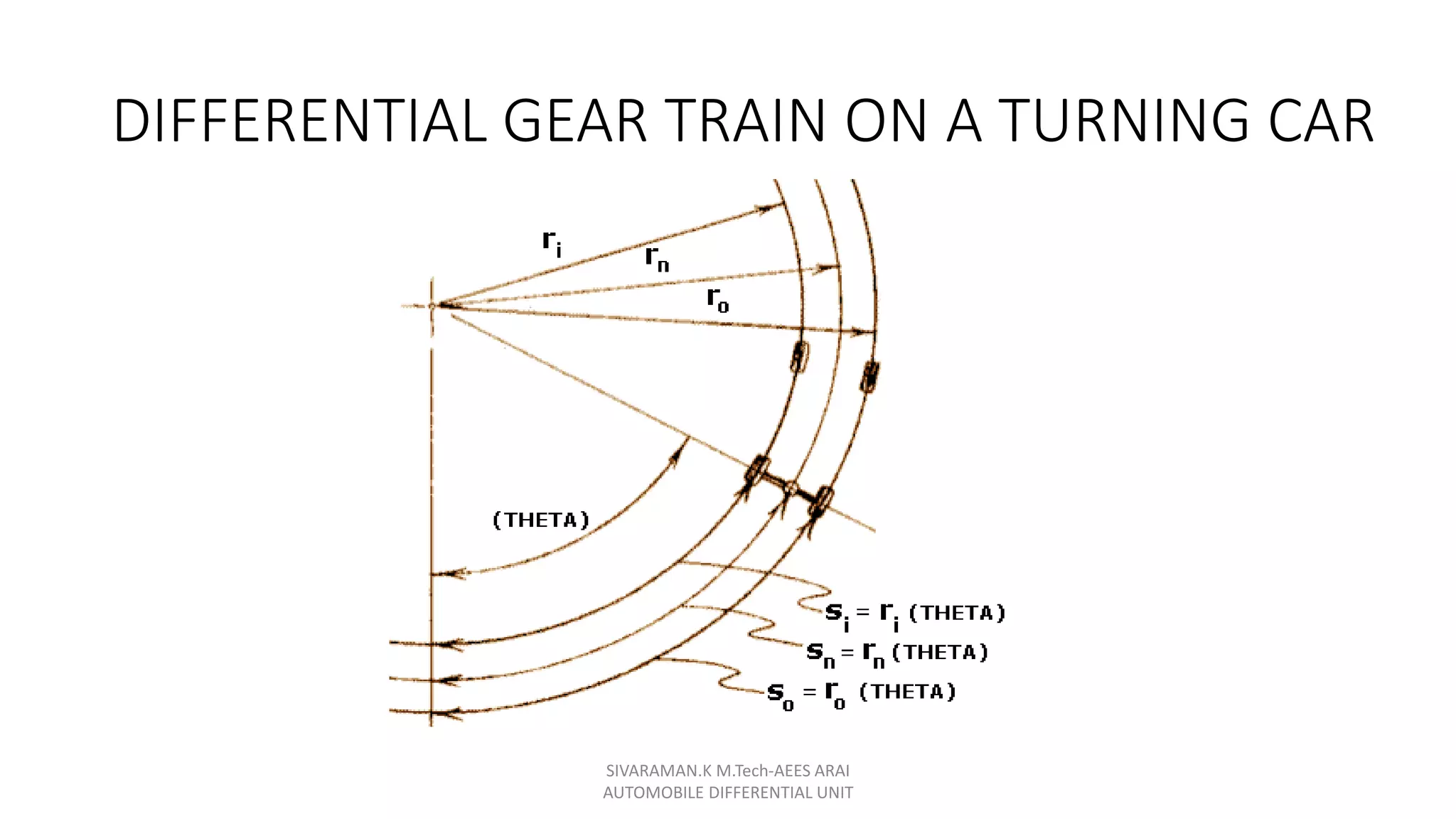
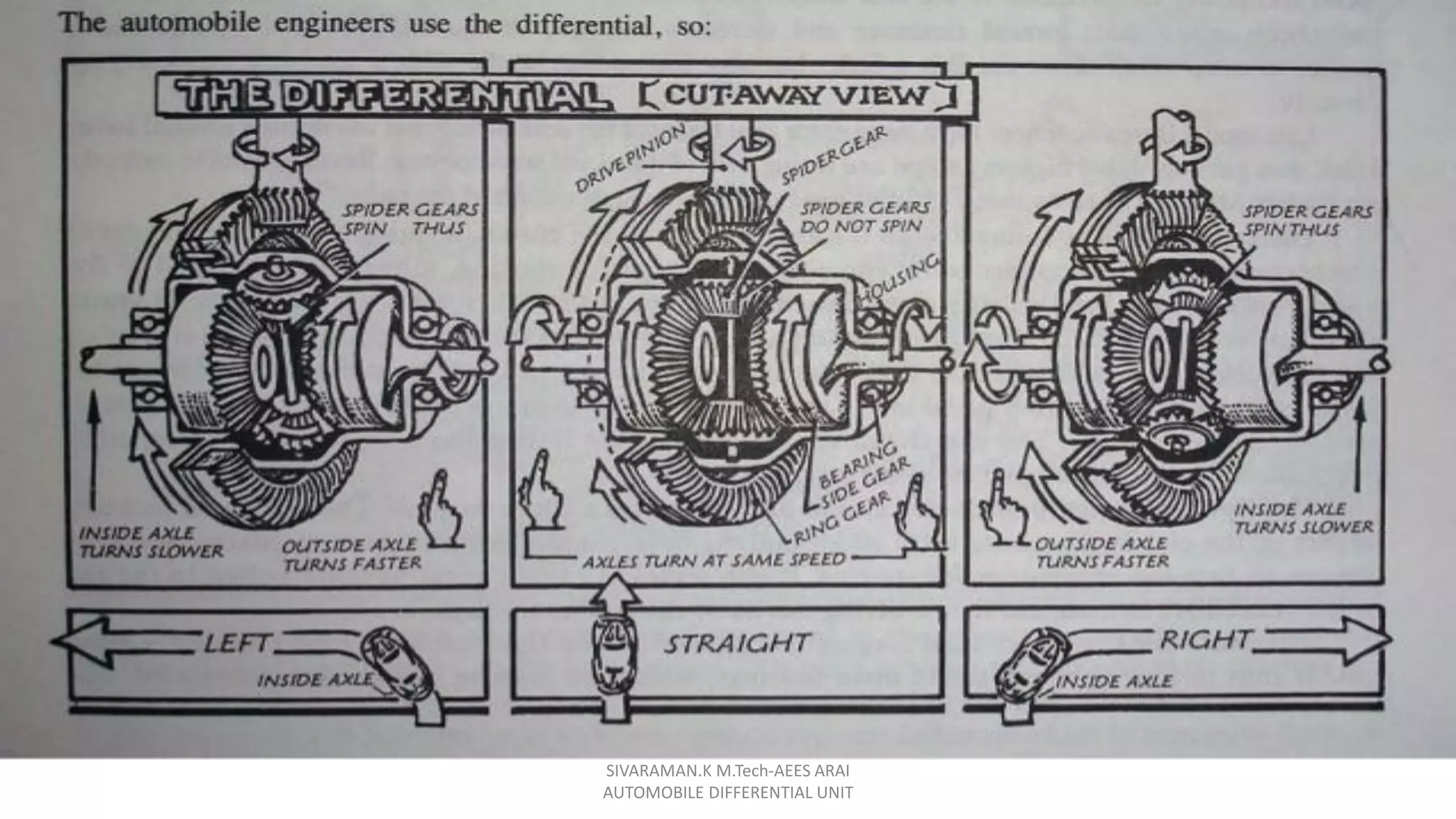
• Allow the wheels to rotate at different speeds in turns
SIVARAMAN.K M.Tech-AEES ARAI
AUTOMOBILE DIFFERENTIAL UNIT
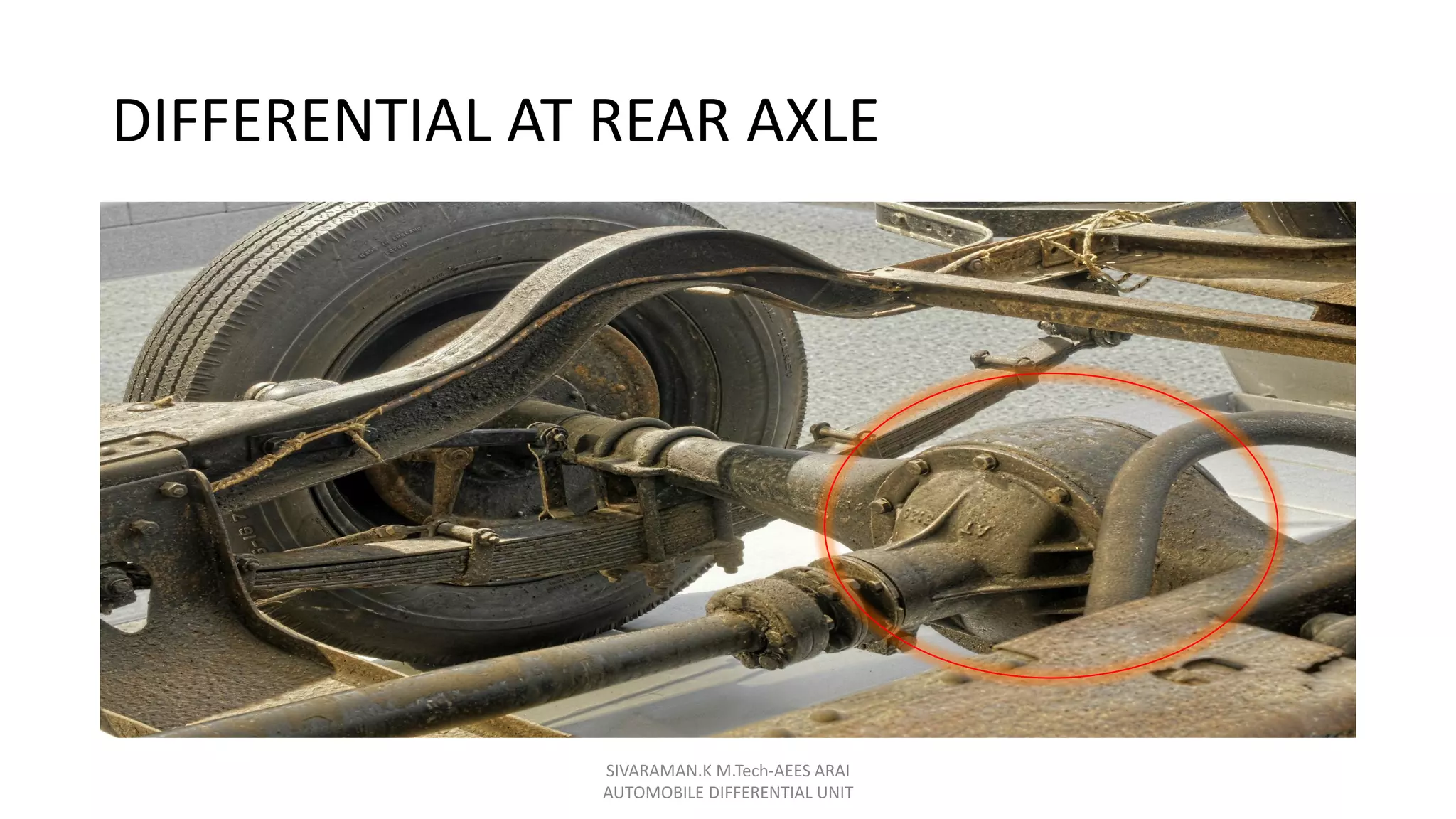
DIFFERENTIAL AT REAR AXLE
SIVARAMAN.K M.Tech-AEES ARAI
AUTOMOBILE DIFFERENTIAL UNIT
HISTORY(BC)
• 227–239 AD: Ma Jun from the Kingdom of Wei in China invents the first historically
verifiable south-pointing chariot, which provided cardinal direction as a non-magnetic,
mechanized compass. Some such chariots may have used differential gears
• 658, 666 AD: 2 Chinese Buddhist monks and engineers create south-pointing chariots for
Emperor Tenji of Japan
• 1720: Joseph Williamson uses a differential gear in a clock.
• 1810: Rudolph Ackermann of Germany invents a four-wheel steering system for carriages
• 1827: modern automotive differential patented by watchmaker Onésiphore Pecqueur
(1792–1852) of the Conservatoire des Arts et Métiers in France for use on a steam cart.
(Sources: Britannica Online and[3])
SIVARAMAN.K M.Tech-AEES ARAI
AUTOMOBILE DIFFERENTIAL UNIT
• Antikythera Mechanism
HISTORY(AD)
TYPES
• Open Differential
• Locked Differential
• Active/Electronic Differential
• Limited Slip Differential
SIVARAMAN.K M.Tech-AEES ARAI
AUTOMOBILE DIFFERENTIAL UNIT
DIFFERENTIAL GEAR TRAIN ON A TURNING CAR
SIVARAMAN.K M.Tech-AEES ARAI
AUTOMOBILE DIFFERENTIAL UNIT
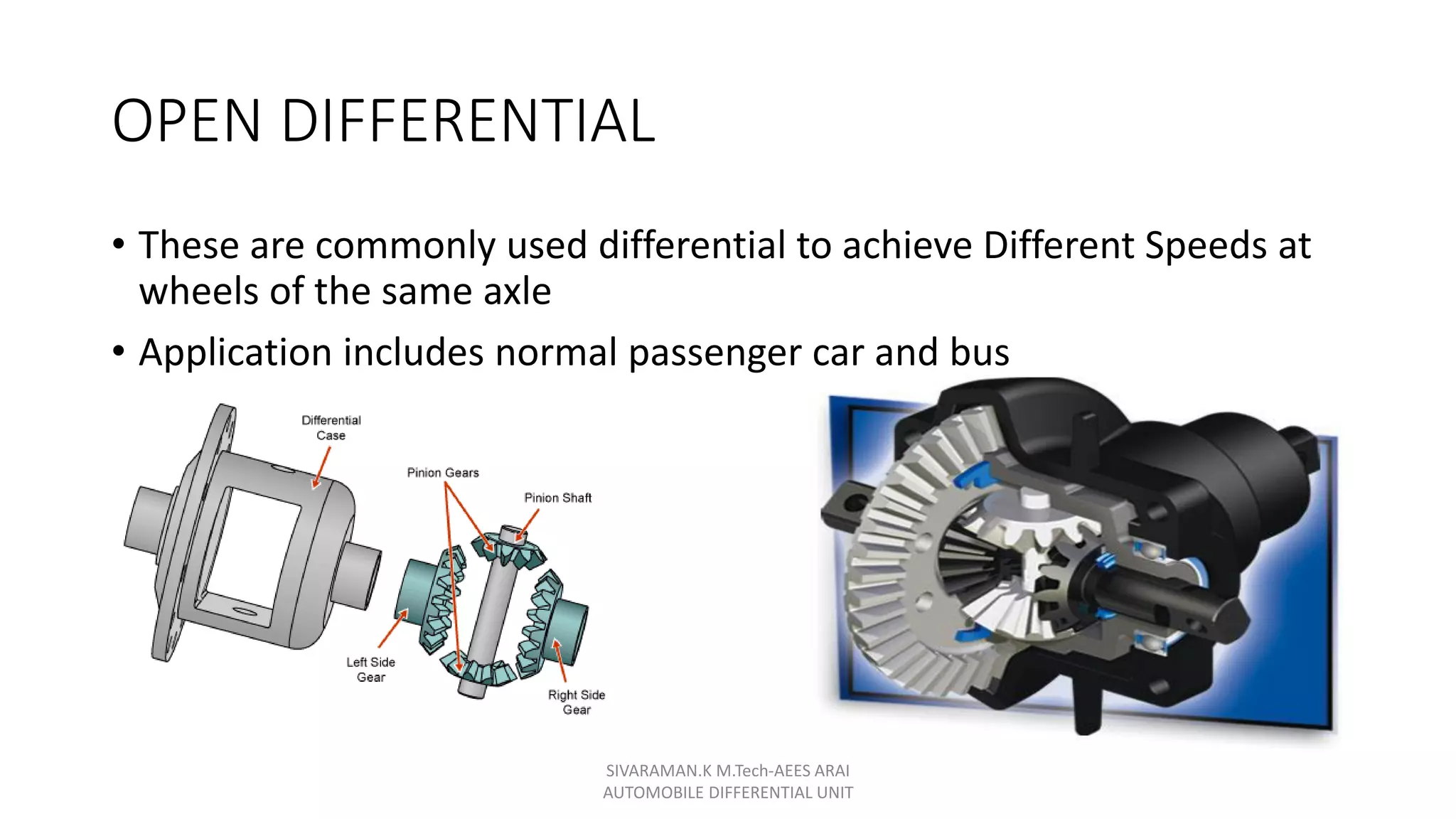
OPEN DIFFERENTIAL
• These are commonly used differential to achieve Different Speeds at
wheels of the same axle
• Application includes normal passenger car and bus
SIVARAMAN.K M.Tech-AEES ARAI
AUTOMOBILE DIFFERENTIAL UNIT
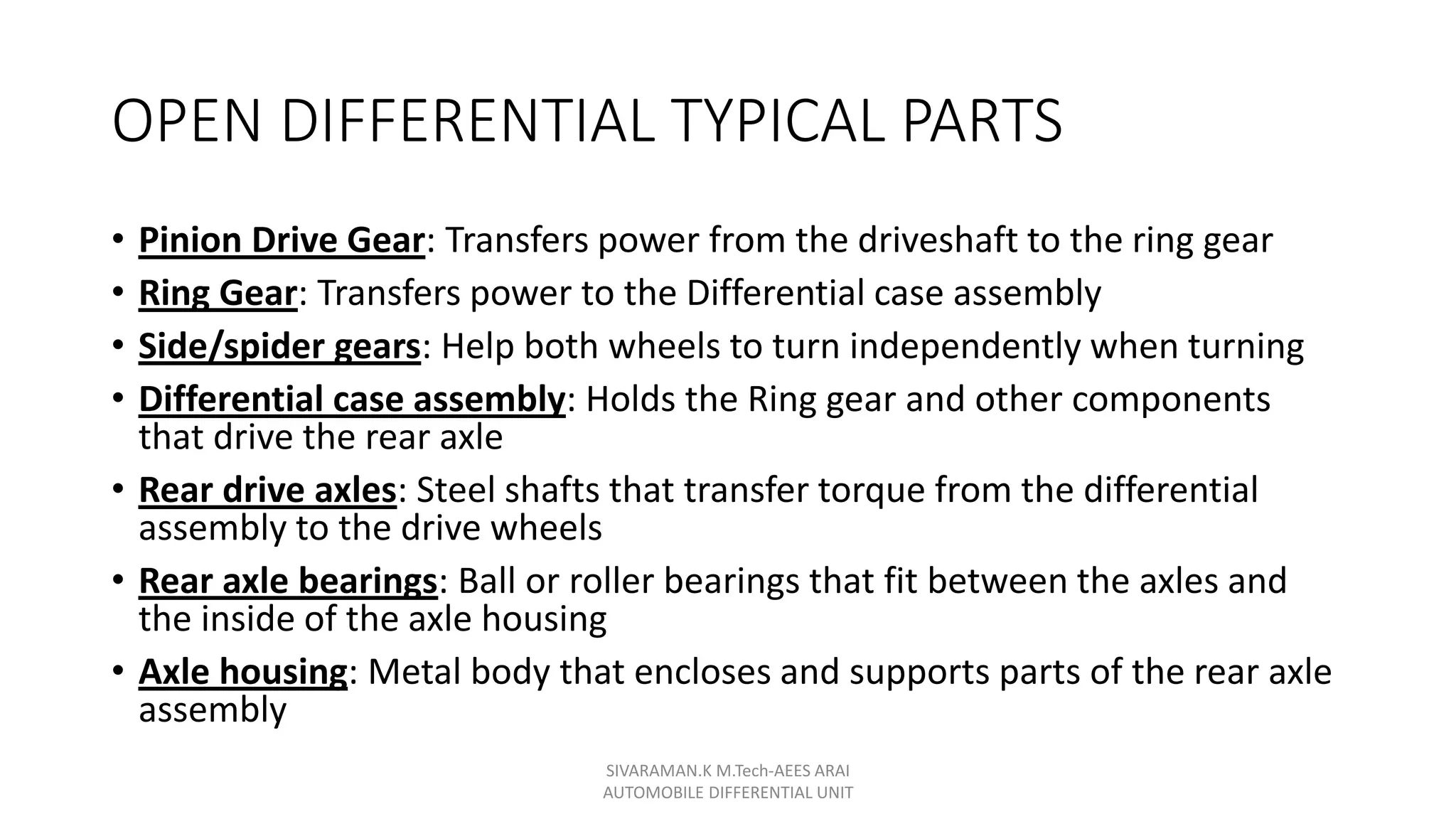
OPEN DIFFERENTIAL TYPICAL PARTS
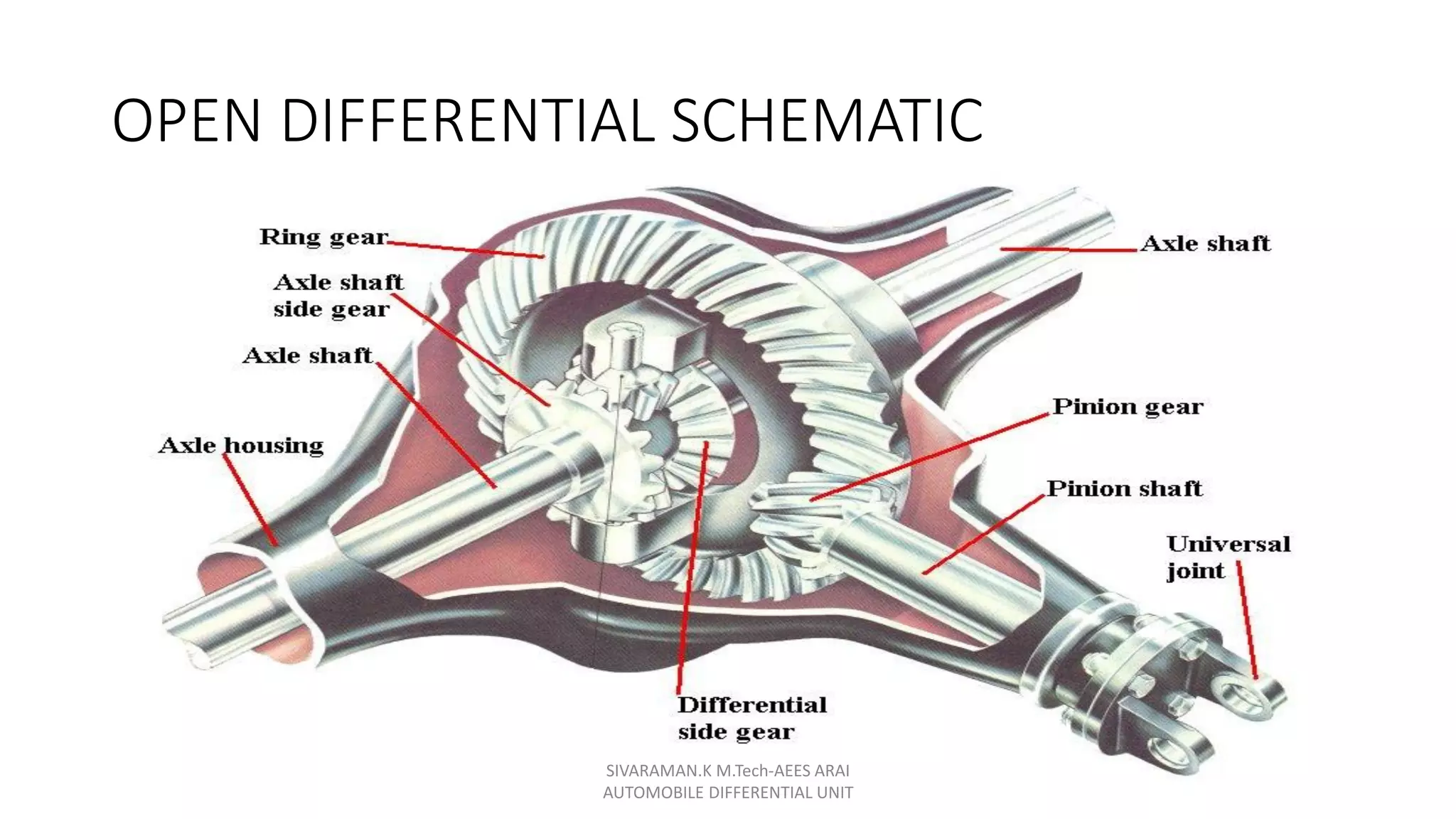
• Pinion Drive Gear: Transfers power from the driveshaft to the ring gear
• Ring Gear: Transfers power to the Differential case assembly
• Side/spider gears: Help both wheels to turn independently when turning
• Differential case assembly: Holds the Ring gear and other components
that drive the rear axle
• Rear drive axles: Steel shafts that transfer torque from the differential
assembly to the drive wheels
• Rear axle bearings: Ball or roller bearings that fit between the axles and
the inside of the axle housing
• Axle housing: Metal body that encloses and supports parts of the rear axle
assembly
SIVARAMAN.K M.Tech-AEES ARAI
AUTOMOBILE DIFFERENTIAL UNIT
SIVARAMAN.K M.Tech-AEES ARAI
AUTOMOBILE DIFFERENTIAL UNIT
OPEN DIFFERENTIAL SCHEMATIC
SIVARAMAN.K M.Tech-AEES ARAI
AUTOMOBILE DIFFERENTIAL UNIT
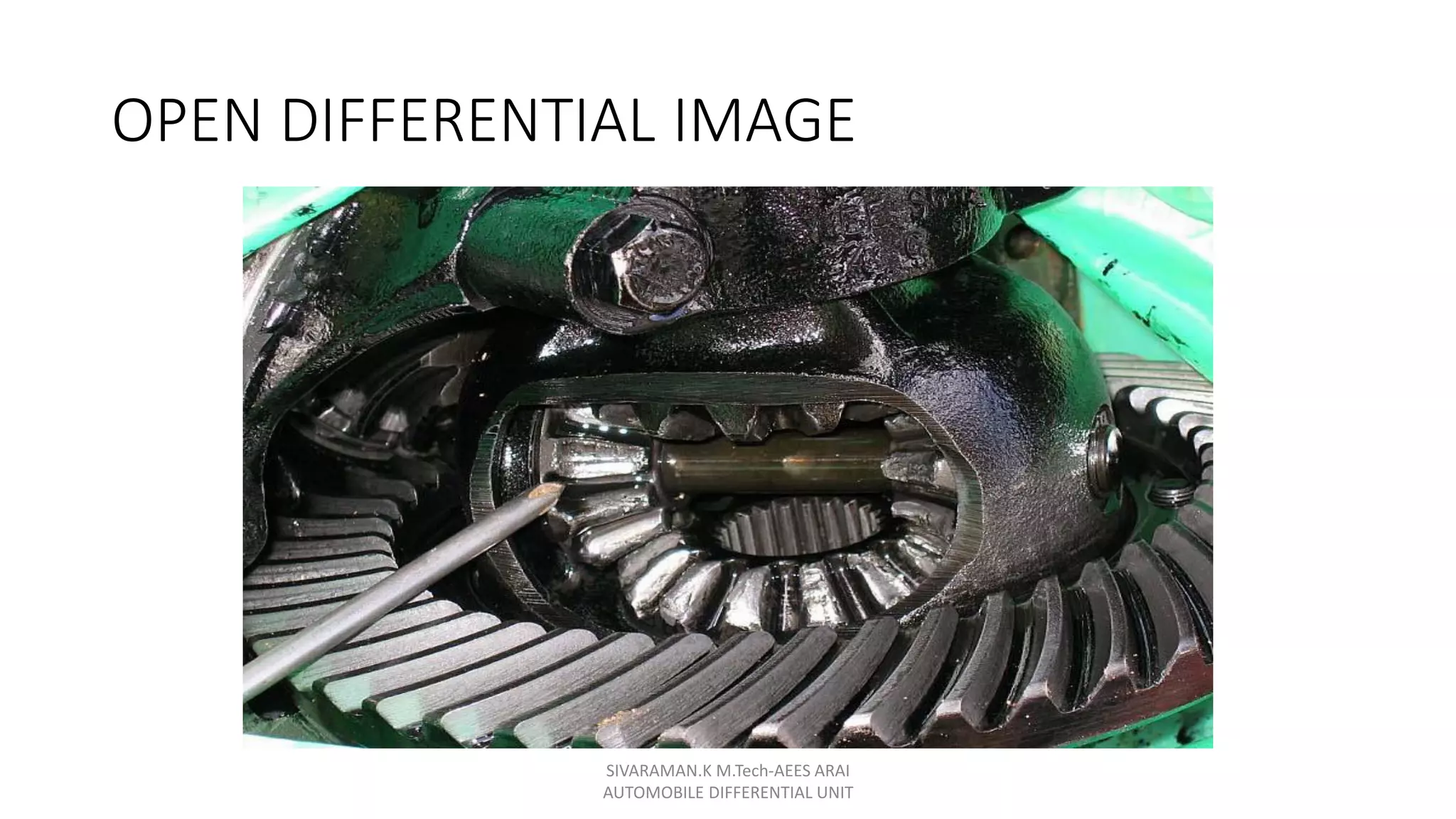
OPEN DIFFERENTIAL IMAGE
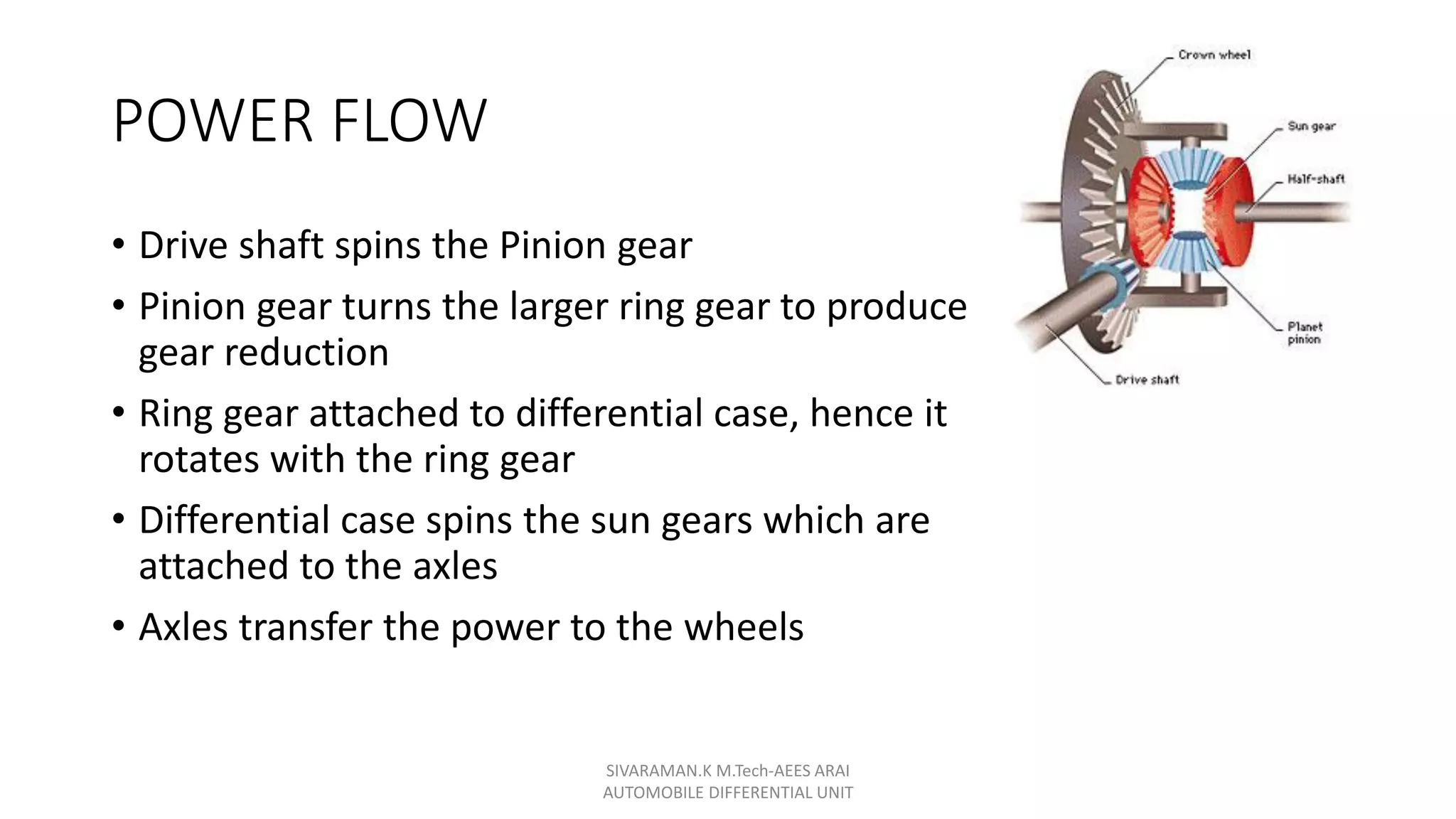
POWER FLOW
• Drive shaft spins the Pinion gear
• Pinion gear turns the larger ring gear to produce
gear reduction
• Ring gear attached to differential case, hence it
rotates with the ring gear
• Differential case spins the sun gears which are
attached to the axles
• Axles transfer the power to the wheels
SIVARAMAN.K M.Tech-AEES ARAI
AUTOMOBILE DIFFERENTIAL UNIT
SIVARAMAN.K M.Tech-AEES ARAI
AUTOMOBILE DIFFERENTIAL UNIT
SIVARAMAN.K M.Tech-AEES ARAI
AUTOMOBILE DIFFERENTIAL UNIT
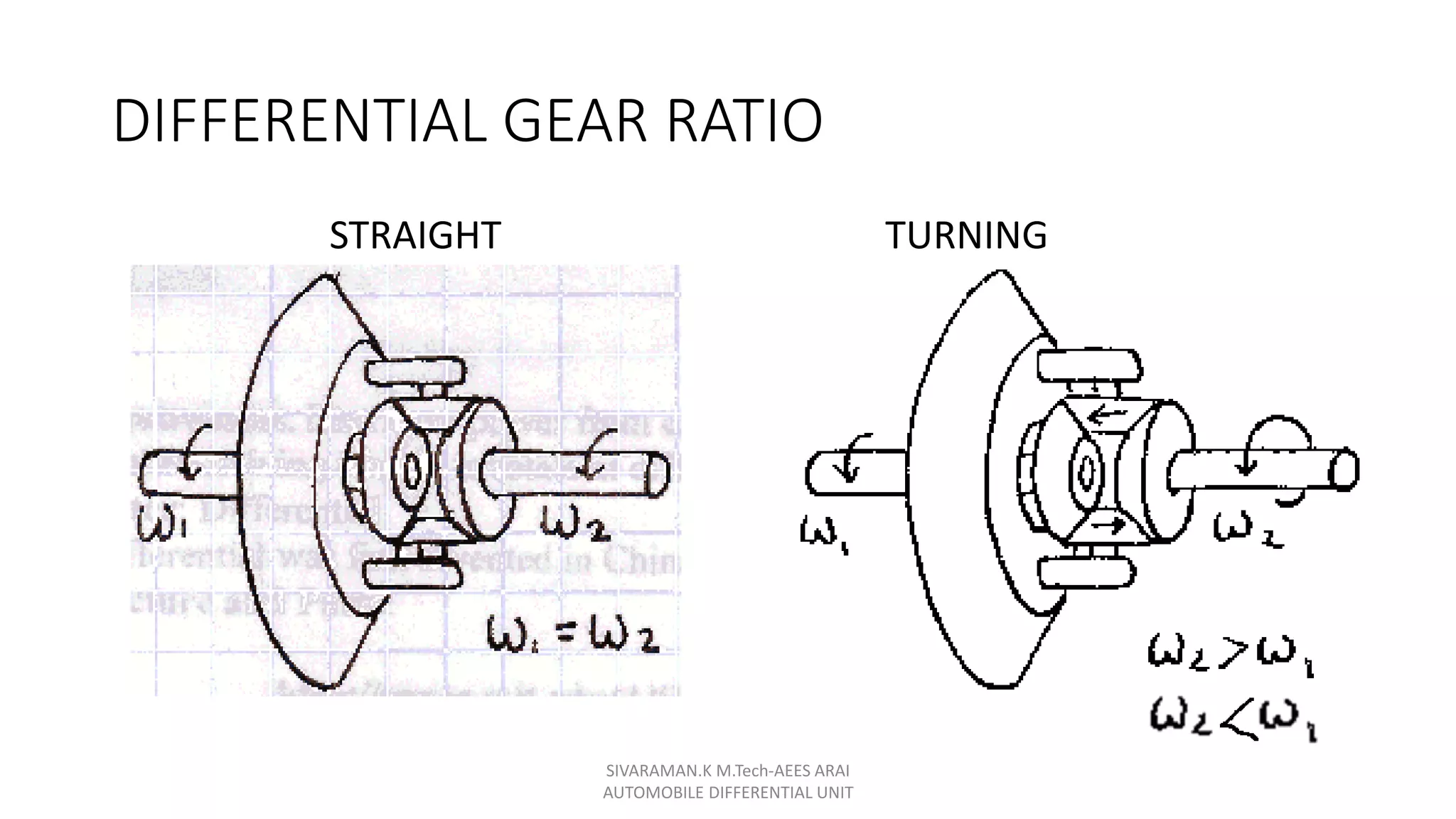
DIFFERENTIAL GEAR RATIO
STRAIGHT TURNING
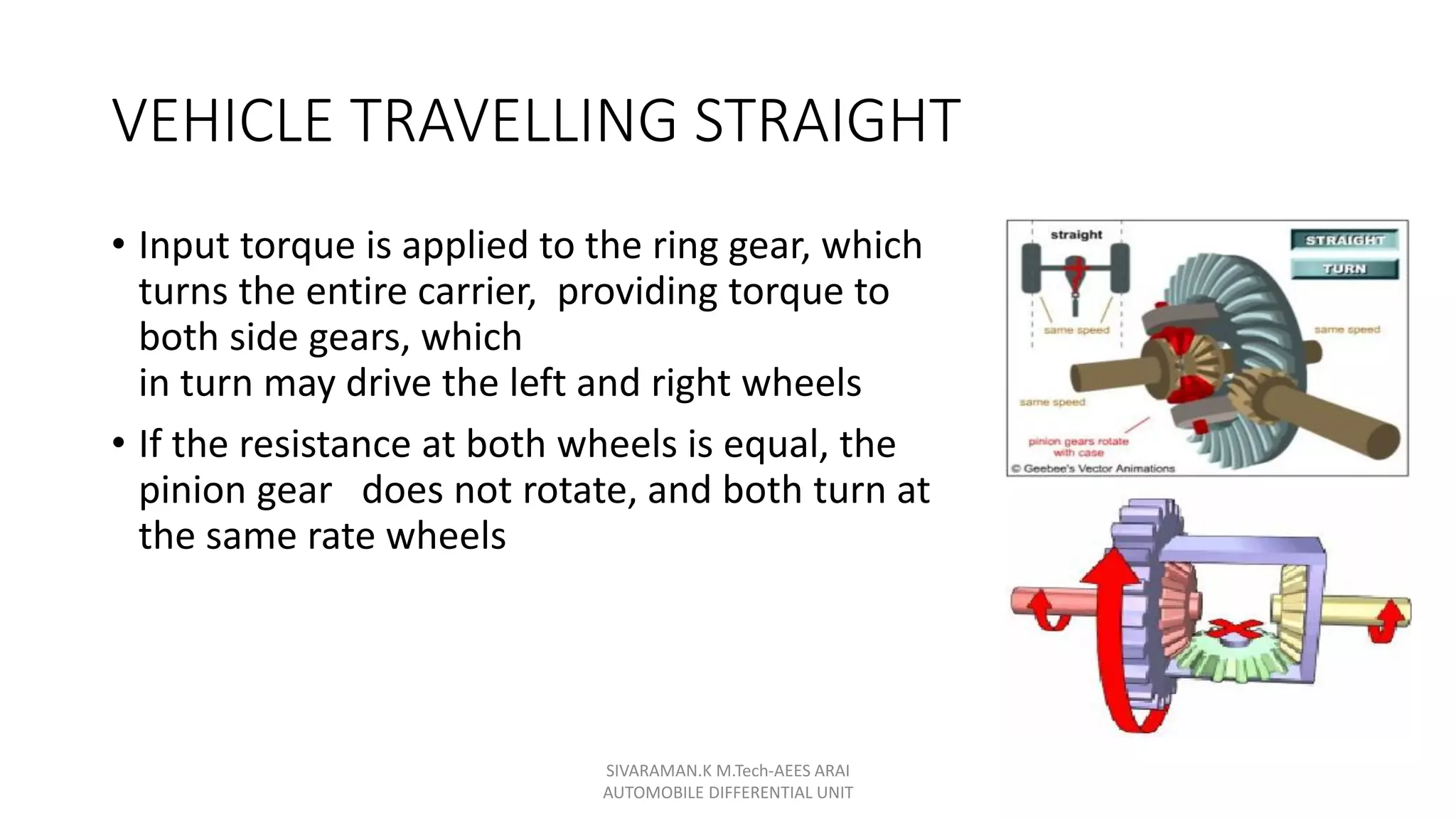
VEHICLE TRAVELLING STRAIGHT
• Input torque is applied to the ring gear, which
turns the entire carrier, providing torque to
both side gears, which
in turn may drive the left and right wheels
• If the resistance at both wheels is equal, the
pinion gear does not rotate, and both turn at
the same rate wheels
SIVARAMAN.K M.Tech-AEES ARAI
AUTOMOBILE DIFFERENTIAL UNIT
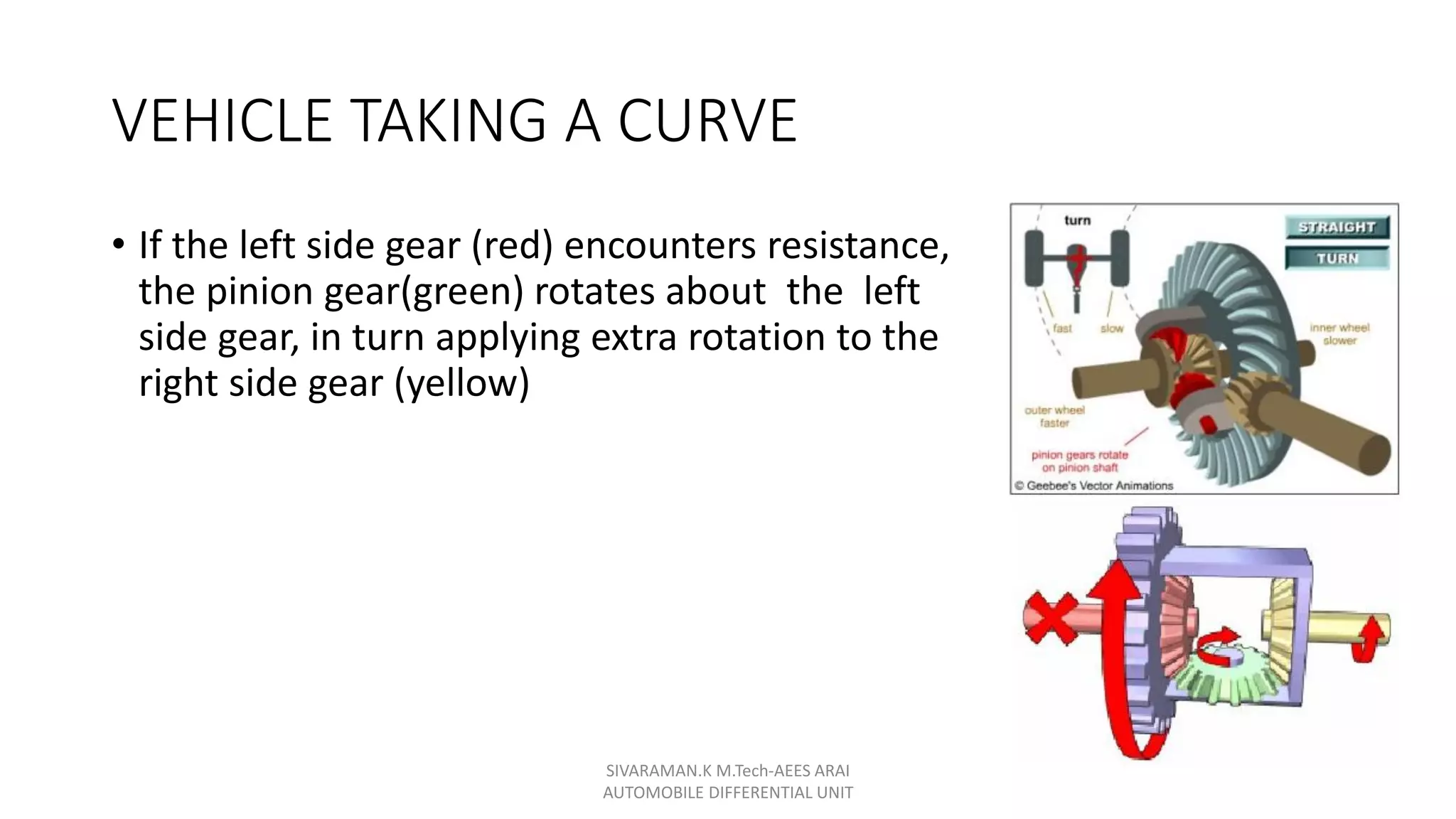
VEHICLE TAKING A CURVE
• If the left side gear (red) encounters resistance,
the pinion gear(green) rotates about the left
side gear, in turn applying extra rotation to the
right side gear (yellow)
SIVARAMAN.K M.Tech-AEES ARAI
AUTOMOBILE DIFFERENTIAL UNIT
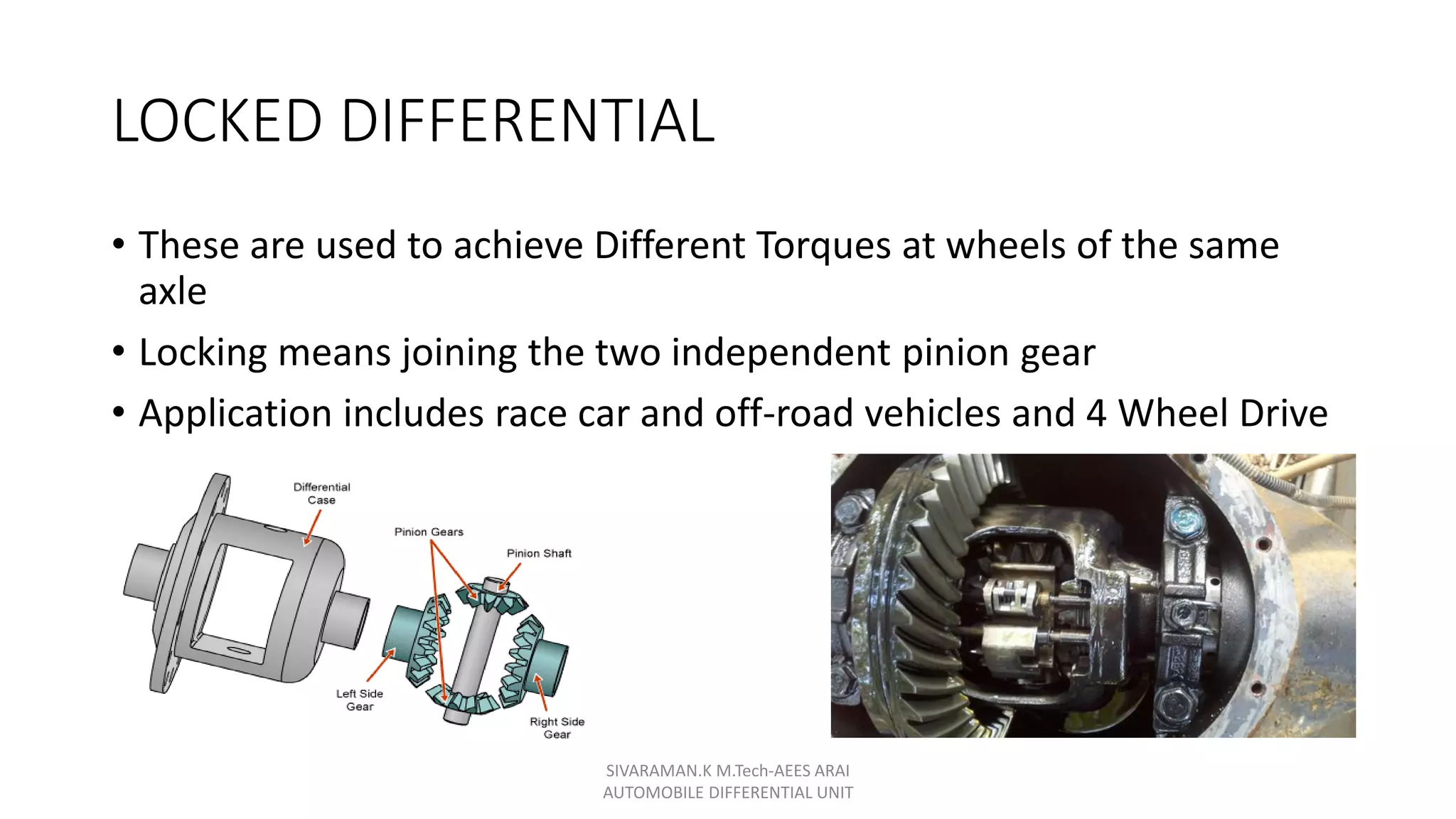
LOCKED DIFFERENTIAL
• These are used to achieve Different Torques at wheels of the same
axle
• Locking means joining the two independent pinion gear
• Application includes race car and off-road vehicles and 4 Wheel Drive
SIVARAMAN.K M.Tech-AEES ARAI
AUTOMOBILE DIFFERENTIAL UNIT
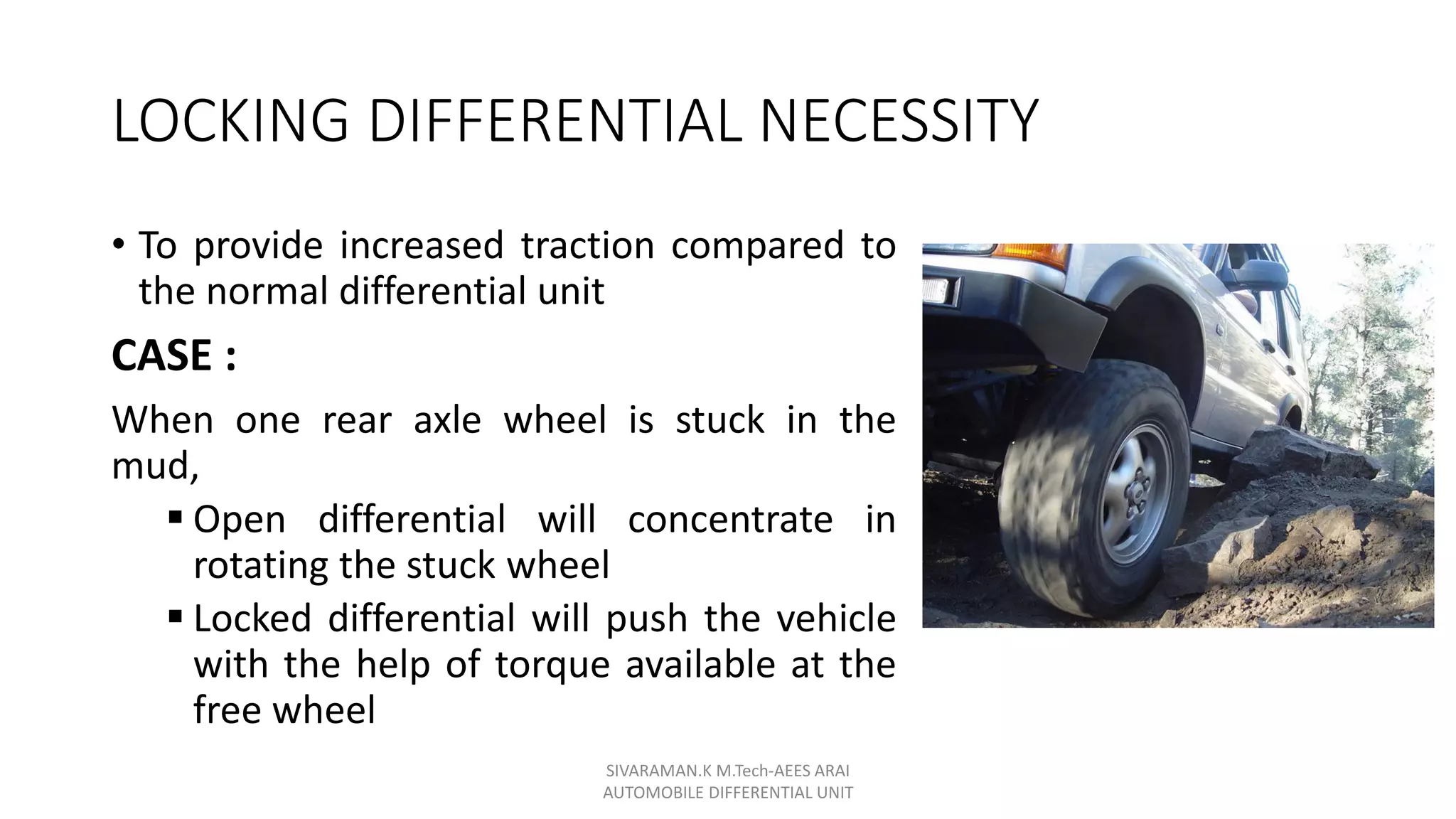
LOCKING DIFFERENTIAL NECESSITY
• To provide increased traction compared to
the normal differential unit
CASE :
When one rear axle wheel is stuck in the
mud,
 Open differential will concentrate in
rotating the stuck wheel
 Locked differential will push the vehicle
with the help of torque available at the
free wheel
SIVARAMAN.K M.Tech-AEES ARAI
AUTOMOBILE DIFFERENTIAL UNIT
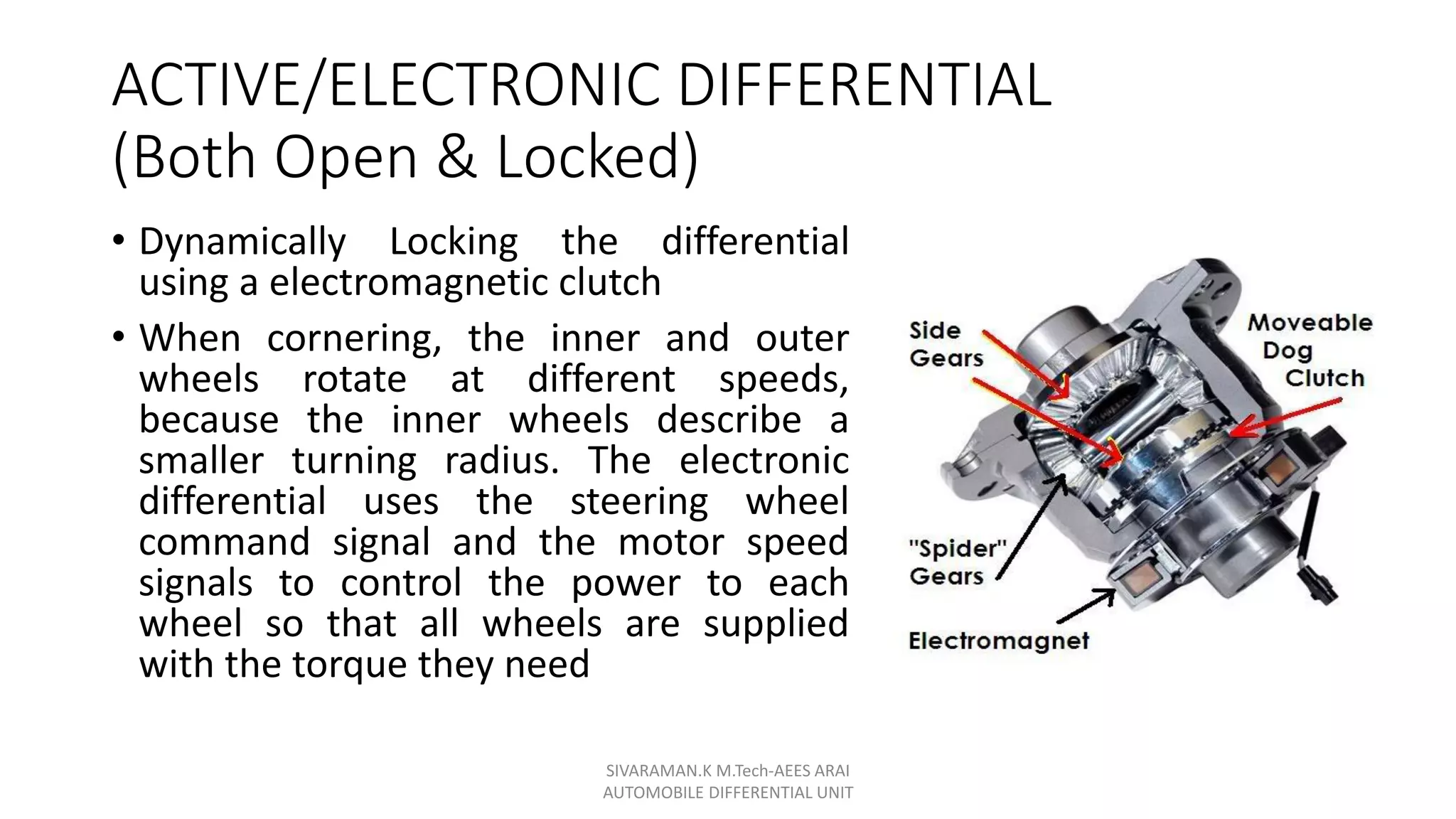
ACTIVE/ELECTRONIC DIFFERENTIAL
(Both Open & Locked)
• Dynamically Locking the differential
using a electromagnetic clutch
• When cornering, the inner and outer
wheels rotate at different speeds,
because the inner wheels describe a
smaller turning radius. The electronic
differential uses the steering wheel
command signal and the motor speed
signals to control the power to each
wheel so that all wheels are supplied
with the torque they need
SIVARAMAN.K M.Tech-AEES ARAI
AUTOMOBILE DIFFERENTIAL UNIT
LIMITED SLIP DIFFERENTIAL
• A limited slip differential (LSD), is very similar to the open differential
unit but has additional link that prevents wheel spin and loss of
traction
• The standard differential delivers maximum torque to the wheel with
minimum traction. The limited slip differential delivers maximum
torque to the wheel with maximum traction
• It is mainly used in off road vehicles
• TYPES :
i. Clutch Pack
ii. Cone Clutch
iii. Torsen
SIVARAMAN.K M.Tech-AEES ARAI
AUTOMOBILE DIFFERENTIAL UNIT
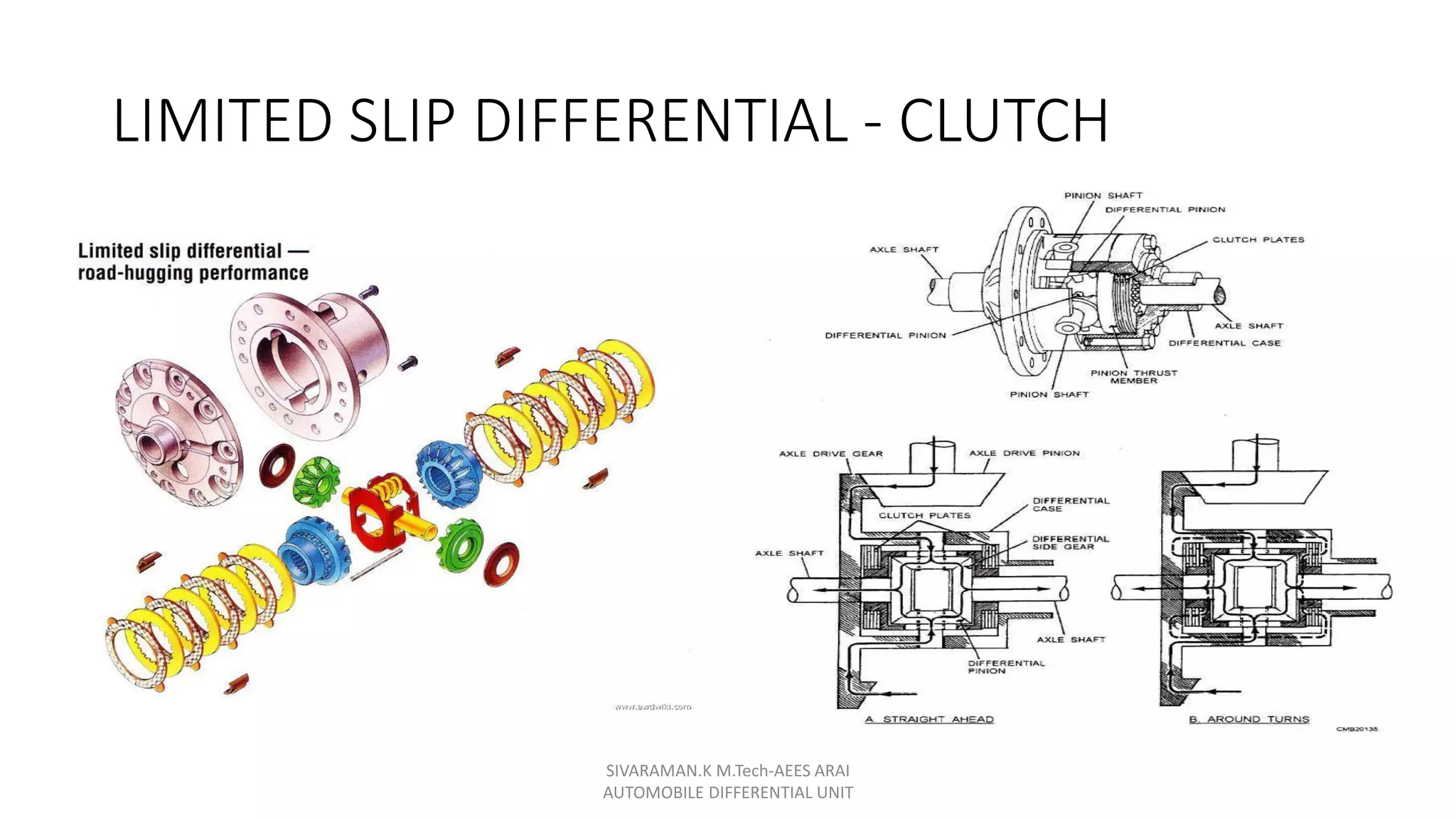
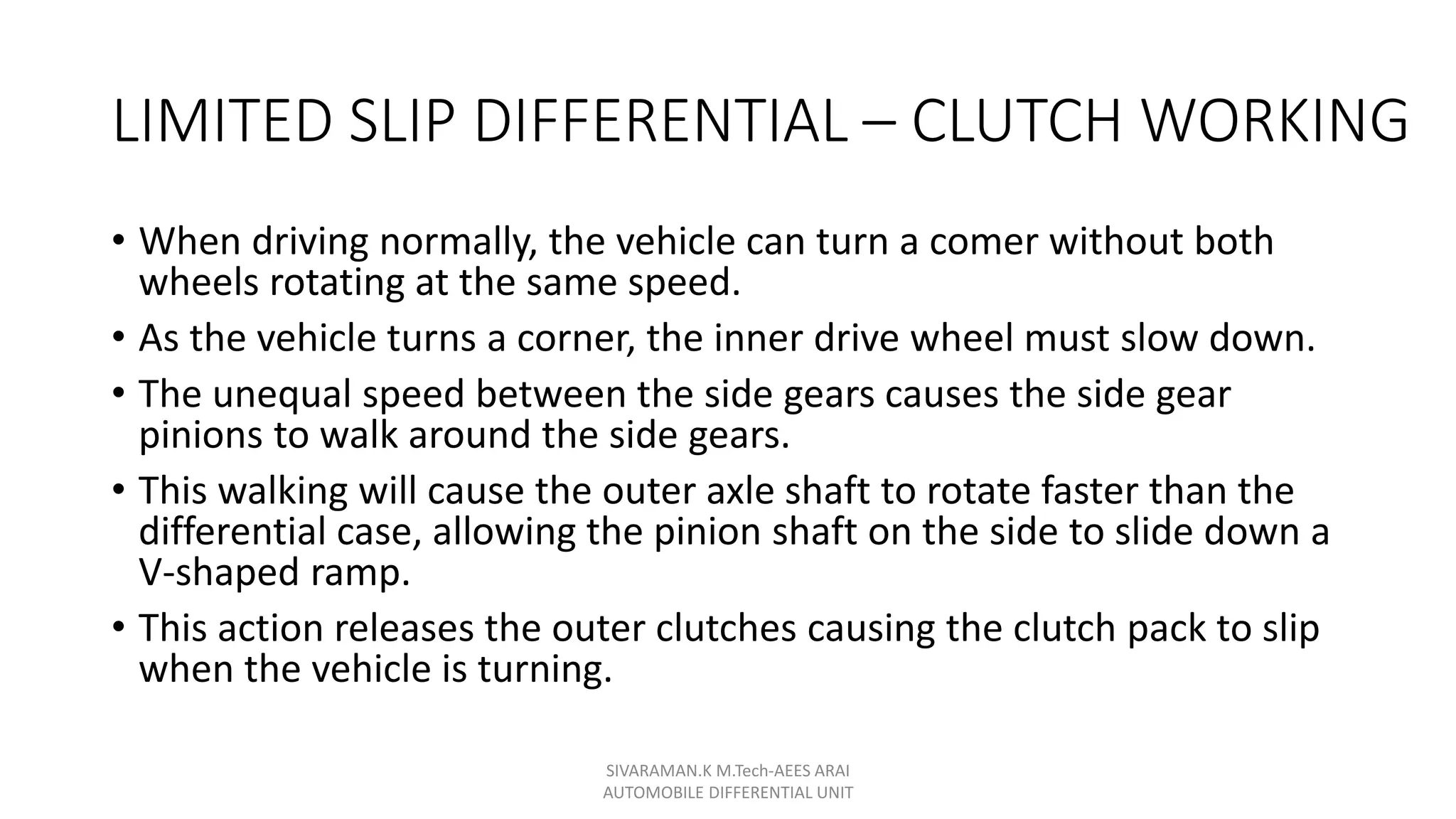
LIMITED SLIP DIFFERENTIAL - CLUTCH
• The clutch pack limited slip differential uses a set of friction discs and steel
plates to lock the axles together whenever one drive wheel experiences
uncontrolled slippage. The friction discs are sandwiched between the steel
plates inside the differential case. The friction disc is splined and turns with
the differential side gears. The steel plates turn with the differential case.
• Springs (bellville springs, coil springs, or leaf springs) force the friction disc
and steel plates together. As a result, both rear axles try to turn with the
differential case.
• Spring force and thrust action of the spider gears applies the clutch pack.
Under high torque conditions, the rotation of the differential pinion gears
PUSHES OUT on the axle side gears. The axle side gears then push on the
clutch discs. This action helps lock the disc and keeps both wheels turning.
SIVARAMAN.K M.Tech-AEES ARAI
AUTOMOBILE DIFFERENTIAL UNIT
LIMITED SLIP DIFFERENTIAL - CLUTCH
SIVARAMAN.K M.Tech-AEES ARAI
AUTOMOBILE DIFFERENTIAL UNIT
LIMITED SLIP DIFFERENTIAL – CLUTCH WORKING
• When driving normally, the vehicle can turn a comer without both
wheels rotating at the same speed.
• As the vehicle turns a corner, the inner drive wheel must slow down.
• The unequal speed between the side gears causes the side gear
pinions to walk around the side gears.
• This walking will cause the outer axle shaft to rotate faster than the
differential case, allowing the pinion shaft on the side to slide down a
V-shaped ramp.
• This action releases the outer clutches causing the clutch pack to slip
when the vehicle is turning.
SIVARAMAN.K M.Tech-AEES ARAI
AUTOMOBILE DIFFERENTIAL UNIT
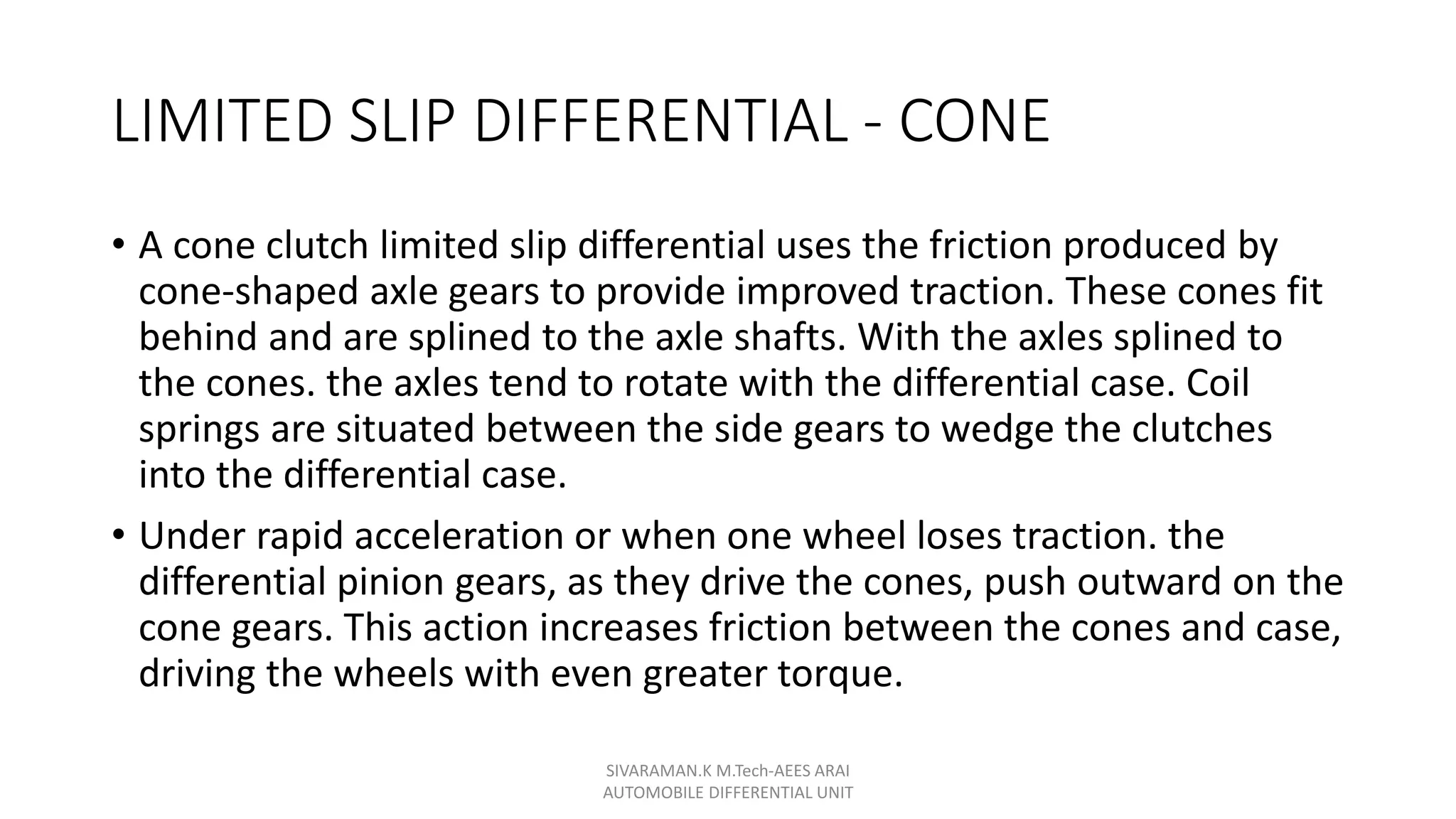
LIMITED SLIP DIFFERENTIAL - CONE
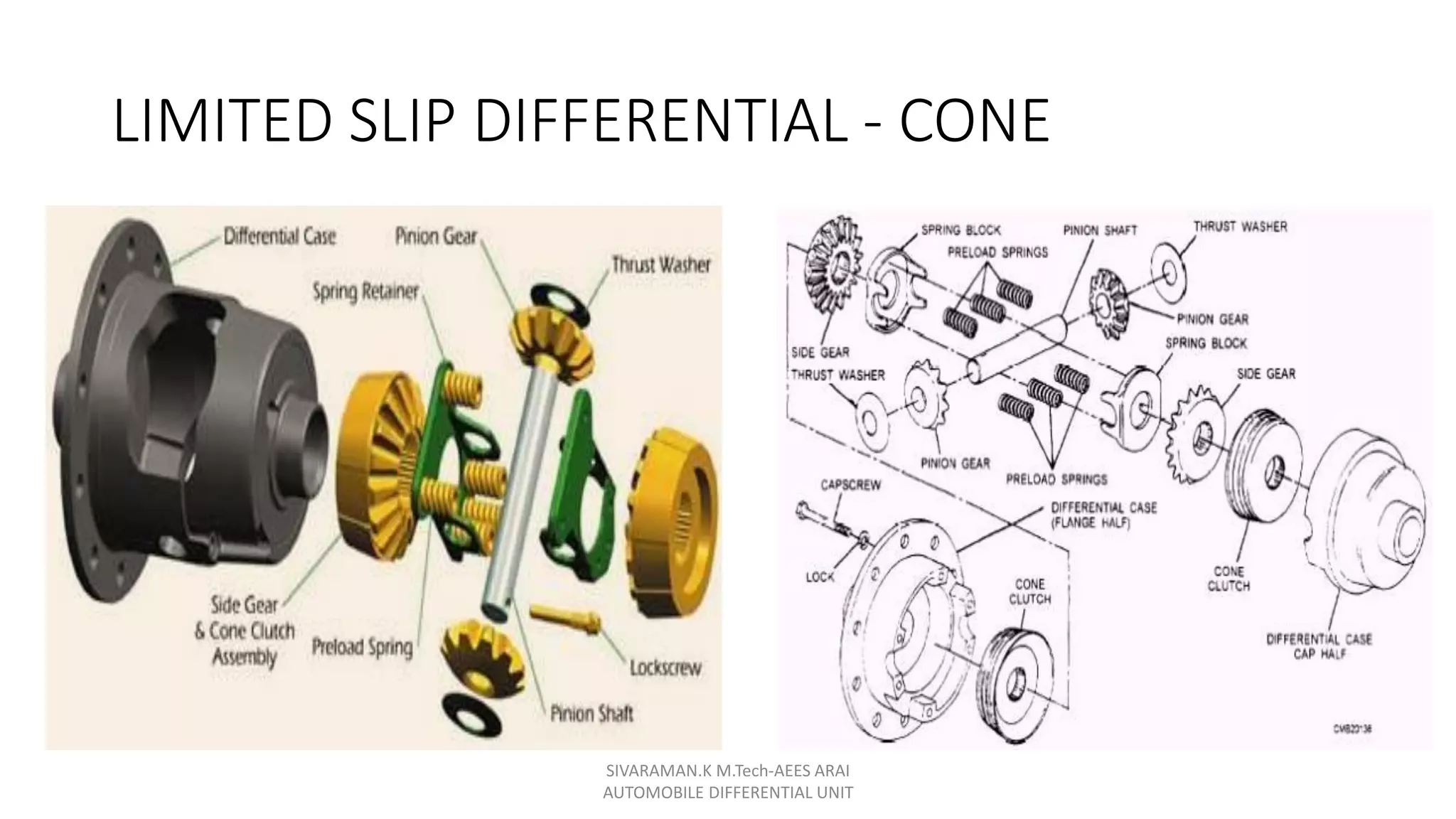
• A cone clutch limited slip differential uses the friction produced by
cone-shaped axle gears to provide improved traction. These cones fit
behind and are splined to the axle shafts. With the axles splined to
the cones. the axles tend to rotate with the differential case. Coil
springs are situated between the side gears to wedge the clutches
into the differential case.
• Under rapid acceleration or when one wheel loses traction. the
differential pinion gears, as they drive the cones, push outward on the
cone gears. This action increases friction between the cones and case,
driving the wheels with even greater torque.
SIVARAMAN.K M.Tech-AEES ARAI
AUTOMOBILE DIFFERENTIAL UNIT
LIMITED SLIP DIFFERENTIAL - CONE
SIVARAMAN.K M.Tech-AEES ARAI
AUTOMOBILE DIFFERENTIAL UNIT
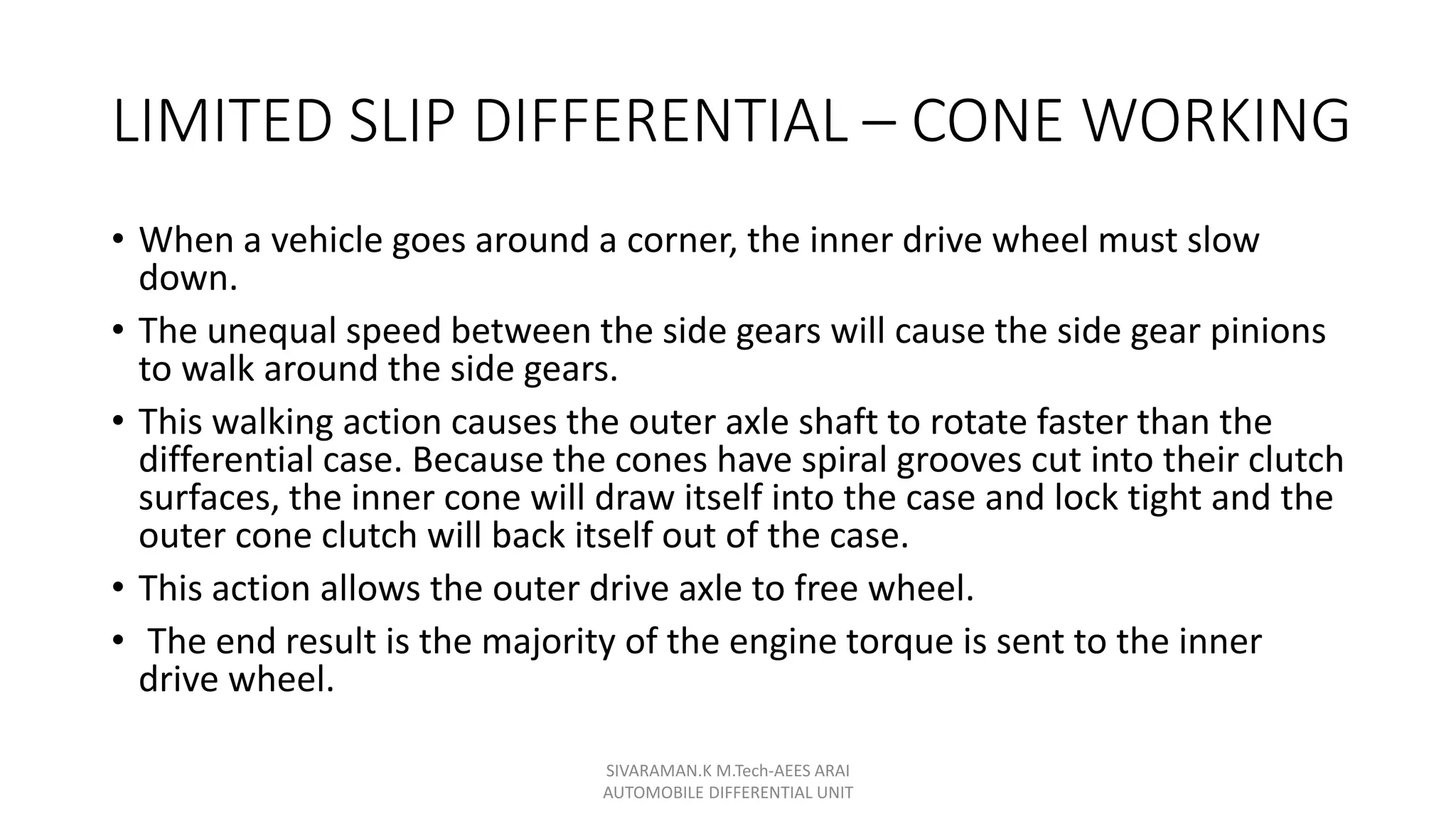
LIMITED SLIP DIFFERENTIAL – CONE WORKING
• When a vehicle goes around a corner, the inner drive wheel must slow
down.
• The unequal speed between the side gears will cause the side gear pinions
to walk around the side gears.
• This walking action causes the outer axle shaft to rotate faster than the
differential case. Because the cones have spiral grooves cut into their clutch
surfaces, the inner cone will draw itself into the case and lock tight and the
outer cone clutch will back itself out of the case.
• This action allows the outer drive axle to free wheel.
• The end result is the majority of the engine torque is sent to the inner
drive wheel.
SIVARAMAN.K M.Tech-AEES ARAI
AUTOMOBILE DIFFERENTIAL UNIT
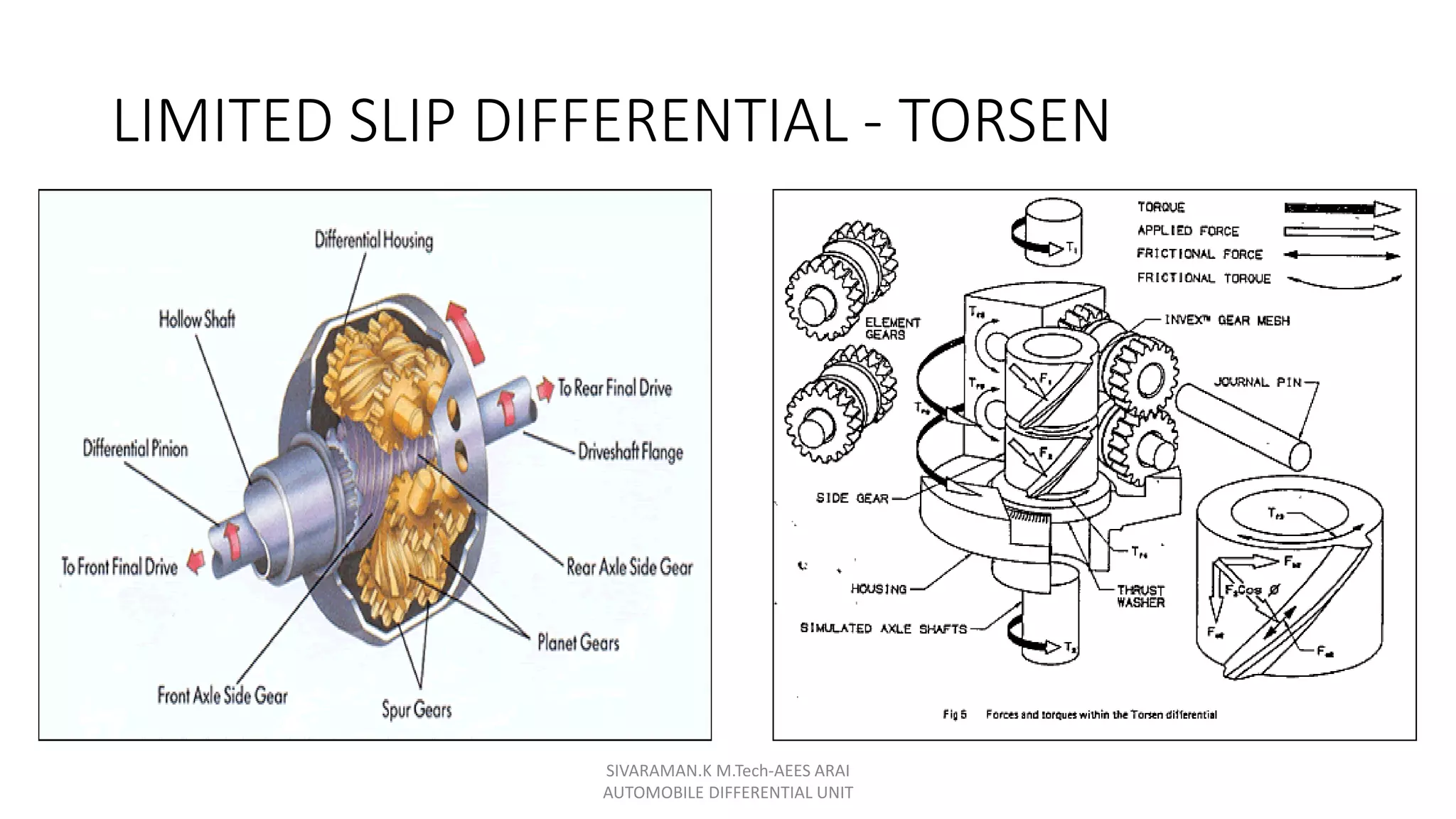
LIMITED SLIP DIFFERENTIAL - TORSEN
• Torsen differentials can be used in one or more positions on a motor
vehicle:
• Center - used to apportion appropriate torque distribution between front
and rear axles on an all-wheel drive vehicle.
• Rear - used to apportion appropriate torque distribution between left and
right sides in rear axles. This may be on either a rear-wheel drive or four-
wheel drive vehicle.
• Front - used to apportion appropriate torque distribution between left and
right sides in front axles. This may be on either a front-wheel drive or four-
wheel drive vehicle.
• A four-wheel-drive vehicle, for example, may use either one, two, or three
Torsen differentials.
SIVARAMAN.K M.Tech-AEES ARAI
AUTOMOBILE DIFFERENTIAL UNIT
LIMITED SLIP DIFFERENTIAL - TORSEN
SIVARAMAN.K M.Tech-AEES ARAI
AUTOMOBILE DIFFERENTIAL UNIT
LIMITED SLIP DIFFERENTIAL – TORSEN WORKING
• The Torsen differential works just like a conventional differential but can
lock up if a torque imbalance occurs, the maximum ratio of torque
imbalance being defined by the Torque Bias Ratio (TBR).
• When a Torsen has a 3:1 TBR, that means that one side of the differential
can handle up to 75% while the other side would have to only handle 25%
of applied torque.
• During acceleration under asymmetric traction conditions, so long as the
higher traction side can handle the higher percentage of applied torque, no
relative wheel spin will occur.
• When the traction difference exceeds the TBR, the slower output side of
the differential receives the tractive torque of the faster wheel multiplied
by the TBR; any extra torque remaining from applied torque contributes to
the angular acceleration of the faster output side of the differential.
SIVARAMAN.K M.Tech-AEES ARAI
AUTOMOBILE DIFFERENTIAL UNIT
LIMITED SLIP DIFFERENTIAL – TORSEN TYPES
There are currently three types of Torsen differentials,
• The original Torsen T-1 (Type A) uses crossed axis helical gears to increase
internal friction. The Type I can be designed for higher torque bias ratios
than the Type II, but typically has higher backlash and the potential for
Noise, Vibration, and Harshness (NVH) issues, and requires a precise
setup/installation.
• The later Torsen T-2 (Type B) uses a parallel gear arrangement to achieve a
similar effect. There is also a specialist application of the T-2, known as the
T-2R (RaceMaster).
• The latest Torsen T-3 (Type C) is a planetary type differential, in that the
nominal torque split is not 50:50. The Type C is available as single or twin
version; the Torsen twin C differential has front and center differential in
the same unit.
SIVARAMAN.K M.Tech-AEES ARAI
AUTOMOBILE DIFFERENTIAL UNIT
DIFFERENTIAL MAINTENANCE
Differential lubrication
• Change this oil every 30,000 to 50,000 miles (or as specified in user
manual)
• Use recommended oil for differential since different type requires
different oil density and properties
• After draining the used oil, clean the differential completely and then
fill the new lubricating oil
• Ensure the seal in the unit is good to avoid leakage and dust
accumulation
SIVARAMAN.K M.Tech-AEES ARAI
AUTOMOBILE DIFFERENTIAL UNIT
DIFFERENTIAL UNIT DISASSEMBLY
• Procedures for removal, disassembly, and reassembly vary depending
on the type of differential, make, and model. Always refer to the
manufacturer's service manual. However, there are several
procedures that relate to almost any type of differential.
To remove a separate carrier differential, perform the following:
• Remove the drive shaft
• Place a drain pan under the differential. Remove the drain plug and
drain the lubricant
• Unbolt the nuts around the outside of the carrier
• Force the differential carrier away from the housing
SIVARAMAN.K M.Tech-AEES ARAI
AUTOMOBILE DIFFERENTIAL UNIT
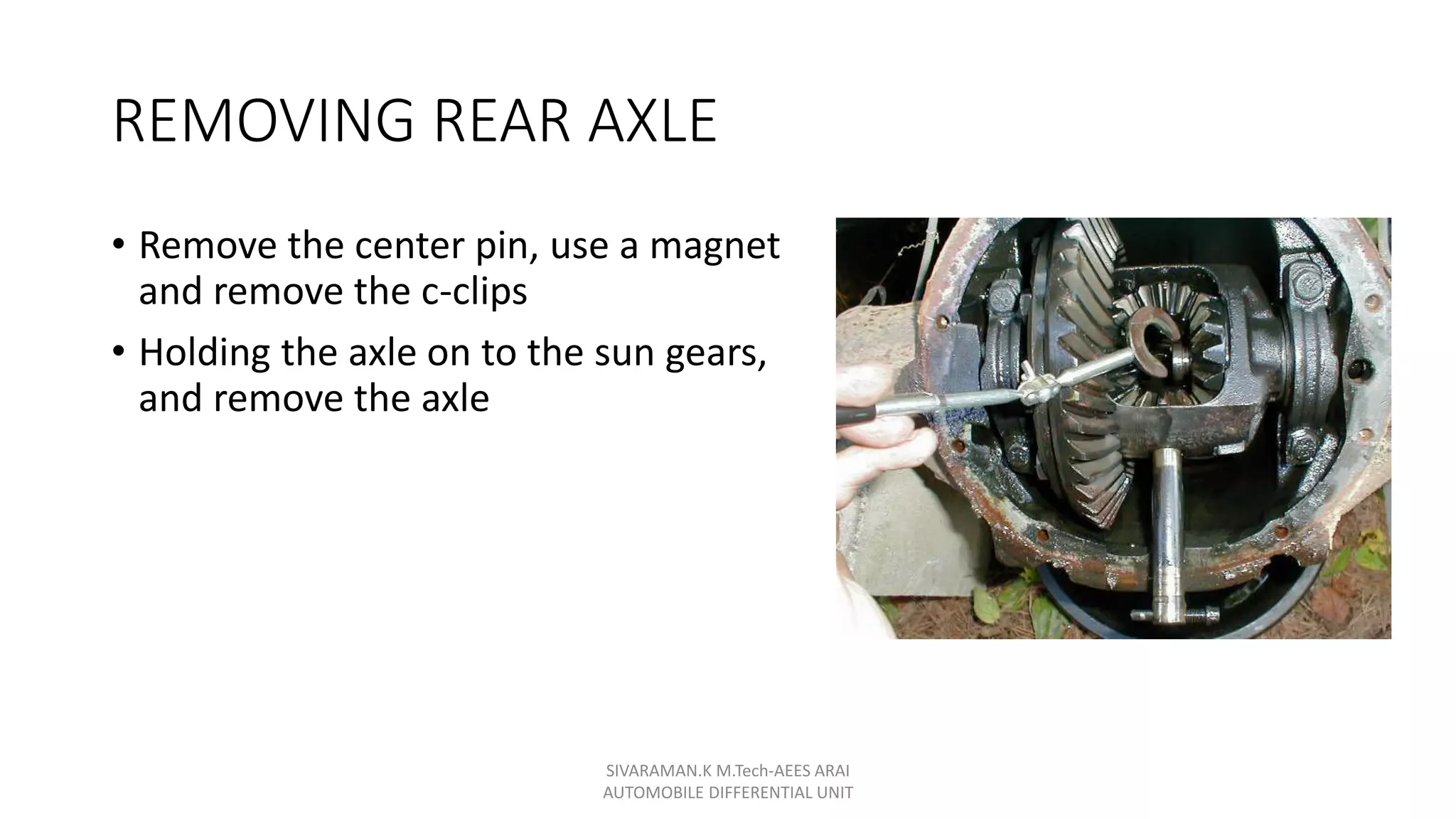
REMOVING REAR AXLE
• Remove the center pin, use a magnet
and remove the c-clips
• Holding the axle on to the sun gears,
and remove the axle
SIVARAMAN.K M.Tech-AEES ARAI
AUTOMOBILE DIFFERENTIAL UNIT
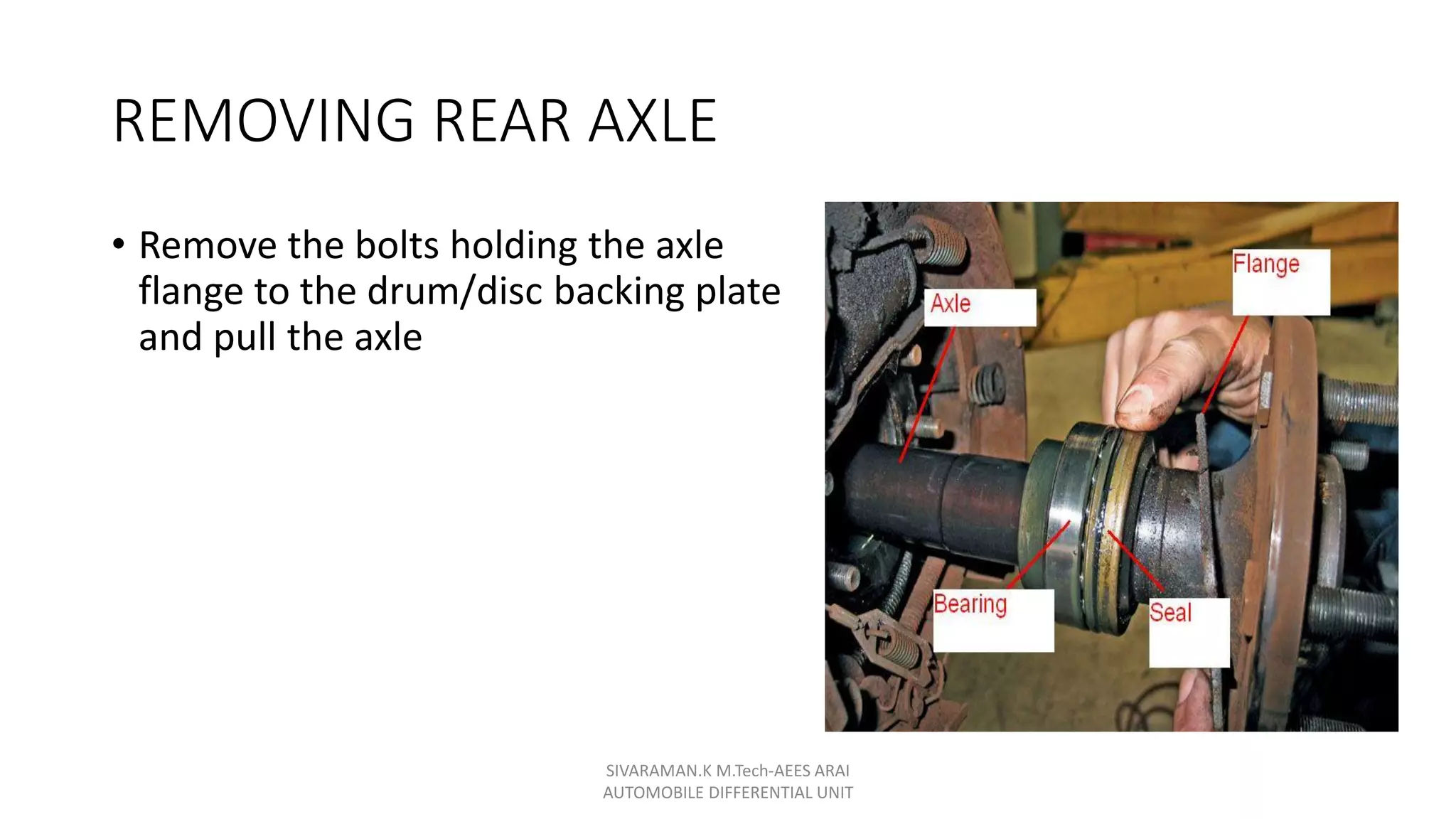
REMOVING REAR AXLE
• Remove the bolts holding the axle
flange to the drum/disc backing plate
and pull the axle
SIVARAMAN.K M.Tech-AEES ARAI
AUTOMOBILE DIFFERENTIAL UNIT
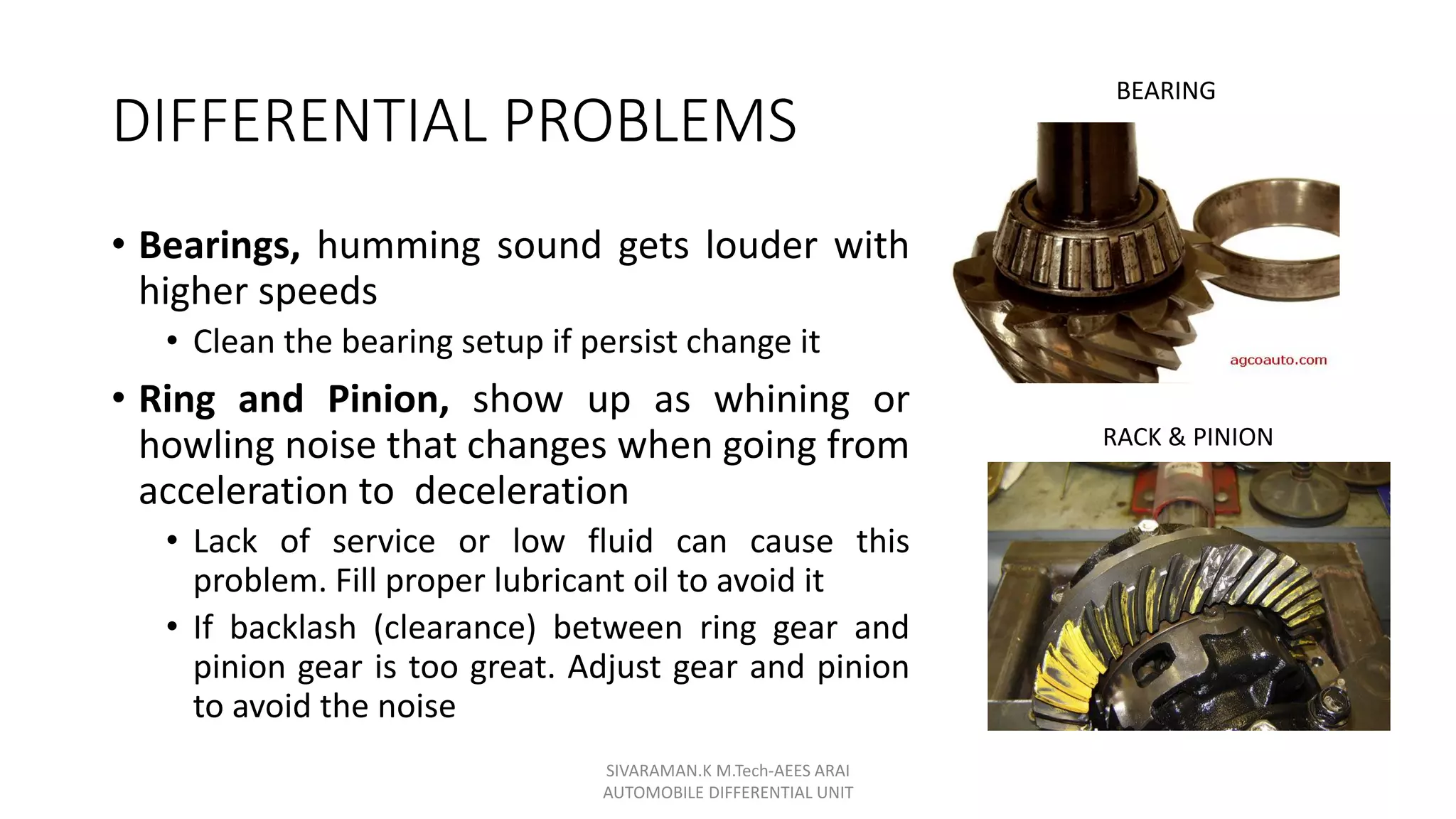
DIFFERENTIAL PROBLEMS
• Bearings, humming sound gets louder with
higher speeds
• Clean the bearing setup if persist change it
• Ring and Pinion, show up as whining or
howling noise that changes when going from
acceleration to deceleration
• Lack of service or low fluid can cause this
problem. Fill proper lubricant oil to avoid it
• If backlash (clearance) between ring gear and
pinion gear is too great. Adjust gear and pinion
to avoid the noise
SIVARAMAN.K M.Tech-AEES ARAI
AUTOMOBILE DIFFERENTIAL UNIT
BEARING
RACK & PINION
REFERENCES
• https://www.expeditionexchange.com/tractech/
• http://www.efunda.com/designstandards/gears/gears_auto_diff.cfm
• https://en.wikipedia.org/wiki/Locking_differential
• https://en.wikipedia.org/wiki/Electronic_differential
• https://en.wikipedia.org/wiki/Differential_%28mechanical_device%29
• LSD by Mohamed Hairi Bin Abdul Shukur, et, al. of Kementerian Pengajian
Tinggi
• http://www.popularmechanics.com/cars/how-to/g1140/how-to-care-for-
your-cars-differential/?slide=1
• http://www.tpub.com/basae/127.htm
SIVARAMAN.K M.Tech-AEES ARAI
AUTOMOBILE DIFFERENTIAL UNIT

Automobile Differential Unit

  • 1.
    AUTOMOBILE DIFFERENTIAL UNIT A MECHANICALGEAR ASSEMBLY UNIT WHICH PROVIDE DIFFERENT SPEED/TORQUE TO SAME AXLE WHEELS SIVARAMAN.K M.Tech-AEES ARAI AUTOMOBILE DIFFERENTIAL UNIT
  • 2.
    REQUIREMENT • Transfers powerfrom driveshaft to the wheels • Provides final gear reduction • Splits amount of torque going to each wheel • Allow the wheels to rotate at different speeds in turns SIVARAMAN.K M.Tech-AEES ARAI AUTOMOBILE DIFFERENTIAL UNIT
  • 3.
    DIFFERENTIAL AT REARAXLE SIVARAMAN.K M.Tech-AEES ARAI AUTOMOBILE DIFFERENTIAL UNIT
  • 4.
    HISTORY(BC) • 227–239 AD:Ma Jun from the Kingdom of Wei in China invents the first historically verifiable south-pointing chariot, which provided cardinal direction as a non-magnetic, mechanized compass. Some such chariots may have used differential gears • 658, 666 AD: 2 Chinese Buddhist monks and engineers create south-pointing chariots for Emperor Tenji of Japan • 1720: Joseph Williamson uses a differential gear in a clock. • 1810: Rudolph Ackermann of Germany invents a four-wheel steering system for carriages • 1827: modern automotive differential patented by watchmaker Onésiphore Pecqueur (1792–1852) of the Conservatoire des Arts et Métiers in France for use on a steam cart. (Sources: Britannica Online and[3]) SIVARAMAN.K M.Tech-AEES ARAI AUTOMOBILE DIFFERENTIAL UNIT • Antikythera Mechanism HISTORY(AD)
  • 5.
    TYPES • Open Differential •Locked Differential • Active/Electronic Differential • Limited Slip Differential SIVARAMAN.K M.Tech-AEES ARAI AUTOMOBILE DIFFERENTIAL UNIT
  • 6.
    DIFFERENTIAL GEAR TRAINON A TURNING CAR SIVARAMAN.K M.Tech-AEES ARAI AUTOMOBILE DIFFERENTIAL UNIT
  • 7.
    OPEN DIFFERENTIAL • Theseare commonly used differential to achieve Different Speeds at wheels of the same axle • Application includes normal passenger car and bus SIVARAMAN.K M.Tech-AEES ARAI AUTOMOBILE DIFFERENTIAL UNIT
  • 8.
    OPEN DIFFERENTIAL TYPICALPARTS • Pinion Drive Gear: Transfers power from the driveshaft to the ring gear • Ring Gear: Transfers power to the Differential case assembly • Side/spider gears: Help both wheels to turn independently when turning • Differential case assembly: Holds the Ring gear and other components that drive the rear axle • Rear drive axles: Steel shafts that transfer torque from the differential assembly to the drive wheels • Rear axle bearings: Ball or roller bearings that fit between the axles and the inside of the axle housing • Axle housing: Metal body that encloses and supports parts of the rear axle assembly SIVARAMAN.K M.Tech-AEES ARAI AUTOMOBILE DIFFERENTIAL UNIT
  • 9.
    SIVARAMAN.K M.Tech-AEES ARAI AUTOMOBILEDIFFERENTIAL UNIT OPEN DIFFERENTIAL SCHEMATIC
  • 10.
    SIVARAMAN.K M.Tech-AEES ARAI AUTOMOBILEDIFFERENTIAL UNIT OPEN DIFFERENTIAL IMAGE
  • 11.
    POWER FLOW • Driveshaft spins the Pinion gear • Pinion gear turns the larger ring gear to produce gear reduction • Ring gear attached to differential case, hence it rotates with the ring gear • Differential case spins the sun gears which are attached to the axles • Axles transfer the power to the wheels SIVARAMAN.K M.Tech-AEES ARAI AUTOMOBILE DIFFERENTIAL UNIT
  • 12.
  • 13.
    SIVARAMAN.K M.Tech-AEES ARAI AUTOMOBILEDIFFERENTIAL UNIT DIFFERENTIAL GEAR RATIO STRAIGHT TURNING
  • 14.
    VEHICLE TRAVELLING STRAIGHT •Input torque is applied to the ring gear, which turns the entire carrier, providing torque to both side gears, which in turn may drive the left and right wheels • If the resistance at both wheels is equal, the pinion gear does not rotate, and both turn at the same rate wheels SIVARAMAN.K M.Tech-AEES ARAI AUTOMOBILE DIFFERENTIAL UNIT
  • 15.
    VEHICLE TAKING ACURVE • If the left side gear (red) encounters resistance, the pinion gear(green) rotates about the left side gear, in turn applying extra rotation to the right side gear (yellow) SIVARAMAN.K M.Tech-AEES ARAI AUTOMOBILE DIFFERENTIAL UNIT
  • 16.
    LOCKED DIFFERENTIAL • Theseare used to achieve Different Torques at wheels of the same axle • Locking means joining the two independent pinion gear • Application includes race car and off-road vehicles and 4 Wheel Drive SIVARAMAN.K M.Tech-AEES ARAI AUTOMOBILE DIFFERENTIAL UNIT
  • 17.
    LOCKING DIFFERENTIAL NECESSITY •To provide increased traction compared to the normal differential unit CASE : When one rear axle wheel is stuck in the mud,  Open differential will concentrate in rotating the stuck wheel  Locked differential will push the vehicle with the help of torque available at the free wheel SIVARAMAN.K M.Tech-AEES ARAI AUTOMOBILE DIFFERENTIAL UNIT
  • 18.
    ACTIVE/ELECTRONIC DIFFERENTIAL (Both Open& Locked) • Dynamically Locking the differential using a electromagnetic clutch • When cornering, the inner and outer wheels rotate at different speeds, because the inner wheels describe a smaller turning radius. The electronic differential uses the steering wheel command signal and the motor speed signals to control the power to each wheel so that all wheels are supplied with the torque they need SIVARAMAN.K M.Tech-AEES ARAI AUTOMOBILE DIFFERENTIAL UNIT
  • 19.
    LIMITED SLIP DIFFERENTIAL •A limited slip differential (LSD), is very similar to the open differential unit but has additional link that prevents wheel spin and loss of traction • The standard differential delivers maximum torque to the wheel with minimum traction. The limited slip differential delivers maximum torque to the wheel with maximum traction • It is mainly used in off road vehicles • TYPES : i. Clutch Pack ii. Cone Clutch iii. Torsen SIVARAMAN.K M.Tech-AEES ARAI AUTOMOBILE DIFFERENTIAL UNIT
  • 20.
    LIMITED SLIP DIFFERENTIAL- CLUTCH • The clutch pack limited slip differential uses a set of friction discs and steel plates to lock the axles together whenever one drive wheel experiences uncontrolled slippage. The friction discs are sandwiched between the steel plates inside the differential case. The friction disc is splined and turns with the differential side gears. The steel plates turn with the differential case. • Springs (bellville springs, coil springs, or leaf springs) force the friction disc and steel plates together. As a result, both rear axles try to turn with the differential case. • Spring force and thrust action of the spider gears applies the clutch pack. Under high torque conditions, the rotation of the differential pinion gears PUSHES OUT on the axle side gears. The axle side gears then push on the clutch discs. This action helps lock the disc and keeps both wheels turning. SIVARAMAN.K M.Tech-AEES ARAI AUTOMOBILE DIFFERENTIAL UNIT
  • 21.
    LIMITED SLIP DIFFERENTIAL- CLUTCH SIVARAMAN.K M.Tech-AEES ARAI AUTOMOBILE DIFFERENTIAL UNIT
  • 22.
    LIMITED SLIP DIFFERENTIAL– CLUTCH WORKING • When driving normally, the vehicle can turn a comer without both wheels rotating at the same speed. • As the vehicle turns a corner, the inner drive wheel must slow down. • The unequal speed between the side gears causes the side gear pinions to walk around the side gears. • This walking will cause the outer axle shaft to rotate faster than the differential case, allowing the pinion shaft on the side to slide down a V-shaped ramp. • This action releases the outer clutches causing the clutch pack to slip when the vehicle is turning. SIVARAMAN.K M.Tech-AEES ARAI AUTOMOBILE DIFFERENTIAL UNIT
  • 23.
    LIMITED SLIP DIFFERENTIAL- CONE • A cone clutch limited slip differential uses the friction produced by cone-shaped axle gears to provide improved traction. These cones fit behind and are splined to the axle shafts. With the axles splined to the cones. the axles tend to rotate with the differential case. Coil springs are situated between the side gears to wedge the clutches into the differential case. • Under rapid acceleration or when one wheel loses traction. the differential pinion gears, as they drive the cones, push outward on the cone gears. This action increases friction between the cones and case, driving the wheels with even greater torque. SIVARAMAN.K M.Tech-AEES ARAI AUTOMOBILE DIFFERENTIAL UNIT
  • 24.
    LIMITED SLIP DIFFERENTIAL- CONE SIVARAMAN.K M.Tech-AEES ARAI AUTOMOBILE DIFFERENTIAL UNIT
  • 25.
    LIMITED SLIP DIFFERENTIAL– CONE WORKING • When a vehicle goes around a corner, the inner drive wheel must slow down. • The unequal speed between the side gears will cause the side gear pinions to walk around the side gears. • This walking action causes the outer axle shaft to rotate faster than the differential case. Because the cones have spiral grooves cut into their clutch surfaces, the inner cone will draw itself into the case and lock tight and the outer cone clutch will back itself out of the case. • This action allows the outer drive axle to free wheel. • The end result is the majority of the engine torque is sent to the inner drive wheel. SIVARAMAN.K M.Tech-AEES ARAI AUTOMOBILE DIFFERENTIAL UNIT
  • 26.
    LIMITED SLIP DIFFERENTIAL- TORSEN • Torsen differentials can be used in one or more positions on a motor vehicle: • Center - used to apportion appropriate torque distribution between front and rear axles on an all-wheel drive vehicle. • Rear - used to apportion appropriate torque distribution between left and right sides in rear axles. This may be on either a rear-wheel drive or four- wheel drive vehicle. • Front - used to apportion appropriate torque distribution between left and right sides in front axles. This may be on either a front-wheel drive or four- wheel drive vehicle. • A four-wheel-drive vehicle, for example, may use either one, two, or three Torsen differentials. SIVARAMAN.K M.Tech-AEES ARAI AUTOMOBILE DIFFERENTIAL UNIT
  • 27.
    LIMITED SLIP DIFFERENTIAL- TORSEN SIVARAMAN.K M.Tech-AEES ARAI AUTOMOBILE DIFFERENTIAL UNIT
  • 28.
    LIMITED SLIP DIFFERENTIAL– TORSEN WORKING • The Torsen differential works just like a conventional differential but can lock up if a torque imbalance occurs, the maximum ratio of torque imbalance being defined by the Torque Bias Ratio (TBR). • When a Torsen has a 3:1 TBR, that means that one side of the differential can handle up to 75% while the other side would have to only handle 25% of applied torque. • During acceleration under asymmetric traction conditions, so long as the higher traction side can handle the higher percentage of applied torque, no relative wheel spin will occur. • When the traction difference exceeds the TBR, the slower output side of the differential receives the tractive torque of the faster wheel multiplied by the TBR; any extra torque remaining from applied torque contributes to the angular acceleration of the faster output side of the differential. SIVARAMAN.K M.Tech-AEES ARAI AUTOMOBILE DIFFERENTIAL UNIT
  • 29.
    LIMITED SLIP DIFFERENTIAL– TORSEN TYPES There are currently three types of Torsen differentials, • The original Torsen T-1 (Type A) uses crossed axis helical gears to increase internal friction. The Type I can be designed for higher torque bias ratios than the Type II, but typically has higher backlash and the potential for Noise, Vibration, and Harshness (NVH) issues, and requires a precise setup/installation. • The later Torsen T-2 (Type B) uses a parallel gear arrangement to achieve a similar effect. There is also a specialist application of the T-2, known as the T-2R (RaceMaster). • The latest Torsen T-3 (Type C) is a planetary type differential, in that the nominal torque split is not 50:50. The Type C is available as single or twin version; the Torsen twin C differential has front and center differential in the same unit. SIVARAMAN.K M.Tech-AEES ARAI AUTOMOBILE DIFFERENTIAL UNIT
  • 30.
    DIFFERENTIAL MAINTENANCE Differential lubrication •Change this oil every 30,000 to 50,000 miles (or as specified in user manual) • Use recommended oil for differential since different type requires different oil density and properties • After draining the used oil, clean the differential completely and then fill the new lubricating oil • Ensure the seal in the unit is good to avoid leakage and dust accumulation SIVARAMAN.K M.Tech-AEES ARAI AUTOMOBILE DIFFERENTIAL UNIT
  • 31.
    DIFFERENTIAL UNIT DISASSEMBLY •Procedures for removal, disassembly, and reassembly vary depending on the type of differential, make, and model. Always refer to the manufacturer's service manual. However, there are several procedures that relate to almost any type of differential. To remove a separate carrier differential, perform the following: • Remove the drive shaft • Place a drain pan under the differential. Remove the drain plug and drain the lubricant • Unbolt the nuts around the outside of the carrier • Force the differential carrier away from the housing SIVARAMAN.K M.Tech-AEES ARAI AUTOMOBILE DIFFERENTIAL UNIT
  • 32.
    REMOVING REAR AXLE •Remove the center pin, use a magnet and remove the c-clips • Holding the axle on to the sun gears, and remove the axle SIVARAMAN.K M.Tech-AEES ARAI AUTOMOBILE DIFFERENTIAL UNIT
  • 33.
    REMOVING REAR AXLE •Remove the bolts holding the axle flange to the drum/disc backing plate and pull the axle SIVARAMAN.K M.Tech-AEES ARAI AUTOMOBILE DIFFERENTIAL UNIT
  • 34.
    DIFFERENTIAL PROBLEMS • Bearings,humming sound gets louder with higher speeds • Clean the bearing setup if persist change it • Ring and Pinion, show up as whining or howling noise that changes when going from acceleration to deceleration • Lack of service or low fluid can cause this problem. Fill proper lubricant oil to avoid it • If backlash (clearance) between ring gear and pinion gear is too great. Adjust gear and pinion to avoid the noise SIVARAMAN.K M.Tech-AEES ARAI AUTOMOBILE DIFFERENTIAL UNIT BEARING RACK & PINION
  • 35.
    REFERENCES • https://www.expeditionexchange.com/tractech/ • http://www.efunda.com/designstandards/gears/gears_auto_diff.cfm •https://en.wikipedia.org/wiki/Locking_differential • https://en.wikipedia.org/wiki/Electronic_differential • https://en.wikipedia.org/wiki/Differential_%28mechanical_device%29 • LSD by Mohamed Hairi Bin Abdul Shukur, et, al. of Kementerian Pengajian Tinggi • http://www.popularmechanics.com/cars/how-to/g1140/how-to-care-for- your-cars-differential/?slide=1 • http://www.tpub.com/basae/127.htm SIVARAMAN.K M.Tech-AEES ARAI AUTOMOBILE DIFFERENTIAL UNIT