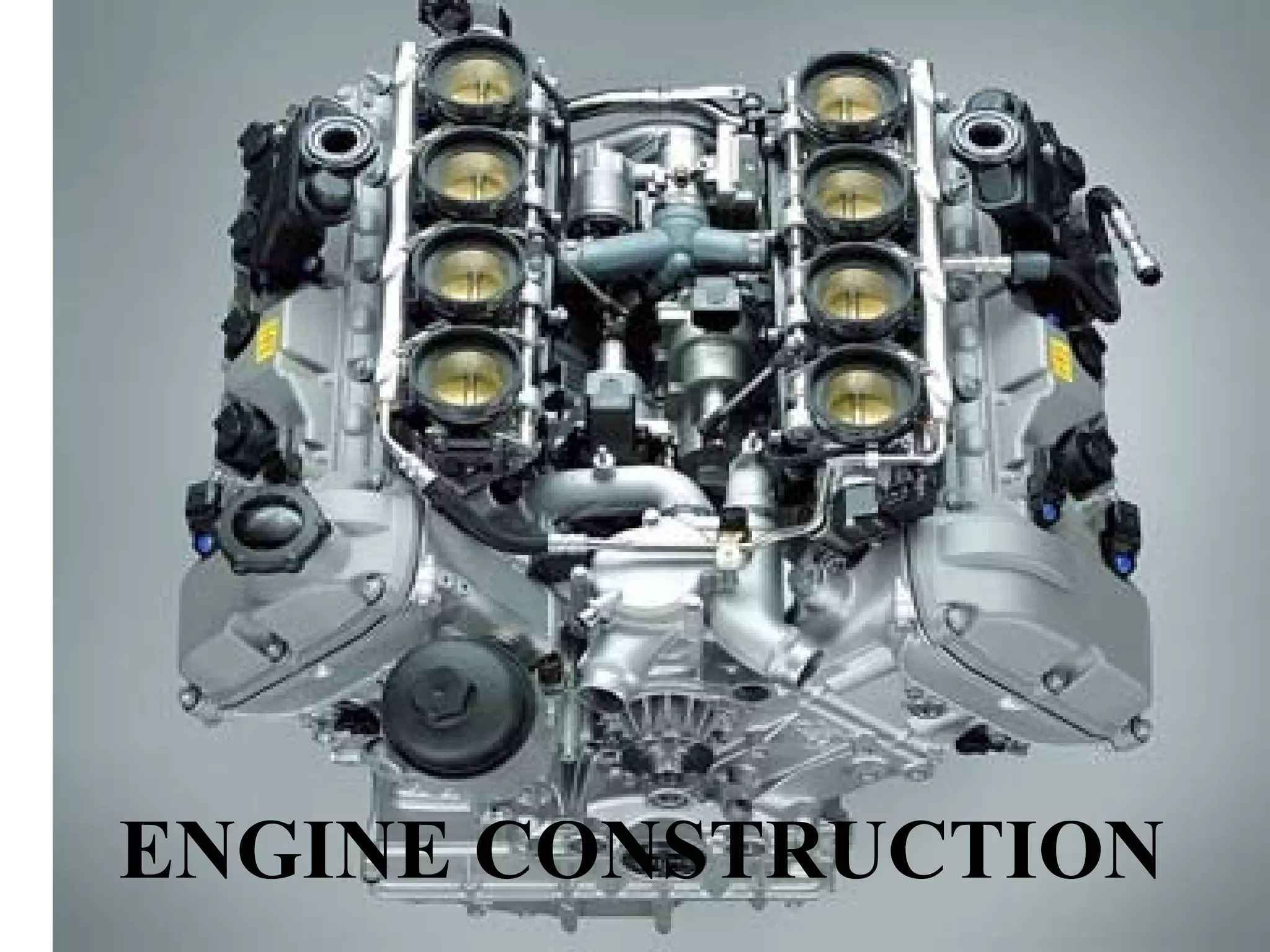
ENGINE CONSTRUCTION
Basic parts of Internal Combustion Engine
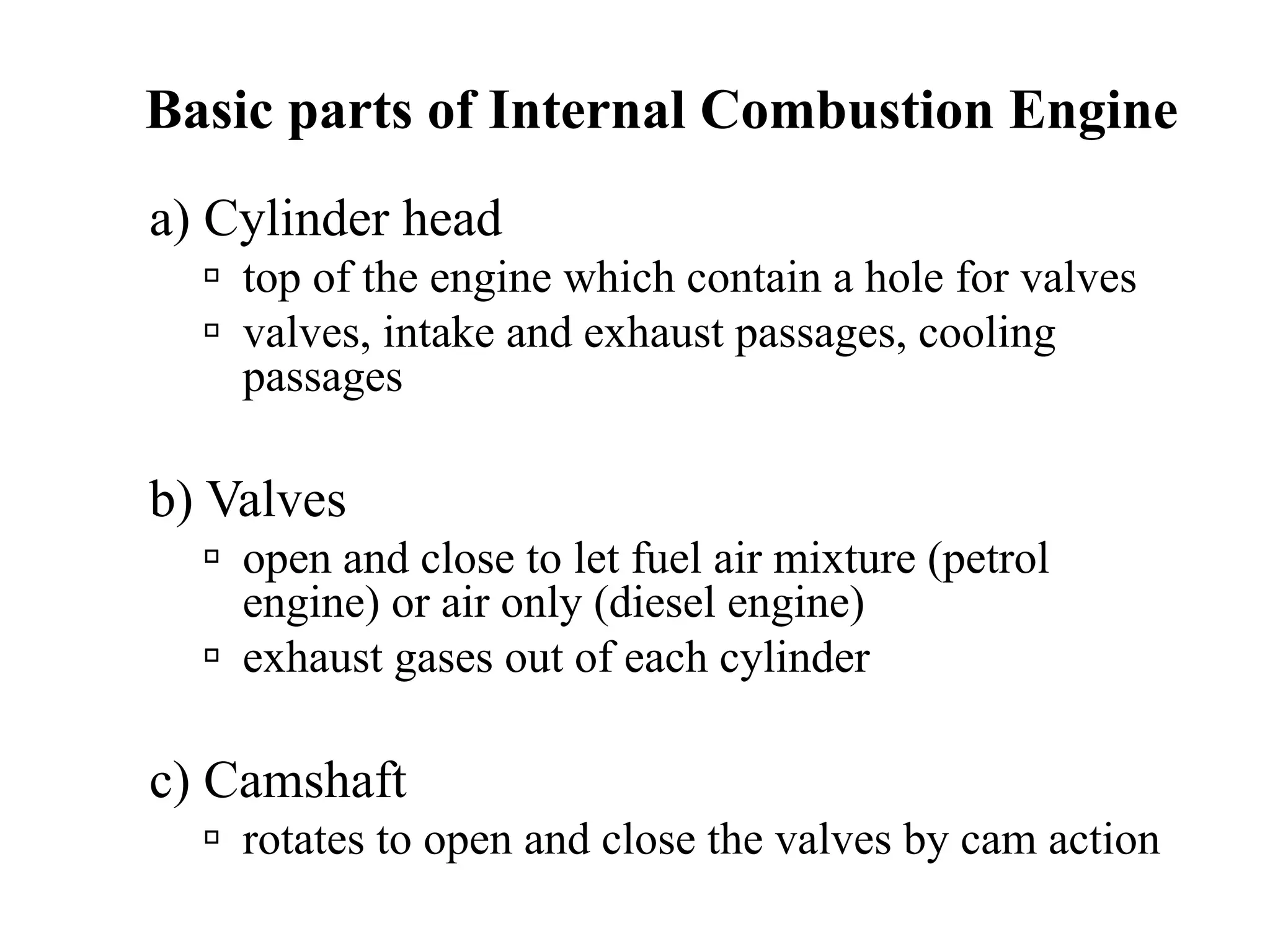
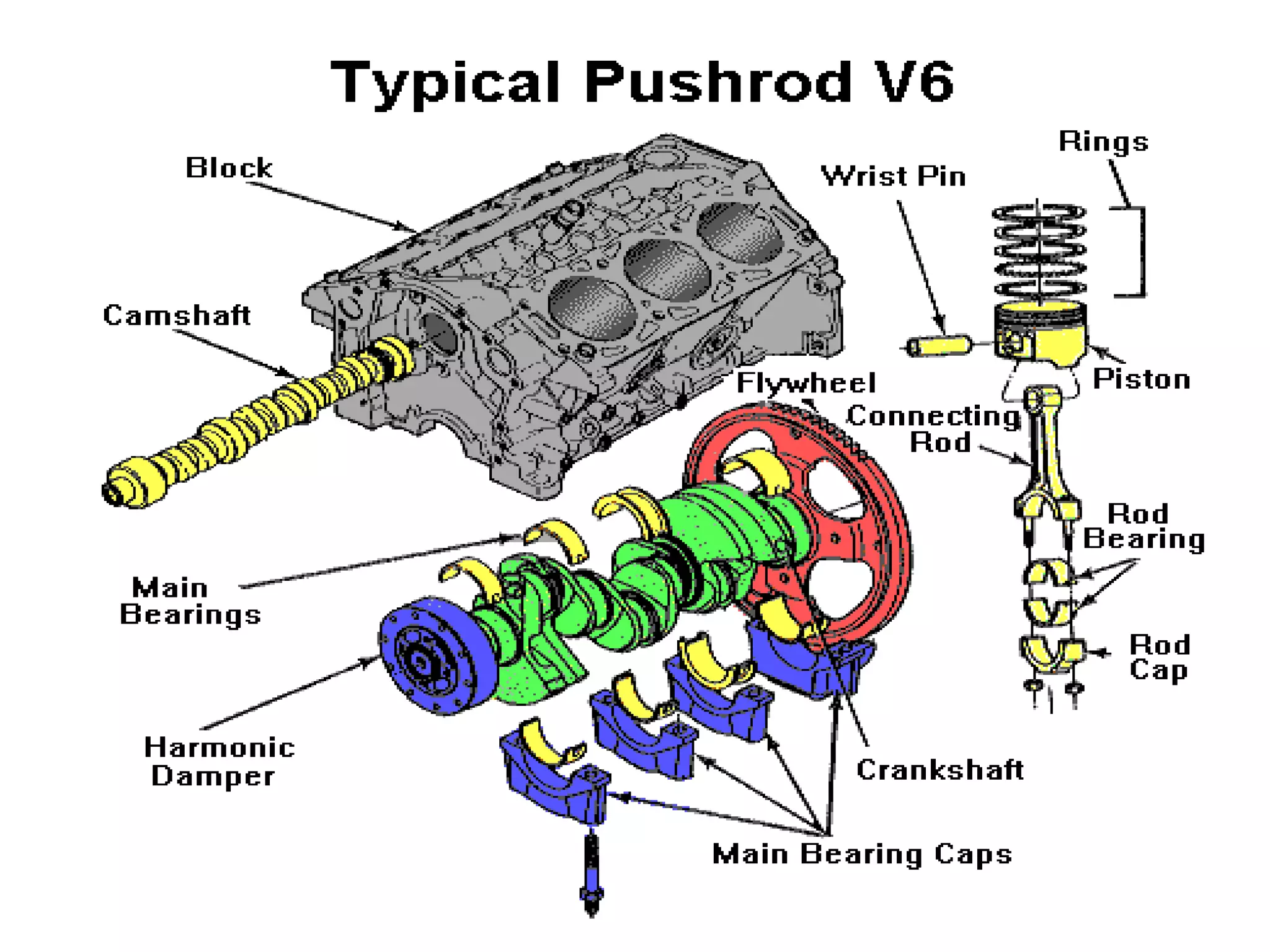
a) Cylinder head
    top of the engine which contain a hole for valves
    valves, intake and exhaust passages, cooling
    passages

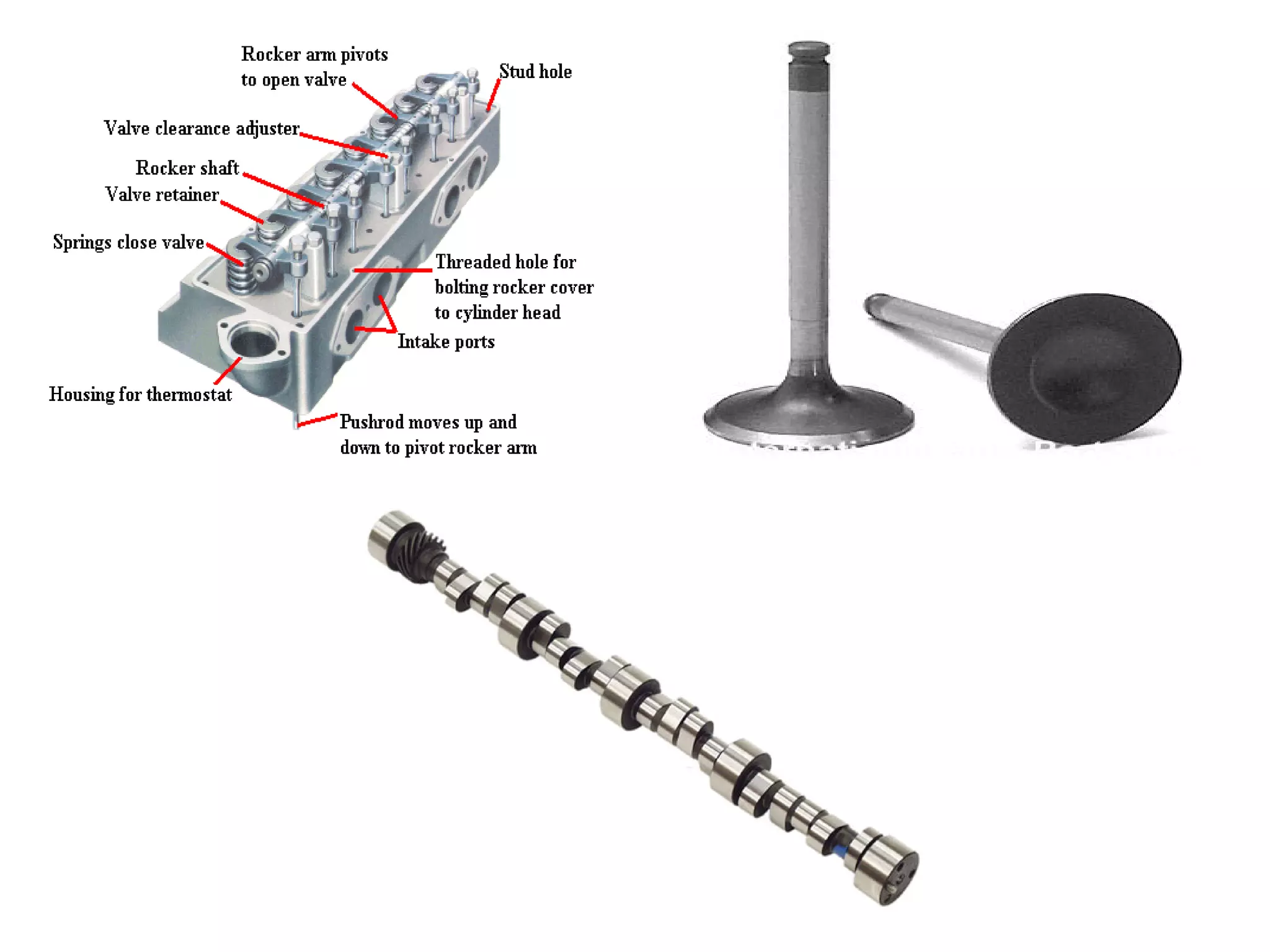
b) Valves
    open and close to let fuel air mixture (petrol
    engine) or air only (diesel engine)
    exhaust gases out of each cylinder

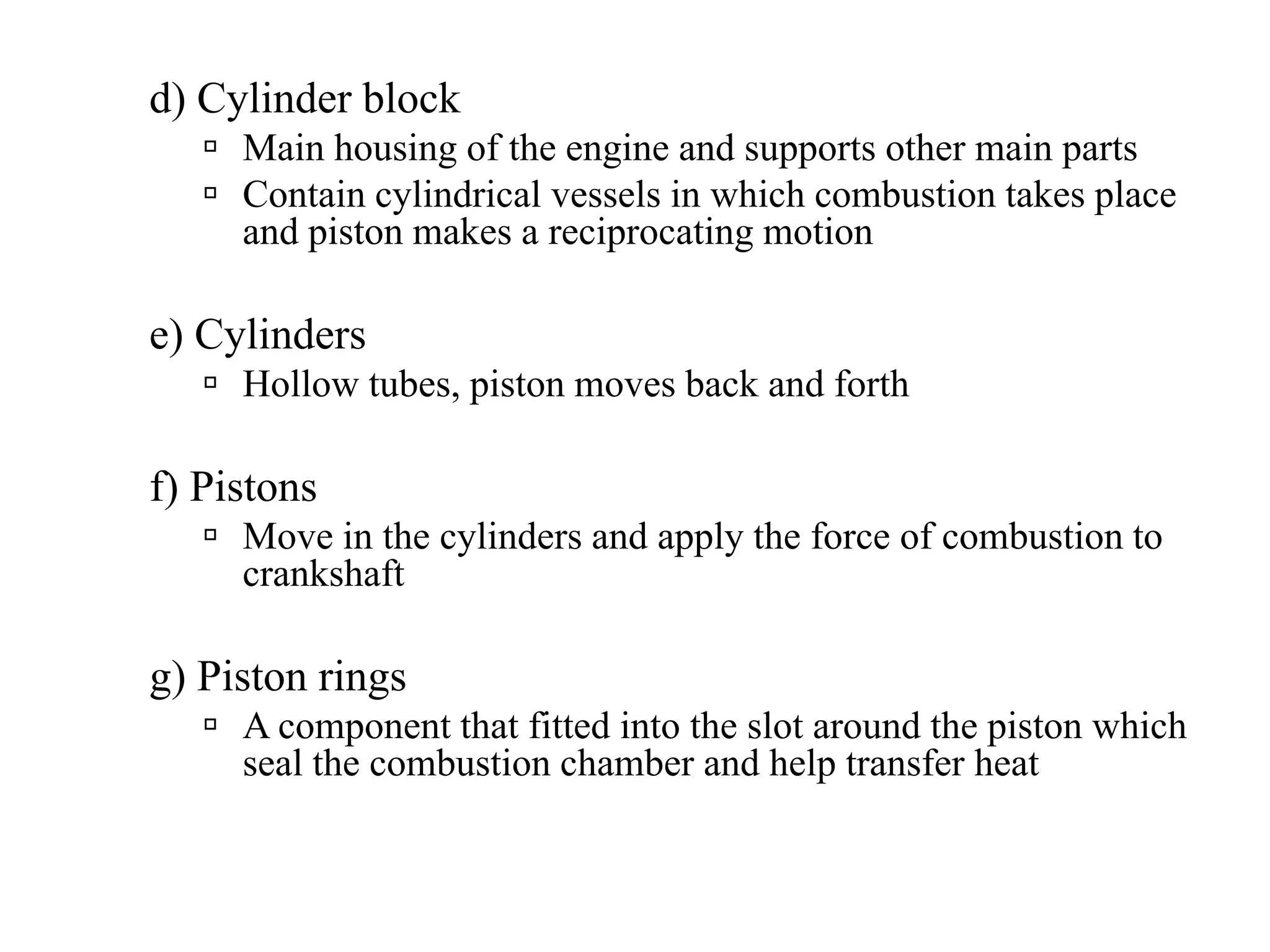
c) Camshaft
    rotates to open and close the valves by cam action
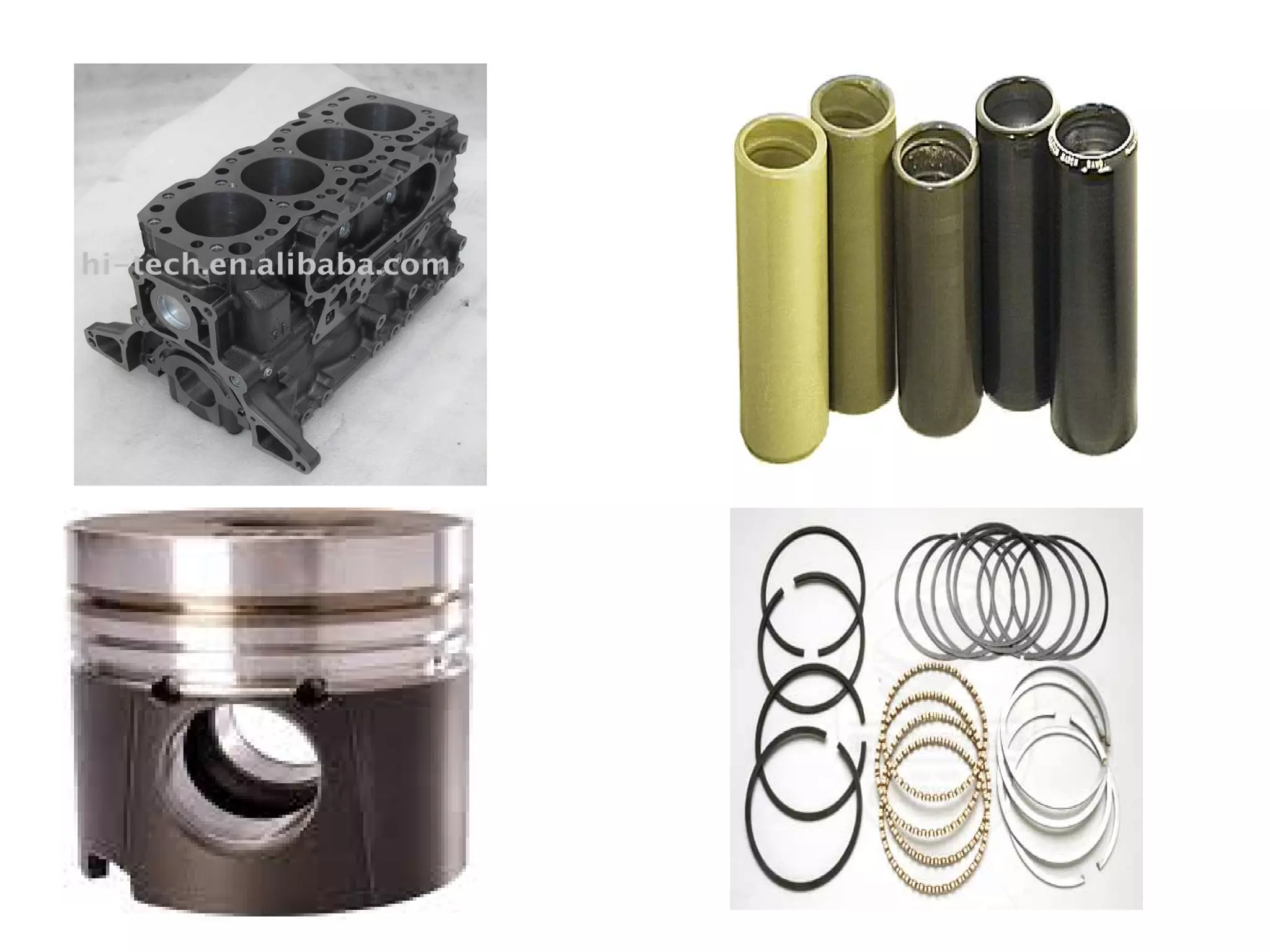
d) Cylinder block
     Main housing of the engine and supports other main parts
     Contain cylindrical vessels in which combustion takes place
     and piston makes a reciprocating motion

e) Cylinders
     Hollow tubes, piston moves back and forth

f) Pistons
     Move in the cylinders and apply the force of combustion to
     crankshaft

g) Piston rings
     A component that fitted into the slot around the piston which
     seal the combustion chamber and help transfer heat
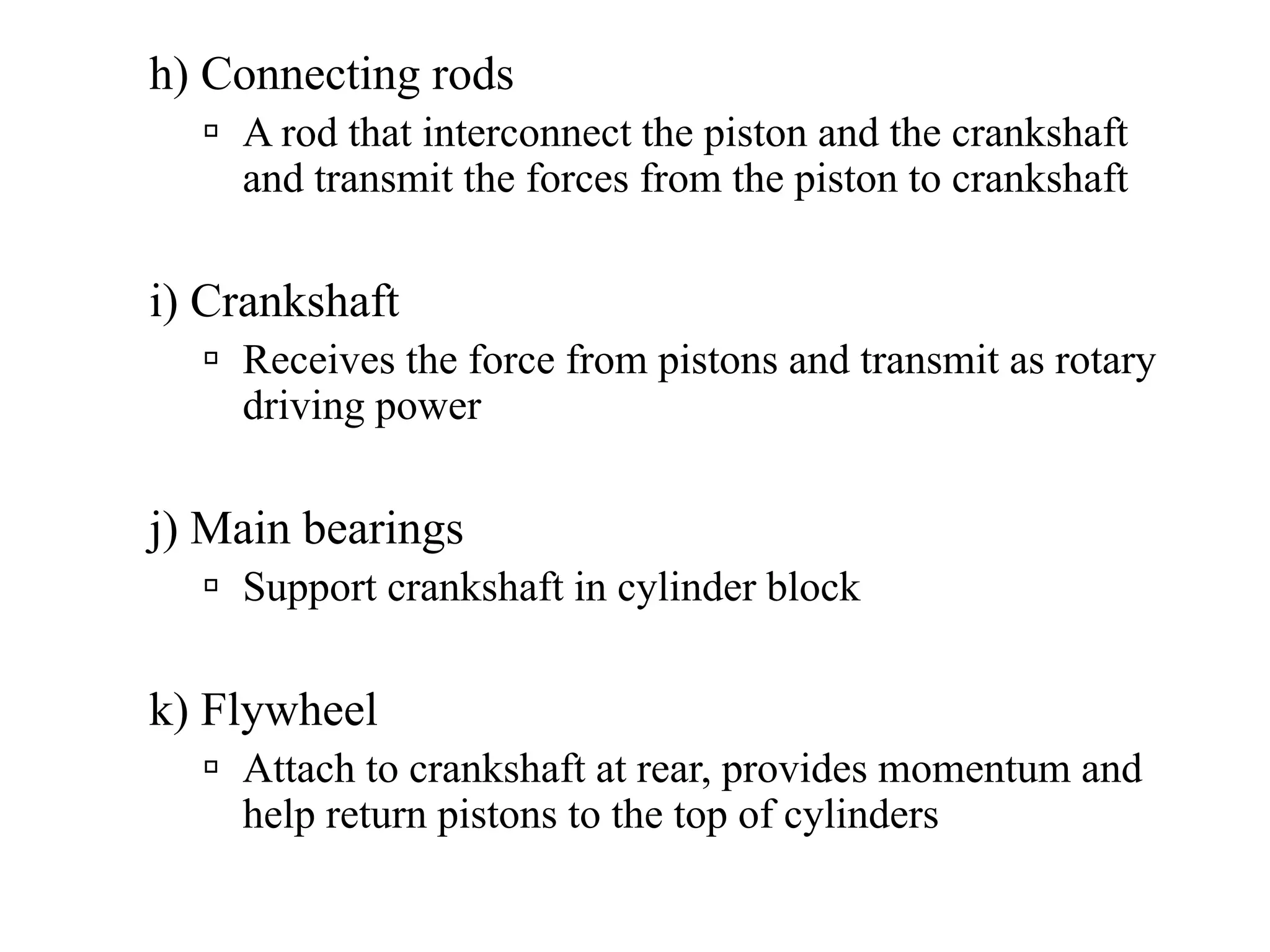
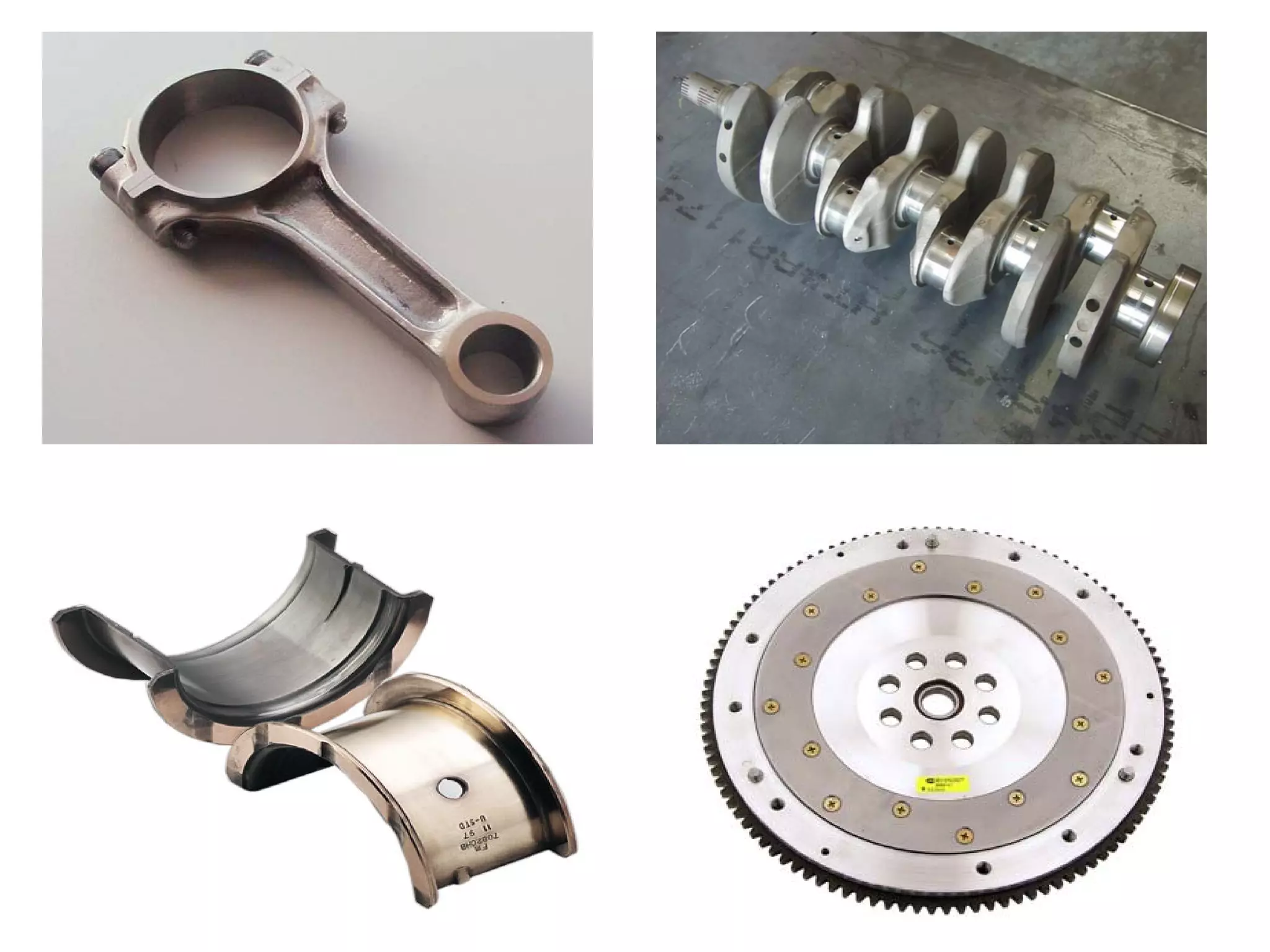
h) Connecting rods
    A rod that interconnect the piston and the crankshaft
    and transmit the forces from the piston to crankshaft

i) Crankshaft
    Receives the force from pistons and transmit as rotary
    driving power

j) Main bearings
    Support crankshaft in cylinder block

k) Flywheel
    Attach to crankshaft at rear, provides momentum and
    help return pistons to the top of cylinders
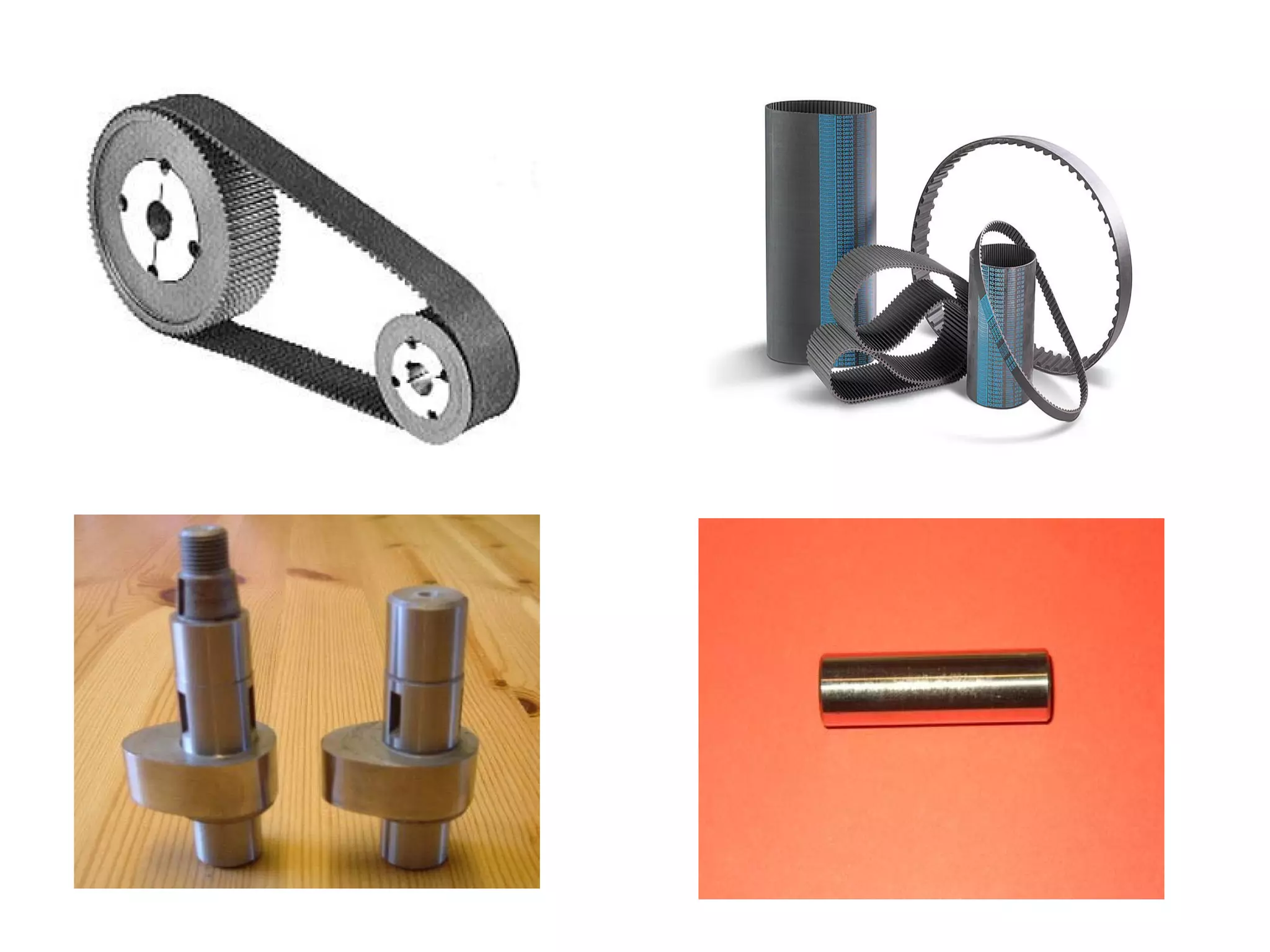
l) Timing drives
    Link the crankshaft, camshaft and other parts
    together to assure each is doing its job at the right
    time


m) Cams
    Integral part of camshaft design to open the valve
    at the correct timing and to keep them open for the
    necessary duration


n) Gudgeon pin
    Forms the link between the small end of the
    connecting rod and the piston
Classification of Tractors

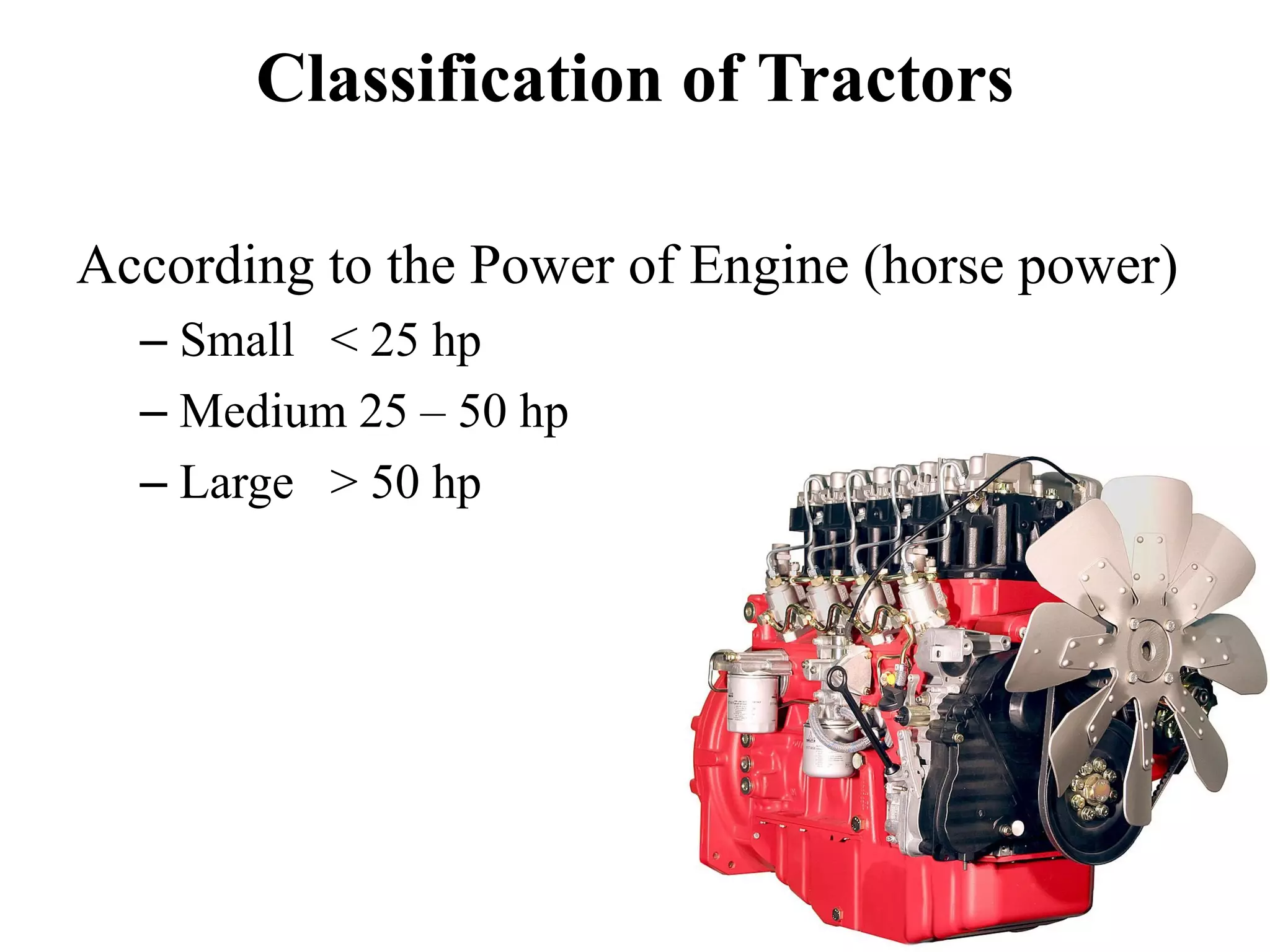
According to the Power of Engine (horse power)
  – Small < 25 hp
  – Medium 25 – 50 hp
  – Large > 50 hp
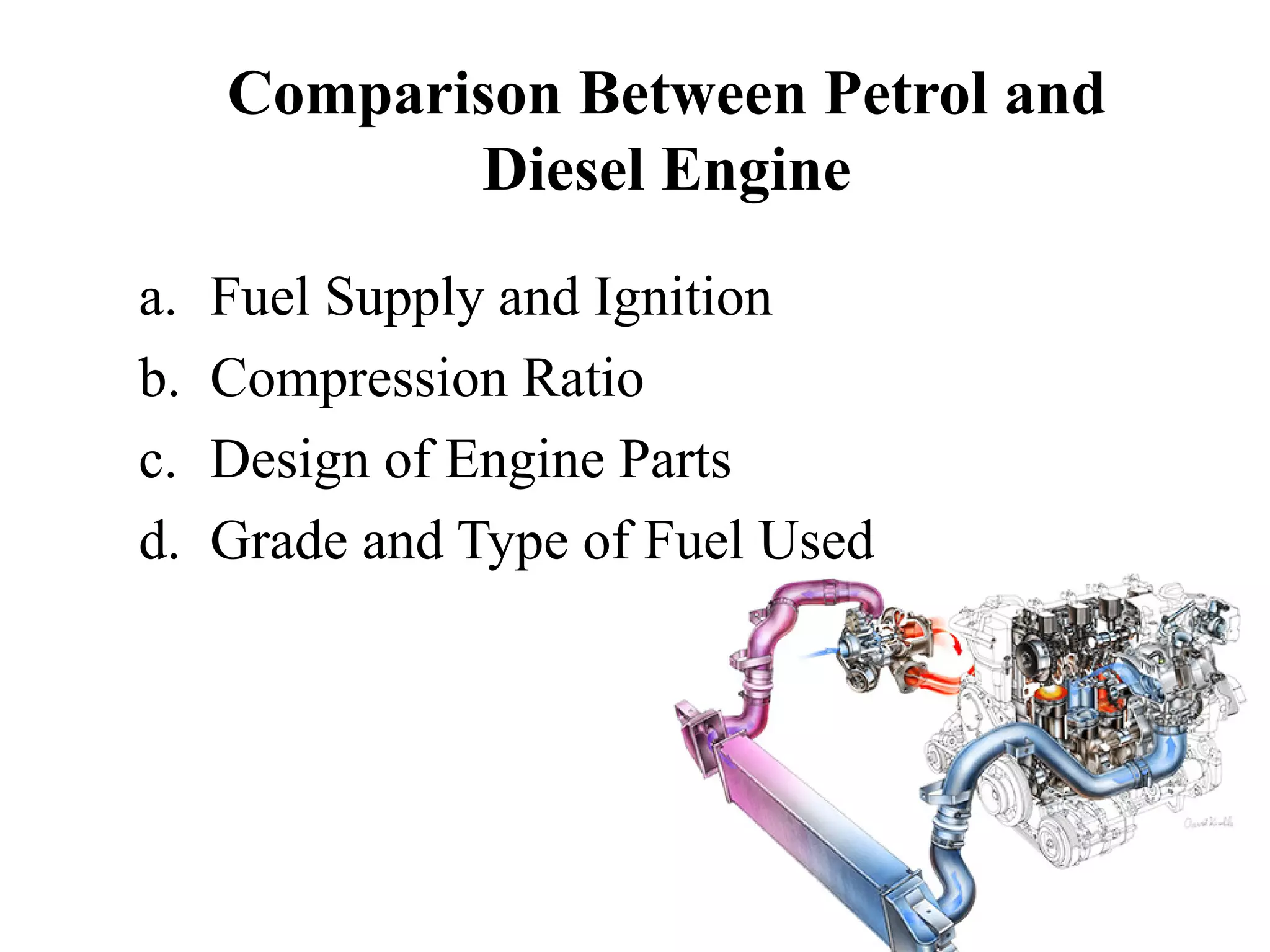
Comparison Between Petrol and
            Diesel Engine
a.   Fuel Supply and Ignition
b.   Compression Ratio
c.   Design of Engine Parts
d.   Grade and Type of Fuel Used
a) Fuel Supply and Ignition
Petrol Engine
     Fuel and air mixed outside the cylinders in the carburetor and
     intake manifold
     Mixture is forced into cylinders by partial vacuum created by
     intake stroke of piston
     Uses electric spark to ignite fuel air mixture
     Compression ratio 8 to 1 (8:1)

Diesel Engine
     No premixing of air and fuel
     Air taken into cylinders through intake manifold and compressed
     Fuel is sprayed into cylinders and mixed with air as the piston
     nears the top of its compression stroke
     Use heat and compressed air for ignition
     Compression ratio 16 to 1 (16:1)
b) Compression Ratio
Compression ratio is a characteristic of an engine
i.e. related to engine efficiency i.e. the ability of the
engine to convert in the fuel to useful mechanical
energy
The greater the compression ratio, the greater the
potential efficiency of the engine
Compares volume in cylinder before compression
with volume after compression
High compression ratio of diesel – cause high
temperature of air to ignite fuel without a spark
Therefore diesel engine more efficient because
higher compression i.e greater expansion of gases
in cylinder therefore more powerful stroke
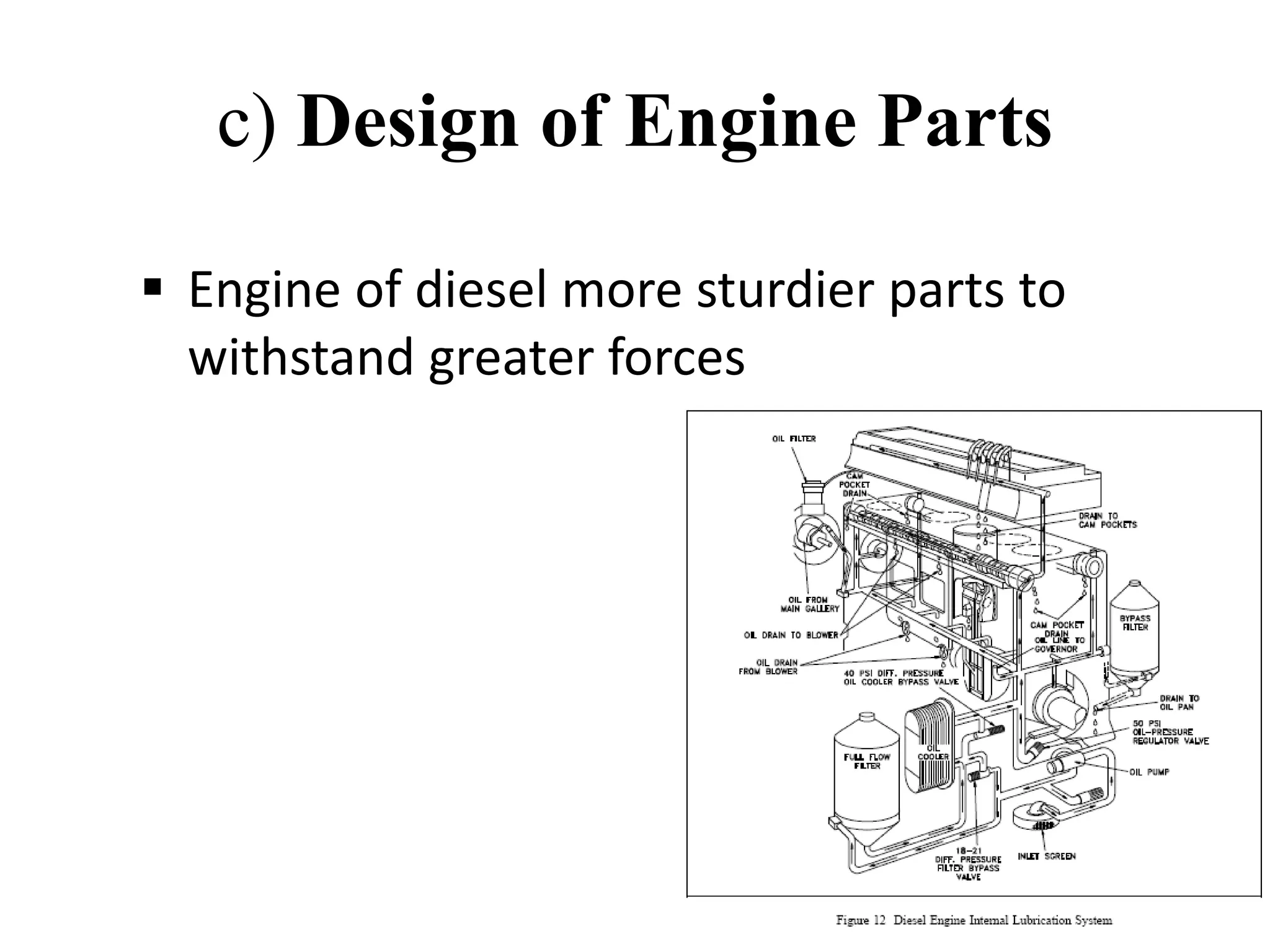
c) Design of Engine Parts

Engine of diesel more sturdier parts to 
withstand greater forces
d) Grade and Type of Fuel Used

• Diesel fuel -- more heat units (joule) per
  gallon
• Therefore produces more power per gallon of
  fuel
  – fuel low cost but fuel injection equipment is more
    expensive than petrol equipment
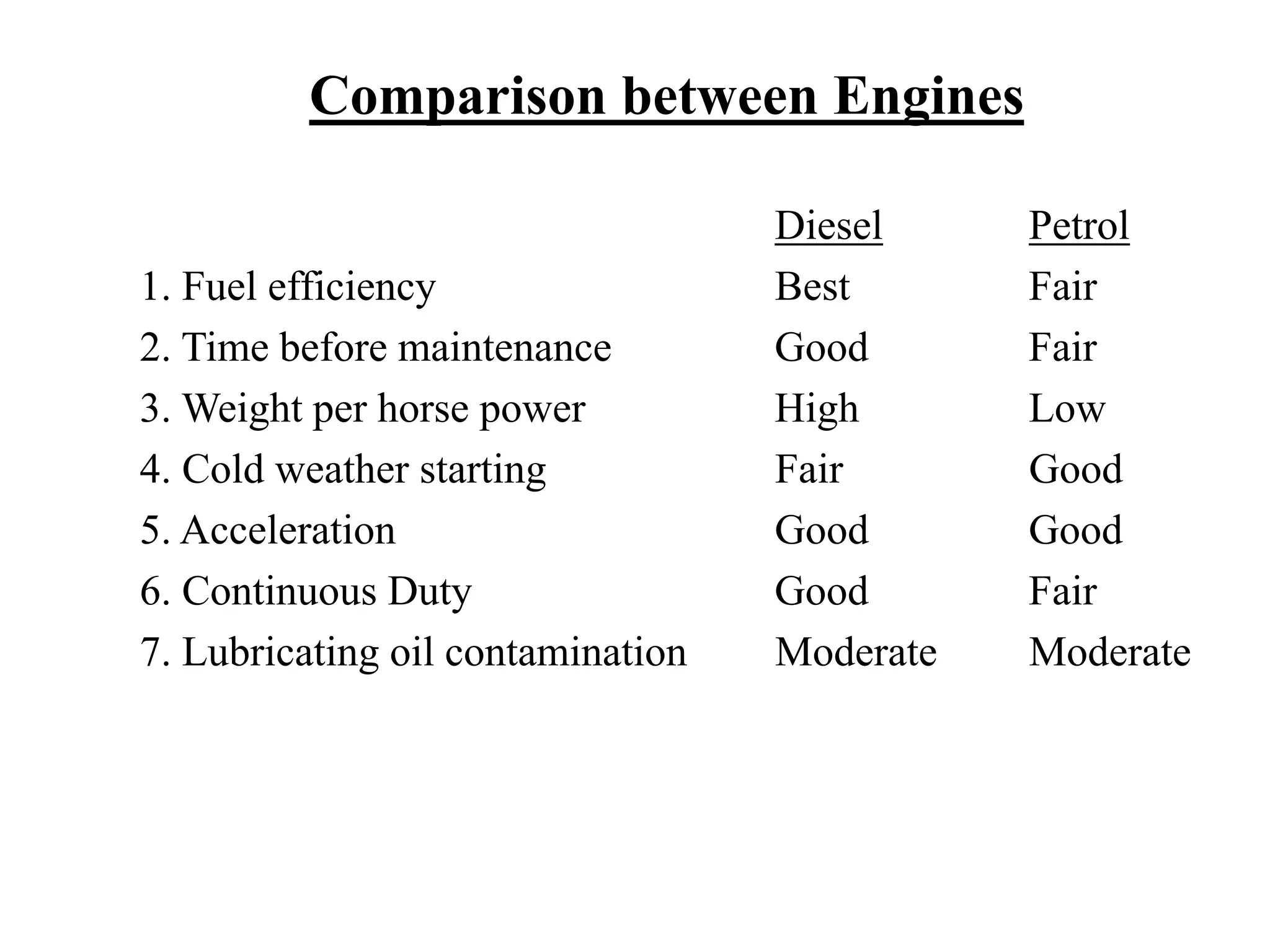
Comparison between Engines

                                   Diesel     Petrol
1. Fuel efficiency                 Best       Fair
2. Time before maintenance         Good       Fair
3. Weight per horse power          High       Low
4. Cold weather starting           Fair       Good
5. Acceleration                    Good       Good
6. Continuous Duty                 Good       Fair
7. Lubricating oil contamination   Moderate   Moderate
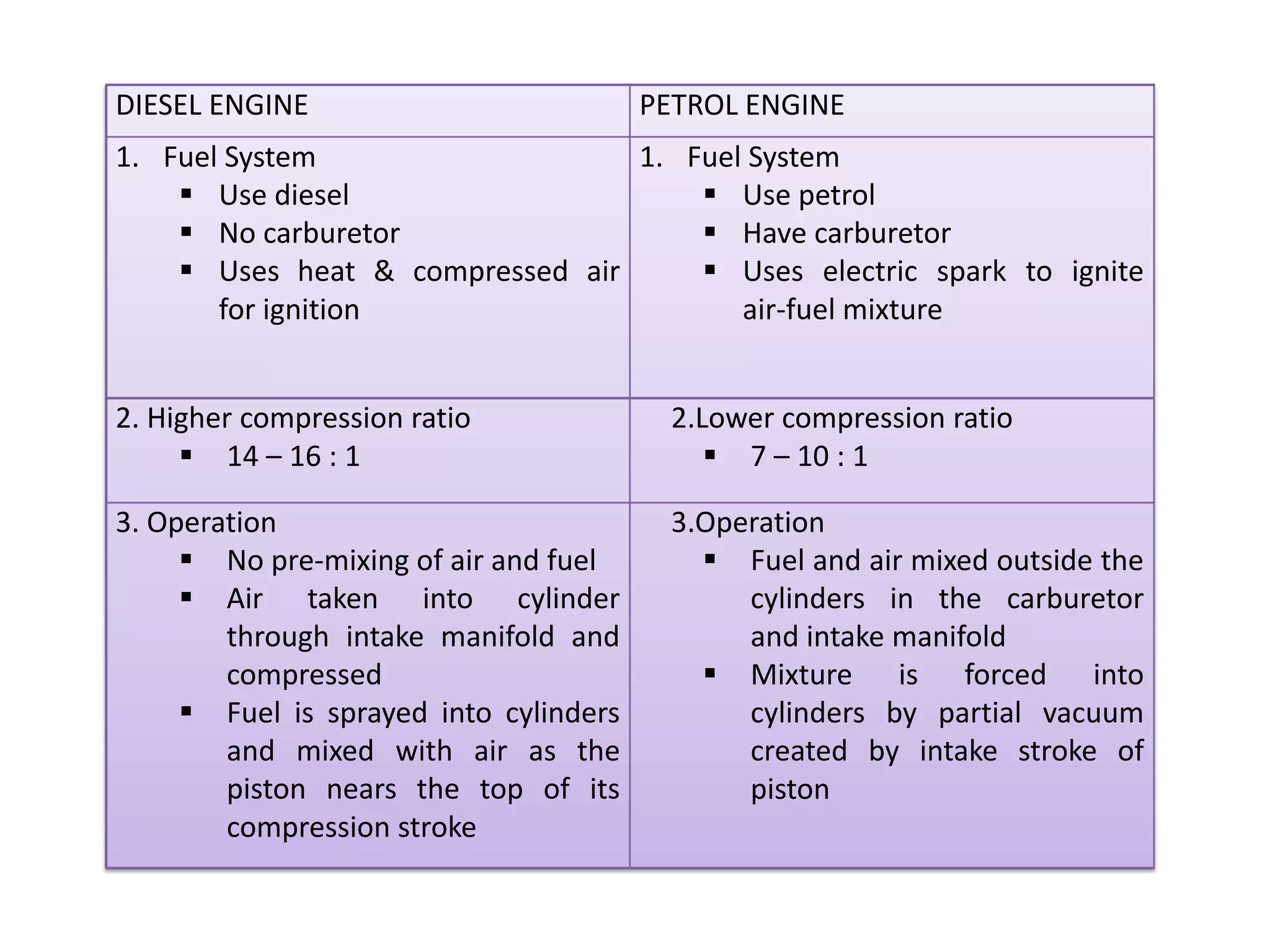
DIESEL ENGINE                            PETROL ENGINE
1. Fuel System                    1. Fuel System
       Use diesel                        Use petrol
       No carburetor                     Have carburetor
       Uses heat & compressed air        Uses electric spark to ignite
       for ignition                      air‐fuel mixture


2. Higher compression ratio                2.Lower compression ratio
        14 – 16 : 1                             7 – 10 : 1

3. Operation                               3.Operation
        No pre‐mixing of air and fuel           Fuel and air mixed outside the
        Air taken into cylinder                 cylinders in the carburetor
        through intake manifold and             and intake manifold
        compressed                              Mixture is forced into
        Fuel is sprayed into cylinders          cylinders by partial vacuum
        and mixed with air as the               created by intake stroke of
        piston nears the top of its             piston
        compression stroke
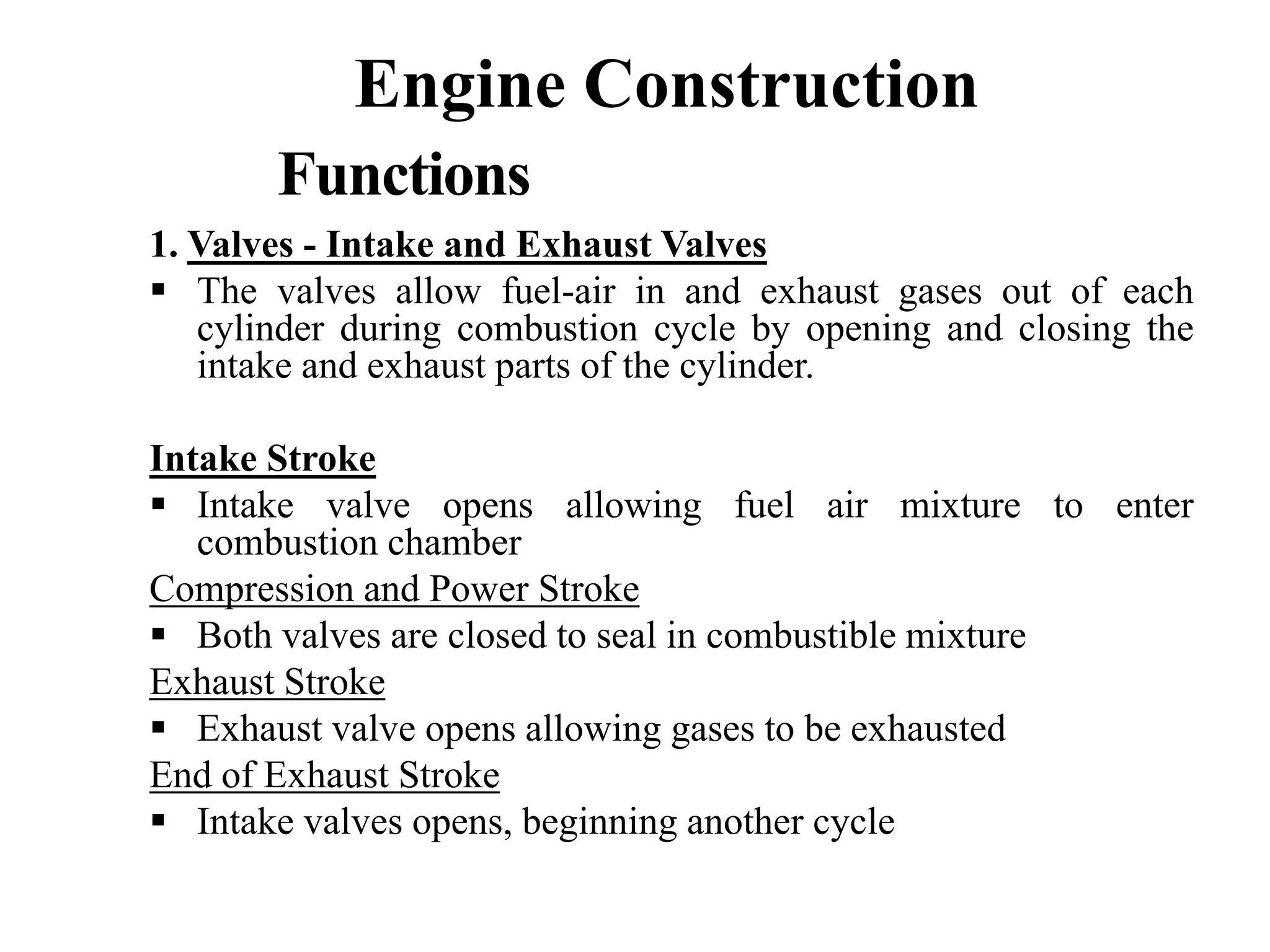
Engine Construction
       Functions
1. Valves - Intake and Exhaust Valves
   The valves allow fuel-air in and exhaust gases out of each
   cylinder during combustion cycle by opening and closing the
   intake and exhaust parts of the cylinder.

Intake Stroke
   Intake valve opens allowing fuel air mixture to enter
   combustion chamber
Compression and Power Stroke
   Both valves are closed to seal in combustible mixture
Exhaust Stroke
   Exhaust valve opens allowing gases to be exhausted
End of Exhaust Stroke
   Intake valves opens, beginning another cycle
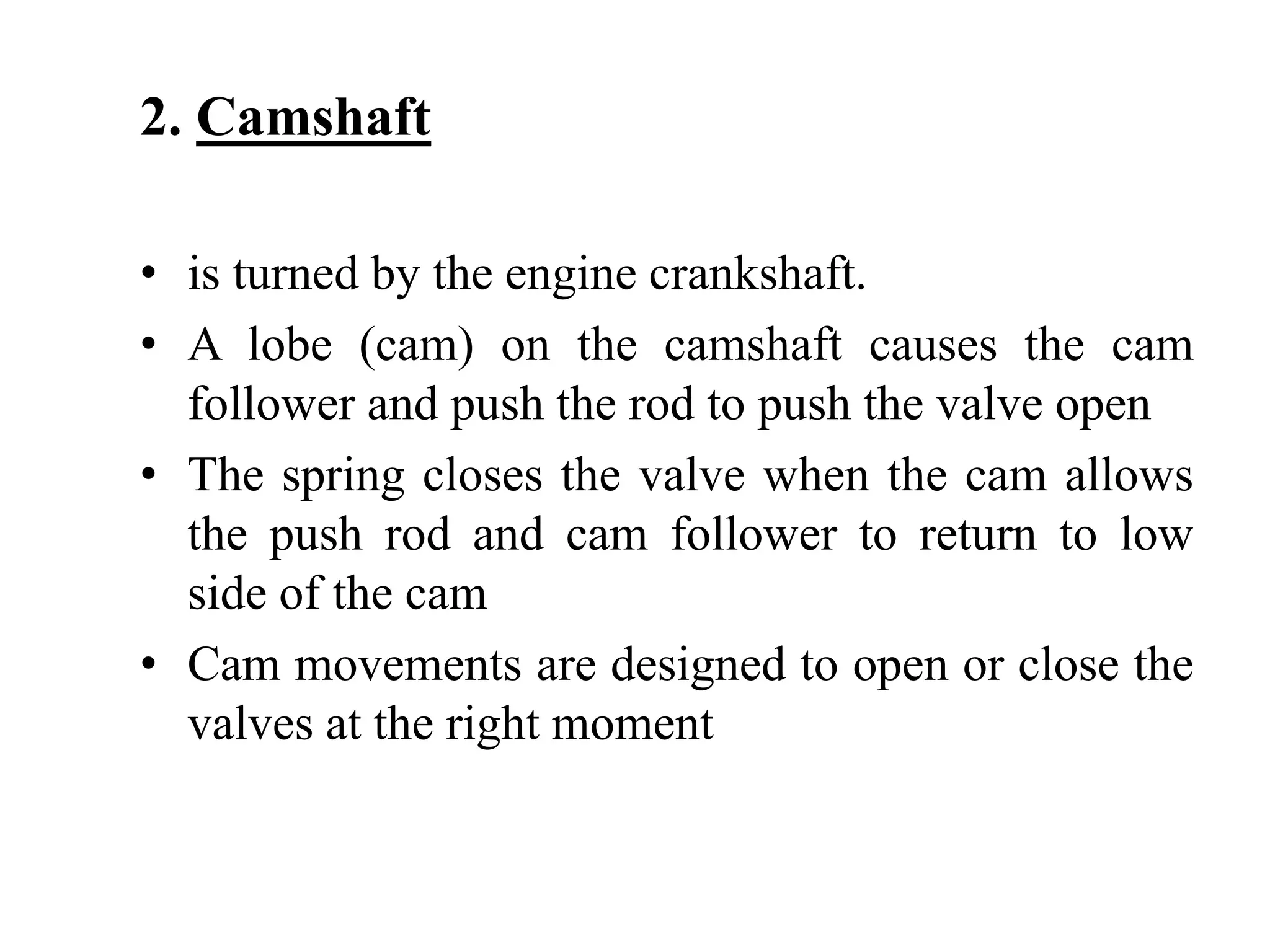
2. Camshaft

• is turned by the engine crankshaft.
• A lobe (cam) on the camshaft causes the cam
  follower and push the rod to push the valve open
• The spring closes the valve when the cam allows
  the push rod and cam follower to return to low
  side of the cam
• Cam movements are designed to open or close the
  valves at the right moment
3. Engine Crankcase and Cylinder Block

• Made of iron casting and is an integral with
  cylinder block which houses cylinder liners
• Liners are said to be wet or dry according to
  whether they are or not in contact with cooling
  water that circulate through engine block
• Crankcase houses the crank gear and valve gear
4. Engine Block

• Houses the injection pump, oil pump, water pump
  and power generator
• The front part carries the timing cover, rear end
  carries clutch bell housing on which the starter
  motor is mounted
• Provided with oil filler cap and breather, oil
  dipstick and water connection to the radiator
5. Cylinder Head

  Consists of fuel injectors , inlet and outlet valves, the rockers
  Cylinder head is in a single piece for engines up to 4 cylinders
  Between cylinder head and engine block – cylinder head
  gasket; to prevent gas, coolants and lubricating oil from
  escaping
  Also connected the inlet and exhaust manifolds water pipe from
  radiator

6. Oil Sump

  Made of iron casting
  Seals the crankcase at the bottom
  Functions as a reservoir for the lubricating oil
7. Piston, Connecting Rod & Cylinder Liners

  Piston
    move in the cylinders and apply the force of combustion to
    the crankshaft
    Combustion chamber machined in upper part known as
    piston head or crown ; lower part known as piston skirt

  Connecting rods
    Transmit the motion of the pistons to the crankshaft

  Cylinder Liners
    made of cast iron
    may be wet or dry; wet liners can be inserted and removed
    by hand; dry liner removal and installation with the use of a
    press (of a few tons capacity)
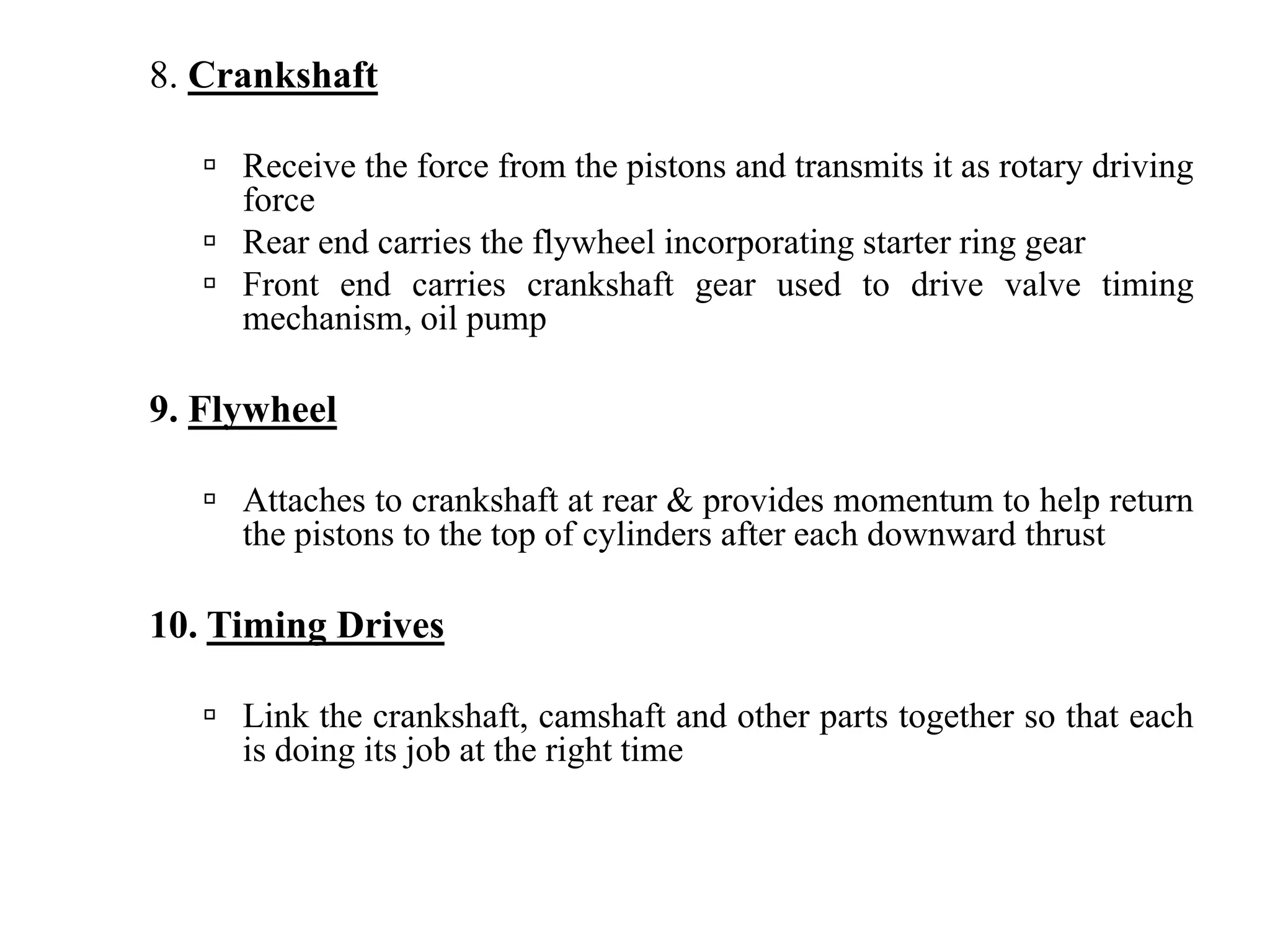
8. Crankshaft

     Receive the force from the pistons and transmits it as rotary driving
     force
     Rear end carries the flywheel incorporating starter ring gear
     Front end carries crankshaft gear used to drive valve timing
     mechanism, oil pump

9. Flywheel

     Attaches to crankshaft at rear & provides momentum to help return
     the pistons to the top of cylinders after each downward thrust

10. Timing Drives

     Link the crankshaft, camshaft and other parts together so that each
     is doing its job at the right time
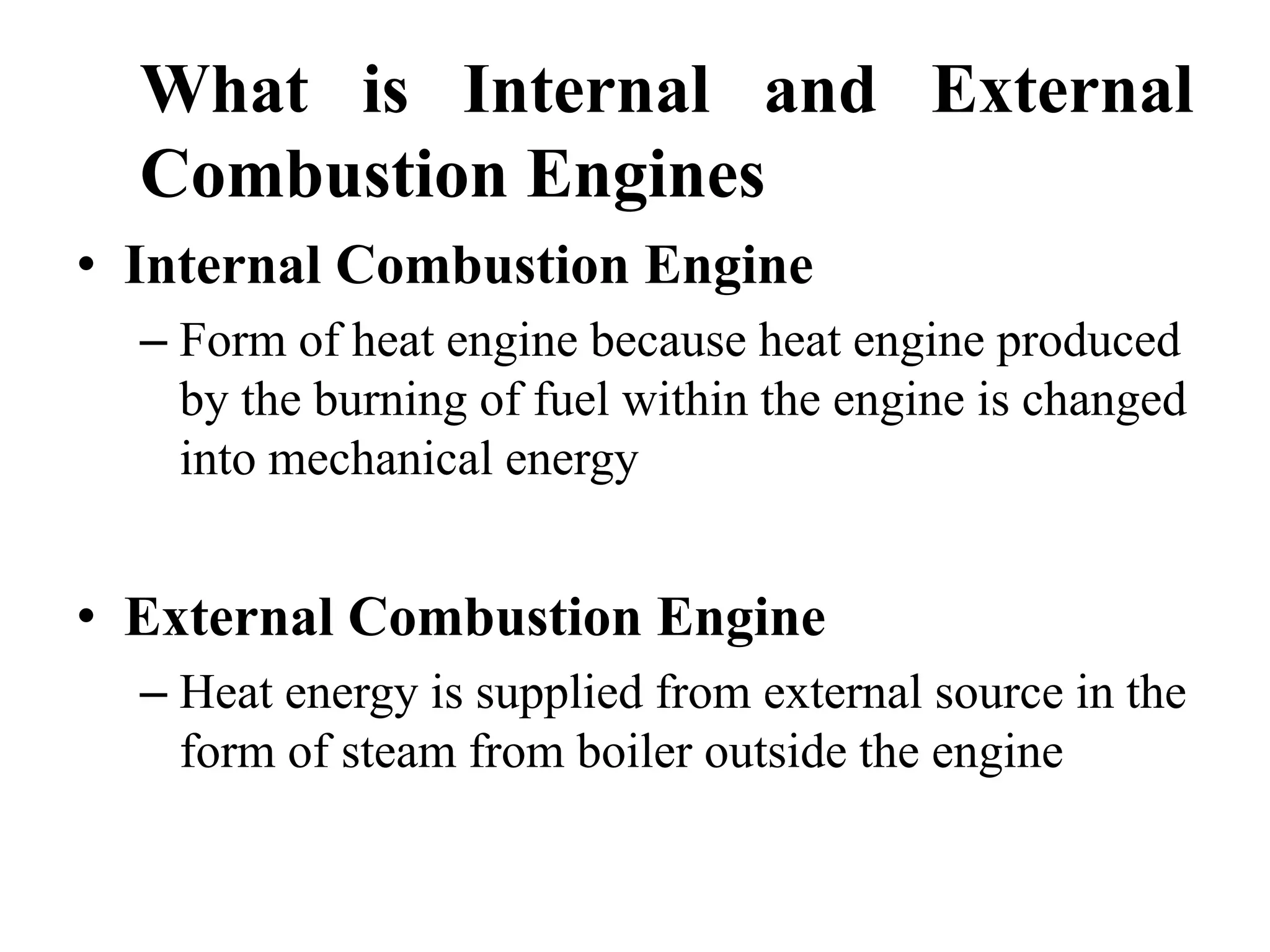
What is Internal and External
  Combustion Engines
• Internal Combustion Engine
  – Form of heat engine because heat engine produced
    by the burning of fuel within the engine is changed
    into mechanical energy


• External Combustion Engine
  – Heat energy is supplied from external source in the
    form of steam from boiler outside the engine
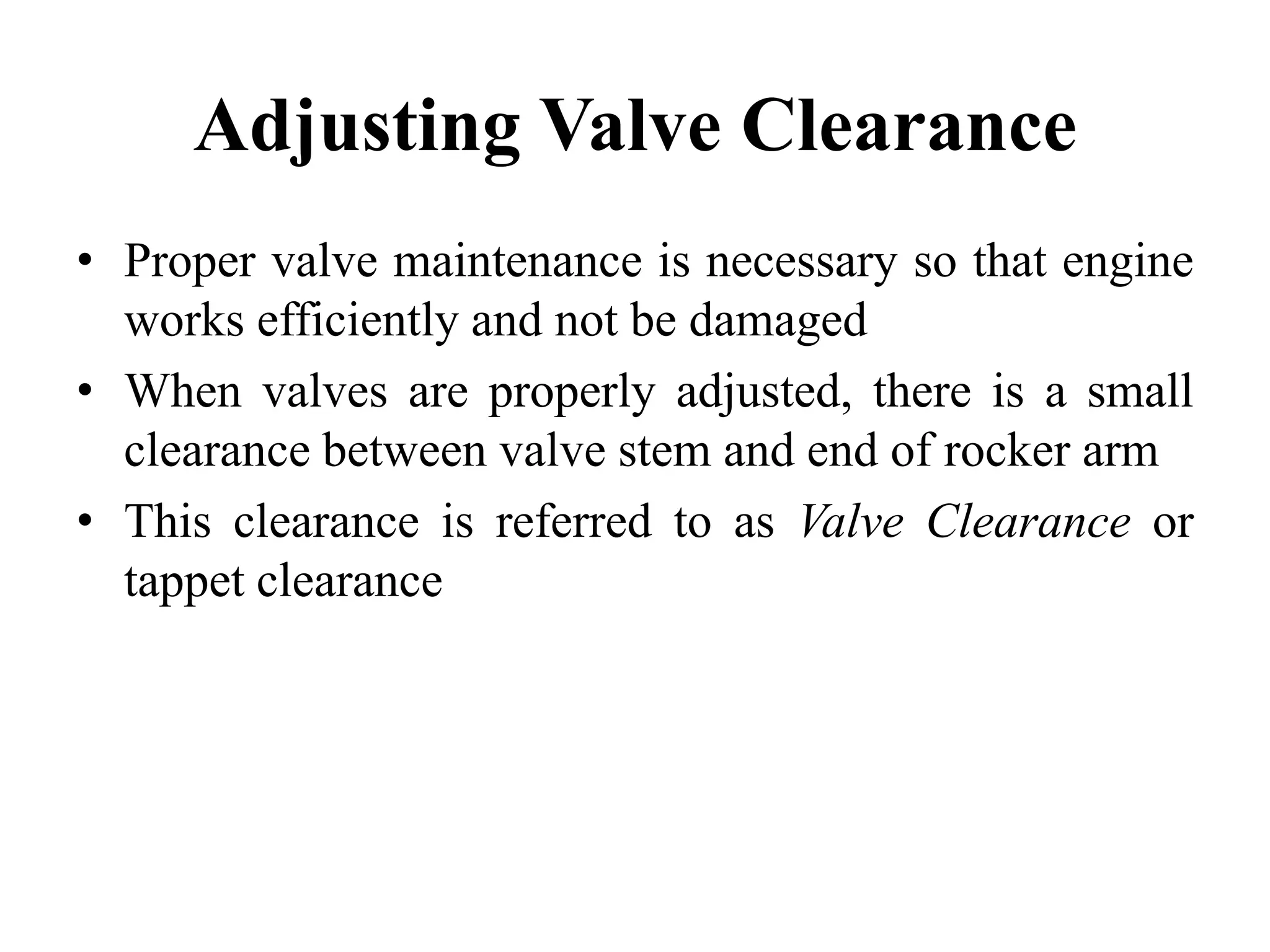
Adjusting Valve Clearance
• Proper valve maintenance is necessary so that engine
  works efficiently and not be damaged
• When valves are properly adjusted, there is a small
  clearance between valve stem and end of rocker arm
• This clearance is referred to as Valve Clearance or
  tappet clearance
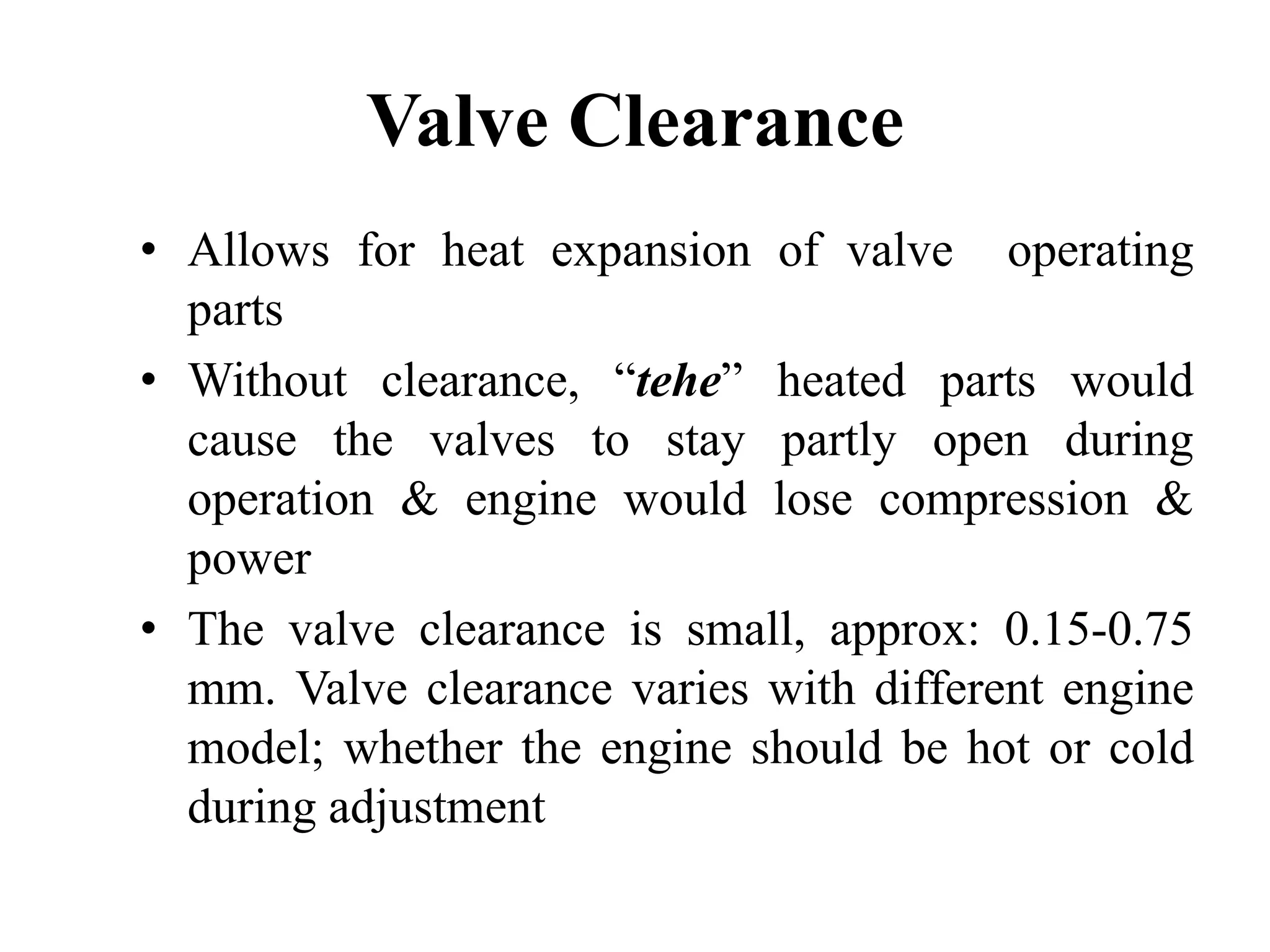
Valve Clearance
• Allows for heat expansion of valve operating
  parts
• Without clearance, “tehe” heated parts would
  cause the valves to stay partly open during
  operation & engine would lose compression &
  power
• The valve clearance is small, approx: 0.15-0.75
  mm. Valve clearance varies with different engine
  model; whether the engine should be hot or cold
  during adjustment
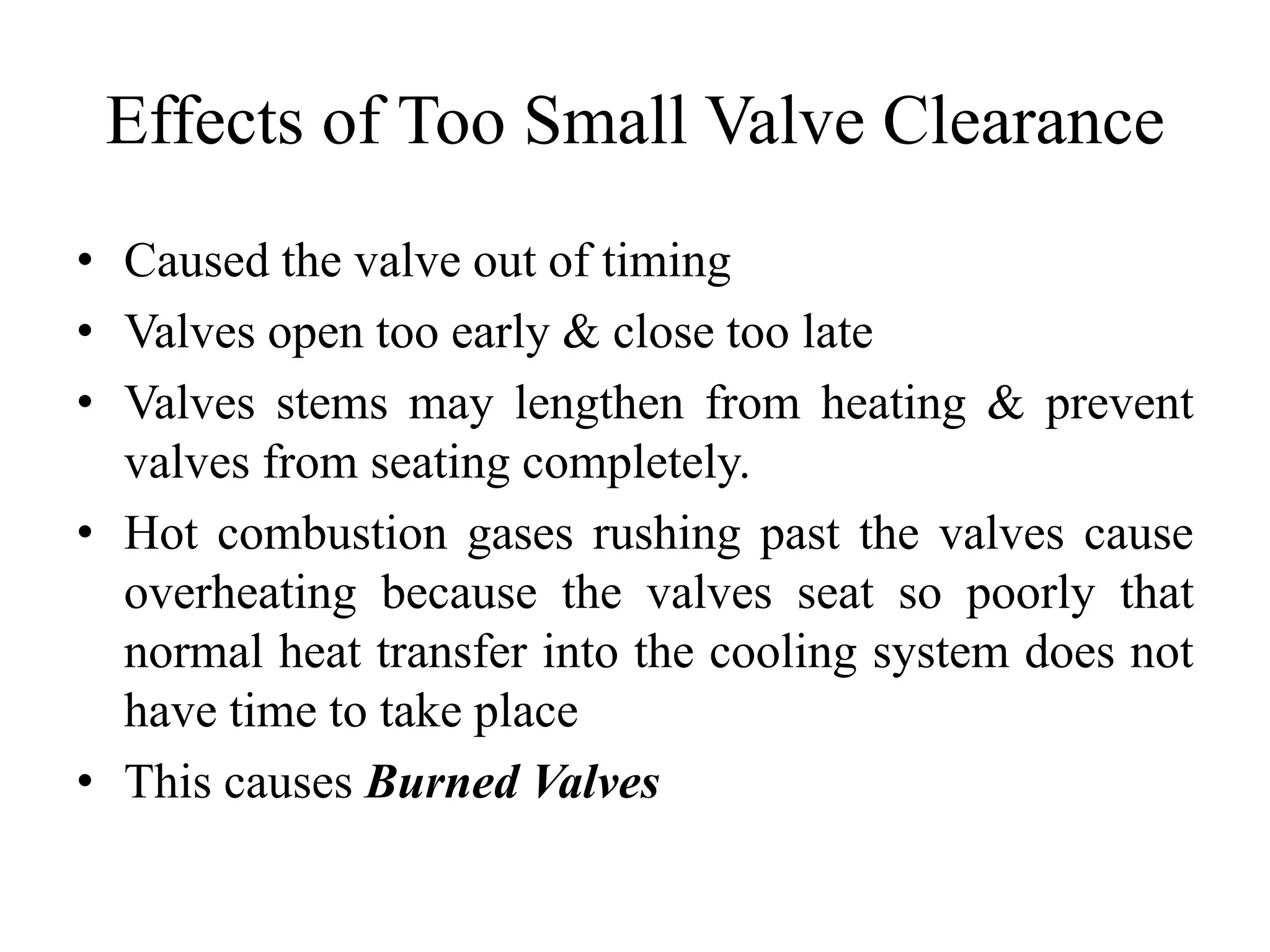
Effects of Too Small Valve Clearance
• Caused the valve out of timing
• Valves open too early & close too late
• Valves stems may lengthen from heating & prevent
  valves from seating completely.
• Hot combustion gases rushing past the valves cause
  overheating because the valves seat so poorly that
  normal heat transfer into the cooling system does not
  have time to take place
• This causes Burned Valves
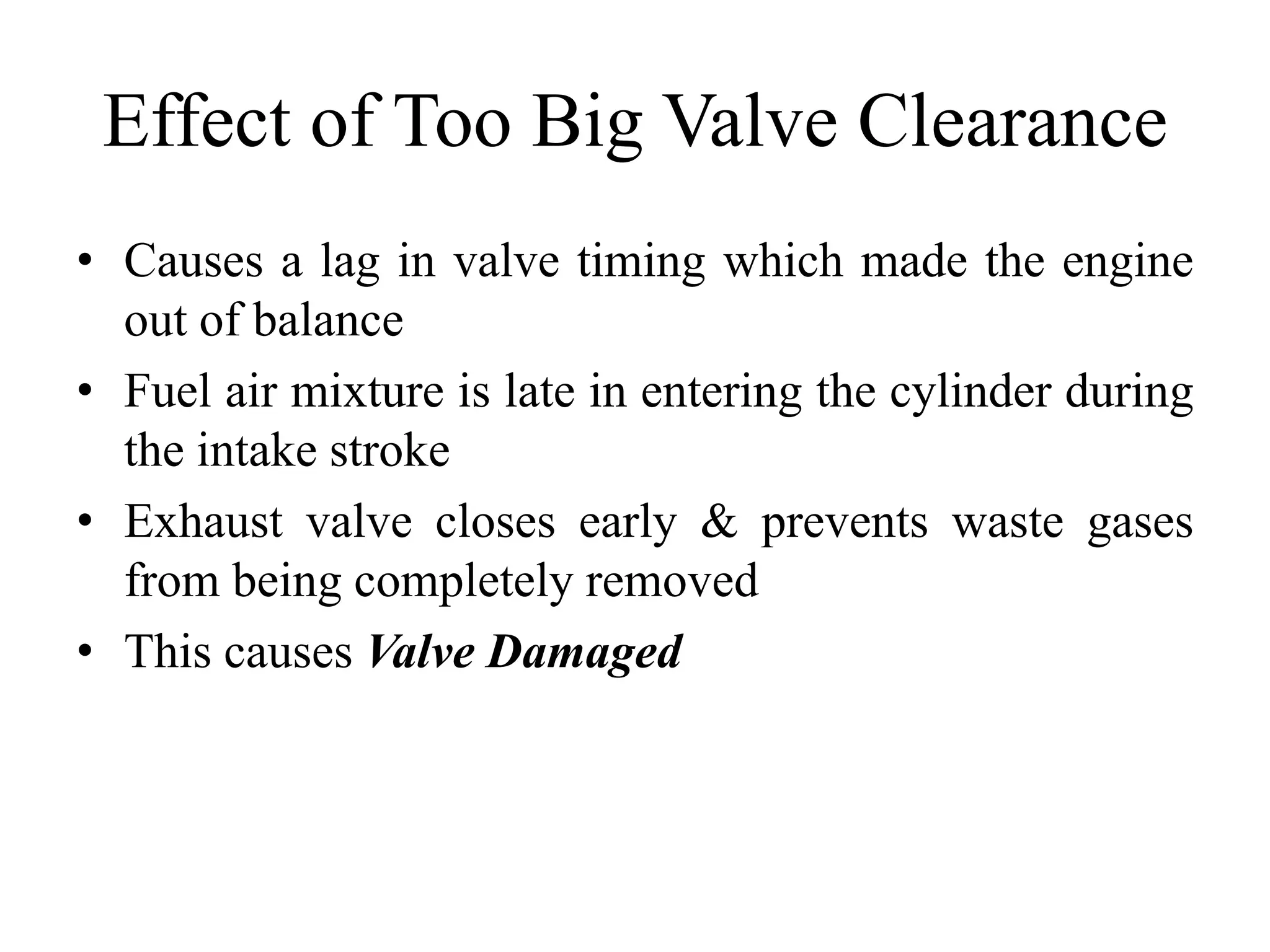
Effect of Too Big Valve Clearance
• Causes a lag in valve timing which made the engine
  out of balance
• Fuel air mixture is late in entering the cylinder during
  the intake stroke
• Exhaust valve closes early & prevents waste gases
  from being completely removed
• This causes Valve Damaged
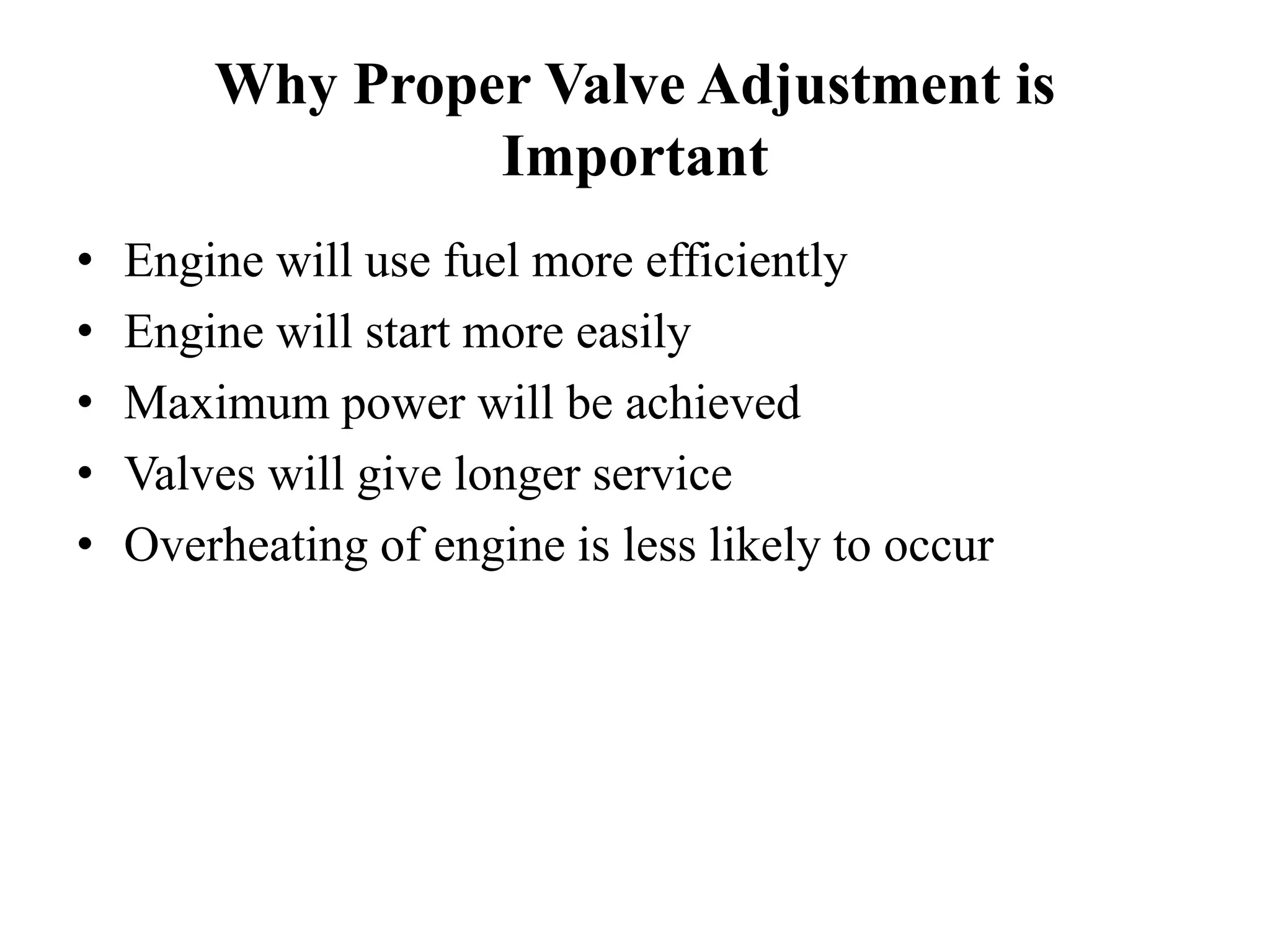
Why Proper Valve Adjustment is
                 Important
•   Engine will use fuel more efficiently
•   Engine will start more easily
•   Maximum power will be achieved
•   Valves will give longer service
•   Overheating of engine is less likely to occur
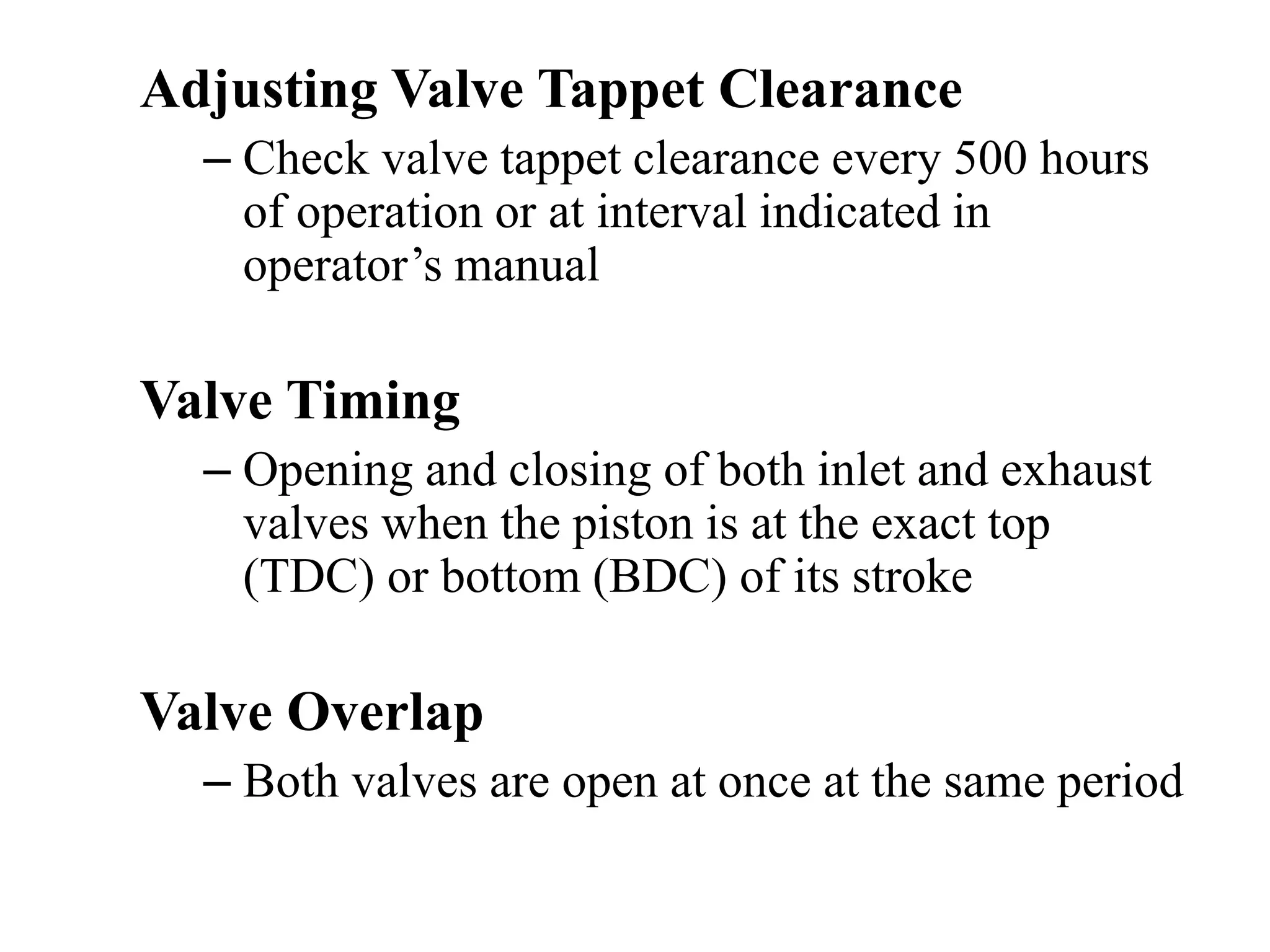
Adjusting Valve Tappet Clearance
  – Check valve tappet clearance every 500 hours
    of operation or at interval indicated in
    operator’s manual

Valve Timing
  – Opening and closing of both inlet and exhaust
    valves when the piston is at the exact top
    (TDC) or bottom (BDC) of its stroke

Valve Overlap
  – Both valves are open at once at the same period
WHAT IS ENGINE
• Is a structure that converts chemical energy
  (fuel) to mechanical energy.
• Usually made available on a rotating output
  shaft.
• Normal engine that been used on road is
  known as Internal Combustion Engine (IC)
• Is a reciprocating engines that have pistons
  that move back and forth in cylinders within
  the engine.
ENGINE CLASSIFICATIONS
1. Types of ignition
  a) Spark Ignition (SI)
        An engine starts the combustion process in each cycle
        by using spark plug.
        The spark plug gives high-voltage electrical discharge
        between two electrodes which ignites the air-fuel
        mixture.
        Before spark plug been used torch holes been used
        (external flame)
b) Compression ignition (CI)
        CI engine starts when the air-fuel mixture self-ignites
        due to high temperature in the combustion chamber
        due to high compression.

2. Engine cycle
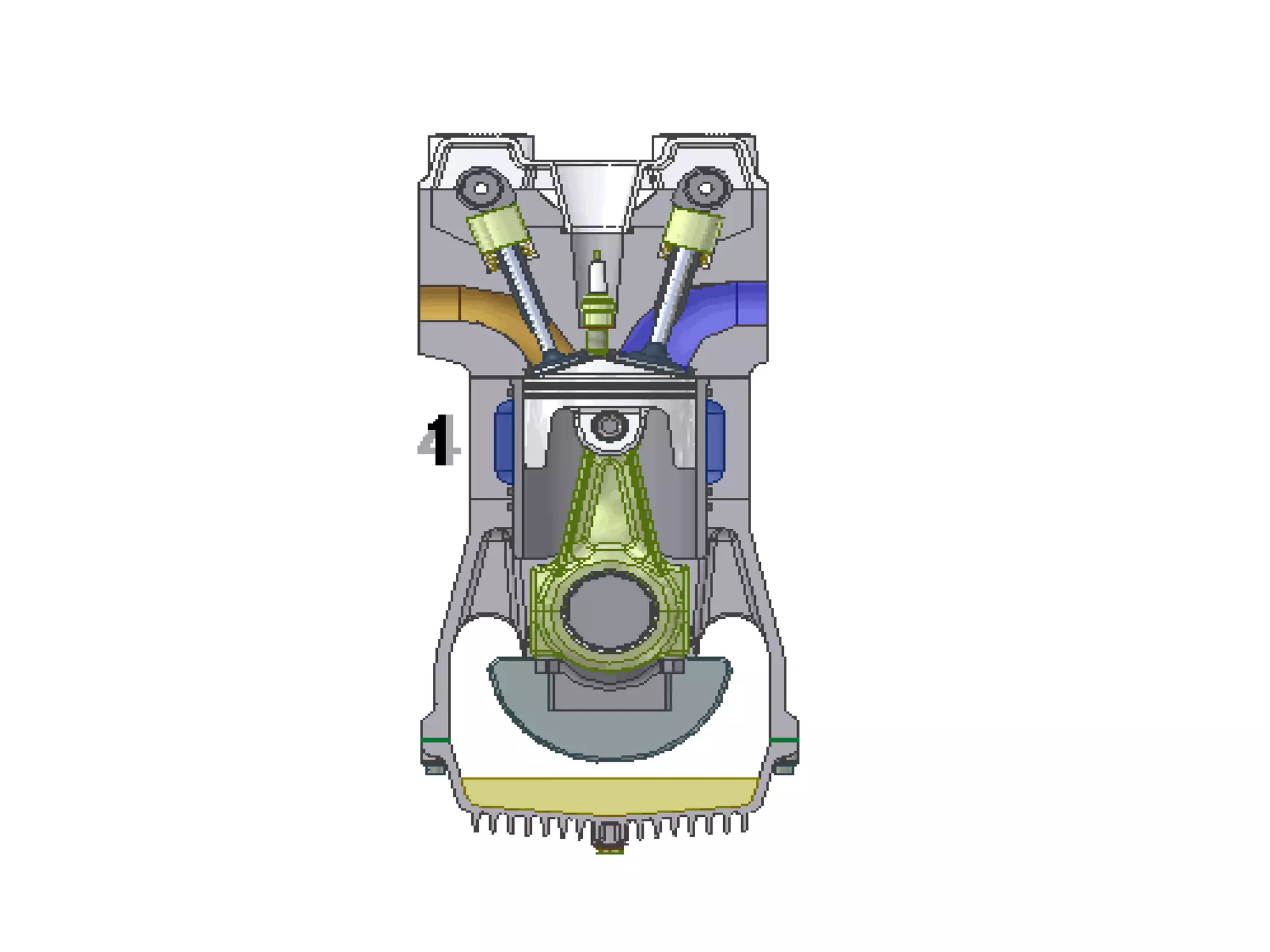
   a) Four stroke cycle
        A four-stroke cycle experiences four cycle movement
        over two engine revolutions for each cycle.
   b) Two stroke cycle
        A two-stroke cycle has two cycle movement over one
        revolution for each cycle.
3. Valve location
  a) Valves in head (overhead valve), known as I
     head engine.
  b) Valves in block (flat head), known as L head
     engine.
  c) One valve in head (intake) and one in block,
     known as F head engine.
4. Basic design
  a) Reciprocating
      Engine has one or more cylinders in which pistons
      move back and forth.
      The combustion chamber is located in the closed end of
      each cylinder.
  b) Rotary
      Engine is made of a block built around a large non-
      concentric rotor and crankshaft.
      Combustion chambers are built into the nonrotating
      block.
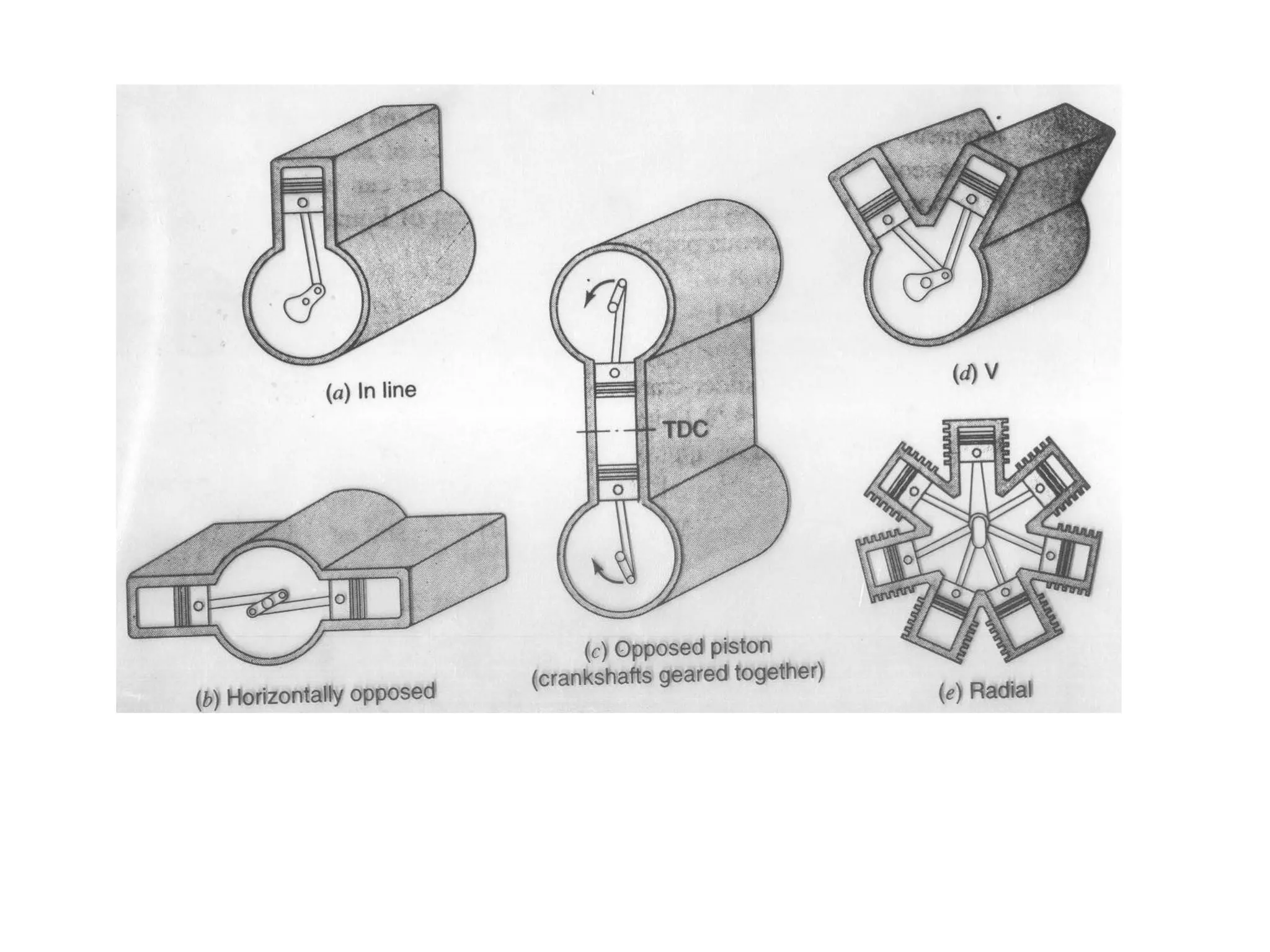
5. Position and number of cylinders of reciprocating
  engines
  a) Single cylinder
       Engine has one cylinder and piston connected to the
       crankshaft.
  b) In-line
       Cylinders are positioned in a straight line.
       One behind the other along the length of the crankshaft.
       They can consist of 2 to 11 cylinders or more
       Common are four cylinders engine
c) V engine
    Two banks of cylinder at an angle with each other along
    a single crankshaft.
    The angle are 15⁰ to 120⁰, common are 60⁰ to 90⁰
    2 to 20 cylinders, normally V6s and V8s
    V12s and V16s for luxury and high performances
    vehicles.
d) Opposed cylinder engine (crankshaft at
   middle)
    Two banks of cylinders opposite each other on a single
    crankshaft (a V engine with a 180⁰ V).
    Used for small aircraft, known as flat engine.
e) W engine
     Same as V engine except with three banks of cylinders on the
     same crankshaft.
     Normally developed for racing automobiles.
f) Opposed piston engine
     Two pistons in each cylinder with the combustion chamber in
     the center between the piston.
     A single-combustion process causes two power strokes at the
     same time. Each piston pushed away from the center and
     delivering power to a separate crankshaft at each end of the
     cylinder.
g) Radial engine
     Engine with pistons positioned in a circular plane around the
     central crankshaft.
     The connecting rods of the pistons are connected to a master
     rod which, in turn, is connected to the crankshaft.
ENGINE COMPONENTS
              LAB 2
1.    Block                 16.   Glow plug
2.    Camshaft              17.   Cylinder head
3.    Carburetor            18.   Head gasket
                            19.   Intake manifold
4.    Catalytic converter   20.   Main bearing
5.    Combustion chamber    21.   Oil pump
6.    Connecting rod        22.   Piston
7.    Crankcase             23.   Piston rings
8.    Crankshaft            24.   Push rods
9.    cylinders             25.   Radiator
                            26.   Spark plug
10.   exhaust manifold
                            27.   Speed control-cruise control
11.   exhaust system        28.   Starter motor
12.   fan                   29.   Throttle
13.   flywheel              30.    turbocharger
14.   fuel injector         31.   Water jacket
15.   Fuel pump             32.   Water pump
BASIC ENGINE CYCLES
A) Four Stroke SI Engine Cycle
B) Two Stroke SI Engine Cycle
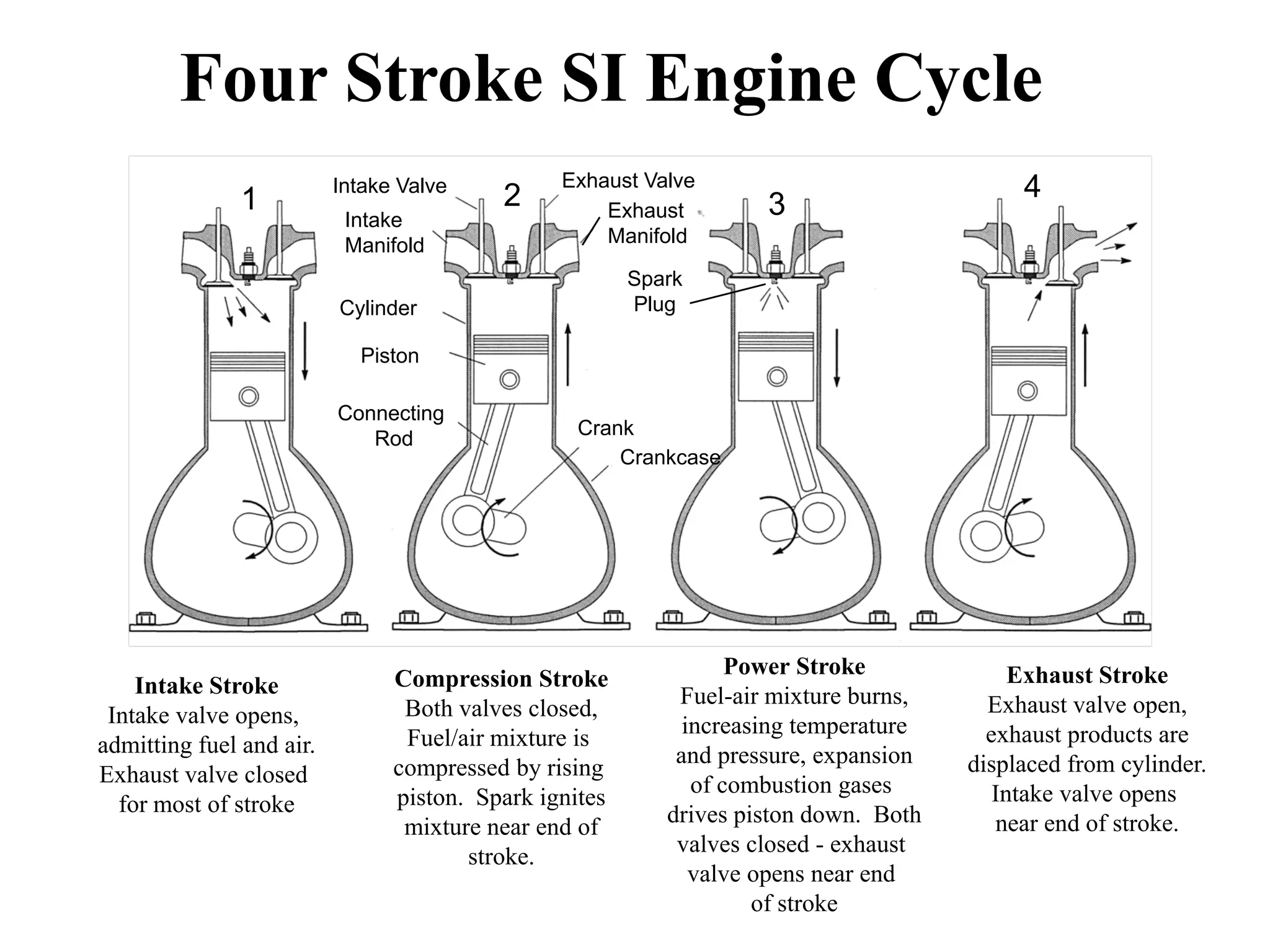
Four Stroke SI Engine Cycle
                          Intake Valve          Exhaust Valve                              4
               1                          2         Exhaust         3
                           Intake
                           Manifold                 Manifold

                                                        Spark
                          Cylinder                      Plug

                            Piston

                          Connecting
                                                  Crank
                             Rod
                                                      Crankcase


                                                                  Power Stroke             Exhaust Stroke
    Intake Stroke               Compression Stroke
                                                            Fuel-air mixture burns,     Exhaust valve open,
 Intake valve opens,             Both valves closed,
                                                             increasing temperature     exhaust products are
admitting fuel and air.          Fuel/air mixture is
                                                            and pressure, expansion   displaced from cylinder.
Exhaust valve closed            compressed by rising
                                                              of combustion gases        Intake valve opens
  for most of stroke            piston. Spark ignites
                                                           drives piston down. Both      near end of stroke.
                                 mixture near end of
                                                            valves closed - exhaust
                                       stroke.
                                                              valve opens near end
                                                                    of stroke
THANK YOU

Agriculture Engineering-chptr 2

  • 1.
  • 2.
    Basic parts ofInternal Combustion Engine a) Cylinder head top of the engine which contain a hole for valves valves, intake and exhaust passages, cooling passages b) Valves open and close to let fuel air mixture (petrol engine) or air only (diesel engine) exhaust gases out of each cylinder c) Camshaft rotates to open and close the valves by cam action
  • 4.
    d) Cylinder block Main housing of the engine and supports other main parts Contain cylindrical vessels in which combustion takes place and piston makes a reciprocating motion e) Cylinders Hollow tubes, piston moves back and forth f) Pistons Move in the cylinders and apply the force of combustion to crankshaft g) Piston rings A component that fitted into the slot around the piston which seal the combustion chamber and help transfer heat
  • 6.
    h) Connecting rods A rod that interconnect the piston and the crankshaft and transmit the forces from the piston to crankshaft i) Crankshaft Receives the force from pistons and transmit as rotary driving power j) Main bearings Support crankshaft in cylinder block k) Flywheel Attach to crankshaft at rear, provides momentum and help return pistons to the top of cylinders
  • 8.
    l) Timing drives Link the crankshaft, camshaft and other parts together to assure each is doing its job at the right time m) Cams Integral part of camshaft design to open the valve at the correct timing and to keep them open for the necessary duration n) Gudgeon pin Forms the link between the small end of the connecting rod and the piston
  • 11.
    Classification of Tractors Accordingto the Power of Engine (horse power) – Small < 25 hp – Medium 25 – 50 hp – Large > 50 hp
  • 12.
    Comparison Between Petroland Diesel Engine a. Fuel Supply and Ignition b. Compression Ratio c. Design of Engine Parts d. Grade and Type of Fuel Used
  • 13.
    a) Fuel Supplyand Ignition Petrol Engine Fuel and air mixed outside the cylinders in the carburetor and intake manifold Mixture is forced into cylinders by partial vacuum created by intake stroke of piston Uses electric spark to ignite fuel air mixture Compression ratio 8 to 1 (8:1) Diesel Engine No premixing of air and fuel Air taken into cylinders through intake manifold and compressed Fuel is sprayed into cylinders and mixed with air as the piston nears the top of its compression stroke Use heat and compressed air for ignition Compression ratio 16 to 1 (16:1)
  • 14.
    b) Compression Ratio Compressionratio is a characteristic of an engine i.e. related to engine efficiency i.e. the ability of the engine to convert in the fuel to useful mechanical energy The greater the compression ratio, the greater the potential efficiency of the engine Compares volume in cylinder before compression with volume after compression High compression ratio of diesel – cause high temperature of air to ignite fuel without a spark Therefore diesel engine more efficient because higher compression i.e greater expansion of gases in cylinder therefore more powerful stroke
  • 15.
    c) Design ofEngine Parts Engine of diesel more sturdier parts to  withstand greater forces
  • 16.
    d) Grade andType of Fuel Used • Diesel fuel -- more heat units (joule) per gallon • Therefore produces more power per gallon of fuel – fuel low cost but fuel injection equipment is more expensive than petrol equipment
  • 17.
    Comparison between Engines Diesel Petrol 1. Fuel efficiency Best Fair 2. Time before maintenance Good Fair 3. Weight per horse power High Low 4. Cold weather starting Fair Good 5. Acceleration Good Good 6. Continuous Duty Good Fair 7. Lubricating oil contamination Moderate Moderate
  • 18.
    DIESEL ENGINE PETROL ENGINE 1. Fuel System 1. Fuel System Use diesel Use petrol No carburetor Have carburetor Uses heat & compressed air Uses electric spark to ignite for ignition air‐fuel mixture 2. Higher compression ratio 2.Lower compression ratio 14 – 16 : 1 7 – 10 : 1 3. Operation 3.Operation No pre‐mixing of air and fuel Fuel and air mixed outside the Air taken into cylinder cylinders in the carburetor through intake manifold and and intake manifold compressed Mixture is forced into Fuel is sprayed into cylinders cylinders by partial vacuum and mixed with air as the created by intake stroke of piston nears the top of its piston compression stroke
  • 19.
    Engine Construction Functions 1. Valves - Intake and Exhaust Valves The valves allow fuel-air in and exhaust gases out of each cylinder during combustion cycle by opening and closing the intake and exhaust parts of the cylinder. Intake Stroke Intake valve opens allowing fuel air mixture to enter combustion chamber Compression and Power Stroke Both valves are closed to seal in combustible mixture Exhaust Stroke Exhaust valve opens allowing gases to be exhausted End of Exhaust Stroke Intake valves opens, beginning another cycle
  • 20.
    2. Camshaft • isturned by the engine crankshaft. • A lobe (cam) on the camshaft causes the cam follower and push the rod to push the valve open • The spring closes the valve when the cam allows the push rod and cam follower to return to low side of the cam • Cam movements are designed to open or close the valves at the right moment
  • 21.
    3. Engine Crankcaseand Cylinder Block • Made of iron casting and is an integral with cylinder block which houses cylinder liners • Liners are said to be wet or dry according to whether they are or not in contact with cooling water that circulate through engine block • Crankcase houses the crank gear and valve gear
  • 22.
    4. Engine Block •Houses the injection pump, oil pump, water pump and power generator • The front part carries the timing cover, rear end carries clutch bell housing on which the starter motor is mounted • Provided with oil filler cap and breather, oil dipstick and water connection to the radiator
  • 23.
    5. Cylinder Head Consists of fuel injectors , inlet and outlet valves, the rockers Cylinder head is in a single piece for engines up to 4 cylinders Between cylinder head and engine block – cylinder head gasket; to prevent gas, coolants and lubricating oil from escaping Also connected the inlet and exhaust manifolds water pipe from radiator 6. Oil Sump Made of iron casting Seals the crankcase at the bottom Functions as a reservoir for the lubricating oil
  • 24.
    7. Piston, ConnectingRod & Cylinder Liners Piston move in the cylinders and apply the force of combustion to the crankshaft Combustion chamber machined in upper part known as piston head or crown ; lower part known as piston skirt Connecting rods Transmit the motion of the pistons to the crankshaft Cylinder Liners made of cast iron may be wet or dry; wet liners can be inserted and removed by hand; dry liner removal and installation with the use of a press (of a few tons capacity)
  • 25.
    8. Crankshaft Receive the force from the pistons and transmits it as rotary driving force Rear end carries the flywheel incorporating starter ring gear Front end carries crankshaft gear used to drive valve timing mechanism, oil pump 9. Flywheel Attaches to crankshaft at rear & provides momentum to help return the pistons to the top of cylinders after each downward thrust 10. Timing Drives Link the crankshaft, camshaft and other parts together so that each is doing its job at the right time
  • 26.
    What is Internaland External Combustion Engines • Internal Combustion Engine – Form of heat engine because heat engine produced by the burning of fuel within the engine is changed into mechanical energy • External Combustion Engine – Heat energy is supplied from external source in the form of steam from boiler outside the engine
  • 27.
    Adjusting Valve Clearance •Proper valve maintenance is necessary so that engine works efficiently and not be damaged • When valves are properly adjusted, there is a small clearance between valve stem and end of rocker arm • This clearance is referred to as Valve Clearance or tappet clearance
  • 28.
    Valve Clearance • Allowsfor heat expansion of valve operating parts • Without clearance, “tehe” heated parts would cause the valves to stay partly open during operation & engine would lose compression & power • The valve clearance is small, approx: 0.15-0.75 mm. Valve clearance varies with different engine model; whether the engine should be hot or cold during adjustment
  • 29.
    Effects of TooSmall Valve Clearance • Caused the valve out of timing • Valves open too early & close too late • Valves stems may lengthen from heating & prevent valves from seating completely. • Hot combustion gases rushing past the valves cause overheating because the valves seat so poorly that normal heat transfer into the cooling system does not have time to take place • This causes Burned Valves
  • 30.
    Effect of TooBig Valve Clearance • Causes a lag in valve timing which made the engine out of balance • Fuel air mixture is late in entering the cylinder during the intake stroke • Exhaust valve closes early & prevents waste gases from being completely removed • This causes Valve Damaged
  • 31.
    Why Proper ValveAdjustment is Important • Engine will use fuel more efficiently • Engine will start more easily • Maximum power will be achieved • Valves will give longer service • Overheating of engine is less likely to occur
  • 32.
    Adjusting Valve TappetClearance – Check valve tappet clearance every 500 hours of operation or at interval indicated in operator’s manual Valve Timing – Opening and closing of both inlet and exhaust valves when the piston is at the exact top (TDC) or bottom (BDC) of its stroke Valve Overlap – Both valves are open at once at the same period
  • 33.
    WHAT IS ENGINE •Is a structure that converts chemical energy (fuel) to mechanical energy. • Usually made available on a rotating output shaft. • Normal engine that been used on road is known as Internal Combustion Engine (IC) • Is a reciprocating engines that have pistons that move back and forth in cylinders within the engine.
  • 34.
    ENGINE CLASSIFICATIONS 1. Typesof ignition a) Spark Ignition (SI) An engine starts the combustion process in each cycle by using spark plug. The spark plug gives high-voltage electrical discharge between two electrodes which ignites the air-fuel mixture. Before spark plug been used torch holes been used (external flame)
  • 35.
    b) Compression ignition(CI) CI engine starts when the air-fuel mixture self-ignites due to high temperature in the combustion chamber due to high compression. 2. Engine cycle a) Four stroke cycle A four-stroke cycle experiences four cycle movement over two engine revolutions for each cycle. b) Two stroke cycle A two-stroke cycle has two cycle movement over one revolution for each cycle.
  • 36.
    3. Valve location a) Valves in head (overhead valve), known as I head engine. b) Valves in block (flat head), known as L head engine. c) One valve in head (intake) and one in block, known as F head engine.
  • 37.
    4. Basic design a) Reciprocating Engine has one or more cylinders in which pistons move back and forth. The combustion chamber is located in the closed end of each cylinder. b) Rotary Engine is made of a block built around a large non- concentric rotor and crankshaft. Combustion chambers are built into the nonrotating block.
  • 38.
    5. Position andnumber of cylinders of reciprocating engines a) Single cylinder Engine has one cylinder and piston connected to the crankshaft. b) In-line Cylinders are positioned in a straight line. One behind the other along the length of the crankshaft. They can consist of 2 to 11 cylinders or more Common are four cylinders engine
  • 39.
    c) V engine Two banks of cylinder at an angle with each other along a single crankshaft. The angle are 15⁰ to 120⁰, common are 60⁰ to 90⁰ 2 to 20 cylinders, normally V6s and V8s V12s and V16s for luxury and high performances vehicles. d) Opposed cylinder engine (crankshaft at middle) Two banks of cylinders opposite each other on a single crankshaft (a V engine with a 180⁰ V). Used for small aircraft, known as flat engine.
  • 40.
    e) W engine Same as V engine except with three banks of cylinders on the same crankshaft. Normally developed for racing automobiles. f) Opposed piston engine Two pistons in each cylinder with the combustion chamber in the center between the piston. A single-combustion process causes two power strokes at the same time. Each piston pushed away from the center and delivering power to a separate crankshaft at each end of the cylinder. g) Radial engine Engine with pistons positioned in a circular plane around the central crankshaft. The connecting rods of the pistons are connected to a master rod which, in turn, is connected to the crankshaft.
  • 42.
    ENGINE COMPONENTS LAB 2 1. Block 16. Glow plug 2. Camshaft 17. Cylinder head 3. Carburetor 18. Head gasket 19. Intake manifold 4. Catalytic converter 20. Main bearing 5. Combustion chamber 21. Oil pump 6. Connecting rod 22. Piston 7. Crankcase 23. Piston rings 8. Crankshaft 24. Push rods 9. cylinders 25. Radiator 26. Spark plug 10. exhaust manifold 27. Speed control-cruise control 11. exhaust system 28. Starter motor 12. fan 29. Throttle 13. flywheel 30. turbocharger 14. fuel injector 31. Water jacket 15. Fuel pump 32. Water pump
  • 44.
    BASIC ENGINE CYCLES A)Four Stroke SI Engine Cycle B) Two Stroke SI Engine Cycle
  • 45.
    Four Stroke SIEngine Cycle Intake Valve Exhaust Valve 4 1 2 Exhaust 3 Intake Manifold Manifold Spark Cylinder Plug Piston Connecting Crank Rod Crankcase Power Stroke Exhaust Stroke Intake Stroke Compression Stroke Fuel-air mixture burns, Exhaust valve open, Intake valve opens, Both valves closed, increasing temperature exhaust products are admitting fuel and air. Fuel/air mixture is and pressure, expansion displaced from cylinder. Exhaust valve closed compressed by rising of combustion gases Intake valve opens for most of stroke piston. Spark ignites drives piston down. Both near end of stroke. mixture near end of valves closed - exhaust stroke. valve opens near end of stroke
  • 46.