Manufacturing
Process of a
Piston
INTRODUCTION
 A piston is an important component of
reciprocating engine helps to convert
energy obtained by the combustion of
fuel in cylinder into useful mechanical
power.
 It is like a disc which reciprocates within a
cylinder.
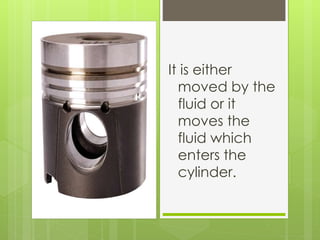
It is either
moved by the
fluid or it
moves the
fluid which
enters the
cylinder.
MANUFACTURING
PROCESS
 Casting
 Heat treatment
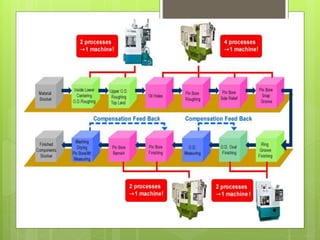
 Machining process
 Pin fitting and Inspection
CASTING
 The foundry is the beginning of the piston.
 At the foundry the die is prepared by heating
it to operating temperature for approximately
one hour.
 This process allows the die to readily accept
the molten material when it is poured.
 The molten material used for Piston is 10%
Silicon content Aluminium or Aluminium alloys
PROCESS
 The process starts by heating the material
to 700 degrees Celsius.
 The material is then scooped up with a
ladle from the crucible (the pot that holds
the molten material).
 This is then poured into the die through
the sprue.
 The material is then allowed to cool
before it is removed from the die.
HEAT TREATMENT
 Heat Treatment is the controlled heating and
cooling of metals to alter their physical and
mechanical properties without changing the
product shape.
 Heat Treatment is often associated with
increasing the strength of material, but it can
also be used to alter certain manufacturability
objectives such as improve machining, improve
formability, restore ductility after a cold working
operation.
MACHINING PROCESS
 Open end bore machining
 Rough outer diameter turning
 Grooves forming
 Semi finish hole boring
 Circle grooving oil hole drilling in 3rd
groove and skirt
 Ring grooving and chamfering
 Final outer diameter turning
 Deburring and cleaning
 Tin coating
 Finish pin hole boring
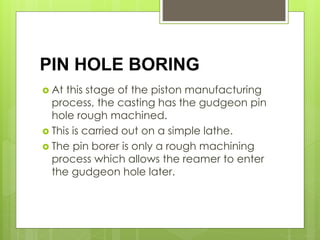
PIN HOLE BORING
 At this stage of the piston manufacturing
process, the casting has the gudgeon pin
hole rough machined.
 This is carried out on a simple lathe.
 The pin borer is only a rough machining
process which allows the reamer to enter
the gudgeon hole later.
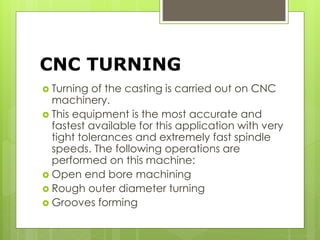
CNC TURNING
 Turning of the casting is carried out on CNC
machinery.
 This equipment is the most accurate and
fastest available for this application with very
tight tolerances and extremely fast spindle
speeds. The following operations are
performed on this machine:
 Open end bore machining
 Rough outer diameter turning
 Grooves forming
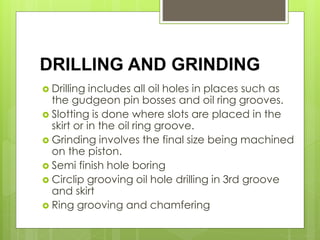
DRILLING AND GRINDING
 Drilling includes all oil holes in places such as
the gudgeon pin bosses and oil ring grooves.
 Slotting is done where slots are placed in the
skirt or in the oil ring groove.
 Grinding involves the final size being machined
on the piston.
 Semi finish hole boring
 Circlip grooving oil hole drilling in 3rd groove
and skirt
 Ring grooving and chamfering
REAMING
 The final machining process for the piston is
that of reaming.
 This process involves the piston being placed
in a bath of oil and reamed at different sizes
to reach the final size required.
 Since the pin boring process is only rough it is
necessary to ream the pin bore a number of
times to achieve the surface finish and size
required.
DEBURRING AND TIN
COATING
 Before coating, the pistons should be
thoroughly cleaned to remove any soap or
phosphate residue, water spots, machining oil,
dirt, etc. picked up during the manufacturing
process.
 For optimum results a mechanical type
cleaner (e.g. spray) is recommended.
 Recommended methods for applying Tin
Coating to pistons are either screen print or
spray techniques.
PIN FITTING AND FINAL
INSPECTION
 At this stage the piston is cleaned, inspected
by the instruments, fitted with the appropriate
gudgeon pin, stamped with the pistons
oversize and any other markings, and then
sent to dispatch.
 Finally, the piston is wrapped and placed in
the shipping container with the ring set and
sent to the customer.
Manufacturing a piston

Manufacturing a piston

  • 1.
  • 2.
    INTRODUCTION  A pistonis an important component of reciprocating engine helps to convert energy obtained by the combustion of fuel in cylinder into useful mechanical power.  It is like a disc which reciprocates within a cylinder.
  • 3.
    It is either movedby the fluid or it moves the fluid which enters the cylinder.
  • 4.
    MANUFACTURING PROCESS  Casting  Heattreatment  Machining process  Pin fitting and Inspection
  • 5.
    CASTING  The foundryis the beginning of the piston.  At the foundry the die is prepared by heating it to operating temperature for approximately one hour.  This process allows the die to readily accept the molten material when it is poured.  The molten material used for Piston is 10% Silicon content Aluminium or Aluminium alloys
  • 6.
    PROCESS  The processstarts by heating the material to 700 degrees Celsius.  The material is then scooped up with a ladle from the crucible (the pot that holds the molten material).  This is then poured into the die through the sprue.  The material is then allowed to cool before it is removed from the die.
  • 8.
    HEAT TREATMENT  HeatTreatment is the controlled heating and cooling of metals to alter their physical and mechanical properties without changing the product shape.  Heat Treatment is often associated with increasing the strength of material, but it can also be used to alter certain manufacturability objectives such as improve machining, improve formability, restore ductility after a cold working operation.
  • 9.
    MACHINING PROCESS  Openend bore machining  Rough outer diameter turning  Grooves forming  Semi finish hole boring  Circle grooving oil hole drilling in 3rd groove and skirt  Ring grooving and chamfering
  • 10.
     Final outerdiameter turning  Deburring and cleaning  Tin coating  Finish pin hole boring
  • 12.
    PIN HOLE BORING At this stage of the piston manufacturing process, the casting has the gudgeon pin hole rough machined.  This is carried out on a simple lathe.  The pin borer is only a rough machining process which allows the reamer to enter the gudgeon hole later.
  • 13.
    CNC TURNING  Turningof the casting is carried out on CNC machinery.  This equipment is the most accurate and fastest available for this application with very tight tolerances and extremely fast spindle speeds. The following operations are performed on this machine:  Open end bore machining  Rough outer diameter turning  Grooves forming
  • 14.
    DRILLING AND GRINDING Drilling includes all oil holes in places such as the gudgeon pin bosses and oil ring grooves.  Slotting is done where slots are placed in the skirt or in the oil ring groove.  Grinding involves the final size being machined on the piston.  Semi finish hole boring  Circlip grooving oil hole drilling in 3rd groove and skirt  Ring grooving and chamfering
  • 15.
    REAMING  The finalmachining process for the piston is that of reaming.  This process involves the piston being placed in a bath of oil and reamed at different sizes to reach the final size required.  Since the pin boring process is only rough it is necessary to ream the pin bore a number of times to achieve the surface finish and size required.
  • 16.
    DEBURRING AND TIN COATING Before coating, the pistons should be thoroughly cleaned to remove any soap or phosphate residue, water spots, machining oil, dirt, etc. picked up during the manufacturing process.  For optimum results a mechanical type cleaner (e.g. spray) is recommended.  Recommended methods for applying Tin Coating to pistons are either screen print or spray techniques.
  • 17.
    PIN FITTING ANDFINAL INSPECTION  At this stage the piston is cleaned, inspected by the instruments, fitted with the appropriate gudgeon pin, stamped with the pistons oversize and any other markings, and then sent to dispatch.  Finally, the piston is wrapped and placed in the shipping container with the ring set and sent to the customer.