AUTOMATIC LOAD
SHARING
TRANSFORMER
USING
ARDUINO
KIPM
COLLEGE OF ENGINEERING & TECHNOLOGY
GIDA, GORAKHPUR
PRESENTED BY :
ABHINAW KUMAR SINGH
DEVESH MODANWAL
UJJWAL VAISH
AKASH CHAURASIYA
KIPM
COLLEGE OF ENGINEERING & TECHNOLOGY
GIDA, GORAKHPUR
TABLE OF CONTENT
 Introduction
 Project Objective
 Components and Their Uses
a. Arduino UNO
b. LCD I2C Display
c. Adapter
d. Current Sensor
e. Capacitor
f. 1N4007 Diode
g. BC547 Transistor
h. Hook-Up Wires and Jumper
Wires
 Transformer
 Circuit Diagram
 Advantages &
Disadvantages
 Applications
Transformers are vital in power systems but need
protection due to overloading from rising electricity
demands, leading to reduced efficiency and costly
damage. This project prevents transformer failure by
connecting an additional transformer in parallel via a
microcontroller and relay to share excess load.
Alternating their operation avoids overheating, while
priority-based load shedding ensures uninterrupted
power for critical facilities like hospitals and industries.
INTRODUCTION
OBJECTIVE
The primary objective of this project is to protect
transformers from overloaded conditions by effectively
sharing the load between multiple transformers. It
involves measuring the current and load in watts for both
transformers to monitor their operating conditions.
Additionally, the system continuously tracks the loading
on each transformer to ensure balanced operation. It also
calculates the percentage of overload to identify and
prevent potential damage, ensuring efficient and safe
functioning of the transformers.
COMPONENTS LIST :
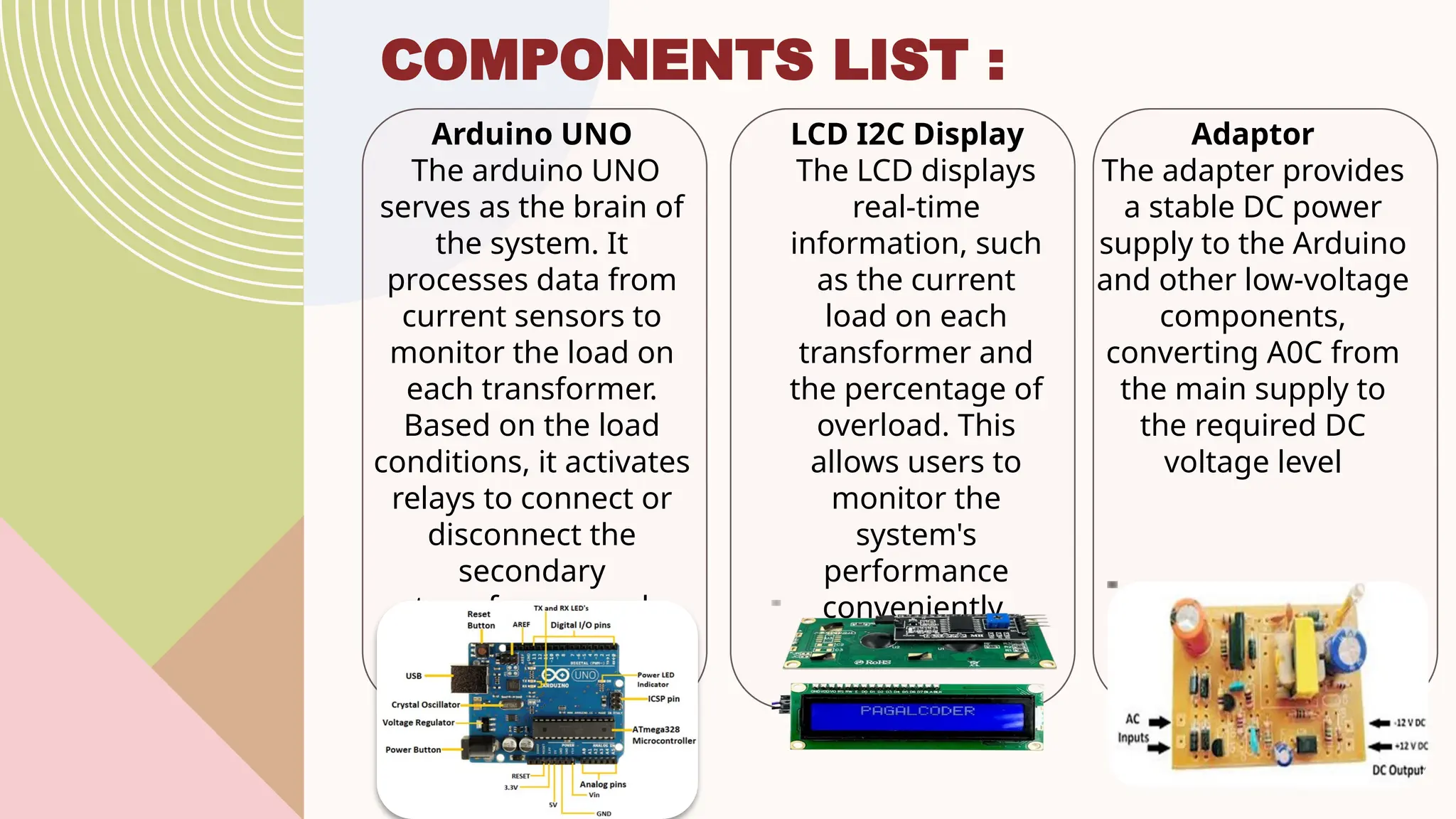
LCD I2C Display
The LCD displays
real-time
information, such
as the current
load on each
transformer and
the percentage of
overload. This
allows users to
monitor the
system's
performance
conveniently.
Arduino UNO
The arduino UNO
serves as the brain of
the system. It
processes data from
current sensors to
monitor the load on
each transformer.
Based on the load
conditions, it activates
relays to connect or
disconnect the
secondary
transformer and
ensures efficient load
sharing
Adaptor
The adapter provides
a stable DC power
supply to the Arduino
and other low-voltage
components,
converting A0C from
the main supply to
the required DC
voltage level
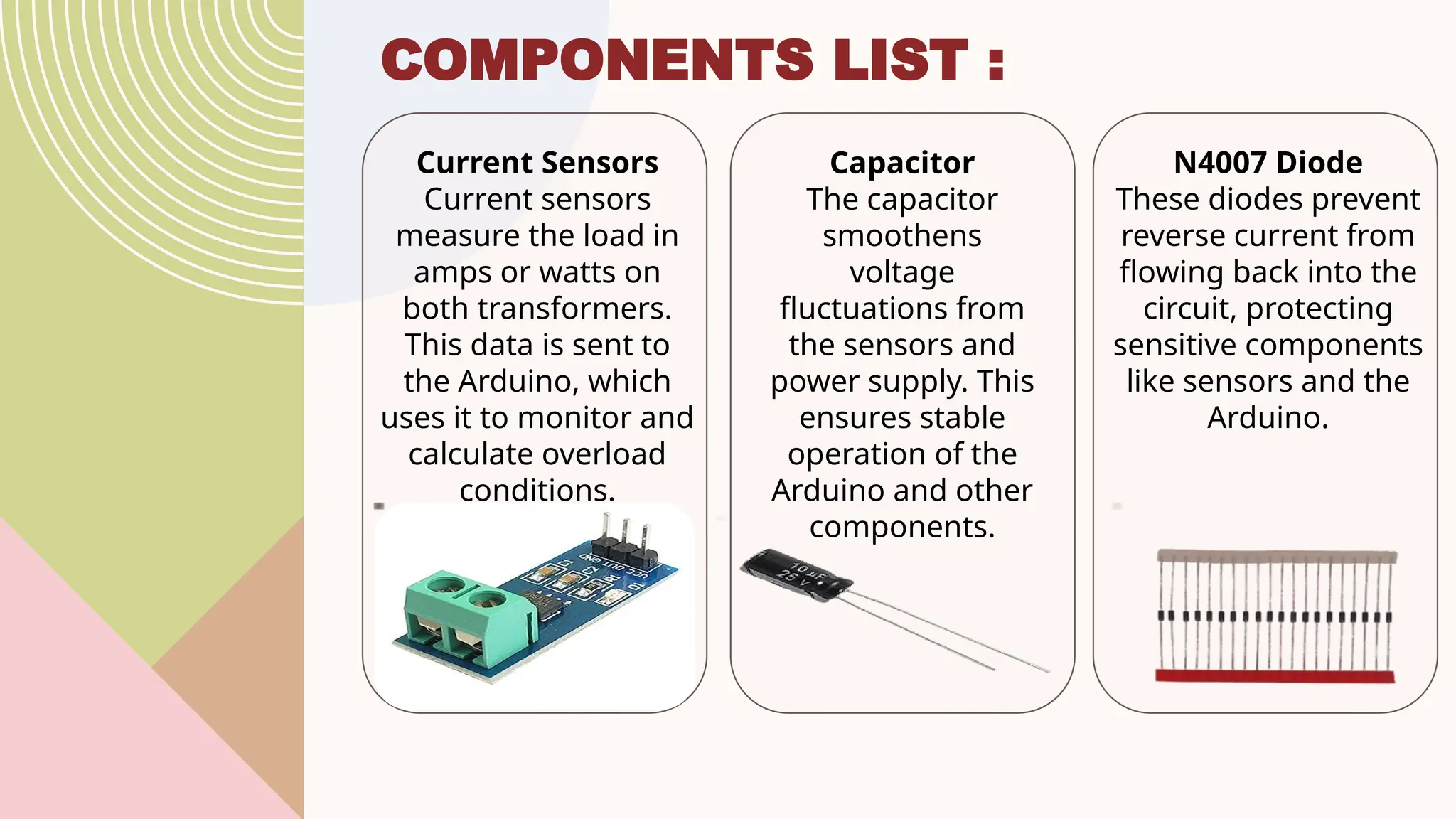
Capacitor
The capacitor
smoothens
voltage
fluctuations from
the sensors and
power supply. This
ensures stable
operation of the
Arduino and other
components.
Current Sensors
Current sensors
measure the load in
amps or watts on
both transformers.
This data is sent to
the Arduino, which
uses it to monitor and
calculate overload
conditions.
N4007 Diode
These diodes prevent
reverse current from
flowing back into the
circuit, protecting
sensitive components
like sensors and the
Arduino.
COMPONENTS LIST :
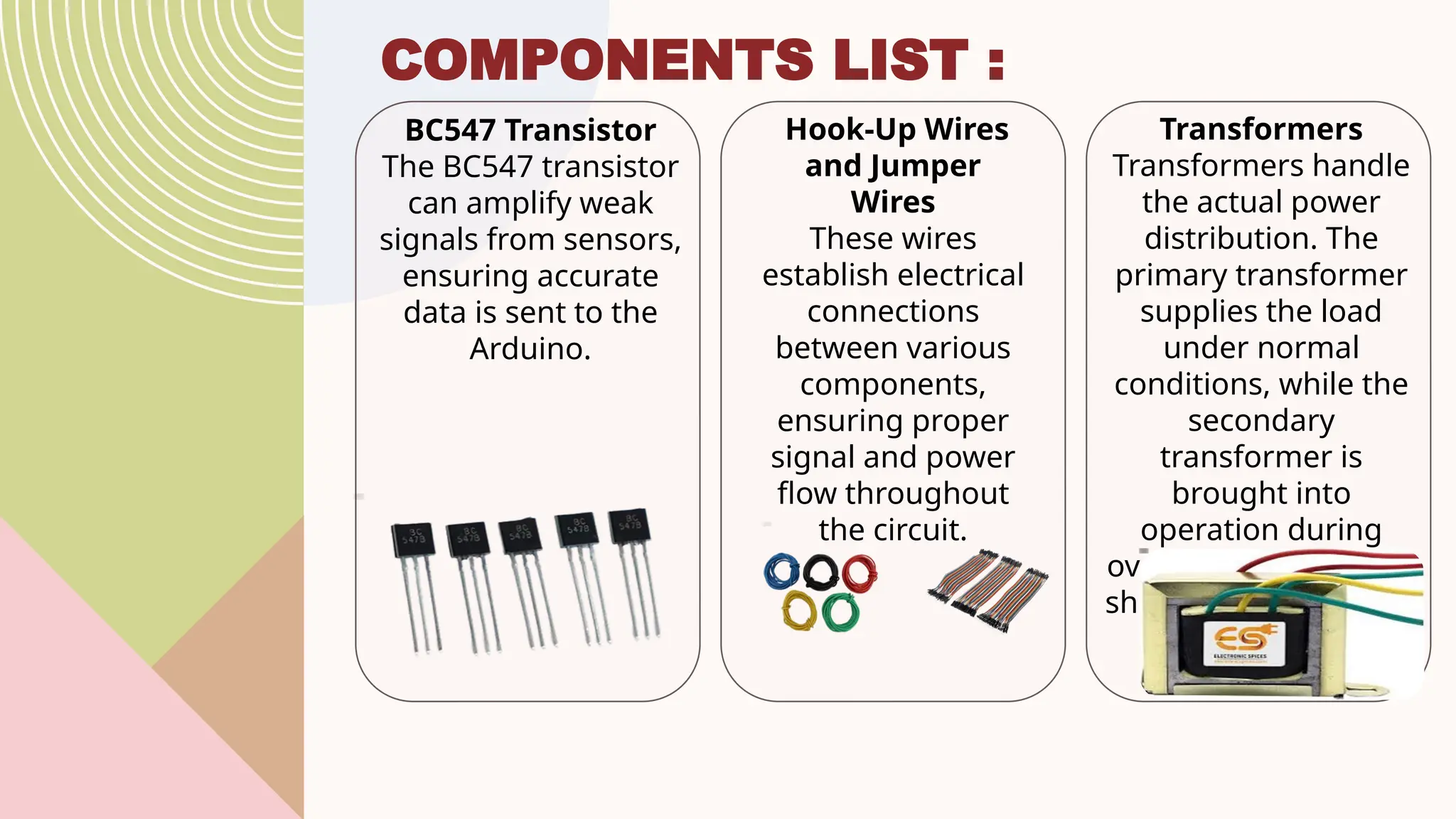
Hook-Up Wires
and Jumper
Wires
These wires
establish electrical
connections
between various
components,
ensuring proper
signal and power
flow throughout
the circuit.
BC547 Transistor
The BC547 transistor
can amplify weak
signals from sensors,
ensuring accurate
data is sent to the
Arduino.
Transformers
Transformers handle
the actual power
distribution. The
primary transformer
supplies the load
under normal
conditions, while the
secondary
transformer is
brought into
operation during
overload situations to
share the excess load.
COMPONENTS LIST :
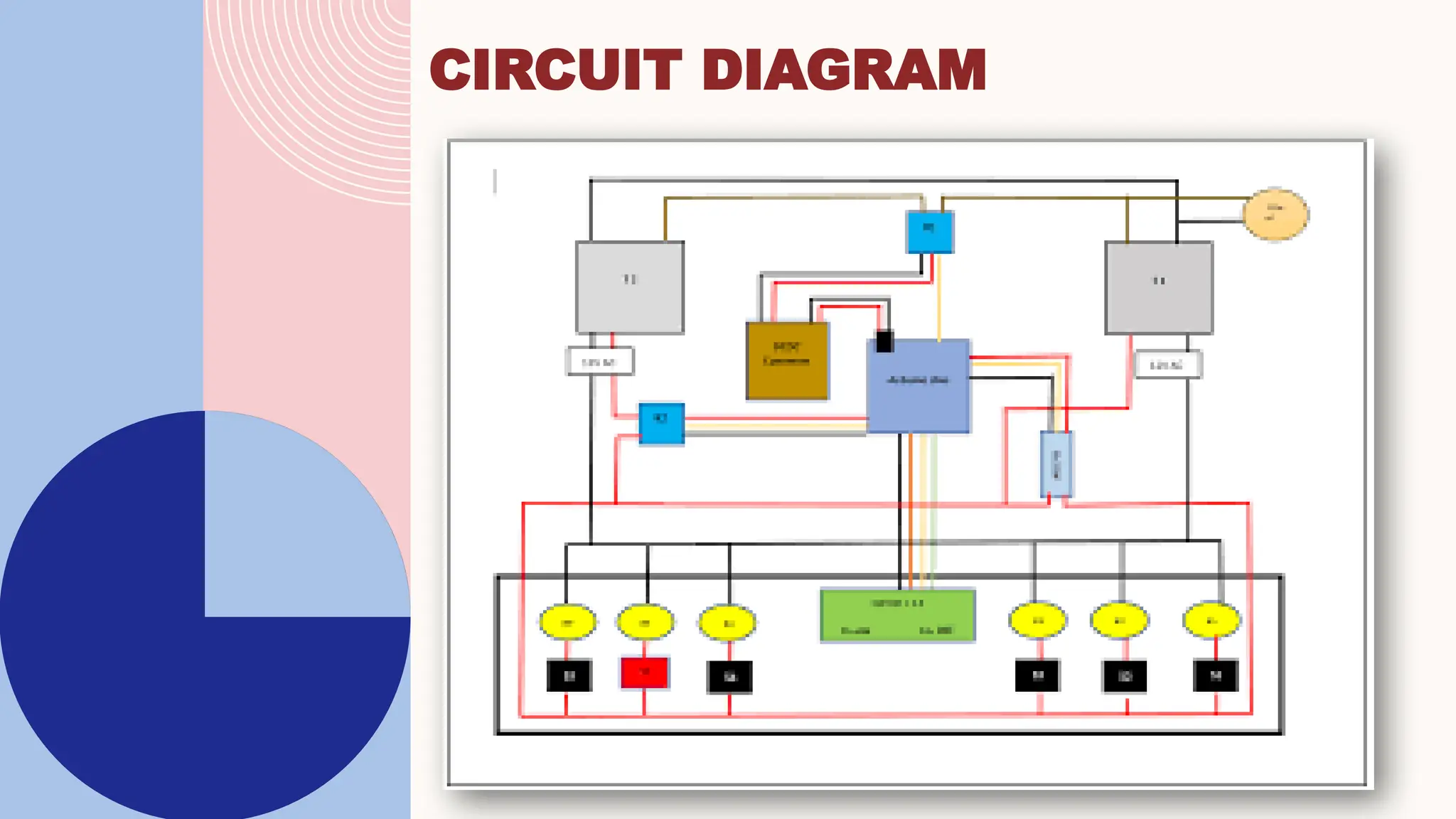
CIRCUIT DIAGRAM
ADVANTAGE
o Protects transformers
from overheating and
damage
o Ensures uninterrupted
power supply.
o Increases system
efficiency and reduces
manual errors.
o Enables cost-effective
long-distance power
transfer.
o Demand growth rate
dependency on
population and
economy.
o Need for advanced
fault current and
surge voltage sensing.
DISADVANATAGE
APPLICATIONS
o Protecting transformers from damage.
o Ensuring uninterrupted power supply
for critical sectors like hospitals and
industries.
o Enhancing system efficiency and
reliability.
11
CONCLUSIONS
In conclusion, this project provides a practical solution to
transformer overloading by implementing an automatic
load-sharing system using Arduino. It ensures efficient
load distribution, real-time monitoring, and uninterrupted
power supply to critical facilities like hospitals. The system
enhances transformer reliability and lifespan while
offering a scalable and cost-effective approach to power
system stability and management.
12
Q&A
13
THANK
YOU…

Automatic Load Sharing Transformer Using.pptx

  • 1.
  • 2.
    PRESENTED BY : ABHINAWKUMAR SINGH DEVESH MODANWAL UJJWAL VAISH AKASH CHAURASIYA KIPM COLLEGE OF ENGINEERING & TECHNOLOGY GIDA, GORAKHPUR
  • 3.
    TABLE OF CONTENT Introduction  Project Objective  Components and Their Uses a. Arduino UNO b. LCD I2C Display c. Adapter d. Current Sensor e. Capacitor f. 1N4007 Diode g. BC547 Transistor h. Hook-Up Wires and Jumper Wires  Transformer  Circuit Diagram  Advantages & Disadvantages  Applications
  • 4.
    Transformers are vitalin power systems but need protection due to overloading from rising electricity demands, leading to reduced efficiency and costly damage. This project prevents transformer failure by connecting an additional transformer in parallel via a microcontroller and relay to share excess load. Alternating their operation avoids overheating, while priority-based load shedding ensures uninterrupted power for critical facilities like hospitals and industries. INTRODUCTION
  • 5.
    OBJECTIVE The primary objectiveof this project is to protect transformers from overloaded conditions by effectively sharing the load between multiple transformers. It involves measuring the current and load in watts for both transformers to monitor their operating conditions. Additionally, the system continuously tracks the loading on each transformer to ensure balanced operation. It also calculates the percentage of overload to identify and prevent potential damage, ensuring efficient and safe functioning of the transformers.
  • 6.
    COMPONENTS LIST : LCDI2C Display The LCD displays real-time information, such as the current load on each transformer and the percentage of overload. This allows users to monitor the system's performance conveniently. Arduino UNO The arduino UNO serves as the brain of the system. It processes data from current sensors to monitor the load on each transformer. Based on the load conditions, it activates relays to connect or disconnect the secondary transformer and ensures efficient load sharing Adaptor The adapter provides a stable DC power supply to the Arduino and other low-voltage components, converting A0C from the main supply to the required DC voltage level
  • 7.
    Capacitor The capacitor smoothens voltage fluctuations from thesensors and power supply. This ensures stable operation of the Arduino and other components. Current Sensors Current sensors measure the load in amps or watts on both transformers. This data is sent to the Arduino, which uses it to monitor and calculate overload conditions. N4007 Diode These diodes prevent reverse current from flowing back into the circuit, protecting sensitive components like sensors and the Arduino. COMPONENTS LIST :
  • 8.
    Hook-Up Wires and Jumper Wires Thesewires establish electrical connections between various components, ensuring proper signal and power flow throughout the circuit. BC547 Transistor The BC547 transistor can amplify weak signals from sensors, ensuring accurate data is sent to the Arduino. Transformers Transformers handle the actual power distribution. The primary transformer supplies the load under normal conditions, while the secondary transformer is brought into operation during overload situations to share the excess load. COMPONENTS LIST :
  • 9.
  • 10.
    ADVANTAGE o Protects transformers fromoverheating and damage o Ensures uninterrupted power supply. o Increases system efficiency and reduces manual errors. o Enables cost-effective long-distance power transfer. o Demand growth rate dependency on population and economy. o Need for advanced fault current and surge voltage sensing. DISADVANATAGE
  • 11.
    APPLICATIONS o Protecting transformersfrom damage. o Ensuring uninterrupted power supply for critical sectors like hospitals and industries. o Enhancing system efficiency and reliability. 11
  • 12.
    CONCLUSIONS In conclusion, thisproject provides a practical solution to transformer overloading by implementing an automatic load-sharing system using Arduino. It ensures efficient load distribution, real-time monitoring, and uninterrupted power supply to critical facilities like hospitals. The system enhances transformer reliability and lifespan while offering a scalable and cost-effective approach to power system stability and management. 12
  • 13.
  • 14.