Breakdown in liquid dielectrics
Chapter Contents:
• Pure and Commercial liquids
• Different breakdown theories
• Breakdown in pure liquid
• Breakdown in commercial liquids
• Suspended particle theory
• Cavitation's and bubble theory
• Thermal mechanism of breakdown
• Stressed oil volume theory
21/01/2020 MBM 1
Introduction
21/01/2020 MBM 2
• More useful as a insulating material
• 103 times denser than gases.
• High Dielectric Strength of order of 107 V/cm.
• Complete volume to be insulated and dissipate heat by convection.
• Higher dielectric strength is of the order of 10 MV/cm but in practice it is obtain of the
order 100kV/cm.
• Insulating oils are used in power and instrument transformers, power cables, circuit
breakers, power capacitors etc.
• Liquid dielectrics acts as heat transfer agent in transformers and arc quenching medium
in circuit breakers.
• For very high temperature applications, silicon oils and fluorinated hydrocarbons are
employed.
21/01/2020 MBM 3
Here they perform a number of functions simultaneously, namely
• Insulation between the parts carrying voltage and the grounded container, as in
transformers.
• Impregnation of insulation provided in thin layers of paper or other materials, as in
transformers, cables and capacitors, where oils or impregnating compounds are
used.
• Cooling action by convection in transformers and oil filled cables through
circulation.
• Filling up of the voids to form an electrically stronger integral part of a composite
dielectric.
• Arc extinction in oil circuit breakers.
• High capacitance provided by liquid dielectrics with high permittivity to power
capacitors.
21/01/2020 MBM 4
21/01/2020 MBM 5
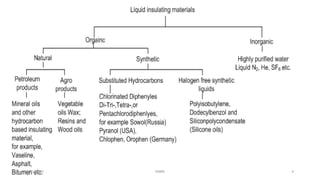
Classification of liquid dielectrics
• Mineral oils and other polyester oils are extensively used in transformers in Europe and
other countries.
• Pentra-Ethythrite-Tetra Fatty Acid Polyester Oil (PETFP oil) has a very good electrical,
physical and thermal Properties.
• It is biodegradable. Almost negligible toxicity and does not contribute to pollution.
a) Transformer oil (Mineral oil):-
used in power apparatus.
Colourless.
mixture of hydrocarbons (includes paraffin, iso-paraffin, naphthalenes and aromatics )
Complete specification for testing transformer oil is given in IS 1866 (1983)IEC 296
(1969) and IEC (1974)
21/01/2020 MBM 6
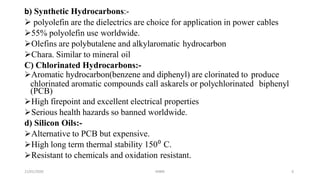
b) Synthetic Hydrocarbons:-
 polyolefin are the dielectrics are choice for application in power cables
55% polyolefin use worldwide.
Olefins are polybutalene and alkylaromatic hydrocarbon
Chara. Similar to mineral oil
C) Chlorinated Hydrocarbons:-
Aromatic hydrocarbon(benzene and diphenyl) are clorinated to produce
chlorinated aromatic compounds call askarels or polychlorinated biphenyl
(PCB)
High firepoint and excellent electrical properties
Serious health hazards so banned worldwide.
d) Silicon Oils:-
Alternative to PCB but expensive.
High long term thermal stability 150⁰ C.
Resistant to chemicals and oxidation resistant.
21/01/2020 MBM 7
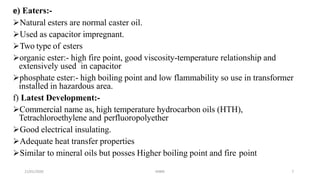
e) Eaters:-
Natural esters are normal caster oil.
Used as capacitor impregnant.
Two type of esters
organic ester:- high fire point, good viscosity-temperature relationship and
extensively used in capacitor
phosphate ester:- high boiling point and low flammability so use in transformer
installed in hazardous area.
f) Latest Development:-
Commercial name as, high temperature hydrocarbon oils (HTH),
Tetrachloroethylene and perfluoropolyether
Good electrical insulating.
Adequate heat transfer properties
Similar to mineral oils but posses Higher boiling point and fire point
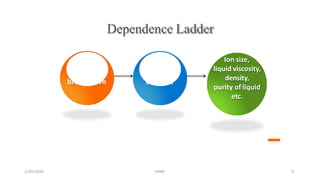
Dependence Ladder
Dielectric
breakdown
Dielectric
strength
Ion size,
liquid viscosity,
density,
purity of liquid
etc.
21/01/2020 MBM 8
21/01/2020 MBM 9
Pure liquid and commercial liquid
• Pure liquids:- which are chemically pure, do not contain any other impurity in traces of 1 in
109, and structurally simple. By using pure liquid , it is easier to separate out various factors
that influence conduction and breakdown in them.
E.g. n-hexane (C6H14), n-heptane (C7H16) and other paraffin hydrocarbon
• Commercial liquids:- which are insulating liquid and are not chemically pure
Purification of Liquid Dielectric
21/01/2020 MBM 10
• Impurities are dust, moisture, dissolved gases and ionic impurities which reduces
breakdown strength of liquid.
• Various methods employed for purification are Filtration (through mechanical
filters, spray filters and electrostatic filters), centrifuging, degassing and
distillation and chemical treatment.
• Dust ------ careful filtration
• Moisture and dissolve gases----- distillation and degassing
• Ionic impurity(water vapour) -----using drying or frozen agents or by vacuum
drying .
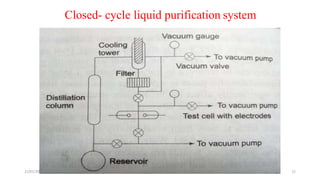
Closed- cycle liquid purification system
21/01/2020 MBM 11
21/01/2020 MBM 12
• This system provides for cycling liquid.
• The liquid from reservoir flows through distillation column where
ionic impurities are removed.
• Water is removed by drying agents or frozen out in low-temperature
bath.
• The gases dissolved in liquid then passes through filter where dust
particles are removed.
• The liquid thus purified is then used in testcell.
• The used liquid then flows back intoreservoir.
• The vacuum system thus helps to remove moisture and other gaseous
impurities.
21/01/2020 MBM 13
Breakdown tests
• Breakdown tests are usually conducted using test cells. For testing pure liquids the test
cells used are small so that less quantity of liquid is used during testing.
• The electrodes used for breakdown voltage measurement are usually spheres of 0.5 to 1
cm in diameter with gap spacing's of about 100-200 nm (i.e. 0.1 mm).
• The gap is accurately controlled by using micrometer. Sometimes parallel plane uniform
field electrode system are also used.
• Electrode separation is very critical in measurements with liquids, and also influence on
breakdown strength.
• The test voltages required for these tests are usually low of the order of 50-100 kV,
because of small electrode spacing's.
• The breakdown strengths and dc conductivities being measured of electric field of order
of 1 kV/cm.
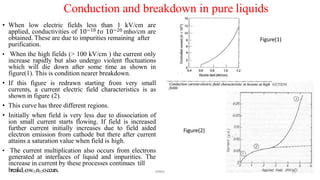
• When low electric fields less than 1 kV/cm are
applied, conductivities of 10−18 𝑡𝑜 10−20 mho/cm are
obtained. These are due to impurities remaining after
purification.
• When the high fields (> 100 kV/cm ) the current only
increase rapidly but also undergo violent fluctuations
which will die down after some time as shown in
figure(1). This is condition nearer breakdown.
• If this figure is redrawn starting from very small
currents, a current electric field characteristics is as
shown in figure (2).
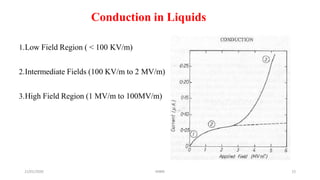
• This curve has three different regions.
• Initially when field is very less due to dissociation of
ion small current starts flowing. If field is increased
further current initially increases due to field aided
electron emission from cathode but there after current
attains a saturation value when field is high.
• The current multiplication also occurs from electrons
generated at interfaces of liquid and impurities. The
increase in current by these processes continues till
Conduction and breakdown in pure liquids
breakd21o/w01/n202o0ccurs. 14MBM
Figure(1)
Figure(2)
Conduction in Liquids
1.Low Field Region ( < 100 KV/m)
2.Intermediate Fields (100 KV/m to 2 MV/m)
3.High Field Region (1 MV/m to 100MV/m)
21/01/2020 MBM 15
21/01/2020 MBM 16
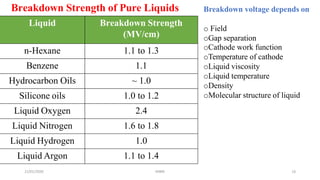
Breakdown Strength of Pure Liquids
Liquid Breakdown Strength
(MV/cm)
n-Hexane 1.1 to 1.3
Benzene 1.1
Hydrocarbon Oils ~ 1.0
Silicone oils 1.0 to 1.2
Liquid Oxygen 2.4
Liquid Nitrogen 1.6 to 1.8
Liquid Hydrogen 1.0
Liquid Argon 1.1 to 1.4
Breakdown voltage depends on
o Field
oGap separation
oCathode work function
oTemperature of cathode
oLiquid viscosity
oLiquid temperature
oDensity
oMolecular structure of liquid
Conduction and breakdown in commercial liquid
21/01/2020 MBM 17
Factors affecting Breakdown
• Nature and condition of Electrodes.
• Physical properties of liquid.
• Impurities present.
• Dissolved Gases.
• Geometry of Electrodes.
• Volume of Liquid in High Stressed Region
Theories Proposed for Breakdown
• Suspended particle theory (∈2 > ∈1)
• Cavitations and bubble theory (∈2 < ∈1)
• Statistical or stressed oil volume theory
• Commercial Insulating liquids are not chemically
pure and have impurities like gas bubbles, suspended
particles etc.
• These impurities reduces breakdown strength of
these liquids considerably.
• When breakdown occurs in these liquids, additional
gases and gas bubbles are evolved and solid
decomposition products are formed.
• The electrode surface becomes rough and at times
explosive sounds are heard due to generation of
impulsive pressure through liquids.
Suspended particle theory
Reasons responsible for breakdown
• In commercial liquids, solid impurities will be present as fibres or as dispersed solid particles.
• If ∈2 is the permittivity of solid particles & ∈1 is the permittivity of liquid.
• If we consider these impurities to be spherical particles of radius r, and applied field is E, then the particle
experience force F, where
F= ½ 𝑟3 [(∈2 - ∈1) / (2∈1+∈2)]*Grad𝐸2
• If ∈2 > ∈1, e. g. In case of presence of solid particles like paper in liquid force is directed towards
maximum stress.
• The force will be in direction of areas of lower stress if only gas bubbles are present in liquid i.e. ∈2 < ∈1.
• This force drives the particle towards areas of maximum stress if voltage is continuously applied (D.C.) or
the duration of voltage is long (A.C.)
• Thus a stable chain of suspended particles can form which may bridge electrode gap if number of particles
are more. This will lead to breakdown.
• In case of less number of suspended particles or these may be single conducting particle between
electrodes, it will rise to local field enhancement depending on its shape.
• Local breakdown occurs near particle when field exceeds breakdown voltage of liquid.
• Th21u/0s1/g20a2s0bubbles are formed which may lead to breMaBkMdownof liquid. 18
21/01/2020 MBM 19
• Factors affecting on breakdown
• Impurity particles and its permittivity affects the breakdown strength. Larger the size of particle
lower will be breakdown strength.
• The values of breakdown strength of liquids containing solid impurities will be much less than
values of pure liquids.
Cavitation and bubble theory
• According to this theory a kind of vapour bubble formed is responsible for breakdown. Vapour bubbles may
form in liquids due to following reasons.
1. Between space charges electrostatic repulsive forces may exist and they may be sufficient to overcome
surface tension.
2. Electron collisions cause dissociations of liquid molecules and thus gases are produced.
3. Gas pockets may be available at surface of electrode.
4. Sharp points and irregularities on electrode surface causes vaporization of liquid by corona type discharge.
• Electrostatic forces will act on bubble and it will elongate in direction of electric field.
• When the voltage drop along the length of bubble becomes equal to minimum value on Paschens curve for
gas in bubble breakdown occurs.
𝐸0 = 1/(∈1 - ∈2) [ 2𝜋𝜎 ( 2 ∈1 + ∈2 ) /r { 𝜋/4 𝑉 𝑏/2𝑟𝐸0 - 1}]^ ½
Where,
21/01/2020 MBM 20
𝜎- surface tension of liquid.
𝑉𝑏- Voltage drop in bubble.
∈1& ∈2 - Permittivity of liquid & gas bubble respectively
r – initial radius of bubble as sphere.
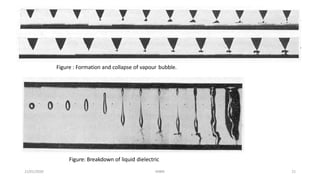
Figure : Formation and collapse of vapour bubble.
Figure: Breakdown of liquid dielectric
21/01/2020 MBM 21
21/01/2020 MBM 22
Factors affecting on breakdown
From above equation it can be seen that breakdown strength depends on initial size
of bubble and it is affected by temperature of liquid and hydrostatic pressure.
Drawback
The production of initial bubble are not considered in this theory and hence results
given by this theory do not agree with experimental results.
21/01/2020 MBM 23
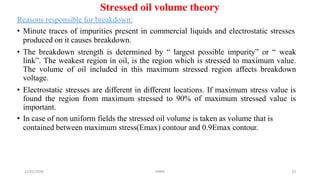
Stressed oil volume theory
Reasons responsible for breakdown:
• Minute traces of impurities present in commercial liquids and electrostatic stresses
produced on it causes breakdown.
• The breakdown strength is determined by “ largest possible impurity” or “ weak
link”. The weakest region in oil, is the region which is stressed to maximum value.
The volume of oil included in this maximum stressed region affects breakdown
voltage.
• Electrostatic stresses are different in different locations. If maximum stress value is
found the region from maximum stressed to 90% of maximum stressed value is
important.
• In case of non uniform fields the stressed oil volume is taken as volume that is
contained between maximum stress(Emax) contour and 0.9Emax contour.
Factors affecting on breakdown
• The breakdown strength is inversely
proportional to stressed oil volume.
• breakdown voltage is highly
dependent on presence of other
impurities, gas contents in oil and
viscosity of oil.
• Larger the stressed oil volume less
in breakdown voltage. The variation
of breakdown voltage stress with
stressed oil volume is shown in
figure.
21/01/2020 MBM 24
21/01/2020 MBM 25
Thermal mechanism of breakdown
Reasons responsible for breakdown
• It is based on experimental observations of extremely large currents which are present just before breakdown.
• The sharp tips of microscopic projections on cathode surface causes high current pulses with densities about
1A/𝑐𝑚3.
• When these high density circuit pulses are produced they cause localized heating of oil which may lead to
formation of vapour bubbles.
• When the energy exceeds 107 J/𝑐𝑚2 vapour bubbles are formed.
• When a bubble is formed, its size increases and due to its elongation gap between electrode bridges. It will
result in formation of spark.
Factors affecting on breakdown:
• Breakdown system depends on molecular structure of liquid.
Drawback:
• This theory is only applicable for very small gap length( ≤ 100 𝜇𝑚).
• It does not explain effect of increased gap lengths on reduction in breakdown strength.
21/01/2020 MBM 26
Agents which contaminate Transformer oil/ Impurities in liquid dielectric Material
The oil should be pure and free from impurities. But following different agents
contaminate oil and becomes impure and loses its dielectric and insulating
properties.
i. Water
ii. Dirt/dust
iii. Solid particles/sludges
iv. Fibers of various origins
v. Sulphur
vi. Acid
vii. Gases
viii. Grease
ix. Carbons
x. Hydrocarbons.
21/01/2020 MBM 27

Chapter 2 breakdown in liquids

  • 1.
    Breakdown in liquiddielectrics Chapter Contents: • Pure and Commercial liquids • Different breakdown theories • Breakdown in pure liquid • Breakdown in commercial liquids • Suspended particle theory • Cavitation's and bubble theory • Thermal mechanism of breakdown • Stressed oil volume theory 21/01/2020 MBM 1
  • 2.
    Introduction 21/01/2020 MBM 2 •More useful as a insulating material • 103 times denser than gases. • High Dielectric Strength of order of 107 V/cm. • Complete volume to be insulated and dissipate heat by convection. • Higher dielectric strength is of the order of 10 MV/cm but in practice it is obtain of the order 100kV/cm. • Insulating oils are used in power and instrument transformers, power cables, circuit breakers, power capacitors etc. • Liquid dielectrics acts as heat transfer agent in transformers and arc quenching medium in circuit breakers. • For very high temperature applications, silicon oils and fluorinated hydrocarbons are employed.
  • 3.
    21/01/2020 MBM 3 Herethey perform a number of functions simultaneously, namely • Insulation between the parts carrying voltage and the grounded container, as in transformers. • Impregnation of insulation provided in thin layers of paper or other materials, as in transformers, cables and capacitors, where oils or impregnating compounds are used. • Cooling action by convection in transformers and oil filled cables through circulation. • Filling up of the voids to form an electrically stronger integral part of a composite dielectric. • Arc extinction in oil circuit breakers. • High capacitance provided by liquid dielectrics with high permittivity to power capacitors.
  • 4.
  • 5.
    21/01/2020 MBM 5 Classificationof liquid dielectrics • Mineral oils and other polyester oils are extensively used in transformers in Europe and other countries. • Pentra-Ethythrite-Tetra Fatty Acid Polyester Oil (PETFP oil) has a very good electrical, physical and thermal Properties. • It is biodegradable. Almost negligible toxicity and does not contribute to pollution. a) Transformer oil (Mineral oil):- used in power apparatus. Colourless. mixture of hydrocarbons (includes paraffin, iso-paraffin, naphthalenes and aromatics ) Complete specification for testing transformer oil is given in IS 1866 (1983)IEC 296 (1969) and IEC (1974)
  • 6.
    21/01/2020 MBM 6 b)Synthetic Hydrocarbons:-  polyolefin are the dielectrics are choice for application in power cables 55% polyolefin use worldwide. Olefins are polybutalene and alkylaromatic hydrocarbon Chara. Similar to mineral oil C) Chlorinated Hydrocarbons:- Aromatic hydrocarbon(benzene and diphenyl) are clorinated to produce chlorinated aromatic compounds call askarels or polychlorinated biphenyl (PCB) High firepoint and excellent electrical properties Serious health hazards so banned worldwide. d) Silicon Oils:- Alternative to PCB but expensive. High long term thermal stability 150⁰ C. Resistant to chemicals and oxidation resistant.
  • 7.
    21/01/2020 MBM 7 e)Eaters:- Natural esters are normal caster oil. Used as capacitor impregnant. Two type of esters organic ester:- high fire point, good viscosity-temperature relationship and extensively used in capacitor phosphate ester:- high boiling point and low flammability so use in transformer installed in hazardous area. f) Latest Development:- Commercial name as, high temperature hydrocarbon oils (HTH), Tetrachloroethylene and perfluoropolyether Good electrical insulating. Adequate heat transfer properties Similar to mineral oils but posses Higher boiling point and fire point
  • 8.
    Dependence Ladder Dielectric breakdown Dielectric strength Ion size, liquidviscosity, density, purity of liquid etc. 21/01/2020 MBM 8
  • 9.
    21/01/2020 MBM 9 Pureliquid and commercial liquid • Pure liquids:- which are chemically pure, do not contain any other impurity in traces of 1 in 109, and structurally simple. By using pure liquid , it is easier to separate out various factors that influence conduction and breakdown in them. E.g. n-hexane (C6H14), n-heptane (C7H16) and other paraffin hydrocarbon • Commercial liquids:- which are insulating liquid and are not chemically pure
  • 10.
    Purification of LiquidDielectric 21/01/2020 MBM 10 • Impurities are dust, moisture, dissolved gases and ionic impurities which reduces breakdown strength of liquid. • Various methods employed for purification are Filtration (through mechanical filters, spray filters and electrostatic filters), centrifuging, degassing and distillation and chemical treatment. • Dust ------ careful filtration • Moisture and dissolve gases----- distillation and degassing • Ionic impurity(water vapour) -----using drying or frozen agents or by vacuum drying .
  • 11.
    Closed- cycle liquidpurification system 21/01/2020 MBM 11
  • 12.
    21/01/2020 MBM 12 •This system provides for cycling liquid. • The liquid from reservoir flows through distillation column where ionic impurities are removed. • Water is removed by drying agents or frozen out in low-temperature bath. • The gases dissolved in liquid then passes through filter where dust particles are removed. • The liquid thus purified is then used in testcell. • The used liquid then flows back intoreservoir. • The vacuum system thus helps to remove moisture and other gaseous impurities.
  • 13.
    21/01/2020 MBM 13 Breakdowntests • Breakdown tests are usually conducted using test cells. For testing pure liquids the test cells used are small so that less quantity of liquid is used during testing. • The electrodes used for breakdown voltage measurement are usually spheres of 0.5 to 1 cm in diameter with gap spacing's of about 100-200 nm (i.e. 0.1 mm). • The gap is accurately controlled by using micrometer. Sometimes parallel plane uniform field electrode system are also used. • Electrode separation is very critical in measurements with liquids, and also influence on breakdown strength. • The test voltages required for these tests are usually low of the order of 50-100 kV, because of small electrode spacing's. • The breakdown strengths and dc conductivities being measured of electric field of order of 1 kV/cm.
  • 14.
    • When lowelectric fields less than 1 kV/cm are applied, conductivities of 10−18 𝑡𝑜 10−20 mho/cm are obtained. These are due to impurities remaining after purification. • When the high fields (> 100 kV/cm ) the current only increase rapidly but also undergo violent fluctuations which will die down after some time as shown in figure(1). This is condition nearer breakdown. • If this figure is redrawn starting from very small currents, a current electric field characteristics is as shown in figure (2). • This curve has three different regions. • Initially when field is very less due to dissociation of ion small current starts flowing. If field is increased further current initially increases due to field aided electron emission from cathode but there after current attains a saturation value when field is high. • The current multiplication also occurs from electrons generated at interfaces of liquid and impurities. The increase in current by these processes continues till Conduction and breakdown in pure liquids breakd21o/w01/n202o0ccurs. 14MBM Figure(1) Figure(2)
  • 15.
    Conduction in Liquids 1.LowField Region ( < 100 KV/m) 2.Intermediate Fields (100 KV/m to 2 MV/m) 3.High Field Region (1 MV/m to 100MV/m) 21/01/2020 MBM 15
  • 16.
    21/01/2020 MBM 16 BreakdownStrength of Pure Liquids Liquid Breakdown Strength (MV/cm) n-Hexane 1.1 to 1.3 Benzene 1.1 Hydrocarbon Oils ~ 1.0 Silicone oils 1.0 to 1.2 Liquid Oxygen 2.4 Liquid Nitrogen 1.6 to 1.8 Liquid Hydrogen 1.0 Liquid Argon 1.1 to 1.4 Breakdown voltage depends on o Field oGap separation oCathode work function oTemperature of cathode oLiquid viscosity oLiquid temperature oDensity oMolecular structure of liquid
  • 17.
    Conduction and breakdownin commercial liquid 21/01/2020 MBM 17 Factors affecting Breakdown • Nature and condition of Electrodes. • Physical properties of liquid. • Impurities present. • Dissolved Gases. • Geometry of Electrodes. • Volume of Liquid in High Stressed Region Theories Proposed for Breakdown • Suspended particle theory (∈2 > ∈1) • Cavitations and bubble theory (∈2 < ∈1) • Statistical or stressed oil volume theory • Commercial Insulating liquids are not chemically pure and have impurities like gas bubbles, suspended particles etc. • These impurities reduces breakdown strength of these liquids considerably. • When breakdown occurs in these liquids, additional gases and gas bubbles are evolved and solid decomposition products are formed. • The electrode surface becomes rough and at times explosive sounds are heard due to generation of impulsive pressure through liquids.
  • 18.
    Suspended particle theory Reasonsresponsible for breakdown • In commercial liquids, solid impurities will be present as fibres or as dispersed solid particles. • If ∈2 is the permittivity of solid particles & ∈1 is the permittivity of liquid. • If we consider these impurities to be spherical particles of radius r, and applied field is E, then the particle experience force F, where F= ½ 𝑟3 [(∈2 - ∈1) / (2∈1+∈2)]*Grad𝐸2 • If ∈2 > ∈1, e. g. In case of presence of solid particles like paper in liquid force is directed towards maximum stress. • The force will be in direction of areas of lower stress if only gas bubbles are present in liquid i.e. ∈2 < ∈1. • This force drives the particle towards areas of maximum stress if voltage is continuously applied (D.C.) or the duration of voltage is long (A.C.) • Thus a stable chain of suspended particles can form which may bridge electrode gap if number of particles are more. This will lead to breakdown. • In case of less number of suspended particles or these may be single conducting particle between electrodes, it will rise to local field enhancement depending on its shape. • Local breakdown occurs near particle when field exceeds breakdown voltage of liquid. • Th21u/0s1/g20a2s0bubbles are formed which may lead to breMaBkMdownof liquid. 18
  • 19.
    21/01/2020 MBM 19 •Factors affecting on breakdown • Impurity particles and its permittivity affects the breakdown strength. Larger the size of particle lower will be breakdown strength. • The values of breakdown strength of liquids containing solid impurities will be much less than values of pure liquids.
  • 20.
    Cavitation and bubbletheory • According to this theory a kind of vapour bubble formed is responsible for breakdown. Vapour bubbles may form in liquids due to following reasons. 1. Between space charges electrostatic repulsive forces may exist and they may be sufficient to overcome surface tension. 2. Electron collisions cause dissociations of liquid molecules and thus gases are produced. 3. Gas pockets may be available at surface of electrode. 4. Sharp points and irregularities on electrode surface causes vaporization of liquid by corona type discharge. • Electrostatic forces will act on bubble and it will elongate in direction of electric field. • When the voltage drop along the length of bubble becomes equal to minimum value on Paschens curve for gas in bubble breakdown occurs. 𝐸0 = 1/(∈1 - ∈2) [ 2𝜋𝜎 ( 2 ∈1 + ∈2 ) /r { 𝜋/4 𝑉 𝑏/2𝑟𝐸0 - 1}]^ ½ Where, 21/01/2020 MBM 20 𝜎- surface tension of liquid. 𝑉𝑏- Voltage drop in bubble. ∈1& ∈2 - Permittivity of liquid & gas bubble respectively r – initial radius of bubble as sphere.
  • 21.
    Figure : Formationand collapse of vapour bubble. Figure: Breakdown of liquid dielectric 21/01/2020 MBM 21
  • 22.
    21/01/2020 MBM 22 Factorsaffecting on breakdown From above equation it can be seen that breakdown strength depends on initial size of bubble and it is affected by temperature of liquid and hydrostatic pressure. Drawback The production of initial bubble are not considered in this theory and hence results given by this theory do not agree with experimental results.
  • 23.
    21/01/2020 MBM 23 Stressedoil volume theory Reasons responsible for breakdown: • Minute traces of impurities present in commercial liquids and electrostatic stresses produced on it causes breakdown. • The breakdown strength is determined by “ largest possible impurity” or “ weak link”. The weakest region in oil, is the region which is stressed to maximum value. The volume of oil included in this maximum stressed region affects breakdown voltage. • Electrostatic stresses are different in different locations. If maximum stress value is found the region from maximum stressed to 90% of maximum stressed value is important. • In case of non uniform fields the stressed oil volume is taken as volume that is contained between maximum stress(Emax) contour and 0.9Emax contour.
  • 24.
    Factors affecting onbreakdown • The breakdown strength is inversely proportional to stressed oil volume. • breakdown voltage is highly dependent on presence of other impurities, gas contents in oil and viscosity of oil. • Larger the stressed oil volume less in breakdown voltage. The variation of breakdown voltage stress with stressed oil volume is shown in figure. 21/01/2020 MBM 24
  • 25.
    21/01/2020 MBM 25 Thermalmechanism of breakdown Reasons responsible for breakdown • It is based on experimental observations of extremely large currents which are present just before breakdown. • The sharp tips of microscopic projections on cathode surface causes high current pulses with densities about 1A/𝑐𝑚3. • When these high density circuit pulses are produced they cause localized heating of oil which may lead to formation of vapour bubbles. • When the energy exceeds 107 J/𝑐𝑚2 vapour bubbles are formed. • When a bubble is formed, its size increases and due to its elongation gap between electrode bridges. It will result in formation of spark. Factors affecting on breakdown: • Breakdown system depends on molecular structure of liquid. Drawback: • This theory is only applicable for very small gap length( ≤ 100 𝜇𝑚). • It does not explain effect of increased gap lengths on reduction in breakdown strength.
  • 26.
    21/01/2020 MBM 26 Agentswhich contaminate Transformer oil/ Impurities in liquid dielectric Material The oil should be pure and free from impurities. But following different agents contaminate oil and becomes impure and loses its dielectric and insulating properties. i. Water ii. Dirt/dust iii. Solid particles/sludges iv. Fibers of various origins v. Sulphur vi. Acid vii. Gases viii. Grease ix. Carbons x. Hydrocarbons.
  • 27.