International Research Journal of Engineering and Technology (IRJET) e-ISSN: 2395-0056
Volume: 06 Issue: 04 | Apr 2019 www.irjet.net p-ISSN: 2395-0072
© 2019, IRJET | Impact Factor value: 7.211 | ISO 9001:2008 Certified Journal | Page 3831
Load sharing of Transformer using Microcontroller
K V Shashankkumar1, Raghavendra Naik2, Naresh Nayak3, Prof.Altaf Mudhol4
1,2,3,Anjuman Institute of Technology and Management (AITM), Bhatkal
4professor,Department of Electrical and Electronics engineering (AITM),Bhatkal
---------------------------------------------------------------------***---------------------------------------------------------------------
Abstract - The transformerisastaticdevice, whichconverts
power from one level to another level. The aim of the project is
to protect the transformer under overload condition by load
sharing. Due to overload on transformer, the efficiency drops
and windings get overheated and may get burnt. Thus by
sharing load on transformer, the transformer is protected.
This will be done by connecting another transformer in
parallel through a micro-controller. The microcontroller
compares the load on the first transformer with a reference
value. When the load exceeds the reference value, the second
transformer will share the extra load. Therefore, the two
transformer work efficiently and damage is prevented. In this
project three modules are used to control the load currents.
The first module is a sensing unit, which is used to sense the
current of the load and the second module is a control unit.
The last module is microcontroller unit and it will read the
analogue signal and perform some calculation and finally
gives control signal to a relay. The advantages of the project
are transformer protection, uninterrupted power supply, and
short circuit protection. When designing low-voltage power
system to the supply large load currents, paralleled lower-
current modules are often preferred over asingle, large power
converter for several reasons. These include the efficiency of
designing and manufacturing standard modular converters
which can be combined in any number necessary to meet a
given load requirement and the enhanced reliability gained
through redundancy.
KEYWORDS: Capacity, Interruption, Load; System,
Transformer, Microcontroller.
1.INTRODUCTION
Power travels from the power plant to house through an
amazing system called the power distribution grid. For
power to be useful in a home or business, it comes off the
transmission grid and is stepped-down to the distribution
grid. This may happen in several phases.The placewhere the
conversion from "transmission" to"distribution" occursisin
a power substation. It has transformers that step
transmission voltages (in the tens or hundreds of thousands
of volts range) down to distribution voltages (typically less
than 10,000 volts). It has a “bus” that can split the
distribution power off in multiple directions. It often has
circuit breakers and switches so that the substation can be
disconnected from the transmission grid or separate
distribution lines can be disconnected from the substation
when necessary.5 8
Transformers being one of the mostsignificant equipment in
the electric power system, needs protection as a part of the
general system protection approach. Moreover the
increasing population and their unavoidable demands have
lead to an increasing demand on electrical power. With this
increased needs, the existing systems have become
overloaded. The overloading at theconsumerendappears at
the transformer terminals which can affect its efficiency and
protection systems. Due to overload on the transformer, the
efficiency drops and the windings gets over heated and may
get burnt. It takes a lot of time to repair and involves a lot of
expenditure. Transformers are occasionally loaded beyond
nameplate ratings becauseof existingpossiblecontingencies
on the transmission lines, any failure or fault in power
systems, or economic considerations. One of the reported
damage or tripping of the distribution transformer is due to
thermal overload. To eliminate the damaging of
transformers due to overloading from consumer end, it
involves the control against over current tripping of
distribution transformer. Rise in operating temperature of
the transformer due to overloading has an influence on
ageing of transformers. The accelerated aging is one of the
main consequences of overloading power transformers.
Thus load limitations must be implemented to operate the
transformerswithinsafelimits.Moreoveronoverloading the
transformers voltage regulation may increase and power
factor drops.
The project is all about protecting the transformer under
overload condition. This can be done by connecting another
transformer in parallel througha microcontrolleranda relay
which shares the excess load of the first transformer. The
transformers are switched alternatively to avoid thermal
overloading. Therefore, two transformers work efficiently
under overload condition and damage can be prevented. If
there is a further increase in load beyond the capacityoftwo
transformers there will be a priority based load shedding of
consumers which will provide un-interruptedpowersupply
for the hospitals, industries etc.
1.1 Objectives
The main aim of the project is to protect the
transformer under overloadconditionbysharingloadwitha
standby transformer and to provide un-interrupted power
supply to the consumers.
International Research Journal of Engineering and Technology (IRJET) e-ISSN: 2395-0056
Volume: 06 Issue: 04 | Apr 2019 www.irjet.net p-ISSN: 2395-0072
© 2019, IRJET | Impact Factor value: 7.211 | ISO 9001:2008 Certified Journal | Page 3832
2. LITERATURE REVIEW
Rekha.T,BinduPrakash,Asna.S,Dinesh.Sand
Nandana. S.Prasad (2015), Distribution transformers are
an important part of power system which distributes power
to the low-voltage users directly, and its operationcondition
is important for the entire distribution network operation.
However, their life is significantly reduced if they are
subjected to overloading and over temperature resulting in
unexpected failures and loss of supply to a large number of
customers thus effecting system reliability. Protection
against fault in power systems is very essential and vital for
its reliable performance. This project is a simplified
approach to protect the transformers from unusual
conditions. For this purposetwosimilartypesofdistribution
transformers are used so that, if any one transformer fails,
then immediately another transformer is brought into the
circuit during over loading, over temperatures,inputvoltage
variations and provides conventional 230V supply to the
consumers without burning of transformers. Most of the
loads (e.g. Induction motors, arc lamps) are inductive in
nature and hence have low lagging power factor. The low
power factor is highly undesirable as it causes an increase in
current, resulting in additional losses of active power in all
the elements of power system from power stationgenerator
down to the utilization devices. So in thispaperanautomatic
power factor correction circuit is also incorporated with the
load sharing module.
Ashish R. Ambalkar, Nitesh M. Bhoyar, Vivek V.
Badarkhe and Vivek B. Bathe (2015), The transformer is
very costly and bulky equipment of power system. It
operates for 24 hours of a day and feeds the load.Sometimes
the situation may occur when the load on the transformer is
suddenly increased above its rated capacity. When this
situation occurs, the transformer will be overloaded and
overheated and damage the insulation of transformer
resulting in interruption of supply.The bestsolutiontoavoid
the overloading is to operate the number of transformers in
parallel. In this work, a slave transformer shares the load of
master transformer in the case of over load and over
temperature. A sensor circuitisdesignedtologthedata from
master transformer and if it is found to be in overload
condition, immediately the slave transformer will be
connected in the parallel to the master transformer and the
load is shared. Initially when we switched ON the load that
load will be shared by the first transformer. Once load has
been increased on first transformer above its rated capacity
then the stand by transformer (second) will share the load
automatically. . In this work we are used a relay and
comparator IC’s for automatic load sharing between three
transformers. The number of transformers to beoperated in
parallel can also be increased according to demand of a
particular area.
3. METHODOLOGY
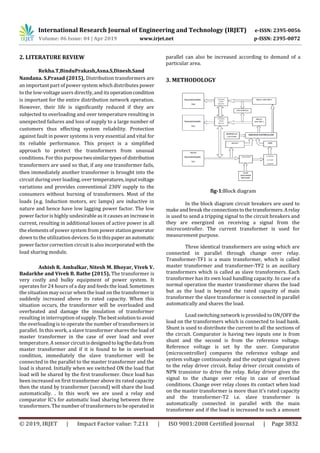
fig-1:Block diagram
In the block diagram circuit breakers are used to
make and break the connectionstothetransformers.Arelay
is used to send a tripping signal to the circuit breakers and
they are energized on receiving a signal from the
microcontroller. The current transformer is used for
measurement purpose.
Three identical transformers are using which are
connected in parallel through change over relay.
Transformer-TF1 is a main transformer, which is called
master transformer and transformer-TF2 is an auxiliary
transformers which is called as slave transformers. Each
transformer has its own load handling capacity. In case of a
normal operation the master transformer shares the load
but as the load is beyond the rated capacity of main
transformer the slave transformer is connected in parallel
automatically and shares the load.
Load switching network is provided to ON/OFFthe
load on the transformers which is connected to load bank.
Shunt is used to distribute the current to all the sections of
the circuit. Comparator is having two inputs one is from
shunt and the second is from the reference voltage.
Reference voltage is set by the user. Comparator
(microcontroller) compares the reference voltage and
system voltage continuously and the output signal is given
to the relay driver circuit. Relay driver circuit consists of
NPN transistor to drive the relay. Relay driver gives the
signal to the change over relay in case of overload
conditions. Change over relay closes its contact when load
on the master transformer is more than it’s rated capacity
and the transformer-T2 i.e. slave transformer is
automatically connected in parallel with the main
transformer and if the load is increased to such a amount
International Research Journal of Engineering and Technology (IRJET) e-ISSN: 2395-0056
Volume: 06 Issue: 04 | Apr 2019 www.irjet.net p-ISSN: 2395-0072
© 2019, IRJET | Impact Factor value: 7.211 | ISO 9001:2008 Certified Journal | Page 3833
that can’t be handled with the two transformers then the
third transformer T3 is automatically connected in parallel
with T1 & T2 and shares the load. Due to which the
transformer-T1 is not overloaded and the problem like
overheating, burning of winding of transformer and un-
interruption of supply is gets eliminated by this
arrangement. The visual indicator containstheLED‟swhich
shows the ON/OFF status of the all transformers.
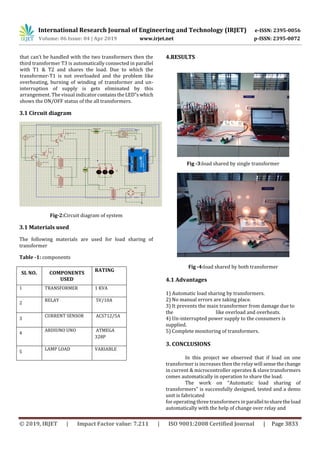
3.1 Circuit diagram
Fig-2:Circuit diagram of system
3.1 Materials used
The following materials are used for load sharing of
transformer
Table -1: components
SL NO. COMPONENTS
USED
RATING
1 TRANSFORMER 1 KVA
2
RELAY 5V/10A
3
CURRENT SENSOR ACS712/5A
4
ARDIUNO UNO ATMEGA
328P
5
LAMP LOAD VARIABLE
4.RESULTS
Fig -3:load shared by single transformer
Fig -4:load shared by both transformer
4.1 Advantages
1) Automatic load sharing by transformers.
2) No manual errors are taking place.
3) It prevents the main transformer from damage due to
the like overload and overheats.
4) Un-interrupted power supply to the consumers is
supplied.
5) Complete monitoring of transformers.
3. CONCLUSIONS
In this project we observed that if load on one
transformer is increases then the relay will sensethechange
in current & microcontroller operates & slave transformers
comes automatically in operation to share the load.
The work on “Automatic load sharing of
transformers” is successfully designed, tested and a demo
unit is fabricated
for operating three transformers in parallel tosharetheload
automatically with the help of change over relay and
International Research Journal of Engineering and Technology (IRJET) e-ISSN: 2395-0056
Volume: 06 Issue: 04 | Apr 2019 www.irjet.net p-ISSN: 2395-0072
© 2019, IRJET | Impact Factor value: 7.211 | ISO 9001:2008 Certified Journal | Page 3834
relay driver circuit and also to protect the transformers
from overloading and thus providing an uninterrupted
power
supply to the customers.
ACKNOWLEDGEMENT
We consider it as a privilege to articulate a few words of
gratitude and respect to all those deserving individuals who
guided us in this project. First andforemost, we wouldliketo
extend our profound gratitude and our sincerethanksto our
guide Altaf M. professor, Department of Electrical and
Electronis Engineering,AnjumanInstituteofTechnologyand
Management(AITM),Bhatkal,whoconstantlysupportedand
encouraged us during every step of dissertation. We really
feel highly indebted to him for constantly guiding us to
continue our work and giving us short term goals.
We are thankful to our project coordinator, Iqbal Ahmed,
Professor, Department of Electrical and Electronics
Engineering, AITM, Bhatkal for his immense support
throughout this project.
We take this opportunity to thank Dr.M.A. Bhavikatti,
Principal, AITM, Bhatkal for his encouragement and useful
suggestions to pursue this work.
REFERENCES
[1]. Dr.J.B.V. Subrahmanyam, T.C. Subramanyam,
T.C.Srinivasarao,M.Kalavani and HarithaInavolu,
“Auto Control of a Standby Transformer Using
Microcontroller”, International Journal ofAdvances
In Engineering Research, Vol. 2, Issue 5, pp. 1199-
1204, 2011.
[2]. S.R.Balan, P.Sivanesan, R.Ramprakash,
B.Ananthakannan and K.MithinSubash,“GSMBased
Automatic Substation LoadShedding and Sharing
Using Programmable Switching Control”,Journal of
Selected Areas in Microelectronics, Volume6,Issue
2, pp. 59-61, 2014.
[3]. Ashish R. Ambalkar, Nitesh M. Bhoyar, Vivek V.
Badarkhe and Vivek B. Bathe, “Automatic Load
Sharing of Transformers”, International Journal for
Scientific Research&Development,Volume2,Issue
12, pp. 739-741,2015.
[4]. Rekha.T,BinduPrakash, Asna. S, Dinesh.S and
Nandana.S.Prasad, “An Intelligent Method for Load
Sharing of Transformers With Temperature
Monitoring and Automatic Correction of Power
Factor”, International Journal Of Engineering
Sciences & Research Technology, Volume 4,
Issue3, pp. 416-421, 2015.
[5]. Hassan Abniki, H.Afsharirad, A.Mohseni, F.
Khoshkhati, Has-san Monsef, PouryaSahmsi
„Effective On-line Parameters for Transformer
Monitoring and Protection‟, on Northern American
Power Symposium(NAPS),pp1-5,September2010.
[6]. Tong Xiaoyang, Wu Guanging, Zhang Guangehun,
Tan Yong-dong „A Transformer Online Monitoring
and Diagnosis Em-bedded System Based on TCP/IP
and Pub/Sub New Technology‟, on Properties and
Applications of Dielectric Materials, vol 1, pp 467-
470, June2003.
[7]. Saied M.M., Fetih Nabil H,El-Shewy, Hamed M.,
"Optimal Expansion of Transformer Substations, "
Power Engineering Review,IEEE,vol.-2,pp.30,Nov.
1982.
[8]. S.V.kulkarni & S.A Khaparde, Transformer Energy
Design And Practical, Crc Press2004,Edition -2004,
PP-32-33.

IRJET- Load Sharing of Transformer using Microcontroller

  • 1.
    International Research Journalof Engineering and Technology (IRJET) e-ISSN: 2395-0056 Volume: 06 Issue: 04 | Apr 2019 www.irjet.net p-ISSN: 2395-0072 © 2019, IRJET | Impact Factor value: 7.211 | ISO 9001:2008 Certified Journal | Page 3831 Load sharing of Transformer using Microcontroller K V Shashankkumar1, Raghavendra Naik2, Naresh Nayak3, Prof.Altaf Mudhol4 1,2,3,Anjuman Institute of Technology and Management (AITM), Bhatkal 4professor,Department of Electrical and Electronics engineering (AITM),Bhatkal ---------------------------------------------------------------------***--------------------------------------------------------------------- Abstract - The transformerisastaticdevice, whichconverts power from one level to another level. The aim of the project is to protect the transformer under overload condition by load sharing. Due to overload on transformer, the efficiency drops and windings get overheated and may get burnt. Thus by sharing load on transformer, the transformer is protected. This will be done by connecting another transformer in parallel through a micro-controller. The microcontroller compares the load on the first transformer with a reference value. When the load exceeds the reference value, the second transformer will share the extra load. Therefore, the two transformer work efficiently and damage is prevented. In this project three modules are used to control the load currents. The first module is a sensing unit, which is used to sense the current of the load and the second module is a control unit. The last module is microcontroller unit and it will read the analogue signal and perform some calculation and finally gives control signal to a relay. The advantages of the project are transformer protection, uninterrupted power supply, and short circuit protection. When designing low-voltage power system to the supply large load currents, paralleled lower- current modules are often preferred over asingle, large power converter for several reasons. These include the efficiency of designing and manufacturing standard modular converters which can be combined in any number necessary to meet a given load requirement and the enhanced reliability gained through redundancy. KEYWORDS: Capacity, Interruption, Load; System, Transformer, Microcontroller. 1.INTRODUCTION Power travels from the power plant to house through an amazing system called the power distribution grid. For power to be useful in a home or business, it comes off the transmission grid and is stepped-down to the distribution grid. This may happen in several phases.The placewhere the conversion from "transmission" to"distribution" occursisin a power substation. It has transformers that step transmission voltages (in the tens or hundreds of thousands of volts range) down to distribution voltages (typically less than 10,000 volts). It has a “bus” that can split the distribution power off in multiple directions. It often has circuit breakers and switches so that the substation can be disconnected from the transmission grid or separate distribution lines can be disconnected from the substation when necessary.5 8 Transformers being one of the mostsignificant equipment in the electric power system, needs protection as a part of the general system protection approach. Moreover the increasing population and their unavoidable demands have lead to an increasing demand on electrical power. With this increased needs, the existing systems have become overloaded. The overloading at theconsumerendappears at the transformer terminals which can affect its efficiency and protection systems. Due to overload on the transformer, the efficiency drops and the windings gets over heated and may get burnt. It takes a lot of time to repair and involves a lot of expenditure. Transformers are occasionally loaded beyond nameplate ratings becauseof existingpossiblecontingencies on the transmission lines, any failure or fault in power systems, or economic considerations. One of the reported damage or tripping of the distribution transformer is due to thermal overload. To eliminate the damaging of transformers due to overloading from consumer end, it involves the control against over current tripping of distribution transformer. Rise in operating temperature of the transformer due to overloading has an influence on ageing of transformers. The accelerated aging is one of the main consequences of overloading power transformers. Thus load limitations must be implemented to operate the transformerswithinsafelimits.Moreoveronoverloading the transformers voltage regulation may increase and power factor drops. The project is all about protecting the transformer under overload condition. This can be done by connecting another transformer in parallel througha microcontrolleranda relay which shares the excess load of the first transformer. The transformers are switched alternatively to avoid thermal overloading. Therefore, two transformers work efficiently under overload condition and damage can be prevented. If there is a further increase in load beyond the capacityoftwo transformers there will be a priority based load shedding of consumers which will provide un-interruptedpowersupply for the hospitals, industries etc. 1.1 Objectives The main aim of the project is to protect the transformer under overloadconditionbysharingloadwitha standby transformer and to provide un-interrupted power supply to the consumers.
  • 2.
    International Research Journalof Engineering and Technology (IRJET) e-ISSN: 2395-0056 Volume: 06 Issue: 04 | Apr 2019 www.irjet.net p-ISSN: 2395-0072 © 2019, IRJET | Impact Factor value: 7.211 | ISO 9001:2008 Certified Journal | Page 3832 2. LITERATURE REVIEW Rekha.T,BinduPrakash,Asna.S,Dinesh.Sand Nandana. S.Prasad (2015), Distribution transformers are an important part of power system which distributes power to the low-voltage users directly, and its operationcondition is important for the entire distribution network operation. However, their life is significantly reduced if they are subjected to overloading and over temperature resulting in unexpected failures and loss of supply to a large number of customers thus effecting system reliability. Protection against fault in power systems is very essential and vital for its reliable performance. This project is a simplified approach to protect the transformers from unusual conditions. For this purposetwosimilartypesofdistribution transformers are used so that, if any one transformer fails, then immediately another transformer is brought into the circuit during over loading, over temperatures,inputvoltage variations and provides conventional 230V supply to the consumers without burning of transformers. Most of the loads (e.g. Induction motors, arc lamps) are inductive in nature and hence have low lagging power factor. The low power factor is highly undesirable as it causes an increase in current, resulting in additional losses of active power in all the elements of power system from power stationgenerator down to the utilization devices. So in thispaperanautomatic power factor correction circuit is also incorporated with the load sharing module. Ashish R. Ambalkar, Nitesh M. Bhoyar, Vivek V. Badarkhe and Vivek B. Bathe (2015), The transformer is very costly and bulky equipment of power system. It operates for 24 hours of a day and feeds the load.Sometimes the situation may occur when the load on the transformer is suddenly increased above its rated capacity. When this situation occurs, the transformer will be overloaded and overheated and damage the insulation of transformer resulting in interruption of supply.The bestsolutiontoavoid the overloading is to operate the number of transformers in parallel. In this work, a slave transformer shares the load of master transformer in the case of over load and over temperature. A sensor circuitisdesignedtologthedata from master transformer and if it is found to be in overload condition, immediately the slave transformer will be connected in the parallel to the master transformer and the load is shared. Initially when we switched ON the load that load will be shared by the first transformer. Once load has been increased on first transformer above its rated capacity then the stand by transformer (second) will share the load automatically. . In this work we are used a relay and comparator IC’s for automatic load sharing between three transformers. The number of transformers to beoperated in parallel can also be increased according to demand of a particular area. 3. METHODOLOGY fig-1:Block diagram In the block diagram circuit breakers are used to make and break the connectionstothetransformers.Arelay is used to send a tripping signal to the circuit breakers and they are energized on receiving a signal from the microcontroller. The current transformer is used for measurement purpose. Three identical transformers are using which are connected in parallel through change over relay. Transformer-TF1 is a main transformer, which is called master transformer and transformer-TF2 is an auxiliary transformers which is called as slave transformers. Each transformer has its own load handling capacity. In case of a normal operation the master transformer shares the load but as the load is beyond the rated capacity of main transformer the slave transformer is connected in parallel automatically and shares the load. Load switching network is provided to ON/OFFthe load on the transformers which is connected to load bank. Shunt is used to distribute the current to all the sections of the circuit. Comparator is having two inputs one is from shunt and the second is from the reference voltage. Reference voltage is set by the user. Comparator (microcontroller) compares the reference voltage and system voltage continuously and the output signal is given to the relay driver circuit. Relay driver circuit consists of NPN transistor to drive the relay. Relay driver gives the signal to the change over relay in case of overload conditions. Change over relay closes its contact when load on the master transformer is more than it’s rated capacity and the transformer-T2 i.e. slave transformer is automatically connected in parallel with the main transformer and if the load is increased to such a amount
  • 3.
    International Research Journalof Engineering and Technology (IRJET) e-ISSN: 2395-0056 Volume: 06 Issue: 04 | Apr 2019 www.irjet.net p-ISSN: 2395-0072 © 2019, IRJET | Impact Factor value: 7.211 | ISO 9001:2008 Certified Journal | Page 3833 that can’t be handled with the two transformers then the third transformer T3 is automatically connected in parallel with T1 & T2 and shares the load. Due to which the transformer-T1 is not overloaded and the problem like overheating, burning of winding of transformer and un- interruption of supply is gets eliminated by this arrangement. The visual indicator containstheLED‟swhich shows the ON/OFF status of the all transformers. 3.1 Circuit diagram Fig-2:Circuit diagram of system 3.1 Materials used The following materials are used for load sharing of transformer Table -1: components SL NO. COMPONENTS USED RATING 1 TRANSFORMER 1 KVA 2 RELAY 5V/10A 3 CURRENT SENSOR ACS712/5A 4 ARDIUNO UNO ATMEGA 328P 5 LAMP LOAD VARIABLE 4.RESULTS Fig -3:load shared by single transformer Fig -4:load shared by both transformer 4.1 Advantages 1) Automatic load sharing by transformers. 2) No manual errors are taking place. 3) It prevents the main transformer from damage due to the like overload and overheats. 4) Un-interrupted power supply to the consumers is supplied. 5) Complete monitoring of transformers. 3. CONCLUSIONS In this project we observed that if load on one transformer is increases then the relay will sensethechange in current & microcontroller operates & slave transformers comes automatically in operation to share the load. The work on “Automatic load sharing of transformers” is successfully designed, tested and a demo unit is fabricated for operating three transformers in parallel tosharetheload automatically with the help of change over relay and
  • 4.
    International Research Journalof Engineering and Technology (IRJET) e-ISSN: 2395-0056 Volume: 06 Issue: 04 | Apr 2019 www.irjet.net p-ISSN: 2395-0072 © 2019, IRJET | Impact Factor value: 7.211 | ISO 9001:2008 Certified Journal | Page 3834 relay driver circuit and also to protect the transformers from overloading and thus providing an uninterrupted power supply to the customers. ACKNOWLEDGEMENT We consider it as a privilege to articulate a few words of gratitude and respect to all those deserving individuals who guided us in this project. First andforemost, we wouldliketo extend our profound gratitude and our sincerethanksto our guide Altaf M. professor, Department of Electrical and Electronis Engineering,AnjumanInstituteofTechnologyand Management(AITM),Bhatkal,whoconstantlysupportedand encouraged us during every step of dissertation. We really feel highly indebted to him for constantly guiding us to continue our work and giving us short term goals. We are thankful to our project coordinator, Iqbal Ahmed, Professor, Department of Electrical and Electronics Engineering, AITM, Bhatkal for his immense support throughout this project. We take this opportunity to thank Dr.M.A. Bhavikatti, Principal, AITM, Bhatkal for his encouragement and useful suggestions to pursue this work. REFERENCES [1]. Dr.J.B.V. Subrahmanyam, T.C. Subramanyam, T.C.Srinivasarao,M.Kalavani and HarithaInavolu, “Auto Control of a Standby Transformer Using Microcontroller”, International Journal ofAdvances In Engineering Research, Vol. 2, Issue 5, pp. 1199- 1204, 2011. [2]. S.R.Balan, P.Sivanesan, R.Ramprakash, B.Ananthakannan and K.MithinSubash,“GSMBased Automatic Substation LoadShedding and Sharing Using Programmable Switching Control”,Journal of Selected Areas in Microelectronics, Volume6,Issue 2, pp. 59-61, 2014. [3]. Ashish R. Ambalkar, Nitesh M. Bhoyar, Vivek V. Badarkhe and Vivek B. Bathe, “Automatic Load Sharing of Transformers”, International Journal for Scientific Research&Development,Volume2,Issue 12, pp. 739-741,2015. [4]. Rekha.T,BinduPrakash, Asna. S, Dinesh.S and Nandana.S.Prasad, “An Intelligent Method for Load Sharing of Transformers With Temperature Monitoring and Automatic Correction of Power Factor”, International Journal Of Engineering Sciences & Research Technology, Volume 4, Issue3, pp. 416-421, 2015. [5]. Hassan Abniki, H.Afsharirad, A.Mohseni, F. Khoshkhati, Has-san Monsef, PouryaSahmsi „Effective On-line Parameters for Transformer Monitoring and Protection‟, on Northern American Power Symposium(NAPS),pp1-5,September2010. [6]. Tong Xiaoyang, Wu Guanging, Zhang Guangehun, Tan Yong-dong „A Transformer Online Monitoring and Diagnosis Em-bedded System Based on TCP/IP and Pub/Sub New Technology‟, on Properties and Applications of Dielectric Materials, vol 1, pp 467- 470, June2003. [7]. Saied M.M., Fetih Nabil H,El-Shewy, Hamed M., "Optimal Expansion of Transformer Substations, " Power Engineering Review,IEEE,vol.-2,pp.30,Nov. 1982. [8]. S.V.kulkarni & S.A Khaparde, Transformer Energy Design And Practical, Crc Press2004,Edition -2004, PP-32-33.