Power Line Carrier Communication
(PLCC)

Submitted By:
Er. Vishwesh Kumar Sharma
PLCC Technology


PLCC system uses the same High Voltage transmission line connecting
two sub-stations for telecommunication purpose too.



PLCC is used in all power utilities as a primary communication service to
transmit speech, telemetry and protection tripping commands. This is
economic and reliable for inter grid message transfer as well as low bit
rate RTU signals.



The voice/data are mixed with radio frequency carrier (40-500kHz),
amplified to a level of 10-80W RF power and injected in to high voltage
power line using a suitable coupling capacitor. The power line as a rigid
long conductor parallel to ground, guides the carrier waves to travel along

the transmission line. Point to point communication takes place between
two SSB transceivers at both ends.
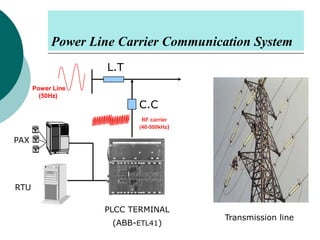
Power Line Carrier Communication System
L.T
Power Line
(50Hz)

C.C
RF carrier
(40-500kHz)

PAX

RTU
PLCC TERMINAL
(ABB-ETL41)

Transmission line
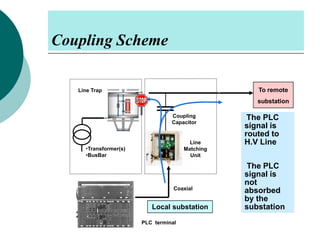
Coupling Scheme
To remote

Line Trap

substation
Coupling
Capacitor

Line
Matching
Unit

•Transformer(s)
•BusBar

Coaxial

Local substation
PLC terminal

The PLC
signal is
routed to
H.V Line
The PLC
signal is
not
absorbed
by the
substation
Components
PLCC Terminal = Translates Voice and data into High Frequency Carrier. Output
Power =10 to 80W
LMU = Line Matching Unit = For impedance matching between line and coaxial
cable, includes high voltage protection devices like drainage coil(20mH), lightening
arrestor(500V) and an earth switch.
Coupling Capacitor (C.C) = Couples high frequency carrier with Power Line (
4000 to10000pF)
Line Trap (L.T) = Do not allow the transmitted HF carrier to enter inside the substation. (L = 0.5 to 2mH) With out Line trap HF carrier get by- passed to some
other line on the same bus bar and may leak to ground ( a earth switch inside the
yard provided for each bay is kept closed during maintenance)
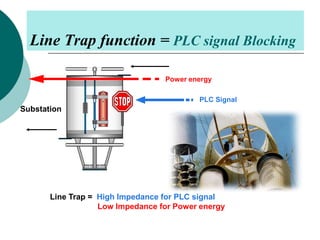
Line Trap function = PLC signal Blocking
Power energy
PLC Signal

Substation

Line Trap = High Impedance for PLC signal
Low Impedance for Power energy
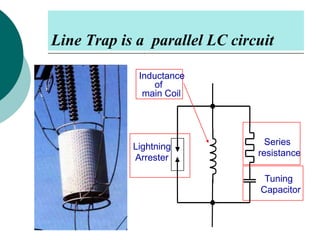
Line Trap is a parallel LC circuit
Inductance
of
main Coil

Lightning
Arrester

Series
resistance

Tuning
Capacitor
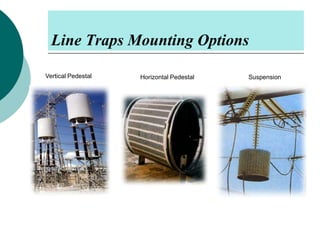
Line Traps Mounting Options
Vertical Pedestal

Horizontal Pedestal

Suspension
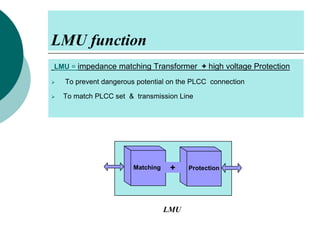
LMU function
LMU = impedance matching Transformer + high voltage Protection



To prevent dangerous potential on the PLCC connection
To match PLCC set & transmission Line

Matching

+

LMU

Protection
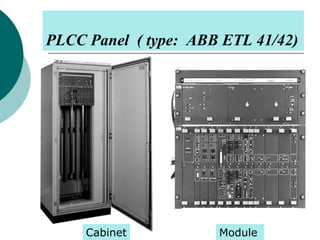
PLCC Panel ( type: ABB ETL 41/42)

Cabinet

Module
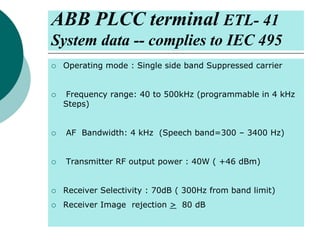
ABB PLCC terminal ETL- 41
System data -- complies to IEC 495




Operating mode : Single side band Suppressed carrier
Frequency range: 40 to 500kHz (programmable in 4 kHz
Steps)



AF Bandwidth: 4 kHz (Speech band=300 – 3400 Hz)



Transmitter RF output power : 40W ( +46 dBm)



Receiver Selectivity : 70dB ( 300Hz from band limit)



Receiver Image rejection > 80 dB
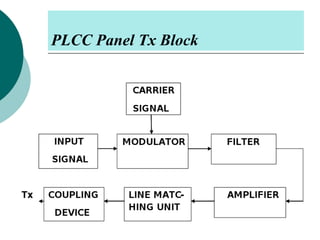
PLCC Panel Tx Block
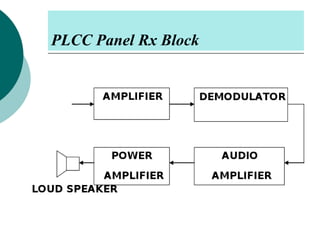
PLCC Panel Rx Block
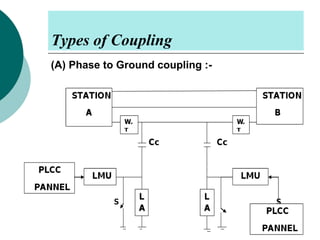
Types of Coupling
(A) Phase to Ground coupling :-
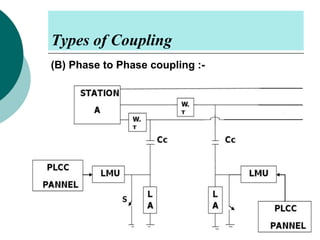
Types of Coupling
(B) Phase to Phase coupling :-
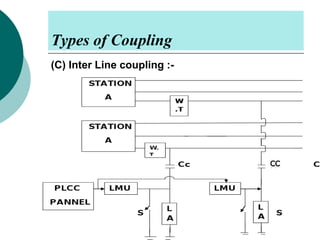
Types of Coupling
(C) Inter Line coupling :-
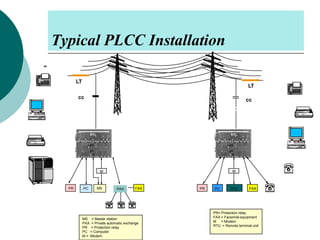
Typical PLCC Installation
LT

LT

cc

cc
C
FAX

ETL

ETL

FAX

M

M

PR

PC

MS

PAX

FAX

MS = Master station
PAX = Private automatic exchange
PR = Protection relay
PC = Computer
M = Modem

PR

PC

RTU

FAX

PR= Protection relay
FAX = Facsimile equipment
M = Modem
RTU = Remote terminal unit
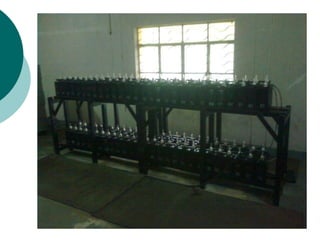
Batteries
•

PLCC work on rectified AC or main supply, when supply
goes off, we make use of a device for proper functioning of
PLCC called battery charger.

•

This is the device that provide supply to the PLCC
equipment for uninterrupted working.

•

It provide DC to the panel by battery.
Advantages






No separate wires are needed for communication
purposes, as the power lines themselves carry power as
well as communication signals. Hence the cost is less.
Power lines have appreciably higher mechanical strength
compared with ordinary lines. They would normally remain
unaffected under the conditions, which might seriously
damage telephone lines.
Power lines usually provide the shortest route between
the power stations.
Advantages






Power lines have large cross-sectional area resulting in
very low resistance per unit length. Consequently carrier
signals suffer much less attenuation than when they travel
on telephone lines of equal lengths.
Power lines are well insulated to provide only negligible
leakage between conductors and ground even in adverse
weather conditions
Largest spacing between conductors reduces
capacitance, which results in smaller attenuation at high
frequencies. The large spacing also reduces the cross talk
to a considerable extent.
Disadvantages




Proper care has to be taken to guard carrier equipment
and persons using them against high voltages and
currents on the lines.

Noise introduced by power lines is far more than in case
of telephone lines. This is due to the noise generated by
discharge across insulators, switching processes.
Power line carrier communication (plcc)

Power line carrier communication (plcc)

  • 1.
    Power Line CarrierCommunication (PLCC) Submitted By: Er. Vishwesh Kumar Sharma
  • 2.
    PLCC Technology  PLCC systemuses the same High Voltage transmission line connecting two sub-stations for telecommunication purpose too.  PLCC is used in all power utilities as a primary communication service to transmit speech, telemetry and protection tripping commands. This is economic and reliable for inter grid message transfer as well as low bit rate RTU signals.  The voice/data are mixed with radio frequency carrier (40-500kHz), amplified to a level of 10-80W RF power and injected in to high voltage power line using a suitable coupling capacitor. The power line as a rigid long conductor parallel to ground, guides the carrier waves to travel along the transmission line. Point to point communication takes place between two SSB transceivers at both ends.
  • 3.
    Power Line CarrierCommunication System L.T Power Line (50Hz) C.C RF carrier (40-500kHz) PAX RTU PLCC TERMINAL (ABB-ETL41) Transmission line
  • 4.
    Coupling Scheme To remote LineTrap substation Coupling Capacitor Line Matching Unit •Transformer(s) •BusBar Coaxial Local substation PLC terminal The PLC signal is routed to H.V Line The PLC signal is not absorbed by the substation
  • 5.
    Components PLCC Terminal =Translates Voice and data into High Frequency Carrier. Output Power =10 to 80W LMU = Line Matching Unit = For impedance matching between line and coaxial cable, includes high voltage protection devices like drainage coil(20mH), lightening arrestor(500V) and an earth switch. Coupling Capacitor (C.C) = Couples high frequency carrier with Power Line ( 4000 to10000pF) Line Trap (L.T) = Do not allow the transmitted HF carrier to enter inside the substation. (L = 0.5 to 2mH) With out Line trap HF carrier get by- passed to some other line on the same bus bar and may leak to ground ( a earth switch inside the yard provided for each bay is kept closed during maintenance)
  • 6.
    Line Trap function= PLC signal Blocking Power energy PLC Signal Substation Line Trap = High Impedance for PLC signal Low Impedance for Power energy
  • 7.
    Line Trap isa parallel LC circuit Inductance of main Coil Lightning Arrester Series resistance Tuning Capacitor
  • 8.
    Line Traps MountingOptions Vertical Pedestal Horizontal Pedestal Suspension
  • 9.
    LMU function LMU =impedance matching Transformer + high voltage Protection   To prevent dangerous potential on the PLCC connection To match PLCC set & transmission Line Matching + LMU Protection
  • 10.
    PLCC Panel (type: ABB ETL 41/42) Cabinet Module
  • 11.
    ABB PLCC terminalETL- 41 System data -- complies to IEC 495   Operating mode : Single side band Suppressed carrier Frequency range: 40 to 500kHz (programmable in 4 kHz Steps)  AF Bandwidth: 4 kHz (Speech band=300 – 3400 Hz)  Transmitter RF output power : 40W ( +46 dBm)  Receiver Selectivity : 70dB ( 300Hz from band limit)  Receiver Image rejection > 80 dB
  • 12.
  • 13.
  • 14.
    Types of Coupling (A)Phase to Ground coupling :-
  • 15.
    Types of Coupling (B)Phase to Phase coupling :-
  • 16.
    Types of Coupling (C)Inter Line coupling :-
  • 17.
    Typical PLCC Installation LT LT cc cc C FAX ETL ETL FAX M M PR PC MS PAX FAX MS= Master station PAX = Private automatic exchange PR = Protection relay PC = Computer M = Modem PR PC RTU FAX PR= Protection relay FAX = Facsimile equipment M = Modem RTU = Remote terminal unit
  • 18.
    Batteries • PLCC work onrectified AC or main supply, when supply goes off, we make use of a device for proper functioning of PLCC called battery charger. • This is the device that provide supply to the PLCC equipment for uninterrupted working. • It provide DC to the panel by battery.
  • 20.
    Advantages    No separate wiresare needed for communication purposes, as the power lines themselves carry power as well as communication signals. Hence the cost is less. Power lines have appreciably higher mechanical strength compared with ordinary lines. They would normally remain unaffected under the conditions, which might seriously damage telephone lines. Power lines usually provide the shortest route between the power stations.
  • 21.
    Advantages    Power lines havelarge cross-sectional area resulting in very low resistance per unit length. Consequently carrier signals suffer much less attenuation than when they travel on telephone lines of equal lengths. Power lines are well insulated to provide only negligible leakage between conductors and ground even in adverse weather conditions Largest spacing between conductors reduces capacitance, which results in smaller attenuation at high frequencies. The large spacing also reduces the cross talk to a considerable extent.
  • 22.
    Disadvantages   Proper care hasto be taken to guard carrier equipment and persons using them against high voltages and currents on the lines. Noise introduced by power lines is far more than in case of telephone lines. This is due to the noise generated by discharge across insulators, switching processes.